




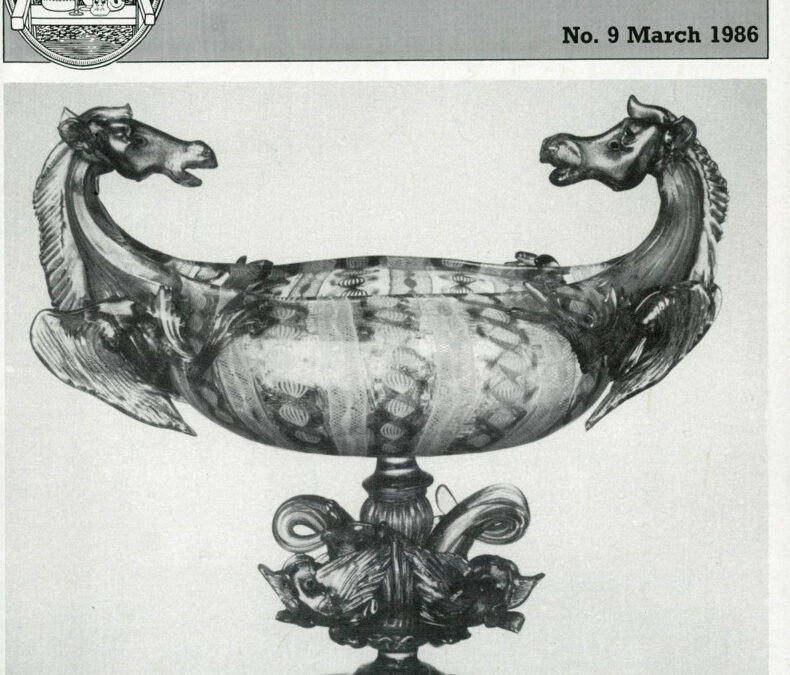
Examples of this type of glass –
such as the flamboyant “Convolvulus
Vase”, produced in the late 19thc,
have been borrowed from the
Broadfield House
Glass
Museum,
Kingswinford.
Prominent displays of 19thc
Venetian glass include a chandelier
from the Castle Museum,
Nottingham which is being restored
and reassembled especially for the
exhibition. A bowl produced by the
Salviati Company displays another
facet of Venetian imagination. Two
sea-green winged horses rise from
the body of the bowl, which is
formed in the retorti technique with
aventurine added, and is supported
by a stem with applied dolphins.
The bowl still retains the Company’s
label and the price, £3.3.0; it was
bought by Blackburn Museum and
Art Gallery, probably in the 1880s.
Other exhibits come from a number
of museums and galleries
throughout the country including
lesser known collections such as
Manchester Polytechnic and
Wightwick Manor, West Midlands.
The exhibition is a unique
opportunity to see a wide range of
English and Venetian glass of the
19thc. It has been organised by the
Postgraduate Course in Art Gallery
and Museum Studies, University of
Manchester. An illustrated
catalogue will be available from the
Whitworth Art Gallery.
14th March — 10th May
Monday — Saturday, 10 a. m. – 5 p.m.
(Thursday 10 a.m. – 9 p.m.)
KINGSWINFORD
BROADFIELD HOUSE GLASS
MUSEUM
BARNETT LANE
Jobling 1930s Decorative Glass
11th March — 20th April
Tuesday — Friday, 2-5 p.m.;
Saturday, 10 am. – 1 p.m., 2-5 p.m.
Sunday, 2-5 p.m.
LONDON
ASPECTS GALLERY
3-5 WHITFIELD STREET
Six Landscapes in Glass
Wendy Ramshaw is Britain’s
premier jeweller in precious metals.
Her diverse interests prompted
Martin Hunt of the Royal College of
Art
Glass
Department, to invite her
to take a year’s residency to explore
the medium
of glass as a decorative
and wearable object. Funding was
assisted by the Crafts Council. The
outstanding results of this
exploration form this exhibition.
Balanced between the wearable
and the sculptural, these works
appeal to the utilitarian and the
abstract Collector. The six
landscapes include three
necklaces, the classic, the
geometric and the shard, a helmet, a
collection of pins and a jewellery
box. The Pin Landscape and the
Jewellery Box can be dismantled to
be worn as individual items or can
be viewed complete as glass
sculptures. Although it is unlikely
that Wendy Ramshaw will work in
glass after this residency, the
experience has added a richness to
her palette and resulted in a
significant contribution to ideas on
glass as a decorative medium.
1st — 6th April
Monday — Saturday, 9 am. – 5 p.m.
ELLASTONE
DERBYSHIRE
YEW TREE GALLERY
“Light Fantastic”
Ban
–
y Cullen — hot and cold glass
with porcelain by Barry Guppy,
Derek Clarkson, David Morris and
paintings on glass by
Frances
Alcock.
8th April
—
18th May
()
) LOCe,
The newsletter of the
Glass Association
Registered as a Charity No. 326602
Chairman:
Anthony Waugh
Hon. Secretary:
Roger Dodsworth
Editor:
Charles Ha)clamach
Address for correspondence:
Broadfield House Glass Museum.
Barnett Lane, Kingswinford,
West Midlands DY6 9QA
Tel 0384 273011
ISSN 0265 9654
Printed by Jones & Palmer Ltd., Birmingham
Cover Illustration
Bowl, latticimb and aventurine, by
Salviati & Co. c1865 — 1880
Collection of Blackburn Museum
and Art Gallery.
One of the star attractions at the
Venetian glass exhibition in
Manchester.
SPONSOR
This issue is published with the aid
of a financial contribution from the
Broadfield House Glass Museum.
Review of the first issue of
`Ceramics’
The much-awaited first issue of
‘Ceramics’, or to give it its subsidiary
title, ‘The International Journal of
Ceramics and Glass’ is now with us
and may be acquired on a
subscription basis published
bi-monthly (6 issues £36; 12 issues
£64; 18 issues £86). In their foreword
the publishers announce that they
“have long been aware of the need
for a specialist magazine in the
English language which caters for
the interest of academics,
collectors, dealers and enthusiasts
throughout the world. Each edition
will feature a particular area of
interest, such as English pottery and
porcelain, European pottery and
porcelain, Oriental ceramics and
glass, while other fields such as
Islamic pottery, Victorian and late
ceramics, studio pottery or
architectural ceramics will also be
covered from time to time”.
The Editor, editorial board and
contributors to the first issue are all
(continued on page 8)
Exhibitions
MANCHESTER
WHITWORTH
ART GALLERY
OXFORD ROAD
Reflections of Venice
The influence of Venetian Glass in
Victorian England 1840-1900.
The 19thc saw a revival of interest in
early Venetian glass in England.
Manufacturers, such as James
Powell of Whitefriars, were
influenced by the 17thc Venetian
originals. Powell produced
table-services in a clear green
glass
reminiscent of the coloured glass of
Venice. His delicate, thinly blown
table-services imitate the
hand-made products of Venice and
provide a contrast to some of the
highly decorated Victorian glass on
display.
Although glass-makers of the Arts
and Crafts movement, like Powell,
emphasised the outline and
proportion of the Venetian originals,
the majority of factories catered for
popular taste by developing pieces
of
highly ornamental glass.
Glass Blowing
From Scenes of
British
Wealth,
in Produce,
Manufactures
and
Commerce,
1825
wca se
The Working Class Movement Library
In their semi-detached house in
Manchester, Edmund and Ruth
Frow have collected over 10,000
books and pamphlets which form
The Working Class Movement
Library. The library represents the
fruit of over thirty years’ collecting.
The Frows spent every holiday
travelling the country in search of
material on the themes of social
reform, the labour movement,
working conditions and feminism.
Since their retirements they have
devoted themselves to the care of
the library, and their love and
enthusiasm for the collection is
reflected in the welcome they give
visitors and the trouble they take to
uncover just what is of interest to
each one from the shelves of books
which line every room. It is a
pleasant experience to visit the
library, (how many library users are
brought cups of coffee by the
librarian as they work at a table in
the corner of his bedroom?) and I
spent a happy day finding out what
books of interest to Glass
Association members are included
in the collection.
A book which would be of great
interest to those studying working
conditions of glass makers is
Abstract Reports & Minutes of the
National Conference of the Glass
Bottle Makers 1893-5,
which covers
wages, terms and conditions of work
and reports of the lockout and strike
in Yorkshire, Lancashire and Dublin
in 1893. This bitter industrial dispute
was caused by a reduction of 3/- per
week in wages, unacceptable work
sharing, unacceptable numbers of
apprentices being taken into the
industry at the expense of
experienced men, and the lack of
quality control on the marbles used
in bottles leading to breakages and
loss of earnings by men paid by
results. Of the 3,300 unionised
journeymen bottle makers and over
400 apprentices only 50 remained at
work at the height of the strike which
Interior of an
Edinburgh
Glasshouse.
From
The Book
of Trades, or
Circle of Useful
Arts,
1841.
lasted 16 weeks in Yorkshire
The
struggle was successful but victory
was hard won, “The result has been
bought at great cost and sacrifice of
domestic comfort, and many empty
stomachs and aching hearts, for
which the manufacturers must for
ever be held responsible
Of
course they ignore and repudiate
this charge and attach the blame
and responsibility to the men, and
especially ‘their leaders’.”
Many books of trades were written
in the late 18th and early 19th
centuries. A number were written
for children and young people,
sometimes in order to give them
guidelines about possible trades in
adult life, but more often as text
books for geography and general
knowledge.
Scenes of British
Wealth, in Produce, Manufactures
and Commerce
was written by the
Rev. I. Taylor in 1825 “for the
Amusement and Instruction of Little
Tarry-at-Home Travellers” and is
peppered with hints on good
behaviour and the proper respect
due to adults which would cause
hilarity among today’s children. The
book takes the form of an account of
a journey around the British Isles
A Glass
Blower. From
The Book of
Trades, or
Library of the
Useful Arts,
1806
taken by two children and their
parents. Papa, in spite of being a
gentleman with no visible
occupation of his own, has an
encyclopaedic knowledge of every
trade and industry including paper
making, cotton weaving, watch
making, japanning and, of course,
glass making. In Newcastle the
family visit one of the sixteen
glasshouses reported to be in
production, and watch glass
blowers at work. In another part of
the
glass
house crown glass for
windows is being made, and at
another plate glass for mirrors. Papa
takes the opportunity to remind his
daughter that only little girls whose
faces had not been spoilt by
“crossness, or vulgar habits” would
see
pretty reflections.
The Book of Trades, or Circle of the
Useful Arts
was published in 1841 as
a text book for the High School of
Glasgow. Its chapter on
glassmaking is illustrated with an
engraving of the interior of a glass
house at Edinburgh with the glass
blowers at various stages of making
a vessel. The descriptions of glass
making processes are as clearly
explained as would be expected in
a text book. Even more detailed is
the information given in
The Useful
Arts and Manufactures of Great
Britain
published by the Society for
Promoting Christian Knowledge
in1848. The anonymous author
describes a visit to the Falcon
Glassworks where “through the
kindness of Mr Pellatt” he was able
to watch workmen “setting a new
pot”, that is replacing a cracked
melting pot with a new one.
Twenty-four men were engaged in
the task, working two or three at a
time. The old pot had become fused
to the floor of the furnace and had to
be broken free with crow bars.
Then, working in the terrible heat
radiating from the opening in the
furnace wall, the men had to
prepare the floor for the new pot” …
for this purpose the most fire-proof
workman was selected; he was
furnished with a kind of shovel, with
a handle fourteen or fifteen feet long,
resting on a roller … A number of
men stood by, each holding a large
kneaded piece of fire-clay — one of
them, as he was directed went up to
the mouth of the opening, and
placing his piece of clay on the
shovel quickly retreated. The clay
was deposited on the bed of the
furnace, and worked quickly with
the spade; and thus piece after
piece was deposited until a
tolerably even bed was produced.”
The new pot was then brought from
the annealing oven and
crow-barred into place. After the
opening was closed with bricks and
clay it was ready to be loaded with
frit.
The materials for making flint glass
required to be heated for at least
forty-eight hours before it was ready
for working. For this reason the
working week was organised with
men working round the clock in six
hour shifts from Monday to
Thursday. On Friday the pots were
refilled and the fire was built up over
the weekend so that the metal was
ready for Monday. “It is to be
regretted that the long-continued
application of heat to the glass-pots
renders it necessary to employ
some of the men on Sunday; but as
the whole of their duty on that day is
simply to watch the furnace, it is so
arranged that the attendance of
each workman one Sunday in four is
all that is required.”
The account of the glass making
processes continues with a
description of bottle making; using a
two-piece mould each bottle took,
we are told, about one minute to
make. The writer also describes the
manufacture of crown glass for
windows. The finished disks of glass
weighed ten or eleven pounds and
were four or five feet in diameter.
Forming a
Glass Vessel.
From British
Manufactures,
by George
Dodd, 1845.
The Glass
Engraver at
Work. From
British
Manufactures,
by George
Dodd, 1845
They were of uniform thickness
except for the “bull’s eye” in the
centre and were sold in crates of
twelve disks.
The manufacture of plate glass is
also described in some detail. The
glass was specially prepared to
minimise bubbles which could flaw
the finished product. When judged
to
be ready it was “poured out or cast
upon tables with perfectly smooth
and level metallic surfaces. The
British Plate Glass Company make
use of an iron table, or plate of
cast-iron, fifteen feet long, nine
wide, and six inches thick. Its weight
is
nearly fourteen tons, it is
supported on castors, and moved
about to the mouths of the different
annealing ovens as the occasion
requires”. The glass was rolled out
with large copper rollers which
extended across the table. Plate
glass was annealed for fifteen days
before being polished with oxide of
iron and water, applied with a
woollen cushion.
The author did not restrict his
concern for the well-being of the
workmen to their Sunday working.
But he believed that the work was
not as unhealthy as might appear to
the outside observer, “the high
temperatures to which the glass
workers are accustomed, does not
appear to have a very injurious
effect … They are subject to coughs
and colds, and in warm weather
describe their work as ‘very
weakening’. But they seem to be
cheerful and contented in their
work; and, when temperate in their
habits, attain the usual age of man.
Many of them are, however,
unfortunately addicted to drinking.
Mr Thacicrah says that individuals
among the most intemperate are
known to take, sometimes, as much
as
two gallons of beer in the day. ‘A
practice like this, though probably
less
injurious than in occupations
where the heat is moderate,
produces disorder of the digestive
organs.’ With the exceptions arising
from
this habit, the men are in good
health”.
George Dodd wrote very
informatively about glassmaking in
his
‘British Manufactures’
(1845) and
in
‘Days at the Factories’
(1843). The
other books I have mentioned are
solely concerned with the
techniques and skills of the
glassmakers but in discussing the
work of the glass engraver Dodd
writes, “This is strictly a branch of
the Fine Arts, and as such places the
engraver on a different level from
the other workmen.” He also makes
reference to the attempts to “diffuse
among workmen a more extensive
knowledge of the Arts of Design”. In
his description of a day at a flint glass
factory Dodd describes decorative
techniques including engraving,
cutting (including of cased glass)
and the method of making sulphides
patented by Apsley Pellatt. “A
medallion or bas-relief,
representing any device whatever,
is moulded in a peculiar kind of clay
capable of resisting the heat of
melted glass; and the medallion is
enclosed between two pieces of soft
glass, or else is introduced into a
cavity in the glass, from whence the
air is afterwards extracted… When finished… the appearance of the
imbedded medallion is singularly
chaste and elegant.” One feature of
Dodd’s day at the factory remains
familiar, “We terminate our visit by a
glance at the elegant show-room”.
The library also holds material on
William Morris.
The library, which is at 1 1 1 Kings
Road, Old Trafford, Manchester
M16 9NU (tel. 061-881 9269) is open
daily. As the library is run from the
Frows’ home and space is limited it
is advisable to make a prior
appointment. A Trust Fund to ensure
the future of the library has been set
up and details are available from
Edmund Frow.
Alexandra Walker
The studio glass department of
Royal Brierley Crystal, known as the
Foundry, is an exciting new venture
in the Stourbridge glass industry.
Here, Arlon Bayliss, the consultant
adviser for the project describes the
ideas behind the project and his
hopes for the future.
“In early February 1985 I was asked
by David Williams-Thomas,
Managing Director of Royal Brierley
Crystal, if I thought it would be a
good idea for his factory to build a
studio specifically to be used by
Studio Glass Artists. I was extremely
enthusiastic, saying I believed the
studio would be of enormous benefit
to all concerned. I was later asked if
I would like to advise and assist in
the setting up and running of the
workshop and I eagerly accepted.
Work began earnestly with
extensive modifications and .
building to create ‘The Foundry’
workshop and neighbouring factory
shop on the site of the old ‘Dudley
Foundry’, (conveniently opposite
Royal Brierley’s factory in North
Street). Interiors and exteriors were
re-modelled, re-painted,
re-concreted and re-glazed. It was a
glorious transformation.
We had decided that the Studio
would be best run by two resident
Glass Artists with the aims of
founding and operating a
commercially successful Craft Glass
Workshop, producing a high
standard of work. Some ideas,
hopefully, would spin off into the
main stream of Royal Brierley’s
product lines. The resident Artists
would also be responsible for
ensuring that all equipment worked
well for any visiting Artists.
A Workshop week-end’ was
arranged to interview short-listed
candidates. They brought work with
them as well as making pieces and
assisting each other in the Foundry
over two days. Jane Beebe and Jill
Devine were appointed.
By this time the Studio was
complete; 2000 sq. ft., well lit and
well equipped. The furnace, which
was built by Stourbridge College
Glass Department contains a
silliminite crucible of 200 lb.
capacity, is fired by fully
proportional controlled natural gas
and governed by computer. The
annealling oven is also computer
controlled and there is
comprehensive cutting and
polishing machinery.
Work is now in progress and, at
present, is being concentrated on
the design and production of three
ranges of Studio Glass. These are
being sold initially in Royal
Brierley’s Factory Shops but are
expected, eventually, to have much
wider destinations selling through
shops and galleries at home and
abroad.
Master and other glass blowers from
the adjacent factory have worked
with the Foundry’s resident Artists
and have shown great interest in
studio techniques. I believe that
some ideas have already filtered
back into the Factory.
The Studio has already attracted
interest from nationally and
internationally well-known Glass
Artists. Several have rented the
Studio at a cost of £100 per day
which includes five hours grinding
and polishing which can be
undertaken on any other day
.
The overall aims of the Foundry are
manifold and ambitious. It will
function as a centre for the exchange
of ideas, and as Factory and Craft
Glass meet, the production of high
quality work. It will be like a
‘stepping stone’, a Studio which can
be rented by newly fledged as well
as established Glass Artists. It will
enable some students to gain
valuable experience during holiday
and week-end periods. Finally with
all of this it will be on view to the
public.
The Factory’s excellent interest
continues, spurred on by
encouraging results. It is an honour
for me to be involved with the
setting up and running of such a
Studio, for it is my belief that the
need for it is great and the potential
it offers even greater.”
(Since the Foundry opened Neil
Harris, a lampworker and David
Prytherch, a glass engraver have
joined the staff.)
Other studio glass facilities in the
Stourbridge area include a major
investment by Stuart Crystal to
provide starter workshops at the
newly restored Red House Glass
Cone. Kay Yeomans and Bill Davis
have worked there since leaving
Stourbridge College last year. As a
result of that collaboration a range of
studio glass has been successfully
introduced by the company.
Adjacent to the Foundry itself Tessa
Clegg has opened a new studio to
continue her work in cast glass. At
Broadfield House the studio vacated
by Simon Gidden, the glass
engraver, has been leased to Louise
Goodman and Dave Green,
ex-students from North Staffs. Poly.
Louise works with kiln-fired glass
while Dave’s work consists of glass
constructions. At the Black Country
Museum Paul Bartlett practices
glass
cutting and engraving.
Monart Glass
“I am currently researching an
article on ‘Monart’ for the ‘British
Glass Between The Wars’
exhibition catalogue. As readers
will already know, this exhibition
is planned for the Spring of 1987
at Broadfield House Glass
Museum. However, I am still
trying to locate two missing items:
one is the ‘Monart’ colour recipe
book and the other is the table
and light fitting pattern book.
John Moncrieff Ltd, who made
‘Monart’ at their Perth factory,
kept a detailed recipe book of all
the pre-war colours. After the war
this seems to have disappeared
and ‘Monart’ labels are no longer
colour-coded.
Several copies of the other
pattern books have survived, but
the one dealing with the lamps
and ceiling light fittings has also
disappeared. Possibly the two
missing items are together
somewhere, but all of my
enquiries have drawn a blank so
far.
If any Glass Association member
can throw any light on whether
these two documents have
survived and, if so, where they
might be, I would be very
grateful. My address is 30,
Gisborne Close, Mickleover,
Derby DE3 5LU.”
Ian Turner
GA
i
News & Views
Book Reviews
Olive R. Jones and E. Ann Smith,
Glass of the British Military
1755-1820.
Paperback, 134 pp., 137
photos and line drawings,
Olive Jones et al and Catherine
Sullivan,
Glass Glossary.
Paperback, 184 pp., 152 photos and
line drawings.
Both books are available from the
Canadian Government Publishing
Centre, Supply and Services
Canada, Hull, Quebec, Canada, K1A
059.
The price of the Jones et al. book is
$12.25 in Canada, $14.70 outside
Canada; the Jones and Smith book is
$7.95 in Canada, $9.55 outside
Canada. Mail orders should be
accompanied by cheques or money
orders, in Canadian funds, payable
to
the Receiver General for Canada.
French versions are available from
the same sources and for the same
prices as the English issues.
These two publications from Parks
Canada are well worth the attention
of
those interested in eighteenth and
nineteenth century British glass.
Glass of the British Military
is a
study, by types, of the glassware of
the years 1755-1820 recovered from
British Military sites in Canada. Most
such glass is British, with an
admixture of continental, and a wide
range of drinking glasses,
tableware, storage vessels,
medicinal wares and miscellaneous
items is discussed. Reference is
made to documentary sources such
as American newspaper
advertisements, merchants’ papers,
advertisements by British military
officers and, most interestingly,
Sample Books for Sheffield plate and
Britannia ware with glass
receptacles dating from the early
nineteenth century. The glass is also
put in its social context through
quotations from contemporary
accounts of its uses and through
paintings and prints, some in North
American collections. Altogether
the book is highly informative about
a little known aspect of British glass
exports in the years around 1800.
The
Glass Glossary
is an extremely
thorough work, presenting a
standard system for the cataloguing
of the tableglass, containers and flat
glass found on Canadian
archaeological sites, whether
domestic, military or industrial. The
glass discussed is largely British
and French and, to a lesser extent,
American. General terminology in
respect of manufacture, form,
decoration etc. is considered in
detail and definitions of types are
attempted. This is a problematic
area. Evidence from the (largely
unpublished) British factory pattern
books of the first half of the
nineteenth century is, not
Venetian Cameo
Glass
In the article in the Journal Dr. & Mrs.
Leonard Rakow stated that a chip
from the vase in their collection had
been sent for chemical analysis but
at the time of publication the report
had not been completed. Since then
Leonard Rakow has kindly sent the
findings which are published here:-
“The chemical analysis proved most
enlightening and verified the fact
that what we had originally thought
was an unfinished piece of cameo
glass (Fig. 11), probably by the
unnaturally, not brought into play,
and some terms will seem arbitrary
to British readers, for example, the
use of the word ‘pitcher’ as a generic
term for ewers, jugs and cream jugs
etc. However, the book draws
attention to a wide range of sources
for glass terminology, and both
archaeologists and museum
professionals will find it helpful in
thinking about cataloguing
procedures, which frequently
remain rudimentary in British
museums.
Ian
Wolfenden
Locke-Lechevrel team,
was actually
an unfinished piece of Venetian
Cameo Glass.
The analysis revealed certain
salient findings which had
previously been discovered in the
Libbey-Curtis vase in the Toledo
Museum of Art (Fig. 1). The formula
was a soda lime formula with a low
lead content. There was no arsenic,
and the antimonate was high and
represented the white opacifying
factor. It would appear that this may
be the chemical hallmark of
Venetian Cameo Glass.”
CC
Regional Reports
As a regular feature we invite our
readers to send in a photograph
together with a few words about one
of the items in their own collection.
The first contribution is from Mr.
Lester.
continued from page 2
well respected names within the
field of ceramics thus one would
expect an initial collaboration of the
highest standard. In this the reader
is not disappointed particularly
should they have a penchant for
English porcelain. Profusely
illustrated with plenty of colour
photographs this well-produced
magazine takes us on a visit to the
new Wedgwood Museum at
Barlaston, offers new evidence for
the sites of the Chelsea porcelain,
investigates the mystery which
This ale, 19.5cm. tall, has a drawn
funnel bowl engraved with a
Jacobite rose and bud, the reverse
with crossed barley ears, and was
made about 1750. The glass is
illustrated in Arthur Churchill’s
‘Glass Notes’ of December, 1954 (No.
14), which makes the following
observation: –
“This particular glass has a strong
claim to attention in itself, in that it
appears to be an indubitable
two-piece air twist glass with a
folded foot. There would be nothing
in that had the glass been given the
multiple spiral air twist, but it has
not; it has what we term a spiral
gauze and this runs (in part) quite a
way up the wall of the bowl, i.e., the
twist does not cease with a
horizontal shear, which ordinarily
leaves a horizontal weld-mark.
“Other glasses with this twist (but a
plain foot) have looked precisely
similar, yet on closer survey all have
been seen to be, ‘side-welded’, that
is to say the bowl and stem were so
joined as to leave a diagonal
weld-mark. The present specimen
leaves no trace of anything of the
kind and with its folded foot must be
accepted as new to our Check List
and a unique specimen so far as we
are concerned.”
surrounds Melbourne creamwares,
reconsiders the activities and
identities of William Reid and
William Ball of Liverpool and
surveys some dated examples of
English blue-and-white porcelain.
There are also sections dealing with
exhibitions, sales, market, books, a
profile, diary and a list of societies
which combine with the scholarly
articles to form a first-rate initial
venture. We wish the new launch
and subsequent issues every
possible success.
Arnold Mountford
NATIONAL MEETINGS
Saturday 3rd May — Bath
Saturday 12th July — Cannon Hall,
Barnsley.
FUTURE GROUP MEETINGS
South East.
It has been possible to arrange for
Glass Association members to see
the glass collection of the
Worshipful Company of Grocers on
Monday, 12th May 1986. Mr. Derek
Davis of Aspreys, who has a strong
personal link with this glass, has
kindly agreed to be on hand to
explain the formation of this
collection, noted for its fine
balusters, taper- and candle- sticks.
Members should meet at the
Grocers’ Hall, Princes Street,
London EC2, promptly at 12.25 p.m.
(The nearest underground station is
Bank). A separate notice will be sent
to South East members nearer to the
date of the meeting.
North West
Saturday, 31st May, 2.00 p.m. –
Warrington Museum and Art
Gallery.
A visit to the exhibition “Best of
Pressed”, with a talk by Jim Edgley
and Eva Frumin about their
collection of pressed glass, which
forms the bulk of the exhibits.
Midlands
Thursday, 12th June, 7.30 p.m. —
Broadfield House Glass Museum.
Reminiscences of a glass collector
and dealer. Tony Waugh, our
Chairman, will speak about how he
began collecting and his
experiences of the sale rooms, and
John Brooks will talk about his life as
a Dealer in Antique Glass.
COPY DATES
April 21st for June issue
July 21st for September issue