

……,..
._,,if ..4fir,
…„.t.,…
….,..
__
,…..
…
61111111!
n
••
n
•
elImmismowwwwww,
••••••
n
oremeNINI•
&ii
,
etttlirix
:40*:;””A:MOW2 •
n
.75
.12.v.W
.
#&
7,%
:-77:
:
:
i it?
•
:-.–…..:
ci
yq
ti
6 q , *
,-
Ict;:mi.
,
x
it
n
..,,,,,-, •?4,„
n
=,
,/,,
..^…,
n
—- ‘ –
I
1,7, –
1
.
‘
‘ t
The
Glass Cone
Issue No: 90 — Spring 2010
The Magazine of
The Glass Association
Registered as a Charity No. 326602
Chairman
Dr. Brian Clarke: chairman(&,glassassociation.org.uk
Hon. Secretary
Alison Hopkins (secretary(&glassassociation.org.uk)
Editorial Board
Bob Wilcock (The Glass Cone), Mark Hill (The Journal),
Yvonne Cocking
Address for Glass Cone correspondence
E-mail to editor@glassassociation.org.uk or mail to
Bob Wilcock, 24 Hamilton Crescent, Brentwood, Essex, CM14 5ES
Address for membership enquiries & backnumbers
Pauline Wimpory, Membership Secretary,
150 Braemar Road, Sutton Coldfield, West Midlands,
B73 6LZ
(membership(aixlassassociation.org.uk)
Committee
Paul Bishop (Vice-Chairman); Julie Berk; Roger Dodsworth;
Jackie Fairbum; Christina Glover; Judith Gower; Francis Grew;
Mark Hill; Valerie Humphries; Gaby Marcon; Janet Sergison;
Maurice Wimpory (Treasurer)
Website:
www.glassassociation.org.uk
E-mail news & events to news@glassassociation.org.uk
Printed by
Micropress Printers Ltd: www.micropress.co.uk
Published by
The Glass Association
ISSN No. 0265 9654
© The Glass Association 2009
All rights reserved.
The opinions expressed in the Glass Cone are those of the
contributors. The aim of the Editorial Board is to cover a
range of interests, ideas and opinions, which are not necessarily
their own. The decision of the Editorial Board is final.
Membership & Subscriptions:
Individual: £20
Joint:
£25 Overseas (Ind/JO: £28
Student:
£10
Institutional: UK £40; Overseas £50
Subscriptions are due on 1 August (for those joining May-July
subs are valid until 31 July of the following year)
John Northwood I and Family:
Some Biographical Notes on Famous Persons
in Glassmaldng
3
Ronnie Stenneft-Willson 1915-2009
6
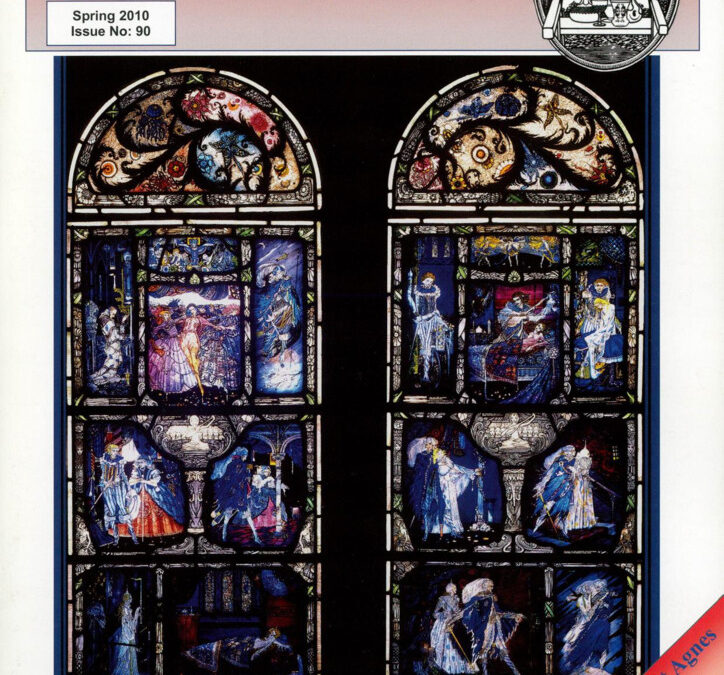
Harry Clarke: The Eve of St. Agnes
7
20th Century British Paperweights
Part I
10
Recent Exhibitions
13
A Modified Alexandrite Glass
14
Events at the National Glass Centre &
at Broadfield House Glass Museum
16
Saturday 24 April
“Swedish Glass in the 20th Century”
A presentation by Geoffrey Lawson at St. Mary’s Church
Hall, Walton St. Mary, Clevedon, BS21 7BX
2:30 pm
to 5 pm; cost £6
For full details see flyer or contact Valerie Humphreys-
01275 877861
valeriehumphreys@btintemet.com
Saturday 19th June
Visit to the exhibition at Frome of the work of the late
Frank Hudson, introduced by his wife, Pearl,
plus visits to
nearby studio glassmaker
Sonia Klinger,
and to the
Liquid
Glass Centre Glass School, for a
tour.
Forfidl details see flyer or contact Valerie Humphreys
Saturday
17
th
July
“The Glass of Greener & Jobling” (Victorian pressed
glass of Henry Greener which led to Jobling art glass of the
20s & 30s, with its tenuous connections to Lalique)
“A celebration of cut glass from the middle of the
20
th
Century” –
presentations by Jackie Fairburn & Maurice Wimpory at
the Sunderland Museum & National Glass Centre, plus a
glass identification session, a demonstration in the Hot
Shop, lunch in the NGC’s award-winning restaurant, and
an opportunity for one-to-one glass-blowing on the Friday.
30-31 October
Annual General Meeting at Bristol Museum
April 2011
Visit to Veste Coburg in Germany
Scottish Year of Glass 2010
For further details go to www.scotlandsglass400.co.uk
or phone: Shiona Airlie on 07722 431 987
Copy Dates:
Spring:
21 January—publication late March
Summer:
21 April—publication late June
Autumn:
21 July—publication late September
Winter:
21 October—publication early January
Articles are welcome at any time, but please bear the above dates
in mind if you have an event you would like to be publicised.
For an up-to-date list of forthcoming events & exhibitions visit
our web-site www.glassassociation.orzuk/news.htm
The Glass Cone—Issue No: 90 Spring 2010
Biennale & International Festival of Glass
Stourbridge 28
–
30 August 2010
—
www.ifg.org.uk
Collectors’ Fairs
28 March: :5E21′ –
Dulwich
9 May:
‘The National Glass Fair’ –
Motorcycle Museum
13 June: ‘Reflect’ –
Kensington Town Hall
Don’t forget your vouchers with Cone 89!
Auction: 3 Centuries of Glass
Fieldings, Saturday 17 April www.faeldingsauctioneers.co.uk
2
JOHN NORTHWOOD I AND FAMILY:
Portrait
of Harry Northwood
c. mid-1890s
Without doubt, John Northwood I
ranks among the foremost names in the history
of glass and glassmaking in England. From his
cameo carved re-creation of the Portland Vase
to his innovations in glass colour technology
and glassmaking techniques, he had a great
impact on the glass industry in the latter four
decades of the nineteenth century. This brief
article will provide some details regarding John
Northwood I and others connected with him
and various members of his family.
John Northwood I was born in 1836.
The exact date of his birth has yet to be
ascertained, but he was baptized on November
13, 1836
1
. He was the son of Fredrick and
Maria Northwood, who resided at Wordsley.
Other children then in the household were:
William (b. 1828); Maria (b. 1829); Eliza
(b. 1832); Mary Ann (b. 1834); and Elizabeth
(b. 1835). Another brother, Joseph, was born in
1839.
In the biography of his father published in 1958,
John Northwood II writes that Fredrick
Northwood “had a village general grocery shop
at the bottom of Glass House Hill”
2
. The 1871
Public Record Office census lists Fredrick
Northwood, age 65, as a “Grocer” residing on
Buck Pool Road in Wordsley. This occupation
probably came later in his life, however, for the
census rolls for Kingswinford from both 1841
and 1851 list Fredrick Northwood’s occupation
as “Carpenter.” This line of work fits well with
John Northwood H’s further recollection that
both his father and his uncle William
This photo was taken in 1888 at the home of Harry Northwood (standing at far right) and Clara Elizabeth Beaumont Northwood (seated
at Hany’s right) on Wheeling Island in West Virginia.
The others are as follows: back row, left to right: E. G. “George” Beaumont; John Beaumont; Carl Northwood; George Pownall;
Samuel Dugan, Sr.; and Percy J. Beaumont.
Front row, left to right: Elizabeth Beaumont with child Mabel Virginia Northwood; child Harty Clarence Northwood;
and Thomas E. A. Dugan.
3
The Glass Cone—Issue No: 90 Spring 2010
Northwood were “working in the building trade” in the late 1840s
3
,
and they were probably allied with their father Fredrick.
The 1851 census records the occupation of John
Northwood I, then about 15, as “Glass Painter.” He was living with
his parents, as was older brother William, 22, who is listed as a
“Carpenter.” John Northwood I may have started out in the glass
trade when he was “about twelve years old” and sought to learn
“painting, gilding and enamelling”.
4
By the time of the 1861 census, John Northwood I had
married Elizabeth Duggan. The wedding took place on 5 February
1859 at Snow Hill Congregational Church, and John’s occupation
was recorded as “Glass Ornamenter of Wordsley”.
5
Elizabeth
Duggan’s brother Thomas Duggan (b. 3 July 1834) emigrated to the
United States in the 1860s, changing his surname to Dugan. He
became a wealthy man in the hotel business and some other
Wheeling on 27 May 1882. She had arrived in the United States just
a few days earlier, accompanied by her brother Percy J. Beaumont
(1864-1947), who had been employed at the Cornwall Works in
Birmingham. He progressed in the glass trade alongside brother-in-
law Harry Northwood, and he was later associated with several
glassmaking firms of his own, including The Beaumont Co. in
Morgantown, West Virginia, until his death in 1947. Percy’s
brother George Beaumont also came to the United States in the
1880s and found employ as a mouldmaker in the glass industry.
In the 1861 census, John Northwood I’s occupation is
given as “Glass ornamenter and Engrave?’ and he was then in
business with his younger brother Joseph as “J. & J. Northwood” on
Barnett Lane near Lawnswood Road in Wordsley. They had earlier
been in partnership with Henry Gething Richardson and Thomas
Guest in a similar venture
8
. In the 1871 census, John Northwood I is
Interior of H. Northwood Co., Wheeling, West Virginia, in June, 1906, showing a press shop at work near the pot furnace.
The man second from right (light shirt) is factory manager James “Jimmy” Haden, who may have come to America from
the Stourbridge area.
enterprises, and, as an investor, he was associated with several
glassmaking ventures, including one in his area of residence,
Ellwood City, Pennsylvania
6
. Three other relatives, Alfred Dugan
(1867-1928), Samuel Dugan (1870-1898), and Thomas E. A.
Dugan (1865-1944), emigrated to the United States in the early
1880s, and they were associated with John Northwood’s eldest son,
Harry Northwood, at glass plants in Ohio and Pennsylvania.
In 1861, Elizabeth and John Northwood I were living at
The Tack in Wordsley, and their first child, son Harry Northwood,
had been born on 30 June 1860. About two decades later, after
having been enrolled at the Stourbridge Government School of Art
and working at J. & J. Northwood in Wordsley under his father,
Harry Northwood emigrated to the United States and embarked
upon a successful career in the glass tableware industry. Over the
years, he was associated with several plants that carried his name,
the best known being H. Northwood Co. in Wheeling, West
Virginia’. Harry Northwood died on 4 February 1919.
Harry Northwood married Clara Elizabeth Beaumont in
listed as “Master Glass omamente?’ and it was noted that he was
“employing 8 men 17 girls” as well. At this time, John Northwood I
and his family were living on Dawley Brook road in Wordsley.
Joseph Northwood and his family resided on Birch Corner in
Wordsley, and his occupation was listed as “Glass Engraver.”
John Northwood II (b. 1870) is also found in the 1871
census. He is listed as “John Lawley Northwood” residing with his
mother Margaret Lawley, 22, and his grandmother Isabella Lawley
on Barnett Lane in Wordsley. Margaret Lawley’s occupation is
given as “Glass Ornamenter” as she was among the employees at J.
& J. Northwood.
John Northwood I, still involved with J. & J. Northwood,
is listed in the 1881 census as “Glass Designer & Engrave?’ and
“Employing, 6 men and 13 girls.” Son Harry Northwood is listed as
“Glass Engrave?’ and then resided with the rest of the John
Northwood I family (mother Elizabeth; brothers Fred and Carl
(1872-1918); and sisters Amy, Eva, Ina, Minnie, Ethel, and Mabel).
Carl Northwood emigrated to the United States in mid-1891 and
The Glass Cone
—
Issue No: 90 Spring 2010
4
Office at H. Northwood Co., Wheeling, West Virginia, in June, 1906.
The men (S. G. Robinson and Harry Clarence Northwood) seated are preparing pay envelopes with the currency and coins
on the table. Carl Northwood is standing just behind Harry Clarence Northwood.
Others are (left to right): W Green; Harry Northwood,• Miss Leah Noble; and Miss Sarah Williams.
several references to information received “from Father.” These
notebooks are in the Rakow Library at the Corning Museum of
Glass in Coming, New York.
worked closely with his brother Harry as a salesman and decorating
foreman in the glass industry until Carl died during the flu epidemic
in early 1918.
John Northwood II, age 11, is listed in the 1881 census as
“Son of M. L.” with his mother Margaret Lawley and his
grandmother Isabella Lawley, residing on Dunbar Street in
Wordsley. Margaret Lawley’s occupation is given as “Glass
Etcher”. Ken Northwood (son of John Northwood explains that
John Northwood I “kept a second home with Margaret Lawley and
John Northwood II was the illegitimate outcome. Thus Harry
Northwood and my father were half brothers.
I
understand that
grandfather insisted that his son John should take the Northwood
name and this was accordingly observed”.
9
John Northwood I’s employ at Stevens and Williams in
Brierley Hill as “artist manager etc.” began about 24 April 1882,
according to the diary of Samuel Cox Williams. John Northwood
I’s many achievements at Stevens and Williams are a matter of
record, so they need not be recounted here. The 1891 census lists
John Northwood I as “Glassworks Manager” and records his place
of residence as Wall Heath. The 1901 census lists his occupation as
“Glass Manufacturer”.
John Northwood I died on 13 February 1902, at age 65.
The Northwood family tomb can be seen today among the
gravestones at Holy Trinity Church in Wordsley. The lettering on
all sides is now considerably weathered, but a stone replica of the
Portland Vase still stands atop the tomb. Many members of the
Northwood family are buried there
10
. Interestingly, two young
children of Elizabeth and John Northwood I (“Ada and John Who
Died in Infancy”) are also noted in the lettering on the tomb.
John Northwood II succeeded his father at Stevens and
Williams and had a lengthy career there. He maintained contact
with his half-brother Harry. Various notebooks kept by Harry
Northwood record glass batch formulas and much information
about different glassmaking processes. Within the notebooks, there
are mentions of correspondence with “Brother John” along with
James Measell
Notes
(1)
Jason Ellis, Glassmakers of Stourbridge and Dudley, 1612-2002
(published by author, 2002), p. 347, n. 79.
(2)
John Northwood II, John Northwood.• His Contributions to the
Stourbridge Flint Glass Industry 1850-1902 (Mark and Moody, 1958), p. 6.
(3)
Northwood, p. 7.
(4)
Northwood, pp. 6-7.
(5)
Charles Hajdamach, British Glass, 1800-1914 (Antique Collectors’
Club, 1991), p. 436.
(6)
William Heacock James Measell and Berry Wiggins, Dugan/
Diamond: The Story of Indiana, Pennsylvania Glass (Antique Publications,
1993). pp. 1-4.
(7)
William Heacock James Measell and Berry Wiggins, Harry North-
wood.• The Early Years, 1881-1900 (Antique Publications, 1990) and Harry
Northwood.• The Wheeling Years, 1901-1925 (Antique Publications, 1990).
(8)
Ellis, p. 334. For additional information and several interesting
photos, see Stan Hill, Wordsley: Past and Present (Sutton Publishing,
2005), pp. 65-69.
(9)
Ken Northwood, personal letter to James Measell, 30 July 1989.
(10)
Hajdamach, p. 439 and Hill, p. 12.
James Measell is historian at the Fenton Art Glass
Company
in Williamstown, West Virginia. He and his wife Brenda visit
England from time to time and enjoy searching for pressed
glass items, especially royalty and political commemoratives.
5
The Glass Cone—Issue No: 90 Spring 2010
Sheringham
candlesticks with
2, 5,
7, & 9
discs
RONNIE STENNETT-WILLSON 1915-2009
Those GA members who attended the Glass Weekend at
Kings Lynn in 2004 will remember with pleasure the fascinating
open discussion between Ronnie Stennett-Willson and Graham
Cooley and the insights revealed into
the life and work of one of the greatest
figures in British Glass in the 20
th
Century. His designs include iconic
pieces, and we enjoyed these, and the
full range of his work, in the
accompanying exhibition.
Ronnie was born in 1915 at Padgate in
*41P
Cheshire. He moved to London and on
leaving school he worked for four years
as a junior at Rydbeck & NorstrOm, a
London-based importer of Swedish
Sheringham
glass. After service in the Royal Tank
candlesticks
Regiment in the war, he rejoined
Rydbeck & NorstrOm until 1951 when
he was appointed sales manager of J Wuidart & Co, importers of
Orrefors and Kosta glass and Rorstrand ceramics. He became
Managing Director, and designed several ranges of glassware
British manufacturers
declined to produce them so
they were made in Sweden.
In 1953 he hired a young
travelling salesman, Frank
Thrower, who later founded
Dartington Glass, and
became equally renowned.
In 1959, Ronnie
was commissioned to
design several ranges for
Lemington Glass, and his
suite of Canberra vases for
Lemington, intended for use
of the P&O liner, won the
Duke of Edinburgh’s
The Glass Cone—Issue No: 90 Spring 2010
Design Centre Award. He left Wuidart in 1961 to spend six years
as the Reader in Industrial Glass at the Royal College of Art and
was responsible for the installation of the RCA’s first glass furnace.
He thus had a major influence on many of the pioneers of the
British Studio Glass movement.
During this time, with his future wife Elizabeth Martens,
he owned and managed Choses, an avante-garde lifestyle shop in
Hampstead, which strongly influenced Terence Conran when he
opened Habitat. He also founded Wilmart (from Willson and
Martens) as a wholesaler and importer of glass. In 1963 he was
elected a Liveryman of the Worshipful Company of Glaziers and
became a Freeman of the City of London.
In 1967 he moved into manufacturing and opened Lynn
Glass, with four furnaces and 35 staff (rising to 100), including 15
skilled Swedish glassmakers. Lynn’s initial product range included
several of Ronnie’s best designs, notably including the iconic
Sheringham candlestick range. Kings Lynn’s proximity to the
Sandringham estate encouraged several royal purchases and
commissions, and the company won the Queen’s Award for
Industry in its first year. Just two years later Lynn Glass was sold to
Wedgwood, with Ronnie retaining his combined roles of managing
director and designer.
He ‘retired’ in 1979, but promptly
set up Langham Glass with Paul Miller,
formerly his chief glassmaker, or head gaffer,
at Lynn, making studio glass. Ronnie left in
1987, and Paul continues the business to this
day.
His writings include two influential
books,
The Beauty of Modern Glass,
and
Modern Glass,
and as a publisher he launched
The Norfolk Journal
in 1990. He also served
for two terms as a Conservative Norfolk
County Councillor from 1970; he was founder
and later chairman of the Wells Arts Centre
from 1973.
He is survived by his wife,
Elizabeth, and two of his three children from
an earlier marriage.
Ronald Stennett-Willson,
glassmaker, was born on 23 November 1915.
He died on 27 November 2009, aged 94.
Bob Wilcock
Acknowledgements to Graham Cooley. For a fuller obituary see
www.timesonline.co.uk/tol/comment/obituaries/article6972579.ece
See also https://ronaldstennettwillson.com/index.html and
20
th
Century British Glass’ by Charles Hajdamach
View
of the Ronald Stennett-Willson Exhibition at Broadfield House in 2005
6
Amber bubble-
stoppered decanter
that was Ronnie’s
favourite design.
—”•• • war
One of the undoubted highlights of the Glass Association
trip to Ireland last September was the visit to the Hugh Lane Gallery
to see Harry Clarke’s masterpiece in stained glass:
The Eve of SL
Agnes
window. The work was originally commissioned in 1923
by a Mr. Harold Jacob, of Foxrock, a Dublin suburb, and was
acquired by the Gallery in 1988. It is one of the most celebrated of
Clarke’s secular windows, second only to the “Geneva Window”,
commissioned by the Irish government in about 1927, intended to
be presented to the International Labour Organisation in Geneva. It
was a series of panels depicting scenes from 14 works of Irish
literature and drama, with daring originality, and although accepted
by the Irish government it was deemed unsuitable for the ILO, was
bought back by Harry Clarke’s widow, and is now believed to be
privately owned in the USA.
Harry Clarke was born in Dublin on 17 March 1889, son
of Joshua Clarke, originally from Leeds, who ran a stained-glass
studio and church decorating business. As a lad Harry showed a
pronounced skill at drawing (including caricatures of his teachers!)
and learnt how to apply those skills in his father’s business, and at
the Metropolitan School of Art (now the National College of Art),
to which he won a scholarship in Stained Glass Design, and at
which he won a Gold Medal in a competition for Success in Art for
students of Great Britain and Ireland. In 1913 he won a travelling
scholarship, which enabled him to visit Chartres Cathedral, whose
glorious stained-glass windows made a lasting impression on him.
He first started to make a name for himself however in
book illustration. Harrap’s commissioned him to illustrate a luxury
edition of Edgar Allen Poe’s
“Tales of Mystery and Imagination”.
The illustrations were in black and white, in a style reminiscent of
Aubrey Beardsley, and the Arts and Crafts movement, with an
unswerving tendency towards the fantastic, which so eminently
suited the subject, as did his illustrations for Goethe’s
Faust.
A
reviewer wrote
“Harry Clarke is probably the ideal interpreter of
Edgar Allan Poe, and wherever the imagination of Goethe conjures
up the macabre, the witch, the imp and the devil, Clarke will add a
shudder which is congruous with the drama. Nothing in these
drawings represents anything in the visible world : all come from
that dread mid-world or purgatory of the soul where forms change
on the instant by evil or beautiful imagination. … In these
illustrations Harry Clarke is not the artist of men and women, but
the seer of the forms which their passions and imaginations
assume.
b,
His work in colour is even more stunning and vibrant, and
we were fortunate that while we were in Dublin, the National
Gallery had an exhibition of his paintings for Hans Anderson’s
Fairy Tales, showing a predominance of the rich blues and golds we
see in
The Eve of St. Agnes
window.
Not long after leaving the Metropolitan School of Art he
received his first major stained-glass commission, eleven windows
for the newly built Chapel of St. Finbar attached to the Honan
Hostel in Cork. The wonderful colour in the work, and the
dignified and imaginative rendering of the religious subjects
established his reputation as a stained-glass artist of distinction. It is
said that there is a sensuousness about his religious figures, a
sensuality about his secular, each appropriate to the subject matter
and adding to the powerful impact of his work.
Throughout his life he worked tirelessly creating stained-
glass and book illustrations, while at the same time, with his brother
Walter, trying to maintain his father’s decoration studio following
his untimely death in 1921. His works are to be seen in many parts
of Ireland, and also in Great Britain, notably at Notre Dame
Convent, Ashdown Park, Surrey, Nantwich Protestant Church, the
Catholic Church. Colwyn Bay, and Dowanhill Convent, Glasgow.
He has work in France and in the USA.
The work seen most often by the public, and which we
certainly made sure of seeing while in Dublin, are the panels he
designed for Bewley’s Café (and produced by his assistants). The
café also has glass by his father, and other works of art, paintings
and sculptures. For a glass-lover, there is no better place for a
coffee, a snack, or a meal.
Harry Clarke died on 6 January 1931 at Coire, in
Switzerland, where he had gone to recuperate from illness.
He was 41. His work lives on. He was a leader in the
resurgence of Irish culture through and beyond the troubles of
the early 20
th
Century, His style of design was new in the
realm of Sacred Art, moved a long way from the excessively
sentimental style of religious art generally accepted in his
time. Sacred or secular, his stained-glass showed unequalled
design flair, masterful technical competence, and a power and
a beauty that cannot but leave the viewer moved, as
The Eve
ofSL Agnes
shows.
Bob Wilcock
Footnote:
(1)
”
The Living Torch” a collection of writings by feE
(George Russell) edited by Monk Gibbon, and cited in
“Harry Clarke: Dublin Stained Glass Artist” by William .1
Dowling in Dublin Historical Record, Vol. 17, No. 2 (Mar.,
1962), pp. 55-61. Published by the Old Dublin Society.
This
article is primarily edited from Dowling.
References & links:
www.boib.com/illustraVclarke.htm
(this is an illustrated biography that differs in small detail from
Dowling ‘s paper. For a full biography, see “The Life and Work of
Harry Clarke” by Nicola Gordon Bowe; Irish Academic Press Ltd
1989; ISBN 978-0716524526)
www.huzhlane.ie/whats on detail.php?id=146
The images of the window are © Dublin City Gallery, The Hugh
Lane
https://bewlevs.com/bewlevs-krafton-street-cafe/bewlevs-cafe-
artwork
7
The Glass Cone—Issue No: 90 Spring 2010
itmooll1111111111
NVOIRFS.W
.
ir41,t4
.
, ,
•
(4. trtiraz.:;;.
;
k
it
A
g
it •
wn
&MI
– –
p
21
–
..
p,
4
.
iJF
Wit W.
_
Q
..;
.
n. .scrama4
it
44Mstit i
_
E•itidia•ta
The Legend of the Eve of St. Agnes
Keats based his poem on the superstition that a girl could
see her future husband in a dream if she performed certain rites on
the eve of St. Agnes; St. Agnes was a member of a noble Roman
family, a Christian, and martyred at the age of 12 or 13 for refusing
to many the son of a Roman Prefect, notwithstanding that Roman
law did not permit the execution of a virgin. Agnes became the
Patron Saint of virgins.
The superstition was that on St. Agnes Eve, 20 January,
the girl should go to bed without any supper, undress herself so that
she was completely naked and lie on her bed with her hands under
the pillow and looking up to the heavens and not looking behind.
Then the proposed husband would appear in her dream, kiss her,
and feast with her. One has to wonder if it was a superstition more
pagan than Christian, and Keats’ publishers had him tone down
more erotic elements in the original poem.
Keats Poem
The poem was written in 1819, and is quite long,
(42 stanzas). It is said to be amongst his finest poems, although to
the modem ear, some of the language is quite abstruse.
On a bitterly chill night, an ancient beadsman [almsman
whose duty it was to pray for his benefactor] performs his penances,
while in the castle of Madeline’s warlike family, a bibulous revel
has begun. Madeline pines for the love of Porphyro, sworn enemy
to her kin. The old dames have told her she may receive sweet
dreams of love from him if on this night, St. Agnes’ Eve, she retires
to bed under the proper ritual of silence and supine receptiveness.
As we might expect, Porphyro makes his way to the castle
and braves entry, seeking out Angela, an elderly woman friendly to
his family, and importuning her to lead him to Madeline’s room at
night where he may but gaze upon her sleeping form. Angela is
persuaded only with difficulty, saying she fears damnation if
Porphyro does not afterward many the girl.
Concealed in an ornate carven closet in Madeline’s room,
Porphyro watches as she makes ready for bed, and then, beholding
her full beauty in the moonlight, creeps forth to prepare for her a
feast of rare delicacies. Madeline wakes and sees before her the
same image she has seen in her dream, and thinking Porphyro part
of it, receives him into her bed. Awakening in full and realizing her
mistake, she tells Porphyro she cannot hate him for his deception
since her heart is so much in his, but that if he goes now he leaves
behind “A dove forlorn and lost / With sick unpruned wing”.
Porphyro declares his love for Madeline and promises her
a home with him over the southern moors. They escape the castle
past insensate revellers, and flee into
the night. The beadsman, “His
thousand Ayes told / For aye
unsought-for slept among his ashes
cold”
[Wilcipedia]
The Harry Clarke Window
Fourteen key scenes
conveying the drama and magic of
the story are illustrated, topped by
two decorative lunettes, with a
unifying frieze below showing the
dramatis personae. It is a work of
consummate skill, encompassing
every technique known to the
stained glass artist.
St. Agnes’ Eve—Ah, bitter chill it was! …
Numb were the Beadsman’s fingers, while he told
His rosary …
At length burst in the argent revelry,
With plume, tiara, and all rich array, …
Meantime, across the moors, Had come young
Porphyro, with heart on fire For Madeline. …
Ah, happy chance! the aged creature came,
Shuffling along with ivory-headed wand,
To where he stood, hid from the torch’s flame,
Behind a broad hall-pillar, far beyond
The sound of merriment and chorus bland: …
… “Mercy, Porphyro! hie thee from this place;
“They are all here to-night, the whole blood-thirsty race! …
The Glass Cone—Issue No: 90 Spring 2010
qF
~
j
r
0,
ts,
eRzff.W.
4/.
is
“Let us away, my love, with happy speed;
“There are no ears to hear, or eyes to see,—
“Drown’d all in Rhenish and the sleepy mead:
“Awake! arise! my love, and fearless be,
“For o’er the southern moors I have a home for thee.
… Madeline, St. Agnes’ charmed maid, …
… With silver taper’s light, and pious care,
She turn’d, and down the aged gossip led
To a safe level matting. Now prepare,
Young Porphyro, for gazing on that bed; …
… Full on this casement shone the wintry moon,
And threw warm gules on Madel fine’s fair breast, ..
Porphyro … then from the closet crept,
Noiseless as fear in a wide wilderness,
And over the hush’d carpet, silent, stept,
And ‘tween the curtains peep’d,
… Awakening up, he took her hollow lute,-
Tumultuous,—and, in chords that tenderest be, …
… Close to her ear touching the melody;—
Wherewith disturb’d, she utter’d a soft moan:
He ceased—she panted quick—and suddenly
Her blue affrayed eyes wide open shone: …
“This is no dream, my bride, my Madeline!”
Down the wide stairs a darkling way they found. …
They glide, like phantoms, into the wide hall …
The key turns, and the door upon its hinges groans. …
And they are
gone: ay, ages
long ago
These lovers
fled away into
the storm. ….
9
The Glass Cone—Issue No: 90 Spring 2010
RrsIo
“®e we
t
-Poo’
l4*
Richard Giles’ presentation at the Glass Association 2009 AGM
Before we look at the subject in detail there
are several points that should be borne in
mind. Firstly, in reflecting on 20
th
Century weights one cannot totally
ignore the weights from the classic
period of paperweight production
around the mid 1800s. Those weights
op
provided the inspiration for the 20
th
Century makers such as the Ysart
Paces –
family, Whitefriars, Perthshire and
Caithness, plus current makers like Peter Holmes, Willie Manson,
John Deacons and Peter McDougall, whose skills were all
influenced by the Ysart family.
The second point relates to the weights that are currently
being produced by a relatively small number of artists in
America. Using optical glass rather than ordinary furnace glass
they have been able to take the quality and complexity of weights,
particularly in the use of lampwork, to a level far in excess of the
antique weights and the best of British-made weights. However,
the weights are generally far more expensive than their British
counterparts and in many cases it is possible to purchase a good
antique weight for a similar cost or less.
The third point is that there are many very talented studio
glass artists around the British Isles who do make some
paperweights but I have not classed them as paperweight makers in
Pay,
Margaret Burke
the strict sense of the term. I illustrate a couple of weights, but
otherwise they do not feature here. I will be concentrating on
individuals or companies who produce or have produced weights in
commercial quantities, and if there are glassmakers present who
make some weights and do not get a mention I apologise.
The heyday of British paperweight production was
probably a fifteen year period between the late 1960s and early
1980s but I must start at the beginning of the 20
th
Century. The
only weights around at this time were really a development of the
souvenir- and advertising-weights of the end of the 19
th
Century.
Both types of weights were able to use
the improvement in photographic technology which enabled better
quality black and white photographs to be used instead of sepia,
with these eventually to be replaced by coloured versions after the
end of the First World War. It is still a matter of debate whether or
not these type of weights were actually made in this country,
the glass blanks imported and the pictures added here or the
whole thing made abroad and finished articles imported. Many
weights have a name on the back of the picture, but often this is the
name of the supplier rather than the maker, and on one example of
the coloured picture variety it says
‘Foreign Made’.
Another clue
to a foreign origin is spelling mistakes in the name of the location
appearing on a weight. New styles of advertising-weight that
made their appearance in the 1920s were the flat press moulded
type, in various shapes, where the advertising material is impressed
on the underside and often filled with various coloured materials to
make it stand out, and a screen-printed transfer-type weight, which
was able to illustrate much more information including pictures of
the products.
In the early 20
th
Century people were taking more interest
in the weights from the antique period, collections were being
assembled and information published, bringing them to the
attention of people who were capable of recreating such items.
From the 1920s concentric millefiori weights and inkwells often
with 1848 date-canes made their appearance, and for a while it was
thought that they were from the early period of paperweight
making. However as the years have passed and research has been
done into glass factories and paperweight production, there is
sufficient evidence to show that most of these weights in fact came
from the Arculus or Walsh Walsh factories in the Birmingham
area. In 1931 the Arculus factory was taken over by Walsh Walsh
and it is assumed that they continued to produce these fake weights
alongside their top quality cut-glass until the old Arculus factory
was destroyed during wartime bombing, and the Walsh Walsh
factory closed in 1951.
The next part of the paperweight story involves those
five famous members of the Ysart family, and their impact on
British paperweight making cannot be understated. With the
exception of current maker Mike Hunter of Twist Glass, the Ysart
family have had an influence on all the past and present Scottish
paperweight makers and the links between the companies
The Glass Cone—Issue No: 90 Spring 2010
10
making Monart
paperweight-making
far the best,
continue making
another fifty
the Monart glass
remained a
business of heat-
and laboratory glass,
ware.
In pure
terms, Paul was by
and was to
weights for almost
years. Although
was successful, it
sideline to the core
resistant industrial
with the family
and individuals can be set out like a
family tree. The credit for the re-
introduction of millefiori and
lampworking techniques in 20
th
Century Britain goes to this
remarkable family, who came to
Scotland from Paris in 1915.
Father
Salvador and wife Enriqueta were
Spanish and sons Paul, Augustine
and Vincent were born in
Monett
Spain before the family moved to
France in 1909 where fourth son Antoine was born. The family
moved several times as Salvador changed from one glassworks to
another, and at the outbreak of the First World War he was working
for Schneider Brothers and Wolf on the outskirts of Paris. The
factory closed when the owners and most of the workforce were
conscripted into the army. Salvador managed to find other work,
but as the German army got closer to Paris, a decision to leave was
taken, when he was offered the chance to join the Leith Flint Glass
Works which eventually would become the Edinburgh Crystal
Company. It was during the period at this factory that eldest son
Paul made his glassmaking debut alongside his father.
After the end of the war they worked at several other
Scottish factories, before eventually being recruited by the North
British Glassworks of John Moncrieff
Ltd
in 1922, where
the paperweight making part of their story really begins. Because
of their remarkable glassmaking skills they were initially employed
in making delicate scientific glassware, with Paul apprenticed to his
father, but their skills soon came to the notice of Isobel Moncrieff
the wife of the owner. Being a member of the Dunlop family she
was well educated with a flair for artistic design, and persuaded
Salvador to start making decorative coloured glassware to her
designs. The glassware was an immediate success and the range of
items made was rapidly expanded from vases and bowls to include
lampshades, decanters, scent bottles, ink bottles and
paperweights. As sales grew, the three remaining sons were
apprenticed in turn to their father, and by the second half of the
1930s all five family members were working together as a team
switching between products according to demand.
With the outbreak of war in 1939 the production of
Monartware ceased and would not resume until 1947, by which
time Antoine had been killed in a road accident, and Vincent,
Augustine and Salvador had left in 1946 to set up their own
company, Vasart Brothers Glass, in Perth, the name coming from
the initials of the Christian names plus
‘art’
from the
surname. Paul remained behind as the sole maker of Monart glass,
and continued production for another fourteen years, but a change
of management resulted in a decision to cease production in 1961,
although the company allowed Paul to continue making his
paperweights. Like their antique counterparts the weights made by
the Ysart family were not appreciated for the artistry and skills
required to make them until many years later, and there is a famous
example of two pictures of Paul Ysart weights being included in the
Evangeline Bergstrom book
Old Glass Paperweights
first published
in 1940. When details of the maker were made known to her she
had the pictures removed from all remaining copies of the first
edition and deleted from further reprints. At the end of 1962 Paul
felt his position was becoming more insecure, so in early 1963 he
left to take up the post of Technical Advisor and Training Officer at
the newly opened Caithness Glass factory in Wick, and started a
new chapter in the history of 20
th
Century paperweight making.
Business at Vasart Brothers Glass started well and the
workforce was expanded but demand for their glass declined after
1950. In addition, by 1956 Salvador and Augustine had
died leaving Vincent running a business that was nearly
bankrupt. Before closing the business he approached George
Dunlop of Pirelli Glass with regard to a possible job, but Dunlop
liked the work the company had been doing and offered to re-
launch the business under the name Vasart Glass with Stuart
Drysdale, the man later to set up Perthshire Paperweights, as
general manager. Pirelli Glass had been working with Vasart
Brothers Glass for some years, marketing the paperweight side of
the business, as well as passing on contacts for producing
decorative items for the souvenir trade. In 1963 the orders for the
famous squashed whisky bottle for Teachers were increased from
400 to 50,000 per month but the existing manufacturing facility
couldn’t cope, so Teachers offered to build a new factory in Crieff to
ensure that production was able to continue. The name of the
company was changed to Strathearn Glass, with Vincent Ysart as
works manager. and Stuart Drysdale continuing his role as general
manager. A year later Teachers agreed to purchase the
business. Unlike Paul Ysart who considered paperweights to be art
objects, paperweight making at Vasart was very much for the gift
trade, so being produced in huge numbers it is not surprising that,
with a few exceptions made by members of the Ysart family or Jack
Allen and later Herbert Dreier, the quality of the weights would
never compare with those from Paul. Miniature weights were also
made to be added to bar tools such as bottle openers and
11
The Glass Cone—Issue No: 90 Spring 2010
corkscrews The majority of weights were spoke pattern
with panels of millefiori canes divided up by lengths
k
of twisted ribbon canes. They came in varying sizes
on clear and coloured grounds, and if you are lucky
you might find one with a date cane or an S cane, or
even both, which makes them much more
collectable. In the 1970s, with competition from the
newly emerging Caithness Glass Company they
ventured into abstract-style weights, which in some
cases look very similar to those from their
safety glass maker Triplex remains unknown. It is
possible that they may have done some work together,
or Triplex just wanted to have some souvenirs of the
exhibition to give to valued customers. The Royal
Visit weight is thought to be unique, and of the
Triplex weights only some 20 are known to
exist. For the Coronation of Queen Elizabeth two
years later, red, white and blue concentric millefiori
weights similar to the Royal Visit weight were
produced, this time with the words ‘El 1R 1953’ in the
rivals. Vincent only stayed with the new company for
centre. Various colour combinations of the millefiori rings
OM of Ans
about a year before leaving for a clerical job with an
i* are known to exist and the weights were produced in faceted
Insurance company, and died in 1971 following a fall at work. In
I
and un-faceted form.
1980 the company was taken over by Stuart Crystal from
Stourbridge, renamed Stuart Strathearn and paperweight production
halted.
Geoffrey Baxter joined
Whitefriars in 1954 and eventually
became their chief designer and under
The next company to venture into the production of his direction further development of
millefiori paperweights was Whitefriars Glass, the mid
2e
Century millefiori weights took place over
name for the company that had stood on the site of the Whitefriars the next 15 years.
This
monastery in the City of London from the late 17
th
Century. James culminated with the issue in 1970 of
Powell bought the company in 1834 to provide employment for his the first dated limited edition using
three sons, renaming it James Powell and Sons. Grandson Harry c o m p 1 e x c a n e w or k a n d •
graduated from Oxford with a degree in Chemistry in 1873 and commemorating the 350
th
anniversary of
Silveria
0
t h e
joined the company, leading to many new colours and techniques sailing of the Mayflower to America. This was
followed by
being developed. In 1875 at the age of 22, he become works a weight in 1972 to commemorate the Silver Wedding of the
manager and under his guidance the company reached its peak
Queen, and then from 1975 until closure of the factory in 1980,
around the 1920s and the Art Nouveau period, when it
annual editions for Christmas and other notable events such as
was recognised as a world leader. In 1919 the name was
the celebration in 1976 of the bicentenary of American
changed to James Powell & Sons (Whitefriars) Ltd and plans
independence, Royal Jubilee celebrations in 1977, and
were made to relocate to a new factory at Wealdstone
Olympics in 1976 and 1980. Towards the end of the
which was then on the outskirts of expanding
company’s life weights featuring a large bumblebee,
London. This relocation eventually took place in
butterfly and owl were produced in small numbers, and
1923. The major shareholding in the company was
today these are some of the most sought after despite
held by members of the Powell family until 1952
being unlimited editions. By 1980 the country was in
when they sold out to G H Zeal & Company who
a recession, and with a subsequent lack of orders, the
specialised in making thermometers and used the
site at Wealdstone had become more valuable than
factory for producing thermometer tubing.
the
the glassworks and the shareholders were unable to
1930114We pattern
Plain glass weights containing patterns of bubbles feature
resist the offers from developers so the glassworks was
closed, so ending some 300 years of glassmaking history. The
Whitefriars name was bought by Caithness Glass who used it for a
range of fine-quality weights featuring both millefiori and
lampwork designs, many of which were designed by ex-Perthshire
and J Glass lampworker Allan Scott
*r
hitefriars 1970s eomPl
c:/‘
millofiori weights
in the catalogue for 1940 but exactly when the company
began experimentation with millefiori canes remains
undocumented. For many years some unidentified weights thought
to have been made around the 1850s and 1860s were attributed to
‘Whitefriars’ but there is no hard evidence to confirm that the Powell
factory ever made millefiori weights before 1951. This was the
year of the Festival of Britain Exhibition, and, along with the 1948
Austerity Olympics in London, was one of the first major events of
international interest after the end of the second World War. Two
types of concentric millefiori weights that are thought to relate to
this exhibition exist, the first being a red, white and blue weight in
the centre of which is a larger blue cane on which are scratched the
words ‘Royal Visit 1951′, and the second a similar concentric
millefiori weight but in varying colours and in the centre the text
`Triplex 1951’. Whitefriars were present
at the exhibition and the first weight is
thought to have been made to
commemorate a visit to
the exhibition by a member of the
Royal Family.
Whitefriars are
known to have experimented with
safety glass, but exactly what the
relationship was between Whitefriars and
To be continued in Cone 91
The Glass Cone—Issue No: 90 Spring 2010
12
Heavenly Scent
I
/is
m/ h
innairtl
This Exhibition followed the
Whitefriars Exhibition at the House,
visited by Glass Association (NW)
members in July 2009. (See Glass Cone
issue 88). It consisted of over 50 superb
pieces by nine glass artists and was co-
curated by Alison Kinnaird. The pieces,
nearly all in display cabinets, occupied
three upstairs rooms, thus using daylight
to maximum effect.
Plus points for a visit are the marvellous
house and setting, with views of the lake
and surrounding farmland and woods;
on-site parking; helpful staff; a good shop,
tea-room and “facilities”; and it’s just a not too
crowded place to visit.
There are regular exhibitions, talks and other events. For
details phone 015394-46139, or view www.blackwell.org.uk.
John Westmoreland
Catching the Light:
Contemporary
Glass
Blac
‘Glacier’ bottles by
Peter Layton
This was the first exhibition in Peter Layton’s new studio at 62-66 Bermondsey Street, London SE1
and featured perfume bottles, paperweights and glass jewellery by some thirty artists including
Andrew Logan, Allister Malcom, Malcom Sutcliffe and Katharine Coleman.
The exhibition was opened by internationally renowned architect, Laurie Chetwood,
designer of the extraordinary award-winning Perfume
Garden at Chelsea Flower Show in 2009.
A rare example of the Elizabeth I
eau de toilette
created in the Perfume Garden at Chelsea by Jean
Patou, in a Peter Layton bottle, was auctioned for
charity at the opening.
Bob Wilcock
Bruce
Photos by John n’estmoreland & Bob Wilcock (with
permission)
Marks
13
The Glass Cone—Issue No: 90 Spring 2010
Glass is truly a magical substance in that it possesses so
many unique properties, particularly the way that its optical
qualities can bend and distort light, which results in pieces formed
in it assuming different aspects according to the intensity of light
falling on it and passing through it.
In this respect, dichroic glass is particularly interesting in
that its colour changes according to the light source illuminating it.
The most common form of dichroic glass is Alexandrite which, like
the mineral of the same name,
changes from pinky-mauve
in
natural
or
incandescent light
to pale blue-
grey under light
from
a
fluorescent or
low energy
source. It is
believed that
Alexandrite glass
was first created
by Josef Riedel
[1862-1924]’, the
brilliant glass
chemist who had
studied under the
Viennese chemist
Richard Adolf
Zsigmondy, who won the
Nobel Prize in 1925. Riedel’s talent ran in
the family as his grandfather was the creator of
uranium-based glass, c1830.
The active ingredient of Alexandrite glass is the “Rare
Earth” or Lanthanide metal Neodymium. However, there are
several other possible forms of dichroic glass and we are always on
the look-out for variants. So, it was particularly pleasing to find a
kidney-shaped bowl, its base acid-badged with the logo of
SEVRES FRANCE, c1960, that appears orange-pink in daylight,
yellow-topaz in florescent light and pale green when illuminated by
low-energy lamps.
Mike inspected it with his portable spectroscope and came
to a tentative conclusion, based on the logic of Sherlock Holmes
that ‘when you have eliminated the impossible, whatever remains,
however improbable, must be the truth’. Because the glass
exhibited a strong but sharp absorption in the yellow region of the
spectrum, its active ingredient was a lanthanide, because only that
group of metals exhibits such sharp absorptions. It clearly wasn’t
Alexandrite, so the possibility of neodymium being the active
ingredient was dismissed. The list of other possible candidates was
fairly limited because most of the lanthanides do not have sharp
absorption bands in visible light . The spectra of possible candidates
were tabulated from data published by John W. Adams (The visible
region absorption spectra of rare earth minerals, The American
Mineralogist, Vol 50, March-April 1965), see table 1.
Examination of the light passed through the unidentified
glass gave a very pronounced series of absorption bands in the
yellow. Other than neodymium, the only lanthanide exhibiting
absorption in that region is praseodymium, so it was assumed to be
an example of that unusual glass.
The Glass Cone—Issue No: 90 Spring 2010
However, nagging doubts remained and further inspection
was required. It was noticed from the spectra of praseodymium and
neodymium that they both absorb at a wavelength close to that of
the yellow light emitted by incandescent sodium (approx. 590nm).
However, neodymium absorbs to the green side of that line while
praseodymium absorbs just to the red side of it. Accordingly, the
following experiment was conducted.
Using string soaked in brine as a source of sodium, the
spectroscope was used to examine the spectrum of a candle flame
into which the string was inserted. The sodium
emission line was very clear. The
flame was then viewed through
Alexandrite glass and then
through the Sevres
piece. In both cases,
the yellow
absorption bands
produced by the
glass
items
were to the
green side of
the sodium
emission line.
Clearly, the
unknown glass did
not contain
praseodymium.
Indeed, in all respects,
the spectra of the two
Sevres 8.5×19.5cm
glass items seemed to be
identical, apart from
differences ascribed to the
different concentrations of the active ingredients in the glass. In
particular, the strong absorption in the blue region of the spectrum,
which would have been produced by praseodymium, was absent in
the unknown glass. It was clear, therefore that, despite the different
appearances of the two types of glass, both relied on neodymium as
the active ingredient. However, the new, unknown glass had to
contain something in addition to neodymium to account for its
strange colour.
In order to discover the secret of the glass, experiments
were conducted in which light was passed through two different
pieces of glass placed together. One was Alexandrite glass and the
other was a piece of glass of another colour taken from a collection
of coloured glass items. This experiment worked on the principle
that the light will be influenced by the two colouring components
irrespective of whether they are in one piece of glass or in two
different pieces.
After a few false trails, an excellent colour match was
produced using a piece of brown (iron) glass in parallel with the
Alexandrite glass. Not only did the colours of the sandwich of glass
and the unknown glass match in natural daylight and in filament
bulb light, they also matched perfectly in the light from a low
energy light bulb, when both were transformed to a beautiful green.
This simple experiment demonstrated, therefore, that the Sevres
glass was, beyond all reasonable doubt, coloured with a blend of
neodymium and iron, the iron being in the iron (III) state, as
opposed to the iron (II) state found in some green glass. Although a
yellow can be produced from uranium, the glass was not radioactive
14
Praseodymium
442 (Violet)
467(blue)
481(blue)
Neodymium
428(violet)
476(blue)
508(green)
Europium
465 (blue)
Erbium
486.5(blue)
522(green)
652(red)
Holmium
416(violet)
451(blue)
485(blue)
591 (Yellow)
598(yellow)
522(green, weak)
580(Yellow,
Strong)
538(green)
640(red)
Dr F Burroughes
Mr D Everall
Mr J Keightley
Mr
N
Twist
Somerset
Shropshire
Worcestershire
Denbighshire
Ian Phillips writes that two GA members have already turned
up in following the article in Cone 89. However, they had
difficulty finding the Museum and the best advice is to Google
search for “Museo Vidrio Cristal Malaga” and then “Get
Directions” (all without inverted commas), for a good map.
so that ingredient was not used.
Further experiments supported this interpretation. When
Alexandrite glass was illuminated using an amber filament light
bulb, the colour obtained was the same as that observed with the
Sevres glass in the light from a normal filament bulb. This was
consistent with the concept that the Sevres glass contained a
colouring ingredient that, on its own, would have produced a yellow
or amber glass. When light from a low energy light bulb was
filtered through amber iron glass, or even through Webb’s sunshine
amber glass, it caused Alexandrite glass to assume the same green
colour as the Sevres glass assumed with normal low energy light.
Even reflected light from a low energy light using a piece of gold
metallic wrapping paper produced the same effect.
It appears, therefore, that a whole new area of collecting is
open to the enthusiast. Rather than just the narrow range of colours
available from the use of lanthanides on their own in glass, it is
likely that a whole range of colour-change glasses exists that
contain a lanthanide plus another colouring agent. The colour
change from natural to fluorescent light is diagnostic, but a cheap
direct vision spectroscope is essential when conducting detailed
investigations. These are available from Timstar Laboratory
Supplies [www.timstar.co.uk, 01270 250459]. An instrument with a
diffraction grating had advantages over one using prisms.
Experiments using glass sandwiches are also a powerful
investigative tool.
Mike Baldwin & Andy McConnell
Identifring the successive generations of the Riedel dynasty can be
tricky, especially as so many of them were called Josef A member
of the family’s seventh generation, Josef The Younger (1862-1924),
was an outstanding chemist and mechanical engineer, creating a
remarkable spectrum of 600 different glass colours, which we used
both at the family’s various glassworks and sold to other makers.
This sophisticated variety of colours set the company, based in
northern Bohemia, apart from the competitors, and enabled his
business to develop further, unaffected by the first Great War. It is
also believed that Josef invented the red-amber-red traffic light and
fibre-glass and new forms of machinery for mass-producing glass
beads.
For further information on individual members of this
extraordinary glassmaking family visit: www.riedel.com.
Moser Alexandrite 22.6cm
Images © Andy McConnell/Glass Etc, Rye
Table 1- THE VISIBLE ABSORPTION SPECTRA OF SOME LANTHANIDES (Wavelengths in
Nanometres)
The other lanthanides do not exhibit sharp absorption bands in the visible region of the spectrum, except for promethium, which is not
found in nature.
4/
I
1
‘
15
The Glass Cone—Issue No: 90 Spring 2010
Work Force:
5 March – 2 May
`Work Force’ draws together
historical representations of
labour in the industry of glass-
making through films from the
1970s to the present day.
Glassworks (1977), produced
by Amber Films for its Tyne
Documentaries series, (left) is a
visual record of a handmade
process in an industrial glass
factory in Lemington on
Tyneside, a site renowned for its
glass production for over 200
years.
In John Smith’s Slow Glass
(1988-91) a nostalgic glazier
relates his knowledge and
theories in a very personal reflection on the changing attitudes to
labour, industry and life in London’s East end in the late 1980s.
Complimenting these two films is a new commission by
Newcastle-based film-maker, Mat Fleming. Fleming’s film reveals
the manufacture of a symbol of work force – the hammer and sickle
– created in glass by himself, a novice glass maker, subverting the
expectation of such ‘industrial films’. The film is commissioned by
National Glass Centre for AV Festival 10: Energy.
Aligned:
13 March – 9 May
Four printmakers are brought together in this exhibition, Jo Bourne,
Deborah Snell, Jacqueline Quinn and Michelle Wood . Each uses
different approaches and printmaking techniques in their work, but
they are linked by their inspiration by the natural world.
Glass Blowing Courses with NGC Visiting Artist, Tim
Shaw MA RCA.
Courses are suitable for beginners.
Weekend Courses:
Sat 15 & Sun 16 May
or
Sat 12 & Sun
13 June,
9.30am – 5pm, £290 per person (includes lunch).
There is a free talk by Tim Shaw on
22 April at 2pm.
The Glass Delusion:
20 May – 3 October
Preview: Thursday 20 May, 6-8pm
`The Glass Delusion’ was the name given in the late Middle Ages
and Baroque times to a form of depression. Sufferers were
obsessive, compulsive, driven by irrational fears, and imagined
themselves to be made of glass, hence brittle and fragile. The
syndrome evokes a psychological separation between reality and
imagination, between a strength and a vulnerability that we all
experience at times. Glass is a barrier, yet allows light to pass
through it Glass has the ability to combine opposites and it is this
duality that is the inspiration for this exhibition of contemporary art,
artefacts and scientific objects that tell the story of human attempts
to reconcile the physical and mental worlds.
Artists’ Showcase
Kosta Boda: 7
January –19 April
Beautiful glass sculptures by Swedish masters, Bertil Vallien, Kjell
Engman and Goran Warff.
Perfume Bottles:
1 May –14 June
Celebrating the art of the perfume bottle
New Work – Tim Shaw:
19 June –1 August
(see www.timshawglass.com)
National Glass Centre,
Liberty Way, Sunderland, SR6 OGL
0191 515 5555 www.nationaklasscentre.com
The Studio Gallery:
Opens 6 March
The top-floor gallery featuring studio glass from the Museum’s
collection has been redisplayed. Old favourites such as three
stipple-engraved cones by Doug Burgess will be joined by new
additions such as the
Secret Garden
dress by Diana Dias-Ledo and
Fertile Landscape
by Max Jacquard.
Black Country Treasures:
Until
7
March
Mini-exhibition featuring artefacts from four Black Country
museums, selected by local schoolchildren.
A History of Broadfield House Glass Museum:
Opens 13 March
Display of artworks, glass and photographs.
Migrate: The Scottish Glass Society:
Until 21 March
This 30th anniversary exhibition of the Scottish Glass Society is
dedicated to the memory of Dan Klein, the Society’s Honorary
President.
Take Thirty:
3 April – 8 August
To celebrate the 30
th
anniversary of its opening, the Museum has
invited thirty leading contemporary British glassmakers, to exhibit
examples of their work, including Diana Dias-Ledo and Harry
Seager, who both had solo shows at the Museum; David Reekie and
Bruno Romanelli, two of twelve artists who took part in the
Millennium Commissions; and David Prytherch who created the
Glass Dance windows for the Museum’s pavilion.
Also included are some of the many artists who have demonstrated
their talents at the Museum such as bead-maker Pauline Holt,
paperweight-maker William Manson, engraver Katharine Coleman
and glassblower Bob Crooks, plus some former occupants of the
hot glass studio, including Okra Glass, former scholarship holders
LoCo Glass, and current resident artist Allister Malcolm.
Visitors can also follow the anniversary trail featuring thirty
highlights from the collection and write their own museum memory
in the special memory book.
20th Century British Glass:
Until 31 December
Curated by Charles Hajdamach, this exhibition includes all of the
key Stourbridge factories plus works by other important companies,
such as Whitefriars, Monart, Darlington, Chance, and Davidson.
Beads Day:
15 May, 10am – 4pm
Trade stands by bead-makers, plus lamp-working demonstrations by
Pauline Holt of Jazzy Lily Hot Glass, Loma Prime of Pixie Willow
Designs and Marlene Minhas.
Paperweight Day:
5 June, 10am – 4pm
Trade stands by specialist dealers, plus demonstrations by leading
paperweight-maker William Manson, and display by the
Paperweight Collectors Circle.
Broadfield House Glass Museum,
Compton Drive,
Kingswinford, DY6 9NS—
01384 812745
www.glassmuseum.org.4
The Glass Cone—Issue No: 90 Spring 2010
16