


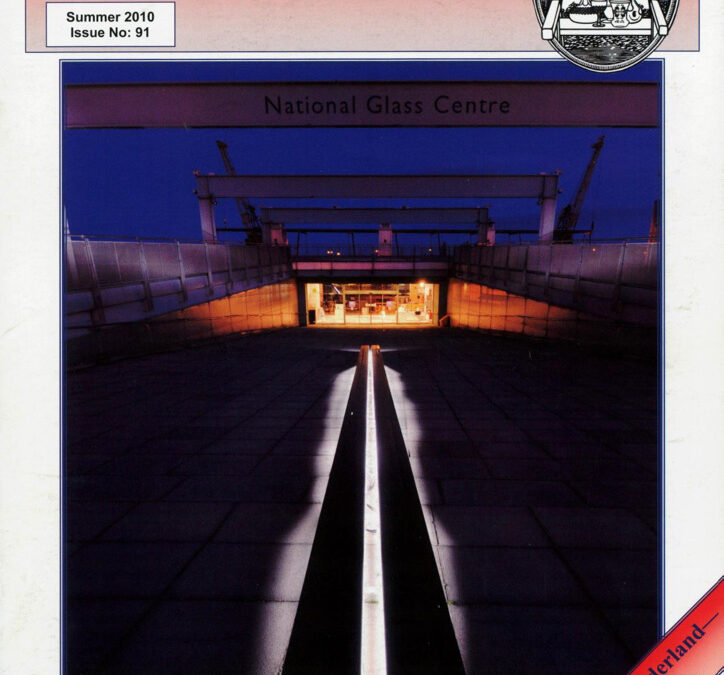
Front Cover: The Entrance to the National Glass
Centre 2009, with ‘Luminous Axis’, by Vaclav Cigler
for the exhibition ‘Light and Water as a Principle’
Whitefriars Cloudy White Lattice
3
Book Review: 20
th
Century British Glass
6
Glass Association Visits
8
Glass Making in Sunderland
9
Glass North East
10
The National Glass Centre
13
National Glass Centre Exhibitions
15
NGC Education—Learning
18
The National Glass Centre Today
19
The NGC Studio
20
Sunderland Artists
21
The New National Glass Centre
23
Friends of the NGC
24
Public Art Project Bears Fruit
24
Sunderland Museum and Winter Gardens
25
New Sunderland Studio—Creative Cohesion….26
The British Glass Foundation
26
20
th
Century British Paperweights—Part 2
27
Book Review: Scotland’s Glass 1610-2010
30
Three Centuries of Glass
31
grop4
Elf
Saturday 17th July
Sunderland Glass Discovery Day
presentations by Jackie Fairburn & Maurice Wimpory at the
Sunderland Museum & NGC, and supporting programme.
Book with Bob Wilcock: editoraglassassociation.org.uk
01277 219598
30-31 October
Annual General Meeting
This year’s AGM will be on Sat.30th Oct. in the spectacular
Victorian Gothic-Revival estate of Tyntesfield near Bristol. We
have lined up some excellent speakers and the predominant theme
of the day is glass during the arts and crafts period.
Full programme and booking form with this Cone.
19-23 May 2011
G.A. Tour to Veste Coburg & Bavaria
From the historic & modern glass museums at Veste Coburg, going
through the Thuringian forest to collections at Laschau and along
the glass route in Eastern Bavaria to Frauenau and Passau.
Provisional programme and booking form with this Cone.
Biennale & International Festival of Glass
The most important event in the glass calendar—don’t miss it!
Stourbridge 28-30 August 2010—www.ifg.org.uk
Collectors’ Fair: Cambridge, Sunday 26 September
Don’t forget your vouchers with Cone 89!
For an up-to-date list offorthcoming events & exhibitions visit
our web-site www.21assassociation.or2:uk/news.htm
Mary Boydell:
As we go to press we have learnt that Mary
Boydell, founder member of the Glass Society of Ireland, passed
away on 8 May, shortly after her 89
th
birthday. An appreciation
will appear in Cone 92.
Chairman
Dr. Brian Clarke: chairman(&,glassassociation.org.uk
Hon. Secretary
Alison Hopkins (secretaryglassassociation.org.uk)
Editorial Board
Bob Wilcock (The Glass Cone), Malcolm Preskett
(The Journal), Yvonne Cocking
Address for Glass Cone correspondence
E-mail to editorAglassassociation.org.uk or mail to
Bob Wilcock, 24 Hamilton Crescent, Brentwood, Essex, CM14 5ES
Address for membership enquiries & back-numbers
Pauline Wimpory, Membership Secretary,
150 Braemar Road, Sutton Coldfield, West Midlands,
B73 6LZ
(membership,glassassociation.org.uk)
Committee
Paul Bishop (Vice-Chairman); Julie Berk; Roger Dodsworth;
Jackie Fairburn; Christina Glover; Judith Gower; Francis Grew;
Mark Hill; Valerie Humphries; Gaby Marcon; Janet Sergison;
Maurice Wimpory (Treasurer)
Website:
www.glassassociation.org.uk
E-mail news & events to news@glassassociation.org.uk
Printed by
Micropress Printers Ltd: www.micropress.co.uk
Published by
The Glass Association
ISSN No. 0265 9654
© The Glass Association 2009
All rights reserved.
Copy Dates:
Spring:
Summer:
Autumn:
Winter:
Articles are welcome at any time, but please bear the above dates
in mind if you have an event you would like to be publicised
Issue No: 91 – Summer 2010
The Magazine of
The Glass Association
Glass Cone
Registered as a Charity No. 326602
21 January—publication late March
21 April—publication late June
21 July—publication late September
21 October—publication early January
2
The Glass Cone—Issue No: 91 Summer 2010
The opinions expressed in the Glass Cone are those of the
contributors. The aim of the Editorial Board is to cover a
range of interests, ideas and opinions, which are not necessarily
their own. The decision of the Editorial Board is final.
Membership & Subscriptions:
Individual: £20
Joint:
£25 Overseas (Ind/Jt): £28
Student:
£10
Institutional: UK £40; Overseas £50
Subscriptions are due on 1 August (for those joining May-July
subs are valid until 31 July of the following year)
The
4
44
It
44** 0
,
I
The exhibition for September 2009 at the
Cambridge glass fair at Linton Hall was a stunning
display of Whitefriars cloudy white lattice vessels.
Mainly from the collection of Graham Hudson,
pieces were also on loan courtesy of The Country
Seat and a decanter with a cloudy white foot and
stopper plus two matching sherry glasses with white
stems and feet from Nigel Benson. This gathering
together of so many examples, showing different
shapes and sizes in the Cloudy White Lattice range,
was exceptional, meriting a permanent place in our
records.
The cloudy white lattice range was
produced from c1928 until the end of the 1930s and
is a highly desirable colour variation. Lesley Jackson,1
in her book on Whitefriars Glass, mentions
(plate 98
p.120)
that the cloudy lattice vessels were first recorded in The
Studio Yearbook of Decorative Art in 1928
(p.154).
Opaque white glass was produced by the addition of
arsenic and tin oxide to the metal and was originally used in the
thermometer-making side of the Whitefriars business. Canes of
white enamel were used at various times in the production of twist
stems and paperweights and streaks of white were used on
ornamental vases in the early 1900s. It was also used for melted-in
threading on decanters and glasses in this era. A feature of this
enamel is that in reflected light it is white, yet with refracted light a
brown tinge is very noticeable; this can particularly be seen on the
lamp base examples.
In conversation, Ray Annenberg, formerly with
Whitefriars, described how the partly free blown vessels were
made. First, a gather of clear molten glass was taken and blown
into a cylindrical shape, to a size comparable to the finished article.
At this point, the white enamel was trailed onto the piece, threading
the enamel evenly, around and along the cylinder. This was then
reheated at the glory hole, spun, blown and gently twisted to
continue forming the required shape; the vessel was then either
blown into a dip mould with an even row of tiny spikes down the
sides – and when the vessel was withdrawn from the mould, the
white threads were drawn upwards by the spikes, producing the
kinks in the trailing and thus the ‘lattice effect’; else the white
threads were drawn upwards using a hand tool, requiring great skill
from the blower. The vessel was then heated again, spun, gently
blown and twisted on the punty iron; twisting in the same direction
gives the spiralling effect, particularly noticeable on the bowls and
dishes. Re-heating, blowing and shaping continued until the piece
was finished. It was very difficult to maintain a consistency in the
thickness & spacing of the threads and there was nearly always a
tendency for them to get thicker at the bottom, but this did depend
on the shape of the object. Comparing the pieces, it can be seen that
there are no two that have the identical patterning. As white enamel
is a difficult material to control, these ranges were short lived.
Graham Hudson researched an interesting cutting from
The Pottery and Glass Record, describing the Exhibition of British
Industrial Art (BIA) design for the home, held at the Dorland Hall
premises in Regent Street in 1933. One item is described as a
Barnaby Powell designed bowl being
“decorated in Cloudy White
Puttice.”(sic) (a typesetting error—there is no such word in the
OED)
The Glass Cone—Issue No: 91 Summer 2010
Today, the White Lattice Effect continues to be
appreciated. The studio glass artist, Anthony Stern, has created a
range of dishes, bowls, vases and lampshades using a technique
with white on clear glass, giving a similar effect to the 1930s
Whitefriars’ pieces. With his work, the “white” remains white,
whether the light is reflected or refracted. Images of two of his
pieces are included for comparison.
For this record, additional vessels from the collection of
Ian Price have been added, including a rare (probably experimental)
“Cloudy Green” lattice example. All the pieces from Graham
Hudson (GH), The Country Seat (CS), Nigel Benson (NB) and Ian
Price (IP), were photographed by Brian Clarke. Additional material
is shown from the Museum of London Archives, with thanks to
Francis Grew. Images are very broadly to scale. Further examples
are to be found in the collection of the Manchester Art Gallery,
pattern no.8608 (accession no. 1997.111) a barrel vase; and pattern
no.8993 (accession no. 1997.112), a vase and posy vase.
Thanks to all the owners of the glass for the use of their
material and to Graham Hudson and Paul Bishop for additional help
with text details.
Brian Clarke
It 1
4
..1 I 4.
4
,
4 NI
,
F
,
Exhibition of British Industrial Art in Relation to
the
Home (
garland
Hall,
Kegent
Street London: 1
933.
1
TAMES Powell & Sons (Whitefriarsi Whitefriars
J
Glassworks, Wealdstone, had a very representative
exhibit of samples of table and decorative glass, show-
ing the remarkable achievements of modern artists in
design and in glass cutting. They had bowls, of various
sizes, designed by modem artists, notably some very
beautiful bowls designed by Barnaby Powell, one splendid
example being decorated in cloudy-white puttice. There
was also a bowl decorated with a carved plate hunting
scene, designed by Burnaby Powell and executed by
James Hogan. There were also vases by many well
known artists, and some beautiful goblets, wine decan-
ters and &lasses. Some of the vases were decorated
with
threaded blue on flint, amber on amber and lido-
blue and ribbon. Some too, were of exceptional beauty,
the ornament being in gold and blue ribbon. Among the
modem specialities were ice plates and grape fruit cups
in gr)1(len amber.
3
13.5in Flared
Bowl 8266 (GH)
4
The Glass Cone—Issue No: 91 Summer 2010
8. Sin Rectangular
Vase 9025
(9023) (G
6.5in Butler Bow
top & side views.
Reflected &
refracted light (R)
7170
(IP)
10 inch bowls
(7192) with normal !attic
work (10) & spider lattice
(Gil)
Rare Wavy
Threaded La
Base c.1932
35
L
`Vase by J.Francis 1927,
only known design
200mm H. mainly
refracted light (left) &
re ected light (CS)
8in x D13in (CS)
Barrel Vase
6.75in 8608
(CS)
Sinai! Sin bowl
(8939)
MoL acc. no.
80.547.661 (GH)
5.25in Butler
BowL Turquoise
Lattice
(IP)
12in Tumbler
Vase 8473
(MoL)
4
12in Lamp Base
mixed light
8942 (GH)
MoL Large Butler Bowl
8.75 D x 6.25 H. MoL
acc.no 80.547.571
Barrel vase 8608
plus unknown design
(MoL)
Large flared
froted vase.
u.
10in Dx Ilin
H 8852.
MoL acc.no.
80.547.572,
Footed BowL 8.25 D x 5in
MoL acc.no 80.542570
Anthony Stern. White Lattice Dish with black border. Nla.v.D I2in
The Glass Cone—Issue No: 91 Summer 2010
5
20th Century
British
Glass
Charles R. Hajdamach
Caw.
Gloss
I45
moso, I
Ovud
19.5.44da.
/X.
02
The long awaited book by Charles Hajdamach, giving a
comprehensive overview of the subject of
“20
th
Century British
Glass”,
and companion to his highly praised tome
“British Glass
1800
–
1914”,
arrived at the end of 2009, filling a gap in collectors’
knowledge of the subject. Although a number of books have been
published concerning individual factories, this is the first
opportunity for collectors to find out about the work of many
British manufacturers and designers throughout one century,
between the covers of one book.
It is indeed extensive, covering a comprehensive range of
topics, from the intricate Art Nouveau designs of Frederick Carder
at Stevens & Williams before his departure to the United States,
through to mass production by Chance Brothers and of Pyrex, and
into the Studio glass movement. There is mention and discussion of
obscure companies intermingled with the well known.
One of the huge pluses of the book is the liberal use of
reproductions of original line drawings taken from archive material.
This includes a goodly number of items from Stevens & Williams
through to Stuart & Sons. For the first time in any publication,
catalogue pages from “The History of Gray-Stan Glass” are
reproduced, giving the widest information available anywhere
about the art glass production of this small but important firm.
Conversely, the author also takes us through the discoveries by
Robert Charleston and discusses the long-known reproductions sold
by Elizabeth Graydon-Stannus giving the reader an understanding
of both sides of the story behind an influential London based
company. This provides the reader with an insight into wares,
whether made for exhibition or general production, with far more
detail about such areas than has been available until now. As such,
it is a valuable resource.
There is an overview of the coloured glass produced
between the two World Wars and the book introduces the reader to
less well known names, such as Haden, Mullet & Haden, alongside
the recognised ones of Monart, Powell (Whitefriars) and Nazeing. It
is understandable if a little disappointing that more information is
not available on some of the lesser known factories. This applies
mainly to more obscure names, such as Arculus, and Century Glass,
although it would also be fair to observe that these makers have
hitherto had virtually nothing, but their name, mentioned in other
books. Such minor frustrations are outweighed by the realisation
that all the information available has been included and the reader is
more aware as a result. For instance paperweight collectors may
well have been aware of production by Arculus of Birmingham but
how many of us knew of their blown vessels?
The chapter on “The Diversity and Richness of Engraved
Glass” takes us through the full gamut of the subject, from
individual commissioned pieces through to runs of items produced
by manufacturers and makes the reader realise how important this
long tradition in British glass really is. John Hutton’s spontaneity is
contrasted with the controlled, fine stipple engraving of Laurence
and Simon Whistler, whose works are both well represented, as is
David Peace whose calligraphy-based engraving is an art form of its
own. Modem engravers whose work has extended the genre have
not been ignored with Peter Dreiser, Katherine Coleman and Alison
Kinnaird, amongst others, being illustrated.
The post-war chapter is the longest, split into sections
covering the eight of the main designers chosen by the author to
represent the period. It is indeed a boon, again, with many
illustrations not previously published; much is taken from private
archives and collections. After a short preamble setting the scene for
post-war glass design, the three designers who had all been to the
Royal College of Art, Irene Stevens, David Hammond and John
Luxton are discussed in detail with predominantly cut works in the
tradition of the Stourbridge area. Having examined how there had
been some ground-breaking work before the Second World War,
the author shows how these three designers were able to break the
mould of what had preceded their non-traditional designs, whilst
showing a progression from predecessors, such as Keith Murray.
In a carefully thought-out progression, the chapter then goes on to
look at the work of Geoffrey Baxter who worked with a firm that
had a tradition of using coloured glass. This progresses seamlessly
into the later 1960s designers, Ronald Stennett-Willson, Frank
Thrower, and Domhnall O’Broin, the influence of Scandinavian
design upon their work and the change in public taste in the 1960s.
The final section looks at the work of Alexander Hardie
Williamson, and his huge influence on bringing design into a vast
number of homes across the UK right up to the 1980s, most notably
through his colourful silk-screened tumblers marketed by Sherdley
and Ravenshead.
The Glass Cone—Issue No: 91 Summer 2010
6
Phu.
OR aw.
k. awe
*dr .let
1978 m
N kJ
•
n
21.5,
..x.00
,
sw
Ow,dhe
mappr.d, 707.0.
,
dight
.1,0 Vale
hos Oft.
hew hods./ henorn
•
khdu hks
n
17,
dnee
Ih.h•nels AR* law
sod resdn…,6, moms
IssIs
dS
1972M. MAI MI. 05 1.0
Thse non hos
d.
hhhhhi phh /hR9
Amos. At dm
SWAMP
of beide
Mrs.
neu.
Puke e
fROX, ael teen Ind eggee *Le
60. 11.k.
0*
121,4
Sh.116 Shah
Tor.rwroue
a*. Paw+
..3.9,94.
1.72(10.1.059..1210.
The diversity of mass production is discussed, including
the pressed glass of Bagley, Chance Bros, Century Glass, Davidson
and Sowerby, as well as the opalescent glass of Jobling. This is
followed by a chapter on Pyrex, its history and the designs used to
decorate it, which can effectively be used to date pieces. Whilst this
may not appeal to everyone it is quite possible to see why a
collector might give it a closer look, since its simple utilitarian
designs emanate from the Art Deco and Modernist era, whilst the
designs upon it follow directly the fashion modes of the day.
An area of collecting that has received very little exposure
in other publications is commemoratives. The background to the
Festival of Britain is discussed, as are some of the events that
happened within the Stourbridge area as a direct result of the
occasion. Intriguingly it is here that we find the origin of the
museum that we now know as Broadfield House Glass Museum.
Whilst many commemoratives were mass-produced to celebrate the
event, there were also commemoratives and souvenirs of high
quality, and one wonders about the general lack of commercial
appeal; perhaps these informative chapters will help redress the
balance. Much is associated with Royalty, and whilst it is probable
that we’ve all seen examples of Chance Brothers plates with
bordered rims commemorating the Coronation, it is less likely that
we are aware that the likes of Keith Murray and even Laurence
Whistler produced designs that also marked royal occasions. The
inclusion of major events (the moon landing, Coventry Cathedral),
sports (the Football World Cup), and politics extends this chapter
into areas that are less obvious to the untutored collector.
The progression of contemporary glass from its inception
in the UK is outlined particularly well in the last chapter, with
reference to early European precursors including the often omitted
Jean Sala. We also find information about unsung heroes, such as
the retired American glassblower Harvey Leafgreen. This writer
cannot recall another book where this name is mentioned, or his
relevance to the beginnings of the Studio Glass Movement; a prime
example of the depth of knowledge such an author brings to the
subject. As is the brief discussion of Harry Seager, whose work
The Glass Cone—Issue No: 91 Summer 2010
from the early 1960s, using plate glass for sculptural forms,
foreshadows its later use by designers such as Danny Lane.
Whilst the reader might be conscious of the beginnings of
studio glass in the UK through the work of Sam Herman, they
might not understand how that progressed through the influence of
further education and the addition of glass courses to the
curriculum. We are given a greater understanding of this, with the
author following the emergence and creation of contemporary glass
courses from their beginnings, to their availability and who taught at
them. Unlike many previous books covering this subject, which
tend to focus on the sophisticated and aesthetically appealing
designs of a movement that has come of age, here there are
illustrations of early works that exhibit a naivety that might now be
wondered at, but that are essential to the story. The later
sophisticated and accomplished works that tell us that contemporary
glass has reached maturity are also well represented and complete
the overview of a century of British glass design.
Lastly, there are two areas that have been included in the
book that are often overlooked by collectors of much of the
foregoing. These are paperweights, which have a following in their
own right, and lamp-worked glass, which as the title of the chapter
suggests, is often associated with seaside souvenirs, yet there are
also established and highly collected studio exponents. It is good to
see both strands of the history of 20
th
Century British glass included
in this wide ranging volume allowing a cross fertilisation of
collecting attitudes.
The book’s front cover is interesting, given the use of
Maltese glass; however it draws attention to the work of the first
British contemporary glass designer/maker, Michael Harris, to set
up a studio abroad, so spreading the influence of what was then the
new British Studio Glass Movement
It is pleasing to observe that, unusually for any author,
Charles Hajdamach has taken the opportunity to draw attention to
other people’s input into the world of glass; where mentioned,
authors and dealers who have some relevance to the subject are
treated with the same acclaim. The author has used his skill in
deciding what to cut and what to keep, and the delicate balance has
been achieved, giving us an informed view on the vast array of
subjects covered within such a weighty tome – be ready to
strengthen your desk, because this book is certainly not one for idle
reading! In conclusion, another unwieldy compendium to add to the
shelf, but this is easily forgiven, especially when one finds such a
wealth of information between the covers. It is all but guaranteed
that this will become the standard work of reference and a must for
anyone interested in the subject of 20
th
Century British Glass.
Nigel Benson
**Special Reader Offer**
The publishers are offering readers a 20% discount
with free P&P, (£39.50 rather than £49.50).
Orders can be directed to the mail order department
on 01394 389977, quoting ‘Glass Cone Reader
Offer’.
Offer expires: 31st October 2010
Committee is pleased to announce that Charles Hajdamach has
accepted a proposal that he become Life President of the
Association.
In accordance with the GA constitution, members will be asked
to approve the appointment at the AGM in October.
7
Chelmsford Museum, Saturday 6
t
March;
The Tunstill Collection of 18
th
Century glass
A group of twelve of our Glass Association’s 18
th
Century
British Glass enthusiasts gathered together at the Chelmsford
Museum on Saturday, March 6th eagerly looking forward to a
private presentation of the Tunstill Collection, from the Keeper of
Art at Chelmsford Museums, Miss Anne Lutyens-Humphrey.
The entrance via the new museum extension was
impressive, as was the education room where we were given an
overview of Frederick Walter Tunstill (1875-1958) and his
collection of drinking glasses. Working as a commercial traveller
for the Electrical Collection Co. based in Wolverhampton allowed
him to roam the country and make the side visits necessary to
follow his collecting passion.
Chelmsford museum’s home is in the Grade II listed
Victorian “Oaldands House”; this was built in 1866 and was
modelled on Osborne House, Queen Victoria’s residence on the Isle
of Wight, a very elegant building. The Tunstill bequest was made in
1957 and though the new extension was officially opened in
January 2010 the glass collection is still in a rather small room in
the main house. The McKelvie collection shares the cabinets with
Tunstill’s and is a rather fine collection of thirty-six 18
th
Century
Ale glasses.
Tunstill’s collection of 18
th
Century glass numbers over
400 items and spans the period c.1695 to c.1800. The collection has
examples of heavy balusters, moulded pedestal stems, “balustroid”
stems, light balusters, plain, air twist, composite, hollow and incised
stems; opaque, colour and mixed twists, a glass enamelled by the
Beilby family and, finally, faceted stems. As with a number of
major collectors of that era, he had a good eye for drinking glasses
and had Barrington Haynes’s publication
“Glass Through the Ages”
to help guide his purchases.
Sadly, the collection does not yet have digitally recorded
images and it was impractical to take adequate photographs on the
day. A job to be done! However, of the many glasses that appealed
to me, a few really do deserve description:
Facing you on entering the display room, placed in front
of the central cabinet, is a magnificent Mammoth Baluster Goblet,
standing just on 10in tall; a large round funnel bowl sitting on a
large triple annular knop over a true baluster with a tear, finishing
up on a wide folded foot; this is
an iconic baluster, the colour of
the metal and overall form
coming together in a creation,
which is a masterpiece of English
glass of the early 18
th
Century
(illustrated above right).
Nearing
perfection of form is the Ale
glass (accession no.R30061), a
long waisted bell bowl drawn
into a straight stem section over a
basal knop, large feared ball knop
and a cushion knop over a
domed foot — of delightful
balance and a joy to hold. The
deceptive short baluster and
deceptive tall wine
(illustrated
left),
with the cordial (accession
no.R30126) crafted from a dark
grey brilliant metal, would grace
any 18
th
Century cabinet. The
facet stem collection was
extensive, with particular
examples being (accession
no.R30380), the stem and foot
faceted, with an engraved bowl of
an insect and flower and
(accession no.R30382), an
ogee
bowled example with the bowl
and stem being cut with diamond
facets on a plain foot. Lastly,
a
rare ale glass from the McKelvie
collection (MCK28), a long
round funnel bowl over a double series opaque twist stem on a plain
foot, the bowl was decorated with an enamelled single barley stem
and a single hop; the museum list attributes this as possibly by one
of the Beilby family.
Thanking Anne and the museum staff, we left satisfied
and in good spirit, Anne joining us for a late lunch in Chelmsford.
This was Anne Lutyens-Humphrey last engagement with
a group of collectors at the museum. Due to staff restructuring, she
has now left the museum. We wish her well in her future enterprises
and thank her for a delightful morning.
Brian Clarke
South West Meeting, 24 April
On Saturday 24
th
April members from the South West
region met again in Clevedon to listen to and enjoy two very
different presentations from Maurice Wimpory and Dr. Geoff
Lawson. Maurice’s talk on Tiffany, Steuben, Hawkes and Evans
was based on a visit to southern USA last year, where he visited
museums which housed the various glass collections. He showed
some stunning slides that were obtained with the permission of the
museums concerned, which gave me an appetite for a trip to trace
Maurice’s steps. The talk was supplemented by some interesting
items from his Chinese pressed glass collection.
Geoff spoke about the
Swedish glass industry
in the 20
th
Century and
the designers and styles
of glass that influenced
its development. This
again was backed up
with an excellent and
very comprehensive
display of slides
illustrating these different
styles and the work of
various designers. Geoff also
brought along some fine
examples of Swedish glass
to complement his talk.
As with last year’s meeting,
members also brought along various pieces of their own glass to
show and discuss. It was a very enjoyable and informative way of
spending a Saturday afternoon.
Valerie Humphreys
Gmal Pa r Vdsi
,
hy E_v
~
land
8
The Glass Cone—Issue No: 91
Summer 2010
Unique window in St Paul’s Jarrow, retaining its
original inserted slab of stone with its small
circular light only 7″ in diameter and containing
fragments of Saxon glass found during an
archaeological dig in the church grounds in
1973/74. The fragments were then placed in the
window to form a mosaic:
The first stained
glass to be
produced in
Britain
was
made
in
Sunderland by
French
craftsmen
imported from
Gaul in AD674
by Benedict
Biscop. Biscop,
Abbot of the
new monastery
at Wearmouth
invited them to
make the
windows for St
Peter’s Church.
The Frenchmen
then taught local
people to make
glass.
A
hundred years later the monastery contacted glassmakers in Mainz,
Germany, asking them for help in creating glass vessels. Through
these extraordinary international contacts Wearside became one of
the earliest glassmaking centres in this country.
Despite this early interest, glassmaking did not become
properly established in Britain until the 12th Century when French
and Italian glassmakers worked in Surrey and Sussex. Fuel was
needed for furnaces and wood was easily obtained from the forests
of South Eastern England. However in 1615, to protect the
diminishing forests, James I banned the use of wood as a fuel for
glass production. North Eastern England, however, had a plentiful
supply of cheap coal to offer the glass industry. In 1611 a group of
gentlemen were granted the exclusive right to make glass in
Tyneside. Glassmaking had returned to the North East.
Between 1615 and 1642 the glass industry in England
was dominated by Sir Robert Mansell. He bought the exclusive
right to glass making in Tyneside and established a glassworks in
Newcastle. There he had a ready supply of coal and his wares could
easily be transported by ship. In 1623 Mansell was the exclusive
producer of glass in the whole of England.
When the Civil War finally ended Mansell’s monopoly,
Newcastle’s Guild of Glassmakers established their own, making it
impossible for anyone to operate a glassworks nearby. However,
cheap coal and regular shipping were available in Sunderland and in
1696 the Sunderland Guild of Glassmakers was founded. They built
3 glasshouses, which produced bottles and glass for windows.
By the 19th Century glassmaking had become a hugely
successful industry in Sunderland. More glasshouses were
established and glass was being shipped all over Europe. Window
glass and tableware were made in Sunderland but bottles were the
main product. By 1833 Sunderland produced more bottles than
anywhere else in the North East with each bottle maker making
over 4000 items a week. By 1860 over 1000 glassmakers were
employed in more than 20 companies.
John and James Hartley established the Wear Glassworks
The Glass Cone—Issue No: 91 Summer 2010
at Deptford on the South Bank of the Wear in 1836. In 1838 James
Hartley was granted a patent for a new process of casting glass.
This rolled plate glass was incredibly strong translucent and
affordable – ideal for the large skylights and roofs needed by
factories and railways. The Wear Glass Works became very
successful. Hartley’s plate glass was transported world-wide and
licences for the process granted to other companies. In the 1860s
Hartley’s were producing one third of all sheet glass used in
England.
The Hartley’s also experimented with coloured glass.
Continuing a tradition that began in the 7th Century they produced
beautiful coloured glass for church and cathedral windows.
Though the Wear Glass Works closed in 1894 the
Sunderland tradition of stained glass continued with James Hartley
Jr. (grandson of James) and Alfred Wood, a talented colour mixer
from Birmingham. The inspirational coloured glass made by
Hartley Wood can be seen in Westminster Abbey, St Paul’s
Cathedral and the House of Commons. Hartley Wood closed in
1997. The rump of the business, Sunderland Glassworks Ltd,
moved into the NGC when it opened, but failed after little more
than a year.
James
A Jobling took
over
the
struggling Wear
Flint Glassworks
in 1885 and
made it into one
of the largest and
most successful
glassmaking
factories in the
country.
Jobling’s
assistant and
Jobling 1930’s classic fern bowl in an unusual
nephew Ernest
Jobling Purser
was a dynamic and visionary business manager. In 1921 he
acquired the patent rights for the production of a heat resistant glass
from the American company Corning – Pyrex.
These glassworks began making headlamp glasses and
traffic signal lenses in 1930s. By 1954 they were producing
4 million headlamps per year. By 1960 the factory was
concentrating solely on its special glasses like Pyrex and Pyrosil as
demand had increased so much. Because of Jobling’s foresight
every piece of British Pyrex domestic tableware has been made in
Sunderland until the closure of Corning’s UK factory in 2007.
black glass (Jackie Fairburn)
St. Peter’s Monkwearmouth and St. Paid ‘s Jarrow
Kiln _ fin nual glass drawings (2008) hr .S’underlaturs Kevin Petrie
9
SS
NORTiiiiiii
iimmim
Northern Arts, the regional arts development agency,
where I was Head of Visual Arts, 1974-1993, embraced and
integrated the crafts in the existing visual arts infrastructure.
Remember those debates about art and craft? Quickly, with national
Crafts Council grant aid, Northern Arts set up a new supporting
crafts programme. A Crafts Officer, Barbara Taylor, was appointed
in 1979. Funding for crafts projects, exhibitions and collections (e.g.
Shipley Art Gallery and Cleveland Crafts Centre, now the
Middlesbrough Institute of Modem Art [MIMA]) was established.
Fellowships and artists in residence schemes were initiated to seed
and stimulate high quality practice.
A regional focus of national importance was required,
something distinctive and of place. Glass was the obvious choice.
Tyneside and Wearside have a long history of glass production.
There was still a flourishing glass industry in the 1970s, with
companies producing antique glass, tableware and scientific/
industrial products. Richard Hamilton, then lecturing at Newcastle
University, was sanctioned to re-make Marcel Duchamp’s
‘The
Large Glass’
for the Tate Gallery (1966) [www.tate.org.uk]. It was
a totemic statement.
Artists are attracted to glass and its properties of
transparency, translucency, refraction and reflectivity. Glass is made
though melting, and it was working the hot glass which was of
particular international and UK creative interest at that time.
Charles Bray, lecturer at Sunderland Polytechnic, now
University of Sunderland, was the key early figure. It was really his
energy, enthusiasm and commitment that started the creative glass
programme, with strong links to material technologists and the glass
industry. Professor Flavia Swann’s essay in
‘Sunderland Glass
Connections’
ISBN 1-873757-19-0 gives a remarkable account of
these early years and the development of Studio Glass at the
University of Sunderland.
From the start, the end was clear – the region needed BA
applied arts courses to achieve structural change. The reasons are
self-evident. Such courses employ artists as staff, generate resources
and built up specialist expertise – and, as important, attract students
to the region. So it has proved. The University of Sunderland
graduate stream has created the high quality glass artists’
constituency.
Northern Arts sought to establish a creative environment
and to invest in Higher Education initiatives. Northumbria
University was assisted with the establishment of its crafts/design
course through the appointment of Julia Manheim as Jeweller in
Residence. It was however the University of Sunderland and glass
support which became structurally important. Northern Arts
supported Sunderland Arts Centre’s exhibition
Suomen Lasi –
Finnish Glass’,
1979, and British Art Glass initiatives, which
evolved into the Contemporary Glass Society, as well as other
projects. The early funded architectural glass commissions were
supported e.g. Susan Bradbury (Newcastle College), Mike Davis
(St. Nicholas Hospital, Gosforth).
Anita Pate and Jenny Antonio, known as ‘Charlie’s
Angels’, Susan Bradbury, Stephen Procter (who moved on to head
the Glass Department at The National College, Canberra) were
appointed artists in residence at the University of Sunderland. Later
residencies took different forms, including Sue Woolhouse’s 3-year
appointment as Stained Glass Artist for Sunderland, with its
interaction with schools and communities.
The BA 3D Design: Glass, Architectural Glass &
Ceramics was validated and started in 1982, led by Goran Warff.
with Willy Andersson, from Sweden. Professor Flavia Swann,
Dean, The School of Arts, Design, Media & Culture, the University
of Sunderland, fresh from ceramics power house of the University
of Staffordshire, came to a similar conclusion about the importance
of glass. Her remarkable, sustained and inspired contribution led to
the blossoming of the department.
Notable was the rise of research interests, with the
creation of a Glass Research Institute. Three Research Professor
appointments were made in the mid-nineties – Dan Klein, Zora
Palova and Sylva Petrova—and, with the partnership of Tyne and
Wear Development Company, City of Sunderland, Arts Council
and the University, supported by the new Lottery Funds, there was
a drive to establish a National Glass Centre in Sunderland.
The Glass Infrastructure
Contemporary creative glass in NE England has several
complex interlocking and integrated elements, such as artists,
artists’ groupings, supporting organisations, industry, funders and
audience. In structural terms, the University of Sunderland, the
National Glass Centre, artists’ formal groupings (Cohesion, Cobalt,
Designed and Made, etc) and the ambition of individual artists are
the driving force within the region.
The glass industry is going through considerable change,
with the impact of cheap production costs in the developing world,
and the advent of new materials. This can be seen by the closure of
major glass workshops in the UK, such as Caithness Glass and
Edinburgh Crystal. In 2006 Newalls, the Coming glass plant, closed
in Sunderland. The present NE glass industries include: Schott
International, Saint Gobain plc, Peterlee Glass, Creative Glass,
Wearside Glass Works, various small companies and a number of
creative micro-businesses, based on partnership or usually
individual glass artist’s practice.
NE England offers exceptional artist’s support, which is
available at every career stage. Arts Council England, Culture
Business Venture, Business Link and the Crafts Council amongst
others offer advice, assistance and a range of schemes. New
cultural and glass businesses are very welcome and are supported in
various ways. In Sunderland, Professional Development is now
embedded from the first year in glass/visual arts programmes.
Creativitiworks has been established to assist graduates with
business plans, in setting up or in undertaking projects.
The NE region has a lively visual arts constituency and is
known for its active programme of events, projects, residencies,
commissions, exhibitions and galleries e.g. UK Year of Visual Arts,
1996. The National Glass Centre is the only specialist glass gallery.
Other local authority galleries though, such as The Shipley Gallery,
Sunderland Museum and Art Gallery, and MIMA regularly exhibit
glass and have glass artifacts in their collections. Glass though is
integrated into the visual arts.
In cultural terms glass in NE England has an international
significance. Tyne and Wear has one of the highest densities of
glass practitioners in the UK. Nearly all these glass artists have been
educated in, or have some association with, the Glass department of
the University of Sunderland.
The Glass Cone—Issue No: 91 Summer 2010
10
Students working in the University’s Hot Glass Workshop
The National Glass Centre
Glass has been made in Sunderland for over 1300 years.
The Christian scholar Benedict Biscop brought craftsmen from
Gaul to create glass windows for the scriptorium of St. Peter’s
Church, Monkwearmouth, in 674 AD. The church stands adjacent
to the University of Sunderland’s St Peter’s Campus and the
National Glass Centre in its new landmark building, built on an old
dry dock.
The National Glass Centre (NGC), opened in 1998, is
dedicated to the development and promotion of excellence in the art
and industry of glass. It is essentially concerned with the greater
understanding and the practice of contemporary glass making.
The NGC houses galleries, artists studios and production
facilities, a craft & design shop and restaurant and has a programme
of changing exhibitions, education programmes and events for
schools, families, adults and children to explore, be creative and
learn new skills.
The NGC has become one of the two main glass
exhibition galleries in the UK, and presents major exhibitions,
commissions, international fellowships and residencies. The track
record of exhibitions has been remarkable. Many of the most
important glass artists have exhibited their work to a NE audience.
Exhibition often extends beyond gallery spaces into the entire
building. A distinguishing feature of the programme is an
exploration of how glass is used or combined with other materials,
mediums and disciplines for different ends. Inspired by the
properties, qualities and characteristics of glass with other
disciplines, the NGC aims to stimulate new and existing audiences
and provide exciting opportunities for artists to produce and present
their work.
The Glass Cone—Issue No: 91 Summer 2010
The University of Sunderland
English antique glass, mouth blown, was made in
Sunderland by Hartley Wood which became Sunderland
Glassworks. It moved to the new National Glass Centre and was
central to the visitor attraction strategy. When the company closed
an ambitious decision was made to relocate the whole of the
University’s Glass and Ceramics department to the large factory-
like floor space and to build education facilities for glass to the
highest standards.
The University has a mission of teaching and learning,
research and reach-out. The Institute for International Research in
Glass (HRG), established 1998, leads and integrates the research.
IIRG presents an international programme of Fellows, residencies,
exhibitions, conferences, lectures and master classes. Research is
central to projecting the department into the leading tier of
European/World Glass higher education institutions, so attracting
further inward investment, increasing quality, extending
opportunities and enhancing the student experience.
The department is the largest of its kind in Europe, with
some 100 BA, MA and PhD students. It works comfortably across
a wide span of crafts – fine art – design, with different forms of
practice, and with material technology.
Presently there are some 15 academic and technical staff:
Prof. Peter Davies, Prof. Sylva Petrova, Prof. Kevin Petrie, Dr. Jack
Dawson, Colin Rennie, Dr Andrew Livingstone, Cate Watkinson,
Inge Panneels, Jeffrey Sanniento (RCUK Academic Fellow), Ellen
Dorans, Tim Betterton, James Maskrey, Robert Winter, Stephen
Beardsell and Matt Jobling.
Anne Vibeke Mou and Philip Vickery are presently artists
in residence, while Kathryn Wightman and Mimi Joung are on
Crafts Council ‘Next Move’ two year placements in the department.
The unique glass facilities have been supported by
European, regional development and higher education grants. This
has helped provide a substantial range of equipment including:
extended hot shop, CAD Water-jet cutter, and large kiln, print and
architectural glass workshops.
Over thirty years there have been valuable contributions
from staff, numerous visiting lecturers including: Margaret Alston,
Galia Amsel, Jenny Antonio, Kirsteen Aubrey, Sara Bowler,
Charlie Bray, Effie Burns, Sarah Chrisp, Dillon Clarke, Alan Davis,
Mike Davis, Morag Gordon, Jim Griffiths, Susan Hill, Kathryn
Hodgkinson, Ed Iglehart, Laura Johnston, Christina Kirk, Dan
Klein, Zora Palova, Elizabeth McClure, Charlie Meaker, Zora
Palova, Anita Pate, Steven Procter, Sarah Richardson, Bruno
Romanelli, Mike Saul, Bibi Smit, Sien van Meurs, Chris Watts,
Rachel Woodman and Sue Woolhouse.
The international dimension of the programme and cross-
fertilisation of ideas, research and practice is evident in many ways.
Present Visiting Professor is Zora Palova (Slovakia), who
was a Research Professor. In the recent past Visiting Professors
have included Dan Klein (former head of department), Oiva Toikka
(Finland), Stepan Pala (Slovakia) Jiri Harcuba (Czech Republic),
Bertil Vallien (Sweden). The University has conferred Honorary
Doctorates on Stanislav Libensky and Jaroslava Brychtova (Czech
Republic), Antony Gormley (UK), and Bill Viola (USA).
Reach-out and ‘reach-in’ access schemes support the glass
sector and the visual arts constituency. Annually some 40 artists and
researchers come to undertake projects in the workshops.
11
Alena Matejkova’s Magic Carpets
The UK’s largest ever piece of kiln-formed glass was created by an
artist at the University of Sunderland in 2004, weighing in at a staggering
30 kilos and measuring 1.8m by 1.4m, Alena Matejkova’s Magic Carpets
surpasses anything produced in the UK before.
The impressive design was formed in western Europe’s largest kiln,
at the University’s glass department at the National Glass Centre.
Czech artist Alena came to the University especially to work on
pieces of this size. She has won awards in Italy, Denmark and the Czech
Republic. She was influenced in creating Magic Carpets by some of the
UK’s ancient stones and gravestones. Alena says she wanted to connect
the Middles Ages with modern technologies now used in Britain.
Alena has produced smaller versions of Magic Carpets which will
be kept at the university, while the major piece will be exhibited around the
world.
Sylva Petrova, professor in glass at the University, was instrumental
in bringing Western Europe’s largest kiln and Alena to Sunderland Any
kiln-formed glass of this size in modern British architecture has come from
abroad Now the university can supply modern architects in the UK with
what they want, as well as offering a unique facility to students and artists.
Artists’ Societies and Groupings.
Cohesion, established 2001, is now a UK
Glassmakers’ membership organisation. Initially NE based, it
results from the growth of small glass businesses, which
produce handmade, designer products and undertake
architectural and other commissions.
Cohesion seeks to assist and support the region’s
glass businesses and practitioners by developing their skills,
creating new opportunities and promoting the quality and
diversity of their work to wider markets. A professional
secretariat has undertaken various strategic initiatives from
specific schemes for makers, lectures, site-orientated
exhibitions, publishing of a newsletter, to attendance at trade
fairs. Cohesion is supported by the City of Sunderland.
Other regional groupings and studios as one might
expect comprise of a mix of artists. Designed and Made, as its
name implies, is an applied arts/design grouping.
The Ouseburn Valley in Newcastle provides
accommodation for a clustering of visual arts businesses. The
Biscuit Factory is a brave combination of commercial gallery
and crafts shop, with studios. Nearby is Cobalt, with Effie
Bums and Kathryn Hodgkinson, with recently developed
new studios. The Ousebum Warehouse offers traditional
artists’ studios and within walking distance is Mushroom
Works. Newcastle Arts Centre, close to Central Station has
studios, exhibition space and a shop.
Nationally the Contemporary Glass Society is most
important for artists. Specialist societies, such as the British
Society of Master Glass Painters, The Worshipful Company
of Glaziers and Painters in Glass, and the Guild of Glass
Engravers, as well as wider based groups, such as Art and
Architecture, have regional membership.
In 2006 The Society of Glass Technology held its
Annual Conference, with an Art and Science strand, in
Sunderland, attracting some 500 delegates.
The platform
NE England has the highest density
of micro and small to medium glass enterprises
(SMEs) in the UK. On the NGC footprint, the
NGC and the University of Sunderland /
Institute of International Research in Glass,
present a critical mass of programmes, facilities
and activities in contemporary glass of a
European order. Well supported, integrated,
lively, with Cohesion, artists’ initiatives,
galleries, and the strong visual arts
infrastructure, then the region can make a
credible case for being a European centre for
contemporary glass.
Peter Davies
Professor, Head of Glass and
Ceramics,
The University of Sunderland.
This essay first appeared in
‘Glass
North East’
by Professor Davies, published by
Art Editions North in 2007
(ISBN 978-1-873757-28-4)
`Unity’
hot glass sculpted and coldworked
by Colin Rennie
Art met politics in January when
Nick Brown, the Minister of
State for the North-East,
launched an exhibition of North
East glass art at the Houses of
Parliament.
The
Glass North East
exhibition
featured the work of lecturers,
professors and graduates of the
University of Sunderland. The
collection of works highlighted
the range and quality of glass
research being carried out at
Sunderland.
The Glass Cone
—
Issue No: 91 Summer 2010
12
nindon
,
The National Glass Centre was the first cultural building
to open in the UK funded by a Capital Arts Lottery award. It was
officially opened by HRH Prince Charles on 23 October 1998. A
competition initiated by Tyne and Wear Development Corporation,
and funded by the ERDF and the Arts Council / National Lottery,
set out to find a design that would celebrate the heritage of glass
making in Sunderland and support the development of new glass
production for the 2 l
st
Century.
Over eighty architectural practices entered the competition
which was won by Gollifer Associates. Gollifer Langston (as they
now are) is an architectural studio for commercial, education, arts,
media, residential and public design. The practice, based in central
London, was founded in 1994 by directors Andy Gollifer and Mark
Langston.
Their proposal aimed to make the activities and
production going on inside the building accessible and visible from
the unique glass roof, that visitors could walk on, and also enjoy
views to the North Sea, looking out towards Europe. Its
architectural features refer to the shipbuilding and coal industries
that have played a key role in the development of the heritage and
landscape of the area and site.
The building was constructed by Kavemer Construction
Limited. Work on the foundations started in January 1997, and in
May there was an official ceremony to mark the opening, attended
by news reporter Kate Adie, and Geoffrey Bond of the Worshipful
Company of Glaziers. Two local school-children buried a time
capsule—glass of course, made in Sunderland by Coming
(Glass
Cone No 43, Autumn 1997).
The building cost some £16 million,
and opened to the public in June 1998. In the four months before
the official opening it attracted 70,000 visitors, and in the first year
160,000.
The Glass Cone—Issue No: 91 Summer 2010
`Light Transformer’ by Stepan Pala and Zora Palova,
who is Professor in Glass at Sunderland University.
It was made in the Czech Republic and weighs over
1,000 kilos.
Three works of art were commissioned through a national
competition: Professor Zora Palova of Sunderland University and
her partner Stefan Pala, both of Bratislava produced ‘Light
Transformer’, a coloured lens with two parallel optical prisms
which stands near the main entrance; Laura Johnson, a Sunderland
Graduate, designed a shoal of fish, some 80 pieces of dichroic glass
which change with the light, suspended from the roof, and guiding
the visitor into the heart of the Centre, while fellow graduate
Bridget Jones produced 18 stained-glass panels depicting the
history of glass-making in Sunderland.
When it opened, there was no comparative institution
anywhere in the world, combining as it did entertainment and high-
quality craft provision. It was, and is, an amalgamation of an
exhibition gallery, artists’ studios, glass manufacturing of every
kind, seminar facilities, a superb riverside restaurant and a shop to
showcase the best of British glass. It is not, and was never intended
to be, a museum, and it does not have a permanent collection of
glass, nor does it acquire glass. Thus it does not compete with
Broadfield House, nor Sunderland Museum, but complements
them.
While it was undoubtedly a success with the visitors in the
first year, the NGC got off to a troubled start. The director initially
appointed was Shiona Airlie, previously Curator of the Dutch and
Glass Collections at Glasgow Museums, and the daughter of John
Airlie who ran Kirkhill Glass in the 1970s in Edinburgh. (She is co-
author with Brian Blench of
“Scotland’s Glass: 400 Years of
Glassmaking”,
reviewed on p. 30). Having overseen the project
13
was a great boost for the Centre, and for visitor numbers. The
Centre entered into a partnership with Sunderland City Council and
other key partners, including the Arts Council, TyneWear
Partnership, the University of Sunderland and Tyne & Wear
Museums, to secure a new way forward for this national cultural
venue. It brought about a subtle but important change of emphasis
in the Centre’s remit and activities: the aim was to develop the
National Glass Centre as an outstanding cultural facility for local
people, visitors and artists. New educational facilities for school
visits were created, as well as riverside rooms for events and
conferences. Glass remains at the core, but the NGC’s activities
now cover a much broader cultural and artistic spectrum.
From the earliest days, when initial cost over-runs meant
virtually no money for furniture for the staff, or for a proper
computer system, financing has been one of the biggest headaches,
as it is for all such organisations, and financing perhaps remains the
Centre’s biggest challenge. In 2008 The Northern Rock Foundation
awarded a two-year grant of £150,000 towards a programme of
exhibitions to attract a wide audience, funding fortunately not
affected by the collapse of Northern Rock. The accounts lodged
with the Charity Commissioners show that for the period to 31 July
2009 the Centre’s outgoings exceeded its income by some
£328,000. Half its income was from trading, the balance largely
grants. Its trading income did not quite cover its trading costs, and
the grants did not quite match the charitable outgoings. Income did
exceed outgoings in 2005-6, but has not since. The changes since
last July are aimed at balancing the books, and the NGC and
University are working together to achieve this. There has been a
significant increase in visitor numbers, so signs are good.
The Centre’s vision in 2010 is to be known locally and
nationally as a vibrant cultural venue, presenting engaging and
thought-provoking exhibitions, inspired by the craft, science, and
history of glass, supporting the production of new glass and
delivering creative learning opportunities for all.
Its aim is to be a centre of national excellence supporting
the production, exploration, presentation and enjoyment of
contemporary glass.
Its objectives are:
through construction to opening, and dealt with the many
challenges of finance and of conflicting visions between the various
organisations involved, unfortunately, ill health obliged her to retire
before the official opening.
The NGC was primarily funded by grants and admission
charges, but integral to the financial success of the Centre were
plans for Sunderland’s renowned traditional glassmakers, Hartley
Wood, and contemporary glassmakers Phoenix Hot Glass, to
become tenants of part of the premises. In November 1997 Hartley
Wood was taken over by a German company, and production
ceased. A group of former employees formed a new company,
Sunderland Glassworks Ltd, and they moved into the Centre, but
the company failed to win a foothold in the stained-glass market,
and collapsed after 18 months. There was an inevitable effect on the
Centre’s finances, but income from the glassworks reportedly
represented only 2-3 per cent of the Centre’s income although the
firm took up 80 per cent of tenanted space. .A year later the
University moved into the factory area.
When the Centre opened there was a charge for entry, and
this was increased to £5 in November 1998. Visitor numbers
declined, falling far short of the 250,000 per annum on which
financing was based—only some 40,000 in 2001-2—and the
Centre was reportedly losing £100,000 a year. A £500,000 rescue
package was needed, but still the Centre struggled. Then, in 2006,
Sunderland City Council stepped in with a grant of £100,000. This
released additional funding of £275,000 from the Arts Council and
Northern Arts, and enabled admission charges to be scrapped. This
1.
To present a thought—provoking, exciting and
adventurous programme of exhibitions and
creative projects that explores ideas through glass.
2.
To provide high quality educational resources and
learning opportunities for schools, families, adults
and children
3.
To support artists/designers working in glass by
providing studios, production facilities, and advice
and making services.
4.
To establish the NGC Shop as the key national
outlet for the promotion and sale of UK glass.
5.
To establish the Glass Studio as a renowned
producer of artist designed glasswork and bespoke
private and corporate commissions.
6.
To establish Throwingstones Cafe & Restaurant as
a key dining destination for local people and
visitors to the region, and the National Glass
Centre as one of the best conferencing and events
venues in the region.
A
school party at the ‘Space-Time’ exhibition in 2009, discovering Kiki
Smith’s Constellation
14
The Glass Cone—Issue No: 91 Summer 2010
Shiona Airlie curated the first
exhibitions, starting with
‘Glass UK’
featuring the best of British
contemporary glass-makers. This was
a bold and exciting exhibition, and
fascinating to look back on twelve
years later.
It showcased over 130
works from more than 80
artists, partnerships, studios
and companies, examining
the origins of the British
Studio Movement from its
inception in the 1960s and ’70s
when Sam Herman arrived from the
USA, and charting its development in
subsequent twenty years. An increasing number of artists
became captivated by glass, and they, with the established makers,
were constantly pushing forward the boundaries, technically and
artistically, aided and abetted by a healthy influx of artists from
abroad.
The exhibition included work from 13 artists
in “The First Wave”, starting naturally with
Sam Herman (and Sam is still working in
glass today), and including such well-known
artists as Norman Stuart Clarke, (who has
been regularly coming back to the NGC to
make glass in the last few years), and the
`honorary Briton’ Peter Layton, who has
become one of Britain’s leading
ambassadors for glass. Others in the first
wave, such as John Herald Cook and Ray
Flavell, inspired so many through their
teaching.
The rest of the exhibition followed a natural
progression showing the development of
contemporary glass away from utilitarian
vessels. Artistic work emanating from factories (Dartington, and
Caithness) and workshop studios led to fascinating abstract vessels,
including engraved vessels, and the exhibition concluded with a
look at the sculptural form.
Looking back today at the exhibition and the selected
artists, it is a powerful testament that there are a dozen or more who
had world status and have consolidated that status, or have since
acquired world status. There is nobody who has vanished into
obscurity. There are one or two still making today works that are
very similar to those of twenty years ago. Looked at positively it
shows that those artists are producing works of art that have a
timeless quality and a strong universal appeal, but there are one or
two instances where you wonder whether they have stagnated. A
question for another exhibition in the near future perhaps?!
`Glass UK’
moved on to Edinburgh to be replaced by
`New Danish Glass’
the NGC’s first international exhibition,
mounted with the assistance of the Ebeltoft Glasmuseum. Nine of
the nineteen artists whose works were shown had studied or spent
time in the UK (two of them at Sunderland), others at major glass
institutions in Sweden or the USA (several at the famous Pilchuck
School of Glass).
The artists have subsequently developed
their careers outside the UK, and none of them
have become well known here.
Another
exhibition from Ebeltoft was of an artist who is
well known, Ann Wolff, who was a
designer for Kosta Boda for 14 years, and a
teacher at Pilchuck.
‘Observations’
in 2005-6
had some 80 pieces showing the wide range of
skills and techniques she employs, and Ann
herself came over to talk about her work.
`Smash’
tongue-in-cheek title for an exciting exhibition in
2002 of colourful, fun, and stylish works from contemporary artists
working in
the
home of glass, Murano, in Italy, works
commissioned by Emmanuel Babled, consciously stepping away
from the tourist kitsch so prevalent in Murano today.
In 2002-3
‘Smooth Finnish’
focussed on the
distinct aesthetic and design emanating from Finland,
and
came
l’apio Wirkkala, Design
Legend from Finland’,
some 600
works (in glass and other
materials) from one of the most
influential designers and glass-
makers of the 20
th
Century. Many
of his designs were influenced by
ice, one of those most sees being
that of the Finlandia Vodka bottle, in production for
over 30 years. The exhibition was so large it was
spread over two venues, the NGC, and Sunderland’s
Northern Gallery for Contemporary Art.
In 2004 the NGC secured another
major coup, the exhibition
‘William
Morris—Past Present Future’
the
only UK venue for the touring
exhibition of the works of
the outstanding American glass-
maker, William
Morris. Morris
creates
sculptures based
on themes ranging
from death to survival
and draws on
everything from
animal imagery to bones and weaponry in his
work, bringing the past, present and future
together in a wealth of unique colour,
design and technique. An associated
family workshop focussed on
mask-making, including masks of
visitors faces!
Peacock Blue Vase 80
Norman Stuart-Clarke
(Broadfield House
Collection)
The Glass Cone—Issue No: 91 Summer 2010
15
`Conversation’ Charles Bray
Sunderland
honours degree
from 1982-85. He is
designer for the
Swedish glass firm
Many of the other
established
top-rank artists on
and this was an
exhibition.
Polytechnic’s
course in glass,
a renowned
world-famous
Kosta Boda.
artists have
themselves as
the world stage,
outstanding
The 2003 prestigious
Jerwood
Applied Arts Prize
was for glass, and
the exhibition of works from the top
eight artists naturally came to the
NGC. The prize was won by Helen
Maurer, a London based glass artist
whose work explores the nature and
exposure of illusion. She creates miniature three-
dimensional models from glass that are placed on the
surface of an overhead projector, adding light to
produce near photographic images.
`Barley’
Helen was invited back in 2005 for
‘Journeys of a
Katharine
River’,
a unique collaboration with dance company
Coleman
Urban Classicism headed by Rob Hylton, who was
nominated for the Jerwood Choreography Prize. The
artists worked with groups of children from Monkwearmouth
School, Sunderland and the Gymnastics Club at Temple Park
Centre, South Shields and the work created by the young people
was included in a final performance. The exhibition featured the
young people’s art work.
`Leopold and Rudolph Blashka—The Glass
Aquarium’
in 2002 featured over 60 of the incredibly realistic
glass models of marine life, from museum collections in Cardiff,
Coming (New York), and Nottingham. Created in the second half
of the 19′
h
Century, the models allow academics and the public to
see accurate representations of sea creatures, unlike spirit specimens
in jars, which quickly lose their colour and shape; the glass models
demonstrate every unique detail and colour of the animal. Today
we have photographs and films, but we still admire the astonishing
technical skill involved in the making of the models, and the
harmonious merger of artistic beauty and scientific accuracy.
AURELIA AUR I TA
Coczata
of F_urope.
contemporary
have made marina
subject using
media including –
glass, film, textiles,
and pen and ink.
–
The artists
included Maria Rosin from Murano, Dale Chihuly from Seattle,
Tue Greenfort from Denmark, and Britain’s James Lethbridge.
Accompanying the exhibition was an extensive programme of
family and educational events, with key involvement of Tynemouth
Blue Reef Aquarium.
In the winter of 2006-7
`Snowdomes’
proved a very popular
exhibition. It was primarily made
up of some 450 snowdomes from
the collection of 5,000 belonging
to Nancy Mac Michael (who has
written a book `Snowdomes’) but
also featured the very first
snowdome, made for the Paris
International Exposition of 1889, and
some 50 snowdomes from the then artist
in residence, Simon Woolham. To cap
it all,
‘The Biggest, Most Beautiful,
Most Fascinating Snowdome in the
World’
was staged at Sunderland Museum and Winter Gardens
connecting Sunderland with other cities around the
world via a semi-transparent,
flexible LED
curtain. The
Winter Garden’s 32
metre ornamental glass dome was
the backdrop for a changing digital
wonderland.
Snowdomes was
`Pate de Verre:
Contemporary
beautiful ‘glass
Amalric Walter,
Broadfield House
Sylvie Vandenhoucke
`Raw Target’ 2005
(Glass Cone 76,
supported by a
work using this
ancient technique, by Sylvie Vandenhoucke, artist and senior
lecturer at the University of Sunderland.
The first exhibition linking the NGC and Sunderland
University was
‘Sunderland Glass Connections’
in 2001-2. To
celebrate the 20th anniversary of the University’s renowned glass
and ceramics degree programme, the NGC hosted an exhibition of
work by 38 University staff, past and present. Among those whose
work was featured is former lecturer Charles Bray, an honorary
graduate of the university, who played a key role in establishing
glass education at Sunderland. Now retired, he continues
to run his own studio in Cumbria. Also
featured is Goran
Warff, who was the first course
leader
o f
AnlI
UD
UV
V
OA
CD
A second Blaschka exhibition was
held in 2008,
‘Art Forms from
the Ocean’,
this time featuring
newly restored models from The
National History Museum. The
2002 exhibition was accompanied
by modem works inspired by the
sea, by Colin
Rennie and
Samantha
Sweet,
amongst
others. The
2 0 0 8
exhibition
w a s
supported by
artworks by
artists who
life
their
variety of
porcelain,
watercolour
followed by
Historical and
Glass’,
the
paste’ works of
transferred from
Glass Museum,
Autumn 2006),
contemporary
16
The Glass Cone—Issue No: 91 Summer 2010
Beautifully
October ’08 – 22 February ’09
•
hy
I
itnert Cutler
The University provided another outstanding and leading-
edge exhibition in 2005.
‘Wheel and Water Grind an Edge’
was
curate(‘ by Professor Peter Davies, Head of Glass and Ceramics,
and aimed to bring to public attention the work of rising and
talented artists from the special Glass Cluster in the North-East, and
the various innovative techniques they were employing, using the
University’s remarkable workshop
facilities, notably
I
water-jet cutting for which Sunderland is renowned world-wide.
Colin Rennie’s water-jet cut
Nexus
was shortlisted for the 2003
Jerwood Prize, and the process was developed substantially by
Vanessa Cutler, (then a PhD student and now teaching at the
University of Swansea). The exhibition also featured the cast work
of Hannah Kippax who
_ won the British Glass
Biennale
Prize in 2004.
working.
It brought together the
work of established and
emerging artists, designers and
businesses from the UK, across
Europe and beyond, who are
experimenting in a range of
material and form that pay
homage to bygone traditions,
artisan techniques, and display a
meticulous attention to `making’;
from glassmaking to taxidermy,
lacemaking to marquetry.
The works of seventy
artists were included in the
exhibition, working with around
20 different traditional
techniques. Contemporary art,
design and craft will sit side-by-
side antique furniture and objects
from the late 18
th
and early 19
th
century, courtesy of The Bowes Museum collection as well as
objects from Beamish Museum’s archive. Work was presented
throughout the NGC. The Contemporary Gallery set the scene,
where contemporary works as well as works of antiquity sat side-
by-side with beautiful objects and furnishings. Elements of the
exhibition were integrated within the restaurant and shop areas on
the ground floor. These different settings throughout the building
enabled an imaginative presentation of how we live with beautiful
objects.
The exhibition won a Culture Award as the best event in
Sunderland in 2008-9.
I
lt
nv
urlr hippax: •Seching
Rovnovoli.
ce
2004
There was
the site specific work of Henry Amos — a
bulging window and a glass crack in the wall, Dan Savage’s
overlaid silk-screened printed images on glass sheets offering
a portrait of The National Glass Centre, and Kevin Petrie’s
innovative “integrated glass printing” in which the glass form and
the printed image are fully integrated
(see illustration on page 9).
The exhibition went on to Singapore, and was followed by a book,
Glass North East
by Peter Davies.
October 2008 marked the tenth anniversary of the NGC,
and the acclaimed
‘Beautifully Crafted’
exhibition was an
outstanding introduction to the NGC’s wider cultural mission.
`Beautifully Crafted’ explored the innovative ways contemporary
artists and designers create works that fuse cultural histories and
ancient techniques with new technologies and new ways of
The NGC’s current exhibition is
‘The Glass Delusion’.
This was the name given in the late Middle Ages and Baroque
times to a form of depression. Sufferers were obsessive,
compulsive, driven by irrational fears, and imagined themselves to
be made of glass, hence brittle and fragile. So pervasive was the
condition that it entered world literature, philosophy and history.
Cervantes wrote the novel
The Glass Licentiate,
Descartes mentions
it as a premise to his syllogism
‘I think therefore I am’,
and Charles
VI of France had iron ribs sewn into his clothes to protect himself
from breaking. Victims allegedly travelled padded in straw and
refused to sit down fearing their body weight would fracture their
buttocks.
The Glass Cone
—
Issue No: 91 Summer 2010
17
The syndrome evokes a psychological
separation between reality and imagination,
between a strength and a vulnerability that we
all experience at times. Glass is a barrier, yet
2,241\AD
shrinks; it can be delicate as well as deadly. Its
allows light to pass through it; it magnifies and
attributes are appropriated in symbolic ways:
the Glass Brain and the Glass Man; mirror
image, alter ego, Doppelganger, and split
personality all come to mind. More than any other material glass
has the ability to combine opposites, and it is this duality that is the
inspiration for this exhibition.
Contemporary art, artefacts and scientific objects have
been brought together to tell the story of
human attempts to reconcile the physical
and mental worlds. Susan Hiller’s hypnotic
video installation,
From Here to Eternity,
(2008) comprises a pair of projections onto
canvas that trace the pathway of a moving
point through a maze, and Beryl Sokoloff ‘s
My Mirrored Hope
(1962) immortalises
Clarence Schmidt’s House of Mirrors (a
labyrinthine house in Woodstock, New
York).
Artefacts, such as Charles
Annie Cottrell
Babbage’s scribbling notebook, in which
`Capacity, 2008
he expresses his first thoughts on Artificial
Intelligence in outlines that bounce from brain to mind and from
thought into form; and scientific objects, such as Alan Bennett’s
Klein Bottles,
which have no edges, outside or inside but are one
continuous surface.
A new commission by American artist
Matt Mullican and Wearside Glass
explores the artist’s fascination with the
visual manifestations of the relationship
between information and perception. His
work includes performances of the artist
drawing and painting while under
hypnosis.
`The Glass Delusion’
includes the work
of some two-dozen artists, and includes
artefacts and objects from: Beamish
Museum, Co. Durham, Tyne & Wear
Archives and Museums, The Science Museum, London and Great
North Museum Hancock, Newcastle upon Tyne. It is curated by
Grianne Sweeney and Alessandra Pace.
Following ‘The Glass Delusion’ will be a very topical
exhibition of works in recycled glass, provisionally entitled
‘Waste
Not, Want Not’. It
will run from mid-October 2010 to early 2011.
This review does not cover every exhibition held at the
NGC since its opening twelve years ago, nor does it mention all
the additional activities—workshops, classes, talks,
demonstrations and much more—that accompany each exhibition.
These selected highlights are but a taste of the quality in depth and
breadth of the exhibitions held here. Glass may be at the core, and
has its unique properties and appeal, but glassmaking is a craft
like any other, and the exhibitions aim to show glass of the finest
quality in the widest context—and introduces the magic of glass to
a wider audience.
Bob Wilcock
18
CRAFT AND DESIGN SHOWCASE
The NGC shop presents a succession of displays showing
the works of selected artists or on a selected theme, all the works
being for sale. Current and forthcoming Showcases are:
New Work
—
Tim Shaw: 19 June
–
1 August
Tim, from Australia, is visiting artist at the NGC this summer.
Glass Microbiology
—
Luke Jerram: 7 Aug.
–
3 Oct.
A collaboration between artist and Research Fellow at the
University of Southampton, Luke Jerram, and Wearside Glass,
whose studio is in the NGC, presenting lamp-worked structures
showing microscopic viruses magnified in size a million times.
One of the NGC’s prime aims is to provide high quality
educational resources and learning opportunities for schools,
families, adults and children, to explore, be creative and learn new
skills.
All activities are inspired by the current exhibitions
programme, the science and technology of glass, the history of
glass-making and the history of Sunderland.
The Centre has always provided glass-blowing courses,
usually for small groups, and glass-making classes, from jewellery
to sand-casting, slumping and fusing to stained glass and engraving.
One-to-one tuition is now available in half-day or one day
packages, and there are evening and weekend courses, including
packages with accommodation.
The NGC was recently involved in a project with
Mortimer Community College in South Shields. NGC worked with
a small group of students on the design of a large glass mural
(2.1 x 1.1m and 110kg) for the foyer of the recently refurbished
school.
The glass mural, made from 32 individual fused panels,
was unveiled by David Miliband, the Foreign Secretary, on
19 March 2010.
The NGC studio team is actively seeking more projects of
this calibre, as they offer young people the chance to work with
artists, expand their knowledge of glass making processes, and with
suitably visionary clients, to produce high quality glass works for
public spaces—contact the NGC as below:
All the latest information on exhibitions, events and
opportunities can be found at
www.nationalglasscentre.com/learning.html
or e-mail
infoanationalglasscentre.com
or telephone
0191 515 5555
**The NGC is open 7 days a week 10 am to 5 pm**
The Glass Cone—Issue No: 91 Summer 2010
GLASS
DELUSION
MST
HOIEUI3a
21 May-3 October
The first room the
visitor sees, on the left opposite
reception is
The Contemporary
Glass Gallery
which is the key
exhibition space (much larger
than it looks on the plan) for
showing the very best in
international artists’ practice.
Other spaces are available to
show contemporary work,
including the reception area, and
rooms in the
Riverside Suite
(behind the Kaleidoscope
Gallery). The Sunderland
University Glass and Ceramics
Department Degree Show was
held there in mid-June.
The Sunderland
Room
is being redeveloped at
present to become a permanent
educational exhibition area for
NGC’s visitors, students, young
people and children alike to discover the significance and history of
glass in Sunderland as well as the local area, its activities and its
people and industry.
The Kaleidoscope Gallery
hosts a permanent
display of historic and scientific glass objects as well as ephemera
that signifies the importance of glass and how it is used in our
everyday lives.
The Mezzanine Gallery
area gives a
Project
Space,
an opportunity to show one-off, short term projects. In the
Shop,
a rolling programme of up-and-coming designers showcases
the very best talent in UK studio glass and ceramics.
At the heart of the building is a
Hot Glass production
facility
with a resident team of glass specialists. The studio is a
valuable resource demonstrating daily the visual spectacle of
glassblowing. It produces work to commission, is available for
artists to hire and its team supports artists to make new work. Two
visiting artist’s studios offer artists time for reflection, curatorial
support, as well as access to the best art-glass making production
facilities in the UK.
The
Seminar Room,
more familiarly known as
‘The
Pod’
stands out intriguingly over the
restaurant, and is part of the facilities used
for conferences, weddings, and
other private functions.
The restaurant,
Throwingstones,
is the NGC’s trump card. Not
only does it make any visit to the
Centre more complete and
attractive, its reputation for
quality, and its situation beside
the River Wear draws in patrons
simply to have a good relaxing
meal, which all helps to cover the
high costs of running a full-time
hot-shop. Special events are held
in the restaurant: private events
such as weddings, and public
events, such as a Special Father’s
Day celebration (with a specially-
brewed beer!) and a Summer
Quiz evening on 1 July this year.
The tour of the building takes the
visitor on a walkway above and
around the
Sunderland
University facilities. Up to the present largely separate from the
NGC facilities, some closer working is to be expected now that the
University has taken over responsibility for running the Centre.
University of Sunderland
Glass Factory
UM
WM
n Gardner, some of his team, and their recent award
The Glass Cone—Issue No: 91 Summer 2010
19
THE T DIO
Shiona Airlie recruited Barry Clark, a technician from
Dudley, as her first Studio Manager. Work is always hard in the
studio, but never more so than at the beginning when budget cuts
meant it was a struggle to build up even the basic equipment, and
50-hour weeks were not uncommon.
Barry recruited Jill Ellinsworth as his first assistant. She
found Shiona an inspirational Director, who put people at the heart
of the place, and she enjoyed working there, although it was not the
same after Shiona left. The studio team were not sheltered from the
hot and cold problems with the heating and ventilation system, but
were largely sheltered from the other birth pangs of the
organisation, and were as frustrated as everybody else with the hot
and cold attitude of the local press.
One of the aims from the beginning was to preserve the
traditional skills of the glass industry by having an apprenticeship
scheme, and a popular and talented member of the team, Colin
Brown, was one of the first to progress through the ranks in this
way, before leaving the Centre to move into teaching. Now that
there is now no glass industry to speak of in the UK, youngsters
come to glass through colleges and universities, before progressing
to become assistants to established glassmakers, and then branching
out on their own, but the NGC has recently taken on a fresh
apprentice, Ryan Pell, in
conjunction with the
work based learning
organisation ITeC
(Sunderland City
Information Technology
Centre). Ryan will be
working alongside the
glass studio team to
learn the skills of the
cold glass studios.
Colin Brown giving a public demonstration
While there have been
good links between
Sunderland University and the NGC, students, teachers and the
studio glassmakers, those links will inevitably become closer and
easier now that the University has taken full control of the Centre.
For the first few years the NGC team had to share the
studio with the smaller of the commercial tenants, Phoenix Hot
Glass. It was not the best of arrangements for Phoenix or the studio
team, but was a situation brought about in part by the demise of
Hartley Wood, who were intended to give the public
demonstrations initially. The studio team took on this key
educational role, to give a lively and entertaining demonstration to
the visitor, who will be inspired to go straight to the shop to buy the
piece of glass they have just seen being made—or rather the one
they made yesterday, of course!
Another aim was to encourage members of the public to
try their hand at glass-blowing, and other glassmaking skills from
simple sandcasting upwards. It is the glass-blowing that hooks and
enthrals people, and Jill really enjoyed this aspect of her work.
Awards and trophies have also been a key feature of their
work; Jill particularly mentioned the Great North Run awards.
Barry left in 2002 (to go into teaching glass at Bradford
College), and Jill took over as Studio Manager. She describes
herself as a craftsperson, and she was never totally comfortable
being a manager sitting behind a desk a lot of the time. Neither felt
20
that the Centre had settled from its uneasy birth pangs, and Jill and
Barry were not alone in thinking that it did not help that the Centre
went through six Chief Executives in six years. Each had different
ideas and priorities, but each time the new director started from the
beginning, and as a result, the studio (and other aspects of the
Centre) hardly developed. They quietly meandered along until, in
2004, Katherine Pearson came into the calm pond like a tornado.
Katherine wanted the Centre to be “the best”, and she
worked hard to get funding, and to get large public artwork
commissions for the studio. These included a roof sculpture
“Look,
Reflect and Recover”
designed by Lorna Green for Queen Elizabeth
Hospital Gateshead, and Chris Marshall’s
“Blue Well”
made in
2007 for Lewisham Hospital
(seep. 23).
After six years Jill stepped down, (and set up Firecracker
Glass Ltd in Nottinghamshire), but not before she had secured the
Centre’s first Studio Technician, Matt Jobling, and also secured
“making time” for the artists. This gave them freedom to develop
their creative talents, to try new skills and techniques. 2006 had
seen the Centre turn in its first ever profit. For their part, the studio
team flogged themselves to achieve their contribution, and they
cherished this new-found freedom. They started to enter
competitions and to exhibit, to secure commissions (sometimes
quite challenging), and make more of a name for themselves
outside the Centre. It is a policy that continues, to the benefit of all.
A unique, and very rewarding venture for the studio was
“Roker Breakfast”. A highly amusing film by Anne Brodie, Ruth
Dupre and Louise Gilbert Scott, put together from ‘trial and error’
experiments by artists in the studio, it won the Bombay Sapphire
Prize, and admirably showed how the craft of glassmaking could
produce a fine work of art in an unexpected direction. It is a studio
contribution to the policy developed by Katherine Pearson of
placing glass firmly in the wider cultural spectrum, and an
imaginative forerunner perhaps to the video clips now on YouTube.
In the autumn of 2009 Chris Blade joined the NGC team
as Studio Manager. Having a Masters degree from the Royal
College of Art in London, Chris has a wealth of experience in glass
making and design, and taught art and design at university level.
He has a passion for photography as well as glass, and has travelled
extensively. His partner, Katya Filmus is studying for an MA at
Sunderland University.
His priorities are to provide more one-to-one glass making
experiences for NGC visitors. This includes a range of hot glass
taster sessions and glass blowing courses and in the Spring of 2010
visiting glass artist Tim Shaw (from Australia) added his experience
to the team giving tuition. Chris Blade is also investing in improved
glass studio hire resources to support glass makers in the region, the
rest of the UK and internationally.
Bob Wilcock
Compiled from discussions with Barry Clark, Jill
Ellinsworth, Christine Keers and Chris Blade.
the
Keers teachno
,
t rititor to make a wine glass
The Glass Cone—Issue No: 91 Summer 2010
Jessamy works with Joanne Mitchell as
Juo Ltd.
‘LightScape’
is a recent bespoke commission completed with the
NHS for a sexual Health Clinic in Newcastle. The piece is made
from 20 sheets of fused art glass and is 4 metres in length, Juo’s
largest commission so far.
Links:
Rena Holford:
www.hagghillglass.co.uk
Jessamy Kelly:
www.jessamykellvglass.com
Juo Ltd: wwwfuoltdcorn
Joanne Mitchell:
wwwjoannemitchellglassdesign.co.uk
Christine Keers: www.nationalglasscentre.com/glass-studio.html
Following her MA at the University of Wolverhampton, Joanne
worked as in-house designer for Edinburgh Crystal (as did Jessamy
Kelly) before setting up
‘Joanne Mitchell Glass Design’
in 2003. She now has a studio at the
NGC, and her work combines hot, cold
working and casting techniques. Pieces are
extensively ground, diamond-wheel cut
and polished to
achieve the
fmal form,
exploring
the tactility
and sensuality
of the material.
Dancer I
Void Aqua
I
Christine went to university to do architectural glass, but
found she was “born in the hot-shop”, and since graduating in 2005
has become a stalwart of the studio. She loves all aspects of the job:
the demonstrations and entertaining and educating the public, the
classes and one-to-one tuition, the making, for the NGC Studio
range, for herself, and
commissions and installations.
She is a key assistant to makers
who come in to use the studio
facilities, and enjoys the different
skills and techniques each maker
demands.
Dynamic
Dr. Jessamy Kelly
secured a BA at Sunderland,
a Masters degree at Edinburgh and has recently completed a PhD
back in Sunderland. Her research involved solving the technical
challenge of combining glass and ceramics, normally
considered incompatible. She was also Gold
Award Winner & Overall Winner
securing the
craft&design
Maker of the Year
Award for 2009.
Spiked
in blue and
pale grey glass,
with a fused glass
pike de verre and
ceramic core.
Landscape Series
JUO LTD
Sunderland Graduate Rena Holford used the University’s
cutting edge water-jet technology and Europe’s largest kiln to create
a life-size glass horse for her final year project. After the Degree
Show Rena’s horse was displayed outside the Rena’s Hagg Hill
Farm Livery Yard where she now has her studio (though she
continues to use the University and NGC facilities). The horse is
currently on loan to Bamburgh Castle.
The Glass Cone—Issue No: 91 Summer 2010
21
Stephen is a versatile member of the NGC
Studio team, as well as being a tutor at Sunderland
University, from where he secured his Masters
degree in 2001.
His particular forte is
sculpture
(see his ‘Poppies’ body-form
sculpture on the cover of Cone 83 and
his ‘Seed Forms’ and ‘Tree Fungi’ in
Cone 86).
www.stephenbeardsellcom
777
Having worked for, among others, Danny Lane in London
and Cydonia Glass Studio in Sydney, Zoe gained her MA at
Sunderland University, and now has her studio in the NGC. She
specialises in jewellery, lighting, and interior installations.
www.zoegarnerglass. corn
`Chemical Romance’
clear flameworks on
black glass panels on
white background
(currently at Seaham
Hall Serenity Spa)
Chris Blade became NGC Studio Manager in
September 2009
(seep. 20) www.chrisblade.com
Katya Izabel Filmus is one of Israel’s foremost
glass artists. A former Pilchuck
Scholarship holder, she is
Is there
now studying for her MA
anybody out
at Sunderland University.
there?
She specialises in
sculptural kiln formed
glass, ceramic and glass design.
www.kavafilmus.com
`Chain Gang’
series necklace
We-o-Nate’ Pearsons’ Prize for
`One Way or Another’
Best Use of Flameworking 2008
Desiree Hope won theCraftsman
craft&design
Best
Newcomer Award at the British Craft Trade Fair in 2008. Her
signature range is
‘Fossil’
which uses an unusual graal technique
whereby the embryo is engraved with the pattern, reheated and
cased with several layers of colour before being stretched and curled
into shape, then finally cut and polished to reveal the inner pattern.
She makes her pieces at the NGC, but now has a gallery in
Masham Market Place (open Monday, Wednesday, Friday-Sunday):
www.desireehope.co.uk
`Echo Nature—Poppies’ one offour
pieces acquired by S
10
Museum
in 2009
/
itr
Enigma ran
Fossil (blue)
WEARSIDE GLASS SCULPTURE
Wearside Glass Sculptures was
founded in 1996 by Brian Jones and
Norman Veitch. They decided to start
a business designing handmade glass
giftware after
they had spent several years
working together in the science
department at Pyrex.
Brian and Norman provide
regular public demonstrations in
their studio of their work. Here,
visitors can see
au ‘ful
glasswork and the
specialised
practice.
o create dec
an
Acknowledgements and thanks:
I am particularly grateful to the following current and former NGC
personnel for assistance in compiling the Sunderland feature:
Professor Peter Davies, Grainne Sweeney, Alex Evans, Alison Cleland,
Chris Blade, Christine Keers, Shiona Airlie, Barry Clark Jill Ellinsworth.
Also Peter Grundy (Friends of the NGC), Shauna Gregg (Sunderland
Museum and Winter Gardens), Anne Tye (Cohesion), and the individual
artists.
Much of the information is taken from www.nationalglasscentre.com, but I
remain responsible for the accuracy of the articles, and the views
expressed in this feature do not necessarily reflect those of the NGC.
All photographs in the feature are © the NGC, or the Museum, the artists
or the authors, unless otherwise indicated.
Bob Wilcock
technique of lampworking in
Lamp working can be us
glass as well as technical
laboratory glassware such
as Pyrex (borosilicate
glass).
22
The Glass Cone—Issue No: 91 Summer 2010
‘Blue Well’ by Chris. Marshall
NGC commission 2007
In recent months the University of Sunderland has been
working with its partners, Sunderland City Council and Arts
Council England, to secure the long-term future of the NGC. Both
partners feel that because of the longstanding ties the University has
with the NGC, and its academic expertise in glass and ceramics,
that the University is best placed to take a lead role in its future.
After careful consideration the University has agreed to
take over the management of the NGC. A new Team Leader of
Glass and Ceramics is to be appointed, with Prof Peter Davies
stepping up to be Project Director of the NGC, until a further new
head NGC appointment is made.
An outstanding opportunity is now presented to bring
together the artistic programming and outreach work of the NGC
with the academic, research and enterprise activity of the University
in glass and ceramics. The commitment of the three partners
ensures that the National Glass Centre will continue to offer its
programmed activity, while allowing opportunities for
development, which will widen the centre’s appeal regionally,
nationally and internationally.
The Glass and Ceramics department is housed in the
NGC and is the largest of its kind in Europe, with over 100 BA,
MAs and MPhil/PhD students. It works comfortably across a wide
span of crafts – fine art – design, with different forms of practice, and
with material technology. The world-quality facilities have been
supported by the European, regional development and higher
education grants. This has helped provide a substantial range of
equipment including: an extended hot shop, CAD water-jet cutter,
large kiln and print, flame-working, architectural glass and ceramics
workshops. Together with the NGC’s programmes, exhibitions and
public interface, this offers a new, larger, European Glass Centre
model.
Presently there are some 15 academic and technical staff
(see page 10).
Over the last few years there has been a significant
rise in MPhil/PhD students numbers to a cohort of c28 students.
The University has a mission of teaching and learning,
research and reach-out. The Institute for International Research in
Glass (Director, Prof. Petrova), established in 1998, leads and
integrates the research. ERG presents an international programme
of Fellows, residencies, exhibitions, conferences, lectures and
master classes. World and international research is central to
projecting the department into the leading tier of European/World
Glass HEIs, so attracting
further inward investment,
increasing
quality,
extending opportunities and
enhancing the student
experience.
Professor Peter Davies
May 2010
Demonstration in the University’s Hot Glass Workshop within the NGC
`Corrections’
Jeffrey Sarmiento
(2007)
(layers of sheet glass,
each screen printed
then fused together to
form the block)
The Glass Cone—Issue No: 91 Summer 2010
23
.come of the g ass ,wen oil the Frites’
recent visit to Gillies Jones Glass at Rosedale
on the Yorkshire Moors
I
A
A
•
A
The National Glass Centre has been fortunate in having an
active Friends group from the beginning and have recently
welcomed Peter Moth, a former Chair of the Trustees, as the new
chair of our Committee. We work in partnership with the staff of
the NGC to support and further the aims of the Centre and to
promote the work of the NGC locally, nationally and
internationally. In particular, we encourage public involvement in
the NGC, promote the involvement of young people in the NGC,
respond to fund raising requests from NGC, organise social events,
and publicise the work of the NGC and the Friends via a newsletter
and the Friends’ pages on the NGC website.
A typical month in the life of the Friends may include
some or all of the following:
•
taking our Roadshow’ to a local history society to
promote the work of the NGC and raise public awareness of glass.
The Roadshow usually consists of a short talk about the NGC by a
staff member, an illustrated talk or demonstration by a glassmaker
or engraver, a handling session based on a Friend’s personal glass
collection and a short entertainment of some kind. Our Roadshows
are so successful that it’s even been suggested that we should offer
them to local organizers of national and international conferences!
•
arranging a free-to-attend glassmaker’s talk at the NGC.
Frequently these talks are given by resident glass artists – indeed we
recently sponsored an ‘artist-of-the-month’ lecture series.
•
arranging an outside
visit to an artist’s studio or
gallery or to view public
glass in the towns and
cities in the region.
•
attending a preview and
briefing session of a new
exhibition. These briefing
sessions enable us to
make an even better job
of welcoming visitors to the NGC and accompanying them on the
conducted tours we provide at weekends.
•
taking a
decision about which
proposal to accept
for the ‘Friends’
Plinth’ The Friends’
Plinth is a display
stand in the entrance
of the NGC with a
changing monthly
exhibition of glass,
ceramics or historic
items of local significance.
•
taking forward fundraising projects – currently we are
raising funds for climate controlled display cabinets for the
refurbished Sunderland Room to enable the NGC to display items
that we would not otherwise be able to show.
We also have a Friends’ newsletter,
Reflections,
which
appears at roughly bi-monthly intervals. Do visit the Friends’
section of the NGC website to see the current edition
(www.nationalglasscentre.com/about-us/friends.html).
A highlight
earlier in the year was our special bilingual edition, Reflexions,
which included an English/French interview with Jo Mitchell, a
distinguished glassmaker and NGC tenant, and Sandra Villet, her
collaborator from St Etienne in the Ten Degrees North Project.
Friends enjoy the following benefits:
•
Personal Invitations to First Night Exhibition Previews
•
15% Discount in NGC’s Shop
•
10% Discount on food in Throwingstones Café
Restaurant
•
10% Discount on Family Workshops and One-off Adult
Workshops
As you can see, the Friends of the NGC are extremely
active and in very good heart. We are especially excited about the
integration of the NGC into the University of Sunderland. We
already enjoy very warm relations with the staff and students of the
Department of Glass and Ceramics who very generously invite us
to degree shows and exhibitions, which are highlights in the
Friends’ calendar. We look forward with immense enthusiasm to
promoting the work of the Department and their extremely talented
students in the wider Friends’ community.
Peter Grundy
A public art project is transforming the Hartley Wood
Estate in Sunderland into an orchard with glass apples.
In recent months, the residents of Sunderland’s Hartley
Wood Estate have noticed a small orchard of apple trees appearing
in the communal landscaped area at the centre of the Estate. Each
tree will bear a different variety of English apple, identifiable by a
name label. By autumn, the trees will have produced a crop of
apples of varying tastes, textures and colours: a harvest for the
whole community to enjoy.
The orchard is, in fact, a public artwork commissioned by
the housing organisation Gentoo. Gentoo approached the National
Glass Centre to produce a public work for the Estate to create a
lasting landmark following the development of 120 new homes in
Pennywell. Artist Alec Finlay came up with the concept and the
idea of planting an orchard with a barrel of glass apples at its
centre. Each glass apple will be handcrafted and coloured, to
replicate the real apples produced by the orchard. These glass
apples have been sculpted from molten glass at the National
Glass Centre, using traditional glass making techniques,
NGC and ex-Hartley Wood glass makers joining forces to
create them.
As part of the project, forty residents from the Estate have
been given apple trees, suitable for their gardens. Each
resident who claimed an apple tree has received a unique
glass apple, hand-crafted at the National Glass Centre, as a
celebration of the project.
7
24
The Glass Cone—Issue No: 91 Summer 2010
THE_WASS
CO
It is not as well known
as it should be that the
Sunderland Museum and Winter
Gardens has a fine collection of
glass, primarily made in
Wearside in the last 200 years or
SO.
On display
The highlights of Sunderland’s
glass collection are: friggers,
made by individual glassblowers,
often just for fun; nineteenth
century engraved glass, including
Sunderland’s famous Wear
Bridge rummers; the
Londonderry service of 1824;
Victorian pressed glass and
1930s Jobling’s art glass.
Examples can be seen on display
in the
‘Glorious Glass’
gallery.
EUM
AP
Bookends, Jobling’s, 1930s
Autumn-Winter 2005, for an
article by Simon Cottle on the
Darnell service).
Examples of
contemporary glass have been
purchased to build on the small
collection of twentieth century
studio glass.
In the stores
The collection also includes a
large amount of objects made by
PYREX which dates back to the
start of PYREX production in
this country in the 1920s. Hartley
Woods’ stained glass is
represented by a number of glass
samples, pressed ‘jewels’ and a
small collection of hand-blown decorative pieces.
In recent years the Museum acquired the Darnell service,
an important engraved armorial cut-glass table service made by the
Wear Flint Glass Works in the early 1800s
(see Cone 72-3,
Plate, Greener’s, 1897
Sunderland Museum & Winter Gardens
Burdon Road, Sunderland, SR1 1PP
www.twmuseums.org.uk/sunderland
Tel: (0191) 553 2323 (0191) 553 2323
Textphone: 18001 0191 553 2323
Opening Hours
Monday – Saturday 10am – 5pm; Sunday 2pm – 5pm
Closed: 25 & 26 December & 1 January.
Admission is free.
Sunderland Museum & Winter Gardens is in the heart of the
city just a short walk away from many of the city’s car parks.
The nearest public car park is Tavistock Place (free on
Sundays).
Large rummer with a view of
the Exchange Building,
Sunderland, Wear Flint Glass
Works, c.1825
The Glass Cone—Issue No: 91 Summer 2010
`Crinoline’ Lady, Jobling’s, 1930s
Hen, Turnbull s, 1889
25
Due to open on 24
th
June,
Creative Cohesion
is the name
of Cohesion’s latest venture, currently taking place in the centre of
Sunderland. Cohesion makers, in partnership with Sunderland City
Council, are transforming an almost derelict building to create hot,
warm and cold glass facilities, studio spaces for makers and
graduates, a gallery and flexible spaces for community and
professional workshops.
Although glass will undoubtedly dominate, makers and
artists in other disciplines will be encouraged to participate in
exhibitions and workshops and where feasible to take studio space.
Cohesion has received a number of accolades in recent
months and its upside down, ‘bottom up’ approach is now widely
regarded as a successful model, generating further challenges for
Anne Tye: “We’ve worked really hard on Cohesion for 8 years now
and we’ve had the chance to work out what really works for artists
and makers . Here in Sunderland we’re taking those lessons learned
and applying them to a new creative enterprise support programme
for other disciplines. As well as the glassmakers I’m now working
with fine artists, illustrators, musicians, poets, photographers – it’s
great fun! The best part is however, watching what happens when
you put them all together and see them influencing and energising
each other so that new ideas and collaborations emerge.”
Planned opening times are Thursday-Saturday, 10-5.
For more information, phone 0191 561 1219 or visit the Cohesion
web-site www.cohesionglassnetwork.org
The British Glass Foundation (BGF) is pleased to
announce its recent formation in April, following the lead of the
special Advisory Group towards the creation of a future vision
beyond ‘Saving Broadfield House Glass Museum’.
The Foundation has established a Board of Trustees to
serve the interest of the Glass Collections and seek the creation of a
new Museum of International standing. The Board of Trustees
appointed, to date, are as follows: Graham Knowles (Chairman),
Stephen Pollock-Hill, Brent Richards (Vice Chairs), Graham
Cooley, Janet Hendry, Maurice Wimpory, Steven Newall, Nigel
Benson, Andrew Lineham and David William-Thomas.
The Foundation is pleased to confirm the appointment of
Janet Hendry as the PR & Communication Officer following the
success of her local campaign in Kingswinford, on behalf of
Broadfield House Glass Museum Glass collections. In addition, The
Foundation is pleased to announce that it has successfully gained the
support and pledges of financial support from key organisations,
ranging from The Glass Association [a pledge of up to £2,000],
Glass Circle, Friends of Broadfield House Glass Museum, Save Our
Glass Heritage, the British Glass Federation, British Society of
Scientific Glassblowers, the President of British Glass 2010, all of
whom have joined the Foundation’s vision.
The Foundation has identified an alternative site in
Stourbridge for a Museum, and is currently in early discussions for
advancing its visionary plans, however, The Foundation is very
much looking forward to engaging in meaningful discussions with
Dudley Metropolitan Borough Council, to secure a suitable site, and
to preserve and enhance the glass collections and archives. This is a
real opportunity to combine resources, local energies and national
expertise, and to invite the Council to embrace the ambitions of the
Foundation. A letter has been sent to Chief Executive
Mr Polychronakis, and the leader of the Council Anne Millward,
outlining our aims of creating a worthy Museum, bringing together
the glass collections, funding, and for converging the legacy that is
Broadfield House Glass Museum with contemporary glass making,
both hot and cold, design and architecture, to a future of living glass
artefacts. We wait in anticipation to discuss this comprehensive
plan, and to put Stourbridge back on the map, whilst working
towards creating a new Museum ready to celebrate the region’s 400
years of Glass Heritage, by 2012.
The venture is based in Sunniside, part of ‘old’
Sunderland which houses many lovely historic buildings and the
whole area has been undergoing regeneration for several years. The
economic downturn however has had developers turning away
from projects and buildings were left empty. The Creative Cohesion
building formerly housed a car sales showroom, parts counter and
service bay and was ear marked for demolition by Regional
Development Agency, One NorthEast. A lot of work is needed to
get the building up to scratch- not least the decommissioning of an
underground oil tank containing 1,000 litres of dirty engine oil -but,
glassmakers are working alongside the Council contractors to hit
the tight deadlines and it’s all hands to the pumps.
At this point, makers taking up occupancy of the studio
spaces are not finalised but the making facilities will be built and
managed by Roger Tye, Stephen Beardsell and Phil Vickery. The
Gallery will initially be managed by Cohesion Director Anne Tye,
and makers Joanne Mitchell and Zoe Garner, who are devising a
programme of changing exhibitions which, over a 12 – 18 month
period will feature national and international artists.
The first exhibition will be a showcase of Sunderland and
North East glass, alongside an exhibition of Sunderland Cityscape
photography, and the grand opening will be marked by a specially
commissioned poem composed by local poet Wajid Hussain who
will run a series of poetry workshops.
Cohesion Glass Network continues as normal under the
sponsorship of Sunderland City Council, but the new building is run
by an independent Charity formed by a group of Cohesion
members, chaired by Managing Director of PLG Glass (Peterlee),
George Stephenson. Cohesion Director, Anne Tye, remains close at
hand and is now leading on a new support package from
Sunderland Council and Arts Council England to ensure that the
project establishes and grows.
Janet Hendry
11 May 2010
26
The Glass Cone—Issue No: 91 Summer 2010
20TH
Richard Giles ‘ presentation at the 2009 AGM continued:
The next part of the story of 20
th
Century paperweights
brings us to
Caithness Glass.
The company had been set up in
1961 with the help of Government
funding, to provide employment in
the rural area around Wick in the
very North of Scotland. As
mentioned in Part 1, Paul Ysart
had been taken on as Technical
and Training Officer in 1963, and
until 1969 weights made by him
out of working hours were the
only paperweights to come out of the
4441
Theme:140 new factory, the majority going to North
America.
Colin Terris, the man who was to become
Mr. Caithness, joined the company to set up an engraving and
design department in 1968, and watching Paul Ysart at work gave
him the inspiration for the development of the vast range of both
traditional and abstract weights that were to follow. The first
weights to be produced were those for Harrods commemorating
the first landing on the moon in 1969, and were in the shape of the
command module with engraved details of the landing date. These
were closely followed by the very first set of abstract-design
weights based on the theme of
The Planets,
and were something
completely new in paperweight design. Two of Pauls Ysart’s
apprentices were to go on to make names
for themselves in the world of
paperweights, and are still around
today using their skills to make
top quality weights. These are of
course Peter Holmes, later to
leave Caithness in 1977 to set up
Selkirk Glass, followed
by Scottish Borders Art Glass,
and Willie Manson, who was to
leave Caithness in 1970 to work
alongside Paul Ysart in his new
6tirkt
flower ell
e
‘
venture at
Harland Glassworks,
returning to
Caithness
when the Harland business was closed in 1974. Paul Ysart
continued on his own making weights under the Highland
Paperweight label for a while longer but eventually in 1979 at the
age of 75 he took the decision to retire, surviving for another 16
years before his death in 1991. In the late 20
th
Century two separate
batches of fake PY signed weights found their way onto the market,
which I guess could be seen as a huge tribute to the stature of Paul
Ysart in the world of paperweight making.
By 1969 Caithness had added a new production unit in the
popular tourist destination of Oban, and in 1979 they opened a new
factory on the outskirts of Perth, which later became the
headquarters, complete with visitor centre, cafe and museum, as
well as improved glassmaking facilities. Business expanded and
they continued to operate the factories at Wick and Oban as well as
taking over the old Wedgwood Glass factory at Kings Lynn. In
recent years the company has had a rather chequered history, being
the subject of several management buyouts, as well as being owned
by other companies including Royal Doulton, Royal Worcester
and Edinburgh Crystal, all of whom have suffered
financial problems. When owned by Edinburgh Crystal the Selkirk
Glass factory was added to the Caithness Glass portfolio and things
seemed to have improved, but this company also eventually failed
The Glass Cone—Issue No: 91 Summer 2010
P
in 2006, leading to the closure of Selkirk Glass, and eventual
purchase of what was left of Caithness Glass by Dartington
Glass. The weights in the museum were sold at auction by the
administrators. To ensure survival, difficult decisions had to be
taken by Dartington, the majority of staff including lamp-workers
Allan Scott and Linda Campbell plus Chief Designer Helen
McDonald being laid off, as part of a major downsizing exercise
including relocation to a unit within the Crieff visitor centre at the
end of 2007, next door to what was the Perthshire Paperweight
factory. Today Caithness continue to make a large range of abstract
weights as well a few traditional-style weights, and still have a
large worldwide following of dedicated collectors who eagerly
await the new annual editions.
The next part of the story
has to be
Perthshire
Paperweights,
who many people
would argue produced some of
the finest modem British
paperweights. As mentioned in
Part 1, in 1960 Stuart
Drysdale had been employed
by Vasart Glass, later to become
Strathearn Glass, as General
Manager, and around 1967 was shown Patterene
4
an article on antique glass paperweights in the American
publication
Woman’s Day.
Fascinated by what he saw, he
approached the Strathearn management with regard to the
possibility of making high-quality weights, but the idea was turned
down, the company preferring to concentrate on the mass
production of cheaper weights for the tourist trade. To fulfil his
dream, the only course of action was to leave and set up his own
company, and this came to fruition in 1968 when Stuart Drysdale,
along with five of the best craftsmen on the Strathearn workforce
left to form Perthshire Paperweights in an old school in Crieff. The
initial band of glassmakers included Jack Allen, who had worked
with the Ysart family, Peter McDougall and John Deacons, who are
both still making weights under their own names. Demand for the
paperweights was so good, that within two years the company had
outgrown the school facilities and moved to a brand-new factory
almost opposite the Strathearn works. As well a range of unlimited
weights there were annual limited-edition issues, and under the
guidance of Peter McDougall as the Works Manager the company
went from strength to strength. Apart from one year when they
ventured into some Ysart style art-glass, they only produced top-
quality weights and some associated items like inkwells, ashtrays
and shot glasses. Neil Drysdale took over the running of the
business on the death of his father, but in my view never had the
passion for paperweights that his father did, and with a few personal
problems to cope with, the business started to flounder despite there
being a big demand for their
weights.
In the end, financial
problems caused the company to
go under in early 2002. It was a
sad end for such an innovative
company, but I guess that it can
be said that during its existence it
did achieve the aims of its
founder not only to replicate but
surpass the quality of the antique
weights that had inspired him.
27
When covering the Caithness story I mentioned Peter
Holmes and
Selkirk Glass,
the business that he set up with Ron
Hutchinson, the ex-sales manager at Caithness, in 1977 in the town
of Selkirk in the Scottish Borders. The first premises was a small
unit rented from the local Council in an old paper-mill, but demand
for both Peter’s abstract and traditional Ysart-style weights meant
taking on more staff, and a move to a new industrial unit complete
with gift shop and restaurant This was always popular with the
coach tours, since they could watch the
craftsmen creating the
paperweights.
In 2002 Peter
decided to move on from Selkirk
Glass and set up his own
workshop along with his son
Andrew just outside Hawick and
suitably called
Scottish Borders
Art Glass
where they can be
found today. Selkirk Glass
15
,
q
,
continued for another few years
before being bought up by the owners
with TEr sipstuto
fs.
841141
% Borden Ma
l
of Caithness Glass, and to a lot of people’s surprise both factories
continued to make their various wares, but on the demise of owners
Edinburgh Crystal in 2008, the Selkirk factory was closed
immediately and the site sold off to raise money for the creditors.
Long before Edinburgh Crystal became the owners of
Caithness Glass they commissioned the company to make some
millefiori-weights for sale under the
Edinburgh Crystal
label
including an E signature cane. Setting up and training their own
workforce was the other alternative,
but as most of their wares were
plain cut-glass, they took the
easy option and contracted the
work to someone else who
already had the skills and
facilities. The venture lasted
for just two years, 1986 and
‘
4
4
1
1987, many being sold
At
•
-wz,
▪
*
.C
4
through the company shop,
.,/eibtugh
so these days they are quite a
–
Crfi
ci
to
rarity, although not particularly
—441e4C
li W
I*
valuable when they do turn up.
To complete the story of paperweight making in Scotland
I will give a brief update of the whereabouts of Willie Manson,
John Deacons and Peter McDougall, plus the newcomer who has
no connections to previous Scottish paperweight making
companies, Mike Hunter of Twists Glass Studio. Having returned
to Caithness in 1974, Willie Manson continued with them for a
further 5 years before receiving an offer from a company called
Aidenhill to run a glassworks that they had set up. The weights
were marketed under the
William
Manson Paperweights
label and as
business improved a cheaper range
was introduced and sold under a
Scotia label but sadly the
business was forced to close in
1981 after only two years. Over
the next 20 years Willie worked
as a freelance for Caithness, as
well as making his own weights in
between several spells when he
became disillusioned with the
business and did other
things. In 1998 he returned to
William Manson
Paperweights, involving both
wife Joyce and son William
Junior who by then had
become a very talented
paperweight maker, and things
appeared to be going well when
they set up an additional
company Phoenix
4)
0
0
Paperweights in 2002 but both
$
a1″
businesses
ra
n
e With t
oo
businesses were shut down in mid-
g
2003. More recently Willie forged a working relationship with
John Deacons whereby, as well as being able to use John’s studio to
make some of his own weights, they combined their skills to
produce a
Strathearn
range of weights made by John using Willie’s
lampwork. That relationship ended in 2008, and Willie has recently
reappeared producing weights under his own name once again.
John Deacons spent 10 years at Perthshire before leaving
to set up
J Glass
in 1978, initially working on his own and later
persuading lamp-worker Allan Scott from Perthshire to join him in
the new
venture. After the closure of Whitefriars in
1980 the main American importers
were looking for another supply of
good quality weights and
approached John with a proposal
to create a new range of weights
exclusive to them. John came up
with the name
St Kilda
for the
range of weights, but due to the
failure of the American business
shortly afterwards, only a few were
b
eacons)
1
0016°
Made,
the majority going to America,
making them quite difficult to
find. The weights were generally
signed with a ‘St K’ cane but
occasionally one can be found
with the full St Kilda
name.
Another short-lived
venture was a range of weights
under the St. Andrew label with
`St A’ signature canes for another
American dealer, and these are
even more difficult to find. Due to
Celtic Cross
increasing competition, in 1983
41
w on
n 13ea
John was forced to close the business and
JOh
cony
Allan Scott moved on to Caithness Glass. A short-lived revival
under the Crieff Glass label followed, before he took the decision to
convert a small outbuilding attached to the side of his house into a
studio, and he started making weights there in 1985. This
time fortune smiled upon him, and he has gone from strength to
strength, with an ever increasing range of weights, and today can be
ranked alongside the best in the world. In recent years he has been
joined by son Craig who does much of the work other than actually
making the weights. Further, a mutually beneficial working
relationship with Franco Toffolo, the ex-Caithness master
glassmaker, has enabled John to introduce new techniques like
spiral torsades into his weights. In these current difficult times John
has a big advantage over many of his rivals in that he lives next
door to the workplace, so doesn’t have huge overhead costs,
28
The Glass Cone—Issue No: 91 Summer 2010
and therefore the cost of his weights is
always very competitive.
When Perthshire Paperweights
was forced to close in 2002 Peter
McDougall was works manager
as well as master paperweight
maker, so had much more to lose
than most other employees. After
the unpleasant task of having to
ei
t• supervise the break up of the
(1
1
%,
c
s,’ company, he eventually took the
aCk millef1.0
0
decision to return to what he knew
best, paperweight making, and after finding suitable premises in
Crieff, set up
Peter McDougall Glass Studio
where he can be
found today making a range of top quality weights in the Perthshire
style. Mike Hunter set up his own business,
Twists Glass Studio
at
Selkirk in 1998 after working at the Wedgewood Glass factory in
Kings Lynn and then Welsh Crystal. Many of his skills are self-
taught. He loves nothing better than
experimenting with new ideas,
and admits that making
paperweights is not his
favourite task. He is best
known for his magnificent
range of coloured ribbon
twist and air twist stemmed
drinking glasses, plus studio
glass vases and bowls, and did
not start making
paperweights until
Twists Glass (Mile Hunter)
2002.
Since the first
Face canes amongst spiral blue twists
weights using his own millefiori canes and lampwork, the quality of
his work has improved beyond all recognition, and today if he can
be persuaded to make them, his weights would compare favourably
with the best from other makers. As well as using millefiori he has
introduced weights with wonderful spiral ribbon patterns with
murrine face canes or torch-work flowers set in between the
ribbons, a technique not used by any other makers. Probably his
best known weights are those featuring gold and silver leaf inside
with a lizard clinging to the outside, the legs and body of the lizard
being made from the left over pieces from his ribbon twist stems
made for the drinking glasses.
So far all the people I have talked about have worked in
Scotland but what of makers south of the border? In 1969 the
Wedgwood Group decided to expand into glass and bought the
Kings Lynn Glass factory that had been set up by Ronald Stennett-
Willson two years earlier. The range of
weights included swirls of coloured
glass, patterns of bubbles or other
abstract shapes, as well as cut glass
weights with Wedgewood china
plaques set in the top, some of
which were commemorative, but
they are probably best known for
the animal weights that they
produced and which are still
sought after by collectors
today. For a period of five years
they produced a series of acid-
etched church window weights,
Wedgwood Glass
and then repeated them in colour
Coloured Church Window
using a silkscreen printing process for a
further five years. In 1979 Stennett-
Willson and head glassmaker Paul
Miller moved on to set up
Langham Glass, and after a brief
period when Dartington Glass
was owned by the Wedgwood
Group and Frank Thrower was
involved in the design process, the
factory was taken over by Caithness
i n
1988 and continued until 1992 as
a
production unit for household
glassware similar to that made by
Isle of Wight Glass (Timothy Harris)
Wedgwood.
Gold foil grag weight
Since their formation by Michael Harris in 1972,
Isle of
Wight Glass
based just outside Ventnor have made paperweights in
the same styles and finishes as their ranges of innovative decorative
glass. Over the years many of the current studio glass artists passed
through the workshops of Isle of Wight Glass. Elder son Timothy
joined the business in 1981 followed by other son Jonathan in 1987,
and he was particularly interested in surface decoration. They
eventually took over the running of the business as Michael’s health
deteriorated. After his death in 1994 the business continued to
expand the ranges of glass produced but in 1998 Jonathan took the
decision to leave and after a short-lived arrangement with Okra
Glass, moved on to his own studio,
Jonathan Harris Glass
in
Ironbridge in 2000 where he can
be found today producing superb
hand-carved cameo
glass. Timothy remained to lead
the company into new ventures
and today, like his brother, has
taken a particular interest in
special techniques like
4
.4
Graal and hand-carved cameo,
which are also used on
paperweights.
co
fl
As mentioned above
Langham Glass
evolved out of the
Wedgwood Glass factory in Kings Lynn, when designer Ronald
Stennett-Willson and glassmaker Paul Miller decided to set up their
own business in the village of Langham in North Norfolk. They
continued the theme of bubble-pattern and animal weights that had
been developed at the Wedgwood factory, as well as adding
abstract designs, flowers and lamp-worked animals with and
without millefiori canework. Since my last visit several years ago
the production unit and visitor centre have relocated to a unit on a
Business and Leisure Park at East Rudham near Fakenham in
Norfolk.
Dartington Glass
started making paperweights
when they opened the factory in
Torrington North Devon in
1967. In those early days the
skilled glassmakers were
Swedish, and, as well as
making glass, were also tasked
with training local people in the
glass-making skills. In fact the
very first weight that set me off
down the paperweight path was a
Christmas present bought at the factory
gham G1
90
The Glass Cone—Issue No: 91 Summer 2010
29
in 1974, which has a real Swedish
look about it. At that time Frank
Thrower was chief designer, and
from 1977 to 1985 they issued a
series of clear glass press-
moulded weights that
commemorated a diverse range
of anniversaries from the
e
Queen’s Silver Jubilee, the 100
th
business from owner Tim Bristow and renamed
it
Merlin Glass
which continues to the present day. Liskeard Glass/
Liskeard Studio Glass are probably best known for the weights
containing a piece of Cornish quartz and stamped on the
underside either with the letters `ST’ and a date or ‘Y’ and a
date. These were made for paperweight enthusiast Bernard
Broughton and sold at his paperweight museum that at first was
located in the village of St.Tudy later moving to Yelverton. All the
other Liskeard Glass weights were stamped ‘LG’ with a date.
Last but by no means least is
Okra Glass,
set up by
Richard Golding and partner Nicky in 1982 in the newly-opened
glass studio at the Broadfield House Museum, following a year long
course at the International Glass Centre in Brierley Hill and a brief
spell near Ripon. They remained at the museum studio for five
years before moving to several different locations within the
Stourbridge area, as well as entering several different partnerships,
including the best-known one with the Moorcroft Group.
Until recently they were still making their wonderful surface
decorated
and torch-work glass, including a range of
weights. They are probably best
known for their stunning cameo
glass, but during their early years
the range of beautifully coloured
Tiffany style iridescent surface-
decorated weights was
something completely new and
different from anything
previously seen in the UK.
Richard Giles
30
`Scotland’s Glass: 400 Years o
cotla
–
ndc &lass
Glassmaking, 1610-2010′
is an
of Glassmakin
g
1 6 1 0
excellent book to mark this
2 0 1 0
important anniversary. Authors
Shiona Airlie
daughter of a
Scottish glassmaker, and first
director of the National glass
Centre—and Brian Blench—
former Keeper of Decorative Art
at Glasgow Museums and Art
Galleries, and founder Chairman
of the Scottish Glass Society—
have a straightforward style o
presentation that is interesting and
easy to read.
In essence the book is a chronological guide, with a
chapter on each century, followed by a showcase of some of the
finest 20
th
Century glass, and, most importantly, an index. The
progression is far from dull, and the authors’ style encourages the
reader to keep reading to discover the next stage in the development
of Scottish Glass.
Sir George Hay was granted the first patent to make glass
in Scotland in 1610, and set up a glassworks using skilled Italian
craftsmen, and probably at Loch Maree in Wester Ross where fuel
and materials, including kelp for soda ash, were plentiful, and
transport by water was easy for the finished product. Initial
production is believed to be window glass, (a highly useful luxury in
the Scottish climate) followed some years later by bottles and
drinking glasses, so it is not surprising that not a single identifiable
example of Hay’s glass has come to light. In 1627 Sir Robert
Mansell bought out Hay’s patent and closed down the furnaces, and
the chequered history of Scottish glass in the 17
th
and 18
th
Centuries
is well described, with illustrations of some fine 18
th
Century glass,
including of course ‘Jacobite’ engraved glasses. Cut and engraved
glass is highlighted as factory production expanded throughout the
19
th
Century, and the story of Edinburgh Crystal, founded in 1867
provides the link into the first half of the 20
th
Century, and the
company’s heyday. Edinburgh Crystal had an international
reputation, but as their traditional eminence faded so the fascinating
story began of the rise of the outstanding ‘modern’ and
contemporary Scottish glass, stemming from named designers,
artists and makers –Helen Munroe Turner, Paul Ysart, Colin Terris,
Mike Hunter, Alison Kinnaird, and many others (and not forgetting
Caithness Glass). It is an impressive modern history, well told and
well illustrated, as is the whole book. I recommend it.
Bob Wilcock
Scotland’s Glass: 400 Years of Glassmaking, 1610-2010′
by
Shiona Airlie & Brian J.IL Blench
published by
Coder Design www.cortex-desi2n.co.uk
ISBN 978-0-9549196-5-8;
price £14.99
With each book is a handy booklet
‘Scotland’s Glass: A Directory of Glass
Businesses’
compiled by Frank Andrews ISBN 978-0-9549196-6-5
Scottish Year of Glass 2010
The International Glass Conference in Scotland:
1st-4th October 2010, Edinburgh College of Art
For further details go to www.scotlandsglass400.co.uk
or phone: Shiona Airlie on 07722 431 987
1 FA Cup, and the death of the
4
88.
E
ar
l
y
Dose’
Dodo. Other similar weights featuring
such subjects as signs of the zodiac are also
around, and in 1992 I purchased a surface-decorated egg-shaped
weight from a range called Aquarelle, but have seen nothing similar
since, so assume they went away from paperweight making until
they purchased Caithness Glass from the administrators in 2006.
Back in 1973 aniversity lecturer Doctor John Rands11 and
his wife set up
Liskeard Glass
for their son Duncan, who was
making weights and other glass objects in Yorkshire. As well as
general glassware, paperweights were made for the tourist trade.
Mostly they were of the abstract variety,
but in the early days they also made
some weights containing millefiori
canes imported from Murano.
One of the first apprentices to be
taken on was Liam Carey who
was to stay with the company for
the next ten years, past the
change of ownership in 1978
and name-change to Liskeard
42
4
40
,
Studio Glass. Eventually in 1983 e
llk_
Liam got the chance to purchase the
The Glass Cone—Issue No: 91 Summer 2010
BOOK RE
£600 over top estimate of £150. The two lots of cased opal over
ruby also created a stir,
lot 125,
a large pedestal cup & cover going
for £1550 (£1200) and 161, a pedestal comport for £520 (£150).
Lot 167,
the pair of spherical Harrach vases made £260 (£150), but
lot 162
the pair of vases engraved by Franz Zach, estimated at
£4000 to £6000, failed to find a
buyer.
The 19
th
Century
1111
,
British glass sold
414
111
W steadily, most lots
selling just above
the
low estimate.
As
ever, the
unusual sold well:
n
-•
4
Lot 522
Lot 233
Lot 245
Fieldings’ Three Centuries of Glass
sale is now a fixture
in the glass calendar, and on 17 April the saleroom was full at the
start of the day. Last viewing over, once everyone was seated, the
sale was hammered into life by Will Fanner, starting with the
18
th
Century items. With three large monitor screens in the room,
the sale is easier to follow than in the early days.
A new venture for Fieldings, following the sale at
Bonham’s London in 2009 of studio glass, arranged with the late
Dan Klein & Alan Poole, was the self-consignment of
contemporary glass, from amongst others, Karl Harran, Bruno
Romanelli, Peter Layton, and Iestyn Davies.
The 18
th
Century glasses, were in general, poor examples,
with low prices to match. Anything well made being only gently
contested. Lot 66, a pan top bowled wine on a mixed twist stem was
bid up to its top reserve of £250, & Lot 89, a mixed group of three
glasses was still a bargain at £130 over its estimate of £40 to £60.
The Bohemian section was generally quiet,
but several keen collectors, including
telephone bidders, were competing on
green alabaster ware and
sent prices way above
estimate,
lot 106
selling at
Lot 173, with an
engraved water glass, the
design attributed to
Christopher Dresser, made £250 (£200) and
lot
245, a Stevens &
Williams scent bottle, cased ruby over citron, found a buyer at
£1560 (£2000).
Lot 229,
a cameo scent bottle of torpedo form,
cased opal over ruby, with a domed silver stopper dated 1886
(London) made just under top estimate £3800 (£4000).
Lot 233,
a
handsome mounted epergne of clear crystal with amethyst tears, by
Stuart & Sons, went up to £370 (£200)
Charles Hajdamach, with a collection built up over many
years, had decided to release some pieces back into the market
place. These were well received, the Thomas Webb & Sons spirit
flask in the form of a mythical beast, the design again attributed to
Christopher Dresser,
lot 261
making
£1650 (£1200) —
(see article in The
Journal, volume No.7).
Lot 270,
a
Thomas Webb & Sons polished intaglio
/
•
•
•
9
4
b
a
v.,. 00
Lot 125
wine was competitively bid up to £270 (£60),
whilst a wine seemingly equal in quality, lot 271, but
uncertainly attributed, only made £100 (£60). Lot
290 the Ludwig Kny designed vase for Stuart
& Sons in 1937 & exhibited at the British
Industries Fair, went for just over top
estimate £160 (£150). The Stuart & Sons
cocktail shaker,
lot 293,
with the enamelled
spider pattern and with only one glass, sold
at £270 (£180), but the David Peace
engraved goblet, lot 315 and the
paperweight with two mice formerly
belonging to Michael Parkington, lot 320,
failed to find buyers.
The Continental section attracted
healthy bidding, as did the Italian
section; lot 436, a Venini Fasche
Verticale vase with red, green and
clear stripes making £270 (£300), and
lot 448
a large multicoloured Murano
Macaw parrot made a slightly
disappointing £380 (£600).
The results from the
next section, the designs of
Lot 448
Lot 106
Lot 162
Lot 167
Lot 293
The Glass Cone—Issue No: 91 Summer 2010
31
Lot 595
Lot 639
Ronnie Stennett-Willson were mixed, only the rarest of the
pieces creating a contest. Lot 494, a set of five matching
blue Sheringham Candlesticks,
(like those illustrated
in Cone 90, p.
6) with 1,2,3,5 & 7 rings made £330
(£200). The matching 9 ring stick was sold
separately in lot 495 and was bid up to £600 (£800).
Lot 501, a delightful pair of clear Sheringham
wineglasses with one ring made £220 (£200) and lot ,
537, the other 9-ring Sheringham Candlestick in the
sale, in topaz, went for just £370 (£400). The iconic
Lunar paperweights, to celebrate the landing of man in
the moon in 1969, lots 521 &
522,
failed to sell in th
room, but were both sold in after-sales, at £250 a piece.
Moving on to the section of 20
th
Century British
glass, Sam Herman will be pleased to see a strong secondary
market for his work,
Lot 567,
his flask in green and blue was bid to
£460 (£400). Lot 577, an early Stevens & Williams
Lot 567
intaglio vase of shouldered ovoid form, cased pink
over clear with floral cutting, surprisingly
struggled to just £550 (£800), while the name
of the designer Keith Murray added to a
very modem looking Stevens & Williams
decanter, Lot 578, with a long tapering neck
deeply prism cut in horizontal bandings,
went up to £220 (£200). Sets of wine glasses
will often do well; the set of six early Thomas Webb & Sons, clear
Rock Crystal glasses, with a design of scrolls and exotic birds,
lot
583,
climbed up to £680 (£600). This section of Thomas Webb,
Stuarts and especially Stevens & Williams, even though it was
towards the end of the day, kept everyone alert:
lots 591 to 595,
a
group of Stevens & Williams cased intaglio hock glasses, in
different patterns and colours produced a hush of expectation; as
with all the phones bidding as well, one by one, each glass went
soaring over estimate; in order, £1050 (£700), £1600 (£700), £1350
(£700), £760 (£600), £1050 (£600).
In the same section, lot 599 had a mis-attribution. This
was the Homage double-handled vase for Queen Mary, one of a
series of 10 vessels made for royal “happenings” between 1935 and
1937 by Stevens & Williams for Thomas Goode & Co. at the
behest of Herbert Goode. The editions of these glasses were very
low; apart from a tankard they were between 25 and 50 pieces and
thus very rare. This vase was of an edition of 26. Herbert Goode
died in 1937 and the low editions of these very special pieces
stopped with him, though Royal Brierley continued with their new
tradition of making royal commemorative pieces for Thomas
Lot 583
Lot 591
Goode & Co.
Lot 610,
a striking pair of multicoloured Stevens &
Williams Abbey Glass decanters, with silver collars
marked for Hukin & Heath in 1929, made £380
(£200). The last lot of this British section was
lot
639,
A William Fritsche
engraved
cameo on a
Thomas
Webb blank,
blank, a
female side
portrait in
oval
and
cinnamon,
commissioned
from Fritsche by a co-
worker at Thomas
Webb. The lot made
£1150 (£1500).
The
Dartington/Caithness
section disappointingly
Lot 610
under-performed, and when sold the prices
were muted. The last section, that of the contemporary artists, had
mixed results. Iestyn Davies’s large stainless steel fish panel
(lot
674)
swam away at £1000 (£1500), whereas Karl Harron’s very
particular work
(see Cone 89, p.20),
failed to find buyers. Rachel Woodman’s
cased bowl,
lot 685,
crept over the low
estimate, £320 (£300), this for one of the
iconic pieces that helped to make her
name. Colin Reid’s perfume bottle,
lot
Lot 685
686,
went over estimate at £720 (£700) –
a well known name added to an engaging
piece of work. Peter Layton’s lower priced items sold, but not his
more expensive pieces; similarly, perhaps due to a long day
drawing to an end a number of the contemporary studio pieces,
especially the higher estimated, did not find buyers.
Fieldings were happy with the sale,
439 out of the 734 lots on offer
having found a new home.
A feature was certain
sections being heavily
contested and some
others struggling to find
new collectors. Overall, a
well organised,
satisfying day.
Lot 686
Brian Clarke
For more information and illustrations visit
wwwfieldingsauctioneers.co.uk
32
The Glass Cone—Issue No: 91 Summer 2010