

The
Glass Cone
Issue No: 92 — Autumn 2010
The Magazine of
The Glass Association
Registered as a Charity No. 326602
Chairman
Dr. Brian Clarke: chairmanAglassassociation.org.uk
Hon. Secretary
Alison Hopkins (secretarva,glassassociation.org.uk)
Editorial Board
Bob Wilcock (The Glass Cone), Mark Hill (The Journal),
Yvonne Cocking
Address for Glass Cone correspondence
E-mail to editorAglassassociation.org.uk or mail to
Bob Wilcock, 24 Hamilton Crescent, Brentwood, Essex, CM14 5ES
Address for membership enquiries & backnumbers
Pauline Wimpory, Membership Secretary,
150 Braemar Road, Sutton Coldfield, West Midlands,
B73 6LZ
(membership@glassassociation.org.uk)
Committee
Paul Bishop (Vice-Chairman); Julie Berk; Roger Dodsworth;
Jackie Fairbum; Christina Glover; Judith Gower; Francis Grew;
Mark Hill; Valerie Humphries; Gaby Marcon; Janet Sergison;
Maurice Wimpory (Treasurer)
Website:
www.glassassociation.org.uk
E-mail news & events to news(&glassassociation.org.uk
Printed by
Micropress Printers Ltd: www.micropress.co.uk
Published
by The Glass Association
ISSN No. 0265 9654
© The Glass Association 2010
All rights reserved.
The opinions expressed in the Glass Cone are those of the
contributors. The aim of the Editorial Board is to cover a
range of interests, ideas and opinions, which are not necessarily
their own. The decision of the Editorial Board is final.
Membership & Subscriptions:
Individual: £20
Joint:
£25 Overseas (Ind/Jt): £28
Student:
£10
Institutional: UK £40; Overseas £50
Subscriptions are due on 1 August (for those joining May-July
subs are valid until 31 July of the following year)
Copy Dates:
Spring:
Summer:
Autumn:
Winter:
21 January—publication late March
21 April—publication late June
21 July—publication late September
21 October—publication early January
Articles are welcome at any time, but please bear the above dates
in mind Ifyou have an event you would like to be publicised.
For an up-to-date list of forthcoming events & exhibitions visit
our web-site www.glassassociation.orzuk/news.htm
Bonhams Spring Sale – Peter Dreiser etc
3
Glass in Literature
4
The 18
th
Century English Drinking Glass (2)
6
News & Harry Clarke update
7
More Cloudy Lattice; Art in Action
8
Book Review—Burne Jones
9
Mary Boyden—an Appreciation
10
Book Review—Kiln Forming Glass
10
Paperweight Corner
11
GA Trip 2011—Veste Coburg & Glass Route
12
Glass Association visit to Sunderland
13
Frank Hudson (1914-2009) – a Retrospective
14
oviv tomacem
Saturday 30 October 2010
This year’s AGM will be in the spectacular Victorian
Gothic-Revival estate of Tyntesfield near Bristol. The house, the
park and the garden are just stunning but the most impressive
interior of all is the chapel. We have lined up some excellent
speakers. We look forward to seeing you there.
10.00 to 10.30 Arrival, coffee and registration
10.30 to 12.00 Tyntesfield Glass Collection
presented by
John Delafaffie
followed by a visit to the chapel, full of Victorian
church art – including glass by Powell and Wooldridge, mosaics by
Salviati, and ironwork by Hart, Son, Peard and Co.
12.00 to 13.00 Marigold Hutton: “The making of the
Great West Window of Coventry Cathedral”.
Rare opportunity
to hear John Hutton’s model and muse to talk about the 10 years it
took her husband to design and make the engraved glass windows at
Basil Spence’s cathedral that allows all those who walk by to see
inside. Apart from John Hutton, the cathedral has inspired many
well-known contemporary artists, from Graham Sutherland to John
Piper, Elizabeth Frink and Jacob Epstein.
13.00 to 14.00
Lunch—optional visit to house and gardens
14.00 to 14.45 AGM at the Saw Mill
14.45 to 16.00 Brian Slingsby – “Whitefriars Glass
between the Wars”
Brian Slingsby, for 13 years the technical
manager at Whitefriars Glass, will present a fascinating account of
the range of activities carried out at the Harrow, Wealdstone factory,
including their stained glass production, with the aid of a 1938 film
and a small collection of art glass pieces from the period.
16.00 to 16.15 Tea break
16.15 to 17.00 Nigel Benson — “Mistaken Identity: The
Minefield of Arts & Crafts Glass, or, is it Powell?”
This talk by
Nigel Benson, a well known dealer, consultant and writer, will
concentrate on scrutinizing where British Arts & Crafts glass may
come from.
**See flyer & booking form with this Cone**
Collectors’ Fairs
Cambridge Glass Fair,
Chilford Hall Vineyard on Sunday,
26 September 2010, from 10.30am until 4.00pm
www. cambridgeglassfair.com
National Glass Fair,
National Motor Cycle Museum, Solihull,
on Sunday 14 November 2010, from 10.30am until 4.00pm
www glassfairs co uk
Don’t forget your vouchers with Cone 89!
2
The Glass Cone—Issue No: 92 Autumn 2010
The Bonhams sale of Fine British &
European Glass & Paperweights on
Wednesday 19
th
May had an intriguing
selection of glass, to interest the enthusiast
across a wide range of glass collecting.
18
th
Century bottles and drinking
glasses, Beilby enamelled goblets and Beilby
watercolours, engraved glass — English &
European, including some excellent Dutch
engraved light balusters, Venetian glass &
Paperweights. The sale of the glass and prices
realized had very mixed fortunes.
I’m going to indulge myself this time
with a very personal view of just a few glasses.
My interest in British Royal Commemorative
glass led me to view with desire, Lot 42,
a
large engraved George 1 commemorative
heavy baluster goblet. Dated around 1715, this
superb piece of English lead glass stood
245mm high, its wide round funnel bowl set on
a teared inverted baluster stem over a domed
and folded foot. The bowl was decorated with
a GR cypher, the catalogue notes referring to a
similarly engraved cypher on a baluster goblet
illustrated in Joseph Bles’ book, p.150 p1.52.
The guide price was £6000 to £8000 — already
out of my league, but
I
was hoping that if the
glass did not sell, a post sale offer might be
accepted. No chance. The glass was quickly
bid up to a
hammer price of
£11,000.
As
ever, quality
finds a market.
I had
also been hoping
to adorn my
collection with a
glass earlier in
the sale, Lot 19;
a waisted bell
bowl with teared
solid base over a
stem created
from
two
opposing acorn
knops with a
cushion knop in
between, finishing on a large
folded conical foot. This handsome
glass was 173mm tall. A few days
previously,
I
had been examining
a
similarly desirable baluster glass in
the Garton collection at the
Museum of London — the stem and
foot were almost identical, the
bowl in the Garton collection glass
being a smaller round funnel. This
time
I
was lucky and the glass is
now with me.
On a completely different note, a
glass sculpture engraved by the late
Peter Dreiser was available in Lot
102. In the shape of a rock or
iceberg, the glass was decorated on
one side with deer running through
trees and on the other with birds and
a large tree. The flat narrow side had
a monogram — two entwined “R’s”
one forward and one reverse as in
the G1 cypher (above), with the
dates 1948 and 1973 either side of
the monogram. My bid was
successful; later, on wrapping the
piece,
I
was approached by a couple
— having inwardly drawn a breath,
thinking “what’s wrong now”, I
found myself talking to Rosa & Reg
Seymour, the two “R’s” from the
monogram. Living in Barnes, Rosa
had held an office position with
Thomas Goode & Co., the glass &
ceramic retailers in Mayfair. She
had worked there for nineteen years,
leaving in 1972, just two years after
Peter Dreiser moved on, having
been at Thomas Goode’s himself for
ten years. As the engraver for
Thomas Goode, Peter had a small
workshop and office, at the very top
of the building in South Audley
street. The tea lady wouldn’t go up
that far, so to have a break, Peter
would come down and have a cup of tea in Rosa’s office.
Over the years, they became good friends with both Peter and
Tina Dreiser; Reg remembers going up to the workshop and
being instructed in the use of the copper wheels. Peter arrived
at Rosa & Reg’s 25th wedding anniversary party in 1973 and
presented them with this sculpture, which has been on display
ever since. Reg & Rosa, now in their 80’s and with no
children to whom to pass on
their treasured decorative
pieces, decided to sell
the sculpture and came
to speak with me,
to “check me out”,
making sure it
was going on to a
suitable
home!
Brian
Clarke
3
The Glass Cone
—
Issue No: 92 Autumn 2010
The drops viewed in
polarised light
Some years ago I wrote a small
piece on this subject
(Cone 51, 1999)
featuring descriptions of glass artefacts in
A.S. Byatt’s short story
Co/d
I
Since then I
have been collecting further instances of the
depiction of glass in literature. Of the many I
found, here are a few which readers may find
of interest.
It seems that A.S. Byatt has more
than the usual interest in glass, for she returns
to it in several of her works. In a short story
Art Work
2
she
describes a collection of items in an artist’s studio:
…a box of multi-coloured glass-headed pins, which he
occasionally displays in a random scattering shape, or…a tight
half-moon…a 1950s Venetian glass tree, picked up in a second
hand shop, bearing little round fruits of many colours –
emerald green, ruby and dark sapphire, amethyst and topaz.
In her novel
Possession
3
,
in one of the rooms in her
heroine’s house
are
`alcoves beside the fireplace [which] held a
collection of spotlit glass, bottles, flasks, paperweights… ‘
and the bathroom is described as
`a chill green glassy place … huge dark green
stoppered jars on water-green thick glass shelves, a floor tiled
in glass tiles into whose brief and illusory depths one might
peer, a shimmery shower curtain like a glass waterfall… ‘
Within this novel there is a fable
4
,in which a girl is locked
by a magician in a glass coffin which can only be opened with a
glass key, where again Byatt uses the imagery of glass throughout.
There is a goat with
‘eyes like yellow glass’;
the key
‘had taken
masterly skill to blow all those delicate wards and barrel’;
glass
bottles
of many colours, red and green and blue and smoky topaz’;
a glass dome containing a castle in a park
‘tiny enough to need a
magn6ing glass to see the intricacies of its carvings’;
and the glass
coffin itself, which when finally opened
‘with a strange bell-like
tinkling …broke into a collection of long icicle splinters’.
Oscar and Lucinda
5
,by
the 1988 Booker Prize winner
Peter Carey, is set in 19
th
Century Australia. Lucinda, seeking to
invest her legacy, buys on impulse a glass factory,
“her previous
experience of glass [had been] via the phenomenon known as
`larmes bataviques, or Prince Rupert’s Drops”.
The narrator
explains:
You need not ask me who is Prince Rupert, or what is
a
batavique
because I do not know. I have, though, right here
beside me … a Prince Rupert drop — a solid teardrop of glass
no more than two inches from head to tail …which you will
understand faster if you take a fourteen pound sledgehammer
and try to smash it on a forge. You cannot. This is glass of the
most phenomenal strength … And yet if you put down your
hammer and take down your pliers instead — I say ‘if’ ; I am
not recommending it — you will soon see
that this is not the fabled glass stone of
the alchemists, but something almost as
magical. For although it is strong
enough to withstand the sledgehammer,
the tail can be nipped with a pair of
blunt-nosed pliers. It takes a little effort.
And once it is done …the whole thing
explodes. And where, a moment before,
you had unbreakable glass, now you have
4
grains of glass in every corner of the
workshop — in your eyes if you are not
careful — and what is left in your hand you
can crumble — it feels like sugar — without
danger. The drops are made by accident,
when a tear of molten glass falls a certain
distance and is cooled rapidly.
Prince Rupert’s Drops, which possibly
originated in Holland (hence
batavique),
were first described in the 17
th
century,
though a full account of their early history
was not to appear until much later in
Notes and Records of the
Royal Society of London
6
.
The famous diarist John Evelyn
recorded on 6
th
March 1661 the meeting at which the properties of
Prince Rupert’s Drops were demonstrated:
To our [Royal] Society, whither his Majestie had sent
a small piece of Glasse made in this forme
[here there is a
drawing of a drop]
which though strock with a hammer at the
oval end would not breake, but breaking the taile or small part
with your hand, & which was not much bigger than a small
pin, the whole would crumble to dust in your hand.
In 1645 a group of scientifically inclined people had
begun to gather for meetings at Gresham College, founded in 1597
by the philanthropist Sir Thomas Gresham for the holding of free
public lectures. In 1662 this group was to form the Royal Society,
and in 1663 an anonymous ballard
In Praise of that choice
Company of Wilts and Philosophers who meet on Wednesdays
weekly att Gresham Colledg’
was published, and included a verse
about the Drops:
And that which makes their Fame ring louder
With much adoe they shew’d the King
To make glasse Buttons turn to powder,
If off their tayles you doe but wring.
How this was donne by soe small Force
Did cost the Colledg a Month’s discourse.
Evelyn had embarked on an extended journey through
France to Italy in November 1643 and visited Venice several times.
In August 1645 he wrote:
I return ‘d to Venice, and pass ‘d over to Murano
famous for the best glasses of the world, where having viewed
their furnaces and seene their worke, I made a collection of
divers curiosities and glasses which I sent for England by long
sea. Tis the white flints which they have from Pavia, which
they pound and sifi exceedingly small, and mix with Ashes
made of a sea-weede brought out of Syria, and a white sand,
that causes this manufacture to excell.
Most of Evelyn’s observations about glass were made at
meetings of the Royal Society, so were from the technical rather
than the aesthetic aspect. In 1673 he visited
‘the Italian Glass-
house at Greenewich,
where he noted that
‘Glasse was blown of
finer metal than that of Murano at Venice’,
The Glass Cone—Issue No: 92 Autumn 2010
and in 1676
`To Lambeth, to that rare
magazine of marble [where] we also saw
the Duke of Buckingham’s Glasse-worke,
where they made huge vases of mettal as
cleare, ponderous and thick as chrystal;
also looking-glasses far larger and better
than any that come from Venice.
The public entertainment of the day is vividly portrayed in
Evelyn’s diary entry for 8
th
October 1672:
…Richardson the famous Fire-Eater before us devour’d
Brimston on glowing coals, chewing and swallowing them down;
he also mealted a beere glasse & eate it quite up…
A visitor to Margaret Drabble’s heroine in
The Sea Lady
8
notes
a large red glass ashtray, filled with little long-tailed
tadpoles of glass of different colours: he recognised them as
Prince Rupert’s tears, those strange and magic droplets of
glass that can withstand a heavy hammer blow, but by cunning
may be made to shatter into a thousand grains
and in one of Michael Innes’s crime stories
9
he describes
`Verona drops’, with similar properties:
`My dear Arthur, he said, you understand the
principle of the Verona drop? ‘
Emphatically not’.
The Verona drop is a fragile bubble of glass which,
under certain conditions, will resist a sharp blow with a
hammer. What is called the safety catch on a rifle or revolver
embodies the same principle. A bump or jolt’ — and Wilfred
tossed the revolver to the floor — ‘merely increases the security
with which the whole mechanism is locked’.
In
Flight”,
by Victoria Glendinning, the hero, Martagon,
a structural engineer commissioned to build an airport in Provence,
chooses glass as his material.
He learned…how best to exploit glass as a ‘strong
material’, and how to create all-glass structures with no
supporting steel or wood anywhere. He designed glass beams
and glass staircases … He was working on using hollow tubes
as supports, convinced that the load-bearing capacity of glass
was still underestimated. He dreamed of designing a bridge –
a footbridge — made entirely of glass. The technology was not
up to speed for that yet, but in another couple of years it might
be. ..he was reading and thinking about nothing but glass,
obsessed by its unexpected elasticity and sudden fickle brittleness,
and by the way it transmits, reflects and refracts light …
Martagon, always concerned about the safety of his structures,
was acutely aware that
a constant was the drama of working with glass — its
paradoxical elasticity and brittleness, and the challenge of
outwitting gravity and danger. Something possible in theory,
and on the drawing board, must always be tested to
destruction. Glass is unpredictable.
At one point, suspecting a weakness in the fixings, he
orders the glass curves of the roof to be taken down and replaced
more securely, a procedure which clashes the company’s hope of
opening the airport ‘on time and on budget’. To Martagon,
however, safety is paramount.
One of his friends cites a poem by George Herbert (1593-
1633):
A man who looks on glass
On it may stay his eye;
Or, if he pleases, through it pass
And so the heavens espy.
and also tells him about
Oscar and Lucinda:
The woman in it inherits [sic] a glassworks and tried
to build a glass church. It’s her lover’s idea. They have this
obsession about it. They are both compulsive gamblers.
The church is to be made at Lucinda’s factory from sheets
of glass 3 feet long and 18 inches wide, in a frame of cast-iron rods.
[Oscar] walked with Lucinda into the works on a
Monday morning and saw the glass-rolling machine from
Chance Brothers turn the great rubbery sheets of glass, like
pastry, off its shiny metal rollers
The church is destined for a poor parish in New South
Wales. Oscar, who fears the sea, bets Lucinda that he can transport
it in wooden crates overland to Boat Bay. In the final stages of the
journey the church is assembled on a platform made from its
packing cases and floated up the Bellinger river on two lighters to
its destination.
It came up the river, its walls like ice emanating
light … it was not simply that the little steep-roofed church was
made from glass, but that it had all the lovely proportions … of
a fancy constructed for a prince …The glass sheets of its walls
were not square and dull like window panes, but tall and thin,
with a triangulation at the top, and a lovely cast-iron frieze
made of medallions, which repeated in a frieze along the
bottom of the walls … like a rood screen in a cathedral.
One of the many poems I loved as a child was Harold
Munro’s
Overheard on a Salt Marsh
ll
,
a dialogue between a
nymph and a goblin:
Nymph, nymph, what are your beads?
Green glass, goblin. Why do you stare at them?
Give them me.
No.
Give them me. Give them me.
No.
Then I will howl all night in the reeds,
Lie in the mud and howl for them.
Goblin, why do you love them so?
They are better than stars or water,
Better than voices of winds that sing,
Better than any man’s fair daughter,
Your green glass beads on a silver ring.
Hush, I stole them out of the moon.
Give me your beads. I desire them.
No.
I will howl in a deep lagoon
For your green glass beads, I love them so.
Give them me. Give them.
No.
This mysterious and haunting poem has always remained
in my memory, and
I
like to think that it engendered my own
interest in, especially green, glass.
Yvonne Cocking
References
1
Cold.
In
A.S. Byatt.
Elementals: stories offire and ice.
Chatto &
Windus, 1998.
2
Art Work In
A.S. Byatt.
The Matisse Stories.
Chatto & Windus,
1993.
3
A.S. Byatt.
Possession: a romance.
Chatto & Windus, 1990
4
The Glass Coffin. In
A.S. Byatt.
Possession.
op.cit.
5
Carey, Peter.
Oscar and Lucinda.
Faber & Faber, 1998.
6
Brodsley, L.,
et al.:
Prince Rupert’s Drops.
Notes Rec. R. Soc.
Lond.
41,
1986, 1-26
7
Evelyn, John.
Diary, 1641-1706.
Various editions.
8
Drabble, Margaret.
The Sea Lady.
Fig Tree, 2006.
9
lnnes, Michael.
There Came Both Mist and Snow.
Gollancz, 1940.
I°
Glendinning, Victoria.
Flight.
Scribner, 2002.
II
Overheard on a Saltmarsh. In
Monro, Harold.
Children of Love.
The Poetry Society, 1914.
Grateful thanks to Hazel K. Bell, who provided some of these
sources.
The Glass Cone—Issue No: 92 Autumn 2010
5
are all cast from a mould. The four sided variety is deemed to be the
earliest, as many have wording in the mould referring to King
George 1s
t
, such as “GOD SAVE KING GEORGE”, each word
being at the top of a panel of the four sides. The example shown,
Fig.3,
with a conical bowl on a solid base, has crowns on top of the
shoulders over the four ribs and raised stars at the top of the four
panels. The last wine glass of this group,
Fig.4,
has an eight sided
stem, with a sloping shoulder and raised stars on the shoulder at the
tops of the eight ribs. I find this glass particularly pleasing as the
drawn trumpet bowl with solid base has been shaped with the stem
The second of an occasional series
Continuing from the article in Cone 84, I wish to share
with you the variety of bowls and plain stems that are available on
the 18
1
Century drinking glass. Many can be found at a very
reasonable cost, allowing a collection of handsome glasses to be
started without breaking the bank.
Firstly, to correct an error from the previous article,
Figs.1
& 2
were respectively of a tall, narrow, waisted bell bowl and a
waisted bell bowl. The “Thistle Bowl” referred to is as shown in
Figs.1 & 2
below. A thistle bowl features a conical bowl seated on a
separate gather of glass, shaped
as a ball or a flattened ball, mimicking the base of the thistle. Both
of these glasses are on six-sided pedestal stems, with an air column
running through the stem (a normal feature of these stems). The
glass in
Fig.]
has a sloping shoulder to the stem, whereas the stem
in
Fig.2
has raised diamonds on the shoulders of the ribs. Both
glasses are supported on conical feet with folded rims.
Pedestal stems are found with four, six or eight sides, and
’17
to make it appear that bowl and stem are flowing as one, although
they are separate; in addition, to mask the join between the stem and
the folded conical foot is a collar knop, tooled into three rings. A
glass where art and craft are melded into a single expression of
excellence.
(For more on pedestal stems, see “18th century
Glasses with Pedestal Stems”, by Tim Osborne, in Antique
Collecting, July/August 2010)
Fig.5
is a most unusual glass. Appearing to be a drawn
trumpet glass, where the bowl and stem are from a single gather of
glass, this is in fact a three part glass, the honeycomb-moulded bowl
and foot being joined to the plain stem with enormous skill. On a
quick glance,
Fig.6 is
a drawn glass, but again, a closer examination
reveals that the small shoulder to the top of the stem could only be
there if it was a three part construction. Once this is realized, the
join between bowl and stem is apparent.
At the end of the 17
th
Century, the glass produced in
England had taken on its own style, more suited to the brilliant,
heavy lead glass that was now being produced. By the turn of the
century, the Venetian influence had all but disappeared. So,
unadorned plain stems, to show off this fluid, clear glass were being
created, but with either the addition of knops—bumps of extra
glass—or swellings in the stem. An early glass, dated to the turn of
the century is shown in
Fig.7,
a small wine glass with a round
funnel bowl with solid base, set on a “ball” knop over a short
straight section and a plain foot. As with all of the glasses of this
“Baluster” period, it is a delight to hold and from which to drink.
Fig.8
shows a small wine glass, again with a round funnel bowl, set
Fig.3
6
The Glass Cone—Issue No: 92 Autumn 2010
on a collar over a baluster stem
with
two ball knops separated by a
cushion knop, this time, over a
folded foot.
Cordial glasses had very small bowls, the liquor being
very strong. The incredibly sturdy drawn-trumpet cordial glass in
Fig.9,
is of the same era as the balusters and I would date this to
around 1700 to 1720; whereas the cordial glass in
Fig.10,
with a
small bell bowl with solid base, is set on an early baluster stem with
a central swelling, leading to a small basal swelling over a conical
folded foot. The baluster family of glasses have so many varied
knops and swellings, their bowls covering all manner of uses, that
they are a collecting area in their own right. A future article will
concentrate on the style of these very English glasses.
Brian Clarke
Bonhams second auction this year of Fine British and
European Glass and Paperweights will be held on 15
th
December.
Included will be the third part of Chris Crabtree’s Collection of
English Glass, the Bader Collection of Paperweights, and a
collection of 20
th
Century Italian art glass. However, one of the
major highlights for glass collectors will be the inclusion of the
collection of English glass assembled by Albert Hartshorne and
included in his book
‘Old English Glasses’
published in 1897. As
the first major publication on the subject, this book inspired the
collecting of English glass in the 20
th
century. Many of the pieces
have subsequently been published by L.M.Bickerton.
The sale will include Hartshorne’s personal annotated
copy of his book published in 1897 which has a great sepia
photograph of the man seated at a desk, and also one of the
collection as a whole, taken in 1910.
The main highlights of the Hartshorne Collection include
a punchbowl and cover, circa 1685, with a crown finial, probably
Hawley-Bishopp, at £10,000-15,000 and a moulded-stem wine
glass commemorating the coronation of George I at £5,000-7,000,
inscribed ‘God save King George’. There is also an extremely rare
and unrecorded wine glass which is believed to be one of the only
surviving Kit-Cat Club glasses, engraved in diamond-point ‘Mrs.
Walpole 29 July 1716’. The Mrs. Walpole referred to may be the
wife of the prime-minister, Robert Walpole (knighted 1725).
Dear Editor
I refer to your article on The Eve of St Agnes window in Cone 90.
Things have moved on a bit.
Ashdown Park is now a hotel and is in Sussex. The chapel is now a
function room, so any visit needs to be planned to avoid functions
like weddings. The glass has the WOW factor.
The glass at Dowanhill convent has been sold; a side-window is in
the stained glass museum in Ely Cathedral; see their web-
site www.stainedglassmuseum.com.
Kind regards
Andrew Rudebeck
It was 1979 when Richard Golding founded Okra Glass.
The business has undergone many changes over the last 30 years. In
2008 Richard invited Dean Hopkins and Karinna Sellars to join him
as partners, and in March 2010 Richard handed over Okra to
Karinna and Dean to set up from scratch, “Station Glass” at Shenton
Station in Leicestershire.
Dean and Karinna have an Okra open day on Saturday
18 September. Station Glass has an open day on Saturday
16 October.
www.okraglass.com—e-mail info(&okraglass.com
vvww.stationglass corn—e-triail richardgolding(&stationglass.com
Mr J Allinson
Surrey
Mr R Parkin
S Yorks
Mr R Thomas
Notts
Mr M Copelin
Bucks
Mr K Slowey
Jersey
Ms A Brown
Glasgow
Mrs R Dunnico
Cambs
Mr A Mitchell
NSW, Australia
Miss P Mason
London
Mr & Mrs J Linfield
W Sussex
Mrs H Erridge
Somerset
Miss S Papalios
London
Mr P Pickersgill & Dr I Macdonald
Oxon
Mr S Parry
W Midlands
Mr R Sinai
London
Mr & Mrs
0
Storr-Hoggins
Kent
Mr J Street
Notts
Mr M Webster
Surrey
Mrs S Walker
Cambs
Mr & Mrs V Symcox
W Midlands
Mr J Bradley
London
The Glass Cone—Issue No: 92 Autumn 2010
7
Charlotte Hughes-Martin ‘The Knowledge’
Following the publication of Brian Clarke’s article on Whitefriars Cloudy
White Lattice in Cone 91 (p133-5) the following letter was received from Sue Hunter:
“My introduction to the Glass Association and the Glass Cone was issue no 91,
sent to me this morning by Shiona Airley of the Scottish Glass Society. I found the
article on Whitefriars Cloudy Lattice interesting enough to be inspired to become a
member and to make my own contribution by way of this letter.
My husband, Mike Hunter, is a glass artist in the Scottish Borders. His interest
in glass started at school after he won an antique marble. He was fascinated as to how
they got the twist into the marble, and he was surprised that no one seemed to know
exactly how it was achieved. On leaving school in 1975 he was determined to follow his
interest and his initial training was at Wedgwood, Kings Lynn, under Ronald Stennett
Wilson.
Mike’s
first reaction to the
article on Whitefriars
was to look closely at the
pictures to study how each
one was put together.
His
conclusion is that two different
methods have been used: for
example bowl 8266 appears to have
been made been made using two separate
solid cane sections, whilst others have had trails
applied.
It appears that Ray Annenberg’s
explanation describes just one of the techniques.
Whitefriars’ work was quite an accomplishment
for 1928-1930, and the results show how well they
emulated the secret and difficult Venetian techniques.
Mike incorporates lattice insertions into some of
his designs, using French paperweight techniques, and it
appears to him that Whitefriars have used the same
techniques albeit in a heavier style. It is easy to figure things
out when some one else has done the hard work first, but for
Mike the only way forward was to figure it out the hard way,
which was both time consuming and expensive. The quality
of the Whitefriars work is high, and if they too worked out
the techniques for themselves it is an impressive
achievement.
I
attach examples of Mike’s lattice work.
Susan Hunter
See: www.justglass.co.uk/Hunter/index.htm
www.madeinscotlanddirectco.uk/acatalog/
Online Catalogue Craft 2.html
Graham Muir’s
impressive
demonstration of the
making of his
Tropical Waveform’,
voted
“Best of the Best”
8
The Glass Cone—Issue No: 92 Autumn 2010
1
,
1
,
1
11
1
,
i
p
Ilf?aifol.ityz
e
r,
7
o:16:7′””111″
vkaill Pt,
r
e
/,
fi
r
OP
P
“,
,
ii14114; welep
„fr
to itOsedirptiPt
!’„
0
1
*
–
17
.11`”
‘
,-
:
4401
llar=P:
Pr
ito wan”
e
,
14.
Air “‘wir
,
a
,
‘t
ittri r
i
.r
11
11
e
4
Vrit
“
IIIP
‘ ‘p1 GIl
‘l’
a.
!I
tir
11;41
4
;;INA11101
,f
;Er:
t
e
i
2
111furls
11
1
1114
11
°11
1
1
1
1
1141
-11
1:110
1
I’ p
–
ir
lato 4,000 Att
o
s
R
0
4
41.!
*
47
k
AVIV
A
l 14
04
4
e
1
“4’0
114.4.,41161.6:
/ -11
”
40
1
4
1
.”Wi,#
1
.
41PAirlil
4011016‘.”04
1
01/…2$
thlarpro$FX “try
‘
d
4
€
414
4
1r
1
10as ‘1
“k
r
. 441,1
11
,
1,
(
0
.
44
tri ,t
k
.
1
11
14
111
t,
trifiC
‘ d.fieh
7
iffri
0
4
0.;;
;
;;-
,
!
Edward Burne-Jones
Pre-Raphaelite Glass in Birmingham
(Burne-Jones) is recognised as being amongst the greatest of
artists in glass. From being one of the Pre-Raphaelite
followers who chose to bring the art from out of the neglect of
the centuries before, he took it to new heights of expressive
power. His skills and example paved the way forward for 21
s1
Century artists to accept stained glass as the major art form
that it is today.’ William Waters.
Introduction
In 1998, The Governors of the
Foundation for the Schools
of King Edward VI in Birmingham commissioned
the publication
`Edward Burne-Jones Stained Glass in Birmingham
Churches’ as a
tribute on the centenary of the death of their famous
former pupil.
A decade later, William Waters (text) and Alastair
Carew-Cox
(photography) have produced an updated version
of this work.
There have been minor changes to the text,
a new church
(St. Margaret’s, Ward End) has been added, and
a lar
g
e number of
new photographs, especially of sectional details of the windows,
have been included.
Contents
In his forward, The Right Reverend David Andrew
Urquart, Bishop of Birmingham, reflects on the moving
combination of awe, wonder, quiet contemplation and faith evoked
by Burne-Jones’ vivid story telling windows.
The first chapter chronicles Burne-Jones’s life-long
relationship with Birmingham, the city of his birth, his association
with other Pre-Raphaelite figures such as Ruskin, GF Watts and
Rossetti, and his collaboration with William Morris. He was a
founding partner and prolific designer for the art furnishing
company ‘Morris & Co’ which provided the stained glass windows
for the Birmingham churches described in this publication. John
The Glass Cone—Issue No: 92 Autumn 2010
Henry Dearle supervised the practical translation of Burne-Jones’
designs and cartoons into the installed windows.
Subsequent chapters describe the origins, history and
artistic background of windows in St. Martin in the Bull Ring,
St. Mary the Virgin, Acocks Green, St. Margaret’s, Ward End and
The Cathedral Church of St. Philip. The superb illustrations include
not only the complete windows but also sections of the works
which highlight in detail the quality and genius of the intricate
designs. Each window is a moving Pre-Raphaelite masterpiece, but
the four richly coloured late examples in St. Philip’s probably
confirm Edward Burne-Jones’ place as a great and original designer
of stained glass.
‘The Ascension’, ‘The Nativity’,
and
‘ The
Crucifixion’,
all executed by Bowman and Dearle were installed
when the east end of the church was extended (1885-7) but ‘ The
Last Judgement’
at the west end (1889) is probably the best. It was
created by 5 painter-craftsmen; Walters, Bowman, Wren, Stokes
and Titcomb, under the constant supervision of Burne-Jones.
Obviously, the most rewarding experience is to view these
works with this splendid publication in hand. The book alone,
however, offers a valuable insight into the skills and talents
harnessed to create these works of art.
Ro
g
er Ersser
The 30 page book costs £7 and is available from the Cathedral
Church of St Philip, Colmore Row, Birmingham, B3 2QB
(www.birminghamcathedral.com) or post free (cheques payable to
A Carew-Cox) from Alistair Carew-Cox, Home Farm, Abbots
Morton, Worcestershire, WR7 4NA.
(www.a carewcox@vahoo.co.uk).
9
MARY BOYDELL, who has died shortly after her 89
th
birthday, was a well-known authority on Irish glass and her
contribution to its study has been of huge significance and is a
legacy to future generations.
She started buying 18
th
Century table glass in the 1940s,
and became an expert on the subject. Her interest was more
widespread than just 18
th
and 19
th
Century glass, as she researched
meticulously all aspects of its making in Ireland, from its beginning
in the late 16
th
Century until the present day. Always happy to put
on her rubber boots and go out with a trowel to scrabble in mounds
of soil, her investigations led her to find evidence of glass-making
in various parts of Ireland. It was she who discovered the
previously unrecorded 17
th
Century upstanding glass furnace, that
still exists at Shinrone in Co Offaly, unique in Ireland and Britain.
Mary Boydell lectured and wrote for many journals on
various aspects of glass and had the gift of transmitting her
enthusiasm to others with whom she generously shared her
expertise.
She and her husband, the eminent composer and professor
of music at Trinity College Brian Boydell, welcomed many a
student of glass to their home in Baily in Howth. In the 1970s, she
curated the special exhibition of Irish glass at the Rosc exhibition.
She also edited Dudley Westropp’s standard work,
Irish Glass,
to
which she added a chapter on Pugh, the Dublin glass-makers of the
late 19
th
Century. She was particularly interested in Franz Tieze,
the Bohemian engraver who worked for them.
She was a co-founder of the Glass Society of Ireland, and,
always keen to support craft workers and artists, she was
instrumental in the founding of the Contemporary Makers wing . In
recognition of her work on Irish glass, Trinity College awarded her
an honorary degree.
When she moved from Howth, she donated her collection
of historic Irish glass, her library and archive to the National
Museum and the National Library respectively.
Mary Boydell was born in Trim where her father, Teddy
Jones, was a bank manager. Soon after her birth, he was posted to
Skibbereen and they later moved to Drogheda. In the 1940s she
trained as a nurse and was an assistant matron at Castle Park
School. About this time, she took singing lessons with Brian
Boydell. They were married in 1944 and 14 years later, Brian
founded the Dowland Consort of which she was a member. She
sang as a soprano soloist at concerts in Dublin and included the
songs which he had written specially for her. The consort
specialised in renaissance music and she discovered her passion for
the music of Monteverdi.
She worked as a consultant for Sotheby’s in Ireland for
many years. She also served as a member of the Irish Museums
Trust as well as being a council member of the Old Dublin Society.
After her husband’s death in 2000, she developed her
interest in studio glass, making a remarkable collection of
contemporary glass art.
It is an appropriate tribute that a comprehensive book on
the history of Irish glass-making, to be published later this year by
Irish Academic Press, is dedicated to Mary Boydell.
She is survived by her sons, Prof Barra Boydell of the
department of music at NUI Maynooth, and Cormac Boydell, a
ceramic artist; a third son, Marnac, predeceased her.
From The Irish Times, 19 June 2010; reproduced with permission.
Kiln Forming Glass
by
Helga Watkins-Baker.
In 2000 Helga co-founded the Liquid Glass
Centre near Trowbridge, where she teaches
kiln techniques for glass and she draws upon
her wide experience in this comprehensive
book. From the beginning the reader, whether
novice or practising artist in search of further
inspiration, is in safe hands.
A brief history of glass is followed by an important
description of the technical aspects of glass, its properties and
composition, viscosity and softening, expansion and compatibility,
heating and firing, and annealing issues; without understanding the
nature of glass the artist cannot proceed successfully. The author
goes on to discuss the wide range of glass available, the materials
for firing, for modelling and mould-making, and the tools and
equipment, in a useful common-sense factual fashion.
There is detailed analysis of the various techniques –
fusing, slumping, kiln casting and pale de verre. The descriptions
are full and accompanied by clear step-by-step photos, charts and
drawings of all the different processes involved. The author knows
how to put her subject across and I cannot imagine that she has left
many, if any, areas untouched in order to give the reader a full
grounding in the art of kiln-forming glass. There are also several
projects to try.
Nothing is left to chance, with descriptions and
illustrations of the different types of mould making, how to prepare
the glass so as to obtain different effects
;
to that tricky business of
10
kiln settings – all with photos demonstrating each stage along the
way; more on firing schedules follows in one of the helpful
appendices. The whole approach of the book is practical, and
wonderfully captures the excitement of working with glass.
An in-depth look at the lost wax technique for kiln casting
glass unravelled for me the mysteries of this process. How lovely to
be able to know how a particular piece of glass was made, to follow
the process through and see what time and skill was involved. A
whole section on more advanced kiln forming methods to extend
creativity and skills will inspire many makers. Cold-working and
finishing are covered in detail.
As a bonus there are photos of the methods used by well-
known artists, and inspirational photos of some of their work.
Details are given of short courses available, together with details of
suppliers and studio and equipment hire. Useful websites (including
the GA!), reading list and glossary close an excellent book.
This is a delightful, practical, user-friendly book, and
clearly written by someone who knows not only has an in-depth
knowledge of kiln forming, but the skills of how to impart that
information by answering the sort of questions beginners and
established artists alike may raise. Whether you are a professional
maker, an amateur, or just someone interested in the different
processes in making the sort of glass that appeals to so many
collectors, then this book cannot be too highly recommended. It is
an excellent buy at £25. [The publisher’s own website offers it at
£20: www.crowood.com]
Ruth Wilcock
Kiln Forming Glass by Helga Watkins-Baker
Published by Crowood Press 2010, ISBN 9781847971760
240 pp. 260x215mm hardback; 250 colour photos and diagrams
The Glass Cone—Issue No: 92 Autumn 2010
L
0
11
L • .
20
th
Century British Paperweights—The Future
Since delivering the talk on 20
th
Century British
paperweights to the AGM last October and the publication of a
written version in the last two issues of the Cone, I have been asked
on several occasions about my views on the future of British
paperweight making. Certainly I think we can safely say that we
have seen the end of major factory paperweight production.
Caithness Glass under the ownership of Dartington Glass continue
to defy this statement to a certain degree but these days they have a
much reduced set-up to that they had a few years ago in Perth.
As has been the case in the latter part of the 20′
h
Century,
I am sure that the growing number of studio glass artists around the
country will continue to supply the market with small numbers of
art glass paperweights. However the production of traditional
millefiori and lampwork weights is not guaranteed because of the
small number of people not just with the skills, but the desire to
produce them. Four of the five current top paperweight makers,
John Deacons, Peter Holmes, Peter McDougall and Willie
Manson started out at much the same time and therefore are
all approaching retirement age together. Happily all four
makers are their own bosses so can make decisions on
retirement to suit their own circumstances, and paperweight
making is something where it is possible to reduce activity
as the years pass, providing that the studio costs do not
preclude part-time activity. Here John Deacons has a
possible advantage because his studio is attached to his
home rather than a leased unit on an industrial park.
Willie Manson may have solved part of the
problem of increasing costs by buying in top quality glassware
blanks from the continent that can be melted down for use as
demand requires. This method, favoured by many of the American
makers, not only ensures a better glass quality but also means that
the size of the kiln to melt the glass is much smaller than a
traditional set up and the glass can be brought up to working
temperature much more quickly.
Willie Manson’s son, William junior, has proved in the
past to be a very talented paperweight maker, but at the moment
prefers to pursue other activities; who knows, he may well return to
paperweight making at some future point. Craig Deacons works
alongside father, John, and takes on the responsibility of running the
family business, but although skilled in most aspects of
glassmaking, doesn’t actually make weights.
Since he left Selkirk Glass to set up Scottish Borders Art
Glass in Hawick, Peter Holmes has deliberately been widening the
range of glassware produced, because he feels that the paperweight
market is too limited these days, and additionally he has been
passing on his glassmaking skills to son Andrew. Some Selkirk
style abstract paperweights do feature amongst their range of
products, and if he can find time between running the business,
keeping visitors entertained ,and working with Andrew, he might be
persuaded to use the skills that he learnt from Paul Ysart to produce
some traditional-style weights.
Since the demise of Perthshire Paperweights in 2002 Peter
McDougall has continued to work on his own in Crieff making the
top quality weights for which Perthshire was renowned, but in
recent years the pressures of running a business as well as keeping
up with the demand for his weights has taken its toll, and I believe
that retirement is on the agenda at some point in the not too distant
future.
The Glass Cone—Issue No: 92 Autumn 2010
As far as am aware Mike Hunter of Twists Glass will
continue making his distinctive style of top-quality weights in small
numbers, but he makes no secret of his preference for the
challenges involved in making his drinking glasses and studio glass.
He would probably not be interested in trying to fill the gap left by
the retirement of any of his fellow paperweight-makers in Scotland.
The cost of producing top quality weights means that it
will always remain a niche market for collectors rather than the
public at large. From my experience the next generation do not have
the same enthusiasm for collecting as my generation, so maybe a
reduction in supply will be balanced by the reduction in demand as
the various makers hang up their glassmaking tools. If you are
thinking of adding a special weight to your collection, I would
suggest that you go ahead while there is good range of weights on
offer, for the price of weights from current makers is almost
certain to rise once the supply of new ones dries up.
Additional Commemorative Weights
With the current football World Cup taking
place in South Africa as I write this article,
it is perhaps appropriate that my first newly
acquired weight is a World Cup related
weight going back to when it was held in
Spain in 1982. It was the 12
th
World Cup
and Italy beat Germany in the final. The
weight is nothing special, being only being
a flat press moulded clear glass weight
featuring a moving football and the
words Espana. 82. I wonder if there are
any paperweights out there for South Africa 2010?
The second weight is some sixty years older and relates to
the New Zealand and South Seas Exhibition held in Dunedin, South
Island in 1925/26. Looking at my list of major exhibitions it says
that it was actually an official World’s Fair and was held in Logan
Park, Dunedin, opening on 17 November 1925 and closing in May
1926. The number of visitors was in the region of 3 2 million,
which was twice the population of New Zealand at that time, and
the official opening was carried out by the Governor General,
Sir Charles Fergusson. As well as the seven pavilions, there was an
amusement park including a scenic railway, and the Festival Hall
was surmounted by a magnificent dome which I assume is the one
shown in the picture. As one would expect the international
element of the Fair was dominated by Britain and the colonies. The
way that the weight found its way into our possession is slightly
unusual in that I was offered it by a member of the Paperweight
Collectors Circle who lives in New Zealand. It turned out that she
had bought the weight for a friend who, in the mean time and
luckily for me, had found another copy so it was surplus to
requirements. Having read my articles on commemorative weights
last year, she wondered if I
would like to have it to add to
the collection. Needless to say I
was very pleased to take up the
offer, and after a couple of
weeks it arrived in the post, the
sender refusing to accept any
payment for the weight or the
cost of the postage.
Richard Giles
l
e
A
A
P
19-23 May 2011—Highlights
Those who have joined one of the GA’s trip abroad are
familiar with the fact that we try to pack in as much as we can – this
trip to Bavaria is not going to be any different. In just 5 days we are
planning to visit of one of the most important glass making areas in
Europe. The trip, now at the final planning stage, has already
attracted an enthusiastic group of participants – we’d enjoy having
more of you with us. The provisional itinerary and booking form
are enclosed with this Cone (or can be downloaded from the GA
website www.glassassociation.org.uk/News/vestecoburg.html) The
trip is very much glass-oriented, but there will be opportunities to
experience the local culture and enjoy the traditional hospitality.
Coburg is the home of the prestigious ‘Coburg Glass
Prize’ instituted in 1977 by Heino Maedebach with Otto Waldrich
as its champion and supporter. The Glass Prize was launched in
response to the American studio glass movement, and was intended
to give new impetus to the glass scene of the Old World. So far
there have been three competitions, in 1977, in 1985, and in 2006.
This latter attracted a total of 1,165 works by 483 artists from 28
European countries, and British artists did particularly well
(see
Cone 75, Summer 2006).
On the third day we will be venturing into the Thuringian
Forest to visit the Farbglashutte Lauscha. The glass factory was
established during the second half of the 15
th
century by Hans
Greiner, and glass makers who worked there moved through the
region and established other glass workshops. It was here that Elias
Greiner invented the glass marble. Today, on its site is a multimedia
centre, a testimony to its glorious past
•
htful flame-work at
Lausche
The first port of call
is Coburg, home of
one of Germany’s
largest castles, the
Veste Coburg
citadel, dating back
to the 12′
h
Century,
and which houses
the art collections
assembled by the
Dukes of Saxe-
Coburg and Gotha,
including one of the
most comprehensive
collections of glass
dating from the
Italian renaissance to
the Art Deco period. Of
particular significance is
its collection of Venetian
glass, gathered mainly
by Queen Victoria’s
second son, Duke
Alfred.
Not far away, in Schloss
Rosenau Park, is the
Museum for Modern
Glass founded by the
Coburg entrepreneur
Otto Waldrich, and
which houses an
impressive collection of
over 1,100 pieces of
contemporary glass.
The last two days will be spent in Eastern Bavaria, along
the popular ‘Glass Route’. Along this route there have been
glassworks for more than 500 years, producing both utility glass
and decorative glass pieces. The route runs for approximately
250km, from Neustadt an der Waldnaab—where we will pay a visit
to the European lead crystal museum
to the Passau Glass
Museum. Weiden is an important manufacturing centre of both
glass and porcelain and home to the International Ceramic
Museum.
Frauenau, along with Zwiesel, is the centre of the glass
making industy of the Bavarian Forest. The Glassmaking Museum
here covers the history of the industry in the area and holds both a
permanent collection and temporary exhibitions. The charming
town of Passau will be our last stop before leaving Germany.
Considered to be one of the most beautiful German cities on the
banks of the river Danube, Passau has plenty of sights to offer and
in the world famous Passau Glass Museum, divided over 5 floors,
are housed 30,000 pieces of Bohemian glass, from the Baroque
period to the 20
th
Century.
To get there, the best airport, in terms of location and
choice of airlines from the UK, is Munich. Although participants
are required to book their flight independently, we should aim at
arriving/departing together. This is because there will be a longish
bus journey from Munich to Coburg on arrival. Flight details will
be sent as soon as it is possible to book online.
The cost sharing a double/twin is £580 excluding flight.
Anyone interested in the trip should contact: Gaby Marcon
T 020 83718357 M 07711 262649 E gabymarconabtinternetcom
12
The Glass Cone—Issue No: 92 Autumn 2010
Lunch was in the NGC’s Throwingstones restaurant,
beneath the Pod in which the afternoon’s talk was to take place, and
looking out onto the sunlit River Wear.
We then gathered by the
Friends’ Plinth where
one of the party,
Rebecca Elsy, had a
display of American
pressed glass, to start
our tour of the NGC,
ably guided by Friend
Peter Grundy.
►
p
The weekend started on the Friday evening with a game
of musical chairs at Sunderland’s d’Acqua restaurant as the party
grew to 10, and too many for the table of 8. Good company and
excellent food and wine set us up well for the weekend’s events.
Thirty-three from as far afield as Essex, Edinburgh and
Malaga gathered in Sunderland Museum and Winter Gardens to
hear Jackie Fairburn’s highly informative presentation on
‘The
Glass of Greener and Jobling’,
with a chance to handle and
admire the pieces she expertly presented.
The tour took in
‘The
Glass Delusion’
exhibition,
including the highly intriguing
`Klein Bottles’ made by Alan
Bennett, and the permanent
exhibits in the Kaleidoscope
Gallery, before moving onto the
walkway overlooking the
university workshops and kilns.
The University’s innovative
water-jet cutter
Shauna Gregg, the Keeper of Glass, then took us in
groups into the glass store where we were able to handle selected
pieces, including glass from the fabulous Londonderry service.
Chris Blade, the Studio Manager,
arranged for us to have a
demonstration by two ex-Hartley
Wood workers, Ray Starnes and Ian
Spence, and they gave us a full
commentary as they made an
attractive vase using an original
mould.
The Glass Cone—Issue No: 92 Autumn 2010
The day concluded
with Maurice Wimpory’s expert
`Celebration of 20
th
Century
Cut Glass’,
and again we were
able to closely examine many of
the pieces he talked about.
Sunday morning saw a number of us snapping up cut- and
pressed-glass bargains at a Durham antiques fair, before a
fascinating two-hour guided tour of Durham Cathedral, focussing
on the stained glass, naturally. Our thanks to Peter Grundy once
more, for arranging this, and for all his help in putting together the
programme for what turned out to be a very successful weekend. It
is planned to include a feature on the Cathedral’s glass in Cone 93.
Bo
il Eck
13
A
“Frank would often turn up at my
workshop or at Neil Wilkin’s (where I
previously worked). He was certainly a
person one would never forget – cheeky,
intensely curious and so devoted to
learning as much about all aspects of glass
as possible. He never came empty handed
either – he loved to share his glass
magazines and the knowledge he gained
on his travels with the Glass Association.
He would bring with him some of his home
grown vegetables or some of Pearl’s
prized lemon sponge.
I’m still hying to grow vegetables
as well as Frank did…we miss him.”
Sonja Klingler
Introduction
Frank Hudson was endowed
with a variety of practical skills and
creative talents which blossomed, in the
latter part of his life, with his technical
mastery of ceramics and especially glass
working. He resisted most opportunities to
exhibit his varied and prolific output as he felt his pieces were made
for self-satisfaction without commercial or promotional
considerations. Following his death in early 2009
(Andrew
Lavender, Cone 87, p6),
his family and friends have at last brought
his work to a wider audience by curating, organising and staging a
retrospective exhibition in honour of his memory. The Exhibition
`Frank Hudson and Glass: a Retrospective’
was staged at Rook
Lane Arts, Rook Lane Chapel, Bath Street, Frome, Somerset,
between 12
th
and 26
th
June 2010. On Saturday 19
th
June, Pearl
Hudson and Valerie Humphreys arranged a visit to the Exhibition,
and some related activities, for members of the Glass Association,
so that we could share in the celebration of the life of an active and
popular member. The day comprised three elements: – a visit to the
Exhibition, and a video presentation of the work of the Liquid Glass
Centre in the morning, and a demonstration of glass working
techniques at the workshop of KT Yun in the afternoon.
The Exhibition
Within a couple of years of taking early retirement, and as
family commitments eased, Frank, with the encouragement and
14
Fig
2: Inca Mask
overwhelmed by the diversity and originality of his beautifully
made pieces. The high level of natural light in the Rook Lane
Chapel and the unfussy staging enhanced their charm. Pearl, her
family and Sonja Klingler were able to add anecdotal colour to the
comprehensive explanatory cards accompanying each exhibit. A
detached assessment of this high quality work was complicated by
the fact that so many of the pieces radiated his affable personality
(Fig 2, and
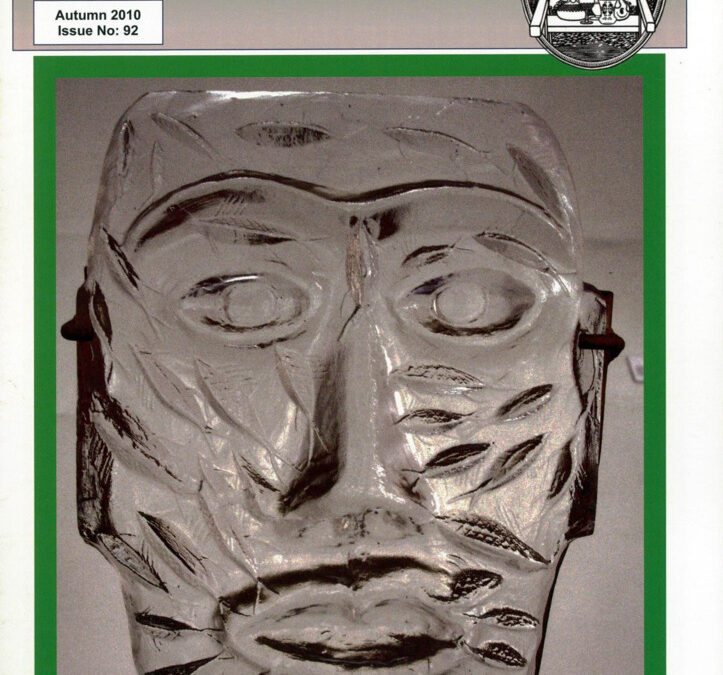
Front Cover—Fish Mask),
triggering fond memories.
The sea, fish, countryside, and Inca designs of the ceramic
plates, bowls, dishes, and vessels of his early years reappeared in
the glass. Some real gems, such as the sgraffito decorated Devon
Harvest jugs (one commemorating his eldest daughter’s wedding)
and the octopus bowl, illustrated his command of pottery colours
and glazes. Another project saw him make plaster moulds of
discarded packaging (jars, bottles, whisky flasks, and tetrapaks), slip
cast and glaze the pieces, thus converting them into permanent
works of art!
The Glass Cone—Issue No: 92 Autumn 2010
support of his wife Pearl, decided to pursue
his creative artistic interests. He started in
1991 with pottery classes (Frome
Community College 1991-5), progressed,
via an art and design foundation diploma
(Trowbridge College 1995-6), to a BA
(Hons) in Applied Arts, Ceramics, Metals
and Glass (Plymouth College of Art&
Design 1996-9) and then spent 2 years
(2002-4) at the International Glass Centre,
Brierley Hill, studying Glass Techniques
and Technology. The exhibition contained
examples of work, including paintings,
from all these periods, together with a
representation of his studio
(Fig 1).
Those of us who have spent time with
Frank and Pearl on GA trips over the years,
were aware of his diverse activities,
appreciated his technical and academic
contributions to discussions and recognised
their shared passion for glass, but I, along
with many of the other fellow travellers
present at this viewing, was somewhat
Fig
9:
Stained glass panel
Fig 3: Chair
Fig 5:
‘Bum’
vase
how movement could be incorporated into vase design if it did not
have a flat bottom! At Brierley Hill his creativity exploded and he
produced masks
(Fig 2),
mushrooms
(Fig 6),
beads, paperweights,
fused
(Fig 7)
cast
(Fig 8)
and stained
(Fig 9)
glass objects. His final
pieces explored wave and other types of movement
(Fig 10). It
is
regrettable that Frank did not have a more commercial side to his
character, but a few of the pieces were for sale, so some of us can
now boast that they own an original ‘Frank Hudson’.
Andrew Lavender reported that Frank ‘threw himself
totally into student life’ during his time in Plymouth and this ease
with younger generations is reflected in his productive working
relationship with members of the West Country’s ‘sisterhood’ of
talented glass artists. Sonja Klingler,
KT Yun, and Kim Atherton all helped
in the arranging of the Exhibition and
examples of Sonja’s
(Fig 11)
and
Kim and Thomas Atherton’s work
(Fig 12)
were on display. We gained
an insight into Frank’s local glass-
working community by spending the
rest of the day, together with
members of the Hudson family, in
their company.
Frank first experimented with the
fluidity and translucency of glass
at Plymouth, and it became his
preferred medium for the
remainder of his life. Some of his
glass furniture
(Figs 3,
4) was
exhibited at the New Designers
Exhibition in London in 1998.
His ‘bum’ vases
(Fig 5)
were
made around this time to illustrate
Fig 8: Cast schooling fish
lig
6:
11
ushrooms
The Glass Cone—Issue No: 92 Autumn 2010
15
`Fig 11:
Stuck Between a Rock
and a Hard Place’
Sonja Klingler
(Crystal rocks, blown
glass bubbles, slate
bases)
specialities is glass sculptures
of ‘bugs’ and they created one
of her black beetles for us
(Fig 13).
Individual appendages
were pre-formed and then
attached to the blown body to
construct a sinisterly attractive
monster. This was followed by a virtuoso creation of a more
conventional wine glass. Sonja has a varied portfolio including
glass sculptures
(Fig 11)
and multi-coloured tumblers and on this
occasion illustrated her versatility by demonstrating how to blow
and draw hollow chandelier arms
(Figs 14, 15).
They showcased
their teaching skills by guiding Katie Stewart (Frank
and Pearl’s great niece) through the creation of
her very own glass bauble
(Fig 16).
Sonja
made other pieces and, at one stage,
Fig 14:
Sonja
pulls a
tube
Fig- 15:
11111
hundeller arm
‘snake’
Fig 12:
pieces by Kim
and Thomas
Atherton
Liquid Glass Centre
Kim Atherton generously took time out from a busy
education schedule to come to Rook Lane to give us a video
presentation of the history and activities of the Liquid Glass Centre.
In the decade since its foundation by Kim and two others in 2000,
the LGC has become one of the premier glass schools in England.
A team of core staff and tutors together with visiting artists,
lecturers and teaching assistants teach glass blowing, kiln casting,
fusing and slumping, hot glass casting, bead making and fused glass
jewellery. The courses range from 1-2 day beginner and team
building fun events to week-long summer schools and master
classes. They are just starting longer professional timetables which
lead to NVQ qualifications. The farm setting in rural Wiltshire is an
added attraction as glass working can be combined with on site
camping, b & b, and visiting local places of interest. Kim’s
presentation and the picture gallery on the website suggest that it is
a dynamic, creative and fun location and it is hoped that a GA visit
can be arranged next year.
Glass Demonstration
Due to a late furnace malfunction, our afternoon visit was
switched from Sonja Klingler’s studio to KT Yun’s workshop. This
allowed a practical demonstration of the portable combined glory
hole/furnace KT has built for her travelling demonstrations. Pearl
was convinced that Frank would have had one of these in his garage
if he had he seen it. Both artists are experienced demonstrators,
frequently work together, and participate in recreational and
educational courses (e.g. KT at the Liquid Glass Centre, and Sonja,
both in house and at Matravers School/Art College). One of KT’s
Links
Rook Lane Arts
www.rookslanearts.org.uk
Liquid Glass Centre, Stowford Manor Farm, Wingfield,
Trowbridge, Wiltshire, BA 14 9LH
Tel. 01225 76888
www.liquidglasscentre.co.uk
Sonja Klingler Glass, The Garages, The Retreat, Frome,
Somerset, BA 11 5JU
Tel. 07837 733461
wwvv.sonjaklingler.com
KT Yun. Tel. 07866 426990 ktandtom@btinternet.com
Fig 16
16
The Glass Cone—Issue No: 92 Autumn 2010
Jane Beebe followed an irresistible urge to leave the audience and
assist. Numerous examples of the innovative skills of both artists
were on display and many of us took the opportunity to purchase
glasses, vases and bowls etc. at bargain prices.
The comments in the visitors’ book and daily visitor
numbers were a fitting reward to all those who helped Pearl and her
daughters realise this tribute to an original and expressive artist with
a passion for glass.
Roger Ersser
Since the visit, a number of items of Frank’s glass furniture have
been accepted by Broadfield House Glass Museum for their ‘Glass
Furniture Exhibition’ which runs from end August until Feb 11. We
strongly recommend a visit.