



–
Contents
1
A Pocketful of Scandinavian Glass at Rye
4
Festival of Britain, 1951-2011
4
A Glasslover’s Tour of New Zealand – part two
7
Art in Action. And the winner is …
8
Treasures from the Ashmolean Museum, Oxford
9
The Stourbridge Twenty Twelve Portland Vase Project
10 Thomas Goode & Co. and British Royal Commemorative
Glass 1887-1937
15 The ‘Magic’ Work of Susan Liebold
17 Paperweight Corner – Sulphide Paperweights
19 Book Reviews
20 Members page
21 What’s on
Chairman’s message
The Glass Cone
THE MAGAZINE OF THE GLASS ASSOCIATION
Issue No: 96 — Autumn 2011
Editorial Board
Editorial Co-ordinator
(The Glass Cone):
Gaby Marcon editor@glassassociation.org.uk
Charles Hajdamach, Mark Hill, Brian Clarke,
Yvonne Cocking, Bob Wilcock
Address for
Glass Cone
correspondence
E-mail editor@glassassociation.org.uk or mail to
Glass Cone, 7 The Avenue, London N3 2LB
E-mail news & events to news@glassassociation.org.uk
Articles and news items are welcome at any time,
but please bear in mind the copy dates if you have
an event you would like to be publicised.
The opinions expressed in the
Glass Cone
are
those of the contributors. The aim of the Editorial
Board is to cover a range of interests, ideas and
opinions, which are not necessarily their own.
The decision of the Editorial Board is final.
Copy dates
Spring: 21 February—publication 1 May
Summer: 21 May — publication 1 August
Autumn: 21 August — publication 1 October
Winter: 21 October — publication 1 February
Advertising rates
Full page £200; Half page £140; Third page £100;
Sixth page £70; Twelfth page £55. For inside back
cover and back cover, prices are on application.
Discounted rates for GA members
Please contact circaglass@aol.com
The Glass Association 2011. All rights reserved
Design by Malcolm Preskett
Printed in the UK by Micropress Printers Ltd
www.micropress.co.uk
Published by The Glass Association
ISSN No.0265 9654
The Glass Association
Registered as a Charity No.326602
Website: www.glassassociation.org.uk
Life President:
Charles Hajdamach
charleshajdamach@btinternet.com
Chairman:
Dr Brian Clarke:
chairman@glassassociation.org.uk
Hon. Secretary:
Alison Hopkins:
secretary@glassassociation.org.uk
Membership Secretary
Pauline Wimpory,150 Braemar Road,
Sutton Goldfield, West Midlands, B73 6LZ
membership@glassassociation.org.uk
Committee
Paul Bishop (Vice-Chairman); Julie Berk; Roger
Dodsworth; Jackie Fairburn; Christina Glover;
Judith Gower; Francis Grew; Mark Hill; Valerie
Humphries; Gaby Marcon; Maurice Wimpory
(Treasurer)
Membership and subscriptions
Individual: £20. Joint: £25. Overseas (IncVJt) £28.
Student: £10. Institutional: UK £40. Overseas £50.
Life: £300. Subscriptions due on 1 August
(if joining May—July, subscriptions valid until 31 July,
the following year)
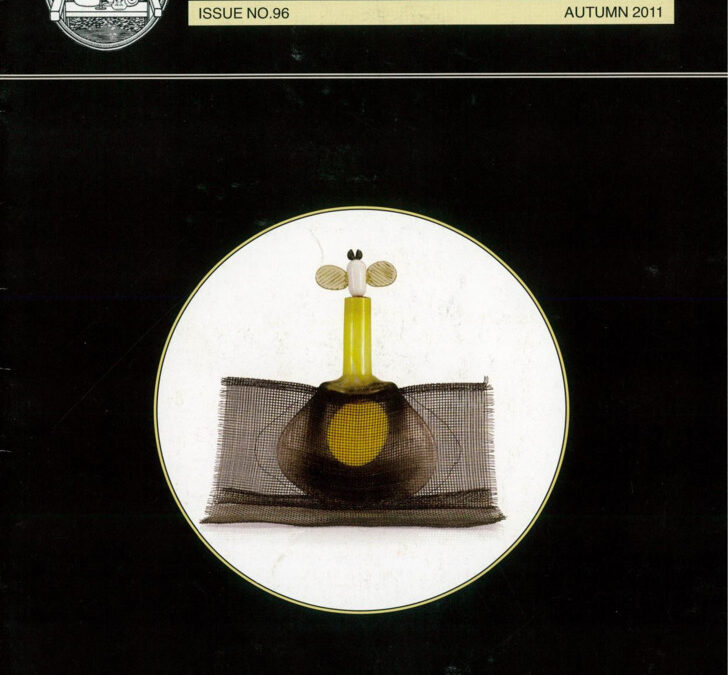
Cover illustration: On the front we spotlight an
item featured in the article on Scandinavian
glass while the back cover shows one of the
commemorative sulphide paperweights.
WITH the evenings closing in, my thoughts
dwelt on the passage of time. Along with
the changing seasons, annual glass events
also give us a measure marking the year’s
progression. Events that were keenly
awaited are suddenly placed in the past, but
their memories live on, making the antici-
pation and the taking part worthwhile. Our
visit to south-east Germany in the spring left
us with many new contacts and friends and,
in this issue, we profile Susan Liebold — a
glass artist creating inventive light installations.
The winning entry from the annual fair ‘Art in
Action’ came from glass-artist Liam Reeves;
a belated congratulations from the GA.
The London Glassblowing Studio has
been very busy, currently hosting ‘Melt’ — an
exhibition featuring works by several of the
world’s leading glass sculptors. Angela
Thwaites’ book on mould making for glass
(see review in this issue) had a packed
evening launch, and a very individual
sculptress in glass and ceramic mosaics,
Takako Shimizu, had an earlier outstanding
exhibition (youtube: ‘Peacemaker’ under the
London Glassblowing Workshop videos).
The car parks at the recent glass fair in
Cambridge were overflowing and the rooms
filled with collectors. Considering the difficult
circumstances of our country’s economy,
it would seem that collectable items could
be one way to offer some protection for our
savings; we look forward to November’s
National Glass Fair. For 18th-century addicts,
two outstanding sales are coming: Delomosne
& Sons Ltd are currently offering the collection
of Tim Udall, a well-known figure in the
Glass Circle, whilst at the end of November,
Bonham’s are selling the collection of A.C.
Hubbard Jnr. — featured in the book ‘A Wine
Lover’s Glasses’ by Ward Lloyd.
Amongst other events for 2012 are
meetings planned on Crystal Palace; the
1851 Great Exhibition and its glass; a new
glass museum created in Spain; a visit to
the glass attractions in York; and joining with
the British Glass Foundation (BGF) at the
Stourbridge Biennale to celebrate 400 years
of glassmaking in the area. Details will
appear shortly on our website.
The BGF is now consolidating its position
as a specialist adviser to Dudley Metro-
politan Borough Council (DMBC). It has
signed a ‘Memorandum of Understanding’
with DMBC to work out a sustainable
way to improve the housing of the glass
collections and archives now at Broadfield
House and Himley Hall, and to bring them,
together with the archives at Coseley, under
one roof in the ‘Glass Quarter’. We are
following the possibility of using the former
‘White House Cone’ site (the old Stuart
glass factory) and, in supporting the BGF,
trust that this singular opportunity is not
allowed to pass by. I look forward to seeing
many of you at this year’s AGM in Oxford,
where we will be taking an overview of the
glass collections of the Ashmolean.
THE GLASS CONE NO.96 AUTUMN 2011
A
Pocketful of Scandinavian
Glass at Rye
Markku Salo,
Honey jar’, 1990
photo Bukowski’s, Stockholm
Simon Gate, Graal bowl,
1918
0
N 10 September 2011, Rye, the East Sussex
home of well-known glass specialist and
GA member, Andy McConnell and his Glass
Etc emporium, was the venue for a celebration of
Scandinavian Glass. After gathering at Andy’s temple
to glass for refreshments, a sell-out audience packed
Webbes Restaurant to hear talks by Andy and Geoff
Lawson either side of an excellent lunch. A final return
to the shop allowed further browsing and discussion.
Andy first took a serious interest in Scandinavian
glass whilst researching his seminal book
20th
Century Glass
(Millers, 2006) and he advised on
the itinerary for the Association’s trip to Sweden in
2007
(Glass Cone 81).
He continues to spend six
weeks or so each spring researching in Scandinavia,
particularly southern Sweden. He
enthusiastically employed his famed
bravado, panache and massive
knowledge to achieve the seemingly
impossible goal of covering the
history of glassmaking in the region
in a couple of hours. His often-
colourful anecdotes brought the
characters and times into vivid
focus. His two lavishly illustrated
talks traced glassmaking in
Norway, Denmark, Finland, and
then Sweden, from their earliest factories up to the
present day. He concentrated on the explosion of
innovative design and techniques that began at
Orrefors in the early 20th century and which
made a significant contribution to the
Scandinavian domination of the global post-
war lifestyle revolution. After lunch and his
talk on why he finds the glass so collectable,
Geoff explained his affection for Swedish
glass, and its designers.
Geoff also makes regular visits to the area
and has collected Scandinavian art glass since
he was seduced into the Illums Bolighus shop
at Copenhagen Airport in the 1970s. His report
on the recent sale of the famous Birgitta Crafoord
Collection (2010,
Glass Cone
93) examined the state
of the current market. He used his equally
extensive knowledge to give us a collector’s
insight, structuring his talk around the heritage of
the techniques used, and illustrating them with
many stunning examples. I expect the majority of
the audience, like me, wished they had the budget
to buy objects of such originality and unsurpassed
quality. His stories on the relationships between the
designers and those who made the pieces were
particularly revealing.
Both speakers managed masterfully to squeeze
several gallons of relevant information into three half-
pint pots, challenging this reporter to further distil
some salient points into a shot glass! Their talks will
be considered jointly.
History of Glass Making
SOME fine goblets made by Nestentangen, the
Norwegian royal glassworks, from the late-17th
century probably remain the earliest significant
Scandinavian contribution to glassmaking. Until the
20th century, most of the region’s glassworks copied
the production of other European
centres and exported little. Hadeland
Glaswerk in Norway (1762), for
example, specialised in lead crystal
and is currently offering contempor-
ary tableware, vases and art bowls.
Some Swedish Art Nouveau vases
and Cameo glass pieces were
illustrated. From the early decades of
the 20th century onwards, although
locally stimulated by different
political and economic factors,
there was a universal change throughout the region.
In addition to novel ways of cutting, engraving and
moulding, the inventive use of colour, texture and
geometric shapes was applied across the quality
range, from functional tableware and simple
decorative pieces to limited-edition and
unique art glass. An extraordinary number of
prize-winning designers and makers, with
diverse technical, graphic and creative skills,
were the drivers of the regions’ international
artistic and commercial success.
Many of their iconic creations are regularly
revived or have remained in almost continuous
production since their introduction, and their work
has influenced or been copied by the rest of the
glassmaking world. However, some of the garish
colours and flamboyant shapes may be considered
by some to be more ‘interesting’ and ‘whacky’
than elegant or beautiful. Yet it must be admitted
that there are many hard-core enthusiasts who
swear by the bizarre creations of Kjell Engman (Boda,
Sweden), and Markku Salo (Nuutajarvi, Finland), for
example, a fact reflected by the cost of their work.
Roger Ersser
Photographs by
Andy McConnell/Glass etc
from Geoff Lawson’s collection
unless otherwise noted
THE GLASS CONE NO.96 AUTUMN 2011
1
Gunnel Nyman, Calla, 1947
photo Geoff Lawson
Gunnel Nyman, Controlled bubbles
A Few of the Giants
HOLMEGAARD was established
in Denmark in 1825 but it and its
sister company Kastrup only started
influencing glass design in the
1930s/40s with the employment of
Jacob E. Bang (pastel colours and
optic moulding) and Per Li tken
(Beak and Heart vases, mould
blown and free blown pieces), and
continued by Bang’s son, Michael.
Finland’s glassmaking past was
similarly derivative until littala
employed the Aaltos in the 1930s
and Alvar designed his iconic Savoy
(Eskimo Woman’s Leather Breaches)
vase in 1935, which is still in
production, along with his wife
Aino’s pressed, horizontally banded,
beakers (1932). Gunnel Nyman
(1909-49], the mother of modern
Finnish design, worked for both
littala/Karhula and Riihmaki. Her
simple, elegant style is typified in
her ‘Calla’ vase and the use, along
with other designers, of ‘controlled’
air bubbles.
In 1945, Finland needed a massive
increase in industrial production and
exports to meet Russia’s menacing
demands for war reparations. This
proved to be an opportunity for
Finnish designers whose prize-
winning international success led
to long and large production runs
(diminishing their attraction to those
who collect rarities). littala employed
Tapio Wirkkala (Kantarelli and Tatti
vases, Ultima Thule and Finlandia
ranges), who later collaborated with
Rosenthal and Venini; Timo
Sarpaneva (i-line and Festivo ranges),
and Kaj Franck, an influential pioneer
of essential form and function, who
soon went to Nuutajarvi. Nuutajarvi’s
fortunes were revived from the 1970s
by Oiva Toikka’s colourful freeformed
birds, starting with ‘flycatcher’.
Playful, but tasteful, animal and
character pieces are produced
throughout Scandinavia and remain
widely collected. Riihmaki prospered
with female designers Helena Tynell
(Pikku Matti series), Nanny Still, and
the mysterious Tamara Aladin.
Modern Swedish glassmaking
started at Orrefors with the
Right
Kaj Franck,
Water diviner,
1946
Below left:
Oiva Toikka,
Flycatcher, 1970s
Below right:
Knut Bergkvist
Goblet Nr 2, 1929
2
THE GLASS CONE NO.96 AUTUMN 2011
Left:
VickeLindstrand,
Pearl diver, 1935
Right:
Sven Palmquist
Ravenna bowl
#206
employment of Simon Gate (1916)
and Edward Hald (1918) and the
exhibition of the internal decoration
technique ‘Graal’ pioneered by Knut
Bergquist from 1916 (see also
Gunnel Holmer,
Glass Cone 82).
Whilst Orrefors became the most
famous and influential, other factories
such as Kosta, Boda, Pukeberg
and many others, made significant
contributions. The traditional cutting
and engraving skills of factories like
Kosta used on bowls and vases were
expanded to include sand blasting
and acid etching in the 1930s when
they were applied to the charac-
teristic muscular, chunky shapes of
‘Modernism’. Mould and freeblown,
cased and engraved, long produc-
tion ranges and art glass followed.
Right
Erik Hoglund,
Bowl
photo Stockholms
Auktionsverk
Below left:
Edvin Ohrstrom
Bathing Lady
face 2, 1939
Below:
VickeLindstrand
Unica, 1955
Right:
Helena Tynell,
Pikku Matti, 1969
Many designers contributed
including: Nils Landberg (Gabriel and
Dusk), Vicke Lindstrand (Pearl Divers
and other engraving, Ariel), Sven
Palmquist (centrifuge casting and
Ravenna technique) and Ingeborg
Lundin (Timglass, Applet and Ariel).
Eric Hoglund, a prototype studio
glassmaker and sculptor had a long
association with Boda.
Collecting Scandinavian Art Glass
THE designers already mentioned,
together with many others, including
contemporary greats such as Bertil
Vallien and Kjell Engman, produced
limited edition, unique and exhibition
pieces of the highest quality. Fortu-
nately they almost always bear
engraved signatures to aid identifi-
cation and authenticity. They often
indicate the engraver or glassworker
as well as designer, range, series
number and date. Some have been
made in several sizes and colours.
Revived editions by different glass
maestros or engravers, and mould
variations also exist. All affect their
desirability and value to collectors.
Also larger sizes and less
commercially successful ranges have
a scarcity premium.
Stained glass, present-day factory
and studio glass artists, the optical
glass and public glass sculptures
we saw in 2007 were not discussed
on this occasion. They all re-enforce
further the colossal contribution of
Scandinavia to modern glassmaking,
as described so expertly by our
speakers.
Thanks are also due Maurice and
Pauline Wimpory for the smooth
organisation of an informative and
entertaining day.
THE GLASS CONE NO.96 AUTUMN 2011
Festival
of
Britain, 1951-
2011
The South Bank celebrates its jubilee year
Brian Clarke
Fig.3: Stevens and Williams
display covered vase.
Possible attribution
to Keith Murray.
Fig.4: Stevens and Williams
festival goblet.
A
HEAD of the forthcoming Diamond Jubilee of
Queen Elizabeth II in 2012, the South Bank is
celebrating its own Diamond Jubilee. The
whole of the ground floor of the Royal Festival Hall has
been transformed into a museum bringing together a
vibrant collection of memorabilia, artworks, personal
histories, models and memories from the original
Festival, including archival and a new film.
The Festival of Britain came 100 years after the
Great Exhibition in 1851, which had been a cele-
bration of Victorian culture and industry. The 1951
event, six years after the end of the Second World
War, was intended to boost public morale after the
hardships of war and display once again the vigour
and creativeness of British industries. The symbol of
the exhibition, the Skylon, pointing, needle-sharp
upwards to the sky, was joined by the other main
buildings of the festival – the Dome of Discovery, the
Royal Festival Hall and a Shot Tower
(fig.1).
This
tower, no longer in existence, had been built on the
site in 1826 to carry a radio beacon on its roof.
The Festival Exhibition showcased British
technology, the arts, and architecture, and although
glass was not at the forefront of the exhibits, there
was a working furnace, with displays of glassblowing
from the glassmakers of the Whitefriars factory
capturing the attention of the visitors, whilst the
Stevens & Williams glassworks mounted a demon-
stration of engraving on glass.
The commemorative glass available was mainly
aimed at the mass souvenir market
(fig.2).
The
famous festival symbol (designed by Abram Games),
Fig.1: Festival of Britain site. Skylon centre left, Dome of
Discovery centre right, Shot Tower on the far side of the
Royal Festival Hall.
Fig.2: Festival of Britain souvenir glass. The Sowerby green
tankard and the blue eggcup are British, the remainder
are imports.
a stylized profile of Britannia as the head of a
four-pointed star, with a loop of bunting joining the
two side stars, was a feature on the glass – in this
genre, Sowerby produced one of their standard
moulds, a tankard with the festival logo on a side
panel. However, much of the souvenir glass available
to commemorate the event came in from continental
Europe. For the celebration of a British occasion,
I personally find the lack of collectable quality home-
made glass to be surprising – an opportunity missed.
Stevens & Williams made a few interesting display
pieces; one a covered vase, cut with shallow panels
and the festival logo on the finial, possibly designed
by Keith Murray
(fig.3),
and the other, a goblet with
the Skylon and Dome of Discovery on the bowl,
mounted on a hollow knop containing two dice over
the domed and folded foot
( fig.4).
In the year leading
up to the festival, Stevens & Williams ‘stimulated
inventiveness’ by holding a ‘modern glass design’
competition; two of the winning pieces are in the
collections at Broadfield House Glass Museum,
Stourbridge. Though the pieces produced were
not reminiscent of the Festival, the competition
concept gave impetus to designer-led creativity in the
UK’s glass industry for the following two decades;
sadly, even this initiative did not manage to halt the
eventual slow downward slide of the Stourbridge
glass industry.
Figs 2, 3 & 4 reproduced by kind permission of Charles
Hajdamach from his book: ’20th-century British Glass’ –
which also provided much information in the compilation
of this article.
4
THE GLASS CONE NO.96 AUTUMN 2011
PART TWO
Bob Wilcock
Fig.1: Burning Issues,
including sculptures and
Jessie Houses by Shona
Firman, birds by Katherine
Rutecki, wall-hangings by
Darryl Fagence, and vessels
from Keith Mahy and from
Jason Svendsen.
Fig.2 (below left): Justin
Culina in Burning Issues
with an intriguing ‘Shell
Bowl’
Fig.3 (below): Jessie’s House
by Shona Firman
A Glasslover’s our
of
New
Zealand
What follows is the continuation
of the Glasslover’s Tour of New Zealand;
the first part of this article was featured
in ‘Glass Cone
95′.
Whangarei
THERE are a good number of artists based in the
Auckland area, and several potentially interesting
galleries, but we had appointments at Kerikeri and
Paihia some 300km north of Auckland so decided
to just drive straight through the city on this visit.
We broke our journey at Whangarei for lunch, but
before eating, called in to what was possibly the best
gallery we had visited, Burning Issues
(fig.1).
Behind
the gallery is the Mahy Hot Glass Studio. Sadly, the
day we visited, Keith Mahy was not blowing, but we
were impressed by the large vessels, some hand
painted, that he produces, and on show in the gallery
(and other galleries also). It is here also that Shona
Firman makes her renowned cast-glass sculptures,
but, again sadly for us, she was not working.
However, in the gallery we noticed a handsome
young man unpacking some familiar bowls—by an
astonishing piece of luck we were face to face with
Justin Culina
(fig.2)!
He was naturally delighted that
we had purchased one of his shell bowls, and
when we mentioned that we had not been able to
work out how he made it, he invited us to his pre-
Christmas Open Day at his studio on the edge of
town the following day, and promised to make a bowl
for the secret to be revealed. We had planned to drive
straight on to Keri Keri, but our appointment was not
until late afternoon, so after a superb seafood lunch in
the restaurant beside the gallery we promptly found a
motel for the night. We then went back to the gallery
for a good look round. There was a lot of glass from
many artists, and we were strongly tempted by some
very attractive stainless steel and glass wall-panels by
Darryl Fagence, and by his Tui Platters – gold/copper
foil beautifully, evenly placed between layers of clear
slumped glass, with attractive patterning on the rim.
(We later saw more of his work in the Real Gallery in
Wellington.) Rather different from her large sculptures,
Shona Firman’s `Jessie’s Houses’ are attractive fun
pieces, with a nice story: her grand-daughter drew a
picture of the house and told her that it was ‘Jessie’s
House’ and she had to make it in glass; so she did,
and does, very successfully
(fig.3).
The following morning we found Justin setting up,
assisted by his partner, Alana Biffert, and Jason
Svendsen from Denmark, both glassmakers in their
own right, and producing works in very different styles
from Justin and from each other
(fig.4).
We then spent
a fascinating 40 minutes watching Justin make a shell
bowl. How he does it will be explained in a separate
article, but we were immensely impressed by his
careful and professional approach – he was relaxed,
but very firmly focussed.
He was equally focussed for his next demon-
stration, making a reverse spiral vase. For this he
does use canes, starting with the traditional Italian
filigrana
technique, picking up the heated canes with
the glass collar on the blowing iron at impressive
THE GLASS CONE NO.96 AUTUMN 2011
5
4,0
Fig.4: Works by Alana Bzffert
and Jason Svendsen in the
Culina Studio.
speed. Having closed and twisted the canes he
closes the neck, heats the side, makes a hole with a
carbon rod, attaches the piece to a collar on a second
blowing iron, and cracks it off from the first iron. A side
becomes the base, the piece is cased in clear glass,
and blown and worked up into a vase in the standard
way, but with a vertical spiral pattern rather than a
traditional twist. It is not an original technique, but
Justin showed he could do it particularly well.
Justin’s mother and father provided an informal
lunch, a very tasty bread and cheese loaf, washed
down with a fruit punch, served in one of Justin’s shell
bowls of course. Jason Svendsen was then to give
a demonstration, but we had our appointment in
Kerikeri, so, sadly, were not able to stay.
The Bay of Islands
OUR appointment was with Sue Hawker,
Ranamok prize-winner in 2010
(Glass Cone
no.93,
p.9) who is also now Co-President of the
New Zealand Society of Artists in Glass. After a
demanding career in international journalism, Sue
took a four-year course in glass art at NorthTec
College’s Kerikeri campus. That was the start of what
has become a very successful second career. Her
artistic flair and her control of the medium are very
apparent in her haunting heads, cast in gaffer
crystal in the series ‘I am Pakeha’ [a New
Zealander of European extraction]
(figs
5&6). More
recently she has taken
pate de verre
to new
heights, culminating in the Ranamok prize-
winning piece ‘Too much is never enough’. It
looked impressive in the Ranamok catalogue, but
was even more so when Sue showed us the
piece, for it stands some 50cm high. We imagined
that each of the flowers had been prepared
separately then fused together in a second firing,
but not so: it was made as a single piece which is
a testament to Sue’s mould-making skills, and her
skill at working with the medium. It was quite
clearly fiendishly difficult to put together, and equally
challenging to get the firing and annealing programme
just right, and Sue mentioned that there was an
added challenge in that she uses Gaffer crystal which
was never designed to be used as
pate de verre.
She
showed us a bowl in the series, and also two copies
where just one or two of the flowers had not fired
correctly. To us they were flowers of a different colour,
but for Sue they were the wrong colour, not what they
should be, making the whole piece a failure.
Sue would never sell such pieces as ‘seconds’,
and disapproves of artists selling off seconds. She, as
we are, is even more concerned with artists who offer
for sale pieces with clear defects, and galleries that
accept them. She and NZSAG want to do all they can
to promote New Zealand glass and glass artists
internationally. New Zealand’s small population
means that it is very hard for glass artists to make a
living from the domestic market alone, but they must
strive to ensure they meet the high standards the
international market demands.
We were very impressed with Sue and her glass.
We were equally impressed in a completely different
way when we drove a few miles around the bay to
Paihia to see GA member Angela Bowey and her
collection of twentieth-century glass. Some years
back Angela ran a museum of glass, but visitors to
the Bay of Islands are more attracted to the stunning
scenery, and Angela now keeps her collection in a
discrete annex at the back of her house
(figs 7&8).
Not only will the collection be the envy of most British
collectors— Davidson, Sowerby, Vasart, Monart,
Whitefriars, Lalique, Carnival glass and much more,
rounded off with some outstanding pieces of
contemporary New Zealand art glass—so will they be
envious of the space Angela has in which to show
it—the room is crammed full, but it is a big
room, well-organised and not overcrowded.
Angela regularly comes over to the UK, at
least partly to visit the fairs and buy glass, but
she is perhaps best known as founder of the Glass
Message Board (www.glassmessages.com), well
used by many of our members. She writes regularly
on glass: with Brian Jenkins she has written a
guide to the Paperweights of New Zealand
(published in the
Bulletins of the Paperweight
Collectors Association Inc.),
and she has written
the definitive guide to New Zealand Glass (ISBN
0-473-06238-0; available in paperback and also
on CD, updated to 2010).
Wanganui
WANGANUI is home to New Zealand’s well-
known Wanganui Glass School. The time to be
there is September—October for the Festival of
Glass, but we were there just a couple of days
before Christmas so could only enjoy visiting
Chronicle Glass Studio and Gallery, run by
Lindsay Patterson and Katie Brown, whose work
we had first seen at Statements Gallery in Napier.
Figs 5&6: ‘Journey to New
Zealand’ from the series,
lam Pakeha’, by
Sue Hawker shown below
6
THE GLASS CONE NO.96 AUTUMN 2011
Figs 7&8: A glimpse of just
some ofAngela Bowey’s
collection
A graduate of the Wanganui school, and sub-
sequently President of the New Zealand Society of
Artists in Glass, Lindsay’s most interesting works
perhaps are blown vessels totally covered in small
murrines. Katie’s work by contrast is more delicate
and feminine, clear or pastel-coloured glass, often
with fine and delicate trails. The gallery does not just
feature their own work, but that of a number of other
Wanganui graduates. There were several pieces by
Justin Culina, and we were impressed by the multi-
layered pod forms by Dominic Burrell.
From Wanganui we drove back to our daughter’s
home for our first experience of Christmas in the sun,
the barbecue, the afternoon on the beach watching
the grand-children in the surf. It was surreal, but our
presents to each other, the two pieces of glass, are
real, and now proudly sitting in the glass cabinet.
ARTISTS
Darryl Fagence: https://nzsag.co.nz/Darryl-Fagence
Sue Hawker: www.suehawker.co.nz; now Co-President of the New
Zealand Society of Artists in Glass: www.nzsag.co.nz
Angela Bowey: (Glass Message Board) www.glassmessages.com
GALLERIES
Burning Issues: www.burningissuesgallery.co.nz
Chronicle Glass Studio and Gallery: www.chronicleglass.co.nz
PUBLICATIONS
Angela Bowey:
New Zealand Glass
(ISBN 0-473-06238-00).
Available in paperback and also on CD, updated to 2010 — see
www.glass-time.com/ordernzglassbook.html
OTHER CONTACTS
Wanganui Glass School: www.wanganuiglassschool.com
Wanganui Festival of Glass: www.wanganuiglass.co.nz
ART IN ACTION
And the winner is
…
ART IN ACTION, the festival of fine art
and craftsmanship that took place last
July at Waterperry House in Oxfordshire,
saw a glass artist proclaimed the ‘winner’
for the second year running.
The event showcased the work of
150
artists who demonstrated their skills and
love of art in a wide variety of disciplines.
Each year artists enter what they
consider their best work for exhibition in
the ‘Best of the Best’ marquee. Then
each of them gets a vote to decide on a
winner. This year it was glass artist LIAM
REEVES, with a wall-mounted glass
plate entitled
Scope IV.
Liam has been investigating glass-
blowing techniques of the past two
millennia, from the mould blowing of
ancient Rome to the complex goblet-
making techniques of Renaissance
Venice and to the finesse of manu-
factured glass after the Industrial
Revolution. Liam’s journey took the
form of an investigation into ways in
which the historical techniques that he
found so inspiring could be put into
contemporary contexts.
Liam Reeves beside his creation—ScopelV
and Liam at work . . .
Congratulations to
Liam Reeves for
outshining the best in other crafts.
But Liam was not the only glass artist;
a core of nineteen artists demonstrated
a wide range of glassmaking skills and
techniques including glassblowing, lamp
working, glass-bead making, glass
jewellery, stained glass, engraving,
pate de
verre
and architectural glass.
Amongst them were GILL ROGERS,
whose most recent work explores the
use of borosilicate glass and who
constructs three-dimensional forms to
create sculptural designs in jewellery;
RACHEL WELFORD, an architectural
glass artist who makes bespoke art-
works within architectural settings such
as commercial and public buildings
and private houses; TIM BOSWELL with
his unique style of glassblowing,
incorporating a variety of secret (and
some not so secret) techniques
including mould blown sculptural forms;
and RACHEL O’DELL who uses glass
powders and frits in various com-
binations to produce a palette of specific
colours which are then applied into a
mould. Her work is tactile and often
intimate in scale, handcrafted yet
contemporary. —
Gaby Marcon
THE GLASS CONE NO.96 AUTUMN 2011
7
Treasures from the Ashmolean
Museum, Oxford
Anglo-Saxon Glass Bowl,
600-700, Ashmolean Museum.
This bowl of royal-blue glass is a great rarity and
in perfect condition. It has been suggested that
the Cuddesdon cemetery in Oxfordshire from
which it comes, is one of a group of princely
graves of the late 6th and early 7th centuries,
of which the famous Sutton Hoo ship burial is
the most important. Dark-blue glass seems to
have been particularly prevalent at this period.
It was excavated near the Bishop’s House in
Cuddesdon, Oxfordshire in 1847.
Glass plate with a view
of SS Giovanni e Paolo,
Venice, by Murano
Miotti Glassworks,
c.1741, Ashmolean
Museum.
This 23cm Italian glass plate
by Murano Miotti Glassworks
is of a type of lattimo (opaque
white). The plate belongs to a
group, generally considered to be one
of the finest examples of 18th-century
Venetian glass work. It is decorated with
a view of SS Giovanni e Paolo, Venice.
OUR October study day and
AGM will take us to Oxford
and to the Ashmolean Museum
where these treasures are kept.
These remarkable purchases
reveal the extraordinary range
of The Art Fund’s patronage
with regard to glass.
THE most substantial of the acquisitions
made by the Ashmolean Museum with the
help of the Art Fund is without any doubt
the Wilshere Collection of gold glass and
sculpture. Charles Wilshere (1814-1906),
was a student of ecclesiastical history
and antiquities. He acquired the collection
during his travels to the Continent, and
bequeathed the glass and sculpture to
Pusey House, Oxford. The glass fragments
have been on loan to the Ashmolean since
1957 and the marble objects were lent to
the Museum in 1984. The collection consists
of 34 fragments of gold-glass and 23
sculptured reliefs and inscriptions. The objects
Fragment from theWilshere Collection of
Gold-Glass and Marble, 3rd-4th century BC,
Ashmolean Museum.
were originally from Roman catacombs and
display a wide variety of Christian, Jewish
and pagan themes. Highlights include one
relief showing a banqueting scene and a
bowl fragment depicting scenes from the life
of Christ. The objects form one of the largest
collections of gold-glass fragments in the
world. These come from catacombs in
Rome and are decorated with biblical and
classical motifs. Another category is
represented by inscriptions, most of
which come from a Jewish catacomb
on the Via Appia.
The Art Fund also helped with the
acquisition of a Roman Engraved
Glass Bowl, 300-400. This Roman
provincial bowl was discovered broken
into twenty fragments but is now
complete. It belongs to a small, well-
defined group of decorated and
inscribed drinking bowls. Made of pale
olive-green glass, spirally streaked,
engraved on the outer surface with a
mounted horseman, with flying cloak and
whip, galloping through a tree-studded
landscape, with two hounds driving a hare
into a net. Round the scene is inscribed
‘VIVAS CVM
wis
PIE Z’ meaning ‘May you
live, you and yours. Drink. Live’.
8
THE GLASS CONE NO.96 AUTUMN 2011
The Stourbridge Twenty Twelve
Portland Vase Project
M
OST glass enthusiasts will have
heard of the Portland Vase housed
in the British Museum. Arguably
the most famous cameo glass vessel from
antiquity, probably made in Rome about
AD 5-25 and copied by the likes of John
Northwood, Joseph Locke and Josiah
Wedgwood. Ian Dury of Stourbridge Glass
Engravers is sponsoring an exciting project
to recreate the Portland Vase in Stourbridge
as a testament to the glassmaking skills
and partnerships that thrive today in the
Midlands.
Ian has asked Richard Golding, founder of
Okra Glass, who now runs Station Glass in
Leicestershire, and Terri Colledge, famous
for her intricate cameo carvings, to help
deliver his dream to leave an English version
of the Portland Vase in Stourbridge as his
legacy to glassmaking in the area.
There is more than a touch of magic
about this project. Richard and Terri have
collaborated for many years to make some
of the best cameo glass on the market
today. Terri originally worked as a painter for
Bilston Enamels before moving to Okra.
Right The Portland Vase. Roman. AD 1-25
© The Trustees of the British Museum
Below: From left-Ian Duty, Terri Colledge,
Richard Golding
7e
Stourbridge Twenty Twelve
Portland Vase Project
to Cdetrate 400 years of
Gass Making in
Stow-bridge
•
Sandra Whiles
One day Richard decided to blow her a
cameo blank, gave her a drill and the rest
is history. Shortly after Richard left Okra
Glass, Terri moved to work along-
side Ian Dury in his gallery at the
Ruskin Glass Centre. Ian was
fascinated by Terri’s work and
the idea to recreate the
Portland Vase for Stourbridge began to take shape.
Work started earlier in the
year when Ian shared his
ideas with historians at the
British Museum. They saw
the quality of Richard and
Tern’s work and gave their
blessing to the project.
Recently Ian, Richard and
Tern spent a morning at the
British Museum examining
the Portland Vase. The honour
and the responsibility of handling
one of the most famous vases in
history will stay with them forever
however, the challenges of the
project are a little daunting. How to
recreate the colour? What glass
recipe will work best for the intricate
carving? Should they recreate the
original shape or the shape we all know as
the Portland Vase? How long will the carving
take? How were the handles put on?
Richard and Merlyn Farwell of
PyElectronics have been experimenting
with glass recipes in Merlyn’s workshop
using a tiny version of the COMBO furnace
developed for Station Glass. Richard is
renowned for his glass recipes and this
project has seen him pouring over his
old ‘recipe books’ to fine tune a batch
mix that will get as close as possible to
the original.
A lot of people are helping make this
project work. Plowden and Thompson have
sponsored the batch production. Gerald
Mann have provided some of the chemicals.
Merlyn is providing one of the furnaces to
test and make the white opal. Leigh White
from the Ruskin Glass Centre is supporting
the marketing and the Stourbridge Glass-
blowers are providing the studio where the
blanks will be blown.
Anona Wyi, who assisted Richard along
with Steve Foster and Ian Bamforth when
the cameo blanks were made last 24
September, has been over at Station Glass
helping Richard master the handles. Tern will
then start carving her version of the Portland
Vase in her studio at the Ruskin Glass
Centre. This will take many months, so pop
along and watch the magic. The vase will be
finished for the Glass Biennale in August
2012, four hundred years after glassmaking
started in Stourbridge.
More information on progress of the project can
be found at:
https://ruskinglasscentre.co.uk/2011/09/portland
-vase-blank-being-blown
https://stationglass.com/TheStourbridgeTwenty
TwelvePortlandVaseProject aspx
THE GLASS CONE NO.96 AUTUMN 2011
9
Thomas
Goode & Co.
and British Royal Commemorative Glass 1887-1937
Brian Clarke
Fig. 1:
Gadroonedflask
for coronation of
George V (one
handle missing).
Fig.2:
Spirit bottle for
Queen Victoria’s
Diamond Jubilee,
1897.
–
Bell bowl Goblet
for coronation of
King GeorgeV
1911
–
Dimple Tumbler
for coronation of
King Edward VII,
1902
WHEREAS the glassmaking
firms of Webb Corbett, Stuart,
Webb, and Whitefriars all
produced commemorative
glass of quality, for this article
I shall be focusing on the royal
commemoratives made by
Stevens & Williams (known from
the 1930s as Royal Brierley) and
in particular their involvement
with Herbert Goode. This is a
selection of their glass and
does not attempt to be a
complete listing.
Tm
ERE does not appear to
be any recorded British com-
emorative glass marking the
coronation of Queen Victoria, neither
blown nor pressed. The first pressing
machine had been installed at T.
Hawkes & Co. in Birmingham in 1831,
but the only known pressed items
for her coronation in 1837 are from
America. Perhaps the glass tax,
finally removed in 1845 had put a
financial brake on production. The
Industrial Revolution gathered momen-
tum and at the time of the Golden
Jubilee of Queen Victoria in 1887,
with pressed glass having been in
production for just over fifty years, the
less expensive end of the market for
commemorative glass was being
catered for. However, the plush sur-
roundings of Thomas Goode & Co.
and their posh clientele, demanded
blown and cut items of quality.
Thomas Goode (1794-1870) opened
for business in 1827, ten years before
Queen Victoria’s accession to the
throne. He moved from a china shop
in Mill Street, Hanover Square, to
South Audley Street, London W1 in
1844.
1
With fashionable success, his
son William James (1831-92) joined
the business and they expanded the
premises on South Audley Street
from No.17 through to No.21. The
major works and expansion was
ongoing until the early 1900s, by
which time William’s son Herbert
(1865-1937) had also joined the
company. Herbert Goode was made
a partner in 1892 and became sole
director in 1924 – the year in which
his older brother Minton died.
Thomas Goode & Co. started by
designing, producing and selling fine
ceramic tableware and from the
1850s they represented and sold
the wares of the glass manufacturers,
Richardsons and Thomas Webb &
Co. In 1863 Thomas Goode became
‘Royal by Appointment’ to Edward,
Prince of Wales, the future King
Edward VII. Around this time, the
glass tableware of Stevens & Williams
would also have been displayed and
sold. Thomas Goode & Co., under
the direction of Herbert, have been
responsible for some of the most
intriguing Royal Commemorative glass
of the 20th century.
For Victoria’s Golden Jubilee,
Stevens and Williams produced an
intricate, two-handled, gadrooned
flask to commemorate the occasion.
The version for King George V’s
coronation, a copy of the original for
Queen Victoria, is shown in
fig.
1.
Royal events came in rapid
succession at the turn of the 20th
century: the Diamond Jubilee of
Queen Victoria and then her death
just four years later in 1901; the
coronation of Edward VII in 1902 and
his death in 1910; the coronation of
George V and Queen Mary in 1911
and their Silver Jubilee in 1935; the
demise of George V in 1936; Edward
VIII’s accession in 1936 and his
abdication in the same year; then the
accession of George VI in 1936 and
his coronation in 1937.
By 1897 and the Diamond Jubilee
of Queen Victoria, the public’s appetite
for commemorative glass was growing.
Following the Boer War and the loss
of so many people in the 1914-18
war, a new social awareness devel-
oped in the country. As royalty became
more visible to the general population,
the commemorative industry blos-
somed, royal memorabilia becoming
more desirable. In 1919, Stevens &
Williams received the Royal Warrant
from the reigning monarch. By the
time of the death of George V and
10
THE GLASS CONE NO.96 AUTUMN
2011
Fig.5:
1/2 pint coronation
tankards.
–
Engraved tankard
with central hoop
for EdwardVIII,
127mm,
edition of 5000.
–
Engraved tankard
for George
v;
130mm,
edition of 1000.
–
Gilt-engraved
tankard for
George
y
130mm,
edition of 100.
Edward VIII’s accession, royalty was
speaking to its public over the
wireless and the commemorative
industry had become big business.
For the Diamond Jubilee, Stevens
& Williams produced six special
commemorative pieces, which I
assume were marketed (amongst
others?) through Thomas Goode &
Co., one of which was the spirit bottle
(255mm with stopper) with gilt
ciphers shown in
fig.2.
Also in
fig.2
are a gilt ‘dimple’ tumbler vase of
1902 (160mm) for the coronation
of Edward VII and the gilt bell bowl
goblet (255mm) with a silver 3d
George V coin included in the stem
for the coronation of George V in
1911. These were typical of the firm’s
production at the turn of the century.
Unlike commemoratives designed
and made from the 1930s, there were
neither maker’s marks nor copyright
marks from the designers on the
glass. They are only recognisable as
the work of Stevens & Williams from
some reproductions of the drawings
from their record books.
2
Typically,
they would use the same or very
similar designs for different occasions;
so the tumbler vase design was
originally one of those six pieces for
Victoria’s Diamond Jubilee which had
the added gilt engraving ‘WHOSE
LIFE IS QUEENLY AS HER LIFE IS
FAIR’.
3
The bell bowl goblet design, a
pastiche of an 18th-century baluster
goblet, was used by Stevens &
Williams in various sizes for many
commemorative events, from Lord
Kitchener’s death in 1916 through to
the coronation of George VI.
The records state that Stevens &
Williams created thirty-nine different
designs for the coronation of Edward
VII and another ‘three dozen or so’
for the coronation of George V and
Queen Mary. Until the Silver Jubilee of
George & Mary in 1935, the designs
(with a few exceptions) were engraved
with the royal cipher, a crown and the
date, perhaps additionally with a single
word denoting the event, such as
‘coronation’. From the Silver Jubilee
onwards Herbert Goode became
intimately involved with the design
of commemoratives, commissioned
from and created by Royal Brierley,
taking the genre into a new realm.
Before looking more closely at
some of these extraordinary pieces,
two decanters from Stevens &
Williams, whose designs were only
used once, are worthy of attention.
The first
(fig.3),
made for George V’s
coronation, is a slim three-sided
decanter (255mm). One face has the
crown and cipher `GRV’ with the date
of 1911, the other two faces and the
stopper are engraved with a six-
pointed star, resembling the eight-
pointed Garter Star. Each face is
surrounded with a close series of
wheel-cut ovals to form a cartouche
The three shoulders are engraved
with the rose (England), thistle
(Scotland) and the shamrock (Ireland).
All of the wheel-cutting and engraving
is polished. Other than the obser-
vation that on a three-sided item it
might be awkward to design in a
fourth symbol, I find the absence of
a leek or daffodil for Wales a
surprising omission. The registration
mark of 577992 on the base, shows
it to have come from Stevens &
Williams. The concept was repeated
nearly twenty-five years later with
the ‘Three Kings Decanter’ (255mm)
(figs 4a, b,
c). Here the three faces
were used to depict three different
royal episodes – the silver jubilee
`GRV 1935′; the abdication ‘ERVIII
1936’, and the coronation ‘GRVI 1937’
– a much more political piece of glass!
This decanter is fatter than the earlier
George V example, has a crown
stopper and has the acid-etched
factory stamp ‘ROYAL BRIERLEY
ENGLAND’ in three separate lines on
the underside of the base. Again, all
the cutting and engraving is polished
and Wales has been left out.
Herbert Goode’s inspired designs
were created for different markets.
Some, such as the 1/2 pint tankards
were quietly elegant, lightly engraved
and had production runs of 1,000 or
5,000, made for a mass market. The
same tankards when gilt, had smaller
runs, usually of 250 pieces
(fig.5).
Left:
Fig.3: Elegant
three-sided
decanter for
coronation of
George V.
Above:
Fig.4: The Three
Kings Decanter
(referred to as a
bottle in Stevens &
Williams records).
THE GLASS CONE NO.96 AUTUMN 2011
11
Fig.6: Hock glass with blue
stem and foot, for George V’s
accession and coronation,
185mm.
Fig.
7:
‘The Jubilee Cup:
There were also a series of ‘statements in glass’,
commemoratives that were much more heavily
decorated and inscribed. It is open to speculation as
to exactly what drove Herbert Goode to be so closely
involved with these elaborate royal commemorative
designs, issued in very small numbers and all ordered
from Stevens & Williams. Was he an ardent royalist
from afar or was he able to count the monarchs as
friends? With runs of just twenty-five pieces for the
top-end items, the decision could not have been
commercial. The commemorative drawings were
made on tracing paper and held in about twenty
black leather-bound volumes, kept at the South
Audley Street premises. Sadly neither these drawings
nor Thomas Goode’s other historical records, are now
believed to exist; they disappeared a few years after
Thomas Goode was taken over in the late 1990s.
4
For
whatever reason, possibly a lack of space, these very
special small-edition items (other than the Stuart
Coronation Cup), do not appear in the booklet on
Royal Brierley.
2
When, in 1952, The Ashmolean
received a bequest of ten of these extravagant pieces
(only nine actually reached them),
5
and the Assistant
Keeper requested information on the glasses from
Thomas Goode & Co., one of its directors replied
that: ‘the pieces were made for the general public,
were made individually at the time of the events
and did not form part of a ‘set’. He also gave the
information that the silver tokens used in these pieces
were not struck especially for them, but did come in
two sizes, one about the size of a ‘sixpenny piece’,
the other that of a ‘florin’.
My investigations suggest that the first design with
Herbert Goode’s personal copyright was for a tall
wine glass
(fig.6),
of a style used for hock. The extent
of the input of Herbert Goode into the design process
is unclear, but it was evidently under his personal
guidance. The glass has a clear cup-shaped bowl,
over a hollow knop containing a silver jubilee token for
1935, and a hexagonal Bristol-blue coloured stem;
the knop and the foot each having three prunts. The
decorated bowl is engraved with dates of the
accession and coronation of George V and a laurel-
wreathed cartouche within which are the simple
words ‘To Commemorate The Silver Jubilee of King
George V and Queen Mary May 6th 1935’. Around
the rim, on the underside of the foot, are the words
‘only 7 of these glasses were made for Herbert
Goode. Coffered, Herts’. With such a tiny production,
these would seem to have been made for Herbert
Goode’s personal use at home – would seven have
been the number of people sitting around the family
table? All seven of these glasses came into the hands
of a dealer many years ago, one of which is now in the
Broadfield House collection.
3
The following years, 1935-37, saw Stevens &
Williams produce Herbert Goode copyrighted
designs of some very striking architectural-style
commemorative vases and goblets, covered in poetic
verses extolling the praises of King and Empire.
All of these glasses are heavily decorated with
engraved poetry, flowers, thistles, oak and laurel
leaves and royal ciphers. The production runs were
very low, mostly around 25 pieces. This was perhaps
due to the complexity of their manufacture and the
amount of time that went into their engraving or
perhaps a style of commemorative glass that was
thought to appeal to only a few people. It is even
possible that Thomas Goode & Co. had clients
targeted as probable purchasers of these items, as
the glasses bequested to the Ashmolean, from one
source, were all numbered No.3 in the series.
5
But
this is all conjecture. A selection follows:
The Jubilee Cup 1935.
(fig.
7)
Celebrating the Silver Jubilee of George V and Queen
Mary, this is inscribed ‘The greatness of their
majesties is reflected in the silver mirror of 1935 by
the happiness of their people’, ‘May 6 1935’, and
on the base ‘From St Paul’s Cathedral rang The Silver
12
THE GLASS CONE NO.96 AUTUMN 2011
Fig.10: ‘The Crown Vase:
Bells of Rejoicing Pealing Glad Tidings to the
Empire Radiating Hope Throughout the World’.
The sentiments are remarkable for their hyperbole.
Before this time, I do not know of any recorded
blown commemorative glass, with the exception of
some rummers of 1821 for Queen Caroline, that
mentions a monarch’s death. Henry Goode broke this
taboo with his epitaphs for King George V.
The Remembrance Vase 1936, edition of 26.
(fig.8)
For George V, inscribed ‘Peace’ – then the dates for
his birth, marriage, accession and coronation; war
and armistice dates for 1914-18; ‘Peace’ – and
the dates for his Silver Jubilee, ‘Eternal Rest –
Sandringham’ and ‘Interred at Windsor’.
The Cup of Sorrow 1936, edition of 25.
(fig.9)
Commemorates the death of George V on one side,
with the inscription, ‘High and Low, Rich and Poor,
The Nation Mourns The King’, with a companion
inscription for Queen Mary: ‘High and Low, Rich and
Poor, The Tears of Sympathy Flow from the People’.
The other side is inscribed for the accession of
Edward VIII, ‘Through Darkness Then Came light For
The Prince Was King’. This is set over the engraved
rays of the sun.
The Crown Vase 1936, edition of 42.
(fig.10)
Included for the sheer exuberance of the design with
the two scroll-end handles and the lid with crown
finial. Commemorating the accession of Edward VIII,
the lid is engraved with ‘Ed.l – Ed.VIII’. This is
copyright 3202. The sides of the square foot are
engraved with the four countries of Great Britain:
England, Wales, Scotland, Ireland. The popularity of
Edward VIII at the time, is shown by the engraved
inscription: ‘By Earth Sea or Air, Our King Leads
the Way, As Friend of His People, They Crown
Him Today’.
The Abdication Comports 1936
These splendid creations, revert to a simplicity
of design and engraved sentiment. They commem-
orated the accession and abdication of Edward VIII.
The first
(fig.11)
is possibly unique, though it may have
a double in the royal household. It has a saucer-
shaped bowl over a large hollow knop and flat foot.
The knop contains an intricate lampworked crown, in
red, white, yellow and blue; almost certainly created
by Billy Swingewood Snr. The inscription on the bowl
reads ‘King Edward VIII Accession January 20th 1936
Abdication December 11th 1936 1.52 p.m.’ From a
contemporary perspective, adding the time to the
inscription seems to add a touch of irony; at the time
it was probably meant to convey the seriousness and
disappointment that many people must have felt with
this popular young king choosing his life rather than
the lives of the nations of his empire. An Edward VIII
silver token is at the bottom of the bowl, centred over
the knop . The base reads ‘Before making the 50
comports with white crowns, two trials were made
with red crowns, this being No.2’. Under the foot is
engraved the usual copyright for Thomas Goode &
Co, with Herbert Goode’s name. The other comport
(fig.12),
with the white crown, differs, in that the bowl
Left
Fig.8: ‘The Remembrance
Vase; 147mm (c/fdesign of
Homage Vase).
Above:
Fig.9: ‘The Cup of Sorrow;
105mm.
Photographs by Brian
Clarke except fig.1
which is reproduced
from The Crystal Years’,
ref.2.
Items shown in figs
7-10 and 13 are in the
Ashmoleum Museum,
the others are from a
private collection.
THE GLASS CONE NO.96 AUTUMN 2011
13
Fig.13: ‘The Homage Vase’
(c/fdesign ofRemembrance
Vase).
Fig.14: ‘The Stuart
Coronation Cup;
332mm with lid.
REFERENCES:
1.
‘South Audley Street: East
Side’,
Survey of London:
vol.40:
The Grosvenor Estate in Mayfair.
2.
Reginald Silvers William-
Thomas,
‘The Crystal Years’,
Stevens & Williams, 1983.
3.
Broadfield House Museum
glass collection, Stourbridge.
4.
Discussions with previous
employees of Thomas Goode
& Co.
5.
Information supplied by
Timothy Wilson of the
Ashmolean Museum, Oxford.
FURTHER READING
Charles Hajdamach,
20th
Century British Glass,
Antique
Collector’s Club, 2010.
Chapter 18.
is more straight-sided, the engraving on the base
informs us that ‘This is No.X of the fifty numbered
comports made’. The copyright notice also contains
the number 3240, for 28th December 1936. The bowl
engraving is the same as above. At least until the last
few years, Thomas Goode & Co. had some of the
white crown comports, nos 24, 29 and 30 in their
vaults, nos 2 and 12 have also been seen.
The Homage Vase 1937, edition of 26.
(fig.13)
To Queen Mary of England, inscribed `To whom the
Nation Owes a Debt of Gratitude Greater than a
Single Generation can understand, or later ones
repay’, the Base inscribed with roses and ‘The Years
to Come’.
The Stuart Coronation Cup 1937,
edition of 25.
(fig.14)
Also for the coronation of George VI and Queen
Elizabeth. This Cup was offered to presidents and
heads of state when royalty visited other countries.
Following the coronation, no.1 of the series was given
to the royal household — the base of this glass is
engraved The Stuart Coronation Cup’. Only 25 were
made and all were numbered. ‘This is No.X, Herbert
Goode. Thomas Goode and Co. Ltd. London,
Copyright no.3346, April 21st 1937’. All of the glasses
in this series have a similar base inscription.
Since the death of Herbert Goode in 1937, the
innovative and loyal approach for royal commem-
orative glass has seemed somewhat lacking and
lightweight. The poetic sentiments, noted above,
really do seem to belong to a bygone age. The
commercial thrust of the production of royal souvenirs
has taken precedence.
Some of the glasses mentioned and illustrated will
form part of a Royal Commemorative display at the
National Glass Fair, The National Motorcycle
Museum, Birmingham, Sunday 6 May 2012.
Left:
Fig.11: ‘Comport’
with multi-coloured glass
lampworked crown,
115mm.
Right:
Fig.12: ‘Comport’
with clear and frosted glass,
lampworked crown,
118mm.
14
THE GLASS CONE NO.96 AUTUMN 2011
•
•
o’
•
4., • •
4,4 .1
•
s
•
‘4
‘
4
k
1
–
•
‘
•
•
I
•
1.,`
•
. • I
I
•
4
,… – ‘
J.’
,
., i”.
• ;, ‘..
N ,, % , ‘ • „
..
1
.
” . •
,
q
.
‘
.
1’
.
0
41k . .4
et • ”,,
n
‘!•’
• •
•
.
..,
•
le .•
1
1′,:em:•`,;..k… *
t• •
% .
,.
1″
9 .. `.
– ,
n
.`.:
1
4.
…
,
•’
.
•
I • ‘
, ‘ ‘
4 ‘,.’,;4 • ,. ”
.
2
.1
•
• I
ti.. .•
r
.
1.1
.
1.N
.
../
‘ 1
‘’
•
1 9
••
n
• •
e• . , %
V.,. .,..
x
4
•
•
g,
The ‘Magic’ Work of
Susan Liebold
Above: O.ZEA. In some deep-sea regions, there are Medusa-like
creatures mysteriously producing luminous materials.
The stylistic elements of0.ZEA pay homage to the magic
of sea creatures.
Below: SYXS. Spikes, which aren’t poisonous but release
shimmering light. Many layers of thinly drawn, melted pieces of
glass form a body of reflecting light like crystal. SYXS is a light
sculpture, which takes the glass to its technical, physical and
craft limit— it has turned into a shapely beauty. The small glass
ball inside the sculpture will be lit either by black- or white-light
LEDs and turns SYXS into a multi-faceted brilliant light.
Gaby Marcon
DURING the recent GA trip to
Southern Germany we came across
an artist who made a lasting
impression on me. She is a talented
female artist who exudes tons of
enthusiasm and confidence and is
daring and innovative in her
approach. Susan Liebold is an
extraordinary young artist from
Thuringia in Germany, who already
has an international reputation and
was recently artist-in-residence at
The Corning Museum of Glass.
Susan grew up with glass, as she
started handling glass at her parents’
workshop. She studied ceramic and
glass design at Burg Giebichenstein,
Hochschule fOr Kunst and Design in
Halle under Prof. Hubert Kittel and
Prof. Michael Bohm. While at college
she had the opportunity to experi-
ment with different materials and
techniques and eventually found her
own unique, artistic expression. She
soon realized that for most designers
the creative process had two distinct
phases; design and execution. Working
at the lamp gave her the opportunity
to influence both the design and the
making and so she started using
the traditional lamp-working again,
but in an unconventional manner,
using glass, light and sound to create
extraordinary multi-media works.
Susan Liebold
The works featured in this article
are from ‘Sequences between
Paradise’, twelve glass sculptures
that were originally designed for an
exhibition at the European Museum
of Modern Glass. The individual
objects are partially made out of
fluorescent glass, which was
custom-made for the exhibition by a
glass technician at the Friedrich
Schiller University in Jena. UV lights
and white-light-emitting LEDs are
used in all the sculptures which are lit
at different times and with different
lights bringing the magic to life.
Right: Sequences
between Paradise
came into being; a
perfect balance of
science and art.
UV lights and
white-light-
emitting LEDs are
used in all of the
sculptures
THE GLASS CONE NO.96 AUTUMN 2011
15
LAU.A.ME0
pays homage to
the magic of the
inconceivability
of nature.
There are
creatures, which
can be found in
the deep sea;
continually
fighting for
survival. During
their fusion, they
develop an
idiosyncratic,
bizarre and
aesthetic quality.
ICU GOSA: The sculpture is made out of afragile network of
transparent glass. Tubular openings are integrated in the
bauble-shaped objects, forming lit-up rings at the end.
They contain a second glass bauble inside. These can be
illuminated with either white or black-light LEDs.
NANOMIA.CARA
Staatsqualle’
At a depth of 400 to
1,000m, there is a
creature in the
ocean that attracts
its prey with the
light of hundreds
of poisonous
tentacles – the
Staatsqualle:
The body of the
Staatsqualle’
consists of various
specialized units, which look like
fragile glass
figures.
SCURA: Hidden, discovered, concealed yet exposed.. The glass
cocoons float at different heights in the room. The glass is
wound around the phosphorescent core expressing itself as
flowing lightness. The glass wraps itself around the lit-up core
as if it were a silk worm.
16
THE GLASS CONE NO 96 AUTUMN 2011
LOOKING at the topics I covered during
my nine years of writing the paperweight
section of the
Glass Cone,
I found that other
than some sulphide weights featured in my
series on commemorative weights, it was
an area I had not dealt with. Hopefully this
article will correct that situation.
It has always slightly surprised me that
despite the fact that antique sulphide
paperweights in many cases pre-date
the millefiori and lampwork weights, with the
exception of examples by master English
glassmaker Apsley Pellatt, the prices for
sulphide weights have never matched
those of the millefiori and lampwork
variety. I can’t see that the different
techniques used to produce the
various types of weights will have
contributed to the difference. Once
the millefiori have been laid out
on the marver in the cast-iron ring,
then lampwork by the blowtorch, or
the carving of the original sulphide, com-
pleted the process of encasing the item. Final
shaping and polishing is the same. So it must
be that sulphide weights are less appealing
to the collector.
The problem with what Paul Jokelson in
his book describes as, the art of cameo
incrustation’, involving encasement of
anything inside hot glass, is the difficulty in
ensuring that the object being encased, and
the hot glass mix being used, are fully
compatible. The problem is very well
illustrated by the weights made by the Ysart
family and others containing brass and
other metal badges and buttons. Anyone
familiar with such weights will probably have
seen one with a stress crack around the
weight, on the line of the metal badge or
button, or in the worst case they have
completely split apart. The first experiments
with enclosing small items in glass we now
know were done in Bohemia around the
middle of the 18th century, generally without
much success. The challenge was taken up
by French glass manufacturers, including
Barthelemy Desprez and his son Boudon de
Saint Amans. Baccarat and St. Louis had
more success. The earliest known dated
sulphide was produced by a
Frenchman, Henri-Germain
Boileau in 1796. Honore
Boudon de Saint Amans
was granted a patent for
embedding of ceramic
images in flat glass
medallions in 1818, a year
before Pellatt was granted a
Paperweight
Corner
Richard M. Giles
Sulphide Paperweights
fig.1
fig.2
patent for ‘Crystallo-ceramie’. Early sulphides
were made from glass paste but after
Pellatt’s experiments, a mix of potash and
kaolin, as used in the making of china
proved to be successful. It was less likely to
drag when encased in the hot glass and
was more compatible with the glass mix, as
before its inclusion it would have to be fired
at a temperature higher than that of the
molten glass.
Pellatt was granted a second patent in
1831 covering methods of pressing glass,
plus techniques involved in the transfer of
medals, coats of arms, crests etc. from the
original dies into hollow glassware, which
was particularly advantageous where large
numbers of the same item were required. To
produce a sulphide involves the carving or
modelling of an object from scratch,
followed by the making of a mould from it, or
more usually the production of a mould from
an original portrait, metal coin, medallion or
medal, which can then be used to cast as
many ceramic copies of the original item
as required. Scotsman James Tassie, along
with his nephew William, produced profile
medallion portraits of their contemporaries,
and examples were exhibited at the Royal
Academy. In addition, they produced
moulds for the Wedgwood and Bentley
pottery factories to make the cameo style
figures used on their wares. As well as being
a chemist, Pellatt also owned the Falcon
Glass Works in London, and knew Tassie
through his involvement in the marketing of
Wedgwood ceramics, and this may have
been the factor that encouraged him to
experiment with cameo incrustation, or
maybe it was meeting Saint Amans
when he visited the Staffordshire
pottery factories. There are many
examples of sulphides that have
been produced from coins, medals
or medallions, and many of these
came from a London company called
Allen and Moore, who were specialists
in producing such items.
The other British company to embrace
the art of cameo incrustation was the John
Ford Company at the Holyrood Flint Glass
Works in Edinburgh, which evolved from the
Caledonian Glass Works set up by his uncle
William Ford in 1812. In 1837 the company
was appointed Flint Glass Manufacturer to
Queen Victoria, and in 1898 the company
was given permission to change the name
of the firm to The Royal Holyrood Glass
Works. It was in the last part of the 19th
Century that the John Ford Company
introduced the inclusion of cameos into
paperweights, bottles, decanters and other
such items, along with the inclusion of small
coins in a specially prepared hollow in the
stems of glasses, and in the bases of
tumblers.
Figs 1 and 2
show a John Ford
paperweight featuring British Prime Minister
William Gladstone, and a glass door handle
featuring a stylised portrait of Albert,
husband and consort to Queen Victoria.
Eventually the production of glassware with
sulphide inclusions extended to other
countries in Europe, Russia and the USA.
All the sulphide makers from the past, and in
modern times, employed similar themes for
subjects, mainly being well-known people
from the era, such as royalty
and politicians, or charac-
ters from the past, such
as Shakespeare or,
religious figures particu-
larly in Catholic countries.
The weights in
figs 3, 4
and
5 portray Louis Phillipe,
who was crowned King of
THE GLASS CONE NO.96 AUTUMN 2011
17
r ; ;
BUILDING FOR TNE GREAT EXHIBIT’
OF I NOUSTRY (FALL NATIONS IN WM
A.B.
fig.7
France in 1830, by the young Queen
Victoria, and the Duke of Wellington, hero of
the battle of Waterloo and later Prime
Minister from 1828 to 1830. None of the
weights are signed in any way but
the former weight is thought to be from the
Clichy factory, and the latter two are thought
to be English possibly by Pellatt.
Fig.6
shows a French weight featuring a sulphide
of the front elevation of the Crystal Palace, at
the Great Exhibition of the Works of Industry
of all Nations in 1851. The weight illustrated
in
fig.
7 includes a sulphide of a dog-cart
probably from a Belgian factory, and
thought to date from the first
part of the 20th century.
In the late 19th and early
20th century, bottle glass
dumps were popular
items, made by the
workers at bottle glass
factories during their spare
moments or at the end of
the day, and as well as the
weights with silvery flowers and
patterns of bubbles, they also made
weights containing sulphides. These
were much larger, and compared to the
sulphides in ordinary paperweights, quite
crudely carved. Fig.8 shows a typical bottle
glass weight with a sulphide of two Scottish
thistles and leaves. The Venetian island
of Murano is obviously an historically-
important glassmaking area; however, to
my knowledge, it hasn’t been a major
manufacturer of suphide weights.
Fig.9
shows
an Italian suphide thought to be from the
1920s, and portrays Victor Emmanuel III,
King of Italy from 1901 to 1946. As with
many Italian weights the quality is not
perfect, the sulphide is not very well defined,
and the rings of millefiori are very irregular,
with several pieces of cane out of place.
Fig.10 illustrates a better quality modern
Italian paperweight, employing both millefiori
and a sulphide of Robert Kennedy, who was
assassinated in 1965. Whether the weight
was produced at the time or at some point
later remains unknown. With regard to
Paul Ysart, who with the rest of
the Ysart family were making
paperweights prior to the Second
World War, there are enough
examples around to prove that
Paul had also perfected the art of
encasing ceramic sulphides in glass
paperweights. As also had the paper-
weight factories in Bohemia and Silesia in
the late 19th and early 20th century.
Fig.11
shows a Bohemian weight containing a
crucufix sulphide on a ground of
millefiori canework.
Modern manufacture by
the St. Louis and Baccarat
factories recommenced in
time for the 1953 Coron-
ation of Queen Elizabeth.
St Louis produced a series
of weights with a portrait of
the Queen, some set within
a ring of millefiori canes, and
other without any canework,
all on various coloured grounds.
In the following years they
produced a small number of
sulphide weights mainly for private
clients. For the Coronation,
Baccarat opted for a sulphide
featuring both the Queen and Duke
of Edinburgh, also on various coloured
grounds, and with various cutting patterns
on the underside, and they then went on
to produce a series of weights
featuring many European and
American people from the past
and present. Another factory
to produce a series of
modern sulphide weights
was the Cristalleries et
Verreries de Vianne, who
issued them under the name
Crystal d’Albret, and
fig.12
illustrates a weight produced for
the investiture of Prince Charles as
Prince of Wales in 1970. 1977 brought the
25th anniversary of the Queen’s accession
to the throne, and Baccarat produced a
series of sulphide weights for John Pinches
featuring all four members of the Royal
family, and another weight for the auction-
eers Spinks, which featured a portrait of
the Queen set inside a ring of millefiori
canework. Prior to the events of a few years
ago, Selkirk Glass and Caithness Glass
produced some sulphide paperweights.
Fig.13
illustrates a weight produced by
Selkirk Glass for the marriage of Prince
fig.11
Charles and Princess Diana in 1981, and
Caithness Glass also produced a sulphide
for that event, as well as others featuring
such people as King Henry VIII, Elizabeth I
and even a Christmas Rose. A notable
absentee from the list of paperweight
makers who have produced some sulphide
weights is Perthshire Paperweights.
Pellatt sulphides were sometimes
impressed with a factory mark, whereas the
sulphides from the French factories are
often signed by the artist who made the
original image on which the sulphide was
fig.12
fig.13
moulded but many aren’t marked in any
way, so it becomes more difficult to
positively attribute the weights to a particular
factory. Modern sulphide weights don’t
present such a problem, as the weights
are always marked with the name of the
weight maker, if not the artist who created
the portrait.
For further information on the subject
refer to
Sulphides — The Art of Cameo
Incrustation
by Paul Jokelson, or
Objects of
Fantasy: Glass Inclusions of the Nineteenth
Century
by Dena K. Tarshis.
0
fig8
18
THE GLASS CONE NO.96 AUTUMN 2011
ENGLISH GLASS
MOULD
MAKING
FOR GLASS
BOOK REVIEW
Archaeological Evidence for Glassworking.
Guidelines for Best Practice by Sarah Paynter
and David Dungworth, English Heritage,
Swindon, 2011
THE latest edition in the English Heritage series of
Guidelines has now been published and a copy
can also be downloaded FREE from the English
Heritage website at: https://www.english-heritage.
org.uk/ (go to Professional > Publications >
Guidelines and standards). This edition focuses on
the identification, investigation and interpretation
of glassworking evidence at sites in England from
the Bronze Age until the 20th century. Comprising
twelve chapters, with numerous photographs and
illustrations, this guidance draws on contributions
and case studies from experts in the field,
including archaeologists, glass specialists,
glassworkers and archaeological scientists.
The Golden Age of
English Glass;
1650-1775
by Dwight Lanmon.
Antique Collectors’
Club, 2011. Hardback
376 pages
ISBN 978-1851496563.
£50
JUST picking up this book in hardback, weighty
and with technically-superb cover photographs of
fabulous baluster goblets, readers know that they
are in for a treat. The author, Dwight Lanmon, has
been collecting and studying English glass (mainly
late 17th and 18th century) for nearly fifty years.
He’s had a distinguished academic career in the
world of glass: appointed curator of glass at the
Winterthur Museum in Delaware in 1968, moving
in 1973 to the Corning Museum of Glass, New
York, to become its director for eleven years.
A short read into this comprehensive overview
on all aspects of Georgian and pre-Georgian
glass, confirms one’s initial anticipations. It is
quickly apparent that in its format and content,
the depth of detail and fastidious research, that
this book is a distillation of a lifetime’s reading and
viewing, handling and love of 18th-century
English glass.
The author has based the book on the
collection of John H. Bryan, with glasses ranging
from about 1650 to 1809. It was the comprehen-
siveness of Mr Bryan’s collection, for the period
1650-1775, that gave Mr Lanmon the urge to
write the book. To collate all of the information, he
told me that he’d spent about a year and a half,
more-or-less full time, reading, writing and checking
information, with two weeks of that time spent
deeply immersed in the Rakow Library of the
Corning Museum of Glass and in it’s collections,
then shipping home over 50Ib of photocopies,
which he used as resource material.
Following a forward, written by John H. Bryan,
which modestly explains his collecting of Delft-
ware, glass and fine wines, there is a chapter
entitled ‘A Brief History of Glassmaking in
England’, which in 32 pages takes us through the
important advances in glassmaking, from Roman
times through the development of lead glass, to
the mechanized cutting shops at the end of the
18th century; the text stays true to the book’s title
with only 1
1
/2 columns given to the advances and
changes in the 19th and 20th centuries. There is
then a small chapter on the ‘Tools of the
Glassblower’ (with a fine copy of the often-used
Diderot prints – the original being in Corning),
which in all the years, have not changed very
much. The following chapter is a well researched
and delightful romp through ‘Drinking in England’.
There are 127 catalogued items in the
collection, some being pairs and some sets,
giving 148 individual pieces of glass, splendidly
photographed in colour. The innovative format
of this book is in choosing chapter headings
which cover separate areas of glass design or
categories, each chapter then follows with the
appropriate catalogued (Cat.) glass entries. Each
of the Cat. examples are then further discussed,
unusual features being pointed out and areas
of interest between the Cat. examples and
other known examples being fully discussed. The
introductory essays to the chapters and the Cat.
examples are further enhanced by the use of
192 figures throughout the text, consisting of
reproductions of paintings, prints and drawings
and photos of other examples of the various glass
types, to compare with the collection’s glasses
and also extra pages of close up details from
those illustrations, for example to zoom in on a
glass that a character is holding.
The chapter headings are again innovative,
having moved away from the straight-jacket
of most 18th-century descriptive glass books,
where there is use of the accepted classifications
introduced by E. Barrington Haynes in 1948
modified by L.M. Bickerton in 1971. The chapters
run through ‘Seventeenth Century English Objects
of Lead Glass’, `Gadrooning’, ‘Drinking Glasses
with Heavy-Baluster Stems’, ‘Diamond-Point
Engraving’, ‘Wheel-Engraved English Glass’,
‘Panel-Moulded Stems’, ‘Jacobite Glass’, ‘Glasses
with Internal Spirals in Their Stems’, ‘Gilding
on Glass’, ‘Glass Candlesticks, “Branches”
and Chandeliers’, ‘Window Glass, Plate Glass and
Mirrors’, ‘English Black-Glass Bottles’. Admittedly,
these chapter headings do not leave room for
some of the more ordinary glass to be found in
most peoples’ collections.
Further entries on each Cat. item are also
innovative and show the depth of research
involved in producing this informative book. There
are four additional entry headings: Provenance –
giving a history of the glass going back as far
as possible, in some cases back to the 1940s;
Published – Books, Papers and Articles where
the glass was mentioned and/or illustrated;
Exhibited – a note of any exhibitions in which the
glass has featured; Parallels -where similar glasses,
perhaps others of a set, or specimens with an
opaque twist stem as against a plain or air-twist
stem are noted, a short description of the similarity/
difference and again a listing of provenance
and/or movement through the salerooms of the
parallel glass, with many entries so up-to-date
that items in Bonhams sales of 2009 are noted.
This feature is so very useful for the collector that I
feel I can consign all of my back catalogues to the
salerooms and perhaps persuade Dwight
Lanmon to publish an annual update of the
movement of ‘parallels’ through the salerooms
and from collection to dealer and collector.
The final pages are given over to an Appendix,
where the technique for chemical analysis of
many of the glasses is discussed. A large ‘Notes’
chapter, in which the note references appended
to the chapter essays, the Cat. items and the
parallel items are expanded and discussed
in even greater depth; this includes the results
of glass analysis. An example entry is that for
Cat.39, a diamond-engraved portrait glass
for Queen Anne; the discussion under Cat.39 is in
itself extensive, going into technique and the
inscription, with comparisons to the inscriptions
on Delftware. The referenced ‘Notes’ lead one
through to all the eight published glasses with
memorials to Queen Anne and their present
locations. The last chapters are the extensive
‘Bibliography’, where amongst the expected
references to Buckley, Thorpe and Charleston
and many others, are contemporary references to
those such as Hugh Tait, Martin Mortimer and
Delomosne, Peter Lole, David Watts and Colin
Brain (apologies – I have omitted so many).
Even Churchill’s Glass Notes, and items from The
Glass Association’s and The Glass Circle’s
publications are referenced. The book ends with
a comprehensive index.
There is so much knowledge in these pages,
arguing the most up-to-date consensus scholar-
ship, including areas of contention, well researched
and referenced, that if you have only one book on
your shelves covering late 17th- and 18th-century
English glass, then this could be the one. The
essays are also a fun, easy and informative read.
Passing on knowledge in this manner is the mark
of a masterful teacher, with a true and deep
understanding of his subject. –
Brian Clarke
Mould Making
for Glass
by Angela Thwaites
A&C Black, London.
144 pages,
110 illustrations
Softback,
ISBN 9781408114339.
£15.99
I FIRST met Angela Thwaites three years ago on
one of her
pate de verre
short courses at the
Richmond Adult Education College. I knew
Angela was writing this book and that it had been
eagerly awaited by artists and students alike. As
a ceramicist, I am already familiar with mould
making and there are several useful books on the
subject. The principals of mould making are the
same however, in this book Angela discusses the
many different types of materials used specifically
for glass casting.
Chapters 3 and 4 go into some detail on the
ingredients and glass types, making clear that
each and every project should be considered
carefully, from start to finish. /
continued overleaf
THE GLASS CONE NO.96 AUTUMN 2011
19
MEMBERS
A Warm Welcome to the new Glass
Association members
Mr E Cracco
London
Mr N Chaney
Berkshire
Mr R Duggan
W. Glamorgan
Ms P Goldie
Warwickshire
Miss J Cooper
Northamptonshire
Dr C Blacklock
Gloucestershire
Ms J Frumin
Surrey
Mike and Sue Hunter share their
excitement after a recent visit in
Louisville
LAST year we (glass artists Michael and Susan
Hunter) were the recipient of two Arts Council
Awards. One of which was a local award, run in
conjunction with the Scottish Arts Council, to
explore ‘murrine’ making using Bullseye glass
sheets. The award included a contribution
towards a visit to the USA, specifically to the
G.A.S. conference in Louisville, Kentucky and
the Centre College.
It was here that we were privileged to see a
private demonstration by Lino Tagliapietra,
followed by a visit to Stephen Rolf Powell’s home,
BOOK REVIEW
continued
She invites the reader to select the approach,
consider the materials, think about the execution,
firing and finishing, before the start of any project.
The book is well laid out, with good photo-
graphs showing examples of her work and that
of well-known glass artists. From chapter five
onwards, Angela shows each stage of the making
process with captions to support the images. This
is very useful as it explains the processes very
clearly. Seeing how Max Jacquard makes his
exquisite ‘Fertile Landscapes’ makes me feel like
I’ve been given a few trade secrets.
The book is about mould-making and the
chapters go from Model and Master Mould-
making to Mould-making Methods, from Hand
Building to Core Casting and from Mould-Drying
and Kiln-Packing to Firing – (showing a couple of
charts she used for drying and firing two of her
sculptures). There is also a chapter dedicated to
Mould-mix recipes.
She touches on techniques, particularly fusing,
slumping and
pate de verre,
and dedicates a
chapter to Surfaces and Finishing. Of note is
a section on Recycling. As a potter, I try to recycle
as much as I can and waste as little as possible.
It is good to know you can re-use fired investment
(ludo) and what you can do when you’ve made
too much investment, or not enough! The pages
on troubleshooting are most useful to understand
what went wrong and how to repair your mould.
There is an excellent Bibliography, an equally
comprehensive Glossary and a list of suppliers.
This is not a book just about mould making for
glass, it is really about understanding the whole
process of casting in glass. It would have been
useful to have had a few blank pages at the back
of the book for notes, as my copy is already dog
eared and scribbled in!
– Ingrid Hunter
Lino Tagliapietra at work
with Stephen Rolf
Powell and NancyCallan.
studio and glass collection. Little did we know at
this point that we were about to witness what we
would describe as one of the most exhilarating
demonstrations we have ever experienced.
When we arrived at Centre College, Lino was
already in full swing, working on a commission to
make a chandelier using his famous Saturn party
trick. To be able to observe Lino and his team
performing live was truly amazing. If you had
asked us anything about his technique before the
demo, we would never have known, but Lino
made it look so simple. We spent around two
hours at Centre College, partly to watch Lino and
partly to view Lino’s most recent projects.
After the college, we made our way to
Stephen’s studio. The sight of about a dozen of
his large pieces, reflecting the myriad of brightly
coloured murrine literally took our breath away (no
photos were allowed). Later in the week we had
to queue to watch Stephen and his team perform
what can only be described as a ‘ballet’. What we
viewed was pure showmanship, artistic creative
energy spilled over the audience in a way that we
had not experienced before.
During our stay we also had the opportunity to
visit some private collections. In one home we
saw so much glass that it put the V&A to shame!
Glass works were displayed on the floors and in
cabinets, hanging on the walls and ceilings. Even
the garden was full of small and large glass
sculptures. One piece of cast-glass sculpture was
so large and heavy that it had to be positioned in
front of the patio doors so that it could be lifted
in and out with a forklift truck. Many of the works
of art in this collection were on rotation to form the
glass collection of the local Museum of Art.
Michael enjoyed watching the students from
Toledo demonstrating in the street as they made
a glass chicken drumstick into Col. Saunders face.
Really special was meeting lots of wonderful
people, artists and collectors. We had a truly
superb time, and we certainly would recommend
any collector to attend a G.A.S conference.
In Memoriam — Danny Howells, a gold
glass research student
WE knew Danny briefly, as the Glass Association
had helped in a small way to fund his research
into ancient gold glass. He’d been introduced
through the British Museum, which had been the
centre for his studies and we had been talking
about publishing an update on his research for
the next
Glass Association Journal.
We read the news of his passing away with
disbelief and a deep sadness at the loss of such a
charming young man. Danny’s family took time
to reply to our letter of condolences; there is no
better tribute to him, than the words they wrote:
‘We are all still in complete shock and unable
to come to terms with what has happened.
Dan loved his work on gold glass and we were
always kept up to date with what he was
doing. He had so many plans. It just does not
seem possible he has left us.
Dan and his lovely wife Azin, had just come
back home to us for a holiday and now he is
now buried in the family church in Colkirk
where they were married on 25th July 2009.
Wherever Dan went he made friends. He was
one of life’s happy people and it is so lovely
that Sussex University are having a memorial
day for him. Thank you for sending a donation
towards this.
We hope that, even though Dan died just two
weeks short of his 27th birthday, his work will
be remembered by future generations.
We are and always will be, so very proud
of Daniel.
Oliver Storr-Hoggins
has sadly passed away
OUR deepest condolences go to Carrie Storr-
Hoggins who stated: ‘We have both been keen
collectors and derived a great deal of pleasure
from the various glass designs. My husband
Oliver has sadly died after a 12-month battle with
Leukaemia’.
In answer to the question posed by
Barrie Skelcher ‘Is it Webb’
(see
Glass
Cone 95
p.13)
STEPHEN Pollock-Hill, MD, Nazeing Glass Works
writes:
‘Your goblet was probably made by Webb
Corbett at what is now ‘The Ruskin Centre’ in
Stourbridge! I knew the late John Byrne, MD of
Webb Corbett, very well and thought this link
might help: https://www.great-glass.co.uk/glass
%20notes/markt-z.htm
Thomas Webb & Corbett, England
(1897-1986) – name changed to Webb Corbett
in 1953 – bought out by Royal Doulton 1969 –
name completely dropped 1986.
In response to the tribute to Eva Frumin
by Nick Dolan
(see
Glass Cone 95
p.21)
PETER Helm, former Glass Association member
and Treasurer writes:
Nick Dolan’s comprehensive tribute to Eva Frumin
was essentially a view from the North East, but
the core of Eva’s interest and collection
comprised Manchester pressed glass, not only
from the great factories of Percival Vickers,
Molineux & Webb, and the Derbyshire family, but
equally from the smaller factories. Of these,
Burtles, Tate & Co. was undoubtedly her
favourite, and their ‘elephant & castle’ table
decoration her favourite piece.
Her introduction to Manchester glass occurred
at the 1984 seminar of the Northern Ceramic
20
THE GLASS CONE NO.96 AUTUMN 2011
MEMBERS
Society, when Ian Wolfenden gave a talk on
two of a kind – ceramics and glass – at which
examples of Manchester pressed glass were
displayed. The study and collection of
Manchester pressed glass immediately became
her priority, and she started to inform herself on
the factories and their products with immense
enthusiasm. Her collection quickly became
significant both locally and nationally. In the late
80s, she and I considered compiling a book on
the Manchester factories and their pressed-glass
products. To that end we photographed
hundreds of pieces, wrote up factory histories
and many captions, only to have much of our
thunder stolen when Jenny Thompson published
her
/dent/float/On of English Pressed Glass.
Sadly,
our project stalled more or less on the spot, and
never recovered.
In addition to the exhibitions mentioned in
Nick’s tribute, Eva and Tom Percival were the
most important contributors to the Exhibition of
19th-century Manchester Glass at the long-gone
Pilkington’s Glass Museum at St Helens in 1996.
Eva never committed any of her remarkable
knowledge of Manchester pressed glass to paper
or electronically, so that her vast store of knowl-
edge died with her. Her collection was removed
to Broadfield House Glass Museum long before
her death, for cataloguing and disposal.
David Reekie receives honours degree
by the University of Wolverhampton
GLASS sculptor David Reekie has been awarded
an Honorary Degree of Doctor of Arts by the
University of Wolverhampton in recognition of his
eminence in English glass sculpture.
In
receiving
the award David said:
‘I
was very surprised and
honoured to be considered for this award. I have
had a very strong association with the West
Midlands over the years – I studied at the Glass
Department of Stourbridge College of Art which
was eventually amalgamated with the University
of Wolverhampton. My two daughters were born
in the West Midlands and I have kept up close ties
with the glass scene which is an important part of
Black Country history, so it is very apt and I am
very pleased that this honour should be coming
from the University of Wolverhampton”.
Plymouth College of Art introduces
innovative new Glass BA programme
DESPITE the closure of craft courses across the
country, Plymouth College of Art is bucking this
trend by introducing an exciting and innovative
new Glass BA (Hons) programme from September
2011. The new three-year programme will enable
students to develop skills to be a contemporary
glass designer and maker, leading to work in glass
studios, architectural studios, product design or
self employment. The excellent range of facilities
at the College will enable students to gain hot-
glass skills like glass blowing, casting, kilnforming,
lost-wax casting, fusing and slumping.
Glenn Adamson, Head of Graduate Studies at
the V&A Museum, said: ‘At a time when craft
education is threatened in British Higher Education,
it is very heartening to see Plymouth taking on
the challenge of imparting skills to the next
generation’. For more information about
Foundation Degrees, BA Honours, and Masters
programmes at Plymouth College of Art visit
www.plymouthart.ac.uk.
Scottish Glass Society Launches website
THE
Society has launched their new website
www.scottishglasssociety.com. The site brings
together a collective of glass artists that actively
challenge and contribute to the rich Scottish Art
scene and aims to embody and celebrate the
society’s policy of inclusion and representation of
its glass artists at various stages of their careers.
The result is a stimulating, diverse and vibrant
collection of glass art, which encompasses a
broad range of techniques and applications by
new graduates, and both emerging and well-
established glass designers, and thus provides a
flavour of the calibre and developments within the
field of contemporary glassmaking in Scotland.
Visualising Spirit: Glass Wings for
Chichester Cathedral
FROM 10 October 2011 to 17 January 2012,
Chichester Cathedral is presenting an
extraordinary pair of flameworked glass dove
wings, created especially for the Cathedral
by the artist Carrie Fertig. Comprised of some
300 glass feathers, this striking sculpture will
be suspended above visitors in the Cathedral’s
North Transept. Chichester Cathedral is open
daily with free entry and all are welcome.
Altogether, and outstretched, the 25ft dove
wings are at a scale intended for flight for the
human body. Each individual feather ranges
from 33cm to 105cm in length and each has
been sandblasted on one side to both catch
and transmit light. To make the largest feathers,
Fertig was assisted by students at Edinburgh
College of Art, and North Lands Creative Glass.
The artist explains: The largest feathers were
created by employing furnace glass team
techniques in the flame studio – they technically
push the boundaries of what is possible in the
medium’.
Further information about Carrie Fertig can be
found on www.carriefertig.com and
https://www.chichestercathedral.org.uk
SOFA Chicago, 4 to 6 November 2011
ZeST Gallery is the only British gallery attending
the fair this year. It will present a dynamic show
entitled ‘Landscape’ by three British artists.
Adam Aaronson and Peter Layton exhibit
WHAT’S ON
sculptural glass artwork alongside embroidered
canvases by textile artist Carol Naylor.
18th-Century Glasses for the Dessert –
The Tim Udall Collection
A Selling Exhibition at Delomosne & Son
Ltd, 8-15 October 2011
DESLOMOSNE is selling the well-known
collection of jelly and syllabub glasses belonging
to Tim Udall. A fully-illustrated catalogue will be
available which will include a fascinating essay
by the food historian Ivan Day which will discuss
the history of jellies and syllabubs and their
recipes in the 17th and 18th centuries.
The exhibition will open on Saturday 8 October
at 2pm. Further details and order forms
for the catalogue are available on
www.delomosne.co.uk
GLASS ACT: This year’s British
Contemporary Crafts will be dedicated
solely to glass art
25-27 November 2011, London
BRITISH Contemporary Crafts, now in its 12th
year, will dedicate this year’s selling exhibition
solely to glass. Organiser Meg Fisher is aiming
to show work from both established artists and
those breaking the mould – highlighting a diverse
spectrum of work using a wide range of
techniques by artists from around the UK.
The Show will be held at Chiswick Town Hall,
accommodating between 50 and 60 stands,
and will run from 25 to 27 November 2011
at Chiswick Town Hall, Heathfield Terrace,
London W4 3QJ.
Opening times are Friday 3pm to 7pm; Saturday
11am to 6pm; and Sunday 11am to 5pm.
Further information: Meg Fisher, 020 8742 1697,
email info@britishcrafts.co.uk
GA EVENTS
2011
Saturday 22 October
Study Day and AGM at The Ashmolean,
Oxford
WE are honoured to have the support of Tim
Wilson, one of the foremost decorative arts
curators in the UK, for the co-ordination of this
study day and AGM at The Ashmolean. Martine
Newby, who catalogued the museum’s glass
and curated the ‘Glass of Four Millenia’
exhibition in 2000, will give an overview of the
collection and other lecturers will illustrate
different aspects of it.
Contact:
Gaby Marcon: 07711 262649;
gabymarcon@btinternet.com
COLLECTORS’ FAIRS & AUCTIONS
2011
National Glass Fair
Sunday 13 November 2011, 10.30-4pm
National Motor Cycle Museum, Solihull,
B92 OEJ. www.glassfairs.co.uk
All details are correct at the time of printing.
THE GLASS CONE NO.96 AUTUMN 2011
21
The Glass Cone
THE MAGAZINE OF THE GLASS ASSOCIATION
www.glassassociation.org.uk
PROMOTING THE UNDERSTANDING AND APPRECIATION OF GLASS