


Contents
1
‘Crossing Cultures, Crossing Time’: Historic Glass at the
redeveloped Ashmolean Museum
4
A Jacobite Club Ceremonial Goblet
6
The Evidence for . . .
8
British Royal Commemorative Glass Part 2.1887-1953
10 A Cotswold Gem
12 Uranium, Glass and Fluorescence
15 The Stourbridge Twenty Twelve Portland Vase Project –
Making the Blanks
16 Paperweight Corner – Christmas Weights
18 Exhibition Review – Dale Chihuly
19 Around the Salerooms
20 Members, Book Review and What’s on
Chairman’s message
The Glass Cone
THE MAGAZINE OF THE GLASS ASSOCIATION
Issue No: 97 – Winter 2012
Editorial Board
Editorial Co-ordinator
(The Glass
Cone):
Gaby Marcon editor@glassassociation.org.uk
Charles Hajdamach, Mark Hill, Brian Clarke,
Yvonne Cocking, Bob Wilcock
Address for
Glass Cone
correspondence
E-mail editor@glassassociation.org.uk or mail to
Glass Cone, 7 The Avenue, London N3 2LB
E-mail news & events to news@glassassociation.org.uk
Articles and news items are welcome at any time,
but please bear in mind the copy dates if you have
an event you would like to be publicised.
The opinions expressed in the
Glass Cone
are
those of the contributors. The aim of the Editorial
Board is to cover a range of interests, ideas and
opinions, which are not necessarily their own.
The decision of the Editorial Board is final.
Copy dates
Spring: 21 February – publication 1 May
Summer: 21 May – publication 1 August
Autumn: 21 August – publication 1 October
Winter: 21 October – publication 1 February
Advertising rates
Full page £200; Half page £140; Third page £100;
Sixth page £70; Twelfth page £55. For inside back
cover and back cover, prices are on application.
Discounted rates for GA members
Please contact circaglass@aol.com
The Glass Association 2012. All rights reserved
Design by Malcolm Preskett
Printed in the UK by Micropress Printers Ltd
www.micropress.co.uk
Published by The Glass Association
ISSN No.0265 9654
The Glass Association
Registered as a Charity No.326602
Website: www.glassassociation.org.uk
Life President:
Charles Hajdamach
charieshajdamach@btinternet.com
Chairman:
Dr Brian Clarke:
chairrnan@glassassociation.org.uk
Hon. Secretary:
Alison Hopkins:
secretary@glassassociation.org.uk
Membership Secretary
Pauline Wimpory,150 Braemar Road,
Sutton Coldfleld, West Midlands, B73 6LZ
membership@glassassociation.org.uk
Committee
Paul Bishop (Vice-Chairman); Nigel Benson;
Roger Dodsworth; Jackie Fairbum; Christina Glover;
Judith Gower; Francis Grew; Mark Hill;
Jordana Learmonth; Gaby Marcon;
Maurice Wimpory (Treasurer)
Membership and subscriptions
Individual: £20. Joint: £25. Overseas (Ind/Jt) £28.
Student: £10. Institutional: UK £40. Overseas £50.
Life: £300. Subscriptions due on 1 August
(if joining May-July, subscriptions valid until 31 July,
the following year)
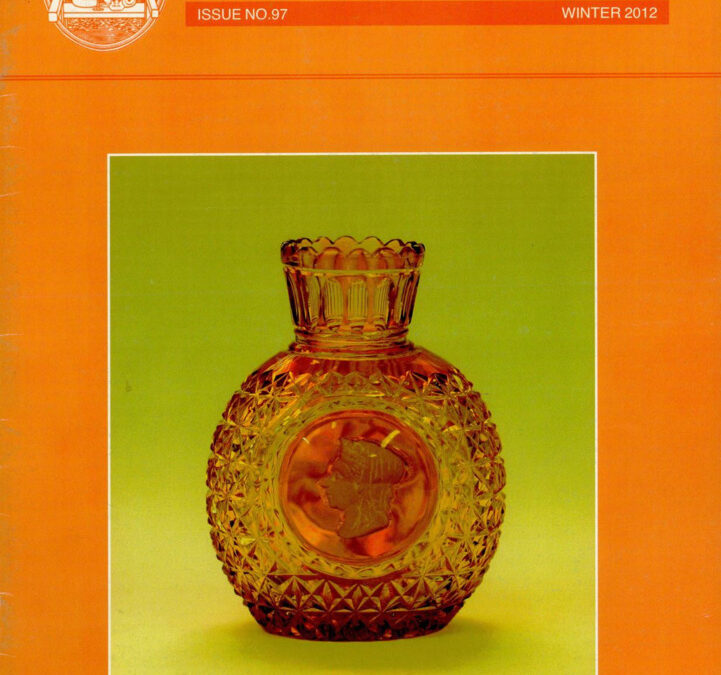
Cover illustrations: (front)
Stevens & Williams, cased
Rockingham over Citron, small cut Sulphide flask.
For the Golden Jubilee of Queen Victoria, 1887.
(back)
Dale Chihuly: ‘Seaform’ from the Persian set
A successful AGM study day at the
Ashmolean, Oxford, last October, was enjoyed
by more than 60 of our members. A thank
you goes to Roger Ersser, who has master-
fully recorded this event (pp.1-3). This year’s
AGM meeting will be centred around the
glass of the 1851 Crystal Palace (see
‘What’s On’).
We welcome the contributions from our
members in this issue of
The Glass Cone:
John Westmoreland, a member of many
years standing, with a two-part in depth look
at Uranium Glass; Colin Brain, a well known
glass researcher, who entertainingly relates
the detection process involved in dating an
unusual baluster glass; Sandra Whiles,
reporting on the process of creating a
modern replica of the Portland Vase — to be
unveiled at the 400 year of glass celebrations
in Stourbridge in August, and Peter Adamson
on a Jacobite Club ceremonial goblet.
Some glassy New Year’s thoughts.
Following the 2011 Diamond Jubilee of the
Festival of Britain (FoB) — a 1951 post war
effort to herald the dawn of a new lifestyle
and hope for the future — we are about to
celebrate with Queen Elizabeth II, in this now
uncertain world, only the second Diamond
Jubilee in the history of the English monarchy.
The FoB was itself the centenary of the
1851 Great Exhibition, when the strength of
Britain and the Empire under Queen Victoria
was celebrated. The glass industry was
growing in size and importance and there
was a mass of pressed glass mementoes,
plates, glasses and jugs, made in Great
Britain, to celebrate her 1887 Golden Jubilee
and even more pressed and blown glass for
the 1897 Diamond Jubilee, the event being
celebrated with great pomp and circumstance.
British glass companies continued to
make royal commemorative glass, both
small editions of pieces of excellence and
mass produced items for everyone, from the
reign of Edward VII through to the coron-
ation of our present queen in 1953, by which
time much poorly designed and decorated
commemorative glass was already being
brought in from abroad.
For the Queen’s Silver Jubilee, there was
hardly any glass of note produced in the UK
and for the Golden Jubilee, even less: of
that, the take up was reportedly slow.
Today, only a handful of small British glass
companies remain. Which company has the
will, design ability and making skills to create
memorable and collectable commemoratives
for this Diamond Jubilee; for a Queen who is
generally agreed to have had a truly majestic
reign? Are there enough of us, who still wish
to go out and purchase a well-designed
souvenir, ‘made in Britain’ or will the glass on
offer, mainly imported, be just for the tourists?
In celebration of The Jubilee, The Glass
Association will be presenting an exhibition
of Royal Commemoratives at the National
Glass Fair on 6 May at The National Motor-
cycle Museum, Birmingham.
THE GLASS CONE NO.97 WINTER 2012
`Crossing Cultures, Crossing
Time’
Historic Glass at the redeveloped Ashmolean Museum
Roger Ersser
A couple surrounded by five
scenes from the Old and
New Testaments.
The scenes are cut into
gold-leaf sandwiched
between two layers of clear
glass, originally forming
the base of a dish.
Wilshere Collection, from
Rome, about AD 330-370.
Ashmolean Museum:
AN2007.13.
O
N 22 October 2011, the AGM of the GA for
2011 was combined with a study day
focussing on the glass collections of the
recently redeveloped, and enlarged, Ashmolean
Museum of Art and Archaeology, University of Oxford.
The morning was devoted to lectures on the
collections in a conference room at the Barcelo
Oxford Hotel. After lunch and the AGM, there was a
visit to the Museum to view the glass under the expert
guidance of Martine Newby and Francis Grew.
Britain’s first public Museum transformed
FOUNDED in 1683, the Ashmolean Museum has,
over the centuries, combined university teaching
and its research role with the public display of
its ever expanding collections of priceless
objects, many donated by members and
fellows of Oxford colleges. Re-opened in
2009 — the latest redevelopment of the site,
a new building behind Charles Cockerell’s
1845 entrance and the European Art
rooms above it, has doubled the
exhibition space and inspired a new
integrated display strategy for its art and
archaeological collections. ‘Crossing Cultures
Crossing Time’ traces the journey of ideas and
influences through time and across continents,
showing how civilisations of the East and West have
developed as part of an interrelated world culture.
Two of our lecturers, Professor Timothy Wilson,
Keeper of Western Art, and Dr Susan Walker, Keeper
of Antiquities, were central to the realisation of this
concept and, during their presentations, shared their
vision with us.
A sharing of expertise and research projects
THE morning session was chaired by the Glass
Association committee member and museum co-
ordinator, Dr Francis Grew (Museum of London), who
was instrumental in arranging this event. It was a rare
and exhilarating privilege to have four distinguished,
internationally recognised, scholars spend the morning
putting the glass held by the Ashmolean into its
historical, cultural, and social context and giving us an
insight into their past, present and future research.
Les arts du feu
PROFESSOR Wilson welcomed us to Oxford, gave
us a short history of the Museum and described the
philosophy and layout of the new building. As Keeper
of Western Art his curatorial responsibilities include
sculpture, paintings and prints, metalwork, jewellery,
ceramics and glass. He has published work and
lectured internationally on most of these subjects. His
primary research interest is European Renaissance
ceramics and particularly Italian majolica. He briefly
explored the historic connections between ceramics
and glass, both the methods of production, which
require furnaces and kilns, in what the French call ‘les
arts du feu’ (includes foundry metalwork), and the
cultural uses of the objects. He discussed their
shared shapes and decoration, how opaque and
cameo glass resembled pottery, and mentioned a
handsome decorated Venetian
lattimo
plate (circa
1741), from the collection, which copied the ceramic
style of the time (see
Glass Cone
96).
Glassmaking was probably developed in the
third millennium Bc in Mesopotamia, alongside
much older ceramic production which used
`glass like’ vitreous glazes. Amulets, beads,
jewellery and small figures were also
fashioned from ancient faience at this time.
This was made by grinding quartz or sand
crystals, mixing them with mineral salts, and
cold forming into objects that were heated to
create a hard shiny, brightly coloured, outer
surface. The critical step was the development of
recipes of sand, flux and lime which allowed the hot
working of the transparent and translucent ‘metal’ we
know as glass.
A cross time/culture story relevant to Professor
Wilson is that the tin glaze used in
maiolica
ware and
also called faience (after Faenza in Italy, one noted
centre for its production) was probably developed
in Mesopotamia in the 9th century
AD
and taken to
Spain by the Moors.
Maiolica
gets its name from
Majorca where tin glazed earthenware was
transhipped from Aragon to Italy.
Professor Wilson then introduced Martine Newby,
the well-known independent scholar, lecturer, and
curator who specialises in ancient and antique glass,
and who had catalogued the Museum’s glass collections.
Glass of four millennia
HAVING struggled to précis 800 years of glassmaking
seen on a recent GA trip to Bavaria, and applauded
the skill of two lecturers in covering a couple of
centuries of Scandinavian glass-making in three
hours at another recent GA meeting, I cannot find the
words adequately to describe the masterful way
Martine led us through collections which run from
fragments of a mosaic glass beaker (circa 1400 Bc)
to a stipple-engraved bowl (1981), in 75 minutes!
THE GLASS CONE NO.97 WINTER 2012
1
Hercules kills the Kelynian
stag in the third of his
twelve labours. The scene is
cut into gold leaf once
attached to the wall of a
glass bowl and protected by
a blob of blue glass.
Wilshere Collection, from
Rome, about
AD
330-370.
Ashmolean Museum:
AN2007.16.
Sasanian hemispherical
glass bowl with facets
(c.
AD
350-650). Ashmolean
Museum: AN1965.739.
Her Ashmolean handbook
Glass of four millennia
(2000) describes how the glass arrived at the
Museum – illustrating 56 outstanding examples.
Most of the Museum’s objects were acquired
through gifts and bequests (some with Art
Fund assistance, see
Glass Cone 96),
so
some periods and areas are better
represented than others. The University’s
tradition for archaeological excavation is
reflected in extensive collections of ancient
glass fragments and objects from the Near
East and the Eastern Mediterranean. A holding
of 750 pieces of late 17th- and 18th-century
glass comes mainly from two donated collections,
whilst there are few 19th-century examples. A
significant collection of 17th- and 18th-century sealed
wine bottles from local taverns and colleges reflect
the social life of a venerable seat of learning.
Unfortunately the Egyptian galleries were closed so
we could not view the rare fish dish, core-formed
vessels and mosaic inlays she illustrated. Along with
slumped and polished Hellenic bowls, blown and
moulded Roman bottles, and Sasanian glass pieces,
other early treasures include a 4th-century
AD
Roman
bowl, engraved with a hunting scene, found in Wint
Hill, Somerset, and a blue Anglo-Saxon bowl with
trailed decoration (circa
AD
600) found in a grave in
Cuddesdon, Oxfordshire. The Museum has some fine
examples of Islamic glass jugs, flasks, bowls and a
mosque lamp and a few significant examples of
Venetian, German and Biedermeier glass. When
viewed in the Museum, the virtuoso techniques used
to create a moulded purple-ribbed bowl with white
trailing (Egypt or Syria 12th-13th century AD), were
enthusiastically discussed.
Most impressive amongst those from later periods
is the collection of 18th-century pieces, mainly
English drinking glasses, donated by Sir Bernard
Eckstein (1948) and Mrs Monica Marshall (1957).
Many styles of stem, bowl, enamelling and engraving
are represented and Mrs Marshall’s notebooks
contain illuminating and often forthright opinions on
the pieces and those from whom they were
purchased. Her diamond engraved baluster goblet
‘The Fall of Adam and Eve’ (1710-20) and pair of
stipple-engraved portrait goblets of Prince Willem V
of Orange and his wife, by David Wolff (circa 1790),
are particularly outstanding. Simpler, less technically
demanding, pieces, such as jelly glasses, bird feeders
and spill sticks, are also displayed.
A pair of Chinese ruby and snowflake glass cameo
vases (1736-95), a large red ‘gourds’ vase by RenO
Lalique (1914 onwards) and two bowls with stipple
engraving by Laurence and Simon Whistler(1981)
were also impressive when seen on display.
Sasanian aspirations
DR Paul Collins has recently been appointed Assistant
Keeper for Ancient Near East in the Department of
Antiquities at The Ashmolean, following similar curatorial
roles at the British Museum and the Metropolitan
Museum of Art, New York.
Dr Collins described how the recent
turmoil and conflicts in the region from the
Eastern Mediterranean to Iran had
thwarted continuous field archaeological
investigation of its ancient sites, at a
time of rapid advancement in analytical
methodology and information technology.
He described glassmaking/glass-working
history from its origins in the middle bronze
age in north Syria/Iraq, and its spread
through Egypt, to the importance of the
Palestine/Levantine coast by Roman times (see
also
Glass Cone
75).
He then looked east of the Roman Empire to
Sasanian territory and its pre-Islamic glass styles.
Succeeding the Parthian era (247
BC — AD
226) in
southern Iraq, from the mid-3rd century
AD,
the
Sasanian dynasty ruled an empire from the Euphrates
to the Indus until the mid 7th century
AD
and the
coming of Islam. Its glass has been found as far east
as Japanese tombs. Their craftsmen adapted
inherited Roman and Parthian glass-working, mainly
blowing, into forms which later influenced Islamic
styles. Whilst archaeological information for this
period is insufficient for precise identification of
where and when the glass was made and the object
was created, some Sasanian characteristics are
apparent. Advanced chemical analysis of the muted
brown/green glass reveals that plant-ash was used
as a source of soda instead of the minerals employed
by Roman makers. The quality differences between
that used for prestige and domestic objects was
reflected in compositional variations. Best known are
the thick-walled, blown or mould-blown beakers and
bowls with ground, wheel-cut and polished facets.
Other designs have been catalogued, by Whitehouse
(2005), for example.
Dr Collins hopes to investigate and catalogue the
Museum’s large collection of, mostly domestic, glass
pieces found in Kish, southern Iraq, during
collaborative excavations with the Field Museum of
Chicago. There is also an archive of vessel shapes.
2
THE GLASS CONE NO.97 WINTER 2012
Sasanian mould-blown,
wheel-cut and polished
glass beaker (left) and bowl
(right) with circular facets
(c.AD 350-650). Ashmolean
Museum: AN1979.192;
AN1965.738.
An Italian-led dig at Veh Ardashir has revealed
evidence of substantial glass-working activities, but
much has still to be learned about the organisation of
glass-working in this region and glassmaking sites
have yet to be discovered.
First millennium
AD
Roman gold-glass
OUR final speaker was the Keeper of Antiquities,
Dr Susan Walker, who is responsible for collections as
diverse as those curated by Prof. Wilson. Following
the realisation of displays in the new galleries, some
scholars in Dr Walker’s department are researching
glass of the mid-first millennium
AD.
In addition to Dr
Collins’ investigations, a study of Anglo-Saxon glass
from Finglesham, Kent, is planned.
She has written many books on Roman art and
archaeology, including one on the Portland Vase
(British Museum 2004), a replica of which is being
created at the Ruskin Glass Centre, Stourbridge, by
Richard Golding and Tern Colledge under the
sponsorship of Ian Dury
(Glass Cone
96). She
described her present research into the collection
of objects from the catacombs of Rome brought
to Oxford by Charles Wilshire over a century ago.
In addition to sarcophagi and tombstones, it includes
one of the world’s largest collections of medallions
made from etched gold leaf sandwiched between
layers of glass. They mostly depict Christian or Jewish
symbols and scenes relating to marriage. They
were originally incorporated into the bases of glass
bowls or dishes which, in the 4th century
AD,
were
presented to high status individuals during their
lifetime. The bowls were broken on the recipient’s
death, and the clipped roundels mounted into the
plaster of the tomb niches as religious grave markers.
Some have blue backgrounds and the fine detail
produces an exquisite jewel-like quality. Publication of
Dr Walker’s detailed studies is eagerly awaited.
In context and ‘in the flesh’
THE Museum was bustling with visitors when we
arrived. A cascading staircase links the five floors
which surround an atrium. The first four floors each
have an orientation gallery by the staircase which link
themes both vertically and horizontally. Their themes
(from the basement) are ‘Exploring the Past’, ‘Ancient
World’, ‘Asian Crossroads’, and ‘West meets East’.
The top floor has 19th-21st century displays and
space for special exhibitions.
Francis guided us through the early galleries and
Martine covered the Renaissance and later. In addition
to getting close to the treasures described in the
morning session, we saw them in their cultural
context. Francis discussed how 19th-century and Art
Nouveau makers had returned to ancient forms for
inspiration and the Venetian glass cabinet alongside
Renaissance ceramics aided comparisons of styles
and decoration. A fully serviced Georgian dining table
brought together the essence of the curators’
integrated display concept. With so much to see,
return visits are essential.
References:
David Whitehouse.
Sasanian
and Post-Sasanian Glass in
the Corning Museum of Glass
Corning Museum of Glass and
Hudson Hill Press. 2005
Ashmolean Museum:
www.ashmolean.org
Ruskin Glass Centre:
www.ruskinglasscentre.co.uk
The Kish Collection:
www.fieldmuseum.org
A new light and airy
atrium in the newly
refurbished Ashmolean
Museum.
photo
courtesy of the
Ashmolean Museum,
University of Oxford.
THE GLASS CONE NO.97 WINTER 2012
3
Peter Adamson
Mammouth
goblet displayed
with firing glass
for size
comparison and
(below and right)
details of the
engravings
on the goblet
Height 11’C
30.2cm.
Bowl 5r,
14.9cm.
Folded foot 6:f6′
15.3cm.
family would have commissioned a
goblet such as this which expresses
such obvious Jacobite sentiments.
To find the original owners of the
goblet it is necessary to move east to
Edinburgh. Until the electoral reforms
of the 19th century only about one
Scot in a thousand could vote. This
gave rise to countless clubs and
societies which enabled like-minded
members to express their views and
A
Jacobite Club Ceremonial Goblet
T
HE bowl of this goblet is
engraved with a six-petal rose
and single bud, together with
a crowned thistle; on the reverse is a
sunburst blasé containing a three-
masted ship flying both the English
and Scottish flags with the inscription
‘Navigation And Trade’. Around the
rim of the bowl there is the motto
‘Nemo me impune lacessit’. A large
goblet such as this was ideal for
drinking toasts at meetings of clubs
and societies when members would
drink several bottles of wine from
a single glass being passed round
the table.
This goblet came with a very good
provenance from a Scottish family
connected, in the 18th century, to
large estates on the outskirts of
Glasgow, and research suggests that
the goblet had been in the family
since the 19th century. In the 18th
century the family were landlords
of their estates and income came
from the renting of their lands. There
is no evidence that they were
connected with any import or export
business (Navigation and Trade)
and they had no known connection
with the Jacobite cause. It is also
known that in the second half of
the 18th century the family were
saved from poverty when the canal
system north of Glasgow was con-
structed. This involved the purchase
of much of their land — the work being
funded with money from the estates
of attainted Scottish Jacobites. It
seems unlikely therefore that this
gain support for their ideals. Each
club was usually aligned politically
and the same people often formed
the core of several societies. Some,
with links to industry or the military,
were able to influence certain
institutions of the state. Edinburgh
was noted for having a large number
of these clubs and societies and also
for the influence they were able to
exert upon the affairs of state.
‘Nemo me impune lacessit’ is the
motto of the Royal Company of
Archers. This society, founded in
1676, was an elite club comprised of
the most powerful men in the city but
it had never been a military force. The
Dukes of Buccleuch have usually
been members. Allan Ramsey and
Sir Walter Scott were members
and the Honourable Henry Erskine
introduced the pioneer psychiatrist,
Andrew Duncan, to it. In the first half
of the 18th century members had
Jacobite sympathies, in common
with much of the Scottish aristocracy,
which led to their marginalisation in
the decades after 1745. However,
by the 19th century the Archers had
again become part of the establish-
ment and were made the honorary
royal bodyguard in Scotland. Some
of the most important members of
the club at the time of the Jacobite
rebellion were the Earls of Wemyss.
The 6th Earl, David Wemyss, better
known as Lord Elcho, was the eldest
son and heir of James Wemyss, the
5th Earl, and a Captain General in
the Royal Company of Archers. Lord
Elcho was in Rome from October
1740 until April 1741. There he met
James Francis Edward Stuart, the
Old Pretender. In February 1744
he was appointed colonel of the
dragoons and was a member of
the Royal Company of Archers. In
September 1745 Elcho met the
Young Pretender, Prince Charles
Edward Stuart, and became his first
aide-de-camp and a member of his
4
THE GLASS CONE
NO.97 WINTER 2012
council. He fought at the battle of
Prestonpans and was one of those
at the council of war in Derby, in
December 1745, who advised the
Prince to retreat rather than continue
the hazardous advance on London.
As the Highland army retreated he
was present at the Battle of Falkirk
and, in April 1746 at the fatal Battle
of Culloden. In May 1746 Elcho,
together with other Jacobite leaders
made his escape to France in the
frigate
Mars.
A parallel for the configuration of
the engraving on this particular goblet
can be seen in ‘The Jacobites and
their drinking Glasses’, 1995, by G B
Seddon (plate 53). The use of the
motto ‘Nemo me impune lacessit’ on
Jacobite glass can also be seen
on the glass sold by Bonham’s in
London, June 2004, sale 10818, lot
95. A further example is in
A Wine
Lover’s Glasses, the A
C
Hubbard Jr
Collection …
(plate 93), a fine Beilby
ale glass with crowned thistle and the
motto in coloured enamels.
The Royal Company of Archers
supported the Jacobite cause and
its members came from Edinburgh’s
elite in trade and commerce. By
the 1750/60s, the time I believe the
goblet was made, it would have been
clear to all the members that the
Jacobite cause was lost. Some
members were in exile in France but
those remaining in Scotland would
have realised the necessity for
engaging in trade with England which
would account for the engraving of
‘Navigation and Trade’. Although no
parallel for this inscription can be
found on any other glass of Jacobite
significance, a similar sunburst blasé
surrounding the cartouche is seen on
a Society of Sea Sergeants’ glass
(G B Seddon, plate 7).
It is therefore my belief that this
goblet was commissioned for the
Jacobite club, The Royal Company
of Archers, and would have been
used at meetings to toast the King
over the water, but also for success
in the wide business ventures in
which its members would have
been involved.
Observations on the engravings
MR Ian McKenzie of Adelaide,
Australia has been a researcher of
Jacobite glasses and their engravers
for many years. It was at the
‘Scotland’s 400yrs of Glassmaking’
conference that Dr G B Seddon
presented their joint paper main-
taining that the famous Scottish artist
and line-engraver, Sir Robert Strange,
was the probable engraver of the
diamond point engraved ‘Amen’
glasses, a highly important discovery
that has gained international
acceptance.
During the conference Mr McKenzie
had the opportunity to examine
closely the Archers’ Goblet and has
kindly provided these comments.
Mr Adamson asked if I would like
to comment on the Archers’
Goblet with regard to the
engraving as I have conducted
extensive research into the
Jacobite glass engravers.
Mr Adamson is correct to draw
parallels to the Society of Sea
Sergeants’ glass; in fact this
engraver is responsible for other
Society type glasses indicating he
had a connection with the people
who ran them. He was a prolific
engraver of Jacobite glass in the
c 1760 period, as yet unidentified,
he was not the highest skilled of
the group but nevertheless
extremely competent. It is
interesting that there appears to
be some Dutch influence in his
work, polished details for example.
My current thoughts would suggest
that he was working in the North
of England because his work can
be seen on glasses that may have
originated in Holland, there being
a long-established link between
the North East and the Low
Countries. It is my opinion that the
engraving is entirely contemporary
with the glass and would obviously
have been a commissioned piece
for the club.
(Ian McKenzie, 2011)
Thanks must be given to Dr G B
Seddon (left in the picture below) for
his invaluable assistance in the final
preparation of this article and to
Mr I McKenzie (right) for his
comments on the engraving.
THE GLASS CONE NO.97 WINTER 2012
5
The Evidence for . . .
Colin Brain
Fig. 1: Peter
Adamson’s
Dublin’ glass.
C
OMMENTING objectively on
an antique glass can often
present quite a challenge.
An unsubstantiated opinion could
unnecessarily raise, or dash, an
owner’s hope and, due to lack of
tangible evidence, there is often no
choice but to come up with an
informed guess. However, when
I saw the picture of Peter Adamson’s
glass
(fig.1),
I knew this piece was
different and that, for once, there
was plenty of evidence to go by.
I believe this glass was made in
Dublin around 1690, probably in the
Odacio Glasshouse. This short article
gives some background to why I came
to this opinion.
The glass literature is usually the
best place to start, but I know of
only one published illustration of a
complete glass like this.’ So, it is
a question of using other evidence,
namely that from archaeological finds.
Interestingly, the archaeological
records for glass in Britain appear
to peak around 1660-70, with
considerably more material being
available then than into the 18th
century. This may be due to the trade
in recycled glass that developed from
the late 17th century. (A petition to
Parliament suggests that as early as
1685 ‘many hundreds of poor
families keep themselves from the
Parish by picking up broken Glass of
all sorts to sell to the Maker.
2
)
We will look first at the evidence to
support the attribution of this glass
to Dublin and Odacio. John Odacio
was one of three people named in a
glass patent for Ireland issued in
1675.
3
This patent is little known and
is overshadowed in the literature by
references to the English glass patent
awarded to George Ravenscroft the
previous year. Some of the story
behind these two patents has been
published by Peter Francis.
4
Since he
wrote that article there have been a
number of developments, including
the finding of a copy of the Royal
Warrant for this Irish patent and the
excavation of the site of the Odacio’s
glasshouse by a team under Franc
Myles.
5
However, these have not
significantly altered the picture that
Peter Francis presented. This work-
shop was comparatively long-lived.
Odacio may have already started
working by the time the patent was
granted and records for the St
Michan’s parish suggest it continued
to operate well into the 1690s.
6
It is the dominant merese at the
bowl base that marks this glass out
as being from Dublin. I know of
sixteen stems excavated in the
British Isles that share this feature.
The fact that fourteen of these were
found in or near Dublin, and only
two have been found in England,
supports their attribution to Dublin.
That one of the stems was found
during the excavation on the glass-
house site strengthens their identifi-
cation with Odacio. With any vessel
fragment found on a glasshouse site
there is always the possibility that it
was not made there, but was
imported to the site as cullet for
recycling. However, in this case that
seems unlikely since the glass
of the stem has been analysed and
shown to be consistent with working
waste on the site, such as blowpipe
moils.
7
Besides, at that stem’s early
date, from where would it have been
imported?
Matching to fragments found in
sound archaeological contexts helps
reassure that we are dealing with a
genuine 17th-century glass here. This
is important because a surprising
number of supposed British 17th-
century glasses don’t seem to
correlate at all well with the archaeo-
logical record, but that is perhaps a
subject for another occasion. For
comparison
fig.3
shows four different
excavated examples. These were
selected on the simple expedient
that I happened to have reasonable
photographs of these to hand.
Other examples of these stems
have been excavated on ‘New World’
sites — which helps with evidence on
the next question of dating. It is often
difficult accurately to date when
archaeological glass was made.
There is uncertainty both about the
date the fragment was deposited
and how old it was when it was
deposited. It does not appear unusual
for glasses to survive in use for thirty
years. For parts of one site, at least,
there is very little uncertainty about
the date (and time) of deposition. This
6
THE GLASS CONE NO.97 WINTER 2012
is Port Royal in Jamaica. A large
earthquake and a resultant tsunami
struck the city at about 11.43am on
7 June 1692, and resulted in much of
the city being submerged. Port Royal
had the reputation of being the
wickedest city on earth and many
saw the earthquake and resultant
inundation as being divine judgement.
In the late 1980s underwater exca-
vations carried out by teams from the
Institute of Nautical Archaeology
under the supervision of Donny
Hamilton carefully excavated some of
the tsunami ruins. The stems shown
in
fig.3
with a ‘Port Royal’ designation
are two of the many glass fragments
they found. This shows that at least
some of these glasses were made
before 1692.
However, while knowing that
some of these glasses were in use
in 1692 is a big step forward, we
would still like to know how old they
were then. The latter part of the 17th
century was a time of considerable
change for British glassmaking. For
example the lead oxide content went
from about 16% to 48% in less than
20 years. An English Heritage study
in which I assisted was able to
suggest approximately when these
various changes in recipe occurred
and this helps us estimate the date
of manufacture. One particular clue
here is that this glass has a slight
blue tint, almost certainly from the
use of minute quantities
of cobalt oxide (intro-
duced as smalt or zaffer)
as a decolourant. These
decolourants were not
needed in early flint glass,
but reversion to the use
of sand instead of flint
and the increasing level
of lead oxide in the
batch led to a need to
reintroduce something
which counteracted an
unappealing brown tint.
The final piece of
evidence suggesting the
date of this glass is
the relatively lax quality
control.
Fig.2
shows that there is a
‘stone’ in the foot – probably a small
piece of refractory from a pot or the
furnace lining. In earlier or later times
this would have probably been
grounds for rejecting and recycling
the glass (without the offending
`stone’). However, there seem to be
larger numbers of residual defects in
glasses from the last decade or so
of the 17th century. Whether this
was because of pressure to supply
expanding markets, or the employ-
ment of less experienced glass-
makers due to the expansion of the
industry, is unclear.
In this short article I have
summarised why I think this glass
of Peter’s was made about 1690 in
Fig.2:View offoot
showing narrow
fold and
manufacturing
defect.
References:
1.
Turnbull, George
and Herron, Anthony.
The price guide to
English 18th century
drinking glass,
1970,
p.7. (glass said to be
worth £130 when the
book was published!)
2.
Buckley, Francis.
The Taxation of
English Glass in the
Seventeenth Century
1914, p.46.
3.
British library
Stowe MSS 207
f.437. I am grateful to
Mike Noble for
finding the document
and providing the
reference.
4.
Francis, Peter.
‘The development of
lead glass: The
European
connections’,
Apollo,
vol.151. no.456,
Feb.2000, pp.47-53.
5.
Myles, Franc.
‘The archaeological
evidence for John
Odacio Formica’s
glasshouse’.
In
Glassmaking in
Ireland,
John Hearne
(Ed.), 2010.
6.
Westropp, Dudley.
Irish Glass,
revised
edition, edited by
Mary Boydell, 1978,
p.206
7.Dungworth, David
and Brain, Cohn.
‘Late 17th-century
Crystal Glass :
An Analytical
Investigation’.
Journal of Glass
Studies,
vol.51,
2009, pp.111-37.
Fig.3: Comparable
excavated stems
from Port Royal
(Jamaica), Dublin
Castle (Dublin)
and Wells
(England).
Dublin, probably at the Odacio
glasshouse. There is of course no
guarantee that this opinion is correct,
or that discoveries in the future will
not cause a rethink. Naturally I shall
be delighted to hear from anyone
with any comments on, or additions
to this view. However, I hope it has
made an interesting read and
perhaps encouraged others to seek
out the evidence for their own
glasses. My thanks go to Peter
Adamson for bringing this glass to my
attention and for allowing me to use
his photographs for
figs 1 and 2.
Colin Brain can be contacted at
cbrain@interalpha.co.uk
THE GLASS CONE NO.97 WINTER 2012
7
British Royal Commemorative Glass
PART 2. 1887-1953
Brian Clarke
H
AVING dwelled at length in
Part 1, on the extraordinary
output of Stevens and Williams,
I will now take a look at the royal
commemorative glass of James
Powell and Sons (later Whitefriars)
and Webb Corbett, with a few pieces
by Thomas Webb and Stuart. I shall
leave the great wealth of pressed
glass commemoratives for others
and keep the transfer-printed and
etched glass group of souvenirs for
the final review in Part 3.
The information on the companies
themselves being best read from the
reference list, I shall be illustrating
glasses, some more scarce than
others, that can still be found in
general and specialist glass fairs and
with luck, at car boot sales.
Whitefriars
THE first
(fig. 1),
is the wonderful Arts
& Crafts style ‘King’s Cup’ vase,
designed by Harry Powell. It stands
159mm high and is in clear glass, the
prunts and rigaree foot decoration
being in sea green. The King’s Cup
flower is engraved around the prunts;
around the rim of the vase, is
engraved: “EDWARDUS.VII.D’I. GRA’.
BR’.0M’.RE’.E’.IN’.IMP’.” translated
as ‘By the grace of G-d King of
Britain and Emperor of India’. This
was created for the coronation of
Edward VII in 1902.
A rare and unusual posy vase, from
Harry Powell’s ‘Glasses with flowers’
group
(figs 2 and 3),
is decorated
with, I believe, a Clematis plant, the
reverse has an oval glass plaque,
designed to look like a red wax seal,
impressed with the English coat of
arms, the letters E and R to the left
and right, all within a diamond
cartouche. The piece, 97mm tall,
was made for the accession of
Edward VII. A companion piece exists
for the coronation.
The eponymous Drawn Trumpet
glass, one of the most recognisable
styles from the 18th century golden
period of English glass, was used to
commemorate the Silver Jubilee of
George V in 1935, the intended
coronation of Edward VIII and those
of George VI and Elizabeth II. They
are shown in a group
(fig.4),
all
diamond point engraved with the
appropriate royal cipher and dates.
The coronation examples have the
cipher surmounted by a crown, whilst
the Jubilee glass is engraved around
its rim: ‘Here’s a Health unto His
Majesty’. The engraving was carried
out by W.J. Wilson.
A further group of generous round
funnel bowl goblets (fig.5), with red,
white and blue colour twist stems,
again a pastiche of 18th-century
style, were made by Frank Hill and
diamond point engraved by W.J.
Wilson. Shown is one for Edward VIII,
(that and the GVI goblet, stand 230mm
tall), and two goblets for the coronation
of Elizabeth II, showing different twists
in the stems; these are shorter, at
202mm.
The use of the pointed funnel bowl,
with an ‘upside down’ drawn trumpet
as the foot and joined by a blue,
flattened knop, gives a very art deco
feel to this unusual design of goblet,
diamond point engraved by W.J. Wilson
for the coronations of George VI and
Elizabeth II. It is 190mm tall
(fig.6).
Frank Hill also
made this clear
copper-wheel
engraved goblet
for Elizabeth II
(fig.
7) again with
a pointed funnel
bowl. The hollow
knop contains a
coin,
especially
minted for the
coronation. Although leaning on the
18th century again for its inspiration,
this goblet is a fresh, stylish design,
195mm tall, showing that Whitefriars
still ‘had what it takes’ in the 1950s.
Other than the first two glasses des-
cribed above, all remaining examples
have ‘WHITEFRIARS’ in upper case
engraved under the foot on the pontil
scar, along with an edition number.
8
THE GLASS CONE NO.97 WINTER 2012
get a look in. The loving cups are
140mm tall. In
fig.12,
the same
design concept has been used for a
cocktail shaker and two glasses, to
commemorate the coronation of
Elizabeth
II.
These 1953 glasses have
the Webb Corbett trademark acid
etched under the feet, giving a positive
identification, applicable as well to
the George VI glasses.
Webb Corbett
A
series of classically-shaped, gilt
decorated glasses by Webb Corbett,
are particularly outstanding. The
same shapes were used for the
various royal events and also for
differing forms of decoration.
Fig.8
shows two similar ale glasses, one
intended for the coronation of
Edward VIII, the other for George VI –
the crown on the Edward glass being
substantially larger than that for
George. Why? Were Webb Corbett
economising on gold, having spent
so much stocking up on the Edward
VIII glasses?
The round stoppered decanter
with its two cocktail glasses
(fig.9),
for
the coronation of George VI, is a very
unique design, with a very period feel.
The loving cup in
fig.10
is the identical
mould to the loving cup in
fig.11 ,
the former with gilt decoration — the
latter with some original polished
copper wheel engraving. Both made
for the coronation of George VI, the
engraved loving cup has, in addition
to the royal cipher and crown,
engraved oak branches with acorns
forming a cartouche around the
cipher and a rose, shamrock and
thistle. As with some of the Stevens &
Williams glasses, poor Wales doesn’t
Webb
JUST one glass included
(fig.13)
but
an original design. Made for the
coronation of George VI, it is a hand-
some round funnel bowl wine goblet
on an unusual hexagonal stem, with
threads of red, white and blue running
down the inside. It stands 193mm tall.
Stuart
STUART produced some round
funnel-shaped ale glasses and cup-
shaped wine goblets on thick stems,
with the typical angled line cutting on
the stems. I have chosen to illustrate
(fig.14),
a more unusual, magnificent
barrel-shaped vase, made for the
coronation of Elizabeth II. At 221mm
tall, it has five vertical bands of three
polished cuts running the height of
References:
Dodsworth, R, ‘British
Glass between the
wars’: Dudley Leisure
Services. 1987
Evans, W, Ross, C
and Werner, A.,
‘Whitefriars Glass –
James Powell & Sons
of London’: Museum
of London. 1995.
Hajdamach, C.,
’20th Century British
Glass’: Antique
Collector’s Club. 2010
Hajdamach, C.,
‘British Glass,
1800-1914′: Antique
Collector’s Club. 1991
Jackson, L.,’20th
Century Factory
Glass’: Mitchell
Beazley. 2000
Jackson, L.,
‘Whitefriars Glass-
The Art of James
Powell & Sons’:
Richard Dennis. 1996
the vase, the cipher and crown being
surrounded by a laurel wreath
cartouche. The ground of the cipher
has been laid by acid etching, the
edges of the
E
and R picked out with
a copper-wheel engraved line. The
base has the acid etched ‘Stuart
ENGLAND’
trademark.
Stevens & Williams
SO well engraved, I’m just completing
this overview of Royal commemor-
ative glass by revisiting Stevens &
Williams. 190mm tall, this wine glass
(fig.15),
is from a set of six, intended
to commemorate the coronation of
Edward VIII. The engraving of a
crown, cipher, date of 1937 and an
English rose on one side of the bowl,
is opposed by the left profile of
Edward. The stem is a colour twist
of two multi-spiral cables of red,
white and blue.
There are many other examples,
which cannot be shown, due to lack
of room. Some glasses mentioned
and illustrated will form part of a
Royal Commemorative display at the
National Glass Fair, The National
Motorcycle Museum, Birmingham,
Sunday 6 May 2012.
THE GLASS CONE NO.97 WINTER 2012
John Delafaille
Fig.3. The
Prophets. George
Carnforth.
oo
A Cotswold Gem
G:e
A
L
L
L Saints Church in Selsley
Gloucestershire was the very
first church with a complete
scheme of windows designed and
executed by the firm of William Morris.
The architect Bodley was working
virtually simultaneously with the same
team on St Michael and All Angels
Brighton. The latter church was altered
later but much of the glass remains.
From medieval times until the early
19th century, the South Cotswolds
were at the heart of the English woollen
industry. The industrial revolution saw
West Yorkshire supplant the area for
a while to become not only the English
but the world’s giant of the woollen
industry. Many of the South Cotswold
churches are linked to the prosperity
of that past era, and the generous
endowments they received. The very
last of these so called ‘wool churches’
is All Saints Selsley in Gloucester-
shire, tucked right under the Cotswold
edge of Selsley Common, on the
outskirts of Stroud, and a couple of
miles from the Victorian Ebley Mill
(now preserved as Stroud District
Council Offices).
Its benefactor was Samuel Marling,
owner of several local mills, whose park
•
S 111
Fig. 1. West Wall
and Windows.
Fig.2. Rose
Window. Philip
Webb, William
Morris, Edward
Burne-Jones.
and mansion adjoined the area. He
set aside land for the church which
was to be based on the church in
Marling, Austria (now Marlengo in Italy).
The foundation stone was laid in
1861, and by November 1862 the
church was consecrated. Marling’s
choice of architect was prescient. He
needed an architect for both his new
mill in Ebley and the church. He chose
for both, George Frederick Bodley, a
young man who had just completed
his apprenticeship in George Gilbert
Scott’s office. This was Bodley’s fourth
church but he went on to become
one of the most prolific and influential
ecclesiastical architects of the
Victorian period. He had got to know
many of the Pre-Raphaelite Brother-
hood during 1858, and they both
10
THE GLASS CONE NO.97 WINTER 2012
(X g.
CiaggX
I
4
0
1
4
Si 1
for
,11
11[111 We-1
XX ED EE ME ars E
••••••
n
• IMP111111” “Mrs.
.•
nnn
MM. OM
Nola —-
Fig.6. Christ
blessing the
children. Edward
Burne-Jones.
influenced each other. His promise to
them was to contribute substantially
to the establishment of the art firm
Morris & Co (1861) that included
Edward Burne-Jones, Dante Gabriel
Rossetti, Ford Madox Brown, Philip
Webb and George Carnfield. 1861 is
also the year when Morris switched
from using James Powell and Sons
to using his own glazing.
Bodley’s architecture developed in
the Gothic style, stripping it down to
its essentials but enlivened with brilliant
colours in which the windows often
play the predominant role. The overall
scheme for the windows is said to be
by Philip Webb, and based on 13th-
century windows in Merton College
Chapel, Oxford. Quoting Pevsner,
`Bodley gave William Morris one of
his first chances of executing ecclesi-
astical stained glass, and the windows
are therefore probably the earliest
work produced by the firm of Morris
& Co’. Whether or not that is true is
uncertain, but what is true is that
Selsley is the only church where the
complete scheme of windows was
designed and executed by the firm set
up by William Morris. The church
survives with little change since
then and therefore is of significant
historical and aesthetic importance.
The windows dominate but do not
overwhelm the church. They follow the
familiar pattern of the period: the Old
Testament at the rear of the church
(West)
(fig.1),
the New Testament in
the nave, and the Passion, Crucifixion
and Resurrection around the altar.
But the pattern of the windows is far
more structured than the church
which has evolved over many years.
Thus the central figure of Christ the
creator in the large Rose window in
the West faces directly a similar
seated figure of Christ, this time in full
majesty on the East Wall, locking the
main axis of the church, with Christ
as the beginning and end of time.
The Rose window on the West
Wall
(fig.2)
tells of the Creation. The
Pre-Raphaelites laid emphasis on
naturalistic details; however, they did
not flinch from the challenge of telling
the story of the Creation, which is more
conceptual than naturalistic. Starting
clockwise from the top numbering
1 to 8 we have first, The Holy Spirit
moving on the waters, then the
creation of light and darkness. It is
only in the final two, Eve picking the
apple and Adam naming the beasts,
that we have a traditional view. Three
of the roundels (nos 1, 6, 8) are by
Philip Webb, the remainder by either
Morris or Burne-Jones, but attribution
is by stylistic analysis and therefore
uncertain. For example, in 1970 Eve
picking the apple was described by
Pevsner as ‘one of the very best of all
Morris’ windows’; now the attribution
is either to Morris or to Burne-Jones.
Beneath the circle of Creation are
four lights of the prophets
(fig.3).
These are by George Carnfield who
started his career as a glass painter
before eventually becoming foreman
of Morris & Co.
There is a tendency to think primarily
of the artists and the overall balance
brought by the architect. There is one
person often overlooked, namely the
client, and when that client is an
individual, one sometimes finds the
unexpected. The South Wall has four
windows, two by William Morris and
one each by Edward Burne-Jones
and Dante Gabriel Rossetti. They all
have delightful touches of naturalistic,
and in one case humorous, repre-
sentation. St Paul preaching in Athens
has his audience on either side. One
includes a very bored looking young
woman
(flg.4),
the other a sleeping
soldier
(fig.5).
Would this have been
approved by a parochial council?
Artists and architects though must
also have models, and identification
of the faces used provides much
fascination. We have for example the
heads of both Bodley the architect,
and Burne-Jones himself making an
appearance on one window
(fig.6),
as well as several identifiable friends
and personalities.
The centre of the altar is the cruci-
fixion flanked by traditional scenes.
Here, Ford Madox Brown appears as
the artist for two of the key windows
— the Nativity and the Crucifixion.
Few people on the M5 realise that
this unique little gem is but five miles
from Junction 13. I recommend a
detour leaving the motorway here
and heading for Stroud — on the
outskirts of which are signs to Selsley.
Fig.4. St Paul in
Athens. William
Morris.
Fig.S. Sleeping
soldier (detail
from St Paul in
Athens).
…0…….
Immo
Intr-/),x
–
…• mmaill
–,o
• –
N.,
„
n
xx
XX 1
.
Z22M-
.
= ME
n
i
ii
,…-“”
.
I
•
.
.1
it
I
I
. –
A 1
1
.* .
G
‘
4*
* I .'”-
I”ii, …
1’`
;AMA
1
r \
(
,
&1/4
I
I
il
72,
1
nilli
I
74
‘ .’
3r
. .1
,
4,
1
Of
I
;
4 0
0/
1
e
1P S
”
Ill
‘ ‘
Alin .,..-
,,
t
….
5
____.—milir
dmilliss
1*
AL.
–
_…
11
” i
m i wio
rave
77
00.-4
nave :>
Wou
‘T iro-ii-Z7:A77
THE GLASS CONE NO.97 WINTER 2012
Uranium, Glass and Fluorescence
John Westmoreland
Uranium
URANIUM, in the form of its compounds,
was discovered by Klaproth, a pharmacist in
Berlin, in 1789. He named it after the planet
Uranus (Heaven), discovered by Herschel,
working in Bath in 1781
(see footnote A).
Appropriately, it appears as green due to its
covering of methane clouds absorbing red
light
,
. Herschel had wished to name the
planet
Georgium Sidus —
George’s Star— after
his patron, George III (Luckily not! e.g. ‘I collect
Georgian glass, it’s mostly late Victorian’.)
In fact, general agreement to the name
‘Uranus’ took until the mid 19th century,
although used well before the end of the
18th century — the name ‘Herschel’ was
even suggested at one time — with Herschel
himself writing of the ‘Georgian Planet’ as
late as 1815
2
. (Astrologers, incidentally,
describe Uranus as the planet of genius,
originality, and sudden change; whereas
(A)
Urania, the Heavenly One (otherwise Aphrodite, or
Venus) and the Muse of Astronomy, was one of the
offspring of Uranus. If you were shocked by Aphrodite’s
behaviour, then please don’t enquire into his! Other
chemical elements named after planets are Mercury,
Neptunium and Plutonium, the latter two being
essentially man-made. The cumulative natural radio-
active decays of Uranium and Thorium are estimated to
provide about half the Earth’s interior heat
32
. Uranium in
earth and rock averages about four parts per million.
(B)
Edward’s book on military customs
33
states that
finger bowls were banned from dinner tables at which
members of the Royal Family were present, after 1745
and until the reign of Edward VII. This was to preclude
Jacobite supporters passing their wine glasses over the
finger bowls to toast the exiled family ‘over the water’.
(Further substantiation of this statement has not been
seen by this writer.)
Holst’s Planet Suite has ‘Uranus the
Magician’.) Klaproth’s source material was
pitchblende, then regarded as a waste
material from mining for silver etc. in
Joachimsthal, Bohemia (from Pechblende,
tad luck mineral’
3
.) The silver coins made
were called Joachimsthalers, and later,
`thalers’; hence the word ‘dollars’.
The waste material acquired value as use
of uranium in glass picked up, was later of
importance as a source of radium, and in
modern times as a source of uranium for
nuclear applications. In earlier times,
adverse working conditions, with high levels
of radon gas, resulted in miners’ early
deaths from (unidentified) lung cancer; evil
dwarves were blamed! Due to serial
widowhood, some local women had up to
seven husbands
,
. After WW2, under the
aegis of the Eastern Bloc, mining for
uranium brought forced labour, health
problems, and further environmental
contamination
3
. The element itself was
isolated by Peligot, a chemist in Paris in
1841, its salts being used in glassmaking
before and since; but the pure metal was
not obtained in bulk until 1942.
Uranium is mildly radioactive and is also a
toxic metal; either may be the more limiting,
depending on the mode of exposure. The
radioactivity increases with time to an equili-
brium, due to the formation of radioactive
decay products
(see footnote B).
Radio-
activity was discovered by H. Becquerel in
1896. He and his father had also researched
the fluorescence of uranium salts. It is the
last natural element in the periodic table,
and one of the most dense at 19g/cc., akin
to gold, lead being 11.4g/cc
8
.
Its concentration in uranium glass can
vary a hundredfold, up to several percent by
weight and, very rarely, somewhat higher, 3%
being the normal upper bounds’. Anything
above 0.5% affects the glass density
measurably
8
. Its use for colouring glass may
be seen as part of the move, starting in the
early 19th century, to produce more coloured
glass, and in a greater range of colours
9
.
10
.
The Riedel factory, and in particular Joseph
Riedel Jnr, produced 600 colours”.
The main commercial use of uranium in
glass spanned the period from the 1830s to
the 1930s. It is said that uranium stocks were
removed from UK glassmaking factories
during WW2. However, there is some slight
evidence that this was incomplete in that
some post-WW2 pieces contain ‘natural’
uranium rather than ‘depleted’ uranium
(i.e. that remaining after processing for
nuclear use). Wartime bans on uranium, in
the UK and USA, were later rescinded.
In parallel with its use in glass, uranium was
used to colour orange and black ceramic
glazes
12
. Examples of UK users were
Brannam’s Royal Barum, Pilkington’s Royal
Lancastrian and Ruskin potteries, but its
use in the UK ceramic industry ceased, for
health hazard reasons, e.g. Brannam’s in
1930
28
. Use in the glass industry seems to
have been more controlled and, once the
batch was melted, the hazard was
essentially contained
613
.
12
THE GLASS CONE NO.97 WINTER 2012
Increasing uranium content
Generally
paler
colours
YELLOW
Generally
darker
colours
UV lights and Geiger counter.
Other uses of uranium, to varying degrees,
have been in photography, UV protection
spectacles, for improvement of steels, as a
chemical catalyst, colouring of false teeth,
armour plating, penetrating ammunition,
ships’ ballast, in pile-driving equipment,
radiation shielding for air freighting of medical
isotopes, homeopathy, in glass gas discharge
tubes (for fluorescence effects), in imitation
pearls, in badge enamels, and consideration
as a replacement for gold in jewelle
The 1923 British Pharmaceutical Codex
quotes its use in treating diabetes and cancer,
and a uranium wine was even offered, for
medicinal purposes
16
!
Post-WW2 use of uranium in glass, often
at lower concentrations than previously, has
occurred in the UK, e.g. Whitefriars
28
, USA,
France, Murano and Eastern Europe, some
using old moulds
15
. Originally supplied as
uranium oxide, the preferred form appears
to have been as sodium or potassium
diuranate
17
. Its chemistry is quite complex
18
.
Thus its first use in glass proved to be quite
difficult, some of the initial variations being
no doubt less controlled.
Early glasses were reported as brown,
yellow, or green. Uranium salts also found
early use as colourants and dyes, for skins
and fabrics, ladies’ yellow kid gloves being
fashionable. The range of colours included
yellow, green, orange, red, and black
3
.
18
. The
17th/18th-century use of uranium to produce
imperial yellow, by the Chinese is reported.
As outlined below, depth of colour, possibly
enhanced by the glass thickness, is only a
partial guide to the uranium content of glass
(see section on Glass), and even less so with
respect to fluorescence intensity (see next
Cone).
This is represented in the chart below,
based on a collection of over 100 pieces.
Uranium content can be assessed, at
least comparatively, with a Geiger counter
(see left).
Comparing the counts (‘clicks’) from
glass with a known percentage content
allows the uranium to be roughly quantified
in other pieces of unknown content.
Glass
THE term ‘uranium glass’ conveniently
embraces all its variations of colour and
transparency. ‘Vaseline glass’, now used in
the USA, is intended to describe yellow-
green, transparent, fluorescent glass; but
not all observe this definition. ‘Vaseline®’
refers to the colour of petroleum jelly in earlier
days, before improved refining techniques
yielded a purer product. In Japan, the term
is ‘shin-ao’ (new green) glass
15
. The typical
yellow-green glass tends towards yellow
viewed by transmitted light (i.e. shining
through the glass), and tends towards green
viewed by incident light (i.e. shining on to,
and reflected from, the glass).
Some of the early reports of uranium in
glass, experimental and commercial, are
summarised in the
Glass Association Journal,
vol.6
20
. An apparent 1912 discovery of
uranium, in first-century tesserae from Naples,
remains unsubstantiated, although some-
times recorded as valid. Klaproth himself
noted the colouring of fluxes (glazes?) with
uraniuml4. An 1817 history of Cornwall
speaks about the use of uranium in glass
manufacture
21
, where a rich lode of uranium
was discovered in 1889
22
.
However, in the history of uranium glass,
the Riedel name is the most prominent.
Franz Riedel, in about 1830, produced
‘annagelb’ and ‘eleonoragrOn’, yellow and
green uranium glasses respectively, named
after his daughters. His nephew Joseph
(Snr) married the elder cousin, and the green
became ‘annagrun’
23
. Those who credit
Joseph with all the above perhaps failed to
note that he was only fourteen in 1830. The
respective names ‘canary’ and ‘green canary’
have also been used for these two colours.
As the yellow was deliberately enhanced, one
may wonder whether some early ‘greens’
were simply the yellow-green of uranium
added to a simple base glass recipe.
Wider use of uranium in glass soon
followed, e.g. at the Harrach glassworks in
Bohemia in 1831. Was this in parallel with
Riedel? (Tomabechi
15
also points out that
the ‘anna’ prefix did not come from the
mine in Mount Anna, Saxony). Some indeed
consider that there may have been other
parallel commercial development outside
Bohemia
9
. Eisner, in Bohemia (f1.1842-62)
produced ‘isabell grun’, chameleon (apt!),
and chrysoprase, a popular name for opaque
green. Whitefriars extended their interest in
coloured glass to uranium by 1835
10
, making
a pair of yellow candlesticks for Queen
Adelaide, wife of William IV, in 1836
8
. In
1837 Whitefriars made topaz uranium glass
fingerbowls (illustrated in Evans et al.
24
and
Hajdamach
9
; and on display at Broadfield
House), and hock glasses, as part of an
order fulfilled by Davenport, which were used
at a banquet attended by Queen Victoria
(see footnote B).
In 1843, Baccarat produced
‘cristal dicroide’ (a yellow-green) and
chrysoprase
10
. Uranium glass was shown at
the Crystal Palace Exhibition in 1851
3
.
Whitefriars originally used uranium in some
coloured glass for church windows
28
, and
also in some of the glazes for
‘opus sectile’
plaques and tiles, applied to an opaque base
tile made from ground glass
28,24
. Ultimately,
it seems that, before WW2, most British
glassmakers used uranium in cut, blown, or
pressed glass, the latter in large quantities,
with 1% uranium content not being unusual.
Many of the pressed pieces carry makers’
and/or registration marks, not forgetting, of
course, that some moulds were sold on at
a later date.
It is stating the obvious that not all
yellow and green glass contains uranium;
conversely, not all uranium glass is yellow, or
green. For instance, uranium plus cerium
produces blue, and uranium plus selenium
yields amber or orange (e.g. Royal Brierley
auburn). In the laboratory at least, uranium,
plus an abnormal 71% of lead, yields red.
Opalescent or opaque uranium glass is
produced by the same methods as for non-
uranium glass.
A pink or red hue may be added by
striking gold, that is, by selectively reheating
(typically the upper) part of the piece, e.g.
Burmese, Peachblow, Amberina. The latter,
changing from yellow to red, often in clear
glass, may also be achieved without
uranium. (Recipes seen, which include gold,
do not refer to the tossing in of a gold coin!)
Webb’s Alexandrite is also a uranium-gold
glass (other ingredients unknown and an
ry14,15
.
THE GLASS CONE NO.97 WINTER 2012
13
archive search proving uninformative) changing from
yellow to red and purple, the latter colours being
produced by reheating twice. The comparable Stevens
& Williams glass was made differently, from three
glasses, each in a different colour. Ivory and turquoise
coloured glass may also be encountered. In many
instances, with both cut and pressed glass
6,728
, the
same designs were produced in different colours,
uranium appearing in ivory, yellow and green versions.
Often, in pre-WW2 harlequin sets of wine glasses and
sundae dishes, any yellow, amber, orange, or green
pieces may well contain uranium. Various pieces of
uranium glass are shown in
the illustrations,
and
identified pieces may be seen at Broadfield House
and at the Turner Museum.
A deeper yellow, at the cost of reduced fluores-
cence, may be induced by the addition of alkali,
aluminium, antimony, lead, praseodymium, etc.,
leading to the ‘canary’ name. In principle, a greener
colour may be developed by varying the proportion of
uranium in the batch; by a more acidic batch (thus
changing the uranium chemistry); by using uranium
reduced from valency 6 to valency 4; by the use of
sand with greater iron impurity; or by adding copper
(sometimes as brass dust – was this the ‘gold coin’?)
and/or iron.
All the commercial recipes for green uranium glass
which the writer has seen utilise the last option, with
one exception, an old ‘fluorescent green’ Whitefriars
recipe
28
. (See, for example, the Thomas Webb recipes
in Hajdamach
9
.) Such added ingredients may also
change the oxidation state of the uranium, thereby
further affecting the final colour of the glass.
Several French
pate de verre
makers, working circa
1900, used uranium in their recipes. The oxide was
used for emerald green, and ammonium uranate for a
yellow-gold, remaining constituents not quoted, other
than lead, in the case of Amalric Walter
26
.
The possibility presumably exists of uranium glass
with both valencies 4 and 6 present. Note, however,
that uranium of reduced valency 4 does not fluoresce.
The presence of lead may affect the final colour, and
also reduce the fluorescence. Iron will also inhibit
fluorescence, including that of lead
12
. The writer is
aware of only one green uranium glass recipe
involving chromium, whose glass chemistry is difficult
– another old Whitefriars recipe, for a green glass,
using uranium, copper, iron, and chromiumi
28
. In fact,
chromium can itself give a yellowish green glass,
another confounder being cadmium, which can give
a greenish yellow glass; both of these in the absence
of uranium.
Chromium, however, can also be used for a clear
characteristic green, known for some while
12
•
21
. All
this prompts two reflections, given that similar colours
may be achieved in different ways.
Firstly it is not always clear whether the expense of
using uranium was necessary, particularly in the case
of a non-fluorescent glass. It could be that a ‘new’
colour was produced by combining two recipes, one
of which originally involved uranium, and maybe
originally fluoresced. Secondly, there are pieces in
which the quantity of uranium is marginal, detectable
by the Geiger counter, but not by any fluorescence.
Were these due to residues in the coloured glass pot,
contamination of the batch, or due to the addition of
uranium-containing (coloured) cullet?
Uranium plus selenium has been used to produce
a ‘champagne amber’ for lamp shades etc., and in
greater concentrations to give a deeper amber.
Uranium has also been tried, experimentally only,
instead of iron, in making bottle glass, easing the
conditions required to yield the desired amber colour,
as well as enhancing it
27
.
To be continued in the next
Glass Cone
ACKNOWLEDGEMENTS
This article was originally suggested by Andy McConnell.
The writer acknowledges his indebtedness to the sources
referenced, on which the article is based. My thanks are also
due, for their helpful comments and technical information,
to Michael Baldwin, Alan Comyns, Roger Dodsworth, Charles
Hajdamach, Peter Lole, John Parker, Barrie Skelcher, Brian
Slingsby (especially re Whitefriars), David Watts, and Magda
Westmoreland. Professor Parker kindly addressed a number
of queries raised by others, including the continuing validity of
ref.1 2. Any errors and omissions remain the writer’s, who
would much like to hear of them (via the Editor). Photographs
were taken by Bill Houston of Regent Studios, Bare.
Amber glass with higher
amounts of uranium, and
(left) a pot with a similar
amount of uranium
in the glaze.
References
1.
Redpath.
Stars & Planets.
Dorling Kindersley, 1998/2002
2.
Holmes.
The Age of Wonder.
Harper, 2008/2009
3.
Hardie.
Deadly Sunshine
[refers to radium]. Tempus, 2005
4.
Fisher.
Much Ado about
(Practically) Nothing.
Oxford
University Press, 2010
5.
Emsley.
Nature’s Building
Blocks.
OUP, 2001
6.
Skelcher, B.
Big Book of
Vaseline Glass.
Schiffer, 2002
7.
Skelcher, B.
Vaseline
Glassware.
Schiffer, 2007
8.
Westmoreland, J.
‘Comparing Glass Density
Measurements’. The
Glass
Cone, no.65,
2003
9.
Hajdamach, C.
British Glass
1800 to 1914.
Antique
Collectors’ Club, 1991
10.
Phillips (Ed).
Encyclopaedia
of Glass.
Spring Books, 1987
11.
McConnell, A.
Wert 20th-
Century Glass.
Miller’s, 2006
12.
Weyl. Coloured Glasses.
Society of Glass Technology,
1992. Reprint, first pub’d 1951
13.
Bray.
Ceramics and Glass
-A Basic Technology.
Society
of Glass Technology, 2000
14.
Doerfel & Gelfort. ‘Uranium
Glasses – their Importance in
the 19th Century.’
Glass Circle
Journal,
no.11, 2009
15.
Tomabechi.
Uranium Glass.
lnwanami Publication Service
Centre, 1995/2004 (in English
and Japanese)
16.
Caufield.
Multiple Exposures.
Secker & Warburg, 1989
17.
Simmingskold.
Raw
Materials for Glassmaking.
Society of Glass Technology,
1997
18.
Partington.
General &
Inorganic Chemistry.
Macmillan, 1951
19.
Preston.
Before the Fallout.
Corgi, 2005
20.
Skelcher, B. ‘Uranium
Glass’.
Journal of the Glass
Association,
no.6, 2001, p.38
21.
Lole, P. ‘Uranium Glass in
1817 – a Pre Riedel Record’.
Journal of Glass Studies,
1995
22.
Haydin.
Dictionary of Dates.
Ward, Lock, Bowden &Co, 1892
23.
Jackson, L
20th Century
Factory Glass.
Mitchell Beazley,
2000
24.
Evans, Ross & Werner.
Whitefriars Glass.
Museum of
London, 1995
25.
Thompson, J.
The
Identification of English Pressed
Glass.
Thompson, 1989
26.
Stewart. ‘Amalric Walter.’
Glass Circle News,
no.125, 2011
27.
Schreiber et al. ‘Novel
Formulations of Amber Glass’.
American Ceramics Society,
Bulletin,
71(12), 1992
28.
Personal Communication
14
THE
GLASS CONE NO.97 WINTER 2012
Anona presenting a handle.
The Stourbridge Twenty Twelve Portland Vase Project
Making the Blanks
Richard shaping the vase and below – the first
perfect blank.
T was an exciting weekend at the Ruskin
Glass Centre in Stourbridge when blanks
for the Portland Vase Project were made
last September. Work started in earnest on
Friday 23 September 2011 when the team
gathered, furnaces were loaded, tee-shirts
distributed and roles assigned.
Ian Dury (Stourbridge Glass
Engravers), the sponsor of the
project, had everything under
control including making the
8am start a lot easier by
having bacon sandwiches
and good coffee on tap.
The team assisting Richard
Golding (Station Glass,
founder of Okra Glass)
comprised Steve Foster and
Ian Bamworth (Stourbridge
Glass Blowers), Anona Wyi
(Ruskin Glass Centre) and Merlyn
Farwell (Pye Electronics). The cameo blanks
were to be made using the dip-casing
method. But first of all, the team had to
practice and get used to working together.
Richard’s current studio at Station Glass
is tiny, probably the smallest hot glass studio
in the country. So it was interesting to watch
him getting used, again, to having space,
working with four assistants and two very
different types of glass recipes, designed by
him to recreate the colour of the original
Portland Vase.
Many glass enthusiasts arrived early to
participate in the recreation of history. Those
there from the start experienced the drama
of the early trial runs. Amongst the
attendees was John Northwood the third
and his family (John Northwood carved one
Sandra Whiles
of the most famous replicas of the Portland
Vase which is now at the Corning Museum
in the US).
The team knew that the handles would be
a challenge. Exactly how much of a challenge
soon became apparent.
Glassmaking started at around 9.15am.
By 1 pm there were several one-handled vases
in the lehr but sadly no perfect two-handled
replica had stayed on the iron. Those of you
who have watched Richard at work over the
years will have noticed his calmness and
focus. For the first time ever I saw Richard
looking worried. When the second handles
were presented to Richard the tension could
be felt in the air. Ian Dury and Terri Colledge
(Cameo Glass Artist) could no longer watch.
Was the dream of recreating history
in Stourbridge going to fail at the
first stage?
The team regrouped after
lunch, refocused and went
for it. At about 1.30pm the
first perfect cameo blank
with two handles went into
the lehr to cheers ringing
around the Ruskin buildings.
Richard smiled, the team
relaxed and the blanks
started rolling.
By the end of the afternoon the
lehr was full – with three Portland
Vases, an amphora-shaped Portland Vase
(given that there is still some doubt about
the original shape), an Auldjo Jug and a few
play pieces. All that was left to worry about
now was whether they would
survive the annealing process.
A fair crowd arrived back at
Ruskin early on the Sunday
morning. After a bacon batch
run and more coffee the lehr
had cooled enough to risk
taking pieces out. The smiles
on Ian and Richard’s faces tell
The team after their success:
Back (1-0: Steve Foster, Ian
Bamforth, Merlyn Farwell
Front (l-r): Richard Golding
AnonaWyi, Ian Dury.
the story beautifully. Five perfect blanks ready
for Terri to work her magic over many, many
hours in the run up to the Glass Biennale
next August when the Three Stourbridge
Sisters – the Portland Vase, the Amphora
Vase and the Auldjo Jug – will be unveiled . The first stage of finishing was to recreate
the detail on the handles. Steve Piper,
copper-wheel engraver, cut the handles on
the Portland Vase and the Amphora,
Richard Lamming cut the handles on the
Auldjo Jug and Ian Dury did the flatting on
the Portland Vase and Auldjo Jug and used
a diamond hand file to shape the top
underside of the Portland Vase handles to
achieve the same shape as the original and
Northwood’s replica.
Now it is over to Terri who will be carving
the detail onto the pieces in her studio at the
Ruskin Glass Centre. Work is already well in
hand on the Auldjo Jug. If you are in the area
please pop in and see how things are going.
In the next edition of the
Glass Cone
we
will share some of Terri’s adventures as she
carves the cameo blanks.
THE GLASS
CONE NO.97 WINTER 2012
15
it
ft2iF,
li
tt
4
%
4
6
k
-,
4
44
4 Ur
10″:.
• * 01
1
4 •
.1/
I
‘
1
0•4 r’
4
9
, a
40,
slik
.
te
•
co.&
4
‘
0
‘,14
lit’
•
a.
c. ‘
e
V
•,,
4 avr
eft
sip.
a
,
t
11’
n
°
CIA
41.
i
lk
0
,
ono
,..
..
it
–
4 As
: *
N
–
ea
0
j
Oa,
Vtlitt
fi
… 0,
al mi
i
n
•••
n
*40
IF
, .
1″
:
1
,0,
4
, …
r o
n
Pt
. 4
„,,,ilk.
to
.
41b
. # , t
.40,74.,::,r,i$0″
., igr
,
tit 0 :4
‘
n
4
0
* 4′ 1…
%At**
ip:. tio,17
–
4
.
)
1
4 p zi
,
till’
AS far as I am concerned, the issue of
paperweights with a Christmas theme is a
modern idea; I don’t recollect ever seeing
any antique weights with holly, mistletoe and
snowmen. My first awareness of such
things was in 1976 when I took advantage
of my membership of the Caithness
Paperweight Collectors Society with a tour
of the Caithness factory in Wick. It was also
the first time that I met Willie Manson who,
I now know, had returned to Caithness after
learning the art of paperweight making with
his involvement, alongside Paul Ysart, in
the Harland Glass project.
Willie was in the process of making the
first Caithness Christmas issue weight, a
lampwork burning candle on a dark purple
ground set inside a ring of millefiori canes
(fig.1).
Having started collecting paper-
weights in 1974, I was just becoming aware
of other Scottlish paperweight makers
including Perthshire, Strathearn and the like,
but I was yet to learn about the Ysart family
and their involvement with the world of
glass. In the years following the visit to
Scotland I discovered a shop in Broadway
that dealt in Perthshire weights, and the first
Perthshire Christmas weight was added to
the growing collection in 1978. For the next
24 years the month of December would
Paperweight
Corner
Richard M. Giles
Christmas Weights
involve a trip to Broadway to look at the
latest offerings. Unfortunately, that was all to
end early in 2002 when Perthshire went into
liquidation. In 1980 I was fortunate enough
to be able to purchase a collection of Perth-
shire weights, which included the Christmas
weights from before 1978, with the
exception of the very first weight from 1971.
For some unknown reason no Christmas
weight was produced in 1973 and it was to
take another fourteen years before I would
complete the set
(figs 2 and
3). Caithness
continued to produce Christmas weights
but my collecting concentrated on those
from the Perthshire factory.
The first time I heard about Whitefriars
Glass was in 1976, when they issued the
weights for the Silver Jubilee of Queen
Elizabeth. However, it was only two years
later that I realised that they had also been
producing Christmas-themed weights since
1975 and continued to do so in the follow-
ing four years until production ended in
1981. It took until the mid 1990s to find the
first four, and the 1979 weight only joined
the others this year
(figs 4 and 5).
I still require
an example of the 1980 bell weight;
however, only a few of these were issued
as it was near the end of the company
production. This is reflected in the price that
one would have to pay, so it may well remain
a gap in the collection. The design for the
1979 weight was based on the carol The
Twelve Days of Christmas’ and featured a
partridge in a pear tree. Whether this was to
be the first of a series based on the carol we
will never know. What will probably not be
appreciated from the picture is that the weight
contains an amazing 9469 individual glass
canes to make up the partridge, six pears,
96 leaves, 40 surrounding canes and the date
cane. It is thought to be the highest number
of canes ever contained in a single weight.
Other makers who have produced some
Christmas weights over the years, but under
various studio names include John Deacons
(‘J Glass’ and his own name) and William
Manson (‘William Manson Paperweights’ and
‘William Manson Paperweights Studio’).
Figs 6 and
7 illustrate Christmas weights
produced during the short-lived existence
of William Manson Paperweights (1979 to
1981) and issued with a Scotia paper label
rather than a WM signature cane.
In 1979 Selkirk Glass introduced the first
of a series of engraved Christmas weights
also based on the carol The Twelve Days of
Christmas’, and featuring the partridge in a
pear tree
(fig.8).
Unlike Whitefriars, they did
fig. I
16
THE GLASS CONE NO.97 WINTER 2012
continue production over the next eleven
years to complete the set. From 1983 to
1987 they also produced a lamp work Christ-
mas weight featuring various Christmas
themes including candles, bells, mistletoes
and flowers. The only other company to
produce a regular series of Christmas
weights was Wedgwood during their days
at King’s Lynn, which opened in 1967. They
are known as the church window weights
because of their distinctive shape. The first
series of five weights was produced from
1975 to 1979 featuring a colourless etching
of a typical Christmas-themed picture
based on a stained-glass church window
(fig.9). From 1980 to 1984, instead of the
etching process they employed a silk-
screen printing process enabling them to
produce a coloured stained-glass type
Christmas picture
(fig.10).
My final example of
a Christmas weight was bought in 1991
from the same shop in Broadway. It is very
different from all the other Christmas
weights being three dimensional rather than
flat and enclosed in glass
(fig.11).
I have
never seen another one and, sadly, as I write
this article, the maker is unknown — but
maybe someone out there will know.
BOOK
Encyclopaedia of Caithness Glass
Paperweights — the first 40 years
Tamefox Publishing, 2011
£155.00
APART from
The Charlton Guide to Caithness
Paperweights,
which was really nothing more than
a list of paperweights produced by Caithness
Glass over the years, and a few publications of
their own, no definitive works on the weights, the
company and the many designers and makers
associated with Caithness Glass over the past
forty years, have been published. Thanks to
Andrew Nowson and four years of research and
writing, this situation has now been corrected
with the publication of his book.
Andrew Nowson’s interest in Caithness
Paperweights was triggered when he inherited his
mother’s collection, which included an original
planets set. The book takes the reader from the
early days of the company and the appointment
of Paul Ysart, through to the various designs,
types and sizes of weights, the jewelry, the
materials, techniques, designers and makers,
many of whom had only a brief involvement with
paperweight making. The book comes in a
REVIEW
massive 630-page hard-back, single volume and,
at £155, it may be beyond the reach of many
collectors. However, you do get excellent quality
in terms of the information provided, the printing
and the two hundred or so pictures of weights
together with their makers.
In my writings over the years I have often
referred to Caithness weights as being the first
abstract weights but this is a term that the author
dislikes, preferring instead the term ‘interpret-
ational weights’ and putting forward a convincing
argument for its use. His enthusiasm for the
project is infectious and it is obvious from talking
to him that the production of the book has been
a labour of love rather than a money-making
opportunity. Despite its chequered history, the
company appears to have come through the worst
and production has been on the increase. This
publication therefore comes at a good time and
will be a valuable asset to the serious collector.
It is unlikely that anyone else will want to take
on the task of this magnitude and, being
produced in very small numbers, the book itself
may well become a collector’s item. For further
information email enquiries@tamefox.me.uk.
— Richard M. Giles
THE GLASS
CONE NO.97 WINTER 2012
17
EXHIBITION REVIEW
Dusky Sky Chandelier
AN attribute of the works in glass by Dale Chihuly
is their extraordinary capacity to command a
room, to fill a space with exuberance, to create
suspense and to inspire emotion.
It is this command that captivates when one
strolls past the new Halcyon Gallery on Bond
Street. An exhibition of such signature character,
set in the classic retail streetscape, simply turns
heads with window displays never seen on Bond
Street – it is startling and wonderful.
Located at 144-146 Bond Street, the new
three-floor Halcyon Gallery was originally
designed as a gallery in a classical hand in 1911.
After a sensitive refurbishment respecting that
classicism, the gallery opened again last autumn
as the fourth London Halcyon.
On entering, the full magic of Chihuly in space
fills every corner of the gallery. The ground floor is
a series of spaces and rooms finished in a stately
residential character, offering the perfect setting
for each Chihuly piece to captivate. The character
being more residential than precious gallery, makes
the pieces so much more approachable; proximity
to these large, extraordinary gravity-defying sculptures
makes them electric, further enhancing their
control of the space. The tall, ground floor
showcases a number of magnificent pieces
from his Chandeliers and Towers series, said by
some to be his most significant contribution to
installation art of the late twentieth century.
Set before you in the centre of the room, and
as well on adjacent walls, are a vibrant collection
of brightly-coloured ribbed forms evocative of
sea-forms. Drawn from his ‘Maize Persian Set’,
they cast out in linear patterns, form on form in
layers of striking colour and light. This series was
said to be inspired by a series of paintings by the
Italian Vittore Carpaccio.
Commanding
Space
Dale Chihuly at the
Halcyon Gallery, 2012
A review by Paul Hanegraaf
For those who have witnessed a Chihuly
exhibit before, the initial gallery settings are indeed
delightful – but are well known. As one moves
deeper into the gallery the tone changes and the
drama increases.
Deep in the gallery are a collection of orange
and Cherokee-red ‘baskets’ set precariously atop
tall pedestals, soft shapes and strident colours
inspired by Native American baskets. Chihuly was
intrigued by how the woven Indian baskets took
a natural form and when made large, lazily
collapsed in themselves. It was this character and
the native Indian colour palate that informed the
making of these pieces. The baskets are set
against a complimentary backdrop of one of the
many large-framed illustrations by Chihuly.
At the rear of the gallery, atop an elegant rise of
marble stairs and framed by a classical doorway,
one’s eye is drawn to the most extraordinary
vibrant collection of crimson red spires – these
from the ‘Mille Fiori’ series. The series expresses
the artist’s lifelong passion for nature and flowers
and in setting an unbridled playful spirit. The
excitement and super scale of this manic
collection of colours and forms simply consumes
the large room in which it is set.
As one moves to the lower level of the gallery
you pass by collections of Chihuly’s drawings
which are truly of interest, yet in comparison to
and in context with the complexity of the glass
they are diminished to wallpaper.
The lower gallery honours Chihuly’s investi-
gation of textile and glass in the showing of a
select family of pieces from his ‘Soft Cylinders’
The Mille Fiori series 2
Vessel from the Venetian Series
series. The decorative expression of a weave of
glass fabric on the simple cylinders belies the
painstaking process involved and the years
developing it and, like the illustrations, these
pieces seem timid by comparison – for the
remainder of the room is what captivates.
The delight of the exhibition rests in the more
intimate pieces of his work. It is here, set
individually on wall shelves, that we find vessel
after vessel taken from his ‘Venetians’ series.
When introduced in 1988 collectors of contem-
porary glass embraced them avidly whilst glass
aficionados were less convinced. In a space
where Studio Glass had been preoccupied by
a need for organic, individual expression, Chihuly
drew inspiration from the craft of Italian glass-
making and the simple apparent form of the vessel.
Developed in conjunction with Italian glassblower
Lino Tagliapietra, they have become recognised
for their blend of concept and technique.
The vessels are striking, irreverent and brave,
yet so exquisitely made – they demand to be
touched, they are soft, supple and sensuous –
statuesque and strong.
The work of Dale Chihuly is well known, having
been exhibited and shown around the globe and
being held in collections by more than 200
museums worldwide. The Halcyon Gallery
exhibition and sale has been extended to 30
March 2012. The show evolves week by week as
pieces are purchased and thus may vary from
that which was seen by this reviewer.
Halcyon Gallery, 144-6 New Bond Street,
London W1S 2PF
wwwhalcyongallery.com www.chihuly.com
Opening hours: Mon to Sat 10am – 6pm;
Sun 11 am – 5pm
18
THE GLASS CONE NO.97 WINTER 2012
lot 2
lot 82
lot 150
lot 22
AROUND THE SALEROOMS
Bonham’s pre-Christmas Auction
ON the morning of 30 November 2011,
The former made £3,500 (£1,200) and
the auction of the collection of glass
¢
the latter, in spite of a few minor rim and
belonging to A.C. Hubbard Jr. was put
(
1
foot chips went up to £1,400 (£700).
under the hammer. Well known through
The four green-tinted glasses on offer
the book produced by Ward Lloyd in
all sold well within or above estimate and
2000, this collection had been put
the Beilby enamelled, colour-twist stem
together over a relatively short period of
wine glass, Lot 135, a quite spectacular
time and extensively covered the different
example, with only one other recorded (in
styles of late 17th-century and 18th-century
the Dumngton collection), made just below
English drinking glasses, with many rare and
estimate at a healthy £24,000; before A.C.’s,
important examples, as well as some
this glass had been in the Hamilton Clements
examples from the continent.
collection. A handsome pair of opaque twist-
With the world’s economy being in disarray,
stem goblets, Beilby engraved with a fruiting
the buyer’s premium plus VAT and the additional
vine and with covers surmounted by teared
VAT of 5% on imported items – there was some prior
acorn finials with gilt button knops were on offer in
discussion as to whether collectors would be con-
Lot 138, these went for the mid-estimate of £27,000.
fident enough to bid up for the glasses being offered.
Lot 142, the star lot of the day, was the Prince
Concerns were groundless; the saleroom was packed,
William V Goblet. Standing 30.2cm tall, this was a
with A.C. himself and his wife Penny in attendance.
massive version of a light baluster-style glass.
There was standing room only, with Bonhams’ staff
Decorated in painted enamels with the coat of arms
bringing in many extra chairs during the first half an
of the Nassau Princes of Orange and bearing the
hour to let more people sit down. A check on the day
motto, JE.MAIN.TIEN.DRAY, this was signed ‘Beilby
showed that at the auction itself and with additional
Newcastle pinxit’. A magnificent glass, the estimate of
post sale purchases, over 80% of the lots sold – this was
£100,000 to £150,000 had no takers at the time. Later,
a tribute to the quality of the collection and possibly as in
this unique glass sold for a world record price at auction
the rest of the art world, collectable items are presently
for an 18th-century English drinking glass of £117,000,
more desirable than holding funds in a bank.
almost double the last record, set at Sotheby’s
There were many strange ups and
auction in December 1997, for the Buck-
downs. Some lots of baluster glasses, air
master Goblet which sold for £67,500.
twists and opaque twists, glasses with
Lot 150, an opaque twist ale glass, was
Jacobite significance and a Williamite glass did
lot 142
decorated with an unusual subject, also from
not find buyers, whereas rarer glasses of good form in
the oeuvre of the Beilby’s – though by which
general though not always, did well, some very well.
member of the family the catalogue did not discuss; the
Lot 2, a very rare, small engraved Queen Mary baluster gold and red crown over the purple-flowered green thistle,
wine glass, engraved all over the bowl with leafy branches was inscribed below in white, with the words ‘Nemo me
and inscribed ‘GOD SAVE THE QUEEN’, estimated at Impune Lacefsit’, the reverse was painted with a white
£7,000 to £10,000, was bid up to £20,000, quickly butterfly in flight. In Ward Lloyd’s book, Simon Cottle wrote
dousing my initial interest in this glass and leaving many of ‘[this] is a really exceptional glass in every respect. The
us gasping. Then a very pleasing example of a rare cylinder- crowned thistle and its inscription … seem to put its Jacobite
knop baluster wine glass, Lot 18, with a flared bowl and folded significance beyond doubt’. The catalogue entry talks only
domed foot, surprisingly struggled to make £3,600 against of ‘The Order of the Thistle’. We’d enjoy publishing any
the low estimate of £4,000. I was not the only one
— — further thoughts on the decoration and the
waiting for Lot 38 to be called – a sea of hands
meaning of the inscription of this glass. The glass
went up; this was for an early baluster ale flute of
sold post-sale for £10,000. A previously unrecorded
fabulous size and form, a tall conical bowl over a
companion tumbler to this ale glass, came up in
collar and three flattened knops, possibly unique
the afternoon sale, Lot 22; with the same crown,
with a provenance going back through the Cranch
thistle and inscription on one side, the reverse in
and Walter Smith collections; excellence in all areas
white with a flowering plant and two butterflies; the
propelled this glass from the low estimate of £1,500
glass made the mid estimate of £10,500.
up to a hammer price of £2,200 – with all the extras
Amongst the large number of colour twist stems
this translates into £2,920, another bid would have
on offer were a number of gems. Such were the
possibly been just too much. Another glass that
vagaries of the day, that Lot 208, with a blue-and-
surprisingly did not sell, was Lot 53, a King George I
white opaque twist stem and a cordial-size bucket
commemorative wine glass, with a four-sided panel-
bowl, admittedly a handsome glass, was bid up to
moulded stem, raised stars at the tops of the panels and
£5,000 (£1,200), whilst a delightful colour twist firing
crowns on each of the shoulders; conservatively
glass, with a drawn trumpet bowl over a stem with
estimated at £3,000 to £5,000. It drew no interest.
blue, green and white threads around a central white
A few collectors with an interest in floral engraved
gauze column, Lot 220, only sold post sale for
wine glasses competitively bid up Lots 82 and 91. Both
21,800 (£2,000). In general, colour twist stemmed
delightfully balanced glasses, the former a light baluster
glasses were made in three parts; bowl, stem and foot.
with a teared acorn knop and a drawn trumpet bowl,
To find, as in Lot 224, a green-and-white colour
engraved with a daffodil and two moths and
bees, the latter a mercurial twist-stemmed,
drawn trumpet-bowled cordial, engraved with
a fruiting bush of berries, stated to be red-currants.
twist stem, drawn from the trumpet bowl,
making a two-part glass, indeed is a rarity.
Atimaimiw’
The glass sold for £2,800.
lot 38
An interesting day. –
Brian Clarke
THE GLASS CONE NO.97 WINTER 2012
19
The shot tower with its
added beacon
MEMBERS
A glass detective story
SOMETIMES, a convoluted path is taken to help
with a glass enquiry. However, persistence often
pays off. Our member, Mrs Angela Naylor, made
an initial enquiry through the Museum of London
(MoL), hoping to find that her small white cloudy
lattice bowl (see
The Glass Cone No.91)
was
made by Whitefriars. The MoL suggested she
contacted Roger Dodsworth at Broadfield House
Mrs Naylor’s bowl (left) and the one of the two
discovered at the National Glass Fair
BOOK REVIEW
AIV
…e.ESS7561/3111.11,
Glass
at Central
by Hildegard Pax
Malvern Arts Press Ltd,
2011.
204 pages,
ISBN 0-9541055-4-0
RRP: £20 plus p&p
Email Hildegard at
csmcentralglass
@gmail.com
AFTER 115 years of continuous activity, sadly, the
glass course at Central St Martins College of Art
and Design was discontinued in 2011 when the
college moved to its new site at the Granary
Warehouse at King’s Cross. The Central School of
Arts and Crafts, as it was first known, opened in
1896, and taught stained glass right from the
start. Stained glass remained the core activity but,
especially in more recent years, the breadth of the
studies and the student work has expanded
considerably, as this book admirably shows.
Inspired by a suggestion from Caroline Swash,
Hildegard Pax, tutor in architectural glass, set
about bringing together the recollections and
achievements of students and teachers of the
Professional Studies in Glass postgraduate course.
To their delight, more than 80% of those who had
studied over the last 25 years were still working in
glass in one way or another. The book is a history
of the college, but above all it gives each of the
glassmakers the opportunity to share memories
of the college with the reader, and to set out their
work and achievements since graduating. There
are famous and well-known names amongst
them, including tutors Patrick Reyntiens OBE,
Professor Amal Ghosh, Jerwood prize-winner
Helen Maurer, Brett Manley, and many more.
The book is copiously illustrated in colour
throughout, and is an excellent overview of the
work of so many current British glass-makers.
Without the book an important story in the history
of British glassmaking would have been lost
forever. It is an invaluable reference book, and
Caroline and Hildegard are to be congratulated
on their foresight, and on the book itself.
-Bob Wilcock
Glass Museum for an opinion. Roger asked for
some photos and Angela also told him that the
bowl was about 3″ high, 4″ wide; that the glass
thickness was about
3
16″
and that it was quite
heavy. Not recognizing the shape from any
Whitefriars exhibition or catalogues, Roger Dods-
worth sent the enquiry through to me and I sent
the enquiry onwards to the collectors/
dealers/makers I thought most likely to know.
Neither myself, Nigel Benson, Graham Hudson
nor Willie Clegg at Country Seat thought this to be
from the Whitefriars factory. Nothing was quite
right about it: the shape, style, glass thickness,
balance or pontil. I thought it might be a piece of
Vasart or one by Anthony Stern’s studio in
London – Anthony didn’t remember making that
exact piece, but said it was the technique he uses
and someone in his studio might have made it! So
we were a little perplexed.
Onwards to the National Glass Fair, last
November 13th. Just on my way out, staring at
me on the stand of David and Sheila Rose, were
two cloudy white lattice bowls, almost identical
to Mrs Naylor’s example. One, 41/2″ and the other
3%’ diam., both 3″ high, they were very finely
marked T.V.G. in the middle of the pontil and
originated from the Teign Valley Glass Studios
at Bovey Tracey, Devon (alongside the House of
Marbles). An enquiry suggested that they were
probably of recent production.
Job done! A satisfactory finale to an initial
mystery. —
Brian Clarke
In memory of
John Sanders
WE were sad to hear
of the passing away of
John V. Sanders. He
had been a stalwart
supporter of the Glass
Association over many
years and his presence
will be missed, not only at our meetings but within
the Friends of Broadfield House and the British
Glass Foundation. A tall figure, giving of sound
advice, but not suffering fools gladly – he could
make an adversary quiver, with a touch of acerbic
wit, yet wearing a gentle smile on his face. We
have passed the condolences of The Glass
Association to his wife Eileen, Claire and Richard.
His funeral was held with a memorial service in
Stourbridge on 25 January 2012.
News from the The National Glass Centre
(NGC )
THE NGC won the ‘Best Tourism Experience
Award 2011′ in the North East England Tourism
Award for its range of unique glass experiences.
Visitors can sign up for a whole range of glass
experiences, courses, taster sessions and family
workshops, with little or no previous experience in
glass making. The one to one Glass Blowing
Experiences offer the opportunity to work
alongside the centre’s studio glass blowers, trying
different techniques on a range of glass items:
paperweights, baubles, bowls and vases.
Also, the NGC recently appointed a new
director, James Bustard who will oversee an
exciting capital development programme taking
place at the centre over the next two years. He
has an ambitious vision to introduce new galleries
and display areas that will see the NGC develop
as a premier attraction in the North East and set
itself on a truly national platform alongside Baltic
and The Sage Gateshead. —
Gaby Marcon
Festival of Britain. The Shot Tower
OUR member, Brian Blench, wrote with a
correction to the article on the Diamond Jubilee of
the Festival of Britain
(The Glass Cone 96, p.4).
In
editing the article, the erroneous suggestion was
made that the Shot Tower was built to house a
radio beacon – unlikely as the Tower was built in
1826! His letter sparked further investigations.
The Shot Tower, designed by David Riddal
Roper, was built for Thomas Maltby & Company
in 1826. It was a prominent landmark on the river
and featured in a number of paintings and prints,
including those by J.M.W. Turner and W. Wyllie.
The Tower was originally built for making shot
from lead. The molten metal was dropped from
the melting chamber at the top, forming perfect
spheres as it cooled in its fall down the 120 feet
within the tower, finally hardening in a bath of
water at the bottom. The Tower remained in use
for the production of lead shot balls until 1949.
In 1950 the top of the
tower was removed and
a steel-framed super-
structure was added. An
optic, made by Chance
Brothers of Birmingham
was placed on the top
in a specially made
lighthouse lantern and
throughout that Festival
year it sent out a double
flashing beam, visible on
a clear day for 45 miles
across London. The
lamp was 3,000 watts
with the power of 3 million candles and had an
automatic device to ensure that a second lamp
could swing into position should the first fail.
Surmounting the lantern room, was placed a
prominent radio telescope beacon.
The year after the festival, the radio beacon and
lighthouse were dismantled, Chance Brothers’
optic being sold for the Brigand Hill lighthouse in
Manzanilla, Trinidad & Tobago. The Shot Tower
was finally demolished in 1962 to make way for
the Queen Elizabeth Hall, which opened in 1967.
The Royal Festival Hall viewed from the Thames
with the shot tower minus its ‘topping’ in 1959
20
THE GLASS CONE NO.97 WINTER 2012
MEMBERS
Hyper radial single flashing light
A note on Chance Brothers industrial glass
DURING 1832 Chance Brothers became the first
company to adopt the cylinder method to
produce sheet glass, perfecting the process in
1837, with the assistance of Georges Bontemps,
a French glassmaker from Choisy-le-Roi. They
became the largest British manufacturer of
window glass and plate glass using the cylinder
method and specialists in optical glass, including
spectacle lenses (their’s was the well known trade
name of ‘Crookes’) and lighthouse lanterns.
Chance Brothers undertook the glazing of the
original Crystal Palace in Hyde Park to house
the Great Exhibition of 1851, and also the glazing
of the Houses of Parliament (built 1840-60). The
The Glass Association provisional programme, 2012
17 March
At St Mark’s Church Hall, Worsley. Peter Sellers
on ‘Victorian Dumps’ and John Hughes on ‘The
Glass of John Derbyshire and Percival Vickers’.
Full information flyer and booking form enclosed
with this
Cone.
19 May (or 29 September)
A prospective meeting at The Harris Museum
and Art Gallery in Preston. They have an 18th-
century wine glass collection, Laura Seddon’s
coloured glass collection, the Mrs French Scent
Bottle Collection, along with an interesting
selection of novelty ‘friggers’.
9 June. A Day with the ‘Georgian Glassmakers’,
Mark Taylor and David Hill, at Project
Workshops, Quarley, Hampshire, SP11 8PX
The day will centre on practical demonstrations
of Georgian glassmaking techniques, such as
making air and opaque twist stems and will
provide opportunities in a relaxed practically-
based setting to discuss evidence for how this
vessel glass was made. AHG members will be
joining us.
June/July A ‘Whitefriars’ day is being arranged
in the Cambridge area.
13 October AGM — Crystal Palace.
The morning centres on presentations on the
original glass for the four faces of the Westminster
Clock Tower, housing Big Ben, was reportedly a
‘double flashed opal glass’ made in Germany.
Chance’s glass was used over the years to
replace damaged sections (each ‘face’ was made
up of 312 separate glass elements), including the
damage sustained in WWII. In 1956 a decision
was made to replace all of the glass in the four
clock faces, to recreate uniformity of colour; by
then, Chance’s was the only firm that was
capable of making the glass required — their glass
was known as ‘Birmingham pot opal’.
Formed in 1824, Chance Brothers’ one-time
enormous works were situated in Spon Lane,
Smethwick. This pioneer of British glassmaking
technology (they also made cathode ray tubes for
the WWII radar) sadly downsized from 1976,
finally closing in the mid 1980s. —
Brian Clarke
Olympic Glasses 1936
THERE was a query in
The Glass Cone, no.93
as
to whether a glass cocktail shaker might be a
commemorative of the 1936 Olympic Games,
and it was concluded that it was not.
Two glasses that came up at Swiss auctioneers,
David Feldman, in December 2011, definitely do
relate to those momentous Games in Berlin.
The first (left) is described as ‘Official
Presentation Vase, 160mm tall, 80mm diameter,
heavy crystal glass, showing eagle holding the
Olympic Rings, square base with cut
design’. Estimate €550.
WHAT’S ON
1851 Crystal Palace by, amongst others, our
President, Charles Hajdamach. Further
presentations on Paxton, the designer, and the
glass furniture of Osier are being arranged. The
afternoon will be spent in two groups, between
the Crystal Palace Museum and a tour of the
Crystal Palace site at Sydenham.
Other events
11 April 2012
The Worshipful Company of Glass sellers of
London, Ravenscroft Lecture—Glaziers Hall
The Glass Seller’s have invited GA members to
this year’s lecture, to be given by Simon Cottle
Esq., Departmental Director of Continental
Ceramics and Glass at Bonham’s Auctioneers.
The Lecture will commence at 6pm. A reception
will be held at 7pm followed by a 2-course buffet
meal with wine. The cost is £66 per person
inclusive of wine and VAT. To book please
contact: The Clerk, The Worshipful Company
of Glass Sellers, Last Hope, Rissington Road,
Bourton-on-the-Water, Glos GL54 2EA
19-23 April 2012
The Glass Circle (GC) trip to The Netherlands
WILL include several museums with glass in
Rotterdam, The Hague and Amsterdam, and
some private collections. Also a visit to bulb
fields and gardens which have notable displays
at that time of year. Price £550 pp excluding
travel. Further infos: secretary@glasscircle.org
The second
(right)
is described as ‘Hand-
engraved heavy crystal glass for Karl Frick.
160mm high, 77mm wide, showing National
Socialist state symbol (eagle holding a swastika in
wreath) between Olympic Rings “19” “36” and
“KARL FRICK”. Artist’s name “R.K. Karkula”
engraved on the bottom. Karl Frick was possibly
related to Wilhelm Frick, Minister of the Interior.’
Estimate €280.
They are from a collection of Olympic
memorabilia collected by John Wilfrid Loaring, a
Canadian athlete who, amongst other sporting
successes, won a Silver Medal in the 400m
hurdles at the 1936 Berlin Olympics. He also won
three Gold Medals in the 1938 Empire Games in
Sydney, and after the war had a distinguished
career in athletics administration. He died in
1959. This sale was by his family. —
Bob Wilcock
19-22 July 2012
Art in Action celebrates the Diamond Jubilee
A four-day festival of fine art and master
craftsmanship, celebrating the Diamond Jubilee
with a special focus on Commonwealth artists,
and their broad and eclectic range of work
including glass. www.artinaction.org.uk
22 August
A British Glass Foundation event, with the GA
As part of the 400 years of glass celebration at
Stourbridge, the BGF has arranged a celebrity
lecture afternoon at Hagley Hall, from 2pm and
ending with wine and canapes at 5.30pm, leaving
the evening free for people to attend other events.
Dr Paul Roberts (British Museum — his visit
sponsored by the GA), will talk on ‘Ancient Classic
Cameo Glass’ with reference to the Portland
Vase, and Charles Hajdamach on ‘The Glories of
Stourbridge Glass from 1845 to present day’ –
to include the replica of the Portland Vase.
24 August to 15 September 2012
The British Glass Biennale www.biennale.org.uk
Forthcoming fairs and auctions 2012
Sun 26 February: Cambridge Fair, Linton
Sat 31 March: 10am: Five Centuries of Glass.
Auction: www.fieldingsauctioneers.co.uk
Sun 6 May: Birmingham National Fair
Sun 23 September: Cambridge Fair, Linton
Sun 11 November: Birmingham National Fair
THE GLASS CONE NQ.97 WINTER 2012
21
PROMOTING THE UNDERSTANDING AND APPRECIATION OF GLASS
The Glass Cone
THE MAGAZINE OF THE GLASS ASSOCIATION
www.glassassociation.org.uk