




SUMMER 2012
ISSUE NO.99
Contents
1 The Lost Art of Pot Changing
3 British Royal Commemorative Glass, PART FOUR, 1953-2012
5 Let’s Twist Again with the Georgian Glassmakers
8 The Pitcher by H Keller
9 The Lythgoe Coin Goblet
10 Enamelled Cockerel Cocktail Glasses
13 Royal Brierley Studio Range
15 To the Netherlands . . .
18 A Window on Whitefriars
19 Book Review, Members, What’s on
Chairman’s message
The Glass Cone
THE MAGAZINE OF THE GLASS ASSOCIATION
Issue No: 99 — Summer 2012
Editorial Board
Editorial Co-ordinator
(The Glass Cone):
Gaby Marcon editor@glassassociation.org.uk
Charles Hajdamach, Mark Hill, Brian Clarke, Yvonne
Cocking, Bob Wilcock
Address for
Glass Cone
correspondence
E-mail editor@glassassociation.org.uk
or mail to Glass Cone, 7 The Avenue, London N3 2LB
E-mail news & events to news@glassassociation.org.uk
Articles and news items are welcome at any time,
but please bear in mind the copy dates if you have
an event you would like to be publicised.
The opinions expressed in the
Glass Cone
are those
of the contributors. The aim of the Editorial Board is to
cover a range of interests, ideas and opinions, which
are not necessarily their own. The decision of the
Editorial Board is final.
Copy dates
Spring: 21 February — publication 1 May
Summer: 21 May — publication 1 August
Autumn: 21 August — publication 1 October
Winter: 21 October — publication 1 February
Advertising rates
Full page £200; Half page £140; Third page £100; Sixth
page £70; Twelfth page £55. For inside back cover and
back cover, prices are on application.
Discounted rates for GA members
Please contact circaglass@aol.com
© The Glass Association 2012. All rights reserved
Design by Malcolm Preskett
Printed in the UK by Micropress Printers Ltd
www.micropress.co.uk
Published by The Glass Association
ISSN No.0265 9654
The Glass Association
Registered as a Charity No.326602
Website: www.glassassociation.org.uk
Life President:
Charles Hajdamach
charleshajdamach@btinternet.com
Chairman:
Dr Brian Clarke:
chair@glassassociation.org.uk
Hon. Secretary:
Judith Gower:
secretary@glassassociation.org.uk
Membership Secretary
Pauline Wimpory,150 Braemar Road, Sutton Goldfield,
West Midlands, B73 6LZ
membership@glassassociation.org.uk
Committee
Paul Bishop (Vice-Chairman); Roger Dodsworth;
Jackie Fairburn; Christina Glover; Alan Gower; Judith
Gower; Francis Grew; Mark Hill; Jordana Learmonth;
Gaby Marcon; Maurice Wimpory (Treasurer)
Membership and subscriptions
Individual: £25. Joint: £30. Student with NUS card: £15.
Institutions: UK £45. Overseas £35. Overseas
Institutions £55. Life: £350. Subscriptions due on
1 August (if joining May—July, subscriptions valid until
31 July, the following year)
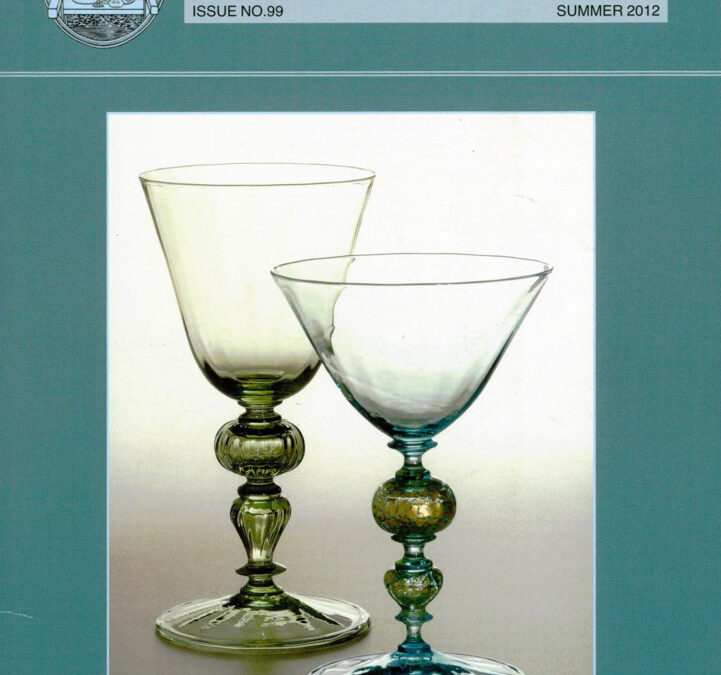
Cover illustrations:
Photos by Dennis Ebden
Front: Venetian inspired goblets for James Powell
& Sons, designed by Harry Powell c.1905. Colours
are sea green on the left and alsatian blue to the
right with gold embedded in the knops.
Collection of Bob Marris.
Back: Whitefriars ‘Drunken Bricklayers’, in indigo,
meadow green and tangerine, designed by
Geoffrey Baxter in 1967. Courtesy of Circaglass.
WHAT a bumpy ride we’re having this year.
An early spring, then a cold and wet
summer, spirits raised by the Diamond
Jubilee and the Olympics only to plummet
again with Europe’s financial turmoil.
Amidst all of this, the Chilford Hall Barns,
home to the Cambridge Glass Fair, burnt
down some while ago. This though, has
provided a lesson in positive thinking – the
organisers have worked hard to arrange a
new venue close by and we are assured of
a wonderful fair on
23
August.
The Olympic champions have shown the
same resolve – work hard and believe;
the results will follow. This Olympic year,
coinciding with the International Festival
of Glass (IFG) has stimulated innovative
ways of following passions in glass. The
Contemporary Glass Society (CGS),
inspired by this Olympic spirit, conceived
the idea of The Glass Games and have
promoted more than fifty exhibitions,
workshops and happenings throughout the
UK.
I’m looking forward to the ‘Medallions’
exhibition at The Ruskin Centre, running
from
22
August to
15
September, featuring
over eighty glass artists who have created
their own unique re-imagining of the
Olympic medallion.
The World’s Longest Glass Blowing
demonstration is a ‘happening’ on
26
August, where Allister Malcolm at the
Broadfield House Glass Museum and Elliot
Walker at the Red House Glass Cone, will
go head to head, raising funds for the
British Glass Foundation (BGF). Completing
a supreme effort, the team of Ian Drury,
Richard Golding and Terri Colledge will
present their copies of the Auldjo and
Portland Vases and an amphora (which
many believe to be the original shape
of the Portland Vase), all to be unveiled
at the meeting staged by the BGF and
supported by the Glass Association and the
Friends of Broadfield House at Hagley Hall,
on
22
August.
Discussions have been ongoing with an
insurance broker, who specialises in antique
collections, especially ceramics. They will
be putting together a package for insuring
glass collections at a discounted premium,
especially for The Glass Association
members. If all progresses as intended, we’ll
have the full terms ready for you by the next
issue of
The Glass Cone.
On
13
October, we’ll be holding our AGM
and day meeting, this time in the newly
refurbished premises of the South London
Gallery, the topic is The Crystal Palace, its
ground breaking, creative design of steel
and glass panels, the history leading to the
Great Exhibition of
1851
and its original site
in Hyde Park before the Crystal Palace
was dismantled, enlarged and rebuilt in
Sydenham, south London in
1854,
standing
until its destruction by fire in
1936.
Please
put the date into your diary now, we have
a fine group of speakers and we will be
visiting the resting site of the palace and
its museum.
THE GLASS CONE NO.99 SUMMER 2012
The
Lost Art of Pot Changing
Charles Hajdamach
p
OT
changing was one of the most spectacular
and awe-inspiring sights within a glassworks.
Performed on a Friday afternoon by the most
talented of the glassmakers i.e. the gaffers of their
respective teams, the pot setting, as it was also known,
fitted into the weekly routine of glassmaking with virtually
no interruption of the system, and the certainty that little
glass was lost due to damaged pots, and that glass-
making could continue on Monday morning. This
sequence of twelve photographs, from Stuart Crystal,
Tudor Crystal and Dartington Glass, highlights some of
that drama. Something of the excitement of pot changing
was also captured by the author of
The Manufacture of
Glass
in 1845:
The reader will suppose that ‘setting a new pot’ is one
of the most tremendous operations of the glasshouse.
Through the kindness of Mr. Pellatt the writer was
present during one of those operations. The first part
of the process was to get out the old pot, which had
done duty for seven months, but was now rendered
worthless from having ‘sprung a leak’ … the wall of
one of the arches was to be taken down, exposing the
men to the naked heat of a huge furnace. The men
were about 24 in number, two or three who worked
at a time, and were frequently relieved. The difficulty
of getting out the old pot was very great: it was in fact
cemented to the floor by the glass which escaped
from the crack. The men therefore had to work at the
bottom of the crucible with huge crow-bars, resting
upon a little roller, supported upon an iron frame,
placed at the mouth of the opening. The blows of the
crow-bar brought away large pieces of glass, soiled
and blackened by the ashes of the furnace, fire bricks,
masses of clay, and sometimes pieces of the pot itself.
The crow-bar was held by two or three men, who
gave a few blows, and then retreated from the fierce
heat, to be succeeded by two or three others, who
performed their minute’s work, and retreated to the
shelter furnished by the massive wall of the furnace.
Pot changing at
Stuart Crystal,
October 1984.
1.
The furnace wall in
front of one of the pots
to be changed, has
been pulled down and
the debris removed on
one of the ramshackle
trolleys.
At this stage the heat
of the furnace,
between 1,000° and
1,180° centigrade,
is released into the
working area.
2.
The old pot has
been levered off the
floor of the furnace,
the prongs of the iron
truck are forced
underneath and the
pot is removed.
3.
The men who
perform the pot
change are the gaffers
of their respective
chairs’ offour
glassmakers. Here
they swing on the end
of the iron truck to
swing the pot round
to allow them to wheel
it outside the factory.
At length the pot being loosened a I round … a low
iron truck on two wheels was thrust under it; and thus
it was withdrawn and thrown aside at some distance.
The floods of heat which now radiated from the
opening were terrible … there was no shield — no
defence. And here was, perhaps, the most arduous
part of the operation; the floor of the furnace had to be
prepared to receive the new pot: for this purpose the
most fire-proof workman was selected; he was
4 (below left):
The new pot has
been brought up
to temperature in
a pot arch, the
annealing oven
mentioned in the
1845 text, and now
it is wheeled into
the glasshouse to
replace the old pot.
5.
While the new
pot is set into
position, one of
the glassmakers
wheels in the
trolleys containing
the replacement
fare-bricks and the
softfire-clay which
will be used to seal
up the opening of
the furnace wall.
THE GLASS CONE NO.99 SUMMER 2012
1
2
mit
%Zee*
1144
9
2.
The new pot has
been brought from
the pot arch and is
about to be
positioned inside
the furnace.
3.
Once the pot
is in its correct
alignment inside
the furnace, the first
of the large bricks is
wheeled in to begin
the process of
re-building the wall.
In the 1845 text
these bricks are
referred to as the
‘two heated masks
of
fire-clay: These
‘masks’ have been
saved and are one of
the few pieces of the
original wall
to be re-used.
The next part of the operation was to close up the
opening, for which purpose two heated masks of
fire-clay were brought on shovels; these rose from
the ground about a yard high; upon them were
placed bricks and fire-clay. The mouth of the pot
being closed with a temporary screen of clay, the rest
of the opening was closed up with great despatch by
a number of men, each bearing a portion of clay or
a brick, which he knew precisely where to deposit.
The final job of the pot changing was to give the
newly-bricked furnace wall a layer of fire-clay to
cover any small gaps.
On Saturday morning any
cracks that had appeared
were covered over with
more fire-clay. Once the
final check was completed
on Sunday morning, the
pot was ‘charged’ with
the raw ingredients which
would melt and be ready
for working on Monday
or Tuesday.
To watch a video on pot changing visit
www.discontinueddesigns.co.uk Click on ‘Thomas
Webb’, play the video ‘Thomas Webb Crystal – part 1’,
and watch sequence from 6min. into video.
•
•
Pot changing at
l’udor Crystal,
Amblecote,
September 1967.
1.
The pot changing
team have removed
the wall of the
furnace, and the pot
is on the truck about
to be wheeled away.
Pot Changing at
Dartington Glass,
December 1986.
1. Here, the team of
glassmakers, using
long heavy crow-
bars, are trying to
free the pot from the
fumaoefloon just as
recounted in the
1845 tea
2.
A fork-lift truck is
used to ease the job
of wheeling the old
pot out of the factory.
The weight of the pot
has to be counter-
balanced by a
glassmaker on
the other end
of the fork-lift.
3.
The wall of the
furnace is already
half rebuilt with the
trolley of soft clay
and fire-bricks
seen clearly in the
foreground.
Illustrations are
courtesy of
Broadfield House
Glass Museum
THE GLASS CONE NO.99 SUMMER 2012
Pot changing at
Stuart Crystal,
continued
6.
The team of
glassmakers now
take turns to pick
up a fire-brick,
spread some clay
onto it, and add the
brick to the growing
wall sealing up the
furnace. Apart from
their ordinary
t-shirts and jeans,
the glassmakers only
have asbestos gloves
and perhaps a visor
to protect them
from the glaring
heat of the furnace.
furnished with a kind of shovel, with a handle fourteen
or fifteen feet long, resting on the roller. A number of
men stood by, each holding a large kneaded piece
of fire-clay – one of them, as he was directed, went up
to the mouth of the opening, and placing his piece of
clay on the shovel, quickly retreated. The clay was
then deposited on the bed of the furnace, and worked
quickly with the spade. [In a modern factory the clay
was replaced by a few shovels of sand to create a flat
and level bed for the pot.]
Another party of men then went with the iron truck to
the annealing oven; its folding doors being thrown
open, revealed the pots, now mounted at about a yard
from the floor, glowing at a bright red heat. To thrust in
the truck under one of them and bring it out, was the
work of a moment; it was quickly wheeled to the
furnace; deposited in its place, and being held by
crow-bars, the truck was drawn out from under it; the
whole being accomplished with a dexterous celerity
which pleased and satisfied the onlooker.
British Royal Commemorative Glass
PART FOUR, 1953-2012
Brian Clarke
Figs 5-7 (below):
Pieces by
Dartington for the
Diamond Jubilee
of Elizabeth II.
T
HOUGH I consider the pro-
duction of most well-designed,
good quality, collectable Royal
Commemorative glass to have come
to a halt after the coronation of
Queen Elizabeth II, commemorative
glass has still been produced. Indeed,
with the show of appreciation for
Elizabeth by so many in the country
at the time of her Diamond Jubilee, it
would have been churlish not to have
brought this series up to date.
The period 1953 to 2012 coincides
with turmoil in the British glass
industry: companies changing hands,
consolidating, being taken over,
leading to factories closing and
consequent social disruption due to
the great loss of a very skilled labour
force. Royal Doulton bought Webb
Corbett in 1969 and used the names
of Minton and Peter Jones to market
their glass. Crown House Ltd bought
Webb’s Crystal Glass Co. (a merger
of Thomas Webb and Edinburgh &
Leith in 1920) in 1964, then merged
with Dema Glass Ltd in 1971, the
whole group was bought by Coloroll
in 1978, leading to bankruptcy in
1990. Whitefriars closed its doors
in 1980, Thomas Webb’s historical
Dennis Lane Works was bought
out by the Coloroll group in 1992,
before folding; Royal Brierley closed
its doors in 2000, and Stuart Crystal
was bought out by Waterford
Wedgwood in 2001. Caithness
and Wedgwood Glass also came
together for a while under the wing
of Royal Doulton, then even the
Drambuie company entered the fray
by buying out Caithness Glass in
1991.
1
.
2
The commercial makers left
today are very few: Dartington Glass,
carrying forward the names of Royal
Brierley and Caithness; Tudor Glass;
Nazeing Glass and Cumbria Crystal.
Outside the studio glass movement,
these are the main companies still in
existence of a once vibrant British
glass industry.
Stuart
Fig.1
shows an impressive 230mm-
tall, bucket bowled goblet, with a
short knopped stem, by Stuart
Crystal for the Investiture of the
Prince of Wales, 1969.
Dartington
DARTINGTON, formed in 1967 by
Frank Thrower, used the annual
production of his iconic FT1 tankards
to produce commemoratives for
Queen Elizabeth ll’s Silver Jubilee in
1977 and a 25-year commemoration
of the coronation in 1978
(figs 2,3)
–
both designed and engraved by Kim
Thrower. An FT1 was also made at
the time of the Golden Jubilee
(fig.4)
in 2002, but not for the Diamond
Jubilee. For this, Dartington produced
drawn trumpet wine glasses and a
vase, both with sandblasted decor-
ation, a diamond jubilee bottle, other
florally engraved bowls, and some
paperweights. They have produced
individual styles for Dartington, Caith-
ness and Royal Brierley
(figs 5,6,7).
Whitefriars
BEFORE passing into history,
Whitefriars made a handsome
baluster presentation goblet to
commemorate the Silver Wedding
Anniversary of Queen Elizabeth and
Prince Philip in 1972. This was
designed and diamond point engraved
by W. Wilson
(fig.8).
Geoffrey Baxter
Fig.1 (left): Stuart
Crystal goblet for
Prince ofWales
Investiture, 1969.
Figs 2-4 (right):
Frank Thrower’s
tankards for
Queen Elizabeth II
anniversaries –
Silver Jubilee,
Coronation’s
25 years, Golden
Jubilee.
THE GLASS CONE NO.99 SUMMER 2012
3
THE GLASS CONE NO.99 SUMMER 2012
designed the Silver Jubilee series in
1977; illustrated are his tankard and
wine glass
(figs 9,10).
The engraving
is sandblasted, using a technique
perfected by C. David Smith and
Irene Stevens of Webb Corbett.
Dema, Minton, Royal Doulton,
Webb, Webb Corbett, Wedgwood
Fig.11
shows a heavy, straight-sided
Silver Jubilee goblet for Queen
Elizabeth II. It is decorated with an
engraved rose, thistles and sham-
rocks, copper-wheel cut and partly
polished, crown, cipher and date
engraved by sandblasting. This goblet
has an eight-sided facet stem over a
starburst cut base. Designed and
signed by C. David Smith of Webb
Corbett for Royal Doulton, it comes in
a presentation box with certificate,
showing this to be No.323 of 750
glasses made, Royal Doulton, 1977.
By now, the design of the packaging
was equal in importance to the
design of the glass!
Boxed as a pair, we show
(figs 12,13)
one each of a drawn
trumpet wine flute and a small brandy
balloon for the Silver Jubilee of
Queen Elizabeth II, 1977. These are
by Webb for their ‘Continental’ range
but were not made in the UK.
Fig.14
shows a wine glass and a
tankard by Dema glass, for the Silver
Jubilee of Elizabeth II, 1977.
In
figs 15,16
we have two bucket-
bowl, air-twist baluster goblets, by
Webb Corbett for Minton, respect-
4
For the Elizabeth 11
Silver Jubilee:
Fig.8 (right): a
baluster goblet by
Whitefriars.
Fig.9 (left): a
Geoffrey Baxter
designed tankard
and fig.10 (centre
right) his wine.
Fig.11 (far right):
a goblet by Royal
Doulton.
Figs 12,13 (below):
A wine flute
brandy by Webb.
Fig.14 (left):
A wine glass and
tankard by Dema.
Fig. 15 (near right):
Air-twist bucket
goblet byWebbb
Corbett for Minton
and fig.16 (far
right) a similar
glass engraved for
the 25th anniversary
of the Queen’s
Coronation.
From left to right:
figs 17,18,19.
ively celebrating the Silver Jubilee and
the 25th anniversary of the Coronation
of Elizabeth II. The goblets are both
copper-wheel engraved with the same
design of an open rose and stems
opposed by a thistle; they both have
additional sandblasted engraving, the
Jubilee glass of the royal
coat of arms and the
Coronation goblet of
Westminster Abbey. They
were marketed through
Peter Jones and, as with
the Webb Corbett piece,
they were designed and
signed by C. David Smith
of Webb Corbett.
Wedgwood used Ronald
Stennet-Wilson’s Shering-
ham design for this Silver
Jubilee candlestick with
a single disc, a cameo
profile of the Queen
setting off the deep purple
glass
(fig.17).
By 2002, there were few firms
interested and able to design and
produce commemorative glass.
Other than the Dartington FT1
tankard, this clear and amber bowl
for the Golden Jubilee of Queen
Elizabeth by Caithness, is one of the
few pieces of collectable glass that
was made
(fig.18).
Tudor Glass
FOR the Diamond Jubilee, Tudor Glass
made the traditionally-designed cut
sugar sifter
(fig.19),
and a goblet.
Unknown makers
Fig.20
is of a green reproduction
sealed 18th-century wine bottle,
celebrating the silver wedding of
Queen Elizabeth and Prince Philip,
1947-72.
4
010
Viriroommms
Fig.1: Mark and David at work in frontof the glory hole.
Fig.2: An air twist stem being formed.
Figs 21,22
are of continentally-made
pieces. A set of six clear-bowled and
amber-stemmed white wine glasses
with silver gilt decoration, then a wine
glass and a tumbler, the only transfer-
printed glasses of which I am aware,
for the Silver Jubilee.
London Glassblowing Studio
It is fitting to end this article with studio
glass, the direction in which glass-
making has been travelling for many
years. Peter Layton, the originator of
this studio, formerly in a warehouse
on the banks of the river Thames in
Rotherhithe, now in Bermondsey,
created a series of forms for Queen
Elizabeth Il’s Diamond Jubilee, loyally
coloured in red, white and blue. A
Segarra form
(fig.23)
is shown.
Top row (l-r)
As 20,23,21.
left:A.22.
REFERENCES:
1.
Charles
Hajdamach.
20th
Century British Glass.
Antique Collector’s
Club, 2010.
2.
Lesley Jackson.
20th Century Factory
Glass.
Mitchell
Beazley, 2000.
Let’s Twist Again with the
Georgian Glassmakers
Brian Clarke
T
HE Project Workshops,
home base to Mark Taylor
and David Hill of the
Georgian Glassmakers, nestles to
the side of a country lane leading
into the small of village of Quarley,
west of Andover in Hampshire.
Their glass studio is part of a
modern visual arts centre.
Our practical day was limited
to sixteen participants, allowing
everyone to view safely the
glassmaking proceedings. Once
seated, we were reminded of their
recent move forward in time
from The Roman Glassmakers’, a
period of glassmaking that still
interests them. With different
levels of knowledge amongst us,
Mark and David started the day by
running through the machinery
and tools in the workshop –
furnace and lehr, an annealing
and strain viewer, different sizes
of jacks, straight and round
shears, and pincers, blowing
irons and punty rods, wooden
blocks and moulds, a supply of
water in a bucket – all items that
have not changed for centuries,
and, as pointed out, not a sheet
of newspaper in sight. Mark had
made his own gaffer’s chair and
ergonomically arranged it at arm’s
reach in front of the glory hole,
less movement for him and his
servitor, David
(fig.
1). They use
cutlet with high lead content,
modified with a few additions to
achieve suitable workability and
colour.
The plan of action was to make
different examples of glasses, with
baluster, air twist
(fig.2),
opaque
THE GLASS CONE NO.99 SUMMER 2012
5
Fig.3: Heavy
Baluster. Inverted
baluster stem.
Simon Bruntnell
Fig.4: Opening up
the bowl of the
light baluster glass
with pucella.
Fig.5:
Drawn Trumpet.
Teared stem.
© Simon Bruntnell
Fig.6: Dripping
excess glass from
the embryonic
stem and cutting
off the waste.
and colour twist stems, folded and
plain feet, finishing off the glasses
with different styles of bowls.
Mark’s first glass was a heavy
baluster, a firm favourite of most
collectors of 18th century glass.
Here, a gather of glass is taken on the
blowing iron; after shaping it on
the marver, with a small blow of air
and stopping the end of the iron, a
controlled bubble begins to form in
the glass gather; this is then blown
out to the bowl shape, heating and
cooling and working with the jacks
(pucellas) to create the desired
shape. Whilst David took charge of
the bowl, Mark amassed a small
gather of glass on a blowing iron,
shaped it, and introduced a small
bubble. After swapping irons with
David, the glass for the stem was
dropped onto the base of the bowl
and sheared away from the iron.
More knops could be added in
sequence as desired. The foot is
added next – this time, a folded foot,
where the rim of the foot is turned
under, depending upon the size of
the glass and the effect required,
from about 4mm to 10mm. The
folded foot requires blowing a small
bubble of glass, which is then
dropped onto the knop and sheared
away from the blowing pipe – the
hole in the foot bubble is opened
further with tools and, on this
occasion, was completed using a
‘soffietta’, a cone shaped tool which
by blowing through it, allows air to
be introduced under pressure, thus
shaping the bubble and flattening the
glass against which it is being held.
To finish the glass, a punty iron is
attached to the centre of the base of
the foot and the original blowing iron,
which has been holding the glass all
this time, is then cracked off from the
bowl. With re-heating and tooling
with the jacks, the bowl shape is then
completed. Finally, the glass is care-
fully taken to the lehr (cooling oven),
coming down to room temperature
over many hours, in order to minimize
stresses in the glass
(fig.3).
In later
discussion, Mark informed me that
he has now decided to create folded
feet without the use of the soffietta –
this will allow a flatter folded foot,
which is more akin to those of the
18th century.
A light baluster was then made
along similar lines, but with the stem
made from two separate gathers and
this time with a simple blown foot
with no folded edge
(fig.4).
Further
glasses were later made with a plain
foot, shaped in the footboard. We
completed the morning with a
demonstration of creating an air
bubble in a glass with a stem drawn
from the bowl – the ‘drawn trumpet’
being the iconic form of an 18th-
century glass
(fig.5).
The bowl was
created as before and a small gather
of glass added to the base. After
marvering, reheating and tooling,
Mark pricked a hole in the base with
a metal knitting needle, into which
was inserted a sharpened piece of
wet wood, a ‘steam-stick’, the size of
a large pencil – the steam created
expanded the hole into a bubble. The
open end of the bubble was then
closed and the glass with the
enclosed bubble further shaped and
drawn with jacks to form the stem.
The foot was added as before.
We all happily broke for lunch,
anticipating the afternoon’s making of
opaque twist stems, and discussing
the techniques seen in the morning.
Mark and David have created a
video
Let’s Twist Again,
which was
played next, showing the making of
glass ‘carrots’, the stretching and
cutting of sections of the carrot to
create ‘proto-stems’, leaving them in
the lehr to stay warm and then the
making of the final opaque twist
stems. The carrots were made by
using a mould into which opaque
canes could be sequenced around
the perimeter – as many and in what
order was needed to produce the
final opaque twist effect in the stem;
a gather of clear glass was then
pressed into the mould, ensuring that
the canes were firmly attached. The
whole was then withdrawn from the
mould and marvered into a smooth
cylinder, which was then dipped into
the pot again, taking on a fresh
gather of clear glass over the cylinder.
On removal from the furnace, Mark
then let excess glass drip away and
be cut off
(fig.6).
This exercise was to
give the effect of the opaque canes
being within the stem rather than on
the surface, yet not buried below too
thick a layer of clear glass. The whole
was then reheated and gravity,
centrifugal force and tooling used to
6
THE GLASS CONE NO.99 SUMMER 2012
finalise the shape. Unless a very complex pattern of
twists were envisaged, no twist was started at this
stage. Eight to ten ‘proto-stems’ could be pulled from
the carrots made in this way — they delightfully used a
pair of wooden kitchen spoons to catch the proto-
stems as they were cracked off the end of the carrot.
More complex ‘double series’ twists could then be
made by plunging the carrot (before its final
stretching) into the mould again, with another set of
opaque canes laid out in a defined pattern; again, on
removal from the mould, the carrot would be further
cased with clear glass before final shaping. All present
were in agreement that the techniques shown, along
with the resultant glasses, were a very convincing
argument to this being the 18th-century way of
working. Colour twists were made in an identical
fashion, the designs dependent on the placing of the
canes in the mould
(figs 7-11).
The afternoon continued with a demonstration of
an incised twist stem. This started life by a gather
of clear glass being dipped into a 10 ribbed mould
(a careful examination of old incised twist, showed
many to have started in a 16-ribbed mould), then
pulled, stretched and twisted further with tools into
shape. The foot was then added and finally the bowl.
Mark made further glasses with a moulded round
funnel bowl, a Lynn bowl
(fig.12),
a bucket-shaped
bowland an ogee bowl, using the proto-stems
already waiting in the lehr. A cheer went up when we
saw the resultant complex opaque twist stems being
formed in front of us.
A final technique shown, was that of making a
‘mercury twist’ stem, so called, due to two thick
columns of air twisting around each other, mimicking
the appearance of mercury in a glass column
(fig.13).
The illusion depends upon the angle and width of the
air twist. Mark started with a plain gather of glass
which was marvered and tooled into a slightly flat
shape; he then used the pucellas to score deeply two
long indents, about 1% inches long, on either side of
what was going to become the stem. This was
cooled and taken back to the furnace for a further
gather of clear glass, so trapping air into the two
indents; as with the opaque twist stems, excess glass
Figs 7-11: A series of
proto-stems to the left and
the resulting twisted stems
to the right in each image.
The unique placement of
opaque and coloured canes
into the mould, allows the
glassmaker to create a
variety of different effects in
the finished stem.
Fig.12: Mark closely
examining his completed
Lynn glass.
Fig.13: Mercury twist stem.
Round funnel bowl.
© Simon Bruntnell
was allowed to drip away, before, in twisting and
pulling this stem attached at one end to the punty
iron, the shape of the mercury air twist was gradually
produced; a foot was then added to this stem before
the bowl was made.
This was a highly inspirational and very educational
day. We all thanked Mark and David for the time they
had put into research and experimentation, and for
having prepared the day so well. Their glasses are
all signed and there are enough differences between
the Georgian Glassmaker’s glasses and those
from the 18th century, for there not to be any
confusion between them. They are there to enjoy as
useable versions of the rather expensive old glass.
The history of the decorative arts, shows the fashion
of the day often harks back to older styles; there was
a strong revival of ‘newl 8th-century glass towards
the end of the 19th century and into the first quarter
of the 20th century, the pattern books of the major
glassworks being peppered with historical designs.
Though having seen so many erroneous glass
attributions on commercial websites these days,
there are concerns, expressed by a number of
dealers and collectors, that some of these glasses
may find their way onto the ‘antique’ 18th-century
market, whether intentionally or through lack of
knowledge by traders. Perhaps Mark and David
would consider an ‘indelible’ signature on their
glasses, such as enamel initials within the foot?
The Glass Association intends to repeat this day in
the spring of 2013.
THE GLASS CONE NO.99 SUMMER 2012
7
The Pitcher by I
–
I Keller
A
T
the end of last year we received a
research enquiry from Mark Quinlan,
living in Pittsburgh, PA, USA. He
was referred to The Glass Association by
the National Library of Scotland and asked
whether we could provide any assistance or
guidance in verifying the history and display
of a beautiful cut-glass pitcher engraved by
his great great grandfather Heironomus
(Mark’s spelling) Keller, the pitcher still being
in his family’s possession in Pittsburgh. His
information indicated that it was displayed
at the Edinburgh Exhibition of 1886 and
later at the Glasgow Exhibition, possibly in
1888. The engraving is titled ‘St. George
and the Dragon’.
A little later he sent over a picture of the
pitcher, which is 7% inches in height with a
base diameter of 4% inches and a top
diameter of 3X inches
(see illustration).
We sent out the details to Jill Turnbull in
Edinburgh, a well-known glass researcher
and writer; Brian Blench, former Curator of
Glass and Head of Decorative Arts at the
Glasgow Museums; David Whitehouse,
former director of Corning Museum; Alison
Brown, the current Curator of European
Decorative Art from 1800 at the Glasgow
Museums; Gordon Mcfarlan (Bonhams);
and Katharine Coleman
MBE,
engraver.
Mark had already had conversations with
Gordon Mcfarlan and Katharine Coleman,
without being able to add much to the story.
Brian Blench had received a letter from Mark
Quinlan in December and was able to send
him details of the register entries for the 22
pieces of Baird/Keller glass in the Glasgow
museums and their complicated prov-
enance, as well as a map of central
Glasgow with locations of several Kellers
from the 1881 census.
David Whitehouse forwarded the request
through to Gail Bardhan at the Rakow library
in Corning, who though researching their
vast resource, could not find any specific
information. Nevertheless, she made the
following general comments: first, it is diffi-
cult to trace the movement of glassworkers
who emigrated, and often the spelling of
names is changed in the ‘new’ country;
second, glass is often passed along in
A story in progress
families, as part of the family history, but
cannot always be officially documented as
to the date of creation. Most important is the
difficulty of documenting specific pieces
from the world’s fairs. Whether the fair was a
very large one or a smaller one, very little
of the specific wares shown are listed or
illustrated in guides.
Jill Turnbull wrote: ‘What a magnificent
glass! A delight to see it and to know its
provenance’. She had a reference to a
water jug described as ‘St. George and the
Dragon and oak ornament’, which was sent
to the Sydney Exhibition in 1879 by John
Ford of the Holyrood Flint Glass Works.
Unfortunately there is no sketch of it. Fords
did employ their own engravers but they
also used the services of John Millar’s
engraving establishment. Millar employed
some Bohemians but also local men who
served apprenticeships with him. Mark’s jug
is unlikely to be the Sydney one because it
was a selling exhibition, but presumably an
engraver might make several of a similar
design. The Edinburgh and Leith Flint Glass
Company (later to become Edinburgh
Crystal) also exhibited engraved glass in the
1 886 exhibition. Jill knew that Keller is said
to have been employed by John Baird in
Glasgow; however, since Baird did not
actually manufacture glass he would have
bought in the blank, possibly from James
Couper & Sons. She has yet to find any
catalogues of the 1886 Edinburgh Exhibition –
a newspaper report mentions engraved
glass, but no individual patterns. The
drawings in the pattern book simply indicate
that a design such as ‘George and the
Dragon’ would almost certainly be a special
one off; there are a couple with horses and
chariots, but nothing remotely like Mark’s
glass, which is so dynamic. Mentioned in
a Sotheby’s catalogue of the time, a Henry
Keller did exist – there is a suggestion that
he may be Hieronymous and that would
be in accord with Gail’s comment about
name changing. Jill finally says that
investigation of the Bohemians who came
over isn’t helped by the fact that most of
them kept their heads down, so there is no
legal material involving them – which would
have been a major source of information.
Censuses are often useful, but someone
could work in Glasgow for nine years and
not be recorded.
Alison Brown kindly overviewed the
correspondence to date, and then noted
that a collection of glass was gifted to
Glasgow Corporation by Mrs John Baird in
December 1927 (accessioned together as
1927.90). There had been a long associ-
ation between Baird and the city’s museums,
for John Baird’s Glassworks had previously
lent examples of (we have always believed)
glass made by his company to the city’s
museums; the register entry always gives
the company address for the loan. The first
loan, documented on 13 June 1881, com-
prised nine pieces all noted in the register as
being engraved by H Keller (no full name
given): including four tankard jugs each
of different designs: ‘St George and the
Dragon’, ‘Adam and Eve’, ‘Moss Troopers’
and ‘Roman Chariot’. The loan was revised
on 13 May 1887 and it would appear that
the tankards were returned to Bairds and
were replaced by claret jugs with glasses,
many of similarly titled designs loaned to
replace them. Revised titles to some of the
jugs and glasses were noted in the register
8
THE GLASS CONE NO.99
SUMMER 2012
1851 census with Joseph Lythgoe and his wife Catherine as the top two entries.
28
3
441/77.
–
deo…..au.04.
71fil
.!.
7.,.
II
Yme at S,
Itoo
i
to:J
,
gr.
..
k..bodc
In . kon,
Night of t, •
. ?tooth, WI
to
thud of g
,
Ago
”.
of
.'”*
..,
Ifoaly
.
Whom Mos
0
OM
/
/7.
V
L4t.
“%ricarirovIAN7
ifirloW-,7„,,W51PF
. –
____±…._____
.
.,,,<,./...,,e..„.L. , x VL: 419atift dwirAtIMIrdi . ." k n do o R i o ge, AGO. . , arY . • £ .Rier s AMINF AII7 i mom A AllillreMMIW ," (..1E111FAMIIE. A 1 M — " /Mlle-gill OM r4 fro ., - , MP' a...._‘e,_ 'AT_ - ii in 1927 when the loan was gifted to the museum by Baird's widow in memory of her husband. This acquisition register entry rather ambiguously notes their manufacture and provenance as follows: 'Set of Water Glasses etc engraved by Keller and made in the Glass Works, Glasgow, then owned by John Baird'. On initial examination, Alison writes: The Charioteer scene on the jug in America is incredibly dynamic compared to the scenes on our pieces; the dynamism on the American jug is largely achieved by the three horses depicted in a head-first gallop being sculpted in 3 /4 profile, their heads held in contrasting positions and the movement taking place along the same direction as the landscape lines. The single rearing horse on our 'St George' claret jug, and the two in our 'Charioteer', look a little more static by comparison, as they sit atop the landscape. The composition is therefore remarkably different. However, from a technical/execution point of view, I would say there are certainly many similarities to those in our collection by H Keller. Various elements of the decorative banding can be seen across a number of the jugs and glasses in our collection, the 'landscape' is almost identical to the treatment of that on `St George and the Dragon', and the polished/unpolished contrasts on the dragon (on helmet) and horses and bridles also bear good comparison with ours. Thank you to all of the above contributors involved in unravelling the fascinating story of this tankard, especially the lengths to which Alison Brown and Jill Turnbull have gone. All being well, an in- depth, collaborative article will be written for a future Journal, piecing together the whole puzzle — this will as ever depend on the writers finding the time to research. The Lythgoe Coin Goblet Michael Jordan Michael Jordan, in coming across a large, engraved, Victorian Coin Goblet, standing 235mm tall, decided to research the name and date engraved on the glass. He has brought to light a fascinating story of glass social history. W ITH its height and large cup- shaped bowl, the goblet makes a handsome presence in my collection. Within the cartouche on the face of the glass is an inscription over three lines, 'JOHN LYTHGOE, BORN AUGUST 7th, 1874'. This is surrounded by engraved flowers, fruits and ferns, whilst the reverse of the goblet is engraved with a river scene; a bull rushes along the banks, two geese in flight and a bird perched on a branch hanging over the water. For an engraved glass, it is quite thinly blown and although lead glass, it only weighs in at 400gm. The stem, in three hollow blown sections, is a drop knop over a cushion knop over a capstan, leading into a plain foot. The cushion knop contains a mint condition Victorian silver threepenny piece of 1878. I was so intrigued by the quality of the glass that I decided to try and find out a little bit more about the young John Lythgoe. With some research, I sourced his birth certificate. This confirmed the birth date and the place of birth (7 Ashcroft Street, Newton, Manchester). Then the first unexpected finding. His father, also named John, had his occupation noted as a 'Glass Blower' so it is very possible that, working at the nearby Newton Heath Flint Glassworks, John's father made the goblet himself, though the engraver is unknown. The Census of 1881 showed that the family had moved to 43 Willows Lane, Rumworth, Bolton and that John Jnr had an elder brother, Joseph — I'm keeping my eyes open for another glass, celebrating his birth! John Lythgoe Jnr died in 1889 at the young age of 15, having slipped on some railway lines. John Snr only lived to the following year, dying in 1890, age 47, from 'anaemia; his profession was then noted as a 'Glass Blower (Journeyman)'. Going further back in time, the Census of 1851 showed John Lythgoe Snr, at that time The goblet celebrating the birth °Rohn Lythgoe. just eight years old, to be one of four siblings, also living in the 'township' of Newton Heath with their parents, Joseph and Catherine. Joseph, born in 1816, had come from Bury in Lancashire and Catherine from Ireland, the occupation of both parents was noted to be 'Glass Bottle Maker'; these two facts lay testament to the mobility of the population at the time, and also to the tradition of handing down skills from father to son. THE GLASS CONE NO.99 SUMMER 2012 9 Enamelled Cockerel Cocktail Glasses Bill Millar Fig.1: 'Harlequin' Cockerel Cocktail Set, comprising glass tray, tot, footed tot, stemmed glass with three glass cocktail sticks, and a cocktail shake,: The cockerels on the cocktail sticks are created by lampwork and all of the other cockerels are hand-painted with enamels. T started with a lonely, unloved cockerel cocktail glass in a charity shop. It desperately needed a good home so I obliged. Some people house stray cats or retired grey- hounds; I re-homed an orphaned cockerel glass. As every collector will understand, once you start it is impossible to stop and my family of cockerels now numbers in the hundreds and is still growing. At least they do not need to be fed, watered and walked! Having had time to examine so many of their species, it is time to state their case and in this article I will concentrate on hand- enamelled cocktail glasses. Cocktails became popular in the early part of the 20th century, initially in the USA and subsequently in Britain. Lunchtime or early evening cocktails became extremely fashion- able during the 1920s and 1930s. The earliest cocktail glasses were produced in America around 1900, followed in Britain by Stevens & Williams, who designed their first cocktail glasses in 1907, although cockerels did not appear on cocktail glasses until a few years later. Most were made in clear glass, with coloured glass being less common. None of the glasses had a large capacity by today's standards. Cocktails led to three distinct shapes of glass; a 'tot', a footed 'tot' (sometimes with a rudimentary stem) and a stemmed glass. The tots were probably intended for those who preferred neat spirits. In addition to the three styles of glass, cocktail sets might include decanters, cocktail shakers or mixer glasses, glass trays, cocktail sticks, ice buckets and I have even seen a matching cigar humidor with a cockerel. A harlequin set of items from different sets is shown at fig. 1. The quality of the glasses is generally high in terms of the materials, methods of manufacture and the standard of decoration. Identification of makers or even country of origin is difficult if not impossible, as the vast majority of glasses do not have manufacturers' marks. Many of the glasses made by British manufacturers can be identi- fied but the remainder are largely of unknown origin. Many will have been made and decorated in Czecho- slovakia but a surprising number are probably American. The Art Deco movement inspired a whole range of stunning, geometric designs. Pictorial decoration was also popular and cockerels were arguably the most common motif. The link between cocktails and cockerels is uncertain and dozens of theories exist as to how the word, first recorded in the early 19th century, came about. My favourite theory relates to horse racing where a cross-bred horse, as opposed to a thoroughbred, had its tail cropped. Thus a horse of mixed parentage had a cocked-tail similar to a fighting cock, which can easily be related to the concept of a mixed drink. However, the similarity between the words cocktail and cock's tail is close enough for most people to accept the use of the motif. The majority of glasses are decorated with a single cockerel or two cockerels cock- fighting. The latter motifs are usually in a series of three or six designs depicting the various stages of the cock-fight. Game cocks were originally prepared for cock-fighting by having their cape and tail feathers, comb and wattles trimmed." When fighting, they were fitted with metal spurs to wound or kill their opponent. Engraved and etched cockerels are Training apart, game cocks were prepared for fighting by having the fleshy comb on top of the head and cheek wattles trimmed so that they could not be damaged in the cock-fight or give their opponent something to grip with their beak. The feathers of the cape (those around the neck area) and the tail were also trimmed to allow the cockerel greater freedom of movement. The claw on the back of each leg was also removed so that a sharpened metal spur could be fitted. 10 THE GLASS CONE NO.99 SUMMER 2012 Fig.2: A transfer- printed tot and a footed tot glass. Fig.3: Two tots with freehand enamelling. Fig.4: Stemmed glass by Stuart Crystal using a single colour decoration. frequently shown in this 'trimmed' state, but I have yet to find an enamelled glass depicting trimmed cockerels. There is logic to this anomaly; if you are going to paint a cockerel, the most attractive parts of his plumage are the cape and tail, with the comb and wattles demanding a daub of red. A few motifs depict cockerels crowing at the rising sun and others include a weathervane and cockerels accom- panied by a hen or chicks. To date, the earliest record I have found of a cockerel-decorated cocktail glass is by Dorflinger, an American decorating company, in 1914. They were produced in Britain and mainland Europe until the outbreak of the Second World War. Cockerel cocktail glasSes were produced in Britain after 1945 but none of these were enamelled. In USA, enamelled cockerel production may have continued through the war but would appear to have ceased around the middle of the century. So the youngest of my enamelled cockerels are now approaching retirement age and the oldest may be looking forward to their centenarian card from the Queen. Cockerels were applied to cocktail glasses by engraving, etching (both acid and possibly sand blasting), gilding, transfer printing and enamelling. Sometimes more than one technique was employed. Whilst this article concentrates on enamelled decoration, it must also consider transfer printing . Firstly, it is necessary to differentiate between enamel and transfer-printed decor- ation. Secondly, a transfer-printed outline was often used as a template for the enamel decorator. Transfer prints are produced by printing the design on a sheet of paper, then floating the design onto the glass. Enamel is low-melting-point coloured glass, ground down and made into a paste which can then be hand- painted onto the surface of the glass; it is either opaque or translucent. Both transfer-printed and enamel- decorated glass is then re-fired in an enamelling lehr, starting with a cold area then rising to over 550°C for just long enough to fix the inks or fuse the enamels onto the surface of the glass. It can be difficult to differentiate between the two techniques. Transfer-printed cockerels will be identical; hand-enamelled cockerels will always have some variation. Comparison of two glasses for their differences is ideal but with experi- ence, careful examination of a single glass may suffice. Transfer printing does not wear as well as enamel and a motif that is looking a bit shabby with fading, scratches or flaked areas is more likely to be transfer printed. Fig.2 shows two glasses with transfer printed decor- ation. The tot glass on the left has damage where small areas of ink have flaked off. The footed tot has a complicated design which could not be produced by hand-painted enamelling. Fig.3 shows two good quality tots with first class, freehand decoration. At first glance the two cockerels look identical; however, careful comparison of the beak, eye and foreground shows some minor differences. Enamelling offers a wide THE GLASS CONE NO.99 SUMMER 2012 11 The author would be interested in any information on cockerel or cock-fighting glasses and would be pleased to hear from you at: billmillar82@yahoo.co.uk most enthusiastic poultry breeders. The best decorators produced what can only be described as minor works of art. Fig.7 includes three glasses, showing two different cock- fighting motifs (from what was probably a series of three - I am still looking for the third motif) painted freehand in Czechoslovakia. I have seen one for sale with its paper label still in place and the quality of the work is outstanding. The detail from one of the glasses is shown at fig.8; from this, you can readily see the skill required to produce a miniature painting with so much detail - the cockerel is actually 2cm high and 4cm long. Fig.5 (left): Black enamel on amber translucent glass. Image created by `scraffito' technique. Fig.6 (right): A lively multi- coloured cockerel. Fig.7 (below): Three Czech enamelled tots. decorative these glasses can be. At their best these glasses are minor works of art. Not all are of a high standard, but no matter how simple they may be, they are all unique. If you come across a cockerel cocktail glass, look at it very closely. They are invariably well made, the decoration is often of a very high standard and they are great fun. Who knows, you too may find room in your heart to adopt a homeless cockerel. palette of colours, though effective results can be achieved using a single colour. Fig.4, a glass by Stuart Crystal, uses one translucent colour over a black, transfer-printed outline. The hand-painted enamel has been applied in different thicknesses to produce different shades. The glass at fig.5 displays a different technique. Black opaque enamel has been applied as a solid shape and a pointed object (possibly the end of a paintbrush) has been used to remove enamel before firing. This scraffito technique is reasonably common but the use of amber glass less so. A livelier style was used on the glass at fig.6 where depiction of movement is most successfully achieved. Translucent enamel has been used for the foreground and opaque enamel for the cockerel itself. With a wider palette, decorators clearly enjoyed themselves, creating images of cockerels in colours that never existed even in the minds of the A variation on the traditional theme can be seen at fig.9, with a superbly painted cockerel's head. The shape was first painted freehand in white enamel, which can be seen from the inside of the glass, and the head then painted in detail. However, this glass has one surprising touch; the area of the eye was left clear and the eye painted in the inside of the bowl which produces a stunning effect. I have provided a brief outline of the life history of enamelled cockerel glasses and used photographs from my collection to show just how Fig.8: Detail of glass at fig.7, showing skilled painting technique. Fig.9: An unusual Cockerel's head. 12 THE GLASS CONE NO.99 SUMMER 2012 Royal Brierley Studio Range Mark Hill W E all know that a piece doesn't have to be did or 'antique' to be desirable and valuable. When browsing around, it's often worth keeping an eye out for product ranges that were or are expensive when sold originally. Although not always the case, a high cost is often indicative of fine quality materials and production methods. High prices can also make a product harder to find when it appears later, on the secondary market, as fewer were bought compared to more affordable designs which become commonplace. Furthermore, as the original owner paid a lot for a piece, they often want a large proportion of their expenditure, or even a premium over it, returned. However, every now and again, some things slip through the net. I think the 'Studio' range produced by the renowned Royal Brierley is precisely one of those. When it was sold during the late 1980s it wasn't cheap. Prices ranged from around £15-220 upwards for a small piece, with the larger shapes pushing £100 or more. That's around £35-245, to over £220, in today's money. But somehow they have been passed over until now. I'm lucky enough to travel around all over the place with my job, and I've begun to hear very wise dealers and collectors make serious rumblings about the fact that it may grow to be quite a 'big thing' very shortly. In 1847, the historic Moor Lane Glasshouse on Brierley Hill near Stourbridge was renamed Stevens & Williams, after having been leased to William Stevens' and Samuel Williams' father in law in 1819. Becoming known for its cut and engraved glass designs, and innovative techniques for producing art glass under the legendary John Northwood, it built a formidable reputation during the 19th century. In 1931, it was renamed Royal Brierley, after a visit from George V. The trial piece for the Royal Brierley Studio' range, made by Michael and Timothy Harris at Isle of Wight Studio Glass, signed TMH Nov 86 ©: The golden brown colouring here is due to the light hitting heavily iridised dark surface. 1986, 7in. (18cm) high. Price guide: f500-£700 Images courtesy of the Graham Cooley Collection, and Millers, www.mNersguides.com Its reputation for cut glass continued to develop, with the Modern designs produced by Keith Murray during the 1930s being particularly notable. After the war, although some modern designs were produced, the company continued to focus on more tra- ditional cut designs. Although main- taining a certain level of popularity, sales began to decline over the following decades as tastes moved away for good. The studio and the new factory- glass movement of the late 1960s and 70s was another factor in this postwar decline. As the movement spread and took hold, colourful often handmade glass in modern styles began to become immensely fashion- able. The trend started with mid- century Scandinavian imports but think of, for example, Geoffrey Baxter for Whitefriars, Ronald Stennett-Willson for King's Lynn and Wedgwood, and Michael Harris for Mdina Glass and Isle of Wight Studio Glass. Royal Brierley saw this and wanted a bit of this burgeoning market for themselves. Their reaction was to approach someone who had successfully adapted the studio glass process to an expandable production-line basis, and built a strong business with exports to over 30 different countries. That person was Michael Harris, of Isle of Wight Studio Glass. Royal Brierley wanted to be able to mimic this process on a larger scale, and produce glass that looked as if it was hand made and modern, thus appealing to this market, but that was actually produced on their factory production line. After consultation, Harris and his family decided to adapt features from one of their existing ranges, 'Ribbons, Satin & Silk'. The trial piece produced for the presentation, handmade by Michael Harris with his son Tim, is shown here. As you can see, an important visual aspect was the appealing iridescent finish that was proving particularly popular at the time, but also harked back to historic Art Nouveau styles. Easy to achieve, the effect was created literally by spraying or 'fuming' metallic oxides onto a piece after it had been formed. The lightly textured and patterned surface, derived from Harris' Lace' design, served to accentuate the effect. Royal Brierley's factory at Tipton, responsible for mass-producing moulded lampshades and other wares, was chosen to produce the range and moulds were adapted or created to form bowls, vases and more. To see how close some of them were to original lampshade designs, look at the wider pedestal bowl shown here, and turn the magazine upside down. See - it's a lampshade! You can also tell they're mould-blown due to the lack of a pontil mark on the base, a slightly concave, smooth base that has not been polished, and walls that are of THE GLASS CONE NO.99 SUMMER 2012 13 a generally even thickness all over the body of the piece. After being formed and fumed, the rims were cut and polished on a machine. To draw attention, they called it the 'Studio' range and marked each piece on the base with a specially designed acid-etched stamp that also included their name - which was still known for quality in the marketplace. The range comprised a number of translucent to opaque colours including black, which is actually a very deep blue, a cranberry pink, green and white. Whilst the red/pink, black and green generally tend to be found with 'fragmented' patterning, the white is more varied. Look out in particular for the combination of 'splashed' black spots against an opaque white, which is much more dramatic than the more sober creamy white mottling on a translucent white body shown here. In terms of rarity, black is the most commonly seen colour, followed by pink, then green and finally white. This order also follows period tastes for bold and dramatic colours - think of the black ash furniture, minimalist grey and smoked glass that was fashionable at the time. Pieces from the late 1980s Royal Brierley'Studio' range A black small globe vase. 4.25in. (11cm) high. Price guide: £30-£40 Right: A black bowl or low vase. 4in. (10cm) high. Price guide: £20-£30 A late 1980s Royal Brierley 'Studio' range pedestal bowl, with strong iridised finish. 8in. (20cm) diam. Price guide: £50-£70 A late 1980s Royal Brierley 'Studio' range pink baluster vase. 9.25in. (23.5cm) high. Price guide: £50-£80 Right: A late 1980s Royal Brierley Studio' range mottled white baluster vase. 9in. (23cm) high. Price guide: £70-1100 A version of this article appeared in Collect it magazine Bowls and vases are the most common shapes found, but perfume atomisers with puffers are also not hard to find. However, they tend to be less popular as they are not as immediately useful or decorative as is, say, a vase. Variety abounds in terms of bowl and vase forms. Vases based around the baluster or squat globe forms are seen more commonly, probably as these traditional forms appealed the most. Simpler cylinder vases are somewhat scarcer. Similarly, simpler bowl forms are harder to find, with most being pedestal bowls with flared rims. Size is important. As the range was rather expensive, it tended to be the smaller examples under five inches or so in height or width that sold the most, usually being given as gifts. Whilst these may fetch around £10-E30 today, a larger 9 inch vase may move nearer to £100. Despite being produced and distributed in large numbers from 1986, the range did not gain the success the company hoped for. It's likely that the limited visual effects and high prices put people off. Also, perhaps they weren't fooled by the attempt to imitate studio glass, which was becoming ever more colourful and varied. As a result, the range was withdrawn after a couple of years, with the company moving back to focusing on its heritage in clear, cut designs. Today, values depend largely on where a piece is being sold. A specialist dealer may ask anything from £20 to £30 upwards - I've seen quite a number of good-sized pieces around the E30-250 mark. I really do think these have some way to go price-wise, particularly if shape is appealing, the size is good and the iridescence is strong, showing a good variation of colours. Buying with the object in your hands is the best method - primarily so you can properly judge the colour and iridescence. You can also check the rims for chips and 'flea bites' which can reduce the value by a quarter or more if numerous or if they affect the pattern on the outside of the vase. Venturing into charity shops can yield some nice surprises - if you're lucky. A good friend paid the princely sum of £3 for a large pink flared pedestal bowl last month - a good investment as I think this should fetch at least £60-270, and probably more in the future. Prices on eBay seem to be on the turn. Vases are now regularly fetching anything from £15 to £30, depending on size, although perfume atomisers can still be an affordable way to buy into the range, generally costing under £10. By the time you read this, you'll be approach- ing one of the best times to buy at an online auction. Summer, when people are saving for or going on holidays, is a great time to buy. Certainly, there are fewer pieces on offer as people go away to the sun, but prices can be lower due to the drop in audience numbers. If you do miss out, I can always recommend a fair organised by Oxbridge Fairs - you can see a list on www.glassfairs.co.uk. Go get! 14 THE GLASS CONE NO.99 SUMMER 2012 To the Netherlands . . . Peter Beebe left-fig.1 above-fig.2 left-fig.3 right-fig.4 T HE emphasis on 17th- and 18th- century glass, the main interest of many of the Glass Circle members, made this glass trip to The Netherlands different from any other I've been to in the past, not my field of collecting, but I can appreciate the design and workmanship of the period. The itinerary included visits to three contrasting museums, two very different galleries covering both old and modern glass, and privileged visits to four private homes which had the most interesting collections of Dutch, Venetian and English glass. Our first visit took us to The Hague and the Gemeentemuseum, a major museum of the Netherlands. We were taken into the basement for a private viewing of their major collection of '1500 years of European Glass', unfortunately now in store. Our guide was the curator Jet Pijzel Dommisse, co-editor of the collection's catalogue, containing superb illustrations. She had laid out a variety of very interesting examples, starting with an 11inch-high facon-de-venise vase, with a flared foot and flared bowl made up from 32 canes of alternating clear and opaque twists (fig.1); the bowl and foot were separated by a strangely coloured knop. It was thought to have been made at a Tirolean Glass works c.1550-74. The plain canes were all diamond-point engraved in a far from orderly fashion, with people's names from the past. Many of the names had been identified and eight were accom- panied by dates, five from 1564 to 1573 and three from 1670 to1674. Our attention was then drawn to a sepia-coloured tumbler of plain shape on 3 bun feet 4.4" high (fig.2). It was attributed to Johann Schaper (1621-70) from Nuremberg and dated c.1668. This featured a large wood frame building with a banner above bearing the word 'HAUSER', even greater detail could be made out when magnified. Several beakers were on show, from the mid 17c to mid 18c, decorated with extremely fine diamond-point engraving, wheel engraving and diamond-point stipple engraving. Using a loop showed up fine detail and engraving technique of the highest quality. Being interested in silver, I pointed out a 17c green globular decanter (fig.3). The top half of the bowl was silver encased, a beautiful example of floral decoration in repousse work; three pierced extensions connected to a silver foot rim, attached with pins. The silver work by Adrian Van Hoecke, dated 1668 was completed with a silver ferrule around the neck of the vessel, joined to the cap with a chain. The open cupboards held sizable collections of Roman, Facon de Denise and other glass, our hour in the store passing all too quickly. The museum is currently buying contemporary glass, not only from The Netherlands but also optical glass by Czech artists. We then had time to wander around the rest of the museum before returning to Rotterdam, where we had been invited to see three private collections. Within walking distance of each other, in a very pleasant suburb, two collections were predominantly 17c and 18c English and Dutch glass, including stipple and wheel-engraved examples. In the third home there was a very different glass collection, mainly of Leerdam glass, designed by A.D. Copier, late artist director of the Leerdam company. Some large pieces reminded us of studio glass and were definitely on the weight limit manageable by a glass blower (fig.4). There were also four pieces of graal and laminated glass. Our second day commenced with a visit to the Simon Van Gijn Museum in Dordrecht, needing a small, inter- esting walk through narrow streets located in an old part of the town. We passed by a typical mix of Dutch style three-storey buildings bearing dates from the 1720s to 1780s, some leaning out rather alarmingly out over the street! The museum, built in 1729, had been the home of Simon Van Gijn (1836-1922), a wealthy lawyer, businessman and collector who left both the home and its contents to the Old Dordrecht Society, to house a museum. During his lifetime he collected a very wide range of objects, including over 25,000 historical prints, drawings and photographs, 17c and 18c glass, some beautifully engraved, and also furniture, including two of the tallest long-cased clocks I have ever seen! One had a row of ships below the dial, gently rocking with the swing of the pendulum. There was a fine collection of silver, and in the attic a large range of toys from all ages, or should it be for all ages? From Dordrecht we went on to Leerdam, a small town about 26 miles east of Rotterdam, home of the glass factory of the same name and of the National Museum of Glass Leerdam. The THE GLASS CONE NO.99 SUMMER 2012 15 fig.5 right-fig.7 fig.8 right - fig.6 fig.9 museum was built beside a raised dyke with the entrance just above the road level, but with the lower floor at the ground level, not unusual in Holland where one third of the country is below sea level. I doubt whether many of us knew much about Leerdam glass - I had only found one identifiable piece in the UK, a press- moulded carnival comport. Our tour of the museum showed what a wide range of glass the factory had produced since its founding in 1848. There was a very large quantity of press-moulded glass, some very modern in style and some in unusual colours, including an orange to commemorate the House of Orange (fig.5). This colour appeared on other pieces of their art glass range. Some light blue blown wine suites also caught my eye. Andries Dirk Copier (1901-91), who started working with the company in 1913 and remained with them all his working life, had an important influence on the company's success, thanks to his designs. He became artistic director in 1927. The cabinets in two well-lit corridors (fig.6), were rather full, but the whole collection was on show, a policy favoured by many collectors. I didn't recognise any of the pieces except a small press- moulded jug, an example of which I found in Holland in 2001. Leerdam glass has been, and still is, widely collected in Holland. At the top of the stairs leading to the top floor we were met by an impressive display of sizable pieces of art glass in black and white geometric patterns. Drapes behind the display depicted a skyline, also in black and white. The rows of skyscraper windows echoed the geometric patterns in the glass producing a very dramatic effect (fig. 7). Our final visit for the day was another contrast, the Etienne Gallery at Oisterwijk, about 40 miles south east of Rotterdam. On show was a selling exhibition of contemporary glass by the Swiss and American glass artists Monica Guggis- berg and Philip Baldwin, who have been working together for over 30 years. On entering the gallery, the first pieces (fig.8) are probably best described as glass kebabs being vertical, slightly curved, stainless steel tubes with glass balls threaded on. These balls varied in size, colour, surface decoration, texture and random spacing. Next came their 'boat series' (fig.9) these were brass boat hulls of a simple curved form around a metre in length, filled with glass shapes such as bottles, each boat with a common theme or colour. The third group of designs (fig.10) were made of stainless steel tubes carrying very extended glass tear-drops with long tails gently curved to the tip. They were multi- cased with thumb print or circular cutting showing the casing colours. Standing over Eft high, together they were impressive and reminded me of a comment made the day before about a private collection not being grandchild proof! I was also impressed by some optical glass by the Dutch artist Andrej Jakob Slowakija dating from 2002 to 2004, needing a finger to be run around the sculpture to fully appreciate the shape. Another Dutch glassmaker on display, was Mehno Jonker whose piece, fascinating rather than artistic, was probably very difficult to make (fig.11). On Sunday we had been invited to a private collection in Amsterdam. The three-storey house built in c.1840 looked much the same as the others in the terrace, but inside, the decor, including woodwork, was of a much earlier period. We were shown up to the first-floor library and sitting room, both with high ceilings. In the library the shelves were floor to ceiling. It was noted that all the books, at the lower levels at least, were glass related and from various countries. At eye level were two shelf cabinets containing the glass collections, an impressive display of a wide range of 17c and 18c glass, except near the windows where the theme changed to English pressed glass by Davidson (fig.12). This was collected by the lady of the house and often used to serve refreshments to visitors. Upstairs we were shown more examples, including two Manchester pieces and a sizable collection of thimbles. Our host gave us a talk on how the collections started. He had shown an interest in glass at the early age of six and schoolboy pocket money was spent on glass. A generous wedding present of 12 early glasses from an uncle was the seed to developing the wide ranging collection and the research that went into it. A short question and answer session followed with 9 glasses singled out for special attention. Our last glass-related visit was to the gallery founded by the late Frides Lameris in central Amsterdam, now run by his siblings, Anna, Kitty and Willem. Their specialty is 17c and 18c drinking glasses, with an emphasis on the fabulous quality 18th-century engraved glass by Jacob Sang. Anna said that they held nearly 100 glasses attributed to Jacob Sang. After lunch Anna Larneris gave us a talk on Jacob Sang and concluded that the signature on some glasses of S.J. Sang (Simon Jacob Sang) was in fact Jacob Sang. The final talk was on an unusual 18c mirror which was beautifully engraved on the reverse with figures from mythology 16 THE GLASS CONE NO.99 SUMMER 2012 left-A.10 right-A.11 below -Al2 (or perhaps real history), together with delicate floral garlands, an impressive piece of work. Their lengthy research on the meaning and origin of the engravings was answering some questions, but throwing up even more! The latter half of the afternoon was free time; unfortunately the few open antique shops in the area produced nothing, but the Amsterdam architecture along the canals made for an interesting wander between cafés and coffee bars. Listening to various conversations during the trip has led me to feel that dating and attributing the origins of 17c and 18c glass invariably results in lengthy discussions. This led me to the conclusion - was this possibly English glass engraved in Holland or was this Dutch or Continental glass enamelled in England, and if this lead glass wasn't made in England where was it from? Our last day was a complete change from glass, to daffodils and tulips at Kirkenhof Gardens at Lasse, south of Amsterdam. This is claimed to be the largest flower garden in the world at almost 70 acres and the large splashes of bright colours are a sight that will be never, never be forgotten. It was this item on the itinerary that was the deciding factor for me to come on this trip, I am so glad I did. If you have never been to these gardens, put them on your list. Finally we must congratulate John Smith and the Glass Circle and thank them for such a varied and interesting trip. My extra highlights — Brian Clarke T HE item of glass at the Gemeente- museum particularly remaining in my memory is the 17th-century blue-footed cup and crowned cover from Nevers (fig.13), which is featured on the cover of the collection's catalogue. For many of us, the four private collections, three in Rotterdam and one in Amsterdam, were the outstanding element of the programme. Not only for the glass and the collectors, but the for the hosts and their families' hospitality. We promised privacy, so no names. below left-A.13 Our group first went to visit a sculptor and friend of the famous Copier (1901-91); they had been involved in the original symposium held in Holland with Harvey Littleton - the 'father' of studio glass. We revelled in the glass on show, with many fine pieces of modern Dutch glass (in addition to choice items of Copier's), all chosen with an artist's eye. Surrounded by the glass and his sculptures in the living room and the courtyard (fig.14). we were served wonderful wine and finger food. We left this atmospheric home, to walk around the corner, where the whole family were our hosts. Several cabinets of 17th- and 18th-century Dutch, English and facon de Venise glass were on display. A true collector, our host talked of his passion and was delighted to open the cabinets and bring out the glass. The cylinder knop (fig.15) would have been a great leaving gift - but no party presents! right- fig.14 The final afternoon stop was another short walk away; a more compact collection - held on four shelves in a Dutch hanging corner cabinet - all of exquisite, engraved drinking glasses. The collector's great grandfather had started the collection, which had then been handed down in the family, his interest had been fired by Frides Lameris. The top shelf was full of stipple engraved glasses, mainly by Wolf, then examples by Artius and Sang. The next shelf were of glasses either depicting or engraved in Rotterdam. The drinking glasses on shelf three all depicted shipping, whilst the final shelf held a collection of glass with particular stories attached to the engraving. What a treat of an afternoon! Two days later saw us at a town home in Amsterdam, holding amongst other treasures, many 18th-century Dutch and English drinking glasses, with many fine twist-stem and green glass fig: 15 examples. THE GLASS CONE NO.99 SUMMER 2012 17 Johnny King (left) and RayAnnenberg. A Window on Whitefriars O N Saturday 7 July the Glass Association (GA) held a meeting on 'Whitefriars, its glass and its people'. We gathered in the Hicks Hall at the University Centre, an interesting building regarded as one of the finest examples of brutalist architecture in Cambridge. Beginning with an introduction to the day by the chairman, Brian Clarke, the first presentation was given by Charles Hajdamach, president of the GA and, one of the top authorities on glass in this country. Charles talked us through some of the almost revolutionary developments in glassmaking tech- niques introduced by the various factories in the late 19th century, especially in the Stourbridge area, which were also employed by Harry Powell at James Powell and Sons (Whitefriars) in London, albeit in a more restrained manner. Illustrating his talk with many colourful slides, Charles showed us how some of these effects were created using arcane machinery and breath- taking skills. The achievements of the 19th-century glassmakers were brought into focus when he described how several contemporary Stourbridge- based studio glassmakers had tried to recreate some of the techniques but with very limited success, especially in reproducing the effects on glass as finely-blown as the originals. This takes nothing away from present day makers, but serves to underline the expertise of the earlier artisans. After a short refreshment break, the central attraction of the day took place when glass expert and TV personality Mark Hill interviewed former Whitefriars glassblowers Ray Annenberg and Johnny King. Ray is a well known figure in some parts of the glass world who was employed at Whitefriars from 1953 until 1980, during which time he became a gaffer, running his 'chair' with Johnny King as his servitor. This was all explained to us in clear and humorous terms by Johnny and Ray, with Mark leading them and drawing out all sorts of interesting anecdotes about their time at the factory. At the very early age of fourteen both became part of a working world from which, although the job was often hot, dirty and repetitive, they obviously derived a great deal of fun and satisfaction that has left them with some very good memories. Given it was piece-work, they had to work hard to produce sufficient quantities to earn a good wage. The furnaces were kept running 24 hours a day and the shifts were 6am-1.30pm, 1.30pm-9pm and 9pm-4am, which meant 2-3 days on and then a change of shift, so these were quite unsocial hours, but they maintained good working relationships and camaraderie. The textured range was produced in the 1960s and, although it sold well, Ray commented that he much preferred producing handmade pieces to mould-blown because it was more skilled and this meant he could take more pride in his work. Ray and Johnny also spoke about some of the designers and how it was to work alongside them, commenting that Geoffrey Baxter in particular understood both design and the glass itself. Christina Glover Ray made many friggers, including swords, animals and goblets, and Harry Dyer, one of the other makers, produced a wonderful replica of the Taj Mahal. When this was seen by one of the managers he was asked to make another one which was kept by the firm and was eventually acquired by The Country Seat, appearing in one of their exhibitions. Johnny decided to leave and start up his own glassmaking business with his father and Terry Blackshaw. This became the Kingsware factory where Johnny produced various designs including swans similar to those made at Whitefriars. Ray was very unhappy to lose his servitor and had to train up another. Toward the end of the Whitefriars factory's life the quality went down and items left the works which wouldn't have passed the quality control checks previously. The workforce weren't happy with this development, but it was because the firm was struggling financially. When Whitefriars eventually closed in 1980, Ray was contacted by glassmaker Dillon Clarke who had set up a studio in Cambridge with Chris Irons, brother of the actor Jeremy Irons. Ray joined Cambridge Glass in 1981 and helped Dillon to build the furnace and put the factory together. There he made high-quality glass including wine glasses with twisted stems, candlesticks, animals and paperweights. (Thanks are due to Terry and Peggy Martin who brought along examples of some of these designs which were displayed at the front of the hall.) Dillon produced her own one-off designs which were unfortunately expensive to buy and various suggestions were made regarding the viability and cost-effectiveness of producing some of these pieces and how the studio should proceed. However, eventually the money ran out and Ray left. The studio did continue after a while renamed as 'Midsummer Glass' and produced some of Ray's designs among others. Ray commented that he felt that the future of glassmaking in this country does lie with this type of small studio rather than with larger manufacturers. After lunch in the bright and airy restaurant, we returned to hear an informative talk from Brian Slingsby, former technical manager at Whitefriars during the final few years. With the help of some interesting slides showing the floor plan of the factory, he explained about the ten multi-pot furnaces which were in use at Whitefriars. All of the pots were made by hand at the works, kiln dried and then taken up and put into a pot arch. There were twenty eight pots in three 'beehives', each pot containing either the lead-crystal glass or one of the different soda glass colours. The stained-glass section produced both tra- ditional and contemporary windows and fused glass panels and Brian showed us slides of some of these, including abstract designs. In 1968, the factory employed 250 people in its various depart- ments. Brian felt that the eventual closure was brought about by tough economic conditions in the UK and increased competition from abroad. Next we were treated to a very interesting lecture from Chris Morley who, with his partner, Brian Cargin, helped to curate the important 1996 Manchester exhibition of Whitefriars glass. Around 700 of the 900 pieces in the exhibition were loaned by Chris and Brian who had been collecting Powell glass for some years. Chris commented that by force of habit he and Brian always refer to the glass as 'Powell' rather than 'Whitefriars'. Chris started dealing in antiques in the early 1980s and they had toured antiques markets buying Powell glass whenever they found it, amassing a wonderful collection — much easier to do at that time!' Lets twist' probably have overdone the twist designsd bought more 'loft fodder', as they themselves did not place any real value on it. In 1987 there was a small exhibition of Powell glass at the Museum of London, but no catalogue was produced and certainly no book. Brian and Chris were puzzled as to why continental glass was more expensive and valued than British Arts and Crafts glass. In 1988, after much discussion, having mainly bought the earlier Powell glass, they decided to buy a Whitefriars tangerine banjo vase from Allies Antique Market in London, paying £35 for it. Friends visited their home and, after seeing their collection, started to appreciate the glass and searched out pieces for themselves. These visitors included Judy Rudoe and Alex Werner, curators at the British Museum and the Museum of London respectively. After moving to Westmoreland, they continued to buy and Chris was asked to produce an article on Powell glass for the Decorative Arts Society. In 1992, Brian Cargin, and Basil Loveridge, another keen Powell aficionado, published an article which appeared in The Journal of the Glass Association, vol.4. Brian and Chris then met author Lesley Jackson, whose interest was in the paperweights of Geoffrey 18 THE GLASS CONE NO.99 SUMMER 2012 Baxter, and who, on seeing their collection, was so enthusiastic about it that together they began planning the exhibition. Various venues were discussed in- cluding Broadfield House Glass Museum, the Corning Museum, the Museum of London, and Manchester City Art Galleries which was eventually chosen. They had no idea how successful the exhibition would prove to be and initially it was wondered if 200-300 promotional leaflets would be sufficient. Publisher Richard Dennis, who produced the soft- back book which accompanied the exhibition, asked them how many copies they thought would sell. On a snowy day in January the exhibition opened to great acclaim and, in the end, thousands visited, sparking a collecting revolution. The exhibition was afterwards loaned to the MOL. After a short coffee break, we heard an entertaining talk from Willie Clegg, who, along with long-term partner Harvey Ferry and their respective wives, owns and runs The Country Seat, a successful antiques business based at a lovely mediaeval Oxfordshire barn. Originally mainly furniture dealers, Harvey and Willie had taken a stand at the second 20th-century design fair at Olympia. Stressed out during the set-up, Willie took a restorative stroll around the fair and came across a display cabinet full of superb glassware. The owners were unavailable at the time so he returned later to find them. They turned out to be Chris Morley and Brian Cargin and Willie and Harvey then bought all of their glass and displayed it to perfection on their own stand, where it also helped to sell the furniture! Members' email addresses TO speed up communication with our members we are endeavouring to use emails rather than slow mail, however we have had several bounce back, which is why we are asking you to contact Judith at info@glassassociation.org.uk informing her of your current and updated email address. Many thanks. Cumbria Crystal, Ulverston, South Cumbria JOHN Westmoreland sent two newspaper cuttings relating to the fortunes of Cumbria Crystal. Cumbria Crystal teamed up with John Walker & Sons Scotch Whisky to mark Queen Elizabeth II's Diamond Jubilee, by offering rare editions of whisky packages, now selling for £100,000. The Company products have been featured on TV and on the big screen, including Downton Abbey, when 89 glasses, decanters and jugs from Cumbria glasses were used. www.cumbriacrystal.com. Further Discussion on 'A Jacobite Club Ceremonial Goblet' by Peter Adamson FIRSTLY my thanks must go to Jill Turnbull for taking the time to respond to my article and her kind note. However, I feel some clarification is needed with regard to her comments on the motto 'Nemo Me Impune Lacessit' . This motto is and has been used by several entities both past From the left Mark Hill, Willie Clegg and Brian Cargin Later on they bought another collection of Powell glass and this time, when they first saw it, it was full of water and covered in dust from where it had been kept in storage at premises in Witney, Oxfordshire. This collection belonged to Basil Loveridge. So, Willie and Harvey became dealers in Whitefriars! The rest is history: lots of exhibitions have taken place at Huntercombe Manor Barn and lots of visitors have passed through, experiencing Willie and Harvey's wonderful hospitality, adding to their knowledge and collections whilst benefitting from seeing the glass displayed in beautiful surroundings. Preparing for the exhibitions is very labour- intensive as each piece has to be moved several times in order to be washed, photographed and placed in position (and there can be 400 plus pieces!), and Spats, Sally's collie, follows MEMBERS and present, including The Most Ancient and Most Noble Order of the Thistle. After the Order's revival in 1703 by Queen Anne, its members (16 in total) were exclusively appointed by the Monarch and remain so to this day. It seems very unlikely that this Order would have had any sympathies for the Jacobite movement whose sentiments are very obviously displayed along with the motto on this Goblet. Other users of this motto, such as the Scots Guards and the Royal Scots Dragoon guards, also have no history of Jacobite support in the mid-18th century, whereas the Royal Company of Archers is very well documented both as staunchly Jacobite and user of the motto. Thoughts on other likely candidates would be very welcome. I would also welcome further thoughts on the 'greater historical significance' of the ship engraving and the Navigation and Trade inscription. Jill Turnbull says: 'while it (the motto) might imply that they (the Royal Company of Archers) owned the goblet, it cannot be regarded as hard evidence'. Hard evidence of the original owner- ship of any Jacobite relic is of course very difficult, if not impossible to prove. The documentation itself would have been treasonable therefore we need to look at the most likely candidates. They would have had to be an influential organisation, with funds available to commission such a goblet (expensive in the 18th century) and they would have had to be very Scottish and very Jacobite everyone back and forth during these operations. Publicity has to be attended to and the catalogue prepared and printed. Harvey likes to turn a theatrical eye to the staging and presentation with a fire in the huge hearth and refreshments with which to welcome visitors. Willie stated that he has hardly any sleep for about a week before these events because he worries so much about the preparations but, once the exhibition opens, the lovely old barn becomes a sort of club, with collectors and former Whitefriars employees attending and bringing their stories, knowledge and insights along with them. Sally and Willie's home is now on the Isle of Wight, where Willie's family comes from and where he spent his childhood. He discovered while researching Harry Powell's diaries that his family memorial, which is in the parish church at Bembridge on the Isle of Wight, was made by Whitefriars. It is an opus sectile or mosaic glass window depicting St George slaying the dragon and was commissioned by his great uncle who was killed in France during the First World War. Whitefriars was proficient in making stained glass and many examples of their windows and memorials exist throughout the world. After the talks there was a short Q&A session with Mark, Chris and Willie. A filmed record of the event will be produced so those who were unable to attend in person will be able to see and hear some of the talks and share in what was an interesting, informative, enjoyable day. We would like to thank everyone involved for their contribution toward making it so. to use both the motto and the very overt Jacobite symbols. Further comment by George Nielson, former curator of the Drambuie Collection. In conver- sation with Jill Turnbull, George Nielson stated that he thought it unlikely that the Archers owned the goblet, but didn't offer another solution; he remembers having seen another glass with the Navigation and Trade motto, though so far hasn't been able to track it down. It was also suggested that the ship's signals had a different meaning. Correspondence on this glass is now closed, unless material evidence comes to light, especially on the Navigation and Trade inscription. Condolences to the family and friends of the following members: Astrid Klemz who died last October from breast cancer. Astrid was an active member and a regular participant on our overseas trips. After a long illness Maureen Reynolds passed away; she was married to Eric Reynolds, former South West Representative and Independent examiner. Dorothy Helm, married to Peter Helm, a founder member and former treasurer. Peter Burdick who lived in Exeter. THE GLASS CONE NO.99 SUMMER 2012 19 WHAT'S ON Glass Association events 29 September Regional Meeting at The Harris Museum and Art Gallery in Preston THE visit, planned for the end of September, will now take place in the Spring 2013. It will include the museum's 18th-century wine glass collection, Laura Seddon's coloured glass collection, the Mrs French Scent Bottle collection, along with an interesting selection of novelty 'friggers'. 13 October The Crystal Palace takes centre stage at the national meeting and AGM next October 2012 THIS year's AGM will take place at The South London Gallery, one of the most 'elegant art spaces in London', according to The Guardian's columnist Adrian Searle. The theme of the day is the Crystal Palace. To illustrate its history and glory are three guest lecturers. Charles Hajdamach, GA President and former curator of the Broadfield House Glass Museum will be talking about the background to the Crystal Palace; whilst we are privileged that Kate Colquhoun, who wrote a biography of Joseph Paxton, will be talking about his work relating to the Palace; and John Smith who used to be Head of Ceramics and Glass at Mallets, Bond Street, will be treating us to a talk on Osier glass furniture. Osier created the large fountain which features in contemporary illustrations of the Great Exhibition. In the afternoon we will be going on to the Crystal Palace Museum where the group will be split into two. One group will go on a guided tour of the site of the Crystal Palace with artefacts that remain; Victorian Glassworlds, Glass Culture and the Imagination 1830-1880 by Isobel Armstrong Oxford University Press, 2008, 472 pages 125 black-and-white illustrations ISBN 978-0-19-920520-2. Price: £42.00 A synopsis of a review by Durrell Clive Manison Mr Manison found that the use of rather con- voluted language and unnoticed spelling errors, made the reading of this conceptually intriguing book an issue which detracted from the main thrust of the arguments. The introductory section, entitled 'The Poetics of Transparency', introduces the reader to seven theses, although themes would have been perhaps more appropriate. The titles of the first two theses are 'Breath' and 'Sand'. We are told that 'most glass in the nineteenth century was blown by human breath. It was partly 'petrified' breath and partly frozen liquid, a breakable liquid'. The author describes sand as the 'useless debris of our globe', an insight into the breadth of the author's imagination. Her third and fourth themes are: 'Looking through; Looking on'; referring to the trans- whilst the other group will be given a tour of the museum; then the two groups will swop over. In order to be economic and eco-friendly we need to run a shared car system to get to the Crystal Palace Museum, so would members, who have space in their vehicle to take extra passengers, please tick the box and indicate how many spaces and anyone who will need a lift to the Crystal Palace Museum please tick the box with number of spaces required. Parking at both venues is free, although at the SLG it is on a first come first served basis in the local roads opposite the gallery. At the CPM there is a car park centrally in the park or paid parking meters on Anerley Hill. For information and booking contact gabymarcon@btinternet.com or 020 83718357 15 to 19 May 2013 GA visit to Barcelona / Cataluna Barcelona/Cataluna is the destination of our next trip abroad. The visit is conceived as a long weekend to immerse in the artistic beauties of Barcelona; from the modernist works present in the Museu National d'Art de Cataluna to the Mies van der Rohe pavilion, made of glass and marble, to the El Poble Espanol (which has a number of glass studios) and to the historic glass collection of the Ametller's family, not to mention Santa Maria del Mar (beautiful traditional and contemporary stained glass), Gaudi's extraordinary church, the Sagrada Familia (where the plain glass windows are currently being replaced with vibrant stained glass) and a day trip to Sitges that houses three charming museums, some with glass. Participants are invited to book their own flight and arrive in the evening of 15 May so that we BOOK REVIEW parency of windows and the reflectivity of mirrors. Her fifth and sixth themes are 'Glass Spaces, Glass Images'. Here she discusses the architec- tural use of glass, and then goes on to examine the use of microscopes, telescopes, and magic lanterns. Her final topic is 'Pleasures, Violence' and here Professor Armstrong illustrates her tendency to compare and contrast two widely disparate subjects, by juxtaposing a quotation about riots with an advertisement for items made from glass and another for magic lanterns and microscopes. The introduction concludes with a section on 'The Dialectic of Glass', and another on 'Reading Glass'. Chapter 3 of the book is entitled 'Riot and the Grammar of Window-Breaking'. Here Professor Armstrong thinks laterally in attempting to link the manufacturers of window glass (Chance Brothers) with a patrician (the Duke of Wellington) and a movement for political reform (Chartism). Superficially attractive, Mr Manison found that a close analysis of the author's evidence revealed the links to be at best, tenuous. In a section on glass chandeliers, the author can start promptly on Thursday 16 May. Please express your interest by emailing gabymarcon@btinternet.com Other events Icelandic Artist Designs Window for Queen Elizabeth THE Diamond Jubilee window for Southwark Cathedral, one of the oldest gothic buildings in London, was inaugurated for the Diamond Jubilee of Queen Elizabeth II last June. A competition was held two years ago and 40 glass artists were invited to participate. The Icelander Leifur Breiniro was the winner. The part where Leifur's window is placed dates back to 1215. The window is a gift from the Worshipful Company of Glaziers and Painters of Glass to Southwark Cathedral. Harry Clarke Stained Glass Tour of Ireland AS from next September 2012, Culture and Heritage Tours will be operating a specialised tour aimed at stained-glass enthusiasts to give them the opportunity to view and appreciate the work of Ireland's greatest stained glass artist as well as sampling Irish hospitality. For information visit www.cultureheritagetours.ie or email stephanie@irishcultures.eu Architecture and the artistry of glass, University of Wolverhampton AS part of the 2012 International Festival of Glass this one-day symposium entitled Architecture and the Artistry of Glass explores the relationship between glass and architectural forms whether in terms of building materials or the artist wedded to architecture. The symposium brings together artists and designers with distinguished international floats an imaginative statement, 'Chandeliers belonged to a generative moment of glass culture, where the need to create and multiply glass droplets and their interaction with light was paramount', this seems to ignore the practical problems that chandeliers posed for their owners, which Martin Mortimer has explored at some length, together with their true purpose, which was to demonstrate the wealth of the owner, or more likely the society which possessed it. In the third part of the book, 'Lens-Made Images - Optical Toys and Philosophical Instruments', the author moves into even greater depths of conceptual thought. We are told that 'controlling the real and the virtual image, as physics termed them, through convergent and divergent rays, the lens made light mobile, enabling light to accom- plish its own transformations by making non- mimetic images out of itself'. Mr Manison found statements of this nature somewhat obscure and the physics that followed less than convincing. Nonetheless if you can manage to read around the awkward constructs of this book, it will no doubt lead your thoughts into otherwise hidden links between glass and life around you. 20 THE GLASS CONE NO.99 SUMMER 2012 74e Oriatoi eeatite THE QUEEN'S The London DIAMOND & 2012 JUBILEE OCympic Bowl Order online, by phone or by mail order Bedminster Bristol BS3 4121 Celebrated in Bristol Blue Glass Limited Numbered Collectors Editions only available from 74 & id ea Oreded, &ate www.bristolblueglass.tom 0117 9636 900 Traditional Glass Blowing Factory and Shop where our Glass Blowing courses run and Graal, Cameo and traditional glassware is made and sold, The Bristol Glass Museum (one of the most significant collec- tions of English glass is the South West) & The Origi- nal Bristol Blue Glass Company Ltd. nInzz 71c7 . miz ( 7rMITTIZ Come along to one of our Glass Blowing Day Courses. We offer a practical introduction and an advanced course, with individual tui- tion by our master Glass-blowers. By the end of the day you will have discov- ered the nature of Molten Glass, created your own Vases, Bowls or Glasses as a unique souvenir of the occasion. Email: mail@bristolblueglass.com 1." Caggle COAfigneg • Gathering Glass • Understanding Glass Tools • Create a Christmas Bauble • Making Paperweights • Blow a simple vase • Forming decanter necks • Spinning Plates • Making Jugs & Beer Mugs WHAT'S ON profiles including John Lewis, Danny Lane, Brent Richards, Tomasz Urbanowicz and Keith Cummings. This symposium will take place on Friday 24 August 2012 from 10am to 5pm. Prices: standard £130/student £65. Email max.stewart@wlv.ac.uk Web www.w1v.ac.uk/artanddesign/glassbiennale Forthcoming exhibitions New exhibition at the Smith Centre (Science Museum) opened in June 2012 GLASS is a magical substance. It can be formed into objects of amazing intricacy and beauty, but it also has deep significance in technology and science. It is impervious to gases and resists virtually all chemicals. It can be blown, moulded or drawn into almost any shape. This exhibition presents some of the many intriguing and beautiful glass objects from the Museum's collections, showing how the development of chemistry, physics and medicine has relied to an extraordinary extent on this delicate material. The exhibition is not usually open to the public however - we are canvassing our members' interest so as to arrange a viewing time in the Spring 2013. The exhibition will be open until June 2013. Please email gabymarcon@btinternet.com. IFG 24 - 27 August 2012 THE International Festival of Glass is an umbrella term to describe a comprehensive programme of events at venues across Stourbridge Glass Quarter that includes Glass Masterclasses (20 to 23 August), the prestigious British Glass Biennale (24 August to 15 September), and a four-day Glass Festival (24 to 27 August). Although the exhibition is free, entry to the Ruskin Glass Centre over the Glass Festival weekend costs £5 (21 for children) per day or £14.50 for a four day Festival pass and includes numerous demonstrations, exhibitions, have a go' sessions and of course, plenty of retail opportunities. www.ifg.org.uk Medallions at Ruskin Glass Centre, Stourbridge Artists get creative with the Olympic medal 22 August to 15 September 2012 A key event in Glass Games - the CGS' nation- wide festival of glass - the Medallions exhibition is officially part of the Cultural Olympiad, and the International Festival of Glass. It's also one of the highlights of the Contemporary Glass Society's Glass Games 2012. 'Medals have been awarded for the summer Olympics since 1896, and have become a recognised symbol of achievement,' says exhibition organiser Victoria Scholes. 'Just as an Olympic medal is the mark of a champion, each glass medal will be made by a champion of contemporary glass art in the UK.' London Glassblowing Studio and Gallery Chime: A Merging of Talents 11 September to 6 October 2012 APART from bells striking or pealing, the word chime has other pleasing connotations, such as to blend, co-ordinate or complement. This latter meaning of chime has been considered for this exhibition. Some of the exhibitors have worked together in the past, or collaborated to produce the pieces for this show. In other cases there is a commonality of theme, as in taking a painterly approach to the medium, or shared subject matter, such as conveying an impression of landscape. Other more sculptural objects, expressed in a variety of styles, chime by virtue of the material and conceptual qualities they reveal and share. Red House Glass Cone, Stourbridge DY8 4AZ Exhibition of Contemporary Engraved Glass by the Guild of Glass Engravers 13 August to 6 October The Downing Street Glass Collection Collection of British Engraved Glass by members of the Guild of Glass Engravers commissioned by The Glass Engraving Trust for use at Downing Street Forthcoming Fairs - 2012/2013 Sun 23 September: Cambridge Fair, Linton You may already know that Chilford Hall in Linton, the much loved venue used for the Cambridge Glass Fair, was reduced to ashes on 13 June 2012. While investigations into the causes of the blaze and plans for reconstruction are under way, the fair organizers assure us that the fair will take place as planned, albeit under a tent. Sun 11 November: Birmingham National Fair Sun 12 May 2013: Cambridge Fair, Linton Sun 10 Nov. 2013: Birmingham National Fair THE GLASS CONE NO.99 SUMMER 2012 21 PROMOTING THE UNDERSTANDING AND APPRECIATION OF GLASS The Glass Cone THE MAGAZINE OF THE GLASS ASSOCIATION www.glassassociation.org.uk