




•
THE JOURNAL OF •
The Glass Society
VOLUME 1 – 2019
The Journal
of
The Glass Society
Volume I
2019
THE JOURNAL OF THE GLASS SOCIETY
The Journal of the Glass Society
ISSN 2633-3147
First published in 2019 byThe Glass Society
Since 19th September 20 I 9,The Glass Society has been registered in England as a
Charitable Incorporated Organisation. CIO number 1185397
Registered office: Red House Glass Cone, High Street, Stourbridge,West Midlands, DY8 4AZ
©Text copyright the Authors and The Glass Society 2019
The rights of the individual authors to be identified as the authors of their respective work
have been asserted by them in accordance with the Copyright, Design and Patents Act 1988
©Images copyright as detailed in each article ORThe Glass Society 2019
World copyright reserved
Editorial Board:
Brian Clarke, editor@glassassociation.org.uk
Susan Newell, chairman@glasscircle.org
David Willars, chairmanaglassassociation.org.uk
Simon Wain-Hobson, Robert Wilcock, Nigel Benson
Design, layout and image processing by Emma Nelly Morgan
Printed by Warners (Midlands) plc, www.warners.co.uk
All rights reserved. No part of this publication may be reproduced, stored in a retrieval system
or transmitted in any form or by any means, electronic, mechanical, photocopying, recording
or otherwise, without the prior written permission of the respective authors and publisher.
Whilst every care has been taken in the research, compilation and production of this
publication,The Glass Society committee members do not bear any responsibility for the views
expressed, which are those of the authors in each case; neither do the authors or the publisher
accept any liability for any financial or other loss incurred by reliance placed upon
the information contained in this publication.
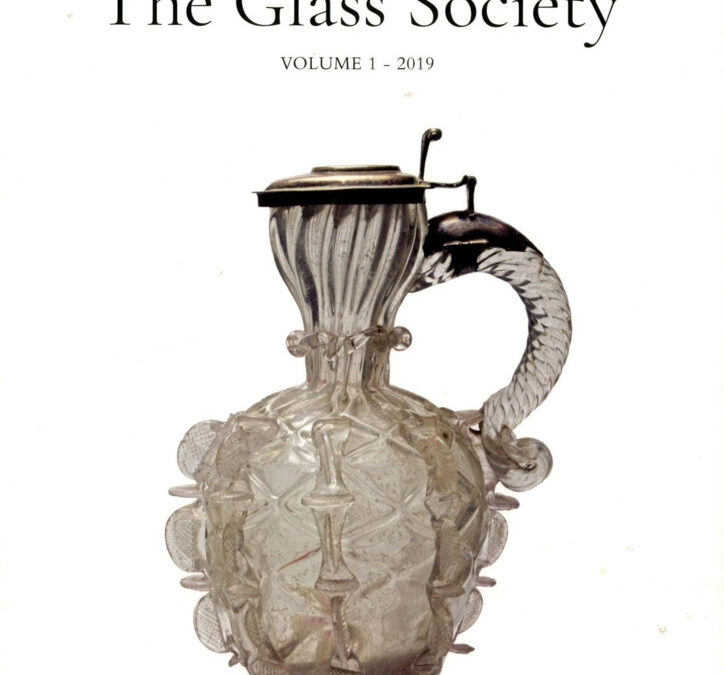
Front cover picture: An
important
Ravenscroft
crizzled decanter
jug, the oviform
body ‘nipt
wales’
and further decorated with eight
vertical
pincered and winged ribs,
the spreading foot
with radial
decoration the
contemporary
hinged silver
cover of
heart
shape centred
by a roundel engraved with
sets of
initials with an
escutcheon surrounded
by a wreath probably by Bonifacius
Weber (
active
1675-79). With permission of the Dudley
Museum Services Collection,
Eila Grahame
bequest.
Back Cover picture: A full set of five
Vistosi pulcini,
models S I
89-193, designed by
Alessandro Pianon and made in Murano in the 1960s:
Ian Turner collection.
Page I picture:
Two-handled
bowl, cover
and
stand, calcedonio
glass,
Venice,
1675-1725,
diameter
of
stand, 20.5cm. V&A 5223-1901.
A new Glass Society website is planned, currently, news, activities and committee emails can be
accessed through www.glassassociation.org.uk
Readers wishing to be in contact with any of the contributors can email the editor
THE GLASS SOCIETY
SOCIETY
Honorary Presidents: Charles Hajdamach and Simon Cottle
Honorary Vice-President: Dwight Lanmon
This Journal celebrates the formal establishment ofThe Glass Society, registered as
a charity in August 2019.The Glass Society promotes the study, understanding and
appreciation of historic, artistic and collectable glass in all its aspects, for the benefit
of both experts and beginners, by means of publications and convivial meetings,
lectures, outings and other events. Membership is open to everyone interested in
glass, including dealers and other professionals, at home and abroad.The possession
of a collection is not necessary although many members are keen collectors.
For many years,The Glass Association andThe Glass Circle have shared common
goals in the research, enjoyment and appreciation of glass. Based on those firm
foundations and with the future in mind, the two societies agreed in 2017 that the
interests of their members would be best served by merging into a single group.
Since then, both societies have effectively acted as one; jointly publishing their tri-
annual magazine
Glass
Matters, aligning their subscription fees and sharing their
activities.This, the first Journal ofThe Glass Society, maintains a commitment to
continue the tradition of publishing scholarly work on all aspects of glass; the Glass
Circle’s first of eleven Journals was issued in 1972 and the Glass Association’s first
often was issued in 1987.
If you have researched a special area of glass production, history, collecting or
consumption and are thinking of publishing, we would be delighted to hear from
you for potential inclusion in a future issue.
Susan Newell and David Willars
Joint Chairmen,The Glass Society
Brian Clarke
Editor
AUTHORS
Our Contributors
JILL TURNBULL
JillTurnbull has been researching Scottish glass history since 1994.After early retirement and moving to Edinburgh in
1989, she studied for a degree in the History and Design of theVisual Arts at Stoke on Trent, specialising in ceramics
and glass. Graduating with a 1st class honours degree in 1992 and then working for two years at Edinburgh College of
Art Humanities Department, she obtained a doctorate at the University of Edinburgh in 1999. Her thesis, The Scottish
Glass Industry I 610-1 750
was published by the Society of Antiquaries of Scotland In 2001.
Jill lectures and has published
articles in The Glass Cone,
The Journal
of the Glass
Association
and The
Glass Circle Journal,
as well as in Scottish local history
publications. Jill’s second book, From Goblets to
Gaslights,
the Scottish glass
industry 1750-2006
was published in 2017.
IAN TURNER
Ian, a retired town planner, is a member of the Glass Society, the Northern Ceramic Society and was Chairman of the
Glass Association. He began collecting Monart Glass in the early I 980s, researched its history and then published a book
and several articles on Monart before selling most of his collection at Christie’s in 2003. Subsequently, he published
several articles on 20th century art pottery. Between 2015 and 2018 he acquired a complete set ofVistosi glass-bird
sculptures designed by Alessandro Pianon and made in Murano in the 1960s; with the company’s help, he then researched
their history. He is currently researching the Dean family of ceramic artists.
MIKE NOBLE
Michael Noble has been a glassman throughout his working life, latterly running the massive glassworks at Harlow in
England and Alloa in Scotland. On retirement he involved himself in researching how the glass industry was established
in England while also investigating his collecting interest for early English porcelain, looking at contemporary documents
stored in archives and museums throughout the length and breadth of the country. His acclaimed first book, Eighteenth
Century English Glass and
its antecedents, was published in 2016 and his second,
Bow Porcelain: a narrative,
published two
years later, related the history of this most famous of early porcelain factories.
JAMES MEASELL
A life member ofThe Glass Society and trustee of the British Glass Foundation, James Measell is historian at the Fenton
Art Glass Co. in Williamstown,WestVirginia, USA. During 1986-2005, he authored numerous books on American glass
forThe Glass Press in Marietta, Ohio, USA. His PhD thesis on the Stourbridge School of Art I 850-1905 was awarded
the Ashley Prize at the University of Birmingham in 2016. His research on various aspects of glass history has appeared
in many journals, including The
Glass
Cone, History West
Midlands,
and The
Blackcountryman magazine.
A retired university
professor, James Measell is currently an Honorary Research Fellow at the University of Birmingham. He can be contacted
by email: jsmeasell©gmail.com
SUSAN NEWELL
Susan Newell, Chairman of the Glass Circle since November 2017 and now joint Chairman ofThe Glass Society, has
worked as a curator specialising in the decorative arts at various institutions, includingTyne and Wear Museums and the
Victoria and Albert Museum. She organised an exhibition of Art Nouveau glass with Victor Arwas in 1996 and in two
articles, published research on glassmaking in the North-East in the
Journal of The
Glass
Association
of 2001. She has also
worked as an auction house specialist and as an independent consultant. Susan is currently a PhD candidate (History
of Science) on an Arts and Humanities Research Council collaborative doctoral partnership between the University of
Leeds and Oxford University Museum of Natural History.
DAVID BURTON
David Burton, CBE, FCIB, FCT, enjoyed an extensive city career; director and head of SterlingTreasury at S.G.Warburg,
Chairman of LIFFE which opened in the Royal Exchange in 1982 and Chairman of Marshall’s Finance, a leading financial
broker, merging with the Prebon Group in 1998. He hosted HMThe Queen when she opened the new exchange trading
floor at Cannonbridge and was awarded a CBE for services to the city of London in 1992. David was a Liveryman of the
Worshipful Company of Glass Sellers and his interests include English bombards, blackjacks and leather bottles 1550-
I 700, Rhenish pottery 1500-1650 and Lambeth Delftware bottles 1630- 1670.
His celebrated three volume book collection, Antique Sealed Bottles 1
640 — 1900 and
the Families
that
Owned Them,
2014,
is available to members from the author. Contact by email: david@burtonl.com.
4
CONTENTS
Contents
Industrial relations in the Scottish glass industry:
The shift in power from masters to men
Jill Turnbull
Alessandro Pianon’sVistosi Birds
Ian Turner
7
21
Art, Mystery, Secrets and Machinations:
The establishment of post medieval
glassmaking in England
Mike Noble
29
The Adorable Miss Lawley
James Measell
41
Collecting for the nation:
The origins of the glass collections at the
Victoria and Albert Museum, acquired c. 1840-60
Sue
Newell
47
What is a sealed bottle?
The Eila Grahame Collection
David Burton
63
5
MASTERS TO MEN
Industrial relations in the
Scottish glass industry:
The shift in power from masters to men
Jill Turnbull
This essay traces changes in conditions of employ-
ment in the Scottish glass industry over a lengthy peri-
od, examining the rise of workers’ organisation which
led to a shift in power from the employers in the 18th
century to a unionised workforce in the 19th. Unlike
those trades whose members combined to create
guilds for their mutual benefit, the different trades
involved in making and decorating glass did not estab-
lish an umbrella organisation. Instead, they created
separate friendly societies and later, separate unions.
The biggest difficulty facing any Scottish entrepreneur
attempting to manufacture table glass in the late 18th cen-
tury was the recruitment of a skilled workforce. Although
bottle making had continued, no flint glass had been
produced in Scotland for almost 34 years by the time the
Verreville glassworks was established in Glasgow in 1777.
Three successful Newcastle glass manufacturers joined
the co-partnership, so it is no surprise that all the known
workmen in the early years were English, who presumably
came voluntarily. This was not the usual situation however
and it is clear, from the number of prosecutions elsewhere,
that devious means were frequently employed to recruit
men trained to make flint glass, bottles and window glass.
A blatant example took place in Leith in 1793 when
manager James Smith was taken to court’ where it was
alleged that ‘an Agent from some of the Glass Works in
Leith … in Newcastle for the purpose of hiring Hands if
any could be met with, was at same time offering them
large sums of money …’. Three men, Robert Wilson,
James Raffield and Edward Groves, who were bound to
Lord Delavel, were discovered making bottles at the ‘the
works of Messrs Ramsay Williamson & Co. in Leith’ and
warrants were issued by the Newcastle magistrates to appre-
hend them and return them to their rightful employers.
Wilson and Raffield were arrested at the glasshouse
and when given the choice by the Edinburgh magis-
trates of returning to their former employer or going
to prison, they chose the latter, ‘as being strongly rec-
ommended to them by Mr Ramsay’ – who said he
would soon be able to get them released, and would
pay their wages in the meantime, which he did.
Another glassmaker, Thomas Brotherton, who had
been hidden at Leith, returned to Newcastle of his own
volition. He described how the Ramsay Williamson’s
agent had gone to Lord Delayers glassworks and arranged
to meet the men at the local pub. He plied them with
drink and then persuaded them to sign up ‘in conse-
quence of which each of them received Ten pounds or
Ten guineas, five Guineas to defray their Expences thither,
& five pounds per annum to be allowed them for their
House and Fire-coals – together
with an advance in their weekly
Wages of Two Shillings for blow-
ing and one Shilling for gather-
ing.’ No wonder they absconded.
The difficulties faced by the
industry were set out very clearly
in 1797, when Archibald Geddes,
then manager of the Edinburgh
Glass House Company at Leith,
gave evidence in a legal dispute
with one of his absconding work-
men
(Fig. 1).
He was talking about
Fig. I The glassworks along the shore
at Leith in the early 19th century,
(private collection)
7
THE JOURNAL OF THE GLASS SOCIETY
bottle production, but the same constraints applied to
the manufacture of table glass. His statement reads:
“The manufacture of glass is different in its nature from
most other manufactures. A large capital is required and
must be laid out in the erection of buildings and furnaces,
and this is sunk in the first place. These furnaces, when
built and set going, require the same quantity of coals and
the same expense of attendance in every respect, whether
they are worked full or not. It is therefore the first care
of every manufacturer to secure the services of as many
workmen by Contracts and Indentures for certain periods
as will insure fully the working out of all the metal his fur-
nace can prepare. From their working in the Bottle Man-
ufactory in sets of 3 or 4 hands together at each pot and
each performing only one particular part of the operation
and the absence of one consequently stopping the whole,
it therefore becomes of the utmost importance that they
all regularly attend. So strict contracts are to everyone’s
advantage, including the workmen because they also have
the highest weekly wages of any artificers in the Kingdom.”
He went on to explain how a team of bottle makers worked:
“One man gathers or takes the metal out of the pot upon
the pipe, another man blows that metal into the shape
of bottles, a third puts the rings on the mouth or, as it is
called, finishes them.” He stressed the men’s interdepen-
dence and their inability to meet their target production
if one man of the team was missing. Geddes described
to the Court how workmen could be persuaded to leave
by the offer of a ‘high premium’: “These premiums are
sometimes very considerable and the more so when a
new works are to be established, as the Proprietors find
themselves under the necessity of holding out a high
premium to procure workmen from the Manufacturers.
Sometimes in this way 40 or 50 guineas are given”.
2
The
recruitment problem continued for many years, with
frequent litigation and disputes between proprietors.
Once a manufacturer had obtained a sufficiently
skilled workforce, by whatever means, it was obviously
beneficial to train local youngsters. An advertisement
in the
Edinburgh Advertiser
in 1796 set out Archibald
Geddes’s requirements. It began: The Edinburgh Glass-
house Company want a number of stout young lads, from
14 to 16 years of age, to engage as apprentices to the dif-
ferent branches of their business. Such young men as
have a particular taste for drawing, or a mechanical turn,
may find employment very much suited to their genius’.
He was also looking for workmen in other departments,
particularly ‘stout active labourers’, offering wages
from 8s to 12s a week, depending on what they could
do.
3
At that period, the manufacturers could engage
as many apprentices as they wished, a situation which
was to change dramatically over the succeeding decades.
Conditions of employment were not easy, so it is
perhaps hardly surprising that men were prepared to
accept bribes to leave an employer, nor that they should
abscond, since they were, as were workers in other trades,
bound by law to serve out their term. It is also quite
possible that English workmen were unaware that the
Scottish legal system was different from the English one.
Whatever the working conditions and possibly dis-
agreements with managers, breaking of the contract
was not an option for the workers in Scotland any
more than it was in England. Recourse to the legal sys-
tem was not uncommon and rarely led to judgements
in favour of the employee. Surviving legal documents
demonstrate clearly that power was entirely in the
hands of the employer, but, of course, it is impossible
to know how good the worker was at his job or wheth-
er he was actually a troublemaker, as is often implied.
Not all contracts were specific about the amount
of work required, but a seven-year contract between
Archibald Geddes and John Robertson, an English bot-
tle blower, of 22 June 1784,
4
specified that he would
“gather, blow and finish fifty two dozen good and suf-
ficient merchantable quart bottles each journey when
working five journeys in a week. That is to say making
in all three hundred and twelve dozen each week” or “a
proportionate number of larger bottles”. However, he had
also reluctantly agreed to be moved to much more menial
tasks for far less money, if the manager decided he should.
For whatever reason Robertson was at one point
demoted to sweeping the yard for 6/- a week, rather
than the 20/- he earned blowing bottles. He was not a
happy man and tried to leave, so breaking his contract
and ending up in prison. A lengthy court case ensued
during which Robertson remained locked up. We can-
not know who was right — the situation for Robertson
was, as he argued ‘humiliating’ and the loss of wages
very difficult. It is, of course, impossible to decide whose
behaviour was worse, but clearly from the viewpoint of
Archibald Geddes as manager of the business, he had to
maintain control and to demonstrate that the power to
enforce the contract was not to be questioned. Whatev-
er the rights and wrongs of the situation, a contract was
legally binding and punitive enforcement was used as a
deterrent to prevent others following suit. In some of the
disputes men languished in jail for two or more years.
However, the number of similar cases does raise ques-
tions. Two apprentices, Donald McLean and Robert Ste-
vens who were bound in 1798 to work for Geddes for
seven years, ran away to Dundee in 1803 to join the navy,
a somewhat surprising choice when press gangs were very
active in order to provide crews for their warships. Just
before they went to sea, Geddes’s petition to the High
Court of Admiralty to hand them over was activated
and they too finished up in the Tolbooth in Edinburgh.’
The Newcastle glass industry provided a benchmark
for Scotland. A typical indenture in April 1793, used
8
MASTERS TO MEN
Fig. 2 Pot-setting at Edinburgh Crystal, 2004.The front of the
furnace is being opened up before removing the damaged pot.
Prior to 1970 the men were not provided with protective
clothing; they wore layers of second-hand clothes to protect
them from the extreme heat, (Author’s photograph)
the terms of employment at Newcastle as its guide. The
apprentice was to work “the same number of moves in a
week and make the same quantity of goods each move as
is presently made at New Castle or any other Flint Glass-
house in the Kingdom”.
6
His pay began at 3s in the first
year, rising to 8s in the seventh. At the end of seven years,
if the company had employment for him, he was bound
to continue in their service for another seven years as a
journeyman, a common condition in such agreements.
The manager also had the power to move the appren-
tice from flint glass production to the less skilled trade
of bottle making. Like all the other employees, he had
to assist “at setting or shifting of pots or heaving met-
al out of broken pots”. This hot and arduous task was
performed every time one of the crucibles cracked or
broke, on average every four weeks
(Fig.2).
While the
glasshouse owners extracted a fourteen-year commit-
ment, they could themselves terminate the agreement
at any time by giving the worker three months’ notice.
Conditions of employment for already qualified
workmen were also restrictive. When brothers Richard
and Nicol Simpson agreed to work as “Gatherers and
Blowers of Crown [window] Glass” at Leith, they signed
up for 14 years, their pay for the first two years being
16s a week, rising to £1 in years five and six. Only in
the final eighth year would they receive “the ordinary
and customary wages” of their trade. If their work was
not up to scratch money could be deducted from their
wages. It is telling that the company could give them
three months’ notice — but if the Simpsons wished to
leave at the end of the term of the indenture, they had
to give three
years’
notice, and unless they did so, their
contract could be extended by yet another three years.’
During the 19th century, working practices remained
much the same, but the balance of power between mas-
ters and men was to change dramatically. There were
periods of considerable industrial unrest, while control
of the workplace shifted from the employers to a union-
ised workforce. An article under the heading ‘The Gen-
eral Trades of Glasgow’, published in 1867, describes
how, by then, the Flint Glass Makers’ Society did not
permit “the employment of more apprentices than one
to each six journeymen, except under special circum-
stances and employers, when in want of workmen, are
obliged to apply through the district secretary instead of
engaging the men themselves”. In short, the Society is
all-powerful and the masters are constrained to submit in
many cases, to arrangements which they consider unjust,
for the sake of peace.’
8
An enormous change — and one
with huge implications for the future of the industry.
Trade Unions
It is simplistic to think of the glass making industry as
a single entity. In reality, not only were there differenc-
es between the skills of the bottle makers, window glass
blowers and those working in flint glass, there were also
huge divisions within the glasshouse between the hot
and cold workers. During interviews with the staff of
Edinburgh Crystal, recorded in 2004, it became clear
that those workers with the hot glass at the furnace
had nothing to do with those who decorated it. They
had no contact with each other, either in work or out,
and a mutual disregard — something both sides took
for granted as the norm and which they did not ques-
tion. The situation had begun to improve slightly, but
one manager described his memories of it: ‘The pas-
sageway that takes you down from … what we called
the cold end into the hot end, sometimes that was
seen as the great divide. For example, the glass maker
would never go beyond that and likewise a hand cutter
would never go beyond. It was crazy at times. Crazy’.
9
It is clear that this separation was nothing new. Sim-
ilar antipathy was commented on by an observer at the
1852 conference of flint glass makers, who wrote of the
`mutual distrust and unfriendly feeling’ between the cut-
ters and makers. A report of the head of the Children’s
Employment Commission published in 1865 stated that
`Flint Glass Makers are a set as distinct even from flint
glass cutters, though in most cases working in the same
manufactory, as if they were engaged in totally distinct
manufactures’.
1
° These strict divisions of labour were
reflected in the fragmented nature of the trade societies
and unions which developed in the 19th century, a frag-
mentation which may have been increased further by a
tendency for Scotland to set up its own organisations.
9
THE JOURNAL OF THE GLASS SOCIETY
Friendly Societies, estab-
lished to provide sickness and
death benefits for subscrib-
ers, were the basis on which
the workers organised them-
selves. In his seminal book
The Labour Aristocracy Revis-
ited, the Victorian Flint Glass
Makers 1850-80,
Takao Mat-
sumura researched the origins
of The United Flint Glass
Makers’ Society. He shows
that there was a local friendly
society in Newcastle as early
as 1755, but it was not until
the mid-1830s that a wider
organisation was established.
In 1837 there were 646 mem-
bers in 25 branches, two of
which were in Scotland, with
47 members in Edinburgh,
and 11 in Greenock.” The
response of the glassworks
owners was robust. A meet-
ing of the Stourbridge and
Birmingham manufacturers
made it clear that they regard-
ed all ‘combinations’ as a threat
to the trade and declared
that they would not employ
any members. The Scot-
tish response is not recorded.
Despite their concerns, the
manufacturers did not set up
House not at Work.
an umbrella organisation of
their own, although they did
meet together to fix prices, something on which they
had made joint decisions since at least 1771. In that
year, a printed
Prices of Glass Goods, Sold by the differ-
ent Manufacturers in England
12
lists them individually
according to weight, or by the dozen. A further list was
agreed at a meeting of manufacturers in Birmingham
in 1819, this time at a meeting of the ‘flint glass manu-
facturers of the kingdom’, presumably including Scot-
land
(Fig.3).
The earliest evidence to have been found
of the Scottish manufacturers establishing their own
list is a hand-written document,
Prices of Flint Glass
arranged at a General Meeting of the Manufacturers of
Scotland Held at Glasgow 23rd October 1823.
Clearly
prices had to reflect not just the predictable excise charges,
but changing costs of raw materials and the competi-
tion of foreign imports, so they were regularly reviewed.
In the Ford-Ranken archive of material from the
Holyrood Flint Glass Works in Edinburgh is the record
LIVERPOOL
Messrs. James Holt and Son.
41
MANCHESTER.
Messrs. Molineaus, Webb, Ellis, and Co.
„
William Robinson.
YORSSIURS.
Messrs. John Bower,
HVIHILET
near LEEns.
Meek, Spence, and Co., Yoax.
„
Wood and Perks, WOESRRODALE
near
BARRE/MET.
Close and Clarke, ROTHERHAM.
Booth and Munn, CATCLIFF near E0-
TIIERHAN.
J
ames
Wood, THORNHILL LEES, near
Dawsnuar.
DURHAM AND NORTHUMBERLAND.
Messrs. Shortridge, Sawyer and
CO., SOUTH
Sniains.
The Northumberland Class Co.,
Nam-
CASTLE-ON.TTNE.
Joseph Price, UATESHEAD.
Souerby and
Co., Dnro.
The Wear Flint Glass Co., Susumu-inn.
The Harmon Hill F. G. Co., STOCKTON-
oN-Tass.
LONDON.
Messrs. Apaley Pellatt.
„ Christie and Co.
„ The White Friars Glass
Co.
RELAND.
Me.srs. John Kane, BELFAST.
•
Edward S. Irwin,
DUBLIN.
•
Thomas Hunt, Dirro.
George Gatehell and
CO., WATERFORE.
CORK and NEWRY F.
G. Houses, not at work.
SCOTLAND.
Msssn. Bailey
and Co., Emmet:Boo.
„
John Ford,
Dirro.
.
„ John Watson sad Co., Ocasolow.
„ Cochrane and
Cooper, Dtrro.
T. K. G.
T.
Johnson, Pratte,
13, Inle.ann.l.n.P.
,
.
(ABOVE) Fig.3 A list of the flint-glass manufacturers
of Britain in 1839
(BELOW) Fig.4 ‘LIST OF PRICES’.The cover of the list of
agreed prices. Courtesy of the City of Edinburgh Council
Collection, Museum of Edinburgh (CEC FRA)
AGREED 1.71
,
C.X BY
THE GLA_SSMAKERS’
11131011341r 111041111171,
PRINTED 184.5,
REVISED
AND CORRECTED 1846.
BIRMINGHAM.
Messrs. Bacchus and Green.
„
Biddle and Co.
•
Gammon and Son.
„
John Gold.
Rice Harris.
Shakcspear and Son.
Thompson and Shaw.
DUDLEY.
Messrs.
Thomas Hawkes a
–
nal Co.
„
Badger Brothers.
„
Guest, Wood, and Guest.
STOURBRIDGE.
Messrs. M. and W. Grazebrook.
•
William Hodgetto.
Littlewood and Berry.
„
W. H. R. and J. Richardson.
Raiford and Walker.
Shepherd and Webb.
„
Silvers and Stevens.
„
Stevens and Son.
Whmley and Davis.
LW:Girl/RT.
Messrs. John Davenport and Co.
BRISTOL
Messrs. Henry Ricketts and Co.
PLYMOUTH.
Messrs. Staniforth and Co.
TUTBURY.
Messrs. Jackson and Co.
WARRINGTON.
&fess
–
rs. Alderson, Pen
– in,
and Lo.
„
T.
Robinson
and Co.
–=
ST. HELENS.
Messrs. Thomas
Bell and
Co.
„
S.
Bishop and Son.
RAINHILL.
Apromiam.
LIST OF FLINT-GLASS MANUFACT
trItERS
ENGLAND, IRELAND, AND SCOTLAND.
1839. ”
1
0
P.
339 Patty Pans
310 Pipes for Breast
341 — for drawing out 2d. per dozen
342 Preston Salts, blown over
343 —- made mouth
344 Phials, by hand, flint and green, under 4 oz. …… 400
345 —
ditto,
4 oz. up to 6
350
396 —
ditto,
6 and 8 or
290
347 –
ditto,
above S oz.
220
348 –
ditto,
sample …
200
348*Potting Pots
6
*’
160
72
270
160
MASTERS TO MEN
of a national meeting of glass manufacturers held in Bir-
mingham on 15 March 1836 under the chairmanship of
John Biddle. It was convened to consider revising prices
previously agreed, and, among other things, workmen’s
wages. Correspondence indicates the reluctance of the
Scottish manufacturers to be dominated by decisions
made in Birmingham. A further meeting there in Sep-
tember 1836 decided to revise prices yet again. It was
attended by Englishman Frederick Pellatt, a partner in
the Clyde Flint Glass Company of Greenock, who wrote
to William Bailey of the Holyrood Flint Glass Works on
his return: “It was suggested that the present list be raised,
PILLAWD WORK.
349 Pillar’d Sugars and Cream Jugs, under 16 oz
350
16 oz.& under 20
351
above 20 oz…….
352 Pillar’d Jugs, quarts, under 2tb.
353 —— — pints to match
354
quarts, 21b. and under 4113 …….
355
– pints to match
356
all quaets, 4th. and upwards, and
pints to match, an odd turn.
357
on leg and foot, an odd turn.
358 Pillar’d Carroffs, quarts, under 21b.
359
pints to match
360
quarts, 2tb. and under 41b.
361
pints to match
362
all quarts, 4111 and upwards, and
pints to match, an odd turn.
363 Fillard
Tumble
–
ups
Rol —
Decanters an odd turn.
365
Celery Glasses an odd turn.
366
G-iblets, Wines, Champaignes, Ales, Cus-
tards, and Jellies, an odd turn.
367 – Whiskey Measures
368
ditto,
with rings
All
work at the press an odd turn.
That five or more patterns shall constitute an odd tarn.
1 quarter of a move of all work when three-handed : one-
half off when two-handed.
That two moves and a quarter be paid for an odd turn.
That one move per week be allowed to the chair for
learning an
apprentice footsoaker or servitor for the first
three months.
‘I hat Is. hole-think be given for whatever holds 1 gallon
•
:t upwards, or is 10 inches or upwards in diameter.
That all journeymen receive half wages when the furnace
is out
of repairs, or the place is stopping for repairs,
without
working or having to pay it back.
That the
number of any new pattern be decided by
District
Committee of two members from
each house.
‘filet all sheared work is best.
That whenever the masters do
not find metal enough for
a man to snake
11 moves to week’s
work, that
the man
shall
be paid a week’s
work
without paying it back.
The masters to stand one-half of the loss, and the men
the other half, when there is any melted or cracked in the
leer.
which I objected to on the ground that as the present list
was not adhered to by the Birmingham people, it was
useless to make any new lists; however the list was revised,
and some alterations made, chiefly in heavy goods. It
appears to me that the only object the English people
have in issuing a new list is to fill their order books at the
last advance; which may be so far so well; but that is no
reason that we, who have all along maintained the last
list, should advance.’ He went on to describe their com-
promise agreement that: ‘The Birmingham Manufactur-
ers have agreed to adhere to our prices and discount in
Scotland; if we will sell at the English list in England”.’
3
Meanwhile, the workers were becoming increasingly
well organised. A year after the establishment of The Unit-
ed Flint Glass Makers’ Society in 1844, there appeared
a printed List of
Prices agreed upon by The Glassmak-
ers’ Friendly Society printed 1845, revised and corrected
1846
14
(Fig.4).
Not to be confused with the lists of selling
prices agreed by the manufacturers, this fascinating docu-
ment lists 485 items of glass in alphabetical order and pre-
cise detail, each with the number to be made per ‘move’,
on which the amount paid to the worker would be based.
They range from ‘Ales, egg-bowl, plain stem and merese’
at 55 per move, through ‘Glasses, musical, up to 1 quart’
at 36 a move, to Tillar’d Carroffs, quarts, under 21b’ at 32
(Fig.5).
On the first page is a list of agreed conditions
including ‘That all journeymen receive half wages when
the furnace is out of repair, or the place is stopping for
repairs, without working or having to pay it back’, thus
perpetuating the system of ‘play wages’ dating back to
the 17th century. Another condition was ‘That whenever
the masters do not find metal enough for a man to make
11 moves to a week’s work, that the man shall be paid a
week’s work without paying it back’ and ‘The masters
to stand one-half of the loss, and the men the other half,
when there is any melted or cracked in the lear’
(Fig.6).
A year later, there was a meeting of all the Scottish
manufacturers with representatives of the workforce, to
decide on the numbers of items to be made per move
which would apply across all their glassworks, separate-
ly from those agreed in England. They met on 24 and
25 October 1845 and subsequently published a booklet
entitled
Catalogue ofNumbers agreed upon by the Flint
Glass Manufacturers and delegates of workmen of the
Houses in Scotland.”
A supplement published in 1847
contains an interesting preface, confirming that the origi-
nators of the list were the flint glass makers, not the man-
ufacturers, and suggesting that the list had, in fact, been
LEFT (TOP) Fig. 5 Page 20 of the list of numbers of items per
move agreed by the Glassmakers’ Friendly Society (CEC FRA)
LEFT (BELOW) Fig. 6 Page I sets out general conditions
agreed by the Glassmakers’ Friendly Society, (CEC FRA)
40
36
30
22
26
1$
22
32
40
21.
32
72
SO
15
THE JOURNAL OF THE GLASS SOCIETY
GENTLEMEN,
We, the Flint Glass Makers in
the different Manufactories in Scotland, having agreed
that the following rates should become part of our cata-
logue ; we are also in the belief that you will perceive
that the interest of both parties, master and man, has
been our aim. And with the view of keeping up the
hitherto friendly feeling on this subject, we humbly sub-
mit them to your inspection, when it will be foud that
three-fourths of them are what we are now, and ics
,
teen
working to for
years,
but was omitted
when
the cata-
logue was printed ; the remainder is new patterr.s come
out since. As it is desirbable that these should be print-
ed as speedily as possible, you are requested to
give
your
yea or nay, in writino, to the party delivering this on
before the /
f
May
184*
We are,
GENTLEM
Your most
THE FLINT GLASS MAKERS.
ICW
—
the
blank leaf at end for Obj
Fig. 7 Flint Glass Makers ‘rates’ agreement, 1840 altered to
1847 (CEC FRA)
in existence since 1840, the printed date of May 1840,
having been crossed out and 1847 written in,
(Fig.7).
The practice of updating the rates continued at regular
intervals. A small booklet recording the agreements result-
ing from a meeting held in Glasgow in December 1855 is
in the care of the Museum of Edinburgh. It lists the names
of the delegates as well as hand-written details of the agreed
number, complete with alterations in red ink
(Figs.8,9).
Once again conditions of employment were also pub-
lished, one being ‘That a fortnight’s notice be given and
received on separation between master and man’ — a truly
significant change from the situation some fifty years ear-
lier. As well as the number of glasses per move, basic wag-
es were also agreed. They stated that ‘the lowest standard
wages in Scotland be, workmen 22/- per week on going
into the chair, 23/- per week second year, 24/- third year.
The servitors to have 16/6 first year, 17/6 second year, 24/-
third year’. A footmaker
was
to earn at least 12/- a week.
The signatories to the Catalogue were represen-
tatives from St.Rollox, A&R Cochran, and the City
Glassworks of James Couper & Son, all in Glasgow,
and the Holyrood Flint Glass Works, Donald Fraz-
er’s Edinburgh Glass Work, and the City Glassworks
of John Thomas, also in Edinburgh. Twelve men rep-
resented the workmen, two from most of the compa-
nies and three from the St.Rollox and the Holyrood
glassworks. The chairman was Robert Cochran and
Richard Heron, an employee at Couper’s, was vice-chair-
man. The catalogue was updated in October 1863 at a
meeting in Falkirk. A further ‘list of numbers’ which
included pressed work, was printed in 1867
(Fig.10).
Although this was an exclusively Scottish agreement,
it was, like other area agreements, still under the aus-
pices of the national Flint Glass Makers’ Friendly Soci-
ety. After 1858 the society held a triennial conference,
although the decision-making rested with a central com-
mittee and district votes. In 1867 the conference was held
in Edinburgh, at a cost to the society of £324, largely
made up of second-class fares and payments of 7s 6d
a day to the delegates, an expense which created con-
siderable dissatisfaction among the wider membership.
The system of payment per ‘move’ was incredibly com-
plicated as well as being rigid, and frustrating for the
manufacturers. It is made even more difficult to under-
stand because definitions of the terms ‘move’ and ‘turn’
are unclear and they were sometimes used interchange-
ably.
16
The current consensus appears to be that a ‘move’
should be taken to mean three hours, i.e. that there
were two moves to a turn of six hours. Making sense of
the system is further complicated by the acknowledge-
ment that it was based on a fiction. Matsumura writes
that the wages of flint glass makers were actually piece
rates, but ‘took the ‘fictitious’ form of time wages.’
17
The
money paid to the workman was, as can be seen in the
above list, calculated according to the number of a par-
ticular item which could be produced per ‘move’. Aps-
ley Pellat, a leading glass manufacturer, wrote in 1849,
giving a different definition of ‘move’: The mode of
reckoning the piece-work of Glass-makers is peculiar.
The ‘move’ as it is technically called is a nominal period
of six hours; and the payment is proportionate to the
number of articles supposed, by fair exertion, capable of
being made in that time by a set of ordinary workmen.'”
He went on:
in consequence of superior skill and
industry, the chairs [team of glass makers] made double
that quantity in the six hours, which is often the case,
they would be paid double the price; and in proportion
for any intermediate or lesser number, so that the men
are paid proportionally to the quantity manufactured.’
Initially it appears that, although the workmen seem
to have had the dominant role in deciding the number of
glasses to be made in a given time, they did actually work
to maximum capacity and were paid for the extra objects
they produced. However, by 1868 that had changed dra-
matically. In the Minutes of Evidence given to a gov-
ernment Commission inquiring into trades unions, the
RIGHT (TOP) Fig. 8.A list of the participants at a meeting in
1855 from the revised Catalogue of Numbers (CEC FRA)
RIGHT (BELOW) Fig.9 Revisions to the Catalogue of
Numbers (CEC FRA)
12
MASTERS TO MEN
30
JOURNEYMEN’S WAGES.
That the lowest standard wages in Scotland be, workmen,
:wmay.two shillings per week on going into the chair, twenty…
shillings per week second year, twenty-four third year.
The servitors to have sixteen and sixpence first year, seventeen
apd sixpence second year, eighteen and sixponce third year..
per week. Footmaker eleven shillings per week at the lowest,.
That
alt
journeymen
receive
half wages when the furnace is
out for repair without having to pay it back afterwards.
The number of any now pattern to be decided by communi-
cation among the houses in Scotland.
No engagement to be affected by this present agreement.
JOHN BALLANTYNE,
Chairman.
SIGNED AS UNDER.
ode,/
hc-c,-LL4404
ad
Sk.
4..ed
r
&
/Fir-
7
–
L
/2
0
–
&-e–“t.f
cr-47:-‘4
,
rf
6o
Co
.72o
FLACIS.
Portobello.
BAILEY & Co.,
Per William Bailey, jun.
Townhead, Glasgow.
A. & R. COCHRAN,
Per R. Cochran.
Port Dundas.
GEDDES & Co.,
Per John Geddes.
Edinburgh Glass Works.
THOMAS & FRASER,
Per John Thomas.
Bolgrood Glass Works.
JOHN Ft/RD,
Per R. Barlow. S
DELES
n
21111.
William
Henderson.
William Scott.
Robert Hamilton,.
John Campbell.
William
Smar
t.
James Browq,,
John Robson.
Thomas Benson.
Robert Wilson.
John Ballantyne. –
William Reedy.
Alexander Thompson.
Robert Hall.
„
J.
linasio, hunter, 1311 High Street, kilinburgh.
i
t°
12
– 30
36
1 pint,
–
} pint,
•
–
–
186.
Do.
stronger, 2 lb. each, 1 quart 28
Ne..
187.
Do.
do.
• ‘
do. pints 40
188.
Do. stronger than common, withcat rings, tinder
3 lb., quarts,
–
–
–
– – –
–
–
28
189.
Do.
do. with snake
ring,
quarts, 28
190.
Do. with snake ring, quarts,
–
–
–
– 40
191.
Do.
} pinta,
–
–
–
•
50
192.
Do. with foot and ring, quarts, –
–
–
– 24
193.
Do.
pints, – – – • 30
194.
Do. with fancy necks, 311b. each and under, quarts, 22
195.
Do.
do.
pints, 28
196.
Do. tinted, 1 lb. and upwards, quarts,
–
– 28
197.
do.
pints,
40
196.
Do. from 31 upwards,
–
–
• odd turn.
199.
Do. claret, with spout and handle, -……….- odd turn.
200.
Do. pulley body, quarts,
–
–
–
–
–
14
.–
201.
Do.
pints,
18 .-
202.
Do. toy,
72 .-
DEARS.
203.
Drams, tale, sham, common shape, all out of one
piece, cast foot, –
– —
–
–
–
–
60
204.
Do. Spanish or round bowl, plain stem, and
welted foot, .
–
–
–
–
–
-, 160
205.
Do.
do.
plain foot,
– 150
206.
Do. all she s, with knob or button, moulded or
plain,
– – – – – – 140
207.
Do,
do
–
Do. heavy,
04″”.”
ntl
1
0
20
0–
209. Do. creabows.steiti zsalissasslasaPT0154er
–
Slew+
DEM:WORTS.
melted, – _
not melted,
– ‘ –
–
oblong or square,
do. using
2
or 3 mbulds,
DECANTERS.
ISO. Decanters, without rings, 1 gallon,
181.
Do.
3 quarts,
182.
Do.
2 quarts,
183.
Do,
I quart,
184.
Do.
186:
Do.
9
0
4
2
69.
7x
24
40 –
30
40
floe
2 4411s
,
2
/
k
23
s. •
WATER JUGS—Quarts
..
LIQUEURS-Vth
..
•
•
Malted feet • •
•
WINES
ALL MELTED ‘
,
WORK TO BE PAID FOR, AND
UNMELTED PRESS ORK CRACKED TO BE
PAID FOR,
,
A
Cracked, Sulphured, and Picked out work to be decided by a
Deputation, if the men or employer require it.
ALLOWANCE TO BE MADE BY THE EMPLOYER
FOR A WORKMAN BEING OFF of a move per turn.
Servitor I of a move.
Foot Maker
l
move.
THE NUMBER OF ALL NEW PATTERNS TO BE
DECIDED BY THE EMPLOYERS AND COMMITTEE.
SLOPED OFF WORK TO BE AS THIN TOPPED.
FIVE PATTERNS TO BE AN ODD TURN IN BLOWN
WORK.
FOUR 14OULDS TO BE AN ODD TURN IN PRESS
WORK.
Fig. 10 The
numbers per
move of various
pressed items and
the conditions
applicable in the
1855 Catalogue
of Numbers,
(CEC FRA)
per ISOM.
30
“f-v.v.t
’45
900
150
THE JOURNAL OF THE GLASS SOCIETY
se
MISCELLANEOUS.
PRESS WORK.
per
11100e.
MUSTARDS—Large, S ox. and above
900
Small, under8 oz.
240
Covers
..
300
WAFER BOXES-13 oz.
`240
Under 13 oz.
300
Covers
300
REFLECTORS-9 inches
100
120
5
„
150
ROOF LAMPS—Large
50
Small
..
100
CARRIAGE LAMPS—Toft’s patent
40
COLLIERS’ LAMPS
..
160
LIGHTNING CONDUCTORS
160
VASES-7 inches ..
200
Over ; inches
160
EGG CUPS
300
RING ICE PAILS ..
260
Plain
260
KNIFE RESTS—Large
160
Small
200
RING STANDS
..
200
NIPPLE SHELLS
240
LETTER DAMPERS-20 oz.
120
16 oz.
160
ALL GOBLETS
..
120
chairman asked: ‘Is there in the carrying on of work on
the premises any restriction upon the amount of pro-
duction by each workman?’ The reply was: ‘Very consid-
erable restriction, that is to say, a restriction to a certain
amount of produce in a given time: it is considered that
that should be strictly adhered to and not exceeded. If it
is exceeded the workman who does so exceed is liable to
a heavy penalty being imposed by the society and that
penalty I believe is inflicted.”’ So instead of the agreed
number made per move being a base line above which the
worker could earn overtime, it had become a maximum
number to be produced, even if a skilled workman could
make far more in the allotted time — which would appear
to be to the detriment of both worker and manufacturer.
A report on the English glass trade in
The Pottery
Gazette
in 1886 began by saying that ‘the present state
of the glass trade, is such as to cause the greatest anxiety
to those who have capital invested in it, and whose live-
lihood depends upon its successful working.’ Explaining
why the wages in England were three times those on the
continent, the article continued: ‘The English glass mak-
er works forty-eight hours per week (i.e. eight turns of
six hours each), and receives at the week end say £3 (in
many cases considerably more): Having stated that one
essential remedy to get the industry back on its feet was
to remove the limits imposed by the Flint Glass Makers’
Society, it continued:
“It
is infamous that a man who
can make four or even five moves in six hours, should be
restricted to three moves. Men should be paid according
to their ability, and not at the rate fixed by the society.”
There were, of course, many other contentious points
made, and there are always two sides to an argument — not
least that the men were constantly fearful of losing
their
jobs – but there is no doubt that the controlling
power
of the Society was perceived to be increasingly detrimen-
tal to the success of the glass industry over many years.
There do not appear to have been many serious dis-
putes between management and workers in Scotland,
although strikes did occur and relations were not always
harmonious. Whether acting as part of the Society or on
their own initiative is not clear, but in April 1844 the glass
makers at the Holyrood Flint Glass Works presented a
letter headed ‘Humble address of Flint Glass Makers of
Holyrood Flint Glass Works to their employer John Ford’.
The men wanted their rates to be raised ‘to correspond
with the rates of the St. Rollox Glassworks, Glasgow’. It
appears that their pay had been cut and the workers were
up in arms, asking how an employer ‘whose liberality
and generosity has hitherto been so conspicuous’ could
be the first to ‘set an example to the other proprietors of
depriving the operative of a portion of his hard earned
wages’.
2
° The paper was signed by 15 ‘men of Holyrood
Flint Glass Works’. John Ford’s response is not known.
Meanwhile, in 1844, the glass cutters had estab-
lished their own organisation, The United Flint Glass
Cutters’ Society’. In accordance with their long-stand-
14
e/#4,
•
Wi/t //,//q4(
cr. ahi
reee/’
gia,4 I Ai*
r
ot,.444/ee …aeerit-4-711Z
MASTERS TO MEN
ing separation from the makers, the two groups did
not join forces for another hundred years
(Fig. 1 1).
The bottle makers also had their own society. Those
working at Port Dundas in Glasgow set up their branch
of the Glass Bottle Makers’ Friendly Aid Society (Scot-
land), and were officially accepted as members of the
Friendly Society Association on 24 December 1861.
21
Their printed booklet of rules was largely related to sub-
scriptions and benefits, but it also stated that if a bot-
tle maker came from England or Ireland with a card or
certificate proving he was a member of a trade’s society,
he could be admitted as a member of the Scottish one.
In 1871 a society was set up at the Holyrood Flint
Glass Works in Edinburgh which did not differentiate
between different classes of employee. The Holyrood
Flint Glass Works Sick and Funeral Society was estab-
lished to provide for members ‘during sickness and to
help with funeral expenses’. It was open to all employ-
ees, provided they paid their dues;
22
male members had
to pay 6d entry fee and 2d a week thereafter, wom-
en paid half. The funeral allowance was £3 for a male
employee, £1.10. 0 for a woman. Three collectors were
appointed to gather in subscriptions from their partic-
ular section; the glasshouse, the cutting shop and the
warehouse and yard. The rules included some designed
to prevent fraudulent claims by workers feigning sick-
ness, being drunk while claiming sickness benefit, or
being out in the town after 9pm. The Society was offi-
cially certified in May 1871. Whether it was set up in
order to lessen the domination of the union is impos-
sible to say, but that is certainly a possibility
(Fig. 1 2).
The manufacturers had also discovered the need to
4,4
.
~~
r.
7
,
are 4,47.,,;6!;17.
det4e,
o
a•-tc4 4 ordifeel,e-;
v
“4.4,
ql
/4e
.
z
/
4-ree,,Ate; 60e-orde…1
I.
,-
,
94yeatdeied alr,e/oke, / /Ie…ei 4.06 xze e
,
riGre-464:e-
.aret
n
t,
-64
)
akifr-advmesaezi,e/ardr
POREAV-
Z74011reW4.447e
.71
.1eggee/ao atte,,Itcus,x.
-7-z,..4
:
r:tene
,
,,
/
;
4 r4e/ o;;;y
r,
ce.t.e44
▪
,
Reed.:56
,
?•/;…
1
%
–
t
–
;
er
,
r-of,.-4;sida,?
%
,
..aboafe,
),
‘4/e’teda.//4/.‘cce,/
,e,71’
.-fr
,
•
eLeak:
“We/ /ier
y
7
“`”(./ `,.”
)
.l
e
,
‘
,
dee °
te,
.7″ /
1
;
%;;`/
.4 4-
ABOVE Fig. I2 The title page of the Rules and Regulations
of the
Holyrood Sick and Funeral Society (CEC FRA)
BELOW Fig .1 I The cutting shop in what became
the Holyrood
Flint GlassWorks in 1834 (CEC FRA)
5
THE JOURNAL OF THE GLASS SOCIETY
work together, at least locally. Matsumura writes at some
length about ‘The great strike and lock-out of 1858-59′,
which lasted for six months. It began in Stourbridge with
a confrontation between the local branch of the Glass
Makers’ Friendly Society and the employers and culmi-
nated in a nation-wide lock-out at the beginning of 1859.
In Edinburgh and Leith, though, it only lasted from
19 February to early March. The manufacturers in the
Stourbridge area formed the Flint Glass Manufacturers
Defence Association in November 1858, followed by the
Association of the Midlands Employers, who had called
on other manufacturers to impose the lock-out, which
most of them eventually did. The dispute, which was
chiefly about the number of apprentices to be employed,
was eventually resolved by mutual agreement and the
number was increased from one apprentice to three chairs
to one to two, giving some respite to the employers, who
were very concerned about the lack of skilled workmen.
Despite this success, no national manufacturers’ asso-
ciation was established; this was somewhat to the surprise
of Lord Elcho, who questioned the reasons for their lack
of unity in the
Tenth Report of the Royal Commission
on Trades Unions in 1868.
23
After it had become quite
clear that the union was in complete control of the work-
force, that they opposed virtually all changes in technolo-
gy, such as the introduction of the Siemens furnace, and
that skilled men were not allowed to make more than the
agreed number of objects per move, even if they want-
ed to, Lord Elcho asked the chairman of the Midlands
Manufacturers’ Association: ‘Is there any reason why the
masters should not form as formidable a combination as
the men?’ He replied that they appeared reluctant to do so.
Twenty years after the 1858/9 lockout another was
threatened, this time because of foreign competition
and poor trade in general. Wages were being cut by a
wide range of industries and the glass manufacturers
were also under pressure. William Ford of the Holy-
rood Flint Glass Works decided in March 1879 to
write to the secretaries of what was by then the Oper-
ative Glass Makers Friendly Society, giving his views
about the wage reduction and emphasising the need to
avoid “drifting into a Lockout which at present seems
most imminent and if so will no doubt end in disaster
to all connected, besides entailing distress upon inno-
cent parties such as the glasscutters and decorators,
who have already had a hard pinch for work as it is”.
24
He went on to remind the men that two years ear-
lier the Midland Employers had been urging the men
in their area to take action to reduce the cost of pro-
duction in the face of foreign competition and the bad
state of trade in general. Their plea was ignored, and
the men had decided to wait and hope that trade would
improve, despite one of the manufacturers in the Mid-
lands circulating a very comprehensive letter, setting out
the problems of foreign competition. Ford wrote that
the employers were now unanimous that action had
to be taken, explaining that they had reduced prices as
far as they could to compete with foreign imports, and
that the only choice left was for the glass makers to fall
in with the general movement of a reduction of wages.
William Ford’s description of the pressure
on the British glass industry in 1879 is graph-
ic, detailed, and worth reproducing in full. He wrote:
“My
experience ofForeign Imports is equal to any oth-
er in the trade, on an average not a week passes with-
out a traveller visiting Edinburgh and the larger cities
of Scotland with an assortment of patterns, supplying
all Wholesale Merchants, who again sell at a small prof-
it to Retailers. — Our Customers say they would pre-
fer purchasing British Ware as being a more satisfactory
article, especially as it is a higher price and bears a larger
profit in selling, but competition obliges them to deal
in the cheaper article or another will. Even Upholsterers,
Drapers and General Merchants deal largely in Foreign
goods. Patterns are freely sent abroad by Merchants, also
the Agents have instructions to purchase specimens of
whatever they find in demand, and each year testifies
they are improving in workmanship and quality of metal.
The chandelier trade in Bohemia having suffered
much owing to gas lustres not being so fashionable,
the Manufacturers have turned their attention to the
various articles admitting of flat Cutting, namely Salts,
Inks, Knife rests, Spirit Bottles etc. These you will see
offered at extremely low prices in almost every shop.
During the last 3 years stocks have accumulat-
ed both at Works and Shops. The numbers of Unem-
ployed on your roll, and the shortness of overwork is
a clear proof that my statement is correct. You cannot
accuse Employers of having neglected their business or
not using all energy and legitimate means of pushing
trade. No expense has been spared in producing new
designs, and each Firm has within the past 20 years laid
out many Hundred Pounds in issuing Illustrated Cata-
logues and Pattern Books distributing same freely to their
Customers both at home and abroad. See also the large
outlay showing at the Great International Exhibitions.
The fine Art glass such as Flower Vases and ornaments
for table decoration so extensively made in Stourbridge
District for the past 10 years is going out of fashion, their
novelty wearing off with the General Public, such being
mostly purchased for Presents, this is my own experience
and Stocks in the Retailers’ hands are large and very slow
of Sale. Silver and metal ornaments are now taking the
lead, glass being only a supplementary article to same.
This letter I have drawn out for your personal infor-
mation and as stated already with the desire of giving
you my views of the present crisis and its cause. There
is no wish on the part of Employers to stop Work and
16
MASTERS TO MEN
if you consider it advisable to propose Arbitration as a
means of Peace I would endorse the movement, other-
wise I am certain matters will come to a Severe Contest.
I address a copy of this letter to each district Secretary
and request that it will be read at first local meeting hop-
ing it may result in good feeling and haste in settlement.”
Whether William Ford was acting as an individual
employer, or after consultation with his counterparts
elsewhere, is unknown, and what effect his plea had, if
any, it is impossible to say, but there does not appear
to have been a repeat of the 1859 lock-out. The Holy-
rood glassworks, like others in Scotland, managed to
survive until it closed in 1904 for family reasons
(Fig.13).
Whether the antagonism between unions and man-
agement was as fierce in Scotland as it was in much of
England it is difficult to know, and it may have varied
from one glassworks to another, but it certainly exist-
ed. One battle in 1876 between James Couper Jun. of
the City Glassworks in Glasgow and one of his union
members became something of a
cause celebre.
In this
case he was in dispute not with the blowers but the cut-
ters, members of the ‘Flint Glass Cutters’ Mutual Pro-
tective Association
25
otherwise known as the ‘United
Flint Glass Cutters’. Couper claimed
that the wages earned in his glassworks
were higher than were paid elsewhere
and resolved to change the payment sys-
tem to piece work, something the cut-
ters would not accept. In 1876 he sacked
more than thirty glass cutters who refused
to agree to piece work and brought in
replacements from all over England. This
caused a great deal of ill feeling among
the sacked cutters, there was a strike at
the glassworks, and in August
The Scots-
man
reported that ‘the workers who had
come from England were escorted to and
from their work by a body of policemen’.
26
The United Glass Cutters’ had under-
standably reacted angrily to James
Couper’s treatment of their members,
and went to some lengths to induce the
new workmen to return to England by
persuasion, intimidation, and payment
of their rail fares plus £2 to £3.10.0 in
cash from their funds. The man who
handed over the money was William
Donaldson, who had worked for Couper
&
Sons for 22 years, and who had him-
self been ‘locked out’. He was treasur-
er of the local union branch at the time.
Unfortunately for James Couper Jun.,
he decided to sue one individual, Rob-
ert Macfarlane, for illegally ‘seducing’
and assisting the blackleg workers to ‘desert the pursu-
ers’ service’.
27
Macfarlane, who had worked for Couper
for about 14 years, had not himself been dismissed, but
had left after giving notice, in solidarity with the other
cutters. He was specifically accused of intimidating the
new employees, causing them to leave the works at great
cost to the owners. Couper had provided beds for the
English workers within the factory, but a report of the
court case in
Capital and Labour
(very much an employ-
ers’ publication) stated that ‘whenever the men appeared
in the streets they were followed, inveigled, and molest-
ed’.
28
It went on to say that there had been two convic-
tions for assault, the fines being paid from Union funds,
and that All the circumstances showed that a combi-
nation existed for the purpose of interfering with and
harassing the new hands, and of preventing the plain-
tiffs from carrying on their work.’ Macfarlane was found
guilty in the Sheriff Court and fined £.100 damages.
Robert Macfarlane appealed the verdict which, at a
hearing on 24 February 1879, was (reluctantly) over-
Fig. 13 William Ford owner of the Holyrood Flint
GlassWorks.(CEC FRA)
17
3129. 36;
3508. 24/
3509. 23/
1783
18,
3510. 17/.
2511. 20/.
n
p
24/.
3091. 30/
ETCAID. 3511 28/
2700 18
3512 VI.
2686. 27/.
AEG AND 30:3 36/
2514 20,
3515 30/
1
2
ARKFEN 2209 9;
GLASS WORKS, EDINBURGH
THE JOURNAL OF THE GLASS SOCIETY
turned on the grounds that, while intimidation of the
workers was clearly illegal, it had not been shown that
Macfarlane, who had been prosecuted under common
law, was individually responsible, nor that he was con-
spiring with others. Evidence at the appeal was given by
both Couper’s original glass cutters and those brought
in from England and it is clear from one of the judge’s
comments that he had his doubts about their testi-
monies. Lord Gifford said that he regarded the case as
`very important’, but was anxious that because of the
way it had been pursued, it ‘considerably enhanced
the difficulty in determining what were the true posi-
tion and rights of masters and workmen respective-
ly in the trade struggle in which they were engaged’.”
There were strikes, but the problem does not appear
to have been as severe in Scotland as it was in the Mid-
lands. Whether or not relations were less antagonistic,
Fig. 14 A page of lighting globes in a Holyrood catalogue from the
second half of 19th century
No
OIL LAMP GLOBES
the unions’ intransigence took its toll and the decline of
the Scottish flint glass industry was graphically described
in end-of-year reports in
The Glasgow Herald
in 1885.
Having commented on the loss of production of the for-
mer staples which were now supplied by German and
French houses ‘at a fraction of the price’, it continued:
`All this has to be put against high wages, short hours
(33 to 48 per week) and antiquated rules as to the divi-
sion of labour on the part of the Glass Makers’ Union
here, one of the strongest, smallest and wealthiest in
Great Britain’. Fortunately, the manufacturers had man-
aged to diversify into ‘coloured goods for flowers etc.’…
and globes for gas, oil and the electric light’
30
(Fig. 14).
In the late 1890s
The Glasgow Herald
published its
report annually, always including flint glass, and they
make sad reading. The problems in 1894 were exacer-
bated by a colliers’ strike, resulting in one of the glass-
houses closing a furnace completely and doubling up
the workforce in the one that was still functioning. The
Glasgow glass manufacturers had been trying to introduce
mould-blowing, as was generally used on the continent, in
an attempt to reduce costs, but with
little success. Exports of British glass
were reducing every year and ‘lots of
glass leaving our ports supposed to
be British is really of foreign make’.
The author accuses the union of
being ‘blind if they cannot see
that Continental labour and wages
are exterminating the blown glass
trade in the United Kingdom. ..
‘
.
31
Reports first published in
The
Times
on the stranglehold of the glass
unions and the consequent closure
of glassworks in England appeared
in
The Scotsman
in the early 20th
century. The first was published
on 2 December 1901 under the
heading ‘The Crisis in British
Industry’, concentrating entirely on
the flint glass trade. The arguments
and the main points are depressingly
familiar, emphasising the expansion
in glass production abroad, adding:
`It has been estimated that nine-
tenths of the flint glass now sold
in this country comes from abroad,
while in some departments of the
trade, the foreign makers have also
captured the whole of the markets
in our British possessions, in South
America, in Russia, in Spain and in
other countries.’ The loss of exports
would have been particularly serious
18
MASTERS TO MEN
for the Scottish manufacturers with their small home
market. The article then set out the main grievances of
the employers: two important ones being that they could
not employ men without going through the union and,
yet again, that the number of items made per move could
often be completed in less than the six hours allowed –
the union did not allow them to make more, so they
would finish work early, although paid for the full time.
There were many more restrictive practices quoted.
Two years later, another article, also reprinted from
The Times,
described intense rivalry between the flint
glass makers and the bottle makers, who appear to have
to have had a joint strike fund. ?? Clearly there was also
disagreement among the manufacturers whose ‘Glass-
masters’ Association’ was reported as having been dis-
solved in the spring of 1902.
32
In 1905 a ‘Trades Disputes
Bill’ was passed in the House of Commons. There was
a large demonstration in Edinburgh in support of its
principles and as a protest against changes which had
subsequently been made to it. Organised by the Edin-
burgh, Leith, and District United Trades and Labour
Council, thirty-one trades took part, including the ‘dec-
orative glass workers’ and the glass blowers, described,
with the bakers, as ‘perhaps the most conspicuous by
reason of the examples of their workmanship which
they carried’. It was a big affair, with nine bands, a ral-
ly of 15,000 in Holyrood Park, and numerous speak-
ers who expressed strong support for the unions.”
A
Scotsman
report on the analysis by the Tariff Com-
mission of the problems in the glass industry in 1907
listed the advantages enjoyed by the foreign compe-
tition. It is no surprise that they were defined as: `(a)
lower wages and standard of living; (b) longer hours of
labour, including Sunday labour; (c) greater capacity of
output, and, therefore greater cheapness of production
…; (d) more modern equipment in many cases, which is
attributed to the greater security for capital; (e) better
and cheaper transport facilities, due in part to Govern-
ment action; (f) less restrictive trade union and factory
regulations in foreign countries.'” The comment about
more modern equipment is significant and reflected the
unwillingness of the Flint Glass Makers’ Society to agree
to the introduction of new machinery, confirmed in evi-
dence to the Commission on Trades Unions in 1867-8.
Although the
Scotsman
article accurately reflected the
tenor of the Tariff Commissioners’ Report, the commis-
sioners themselves did listen to the Unions as well as the
glassworks owners. While acknowledging their restrictive
practices, the report also commented that ‘other employ-
ers speak of the more reasonable attitude of the unions’.
It went on to mention a work-sharing system described
by a Yorkshire manufacturer, whose employees operated
a scheme whereby ‘although there are 2,000 men out of
work, they are not the same 2,000 all through the year,
they take on so many weeks’ work each. They ask the men
who are out of work to share the work and the bread. That
is the only way we can keep the skilled hands together’.
35
Clearly, although that firm was struggling, there was also
considerable cooperation between management and men.
The unions continued to be a force in the glassworks.
An article published in
The Scotsman
on 11 August
1915 claimed that an agreement between the employ-
ers and the National Flint Glass Workers’ Association
had been reached, granting a pay rise of two shillings a
week.” It also reported that new machinery and meth-
ods had been introduced ‘in order to capture the great
Austrian and German trade in fine glass wares’ result-
ing in greatly increased output. The principle towns
affected include Stourbridge, Manchester, Glasgow
and Edinburgh. However, the Edinburgh and Leith
Flint Glass Company did not honour the agreement,
resulting in 32 men going out on strike for an increase
in their wages, which, although agreed nationally, had
been refused in Edinburgh. The men had a further
grievance, claiming the employers ‘had induced a num-
ber of Italians to come to Edinburgh from Paris to fill
their places’, six of them in al1.
37
In 1948 the makers
and decorators finally came together when the National
Flint Glass Workers Friendly Society amalgamated with
the National Union of Glass Cutters and Decorators.
In the late 20th century workers at Edinburgh Crys-
tal could chose to join either the National Union of Flint
Glass Workers or the Transport and General Workers
Union, although only the former was recognised by the
company. The piecework rates were still fixed by a pricing
committee involving men, management and union. Until
about 1990 the rates for cutters continued to be based on
the number of units cut per move, and, amazingly, were
still calculated using the defunct farthing! The system was
then changed to calculations based on the time allowed
to cut individual pieces described by one of the men: ‘so
much money per minute … time for doing a glass, maybe
two minutes… up to … a big punch bowl, you get an hour
to cut one of them. You would get so much per minute’.”
In contrast to the earlier entrenched difficulties
between management and unions, the company oper-
ations manager who dealt with the unions from 1991-
2004 perceived them very differently. He wrote: ‘I had
nothing other than respect for them. They had the task of
supporting their members and did so to the best of their
ability. There were situations where remuneration rates
required renegotiating and incentive schemes introduced,
however these were done through proper consultation.
When the workforce was reduced, the Union leaders
and members helped us manage the process with the
utmost dignity and I had the highest respect for that’.
39
The overall situation in the 20th century was
little different in essence from that in the 19th
19
THE JOURNAL OF THE GLASS SOCIETY
in that it was a roller coaster of recession, recov-
ery, wars and their aftermath, changes in fashion
and market demand, plus numerous disruptive take-
overs, and as ever, increasing foreign competition.
There is no easy answer to why a long-established
industry declines and dies. There is no doubt that the
shift of power from the masters to the men had a profound
effect on the glass industry in the 19th century, but much
of the unions’ intransigence was prompted by fear of job
losses and a lack of understanding of the wider issues.
Glass making was a very traditional industry and the men
feared and resisted change. Scotland held its own, produc-
ing fine glass for many markets, and there appear to have
been better relations between masters and men there than
in
much
of England, but in the end their fate was the same.
ABBREVIATIONS
AC:
Admiralty Court Records in the National
Archives of Scotland.
Corning: Corning Museum of Glass, Corning NewYork
CEC:
City of Edinburgh Council, Museum of Edinburgh,
which houses the Ford- Ranken Collection
FRA:
denotes material in the Ford-Ranken archive, housed
in the Museum of Edinburgh.The archive is currently
being re-catalogued, so no further reference is given
(CEC FRA): Photographs courtesy of the Museum of
Edinburgh Ford-Ranken archive
Mitchell: The Mitchell Library, Glasgow
NRS:
National Archives of Scotland
NMS:
National Museums Scotland
NRO:
Northumberland Record Office
ENDNOTES
I. National Archives UK, NRO 1765/17/1
2.
NRS CS27 I /62269 Answers from Archibald Geddes to the
Bill of Suspension and Liberation for Robert Reoch, 9 Decem-
ber 1797.
3.
Edinburgh Advertiser, 10 May 1796. Capital letters have been
removed.
4.
NRS CS271/45950 John Robertson v Archibald Geddes, Man-
ager, Edinburgh Glasshouse Co.
5.
NRS AC 10/ 1292 Petition for Archibald Geddes v Donald
McLean and Robert Stevens 15 October 1803
6.
NRS AC10/1009 Admiralty Court Summary Warrant, Petition
for Archibald Geddes 1796.
7.
NRS RD2/227/521 Agreement between Archibald Geddes,
Manager for the Edinburgh Glass House Co. and Richard and
Nicol Simpson to work as Gatherers and Blowers of Crown
glass’at their works at Leith starting I Jan 1795.
8.
Glasgow Herald,
21 December 1867
9.
NMS Oral history project interview 2004.
10.
Matsumura 108.
II. Matsumura 120, note 32.
12. Birmingham City Museums and Art Galleries.
13.
Museum of Edinburgh (henceforth CEC) FRA.
14.
Corning Museum of Glass, Rakow Library BB ID 55144
15.
CEC FRA
16.
Pellatt refers to a ‘move’ of six hours, while a report in the
Pottery Gazette (I
Jan 1881) refers to ‘eight turns of six hours
each’The more the author has looked into the definition, the
more confusing it has appeared to be. One certainty is that the
men worked six hours on and six hours off throughout the
five days of their working week.The crucibles were refilled on a
Friday evening, the glass melted over the weekend and blowing
resumed on Monday. If all went according to plan.
17.
Matsumura, 48.
18.
Pellatt, 90
19.
Tenth Report,
23.
20.
CEC FRA II April 1844
21.
NRS FS4/131 Glass Bottlemakers Friendly Aid Society
N 293 Lanark
22.
NRS FS4/27 Holyrood Flint Glass Works Friendly Society,
No. 9 Edinburgh
23.
Tenth Report, 25
24.
FR2/22, CEC FRA
25.
MitchellTD389/25 Record
in
Appeal
Robert
Macfarlane
against James
Couper & Sons
Flint
Glass Manufacturers,
Kyle
Street,
Glasgow.
26.
Scotsman, 24 August I 876, 5.
27.
Scotsman,
24 Feb. 1879, 3.
28.
Capital and Labour,
7 August 1878, 473.
29.
Scotsman, 24 Feb. 1879, 3.
30.
Glasgow
Herald, 26 Dec. 1885
31.
Glasgow
Herald, 27 Dec. 1894
32.
Scotsman, 16 Jan. 1903, 8.
33.
Scotsman,
15 May 1904, 9.
34.
Scotsman, I July 1907, 8.
35.
Report, 59
36.
Scotsman, 11 Aug 1915, 10
37.
Scotsman, I Sept. 19 15, 7
38.
NMS oral history project, 2004.
39.Tony Hoskins
pers. com.
BIBLIOGRAPHY
Matsumura,Takao The LabourAristocracy Revisited, The
Victorian Flint
Glass.
Makers 1
850-80
Manchester University Press, 1983.
Pellatt, Apsley Curiosities of Glass
Making, London
1849.
Report ofThe
Tariff
Commission,Vol. 6 ‘The Glass Industry’,
London 1907.
Tenth Report of the Commissioners
Appointed to Inquire in
the
Organization and Rules ofTrades Unions and other Associations:
together with Minutes of Evidence. House of Commons
Parliamentary Papers, 1867-68.
Turnbull, Jill The
Scottish Glass Industry I 6 I 0-1750
Society
of Antiquaries of Scotland, 2001.
Turnbull, Jill ‘The Rise and Fall of Dundee’s Glass Works’
Scottish
Local
History, Issue 61, Summer 2004, 32-38.
20
PIANON’S BIRDS
Alessandro Pianon’s
Vistosi Birds
an Turner
written in August 20 18
Twentieth century Italian art glass has never been a pop-
ular collecting field in the UK. There are a few exam-
ples in the Victoria
&
Albert Museum and the British
Museum in London and in the former Broadfield House
Glass Museum collection, shortly to be re-housed in the
new
White House Cone museum of glass
at Wordsley.
Collectors in the UK have tended to specialise in
glass made in British factories, such as Stevens & Wil-
liams, Thomas Webb, Whitefriars and Monart (my own
collecting field), along with those in Scandinavia and
France, particularly Orrefors, Kosta Boda and Lalique.
I was guilty of this narrow focus, until while chair-
man of the Glass Association, I was invited to view
a collection of pottery and glass acquired by the late
Joyce Conway. At her cottage in Wiltshire she had
amassed a collection of pottery figures by Lenci and
glass sculptures by Cenedese and Vistosi; these demon-
strated the extraordinary virtuosity of mid-century Ital-
ian design. Included in her collection were five Vistosi
birds —
pulcini
(chicks) — in stylised shapes perched
on wire legs. At that time no one else that I knew was
collecting such unusual pieces and I was enchant-
ed. I had never before seen glass that made me smile.
In the past three years a combination of circum-
stances has serendipitously enabled me to acquire a
complete set of Vistosi birds. Three came up for auc-
tion almost simultaneously in the UK, and two were
bought subsequently from dealers in Buenos Aires and
Virginia. My collection is illustrated in
Fig. 1.
It gives
me great pleasure – as much, I am sure, as the other
set gave to my friend Joyce. Having acquired all five
birds, I decided to research their history and try to relate
their production to what was happening in Italy when
they were made and then through the following years.
But first, I shall describe Pianon’s Vistosi
pulcini
in detail.
All five birds are made of coloured glass and met-
al. One is a cube, another a tube, a third is a wedge
and two are sort-of round. Each has been hand blown
and three of them are decorated with slices of mul-
ticoloured glass canes
(murrine)
which have been
picked up from the marver before each bird’s body was
shaped in a mould. The trailed threads on the blue
wedge have been applied after shaping, as has the glass
grit
(granzeoli)
on the surface of the orange bird. The
beaks and tails have then been pinched or shaped on
all five before the birds were cut away from the blow-
ing iron, leaving irregular openings on the underside
of the bodies; these holes are sometimes almost com-
pletely covered by clear glass, the seats for the leg sock-
ets. All have eyes made from complex circular floret
canes placed on opposite sides of the bodies; these have
been applied later, possibly with the use of a blow torch.
The two brass sockets for the legs are set in clear glass
seats, gobs of glass, and were applied following the mak-
ing of the body. I struggled to understand how this was
done until I showed one of them to glassmaker Rich-
ard Golding at his Station Glass studio.’ He suggested
that each small gob of glass had been picked up from
a furnace pot using a hollow cylindrical brass rod as a
miniature `punty iron’, which was then attached sepa-
rately to the underside of the bird when the glass was
still molten. When cold, the rods were shortened leaving
the metal sockets proud of their clear glass seats. Richard
thought it possible that the undersides of the birds had
also been softened using a blow torch before the seats
had been attached, thus ensuring a better connection.
The legs on all of the birds are identical. They are
made from patinated copper wire, soldered together to
form splayed feet. They are detachable from their sockets.
Each bird is different and there is some variation in
the coloured threads and inclusions used. I have now
had an opportunity to examine several examples of
the same bird and these variations are self-evident (see
below). The eyes use murrine canes of different colours
21
THE JOURNAL OF THE GLASS SOCIETY
Fig. 2a
Fig. 2b
Fig. 2c
and the brass sockets for the copper legs are placed in
the glass seats, either forward or almost completely
over the openings that remained from cracking off
the bird from the blowing iron. As a result, each bird
stands slightly differently and in some cases the copper
legs have been slightly bent to keep the birds upright.
The features which I have just described can be
seen in the separate photographs of my cube
pulcino
in
(Figs.2a-e).
The side views in
(Figs.2a and b)
show
the eyes and
(Figs.2c,d and e)
show the back and the
underside, in the latter case with the legs removed. The
olive green body has five rows of blue and red square
murrine
wrapped around the lower part and extending
under the body: the fifth row is only partial because
it has been cut away round the blowing hole. The leg
sockets are set well in front of the hole, which is clearly
visible in
(Fig.2e).
The rear view in
(Fig.2c)
shows the
original paper labels, a rectangular one with the Vis-
tosi logo and a circular one reading ‘MADE IN ITA-
LY MURANO’, in
(Fig.2d)
these are shown enlarged.
To emphasise the differences between examples of
the same bird I have included
(Fig.2f),
another cube
pulcino
in which four rows of
murrine
are arranged hor-
izontally across the central part of the body. Also note
the different coloured eyes. Each bird is really unique.
(Figs.3,4,5 and
6) show side views of each of
the other four birds, showing their details more
clearly than in the composite photograph,
(Fig.1).
I know that these birds were difficult to make, and
this has been confirmed from several sources. Most
of the glass
maestri
who made them are now long
retired or no longer with us, but the complexity of
Fig. 2d
Fig. 2e
Fig. 2f
22
PIANON’S BIRDS
Fig. 3
Fig. 4
Fig. 6
Fig. 5
23
WUIDART 6 CO LTD
SHOWROOMS 5/16 RI/THRONE PLACE LONDON W MUSeum 7581
GLASSWARE FROM
WUIDART
napplir-
3ES. MD IS aSZ -A!. 1\T I MT -EL. 31E.
Bird
CO.. LTD., LONDON, W.I
24
S 190 Bird
S 191
Bird
SR 12
Elephant
S 192
Bird
SR 13 Bird
Page three
S 1113 Bird
THE JOURNAL OF THE GLASS SOCIETY
their manufacture is legendary amongst older Murano
glassworkers.
2
As a consequence, they were expensive.
The Vistosi agent in London at this time was J Wuidart
& Co Ltd, and that company’s 1964 price lists and
sales brochure have survived.
Fig.
7 shows the brochure
cover design and
Fig.8
on page three illustrates the
bird and animal sculptures on offer. Wuidart was a
glass wholesaler, but its price
list, illustrated in
Figs.9
and 9a,
helpfully shows the wholesale
price of each bird in today’s prices would have been
close to £250. An Edinburgh businessman who
remembers them on display in Elders department
store has described them as “hideously expensive”.
5
These birds are rare. I know of two other com-
plete sets in private hands in the UK, but I have not
found any examples in British museum inventories
Fig. 7
price for each bird as 75/-
(£3.75) and the suggested
retail price of 150/- (£7.50) “…
calculated to show a 70% mark
up on Wholesale Price (41%
gross return) and also allows for
purchase tax at present rates.”
3
These days, it is difficult
to compare 1964 prices with
today’s values, as commod-
ities have changed so much,
but the average UK weekly
wage in 1964 was £18.2s.6d
(£18.13).
4
The average week-
ly wage in August 2017 was
£507.00, so the pro rata retail
Fig. 8
PIANON’S BIRDS
Fig. 9a
J.
NUIDART & COMPANY LIMITED
PLANSTON WORKS, =MIDGE LANE,
L.nrmsime,
LONDON, N.20
(Telephone =side
0233)
Showrooms;
15/16
Rathbono Place, London, W.1. (MUSeum
7581)
LOOSE LONDON STOCK
JANUARY, 1964
WHOLESALE PRICE LIST
Fig. 9b
Catalogue
Pepe
No.
ARTICLE
Whole-
side
Loose
Stock
NCO
Wholesale Canon
Or
Bulk Price
Sup-
Rested
Retail
Selling
Price
s. d.
BOWLS & DISHES
PU
3092/3/150
Stool
59/-
BU
3903/140
Cryntal
53/-
DB
136
Light Blue
5/6
Violet
Green
Stool
ES
1412/160
Dusk
14/-
Stool
Fuga
11/95
Dusk
3/3
Steel
Fuga
12/115
Clear
6/6
NF
116
Crystal
33/6
NS
1746/203
Crystal
59/-
Stool
NS
1749/195
Crystal
77/-
Dusk
NS
1913
Dusk
15/6
NU
3913/120
Crystal
30/6
v
/160
52/6
” /200
95/-
P
3838
90/-
SR 1 Boxed
Dark Bluer
7/6
Light Blue
Cryotal
Emerald Green
Moos Green
SR
2
Boxed
Load crystal
16/-
SR
3
Boxed
Light Blue
8/3
Emerald Green
Moss Green
Smoke
SR 11 Boxed
Smoke Green
40/-
Smoke
SR
36
Boxed
Smoke Green 30/-
SR
37
Boxed
Ruby
15/6
Steel
11/6
BIRDS & ANIMALS
S
189
Bird
75/-
S
190
Bird
75/-
S
191
Bird
75/-
S
192
Bird
75/
–
BIRDS & ANIMALS (Cont’d)
S
193
Bird
75/ –
SR
12
Elephant
21/ –
SR
13
Bird
10/ –
CANDLESTICKS
NF
122
Green
4/-
Ruby
6/-
Indigo
4/-
PU
3602
Crystal
5/-
PU
3945/55
5/6
” /70
11/6
SR
4
Boxed
Light Blue
7/3
Emerald Green
Smoko
SR
8
(Set of
6
Night Lights)
21/6
Harlequin
SR
9
(Set of
2)
Ruby
16/-
SR
31
Smoke Green
14/-
CONDIMENT SETS
CZ
15
(Twin 0 & V)
9/-
IP
81
Salt & Pepper Braes
27/6
Chrome
510/40 Popper Mill
DECANTERS
DB
55
Square
28/6
DB
124
Round
25/-
NA
1623
Cut Crystal
go/-
Ls
1683/1/20
Crystal
43/-
“ /40
74/-
LU
2063/16
Cut Crystal
68/-
HA
2493
77/-
HA
2495
130/-
HA
2497
78/-
HA
2498
97/-
PA
2998
v
103/ –
DU
3310
Crystal Shakier
65/-
DU
3510
Crystal Decanter
60/ –
DU
3574/17
Cryatal Decanter
58/
–
2
2
2
2
2
2
2A
3
3
3
3
3
3
3
2A
2A
2A
2A
2A
2A
2A
2B
2B
2B
2B
2B
2B
5
4
4
4
4
4
4
BAR SET
E6073/8 Tall Champagne, Crystal
56073/11 Cocktail,
Crystal
E6073/13 Tumbler,
Crystal
E6073/35 Old Fashioned, Crystal
BEER MUGS
FS1660 23 oz 7 each Crystal, Dusk
and Steel
W1291 12 oz 2 each per Gift Carton,
Crystal or Steal
DB123 12 oz Crystal or Steel
DB123 16 oz Crystal or Steel
FHX47 12 oz Gold
FHX168 12 oz Steel
ES1287 15 oz Dusk or Steel
BIRDS AND ANIMALS
S189 Bird, 16″, Green
S190 Bird, 7″, Blue
S191 Bird, 8″, Green
S192 Bird, 106″, Blue
S193 Bird, 9″, Orange
SR12 Elephant, Stee
SR13 Bird,
Stee
SR42 Duck,
2y,
Stee
SR42 Duck, 41″. Stee
SR43 Fish,
Stee
SR44 Mouse,
Stee
SR45 Owl,
Stee
SR46 Bird,
Stee
SR47 Horse.
Stee
SR48 Fish,
Stee
SR49 Cat,
Stee
SR50 Rabbit,
Stee
SR51 Polar Bear, Matt Crystal
SR52 Bird,
Whi e/Black Mottled
SR53 Seal.
Whi e/Black Mottled
BOWLS AND DISHES
PU3092/3 6″ Dish, Cased Steel
Lead Crystal
BU3903
4″ Dish, Lead Crystal
BU3903
51″ Dish, Lead Crystal
DB136
5″ Dish, L Blue, Green,
Steel or Violet
ES1412
66″ Dish, Dusk or Steel
FUGA/11
31″ Dish, Dusk or Steel
FUGA/12 41″ Dish, Crystal
8/9 24 at 7/6 9 0 0
13/6
6/3 24 at 5/3 6 6 0
9/6
6/9 24 at 5/9 6 18 0
10/6
7/3 24 at 6/3 7 10 0
11/3
15/- 21 at 13/- 13 13 0
23/6
4/9 48 at 4/- 9 12 0
7/3
4/- 24 at 3/6 4 4 0
6/3
5/- 24 at 4/3 5 2 0
7/9
6/6 24 at 5/9
6 18 0
10/6
6/6 24 at 5/9
6 18 0
10/6
12/6 24 at 11/- 13 4 0
20/-
75/- 4 at 70/- 14 0 0 160/-
75/- 4 at 70/- 14 0 0 150/-
75/- 4 at 70/- 14 0 0 150/-
75/- 4 at 70/- 14 0 0 150/-
75/- 4 at 70/- 14 0 0 150/-
22/- 6 at 20/- 6 0 0
40/-
11/- 6 at 10/-
3 0 0
20/-
10/6
6 at 9/3
2 15 6
18/6
12/9 6 at 11/6
3 9 0
23/-
10/6
6 at 9/3
2 15 6
18/6
12/3 6 at 11/-
3 6 0
22/-
12/3
6 at 11/-
3 6 0
22/-
10/9
6 at 9/9
2 18 6
19/6
19/9 6 at 18/- 5 8 0
36/-
17/9 6 at 16/- 4 16 0
32/-
12/9
6 at 11/6
3 9 0
23/-
18/9 6 at 17/- 5 2 0
34/-
25/6 4 at 23/- 4 12 0
46/-
28/-
4 at 25/6 5 2 0
51 /-
28/- 4 at 25/6 5 2 0
51/-
59/- 4 at 54/- 10 16 0 106/-
31/- 4 at 27/- 5 8 0
48/-
53/- 4 at 48/- 9 12 0
95/-
6/- 12 at 5/8 3 6 0
10/-
15/3
6 at 13/6
4 1 0
24/3
3/9 24 at 3/3 3 18 0
6/-
7/3 12 at 6/6
3 18 0
11/9
and even the Corning Glass Museum in upstate New
York, which has the world’s largest and most com-
prehensive glass collection, has only three out of
the set of five and there are none on display at the
moment.
6
An internet search identified the Museum
of Fine Arts in Houston, Texas, as the only museum
in the world with a complete set; these were bequests
from local collectors. There is another complete set
in America, held in the private Olnick Spanu Collec-
tion of Murano Glass; this was exhibited in several
American museums in the first years of this centu-
ry, accompanied by a superbly illustrated catalogue.’
What then, is their history?
We know from several publications, all using the
same Italian sources, that they were made in Mura-
no, in the glassworks established by the Visto-
si family in 1945. Lesley Jackson has given an
excellent summary of the company’s history in
her book
20th Century Factory Glass’
published
in 2000, but more details have now come to light.
For the first ten years of its existence, under the
direction of Guglielmo Vistosi and his brother
Oreste, the company made lamps and light fittings,
but after Guglielmo’s early and unexpected death
in 1952 his two sons Luciano and Gino played a
much greater role in the management of the com-
pany. By the mid-1950s they and their uncle had
come to the conclusion that new designs were
essential for the company to survive and prosper.
In 1956 Alessandro Pianon, a young Venetian archi-
tect, born in 1931,a friend and contemporary of Lucia-
no Vistosi, was commissioned to revise the company’s
designs. According to Rosa Barovier Mentasti, he had
a very clear vision of the direction that the company
should take, inspired by the belief that production
should be design-led and aimed at satisfying a much
more sophisticated market than hitherto.
9
He designed
a new catalogue and logo and the new product range
was launched in 1960. A rather flood-damaged copy of
this catalogue,” published by the company’s American
agent Koch and Lowy Inc. is in the Rakow Archive at
Corning and it includes a large number of lamps
(lam-
pade)
and art glass to be placed ‘on top of the furniture’
(soprammobili),
items designed by Oreste, Luciano and
Gino Vistosi, Alessandro Pianon and Giorgio Gentili.
Amongst Pianon’s designs were lamps in plain
`lat-
timo’
(milky-like) glass and art glass vases and bot-
tles, some in brilliant colours and others in subdued
colourways with
murrine
arranged in groups or in
25
rassegna damns
In a-etro
di
Nturano
Una serie di c pulcini x. in retro di
diversi colori e grandezze, con zanipe
in metal°. (Vistosi, Venezia).
foto Marchi-Damn.
26
Fig. 12
THE JOURNAL OF THE GLASS SOCIETY
Fig. 10
Fig. I I
PIANON’S BIRDS
irregular lines, similar to the patterns we have already
seen in three of the birds.
(Fig.10)
is an example of
a vase designed by Pianon, design S175, which uses
linear
murrine;”
Fulvio Bianconi, a graphic design-
er, was later responsible for a range of tall cylindrical
vases with groups of similar
murrine,
one of which is
illustrated in Rosa Barovier Mentasti’s book. Of the
iconic lamp designs attributed to Pianon, one is the
tomato-red pendant light illustrated in
(Fig.11),
13
later
widely copied in glass and acrylic by many other makers.
Pianon’s
pulcini
were launched in 1962 and were
illustrated and reviewed in the April 1962 edition
of
Domus’,
Gio Ponti’s influential design magazine
— seen in
(Fig.12).
They were sold through Vistosi’s
agents in top department stores in Europe and North
and South America and appeared in the company’s
1964 catalogue as models S189-193 (the same num-
bers as in the Wuidart catalogue), all designed by Ales-
sandro Pianon and with the following descriptions:
Model Description
Year
S189
Bird in green glass with
1962
murrine.
Elongated.
S190
Bird in blue glass with
1962
red spiral. Triangular
S191
Bird in olive green with
murrine.
1962
Cube form.
S192
Bird in dark grey glass with
1962
murrine.
S193
Bird in orange glass. Ball-shape. 1962
Their later history, however, is inexplicably
vague. They were in production for several years,
and in the late 1960s the company brought out
cheaper versions in different plain colours with-
out
murrine
or any surface decoration; these ver-
sions do not appear to have been documented.
Rosa Barovier Mentasti has written” that after
1961, Pianon reduced his design studio’s work for
Vistosi and began a regular collaboration with the
firm of `Lumenform’, whose designs were geared
towards a more commercial range of lamps which
were made by several Murano glassworks. ‘Lumen-
form’ itself was soon taken over by Aureliano
Toso, a much larger glassworks and one of Visto-
si’s competitors. Pianon was replaced as Vistosi’s
chief designer in 1962, and the 1964 catalogue
was the work of Peter Pelzel, who continued work-
ing for Vistosi for the remainder of the 1960s.
Indeed, after 1962 Alessandro Pianon seems to
have disappeared. He is almost unknown in Italy.
There is no known biography of him and, although
he trained as an architect, I have not been able to
identify on the Italian architectural database any
Fig. 13
Fig. 14
27
THE JOURNAL OF THE GLASS SOCIETY
buildings designed by him. The only photograph
of him,
(Fig.13),
is an image in the 1960 Koch and
Lowy Inc. trade catalogue in the Rakow Archive.’
6
He was born in Venice in 1931 and so was in his
late 20s when the photo was taken, quite young to
be the company’s chief designer. He died in 1984.
The Vistosi company, after the retirement of the
founding family members, went through a very diffi-
cult period in the 1980s. It was taken over by Pietro
Toso of the Barovier & Toso company, then by Fontana
Arte of Milan, followed by Mauro Albarelli, who closed
the glasshouse for a time. Since 1989 it has been part
of the Moretti family-owned Vetrofond group of com-
panies. Its Murano factory has closed permanently, and
the present company, a wholly owned subsidiary of the
Vetrofond group, has a new factory and showroom on
the mainland at Mogliano near Treviso where it designs
and makes glass lighting for the very top of the contract
lighting market. Its chandeliers and globes are to be
found throughout the world in luxury hotels and new
prestigious public buildings, palaces, expensive shops
and top-end restaurants. There are examples here in
the UK in the Bulgari store in London’s West End and
the Hari (formerly Belgraves) Hotel in Belgravia. The
company is very active in Europe, North and South
America, the Middle East and Asia, where it has estab-
lished new markets in the emerging economies. Art
glass production, however, ceased four to five years ago.
Vetreria Vistosi srl, the present company, has been
very helpful in the compilation of this article, but its
written archive does not appear to have survived the
earlier changes of ownership. In 2000 the compa-
ny published an illustrated book” to commemorate
its half century and this included many of its icon-
ic art glass and lighting designs by named designers.
Amongst these are Ettore Sottsass, Sergio Asti, Peter
Pelzel, Luciano and Gino Vistosi, Fulvio Bianconi,
Liisi Meronen Beckmann, Vico Magistretti and the
great Angelo Mangiarotti, whose Giogali chandeliers,
illustrated in
Fig.14,
designed in 1967and still in pro-
duction, grace many grand interiors. But Alessandro
Pianon’s name is not on this list, even though he was
the person who sixty years ago set out the two design
principles: firstly, use top flight designers and sec-
ondly, aim for sophisticated markets. These princi-
ples still guide the present company and have enabled
it to survive when so much of the Venetian glass
industry, like that in the UK, has all but disappeared.
I find this omission inexplicable and the compa-
ny’s present management is equally perplexed. It is
almost as though, like purged members of the Polit-
buro in the former Soviet bloc, he has been writ-
ten out of the company’s history. Time will tell
whether Alessandro Pianon’s genius will receive
the recognition it deserves. This article might help.
I wish to record my personal thanks to Paolo
Comacchio, formerly the Commercial Director for
North Europe, the Middle East and South Ameri-
ca at Vetreria Vistosi srl, for his enthusiastic assis-
tance and friendship. He has contributed insights
into the current state of the Venetian glass industry
in addition to his searches for archival evidence and
interviews with retired Murano glassmakers with-
out which this article would have been incomplete.
My thanks are also extended to Nancy Magrath
at the Rakow Research Library in Corning NY,• Sara
Blumberg of Glass Past; Nancy Olnick and Gior-
gio Spanu; Edo Ophir of the Ophir Gallery Inc;
Lesley Jackson for her earlier research and encour-
agement; and lastly but not least to Nigel Ben-
son who has allowed me to reproduce and quote
from the 1964 Wuidart catalogue in his possession.
Ifanyone knows what happened to Alessandro Pianon,
please let me know by email: hillian.turner@gmail.com.
ENDNOTES
I.
Richard Golding, formerly at Station Glass, Shenton Station,
Leicestershire, CV 12 6DJ.
2.
Interviews conducted in the summer of 2016 in Murano by
Paolo Comacchio.
3.
Introduction to the Wuidart Price List, April 1964
4.
Office for National Statistics website, November 2017
5.
As told to Scottish antiques dealer James Strang.
6.
Corning Museum of Glass, accession numbers 85.3.17-19,
and 2010.3.132 (this is a duplicate of 83.3.17).
7.
Nancy Olnick and Giorgio Spanu, “Murano: Glass from the
Olnick Spanu Collection”, 2003, Museum Edition Catalogue,
Millennium Pictures Inc. New York
8.
Lesley Jackson,”20th
Century Factory Glass”,
Mitchell Beaz-
ley, published 2000, pp 220-1: ISBN 1 85732 267 3.
9.
Rosa Barovier Mentasti,”Vetro Veneziano,
I 890-1990″,
p I 32,
published 1992, Arsenale,Venice, Italy.
10.
Koch & Lowy Inc trade catalog vols. I and 2, 1960, Rakow
Research Library record nos. 5440 I and 121981, Clearwater
LG0383, Corning, USA.
I I .This vase is illustrated in ‘Domus’, Milan, April 1964.
12. Rosa Barovier Mentasti op cit. plate I 18.
I 3.This attribution has not been confirmed.
14.
Marc Heiremans “Art Glass
from Murano,1920-1970″,
p296, Arnoldsche, Stuttgart, published 1993,
translated by
Andrea Ulrich-von Oertzen.
15.
Rosa Barovier Mentasti op cit. p I 34.
16.
Koch & Lowy Inc. op cit. p 4 and the Olnick Spanu Collec-
tion, op cit. p 302
17.”Vistosi:Arte e
Magia del Vetro attraverso i
secoli”, published
privately in 2000 byVetreriaVistosi srl, via G.Galilei, 9/ I I –
3 1021, Mogliano Veneto —Treviso, Italy.
28
SECRETS & MACHINATIONS
Art, Mystery, Secrets and
Machinations:
The establishment of post medieval
glassmaking in England
Mike \oble
Never has there been a more aptly written phrase than that
relating to the early glassmaker describing his occupation
as the ART, MYSTERY and SECRET of glassmaking
Imagine, if you will, England in the sixteenth cen-
tury, a lone glassmaker and his family in remote wood-
lands far from the nearest town or village, working in
all weathers to manufacture glass either for windows or
vessels. His skill had been handed down from genera-
tion to generation, but he still had to source and con-
struct a furnace from whatever suitable stone he could
find, repairing it often, and chopping down sufficient
wood from the surrounding lands to raise its tempera-
ture and keep it going. The ashes produced may have
been used, after thorough cleansing, as a raw material in
the mix, acting as a flux to help the melting of the sand,
which most likely had been obtained locally. Finally a
source of clay was required to manufacture the melt-
ing pots which, if not carefully produced, could easily
break in the hot flames of the furnace. So many things
to do, so many things to go wrong, and he had to make
a living out of it to support himself and his family.
Following the pathways across patchy woodland
and scrubland in Bishop’s Wood near Eccleshall, Staf-
Fig. I Bishop’sWood reconstructed late
sixteenth century furnace
fordshire, one comes across an old furnace of the late
sixteenth century. Now reconstructed and with List-
ed Grade II status, this still gives the observer a feel
for what a glass-working location was like in the Eliz-
abethan era,
(Fig.1).
It was discovered in the 1930s,
along with several other glass-houses in the area, at
locations called Glasshouse Farm and Glasshouse Croft;
place names often coupled with glassmaking activi-
ties, glasshouse lane being probably the most common.
This particular furnace was most certainly estab-
lished by one of the émigré glassmakers coming over
from the Continent in the latter half of the sixteenth
century. They were here partly at the behest of the
Elizabethan government who wanted an indigenous
glass industry rather than allowing money to flow
out of England for imported glass, and partly because
these glassmakers were the unfortunate Hugue-
nots who were severely persecuted in their home-
land, with many secrets of glassmaking not known
to the few glassmakers in this country at the time.
In fact the middle of the sixteenth century was at a
particular nadir for English glassmaking. Glassmakers
were extremely sparse and scattered around the coun-
try, although Staffordshire is one of the areas where
glass is known to have been made from medieval times.
Two recorded glassmakers in this part of the coun-
try were
`Sim’oe le Glasemon’
and
`Ric’o le Glasmon’
who appeared in the Staffordshire Lay Subsidy Rolls
of 1332-3 under Bromley Abbatis [Abbots Bromley])
Staffordshire had become a centre for glassmaking
at the time due to a number of factors. The local hard
red sandstone was ideal for building furnaces, there
was fuel from the many wooded areas, sand was readily
available, and potash, the ash produced from burning
vegetation, could be obtained from wood or brack-
en. One other material of particular importance was
the local clay used for making pots, the suitability of
which was of paramount importance in melting glass.
Another important glassmaking centre was the
Weald on the Surrey/Sussex border, and in fact a
‘John
Glazewryth of Staffordshire’
was engaged to make glass
here by the widow of John Schurterre, a glassmaker
in Chiddingfold, after his death in 1380. Well over
29
..
4
.
*
th,
3b. .Pa
l
if
THE JOURNAL OF THE GLASS SOCIETY
forty glasshouse sites have
been located in this area,
established again because
of the local natural resourc-
es, with the names of many
glassmakers being recorded
in the parish records during
the fourteenth and fifteenth
centuries. At least one of
these, John Alemayne, sup-
plied glass to both St Ste-
vens Chapel in Westminster
and St George’s Chapel in
Windsor in 1351, and in
fact Chiddingfold Church
contains a window with
fragments of
‘Ancient Glass’
made by some of these ear-
ly glassmakers,
(Fig.2).
2
Glassmaking in England,
however, did not appear to
flourish, and its inadequa-
cy was highlighted in 1542
when the Glaziers Compa-
ny complained to the gov-
ernment about the high
price of Flemish, Burgun-
dian and Norman window
glass. The wording of the
text seems to suggest that
only these types of glass
were then available, English glass not even worthy of
a mention. One glassmaker near Chiddingfold actu-
ally stated that he could not make window glass, but
only
‘small things like urinals, bottles and other small
wares,’
and even these would have been somewhat
inferior products to their Continental neighbours.’
Twenty years later, in 1562, the situation appears to
have altered very little. While building Trinity Col-
lege, Cambridge, William Blithe of Thaxted obtained
a contract
‘ for glassing the windows of the new chapel
with Burgundy glass.’
He agreed that the glazing would
be done by Easter
‘provided passedge by sea be had.’
Although customers were looking abroad for their
requirements, glass imports were still relatively small
compared to other commodities. A list prepared for
the Privy Council in 1565 gives the valuation of glass
imports as £1,662, ranked well down in the table.
Lynen Cloth’
topped the list with £86,250, Wyn-
es’
came next with £48,634, and
‘Canvas’
third with
£32,124.
5
Window glass accounted for about half of the
glass imports, followed by looking glass plates and then
other products such as bottles, spectacles, hour glasses
and table wares, not least of which was the
`cristallo glass’
LEFT Fig. 2 ‘Ancient Glass’at Chiddingfold Church
BELOW Fig.3 Venetian cristallo glass, 1550 — 1560.
V&A 5554-1859
manufactured in Venice, or more specifically Mura-
no, a small island a short distance from Venice itself.
This cristallo glass was the finest glass being pro-
duced at the time, an example being shown in
Fig.3,
the secret of its manufacture being closely guarded by
the Venetian Council of Ten. There was, however, some
unrest by the Murano glassworkers around the middle
of the sixteenth century when they could not be kept in
employment for the whole year, forcing some of them to
leave and set up their own glasshouses in foreign parts.
Eight of these disaffected glass-men were in England in
c.1550, probably at the behest of the Government of
Edward VI. The Venetian Council had already issued
a proclamation threatening them with imprisonment
or worse if they were captured, but on receiving a peti-
tion from the English government, they replied
‘that to
gratify the most Serene King ofEngland they may con-
tinue working in England until the expiration of the
term of their contract. On the expiration of that term of
about 18 months, they must immediately return hith-
er, under the penalties in the proclamation aforesaid’ .
6
It was not only cristall glass that was in great demand
but also window glass. There was such a shortage of
30
SECRETS & MACHINATIONS
this that in 1552 a London merchant, Henry Smyth,
requested permission to bring foreigners or ‘strang-
ers’ into England to make
‘Brode glass of like fashion
and goodness to that which is commonly called Nor-
mandy Glass.’
His justification was not only that his
glass
‘shall not only be a great comoditie to our said
Realme’
but also that the English workmen would
‘in
time learn and be able to make the said glass them-
selves.’
7
Nothing further is heard of the enterprise and
one can only presume that it failed, possibly as a result
of the accession of the Catholic Queen Mary to the
throne in 1553, which would certainly have deterred
any of these Calvinist glassmakers from Normandy.
A further attempt was made in 1565 under the
Government of Elizabeth I when a certain Corne-
lius de Lannoy attempted a similar enterprise because,
it was stated,
‘he is now forced to send to Antwerp
and into Hassia for new provisions of glasses, his old
being spent’.
This was apparently not taken forward
because, it was further stated,
‘all our glass makers can
not fashion him one glass tho’ he stood by them to
teach them’,
and that
‘the potters cannot work him
one pot’
which could withstand the heat of the fur-
nace.’ This derisive comment sadly reflects the lack
of technical skills available in England at the time.
This lamentable state of manufacturing happened to
coincide with the tremendous religious and econom-
ic unrest developing in Europe, directed particularly
towards the protestant French Calvinists or Huguenots.
Many of these were artisans skilled not only in glass-
making but in many different crafts, and as Catholic
mob violence broke out against them, considerable
numbers left their homes in search of a more peace-
ful and productive life. It was from this migration
that the beginnings of the English glass industry were
founded, the furnace in Bishop’s Wood, referred to
earlier, being a tangible illustration of this migration.
The first of these glasshouses was established by John
Carre, a Huguenot from Arras in Flanders who, togeth-
er with a Frenchman called Peter Briet, petitioned Wil-
liam Cecil in August 1567
‘Desiring permission to erect
glass works, similar to those of Venice’.’
This he did at
the old monastery of the Crutched Friars near the Tow-
er of London. In a letter written by Carre to Lord Cecil
around 1567 he stated that
‘I have erected two glass
houses at Fernefol, Sussex, for Normandy and Lorraine
glass, by Her Majesty’s licence, and one in London,
by leave of the lord mayor and aldermen, for crystal
glass; also brought over workmen,
at
my own great
cost, and to the benefit of the kingdom, on sending for
soda from Spain, that of London not being good’.
10
The two glasshouses mentioned in `Fernefol’ were
situated in Fernfold Wood near the village of Alfold in
Sussex. The manufacture of Normandy and Lorraine
glass were given over to two families with particular
expertise in these types of window glasses. Lorraine
glass production was handed to members of a well-
known glassmaking family originating in that part of
France, Thomas and Balthazar de Hamezel, later known
by the name Henzel. Similarly Normandy glass was giv-
en to two brothers by the name of Pierre and Jean de
Bongard, anglicised to Peter and John Bungar. Carre
himself was to concentrate predominantly on the Lon-
don operation where he employed a number of Italian
glassmakers sometime shortly before his death in 1572.
It was a Jacob Verzelini who was to assume the
leadership at Crutched Friars after Carre’s demise, his
name appearing in the Huguenot records of 1576,
stating that he was from
‘the dominion of the Doge
of Venice’
and that
‘James Vesselyn, a fugitive, born
in Venice and carried on the craft of glass-making, in
Crutchet-friars, London, and held lands in Kent.’ ”
In December 1575 he applied for a patent to make
Venetian style drinking glasses, this being granted for
a period of twenty one years, stating that he
`bath to
his great costs and charges erected and set up within
our city of London one furnace and set on work div-
ers and sundrie persons for the making of drinking
Glasses such as be accustomablie made in the town
of Morano.’
One demand written into the patent was
that the patentees must
`teach and bring up in the
said Art and knowledge of making the said drinking
Glasses our natural Subjects born within our Realms
of England and Ireland.’
12
This was an attempt to be
less reliant on the foreigners, who were fiercely protec-
tive of their ‘Art, Mystery and Secret’ of making glass.
This monopoly as might be expected was not at
all popular, particularly with the merchants. John
Strype in his Survey of London commented that
‘One
James Verselyn, a stranger, a Venetian, about the year
1580, or before, was the first to set up a glass house
in London, for making Venice Glasses. For which the
Queen granted him a privilege under her Great Seal.
But the glass-sellers in London were much aggrieved
at this, and spewed the Lords of the Privy-Council,
that it was the overthrow of fifty households, using
only the trade of selling of glasses; besides the hin-
derance of the merchant-adventurers bringing glasses
into this realm beyond the seas, the loss of Her Maj-
esty’s custom, and the consuming of 400,000 billets
every year, in burning the same in one glass-house;
and the enhancing of the prices of glasses, prejudicial
to all the Queen’s subjects; there being a prohibition
in the same patent, that none should sell such glass-
es, but the said Verselyn only.’
This was taken almost
verbatim from a petition by the glass-sellers in 1582
who complained of their ‘griefs sustained by reason
of privileges granted to private persons’, although this
3
1
THE JOURNAL OF THE GLASS SOCIETY
was apparently ignored and the patent ran its course.”
There was, however, a challenge to Verzelini’s
monopoly in the late 1570’s when a glasshouse was
built at Beckley near Rye. A Venetian called Sebastian
Orlandini and a Frenchman, Godfrey Delahay, found
a loophole in the patent by manufacturing beads of
various types including a tube shaped bead called a
bugle, together with enamels in the Venetian style. It
would appear that Orlandini then moved to London
around 1580 with John Smithe as his new partner and
erected a glasshouse just to the east of London at Rat-
cliff. A complaint was subsequently made by Verze-
lini to the Privy Council stating that they had
‘lately
sett up a furnace at the gonpouder mille by Ratcliffe,
intending to make glasses.’
This resulted in an order
to
’cause the said furnace to be presently defaced in
their owne presence before they do depart from the
place.’
Whether this action was fully justified seems
to have been in contention because in March 1581
an investigation was undertaken, concluding that
the monopoly had not been broken and that both
parties should come to some sort of compromise.”
A further, albeit abortive, attempt to establish a
manufactory for making glasses not covered by Ver-
zelini’s patent was also made by two of the Queen’s
footmen, Messrs. Miller and Scott, when they applied
for a licence in 1590. This was to manufacture
‘urinals,
bottles, bowls, carps, to drink in and such like, except
such as is already granted to a stranger dwelling in the
Cruched fryers in London which he bath by the patent
for terme of years for the making of all manner of coun-
terfeit Venice drinking glasses and except all manner of
glass to be made for glasses used for windows and such
like.’
Although they claimed that they were
‘well
able to
exercise that trade and with as much skill in any other’
the application was seemingly made without any previ-
ous knowledge of glassmaking and purely for financial
gain.” Apparently nothing came of this application,
nor did a similar one submitted by another footman,
George Stone, who applied for the
‘grant of the licence
which the Queen gave to Captain Thomas Woodhouse
for making glass in Ireland lately deceased’
in 1596.
16
Verzelini was to die a relatively rich and well respect-
ed man, his will, written in 1604, running to many
pages. When it was witnessed on the 31st May 1604 by
the Parson of St Olaves, John Simpson, he was record-
ed as living in his house in Crutched Friars, and was at
the time
‘then
in his house parlour next to his garden.’
Apart from bequeathing much of his estate to his wife
Elizabeth and their two sons, which included consid-
erable properties in Kent, he also left
‘to every of my
tenants dwelling in Downe aforesaid or elsewhere with-
in the County of Kent so much cloth of eight shillings
at ten shillings a yard as will make every one of them a
coat to be by them worn at my funeral.’
Additionally
he gave five pounds each to be distributed amongst the
poor at Downe, in the Parish of St Olaves, the
‘poor
orphans’
of Christ’s Hospital near West Smithfield, the
poor and diseased people harboured and cherished ‘
at
St Thomas Hospital, Southwark, and three pounds
for the poor at St Bartholomew’s in West Smithfield.
17
A number of drinking glasses have been attribut-
ed to Verzelini’s enterprise, all decorated with scratch
engraving and containing a date between 1577 and
1590. The engraving, made by scratching the surface
of the glass with a diamond point, has been tentatively
RIGHT Fig.4 Drinking
glass, 1577
FAR RIGHT Fig.5
Drinking glass by
Verzelini, 1580
32
RIGHT Fig. 8 Drinking glass
byVerzelini, 1586
FAR RIGHT Fig.9 Drinking
glass byVerzelini, 1586
SECRETS & MACHINATIONS
LEFT Fig. 6 Drinking glass by
Verzelini, 1581
FAR LEFT Fig.7 Drinking glass,
1583
linked to an engraver called Anthony de Lysle. He was
referred to in the Huguenot Society records as
‘Antho-
ny de Lisley, graver in puter and glasse’
and the only
person to be mentioned in this connection. Robert
Charleston compiled a list of these glasses which are
(i) a goblet dated 1577 in the Corning Museum of
Glass,
(Fig.4);
(ii) a goblet dated 1578 in the Fitzwil-
liam Museum, Cambridge; (iii) a bowl-topped goblet
dated 1578 in the Musee de Cluny, Paris; (iv) a bowl-
topped goblet dated 1580 in the Victoria & Albert
Museum
(Fig.5); (v)
a goblet dated 1581 in the Vic-
toria
&
Albert Museum
(Fig.6);
(vi) a goblet dated
1583 in the Corning Museum of Glass
(Fig.
7) ; (vii)
a goblet dated 1584 in the Birmingham City Muse-
um; (viii) a goblet dated 1586 in the Victoria
&
Albert
Museum
(Fig.8);
(ix) a goblet dated 1586 in the Brit-
ish Museum which also has opaque white threads
(Fig.9);
(x) a goblet of gilt decoration dated 1590 in
the Wine Museum of San Francisco; (xi) an undecorat-
ed bowl-topped goblet in the Royal Library, Windsor.
FAR LEFT Fig. 10
Sir Jeremy Bowes
LEFT Fig. I I
Drinking glass,
I 602, patented by
Bowes
THE JOURNAL OF THE GLASS SOCIETY
In February 1591/2 Sir Jerome Bowes, whose por-
trait is shown in
Fig.10,
in recognition of his services
to the Crown, was granted a patent to
‘set up and put
in use the said art & feate of making of drinking glasses
or other glasses whatsoever like unto such as be most
used made or wrought in the said town ofMorano. And
also to make erect and set up in any place as aforesaid
any furnace or furnaces whatsoever concerning the said
art or feat of making drinking glasses aforesaid.’
These
were to be sold
‘in grosse or by retaile… as good cheape
or rather better cheape then the drincking Glasses com-
monly brought from the Citry ofMorano’
and included
severe penalties to anyone found making or importing
drinking glasses in contravention to the monopoly.”
Bowes himself had been a diplomat for many years,
serving as Queen Elizabeth’s Ambassador to Rus-
sia under the reign of Ivan the Terrible. His abilities
in this position, under such a difficult regime, were
obviously deserving enough to be rewarded in such
a manner, even though Bowes would have had no
involvement in glassmaking and little, if any, experi-
ence in business matters. The patent was to run for a
period of twelve years, starting after the expiry of Ver-
zelini’s old one, and also had a clause inserted whereby
an annual payment of one hundred marks was to be
made to the Exchequer from the revenue it generated.
This, however, did not go down at all well with
Verzelini’s sons, who expected to continue in the
family business of making drinking glasses. Bow-
es in fact claimed that he had been
‘much Jetted and
hindered by the said Versalins’,
his solution being
to appoint a William Turner and two other
‘gen-
tlemen’,
William Robson and Thomas Lane, to
establish and run the new enterprise, in effect relin-
quishing his patent rights to these three, but receiv-
ing in return an annual fee of five hundred pounds.
In compliance with this agreement, Turner, Robson
and Lane actually erected a new furnace in the old Black-
friars monastery, and seem to have utilized glassworkers
from the Crutched Friars glasshouse. A later reference
of 1608 states that the inhabitants of the Blackfriars
included a
‘capital messuage held by Sir Jerome Bow-
es and Ralph Bowes and their undertenants, and the
glasshouses within the said messuage held by rent of
eighty one pounds and two dozen drinking glasses per
anum,’
the following year referring to a
‘vault used for
34
SECRETS & MACHINATIONS
Fig. 12 Southwark, Matheus Merian’s map of 1638
a glasshouse’
in Blackfriars.’
9
A glass bearing the date
1602
(Fig.11)
was almost certainly made at this site.
This new arrangement did not, however, run
smoothly, probably because Bowes was not receiv-
ing his money. Further agreements had to be drawn
up, and it was actually stated that one of Bowes’s
men
‘drew his sword and threatened to be the said
William Turner’s death’
if he did not comply with it.
These disputes, often in the Court of Chan-
cery, carried on for some time, until Turner decid-
ed to move to Yorkshire where he was involved in an
alum works. This left William Robson and Thomas
Lane to run the business, and it was the former who
would subsequently drive the enterprise forward. As
a young man in his twenties Robson had already
claimed to have
‘spent much labor and trouble this
seven years in and about the said patent and bath
come at great charge and expense of money in travel-
ling to the Court and to other places about the with-
standings and putting down of the said Vesalins.’
20
Apart from the disputes between Bowes and Turner,
the monopoly also came under pressure from a num-
ber of merchants who were trying to import glasses in
defiance of the patent. On one occasion, in the spring
of 1607, an Edward Fawkener tried to bring into the
country
‘ten chests with lock and keys of one hun-
dred ninety and nine fair drinking glasses of christall
of forty dozen of trencher plates of christall glass and
of twenty double bottles of like christall glass.’
The
price of the Venetian glass, at £240 wholesale, was
lower than that of Robson’s and obviously worth the
risk. In retaliation
‘William Robson, about the thirti-
eth day of May in the year aforesaid upon the river of
Thames and in the Port of London did violently and
without any lawful right or title whatsoever seize and
forcibly take the said goods.’
This action of course went
to litigation, Robson apparently winning the case.
21
The following year another serious challenge was
made by Edward Salter who obtained a patent from
James I to make
‘all or any manner of Glass, Glasses
or Glass Works’
not covered by Bowe’s patent which
concerned only the making of drinking glasses. To this
end he built a furnace in Winchester House, Southwark,
and brought over a number of Muranese glassworkers
to establish the business, resulting once again in another
Chancery Law Suite. This time it appears that Robson
was not so fortunate because he actually had to take over
Salter’s interest by paying him a yearly sum of money for
the privilege, although, in effect, this did give Robson
the sole rights for making cristallo glass in England.
22
It was not only this high quality cristallo glass that
glassmakers were producing, however, window glass
being at least as important a commodity, and Win-
chester House seems to have played a significant role
here. It was stated, in 1612, that
‘very lately, by a
wind-furnace, greene glasse, for windowes, is made as
well with pit-coale at Winchester House in Southwarke
as it is done in other places with much wast & con-
suming of infinite store of billets and other wood-fu-
el.’
23
This change of fuel from wood-firing furnaces,
such as the one illustrated above in Bishop’s Wood, to
coal firing furnaces, was to have a major impact on the
development of glassmaking throughout the coun-
try. Winchester House can be seen as No. 36 on in
Matheus Merian’s map of 1638, No. 35 being St. Mary
Overy’s Church, later Southwark Cathedral
(Fig.12).
Going back to 1587, there were reportedly fourteen
or fifteen glasshouses scattered around England, estab-
lished after Carre’s initial Wealden glasshouses, by the
influx of many Huguenot families escaping the perse-
cution that was rife in France and the Low Countries
towards the end of the sixteenth century. Many arrived
through ports such as Southampton and Rye, establish-
ing their trade around these locations before moving on
to other parts of the country, where fuel in the form of
wood and brushwood was plentiful and other essential
requirements such as sand and clay available locally.
The Henzey’s, Tysack’s and Tyttery’s were perhaps
35
THE JOURNAL OF THE GLASS SOCIETY
Fig. 13 Excavated glass from Buckholt I
the most prominent of these families, although many
other names were recorded in such places as the Wal-
loon Church of Southampton. They were manufac-
turing not only window glass but also a variety of
vessels and drinking glasses, albeit of a lesser quali-
ty than those made in London from Cristallo glass.
For example glass excavated from one site near Buck-
holt, not too far distant from Southampton, showed
a variety of drinking glasses, vessels and window
glass, a selection being shown here
(Figs.13, 14, 15).
As the industry expanded, with more families
arriving from the continent and their descendants
also entering the trade, these woods were becoming
exhausted. A consequence of this was a migration of
the glassmakers both to the west of the country and
into the Midlands, with at least two furnaces being
established as far north as the Yorkshire Moors. This
devastation of the woods was also becoming a seri-
BELOW (LEFT) Fig. 14 Excavated glass from Buckholt 2
BELOW (RIGHT) Fig. 15 Excavated glass from Buckholt 3
ous
concern for the Government. Furnaces for both
iron smelting and glass making were taking away good
quality wood used not only for building houses but
also for the construction of ships which were vital for
the defence of the Nation. One report actually stat-
ed that
‘Where such plenty of wood is, there are no
doubt many iron works and glasshouses already erect-
ed which do faster consume it, than it can grow’
24
Finding an alternative fuel was becoming of vital
importance, but it was not until 1610 that a patent was
to be granted to Sir William Slingsby by James I for the
use of sea coal or pit coal to replace wood and charcoal.
This was for use in
‘the boiling of beer and ale, dyes of
all sorts, alum, sea salt, salt peter, spring salt, copperas,
soap and sugar, & for the melting of ores of all kinds &
mineral earths of all sorts, and for the melting of glass,
ordinance, bell metal, lattyn, copper, brass, tin, lead &
other metals’.
The reason for granting the licence was
because, as the patent stated,
‘it is to be feared there
may in time grow great scarcity and want of fuel and
timber as well for the maintenance ofhis Majesty’s Navy
as for divers other necessary and important uses.’ ”
Although the patent was commendable, it was not
particularly successful on technical grounds, Slingsby
later saying
‘our busyness haythe had as yet butt slow
progression’.
26
It was improvements in furnace design,
probably at Winchester House, that were to enable glass-
making to encompass coal as a fuel. A patent, specifical-
ly for melting glass with coal, was given to Sir Edward
Zouch and his associates, a fellow courtier Bevis Thel-
well together with the King’s glazier Thomas Mefflyn
and Thomas Percival, a gentleman who seems to have
been instrumental in developing the method, in 1611.
This was granted ‘
to melt & make all manner of glasses
with sea-coal, pit-coal, fucash or any other fuel whatso-
ever, not being wood nor under of wood throughout all
this my Realm of England and Wales and the Domin-
ions thereof
and included a provision for Bowes
acord-
ing to the true intent & meaning of the said letters’ .
27
It was one thing to obtain a patent, but quite another
to enforce it, particularly outside the capital where the
hard working glassmakers objected to their livelihoods
being affected in such a way. Zouche himself probably
did not have either the wherewithal or even enthusiasm
for imposing his patent rights in these often remote
locations, and indeed the patent itself was being chal-
lenged as being unlawful by both the itinerant glassmak-
ers and the previous patent holders including Robson,
who then controlled both Bowes and Salter’s patents.
An attempt to finally resolve the issue was made
in 1614 when the King issued a ‘Special Licence’ to
Sir Edward Zouch, Bevis Thelwall, Thomas Percivall
and Robert Kellaway to make both drinking glass-
es and broad glass in England and Wales for a peri-
36
SECRETS & MACHINATIONS
Fig. 16 Portrait of Sir Robert Mansell
od of 21 years, paying the exchequer an annual fee
of £1000. It was also stated that at least £5000 had
been spent on developing the process, and that all the
previous licenses were to be revoked, forbidding any
further glass to be made using wood, prohibiting the
importation of foreign glass, and not allowing glass
sellers to enter into any contracts with foreign glass
makers.” An annuity was granted to recompense the
previous patent holders, although glassmakers in the
country were not treated in such a reasonable man-
ner. For example in November 1614 it was recorded
by the Privy Council that
‘one Paule Tisick, a mak-
er and worker of glasse, bath sett up furnasses in the
countie of Stafforde contrary to a graunt made to Sir
Edward Zouch knight and others’
and was ordered to
be brought before the Council `to
give order that there
bee noe further proceedinge in that glasse worke until
hee hath aunsweared his contempt here before us.’
Sim-
ilarly a warrant for the arrest of Toby, Edward, Joseph,
Daniel, Peregrin and Edward Henzey, together with
Thomas and Timothe Tisack, was issued for
‘setting up
of glasse furnaces and woreking of glasse in Sussex.’
29
This continued opposition prompted a third pat-
ent to be granted in January 1615 to underline the
position of the Government, with virtually the same
conditions as the previous one but which included a
number of new partners, not least of which was Sir
Robert Mansell
(Fig. 16).
He was of a totally differ-
ent disposition to that of Zouche, being an Admiral
of his Majesty’s Navy, and was to take over the sole
right to manufacture glass in England within a mat-
ter of months, a position of which he was perfect-
ly capable of enforcing. In fact by about 1618 the
wood burning furnaces had all but disappeared.
3
°
Interestingly the coal in Newcastle was actu-
ally trialled by Mansell’s wife while he was
away at sea. (Also see
‘The Rise of the Coal
Industry’
by J. U. Nef published in 1932).
Supressing the wood burning glass-hous-
es was not the only problem facing Mansell. He
had also to fulfil his obligation to actually sup-
ply the country with glass, including window glass
and table wares, both of which were in short supply.
A glasshouse at Lambeth had already been construct-
ed around 1612 for the manufacture of window glass,
but this was not commercially viable to operate, partic-
ularly as it used expensive coal shipped down from Scot-
land. This was thought to be the only coal suitable at the
time, having a low sulphur content and being relatively
free of noxious gases. A comment made at the time was
that
‘broad glass
[window glass]
spendeth both more
coales and asse
[ash],
quantitie for quantitie, then drink-
ing glass clothe’,
the selling price of window glass being
relatively cheap compared to those of drinking glasses.
31
To this end he made several attempts to find a suit-
able coal in a number of locations around the country.
The first, at Kimmeridge on the Isle of Purbeck was
on land owned by Sir William Cavell who had been
utilizing a local coal for the manufacture of Alum but
whose business had failed. The glass trials also proved
unsuccessful, due primarily to the poor quality of
the `Kimmeridge Coal,’ or more precisely oil shale.
This emitted so many obnoxious fumes it was aptly
described in one account as emitting too much smoke
and
‘in burning yeelds such an offensive Savour and
extraordinarie Blacknesse that the People labouring
about those Fires are more like Furies than Men.’
32
A second attempt was made in his native Wales, the
site chosen being at Milford Haven, a coal producing
region but sadly with insufficient sea travel available for
a commercial activity such as this. The third trial was
in the manor ofWollaton near Nottingham, owned by
Sir Percival Willoughby, a site which seemed to show
much more potential. Two furnaces were in operation
by the end of 1615, one for vessels and one for window
glass, although, because of expensive shipping costs,
this was also thought to be unviable. Finally, and with
unexpected success, a suitable coal was found at New-
castle, where glasshouses were first erected in 1618
or 1619, thus establishing Newcastle’s glass industry
37
ISAILimitivb
i
.„
ice
V
all.08. ,
•
w•Ilegg 1
,
•
17
1191
111″
‘. 4k01
1;
*1.1″
\
THE JOURNAL OF THE GLASS SOCIETY
which lasted for three hundred years or thereabouts.
In order to supply the market with sufficient drink-
ing glasses, Mansell built a new furnace in Broad Street,
London, at the old and defunct Austin Friary. He may
even have hired William Robson to run the operation,
Robson being named a ‘servant’ of Mansell’s in 1620
when supplying window glass to a merchant, Mr. Dynes.
By 1618, however, James Howell, an Oxford grad-
uate and the son of a Welsh clergyman, was in charge
of the Broad Street glass works, albeit only for a short
period of time. In a letter dated 1st March 1618 How-
ell wrote to his father that
‘The main of my employ-
ment is from that gallant knight Sir Robert Mansell,
who, with my Lord of Pembroke, and divers others of
the Prime Lords of the Court, have got the sole pat-
ent of making all sorts of glass with pit-coal, only to
save those huge proportions of wood which were con-
sumed formerly in the glass furnaces: and this business
being of that nature, that the workmen are to be had
from Italy, and the chief materials from Spain, France,
and other foreign countries’.
He goes on to say that
one of Mansell’s old sea captains, Francis Bacon, had
succeeded him, lamenting that had he continued he
would
‘in a very short time have melted away to noth-
ing amongst these hot Venetians’.
Howell went on to
say that Mansell
hath melted vast sums of money in
the glass-business, a business indeed more proper to
a merchant than a courtier. I heard the King say, that
he wonder’d Robin Mansel, being a seaman, whereby
he bath so much honour, should fall from water to
tamper with fire, which are two contrary elements’ .
33
Tamper with fire he did though, sometimes to
fend off others who were protagonists against the
patent such as Sir William Clavell, who had not
forgiven Mansell for abandoning Kimmeridge,
and Sir George Hay, who had originally obtained
a monopoly on 24th December 1610 for making
glass in Scotland using either wood or coal as fuel,
and was making incursions into Mansell’s patent.
Merchants were also trying to import glass, some-
Fig. 17 Stained
glass in the
chapel of Easton
Lodge, 1621
I /V
0 MI
I
A
n
– Ell
Ilb
. –
111Plet
I
I
wisimmailinimumusum
I
0.
/CI
II
11
11
kt
4
f
t
Zinatis*
k
‘NI ‘4- ‘ t 111
i
010 ,
a a 0
I 4
P
4.1 1
–
…..-
, Arils tow wow
i
,
0
0
I
—
.fit ?•lemaggpr+of
–
i aumwmumnsanummosom amommonainsanuam
NH
was
—- mmmm
m
mmmmmmm
PS
1 1
11.11
I
11
Ir..’
rt
.,—r.
n
•
4,
win
• .
4
,
,
,
se 0
1
0.
i
ii
38
SECRETS & MACHINATIONS
times on the pretence of its shortage, and other times
because of its quality. So much so, particularly regard-
ing window glass, that a commission was appointed
in 1620 to resolve the matter. One of those testi-
fying at the enquiry was Inigo Jones, then the Sur-
veyor of the Works to the King. His conclusion was
that
‘generally the cases are mingled with his best
and worst sort together, and all for the most part,
unless it be towards the edge of the tables, are very
thin.’
34
One of the outcomes of this commission was
to ban all imports of glass unless there were special
reasons for doing so. An example of imported glass
can be seen in Little Easton Church, Essex, which
contains a window thought to have been painted by
Batista Sutton of London and installed in the pri-
vate chapel of Easton Lodge around 1621
(Fig.17).
His most serious threat, however, was not connect-
ed with his own patent, but with the threat to the
patent system itself. It started in February 1621 when
the House of Commons had condemned a number of
patents for corruption, such as those for
‘Inns, Ostryes,
and Ale-houses’
and in a later case where
‘the Paten-
tees Abuse was, by mixing, gold and silver Thread with
Lead’.
The mood of the House was such that comments
like
‘These Blood-suckers of the Kingdom, and Vipers
of the Commonwealth, which have misled the King’
and
‘the Plague of Corruption did exceedingly poison
the Country’
were recorded, with feelings running so
high that a proposal was made for a Bill to be drawn
`to have all the Patents called in, and suppressed.’ ”
Each of the patents was examined on an individual
basis by the ‘Committee of Grievances’, the glass pat-
ent being no exception. Mansell, as it happened, had
been recalled back to duty with the Navy and had set
sail with the fleet when this was occurring, leaving his
very able wife to defend his position. After some for-
midable arguments, both for and against the patent,
the Committee of Grievances quite rightly decided to
leave a final decision until Mansell’s return. A num-
ber of glassmakers had, however, begun to take advan-
tage of this state of disorder, and the Privy Council
records that
‘divers persons presuming as it seemeth
to be freed from those prohibitions and restraints,
for that the said patent hath been lately questioned
in Parliament, doe not only erect new glasse workes
within the kingdome, but doe also bring in glass
from forraine partes’.
On one occasion, for example,
it was recorded that
‘Sir William Clavell and Byg-
oe and their assignees did bring great quantities of
green glasses from Purbeck aforesaid unto the City
of London and there sold the same’,
Bygoe being the
glassmaker running the Kimmeridge glasshouse.
36
When Mansell finally returned in the late sum-
mer of 1621, he then had to spend some considerable
time and effort in making his own representations
to the Committee, regaining his own patent rights,
and seeing off these latest attempts to under-
mine the patent. It was not until May 1624 that a
bill called the ‘Statute of Monopolies’ was finally
passed in both Houses, completely overhauling the
patent system and making the bulk of them null
and void. There was however provision for excep-
tions, one of these being Mansell’s glass patent.
Although he had now secured his patent rights,
these were still being challenged by the likes of Clavell
and Hay, and it was not until 1626 that Mansell could
say that he had full control of English glass produc-
tion, extending this further in 1627 when he bought
the Scottish patent from Sir George Hay. Glass-
houses at the time were still established around the
country in areas conducive to glassmaking, but coal
was now, of course, the major factor in their loca-
tion, rather than the older, traditional wooded areas.
Mansell himself would not have been direct-
ly involved in producing the glass, rather he would
have licenced the operation in return for a fee. This
can clearly be seen in an agreement of 1626 when
Mansell
‘did demise and grant unto Thomas Rob-
inson and John Dalby all that glass furnace or glass-
house with warehouses lying and being in Ratcliffe’
together with ‘the
several green drinking glasshouses or
glass furnaces at Newnham in the County of Glouces-
ter, Amblecote in the County of Stafford, Hidemill
in the County of Lancaster, Ruabon in the County
of Flint, and Handsworth in the County of Notting-
ham, and to all other glass furnaces in the Kingdom
of England and Dominion of Wales then erected and
then after to be erected wherein green drinking glasses
then were or of late had been made’ .
37
This
agreement
obviously gave Robinson and Dalby the sole manu-
facturing rights of ‘green’ drinking glasses in England
and Wales, and in return for the licence Mansell would
receive the sum of two thousand three hundred and
fifty pounds, paid in instalments. A similar agreement
of 1632 with his old adversary William Robson put
another fifteen hundred pounds into Mansell’s coffers.
Although the attacks on Mansell’s monopoly were
to continue for many years to come, the tenacious
character of the man, supported by his wife, was to
carry him through. In fact in 1634 he was grant-
ed yet another patent for
‘melting and making all
manner of drinking-glasses, broad glasses, window
glasses, looking-glasses, spectacle-glasses, bugles,
beads, otherwise known by the name of couterias
or byniadoes, bottles, vials, and vessels whatsoev-
er now made with sea-coal, pit-coal, or any other
kind or sort of fuel whatsoever, not being timber or
wood within his Majesty’s kingdom of England and
39
THE JOURNAL OF THE GLASS SOCIETY
the dominion of Wales, and town of Berwick.’
38
Even with all these patents and licencing agree-
ments, the Mansells probably made very little money
out of the business, and by all accounts invested a great
deal of their own personal wealth. After the advent of
the English Civil War, the whole shape and character
of the glass industry was to change forever. Mansell
died in 1652, and the last reference to the glasshouse
in Broad Street actually came from an entry by Samuel
Pepys, in his diary for the 24th September 1660 where
he says ‘I
went to
a
dancing meeting in Broad Street,
at the house that was formerly the Glass-house.’
39
A more detailed account of the development of
early English glassmaking and the rise of the Stour-
bridge glass industry can be found in
‘Eighteenth
Century English Glass and its antecedents’.
Pub-
lished in Great Britain in 2016 by Michael Noble.
Contact couchant.publisherobtinternet.corn
PICTURE ACKNOWLEDGEMENTS
Figs. 3, 5, 6, 8, I I are ©Victoria and Albert Museum, London
Figs. 4, 7 are © Corning Museum of Glass
The following are reproduced with acknowledgements to:
The British Museum, Fig.9. English Heritage, Fig. 10.
Penrice Castle, Fig. 16
Figs. I, 2, 12, 13, 14, 15, 17 are from the author.
ENDNOTES
1.
‘Staffordshire Historical Collections’, vol. 10, part I (1889),
pp. 87-102, available from British History Online
2.
G 105/2/4, 1370,G105/2/5, 18th April 1378, GI05/1/117,
23rdApril 1380, all refer, Surrey History Centre.
3.
Godfrey E.S., The Development
of English Glassmaking,
1975,
p. 12, citing S.P. 12/42, No. 43 [in French]
4.
Knowles, J.A., The Source of Coloured Glass
used in Medieval
England,
Glass, April 1926, p.201
5.
Lansdowne MS 8, NO. 17, €75, British Library Manuscripts
6.
Calendar of State Papers Venice,Vol. 5, pp. 318-325, No. 669,
13th June 1550.
7.
C 66/846, Patent Roll, 6 EdwVI, Pt. 5, 26th April I 552,The
National Archives, Kew
8.
SP 12/37 €5,The National Archive, Kew; Calendar State
Papers Domestic,Vol. 37, pp. 255-257, 7th Aug. 1565
9.
SP 12/43 f. 103, August [9] 1567, (in French),The Nation-
al Archive, Kew; Calendar State Papers Domestic,Vol. 43, pp.
296-298, No. 42,
10.
SP 15/ 13 f. I 79 [in French]; Calendar State Papers Domes-
tic ,Vol. 13, pp. 33-34, No. 89, July 1567 Addenda, pp. 33-34
I I . Letters of Denization, 1893, p.246.
12.
C 66/1135, Patent Roll, 17 Eliz. Pt. 13, mm 3-5, 15th
December I575,The National Archives, Kew
13.
John Strype, A Survey of
London,
1754, vol. 11, p. 327, and
Lansdowne MS. 48, No. 78, British Library Manuscripts
14.
Acts of the Privy Council of England,Vol. 12, pp. 336, 337,
1580/8 I , and Vol. 13, pp. 4, 5, 28th March 1581
15.
Lansdowne MS. 59, no. 77. British Library Manuscripts
16.
Calendar of Cecil Papers,Vol. 6, pp. 43-58, February 1596;
Vol. 14, pp. 31-49, Addenda
17.
G20/2/12,Will and LastTestament of Jacob Verzelini made
29 May 1604, Surrey Historical Centre, also PROB 11/109/37
will of JamesVersellin 20th January I 607 The National
Archives, Kew
18.
C 66/1394, Patent Roll, 34 Eliz. Pt. 15, 5th February
159 I /2,The National Archives, Kew
19.
LM/349/45, 4th May 1608, LM/349/63, 19th June I 609,
Loseley Manuscripts, Surrey Historical Centre
20.
E 112/95/569.b, 1607, ‘The joint and several answers
ofWilliam Turner William Robson and Thomas Lane’, The
National Archives, Kew
21.
E 112/96/628, Fawkener v. Robson, Robson and Beane,The
National Archives, Kew
22.
C 66/1751, Patent Roll, 6 Jac. I, Pt. I, mm. 1-9, 15th Feb.
1608,
23.
Simon Sturtevant, Metallica, London, George Eld, 1612
24.
North MS A.2, Fol 145, Bodlean Library,’Notes concerning
Sir Edward Zouche his patent for making of glasse with sea coles.’
25.
C 66/1850, Patent Rolls, 8 Jac. 1 , Pt. 12, No. 20, 28th July
1610,The National Archives, Kew
26.
SP 14/61 f.202,The National Archives, Kew; Calendar State
Papers Domestic,Vol. 61, pp. 5- 13, No. I 13, 26th February
1610/11
27.
C 66/1926, Patent Rolls, 9 Jac. I, Pt. 29, No. 19, 25th March
I 61 I ,The National Archives, Kew
28.
C 66/1993, Patent Rolls, 1 I Jac. 1 , Pt. 16, No. 4, 4th March
I614,The National Archives, Kew
29.
Acts of the Privy Council of England Vol. 33, pp. 634, 635,
18th November 1614.;Vol. 33, p. 643, 30th November 1614
0. C 66/2019, Patent Rolls, 12 Jac.1, Pt. 3 No. 9, 19th January
I 6 I 5,The National Archives, Kew
31.
Nef, J. U.,The Rise of the Coal Industry, 1932,Vo1.1, p. 219,
also quoting H.M.C. Report on the MSS. Of Lord Middleton,
pp. 500-1.
32.
Coker, J., A Survey of Dorsetshire, 1732, p.46
33.
Epistolae Ho-Elianae, 1737, pp. 18-20
34.
SP 14/113 f. 1 02,The National Archives, Kew ; C.S.P.D.Vol.
113, No. 53, p. 127-135, 29th March 1620
35.
Journal of the House of Commons,Vol. I , 27th February
1621; 5th March 1621; 2nd March 162 I ; 5th March 1621, pp.
529-539
36.
Acts of the Privy Council of England, Vol. 38, p. 17, 16th July
1621
37.
H1/25, Indenture between Sir Robert Mansell and William
Robson, 3 I st December I 632, Salters’ Company Archives.
38.
Price W.H.,The English Patents of Monopoly, 1913, Appen-
dix Z, p. 229
39.
Diary and correspondence of Samuel Pepys, reprint, p. I 17,
24th September 1660
40
MISS LAWLEY AND NORTHWOOD
TheAdorable Miss Lawley
James “easel)
In
The Crystal Years,
there is an account of the etch-
ing process at the J. & J. Northwood glass decorating
firm in Wordsley, and author R. S. Williams-Thomas
describes the woman who was ‘in charge of operations
… the adorable Miss Lawley … so sweet, and with a head
of tight silver-gold curls above her velvet neck band and
lace collar.” The diary of Samuel Cox Williams records
that Miss Margaret Lawley
(Fig.1)
‘supervised’ the glass
etching processes when the J. & J. Northwood enter-
prise worked closely with the Stevens & Williams glass
manufactory and that she was the mother of a child
named John Northwood who was born in 1870.
2
This
latter fact goes without mention in sources that discuss
the glassmaking careers of various Northwood men.
Who was Margaret Lawley? What can be known
about her and those related to her as well as others in
the large Northwood family? Public records of births,
marriages, and deaths provide insights that are supple-
mented by other sources, such as the Office for National
Statistics (ONS) decennial census rolls.’ These histor-
ical records reveal much information about Margaret
Lawley and various members of the Northwood families.
Margaret Lawley was born on 5 October 1844. Her
parents, Timothy Lawley and Isabella Lawley, had been
born and reared in Ireland. They came to England
during the 1830s to settle in the St. Mary’s district of
Birmingham, and their sons John and Timothy were
born there in 1838 and 1839, respectively. The birth-
place of Margaret Lawley was officially registered as
Wordsley on 19 October 1844 by her father Timothy
Lawley, although the subsequent 1851 Census lists her
place of birth as Great Bridge, Staffordshire. The birth
registry for Margaret Lawley gives Timothy Lawley’s
occupation in 1844 as `boneburner.’ The 1851 Cen-
sus records the entire Lawley household then residing
in Wordsley Green. Timothy Lawley’s occupation is
given as Ag Lab’ [agricultural labourer]. Along with
Timothy Lawley’s wife Isabella, the Lawley family con-
sisted of John Lawley, 13; Timothy Lawley, 11; Mar-
garet Lawley, 6; Ellen Lawley, 4; and Daniel Lawley, 1.
In the late 1850s, John Northwood (1836-1902) and
his brother Joseph Northwood (1840-1915) decided to
start a glass decorating business, using traditional glass
engraving methods as well as recently developed pro-
Fig. I Portrait of Margaret Lawley by John Northwood, c.1869
cesses for etching glassware with decorative motifs. The
Northwood brothers were joined by two other young
men, Thomas Guest and Henry Gething Richardson,
the son of glassmaker Benjamin Richardson. This fledg-
ling organisation occupied buildings in Barnett Lane,
Wordsley, and began operations. The arrangement last-
ed about a year until Thomas Guest decided to start a
separate glass decorating firm with his brothers Edward
Guest and Richard Guest. John Northwood and Joseph
Northwood continued their fledgling enterprise under
the name J. & J. Northwood.’ The paths of John North-
wood and Margaret Lawley would cross in the 1860s.
The 1861 Census lists John Northwood’s occupation
as ‘glass ornamenter and engraver.’ He was then living
in The Tack, Enville Street, Wordsley, with his wife Eliz-
abeth and their son Harry, who was born on 30 June
1860. A niece, Fanny Collins, was also a member of the
Northwood household. Marriage records indicate that
John Northwood, glass ornamenter, 23, and Elizabeth
Duggans, 23, were married by pastor William Bevan
in the Snow Hill Congregational Church at Wolver-
hampton on 5 February 1860.
5
The daughter of butch-
er Samuel Duggans, Elizabeth Duggans had resided in
Cross Street, Wolverhampton, prior to the marriage.
41
THE JOURNAL OF THE GLASS SOCIETY
According to the 1861 Census, Margaret Lawley, 17,
was living in Wordsley Green. Her father, Timothy Law-
ley, had passed away in 1860. Margaret’s young broth-
er Daniel Lawley had died of fever at age 5 on 12 July
1856, and the death certificate gives his deceased father’s
occupation as ‘Flint Glass Teazer.’
6
In the 1861 Cen-
sus, Margaret Lawley’s occupation is listed as ‘servant,’
although she resided in the home she shared with her
widowed mother Isabella. The other Lawley household
members recorded in the 1861 Census were Margaret’s
brothers, John Lawley, 23 (occupation: glass maker) and
Timothy Lawley, 21 (occupation: glass cutter). In 1861,
Ellen Lawley, 14, was then employed as a servant in the
Birmingham household of gun manufacturer Arthur
Adams and his wife Emma and their five young children.
Various records enable one to discover many details
pertaining to Margaret Lawley’s siblings in subsequent
decades. The 1871 Census has John Lawley (occupation:
glass maker) and his wife Elizabeth Rebecca Lawley and
their son John Samuel Lawley, 3, in Birmingham; sister
Ellen Lawley, 24 (occupation: warehouse woman), was
also in the household. In 1877, Ellen Lawley married
Benjamin Fenn, a glass engraver at J. & J. Northwood,
and the 1881 Census lists her and husband Benjamin
Fenn living in Dunbar Street, Wordsley. The 1881 Cen-
sus has John Lawley (occupation: glass maker) in Bir-
mingham with his wife Elizabeth Rebecca Lawley along
with son John Samuel Lawley, 13, and daughter Ellen
Isabella Lawley, 8. The 1881 Census has bachelor Timo-
thy Lawley (occupation: glass cutter) in Sheffield residing
as a boarder in 35 Furnival Street, and this same infor-
mation is found in the 1891 Census. However, the 1901
Census lists Timothy Lawley as a widower residing in
Sheffield, and death records indicate that he passed away
in Sheffield in 1903. The 1891 Census has Margaret Law-
ley’s nephew John Samuel Lawley, 23 (occupation: glass
blower) residing in Birmingham with his wife Fannie.
Sometime in the 1860s, Margaret Lawley was hired as
an employee at the J. & J. Northwood glass decorating
firm, and, as noted earlier in
this article, she later became
supervisor of the glass etch-
ing operations. The 1871
Census reveals that Mar-
garet Lawley (occupation:
glass ornamenter) was
residing with her mother
Isabella Lawley in Barnett
Lane, Wordsley, close to the
Fig. 2 This letterhead was used
by the J. & J. Northwood firm
in the 1870s
J. & J. Northwood firm. The 1871 Census also records
residence information in 11 Dawley Brook, Kingswin-
ford, for John Northwood and his family: wife Elizabeth;
sons Harry, 10, and Frederick, 5; and daughters Amy,
9, Eva, 2, and Ina, 1 (there were two other Northwood
daughters: Ada Northwood died in infancy in 1865, and
Minnie Northwood died in 1866 at age 3). John North-
wood’s occupation is given as ‘Master Glass ornamenter
employing 8 men, 17 girls.’ One of the 17 girls then in
the employ of J. & J. Northwood was Margaret Lawley.
The female workers were important to the success
of the J. & J. Northwood enterprise, as detailed in the
following account of the ‘cheaper labour’ provided by
`young women who came from the adjoining village of
Wordsley’ and nearby areas: ‘They were taught how to
work and use the various etching machines, and most
important, were trained to use the etching stiletto. It
looked an easy matter when watching their use of this
tool—drawing smoothly and quickly a pattern on the
waxed surface of the glass—doing this work for nine
hours per day, when many dozens of articles passed
through one girl’s hands, but it was to most people
very difficult to learn.’? This same source describes the
general circumstances in which these young women
found themselves: ‘The Works of J. and J. Northwood
(Fig.2)
were pleasantly situated on the outskirts of the
village and the workpeople could see through their win-
dows, fields and gardens around them, as at that time
there were only a few houses in the neighbourhood. It
was ideally an English craftsman home, congenial to
the artistic spirit of the everyday work done there.’
8
The birth registration and the census rolls for 1871
and 1881 provide details about Margaret Lawley and the
child born to her on 7 May 1870. The official birth reg-
istry, as completed by Margaret Lawley on 24 May 1870,
states that the boy, named John Northwood, was born
to ‘Margaret Northwood formerly Lawley.’ Her place
of residence is given as Chaddesley Corbett, a village in
the Worcestershire countryside between Bromsgrove and
42
MISS LAWLEY AND NORTHWOOD
Kidderminster. The father of the child is listed as John
Northwood (profession: glass ornamenter) on the birth
registry. In the 1871 Census, 11-month-old John North-
wood, living with Isabella Lawley and Margaret Lawley
in Barnett Lane, Wordsley, is listed as ‘Grand Son,’ thus
designating his relation to Isabella Lawley. His name is
recorded in the 1871 Census as ‘John Lawley North-
wood.’ The second forename lawley’ reflects the tradi-
tion of using a mother’s maiden name for a middle name
after a child’s given name; however, there is no record of
a marriage for John Northwood and Margaret Lawley.
The elder John Northwood continued to maintain
a family with his wife Elizabeth in Kingswinford. The
1881 Census records John Northwood (occupation:
glass designer and engraver) in Elm Tree House, King-
swinford. The family residing there consisted of wife
Elizabeth; sons Harry (occupation: glass engraver),
9
Frederick and Carl; and daughters Amy, Eva, Ina, Win-
ifred, Ethel and Mabel.’° During 1878, another son had
been born to Elizabeth and John Northwood. This child,
born in Kingswinford on 11 June 1878 and named
John Northwood, died just a week thereafter on 18
June 1878, and the death certificate gives the cause
of death as ‘premature birth.’ Both the birth certifi-
cate and the death certificate were registered by Eliz-
abeth Northwood on 19 June 1878. The Northwood
family tomb at Holy Trinity Church in Wordsley has
an inscription that mentions two Northwood chil-
dren, Ada and John, who ‘died in infancy’ although
the respective years of their deaths are not given.
As recorded in the 1881 Census, Isabella Lawley,
her daughter Margaret Lawley (occupation: glass etch-
er) and the younger John Northwood were living in
Dunbar Street, Wordsley. The 1881 Census listing for
the younger John Northwood, age 11, does not con-
tain the second forename of lawley,’ but the nota-
tion ‘Son of M. L.’ [Margaret Lawley] was entered
by the census enumerator. Isabella Lawley died on 1
February 1886, and the death certificate lists her resi-
dence as Dunbar Street, Wordsley. The death of Isabel-
la Lawley was registered by her son-in-law Benjamin
Fenn, who was then living in Rectory Street, King-
swinford, with his wife, Ellen Lawley Fenn.
(Fig.3)
In April 1882, the elder John Northwood parted
ways with his brother Joseph and left the J. & J. North-
wood enterprise to join the Stevens & Williams glass
manufacturing establishment at Brierley Hill. This
organisation was then celebrating the commencement
of a cutting shop operation that employed more than 50
glass cutters. The firm provided funds to host a dinner
for the glass cutters that John Northwood also attended
on 22 April 1882. The diary of Samuel Cox Williams
records that John Northwood was welcomed as ‘artist,
manager &c.’ at Stevens & Williams and that some cus-
Fig. 3 This indicia, used by the J. & J. Northwood firm, is
sometimes seen on drawings for glass designs
tomers of the firm ‘wrote to congratulate us’ regarding
his employ.” Later in the 1880s, Joseph Northwood
became disassociated from the J. & J. Northwood firm
and established himself as a merchant selling china and
glass in Wolverhampton. According to the 1881 Cen-
sus, Joseph Northwood (occupation: glass ornament-
er) was living with his wife Rebecca, daughters Laura
and Eleanor, and son Charles (occupation: glass etch-
er) in Lawnswood, Kingswinford. In the 1891 Census,
Joseph Northwood (occupation: china dealer) and his
family were residing in Birch Street in Wolverhampton.
In the 1891 Census, Margaret Lawley (occupation:
glass decorator) was listed as residing in Dunbar Street,
Wordsley, and this entry does not note any other resi-
dents in the household. The 1891 Census also records
a residence for the elder John Northwood at Wall
Heath, Kingswinford, in the High Street near to the
Prince Albert Inn.’
2
Kelly’s
Directory of Staffordshire
for 1892 contains this listing: ‘Northwood, John, The
Laurels, Wall Heath.’ These Northwood family mem-
bers also resided there: wife Elizabeth; daughters Ina
(occupation: milliner), Winifred, Ethel (occupation:
pupil teacher) and Mabel; and son Carl (occupation:
drapers assistant). Carl Northwood emigrated to the
United States later in 1891 to join his brother Harry
Northwood in Martins Ferry, Ohio, where the North-
wood Glass Co. was in business. In 1891, Frederick
Northwood (occupation: draper) was living in Brierley
Hill with his wife Louisa and their daughters Elsie and
Maria. During 1897-1902, Frederick Northwood was
the licence holder of the Seven Stars pub in the High
Street, Wall Heath (in March 1900, he was fined £3 17s
6d for assaulting his brother-in-law John Bradley; see
the full account in the
County Express,
3 March 1900).
At this point, it should be noted that John
Northwood had two households: the first, located
in the High Street at Wall Heath, was known as The
Laurels, and the second, known as Honeybourne
43
THE JOURNAL OF THE GLASS SOCIETY
Fig.4 Honeybourne House,
photographed in May 2019;
the extension to the house
was built shortly after 1900
House
(Fig.4),
was situated in North Street adjacent
to the Stevens & Williams glass manufactory
(Fig.5).’
3
David Williams-Thomas relates that Honeybourne
House was ‘improved for John Northwood’s use’ a few
years after he had joined the Stevens & Williams firm
in 1882, and Williams-Thomas also references the
memoirs of Reginald Silvers Williams-Thomas (1914-
1990) to note that ‘Miss Lawley lived with “old John” at
Honeybourne, and [she] was a charming old lady with
ringlets of white hair and a black frock up to her neck.'”
The 1891 Census does not record the whereabouts
of the younger John Northwood, who would then have
been nearly 21 years of age. Marriage records indicate
that he was residing in Wordsley when he married Ellen
Eliza Guest in the fall of 1893. The daughter of John
Guest and his wife Margaret, Ellen Eliza Guest was
born in Amblecote in 1869 (The ONS Census Office
rolls for 1871 and 1881 give John Guest’s occupation as
`engine fitter in glass works’). The marriage of the young-
er John Northwood and Ellen Eliza Guest took place
on 5 October 1893 at Holy Trinity Church, Amble-
cote. In 1898, when the elder John Northwood pre-
pared a last will and testament, he mentioned ‘my son
John Northwood the younger’ and indicated that this
son’s place of residence was ‘North Street Brierley Hill.”‘
The 1901 Census records The Laurels residence for
the elder John Northwood (occupation: glass manu-
facturer) in 34 High Street, Wall Heath, Kingswinford,
with these members of the household: wife Elizabeth;
daughter Ethel Northwood; daughter Ina Northwood
Attwood and her husband Charles Attwood; and grand-
daughter Ina C. Attwood. The 1901 Census lists the
younger John Northwood (occupation: foreman in glass
works) and his wife Ellen in North Street, Brierley Hill,
with their three daughters (Muriel, Hilda Margaret,
and Ellen) and servant Annie Elizabeth Wilfred. There
is no record of Margaret Lawley in the 1901 Census.
The elder John Northwood passed away on Thursday
13 February 1902, and the official death registry
document gives the place of his death as Wall Heath,
Kingswinford, as attested to by ‘F. [Frederick] Northwood
son’ on 14 February 1902. The last will and testament
of John Northwood had been prepared in 1898, and
this document designated the executors of his estate:
eldest son Harry Northwood, who had emigrated
to the United States in 1881 and became a famous
Fig.5 The main entrance to Honeybourne House, photographed
in May 2019
44
MISS LAWLEY AND NORTHWOOD
glassmaker, and son-in-law, David Campbell, who
was a designer of carpet. The elder John Northwood’s
will bequeathed all of his ‘Real and personal Estate’ to
his wife Elizabeth. The will mentions monetary sums
for daughters Amy, Eva, Ina, Winifred and Mabel as
well as son Frederick. The only reference in the will
to ‘my son John Northwood the younger’ does not
mention money and contains this phrase: ‘whom I have
otherwise provided for in my lifetime.’ In a lengthy
account of the funeral of John Northwood
(County
Express,
22 February 1902), numerous mourners are
listed, but the surname Lawley is not among them.
Within a short time after the elder John Northwood’s
death, the Wall Heath residence known as The Laurels
was offered `to let.’ Described in Public Notices in the
Advertiser
(15, 22 and 29 March 1902) as ‘lately in the
occupation of John Northwood, Esq., deceased’ and
`commodious and desirable,’ The Laurels was ‘composed
of Tiled Entrance Hall, handsome Dining, Drawing,
Breakfast, Sitting and Housekeeper’s Rooms, six large Bed
Rooms, with Bath Room, Lavatory, etc., Kitchen, Scullery,
and all the most convenient Offices: well fruited Garden,
with Lawn and Drive, lined by valuable Shrubs, Stabling
for Two Horses, Coach-house, with commodious Yard.”
6
Most of the children of the elder John Northwood
and Elizabeth Northwood were married by this time
in 1902 and had their own homes, and widow Eliza-
beth Northwood continued to reside at The Laurels
whilst efforts were underway to rent the premises. A
few months later, perhaps because of difficulty in secur-
ing a tenant for The Laurels, the executors of the elder
John Northwood’s estate decided to sell The Laurels at
auction. Public Notices appeared in the
Advertiser
(14,
21 and 28 June 1902), and the sale was scheduled for
30 June 1902 at the Cross Hotel in Kingswinford. The
results of this sale are not known, but Elizabeth North-
wood remained in residence at The Laurels for another
year, when the premises were again offered for sale at
auction
(Advertiser,
13 and 20 June 1903). The Lau-
rels was sold for £750 on 23 June 1903, but the identity
of the purchaser was not disclosed in a brief newspa-
per account of the auction
(Advertiser,
27 June 1903).
In mid-1903, Elizabeth Northwood relocated
from The Laurels to a smaller residence in Kingswin-
ford, where she lived until her death.
Kelly’s Direc-
tory of Staffordshire
for 1904 contains this listing:
`Northwood, Mrs. John, Market Street, Kingswin-
ford.’ Elizabeth Northwood passed away at her resi-
dence on 7 January 1908. A brief notice of her death
noted that ‘since the death of Mr. Northwood, six years
ago, she had been in failing health, and was latterly a
chronic invalid’
(County Express,
11 January 1908).
Shortly after the death of the elder John Northwood
in 1902, the younger John Northwood became art direc-
Fig. 6 When Queen Elizabeth visited Honeybourne House
in the I 950s, John Northwood spoke with her about Royal
Brierley crystal
tor
at the Stevens & Williams firm in Brierley Hill. He
and his family occupied Honeybourne House for many
years, although it is not clear whether their occupancy
commenced soon after his marriage to Ellen Eliza Guest
in 1893 or after the death of the elder John Northwood
in 1902. In any case, Honeybourne House was extend-
ed in size to better accommodate his family. As record-
ed in the 1911 Census, the younger John Northwood
resided at Honeybourne House in North Street, Brier-
ley Hill, with his family: wife Ellen; daughters Muriel,
16; Hilda Margaret, 14; Ellen, 12, and Lilian Irene, 6;
and sons John Harry, 8, and Arthur Leslie, 3 (anoth-
er son, Kenneth Northwood, was born in December
1911). Margaret Lawley, 63, is listed in the 1911 Census
as a ‘visitor’ in this household. In the Census protocol
over many years, the term ‘visitor’ designated any per-
son (other than a boarder or a servant) who had stayed
overnight in the residence at the time when the census
forms were completed by the head of the household. In
this instance, of course, it is clear that Margaret Lawley
resided with her son John Northwood and his family.
Perhaps she had done so since the marriage of the young-
er John Northwood and Ellen Eliza Guest in 1893 or
since the death of the elder John Northwood in 1902.
At age 86, Margaret Lawley passed away on 14 July
1931, and the death registry certificate provides evidence
regarding her place of residence and her relationship with
the family of her son, the younger John Northwood.
The certificate gives the place of her death as ‘2 North
45
THE JOURNAL OF THE GLASS SOCIETY
Street, Brierley Hill,’ and the person reporting the death
was ‘Ellen E. Northwood, daughter-in-law … 2 North
Street, Brierley Hill.’ The certificate also describes Mar-
garet Lawley as ‘Spinster (of no occupation), Daughter
of Timothy Lawley, Ironworks furnaceman (deceased).’
Margaret Lawley did not leave a last will and testament.
The younger John Northwood is credited with con-
tinuing the ‘cameo tradition”? at Stevens & Williams, and
he enjoyed a lengthy career in the glass industry until his
death at age 90 in 1960. He was an active and esteemed
member of the Society of Glass Technology, and he par-
ticipated in quarterly meetings and wrote several articles
for that organisation’s learned journal
(Fig.6).
North-
wood was also instrumental in establishing a noteworthy
collection of Stourbridge glass that was exhibited during
the Festival of Britain in 1951. In 1958, he authored the
detailed biography of his father, the elder John North-
wood, that is referenced in notes accompanying this article.
PICTURE ACKNOWLEDGEMENTS
Fig. I is
courtesy
ofJohn Northwood III
Figs.2 and
3 are courtesy of the Collection ofThe
Rakow
Research Library, The Corning
Museum of
Glass, Corning, NY.
Figs.4 and 5
are courtesy of the author
ENDNOTES
I. R. S.Williams-Thomas,
The Crystal
Years:A
Tribute
to
the
Skills
and Artistry of
Stevens &
Williams Royal
Brierley
Crystal
(Brierley
Hill: Stevens & Williams, Limited, 1983), pp. 40-41.
2. As noted in David Williams-Thomas,’Introduction’ to The
Dynasty Builder:The Hidden
Diaries of
Samuel Cox Williams,
Founder
of Stevens
and Williams
(Bath: Brown Dog Books,
2016), pp. 35 and 119.
3.The subscription website
ukcensusonline.com
is an exceptional-
ly valuable research tool, since one can research births, marriag-
es and deaths as well as the Census rolls I 841-1911.
4. Charles R. Hajdamach,
British Glass 1800-19 I
4 (Suffolk:
Antique Collectors Club, 1991), pp. 179-192 and Jason Ellis,
Glassmakers of Stourbridge and Dudley 16 12-2002
(Harrow-
gate: privately published, 2002), pp. 334-335.
5.A minute book containing handwritten entries of the church’s
marriage and baptismal records 1849-1864 can be consulted at
the Wolverhampton City Archives (catalogue DX-125/ I /1).
6. Sometimes spelled ‘teaser in sources that describe glassmak-
ing, this term refers to labourers who were responsible for var-
ious jobs in glass manufacturing plants, particularly regulating
and maintaining the melting furnaces. In addition, their duties
might include mixing raw materials for glass batches, shoveling
batch into the melting furnaces, and skimming impurities called
‘glass gall’ from the melting furnaces so that glassmaking could
commence properly at the scheduled time for the start of a
turn. For further information, including the ‘barbarous hours’ of
work for teazers, see John Northwood II,
John Northwood:
His
Contribution
to the
Stourbridge Flint
Glass
Industry 1850-1902
(Stourbridge: Mark and Moody, 1958), pp. 97-98.
7.
Northwood
II, John Northwood,
p. 6 I .
8.
Northwood
II,John Northwood,
p. 29.
9.
Several months after the census was taken in April 188 I ,
Harry Northwood emigrated to the United States as a
steerage passenger on the S. S.
England,
arriving in NewYork
City on I November 1881. He journeyed to Wheeling,West
Virginia, where he joined his cousin Thomas Dugan (who had
changed his Duggans surname) and found employ as a glass
etcher at the glass manufactory of Hobbs, Brockunier and Co.
10.The six Northwood daughters were married in later years:
Amy Northwood Glaze (married Albert Glaze in 1886); Eva
Northwood Campbell (married David Campbell in 1896); Ina
Northwood Attwood (married Charles Attwood in I 898);
Winifred Northwood Meredith (married Will Meredith in
1897); Ethel Northwood Guy (married Leonard Guy in 1903);
and Mabel Northwood Bradley (married John Bradley in 1897).
I 1.Williams-Thomas,
Dynasty Builder,
pp. 119 and 470-471.
12.
In early 1937, the licence for the Prince Albert pub was
transferred to The Laurels, and the former Northwood res-
idence became a pub.The original Prince Albert building is
no longer standing, but the Prince Albert pub is in business in
2019 in the former structure known as The Laurels.
13.
For an illustration of the 1901 location of Honeybourne
House adjacent to the Stevens & Williams glass factory, see
The Godfrey Edition, Old Ordnance Survey Maps, Stafford-
shire Sheet 71.06, for ‘Brierley Hill (West) & Brettell Lane
1901, second edition 1903’ (Leadgate, Consett Alan Godfrey
Maps, 2006) for the directions in John Boynton’s comments
(‘the house is right above the “r” in street in North Street on
the map’!). Following the closure of Royal Brierley Crystal (the
successor to Stevens & Williams) and the demolition of some
buildings, this area of Brierley Hill has been redeveloped and
numerous housing units constructed.The postcode for the
private residence Honeybourne House on Bague Walk, Brier-
ley Hill, is DY5 3AT.
14.Williams-Thomas,
Dynasty Builder,
p. I 19. In personal corre-
spondence to this writer in 1989-1990, Kenneth Northwood,
son of the younger John Northwood, reiterated the fact that
the elder John Northwood maintained two households. John
Northwood Ill, the grandson of the younger John Northwood
and son of Arthur Leslie Northwood, relates that his family
referred to Margaret Lawley as ‘Grannie Lawley.’ David Wil-
liams-Thomas thinks that Margaret Lawley may be pictured
(back row center, wearing black blouse) in a group of employ-
ees c. 1900 (see p. 136 of
The
Dynasty Builder).
15.
Hadjamach,
British Glass
I 800-1914, p. 438.
16.
Other references suggest that Northwood’s Wall Heath
residence was ‘The Cedars’
(Advertiser,
15 February 1902, and
County
Express, 22 February I 902), but The Laurels’ is surely
the correct local name.This building in Wall Heath, Kingswin-
ford, is now the home of the Prince Albert pub.
17.
Charles Hajdamach,
20th
Century
British Glass
(Wood-
bridge, Suffolk:Antique Collectors Club, 2009), p. 73.
46
TVS 7.1
,
WiEr31
Or
PRACTICAL 4ZOLOGI..1.1
n
111V}.7.27.-(1. Pit.CLIMIC
COLLECTING FOR THE NATION
Collecting for the nation:
The origins of the glass collections
at theVictoria and Albert
Museum, acquired c. 1840-60
Susan Newell
This article is based on a paper read by Susan New-
ell at the joint Annual General Meeting of the Glass
Circle and the Glass Association held at the Vic-
toria and Albert Museum, 13th October 2018.
Introduction
The subject of this article is the growth of the earliest
glass collections in two government-funded institutions
where the collections were later merged. The institutions
in question are the earliest iterations of the Victoria and
Albert Museum (V&A) and the first national museum
dedicated to science, the Museum of Practical Geology
(MPG). While my narrative aims to contribute to the his-
tory of institutional collecting in the field of glass, I also
hope to shed light on wider issues connected with art and
science education, manufacturing, class and collecting
fashions in mid-nineteenth-century Britain. In the case of
both museums the authorities responsible for acquisitions
professed to have educational intentions, but despite the
high-minded seriousness of their aims, I will show that
these were affected by collecting fashions prevalent in
society at the time. As the subject of glass collecting at
the geological museum has not been published before
and represents new research, the emphasis will be on the
items in this collection rather than those belonging to the
better known collections of the early V&A which have
a more extensive historiography, discussed on page 48.
1
The foundations of the magnificent glass collection
at the V&A were laid during the mid-nineteenth cen-
tury. Glass items were included in a group of decorative
and fine art items originally acquired for teaching pur-
poses in an
ad hoc
‘museum’ attached to the Govern-
ment School of Design at Somerset House founded in
1837.
2
The collection was formalised as the Museum of
Ornamental Art and moved with the School in 1852 to
Marlborough House, home of the new Department of
Practical Art under Henry Cole (1808-1882). The prof-
itable success of the Great Exhibition in 1851 allowed
the government to buy land for a new cultural quarter
in South Kensington, a semi-rural area of London at the
time. At Marlborough House, the museum was known as
the Museum of Manufactures and when the buildings in
South Kensington were ready, the Department moved to
the museum’s present site, which opened to the public in
1857 and was known as the South Kensington Museum,
(SKM). The School’s early collection formed at Somerset
House and Marlborough House was at the core of the vast
collections at this museum, known as the V&A today.
It is the glass acquired during the earliest decades
c.1840-1860 that is the subject of this paper. It may
surprise some readers to learn that, similar to the ear-
ly V&A, the MPG was a national body in central Lon-
don where glass was actively being collected during this
period. Largely forgotten today as the building does not
survive and its geological collections are now part of the
Natural History Museum, the MPG was the home of
the new Geological Survey of Britain founded in 1835
Fig. I ‘The New Museum of Practical Geology, Jermyn-Street’,
wood engraving, Illustrated London News, I May 185 I , p.422.
Architect, James Pennethorne, designed c. 1842-48, opened 1851
47
THE JOURNAL OF THE GLASS SOCIETY
under the direction of Henry De la Beche (1796-1855),
an experienced geological surveyor and a member of the
elite Geological Society. Originally called the Museum
of Economic Geology and sited in makeshift premises
in Craig’s Court near Charing Cross, the MPG moved
to a handsome purpose-built building in Jermyn Street
in 1851 where De la Beche set out to form a comprehen-
sive collection of British geological specimens, mostly
supplied by himself and his growing team of surveyors.
A view of the Jermyn Street building can be seen in
Fig. 1.
In the mid-nineteenth century when curators had great
autonomy in deciding the character of new institutions,
De la Beche considered substantial groups of ceramics,
metalwork and glass, presented alongside their constit-
uent raw materials, to be an essential component of his
museum’s displays.
3
In 1901, the entire decorative arts
collection of the MPG was transferred to the V&A, as
the South Kensington Museum had been re-named
in 1899, effecting a merger of the two groups of items
collected in parallel during the early period c.1840-60.
Due to the partial nature of the surviving records and/or
objects from the period under examination, this article
will not attempt a quantitative survey of these early col-
lections, but will offer instead an overview of the types of
glass items collected by both institutions, drawing atten-
tion to the areas where they overlap or appear to differ.
A historiography of early glass collecting by
the institutions that became the Victoria and
Albert Museum
In
terms of the glass collections at the museum today, this
early phase of the V&A’s collecting history has only latter-
ly been considered of interest. Nearly two decades before
the ‘collecting turn’ of museum studies in the 1990s, Bar-
bara Morris (a curator in the Circulation Department of
the museum), considered the early collecting of the Muse-
um of Ornamental Art in her ground-breaking study of
Victorian glass published in 1978.
4
However, her princi-
pal concern in this volume was contemporary production
across the whole period rather than collecting practices
per se. A seminal article by Clive Wainwright, Keeper
of Furniture, (published posthumously in two parts in
2002), investigated the growth of the museum’s collec-
tions from its earliest days as an adjunct to the School of
Design.’ He draws on the correspondence of the School’s
Director, Charles Heath Wilson (1809-1892), with gov-
ernment officials for evidence of the rationale behind
the acquisitions: the School’s official aim was to pro-
vide approved models for artisans to imitate, thereby
effecting the improvement of design standards in British
manufacturing. In line with the prevailing opinion of
the day, ‘best design’ was considered to be Continental –
predominantly French in terms of contemporary work,
and mostly German and Italian in relation to historical
items. The glass acquired during the 1840s governed by
these policies will be a point of departure for my narrative.
Robin Hildyard, Deputy Curator of the Ceramics
and Glass Department at the V&A, published an essay
in 1999 on the growth of the museum’s early collections
of seventeenth and eighteenth-century glass in
Glass
Collectors and their Collections in Museums in Great
Britain.
6
This important contribution to the history of
British glass collecting was the result of a Glass Circle
Symposium held at the British Museum in 1997. With
the exception of the British Museum (the recipient in
1868 of Felix Slade’s vast collection), Hildyard’s research
showed that collecting patterns at the V&A echoed those
of other major museums covered in the volume; they
were founded on major gifts of private collections accu-
mulated principally during the first half of the twentieth
century.’ The museum’s own collecting of glass during
its founding decades and the MPG’s contribution to
its collections were not addressed by Hildyard in his
essay, so I will take the opportunity to fill that gap here.
Glass collecting at the geological museum
Records of the first five years of the geological museum’s
existence are extremely thin, however a daybook of 1839
reveals that boxes, hampers, cases, casks, baskets, parcels,
jars and bundles regularly arrived at the museum’s door.’
These would have mostly contained rock and miner-
al specimens and the first record of glass at the muse-
um occurred in 1842, see page 50. Unlike the extensive
ceramics collections published in a catalogue that ran
to four editions issued between 1855 -1893, there was
no equivalent publication for the museum’s glass which
appears never to have been listed. It is therefore difficult
to be certain when an individual piece was acquired.’
Exceptions to this occur only rarely when for example,
items can be linked to the text of two general guide-
books to the collection published in 1843 and 1857, or
when the present writer has discovered identifiable items
in the museum’s accounts or other archival sources.rn
My research into primary sources at the British Geo-
logical Survey (BGS) would suggest that glass was rarely
acquired after about 1860.” This theory is supported by
various factors. I believe the impetus for the collecting
of decorative art as ‘applied geology’ was driven by De
la Beche himself, who died in 1855. His trusted curator
Trenham Reeks (1823-1879), appears to have contin-
ued accepting gifts for the museum on rare occasions in
the 1860s, however increasing overcrowding of the dis-
plays also militated against this strand of collecting. A
change in the museum’s focus to become more narrow-
ly ‘geological’ also reflects the increasing specialisation
and separation of the sciences and the arts during the
final quarter of the nineteenth century. Another factor
against the active acquisition of objects during this pefi-
48
Antiques et Itindernes
COLLECTING FOR THE NATION
od was the growth of the SKM which was increasingly
identified as the national centre for the decorative arts.
The Accession Registers of 1901 in the V&A are our
main source of knowledge about the glass formerly at the
MPG. The decorative art items transferred there from
the `Jermyn Street Museum’ (as the MPG was common-
ly known by then), were listed and given a number end-
ing in 1901 to denote the year of their entry into the
collection. While the majority of the 5000+ items were
ceramics, the Registers record items of glass, metal-ware,
enamels and jewellery scattered throughout the relevant
volumes.
12
However, research in the Registers quickly
shows that the surviving MPG items in the V&A afford
only a partial view of the geological museum’s collection
which originally included raw materials, utilitarian and
scientific objects, specially commissioned samples show-
ing stages of production, glassmaking tools and models,
almost none of which survive today.” I will draw mainly
on a combination of surviving objects and related archi-
val evidence to evoke the geological museum’s collections.
The character of the glass collection at
the
Museum of Practical Geology
The glass collections of the MPG appear to be extreme-
ly diverse although re-contextualising them within their
geological frame provides unity of a kind. I believe that
De la Beche was probably influenced in his eclectic
collecting by the only publication relating to ceramics
and glass available in the 1840s, namely the catalogue
of the ceramics museum established by the Director of
the French national porcelain manufactory at Sevres,
Alexandre Brongniart (1770-1847).
14
As well as being
in charge of Sevres, arguably the most prestigious dec-
orative arts institution anywhere at the time, Brongni-
art was also a celebrated geologist, known personally
to De la Beche.” The museum he established at Sevres
demonstrated his aim to present a comprehensive dis-
play of historical and contemporary ceramics and glass.
Steeped in the Enlightenment tradition of the
encyclope-
distes,
his catalogue reflected this aim and the objects
were organised by production technique and decora-
tion, irrespective of age and geographical origin as can
be seen in this plate illustrating part of the glass collec-
tion at Sevres,
(Fig.2).
De la Beche, while collecting on
a smaller scale, accumulated wide-ranging collections
of ceramics and glass, which extended far beyond the
interests of elite collectors of the time and could be
termed ‘scientific’ in the same way as the French col-
lection. The glass collection of the MPG had no uni-
fying factors and cannot be defined by designer, genre,
glassworks, nor indeed any particular place or period.
In his inaugural address at the opening of the new
Jermyn Street museum building De la Beche stressed
the seriousness of his pedagogical intentions: displays
were not, ‘mere assemblages of specimens striking either
for their brilliancy, colour, or form’, but were presented
for the purposes of instruction about the applications
of geology.’
6
A parallel can be found at the Museum of
Ornamental Art where the focus was initially on incul-
cating better design standards for artisans and manu-
facturers, as discussed on page 48. This situates both
institutions in the sphere of progressivist Victorian
thinking that has been explored by numerous authors in
relation to the Great Exhibition.” The Exhibition itself
plays a part in my narrative and will be discussed shortly
as the curators of both museums made purchases there.
Fig. 2 Plate LV,Verreries
Incrustees, Doublees,
Peintes et Dorees :Antiques
et Modernes’,Alexandre
Brongniart and Denis-
Desire Riocreux,Description
methodique du musee
de la manufacture royale de
porcelaine de
Sevres
(Paris: A.Leleux, 1845)
-19
THE JOURNAL OF THE GLASS SOCIETY
Contemporary sources as evidence
Thanks to the efforts of De la Beche and his overlap-
ping networks of friends (often fellow Geological Society
members), landowners, manufacturers, private collectors,
and those with an occupational interest in practical geol-
ogy such as surveyors, the collections of the embryonic
geological museum began to grow. 1843 was the first
year when the museum had regular opening hours and
was open to the public, even though the collection had
been accessed by a small circle of people prior to this
date. A record of the first donation of glass items can be
found in the previous year as shall be discussed below.
Thomas Sopwith, a North-East mining
surveyor and friend of De la Beche, published
a small general guidebook to coincide with the
museum’s opening.’
8
Sopwith references glass in
the collection in various ways, initially as follows:
One important feature will be formed by a vitreous col-
lection, for which many valuable specimens have already
been received. It is intended to exhibit the materials of
which glass is composed, specimens of its manufacture in
ancient as well as modern times, as applied to useful and
ornamental purposes, and of the effects produced by var-
ious mineral substances in colouring glass, with the result
in stained-glass windows, one of the many departments
in which attractive beauty is added to geological interest
in viewing the contents of the museum. Among the spec-
imens of this series already in the cases are: An ancient
Egyptian necklace presented by the Rev. Henry Lloyd.”
This extract underlines the ‘useful and ornamental’
thrust of the collection. It also suggests that De la Beche
relied on donations. He was well-connected socially as
mentioned above, and had managed to garner govern-
ment support for his new Geological Survey and muse-
um. However, funding was (as ever) thin, and donations
were important, especially in this early phase of the
museum’s existence. In the extract above Sopwith high-
lights stained glass in line with the revival of interest in
this at the time. A number of British nineteenth-cen-
tury panels survive from the MPG’s original collection,
one of which is illustrated here,
(Fig.3).
This is an excel-
lent specimen in terms of demonstrating technological
innovation, as the plate glass has been rolled to produce
designs in relief, and then painted in grisaille with yellow
stain, a method of production presumably still cheaper
than stained glass made by traditional methods. Unfor-
tunately the identity of the manufacturer is not recorded.
Sopwith’s reference to Rev. Lloyd’s Egyptian necklace
can be linked to the earliest surviving daybook refer-
ences to glass acquisitions of 1842: ‘Ancient Egyptian
Necklace taken from an Egyptian Mummy illustrative
of the Ancient Manufacture of Glass Presented by the
ABOVE Fig. 3 Panel, rolled plate, painted in grisaille and yellow
stain, h. 47.6cm, c. 1840. V&A 4438- 190 I
BELOW Fig. 4 Selection from a group of 107 beads, ancient
Egyptian and Roman, transparent and opaque coloured glass,
stone, onyx, rock crystal and amber. V&A 5633- 190 I
50
tilS
s-coNE
OVAL EXC HANG
S’ LEA-ID Ham
–
ovA r—t-t GE! ivr.ss-r-
q
t: PRINCE AT.REKT,4.
(fliT OE I/ ER Mos”1′ GRACIOUS MA.JIr. SY
CE
M
QUEE
241
N
r J
O
IC1
–
‘0
R. I ,
E
AN L.A.R.”1-
mpecCX1.1I.
L4 NI) 1
–
1* THE
,
7TII
–
N
–
EA_ R
H ER
ralaer
Lw SSI,(CF
COLLECTING FOR THE NATION
Rev Henry Lloyd, Carew Pembrokeshire’.
2
° The neck-
lace illustrated
(Fig.4),
known to have been in the MPG’S
collection, may be the one in question. This, togeth-
er with other Egyptian items, demonstrates the impor-
tance of the early antiquarian strain of collecting at the
museum, itself a reflection of elite collecting at the time.
As might be expected in a geological museum, glass
exhibits were linked in various ways to rocks and minerals
in the display. In addition to the samples of raw materials
used in manufacturing glass, Sopwith tells us that materials
used for polishing -grindstones, pumice and emery powder
– were exhibited next to objects demonstrating their use. We
learn that cut glass featured in a display containing ‘scythes,
knives, cut glass, marble and copper plates.’
21
De la Beche
also enrolled the celebrated mineral dealer James Tennant
in his project as Tennant had presented eight ‘Glass models
of diamonds’ to the museum, presumably also cut in imita-
tion of precious stones. These were a precursor to the glass
models of gemstones later shown at the Great Exhibition.
22
Apsley Pellatt will be familiar to many Glass Society
members as co-owner of the Falcon Glasshouse of Holland
Street in Lambeth, where he had sumptuous showrooms
for retailing glass and ceramics.
23
He is recorded as an early
donor of glass to the geological museum and is addition-
ally interesting as a manufacturer with links to the School
of Design. He was a member of their governing Council
and also made donations to their Museum of Ornamen-
tal Art.
24
Sopwith highlights his innovative contributions
to glassmaking: ‘Specimens of incrusted glass inscriptions,
one of which is broken to show the mode of formation,
were made and presented by Mr Pellatt, who prepared in
this manner one of the inscriptions deposited under the
foundation stone of the Royal Exchange.’ Pellatt’s com-
memorative slabs and the fact that one of them, illustrated
(Fig. 5),
was broken revealing the jagged edges of the glass
layers sandwiching the printed inscription preserved with-
in its centre, would have made these objects ideal for inclu-
sion in the museum. Sopwith also describes the ornamental
adaptation of this technique by Pellatt known as sulphi-
des today. A fine large example depicting King George
III from the MPG’s collection, V&A 5352-1901, can
be seen displayed in the Glass Gallery at the V&A today.
In addition to examples of his own company’s prod-
ucts, the archives reveal Pellatt donated glass items of
antiquarian interest, including a specimen described as
`A Druidical bead, ancient glass’, possibly acquired from
one of the numerous curiosity shops in the capita1.
25
In
December 1843 and January and February of 1844, Pel-
latt was paid for further unspecified items of ‘ancient glass’,
so he may have taken responsibility for sourcing these
types of items for De la Beche. On 15th February of the
same year, we find the first mention of the museum pur-
chasing Pellatt’s own glass products, with an entry in the
records for ‘4 tazzas’, and in April, a purchase of unspec-
Fig. 5 Slab with an inscription relating to the Royal Exchange, signed
‘Apsley Pellat I ncrustator’, dated I 842,w. 26cm. V&A 4523- I 90 I
ified glass and Wedgwood pottery from his showroom
in Holland Street, by the site of Tate Modern today.
26
Pellatt was one of a number of glass manufacturers who
contributed to the displays, (as discussed below). Archival
evidence indicates that retailers also presented items to the
early geological museum. In 1844 `Messrs.Phillips’ present-
ed ‘three glass vases’ and it is tempting to think that the fine
French vase V&A 4441-1901 which has an MPG prove-
nance and bears the retailer’s paper label for `Donn. Phillips,
359 Oxford Street’ is one of these.
27
In the following year,
Claudet and Houghton, makers of stained glass, present-
ed ‘a small pine frame filled with various pieces of glass’.
28
The relationship between the museum and glassmakers/
retailers was symbiotic rather than altruistic, as while the
museum gained ‘free’ exhibits, donations were acknowl-
edged on labels in the cases and the presence of these items
in a national museum would arguably have been viewed
by visitors as an eloquent endorsement for their products.
Thanks to Sopwith, we have a rough idea of some of the
earliest glass acquisitions in the collection and in addition
to the antiquarian specimens, we learn that innovation was
an important criterion for the inclusion of contemporary
items. Further opportunities for this museum, and the
Museum of Ornamental Art at Somerset House to access the
latest products would soon present themselves in the form
of large-scale exhibitions. Glass that can be traced to these
major events will be considered in the following sections.
Purchases made in Paris in
1844 for the
Government School of Design and the
Museum of Practical Geology
Some of the earliest glass acquisitions recorded for the
School’s museum were luxury items purchased by its
Director, Charles Wilson on a buying trip to Paris. My
research suggests that he was acting on behalf of both
51
THE JOURNAL OF THE GLASS SOCIETY
FAR LEFT Fig. 6 ‘Cristallerie de St.
Louis, Moselle’, Jules Burat,
Exposition
de I’Industrie Francaise Annee 1844,
Description
Methodique,
II (Paris:
Editions Challamel, 1 844),facing p.19
LEFT Fig. 6a ‘Cristallerie de St Louis’,
page detail showing the opaline glass
vase pictured below
BELOW Fig. 7 Vase, opaline glass,
moulded in relief with convolvulus,
enameled and gilded, St. Louis, c.
1840, exhibited at
L’Exposition de
I’Industrie Francaise,
1844.
V&A 4442-1901
the School and the MPG, as the items he acquired
appear to have been divided between the two museums.
Up to that date, the majority of the School’s collection
used in teaching appears to have been paintings and
casts of sculpture and metalwork acquired for the stu-
dents to copy. Wilson was sent to the French national
trade exhibition, the
Exposition des produits de
dustrie
of 1844 in Paris to purchase suitable contem-
porary objects to supplement this materia1.
29
He was
able to buy from approved retailers, some of whom had
stands at the exhibition. Among the items he bought
during this trip were two contemporary stained glass
panels, one enamelled at Sevres,
The Virgin and Child
by the artist Antoine Beranger, V&A 58-1844 (the most
expensive items Wilson bought in Paris, costing the equiv-
alent of £100), and a German example, V&A 59-1844,
inspired by an early painted altarpiece in Munich.
3
°
Soon after Wilson returned, the archives of the
geological museum reveal that De la Beche received ‘3
cases from Paris containing specimens of Glass, China,
Bronze’.” In trying to identify items that might link to
Wilson’s purchases, a publication by art critic Jules Burat
reviewing the
Exposition
came to my attention.
32
A group
of St Louis glass items is illustrated, including a trumpet-
shaped vase moulded with trailing convolvulus recognised
by the present author as an unmarked item in the V&A’s
store,
(Figs.6, 6a detail, and
7) .
This was presumably
acquired as a contemporary example of the colouring,
moulding and enamelling of glass. There are further
items in the MPG’s collection that are good candidates
for having been purchased by Wilson during this trip
from the stand of another exhibitor. This was the
Escalier
de Cristal,
one of the most prestigious retailers of the day,
owned by Lahoche and Company during this period that
included members of the French royal family and other
notables among its customers. The items in question are
two fine examples of Bohemian or Bohemian-style cased
and cut glass and a large opaline vase enamelled in the
52
COLLECTING FOR THE NATION
decorating workshop of the Sevres Porcelain Manufactory,
all bearing the mark of the
Escalier de Cristal.
One of
the Bohemian-style items, a large goblet is illustrated
in
Fig.8.”
Both of the Bohemian-style items may have
been made at the Voneche glassworks in Belgium and
decorated by craftsmen from Bohemia or of Bohemian
descent, probably in Paris at the retailer’s workshops.
34
Another possible candidate for a purchase at the
exhibition was a pressed glass vase bearing the mark of
Launay-Hautin,
(Fig.9).
This company acted as agent for
various glasshouses in the Paris region. Like St. Louis, it
received a medal at the exhibition, and perhaps guided by
this official mark of approval, Wilson acquired this piece
at the exhibition.
35
Fancy pressed glass was still a novel-
ty at this period and the mass production of this type of
object would later become important for the British glass
industry. As an example of technical innovation, this piece
would have been seen as appropriate exhibit at the MPG.
The 1844 French exhibition was the source of an inter-
esting group of items for both London museums. The
contemporary stained glass panels were bought for arti-
sans at the School of Design to learn from the way their
Continental counterparts drew design inspiration from
historical models. The French items destined for the MPG
Fig. 8 Goblet, glass flashed in red, cut and engraved, Bohemia or
France, h.28.5.cm, signed ‘gray. par C. Hille’, with retailer’s mark
‘Lahoche L’Escalier de Cristal Palais Royal’. V&A 4464-1901
provided an injection of elite foreign wares for the geo-
logical museum’s collection which are distinctive as they
represent the height of fashionable and expensive taste.
Their presence could be justified as showing the use of
raw materials to produce a range of decorative effects and
different techniques, but their display in a national muse-
um in London could be also be seen as an endorsement,
encouraging British manufacturers to emulate Continen-
tal wares. In addition, the items are large and eye-catching
and it is possible they were bought with Jermyn Street in
mind as the prestigious new geological museum build-
ing was already on the drawing board at this date.
36
The
Great Exhibition, 185 I
There were many different companies or individu-
als exhibiting glass at the Great Exhibition of 1851 in
Hyde Park, London. Among these were a few Ameri-
can and Bohemian glassmakers, but the majority were
British, not least Osler of Birmingham who exhibit-
ed the glass fountain which became the focal point of
many published views of the interior. De la Beche vis-
ited the Exhibition with Reeks, having secured a float
of £500 from his paymasters at the Department of
Woods, Forests and Land Revenues, an extraordinary
Fig. 9 Vase, press-moulded glass, France, h. 2 I .5cm.
Illustrated in the catalogue of Launay, Hautin et Cie, 1840.
V&A 4422-1901
53
.,/ I
Y
e
ti
t4
r
Yr:, r,
,
te =• kit fr7e
17 or
‘
ir~
r
rattrL
Id.
•
..
2,5
/
/
1,
i•
/( .
‘1
/2.
THE JOURNAL OF THE GLASS SOCIETY
Fig. 10 Ewer, Designed and engraved by J. G. Green, blank
supplied byVV.H.B. Richardson of Stourbridge. Purchased by
Museum of Practical Geology at the Great Exhibition, 1851
@ £25. V&A 4453-1901
sum in terms of the museum’s usual modest allow-
ance for purchases.
37
The new Jermyn Street premises
would open to the public two weeks after the Exhibition
opened, and it would seem that he was allowed funds
to acquire some eye-catching additions to his displays.
In the event we know that De la Beche spent £579
in total at the Exhibition, of which less than £60 went
on glass.
38
The majority of this sum, £25, was for an
engraved ewer of Greek shape seen in
Fig.10.
This was
bought from the stand of the glass decorator J. G. Green,
and the payment can be identified in the museum’s
accounts,
(Fig.11).
Known as the ‘Neptune jug’, after its
classical engraving on an appropriately watery classical
theme, this had been praised by the jurors for the ‘gener-
al excellence of the forms’ and ‘large adherence to those
principles which have been considered as best regulating
the true use of this beautiful material’. Their report con-
tinued: ‘In his blown glass jugs, water-bottles and wine
glasses, some of the purest forms derived from Greek
utensils have been selected and adapted to the material
and to present use.’ Green is thought to have been sup-
plied with blanks by W. H. B.
Richardson of Stourbridge
and a group of his work is
reproduced here
(Fig.12),
from the illustrated cata-
logue of the Exhibition.
39
While De la Beche could
justify his selection in terms
of showing the technique of
manufacturing and decorat-
ing glass, his choice of this
piece with its pure Greek
form and classical decora-
tion speaks to notions of taste for Greek art continu-
ing in elite circles into mid-nineteenth-century Britain.
While the ewer accounts for most of the money
spent on glass, other glass items can be found in the
accounts, although they do not appear to have sur-
vived today. A ‘Model of a Glass Furnace’ was bought
from King and Co. for £1.10s,
see
Fig.11;
‘Illustrations
of Venetian Glass Manufacture and artificial Avantu-
rine’
[sic]
were bought from S.Scheiffele for
£22
8s 1d,
and Savary and Mosbach were paid £6 for ‘Illustra-
tions of Glass…. employed in making Artificial Pearls’.
The sum allocated to the MPG for purchases at the
Great Exhibition pales into insignificance next to the
£5000 allowed the Museum of Ornamental Art. Pur-
chases there were decided by a committee consisting of
,
1
I
a
1
;41;
; At ? AIN
Fig. 11 British Geological Survey, Cash Account Book MPG 1850-
53 GSM I /3,’Account for Specimens purchased at the Great
Exhibition of 185 I , for the Collections of the Museum Grant
taken from Estimates 1852-3′, 27 November 1851 and February
1852 (detail)
two Superintendents, namely Henry Cole and the art-
ist and teacher at the School of Design, Richard Red-
grave (1804-88), with the architect/designers Augustus
Welby Pugin and Owen Jones. The committee spent
£312 on eight items of ceramics but no glass purchas-
es appear to have been made.” This lack of interest in
`homegrown’ glass can perhaps be accounted for by the
growing influence of art critic, John Ruskin. His writings,
with their message of ‘truth to materials’, were influen-
tial in the rejection by some of the heavily ornamented
54
Fig. 12 J. G. Green’s
engraved wares’,
Illustrated Catalogue of
London’s
Crystal
Palace
Exposition, [London: 185 1]
COLLECTING FOR THE NATION
style favoured by manufacturers. Hildyard in his over-
view of the V&A’s collecting summed this up neatly, ‘so
long as the taste of the Establishment idolised the Ital-
ian Renaissance, it was Venetian and
facon de Venise
that remained the ideal of beauty in glass.’
41
The major
glass purchases made by Museum subsequently in the
1850s will be examined in the next section, and these
tie in with the taste for early continental items and par-
ticularly the type of Venetian glass extolled by Ruskin.
Collecting in the 1850s, the taste for early
Continental glass
In the mid-nineteenth century collecting in gener-
al was becoming increasingly popular, filtering down
the social scale to the middle classes, encouraged by a
growing number of curiosity shops, auction sales and
independent dealers. Glass was not a field that collec-
tors tended to pursue in isolation before c.1860, but
when it featured in mixed collections, fifteenth to sev-
enteenth-century Venetian or Venetian-style, or Ger-
man glass was favoured, as well as early stained glass.
Regarding the last group, a few wealthy antiquaries
such as Horace Walpole had collected stained glass in
the eighteenth century, but as the former Keeper at the
V&A Paul Williamson has described, the early nine-
teenth century was a boom time for stained glass collect-
ing as huge quantities became available, removed from
churches and chapels throughout Northern Europe
following the French Revolution.
42
England became
the main market for medieval and Renaissance stained
glass and by the time the museum was founded there
was a well-established tradition of collecting. Many of
the early panels already in private hands re-appeared
on the market during the second half of the century.
By the time the Museum of Ornamental Art moved
to Marlborough House in 1852, the ideas guiding col-
lecting there had developed. In the words of Anthony
Burton, ‘there was a widespread consensus that contem-
porary designers and manufacturers would naturally
turn to the art of the past, from which they had much
to learn’.
43
To this end, Henry Cole set about founding
a historical series of objects for the museum (now called
the Museum of Manufactures), to complement the draw-
ings, paintings and casts and the contemporary items
acquired at the exhibitions. This point also marked the
beginning of the period when the administration of the
Museum of Manufactures and the Geological Survey and
its Museum of Practical Geology were linked under a new
Department of Science and Art under the joint direction
of Lyon Playfair (1818-1898), Professor of Chemistry
at the MPG’s new School of Mines, and Henry Cole.
The first joint report of the Department issued in
1854 contains an Appendix listing the glass acquired by
the Museum of Manufactures during the year 1853.
44
This demonstrates the change in the museum’s policy
to focus on historical, particularly Venetian (which at
the time embraced all
facon de Venise)
items. There
were fifty items, numbered G.17-66, which had all
been purchased: the majority (thirty-six) were termed
`Venetian’ or ‘Old Venetian’, while the only German
item, an ‘Old German Drinking Glass (Dated 1671)’
was one of the more expensive individual items at
£2.12s. 6d.
45
With the exception of the dated German
glass the descriptions are not detailed enough for us to
link them to individual items, but thirty Venetian or
facon de Venise
items acquired in 1853 survive in the
55
THE JOURNAL OF THE GLASS SOCIETY
Fig.13 Ewer, mould-blown,Venice, seventeenth-
century, h. 24cm. Purchased from W. Chaffers
jnr. £2.5s. V&A 241-1853
collection today. An example from this group and the
dated German beaker are illustrated in
Figs.13 and 14.
In 1855 the extensive collection of Ralph Bernal
(1783-1854) came on the market in an extraordinary
sale at Christies that lasted 32 days.” The Treasury
authorised the Museum of Manufactures to spend up
to the enormous sum of £12,000, and Cole and Red-
grave were tasked with acquiring items ‘calculated to
encourage good taste and general improvement in man-
ufactures’.
47
The museum’s purchases included a number
of important glass items such as a magnificent stained
glass window depicting Guillaume de Croy and his
wife, Marie Madelaine de Hamal, attributed to Nicolaas
Rombouts of the South Netherlands (Brabant), c.1520,
V&A 2210:1,2-1855,
(Fig.15)
and an early Innsbruck
engraved goblet and cover in green glass
(Fig.16).
These
items tie in well with the collecting trends of the time.
Collecting for new Museum of Practical
Geology (MPG) in Jermyn Street
The relatively limited range of items purchased by the
Museum of Manufactures in the 1850s contrasts with
the broad range of glass acquired by the MPG. It can
easily be imagined that the lion’s share of limited funds
available to the latter institution went on geological
items. Important pieces where they exist were donations,
Fig. 14 Glass beaker,’humpen’, enamelled with a miner
and his wife, inscribed toast and date 1671, made in
Bavaria, Hesse or Baden-Wurttemberg. ‘G. 40. Old
German Drinking glass (dated 1671). Purchased of
Mr. J.W. Brown, at £2 12s. 6d’, 1853. V&A 95-1853
not purchases, with the exception of those associated
with the exhibitions described previously. Innovative
contemporary products were still very much to the fore
as was antiquarian glass and items probably acquired
through overseas networks related to the colonial remit
of the Geological Survey. In the late 1840s when the
shell of the new Jermyn Street building was standing, the
accounts books bear witness to a flurry of purchases of
small value from curiosity dealers, but unfortunately the
items are almost never identifiable as the accounts state
merely ‘glass’ or ‘antique glass’. By the opening in 1851,
the
Illustrated London News
reported on the museum’s
glass displays: ‘we find the history of glass series com-
mencing with Roman glass, proceeding with very fine
examples of Venetian and early German, and continu-
ing onward to the best examples of modern glass….
,48
The first general guidebook to the MPG at Jermyn
Street by Robert Hunt allows us further insights into
the organisation and content of the displays. The main
series of cases were situated in the ‘Great Room’ accessed
by a broad staircase, while the basement (entrance) floor
housed heavy objects such as raw materials and statuary
and also gave access to the Laboratory and large Lecture
Theatre. Ceramics and glass were situated in the ‘Great
Room’ in bays near the staircase. No contemporary illus-
tration of the glass displays is known, although a rare
56
FAR LEFT Fig.15
Guillaume de
Croy and his
wife, perhaps Nicolaas
Rombouts, d. 1531. South
Netherlands (Brabant), c. 1520,
h.223 x w. 1 09.5cm. Purchased
from Bernal Collection sale.
V&A 2210:1,2-1855
LEFT Fig. 16 Green goblet and
cover, diamond-engraved with
double eagles, probably Innsbruck,
c. 1570-1600, h.23cm. Purchased
from Bernal Collection sale.
V&A 1836-1855
BELOW Fig 17. J.P. Emslie,
The
Museum
of Practical
Geology,
watercolour, signed and dated 1875.
COLLECTING FOR THE NATION
interior view by J. P. Emslie
(Fig.17),
shows the
ceramics cases situated in the corresponding bay
on the other side of the staircase. As mentioned
previously, De la Beche used geological interest
in materials to justify collecting glass. By way
of introduction to the subject, museum visitors
would first encounter samples of raw materials:
`American and Lynn sand, carbonates of soda
and potash, peroxide of manganese, arsenious
acid, red lead, chalk, and anthracite’ .
49
These
were followed by a model of a glasshouse, glass-
makers’ moulds and tools, and a series of items
showing the stages of bottle and wine glass pro-
duction. The different techniques of making,
colouring and decorating glass were described
and illustrated by appropriate objects, in line
with the museum at Sevres described previously.
Hunt makes the point that the building embod-
ied lessons of its own; the ‘roughened plate’
glass panes in the roof, and the plate glass of the
display cases should be seen as further import-
ant examples of British glassmaking.” Unfortu-
nately he does not describe individual items as
the text focuses on describing the chemical and
manufacturing processes. Items demonstrating
innovative processes appear to have been pri-
oritised in the displays, while numerous exam-
ples of European glass items were admitted to
illustrate non-British techniques and decora-
tion, as well as for the purposes of comparison.
57
ABOVE Fig. 18 Two-handled bowl, cover and stand,
calcedonio
glass,
Venice, 1675-1725, diameter of stand, 20.5cm. V&A 5223-1901
RIGHT Fig. 19 Vessel and cover, glass
‘a
reticello’,Venice,Venice
and Murano Glass & Mosaic Co. Ltd., late nineteenth-century,
h. 34.5cm. V&A 5222-190 I
THE JOURNAL OF THE GLASS SOCIETY
The following groups illustrate the range
of the MPG’s collections.
•
Glass of antiquarian interest:
As well as items from ancient Briton, this includ-
ed Roman glass fragments, cinerary urns and mosaic
tesserae. Roman glass was regularly being unearthed
during the massive infrastructure works (railway cut-
tings, roads and the Thames embankment) taking
place in London and countrywide during this period.
Ancient glass from the Near East, ‘Babylonia’, `Chal-
dea’, Assyria’ and Egypt also featured in the displays.
•
Venetian and facon de Venise glass,
fifteenth to nineteenth centuries:
This was included in displays of frosted, filigree, mille-
fiori, beads,
calcedonio,
enamelled and ‘threaded’ glass.
Some of the finest examples in the V&A today came
from the MPG’s collection, and there is generally scarce
information about their provenance. The
calcedonio
glass, an example of which is illustrated in
Fig.18,
would
have been of particular interest in a geological muse-
um as well as echoing a fascination with the imitation
of hard stones in Antiquity, reprised by elite collectors
from the Early Modern period onwards.” Beads, prob-
ably made in Venice for the slave trade, were described
as Aggry beads’ in Hunt’s catalogue.
52
These can be
identified as V&A 4551, 4552, 4553-1901. One item,
the vessel and cover in filigree glass ‘a reticello’, V&A
5222-1901, was until recently thought to date from
the Renaissance period, but analysis has now con-
firmed it as late-nineteenth century. Its recent attri-
bution to the Venice and Murano Glass company fits
with the MPG’s collecting brief of acquiring examples
demonstrating innovative technical prowess, in this
case the innovative recreation of a Renaissance dec-
orative technique by contemporary makers,
(Fig.19).
•
Opaque and coloured glass:
This was acquired as demonstrating the use of metallic
oxides in changing the colour and translucency of the
glass metal. Opaque pieces resembling expensive porce-
lain were a special area of glass production that became
popular again in the nineteenth century. Venetian,
English and German examples featured in the displays,
including a plate from the celebrated series commissioned
by the antiquarian Horace Walpole, enamelled by the
Miotti workshop with views of the city, V&A 5272-1901.
•
Chinese glass from the seventeenth
to nineteenth centuries:
This includes snuff bottles, opaque items and a cased and
carved vase. Some of this was acquired from dealers
(see
note
45); however, other items may have been supplied by
Sir James Bowring (1792-1872), appointed 4th Governor
of Hong Kong 10 January 1854, linking the presence of
Chinese items to British policies of colonial expansion.”
•
‘New’ glass:
There are many examples of ornamental glass
that were contemporary during the 1840-
60 period under scrutiny here. These include:
Bohemian or Bohemian-style pieces in the late Bieder-
meier style: e.g. the tazza V&A 4414-1901, and those items
acquired at the 1844 Paris exhibition discussed earlier.
Italian micromosaic: this ancient technique
became popular again in the nineteenth century and
the portrait of the Tsar by Barberi of Rome
(Fig.20),
is a rare large documented example. More typical
small items using this technique were jewellery, but-
tons, or furniture ornaments and these also featured
58
COLLECTING FOR THE NATION
ABOVE Fig. 20 Michelangelo Barberi,
Tsar Nicolas I of Russia,
micromosaic , dated 1828, h.28cm x w.23cms. Exhibited Paris
Exhibition 1855, presented by the artist to the Museum of
Practical Geology. V&A 4633- I 901
in the museum’s collection, e.g. V&A 4641-1901.
French millefiori: The millefiori technique was re-in-
vented in France to great acclaim in the early nineteenth
century. Examples by the French glass manufactories of
St. Louis, Baccarat and Clichy were all represented in the
MPG as well as a small circular tray of millefiori canes
of the type used in the manufacture of these items and
more routinely in paperweights, V&A 4476-1901. As
a deconstructed item, acquired to explain how finished
objects were made, it is a rare survivor of many such
items in the original collection of the geological museum.
British glass: there are various unmarked items in the
collection deriving from the MPG, including modest
utilitarian pieces. These are a valuable record of the kind
of glass which did not feature in elite collections, but
survived in the geological collection in line with their
comprehensive collecting remit. There are three items
made by the Stangate glassworks of A. J. F. Christy in
Lambeth.
54
A group of items was acquired. One of these,
the ‘Well Spring’ carafe, V&A 4503-1901, was designed
by Redgrave in the late 1840s for Summerly’s Arts Man-
ufactures. This was in fact a venture set up by Henry Cole
under his pseudonym of Felix Summerly; Cole is known
to have promoted ‘improved’ designs for domestic prod-
ucts through this company for a brief period.” A depar-
ture from the heavily cut and coloured glass criticised by
Ruskin, the glass is clear with enamelled decoration in a
design appropriate to its function. We know further glass
was acquired from the Birmingham glass manufacturer,
Rice Harris and Son, as a payment of £13. 19s. 6d. was
made to ‘Glass for Vitreous Series’ in 1850.56 Unfor-
tunately this is typical in not being identifiable in the
V&A today, possibly because the items have not survived.
Conclusion
In the mid-nineteenth century the visual splendour of the
Great Exhibition at the ‘Crystal Palace’ helped to make
glass seem topical and exciting. The subject also seemed
to permeate the new Jermyn Street Museum of Practical
Geology at many levels, from the phials and bottles used
in the chemistry laboratory to the glass roof, display cas-
es and wide range of historical and contemporary exhib-
its. The interest in glass is additionally underlined by
its selection as the subject of the first lecture at the new
School of Mines established at the MPG in 1852. This
inaugurated the museum’s lecture series designed ‘to com-
municate scientific instruction to artizans’
(sic),
and was
delivered by Professor Playfair to a packed house of over
five hundred men.” The occasion was commemorated
by the
Illustrated London News
in a woodcut
(Fig.21),
that shows the MPG’s grand Lecture Theatre with
Playfair surrounded by teaching diagrams and models.
Before the close of the Great Exhibition, Apsley Pel-
latt wrote to Sir Henry De la Beche at the newly-opened
geological museum: ‘I shall be happy with my Brother’s
consent to let you have any specimens you like to select
from the Great Exhibition when it closes & feel hon-
oured by the opportunity of occupying some portion of
space in your instructive National Institution.'” Pellatt
had published a prospectus to his stand at the Exhibition
where 26 items (raw materials, groups of sample speci-
mens illustrating colours and decorative techniques, mod-
els and tools) are listed and explained.
59
De la Beche’s
response has not survived, but given the wide range of
exhibits relating to the processes of glassmaking recorded
by Hunt in his guidebook discussed on pages 56-58, it
seems likely that Pellatt’s offer was accepted. This group
of items would have given a substantial boost to the muse-
um’s displays relating to the manufacture of glass and
complemented the historical and contemporary exhibits.
By 1860, the collections of the Museum of Practi-
cal Geology afforded visitors a rounded view of glass-
making past and present through its displays, as well
as allowing them to appreciate the possibilities of the
material for a wide range of scientific, ornamental and
architectural purposes. This comprehensive overview of
the subject differed from the glass exhibits at the South
Kensington Museum, where Henry Cole and his col-
leagues privileged the provision of expensive high quality
items, selected to provide exemplary models for indus-
trial production. Ostensibly, collectors were not their
target audience, but the historical Continental pieces
59
THE JOURNAL OF THE GLASS SOCIETY
IILSLUM or
raaortrws. Grot.00r.
—
v..
Li,. PLA I FAIR’S .artiL.
acquired by them laid the foundations of a collection
prized by connoisseurs from that time onwards. In this
the SKM was in step with broader developing interest in
Renaissance, particularly Venetian, glass for as Suzanne
Higgott has stated, ‘The inclusion of Venetian Renais-
sance glass in sales and exhibitions from the mid-1850s
onwards alerted a wider public to the great technical and
aesthetic achievements of the Venetian glass-makers.'”
A little-known catalogue of the glass collections at
South Kensington Museum was published in 1878, twen-
ty years after the period that has been the focus of this
paper. This reveals that interest in glass had expanded
considerably beyond the stained glass and early Vene-
tian and German items favoured during the museum’s
earliest iterations.
61
The museum had acquired items of
antiquarian interest, with groups from Egypt, Thcenicia,
the Roman Empire and China, as well as a donation of
English glass from the Anglo-Saxon period. A summary
analysis of the contents of the catalogue shows that the
emphasis remained on European glass of the Renaissance
and later period: over forty pages each (of the total of
175), were devoted to ‘Glass of Venice and other Italian
States’ and interestingly, to ‘Glass of Spain’, while the
next most important group was ‘Glass of Germany, Hol-
land and the Low Countries’, amounting to nineteen
pages. That nineteenth-century glass was not considered
ABOVE Fig. 21 ‘Museum of Practical Geology — Dr Lyon Playfair’s
Lecture’,
Illustrated London
News, 2 I February 1852, p. I 6 I
significant in the same way is indicated by its location
in an Appendix, and by the minor amount of space it
occupies (less than15% of the total). This group however,
included important items acquired at the international
exhibitions, as well as a small number of other pieces.
62
Once the collections of the MPG were transferred
to the V&A in 1901, their identity as a group faded. As
with the ceramics, the practical, utilitarian items from
the geological museum were sent to the V&Ns branch
museum in Bethnal Green, while fine historical items
were incorporated into the existing displays. Howev-
er, the publication of Albert Hartshorne’s
Old English
Glasses
in 1897 ushered in a new fashion for British sev-
enteenth- and eighteenth-century glass.
63
The growing
dominance of these connoisseurial interests meant that
the contribution of the geological museum to the glass
collections of the V&A was largely forgotten.This study
of the early collecting modes of the respective museums
has hopefully shed some light on the rationale that guided
their curators in their pursuit of glass. At the same time,
I hope to have restored the Museum of Practical Geology
to its rightful place as the source of an important tranche
of the spectacular glass collection at the V&A today.
60
COLLECTING FOR THE NATION
ACKNOWLEDGMENTS
The author would like to thank staff at theV&A for their assistance
in accessing the museum’s collections and archives
PICTURE
ACKNOWLEDGEMENTS
Figs.3, 7, 8,9,10,13,14,15, I 6, 18, 19,20 are ©Victoria and
Albert Museum, London.
Figs. I , I 1,17
are reproduced
with
the
permission of the British
Geological Survey
Photographs without acknowledgements were taken by the author.
ENDNOTES
1.1n addition to those publications dealing specifically with glass dis-
cussed presently, see e.g.,Anthony Burton,
Vision and Accident
The
Story of
the
V&A (London:V&A Publications, 1999), and Julius Bryant
(ed), Art
and Design for all, the Victoria and Albert Museum
(London:
V&A
Publications, 2012).
2.
Clive Wainwright,’The making of the South Kensington Museum
I:the Government Schools of Design and the founding collection
I 837-51′ ed. by Charlotte
Gere,Journal
ofthe
History of Collections,
14, 1 (2002), 3-23.
3.
For a more detailed account of the founding of the MPG and the
growth of its ceramics collections, see Susan Newell,”The Jermyn
Street Collection’: an introduction to early ceramics collecting at
the Museum of Practical Geology, c. 1835-55+’,
English Ceramic
Cir-
cle
Trans.,
28 (20 17), 127-144.
4.
Barbara Morris,
Victorian Table Glass and Ornaments
(London:
Barrie and Jenkins, 1978), p.131. The Circulation Department was
responsible for loan exhibitions of the V&A’s collections to the
regions until its closure in 1977.
5.Wainright,The making of the South Kensington Museum’, see
also ‘Collecting modem manufactures: 185 I and the Great Exhibi-
tion’ Journal of the History of Collections, II’, 14,1 (2002), 25-44.
6.
Robin Hildyard,’The Glass Collections at the Victoria and
Albert Museum’, in
Glass Collectors and their Collections in
Muse-
ums
in Great Britain,
ed. by David Watts (London:The Glass Cir-
cle, 1999), pp.9-16.
7.
Glass Collectors and their Collections
ed. by Watts (1999).
8.
British Geological Survey (BGS) Archives, GSM/MG/C/6, 1839.
9.The accounts of the MPG are included in the archives of the Brit-
ish Geological Survey (formerly the Geological Survey). After the
demolition of Jermyn Street Museum in 1933, its collections went
to a new Geological Museum in Exhibition Road, South Kensington.
The BGS and its archives moved to Keyworth, Nottinghamshire in
1985, when the Geological Museum closed and geology became
part of the remit of the Natural History Museum, London.
I 0.The guidebooks were,Thomas Sopwith,
Account of the Muse-
um of Economic Geology and Mining Records Office
(London:
John Murray 1843), and Robert Hunt,
A Descriptive Guide to the
Museum of Practical Geology…
(London: HMSO, 1857).
I 1.This research, while as thorough as possible, was limited by pres-
sures of time and distance.
12.Accession Registers for nos. 1662-1901 to 5691-1901, Ceram-
ics and Glass Department,Victoria and Albert Museum. There are
4,029 individual register entries covering objects of all types. Pairs
or groups of similar items are often entered together under indi-
vidual numbers making a quantitative survey impracticable.
I 3. Discussion of the disposal of certain aspects of the
collection during the mid-twentieth century lies outside
the scope of this article.
I 4.Alexandre Brongniart and Desiree Riocreux, Description
methodique du musee de la manufacture royale de porcelaine
de
Sevres, 2 vols (Paris:A. Leleux, 1845).
15.
For a detailed account of the connection between De la
Beche and Brongniart (a distinguished geologist colleague of
Cuvier at the
Museum de l’Histoire Naturelle
in Paris, as well as
Director at Sevres), see Susan Newell,’Alexandre Brongniart,
Museological Muse? Reflections on Brongniart’s Influence on
the Formation of the Ceramics Collection at London’s Museum
of Practical Geology, c. I 850′,
French Porcelain Society Journal,
7
(2017), 133-159.
16.
Henry De la Beche,’Inaugural Discourse’, November 185 I ,
Records
of
the
School ofMines and Science Applied to the Arts: Inau-
gural and Introductory Lectures to the Courses
for Session
185 I –
1852
(London: Longman, Brown, Green and Longmans, I 852),
pp 1-22, p. 2.
17.
See e.g., Louise Purbrick (ed.), The
Great Exhibition of 1851
(Manchester and NewYork: Manchester University Press, 2001).
18.
Sopwith, Account of
the Museum
of
Economic Geology (1842).
19.
Sopwith,
Account ofthe Museum of Economic Geology,
pp. 32-33.
20.
BGS, GSM/MG/C/6, 9 July 1842.
21.
Sopwith,
Account
of the
Museum of Economic Geology (1842),
pp. 33-34.
22.These models cannot be traced today. For models of diamonds
displayed at the Great Exhibition by Pellatt & Co., see Watts, A
His-
tory of Glassmaking in London
(2014), p. 165.
23.
J. A. H. Rose,The Apsley Pellatts’,
The Glass Circle Journal,
3
(1979), 4-15, and Watts, A
History of Glassmaking in London
(2014), pp. 161-170.
24.
For Pellatt’s role at the School and its Museum, see
Minutes
of the Council of the Government School of Design from May 1844
to April 1846,11
(London: Clowes and Sons, 1847) and III for
May 1846 to October 1847, (1849). Pellatt was not alone at the
School in supporting the early geological museum, its Director, C.
H.Wilson is recorded as donating items including ‘Ancient Vene-
tian glass’ and a ‘Lachrymatory from Pompeii’ in 1844. See BGS
GSM/MG/C/6, 28 June, 1844.
25.Watts, A
History of Glassmaking in London
(20 14), pp. 161-170.
26.
BGS, GSM/MG/C/6, 15 February 1844.
27.
Generations of the Phillips family were ceramics and glass deal-
ers in London at various addresses, and are described by Hildyard
as ‘super-dealers’ by the mid-nineteenth century. See Robin Hild-
yard,’London Chinamen’,
English
Ceramic
Circle Trans.,
18, 3 (2004),
447-524, (pp. 453, 488).
28.
BGS, GSM/MG/C/6, 23 January 1845.
29.Wainwright,’The Making of the South Kensington Museum I’,
p. 12. The author also describes a small group of decorative art
objects bought by a member of School’s Council in Paris, Henry
6
1
THE JOURNAL OF THE GLASS SOCIETY
Bellenden Ker in 1843, including a contemporary French painted
glass panel,V&A 3570-1844.
30.
For a detailed account of the Beranger panel, see Susan
Newell,’A French Stained Glass Panel in the Victoria and Albert
Museum’,
Glass Matters,
1, I (January 2018), 30-32.
31.
BGS, Daybook, 26 July 1844.
32.
Jules Burat,
Exposition de I’industrie francaise de
l’Annee 1844
(Paris: Challamel, 1844).
33.The two other vases with
Escalier
de Cristal retailer’s marks
are V&A 4622-1901 and 4457-1901.
34.
JacquesToussaint,
Bicentenaire de la cristallerie
de
Voneche,
exhibition catalogue, Chateau du Val-Saint-Lambert, Aug.-Nov.
2002 (Namur : Societe Archeologique de Namur Service de la
Culture de Ia Province de Namur, 2002), p.75.
35.
Burat,
Exposition de l’industrie francaise de l’Annee
1844, p. v,
and p. ix.
36.
GeoffreyTyack,
Sir James Pennethorne and
the
Making ofVicto-
non London
(Cambridge: Cambridge University Press, 1992), pp.
178- I 82.The architect James Pennethorne started work on the
designs in 1842.
37.
BGS, Entry Book In and Out Letters, 1850-1855, GSM 1/6, p.110.
38.
BGS, Cash Account Book I 850-53 GSM 1/3:Account for
Specimens purchased at the Great Exhibition of 1851′.
39.
Bryant, (ed). Art
and
Design
forAll,
(2012), no. 70, p. 134.
40.Wainwright,’The Making of the South Kensington
Museum’ II, p. 29.
41.
Hildyard,’The Glass Collections at the Victoria and
Albert Museum’, p.9.
42.
Paul Williamson, Medieval
and Renaissance Stained Glass in the
Victoria and Albert
Museum (London:V&A Publications, 2003), p. 10.
43.Anthony Burton,’Collecting to Inspire: Early Museum Acquisi-
tions, Displays and Design Reform’, ed. by Bryant, Art
and Design
forAll,
(2012), pp. 53-54.
44.’Appendix G: A List of Additions to the Museum of Art
during theYear 1853: Division II. Glass’, in First Report of the
Department of Science
and Art
(London: George E. Eyre and Wil-
liam Spottiswoode, 1854), pp. 226-8.
45.
Eighteen of the Venetian glasses were bought ‘at the sale
of the Conte di Milano’s collection’, while the others appear
to have been bought from dealers listed as ‘Mr Chaffers’,’Mr
Heigham’,’Mrs. Moore’,’Messrs. Jacobs’ and ‘Mr Bryant’. It is not
always clear if the payments were made for individual items or
groups of items. The other glasses were ‘ThreeYel low Chi-
nese Vases’, also bought from William Chaffers, for £2 2s., four
unspecified items and six new items from George Bacchus and
Sons of Birmingham, including two described as “Venetian”.
46.
Henry G. Bohn,
A Guide
to the
Knowledge of
Pottery,
Porcelain,
and other
Objects ofVertu Comprising an Illustrated
Catalogue
of the
Bernal Collection ofWorks
ofArt… (London: H. G. Bohn, 1857).
47.’Minute on Bernal Collection, 21 July 1855′,
Board Minutes
with summary relative to Acquisition ofArt Objects for benefit of the
Schools ofArt 1852-1870.
48:Museum of Practical Geology’,
Illustrated London
News, 24
May, 1851, pp. 445-6.
49.
Hunt, A descriptive
guide …, (1857),
pp. 90-104, p.90.
50.
Hunt,A descriptive guide …, (1857), pp. 90-104, p.92.
51.
For the production of calcedonio in fifteenth- sixteenth-cen-
tury Venice, see Suzanne Higgott, The
Wallace
Collection Cata-
logue
of Glass and Limoges Painted Enamels
(London:Trustees of
the Wallace Collection, 201 1), pp. 46-48.
52.
Hunt,A
descriptive guide …, (1857),
pp. 90- 104, p.95.
53.
Precis of
the Minutes ofThe Science &Art DepartmentArranged
in Chronological Order From 16 February 1852 to I July, 1
863
(London: George E. Eyre and William Spottiswoode, 1864). De
la Beche’s recommendation that ‘Chinese Specimens to be col-
lected by Sir J. Bowring, to extent of 1001., for Museum of Practi-
cal Geology’, proposed and approved 20th Mar 1854.
54.
See Watts,
A
History
of Glassmaking in London
(2014), p. 258.
The owner of the Stangate Glass Works is also found with the
spelling ‘Christie’.Two of these are an opaque white vase with
printed decoration,V&A 4499-1901, and a black vase with a
Greek-style motif, both imitating ceramics,V&A 4501-1901.
55.
For further details of Summerly’s Art Manufacture and this
carafe, see Bryant, Art
and
Design forAll, (2012), p. 1 12.
56.
BGS Cash Account Book MPG 1850-53, GSM 1/3,
17 August 1750.
57.
Illustrated London
News, 21 February 1852, p. 161. The lec-
ture was on 9 February
58.Apsley Pellatt to Sir H. De Ia Beche, 2 I June 1852, National
Museum ofWales, Geological Archive, NMW.84.20G.D.I178.
59.Apsley Pellatt,
Explanatory Catalogue of Models and
Specimens
illustrative ofthe Manufacture of Flint Glass Contributed to the Great
Exhibition ofAll Nations, 185 I
byApsley Pellatt & Co. (London:
Apsley Pellatt and Co., 1851), bound in Prospectuses
of Exhibitors,
Volume XV Manufactures
Collected
under the
Authority
of
the Royal
Commissioners,
National Art Library,Victoria and Albert Museum.
60. Higgott,’Introduction’, in The
Wallace
Collection
Catalogue
of
Glass
(2011), pp. 12-35, p. 21. For the fashion forVenetian glass
collecting during the second half of the nineteenth century, see
also Rosella Mamoli Zorzi,
—
Foresti” in Venice in the Second Half
of the 19th Century:Their Passion for Paintings, Brocades, and
Glass’ in Study Days on Venetian Glass:The Birth of the Great
Museum:The Glassworks Collections Between the Renaissance
and the Revival, ed. by Rosa Barovier Mentasti and CristinaToni-
ni, Atti dell’Istituto Veneto
di
Scienze, Lettere ed Arti, 174 (2015-
2016), 1-44.
6 I .Alexander Nesbitt, A
Descriptive
Catalogue of
the Glass
Vessels
in the South Kensington
Museum (London: George E. Eyre and
William Spottiswoode, 1878).
62. Nesbitt, A Descriptive Catalogue (I 878), there were 13
English nineteenth-century pieces, described pp. 168-170.
63.Albert Hartshorne,
Old English
Glasses: an account of glass
drinking
vessels
in England from
early times to the end of the eigh-
teenth century (Edward Arnold, 1897). See also Robin Hildyard,
‘Glass collecting in Britain:the taste for the earliest English lead
glass’,
Burlington Magazine136,
no.1094 (May 1994), pp. 303-7,
and W.A.Thorpe:The Henry Brown Collection of English Glass
I:The Preference for Balusters’, Apollo, 8 (1928), pp. 14 I -148.
62
SEALED BOTTLES
What is a sealed bottle?
The Eila Grahame Collection
David Burton
The title of my book published in Decem-
ber 2015 is
Antique Sealed Bottles (1640 — 1900)
and the families who owned them.
Not, as one
might have expected,
Antique Sealed Wine Bot-
tles (1640 — 1900).
This may seem a little surpris-
ing. After all, did not sealed bottles hold wine?
The bottles did hold wine but not exclusively, and
subsequent research has confirmed the sealed bottle
as a receptacle for oil, vinegar, liquor including rum,
dry wares, wine, beer, mead, cider or ale, having been
used as a form of decanter to carry wine or ale from
the tavern or cask to the table, to be used at table as a
bottle of wine or a decanter would be used today. The
tavern keeper’s initials or sign of the tavern on the
seal would have identified the owner and the bottles
would have been taken back regularly to be refilled.
The mark or seal denotes the owner’s name, house,
crest, initials, tavern, coat of arms, date, or indeed
any form of personal identification such as a mer-
chant’s mark. The sealed bottles listed and discussed
in the book were manufactured primarily in England.
The landed gentry, gentlemen, merchants, artisans
and other well-to-do families living in this country as
well as the settlers living abroad, mainly in the former
British colonies during the seventeenth to the nine-
teenth century, were the original owners of the bottles.
What is it about an empty, utilitarian sealed bot-
tle that gets collectors, auction houses and museums
excited? The seal impressed on the side of the bot-
tle, formerly known as a mark, medallion, stamp or
prunt, is the most important element in the collect-
ing of sealed bottles. There are very few collecting
fields where the original owner of an ancient object
can be positively identified, and it is this aspect of
social history that interests the majority of collectors.
It is the question
“How much is the bottle worth?”
that is always being asked.
“Can you tell me anything
about the bottle, its age, whose bottle it was, where
the family lived, and is there any interesting informa-
tion about the family—any gossip?” It
is the engraving
of the seal that provides the basis for the genealogical
research necessary to be able to identify the original
owner. It is the seal that adds value to a bottle, not
always in monetary terms perhaps — although there
can be a vast difference in price between a bottle that
is sealed and one that is unsealed of the same form,
condition and period. The form of an early glass bot-
tle interests many collectors, but equally there are
others who want much more than this from a col-
lection. An empty sealed bottle is not just another
piece of glass, however rare that glass might be. Each
bottle has a story to tell; it has a place in history, in
the social fabric of its period, and it is the aim of my
book to encourage an awareness of that history, to get
behind the seal and find out who actually ordered the
bottles, opened them, and disposed of the contents.
The second important aspect of what is of inter-
est to collectors is the form, quality and condition of
the bottle. While utilitarian in usage, the bottles are
free-blown and each has its own personality, its own
character, which creates more or less interest from
the collector. A ‘wonky’ bottle seen on display is a
wonderful expression of this individuality, and if it is
sealed and the original owner can be identified, then
it becomes so much more interesting — and valuable.
This ability to identify the original owner is unique
but to be in a position to look back in time, to find
out about the family, the house, or the tavern, it is
most important that the site-find location is recorded
when a bottle or detached seal is recovered, often
through archaeological excavation or the digging of
some long-forgotten rubbish dump. Many of the more
recent discoveries made over the last forty or more
years cannot be positively identified, particularly those
bottles sealed with initials only. Quite often, the finder
of the bottle or fragment is reluctant to reveal the
source of the find, even in confidence, and there are
instances known where the site-find location has been
purposely changed, perhaps because the find was made
illegally, without the permission of the landowner.
Of course, concerns of a monetary nature can be
overcome, but what is certainly more worrying are
those discoveries removed illegally from archaeological
sites. Once the potential for successful research is
lost, it is lost forever. Let no one lose sight of the fact
that a sealed bottle with a good provenance is valued
much more highly by the collector than a sealed bottle
where the original family has not been identified.
63
THE JOURNAL OF THE GLASS SOCIETY
“Thence to Mr. Rawlinson’s
(Daniel Rawlinson was
licensee of the Mitre Tavern in Fenchurch Street in the
City of London),
and saw some of my New bottles, made
with my Crest upon them, filled with wine, about five
or six dozen.”So
recorded Samuel Pepys on 23 October
1663, information that today, over three hundred and
fifty years later, means more to collectors of antique
glass than Samuel Pepys could ever have envisaged.
Unfortunately, no bottles have yet been discovered that
can be traced to the diarist, but the entry provides one
of the earliest references to sealed bottles and their use.
The practice of sealing a bottle to denote its owner
was not new in the seventeenth century. Although glass
as a metal has been known since about 3,000 BC, it
was the Roman Empire embracing an area stretching
from North Africa and the Atlantic to the Caspian Sea
that developed the art of glassblowing, which eventu-
ally led to the development of the mould-blown bottle
in about the 1st century BC. This important discovery
meant that the glassmaker could now produce a broad-
er range of products of different shapes and sizes. The
period of Roman glass lasted until about 450 AD, by
which time the Roman Empire was in terminal decline
and the rise of Islam imminent. Most of the glass pro-
duced during this period was of a pale green, almost
natural colour, reflecting the presence of ferrous oxide
in the silica, otherwise known as sand, which resulted in
the production of a cheaper glass. The more expensive
glass was of a dark or aqua colour and is much rarer so
would probably not have been used in the manufacture
of bottles, although many examples of bowls or dishes
are to be found. Roman glass was made by the Alex-
andrians and Syrians in Gaul, the Rhineland and Italy,
and possibly even in England. There is a good exam-
ple in the Victoria & Albert Museum in London of a
bottle found at Amiens in France, which is indistinct-
ly marked on the base FRONTIN 0. Frontinus, who
worked in the 3rd/4th centuries AD and who probably
made the bottle at Boulogne or Amiens, was originally
from Syria. A similar example with an everted rim and
strap handle is recorded in the author’s collection, bear-
ing a moulded inscription on the base, again slightly
unclear but identified as YOHAIAYOh. A number of
these early moulded bottles incorporate the name of the
manufacturer on the base with most examples having
a simple, square design for ease of transport through-
out the vast Roman Empire, similar to the Dutch
case gin bottles shipped to the East and West Indies
in the late eighteenth and early nineteenth centuries.
A step back in history
On Wednesday 21 June 1933, a Loan Exhibition of
English Drinking Vessels, Books and Documents was
opened by H.R.H. Princess Alice, Countess of Athlone,
at Vintner’s Hall in the City of London. The exhibition
ran for two weeks until 6 July 1933 and was organised by
Francis Berry who penned the foreword to the catalogue
and arranged the glass, silver, horn, treen, leather and
other objets d’art, and Andre L. Simon, who arranged
the books and documents. The catalogue is now a col-
lector’s item. Many of the sealed bottles featured in the
Loan Exhibition were from the Berry Bros. & Co col-
lection, now Berry Bros. & Rudd, leading wine mer-
chants of St. James, and when I was researching for my
book, this encouraged me to visit BBR in the late 1990s
to catalogue, measure and photograph the collection.
The business was established by the widow Bourne
in 1698 at 3 St. James’s Street, London, and is Britain’s
oldest wine and spirit merchant, having traded from the
same shop for over 300 years. In 1765 Berry’s supplied
the fashionable coffee houses at the
‘Sign of the Coffee
Mill’,
later to become private clubs such as Boodle’s
and White’s. I recall walking across the portal feeling as
though I were taking a step back in history. I met Simon
Berry, the then chairman, and was shown around the
ground floor where some of the bottles were on display
in ancient cabinets, and then taken down a rickety wood-
en staircase to the cellars. I went carefully down about
four or five steps and happened to glance left to a space
about 12 inches high between the floor of the ground
floor reception room I had just left and the ceiling of
the cellar I was about to enter. It was full of old bottles
of all shapes and sizes, pushed into a small, elongated
space that seemed to be bursting with history. I stopped
and tentatively removed one of the bottles, an early Shaft
& Globe (see later in this article for the description)
dated c.1655-1660, and held it up to examine the seal
engraving: R / R M (pyramidal format) surrounding an
antelope, possibly guardant, within a slightly crimped
border.
“Do you know how much this bottle is worth?”
I asked of Simon.
“No,”
came the response.
“It’s
a
very
early London tavern bottle from an Antelope tavern, I
said, so probably in excess of£10,000.”I
was amazed at
the discovery so early in my visit, and (I think) Simon
was equally amazed at the value because the next time
I visited, all the bottles had been removed from ‘stor-
age’, cleaned and washed, and were now housed in new
cabinets in the directors’ dining room. I subsequently
discovered once I had removed the dust and cobwebs,
that many of the bottles were sealed, feeling, perhaps,
that I should have worn some older clothes for the visit!
I have had similar experiences in the cellars of many
of our museums where particular bottles could not
be found or were stored in drawers or cubicles and
had long been forgotten. When I first had an oppor-
tunity to examine the sealed bottles in the Eila Gra-
hame collection in 2018, it was in a storage area at
Himley Hall, an early seventeenth century country
64
SEALED BOTTLES
house in Staffordshire. This was not an ideal situ-
ation as the lighting was poor and it was impossible
to take good photographs of the individual bottles
and seal engravings. However, it soon became appar-
ent that this relatively small collection held a number
of important early bottles with an interesting history.
The sealed glass bottle
The development of the sealed glass bottle began in free-
blown form sometime after 1630 and followed closely
the outline of the stoneware bottles and flagons, pop-
ularly known as bellarmines, used to import Rhenish
wine in the sixteenth and seventeenth centuries. Lam-
beth Delftware bottles of the mid-seventeenth century
also followed the bellarmine shape, but this fragile tin-
glazed pottery was unsuited for regular use at table and
was quickly confined to the dustbin of history, although
collectors of these rare and very expensive bottles would
probably object to the use of the word dustbin. The
development of the glass bottle evolved through many
stages until 1821 when Henry Ricketts of Bristol pat-
ented a process that produced a bottle of standard shape
and size, not unlike those in use today. It was from
about this time that the popularity of the sealed bottle
gradually declined and has never reappeared in any sig-
nificant quantity, although some businesses even today
incorporate an embossed seal bearing a company logo
or crest, used as a marketing tool for their products.
Between 1640 and c.1720, the gradual evolutionary
change in shape of the long-necked, unstable sealed
bottle arose from the need to avoid damage to the long
neck and string rim. This produced a much heavier
onion-shaped bottle, often of quite thick glass and with
a short ‘stubby’ neck that was difficult to grasp. In the
first quarter of the eighteenth century, imports of wine
were often encouraged or adversely affected as a result
of war, but the practice of binning wine in an effort to
improve quality and longevity prospered. In the early
eighteenth century, the onion-shaped bottle was often
binned upside-down, evidenced by wear marks around
the body of the bottle, passing across or just above
the seal. The onion shape was superseded by the bul-
bous-sided bladder and straight-sided, mallet-shaped
bottles, so designed to pack tightly together when being
shipped to the American colonies, the shape develop-
ing to become the cylindrical-shaped bottle of today.
The various development periods relating to the
shape of the sealed bottle are quite distinctive, and
although there is a degree of overlap as one would
expect, particularly in the first half of the eighteenth
century which was one of the most exciting periods
for English glass bottle design, this does enable bot-
tles to be dated reasonably accurately, even when
only a fragment of the original bottle has survived.
The main bottle categories are:
–
1.
Shaft and Globe:
1630
—1675
2.
Shaft and Globe/Onion
1670
—1690
transitional:
3.
Onion:
1680
—1730
(a small number are dated to the late 1740s)
4.
Onion/Bladder transitional:
1710 — 1730
5.
Onion/Mallet transitional:
1710 — 1730
6.
Bladder:
1715 —1740
(examples dated between
1754 and 1764 are also recorded)
7.
Bladder/Mallet transitional:
1725 —1735
8.
Mallet:
1715 —1750
9.
Mallet/Cylinder transitional:
1730 —1765
10.
Rectangular Octagonal
1730 —1790
Cylinder:
(1730-1740 was the
main period for this form)
11.
Equal-sided Octagonal Cylinder: 1740 — 1785
(1740-1750 was the
main period for this form)
12.
Cylinder:
1745
—1900+
13.
Squat Cylinder:
1755
—1830
14.
Nailsea style:
1730
— 1820
15.
Alloa glass:
1800
— 1835
16.
Stipple-engraved Alloa glass:
1830
—1880
The seal engravings
The engraved seal is the most important factor in
helping to identify the original owner of a sealed
bottle. Without the addition of a seal, it would be
impossible to research the family and social history
associated with these important early bottles. Research
and collecting habits would concentrate on the form
and style of the bottle from an aesthetic standpoint,
the ability to identify the original owner long having
been lost in the mists of time. The information
contained within the seal engraving can retrieve that
lost history and this was recognised by E. T. Leeds
65
Location of glasshouse:
London district, including Southwark:
Topsham, near Exeter:
Oddam, near Bath, Somerset:
Bristol district:
Gloucester:
Newnham, near Gloucester:
Swansea,Wales:
Stourbridge, Worcester:
Nottingham:
Custom More, near Nottingham:
Newcastle upon Tyne:
King’s Lynn:
Yarmouth:
Silks
–
tone, near BarnsleyYorkshire:
Total:
Number producing
bottle glass
5
3
2
5
4
2
37
THE JOURNAL OF THE GLASS SOCIETY
writing in 1941
(17th and 18th Century Wine Bottles
of Oxford Taverns,
Oxoniensia Volume VI, pp.44-55)
who stressed the importance of the seal, which, when
combined with the form of the bottle, was fundamental
in the identification of the early Oxford taverns and
tavern keepers, even those bottles that were undated.
Where were the bottles made and
who ordered them?
It was on 15 May 1696 that John Houghton’s
Let-
ter No. 198
provided a list of glasshouses operating
in England and Wales producing bottle, flint, plate,
crown, window and other glassware. This letter was
one of a series written between 1681 and 1703 and
published in his book
Letters for the Improvement of
Husbandry and Trade.
Houghton gives the total num-
ber of glasshouses involved in the manufacture of glass
as eighty-eight, of which sixty-one produced flint,
green and ordinary glass, twenty-seven produced crys-
tal glass only, and thirty-seven produced bottle glass.
It is no surprise to note that the four main cen-
tres of glass bottle manufacture as recorded by
Houghton were London, Bristol, Stourbridge
and Newcastle upon Tyne. Although his list is
not definitive, it is the only account of late seven-
teenth-century bottle glass manufacture in England.
London
It
is recommended that anyone interested in Lon-
don’s glasshouses should get hold of a copy of
John Baker’s late seventeenth-century glasshouse
at Vauxhall,
a joint-venture publication by the
Museum of London Archaeology Service (Mono-
graph 28) and English Heritage, published in 2005.
This Thameside glasshouse at Vauxhall is the first of
London’s seventeenth-century glasshouses to be exca-
vated. The glasshouse opened between 1663 and 1681
but had ceased manufacture by 1704 and was demol-
ished by 1706. The archaeological excavations were
directed by the Museum of London’s Department of
Greater London Archaeology: Southwark and Lam-
beth, and took place between May and December 1989
(site code: VBN89). A minimum total of sixty-four
glass vessels were discovered at the site, and what is
particularly interesting about these results is the near
but not absolute certainty that sealed bottles were pro-
duced at the glassworks, and possibly in some quantity.
Fragmentary items found at the site included Venetian
or fawn de Venise vessels, Roemers, vials, jars, bea-
kers, goblets and flasks, as well as bottles and detached
(i.e. broken) seals. It is probable that some of these
artefacts were brought to the glasshouse as cullet for
use in the furnace, which is almost certainly the case
with the Venetian or facon de Venise and Roemer ves-
sels. The most interesting finds are those associated
with Shaft and Globe bottles of the period 1655-1670,
which coincides with the approximate dating of the
early sealed bottles in the Grahame collection. There is
always the possibility that these fragments were intro-
duced to the site as cullet for use in the manufactur-
ing process and were not produced at the glassworks.
Demand for glass products in London in the late
seventeenth century was significant; these were excit-
ing times and London was at the centre of change,
providing a wide range of services to its well-to-do
inhabitants and visitors. Glass of all shapes, sizes and
quality was being produced, including sealed bottles
ordered by the gentry, tavern keepers and the profes-
sional classes, the ‘movers and shakers’ of society. In
1658, William Russell, the 5th Earl of Bedford, ordered
12 dozen glass bottles at 4s 6d (22
1
/2 pence) per doz-
en for delivery to Woburn Abbey. It is not recorded
whether these bottles were sealed or unsealed but on
the 5th March 1671/72, the earl purchased
“12 doz
of Glass bottles wt my Lords Coat on yem at 5s p
doz”.
In 1672, a further 18 dozen sealed bottles at 5s
6d (271/2 pence) per dozen were ordered and between
1671 and 1691, the household purchased an aston-
ishing 13,500 bottles at an annual rate of about 700
bottles per year (Wills, p 61). Not all these bottles
would have been sealed, but this record provides a
useful guide to the level of demand for bottles, sealed
and unsealed, in the major centres of business, educa-
tion and social activity in the late seventeenth century.
Demand for bottles, both sealed and unsealed was in
its infancy but rising. The restoration of the monarchy
with the accession of Charles II had introduced a feeling
of stability and confidence which encouraged society
66
Fig. I BH5293 unsealed bottle
SEALED BOTTLES
to reflect on a life without internal strife or religious
persecution. But this feeling of euphoria proved
short-lived. The Black Death hit London in 1665
with an epidemic of bubonic plague which created a
mass exodus from the city. City tavern keepers were
not immune; Daniel Rawlinson at the Mitre tavern
in Fenchurch Street was one who did not survive the
plague. A second disaster followed in 1666 with the
Great Fire of London which destroyed many of the
old city taverns, inns, ale-houses, coffee houses and
ordinaries. London would never be the same again.
The main list of dated and undated sealed bottles of
the 1670s and 1680s confirms a significant increase in
the number of bottles ordered by the gentry, individuals
and tavern keepers associated with London. John Baker
would have been one among a number who supplied a
large part of this demand after the devastating impact
of 1665 and 1666 had moved into history. Life, indeed,
must have felt good. Baker would have had to com-
pete with other London bottle manufacturers at Good-
man’s Yard in the Minories, (c.1651-1691+), Stony
Street, Southwark (1677/78-1703+), the Falcon (or
Cockpit) glasshouse, Southwark (1688+, also in busi-
ness in 1715 and 1762), Whitechapel (1678+), Swal-
low Street, Piccadilly (c. 1679+), Cock Lane, Ratcliffe
(1680+), Cut Throat Lane (what a wonderful name),
Ratcliffe, (known in 1696), Savoy (1673-1679) and
Wapping (from 1684)
(Old London Glasshouses,
Buck-
ley (1915), pp.12 — 13, 15 — 22, 25 — 28, 32 and 37).
Inns and taverns, ale-houses and ordinaries
`There is nothing which has yet been contrived by
man, by which so much happiness is produced as by
a good tavern or inn.’
(Dr. Samuel Johnson 1776)
What were they really like?
By the early 1660s the relationship between an inn, cof-
fee house, tavern, ale-house and what became known
as an ordinary was changing, albeit slowly. The tavern
and inn catered for different clientele and bear little
relation to their modern counterpart, the tavern pro-
viding the service expected by the more casual visitor
who wanted a glass of wine or a meal, perhaps a private
room to entertain his friends or arrange a game of cards
or backgammon. The taverns and inns did not provide
public rooms for their visitors’ use; one did not arrange
to meet ‘at the pub’ so to speak but to meet in the con-
fines of a private room. The visitor to the tavern would
not have been staying overnight but would have expect-
ed a high-quality service from the tavern keeper. This
is similar in many respects to the private clubs, high
quality public houses and wine bars of today, where one
can entertain or be entertained in a private room and
enjoy a two or three-course meal with friends or busi-
ness associates in reasonable comfort and surroundings.
Until 1750, London Bridge was the only crossing
over the River Thames into the City. Travellers by coach
were accommodated at the many inns along Borough
High Street which lies to the south of London Bridge on
the site of a Roman road that runs through Southwark,
one of the oldest of London’s many boroughs. It pro-
vides much in the way of social interest for the collector
and researcher of sealed bottles with its many medieval
alleyways running from the High Street between nar-
row buildings, each alleyway headed with the name of
an inn or tavern. This important historical area was the
final stopping place for the traveller, with the inns pro-
viding a welcome resting place before crossing London
Bridge into the City of London proper. The George
Inn in George Inn Yard, now owned by the Nation-
al Trust, is London’s only surviving coaching inn and
retains its original gallery. A walk along Borough High
Street today is a walk through history with the numer-
ous passages, alleys, yards or signs denoting the sites of
the inns and taverns of the seventeenth and eighteenth
centuries. Another important inn was in Talbot Yard
just off the High Street, home to the famous Tabard Inn,
renamed the Talbot Inn when it was rebuilt, having also
been destroyed in the 1670s. This was the inn where the
pilgrims met at the start of Chaucer’s
Canterbury Tales.
Once travellers from Southwark had passed safe-
ly across the Bridge-foot and entered Fish Street Hill,
formerly Bridge Street, there were numerous inns
and taverns to visit in the vicinity of Gracechurch
Street, Leadenhall Street and west towards Cheapside.
The Eila Grahame collection
Of the twelve bot-
tles in the Grahame
collection, eleven
are sealed and one
unsealed, this an ear-
ly Shaft and Globe
bottle dated c.1665
Fig. 1
(Accession No.
BH5293). Six exam-
ples date from the sev-
enteenth century, five
of which carry a seal.
There are four Shaft
and Globe bottles
dated c.1655-1665
and an early Onion
bottle dated 1688.
The earliest exam-
ple dated c.1655-
1660 carries the seal
PAINE
(circling the
67
THE JOURNAL OF THE GLASS SOCIETY
upper seal quartile) surmounting
a Talbot dog,
the
initials
H A
positioned inside the curl of the tail. The
bottle has probably been immersed in water for most
of its existence, causing the surface degradation, and
there are two chips to the bottom edge of the seal
Figs.2
&
3 (Accession No. BH5278). A second example of
the same seal in a fragmentary condition is held in the
Museum of London collection (Accession No. A15275),
this example missing its neck, a common occurrence
at the time. The complete example has a label on the
base of the bottle
‘Paternoster Square’
which will sig-
nify the site-find location. The incomplete fragment
in the museum collection was found on the site of 44
Coleman Street, London Wall. The dog, sometimes
qualified as to breed, was a common tavern sign in the
seventeenth century, the Black Dog and Talbot being
the most popular. The bottle can almost certainly be
attributed to the Dog Tavern in Creede Lane in Ludgate
Within (c.1636-1666) where a farthing trade token was
issued with
HENRY PAINE LVDGATE = H A P, AT
THE DOGG TAVERN =
A dog. Another token was
issued at the tavern with
AT THE DOGG TAVERN =
A dog,
WITHIN LVDGATE = G P,
the initials possibly
representing another member of the Paine family. The
tavern was destroyed in the Great Fire of 1666, rebuilt
in about 1668 by William Williams of St. Clement
Danes, a glazier, and was recorded as still being in exis-
tence in 1691. The bottle must therefore pre-date 1666
but the shape of the body would suggest the late 1650s.
The following table classifies the dated and undat-
ed seals from the seventeenth century as at 31 Octo-
ber 2012 (Source:
Antique Sealed Bottles 1640 — 1900
and the families who owned them,
Burton, p.94).
Category:
Dated section:
Undated section:
Tavern
42 (37.84%)
220 (44.09%)
Initials
40 (36.04%)
232 (46.49%)
Name:
22 (19.82%)
32 (6.41%)
House:
6 (5.40%)
Merchant’s Mark:
I (0.90%)
13 (2.61%)
Indecipherable:
2 (0.40%)
Total:
III
499
Although sealed bottles from the seventeenth cen-
tury are rare, tavern keepers were among the most
common users. Most of the population were illiterate,
but the sign of the tavern was easy to understand as a
means of identity, hanging outside a building or fea-
tured on a trade token or sealed bottle. The listings
of undated sealed bottles is more comprehensive and
provides a secure basis on which to assess what bot-
tles were being ordered and by whom. There were four
hundred and ninety-nine undated examples recorded
as at October 2012, which includes two hundred and
twenty taverns (three of which are not certain), two
hundred and thirty-two with the initials of an indi-
vidual and thirty-two with the name of an individual,
thirteen with the mark of a merchant and two exam-
ples that are indecipherable and cannot be classified.
Unlike the seventeenth-century dated sections, there
are no examples with the sole name of a house or estate,
which is surprising, particularly in Wales where the
name of the house was often given priority as it was
more easily recognisable than the name of the family.
The most striking difference between the dated
and undated sections of the seventeenth century is the
much lower percentage of undated examples with the
name of an individual (6.41%) compared with the dat-
ed sections (19.82%), which may reflect a more afflu-
ent background associated with those individuals who
could afford a date and a name. This is supported by
the number of bottles sealed
with initials only with 46.49%
undated and 36.04% dated.
There may be a name asso-
ciated with a Shaft and Globe
bottle dated c.1660-1665, this
sealed
E R / GILFOR / D
above a
stag courant,
dated
c.1660-1665. There are chips
around the lip, part of the
string rim is missing and there
are two chips to the right and
left edge of the seal, the damage
reflecting regular usage
Figs.4
&
5 (Accession No. BH5279).
LEFT Fig. 2
BH5278 sealed bottle
BELOW Fig. 3
BH5278 seal
68
SEALED BOTTLES
ABOVE Fig.5
BH5279 seal
LEFT Fig.4
BH5279
sealed bottle
in time of plague. The Cross ‘in
the Wool Stable’ (Westminster),
The Cross ‘in Grayes Inn Lane’
Holborn, the Croffe neere Char-
ing Croffe (1636) and many
others across London may pro-
vide a source for further research
(London Signs,
Bryant Lilly-
white, 1972, p.1300). However,
the image of the seal shows four
dominant and four weak points
to the cross and this style would
not have been incorporated if the
cross did represent a tavern, suggesting instead a fam-
ily crest, possibly a member of the Cross [e] family of
which there are numerous branches across the country.
A second Shaft and Globe bottle associated with a
London tavern is sealed :
D : S : THE PALSGRAVES
HEAD
encircling a
head,
within a large beaded border.
The motif was thought to represent a Gilford family
crest but this is recorded as an angel, couped at the
breast, so the likelihood is that this probably relates to
an individual, E R, from Gilford, i.e. Guildford, Sur-
rey. Fairbairn records a member of the Roe family with
the crest of ‘on a mount, a stag courant’, similar to
the wonderful engraving of the stag here, but fails to
mention a date or county. There were also numerous
taverns with this name in London and elsewhere across
the country and three trade tokens are recorded that
feature the name Gifford, not Gilford, but none can
be associated with a stag. Recent research produces
many examples where Gilford is the spelling for the
town and there are at least ten trade tokens from Guild-
ford incorporating this spelling so a possible association
with the town cannot be ruled out. Again, a site-find
location would have been useful but this informa-
tion is lacking in all the examples in the collection.
The earliest of the dated examples is sealed
E S
flank-
ing an
eight-pointed cross / 1688
with scrolling, four
minor points of the cross possibly in the form of
a quin-
dent.
There are chips to the lower left and right edge
of the seal, air bubbles in the glass and internal wine
residue
Figs.6 & 7
(Accession No. BH5275). A quin-
dent is a trident with five prongs, not three. The cross
may suggest an association with a tavern, the initials E
S representing the tavern keeper. The cross as a tavern
sign in the seventeenth century was quite common,
often qualified as to colour, apart from red which sig-
nified ‘do not enter’ when placed on houses infected
LEFT Fig.6
BH5275 seal
BELOW Fig. 7
BH5275 sealed
bottle
69
THE JOURNAL OF THE GLASS SOCIETY
Dated c.1660-1665, the typical pale olive-green glass
has a dull patina evidencing signs of burial. The long
neck with the remains of a string rim indicates the bot-
tle has been broken and repaired, leaving a large piece
missing to the left of the seal
Figs.8 &
9 (Accession No.
BH5295). The bottle can be associated with a Palsgrave
Head tavern with the initials D S representing the tav-
ern keeper. There was a Palsgrave Head tavern at Temple
Bar (1641-1690s) and also in Exchange Alley, Cornhill
FAR LEFT Fig. 8
BH5295 sealed
bottle
LEFT Fig. 9
(c.1670s-1680s). A halfpenny trade token was issued at
the tavern in Temple Bar with
THE PALSGRAV HEAD
TAVERN =
Bust of the Palsgrave Fredrick,
WITHOVT
TEMPLE BARR = HER HALFE PENNY D S,
which
appears to support this attribution
(London Traders,
Tavern, and Coffee-House Tokens,
Jacob H. Burn, Sec-
ond Edition, 1855, p.225). D S was a widow and may
be the ‘ID’ on the trade token with the initials S / C D,
her husband C having died. Palsgrave Place, near Tem-
ple Bar on the south side of The Strand, was the site
of this notorious tavern. The Palsgrave Frederick, lat-
er King of Bohemia, was engaged to be married in the
Banqueting Hall at Whitehall on 27 December 1612 to
FAR RIGHT Fig. 10
BH5287 Sealed bottle
RIGHT Fig. I 1
BH5287 seal
70
SEALED BOTTLES
the Princess Elizabeth, only daughter of James
I,
and the
tavern may have been so named to mark this occasion.
See C / D and a man’s head, with PALS GRAVE HEAD
encircling the seal, and S / C D (pyramidal format) with
THE PAVLSGRAVE HED TAVERN encircling the
seal, for probable tavern connection
(Antique Sealed
Bottles (1640 — 1900) and the families who owned
them,
David Burton 2015, Vol. Two, p.930 and 1008).
The simple initials
T B
(single matrices) on the early
Shaft and Globe bottle dated c.1660-1665 was the most
common style of engraving in the seventeenth century.
The glasshouse would maintain a selection of single ini-
tials which could be chosen by the original owner and
impressed separately as is the case here. It was the cheap-
est form of marking one’s bottles to denote ownership.
The bottle has suffered water burial for centuries and
the thickness of the glass makes it difficult to determine
any damage
Figs.10 &11
(Accession No. BH5287).
There are six sealed bottles from the eighteenth century,
all dated within a few years of each other between 1717
and 1735, but one is the most visually impressive bottle
in the collection. It is by no means the earliest, but it is by
far the largest yet discovered from over 5,000 examples
recorded (Burton 2015). When
I
visited Himley Hall in
Staffordshire to view the Eila Grahame collection which
was placed in storage via the Arts Council in late 2017,
I was literally blown away by the presence of this huge,
seemingly early bottle. The circumference is a staggering
116.84cm (46 inches or 3ft 10in). It would have been a
major physical task to lift the bottle and pour the wine
when full and it makes one wonder if the glasses were
of the same relative size! It is sealed simply
W / Marsh
/ 1719
but the style of the lip and string rim confirms
the date of manufacture as much later, probably c.1800-
1810. (See Jn°. / Popkin. / TalyGarn / • 1800 • (Burton,
p.819) and Ricd / Webb. / Whitstone / 1806 (Burton,
p.831) for a similar lip and string rim style). It is blown
in the style of a bulbous ‘carboy’ Onion with a height of
455mm and diameter 390mm, and there is same internal
staining which confirms the bottle has been put to good
use during its lifetime and survived the journey,
Figs.12
& 13
(Accession No. BH5258). As a comparison in terms
of the size of this bottle, the largest sealed bottles recorded
in
Antique Sealed Bottles 1640 — 1900 and the families
who owned them,
are sealed F / Arthur / 1794 at 381mm,
and R • / Crig / Merriott / 1803 with two known exam-
ples measuring 374mm and 379mm. All the large bottles
recorded are dated to the late eighteenth or early nine-
teenth century but this bottle is unique in terms of its size
The question to be addressed of course is who W[illiam]
Marsh was, the significance of the year 1719, a centenary
perhaps, and why it was blown to such a size. It may have
been blown to advertise the skill of the glassblower, a sig-
nificant feat at the time, who may have made the piece for
his own satisfaction. William Marsh was a common name
between 1650 and 1850 but without a site-find con-
nection it has not been possible to identify the original
owner (Pedigree Resource File: database, Family Search).
The larger capacity bottles described in the book as ‘car-
boy’ Cylinder bottles embrace the period 1770 — 1810
and it would have been helpful to learn what Eila Gra-
hame was told when the bottle came into her collection.
LEFT Fig. 12 BH5258 sealed bottle
BELOW Fig. 13 BH5258 seal
71
THE JOURNAL OF THE GLASS SOCIETY
Fig. 14 BH5297 bottle front
Fig. 15 BH5297 bottle side
Fig. 16 BH5297 seal
What is particularly interesting in the bladder-shaped
bottle sealed
Iohn / Richards / Iunior / 1727
is the
aqua or clear glass used by the glassworks, an extremely
rare metal for a sealed bottle of this period and diffi-
cult to photograph. It is not that aqua or clear glass was
particularly rare at this time, far from it; the mould-
blown cruciform decanters of c.1725 to 1730 were quite
common and there is a clear glass bottle decanter with
stopper dated c.1740 in the collection of the Fitzwil-
liam Museum, Cambridge. The diameter is 135mm x
80mm with the seal attached to the widest part of the
body. It has suffered some damage with most of the
lip above the string rim missing, leaving a jagged edge,
but the rest of the bottle appears to be in good condi-
tion
Figs.14, 15 & 16
(Accession No. BH5297). There
is a Devonshire connection, supported by a detached
seal dated 1717 found at the Ketisbury Rectory near
Barnstaple, north Devonshire, where John Snr. (1670-
1717) was rector. He was buried on 3 January 1717
and his son John was installed as rector on 9 February
1717. The bottle dated 1717 may have been commis-
sioned to celebrate his installation and this example
to celebrate the tenth anniversary. He died in 1773.
History:
The seven bottles described above were
in the Eila Grahame collection and are now part of
the Dudley Museum Services collection held in Him-
ley Hall and may in due course be displayed at the
White House Cone museum of glass (WHCmog).
Crests and Coats of Arms
The only example of a coat of arms are the bottles sealed
with the
Edgar arms: per chevron, in chief, two fleurs-
de-lis, in base, five lozenges of the first, each charged
with an escallop,
with elaborate mantling and within a
beaded border. They are bladder-shaped bottles dated
c.1725-1730 and there are three examples stored in a
Tantalus, a wooden cabinet for holding three decant-
ers, or bottles as in this case. The seal is positioned on
the narrow side of the bottle and one of the examples is
in mint condition, never having been used. There are
examples of sealed bottles in other collections associ-
ated with the same family, three onion-shaped bottles
dated c.1710-1715, one of which is of half-size capacity.
The coat of arms on the full-size Onion bottle is incor-
porated within an oval-shaped shield with elaborate
mantling, whereas the half-size example is represented
by the more traditional plain shield with no mantling.
This suggests two separate orders for sealed bottles were
placed with the glasshouse, although one cannot rule
out that the smaller bottle(s) may have been ordered for
use by the ladies of the household. There is a label with
the three bladder-shaped bottles housed in a Tantalus,
`Spirit Case given to the Edgar family, staunch support-
ers of the Stuarts in
[17]
45
[rebellion] .
Secretary to
Cardinal George Stuart in Rome. Bottles bear the arms
of the Edgars. The spirit case was attached to a carrier,
hence the shape’.
The bottles can be attributed to the
Edgar family of The Red House, near Ipswich, Suffolk.
The Red House was a magnificent seventeenth-century
mansion worthy of the wealthiest of families, built in
1658 by Thomas Edgar for his son, his fifth and eldest
surviving son, most of whom died in infancy. This
was Devereux Edgar, born 20 October 1651 in Tower
Parish, Ipswich, died 30 December 1743 (IGI). The
last of the Edgar line was the Reverend Mileson Gery
Edgar who was living at the house until his death in
1853. When his wife died in 1890, the house and estate
deteriorated until it was sold at a Christie’s auction in
April 1937, after which the house was demolished. The
bottles can probably be attributed to Devereux Edgar.
72
SEALED BOTTLES
Fig. 17 BH5237 Tantalus with three bottles
Fig. 18 BH5237 bottle I
Fig. 20 BH5237 bottle 2
Fig. 22 BH5237 bottle 3
Fig. 19 BH5237 bottle I seal
Fig. 21 BH5237 bottle 2 seal
Fig. 23 BH5237 bottle 3 seal
73
ABOVE Fig. 25
BH5280 seal
LEFT Fig. 24
BH5280 sealed bottle
THE JOURNAL OF THE GLASS SOCIETY
Reference:
Antique
Glass Bottles, Their His-
tory and Evolution (1500-
1850),
W. Van den Bossche
2001, p.75, P1.17.
Antique
Sealed Bottles 1640-1900
and the families who
owned them,
David Bur-
ton 2015, p.1413. One
example sold at a Sotheby’s
auction in 1977, hammer
price unknown. A second
example sold at a Bon-
hams, Ipswich auction,
October 2004, hammer
price £520. UK dealer pri-
vate sale, November 2004,
£1,700. UK private collec-
tion (1 example – Onion).
History:
These three
bladder-shaped bottles
Figs. 17-23 (Accession
No. BH5237), were in
the Eila Grahame collection and are now part of the
Dudley Museum Services collection held in Himley
Hall and may in due course be displayed at WHCmog.
A mallet-shaped bottle dated c.1730-1735 bears
the
crest of a salmon ?haurient,
surmounted by
two
fronds of ?seaweed.
The description of a salmon may
be misinterpreted as the seal engraving is weak and
poorly executed with a strand of surplus glass compli-
cating the detail. Close examination of the seal appears
to show three spikes or spines to the dorsal, which might
suggest a three-spiked stickleback. The space below
the salmon may incorporate a date, possibly 173 [?]
although this cannot be determined with any certainty.
The salmon as a London sign was known in the sev-
enteenth century, confirming that salmon were once
caught in the River Thames. As a tavern sign in London
and probably elsewhere, it was often suffixed with Ball,
Bell, Bowl, Compass, Pearl and Ring, i.e. the Salm-
on & Bell, the Salmon and Compasses, etc. The lack
of clarity in the engraving makes this impossible to
identify but the likelihood is that this is a family crest
rather than a tavern bottle and it would be rare for
this to be dated, especially in the 1730s. There are no
initials with the crest and very few examples of sealed
bottles from taverns associated with the 1730s. There
are references to various Salmon families featuring the
salmon within their Coat of Arms but none with the
salmon as the Crest. Eila Grahame described the bot-
tle as
“An almost straight sided bottle with very high
kick with seal impressed with a fish c1670 (this has
been ascribed to Glasgow (salmon in the Glasgow coat
of arms)); it most probably comes from a tavern such
as the pike or trout, both of which are to be found
in the vicinity of Oxford (see Ruggles-Brise).”
The
Glasgow coat of arms includes the salmon but the arms
were not awarded until 1866 so there is no connection.
Reference:
The General Armory Burke’s Peerage,
1884. London Signs,
Bryant Lillywhite, 1972, p.477.
History: The bottle was in the Eila Grahame collection
Figs.24 & 25 (Accession No.BH5280), and is now part
of the Dudley Museum Services collection held in Him-
ley Hall and may in due course be displayed at WHCmog.
My thanks go to the Dudley Museum Service for
allowing me access to all of the bottles, sealed and
unsealed, held in their collection at Himley Hall, par-
ticularly those of the Eila Grahame Collection, and then
providing photos and additional information. This was
helped by the Museum volunteers who had the task of
setting out the individual items for my appraisal and
responding subsequently to the many questions raised
in the preparation of this article. I make a specific ref-
erence to Bill Millar, a volunteer who photographed
and edited all the images included here. Photographing
these artefacts is never an easy task as the smooth and
sometimes degraded surface of the glass can reflect light
from any source. The Museum should feel pleased with
the final result. I also pay special thanks to Lorraine
Olphert of Wellington, New Zealand, for her metic-
ulous work proofreading the article to its final stage.
The collection was bequeathed to Dudley Muse-
um Service by Eila Grahame with Art Fund support.
74
GLASS
SOCIETY