




The Journal of
The Glass Association
Volume 1 1985
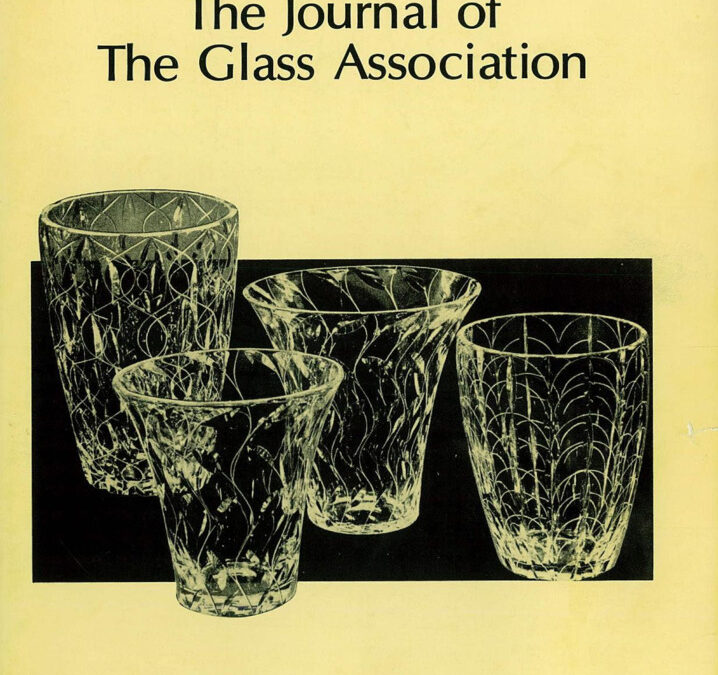
FRONT COVER: detail from a John Walsh Walsh advertisement, 1939.
Printed by BPCC Northern Printers Ltd., 76-80 Northgate, Blackburn, Lancashire.
ISBN: 0 9510736 0 5
The Journal of The Glass Association
Volume 1
1985
Contents
Thomas Betts — an Eighteenth Century Glasscutter
Alexander Werner
1
The Early History of the Redhouse Glassworks, Wordsley, Staffordshire
Martin Buckridge
17
The Davenports and their Glass
Ronald Brown
31
The North of England Bottlemakers’ Strike of 1882-1883
Catherine Ross
41
Venetian Cameo Glass
Leonard S. Rakow and Juliette K. Rakow
51
John Walsh Walsh of Birmingham — Tradition and Innovation 1918-1939
Roger Dodsworth
59
The Glass Association
Chairman: Anthony Waugh
Hon. Secretary: Roger Dodsworth, Broadfield House Glass Museum, Barnett Lane, Kingswinford, West
Midlands DY6 9QA.
Hon. Treasurer/Membership Secretary: Ronald Brown, 8 Chestnut Court, Warren Close, Bramhall Park
Road, Stockport SK7 3LH.
Launched at an inaugural meeting at Stourbridge College of Art in November 1983, The Glass Association
is a national society which aims to promote the understanding and appreciation of glass and glassmaking
methods, both historical and contemporary, and generally to increase public interest in the whole subject of
glass. The Association publishes a quarterly newsletter,
The Glass Cone,
which includes short articles,
news and reviews.
The Glass Cone
is edited by Charles Hajdamach, Broadfield House Glass Museum,
Barnett Lane, Kingswinford, West Midlands DY6 9QA.
The Journal of the Glass Association
is issued every two years. It deals primarily with the history of glass in
the nineteenth and twentieth centuries, although articles on the eighteenth century are published as
appropriate. There is a natural emphasis on the glass of the British Isles, but contributions on overseas
glass are welcome where they relate in some way to British glass. Articles reflect the breadth of interest of
current glass studies in the design, social, industrial and economic contexts of glass as well as its aesthetic
and art historical aspects. Anyone wishing to publish in the
Journal
should contact the editor.
Editor of the
Journal:
Ian Wolfenden, Department of History of Art, University of Manchester, Manchester
M13 9PL.
The Glass Association gratefully acknowledges the financial support of Stuart and Sons Ltd.,
Redhouse Glassworks, Stourbridge, and Hulbert of Dudley Ltd. towards the cost of this volume.
Published by The Glass Association 1985
Printed by B.P.C.C. Northprint Ltd., Northgate, Blackburn BB2 1AB.
ISBN 0 9510736 0 5
Thomas Betts — an Eighteenth Century Glasscutter
Alexander Werner
Thomas Betts died on 7 January 1765, without leaving a will. A probate inventory of his “goods chattels and
credits” was subsequently drawn up, a ‘commission of appraisement” having been set up by the Preroga-
tive Court of Canterbury. Betts’ estate was disputed by his wife and his two nephews, the next of kin by law.
The case was made more complicated by the fact that Ann Charlotte Betts was pregnant at the time of her
husband’s death and had remarried by the time the inventory was taken. It seems likely that her child died at
birth for she became the administrator of the estate for the nephews (
1
).
Two copies of the inventory are to be found at the Public Record Office, Chancery Lane, London. One
is made of vellum strips or lengths sewn together to form a continuous roll. This would appear to be the
`working’ copy, as it includes words that are crossed out. Its condition is poor, dirt being engrained so thickly
that it often obliterates the writing(
2
). In contrast to this, the other copy is written in a variety of fine scripts on
well preserved paper
131
.
It took the six appraisers eight days to draw up the inventory. They listed and valued Betts’ working
tools, stock in trade, household possessions, investments, leasehold estates and book debts. Colebron
Hancock and William Slack appraised the stock in trade and working tools. The former, the son of a poor
clergyman, had been apprenticed to Betts for £20 in 1752, a charity paying his indenture fee
141
. By 1762, he
was running his own glass-shop, not far from his former master, in Suffolk Street.
Very little is known of Thomas Betts’ early life. On 16 June 1708, a Thomas Betts was baptized in the
parish of St. Martin’s-in-the-Field(
5
), and in 1718 a Thomas William Betts was apprenticed to Thomas
Smith, citizen and joiner, for £10(
6
). Whether this was the Thomas Betts of the inventory remains only a
supposition. The first definite reference to him can be found in the poor rate commission for the parish of St.
George’s Bloomsbury
17
>. In 1737, in Hart Street, three houses east of Hawksmoor’s church, there was a
‘Betts’ paying the rate of 7 shillings and six pence. In fact, it seems likely that Betts had been living there
since 1735, the poor rate collector spelling his name ‘Bates’ rather than ‘Betts’. He remained there until
1741, when he moved to Cockspur Street.
Francis Buckley discovered the first reference to Betts’ trade in
“The Leeds Mercury”,
dated October
24 1738(
8
);
“The same Day early in the Morning, was apprehended in Bed at Mr. Betts, a Glass-Polisher, in
Bloomsbury, Thomas Wade, the Person that perpetrated that most tragical Scene of Vilany, (lately taken
Notice of in the publick Papers) at the Appartment of Dr. Peters, at Whitehall, upon the body of Jeffon
Hodskins, the Servant Maid, &c. he was immediately carried before the Bench of Justices at Hick’s-Hall, in
order for his Security”. One wonders what Betts was doing harbouring such a character. Buckley inter-
preted the term “glass-polisher” as meaning that Betts ground and polished glass for mirrors
191
. This term
occurred again in 1749, when Betts was described as a glass-polisher on the apprenticeship indenture
form of William Jonasoo. The usual term employed to describe an early eighteenth century glass cutter
would have been a glass scalloper. A glass-polisher implies that Betts worked more with plate glass than
with table glass. However, it would appear from his trade card that he practised all forms of glass cutting.
The polishing of glass which was the final stage of cutting might have been one of his special talents. And he
might have acquired this skill through having begun his career with mirrors. He was described on his Sun
Life Fire Insurance policy of 1745 as a “glass cutter and scalloper” 1
11
1.
Belt’s new premises in Cockspur Street, or as he wrote on his trade card “at ye King’s Arm’s
Glass-Shop, Opposite Pall-Mall, Charing-Cross”, was located in one of the prime fashionable shopping
areas of London (PL.
1
). This move signalled Betts’ stature as an important glass cutter. As his trade card made
clear, he had stepped from being a jobbing glass cutter to being a master in his own right, glass-seller and
glass cutter rolled into one (
02
). Unlike others in the trade, Betts does not appear to have advertized his cut
glass in the newspapers. He seems to have relied upon his reputation. In 1742, shortly after his arrival in
Cockspur Street, the Duke of Cumberland visited his shop to view the “curious inlaid Glass Tables”, which
the
Daily Advertiser
reported as having involved “three years labour”
1121
. These were probably made up of
different coloured pieces of glass, rather like a furniture maker would inlay a tray or table-top with different
woods. Interestingly, Bells’ stock in trade included “one curious blue and gold table in a brass frame”. As
1
Plate 1.
View of Cockspur Street, looking west towards Pall
Mall. Detail from Sutton Nicholls’ engraving of c.
1728, published in John Bowles’
London
Described,
1731. (Museum of London).
y
e*
ao:.Wettri7
,1
qr-
ci
m
4
4P
4
lAss-CuTaziPt-
…-4F
iA
9
1111
At§KingsArin’s Glafs.
41
CA:4
hop. Oppolite PallMall.Charring Crofs
-71
II
11
ii
III
110
I/
1
k 4
0
11
444
XV’)
Ikea
kgells
agtforei ofititious
juiY£
ae awed4. Cad tom.hits ,
tree
I
ALred._
:
0061,keee9l’anta
e
on&
ekaotTareks:withpnlee791-
J7z/Perzi orAlated
theft z” or’
froAt atita
a:V&A
orR/it/hput,
eknie
ligious`ffont trt ,..coo,”
aderafel orNay.tnienew(ChearemBetter
denAderto km Gem
a/o-Aeolic beingthe
RealWorkwan.,for
margYears
Plate 2.
Trade card
of Thomas
Betts, c. 1745. British
Museum.
2
one would expect of a glasscutter of this period, his trade card reveals a specialization in table glass. His
main stock lines may have been the dessert centre pieces or salvers in flint or looking glass on which
numerous cut dessert-glasses would have stood, the cut and ornamented table lustres, the cruets, castors
and salts, dishes, plates and bowls of all shapes and sizes. He maintained that his cut glass was cheaper
and better than anything previous, a common boast of manufacturers and traders. The retort “He being the
Real Workman, for many years” was aimed at those glass sellers who had sold his work as their own. It
would have, also, alerted the customers to his position as a major glass cutter.
One of his workmen left him in 1744. From the tone of the announcement in the newspaper, Betts was
somewhat concerned about his departure;
“Whereas Andrew Pawl went away from his Master, Thomas Betts, at ye King’s Arms Glass Shop,
opposite Pall-Mall, Charing Cross, on the 7th Instant, whoever harbours or entertains him after the
publication hereof, be it at their peril.
He is tall, has a thin meagre look, is very much Pockfretten, with very small grey eyes, and a large scar
on his Forehead; he had on when he went away, a Cinnamon Colour Coat, and a Dutch Frize Waistcoat.
Note — He is a Bohemian, and speaks good English” (13).
There was no mention of whether he was a glass cutter or an engraver. He may have been under contract to
work for Betts for a certain length of time.
For the next twenty years, Betts prospered. This is substantiated by the value of his personal
possessions and stock in trade at death. From the inventory, it is possible to analyse certain details relating
to Betts’ working life. By 1765, there were perhaps a dozen glass cutting workshops in London. There was a
further category of craftsmen involved with gilding, enamelling and engraving. Finally, there were the
shopkeepers who only sold glass, being supplied direct from the glasshouse or specialist decorator. Betts’
retail business supported an extensive cutting workshop.
Located above and at the back of the Cockspur Street premises he had his town workshop. In the
garret, there was “an engraving tool with foot wheel bench and small wheels with a stand . . . with other
necessaries compleat, a small flatting iron, and an engraving mandrel and frame with some spindles”. In
what was termed the “back shop and lead one pair of stairs”, which can confidently be interpreted as the
back shop and lead shop on the first floor, there was “a stopping tool with pinns and chucks compleat, a vice
and bench with sundry tools, an engraving tool with two mandrels and turning bench” and “a large table
with a foot for covering”. There were no obvious cutting tools here. The engraving mandrels would have
been used for engraving names, crests, flowered borders and other such fine decoration. Gwillim’s
Heraldry and another book (probably a standard pattern book) were to be found in the shop. These would
have enabled the customer to decide upon a design. The pattern could then be copied by the engraver onto
the glass. The flatting iron would have been used to even out copper engraving wheels. The stopping tool
was basically a lathe with special chucks. Its purpose was to grind, smooth and polish stoppers as well as
the inner rims of bottles, decanters and other such objects so that the two parts would be close fitting. Once
they had been worked to nearly the required size, the pieces would be ground together for the exact fitting.
The rest of the workshop seemed to have been used for constructing “branches”, “girandoles”, “tunns”
and “fountains” which would have been a skill peculiar to a glass seller and glass cutter. The “large table
with a foot for covering” as well as “the vice and bench” were no doubt employed for this purpose. The term
“a foot for covering” remains a mystery. Possibly, it refers to something similar to a shoemaker’s last. This
could have been used to support the chandeliers, girandoles and fountains while the numerous arms were
being attached to the central shaft. “Covering” might refer to the process of silvering. The central bowls of
chandeliers were often silvered in order to hide the point where the arms met the shaft.
Betts also constructed mirrors. It seems more likely that he would have sent out the task of silvering
mirrors to a specialist workman. However, earlier in his career, he might have done the work himself. There
were facilities for cutting plate glass. The inventory listed “7 diamonds set for cutting”. Betts had a stock of
“looking glass plates”, a drawer full of “looking glass borders” and a box of “looking glass ornaments”.
There were also a variety of sconces (some “scollopt”), chimney glasses and pier glasses. He had over 60
pounds (weight) of lead which could have been used for constructing looking glasses with borders. The
special fittings such as feet, pulleys, rods, nuts, and cocks as well as other more general items such as
fish-skin cases or boxes for smelling bottles, wooden or plated stands for castors, silver or plated caps or
tops, and metal work for lamps would no doubt have been bought in from specialist makers. However, Betts
owned a set of iron and brass moulds for making ornaments for lustres and branches, which included star
and prism moulds. These were either moulds for drawing out the pattern to be cut or possibly for hammering
out metal ornaments. It seems unlikely that they were glassmakers’ moulds. There was no furnace in Betts’
workshop and therefore no facilities for melting down cullet or for enamelling. Gilding, would have been to
the recipe described by Dossie, where the glass did not require annealing. “A German stove” was listed,
which might have allowed some form of soldering to be carried out. In the cellars, “an old scolloping frame”,
“a scolloping frame with a large wheel compleat” and “2 lead mills” were stored. It would seem that Betts
3
had before 1756 used the space in the garrets and back rooms as a cutting workshop. The machinery found
in the cellars had been made redundant by his new large scale water-powered cutting workshop in
Lewisham. No doubt the majority of the scolloping mills were transfered there, what remained in the cellars
being kept for use in emergency.
The listing of “lead mills” matched the description of a petition of one of Betts’ apprentices to the
Middlesex Sessions in October 1751(
14
). It is worth quoting the decision of the court in full;
“Richard Lidgley, the younger, discharged from his apprenticeship to Thomas Betts, of St. Martin’s in
the Fields, “glass scolloper”, by reason that there was used in the said Business of a Glass Scolloper a
Leaden Mill or Wheels wherewith the Glass is cut or scolloped the motion of which was so exceeding swift
that it forces or throws out a great Effluvia of the pernicious particles from the Lead which has not only
effected the said Richard Lidgley’s nerves but as the said Richard Lidgley was advised (by Persons skilled
in Physick) but his intestines also and that if the said Richard Lidgley should continue much longer in the
said Trade he must immediately die having at several times had very severe Fits occasioned by the said
Effluvias which grow upon the said Richard Lidgley more and more and at such times the said Richard
Lidgley has been obliged to go Home to his Friends and be put under the care of an Apothecary for a long
time together”.
Betts attended the court with his counsel Luke Benne Esq. (a sign of his wealth). This was not a unique
case. On 10 July 1736, Charles William Stutley presented a petition praying that his master, Jerrom
Johnson, instruct him in the art of a Glass Engraver(
15
). The apprenticeship was to learn the Art of Glass
Engraving from Jerrom Johnson. It appeared that in 1734, Johnson had taken up the art of glass scalloping.
Stutley had only been taught glass scalloping. He protested that Johnson had concealed the art from him,
giving the work to another for the last two years. He also complained about the deterioration of his health.
He wrote “your petitioner has been twice poisoned and is now so weak that he is unable to work at any
Business and is afraid he shall never recover his Health again”. The scalloping of glass was clearly a
dangerous profession. Lead poisoning must have been prevalent, caused by the lead polishing wheels.
This must have been compounded by the polishing abrasives such as pummice stone and rotten stone.
Betts had a supply of both these materials at Lewisham.
His watermill was located to the south east of
London on the Ravensbourne, a small river which
met the Thames at Deptford. The Doomsday Book
listed eleven mills on the Ravensbourne. These
would have been cornmills(0
3
). However, by the
fourteenth century, an Armoury Mill had been
established to grind and sharpen steel blades for
swords. In the seventeenth century, a mill further
up the river was used by a group of cutlers who
came there to avoid the restrictions imposed by the
Cutler’s Company in the City of London(
16
). Betts’
mill, probably an old corn mill, must have been
converted by a specialist millwright into a cutting
workshop. The inventory included a “stamper and
its iron work and frame”. This may have been part
of the old fittings of the mill, for it seems unlikely
that a “stamper” would have been required to cut
glass. It was possibly used to beat down the cutting
and polishing abrasives into fine powders. The
earliest record of water power being employed to
cut glass in England occurs in 1678. John Roberts
had obtained a patent for “grinding, polishing and
diamonding glass plates for looking glasses, etc.,
by the motion of water and wheels”C
17
). Nothing
more is known about Roberts or whether he actu-
ally put his patent into practice. In the seventeenth
and eighteenth centuries extensive water powered
glass cutting workshops existed in Bohemia and
Silesia. It has always been thought likely that
waterpower was used to cut glass in England in the
late eighteenth century just prior to the introduction
of steam powered workshops.
Plate 3.
Map showing the site of Thomas Betts’ watermill on
the river Ravensbourne (site marked ‘Corn Mill’).
Detail from John Rocque’s
Map of London and
Surrounding Districts,
1747. Port of London Author-
ity.
4
The evidence from the inventory suggests that Betts was using waterpower from about 1756 onwards.
What made Betts set up a water powered cutting workshop? Perhaps his town workshop had become too
small to satisfy the demand for his cut glass. He must have heard about the use of water power from his
Bohemian workman. It would have undoubtedly been a major capital investment for him. Technically, the
replacement of human power, as shown on the Maydwell and Windle trade card (
,14
), with water power
would have meant that Betts could produce cut glass probably more cheaply and quickly than his major
rivals. Furthermore, there would have been little in rural Lewisham to distract his skilled workmen and
apprentices from their repetitive work.
From the list of “tools and utensils in the two workshops at the Mill and places adjoining at Lewisham”
one can attempt to reconstruct the general layout of the workshop. The water wheel was connected to a
“wallower”. In the eighteenth century, this was the common word used to describe a trundle or lantern
pinion. It converted the power of the turning water wheel into motive power. There would have been shafts,
pulleys and wheels connecting the “wallower” with the cutting machinery. The “six scolloping frames”
would have taken up the most power. For this reason, they seem to have been located near “the wallower”.
They would have been used for rough cutting, smoothing, and polishing. There were a further “two old
scolloping frames”, but it is not clear whether these were connected to the line shafting. As well as the
scolloping frames, Betts had “five underhand mandrels and frames”. With the scolloping frames the glass
would have been worked upon from the top of the wheel. With the underhand frames, as the word implies,
the glass would be cut and smoothed from below. Amongst the other equipment in the workshop there were
“two stopping tools”, “the lapidary frame and four grooved wheels and iron work and two diamond frames,
a turning wheel and laith”. A clear distinction was made by the appraisers between “the lapidary frame” and
the “diamond frames”. It seems likely that these were some kind of horizontal cutting laps similar to the one
shown on the Maydwell and Windle trade card(P
1
.
5
). They appear to have been used especially for cutting
lustre pieces and drops, hence the link with the gem and diamond cutters’ machinery. There were other
implements that called to mind this related trade such as “five diamond skives” and “one cutting box”. The
left hand of the cutter would have turned the crank handle while the right would have held the lustre piece
against the revolving horizontal lap. A special rest alongside this wheel would have helped to keep the
cutter’s hand steady.
Over 150 wheels and spindles were listed. There were “five large iron lapidary wheels and spindles”,
as well as “8 iron wheels and spindles” and a further “eight iron wheels”. Iron would have been the most
Plate 4.
Glass cutting by hand-wheel power. Detail from the trade card of Maydwell and Windle, c. 1760. British Museum.
(Museum of London photograph).
5
7
suitable material for the rough cutting of the glass. The “scollopers stones” could have also been used for
this purpose, as well as for the smoothing process. There were, also, wooden and lead wheels which were
for polishing the glass after it had been smoothed. Betts had a stock of the main abrasives, a “parcel of
sand” for use with the iron wheels, for the stone wheels water was all that was required, and “a parcel of
rotten stone, a parcel of pummice stone and a parcel of live oak” for polishing. The latter substance was a
type of oak which grew in the Southern States of America and was renowned for its durability. It would have
been a suitable polishing medium when it was broken up and mixed with water. There were “nine tongs”
which would have probably carried the sand and other abrasives mixed with water from a can above the
cutting frames down to the surface of the wheel. As with all skilled workshop trades, good light conditions
would have been essential. There were almost certainly either skylights or a continuous run of windows
along one side of the workshop. The cutting frames would have been positioned along the windows or
under the skylights. One of the main problems of a water powered cutting workshop would have been in the
summer months when the river would be at a low level. In 1775, Jonathan Collet, Bells’ successor, in a
letter to Matthew Boulton, described how he had been thinking of erecting a horse mill to power his cutting
and polishing machinery, prior to being told about steam power(
18
). However, in Betts’ time, the watermill
seems to have functioned successfully. In 1758, one of his main rivals, Jerrom Johnson, advertized his cut
glass, informing the public that he was not using water powerog).
Who was Betts’ glass supplier? The inventory referred to “Goods remaining unpacked as pr the
glassmakers accompt after having deducted the discount”. The “goods” were valued at £252. He would
have required glass of the highest quality. The Anthony Seale papers reveal Betts to be buying glass from
the Whitefriars glasshouse in the mid 1750s(
20
). In fact, he was one of their largest customers. It seems likely
that he bought glass from other glasshouses, such as those in Southwark, which were supposed to have
been makers of fine coloured glass.
The glass at the Lewisham workshop was stored in the “Ware Room”. It included glass awaiting or in
the process of being cut. Apart from the standard items such as “candlesticks”, “decanters”, “salvers”,
“smelling bottles”, “sweetmeats”, “sillibubs”, “salts” and “wines”, there were a number of unusual pieces.
Quite a large number of “liquier glasses” were being cut. These were probably small capacity glasses
which were then becoming fashionable. Blue glass was being cut, of special note were the “2 large blue
ewers unfinished”. There was also a solitary “green goblet”. Parts of chandeliers or girandoles were
included such as “lustre pieces”, “snake arms”, “sockets”, “drops”, “large arms” and “scroles”. The
Plate 5.
Horizontal cutting lap. Detail from the trade card of Maydweli and Windle, c. 1760. British Museum. (Museum of London
photograph).
6
Plate 6.
Trade card of Colebron Hancock, c. 1770. British
Museum. (Museum of London photograph).
inventory listed “7 cut sugar plumbs” which were probably top-glasses or large sweetmeat glasses. For
packing the glass, there were “seven stake baskets”.
The journey from Lewisham to Charing Cross would have been treacherous. The conditions of the
roads in the eighteenth century were appalling. “A bay cart horse” and “two carts compleat” were kept at
Lewisham. These would have been used to carry the glass. It was possible that Betts transported the glass
down to Deptford and then had it sent on by river to one of the Westminster landing stairs. On the other
hand, he could have sent it all by road, crossing the river at Westminster or London Bridge. Both routes
would have been equally hazardous and breakages must have occurred.
An immense quantity of glass was on show and in store at his Cockspur Street shop. Numerous
“tables”, “cases”, “drawers”, “racks” and “shelves” were listed as being in “the shop and accompting
house”, in “the warehouse” and in “the cellars”. The rooms must have felt as if they were made of glass.
There were three “pairs of steps”, no doubt needed to reach the glass set out on the top shelves. Both the
warehouse and the shop had “mahogany writing desks”. In the warehouse, there was “a drawing framed
and glazed” on the wall as well as “a small picture”. “Five lead medals” were listed. These might have been
awarded to Betts by the Royal Society or Society for the Encouragement of Arts, Manufactures, and
Commerce, or even by a foreign government, for Betts’ customers included the Venetian and the Viennese
ambassadors. The shop seems to have had “a glass door”, probably a very unusual feature in the mid
eighteenth century. There was “a slate” on which to add up the bills. For weighing the glass and cullet, there
were three “beam scales”.
The light fittings were the most valuable items on show in the shop. In unassembled form, there was a
vast array of “shades”, “panns”, “arms”, and “scrolls”. These were stored in bulk in the warehouse and in
the closet nearby. The smaller decorative features were set out in a similar way such as “one hundred and
forty one cut drops of different patterns, twenty six cut starry, seventy one cut ornaments, forty seven cut
bottom knobs” being valued at “£28-11s-11d”. The chandeliers or “branches” were described in two main
entries;
“One Cut Eight light Branch, one twelve light Branch with ornaments, two Branches nine Arms and
three Scroles with ornaments, one Small four light Branch cut, one ten light Branch with ornaments, one
Eight light cut Branch.
£142-11-2.
One large cut Eighteen light Branch One Body of Sixteen light Branch cut one German branch Ten
lights ornamented One body of a Six light cut, one pair Globe Lamps mounted in french plate, one Small
Globe Lamp mounted, Three large Bell Lamps mounted.
£62-0-0”.
The value of a large chandelier can be estimated at about £30 and a small one at about £15 to £20. This
was quite likely to have been the trade price. The customer would probably have paid more. The branches
were described as being either “cut” or “ornamented”. The Colebron Hancock trade card shows an eight
light cut branch on the right and a six light ornamented branch on the left. Elsewhere in the inventory the
individual types of ornaments were listed. These included “pillars, balls, drops, fleur de lis, moons, prisms,
and stars”. One entry referred to “one thousand
nine hundred and forty one cut drops of different
patterns”. The “German branch” could refer to a
chandelier in the German style, which Betts had
made, or an imported German one. In the shop,
amongst an assortment of miscellaneous items
was an “eight light moulded branch”. The term
“moulded” probably refers to the globes and bowls
of the body being ribbed or meshed in imitation of
cutting. The “girandoles” or candelabra were listed
together like the branches. A stock of “girandole
feet” was kept in the closet adjoining the ware-
house. The constructed girandoles comprised a
variety of shapes and sizes;
“One large Girandole Cut with five Arms and
three Scroles Ornamented, One Ditto Eight Arms
and Ornaments, one two light Girandole with
ornaments, Two two light Ditto Ditto, one two light
Ditto with Coloured Drops, one Girandole with One
Arm and two Scroles ornamented, Two Cut feet of
Girandoles.”
These table lights were illustrated on various
contemporary trade-cards. Two examples can be
seen on the left hand side of the table in the Coleb-
ron Hancock trade card(P
1
–
6
), and a further larger
7
girandole stands on the floor to the right of the claw foot. These girandoles were sometimes called “branch
candlesticks”. An even more elaborate form of light fitting can be seen on the centre of the table. This was
called a “fountain”. It is not certain how the fountain’s mechanism worked for the simple reason that none is
known to have survived. On the Maydwell and Windle trade card, a fountain was shown with a tube
attached to the lower basin. This implies that water was pumped in here. Once it was full the water would
have been forced up a tube, which ran through the central shaft, to emerge at the top like a fountain. It is
difficult to imagine how the candles stayed alight. The water would have been caught by the large basin
without soaking everything around the fountain. This would have been important as fountains may have
formed the centrepieces of elaborate table arrangements. It is possible that one of these fountains might be
discovered in a scientific instrument collection. In Betts’ warehouse, “one small fountain with four arms
ornamented” and “one large fountain with six arms ornamented” were listed as well as “two small
fountains” and “four fountain basons”. These must have made impressive show pieces in the shop,
catching the attention of the customer. In the cellars, there was an “old bench electrical machine the globe
broken”. This must have also proved to be a fine attraction in the shop, especially in 1740s and 1750s when
the early electrical experiments were taking place.
Besides the table lights, there were numerous pieces of table furniture in glass. Most of these were
exclusively for the dessert course. The only “desert frames” in the inventory were made of looking glass
and they had been gilt. Rather confusingly, the inventory included “desert boards” which were probably
glass trays, and “desert stands”, which might have been dessert frames in flint glass, as well as “desert
feet” on which no doubt the frames would have sat (these could have been made of metal). There were
“two epergnes compleat”, one large and one small, and 13 “epergne stands”. A “confectioner” was
described as having “six arms with baskets” which would make it very similar to an epergne. There were
over 2000 “jelleys, sillibubs, and sweetmeats”, of all shapes and sizes. These included 447 “Dutch
sweetmeats”, which were likely to have been imported from Holland.
Numerous other glass objects appear in the inventory not necessarily linked with a dessert display.
There were “toilet bottles” and the smaller “smelling bottles”, “flower bottles”, “flower root glasses”,
“vases” and even an “engraved sprinkling bottle”.
All the common terms were used to describe the vast stock of wine glasses (probably about 10,000 in
all). There were “beers”, “champaigns”, “flutes”, “gills”, “glasses”, “liquiers”, “middle glasses”, “spanish
wines”, “wines” and “wine and waters”. The words used to describe their shape and decoration were not
very detailed. These include “hollow shank” or “hollow stem”, “worm’d”, “enamell’d”, “engraved”, “gilt”,
“half moulded” (this was for champagnes), “twisted”, “plain”, “cut”, “painted” (only one of these), “cut
shank”, and “tale”. Sometimes two of these terms were combined. The “hollow stem” wine glasses exist in
a number of museum collections; this is where the stem is made up of a continuous air bubble surrounded
by a thin layer of glass. “Worm’d” probably refers to what is known as an ‘air-twist stem’ and “twisted” to an
‘incised twist stem’. However, it is quite possible that this interpretation could be the other way around.
“Enamell’d”, here, did not mean that the bowl was decorated with enamel colours but that the glass had an
opaque white twist stem. The term “painted” was probably equivalent to what is usually known as
enamelled glass. Although only one wine glass was described as “painted”, elsewhere in the inventory a
few coloured glass objects were also “painted”. There were “two green bowies and covers”, “one blue
jelly”, “two green mugs”, and “one blue tone”. These pieces might well have been imports from the
continent. Furthermore, “one green rummer” and “one green and white rummer” were described as being
“printed”, and there was even a “half pint Venetian tumbler”. The majority of tumblers were either cut or gilt.
In fact, generally, Betts’ stock in trade appears to have been made up of ‘quality’ glass. There were only a
few pieces described as ‘tale’, and even these sometimes had “engrav’d borders”.
The objects known as “tonns” are worthy of some attention. The elaborate glass barrels positioned on
metal trolleys are quite a common feature of nineteenth and twentieth century glass. In the eighteenth
century, these were called “tonns”. They were basically barrels supported on metal or glass stands. Often
the figure of Bacchus would ride astride the barrel. Betts had a large stock of these pieces. In unmade up
form, there were “nineteen blue threaded barrels”, “twelve bacchus”, “a bacchus and bung compleat”
(obviously in metal), “two part of a set of brass for a tonn”, “seventy four pounds of tonns and stands” and in
a finished state, “one large engraved tonn”, “one blue tonn mounted in metal gilt with a bacchus etc.”, “one
green tonn and stand”, “two blue tonns and stands”, and “seventy four pounds of green tonns and stands”.
Francis Buckley included at the end of his article on Betts the relevant trade bills from the Heal Collection.
However, he left out an entry on one of the bills which referred to a tonn. It read “5th July 1755 To mounting
a tonn with metal! gilt wt cock and bung 21-11-5″(
21
). On the Colebron Hancock trade card, a tonn with a
bacchus and vine leaves is displayed on the table(P’
6
). The Corning Museum of Glass has recently acquired
a particularly fine blue tonn.
A considerable amount of coloured glass was listed in the inventory, the main colours being blue or
green. There were “scollopt green basons and covers”, “cut green bowies and covers”, “cut green dishes
8
and plates”, and large “green squares”; there were “blue cut cannisters and canns”, “blue cups and covers
with metal handles and choaks”, “blue dishes”, “blue toilet bottles” with either “silver” or “metal necks”,
and “blue gilt vases and saucers”. A few other unusual coloured objects were also listed. A solitary “cut
yellow ewer” was noted as well as “two purple gilt carrafts” and “one cut purple dish”. The only opaque
white glass was located in Betts’ own private rooms. In the parlour at Cockspur Street, he had “one pair of
white glass beakers”. In the Hall of the house at Lewisham, he had a further “white beaker”, a “pair of small
white bottles”, “one large” and “one small pair Staffordshire birds” (these may have been made of
porcelain or white saltglaze stoneware) and “two Rice figures”. These “Rice figures” are a mystery. Betts
had a “parcel of Rice figures” in his shop. Perhaps, they were the plain white glazed figures made by the
Bow Porcelain factory. They could, also, have been Chinese porcelain figures. In one of the bed chambers,
there was “one white glass corner copia”, a very unusual piece.
The stock in trade, then, shows Betts’ main business to have been cutting and selling glass. The
inventory does not often distinguish between the different styles, terms like “neat cut”, “sprigg’d” (this could
refer to engraving), “scollopt”, “wav’d” and “French pattern” were employed only occasionally. About
seventy five per cent of the list of glass was described as cut. From the variety of tools and machines in his
workshops, it is safe to suggest that Betts had the facilities to cut elaborate patterns on his glass. His
considerable wealth, also, implies that he was one of the leading glass cutters. He may well have been
creating new styles of cutting. It seems likely that the term “cut” in the inventory was used for a number of
different patterns.
The term “engraved” was much less common in the inventory. Again, Betts had the equipment to
engrave all the standard motifs found on glass of this period. As the stylized flowered border patterns occur
more than any other it is likely that when the term engraved was used in the inventory that it referred to
something of this sort. There were a number of “bowies and covers” as well as “plates” described as being
“engraved landscapes”. Certainly, a number of these survive in glass collections, the bowies usually
without their covers. The large glasses and rummers (one was of three quart capacity) also tended to be
engraved. There were “4 tumblers engraved the seasons”; similar patterns survive on large wine glasses
(three of a set of four are illustrated by Thorpe — the Autumn one missing)(
22
). There was also one “round
looking glass engraved Mars and Venus”.
The gilt glass in the inventory tended to be either drinking glasses or coloured glass objects. It was
quite likely that Betts sent these out to a specialist decorator. The coloured glass vases and beakers that
survive from this period tend to be of fine quality. And as Betts was one of the leading giass sellers he would
have surely stocked the luxury gilt glass items, of a kind similar to the work produced by James Giles in the
1760s.
The total amount of Book debts owing to Betts at his death came to £1297-8s-7+d. From his death on
7 January to the time when the inventory was appraised on 16 February, a period of about five and half
weeks, £437-2s-5d worth of goods had been sold. January and February would not have been the best
trading months. This can be substantiated by the surviving Bow account book in the British Museum(
23
), the
best retail months being shown to be later in the year. So, Betts’ turnover was probably about £5000 per
annum. Who was buying his wares? Two hundred and thirty customers were listed in the inventory. Many of
the leading aristocrats were to be found here including “the Duke of Richmond, The Earl of Harcourt, The
Duke of Montrose, The Duke of Bridgewater, Lord Weymouth, Lord William Campbell and Lady Northamp-
ton”. There were also two royal customers, “the Duke of York” and “Princess Amelia”. Hopefully, some of
the glass which they bought will come to light and the specific bills be discovered in the various archives. It
would be exciting if a piece of cut glass could be definitely attributed to Betts’ workshop. The bills were
usually no more than a couple of pounds. However, in the mid eighteenth century, this was a considerable
sum of money. For example, the average weekly wage of a labourer at this period was about 12 shillings
and that of a journeyman about 15 shillings. Betts’ skilled cutters and engravers might have been earning
as much as £2 or £3 a week, but this would have been a high wage. It is very difficult to equate the general
standard of life in the mid eighteenth century with that of the present day. There are various different
methods of comparison; some social historians use the price of bread, others compare the average weekly
wage. A very rough estimate of the value of the outstanding debts owed to Betts would be to use a
multiplying factor of between 75 to 100. So, when Betts was selling cut wines in 1757 at 2s each, today’s
price would have been roughly 215-£20. The debts of two or three pounds were, therefore, quite large
sums.
Sir Lawrence Dundas owed the sum of £25 exactly. He had numerous different houses in England and
Scotland, having made most of his money from his time as Commissary General and Contractor to the
Army between 1748 and 1759. It seems quite likely that this bill was for a chandelier. His house at No. 19
Arlington Street was being decorated in 1763. In the 1768 inventory made of the furniture and fittings of the
house, the Front Room included a “cut glass chandelier” (
24
).
The largest customer of all was Mrs. Cornely. She was the extraordinary German opera singer who
9
had settled in London and organized a series of high society masked balls at Carlisle House in Soho
Square. Tickets cost £2. She had built two large ballrooms at the back of the house. An advertisement in
1771 spoke of the gallery being “strangely illuminated” and the pavilion having a ceiling with “looking
glasses”{
25
). She was almost certainly decorating one of her large rooms in 1764, hence the enormous bill
for £189-19s-6d. Unfortunately, nothing survives of this house.
There were three or four other large outstanding bills. No record of these names occurs in the trade
directories. Brian Broughton owed £54-9s-3d, Messrs Francis & J Booker £73-13s-Od, Mr. Richter £70,
and Mrs. Ann Gast £60-13s-Od. It was possible that they were merchants exporting the glass. A “Cockburn
Esq.” owed £38-13s-Od. This may have been George Cockburn the Dublin merchant and army agent. The
British Library Manuscript Department possesses a number of his account books. However, there was no
mention of Thomas Betts(
26
). The next entry reads “Mr. Hamilton Envoy £43-8s-6d”. It seems likely that
George Cockburn visited the shop with his friend William Hamilton, the Chief Secretary for Ireland.
The final name on the list was Thomas Nixon who owed the sum of £144-14s-Od. While searching for
notices of Betts’ death in the London newspapers, a reference was found to a Mr. Nixon, hatter and
sword-cutler near Temple-Bar, who had been appointed by the Commissioners, Surveyor of the new
pavement in the City and Liberty of Westminster(
27
). No doubt this was a well paid post, Mr. Nixon being able
to afford luxury glass items.
Betts was unlikely to have had any financial problems, even with such a large list of debtors. This was
because he had £3000 invested in various government stocks. Unlike many of the smaller tradesmen, he
would have been able to survive the times of financial crises. Among his collection of books, there was
Defoe’s “The English Tradesmen”, the standard work, explaining how to run a business successfully.
Betts’ own wealth was reflected in the furnishings of his two houses. He must have lived very comfortably
when he was in town. Above the shop, on the second floor, there were two bedrooms and a dining room.
Both bedrooms had four post bedsteads. A number of Japanned pieces of furniture were listed, including a
“dressing glass”, “cloths press” and “tea chest”. One of the bedrooms had “three painted pictures” as well
as a “large picture in a gilt frame”. The dining room was fitted out in style. As one would have expected,
there was a “chimney glass and “two pier glasses with gilt frames”. The majority of the furniture was in
mahogany. Amongst the other fittings, there were “two marble slabs with
i
ron scroll brackets”, a “Turkey
carpet”, an “India paper-claw firescreen” and, an important possession for Betts, a “strong box”. The
parlour had a similar array of mahogany furniture and gilt framed mirrors. It also included 12 “prints of the
seasons coloured and framed”, a “table clock” made by Wright, and “three bird cages with birds”. Such an
inventory of expensive furniture was not uncommon among successful tradesmen. Large fortunes could be
made from producing and selling high quality luxury goods. Such tradesmen were almost able to emulate
the material lifestyles of their wealthy customers. Betts must have had trading connections with furniture-
makers and silversmiths. A system of reciprocal favours or exchanges between tradesmen could explain
the quality of Betts’ furnishings. He owned a considerable amount of silver objects. As well as a set of 12
knives, forks and spoons, and other small objects, he had a “large salver”, 2 “cream saucepans”, a “cream
ewer”, a “pair of candlesticks and nossels” and a “quart mug”. The total value of the silver in both the
houses came to over £110. Betts was also the owner of a gold watch.
His house at Lewisham alongside the mill was filled with even finer furniture and fittings. One of the
bedrooms and the parlour were decorated with Indian or Indian styled wallpaper. The bedroom had a “four
post bedstead with mahogany feet posts”, the coverings being made of cotton. There were “two cotton
festooned window curtains lined”, a “mahogany commode table”, a “dressing glass mahogany frame”,
“six dressing boxes”, a “mahogany bearoe”, a “mahogany claw table”, a “mahogany bason stand”, a
“mahogany necessary corner chair”, “four chairs, a “horse pistol” and “two pieces of Turky carpet”. The
other bedrooms were also well furnished. The India paper palour had an “inlaid marble table on a
mahogany frame”. The kitchen was well fitted out, having a vast array of pots and pans (as well as a “parrot
in a cage”). There was a “lardour” and dairy, a wash house and laundry, even a summer house. This last
building contained an “old card table, five chairs, three lead garden polls, one stone roller iron frame and
one perspective glass”. It would seem from this that there was a garden with a lawn. By the mill, there was a
punt in the river. Betts may have relaxed here away from the noise and bustle of London, and, at the same
time, have been able to keep a watchful eye on his workmen in the mill and workshops.
So, this inventory reveals the extent of Betts’ considerable wealth and tells one something about his
lifestyle. The stock in trade and working tools as well as the list of debtors will be the source of reference and
further research for those interested in the working history of the eighteenth century Glass trade.
Footnotes
1.
PRO — PROB 31/497/170, PROB 31/499/316 and PROB 6/1785/161.
2.
PRO — PROB 3/61/5.
3.
PRO — PROB 31/498/187.
4.
Francis Buckley’s unpublished alphabetical list of glass sellers, chinamen and potters of London recorded in newspapers and
10
other records between 1660 and 1800. Guildhall Library – MS. 3384 –
Daily Advertiser,
18 Jan. 1752.
5.
Westminster Local History Library – Register of Births for the Parish of St. Martin’s-in-the-Field 1708.
6.
The Apprentices of Great Britain 1710 to 1762, extracted from the Inland Revenue Books at the Public Record Office, London,
for the Society of Genealogists. Copy held by the Guildhall Library.
7.
Holborn Local History Library – Poor Rate Registers.
8.
F.
Buckley, op.cit. – original newspaper held by Leeds Local History Library.
9.
Francis Buckley, “Thomas Betts”,
Glass,
July 1928, pp. 299-300.
10.
Apprentice Lists, op.cit.
11.
Sun Life Insurance Ledgers – Guildhall Library MS. 11936 – vol. 74, p. 54, No. 102891, July 16 1745:
“Thomas Betts of the Parish of St, Martins-in-the-Field, Glass Cutter and Scalloper on his household Goods and
Utensils in Trade in two brick houses laid into one being his new dwelling house at situate at the Kings Arms on
the North Side of Cockspur Street in the Parish aforesaid not exceeding 200 pounds and on his stock in Trade
not exceeding 400 pounds. Total £600”.
12.
Francis Buckley, op.cit. –
Daily Advertiser,
24 December 1742.
13.
Francis Buckley, op.cit. –
Daily Advertiser,
18 October 1744.
14.
Greater London Record Office. Middlesex Sessions Records – MJ/SBB 1088.
Quotations from Crown Copyright documents are made with the consent of the Controller of Her Majesty’s Stationery Office.
15.
GLRO – Middlesex Sessions Records – WJ/SP 1736/1-2.
16.
Information supplied by Carl Harrison, Lewisham, Archivist.
17.
Public Record Office Patents of Invention No. 203 – no specification enrolled.
18.
Birmingham Reference Library – Boulton Papers, Box 2’C’.
19.
Daily Advertiser,
28 April 1758.
20.
Guildhall Library, MS. 5745A.
21.
British Museum – Dept. of Prints and Drawings – Heal Collection.
22.
W. A. Thorpe,
A History of English and Irish Glass,
1929, vol. 2, plate CXX.
23.
British Library Add. MS. 45905.
24.
A. Coleridge, “Sir Lawrence Dundas and Chippendale”,
Apollo,
vol. 86, 1967, p. 195.
25.
The Memoirs of Jacques Casanova de Seingault –
Navarre Society Ltd., 1922, p. 143.
26.
British Library Add. MS. 20965.
27.
Gazeteer and New Daily Advertiser,
January 4 1765 – British Library.
Acknowledgements
I would like to thank Ian Wolfenden, Robert Charleston, Martin Mortimer, Chris Ellmers and especially Wendy Evans
for their helpful comments on aspects of the Betts’ inventory and on an earlier draft of my article. Such errors as remain
are my own.
Appendix 1
The list below is a typescript extract from the probate inventory of Thomas Betts, of which two copies are
located at the Public Record Office (footnotes 2 and 3). The extract lists the household goods of Betts at his
Cockspur St. house, leases, debts due to Betts at the time of his death and a summary of Betts’ assets. To
record the numbers in the manuscript, figures have been substituted for words in the typescript. Lists of
glass, tools and equipment found at Cockspur St. and at Betts’ mill at Lewisham are given in Appendix 2.
A true and perfect inventory of all and singular the Goods Chattels and Credits of Thomas Betts late of the Parish of St. Martin in
the Fields in the County of Middlesex deceased as they were taken and valued the 16,
18,19,
20, 21, 22, 23, 25 days of February
1765 by us the underwritten Colebron Hancock, George Reynolds, Richard Bosle, Edward Aylett, James Barber and William Slack
by virtue of a commission of appraisement to us directed issued under the Seal of the Prerogative Court of Canterbury and bearing
the date the 7th of February 1765 as followeth to wit.
House, Cock Spur Street, Parish of St. Martin’s in the Field
Garret Right Hand
A stump bedstead, a feather bed bolster, a mattrass, 3 blankets, a coverled, a chair, old chest of drawers, a dressing glass, green
harrateen furniture of a field bed, a pair of flaxen sheets.
£4-10-0
In the Middle Garrett
A bedstead with three check curtains, tester pallens laths and rods, a feather bed bolster, 3 pillows, 3 blankets, a coverled, a pair of
sheets, a chimney glass, a chest of drawers, 3 pictures, a chest, a rug carpet, a chair leather seat.
£5-6-0
In the Farthest Garrett
A German stove, a shovel, a table, a payle.
C0-15-0
In the Back Garrett
Two stump bedsteads, a green lincie curtain and rod, 2 feather beds, 2 bolsters, a flock mattrass, 6 blankets, 2 coverleds, 2 pair of
sheets, 2 bolster cases.
£5-12-0
In the Two Pair of Stairs Right Hand and Closet
A four post bedstead red check furniture lined, a feather bed bolster, 2 pillows, a flock mattrass, 3 blankets, a printed linen quilt, a
pair of sheets, 2 pillow biers, 2 pairs of the check window curtains and rods, a walnut tree double chest of drawers, 2 mahogany
11
chairs stuf’d seats, check cases and one broke, a deal dressing table red stuff cover, minionet fall and a napkin, a Japan dressing
glass with a drawer,
10
dressing boxes, a comb trey, 2 breakfast carpets, a feather cushion, a hassock with check cases, 2 trunks, a
wind stove compleat, a small chimney glass in a gilt frame, a rope ladder, a wainscot desk, a bookcase, a necessary chair, a bason
stand.
£20-7-0
In the Next Room Two Pair of Stairs
A brass stove compleat, brass fender and brush, a chimney glass in a gilt frame, 2 pier glasses in ditto, 2 marble slabs with iron
scroll brackets, 5 mahogany chairs stuf’d seats with check cases, a Japan cloths chest and India paper claw fire screen, a princes
wood strong box, a mahogany oblong dining table, a claw table ditto, a hair trunk, a Turkey carpet, an iron Japan plate warmer, an
old Turkey carpet.
£21-6-0
In the Two Pair Back Room and Closet
A four post bedstead with blue check furniture, a feather bed bolster, 2 pillows, 3 blankets and cotton counterpan, a field bedstead
blue check furniture, a feather bed bolster, 3 blankets, a linnen quilt, a pair of blue check window curtains and rods, 3 painted
pictures, a dressing glass, an easy chair and cushion and check case, a corner necessary chair, 2 chairs stuff seats check cases, 2
pair of brackets, 2 breakfast carpets, a painted chimney board, old stove, tongs poker and shovell, a Japan tea chest, a frett tea
board, 2 chagreen knife cases, a mahogany balustrade, a tea board, a case with 9 bottles and 2 drinking glasses, a corner
cupboard, a large picture in a gilt frame.
£18-11-0
In the Ware Room
A steelstove compleat, a chimney glass and brass arms, 2 pier glasses in gilt frames, a mahogany oval table, 3 chairs, 2 stools, an
iron coal skuttle, a mahogany writing desk on a frame, a drawing fram’d and glazed, a small picture, 5 lead medals, a wainscot glass
case with sixteen drawers and shelves, a long deal table with ten drawers, to a ditto with a shelf, 2 deal flap tables, 2 pair of steps, a
stool, 4 drawers under windows, a rack with eight rollers, all the shelves as fixed.
£31-19-6
In the Shop and Compting House
Two deal tables with ten drawers, 2 flap tables with iron feet, a pair of steps, 2 windsor chairs, 2 stools, a mahogany desk on a frame,
a slate, a joint candlestick, shelves for books, a glass door, 2 drawers, a flap table, all the frames glaz’d, all the shelves as fix’d, a
beam and brass scale, 2 beams with copper scales and all the weights, a tin watering pot.
£14-16-0
In the Parlour
A brass stove compleat, brass fender and brush, a chimney glass in gilt frame, a pier glass in ditto, 12 prints of the seasons colour’d
fram’d and glaz’d, a print, a painted piore(?) fruit, a mahogany oval table, a ditto claw table, six ditto chairs hair seats, a corner chair
stuf’d seat, a table clock Wright, 2 pair of short green gauze curtains and rods, 3 bird cages with birds, a mahogany tea chest, 2
brackets steele snuffers and stand.
£19-18-0
In the Kitchen and Washhouse
A range with cheeks compleat iron back and ash grate, a jack with a multiplying wheel compleat, 2 spitts, a pair of hand racks, 2
trevets, a gridiron, a hanging iron, 3 flat irons, a box iron, 2 heaters, 3 stands, 2 footmen, a chafing dish, a leaded skewer, 8 small
ditto, a flesh flork, a cutting knife, 3 iron candlesticks, a frying pan, 3 copper pottage pots and covers, a stew pan and cover, a brass
dish kettle, 7 sauce pans, 2 covers, a warming pan, 2 tea kettles, 2 copper drinking potts, a chocolate pot, a pudding dish, a drudger,
a basting ladle, a brass candle box, 4 pair of high brass candlesticks, 2 flatt ditto, 6 pewter dishes, a water dish and 6 plates, 26
plates, 8 spoons, a tureen and cover, a tin Dutch oven, 2 large dish covers, a dripping pan and iron frame, 16 pieces of tin ware, 3
stone dishes, 12 plates, 2 basons, 11 pieces earthenware, a deal table, a square ditto, a wainscot oval table, 7 wood chairs, a pair
bellows, a coal shovel, 3 bowls, a meat screen lined with tin, a butter tray, a knife ditto, a payle, 3 brushes, 2 brooms, a wash tub, a
form, a rolling pin, salt box, flour tub, a beer stand, a China plate basket, a Windsor chair, a cloth horse, a brass cock, sign of Kings
Arms, a copper and iron work, a wood cistern lined with lead, a lead cistern and cock.
£19-14-0
In the Cellars
A pullie for casks, all the shelves as fix’d and bells of the house.
£4-17-9
Plate
A tea kettle and lamp, 2 salvers, 2 cream saucepans, a cream ewer, a cream pott and cover, orange strainer, 2 punch ladles, a soup
spoon, 9 table spoons, 3 tea spoons, a pair of tongs, 2 pair of shoe buckles and one pair of knee buckles.
147 oz/13 dwt at 5s 5d
£39-19-6
A gold watch and seal and steel chain.
£8-8-0
Wearing Apparel
A suit of liver colour cloth cloaths, a blue cloth coat, a black velvet wastecoat, a white cloth coat, a black cloth coat, a wastecoat, a
blue surtout coat and wastecoat and 2 pair breeches, a plad night gown, 12 Holland shirts, 6 neck cloths, 3 pair of spectacles.
£11-0-0
China
A blue and white dish, 11 plates and 2 crack’d, 2 colour’d dishes, 5 ditto plates and 2 crack’d, 3 coloured bowls, one ditto cracked, 2
enamell’d jars, 2 basons and one cracked, a pasty pan and 2 crack’d, a colour’d teapot, 10 coffee cups and one broke, 4 breakfast
cups, 4 saucers, 5 octagon colour’d cups, 3 saucers, a cream pott and white coffee cup, 2 coloured escallop shells, one
saucer.
£4-5-0
Books
A large folio Bible, two volumes Milton’s works, a Josephus, two volumes of the New Testament, second and third of Berryman
Sermons, a Common Prayer Book, the English Tradesmen, Rollett’s Philosophy Whole Duty of Man, a Treatise on the Scurvy and
twelve others.
£2-10-0
A chariott and pair of grey coach horses and pair of harness.
£33- 0-0
As valued and appraised by us
£266-14-9
An Account of the Household Goods & Furniture Linnen and Plate and China being in and about the house and
premises of the said deceased at Lewisham in the County of Kent.
In the Attick Storey on the Right Hand
A stump bedstead, a feather bed bolster, a mattrass, 3 blankets, a coverled, a pair of sheets, a bolster case, old Kidderminster
carpet.
£3-5-0
12
In the Middle Room
A stump bedstead, a feather bed bolster, a mattrass, 3 blankets, a coverled, a pair of sheets and bolster case, 3 odd pistols, part of a
windstove tin fender.
£3-8-0
In the Farthest Garrett
A stump bedstead, a mattrass.
£0-15-0
In the One Pair of Stairs Right Hand
A settee bedstead, a feather bed, 2 bolsters, a mattrass, 4 blankets, old quilt, a pair of sheets and bolster case, old chest of drawers,
2 chairs, a hanger, a window bell.
£3-17-0
In the India Paper Room
A brass stove, brass fender and brush, a four post bedstead mahogany feet posts with cotton furniture lin’d, a goose feather bed
bolster, 2 pillows, 2 mattrasses, 3 blankets, a cotton counterpan, a pair of sheets, 2 pillow biers, 2 cotton festoon window curtains
lin’d compleat, a mahogany commode table and napkin, a dressing glass mahogany frame, 6 dressing boxes, a mahogany
beauroe, a ditto claw table, ditto bason stand, a mahogany necessary corner chair, 4 chairs and one broke with cotton cases, a
horse pistol and 2 pieces of Turky carpet, 2 window bells.
£30-8-6
In the Middle Bed Chamber
A brass stove brass fender compleat, a chimney glass in gilt frame, a four post bedstead and green morine furniture, a feather bed
bolster, 2 pillows, a mattrass, 3 blankets, a cotton counterpan, a pair of sheets, 3 morine festoon window curtains, a dressing table
with stuff fall and minionet and napkin, a Japan dressing glass and five dressing boxes, a green morine couch and case, 2
mahogany elbow chairs, 2 other chairs and one broke, a print glaz’d, 2 pieces of carpeting, a Rhinoceros glaz’d, 6 prints of Harlot’s
Progress, a side saddle and bridle, a bason and hanger.
£18-17-0
In the Farthest Bed Chamber
An old stove and a painted picture, a four post bedstead and cotton furniture lin’d, 2 feather beds, one bolster and 2 pillows, a
mattrass, 4 blankets, old quilt, 3 blankets, a coverled, a mahogany double chest of drawers, a dressing table, a napkin, a stuff and
mininet fall, a dressing glass broke, 2 pieces bedside carpet, a large trunk, an elbow chair and 5 other leather seats, a corner
necessary chair, pewter pan, 3 wainscot boards, 6 curtain rods, a window bell, 5 cloak pins.
£15-18-6
In the Store Room and Staircase
A four post bedstead green harrateen furniture, a pewter bed pan and some old iron, an harum, a matt, 3 hair brooms. £1-9-0
In the Parlour Bottom of Stairs
A brass windstove brass fender compleat, a pier glass mache, a walnut tree book case and desk with glass doors, a mahogany
oblong table, claw table, an elbow mahogany chair and four others, a tea chest, a table clock and bracket, a hand bell, 3 old curtains,
2 rods, a painted floor cloth, 2 window bells.
£18-12-0
In the India Paper Parlour
A brass stove a brass fender compleat, an oval chimney glass broke, 3 chintz drapery window curtains lin’d compleat, 2 elbow
chairs with chintz cases, 6 back stools and 2 square ditto, an inlaid marble table on a mahogany frame, a tray, a mahogany card
table and a claw, an iron Japann’d tea waiter, a Turkey carpet, 3 window bells and 2 brass pullies.
£21-8-6
In the Ware Room
A grate fix’d, an iron back, a pair of steps, 2 bells, all the shelves as fix’d.
£2-1-10
In the Kitchen
A range with cheeks iron back compleat, a jack compleat lead weight, 3 spits, a pair of hand racks, 2 trewets, 2 gridirons, a hanging
iron, 4 flatt irons, 2 box irons, 4 heaters, a cleaver, a shreading knife, stake tongs, flesh fork, 2 footmen, 10 iron skewers, 3 pair of
snuffers, a chafing dish, 3 flesh hooks, a coffee mill, 3 pottage potts, 2 covers, 2 stewpans, a preserving pan plate and cover, a dish
kettle, a copper coal skuttle, 2 tea kettles, 3 sauce pans, 2 covers, a warming pan, a chocolate pott, 2 drinking potts, a pasty pan, a
candle box, a drudger, 5 high candlesticks, 3 flat ditto and snuffer stand, 2 skillets, a ladle, a slice, 6 oblong dishes, a fish drainer, 6
round dishes, 17 eschallop’d plates, 21 round plates, a turren cover, 12 spoons, a tin Dutch overn, a dripping pan and iron frame, a
cullender and 13 pieces of tinware, a coal skuttle, a French plate stand, 4 castors cut glass and silver tops, a brass salver, a French
plate coffee pot, a stone dish, 4 plates, 28 pieces of stone and earthenware, a parrot and cage, 3 deal tables, 2 windsor elbow chairs
and five others, a mahogany tea board and one broke, a bottle dish, a meat screen lin’d with tin, a plate rack, a pair of bellows, a
flower tub, cloths brush, 11 knives, 20 forks, 2 fowling pieces, all the bells as fix’d.
£16-10-8
In the Lardour and the Dairy
An iron pott set in brick work lead kirb and iron work, a beer stand, a mahogany cheese cradle, a brass cock, 2 stand churns, 4 pails,
4 bowls, 4 skimming dishes, 2 prints, a sieve, 2 candle boxes, a salting tub and cover.
£1-10-0
In the Summer House
A grate fix’d compleat, old card table, 5 chairs, 3 lead garden potts, a stone roller iron frame, a perspective glass.
£2-11-0
In the Wash House and Laundry
A copper with iron work and lead kirb, 4 wash tubs, a pail, 2 forms, a saur(?) long ironing table, a stove for irons, a grate fix’d iron
back cheeks keeper compleat, a deal mangle compleat, a chair and 2 stools, 2 cloths horse, a hair line, a large deal chest. £5-10-0
In the Stable and Cart House
A bay cart horse, 4 saddles, 3 bridles, 3 cart harness, 2 shovels, a fork, a setter, 2 corn bins, a lantern, 3 halters, small iron pott, 2
carts compleat, 2 wheelbarrows, a ladder, all the fire wood on the premises.
£16-0-0
A red cow and a pyed cow.
£8-0-0
In the Mill House
Two German stoves compleat, a punt in the river.
£2-12-0
Household linen
9 flaxen sheets, 8 pillowbiers, 4 damask table cloths, 6 bird eye ditto, 18 diaper cloths, 8 kitchen table cloths, 6 towels, 12 napkins,
40 rubbers, 5 bolster cases, a Turkey cotton counterpan, some chair cases.
£8-0-0
Wearing Apparel
A crimson velvet wastecoat lac’d with gold, a pair of velvet breeches, a hat, 5 dimity wastecoats, a pair of drawers, 3 flannel
wastecoats, a pair of silk stockings, 8 pair worsted and
4
pair thread stockings.
£4-2-0
13
China
2 enamell’d jars, a blue and white dish crack’d, 9 plates and 3 crack’d, 5 coloured dishes and one crack’d, 12 coloured plates, a fruit
dish, a quart and two pint mugs, a pasty pan and one cracked, 2 coloured bowls and one cracked,
4
coffee cups and cream ewer, a
tea pot, a bason, 6 coloured tea cups and saucers, a tureen, a cover and plate, 10 oblong dishes, 22 plates and 2 cracked, a copper
tea kettle and lamp enamell’d, 12 plates and 3 cracked, a soup dish and a dish cracked, 4 soup plates and 2 cracked.£10-14-0
Plate
A large salver, a set of castors in a frame and tops, 2 sauce boats, 12 table spoons, 2 old ditto, 12 desert spoons, 6 tea spoons, a pair
of tongs, 6 table knives, 6 forks, 12 desert knives and 12 forks, a pair of candlesticks and nossels, a quart mug.
262 oz. 4 dwt at 5s 5d
£71-0-2
Books
Smith’s Annotation on the Bible, 4 Volumes Rapins History of England, 3 volumes Lock’s works, a Lexicon, Virgill’s Georgics,
2 Volumes memoirs Q. Eliz., 2 Volumes Hume’s History, Tillotson’s Works Statutes of the Admiralty, 4 Volumes Dryden’s works, 3
Volumes of Clarendon, 5 odd Volumes Plutarch’s Lives, 4 Volumes Gill Blafs, Pamela and 11 others, Cyrus’ Travels and 11 others,
4 Volumes Spectacles de la Nature, Cook upon Littleton and four others.
4-16-0
As valued and appraised
£271- 6-2
The total of the Stock in Trade and Working Tools and Utensils of both Houses.
£3094-14-5 1/4
An Account of the Several Deeds or Writings being Leases of Messuages and Lands in the Possession of the Deceased at
the Time of his Death.
A lease bearing the date 20th day of November 1752 made between JOhn Rowlls of Kingston upon Thames in the County of Surrey
Esq executor of Jonathan Stevens of the one part and the said Thomas Betts of the other part whereby the said Thomas Betts of the
other part whereby the said John Rowlls in consideration of the sum of £670 demises all that messuage or tenements on the
northside of the High Street leading from Charing cross to the Haymarket in the Parish of St. Martin’s in the Field in the County of
Middlesex to hold from midsummer then last for 29 years 2 months and 21 days under a yearly rent of £5 and for the 2 months and
21 days the rent of £1-5-0 with an assignment of a policy of insurance of the same date this house was in the possesion of the
deceased at the time of his death and is now in the occupation of his late widow Ann Charlotte now the wife of Jonathan Collet the
relict of the said deceased, the remainder of the said term therein being sixteen years and an half at Christmas last valued and
appraised at the sum of
£775-0-0
A lease bearing the date the 29th of March 1755, between the right Honourable the Earl and Countess of Northumberland of the
one part and the said Thomas Betts of the other a parcel of waste ground containing 17 acres upon Hounslow Heath lying near the
Windmill at Whitten in the parish of Twickenham in the County of Middlesex, and also one messuage called the Warren House and
other premises therein mentioned To hold to the said Thomas Betts from 25th day of April then next for 50 years at the yearly rent of
£55 clear of all taxes — now in the possession of George Marchant as tenant by lease from the said Thomas Betts bearing the date
the 5th day of August 1758 for the term of 46 years half a year 2 months & 21 days — for the 5th July then last at and under the
advanced rent of £87 clear of all taxes—the remainder of the term of the said lease granted to the said Thomas Betts being 39 years
and half a year and 2 months in December last is valued and appraised by us at the sum of
£416-0-0
A lease bearing the date the 2nd day of June 1758 between the Right Honourable Anthony Lord Feversham of the one part and the
said Thomas Betts of the other part of all that brick messuage or tenement stable & garden plot and the ground lately occupied as a
Coney Warren and other premises therein mentioned in the Parish of Twickenham in the County of Middlesex, to hold from
midsummer then next for the term of 47 years at a yearly rent of £40 —Now in the possession of George Marchant as tenant by leave
from the said Thomas Betts bearing the date 1st day August 1758 for 46 years 3 quarters of a year 2 months & 21 days at the
advanced rent of £45 — the remainder of the term of the said lease granted to the said Thomas Betts being 39 years & a half at
Christmas last is valued and appraised by us at
£65-0-0
A lease bearing the date 29th March 1756 between the Honourable Lewis Watson of the one part and the said Thomas Betts of the
other part of all that piece or parcel of ground in the parish of Lewisham in the county of Kent with the use of the river to hold the same
to the said Thomas Betts for the term of sixty years from Michaelmas then next at and under yearly rent of £50 this was late in the
possession of the deceased now of his late widow now the wife of the said Jonathan Collet, the remainder of the lease being 52
years and one quarter at Christmas 1764 is valued and appraised by us at
£500-0-0
Cash in the house of the said deceased at the time of his death
£30-12-6
Money in the Government Stocks or Funds standing in the name of the deceased and belonging to him at the time of his decease
that is to say
In the stock commonly called Bank Stock 3 per cent
£1000-0-0
In the stock commonly called Consolidated Bank Annuities
£1000-0-0
One year and an half dividend due 5th Jan 1765
£ 45-0-0
In the stock called the South Sea Stock
£1000-0-0
One year and an half dividend due on the 5th Jan 1765
£ 52-10-0
Arrears of 11 years rent due Christmas 1764 from George Marchant which this exhibitant protests against being charged with
£232-10-0
Mary Whiffin rent which she likewise protest against being charged with
£12-0-0
Money due to the deceased at the time of his death which this exhibitant protest against being charged herewith til received by her.
From George Samuel Fryer on a promisory note dated Oct 1 1719 for the payment of £5-5-0 to the deceased or order £5-5-0
From George Norman on note dated April 4 1759
£32-15-0
From William Wenzell on note dated July 14 1757
£28-12-9
From Daniel Hill on note dated Sep 16 1758
£6-6-0
From Thomas Norman on note dated Jun 5 1760
£5-0-0
From Daniel Hillmore on note dated Nov 22 1760
£11-0-0
From Issac Maddox on note dated July 25 1761
£2-8-0
From Thomas Spooner on note dated Oct 5 1763
£2-2-0
From Enoch James on note dated May 24 1764
£20-2-0
14
Book debts due to the said deceased from several persons hereunder written as appears by his books of Account
kept in his Trade and Business upon a balance here of after allowing for what appears thereby to have been paid on
account which this exhibitant protests against being charged herewith til received by her.
Due from
Upon Balance
Due from
Upon Balance
Lord Sands
£2-11-0
Dean of Exeter
£1-8-6
Mr. Shipman
2-5-0
Mrs Johnson
0-12-0
Capt. Forrest
3-5-6
Col. Clarke
0
6 0
Ellis Esq.
1-11-0
Hutchinson Irvine (?)
1-12-0
Sir Henry Harper Bart.
0-6-6
Capt. Knight
1
6 0
Rvd. Dr. Louth
0
8 6
Elphington
0-9-6
Miss Armitage
0-8-0
Mrs. Thompson
0-13-0
Mr. Cambell
0-11-2
Mr. Webb
1-7-6
His Grace the Duke
Capt. Harrison
0
6 0
of Richmond
0-4
6
Col. Hubbard
0-5-0
William Matthews Esq.
0-2-0
Lord Mountford
6
0 6
Rudge Esq.
0-10-0
Mr. Clark
2-17-0
Lady Faulconer
2-14-6
Mr. Patterson
0-7-6
Humphry Coles Esq.
1-12-3
Mr. Bromfield
0-13-0
Miss Prardox
1-5-6
Capt. Harland
2-14-6
Claton Esq.
3-11-9
Miss Sherreds
0-3-0
Lord Eglington
0-2-6
John Walsh Esq.
1-12-0
Mr. Whitbread
4-16-9
Mr. Mackey
0-12-0
Ludwick Grant Esq.
0-9-0
Mr. Tindall
1-6-0
William Campbell Esq.
2-3—C)
Mr. Cripney
0-17-3
Bishop of Worcester
0-1-0
Mr. Wright
0-2-6
Edward Lasselles
7-13-0
Mr. Gildart
0-19-0
Lord Crawford
14-15-6
Capt. Sands
5-11-0
Col. Wynard
9-4-6
James Brown Esq.
3-11-0
Messrs. Whitford & Brown
3-10-9
Mr. Richards
0-2-6
Lord Cantlehope
1-9-0
William Pitt Esq.
4-9-0
Mr. Wood
0-19-0
Mr. Cantrill
18-11-4
Van Stettart
0-16-6
Duke of Montrose
4-12-0
Col. Johnston
1-16-0
Duke of Bridgewater
6-9-0
Lestard and Goddin
0
4 0
Doctor Blair
3-2-3
Walsingham Boyl
0-7-0
Mrs. Addersley
8-14-6
Gen. Webb
0-3-6
Mrs. Richardson
3-4-0
Mr. Gee
4-14-0
Mr.
Mason
6-2-0
Mr. Spinnage
0-14-9
William Morchead(?) Esq.
1-16-6
The Earl of Harcourt
1-8-0
Lord Bertie
1-19-0
Capt. Pearce
1-7-0
Mr. Cadogan
0-14-0
His Royal Highness the
Dayrolls Esq.
6-1-2
Duke of York
3-13-4
Major Corbet
0-6—C)
Mr. Vane
0-7-0
Marquis Lorn
0-2-0
Gen. Burgoyne
1-11-6
Lord Despencir
9-3-6
John Pitt Esq.
5-17-0
Mr. Eyers
1-3-6
Mr. Bell
1-0-0
Mr. Rolls
2
6 0
Sir Brooke Bridges
3-8-0
Mr. Wildman
6-16-0
Sir James Dashwood
0-3-0
Lord Weymouth
4-18-6
John Darner Esq.
0
‘I 6
Mr. Dugdale
0-5-0
Sir Henry Englefield
1-7-6
Lord Clanbrasill
2-5-6
Mr. Brilliard
6-9-2
Barron de Mouleen
2-5-6
F. Hunter Esq.
2-7-0
Capt. Monroe
0-16-0
Lady Ayslesbury
0
6 6
Mr. Stone
0-4-0
Mr. Winn
7-15-0
Lady Stowell
0-2-0
Sir Thomas Salisbury
3-16-9
Mr. Hewett
0-10-6
Mr. Bailey
0-4-0
Mr. Smith
0-18-0
Col. Shutz
3-11-3
Lady Powlett
1-1-0
Mr. Harbord
0-12-0
John Calvert Esq.
8-9-6
Col. Scott
1-11-2
Accourt Powell Esq.
1-12-3
Robert Wood Esq.
0-8-6
Miss Hope
0-10-6
Mr. Shirley
2-13-6
Lord Witherington
2-14-0
Sir Lawrence Dundas
25
0 0
Mr. Atwood
0-13-6
Capt. Twisleton
2-2-8
Mr. Campbell
0-7-6
Capt. Twisleton
1-5-0
Capt. Sawyer
3-4-0
Sir John Tyrrel
7-19-6
Mr. Holt
2
6 0
Mr. Blackwell
0-7-6
Mr. Merrman
0
6 0
Robert Dalzell
1-8-0
Mrs. Foot
0-15-0
Mr. Lake
1-8-0
Mrs. Middleton
0-9-6
Mrs. Halley
0-1-2
Capt. Dilkes
1-12-0
Mr. Bannister
7-2-0
Mr. Gaddiz
0-13-0
Sir George Rodney
1-12-0
Mrs. Hearn
2-2-6
George Wright Esq.
1-3-0
Lord William Campbell
2-2-8
15
Major Matthews
Mr. Boteleur
Mr. Lawrence Molloy
Earl of Cork
Mr. Beal
Wiliam Lynch Esq.
John Marsh Esq.
Mr. Cornwall
Sir Francis Vincent
0-16-0
0-18-0
1-12-6
5-16-0
0-19-0
1-16-6
0-3-0
0-14-6
1-14-6
Mr. Off
Mrs. Francis Young
Mr. Stephens
Lady Mary Carr
Lord Bishop of London
William Ord
Col. Lambert
Mrs. Coleman
Hon. Mr. Justice Clive
2-4-6
1-18-0
1-9-0
4-15-9
1-19-0
1-1-0
0-2-4
0-2-0
0 6 0
Robert Lane Esq.
16-4-9
Hon. Mr. Justice Clive
0-2-6
Lady Wheat
1
6 0
Lady Dowager Walgrave
0-7-6
Lord Jersey
2-1-0
Mr. Lascelles
6-9-0
Lady Ann Hamilton
0-7-6
Mr. Wills
3-17-0
Mr. Palley
3-4-0
Vienna Ambassador
4 0 0
Mr. Rook
0-12-8
Messrs. Trotten & Co.
6-9-6
Mr. Walsh
0-5-0
Mr. Harland
4-11-0
Mr. Townley
6-5-6
Mrs. Markinzir
3-9-0
Major Brown
9-13-3
Brian Broughton
54-9-3
John Sutton Esq.
0-9-3
Miss Wilkinson
1 8 0
Mr. Freeman
0-8-0
Countess of Weldon
16 6 0
Valentine Morris Esq.
15-4-0
Mr. Willet
0-14-0
Lady Owen
4-1-0
Lady Louisa Connely
0-18-0
Mr. Moreton
0-9-0
Mrs. Lindagreen
8-16-0
Miss Gearin
0-5-0
Messrs. Fran & J. Booker
73-13-0
Lord Essex
0-19-3
Gen. Elliot
5-10-6
Col. Douglas
0-11-9
Sir Thomas Stepney
9-5-6
James Wallace Esq.
0-8-0
Col. Morris
0-10-0
Mr. Tiltson
2-7-9
Mr. Belas
1-5-6
Mr. Henry Shelley
3-9-0
Mr. Neave
8-12-0
John Sutton Esq.
0-16-0
Lady Cunnesby
0-4-0
Lord North
4-19-0
Mr. Smith Old Jewry
2-3-0
Lady Hamilton
3-4-0
Her Royal Highness
Mr. Richter
70 0 0
Princess Amelia
6-14-6
0-15-0
Lady Northampton
Mr. Rowley
0-14-6
Lord Warkworth
5 0 0
Mr. Mendez
10-4-0
0-19-0
Col. Tatton
Mrs. Bond
1 6 6
Miss Hollingsworth
3-13-0
Mr. Hay
4-12-0
Cockburn Esq.
38-13-0
Capt. Haldarne
1-4-0
Mr. Hamilton Envoy
43-8-6
Sir Walter Blackett
14-1-0
Col. Jennings
1-6-0
Henry Ashton
4-6-0
Col. Blomer
3-13-6
Hon. Mr. Shelley
2-9-0
Miss Cholonet
3-2-6
Lady Williams
0-11-6
Venetian Ambassador
1-2-6
Mr. Thompson
0-16-6
Haberdashers Hall
2-2-6
Mrs. Newceller
0-11-6
Mrs. Ann Gast
60-3-0
Col. Kepple
0 6 3
Admiral Hawke
1-5-0
Thomas Nixon
144-14-0
Mrs. Comely
189-19-6
Mrs. Fortescue
2-0-0
Total Value of Household Goods and Furniture
Total Value of Stock in Trade
Total Value of Leasehold Estates
Cash in House on his death
Money in Several Funds or Government Securities
Interest or Dividends due thereon
Arrears of Rent due to the said deceased at his death
Money due on notes in hand
The Total Amount of the Book Debts
£ 538-0-11
£3094-14-5 1/4
£1736
0 0
£ 30-12-6
£3000
0 0
£ 97-0-0
£ 244-10-0
£ 113-8-9
£1297-12-0
Total
£10172-8-7 1/4
The exhibitant declares that there is in the said deceased’s House two wiggs and one pair of Boots which were not inserted in
the Inventory taken by virtue of the Commission of Appraisement. The exhibitant also declares that she delivered a note of hand
from Edward Ephraim Cooke to the said deceased for sixty pounds to the commissioners etc
six silver handle knives and forks
and a seal which were given by the exhibitant by the consent of the nephew of the deceased …. to Mr. Gray …. who married a
distant relation and an engraved middle Glass, a plain gold ring and a pinchbeck metal watch which she also gave to the said Mr.
Gray.
Appendix 2
is inserted at the back of the
Journal
as plates 7-12.
16
The Early History of the Redhouse Glassworks, Wordsley,
Staffordshire
Martin Buckridge
The history of the Redhouse begins in a very dynamic period in the industrial and social development of the
Parish of Kingswinford as the closing decades of the eighteenth century saw the gathering momentum of
the Industrial Revolution(P’
1
). The series of local land enclosure acts in this period, the improvements in road
transport and the construction of the Stourbridge Canal, were all part of the general trend towards the
modernisation of the Parish. These and other developments played a major part in the growth and future
prosperity of iron works, coal mines, clay pits and glass houses in the area. As the nineteenth century
unfurled, the population increased rapidly, bringing further stimulation to commerce and manufacturing
industry, including the glass trade. In Kingswinford the centre of population slowly shifted in the nineteenth
century, from the traditional rural/industrial centre of Wordsley to the rapidly growing Brierley Hill area.
Sometime before January 1753, Rebecca, the widow of Isaac Allen, gentleman of Birmingham, died,
leaving as her sole heirs, her spinster daughter also called Rebecca, and her intended Jonathan Stokes,
glover of the City of Worcester. The inheritance, which undoubtedly included some land, put Stokes in a
position to marry Rebecca, label himself “gentleman”, and purchase jointly with a Mr. Southwell of Stafford,
considerable tracts of land in the
Parish of Kingswinford, particularly
in and around Wordsley. Much of
this property was, at the time of the
Enclosure Act for the area (1777),
tenanted by one John Foster Esq.,
including pieces of land called “the
Homestead, Croft and Glasshouse
Plate 1.
View of the Redhouse Cone,
Wordsley.
17
Sand
pbt
PART OF WORG5LEY
1883
0
100
1
n
MCI
YARDS
N
Plate 2.
Part plan of Wordsley in 1883, Ordnance Survey
Map.
Piece” valued at £15 1 s 56
1
). When the first General Assembly of the Stourbridge Canal Navigation was
held at the Talbot Inn, Stourbridge, on 1 June 1776, both Jonathan Stokes and John Southwell were
recorded as proprietors in addition to being wealthy enough to own five shares each in the company
12
).
Jonathan Stokes died several years later, and on 21 June 1788 his widow Rebecca and John
Southwell sold approximately one acre of land in Wordsley to “Richard Bradley of the Parish of Kingswin-
ford glafs manufacturer and his heirs for ever”. At the time it was still occupied by John Foster. According to
the document detailing the sale, the position of the land was as follows:
“bounded on the North by the Stourbridge Canal Navigation On the West by The Turnpike Road
leading from Stourbridge to or towards Wolverhampton On the South by a piece of Land
belonging to the Heirs of
Nicholls deceased now in possesion of Mrs. Catherine Palmer
and on the East by a Road or Way leading over the said Navigation to Wordsley . . . .”(
3
).
This is the location of the Redhouse glass cone to-day, in a corner between the main road and the
Stourbridge Canal. On the other side of the road is the site of the demolished Whitehouse glass cone (now
occupied by Stuart and Sons), and on the North bank of the canal is the site of the former Wordsley
glasshouse (alternatively called the Richardsons, London, or Steel glasshouse)(
02
). Although constructed
at different times by different men, the history of these three glass works is firmly linked by family ties which
are typical of the way many glass houses and other local industrial concerns were inter-connected through
marriage or descent.
The Bradley name was not new to glassmaking, indeed there were many branches of this old
Kingswinford family who involved themselves in a wide range of industrial activities. Guttery notes that in
1691 Thomas Bradley of Amblecote leased a glasshouse at Dennis to members of another old glassmak-
ing family, the Batchelors. In the early eighteenth century three Bradley brothers produced white glass at
Audnam near Wordsley but they were not successful. The last brother went bankrupt in 1743. In 1768,
Oliver Dixon let a glasshouse at Coalbournbrook to John Pidcock, George Ensell and Richard Bradley,
(Bradley was already making flint glass at his other glasshouse at Audnam)(
4
). The
Newcastle Chronicle
alerted its readers to “Samuel Richards apprentice to Pidcock Ensell and Bradley, to the glass engraving
business . . . . absconded his masters service .. Jo). By 1774 George Ensell was in sole possession of the
Coalbournbrook house where he made sheet glass and perfected a new type of tunnel lehr
161
.
Richard Bradley appears to have been a particularly successful businessman and industrialist; he not
only made glass but owned coal mines at nearby Brockmoor and was probably also involved in iron making.
In the 1780s and 1790s he bought several pieces of land in and around Wordsley, which was still the
industrial heart of Kingswinford, all of which were very near the Stourbridge Canal
171
. It seems likely that
Bradley was contemplating considerable industrial expansion in the area. For example, it appears that his
output of coal had increased to the extent of creating a surplus beyond the requirements of his own
industrial interests, and he was selling it in Stour-
bridge. In April 1792, a Canal Co. Committee Meet-
ing ordered:
“That Mr. Richard Bradley be accom-
modated with half a Boats’ length at the
upper end of the Stourbridge Wharf next
the Company’s Crane for a Coal Wharf
from Lady Day but at the rent of one
Guinea a year”)
6
).
An abstract of title dated 17 May 1776 refers to
the Wordsley glasshouse under the ownership of
John Hill who produced white and flint glass there.
Waldron Hill (John’s father) sold the glasshouse to
Richard Bradley in August 1782, and there is every
reason to believe Bradley continued making white
and flint glass there). It was probably near this
date that he bought the Park House from John
Northall, an imposing building later called Word-
sley Manor, conveniently situated a short distance
from the Wordsley glasshouse. At this date the
glasshouse was run under the name of a partner-
ship called “Pidcock Ensell and Bradley”. Later,
Pidcock left the business and in 1789 the partners
were Richard Bradley, J. Bradley and George
Ensell.
18
On Monday 7 March 1796 the
Birmingham Gazette
announced the death of Richard Bradley “eminent
glafs manufacturer . . .”. Unfortunately his will, (proved 4 Dec. 1794), has not survived, but it is known that
he left to his sister Kitty Bradley and his niece Lucy Mary Ensell all his possessions and land, including his
“Glafs houses Lands tenements and heredits . . at Wordsley . . . stock in hand utensils implements
furnature and things in and about the same . . .”(
10
). Thus the Redhouse must have been built by Bradley
before his will was written in 1794 and probably after 1788, for there is no mention of any building in the
document detailing the sale of the land in that year.
Two contemporary maps tend to confirm this view. The first is Robert Whitworth’s plan of the intended
route of the Stourbridge Canal, dated 1775. It is a detailed and seemingly accurate plan, showing amongst
other things the position of several mines and steam engines, together with major landowners’ names. In
Wordsley several buildings are shown on the site of the Wordsley glasshouse and, (surprisingly), on the
Whitehouse site, but nothing on that of the Redhouse. Yet the scale is really too small to see what the
buildings are, or to rule out the possibility of error. The second map dated 1785 is also a canal plan, this time
drawn by John Snape to a larger scale. It is more detailed and shows quite clearly two glass cones
positioned correctly for the Wordsley and White-houses, but nothing on the plot scheduled to become the
site for the Redhouse. The earliest specific references to the Whitehouse date no earlier than 1812, so it is
intriguing that both maps should indicate the existence of a glasshouse occupying the same plot of landol).
Before Richard Bradley’s death, but after the proving of the will, his niece Lucy Mary Ensell married
John Holt of Wigan. Holt was born in Wigan in 1758 and died in December 1820, aged 62. A search of late
eighteenth and early nineteenth century commercial directories and surviving probate wills in the Lanca-
shire Record Office, revealed no Holts connected with the glass industry in Wigan. There is however
information on several glassmakers and dealers in Liverpool called Holt, particularly Thomas Holt who in
the 1780s and 1790s was making flint and bottle glass in Hanover Street, Liverpool. The name John Holt
and Company appears in 1800 at the same place, though it need not necessarily be the same John Holt
who married Miss Ensell. Although no direct link has been shown, the long standing connections between
glassmakers in Stourbridge and Lancashire make it not inconceivable that the John Holt at Wordsley
gained his knowledge and experience of glassmaking in Hanover Street, Liverpool. Contacts with the
Bradleys and the Ensells may have first been established through the glass dealing side of the Liverpool
business’
12
).
Slightly before Richard Bradley’s death, the partnership appears to have accepted into its ranks a
member of the Pagett family of broad glassmakers as a type of junior partner at the Redhouse. On
26 October 1797 Lucy Mary Holt (formerly Ensell), was formally granted ownership of the property,
including land about one acre and thirty two perches “with the glafshouse warehouses and other buildings
thereto atchd”(
13
. Although Richard Bradley’s share of the business was owned by Mrs. Holt, the two
partnership glasshouses, were, according to Guttery, managed by Charles Ensell the elder, Charles Ensell
Jr. and Richard Bradley Ensell. Perhaps John Hoit’s lack of involvement at this time can be explained by his
possible connections with the Hanover Street business in 1800.
On 31 December 1804, the business formally became a partnership between John Holt, Charles
Ensell and Richard Bradley Ensell, (the latter two were probably nephews of Richard Bradley). Under the
agreement each partner would own an equal one third share, the profits being divided up equally between
them. It was decided that regular accounts would be made (for the first time), and that John Holt, no doubt
because of his greater experience would be treasurer of the partnership. In the case of one partner dying
his one third share would go to his heirs. Their trading name would be “Bradley Ensells and Holt”(
14
).
Tragedy struck John Holt at Christmas 1805 when his wife Mary died, but the partnership continued
unaffected, profitable and increasingly ready for expansion. In January 1811 Comber Raybould sold a plot
of land to the partnership. On the land were two glasshouses one later to be called the Whitehouse and the
other soon to be demolished.(
15
).
At this date the partnership of Bradley, Ensell and Holt comprised amongst other interests, three
glasshouses. One was the Wordsley glasshouse, built sometime before the Canal, probably by the Hill
family, and sold to Richard Bradley in 1782. Between 1788 and 1794 Richard Bradley built what was later to
be known as the Redhouse glassworks on land sold to him by Stokes and Southall. Finally, the Whitehouse
property was purchased in 1811.
The partnership continued untroubled until the death of Charles Ensell on 6 March 1815, aged 41
(presumably this was Charles Ensell the elder). It was his death, or rather the consequences of his will
(proved in 1809), that was the root of the confusion over the ownership of the partnership property,
confusion which was later to develop into lengthy legal proceedings, resulting in the dissolution of the
partnership and the separation of the property.
Charles Ensell left his one third share in the business to John Holt and his friend Francis Hobson. He
provided for his wife and left money to buy apprenticeships for his children; the rest of his estates going to
his two sons Charles Ensell Jr. (the third person by that name), and Richard Bradley Ensell the younger.
19
The successor to the one third share was entitled to join the partnership with John Holt and Richard Bradley
Ensell the elder. Unfortunately, the friend Francis Hobson died between the writing of the will and Ensell’s
death; in addition the son Charles Jr. died in 1816, unmarried and under twenty-one(
16
).
Records detailing the closure of a footpath behind the Wordsley glasshouse in 1817 show that the
partnership property was now owned just by the two men “Messers. John Holt and Richard Bradley
Ensell”
(17).
This situation continued until Holt’s own death (at the age of 62), on 15 December 1820. Before
dying, Holt failed to write a proper will, but he did leave some unattested and undated pieces of paper
expressing his wish that his one third share in the “glass business” should go to his daughter and only child
Mary Holt. The papers were taken before the Prerogative Court of Canterbury, who granted the “will” in
favour of Mary(
18
). On 12 February 1821 she inherited the Redhouse glassworks and, soon afterwards, she
married George William Wainwright who took over running her share of the business(
19
).
Up to this point, the firm still continued trading under the name “Bradley Ensells and Holt”, even though
R. B. Ensell the elder was the only surviving member of the original partnership. When Wainwright married
Mary Holt, the firm operated as “Ensells and Wainwright” or “Ensells and Co.”, until the partnership was
dissolved by mutual agreement of 11 April 1827. Land Tax returns for the years between 1822 and 1827
show two partnership properties, one owned and occupied by Charles Ensell, Richard Bradley Ensell and
Mary Holt (tax £1); the other owned by Mary Holt and occupied by herself, Charles Ensell and others (tax
13s 9d). Two glasshouses were probably covered under the £1 tax, which would explain the higher rate.
Although the interpretation of Land Tax needs care, it seems that Charles Ensell (who was present in the
business before 1804 with Charles the elder), had a financial stake in the business even though he was not
a partner{20).
On 20 July 1827 the
London Gazette
announced that Jeremiah Matthews of Stourbridge had been
appointed manager to wind up the partnership business
121
). In essence the Agreement of 11 April
engineered by Matthews comprised the division of the partnership property into six lots, which would be
auctioned and sold to the highest bidder. Lot one was the Whitehouse and associated buildings; lot two the
“Steel” house or “Old Glasshouse”, associated buildings and four houses; lot five was the Redhouse,
buildings and a piece of land called “Glasshouse piece”; lot six was the piece of ground near the canal
bought by Richard Bradley in 1786(
22
).
The settlement seemed not to satisfy R. B. Ensell the elder, for the matter was taken further by his
partners the Wainwrights, Elizabeth Ensell, his son R. B. Ensell Jr., his four younger brothers and sisters,
and numerous other Ensells possibly including the surviving Charles Ensell. It is not particularly clear, but
the dispute in essence seems to have been over the rights to the one third share left to Francis Hobson and
John Holt, both of whom had died. The case of Ensell v. Ensell was argued in court in May 1827. After
hearing both sides of the argument “His Honour doth order that it be refered to the Master” to decide
whether the April agreement should be carried out. The Master would be empowered to appoint two
managers to run the partnership affairs and to inspect its books and accounts(23).
The situation is complicated yet further by a separate legal dispute which came to a head on 2 July
1827. The dispute was between John Ball, gentleman of London and G. W. and Mary Wainwright over the
ownership of a part of the partnership property — the Redhouse(
24
). The details of this curious case are
sketchy, as is the background of John Ball. At first glance he seemed to have had no connection whatever
with the Redhouse, Wordsley, or the glass industry in general. A search of London directories revealed that
in 1828-9 he was a solicitor living at 3 Kings Road, Bedford Row, London. They also show his connections
with another solicitor Mr. John Gregson(
25
). In addition, the signatures of both Ball and Gregson appear as
witness to a deed of covenant between G. W. Wainwright and R. B. Ensell the younger in May 1828, almost
a year after the dispute of ownership. The nature of John Ball’s involvement in the Redhouse is still a
mystery, but the outcome of the dispute is not. The Wainwrights won the case and were re-admitted to the
ownership of the Redhouse on the same day.
The Master’s report of 28 July in the main case of Ensell v. Ensell investigated the entire legal history of
the partnership and concluded that it would be to the benefit of the plaintiffs if the April Agreement were
carried into effect. Lots one, two, five and six of the Agreement would be sold to the highest bidder, but lots
three and four were found to be the “absolute” property of the Wainwrights. In the meantime all money
received by the managers from the business would be paid into the bank of Messrs. Hill & Co. of Lombard
Street, London, under the name of “Ensell and Wainwright”(
26
).
On 24 November that year, the Master, W. Wingfield, reported that he had auctioned the properties
including lot three which comprised the Redhouse. Several people bid for lot three including R. B. Ensell the
younger, who eventually purchased it for £2060. Ensell also bid successfully for “machinery utensils and
articles in the said premises” (£1147), making a total of £3,207. Although he had purchased the property it
did not officially come into Ensell’s hands until 31 May 1828 when the Wainwrights signed a deed of
convenant to surrender it to him(
27
).
A little over two years later on 7 June 1830, Ensell surrendered (but did not sell), the Redhouse as
20
E
_.11•=01MI
security to Messrs. Rufford and Co., bankers of Stourbridge and Bromsgrove, in lieu of debts to them
totalling £8000. The value of the Redhouse was accepted at the rather low price of £3661 14s 5d, and
Ensell bound himself to repay the total sum with interest(
28
).
Between 1828 and 1832 the national production of white glass (including flint) fell from 12,500 tons to
8,800 tons. Over the same period, production of bottle glass also dropped from 16,600 tons to 12,200
tons(
29
). It is uncertain whether Ensell unwisely over-stretched his resources by purchasing the Redhouse
(for a little earlier he gained possession of the Whitehouse too), or whether he would have succeeded were
it not for the untimely depression in the industry. It seems Rufford was benefiting also from the difficulties of
other glassmakers connected with the former partnership. On 5 April 1834, G. W. Wainwright and several
Ensells including R. B. Ensell the younger, sold to Francis Rufford two pieces of land (one called
Furboroughs Innage) at Brbckmoor Lane near Wordsley, both purchased by Richard Bradley in 1790. A
sale of land in itself is not unusual, but what is worthy of note is the price — five shillings to Wainwright and
each of the Ensells. Seemingly unable to repay his large debts, R. B. Ensell finally sold the Redhouse to the
Ruffords on 8 May 1834 for £2111. At this point in time he was living in his new home at 3 Warwick Court,
High Holbourne, Middlesex(
30
).
Anxious to ensure the continual running of the Redhouse, Ruffords leased it to William Edward Davies
and William Hodgetts on 14 June 1834. Under the terms of agreement Davies and Hodgetts would occupy
the Redhouse for twenty one years at an annual rent of £140(
31
). The two men were no strangers to
glassmaking, for as early as 1806 Hodgetts had worked at the Dixons Green glassworks in Dudley.
Between 1829 and 1833 Hodgetts and Davies managed the works together as partners(
32
).
To help take stock of events since the breakup of the partnership in 1827, it would be useful to look at
the Kingswinford Tythe Map of 1839 and pertinent extracts from the Tythe Appointment book(
0
.
3
). The
section of map shows the three glassworks positioned where the turnpike road from Stourbridge to
Wolverhampton crosses over the Stourbridge Canal. Plot 363 contains the Redhouse, owned by Rufford
and occupied by Hodgetts. The neighbouring piece of land(
364
) which used to be part of the Redhouse
property, also owned by Rufford, is now separate and in the occupation of Thomas Webb. The description
`shops and yard’ conceals the fact that this is now the site of a small forge. The 1836-7 Kingswinford Poor
Rate book clearly shows the Redhouse in the possession of Hodgetts and Davies, and with a rateable value
of £56 1
s
(33)
.
The Whitehouse glassworks(
272
), are seen to be owned by Sarah Ensell and occupied by “John
Sheppard and others”. The Poor Rate book shows one of the “others” to be John Webb, the rateable value
being £63 plus £18 for the attached flour mill. The Whitehouse was conveyed to R. B. Ensell the younger in
1828 from G. W. Wainwright and R. B. Ensell the elder and appeared to change occupants several times in
the 1830s. A directory of 1834 shows it occupied
by Shepherd and Thomas Webb Sr., the latter
moving to the “Platts” glasshouse in 1836(
34
).
Plot 271 on the Tythe map comprises the
Wordsley glasshouse which, according to the
appointment book is owned by G. W. Wainwright,
with “various” occupiers. W. H. Richardson went
into partnership with Thomas Webb and his
brother Benjamin Richardson in 1829. The glass
licence for the works issued on 5 July 1838
I icenced W’m Haden Richardson, Benjamin
Richardson and Jonathan Richardson to carry on
the business on receipt of £20(
35
). The Poor Rate
book simply mentions “Webb and Richardson”
(rateable value £44 25s), Benjamin Richardson
appearing to have had a house next door. Park
House bought by Richard Bradley is shown by the
•
Poor Rate book to be in possession of William
Foster Esq. in 1836-7.
One fateful day in July 1851, a Mr. John Har-
wood called together the creditors of Messrs. Ruf-
ford and Wragge of Bromsgrove and Stourbridge
to preside over the firm’s bankruptcy; their debts
amounted to some £452,000. The proceedings
eventually involved the sale of land, private
houses, iron works, flour mills, collieries, banking
Plate
3. Part of Wordsley in 1839, from William Fowler’s
premises, and glasshouses(
36
). One of those
Kingswinford Tythe Map. Lichfield Record Office.
glasshouses was the Redhouse. On 21 Sep-
21
tember 1852, John Balguy the commissioner handling the bankruptcy conveyed the Redhouse to the
brothers Edward and William Webb (glass manufacturer and miller respectively), on payment of £1750.
While the property was now in the possession of the Webbs it was still occupied by Davies and Hodgetts,
whose lease had several years to run. The purchase included Glasshouse Piece, next the Redhouse,
which contained an “iron foundry” by this time. William and Edward Webb in 1852 — 53 also purchased the
Whitehouse from the Richardsons, who like Ruffords’ bank, had recently been declared bankrupt(
37
(. In
August 1856 Edward Webb extended the lease to Elizabeth Hodgetts and William James Hodgetts for a
further fourteen years at the annual rent of £140(
38
).
It is not intended to trace the history of the Redhouse beyond this period as it is already fairly well
documented; however, there follows a brief summary of the main events. The Hodgetts remained in
occupation until 1870, and then their lease was taken over by Philip Pargeter in July 1871. It was while
Pargeter was at the Redhouse that the blanks for the famous replica of the Roman Portland Vase were
made. When a satisfactory blank had been blown, it took John Northwood three years to complete the
carving. Pargeter left the Redhouse in 1881 and it was leased to Fredrick Stuart who already ran the Albert
glassworks within the partnership of “Mills, Webb and Stuart”. At the Redhouse, he traded under the name
“Stuart and Sons”. Stuart and Sons did not actually purchase the site from the successors to William and
Edward Webb until 1920. The Redhouse glassworks finally ceased production in 1936 when production
was transfered to a new factory on the site of the old Whitehouse. In 1971, the Redhouse became a grade 2
listed buildings, and plans were first developed to restore the site in 1980.
It has been demonstrated that the Redhouse glassworks was founded by Richard Bradley sometime
between 1788 and 1794. The site is mentioned in Bradley’s will and is first described on the document
admitting his niece Lucy Mary Holt (Ensell) to the land in 1797. The property was described as measuring
one acre and thirty two perches on which there was a glasshouse, warehouses and other buildingsm). No
other descriptions of the site are available until Mary Holt daughter of Lucy Mary Holt inherited it in 1821(
40
).
It would be useful here to attempt to answer a few questions concerning the reasons for the
construction of the Redhouse and the nature of the glass produced there in the first few years. The answers
are crucial to the understanding of the early history of the site, about which there have been a variety of
views. An array of seemingly contradictory pieces of information combine to cloud the waters.
Writing in 1931, D. S. Sandilands tells how in 1780 George Ensell not only built the first tunnel lehr (for
annealing), but obtained the secret of manufacturing what was known as German spread glass. On his
return to England he built the Redhouse in order to produce this type of glassw). The origin of Sandilands’
confident assertions takes the form of an article in the
Birmingham Journal
of 31 May 1851. Aitken relates a
romantic story about George Ensell obtaining the closely guarded secrets of spread glass while entertain-
ing the glassmakers disguised as a wandering violinist. He writes that the Redhouse “now in the posses-
sion of Messrs. Hodgetts” was built “expressly for the purpose of manufacturing German spread glass”.
While the musical aspect of this story is clearly fanciful, the statements about the Redhouse, from a glass
expert writing almost within living memory of its construction, must bear some weight(
42
.
Later, historians tended to discount this view, pointing to the following advertisement in the
Birming-
ham Gazette
of 22 February 1796.
“Glafs Bottle Manufactory.
Messers Bradley, Ensell, Pagett & co having established a Manufactory for Glafs bottles of all
kinds at Wordsley near Stourbridge respectfully beg leave to inform the Public in general that
they may be fupplied with thofe articles of as good a Quality and upon as reasonable Terms as
from any other Manufactory whatever”.
This cannot have been the Wordsley House, which produced flint (crystal) glass both before and after the
advertisement. As late as 1977 Haden states his belief that the advertisement referred to the Redhous&
43
).
A third scrap of information was recently uncovered in records from the Stourbridge Canal Co., which
initially seemed only to add to the confusion. At a meeting on 2 August 1792 it was:
“Resolved that Mr. Richard Bradley have permifsion to take water out of the Canal for the Supply
of the Boiler in the Steam Engine proposed to be erected by him at Wordsley for grinding Glafs
returning an equal Quantity of water into the Canal” (44)
Did this new piece of information effectively date the construction of the Redhouse? If so, it would also have
indicated the nature of the glass produced there.
The key to understanding the evidence appears to lie in the factual information available on George
Ensell and in his relationship with Richard Bradley. We have seen how in 1768 John Pidcock, George
Ensell and Richard Bradley leased a glasshouse at Coalbournbrook, and how by 1774 Ensell was in sole
possession. Here he made broad glass. It was reported in 1778 that “Mr. Ensell has in his warehouses Fifty
Sheets of Sheet Glass . . . not less than thirty six inches in length and twenty six inches in breadth”
05
). By
1780 an advert in the
Birmingham Gazette
revealed that Ensell had gone into partnership with glassmaker
22
Robert Honeybourn at a new glassworks (probably at Brierley Hill) making “German sheet and Crown
glass”(
46
).
It is uncertain what happened to the Brierley Hill Glasshouse. Guttery suggests it may have collapsed
as did his other glasshouse at Coalbournbrook in 1785(
47
). What is important is the knowledge that in the late
1770s and early 1780s, Ensell successfully produced German spread glass. Richard Bradley bought the
Wordsley glasshouse from Waldron Hill in 1782(
48
), and by 1789 the partners in the glasshouse were
Richard Bradley, J. Bradley, and George Ensell, where they continued to produce cut glass. Ensell,
anxious to repeat his earlier well publicised successes with broad (spread) glass may have pursuaded R.
Bradley to purchase a nearby plot of land in Wordsley and erect a new glasshouse sometime after 1788, for
this purpose.
The bottle factory advertisement of 1796 does not necessarily contradict this theory, indeed it tends to
support it. For it is now known the construction of the glasshouse pre-dates the advertisement by anything
from two to eight years. Yet the latter cannot refer to any glassworks but the Redhouse. Moreover, one of
the partners in the bottle house advertisement was called Pagett, which, as Guttery points out, is the name
of a long established family of Wordsley broad glassmakers(
49
). It seems unlikely the partnership would
recruit a broad glassmaker to produce bottles.
One can only speculate as to why the Redhouse changed from producing broad glass to manufactur-
ing bottles, but the most plausible reason may have been the growing public demand for a different type of
window glass. Crown glass, with its clear, bright quality similar to flint glass, had gradually been replacing
broad in London and the South East from the beginning of the eighteenth century. By 1728 crown was being
made in the Stourbridge district at Dennis(
50
). Poor communications helped ensure that established tastes
and traditions died hard in the regions, and Ensell managed to compete successfully, even winning prizes
until time finally caught up with him(
51
). By the end of the century crown had almost completely replaced
broad glass in Britain. The change to bottles therefore, may have been an attempt to restore or increase
profitability to the Redhouse.
The Canal Company Records of Richard Bradley erecting a steam engine in 1792 for grinding glass is
thus surely a reference to glass cutting activities at the Wordsley house. A steam engine in the 1790s would
have been a major asset, and certainly expensive enough to warrant a mention in the Admission of Mary
Holt to the Redhouse in 1797. Yet there are no such recordings of the steam engines until well into the
nineteenth century.
In short, Ensell’s well documented experiences with spread (or broad) glass; the advertisement for the
bottle factory several years after the Redhouse was built; and the name of a broad glass maker, all point
towards the original purpose of the Redhouse glassworks(
52
). It seems that for the first two decades of the
nineteenth century the Redhouse produced bottles, while the Wordsley glasshouse and, later, the White-
house made cut crystal. In 1801 Bradley Ensell and Holt advertised for “3 or 4 overhand glass cutters”, who
would have had the opportunity to use the new steam equipment at the Wordsley house(
53
).
The deed admitting Mary Holt to the ownership of the Redhouse in February 1821 gives little
information as to the state of development on the site
(54)
. It simply mentions the “Glasshouse Warehouses
and other buildings thereon erected”. The first detailed descriptions appear with the ownership disputes in
1827. In his report of 28 July, W. Wingfield, the Master appointed by the courts, described the partnership
property in some considerable detail(
55
). The freehold included:
“the Old Glafs House Crate Houses Gig or Warehouse Wainhouse Pot Rooms Two Stables
Sarah Perrins House Joseph Hugh House Joseph Robin’s House and Brewhouse with the site of
the buildings containing one rood and thirty eight perches. The White Glass House Store Rooms
Engine Boiler etc with the yard and wharf containing together two roods and eighteen perches”.
Those two glasshouses were described as lots 1 and 2 respectively. The Redhouse was discovered to be
copyhold property and was, under the Agreement of April that year, called lot 5, comprising:
“Red Glafs House a Mixing Room Warehouses Offices Buildings Yards and Ground and a close
called Glass House piece”.
On Friday 28 September 1827 at an auction in the Talbot Inn, R. B. Ensell the younger bought the
Redhouse and its contents. A copy of a complete and very detailed inventory of the contents survives and
provides valuable information, (see appendix for full list)(
56
). The list tells us not only about the tools and
equipment used, but also about the size of the works. At the centre of the kiln was a ten pot furnace which
would have been considered large by contemporary standards. By the furnace was a “new Wrought Iron
Pot setting Carriage” together with “ten setting bars and tools”. These would have been used in the difficult
and dangerous task of removing old fire clay pots and replacing them with new ones while the furnance was
still at production temperature. Hand tools included a wrought iron pot hook, teasing rake and fork. There
were twelve glassmakers’ chairs; each one would have had a team of four men working. Constructed from
2267 fire bricks was the pot arch, in which newly made pots would be slowly dried out over long periods of
time.
23
REDHOUSE GLASS WORK •
1834
– – – –
—
13
fe.-1 .z)
G E
– – – — –
– – –
Go
e
1°
Y A TZ.
0
fa
20
30
Go
so
1
c1
S
ti
When the glass objects were made they were gradually cooled for several hours in one of the two
tunnel lehrs. Placed in metal trays on iron rails the hot glass would slowly be moved through the tunnels, all
the time getting cooler, until they were ready to be taken out. The furnace for burning sand, known as a
calcar, was used to expel all moisture from the sand and remove unwanted impurities. According to Lardner
the calcar is an oven usually about 10ft. long, 7ft. wide and 2ft. high. The coal was placed in a trough on one
side and the heat reverberated from the top of the oven back to the pit
157
). After calcining, the “frit” was cut
up, removed and stored. Presumably the three cast iron water boshes were connected with washing the
sand.
The next area covered on the list was the “Small back office”, possibly where one of the excise men
worked. There were two showrooms containing shelves, show table desks and weighing machines, also a
counting house and second office. In the packing room there were “sundry bins for phials”, indicating one
type of bottle produced at the Redhouse. Other rooms included a Metal Room; weighing room; a mould
room containing several hundred brass and copper patterns, as well as six broken clay pots; and the mixing
room. Although four boilers are mentioned there is no specific reference to a steam engine.
The first such reference appears four years later on the back of Covenant dated 7 June 1830 when R.
B. Ensell surrenders the glasshouse to Ruffords. It is within a statement by Ensell explaining how he took
his brother John Holt Ensell into partnership with him; he mentions “the Steam Engine and other machinery
and apparatus utensils articles and effects …”(
58
). Although cutting shops are not mentioned, this may have
been the approximate period the Redhouse began to turn from bottle making.
The June 1834 lease from Messrs. Rufford to William Edward Davies and William Hodgetts provides
further useful information(
59
). Two of the conditions of the twenty one year lease were that Rufford would
build a five foot high wall around the glassworks (which formally fronted fields), and to “erect and build a
Corker and a Sand Room upon such part of the Premises . . . . Davies and . . . Hodgetts . . . . shall . . . .
require”. On the back of the document is the earliest available large scale plan of the Redhouse site (
0 4
). The
cone is shown positioned near the centre of the property, with the furnace in the centre. From the plan, the
central furnace appears to have a siege with a diameter slightly over twenty feet. The heavy lines appear to
represent the various furnaces used. At three o’clock to the central furnace, the small square room appears
to be the calcar, or furnace, for burning sand. The five o’clock position shows another furnace, possibly the
FROM 1534 LEASE
Plate
4. Plan of the Redhouse in 1834, Redhouse Papers.
24
4SED ON FOWLERS A’IRGS WINFORO MAP
Plate 5. Part of Wordsley in 1840, from Fowler’s Map of
Kingswinford Parish. Dudley Archives.
pot arch. Both tunnel lehrs appear at nine o’clock,
one approximately twice the length of the other.
This could indicate further evidence of the gradual
change over from bottle glass to crystal, for the
heavier thicker, crystal (for cutting) would require a
much longer period for annealing than would glass
bottles.
Behind the two lehrs are the buildings that
comprise the rest of the glassworks, at the centre
of which is an enclosed, rectangular courtyard.
These buildings would contain the various store-
rooms, offices, showrooms, packing rooms and
warehouses. To the left of the plan on the other
side of the turnpike road one may see the position
of the Whitehouse cone, and to the right of the
Redhouse, on the other side of the wall is part of
the forge, later to become the Albert glassworks.
The next plan, based on Fowler’s Map of
Kingswinford, dated 1840, is simply a larger scale
version of the Parish tythe map, and shows no
significant new developments, although the forge
appears to be slightly largeno.
5
). It is also interesting
to compare the relative sizes of the glassworks
(63)
.
The conveyance, dated September 1852, of
the Redhouse from Ruffords (after their bank-
ruptcy) to William and Edward Webb contains the
next useful pieces of information, within a schedule
of the contents of the glasshouse
(61)
.
It is difficult to
make comparisons with the list of 1827 however,
because the schedule is not so complete. The
structure of the furnace seems to have changed,
and production of glass appears to have been on a
smaller scale. In 1827 the furnace had ten pots but
the schedule of 1852 records a nine pot furnace;
furthermore, there appears to have been only one
lehr, and there is no mention of the steam engine.
On 15 August 1856 Edward Webb extended the Hodgetts lease on the Redhouse for a further fourteen
years
62
). The document is important because it refers to “the cutting shops lately erected and built by . .
Hodgetts”. As the shops were not listed in 1852, they must have been built between that date and August
1856. No mention is made of the exact location of the cutting shops but later maps indicate they were
situated against the southern or south eastern wall of the premises. A private ledger or account book, with
entries dating between 1856 and 1881, provides some interesting information concerning the approximate
cost of building a cutting shop
(63)
.
In an entry that was undated but followed after April 1869, somebody had
calculated that the cost of such a venture including materials and labour would be £463 1 s 6d.
After 1856 there is a gap of twenty nine years before the next information comes to light. In December
1885, William and Edward Webb leased the Redhouse to Fredrick Stuart and others trading under the
name “Stuart and Sons”, for twenty one years(
64
). The lease mentions several buildings recently erected by
the Webbs themselves: “a new office and Show Room and Boiler and Steam Engine as well as the building
alterations”. The Webbs admitted certain things were built by the former tenant (Philip Pargeter) which now
belonged to the Stuarts:
“a Glass House furnace containing eleven pot arches together with bearers buckstaffs ironwork
brickwork and other things connected therewith and fitted with patent Frisbie Feeder”.
Thus at some date after 1871 (when he first occupied the Redhouse), Pargeter reconstructed the main
furnace, increasing its size from nine pots to eleven. The frisbie feed was a mechanical device introduced in
the late nineteenth century to improve the efficiency of the furnace. It was a fairly complicated device
whereby the fuel would be fed in buckets through the caves (underground flues), up into the fire, instead of
placing new coals on top of the existing fire. According to Douglas and Frank, this caused the coal to
release gasses which passed upward and burnt in the furnaces. Although the system enabled higher
temperatures to be reached, fuel consumption was not significantly affected ow.
The 25″ Ordnance Survey map dated 1883 shows the position of some of the new buildings
25
constructed before that date, on the Redhouse site (shaded)(0.
2
). It is difficult to determine what use each
building had originally, but it seems likely that the buildings shaded in an inverted “L” in the south east
corner of the property were the cutting shops built by Hodgetts between 1852 and 1856
06
).
Finally, the last document searched was an indenture dated 31 May 1890, on the back of the 1885
lease. It mentions that after 1885 the Stuarts built a new cutting shop and transfered the machinery from the
old one into it. It continues to say that “they now intended converting the old cutting shop into a etching
shop”.
Richard Bradley was one of the new breed of glassworkers, a capitalist and entrepreneur. His interests
lay not only in glass production but also in property, coal mining and iron making. He built the Redhouse
glassworks in partnership with George Ensell between 1788 and 1794. Its position was chosen in
consideration of the pull of Wordsley as a centre, and the proximity of the Stourbridge Canal and the
existing Wordsley glasshouse. It seems probable the intention was to produce English broad glass, or the
similar German spread glass. In 1796 the Redhouse switched to the production of bottles, a few months
before the death of Bradley. Together with other partnership property the site was inherited by his niece
Lucy Mary Ensell, who married John Holt, and continued within the ownership of the family, trading with the
name of “Bradley Ensell and Holt”, then “Ensells and Wainwright”, until 1827. Disputes over the ownership
led to the sale of the Redhouse to Richard Bradley Ensell the younger, and the disintegration of the
partnership which up to then included three glassworks. Ensell mortgaged the site to Messrs. Rufford,
Bankers, in 1830. Maps and contemporary descriptions show how the period 1827-34 was one of major
growth for the site with new buildings erected and the first steam engine installed. Ensell sold the Redhouse
to Rufford in 1834, who leased it to Messrs. Davies and Hodgetts for twenty one years. A condition of the
lease was that certain buildings should be erected, and a wall built around the entire property.
William and Edward Webb bought the Redhouse in 1852 after the Rufford firm was declared bankrupt,
although Davies and Hodgetts remained tenants. Between 1852 and 1856 the first separate cutting shops
were built, but the size of the furnace actually diminished, from containing ten pots in 1827 to nine pots in
1852. In 1871 Philip Pargeter leased the site for ten years, during which time he produced the blanks for
John Northwood’s replica of the Portland Vase. During the period as tenant, Pargeter was responsible for
several alterations and additions such as the expansion of the furnace to accommodate eleven pots and
the installation of the frisbie feed device. In 1881 the lease was transferred to Frederick Stuart of the “Mills,
Webb and Stuart” partnership at the Albert glassworks next door, but the site was not finally purchased by
“Stuart and Sons” until 1920.
Since 1980 the intention of Stuart and Sons has been to gradually develop the Redhouse site into a
working museum over a period of a few years. Visitors will have the opportunity to be guided around the
modern glassworks in Vine Street and then enter into a working glassworks of the nineteenth century on the
same trip. The importance of the site is in no doubt, being one of the only four remaining glass cones in the
country and situated within an area with strong glassmaking traditions. Several factors, the cone itself, the
tours round the modern factory, the nearby canal, and the existence of other major local attractions in the
area, combine to make the new museum’s potential enormous.
Footnotes
1.
Staffordshire Record Office (SRO), 1859 Abstract of title of Messrs Hunt and Kell, 0695/4/16/4-5. The name “Homestead,
Croft and Glasshouse Piece” indicates land near a glasshouse, which must be either the Wordsley or possibly the
Whitehouse glasshouse sites. As both houses are very near the Redhouse site it is thought that this was the land later to
accommodate the Redhouse.
2.
Public Record Office (PRO), minutes of General Assembly Meetings, RAIL 874.1.
3.
Redhouse papers (RH), no.1, 1788 Surrender and Admission of land.
4.
Guttery, D.R.,
From Broad Glass to Cut Crystal,
London 1956, p.63, p.96.
5.
Buckley, F., “Notes on the Glasshouses of Stourbridge 1700-1830”,
Transactions of the Society of Glass Technology
(T.S.G.
T.) v13, 1929, p.119.
6.
Guttery, op. cit., p.97.
7.
Birmingham Gazette
(5.6.1788). Advert for the sale of land which had been leased to R. Bradley in 1783, 3 acres of land at
bottom of Wordsley Green, 1 acre at Moor Lane, 2 acres of land called the Park. Annual rent of £22.
RH5, 1827, Bradley bought land at Wordsley on south side of canal on 24 June 1786 — exact location uncertain.
SRO, Conveyance, 9 July 1790. Late Seager to Bradley, 4 acres of land at Moor Lane, Called Furlborough Innage.
D648/5/22.
Dudley Archives (DA), Plan of an estate at Wordsley 1 827. Shows land bought by Bradley in 1795 from John Compson –
called “The Park”.1579C.
8.
PRO, Minutes of Committee Meetings, 5 April 1792. RAIL 874.5.
9.
Richardson Papers (RP) no. 27, 1827, from W. E. Stuart, “Crystal Makers in the Village of Wordsley”,
T. S. G.
T. v.18, 1977,
p28.
26
10.
RH 5, Office Copy Master’s Report, 1827.
11.
Birmingham Reference Library (BRL), A plan of the Canals
of Stourbridge and Dudley, surveyor Robert Whitworth 1775.
436711.
BRL “A plan of . . . . the Dudley and Stourbridge Canals”, surveyor John Snape 1785. 340683.
Stuart, op. cit. In 1811 Comber Raybould sold the Whitehouse land “having two glass houses erected upon”. One house may
have been the Whitehouse and the one appearing on the maps demolished after 1811.
12.
The Holt name appears in directories in connection with glass between 1771 and 1833.
13.
RH 2, 1797, Admission to land.
14.
RH 5, 1827, Master’s Report.
Guttery, op. cit., p.100. It seems they were trading informally under that name as early as 1801.
15.
Stuart, op. cit.
16.
RH 5, 1827, Master’s Report.
17.
SRO, Sketch of Roads near Mr Holt’s House at Wordsley, 1817. Q/SB Epiphany 1818.
18.
RH 5, 1827, Master’s Report.
19.
RH 3, 1821, Admission of Miss Mary Holt.
20.
SRO, Land Tax returns 1821 — 27, Q/RPL.
21.
Buckley, F.,
T.S.G.
T., 1927, p.120.
22.
RH 5, 1827, Master’s Report.
23.
RH 5, 1827, Decree Ensell v. Ensell.
24.
RH 4, 1827, Recovery of one third copyhold.
25.
Pigot’s
London and Provincial directory,
London 1823-4.
Pigot & Co.’s
Metropolitan new Alphabetical Directory,
London 1828
–
9.
26.
RH 5, 1827, Master’s Report.
27.
RH 6, 1828, Deeds of Covenant.
28.
RH 7, 1830, Covenant.
29.
Mitchell and Deane,
Abstract of British Historical Statistics,
(C.U.P.), p.262.
30.
SRO, Release of land, 5 April 1834. D648/5/22.
31.
RH 9, 1934, Lease.
32.
Wakefield, R.,
The Old Glasshouses of Stourbridge and Dudley,
Stourbridge 1934.
33.
SRO, Poor Rate book, 1836-7. D585/159/12.
34.
Wakefield, op. cit., p.13.
35.
Guttery, op. cit., p.101.
36.
Palfrey and Guttery,
Gentlemen at the Talbot, Stourbridge.
37.
Stuart, op. cit., p.31.
38.
RH 11, 1856, Lease.
39.
RH 2, 1797, Admission.
40.
RH 3, 1821, Admission.
41.
Sandilands, D.N., “Chapters in the history of the Midland Glass Industry”,
Transactions of the Society of Glass Technology
(T.S.G.
T.), v.15, 1931, p.226.
German spread glass is basically the same as broad glass, the difference is vague, but seems to be related to the colouring.
42.
Reprinted in Aitken, W. C.,
Glass Manufacturers of Birmingham and Stourbridge,
Birmingham 1851, p.4.
Aitken also appears as the author of a paragraph in the
Official Descriptions and illustrated Catalogue of the Great Exhibition
1851,
v.2 1851, p.699.
43.
Haden, J.,
Notes on the Stourbridge Glass Trade,
Dudley 1977, p.28.
44.
Public Record Office, Minutes of Committee Meetings of Proprietors 1791-1800. RAIL 874.5.
This is one of the earliest references to a steam engine being used for glass cutting in the Midlands. The Minutes of a General
assembly meeting on 5 July 1790 record an even early use of steam: resolved “that the Companys Committee be impowered
to treat and agree with James Dovey of Wollaston Glafs cutter for the letting of a parcel of land at the Company’s Wharf at
Stourbridge to erect a Steam Engine and Shops upon and to grant a leave thereof for him. . . ” RAIL 874.1.
45.
Minutes of the Society for the Encouragement of Arts, Manufactures and Commerce. At a meeting on 22 January 1778. from
Guttery, op. cit., p.96.
46.
Birmingham Gazette,
3 July 1780.
47.
Guttery, op. cit., p. 99.
48.
Richardson Papers 25, 1827, Abstract of Title.
49.
Guttery, op. cit., p.100.
50.
Guttery, op. cit., p.98.
51.
Birmingham Reference Library, Deely Reminiscences 1908. 663048.
This hand written account by Richard Mountford Deely explains how the Dial Glasshouse at Audnam also produced broad
glass very late — until the mid nineteenth century. The same company also had a broad glass works in Donnington Wood,
Salop.
52.
It is possible John Holt may also have influenced the decision to start producing bottles at the Redhouse.
53.
“Wanted, 3 or 4 overhand glass-cutters. Apply to Bradley, Ensell and Holt, Wordsley near Stourbridge”.
Birmingham
Gazette,
19 January 1801.
54.
RH 3, 1921, Admission.
55.
RH 5, 1927, Master’s Report.
56.
“Particulars and Conditions for sale
lot 3 Red Glasshouse”.
57.
Lardner, Dionysius,
Treatise on. . . . Porcelain and Glass,
London 1832.
58.
RH 7, 1830, Covenant.
59.
RH 8, 1834, Surrender and Admittance.
60.
William Fowler and Son, Birmingham,
Kingswinford Parish,
1859.
Though dated 1859 the map is identical to the 1839 tythe map, (also drawn by Fowler) but on a larger scale.
61.
RH 10, 1852, Conveyance.
27
62.
RH 11, 1856, Lease.
63.
Stuart and Sons Papers 2, 1856-1881, Private Ledger.
64.
RH 12, 1885, Lease.
65.
Douglas R. & Frank S.,
A History of Glassmaking,
Henley on Thames 1972, p.110.
66.
Ordnance Survey 25″ Maps of Wordsley, sheets LXX1.5,+6, 1883.
Appendix
SALE CATALOGUE 1827
“Particulars and Conditions for sale of the freehold and copyhold hereditaments forming the Glass Manufactory of the late Firm
of Bradley Ensells and Holt
on Friday the 28th day of September
at the Talbot Inn
Schedule and valuation of machinery, utensils, and articles.
Lot 111 Red Glasshouse.
New Pot Arch 2267 Fire Brick, lading Plate.
Six Cast Iron Binder Plates.
Cast Door Frame.
Two Ditto.
Six Cast Great Bars.
Sixteen Ditto.
Eight Wrought Iron Screw Binders.
Wrought Iron Doors with Locks, Hinges and Sway.
Old Pot Arch Brick work, with Door.
New Wrought Iron Pot Setting Carriage and Ten new Setting
Bars and tools.
Twelve Glass-mens Chairs.
Five Ditto Stools.
Four Cast Iron Boilers, Forty Five Gallons.
Cast Iron Pot Kettle.
Wrought Iron Pot Hook, Teesing Rake, and Fork.
Six Casks of Cement Clay.
Ten Pot Furnace, Fire Bricks and Clay.
Common Bricks Lime and Sand.
Cast Iron Fire Holes, Bearers etc.
Wrought Iron Sundries.
Lear Furnace, no. 1
Thirty thousand nine hundred and seventy six Common Bricks
laid(?)
One thousand seven hundred and fifty five Fire Bricks.
Twenty two 2ft Burs to Flues.
Three Green Rests on Bricks.
Cast Rails, Bearers, Bars, etc.
Two Cast Buckstaffs.
Two Ditto Plates on top.
Wrought Iron Binder Bars, Rods and Flue Plates.
Wrought Doors, Door Frames, Sways etc.
Large Lear Table with winch etc.
Kiln, or Lear no. 2
Eight thousand two hundred and sixty four Common Bricks
laid.
Fifteen two ft Burs.
Cast Rails in Kiln.
Buckstaffs Bearers and Lintels.
Wrought Iron Binders, Rods etc.
Wrought Door Fastenings.
Lear Table, with Pullies, Chain Tackle, Wheels, winch etc.
Sixty Wrought Iron Lear Pans.
Thirty six ditto ditto.
Eight Wrought Iron Lear Pans for Kilns.
Five cast iron Moulding Plates.
Furnace to Burn Sand.
Seventeen thousand Common Bricks, laid.
Castings, Buckstaffs etc.
Wrought Iron ditto and Binders.
Ditto Doors Hinges etc.
Roof Tiled.
Three Cast Iron Water Boshes.
Small Back Offices at Red House.
Tier Shelves, 10ft long, 2ft wide, and four small ditto.
Small Writing Desk.
Show Room
Two Show Tables, Six Draws each.
Shelving on each side of the Rooms with Partitions, and 18
uprights, 674ft.
Room under Show Room.
Thirty five feet of Shelving, two ft wide.
Cast Iron Weighing Machine.
Ladder with fifty eight Rounds.
Step Ladder.
Block, Pulley and Chain.
Wiping Room
Rack two stools, two tubs, Pail, Bucket, and Old Grate.
Counting House
Stove, Fender etc complete.
Iron Safe set in wall.
Book Case with partitions, Drawers, Lock etc.
Three Stools.
Chair.
Table.
Twenty five ft Shelving, 1ft wide 1,1, inch thick.
Pigeon Holes, etc, with drawers.
Blind for window.
Rail for Hats with 5 Brass Pins.
Foot Board.
Large Lock to Office.
Two Bolts ditto.
No 2 Show Room
Eleven shelves.
Nine Ditto.
Show Table with Drawers.
No 2 Office
Grate, Stool and Two Chairs.
Large weighing Machine.
Nest Pigeon Holes with Drawers.
Iron Book Case, fixed in Wall.
Five Shelves.
Small Portable Weighing Machine.
28
Mould Room.
Lots of Iron Patterns for Glass.
Nine Hundred and twenty one pounds of Useable Brass
Patterns for Glass.
One hundred and thirty pounds of Old Brasses.
One hundred and seventy four pounds of Old Patterns
(copper).
Lots of Old Gauges.
Twenty Pot Stands.
Thirty Sound Pots.
Six Broken Pots (clay).
Mixing Room.
Mixing Tub.
Three Boilers, Set.
Three Ditto, Plain Ditto.
Three ditto not set.
Two Iron Troughs.
Tub for washing Sand.
Wheelbarrow.
Two Rakes and two Shovels.
Two ladles.
Crane, Pulley, and Rope.
Five iron Ware Riddles.
Scale Beams and Weights.
Three Wood Spouts.
Pump (Cast Iron).
Mortar, Bars, Hammers, Pick axe, Chain and Hooks.
Packing Room
Pair of Large Steelyards.
Crate Waggon.
Set of Scales and Weights.
Old Table and Desk.
Sundry Bins for Phials.
Metal Room
Three Scale Beams and Lot of Old Iron.
Weighing Room
Two Pair of Scales and Beams.
Six half cwt. Weights.
Two Quarter ditto.
Three 14Ib ditto.
One 7Ib ditto.
One 21b ditto.
Twenty four New Baskets.
Two Scale Hooks and Sundry Old Iron.
Forty Eight New Pipes for Blowing Glass.
Twelve New Punties.
Five Old ditto.
Two New Shovels.
Two Cake Paddies.
Total. £1147 0. 0.
29
Plate 1.
John Davenport by John Phillip
R.
A. From Sleigh’s
History of the Ancient Parish of Leek,
1883. (Photo. T. A. Lockett).
30
The Davenports and their Glass 1801-1887
Ronald B. Brown
Although the name Davenport is known to all ceramic historians and collectors for its vast range of
earthenwares, stonewares and porcelains, very little has ever been discovered about Davenport’s role as
manufacturers of glass. In considering this role it may be helpful first to study the background of the man
who founded this concern, which grew into one of the largest employers of labour in the Potteries during the
first half of the nineteenth century.
John Davenport (1765-1848) was born in Derby Street, Leek, Staffordshire, on 1 September 1765, the
son of Jonathan and Elizabeth Davenport, members of a family which had been in that locality since the
sixteenth century(
1
)(Pri). John was still a boy when his father died and, after being educated at the local
grammar school, he was articled to Lucas Brothers, button and silk twist manufacturers in Leek. This highly
respected firm, in which Elizabeth Davenport, like many others, had invested, failed while John was still an
apprentice(
2
). During his time at Lucas Brothers John Davenport had been sent on the firm’s behalf to
Newcastle-under-Lyme, to the only large bank in the area, Kinnersleys’. The owner of the bank was so
impressed by his keenness that he offered him the opportunity to complete his apprenticeship at the bank.
On completion of his articles, at the age of twenty, John was offered the position of manager of the Dublin
warehouse of Thomas Wolfe, who ran a pottery business in Stoke(
3
). He must have been a success in
Dublin, where the firm dealt in all manner of goods as well as pottery, because twelve months later, in 1786,
Wolfe appointed him manager of his new warehouse and offices in Liverpool. Within two years John was
made a partner and had half a share in the business, during which time exports to North and South America
and to India grew enormously.
In 1786 the Eden Treaty between England and France allowed each country to import manufactured
goods from the other at a lower rate of duty, opening the French market to English goods. John Davenport
went to France in 1788 for a year; there he perfected his knowledge of the language and became
acquainted with the English trade, as well, no doubt, as the quality of French pottery and porcelain(
4
). On his
return new premises at the Old Dock, Canning Place, Liverpool, were taken for further expansion; these he
himself eventually took over in starting his own business{P’•
2
).
By 1793-4 John Davenport was ready to commence business on his own account. The opportunity
arose when he took over a small pottery at Longport near Burslem, which had been started some years
Plate 2.
The Davenport
warehouse,
Liverpool. 1829.
Liverpool City Lib-
raries.
31
previously by a man called Brindley(
5
). Davenport’s partnership with Wolfe was terminated without ill will,
and he eventually became a trustee of Wolfe’s will:
“Liverpool 23rd September 1794.
The partnership lately carried on in Liverpool by Mr Thomas Wolfe, and Mr John Davenport,
Dealers in Earthenware under the name of the firm, Thomas Wolfe & Company, is this day
dissolved by mutual consent. All people indebted to the said company are desired to pay their
respective debts to Mr William Pownall of Liverpool who is duly authorised to receive same.
Thomas Wolfe.
John Davenport.
Will Pownall.”(
6
).
Within twelve months, following his marriage to Miss Diana Smart Ward of Newcastle-under-Lyme,
Davenport’s fortune was substantially increased. During the next few years his business was extended. In
1797 he added the manufacture of litharge and white lead to his firm’s activities; in 1801, with his old patron
Kinnersley and Edward Grafton, a Stourbridge man from Brettle Lane, he began making high class
tableglass, plain, cut and engraved, and ordinary glass, trading as Davenport, Kinnersley and Grafton(?).
This partnership finished in 1807 when the others went back to their own businesses(
5
). The firm was
continued by John Davenport and his cousin James, as J. and J. Davenport, from this date.
The stature of the Davenport firm in the early nineteenth century is shown by the visit, in 1806, of the
Prince of Wales and the Duke of Clarence, not only to the pottery but also to the glassworks. The Prince is
said to have expressed much satisfaction in seeing their improvements in the making of glass and to have
admired the effect of a new method of etching and engraving, for which, he was informed, a patent
application had been made. Davenport were appointed glassmakers to His Royal Highness and received,
in 1806, an order for a range of glasswares, for which invoices dated 1807 and 1808 exist(
9
).
The patent mentioned above was taken out on 1 August 1806, as patent No. 2946. The following
details are extracted from it:
“When I want to prepare the glass for coating I take one or more of the smallest pots in the
furnace
which I fill in the usual mode
cullitt (sic), being the principal ingredient therein, ..
. . For mixture No.1, for 160 parts of cullett. . take ten parts of pearl ashes, forty parts red lead,
and ten parts of arsenic. For mixture No. 2, for 120 parts of cullet. . 160 parts of red lead, 60 parts
of sand.. ..and sixty parts of borax. For mixture No.3, 70 parts red lead, 221 parts of sand…. and
40 parts of calcin’d borax. When the above mixtures have been subjected to a degree of heat in
the furnace sufficient to obtain. . . . vitrification. . . I then take of each mixture, in equal parts, the
quantity which is to be ground and levigated… . When the glass is sufficiently levigated it may be
mixed with the menstruum. . . . To prepare the menstruum. . . . I take one part of double refined
loaf sugar dissolved in two parts of pure water, to which is added. . . . about one third part of
common writing ink”.
The patent describes this mixture as being coated on a glass with a hair brush, designs worked into it with a
pointed instrument of metal, bone etc., and the resulting pattern heated to produce “semivitrification”. Too
much heat produced complete vitrification and so “the desired effect of having a surface in imitation of the
rough surface produced by grinding would not be obtained”. John Davenport claimed two main advantages
for his invention, that it could be used for flat glass as well as vessels and that, unlike wheel engraved glass,
dirt would not gather “on the rough unpolished parts of the borders or designs”. Known glasses with this
type of decoration and the mark “Patent” in script beneath the foot are given in Appendix 1. They are almost
all drinking vessels; decanters also seem to have been so decorated(
10
).
The royal order of 1806/7 was followed by orders from the cities of London and Liverpool for glass, and
a composite order of ceramics and glass for the Emperor of Russia, every piece bearing the Imperial
Arms(“). John Davenport’s experience had shown him that sales to the home market were not sufficient
quickly to build up a worthwhile business and, with the knowledge gained in Dublin and Liverpool, he
decided to deal direct with foreign countries. He opened warehouses in Hamburg, Lubeck and St.
Petersburg, the two former being free ports at that time. Especially was the increase in trade applicable to
glass where bounties in cash, upon all glass sold for export, amounted to between 25% and 50% of the
actual cost of manufacture; these duties were annulled by Sir Robert Peel only in 1845(
12
). The German
warehouses were carried on into the 1860s, when they were taken over by their German managers, Mr.
Dolfer at Hamburg and Mr. Behrens at Lubeck. They were still being used at the end of the century(
13
).
Davenport also traded with South America(P
13
).
At home the firm’s travellers were making journeys over the whole country, and on the “Yorkshire
journey”, which included the Midlands and East Anglia, one man visited by horse and gig seventy five
towns in sixty eight days. This traveller, James Thomasson, left Davenport in 1815 to manage the Derby
Porcelain factory for Bloor(
14
). Over several years Davenport received orders for glass from Liverpool
Council for the refurbishing of the Town Hall. Below are entries extracted from minutes of the Select
Finance Committee
05
) (
1
.
4
):
32
MANUFACTURERS OF
Th
./
•
, ,
Iletom
//
.”7
,
7
1
,
_ (//;;,/,/ ,/
——
‘j0
-.
5
,
5″
•
N,W
7
C%
Fe”
Plate 3. Wm. Davenport & Co., invoice (detail). Author’s coll. (Photo. Peter Burton).
Plate 4.
Davenport chandelier in Liverpool Town Hall. (By kind permission of Country Life).
33
“1st March 1811
J & J Davenport for Sky lights etc £55 Os Od.
7th March 1811
J & J Davenport for glass for Mayor’s table £36 12s 4d.
(no date)
The Surveyor having produced a variety of designs and estimates for furn-
ishing three chandeliers for the Saloon and Drawing Room in the Town Hall.
Resolved that the designs now marked by the Chairman be adopted, and
that the Surveyor be authorised to order same from M/s Davenports at a sum
not exceeding One Hundred Guineas each.
30th Sept. 1818
John & James Davenport for three glass chandeliers £317 5s Od.
10th March 1819
John & James Davenport for hock glasses £7 6s Od.
8th Jan 1820
J &J Davenport Glass Chimneys and lamp shades for Town hall £6 17s Od.
June 1820
that the three chandeliers in the small ballroom did not contain sufficient
lights and to be increased from 12 to 18 lights for about £50 each chandelier.
7th Oct. 1822
J & J Davenport for Chandeliers £185 Os Od.
20th Feb. 1824
J & J Davenport for Hock Decanters £3 12s Od.”
From this early period of the firm’s history there is one other brief notice. To celebrate the end of the war with
France in 1815 John Davenport walked with his employees from Longport to Burslem, headed by a band;
the employees wore glass hats and carried glass walking sticks for the occasiono
6
).
Of the early managers and decorators of glass we know very little as yet, but three names must be
mentioned because of their expertise in their own field. Thomas Lakin (1769-1821) was a potter who must
also have had a very good knowledge of glass. The house allotted him by John Davenport was of
managerial status. Lakin’s recipe book, published posthumously in 1824, showed a technical understand-
ing of colours and enamels for painting on glass(
17
). He is said to have executed several windows of
exquisite workmanship for such noblemen as the Dukes of Devonshire and Sutherland, and the Marquis-
ses of Anglesea and Westminster. Lakin left Davenport’s employ in 1810, to commence business again in
the pottery tradeo
a)
.
‘John Hancock junior (1777-1840), son of the John Hancock who worked as a painter
and decorator for Turner, Spode and Wedgwood, was at Longport until 1820, when he went to Derby. A
clever painter of birds in the old Sevres style, he was noted for his knowledge of bodies and glazes and as a
maker of enamel colours for ceramics; he was an expert on glass painting and staining(
19
. The third name is
that of Daniel Lucas (1778-1867). Lucas was one of the most celebrated painters of landscapes on
porcelain in the nineteenth century. A man of country pursuits, he reflected this in his work, and many of the
early landscapes on earthenwares, porcelains and glass are reminiscent of his touch. He left Davenport in
about 1820 for Derby, where he remained until the works closed in 1848m.
By 1856 John Davenport’s youngest son, William, was carrying on the firm as William Davenport and
Co. In that year, to celebrate the end of the Crimean War, a parade took place through Burslem, in which
most of the principal inhabitants took part:
“The Procession was headed by outriders in scarlet who were, in reality, the whips of the North
Staffordshire Hunt, whose MFH was William Davenport, after them came the chief bailiff, members
and other officers of the Local Board of Health from the town followed by the tradespeople. Then
followed representative parties of the workpeople from all the manufactories, each contingent carrying
some emblem to denote their industry. Mr. William Davenport’s employees carried an enormous
globe with the word ‘PEACE’ engraved in large letters upon it. It was manufactured at the glassworks
there, measured nearly ten feet in circumference and the ‘glory hole’ had to be specially enlarged to
admit it being finished off: the ‘leer’ had also to be very much enlarged, altogether it may be
considered a great feat in glassmaking. It contained a considerable weight of metal and was
preserved in Messrs. Davenport’s showrooms until a few years ago. It was carried by twelve glass
blowers who wore glass hats lined with red, white and blue satin, and surmounted with a white feather.
The hats were afterwards given to them as a souvenir of the occasion; they were low of the shape of
hat so much worn at the present day. They also had the inscription on it expressive of the desire that
the war would be the last to take place and that peace might be established all over the world. There
was also carried by two glass blowers, an enormous ship entirely made of glass; this was a beautiful
piece of work. At the foot of the ship there was an inscription that our commercial relations all over the
world would be increased. As far as the art of glassmaking was concerned the object of the greatest
interest was an enormous glass goblet capable of holding nine quarts. The cutting of this goblet was of
the richest description and took a great amount of patient labour on the part of nearly all the glass
cutters. The people of that time were not disciples of ‘Sir Wilfred’ because the goblet was both filled
and emptied many times at the subsequent festivities. At the Glassworks dinner the employees health
was toasted and responded to by four of the workmen — two blowers named Bloor and Bridgens, and
34
the same number of cutters, of the respective names of Lear and Meigh. Their united terms of service
amounted to over 225 yearst
211
.
From the early 1850s the firm prospered, especially with its large export trade to all parts of the world, but
within twenty years, there was great competition from both the Continent and America. As with many family
firms of that era, not enough family money was put back into the firm and too much was spent on gracious
living(
22
). By 1880 Henry, the son of William, decided to gain more capital by the sale of surplus stock, land
and property. In January 1881 the sale took place of much of the earthenware, china and glass from the
warehouse at Canning Place, Liverpool
123
t. Davenport had been producing a wide range of types of glass for
many years; plates 5 to 10 illustrate glasses attributable to them, and the following list, taken from the 1881
auction catalogue, indicates their production range: wine glasses of all designs and colours, milk coolers,
decanters, spirit bottles, coffee retorts, chandeliers, crystal biscuit jars, spirit kegs, butter coolers, pickle
stands, marmalade cups, cheese dishes, sweetmeat dishes, sugars, cream jugs, confectioners show
glasses, celery vases, mustard pots, ale glasses, stained glass windows and panes, water caraffes, fan
lights, frosted vases, opalised vases, frosted pin trays, ice tazzies, custard cups, custard pails, jelly glasses
on frosted saucers, fly catchers, finger basins, sardine dishes, pickle bottles, powder pots, crystal toilet
bottles, candlesticks, pomade pots, punch bowls, medicine glasses and measures, cigar and tobacco jars,
marmelade and preserve jars.
By 1886 the firm was practically at a standstill. A prospective sale did not materialise, and early in 1887
it closed its doors for the final timet
24
). The glassworks were never re-started, and, in the sale of this part of
the factory, the glass cutters’ machinery and the valuable glassmakers’ moulds “were offered without
reserve”(
25
).
Footnotes
1.
J. Sleigh,
History of the Ancient Parish of Leek,
2nd. ed., 1883, p.46.
2.
Pottery Gazette,
Fancy Trades Supplement, 1 March 1893, p.7.
3.
Ibid., p.7.
4.
Ibid., p.7.
5.
J. Ward,
History of the Borough of Stoke on Trent,
1843, p.156.
6.
London Gazette,
14-18 Oct., 1794.
7.
D. R. Guttery,
From Broad Glass to Cut Crystal,
1956, p.80,n.3.
8.
London Gazette,
1807, p.1289.
9.
Staffordshire Advertiser,
20 Sept., 1806. The invoices are in the Royal Archives, Windsor. The 1807 invoice is for a “service of
glass etched with Grecian border” and that of 1808 for panes and fan lights, eight panes being decorated with “Etched figures
from Flaxman”. Copies of the invoices were kindly supplied by Sir Geoffrey de Bellaigue, Surveyor of the Queen’s works of
Art.
10.
Churchill Glass Notes,
No.6, Dec. 1946, p.10 and No.9, Dec. 1949, p.5.
11.
Pottery Gazette,
Fancy Trades Supplement,
1
March 1893, p.8.
12.
C. P. Hampson, The History of Glassmaking in Lancashire”,
Trans. Lancs. and Cheshire Antiquarian Society,
1932, p.69.
13.
Pottery Gazette,
Fancy Trades Supplement, Feb.-Mar. 1898, p.208.
14.
J. Haslem,
The Old Derby China Factory,
1896, repr. 1973, p.165.
15.
Liverpool City Council Minutes Books, 352/MIN/FIN/1/2/3/4/5. Liverpool Local History Library.
16.
T.
A. Lockett,
Davenport Pottery and Porcelain, 1794-1887,
1972, p.11.
17.
H. Blakey, “Thomas Lakin 1769
–
1821”,
Morley College Ceramic Circle Bulletin,
Vol.1, no.2, 1980, p.4.
18.
J. Ward,
History of the Borough of Stoke on Trent,
1843, pp.156
–
157.
19.
J. Haslem, op.cit., p.129.
20.
Ibid., p.121.
21.
Pottery Gazette,
1 May 1893, p.424.
22.
T. A. Lockett, op.cit., pp.25-31.
23.
Catalogue of the First Portion of the Stock of China . . . of Messrs. William Davenport & Co. . . . Liverpool, 24th -28th January,
1881.
The Wood Papers (1875/1887). Stoke on Trent Museum Library.
24.
Pottery Gazette,
Supplement, Jan. 1888, p.7.
25.
Staffordshire Advertiser,
26 November 1887, Supplement p.8.
Appendix 1
The following is a list of known glasses decorated by the Davenport patent method and marked with the
word “Patent”.
1. Rummer with ovoid bowl on four sided pedestal stem and square foot; a scene each side in a shield, both country pictures with
cottages backed by hills and trees, with a figure in the middle distance walking with a stick; the upper part of the bowl
decorated with key and plume motif. h. 6ain., 15.9cm. Private coll.
(p1.11).
35
36
Plate 5.
Christening goblet, engraved in diamond point,
1828. Stoke on Trent Museum, from a local family.
(Photo. Peter Burton).
Plate
7. Water jug, wheel engraved, c. 1850. Stoke on
Trent Museum, from a local family. (Photo. Peter
Burton).
Plate 8.
Ruby flask, diamond engraved 1855. Stoke on
Trent Museum, from a local family (Photo. Peter
Burton).
Plate
6. Water jug, c. 1870. Author’s coll., from a local
family. (Photo. Peter Burton).
Plate 9.
Sugar and cream jug, wheel engraved, c. 1860. Author’s coll., from a local family. (Photo. Peter Burton).
Plate 10.
Lamp filler. Stoke on Trent Museum, from a local family. (Photo. Peter Burton).
37
Plate 11.
Rummer, marked ‘Patent’, c. 1806-1810. Private
coll. (Photo. J. Hayhurst).
Plate 12.
Bowl, Marked ‘Patent’, c. 1806-1810. Private coll.
(Photo. Peter Burton).
2.
Standing bowl on double knop stem and circular foot; a band of veined leaf decoration around the upper bowl. h. 4in., 10.2cm.
Private coll.
(p1.12).
3.
Rummer with ovoid bowl on four sided pedestal stem and square foot; on one side of the bowl, in a shield, a Regency “Buck”
with gun and bird in hand, on the other, in a shield, a country view with cottages and hills. h.6
15.9cm. Stoke on Trent
Museum and Art Gallery.
4.
Rummer with straight sided bucket bowl on a stem with two faceted knops and a faceted dome disc foot; the upper bowl with a
continuous landscape scene of a church, fisherman on a lake, ruined building and two men on a bridge. h. 5 in., 14.8cm.
Corning Museum of Glass.
5.
Rummer with low cylindrical bowl on a stem with two faceted knops and a faceted domed foot, band of continuous landscape
on the upper bowl, with a horse, a hunter holding a bird above two dogs, and a thatched cottage; also a shield with the initials
“J.B.”; on the underside of the bowl a band of anthemions and bellflowers. h.6.’! in., 15.4cm. Corning Museum of Glass.
6.
Rummer with broad bucket bowl on a stem of two ball knops and circular foot; on one side of the bowl, square vignettes of a
huntsman with rabbit on his arm and a dog ahead of and behind him, reverse a landscape; stylised palmettes on the sides. h.
4 is/i6in., 12.75cm. Corning Museum of Glass.
7.
Rummer with broad bucket bowl on stem with two ball knops and circular foot; on the bowl two square vignettes of
landscapes, one with a man leaning against a tree and holding a cane, the other with a mountain and house. h. 5in., 13cm.
Corning Museum of Glass.
8.
Rummer with ovoid bowl on four sided pedestal stem and square foot; the upper part of the bowl decorated with key and
plume motif, lower, a rectangular vignette of a sportsman with gun and dead hares at his feet, a country landscape with
cottages and hills on the reverse.
15.9cm. Private coll.
9.
Rummer with straight sided bucket bowl, applied stem with two knops; on the bowl two rectangular panels, one with hounds
standing, one with a hound standing and one lying; leaf borders. h.51in., 13.1cm. Fitzwilliam Museum, Cambridge.
10.
Rummer, bucket bowl on double knop stem and flat foot; on the bowl square vignettes of a sportsman and dog; and the
sportsman firing, with his dog alert for game; borders of floral chevrons. h.5iin., 13.1cm. Hampshire County Museum
Service.
(p1s.13,14)
.
11.
Footed tumbler, decorated with a panel showing a sportsman loading a gun with two dogs at his feet; border of stylised
scrollwork and anthemion motifs. h.41in., 11.4cm. Broadfield House Glass Museum, Kingswinford.
12.
Bucket shaped goblet on double knop, cut, stem and domed foot; the bowl decorated with a shield with initials “J.B.” and a
continuous country scene of castle, cottage, tree, downs, and trace of a derelict keep.
14.1cm. Private coll.
38
T
I.
Plate 13.
Rummer, marked ‘Patent’, c. 1806-1810. Hamp-
shire Museum Service.
Plate 15.
Rummer, marked ‘Patent’, c. 1806-1810. Private
coll. (Photo. Asprey).
Plate 14.
Detail of plate 13. Hampshire Museum Service.
13.
Bucket shaped goblet on a double knop stem; on the
bowl a cottage with trees, and a cottage with man with a
pack walking on a road; scallop and key and plume
borders. h.6.1in., 15.9cm. Private coll.( P
1
.
15
).
14.
Large footed globular jug with broad handle; tree branch
pattern with flowers on the handle, scallop shells on the
upper body and country scenes of cottages, trees and a
tower on the globular part of the jug. h.61in., 17.2cm.
Private coll.
15.
Flute glass on stem with two ball knops and a conical
foot; on the bowl a continuous scene of a cottage and
church. h.6in., 15.3cm. Private coll.
16.
Bucket shaped goblet on cut, double knop stem and
stepped circular foot, cut with facets; on the bowl a
continuous landscape with castle ruins, a cottage and
trees. h.51in., 14.1cm. Private coll.
17.
Rummer with straight sided bucket bowl on stern with
two faceted knops and a faceted domed foot; on the bowl
a continuous landscape with buildings, trees, a hill and a
fisherman, the lower bowl with cut flutes.
14.1cm.
Victoria and Albert Museum.
18.
Rummer with ovoid bowl on four sided pedestal stem
and square foot; on the bowl a scene each side in a
shield, one a Regency “Buck” seated in a landscape, the
other a country scene with cottage, hills and trees; key
and plume motif on the upper bowl. h.61in., 17.2cm.
National Museum of Antiquities of Scotland.
39
Appendix 2
The following details are taken from the Census Returns of 1851 for Longport. The streets named were all
close to the Davenport factory.
Brownhills
William Podmore, glasscuffer; John Davenport, glassblower.
St. Pauls
John Biddle, Mark Biddle, glassmaker’s apprentices; Thomas Bridgens, George Andrews, glassblowers.
Princes Sq.
John Scott, glassblower; John Macauley, glassmaker (from Birmingham).
Clarence St.
Thomas Bloor, Edward Bloor, glassmakers; William Cowen, Richard Leese, glass cutters; Josiah Scragg,
glass cutter and grocer; John Moran, glassblower; James Moran, glass cutter.
Longport Hall
William Davenport, Glass manufacturer.
Newcastle St.
Enoch Davenport, clerk, Flint Glass Works.
St. Pauls St.
Samuel Compton, Thomas Compton, glassblowers (from Dudley); Joseph Hydes, glassblower (from
Stourbridge); George Howell (from Sheffield), William Pimlett (from Manchester) and William Lear (from
Worcester), glass cutters; John Cooper (from Betley), glass maker; James Compton, Jesse Compton
(from Dudley), assistants at glassworks.
Glebe St.
James Davies, Daniel Alcock, glassblowers; Cyrus Hill, William Machin, John Adams, Daniel Davenport,
glasscutters and John Jeffrey, glass cutter (from Ireland); Richard Harrison, glassmaker (from Warring-
ton).
Old Bag St.
William Clute, glassblower (from Birmingham); William Ashley (from Cheshire), Samuel Mayer, glass
cutters.
Newcastle St.
Noah Sutton, glass cutter.
Peel St.
Thomas Robinson, flint mills (from Cheadle).
Many others, including labourers and packers, cannot be separated from the pottery workers.
40
BLYTH
STOCK,.
n TEES
SUNKRLAND
Plate 1.
Map of the north east of England show-
ing places mentioned in the text.
The North of England Bottlemakers’ Strike of 1882-1883
Catherine Ross
The fifty years following the repeal of the glass duties in 1845 was a traumatic period for the British glass
industry. The period saw falling prices, loss of trade, bankruptcies, strikes, Iock-outs, and all the other
symptoms of an industry undergoing a profound and painful readjustment to new conditions. At the root of
this disorder was the 1845 Act itself which, despite being welcomed at the time as the herald of a more
prosperous future, proved to be something of a Pandora’s box. The main purpose of the 1845 Act was the
repeal of the excise duties, the taxes that had inhibited the growth of the British industry throughout the
previous hundred years; and indeed their removal undoubtedly did create new markets and new oppor-
tunities for the British glass manufacturer. However, the Act also repealed the customs duties that had gone
hand in hand with the excise duties and had protected the taxed home manufacturers from competition in
their own home market. It was the removal of these customs duties, exposing as it did the British glass
industry to the aggressive attentions of its more well developed counterparts abroad, that gave rise to the
confusion so apparent in the British glass industry during the last half of the nineteenth century.
Nowhere was the period more traumatic than in the north-east of England. In 1850 the north-east glass
industry still retained its traditional regional and national importance, boasting some of the nation’s largest
and most prestigious glass manufacturers. By 1900 the picture was very different: two branches of the
industry, flat glass and blown flint table glass, had completely disappeared, and only in one type of
manufacture, pressed glass, could the north-east lay claim to its former importance. When the British
Association first visited Newcastle for their annual conference in 1863 a whole chapter of their handbook on
local industries was devoted to glass. By the time of their return in 1887 glass had been relegated to the
small chapter on “decayed industries”.
Why did the glass manufacturers of Northumberland and Durham find it so hard to overcome the
difficulties of the period? Some light can be thrown on a general explanation of the north-east’s failure by
looking at one episode in its history, the bottlemaker’s strike of 1882 — 1883(
1
). The bottlemakers’ strike
helps to explain the failings of the north-east glass industry as a whole by providing a dramatic expression
of most of the underlying factors operating so adversely on
the region during this period: the increasing threat of foreign
competition, the particular character of the north-east indus-
try, the responses of both manufacturers and workmen to the
shifts in their fortunes. The 1882-3 strike also provides a
telling example of the effect of strikes and other stoppages.
Whilst not being a root cause of the industry’s difficulties,
strikes undoubtedly aggravated those difficulties, and in the
case of the bottlemakers’ strike, to an alarming degree: in
August 1882, at the beginning of the strike, thirty one bottle
houses were at work in the north-east, by the end of 1883
only ten were left.
Bottle manufacturing was a well established branch of
the north-east glass industry. Bottle houses had first
appeared on the River Tyne at the end of the seventeenth
century. They had multiplied and increased in size during the
eighteenth century thanks to the north-east’s virtual mono-
poly on the supply of wine bottles to the rich markets of
London and the east coast. During the nineteenth century the
north-east bottle houses continued to flourish with the
development of new markets for bottles in the brewing indus-
try; at first the beer bottle was confined to the export trade to
the colonies, but bottled beer soon developed into a section
of the home market. By the 1870s the bottle industry of the
north-east consisted of fifty seven working houses (see table
41
Plate 2.
Wine bottles in different stages of manufacture, produced by Cookson Cuthbert and Co., South Shields, 1861. St. Helens
Museum and Art Gallery.
Plate 3.
Three dark beer bottles made in Sunderland,
c.1870-1900; 1. and r. made by Robert Fenwick
and Co.; centre made for Vaux and Sons, brewers,
probably at the Ayres Quay works. Private coil.
one and plate 1). The north-east was still an important section of the national industry (table two),
comparing well, in terms of numbers of firms and furnaces, with the younger bottle manufacturing districts
of Lancashire and Yorkshire.
Although the statistics of the north-east bottle industry of the 1870s are impressive, they need to be
qualified. The north-east industry was weak in that it was old fashioned, in terms of both its products and its
methods of production. North-east bottle houses were engaged almost entirely in the manufacture of black
bottles, the traditional dark metal bottle used for packaging wine and beer(P
1
s
2 and 3)
.
This concentration on
black bottles contrasted with the younger bottle manufacturing districts, Yorkshire in particular, where
houses produced a new type of bottle, pale bottles made from clear metal and largely used to package soft,
aerated drinks such as ginger ale. Pale bottles were manufactured on a small scale in the north-east,
notably by the Yorkshire firm of Alexander, Austin and Poole who had established a pale bottle works at
Blaydon, but on the whole the north-east was a black bottle district(
2
) (P’
4
).
The second outmoded aspect of the north-east industry concerned its methods of production. Most of
the north-east firms of the 1870s were producing bottles by the same methods that had been used for the
42
WHOLESALE DRUGGISTS’ LIST.
JANUARY, 1876.
Winchester Quarts, 100 oz.
90 oz.
57
le
80 oz.
7
,1
oz.
60
oz.
and Corbyn Pints
„
Pints
„
Pints
Corbyn and Bark
Quarts
77
Pints
Lime Juice
….. …
Quarts
9
Quarts
Quarts
Pints
Pints
Pints
2, 3, & 4 oz.
2 oz.
4 oz.
8 oz.
12 oz.
……
16 oz.
77
24 oz.
32 oz.
I)espensing Bottles…” . 2 oz.
„
3& 4 oz.
„
6 & 8 oz.
„ 10 & 12 oz.
„ 14 & 16 oz.
20 oz.
24 oz.
32 oz.
40 oz.
Per Gross Stoppered.
Plain. N
. W.
65/- 76/- 90/-
50/- 74/- 88/-
48/- 72/- 86/-
46/ – 70/- 84/-
44/- 68/- 82/-
20/6 45/- 60/-
17/- 38/- 55/-
15/- 31/- 52/-
32/- 57/- 70/-
20/6 — 60/-
28/-
50/-
20/-
17/-
15/-
13/-
9/6
12/-
14/-
16/-
18/-
21/-
25/-
31/- 60/-
8/6
9/-
50/-
14/-
16/.
21/-
23/-
27/-
32/-
Cast
‘
o
‘
r Oil
77
77
Chest Squares
77
31/-
35/.
38/-
44/-
48/-
54/-
43/-
47/-
49/-
56/-
60/-
64/.
76/-
Plate 4.
Reverse of a trade card for Alexander and Austin,
pale and dark Glass Bottle Manufacturers, Blaydon
and Southwick, 1876. Sunderland Museum and Art
Gallery.
71
,
77
13
77
last 200 years, that is with small, coal fired pot
furnaces. By the
1870s
pot furnaces were well on
their way to becoming obsolete. The modern alter-
native was the gas fired tank furnace which was
immeasurably more efficient in terms of output and
manufacturing costs. The tank furnace had gained
an early acceptance in the Lancashire district
where, by the 1870s, tank furnaces were the rule
rather than the exceptiono). By contrast tank fur-
naces were the exception rather than the rule in the
north-east; some tank furnaces were in operation
but they were confined to the smaller and less well
established firms.
The old fashioned nature of the north-east
bottle industry, its reliance on black bottles pro-
duced by pot furnaces, is important in explaining
why foreign competition should have been so par-
ticularly troublesome to the north-east firms. Most
importantly, foreign competition first made itself
felt in the black bottle trade, as the Yorkshire pale
bottle manufacturer, William Bagley, described to
the Royal Commission on Labour in 1893(
4
): “as a
rule the foreign competition is in dark coloured
bottles such as wine bottles and beer bottles”.
Bagley went on to complain that the foreign com-
petition was driving the black bottle districts such
as Lancashire into the pale bottle trade, “which is
chiefly Yorkshire trade”. This was confirmed by the
north-east manufacturer J. J. Candlish who pro-
vided a more detailed account of the foreigners’
advance to the Tariff Commissiono):
“In the late seventies the foreigners first invaded our market with black bottles. They drove us
gradually out of that, our special trade; in the eighties they had practically captured our trade in the
export beer bottle and now we have the extraordinary spectacle of ships discharging, within a few
yards of a British bottle works, cargoes of bottles from abroad for a brewery in the same town.
Fortunately a home trade in bottled beer sprang up which sustained our black bottle industry for some
time . . . . The foreigner had now attacked and largely captured the home beer bottle trade and we,
having been driven out of both these trades to a large extent, have had to take to the Yorkshire pale
glass trade and the foreigner is now commencing on that”.
The success of the foreign bottle in the British market was entirely due to its low selling price. Thanks to
cheap labour and more efficient methods of production, foreign manufacturers found no difficulty in
undercutting British prices at all levels of the black bottle trade. In order to meet these low prices British
manufacturers found themselves forced to reduce their own manufacturing costs, and the most important
way of accomplishing this was to install tank furnaces. There is no doubt that the north-east manufacturers
would have been more successful in confronting foreign competition if they had adopted tank furnaces at
an earlier date. As it was, they were slow to see their potential although eventually, as the Sunderland
manufacturer James Laing was reported as saying in the 1890s, their advantages became unavoidably
obvious(
6
):
“Five or six-and-twenty years ago they (his father, his partners and himself) had sent bottles to
Gothenberg under the old system and at one time, as they could not agree terms, the contract
stopped. Well shortly after that, from their agent in London, they received an intimation that bottles
from Gothenberg were being sent into that city. Well, at the time, he said, they must go and see what
they were doing in Gothenburg. Their old friends Messers. Jno. Scott, Walker and Hall went there and
saw a new process in operation.
In
this country at that time they were making bottles ten hours of the
twenty-four and burning coals the rest of the day, but according to the new or “tank” system they could
make bottles the whole of the twenty four hours. Well, he said, when these gentlemen made their
report there was no help for it; they must raze their works and erect new plants. This they did, and what
had been the result? Formerly they had six cones, and the number they now had was equal to sixteen
of those old cones, while they could turn out daily 80,000 bottles per day.”
It must be said that this account shows Laing’s firm, the Ayres Quay Bottle Company, in a rather more
43
creditable light than the circumstances suggest. The Ayres Quay Company was indeed the first of the large
older firms to install a tank furnace but it did not do so until 1879, long after the first thrust of foreign
competition had been felt. By the time of the 1882-3 strike the firm, like most of its neighbours, relied
primarily on pot furnaces. More significantly, it seems clear that throughout the 1870s, the north-east
manufacturers’ drive to reduce costs in order to combat the foreigner concentrated not on installing more
efficient furnaces but on paring to the bone the costs of the old pot furnace process, and this inevitably
meant attempts to reduce the wage bill.
The seeds of the 1882-3 dispute were sewn in the 1870sm, a decade which saw an increasing split
between manufacturers and men in the face of the inexorable advance of the foreign bottle. The decade
began on an optimistic note when the workmen asked for, and received, a rise of 2s 6d on their basic weekly
pay. Four years later the optimism had gone and in 1876 this rise was deducted, at the request of the
manufacturers, pleading that the low prices established in the market by foreign bottles necessitated a
reduction in their own selling prices, and hence in manufacturing costs. The men accepted this reduction
but in 1878 the manufacturers asked for further reductions and these proved more contentious. At first, the
manufacturers asked for a massive reduction of 7s per man off the basic rates but soon reduced this
demand to 5 shillings from the wages of the finishers and blowers, and 2 shillings from the gatherers’
wages(
8
). This was rejected by the men and the reductions were eventually agreed to be 2 shillings off all
wages in addition to 2d per gross off the rate for overwork, plus a guarantee from the manufacturers that all
the men who were currently out of work should be re-employed. This reduction was understood by the men
to be a temporary measure to help the industry through a difficult period. Four years later, signs of a revival
in trade were thought to be detected and in July, 1882, the bottlemakers sent a formal application to their
employers for the restoration of the 2 shillings deducted in 1878. The employers declared that trade had not
revived to any significant degree and that a rise in wages was impossible; and so in August, 1882, the 391
skilled bottlemakers in the north-east of England came out on strike to begin what was to be the longest and
most notorious stike in the history of the local bottle industry.
Throughout the strike a vigorous debate was carried on in the correspondence columns of the
Newcastle Daily Chronicle
between John Joseph Good, the secretary of the North of England Glass
Bottlemakers Association, and John W. Kirk the secretary of the rather more informal manufacturers’
association. The bottlemakers’ society had been established in 1877 and operated as a Friendly Society
(although not registered as such),, receiving subscriptions from its members and paying out welfare
benefits. The letters between the two men are interesting not merely for the information they give about the
development of the strike, but also for revealing the contrasting spirits with which both sides viewed the
dispute. Throughout the strike the bottlemakers remained stubbornly optimistic, both about the righteous-
ness of their demand, and about the state of trade which they believed was far healthier than the
manufacturers had claimed. The manufacturers, in contrast, were deeply pessimistic about the bleak
prospects for the industry if the dispute was not resolved speedily. Indeed the two sides often seemed so far
apart in their convictions about the industry and the state of trade that they appeared to be talking about two
quite separate activities; common ground was very hard to find.
The first month of the strike was uneventful. The bottleworks fell into idleness but the manufacturers
continued trading, using up existing stocks of bottles. Neither side seemed in a hurry to settle and the
bottlemakers’ society began to pay strike pay to its members. The only hardship experienced was among
the outhands, the 2,000 or so unskilled labourers and women who carried out menial tasks at the
bottleworks; these unfortunates were thrown out of work by the stoppage but had no union to provide strike
pay. In October 1882 the first move towards a settlement was made. The manufacturers put forward a
proposal not just for new rates of pay but for a radical restructuring of the whole system whereby a
bottlemaker calculated his weekly wage. Traditionally, the bottlemaker’s basic wage was based on an
agreed number of bottles to be made per “journey” or session (a week’s work usually consisted of 5
journeys); every bottle made in addition to this number was paid as “overwork” at an agreed rate per gross;
for instance, if reputed quarts were being made, the bottlemakers would be paid their basic wage rates for 5
journeys of 63 dozen bottles, the additional make would be paid at the rate of 3 shillings per gross (shared
among the team).
The system had grown complex over the years with new numbers and rates of overwork fixed for every
different type of bottle: in the words of one bottlemaker, referring specifically to the method of calculating
wages, “bottlemaking really can be described in the phraseology of the ancient trade guilds as a ‘mystery’
which no outsider can hope to thoroughly comprehend by two or three days study” (
9
). There is no doubt that
the complexity of the system worked to the bottlemakers’ advantage, particularly as the system had been in
operation since the eighteenth century and the numbers were largely based on eighteenth century
standards, rather than the actual production rate of the nineteenth century bottlemaker. The system had
never been radically challenged by the manufacturers, but it was perhaps inevitable that in times of
difficulties, when costs had to be reduced, manufacturers should question the practice of paying high rates
for overwork that was only defined as such by out of date standards of production.
44
The new method of payment proposed by the manufacturers replaced the old system of numbers and
overwork with a much simpler system whereby the bottlemakers would be paid simply by the gross.
Although the rates per gross that the manufacturers suggested would not have meant an advance in wages
they were “the most favourable to the workmen that the present critical state of the bottle trade owing to
increased foreign competition will justify”. Furthermore, the manufacturers also proposed that a minimum
wage would be paid even when accidents, such as pots breaking, occurred and no bottles were made. This
was also a radical suggestion and one that would certainly have benefited the glass maker, however, the
whole scheme was promptly dismissed by the men as “all fudge”. The main ground for dismissal was that
payment by the gross would mean a substantial reduction in wages and not, as the manufacturers argued,
a slight improvement in wages overall. There then followed a complicated exchange of letters between Kirk
and Good in which both tried to compare the new proposals either favourably or unfavourably with the old
system. This exchange underlined the complexity of the old system. Not only could the two men not agree
on what a man’s average wage was, they could not even agree on what the average rate of production
was(
1
°). A meeting between the two sides in November proved no more forthcoming: the manufacturers
insisted that “it was simply a fact that they could not supply bottles to their customers unless they had a
fresh arrangement in the rate of wages and rules”; the men insisted that trade had now improved and they
were owed the reductions they had submitted to in 1878. With the conspicuous lack of any common ground
between the two sides, the dispute lapsed once more into stalemate.
In December the workmen received some reinforcement for their stand when Sunderland hosted a
conference of representatives from other bottle making districts in England and Scotland. These districts
had their own trade protection societies, most of which had already given money to the north-east men.
They now pledged their further support and encouraged the men to stand firm against the arguments of
their masters. At a public meeting held in the Ayres Quay Mission Room at Sunderland, the Lancashire
representative told his audience that no Lancashire bottlemaker would work on the terms being offered by
the north-east manufacturers; furthermore, the employers’ pessimism about the state of trade was
disproved by the experience of the Lancashire bottle houses where the trade was making great progress.
Lancashire, where tank furnaces had been in operation since the 1860s, was of course far less adversely
affected by the low priced foreign competition than the north-east. For their part, the manufacturers also
marshalled some support for their position and in January, 1883 an “oppressed manufacturer” from
another part of the country wrote to the
Newcastle Daily Chronicle
offering his view that the manufacturers’
new scheme was quite fair and confirming their warnings about the threat of foreign manufacturers: “the
foreign manufacturer is quite alive to the opportunity to strengthen his position in this country”.
With neither side prepared to make concessions, nor even to agree with the other on the true state of
trade, the strike continued through the winter of 1882-3. The only event of note during these months
occurred at Stockton where the bottleworks reopened in December using non-union labour. By the end of
the month the “blacklegs” were being housed within the bottleworks for their own protection, and several
striking bottlemakers had been arrested on charges of intimidation and assault. The reopening of the
Stockton bottleworks did not seem to discourage the remaining strikers and in February 1883 a vote on
whether or not the strike was to continue resulted in a firm decision to stay out.
If events at Stockton had only served to harden attitudes on both sides, events at South Shields in
February and March 1883 probably shook the confidence of both masters and men by underlining the
serious damage being caused by the stoppage. The South Shields bottle works was one of the region’s old
and well established works. It had been built in the eighteenth century; during the greater part of the
nineteenth century it had been worked by the well known firm of Cookson & Cuthbert. In February 1883 the
works’ owners, the South Shields Bottle Company, decided to quit the bottle trade and the works was put up
for sale. Understandably, no buyers could be found for the property as a going concern and the buildings
were eventually bought by an engine boiler manufacturer who promptly demolished the three large cones
in order to accommodate his own business. According to the newspaper reports of the closure the
bottleworks had not been very successful in recent years but the immediate reason for its premature end
was “the unfortunate and protracted bottlemakers strike”(“).
The demolition of the South Shields bottle works must have impressed on both sides the urgent need
for a settlement, and in April 1883 a new chapter of negotiations was embarked on under the chairmanship
of John Price of Jarrow. The manufacturers once more took the initiative in putting forward proposals but
these were once again rejected by the men. On April 20 both sides put forward proposals both of which
were rejected. A series of discussions followed and eventually, on May 9, the newspapers confidently
reported that the dispute was expected to be terminated within the next few days.
When the terms of the settlement were made public they were found to be surprising. Despite the
manufacturers’ resolute stand against the men’s request for an advance in wages, they had conceded
everything. The works were to open on the men’s terms, with the restoration of the 2 shillings deducted in
1878 and the retention of the old scheme of payment by numbers and overwork with all its allowances and
45
traditions. The settlement was in effect a complete victory for the men. Unhappily, it soon became clear that
their victory was a pyrrhic one; the manufacturers’ surrender was in fact a desperate attempt to contain the
damage that the long stoppage had already caused, damage that emerged all too clearly in the months
following the settlement. Although the dispute had technically come to an end in May most of the region’s
bottleworks remained closed throughout the following months, and the bottlemakers’ society continued to
pay strike pay until August 19, the anniversary of the strike’s beginning. By August the Ayres Quay
Company had resumed production, as had the Seaham Harbour works and one of the houses at Deptford;
but John Kirk’s Ballast Hill bottle works and most of the smaller company’s houses remained shut, with no
orders on their books, and looked likely to remain so. By the Autumn prospects looked even blacker: the
whole workforce at Robert Fenwick’s Bishopwearmouth works had been given their notice, and one house
at Seaham had been laid off. By October only ten houses in the district were producing bottles.
The gravity of the situation was such that in November the much depleted bottlemakers’ society held a
meeting at which it was voted by a majority of 45 (76 votes to 31) that “we go back to the old rate of wages
and overwork … and numbers on which we worked before the strike commenced, also to allow our rent and
coals as before”. In accepting this decision Good accused the employers of “gaining by strategem that
which they could not have done through fair fighting”, but there is no doubt that the closure of so many of the
old bottle houses was no mere ploy. During the stoppage contracts and orders had been lost to foreign
manufacturers and with no orders to fulfill there seemed little point in resuming production. Only those
manufacturers who were determined to continue, and had the resources necessary to re-establish
themselves in the trade, survived the aftermath of the strike. Of the 13 firms listed in 1872 only Alexander &
Austin, at Southwick and Blaydon; the Ayres Quay Bottle Company, at Sunderland; J. J. Candlish’s
Londonderry Bottle Company, and George Warren & Co. at the St. Lawrence bottleworks in Newcastle (a
small concern) survived into the twentieth century.
In terms of the immediate effect on trade and employment, the 1882-3 strike had been a disaster. It had
inflicted irreparable damage on an already weakened industry, it had destroyed whole firms, and had left
both sides of the industry considerably worse off than they had been before. In the long term, however, the
effects of the strike were less catastrophic and indeed it could be argued that the strike gave long term
benefits to the industry. It certainly did have a beneficial effect in that it provided a sobering lesson for the
survivors on the need to unite their efforts against the very real threat of foreign competition. The aftermath
of the strike saw a more co-operative relationship between masters and men, the best example of which
was seen at J. J. Candlish’s Seaham Harbour works. in 1885 the workmen at Seaham decided to withdraw
from the Sunderland based North of England Bottlemakers Association, after doubts about the manner in
which the secretary, John Good, was organising its finances; Good had refused a request from Seaham
that the Society be registered as a Friendly Society, which would have ensured proper accounting, and he
had also refused a request for an enquiry into the Society’s finances. (The Seaham men’s fears about Good
were to prove justified and he was arrested in 1891 after having used the bottlemakers’ funds as a deposit
on a Public House he wished to buy.)
With the Seaham men’s establishment of their own separate union, the Londonderry Glass Bot-
tlemakers Trade Society, the relationship between the men and their employers, the Candlish family,
began to work for the benefit of both, as the
Newcastle Daily Chronicle
noted when reporting the installation
of the first continuous tank at Seaham in 1886(
12
):
“The firm have previously . . economised time and method being ably helped by the workmen who
have gone so far as to alienate themselves from the general union of their trade so that they might be
better able to assist the energy and foresight of their employers. The consequence has been that while
other works have been idle, the Londonderry Bottle Works have enjoyed a fair immunity from
depression and been kept going with comparative briskness.”
This co-operation was almost certainly helped by the strong tradition of good working relationship that had
existed at Seaham Harbour since the bottleworks’ establishment in the 1850s. However, there is also no
doubt that the strike had underlined the benefits of such co-operation, particularly in times of depression. J.
J. Candlish himself was well aware of the workmen’s contribution to his firm’s well being and gave due
credit to their willingness to help in his evidence to the Royal Commission on Labour in 1893. His men, he
told the Commission, were the only ones in the north of England to attempt new continental methods of
working, which had been adopted at Seaham despite the disapproval of other bottlemakers in the district(
13
).
A similar spirit of co-operation could be seen at Ayres Quay in the aftermath of the strike(P’.
5
). in January
1884 the
Sunderland Daily Echo
reported that the directors of the Ayres Quay Company had come to an
arrangement with their workforce which had enabled them to tender for, and secure, a large contract which
it was hoped would keep the firm in work throughout the coming year
04
). This arrangement in effect
dispensed with the old numbers and overwork system but when the bottlemakers’ society formally
complained to the Company about the arrangement, the secretary was told that “the men were consenting
parties”. The following year the Ayres Quay Company again appealed to its workforce for help in securing a
46
Plate 5.
Bottleworkers packing bottles at the Ayres Quay Bottle Co., c.1890. Sunderland Museum and Art Gallery.
contract that could only be fulfilled if the Company could supply bottles at the Belgian prices. This time the
firm made a positive effort to educate its workforce in the realities of the trade and paid for a deputation of
bottlemakers to travel to London in order to see the conditions in the London bottle trade at first hand. This,
according to the
Sunderland Daily Echo:
“. . convinced them of a truth they scarcely recognised before, namely that the Belgian manufacturers
were under selling the English makers and that sacrifices must be made if even the remnant of the
trade which is left in the district is to be kept. The workmen are now, we believe, prepared to cooperate
with the employers in the most effective manner by accepting such a reduction in wage rates as will
enable the employers to compete successfully with their Belgian rivals.”
As a result the men agreed to increase the numbers and reduce the rates of both basic pay and overwork.
This had the desired effect of securing the contract which, it was said, would keep five of the Company’s
houses in full employment for a year.
The other long term benefit of the strike was that it undoubtedly encouraged the north-east manufac-
turers who remained to install tank furnaces. Indeed the damage caused by the strike almost forced the
manufacturers to adopt tank furnaces as the only means of regaining their position in the trade; as James
Laing put 00
5
) “the long strike a few years ago … killed the trade and let the foreigner into the market, whilst
we had on the way some 26 cones, nearly all of which are now closed, and simply to save ourselves from
utter annihilation, the only salvation of the trade was these Gas Tanks”. The Ayres Quay Company had
installed their first tank in 1879 and this was followed by a second in 1886 and a third in 1887. Tanks were
erected at the Southwick bottleworks during the 1880s, and at Seaham Harbour in 1886 and 1891; the
second Seaham Harbour tank was said to be one of the most advanced designs of its time, affording
delightfully cool working conditions for the bottlemakers. Tanks, of course, not only reduced manufacturing
costs, they also increased production resulting in the paradoxical situation that, as J. J. Candlish told the
Tariff Commission in 1907, “the actual output of the district is considerably greater (now) than it was in the
days before it was ruined”(
16
).
Candlish’s comment serves to underline one important point about the troubles of the north-east glass
industry during the last half of the nineteenth century. Although the industry did experience a decline, it was
not, as it was thought to be at the time, a terminal one. What the industry was in fact experiencing was not its
47
Plate 6.
The bank of the River Wear at Ayres Quay, c.1885, showing the Ayres Quay Bottle Works and part of William Kirk’s Bottle
Works on the right. Sunderland Museum and Art Gallery.
death throes but a readjustment to new conditions. The old north-east glass industry based on small scale
production from coal fired furnaces did indeed die, but in some cases, it was replaced by a more modern
form of the glass industry based on low cost mass production from tank furnaces. In the case of the bottle
industry, it should also be said that the disappearance of so many of the old firms must be balanced against
the establishment of a few new firms during the 1890s. These new firms (Wardman & Sons of Dunston,
George Moore & Sons of Blyth, and various companies at Hendon and Low Fulwell in Sunderland) were all
modest concerns and none proved to be as long lived as the three older firms: the Ayres Quay Bottle
Company, Alexander & Austin at Southwick, and the Londonderry works at Seaham. Nevertheless they do
serve as reminders that the traumatic experiences of the last half of the nineteenth century had not pushed
north-east bottle manufacturing into an absolute decline. North-east bottle manufacturing did experience a
decline in that it lost its traditional importance in the national industry, but it did not, unlike other branches of
the north-east glass industry, disappear completely from the region(0
6
).
The bottlemakers’ strike of 1882-3 was undoubtedly a particularly painful episode in a traumatic period
for both manufacturers and men. With hindsight it can be seen more dispassionately as an important
catalyst in the transformation of north-east bottle manufacturing into an industry well suited to the demands
of the late nineteenth century. The strike had brought together all the strands in the changing economic
conditions — the fact of foreign competition, the need for new technology and new working practices — and
had provided a sharp, punitive lesson on the consequences of failing to adapt to these new conditions. In
one sense the bottle industry was fortunate in having such a lesson, and in having its faults pointed out so
dramatically. The flat glass firms of the north-east faced similar problems but, with no dramatic event to
encourage radical changes in their approach, continued to decline steadily throughout the 1880s until their
overdue closures in the 1890s. Indeed, the speech by James Laing quoted earlier describing the adoption
of tank furnaces at the Ayres Quay Bottle Company was largely prompted by the closure of the historic
Sunderland plate glass works belonging to the Hartley family. The main theme of Laing’s speech was the
importance of adopting new technology, and he compared Hartley’s unfavourably with his own firm where
“the only thing (he and his partners) had found to save them was to make up their minds to go with the
times”. Laing also took the opportunity to underline the importance of a good working relationship between
employers and men in a firm’s prosperity: in his own Ayres Quay Bottle Company, for instance, “(the) firm
certainly had had slight troubles with their work people but on the whole had got on amicably and their men
48
had good employment, earned good wages and the public generally benefitted”. This was certainly a very
rosy view of the events of the previous two decades but the fact that the 1882-3 strike should apparantly
have been forgotten so quickly again emphasises the point that the strike, despite its length and notoriety,
did not, in the long term, emasculate the north-east bottle industry beyond the point of recovery.
Footnotes
1.
For a more detailed analysis of the problems of the north-east glass industry during this period see chapter six of “The
development of the glass industry on the rivers Tyne and Wear, 1700 —1900”, C. M. Ross, University of Newcastle upon Tyne
PhD thesis, 1982. This thesis also contains further details of all the bottle firms mentioned in this article.
2.
The connection between the Blaydon works and Yorkshire pale bottles is underlined by the fact that the workforce at Blaydon
all belonged to the Yorkshire bottlemakers union. Alexander, Austin & Poole (later Alexander & Austin) also owned a
bottleworks at Southwick in Sunderland but this was used to produce the traditional north-east black bottle, although in the
later years of the century it expanded its range to include pale bottles. Figure 4 shows a trade card from the firm advertising its
range of bottles for druggists.
3.
See T. C. Barker,
The Glassmakers,
1977, pp. 132-133, for the early interest taken in tank furnaces by Lancashire
bottlemakers.
4.
Royal Commission on Labour, volume III, Parliamentary Papers
1893-4,
volume XXXIV, Minutes of evidence before Group
C, q. 30, 090, p. 384.
5.
Report of the British Tariff Commission 1907, Vol. VI, evidence of J. J. Candlish, witness no. 284.
6.
Tyne & Wear Record Office, 741/1, report of the address to the Sunderland Chamber of Commerce by Sir James Laing, 1897.
7.
The details in this paragraph are all taken from a letter from William Hall, the leader of the Seaham Harbour bottlemakers, to
the
Newcastle Daily Chronicle,
19 August, 1882. The following account of the strike is based on further letters and articles in
this newspaper (see, in particular: August 12 — 22, September 28, 31: November 1, 3, 7, 9; December 1, 5, 15, 16, 21, 22:
January (1883) 6, 23: February 6: May 9). Information about the aftermath of the strike is found in
Glass Bottle Makers
Association, North of England District, Report, December 1881 — December 1883,
Sunderland, 1884.
8.
Bottlemaking, like most forms of glass manufacture, was a team activity. A bottle team consisted of three skilled men, a
finisher (sometimes called a maker), a blower, and a gatherer; and two boys— a wetter-off, and a taker-in. Each member of the
team was paid at a different basic rate, with the finisher at the top of the wages scale, and the taker-in at the bottom.
9.
Newcastle Daily Chronicle,
18 August, 1882.
10.
For instance, Good claimed that a bottlemaker was not able to make more than 6 gross of bottles per journey. His old
employers then produced figures showing his earnings over the past year which showed that he himself had made far more
than this. Good replied by saying that he had had to work 70 hours a week to do that and he couldn’t be taken as an “average”
worker; “we might as well average the Prince of Wales, or Baron Rothschild’ incomes with those of our employers and tell
them they had that amount of profit”.
11.
Newcastle Daily Chronicle,
27 February, 1883; also see 23 April for an account of the demolition of the cones.
12.
!bid.
22 June, 1886.
13.
Parliamentary Papers, 1893-4, vol. XXXIV, Royal Commission on Labour, vol.
III,
Minutes of evidence before Group C, qs.
30, 334 — 30, 337, p. 395.
14.
Sunderland Daily Echo,
3 January 1884. The other information in this paragraph comes from the same newspaper, 19
August, 1885 and the
Report of the Bottlemakers Association, January — June, 1884, Sunderland, 1884.
15.
Quoted in the
Report
of the Bottlemakers Association, 1890 — 1891, Sunderland 1891.
16.
See note 4.
Table one:
Table showing the numbers of working bottle houses in the north-east of England, December, 1872.
(Source:
Royal Commission on Labour,
1893-4, vol. 3, appendix LXXXI).
Firms and owners
Ayres Quay Bottle Company (Laing, Horn & Scott)
Londonderry Glass Bottle Company (J. Candlish)
Alexander & Austin
Wear Glass Bottle Company (A & E Featherstonehaugh)
William Kirk & Company
Sunderland Bottle Company (R. Fenwick)
J. W. Moore
Tees Glass Bottle Company
(J.
Bowron)
Middleton Glass Bottle Company (T. Walker)
South Shields Glass Bottle Company (N. Lambert)
J. Davison
T. Ridley
G. Warren
Works situated
Sunderland, Ayres Quay
Sunderland, Bridge
Seaham Harbour
Sunderland, Diamond Hall
Sunderland, Southwick
Blaydon
Sunderland, Deptford
Sunderland, Ayres Quay
Sunderland, Bridge
Sunderland, Southwick
Stockton
Hartlepool
South Shields
Blyth
Newcastle, St. Peters
Newcastle, St. Lawrence
Number of houses
6
2
6
4
6
4
7
5
2
2
4
1
3
3
Total:
57
49
Table two:
Summary of the bottle houses and furnaces in England and Scotland, December 1872. (Source: Royal
Commission on Labour,
1893-4, vol. 3, appendix LXXXI).
District
Yorkshire
Lancashire
North of England
Bristol
Brierley Hill
Scotland
Dublin
Totals
No. of houses
ci)
0)
c
:S
‘3
c
Ta
0
as
3
ti;
o
69
6
75
17
1
18
57
22
79
2
—
2
1
—
1
26
10
36
5
—
5
177
39
216
O
il
‘3
0
61
1
47
—
1
11
3
124
Type of furnaces
‘
5
0.
.Ne
.)..‹
rn
co
8
—
—
16
—
10
—
2
—
—
3
12
2
—
13
40
Tts
o
69
17
57
2
1
26
5
177
50
Plate 1.
The Libbey-Curtis vase at the Toledo Museum
Venetian Cameo Glass
Leonard S. Rakow and Juliette K. Rakow
Ancient cameo glass
is a venerated form of glass making, which probably began its existence about 200
B.C., with relief carving of the outer layer of flat cased glass. With the development of glass blowing about
50 B.C.(
1
) it progressed to its ultimate magnificence during the Augustan period. Unfortunately, less than
fifteen fairly intact pieces are known to exist, with the Portland Vase and the Blue Vase of Naples heading
the list. Many shards of flat or blown pieces are in museum collections.
The great revival of interest in this type of glass was sparked when John Northwood I, after three long
years, 1873-1876, completed his replica of the Portland Vase. He followed this with half a dozen more very
beautiful pieces and the cameo glass industry, centering in the Stourbridge area, was reborn(
2
. Almost a
mania for these blown cased glass artifacts with relief carved outer layers seized the public. The major
English glass factories of Thomas Webb & Sons, Stevens & Williams and Hodgetts, Richardson & Sons
employed every available artisan to work long hours for the next decade in order to supply the tremendous
demando).
This did not go unnoticed by glass manufactories of other countries that attempted to compete in the
production of this desirable glass. The English, however, had spurted far ahead and commanded the
market. Nevertheless there was one Venetian company about which little has been written, that did
produce some fine examples of cameo glass.
The Venice and Murano Glass and Mosaic Company Ltd., of 731 Campo San Vio, Venice, Italy and 30
St. James Street, London, England, had been formed in 1866 by several Englishmen. They provided the
capital, and the artistic and commercial directions for the revival of the famous Italian art glass of Venice
and Murano and, with other Muranese glasshouses, made fine replications of ancient glass. They enlisted
Signor Alessandro Castellani to direct the revival of the arts of Venetian Glass. He is reported to have
stimulated the zeal of glassworkers by providing
them with examples of ancient glass as models. At
the Paris Exposition of 1878, the company won
several awards for its productions amongst which
were fine examples of cameo glass(
4
).
The glass used by the Venice and Murano
Company for the production of these items was a
soft soda lime glass with both the white outer layer
and the blue inner layer being made of the same
material. There is one large vase at the Ashmolean
Museum whose inner layer is brown. All the others
seen thus far have had an inner layer of blue. The
softness of the Venetian glass resulted in a softer
facial and figure relief cutting which is less attrac-
tive than the crisp, very detailed, sharp carving of
the English cameo glass. This softness gives the
cameo figures and decorations the appearance of
aging. In addition, pitting is a fairly constant finding
in the Venetian cameo glass. The combination of
pitting and what appears to be age induced soften-
ing of the sharpness has frequently resulted in
these pieces being mistaken for ancient cameo
glass. This permits the charlatan to misrepresent
the age of the article. The formula of ancient
cameo glass(
5
) differentiates it quite specifically
from the soda lime formula of nineteenth century
of Art. (Toledo Museum of Art photograph).
Venetian cameo glass.
51
Plate 2.
The Moore vase, obverse and reverse. (Yale University Art Gallery photograph).
In the Toledo Museum of Art there is a cameo glass amphora, 7
5
/8″ (19.4 cm) in height and 2
2
/4″ (7 cm)
in diameter(P
11
). It has been broken and restored with only one third of the original body. It is dark blue, cased
with opaque white; flared rim; curved neck with frieze of ivy leaves; two applied handles with inscribed lines;
each handle with mask at end; shoulder with band of ovals set on end; dancing male figure with cymbals on
the body; palmette motif under each handle; narrow wavelike band at bottom; circular foot.
This came to the Toledo Museum of Art along with the entire Curtis collection in 1923, as a gift of
Edward Drummond Libbey. Thomas E. H. Curtis had acquired the amphora in a collection of Roman cameo
glass which was mostly fragments, and which had been assembled by C. C. Coleman, an American painter
living in Rome at the end of the nineteenth century(
6
). It would appear that this vase was reconstructed
before Curtis obtained it from Coleman, and was probably represented to him as ancient glass. At the
Toledo Museum it was thought to be ancient cameo glass until 1970 when it was sent to Corning for testing.
Microscopic examination of the surface did not resemble weathered glass. It had either been etched
and/or ground. Etching is not found in Roman glass. The blue glass had a very high lead content which was
higher than is usually found in ancient cameo glass.
The white opacifier in the outer relief layer was calcium antimonate. This type of white opacification
was used in Roman times. Glassmakers now make use of an arsenous oxide compound for white
52
°pacification of glass. Whether calcium antimonate was still used in the nineteenth century has not yet
been determined. Stylistically, colour wise and chemically, the vase was thought to be of nineteenth
century origin. It can presently be seen in the glass study room in the Toledo Museum, on a shelf labelled
“Deceptions”. It has the surface pitting and figure softness that is associated with Venetian cameo glass,
and it is quite understandable how it may have been mistaken for ancient cameo glass.
In the Moore collection at the Yale University Art Gallery, there is a lovely 7
:
`,” tall cameo glass vase,
opaque white on blue with cameo carved figures of a Maenad and a Faun(PL
2
). In G. A. Eisen’s book,
Glass,
published in 1927, in which Fahim Kouchakji is listed as having assisted, this vase is pictured on the
frontispiece and is the crowning jewel of the collection. It is referred to as being Hellenistic in origin from the
first century B.C.
it is given the following provenance, “Said to have been excavated on the Villa Albani near Rome by
Carlo Marchione when he constructed the palace for Cardinal Alessandro Albani in 1760. It later was in the
collection of Baron Wladimir von Gruneisen, representative of the Imperial Archaelogical Institute Nicholas
II, Florence; the Fahim Kouchakji collection in 1925; now in the Mrs. W.
H.
Moore Collection”(
7
). One might
assume that both the vase and the above questionable provenance were supplied to Mrs. Moore by Fahim
Kouchakji. No proofs of provenance exist. No investigation of provenance was made. Such a provenance
may have been created for purposes of deception. Mr. Kouchakji, who supplied the provenance, was also
noted for other “finds”. Amongst them are the “Rakkah” mentioned in “The Tales of the Arabian Nights”
and a chalice said to be Jesus’ Cup at the Last Supper. The latter is now at the Cloisters.
There is little doubt that the Moore vase is a good example of nineteenth century Venetian cameo
glass. The oblong pear shaped vase with a slender neck, decorated with banded grape vine scroll, and
upright anthemion separated by lines are followed by the two figures, one on each side, and a final
surrounding band of laurel leaves at the base. This is precisely similar to the vase illustrated by Revi as
being in the collection of Pauly et Cie.(‘
3)
.
The only difference lies in the slight beading effect noted in the
uppermost and lowermost rings on the Moore vase. These are duplicate Venetian cameo glass vases. The
quality and softness of the relief carving and the pitting further identifies their Venetian origin.
In the Museo Vetrario in Venice there are two Venetian cameo glass cups. One cup is decorated with
classical subjectst’•
4
). The other cup has an unfinished decoration(P’.
5
). Both are opaque white on blue. The
AlIESIN0
Plate
3. Venetian cameo glass
vase similar to Moore
vase, formerly at Pauly et
Cie., obverse and
reverse. (Courtesy of A.
C. Revi).
53
54
Venetian cameo glass
vase at the Museum Bel-
lerive, Zurich. (Museum
Bellerive photograph).
Plate 6.
Plate
5. Unfinished Venetian cameo glass cup at the
Museo Vetrario, Venice, depicting the Battle
of Constantine. (Museo Vetrario photograph).
Plate
7. Detail from plate 50,
Admiranda Romanarum Antiquitatum
by
Bartoli and Bellori, 1693. This subject from the Borg hese vase is
utilized to decorate the Bellerive, Yale and Pauly et Cie. vases.
Plate 4.
Venetian cameo glass cup at the Museo Vetrario,
Venice. (Museo Vetrario photograph).
Plate 8.
Venetian cameo glass vase at the
Ashmolean Museum, Oxford.
(Ashmolean Museum photograph).
Plate 9.
Terracotta plaque of the 2nd century B.C., Museum of Fine
Arts, Boston. This is the source of the figural decoration on
the Venetian cameo glass vase at the Ashmolean Museum.
Plate 10.
Venetian cameo glass
Plate 11.
Alabastron vase at the
Plate12.
Possible Venetian cameo
vase in the authors’ col-
Bibliotheque Nationale,
glass. (Courtesy Ceramic
lection.
Paris.
Book Co.).
unfinished decoration is purported to be a copy of The Battle of Constantine by Giulio Romano which hangs
in the Vatican. The name of Attilio Spacarelli is associated with the making of this cup
18
). Spacarelli is the
only name we have found that specifically relates to a glass artist or glass decorator involved in the actual
making of Venetian cameo glass. He was a designer and decorator for the Compagnia di Venezia e Murano
of blanks of two or more layers. His work was presented at exhibitions and received a prize in Murano in
1895 for a vase decorated with figures in three layers. Despite the well known Muranese reproductions of
ancient glass in the late nineteenth century, the manufacture of cameo glass would seem to have been
stimulated by the tremendous production and active market generated by the English cameo glass makers.
The Venetians just did not have the huge group of carvers that had been developed in England and as a
consequence produced much less.
In the collection of the Museum Bellerive in Zurich, Switzerland, there is a Venetian cameo glass vase,
15.5 cm in height and 5.8 cm in diameter, white on blue, which was never thought to be ancient, because it
was purchased in 1887 directly from the producer, the Compagnia Venezia di Murano{‘-
6
). Dr. Sigrad
Barten, curator, feels this may have been executed by Attilio Spacarelli. The pose of the figure balanced on
one foot with the other raised backwards and the head thrown back is taken from the Borghese vase. This
figure can be seen on the Pauly et Cie., the Moore and the Bellerive vases. Either the original, now in the
Louvre, the engravings in the
Admiranda Romanarum Antiquitatum
by Bartoli and Bellori in 1693 or the
many reproductions of the Borghese vase by Wedgwood could have been the source for this figure(
0
.
7
).
At the Ashmolean Museum in Oxford, England, there is a very beautiful double-handled Venetian
cameo glass jar, opaque white on brown glass(o
8
). Thus far this is the only one that we know of with a brown
base layer. There are four beautiful cameo figures depicted and two bizarre, carved masks one below each
handle. The familiar grape leaf and closed anthemion designs circle the neck, as does a wave design at the
base. The Ashmolean Museum received this as part of the Mallet bequest in 1947. It had been obtained by
Mallet from the Oppenheim collection in 1936. Again, the quality and softness of the relief figures along with
the pitting place it as Venetian cameo glass(
9
). Stylistically, it bespeaks Spacarelli artistry. There is an
interesting terracotta plaque of the second century B.C., 131 by 172 inches, in the Museum of Fine Arts in
Boston. It illustrates two satyrs dressed in animal skins, holding hands to steady themselves as they tread
grapes in the slippery treading vat. On one side pipe music is being supplied by another satyr so their
footwork will be more effective. On the other side, a fourth satyr brings a basket of grapes to be placed in the
treading vat. This ancient plaque is apparently the source of the figural decoration on the Venetian cameo
glass vase at the Ashmolean Museurnw
9
).
The last of the Venetian cameo glass pieces whose whereabouts is known at present is in the Rakow
collection(P
110
). It is a 5 inch tall inverted cone shaped vase with a small base and of white cameo on blue.
There is a central seahorse sculpture, and a winged youth astride a dragon is on each side. It does not
appear to be quite finished. The softness of the carving is apparent but the pitting is almost non-existent(/
01
.
Chips from the white base have been sent for chemical examination, but the report has not as yet been
completed.
55
There are also some other artifacts that we
have debated as being of Venetian origin over the
years. The cameo alabastron in the Bibliotheque
Nationale has three fully carved figures and had
been considered possibly to be a nineteenth cen-
tury Venetian cameo glass objectl
11
). However the
upper portion of the vase is probably ancient
cameo glass. The lower portion has been replaced
by a non-glass material which has altered its origi-
nal shape(
0
.
11
).
In Geoffrey W. Beard’s book, published in
1956, there appear on Plate I, opposite page 96,
three views of a large goblet. We have never actu-
ally seen or handled this piece. Examination of the
photographs with a magnifying glass would seem
to indicate the presence of pitting and a softness
we associate with Venetian cameo glass(
0
.
12
).
There are so few known or suspect pieces of
Venetian cameo glass despite what must have
been at least a moderate production during the last
portion of the nineteenth century, that one wonders
Plate 13.
Possible unfinished Venetian cameo glass in the
where they might have gone. While breakage or
authors’ collection.
indifference might have resulted in a considerable
loss over the years, it is quite possible that com-
pleted pieces have been confused with English Stourbridge area cameo glass production and exist
unknown or improperly identified in many private collections. We have such a piece(P
,13
) which we acquired
at auction in 1971. At that time we were purchasing unfinished pieces in order to demonstrate production
techniques. We felt that we might be dealing with an unfinished Lechevrel vase. The vase of white on blue
had had at least several acid treatments and some rough carving, depicting sea horses and mermaids.
Now with our renewed interest in Venetian cameo glass we wonder if we might not be dealing with an
unfinished piece of Venetian cameo. We have taken a chip from the blue base and sent it for chemical
analysis. If this is Stourbridge area cameo glass it should have a fairly high lead contentl
12
). If it is late
nineteenth century Venetian glass it would have a soda-lime formula with a high lead content. At the time of
Plate 14.
Venetian cameo glass formerly at Pauly et Cie. Two cups, two vases and a two-handled jug of 1878. (Courtesy A. C.
Revi).
56
Plate 15.
Venetian cameo glass copy of the Portland Vase
at Pauly et Cie. 1878. (Courtesy A. C. Revi).
Plate 16.
Venetian cameo glass plates formerly at Pauly et
Cie. 1878. (Courtesy A. C. Revi).
preparing this article, we still did not have the test results. A chip from the white layer was also sent to
determine whether a calcium antimonate or an arsenous oxide is the white opacifier.
In 1956, A. Christian Revi viewed a collection of Venetian cameo glass at the Pauly et Cie. glassworks
in Venice which had been produced by the Venice and Murano Glass Company about 1877 and for several
years thereafter. He reported seeing a copy of the Portland Vase and of the Toledo vase, as well as several
perfume alabastra, vases, cups and saucers, small vases and drinking cups(
13
). In the first edition of his
Nineteenth Century Glass,
published in 1959, he illustrated two small vases, two cups and a large two
handled jug from Pauly et Cie. illustrations(o
14
). In 1966 he authored an article in which he published
illustrations sent to him by Pauly et Cie. of the Portland Vase(
0
–
16
) and two plates(P’
16
) done in Venetian cameo
glass as well(
14
). There were also three pieces illustrated from pictures sent to him by Pauly et Cie., that had
been made in 1956 by Pauly et Cie. from nineteenth century blanks that had been discovered in their
warehouse(‘
17
). The cover of the May 1966
Spinning Wheel
pictured the obverse of the four pieces
previously illustrated in
Nineteenth Century Glass.
The whereabouts of none of the pieces illustrated in pls.
14, 15, 16 and 17 is known today.
In 1972, when we last visited Pauly et Cie., only one small cameo glass vase remained
(
018
). This
appeared to be one of those cut in 1956 from an old blank. We were informed that no records of this
production had been kept, that Pauly et Cie. had passed under new management in May of 1962 and that
all the directors active at the time of the 1956 production had died. It would appear that as cost and
production difficulties were too great, and as the end result did not approach the beauty of their nineteenth
century production, the project was abandoned.
57
4111111110.
Plate 17.
Venetian cameo glass made at Pauly et Cie. in
1956 from 19th century blanks. (Courtesy A. C.
Revi).
Plate .18.
Last remaining Venetian cameo glass vase at
Pauly et Cie. in 1972, probably part of 1956 pro-
duction. (Rakow photograph).
In summation, we should like to point out that during the nineteenth century Muranese reproduction of
ancient glass, the attempt to recreate ancient cameo glass was begun by the Compagnia di Venezia e
Murano as early as 1877. Although available evidence indicates that there was probably moderate
production, we are able to locate and present only seven such objects in museum and private collections
around the world. Illustrations of a slightly greater number of other such artifacts, whose whereabouts are
unknown, are also shown. The surface softness and the pitting of Venetian cameo glass frequently results
in its being mistaken for ancient cameo glass.
Footnotes
1.
Grose, David F., “Early Blown Glass: The Western Evidence”,
Journal of Glass Studies,
Vol. XIX, 1977, pp. 9-29.
2.
Rakow, Leonard S. and Juliette K., “The Cameo Glass of John Northwood I”,
Antiques,
July 1982, pp. 112-116.
3.
Northwood, John II,
John Northwood,
1958, p. 80.
4.
Revi, Albert Christian,
Nineteenth Century Glass — Its Genesis and Development,
revised ed. 1967, p. 171.
5.
Bimson, Mavis and Freestone, Ian C., “An Analytical Study of the Relationship Between the Portland Vase and Other Roman
Cameo Glasses”,
Journal of Glass Studies,
Vol. 25, 1983, pp. 55-64.
6.
Luckner, Kurt T., Curator of Ancient Art. The Toledo Museum of Art. Personal communication.
7.
Eisen, Gustavus A.,
Glass,
Vol. 1, p. 156.
8.
Barovier, Rosa, “Roman Glassware in the Museum of Murano and the Muranese Revival of the Nineteenth Century”,
Journal of Glass Studies,
Vol. XVI, 1974, pp. 116-117.
9.
Venezianisches Glas 19. his 20. Jahrhundert aus dem Glasmuseum MuranolVenedig ,
August bis Oktober 1981, Berlin,
1981
10.
Goldstein, Sidney, Dr., Rakow, Leonard S., Rakow, Juliette K.,
Cameo Glass- Masterpieces from 2000 Years of Glassmak-
ing ,
1982, pp. 15-16, 118, Illus. p. 84.
11.
Eisen, Gustavus A., “The Place and Meaning of The Portland Vase”,
Antiques, vol
XVI, 2, August 1929, pp. 106-107.
12.
Stan Eveson, former Managing Director of Thomas Webb & Sons at Dema Glass- now Director of their Museum of Glass.
Personal communication.
13.
Revi, Albert Christian,
Nineteenth Century Glass: Its Genesis and Development,
1959, pp. 157-158.
14.
Revi, Albert Christian, “Venetian Cameo”,
Spinning Wheel,
May 1966, pp. 10-11.
58
John Walsh Walsh of Birmingham — Tradition and
Innovation 1918-1939
Roger Dodsworth
This article concentrates on the glass produced by John Walsh Walsh between the Wars, but as little
has been written about this factory, it may be worth starting with a brief history of the firm.
Manufacturers have a tendency to stretch the truth when discussing the age and antiquity of their
establishments, and John Walsh Walsh was no exception. The firm traced its history back to the year 1801
when a glassworks was built by William Shakespear in Lodge Road, Winson Green, two miles north-west
of the centre of Birmingharn(
1
)(P”). The fact that it was another fifty years before Walsh himself appeared on
the glassmaking scene and purchased the Lodge Road works, was a minor detail as far as the official
history was concerned, and was conveniently forgotten. Virtually nothing is known about Shakespear’s
glassworks except that it is said to have made the goblets used by Lady Hamilton to celebrate Nelson’s
victory at the Battle of the Nile). This battle in fact took place three years before Shakespear built his
glassworks, but the tradition linking the factory with Nelson was a strong one (Nelson goblets were being
produced by Walsh as late as the 1920s), and there must be some truth behind the tale).
John Walsh Walsh, the founder of the firm, was born in Mansfield, Nottinghamshire). His curious
double name came about as a result of a mistake at his christening. When asked in the normal way to name
the child, his sponsor, apparently in a state of nerves, not only gave the Christian name John but the
surname also, and so the child became John Walsh Walsh. Far from trying to hide this mistake, John Walsh
Walsh took full advantage of the eccentricity of his name, and he used to say that it was worth hundreds of
pounds a year to him in business.
“,50E.
‘WU
,1
ANn CARRIED oN BY
..11SN”:
AV
)
,
I
iii .VicE5i
3
E:Vik
S
1
),7.
FOR T;’
,3
‘1
–
/
–
4/4
:FY C RAE
Jail:
PE1L,571
.14…4?•Mytitv.Ipe/di’d
Plate 1.
William Shakespear’s Soho and Vesta Glass Works, Lodge Road, founded in 1801 and acquired by John Walsh Walsh
in the early 1850s, which is the probable date of this view. Private collection.
59
Plate 2.
John Walsh Walsh from an original drawing by
Morland. (Photo. by courtesy of
Tableware Inter-
national).
Walsh came to Birmingham “in pre-railway
times” and quickly got involved in various business
ventures including the manufacture of soda water,
and artificial isinglass and gelatine. He owned a
mustard mill and also dealt in cigars. Walsh was a
forceful personality with a striking physical
appearance(
0
.
2
) and was one of the figures behind
the celebrated Aston Hall fetes of 1856 which
raised thousands of pounds for two Birmingham
hospitals. He became involved in glassmaking
about 1851 when he took over an ailing glass
manufactory in Hill Street. He made such a suc-
cess of this business that within a couple of years
he was forced to look for larger premises, and his
eye alighted on Shakespear’s works in Lodge
Road.
By 1877 John Walsh Walsh was dead, and his
glassmaking business was being carried on by
executors for the benefit of his family, which
included two grandsons, Philip and Sydney
Walker. During the last quarter of the nineteenth
century the firm produced the usual range of cut
and engraved tableware, but the speciality of the
house was coloured “fancy” flower-holders, and
hardly a year went by when some novelty in this
line was not introduced. Walsh also supplied glass
to silversmiths, and made glass for gas, oil and
electric lighting.
An interesting picture of Walsh’s operation after the end of the First World War is provided by a booklet
entitled
A
Tour round a Glassworks published
in 1921(
5
). The old cone built by Shakespear in 1801 was still
in use and housed a circular twelve-pot furnace(P
1
.
3
), providing employment for fifty glassmakers. The
furnace was coal fired, the coal being wound up from below by means of a mechanical stoker(P”). On the
decorating side, the firm had engraving and machine-etching departments(p
1
.
5
), but pride of place was taken
by cutting. The cutting shop was of traditional form with a central drive shaft extending the length of the
room, attached to which were long belts which drove the wheels of the cutters, who sat in two rows facing
each other. Iron and stone wheels were still being used for roughing and smoothing, but the polishing was
already being done with acid, described somewhat secretively as “an improved process . . . greatly to the
advantage of the workers”.
In 1923 Walsh, whose proprietor was Philip Walker, became for family reasons a Limited Liability
Company, henceforward trading under the name John Walsh Walsh Ltd(
6
). In 1928 William G. Riley, a
great-grandson of the founder, took over as Managing Director, and it was he who was to be the driving
force behind the firm’s success in the 1920s and 30s. In 1 931 Walsh purchased the Birmingham glass firm
of T. J. Hands and Co., with whom Alfred Arculus and Co. of Broad Street had been incorporated a few
years earlier, and two years later Walsh took over the old-established Warrington firm of Robinson,
transferring the business en bloc to premises adjoining Walsh’s own works in Lodge Road. Hands’ factory
in Cecil Street was used for the manufacture of lighting glass, Robinson’s looked after large contracts from
hotels and shipping lines, which had been their business in Warrington in recent years, while Walsh
concentrated on tableware and decorative glassco.
With the outbreak of war in 1939, the factory changed over to the manufacture of medical, scientific
and utility glass for hospitals and the Services, and the production of decorated tableware was gradually
run down, ceasing altogether in 1942. War-time regulations continued long after the war was over, and
during 1946 Walsh took out a series of vitriolic adverts in cartoon form in
Pottery Gazette,
in which they
bitterly attacked the Government for what they felt were the unnecessary restrictions that were still being
imposed on the manufacturers of crystal glass. Whether Walsh ever got back to normal production afterthe
war is doubtful, and in 1951 W. G. Riley sold the works to the Ford Motor Company and retired to
Switzerland for reasons of his health(
8
).
Walsh’s output in the 1920s and 30s is a story of tentative experiment and innovation set against a
backdrop of traditional hand-cut crystal, and this combination of tradition and innovation was typical of the
British glass industry as a whole in the inter-war period.
One of Walsh’s more interesting ventures was the introduction in 1929 of two new ranges of coloured
60
Plate 3. Interior of the Walsh glass cone from
A Tour Round A Glassworks,
published in 1921. (By courtesy of The Board of
Trustees of the Victoria and Albert Museum).
Plate 4.
Mechanical stoker for winding coal to the furnace. From
A Tour Round A Glassworks,
1921. (By courtesy of The Board
of Trustees of the Victoria and Albert Museum).
61
Plate 5.
Engraving Department at John Walsh Walsh from
A Tour Round A Glassworks, 1921.
(By courtesy of The Board of
Trustees of the Victoria and Albert Museum).
glass, an iridescent glass and a bubbly glass called Pompeian(3
16
). Only a year before, William G. Riley had
become Managing Director, and his hand can be detected behind this development. Walsh had brought out
some coloured glass prior to 1929 including an extraordinarily old-fashioned range of primrose glass with
opal linings in 1922 and some marbled glass the following year. The iridescent and Pompeian was,
however, Walsh’s first serious excursion into colour since the end of the First World War, and in order to
persuade retailers to stock the new ranges, the firm published a brochure called
Colour in Glass
which
contained colour illustrations of the glassm.
There was nothing new about iridescent glass, and Walsh’s range may have been inspired by the
phenomenal success of the mass-produced iridescent glass being made in America, commonly called
Carnival Glass. However no other British firm was producing blown iridescent glass on any appreciable
scale, and it is this that gives Walsh’s product some significance. The iridescent range consisted chiefly of
flower vases and bowls, although wine services and candleholders were also made. The colours were
either amber or blue, and all the pieces were decorated with feint rib-moulding. The wide necks and firm
bases of the bowls and vases were said “to constitute important points in the utility of these works of art”
0,
),
and another claim that was made for the glass was that it changed colour in different lights and would
therefore conform to different colour schemes.
While Walsh may have been the only firm producing iridescent glass, their bubbly Pompeian glass was
certainly not unique. In 1928 Hill, Ouston and Co., a Birmingham firm, had brought out a bubbly amber
colour and by 1930, if not before, several Stourbridge firms including Stevens and Williams, Webb and
Corbett and Haden, Mullett and Haden were manufacturing bubbly glass. Bubbly glass was associated
with antiquity — Hill, Ouston and Co. went so far as to describe their glass as a reproduction of fourteenth
century Irish peat glass(
11
)— and so its sudden popularity in the late 1920s could be regarded as just another
example of a period revival, in the same light as reproduction of Jacobean candlesticks(
12
), eighteenth
century wineglasses, and Regency cut glass, all of which were being made by Walsh and other factories at
this time. The fact that bubbly glass was also simple and cheap to make, and that on an exhibition stand it
formed an effective contrast to the machine-like precision of cut glass, was perhaps another reason for its
appearance.
Pompeian was originally produced in just two colours, blue and amber, though later a jade green and
pink were added to the range. The glass was used mainly for flower vases, and the blue colour was
described in particularly fulsome terms: “all flower lovers will welcome this variety of vase, for it will take
long sprays of flowers and trees. The very colour and lustre of the glass suggests cool streams and open
skies. Fresh beech leaves well arranged in one of these tall practical jars make a picture of blue sky and
62
Plate 6.
Walsh’s iridescent and bubbly Pompeian glass, c. 1930. Clockwise from front: blue iridescent bowl, winged amber
iridescent vase, blue Pompeian vase, amber iridescent vase. Max. height 91”. Private collection and Broadfield House
Glass Museum, Kingswinford.
Plate 7.
Walsh’s London showroom “recently rearranged”, from
The Pottery Gazette and Glass Trade Review,
June 1938.
(Photo. by courtesy of
Tableware International).
63
Plate 8.
Vesta frosted glass panel “Fetching Cerberus from Hell”, c.1930,
10r sq. City of Manchester Art -Galleries.
Plate 9.
Artist’s impression of a hotel dining room decorated with The Twelve Labours of Hercules”, from a Walsh publicity
sheet. Private collection.
64
beech groves”(
13
). Another item made in Pompeian was a table lamp. The spherical base was filled with
water, which reflected the light when the lamp was lit. Pompeian received the royal seal of approval when
Queen Mary purchased an amber vase — apparently the largest that she could find — from the Walsh stand
at the British Industries Fair of 1929. Queen Mary was a regular visitor to the annual B.I.F. during the 1920s
and 30s, and also a compulsive buyer, and at the 1930 B.I.F. she honoured Walsh with another purchase,
this time “a floral table suite in a new coloured glass known as the Blue Moonbeam, a glass of delightful
colouring finished off with a rainbow lustre” {
14
). What this colour was and what was meant by a floral table
suite, we do not know. How successful Walsh’s coloured iridescent and bubbly glass was is difficult to
judge, but it is significant that in a 1938 photograph of the London showroom the coloured range was still on
displayPr
7
).
Walsh’s most original and ambitious undertaking in the period between the Wars was the development
of press-moulded panels in frosted glass for lighting purposes. This type of glass, in which the panel served
to screen the light source and diffuse the light, was familiar enough on the continent, especially France, but
had not been tried before in this country, where the conventional hanging lampshade was still the basic
form of lighting.
This venture into a new, modern style of lighting glass was, needless to say, the brainchild of William G.
Riley. After a lengthy and costly research and development phase the new Vesta glass, as the lighting
range was called, was unveiled at the British Industries Fair of 1929. It was at the B.I.F. of the following year
that the Vesta Glass enjoyed its greatest success. Not only had the range been greatly extended from the
previous year but it was used to illuminate the stand, and the name John Walsh Walsh was actually spelled
out in individual Vesta panels. According to
Pottery Gazette
the stand was one of the talks of the Fair “not
only because of the elegant note that it sounded by reason of its architectural sumptuousness but because
of the fact that it housed one of the finest collections of British glass that has ever been placed before a
critical public.”
05
).
The frosted panels were made in various shapes — square, triangular, seven-sided and in the shape of
architectural keystones with segmental heads — and were used either in wall brackets, hanging lamps or
table lamps. In the hanging lamps the panels were set into a bronze framework which was suspended from
the ceiling, while in the case of the table lamps a slab of soft satinised glass was slipped into the recess of a
bronze plinth which held and screened the electric lamp.
The relief moulded decoration on the panels included squirrels, spiders, stags and storks, but the most
striking Vesta design was a set of twelve panels each 10k” square depicting the twelve Labours of
Hercules(P’
8
). These could be used singly as table lamp bases, but a leaflet survives showing the whole
twelve panels arranged in a frieze along one wall of a hotel dining room, an idea which had first been tried by
the Paris firm of Genet and Michon(0.
9
). No indication is given whether the panels, when used like this, would
have been illuminated from behind. Walsh’s efforts to improve the standard of lighting glass in Britain were
recognised by Guillaume Janneau in his classic work,
Modern Glass,
published in 1931, and one of
Walsh’s hanging lamps was illustrated alongside examples by Sabino of Paris and Lobmeyr of Vienna(
16
).
The Labours of Hercules series and indeed the whole Vesta range was designed by the sculptor
Walter Gilbert, who had worked on the interior of Liverpool Cathedral(
17
). Gilbert and W. G. Riley co-
operated closely over the development of Vesta glass, and once the lighting side had been established it
was their intention to extend the use of Vesta glass into the tableware field — bowls, vases, spirit bottles,
decanters and trays. This plan never materialised however(
18
). After the fanfare that greeted its arrival all
mention of Vesta glass in
Pottery Gazette
ceases after 1 931 , and one can only assume that production was
abandoned.
Walsh’s Vesta glass was a brave attempt to keep abreast with developments taking place on the
continent and to introduce something new in the way of lighting glass. The fact that it failed was a reflection
on the conservatism of the home market and on the inhospitable climate that surrounded most original
artistic endeavour in Britain in the 1920s and 30s.
Before getting carried away with the idea of Walsh as a champion of modern design, whose every
move was thwarted by a reactionary British public, it should be remembered that Walsh’s “bread and
butter” line throughout the 1920s and 30s was traditional hand-cut lead crystal. William G. Riley, whose
influence over Walsh’s output cannot be over-estimated, had an ambivalent attitude towards cut glass. He
liked to think of himself as a disciple of the modern movement, and when the occasion demanded he would
speak out against the exploitation of the lead glass medium by over-elaborate cutting and would advocate
reasonable ornament that supported the shape to which it was applied
09
). On the other hand Riley was well
aware that what the public and particularly the overseas market wanted was traditional, deeply-cut,
sparkling crystal, and when it came to choosing between his artistic principles and the sort of glass that he
knew would sell, he was not such a committed modernist as to allow his artistic principles to stand in the
way.
The flagship of Walsh’s cut glass fleet was a pattern called Koh-l-noor
(
P”)). This had first appeared
65
” KOH-1-NOOR.”
1′..
.\:(_;1.1S-1
l I ‘el\:’ ” ki’
v sp
I
All
.
.ri
4111V
__
4
‘,
O
r
‘
LV…1
–
.4
VA
/
_g,ely
A1019, l% r
BRISTOL BLUE
ENCUSII
CUT
Li 1.A _S•
r
, 137:
Sii7,
71r
,
7
7
I,S11
0
! L
i
lt: 4#
rb.:
n
*ISIE+10
7:41.
–
7E
..
,
4hracluzahr
–
,0?
inrOV
)01
–
IN WALSH WALSI-I LIMITED
4 EEC
)1
11•L41 •
Plate 10.
Walsh’s Koh-l-Noor pattern, loose sheet from a
Plate 11.
Walsh’s Kenilworth pattern, advertisement of
printed catalogue. Private collection.
1927. (Photo. by courtesy of
Tableware Interna-
tional).
around the turn of the century, and it is some indication of the conservatism of the home market that it was
still selling freely right up to the start of the Second World War. Koh-l-noor took its name from the famous
diamond, and was remarkable for the extreme depth of its cutting in which “quite one third of the glass is
carved away, thus giving an appearance far superior to that obtained from the cutting over of moulded
articles”
120
). Almost as heavily cut as Koh-l-noor was Crystal de Luxe which was introduced in 1924, and
was much admired by King George V and Queen Mary at the British Industries Fair that year
121
). When
Laurence Haward, Director of the City Art Gallery, Manchester, wrote to Walsh in 1930 asking the firm to
select some representative pieces for the Art Gallery’s growing industrial Art Collection, several pieces of
Crystal de Luxe were included in the selection. One wonders, though, whether this was quite the sort of
glass Haward had in mind. An example of a less elaborate cutting in the medium price range was a pattern
called Kenilworth. In 1926 Kenilworth was brought out in a range of vases and bowls cased in “Bristol Blue”
and green. This received a barrage of publicity in
Pottery Gazette,
though it can hardly be said to have been
a significant advance in the history of British glassmaking(P’.
11
).
The success enjoyed by traditional cut crystal in the 1920s and 30s was in no small part due to the
editorial line taken by
The Pottery Gazette and Glass Trade Review,
the influential journal of the pottery and
glass industry and retail trade.
Pottery Gazette
equated quality with workmanship, and so patterns such as
Kohl-Noor and Crystal de Luxe, where the cutting was obviously difficult and required great skill, were
invariably given an enthusiastic reception. However, when in the early 1930s Walsh brought out some
simpler cut designs, this caused some confusion, for while the magazine realised that these patterns were
modern in spirit and would appeal to persons of discrimination and taste, they lacked the workmanship that
was normally associated with glassfor the high class trade. This confusion is illustrated in comments that
were made about a Walsh cut pattern of 1932, said to be reminiscent of Swedish design. Having made
some complimentary remarks about the glass, the writer undermined all that he had said by concluding, “It
may not be everyone’s taste but is unquestionably charming in its naive simplicity”
122
). A year later
Pottery
Gazette
appeared to have changed its tune somewhat. Describing a lightly cut pattern called Brendon, the
writer remarked on the “absence of unnecessary twistings and turnings such as have not infrequently been
employed with the object of securing an additional frill or two”, and ended by saying “We believe that more
of this type of thing is wanted in connection with English table glass”(
23
). In the light of other statements made
by
Pottery Gazette
about cut glass, this avowal does not carry great conviction.
Apart from cut glass Walsh’s other speciality in the 1920s and 30s was the wine service(
24
). This differed
little in composition from its Victorian predecessor, and normally consisted of port, sherry, claret, cham-
66
pagne and liqueur glasses, pint, half-pint and soda tumblers, finger bowls and ice plates, large and small
goblets, grapefruit glasses, quart, pint, liqueur and claret decanters, and quart, pint and half-pint waterlugs.
The service could also contain matching romers (sic) and cocktail glasses with shaker but more often than
not these glasses, along with hocks, were made in cased glass (blue, green, ruby and amber being the
commonest colours) and were decorated to suit individual requirements.
Most Walsh wine services were traditional in design, and were decorated either with cutting or
copper-wheel engraving, the latter appearing in both matt and polished rock crystal style. A few more
contemporary designs were introduced howeven
0
.
121
, including several services with matt engraving in a
linear abstract style, designed by W. G. Riley himself.
Among the most interesting services produced by Walsh were the firm’s reproductions of eighteenth
and early nineteenth century style glass. Their appearance can be considered as part of the general revival
of interest in Georgian architecture and interior decoration which occurred in the 1920s and 30s. It should
be made clear that Walsh’s reproduction services were not made with any intent to deceive(
25
). The aim was
simply to re-create the spirit and style of the eighteenth and early nineteenth century, drawing inspiration
from period glass but not copying it slavishly. This approach is well illustrated in Walsh’s most successful
reproduction service called the Georgian, or the Irish Georgian when found with a square foot(
0
.
13
). Here,
two typical eighteenth century motifs are used — diamond facet cutting and engraved grapes and vine
leaves —but in such a way that the finished product could not possibly be mistaken for a genuine eighteenth
century glass. Other reproduction services included wineglasses with drawn air-twist stems with or without
engraved grapes and vine leaves, while the early nineteenth century, which Walsh inevitably associated
with Waterford, was represented by small-scale cutting on typical Regency shapes such as the barrel-
shape decanter with triple neck rings and a flattened stopper. Walsh also made opaque-twist stem and
Jacobite wineglasses. These seem to have been more in the way of straight copies of period glassware
than were the complete services, and although they would have been sold as reproductions, by now they
will have passed into general circulation. Judging by known examples, however, their identification as
twentieth century reproductions should not present too many problems.
Walsh seem to have had a reputation for the excellent quality of their wine services, and in 1921 F. J.
Perry, one of Walsh’s top glassmakers, gave a lecture at the Royal Society of Arts in which he discussed
some of the finer points of wineglass manufacture(
26
). He divided wineglasses into three categories, the
mule, the thin top, and the straw stem glass. The mule was the simplest and cheapest to make and was the
type of glass that was used in large orders from hotels and shipping lines. Even so, it was entirely
hand-made including the rim, and this required a fair amount of skill. The next grade up was the thin top
wineglass which, as its name implies, was thin at the top of the bowl and thick at the base. This was not so
easy to achieve because re-heating the rim prior to shearing tended to make the glass thicken. The thin top
glass was distinguished by having a hollow stem, and because of the thickness at the base of the bowl it
was designed for heavy cutting. The top grade of wineglass, and the most difficult to make because of its
extreme lightness, was the straw stem. The bowl of this glass had to be blown as thinly as possible, leaving
a small solid part at the base of the bowl which was drawn out to form the stem. Afterthis had been done, the
glass was given a blown foot. An average straw-stem wineglass weighed no more than two ounces, and
this lightness was characteristic of every article in a straw stem service including tumblers and decanters.
The manufacture of straw stem services apparently imposed a great strain on the eyesight of the
glassmakers, and they were not popular with the men for this reason.
This hierarchy of wineglass production, in which even the cheapest services were entirely hand-made,
was an inheritance from the Victorian period when time was no object in making glass, but in the more
competitive world of the 1920s and 30s when manufacturers were constantly battling against continental
imports and seeking to find ways of cutting their costs, its days were clearly numbered. By the mid 1920s
few straw services were being made(
27
) and it is likely that some of the other refinements which Mr. Perry so
interestingly describes were sacrificed as time went on.
In spite of the originality of their lighting glass and the high quality of their cut glass and wine services,
the firm of John Walsh Walsh Ltd. would be virtually unknown today had it not been for a man by the name of
W. Clyne Farquharson and a small group of designs he produced for Walsh in the mid 1930s.
Farquharson is one of the mystery figures in the history of British Glass. We do not know when or
where he was born, what his artistic training was, if any, what he did before joining Walsh, what he did after
the firm closed, except in the few months immediately following, or when he died, if indeed he is dead. His
reputation is based solely on his glass, which, fortunately for us, he signed with his name.
Farquharson joined Walsh at a time when the air was thick with talk about Art and Industry, and how the
two could be brought into closer contact in order to improve the standard of British manufactured goods.
The realisation that all was not well with design in British industry had begun to dawn following the poor
showing of British firms at the Paris Exhibition in 1925. In 1 930 the Society of Industrial Artists was founded.
The following year a committee of enquiry was established by the Board of Trade under the chairmanship of
67
Plate 12.
Decanter, champagne glass and tumbler from a Walsh service designed c.1927. Max. height 11”. City of Manchester
Art Galleries.
Plate 13.
Walsh’s Irish Georgian Service, from a catalogue of Wine Services, c. 1930. Birmingham Museums and Art Gallery.
68
Lord Gorrell to investigate the desirability of setting up permanent, temporary and travelling exhibitions of
well-designed articles of everyday use with the aim of improving public taste. This begged the question of
whether any well-designed articles were being produced, and in its report in 1932 the Gorrell Committee
went beyond its immediate terms of reference and suggested ways in which standards of design in British
industry could be improved. The report of the Gorrell Committee bore immediate fruit when an exhibition
called “British Industrial Art in Relation to the Home” was staged at the Dorland Hall in London in 1933. The
following year, again on the recommendation of the Gorrell Committee, a Council for Art and Industry was
set up by the Board of Trade “to deal with questions affecting the relations between Art and Industry”.
One person who had no doubt about the direction in which British industry should go was the
celebrated writer Herbert Read. In his book
Art and Industry,
published in 1934, Read wholeheartedly
supported the ideas of Walter Gropius and the Bauhaus school and urged the acceptance of the machine
as the “essentially modern vehicle of form” (
28
}. Read’s argument was that articles of everyday use appealed
to the aesthetic sensibility primarily through their abstract qualities of harmony and proportion; since these
abstract qualities were measurable and governed by numerical laws, machines were ideally suited to
producing such articles since they themselves worked according to precise measurements and calcula-
tions. These ideas were altogether too radical for a body such as the Council for Art and Industry. Its
solution to the problems of British industry was to try and encourage the leading artists of the day to work in
industry and to involve themselves in the design of articles of everyday use, an idea which dated back to the
days of Felix Summerley’s Art Manufactures in the 1840s. With this aim in mind the Council established in
1936 a National Register of Industrial Art Designers, inclusion in which entitled an artist to use the letters
N. R. D. after his name. By April 1939 the register contained just under five hundred names. Twenty-eight of
these were designers for glass, among them W. Clyne Farquharson. A more exclusive register was kept by
the Royal Society of Arts. This contained no more than forty names at any one time, and those on the list
were designated “Designer for Industry of the Royal Society of Arts”, which was abbreviated to R. D. I. Not
all links between artists and industry were forged at an official level. Retail shops such as Dunbar Hey,
besides selling the best in modern British ceramics and glass, kept their own list of promising young
designers and attempted to introduce them to interested manufacturers.
The initial reaction of the crystal glass industry to this sudden interest in their affairs must have been
one of bewilderment coupled with slight resentment. Manufacturers were happy enough for the govern-
ment to intervene if it was a question of introducing import tariffs and protecting the home market from
foreign competition, but as far as their products were concerned they regarded themselves as the experts,
and they were unaware that any improvements were needed. However, rather than run the risk of being
thought old-fashioned, and aware also of the publicity value of being associated with a famous artist,
several manufacturers were prepared to take on outside designers, whether on a temporary or permanent
basis, though without really being convinced by the arguments put forward by the Council for Art and
Industry for taking this step.
Such was the artistic climate when Farquharson joined John Walsh Walsh Ltd., in the early or mid
1930s. Our knowledge of what Farquharson designed comes from actual pieces of glass signed by him,
from the pages of
Pottery Gazette,
and from two Walsh pattern books in the possession of Birmingham Art
Gallery. Farquharson’s name is not mentioned once in the Birmingham pattern books, and so without the
evidence of the glass itself and
Pottery Gazette
we would have no idea that the designs illustrated in the
pattern books are by him. Nevertheless the pattern books are valuable because they show the sequence in
which Farquharson’s designs appeared, the range of shapes to which his designs were applied and over
what period of time, and they give detailed information about production costs. The pattern books also
illustrate several designs which are almost certainly by Farquharson, but about which there must remain
some element of doubt until actual signed examples come to light.
The first design that can definitely be attributed to Farquharson was a pattern called Arches(
29
). It came
out in 1934 or 1935 and consisted of arcades of arches superimposed one on top of another, copper-wheel
engraved in a single thin line. A similar design had been used by Steuben glass several years earlier, and
Farquharson may have known thism). Arches was immediately followed by an untitled pattern consisting of
two shallow cuts at right angles to each other, done with the intaglio wheel. This motif was repeated all over
the piece, giving the appearance of birds in flight. Both patterns were used on an identical range of bowls
and vases, and because the decoration was so simple, the pieces were cheap to produce compared with
normal cut crystal. For instance the factory price for a 10″ vase in Arches or Birds was 7/6d whereas the
equivalent vase in richly cut glass sold from the factory for 35/6d. Only two examples of Arches and Birds
are known to the author both in the Victoria and Albert Museum, and both signed “Clyne Farquharson
1937″(P
114
). Interestingly enough, they were given to the Museum by the Council for Art and Industry.
The thin engraved line and the simple cutting, used separately in Arches and Birds, were combined in
what were to prove Farquharson’s four most successful designs — Leaf, Kendal, Barry and Albany. These
were unveiled at the start of 1936, and it is on these four designs that Farquharson and indeed Walsh’s
whole reputation rests(P’s
15-17
).
69
Plate 14.
Vases, engraved with Arches (left) and Birds (right), both signed “Clyne Farquharson 1937″. Height 8”. (By courtesy of
The Board of Trustees of the Victoria and Albert Museum).
The Farquharson range was designed to show “that there can legitimately be achieved an intrinsic
beauty in reasonable ornament whilst at the same time avoiding the austerity and rigidity which ensues
from a too slavish interpretation of basic principles”
131
). The words are those of William G. Riley, Walsh’s
managing director, and they were a veiled criticism of Ruskin’s theories about the proper approach to the
manufacture and decoration of glass, which seem to have pre-occupied Riley a good deal
132
). Riley felt that
Ruskin had gone too far in his outright condemnation of cutting as a means of decorating glass, and the
Farquharson range was meant to show that glass did not have to be unadorned to be beautiful, and that
cutting was a legitimate form of decoration provided that it was used in moderation and not solely to exploit
the natural brilliance of lead glass. Riley’s influence on Farquharson’s designs can be detected in another
way. He believed it was the duty of a manager, when selecting designs in consultation with his designers, to
take into account whether the designs in question would provide full employment for his workforce(
33
). It is
perhaps no coincidence that Leaf, Kendal, Barry and Albany all contained a combination of cutting and
engraving, thus providing work for both those departments.
The Farquharson range was unveiled not at the annual British Industries Fair where Walsh normally
put on show its latest designs, but at the firm’s London showrooms, in February, 1936. To coincide with the
launch Riley mounted a vigorous publicity campaign to promote the new glass, laying particular emphasis
on the part played by Farquharson, the artist, in each stage of production. Adverts were taken out in
Pottery
Gazette,
and Riley made quite sure that Farquharson’s glass was written up in the Buyers Notes section of
the magazine. In its first report on the glass in February, 1936,
Pottery Gazette
informed its readers that a
separate part of the factory would be set aside for the production of the Farquharson range. The blanks
would be made from a special type of glass and would be “painstakingly selected”, and the manufacture
and decoration would be carried out by the best craftsmen available. Farquharson himself would supervise
the whole operation from start to finish, “approving or rejecting at his own discretion”, every piece would be
signed by him on completion and the range would be separately marketed under the name “Clyne
Farquharson Crystal”. The report also stated that each piece of Farquharson glass would be made in a
limited edition and would be signed with a fractional number in the same way as an artist’s print. This plan
was mentioned on two further occasions in
Pottery Gazette
during 1936(
34
). So far no pieces have come to
light marked with a fractional number, and by 1937, if not before, the idea had been abandoned. Whether
70
Plate 16.
Vases and jug in the Kendal design, the
straight-sided vase signed “Clyne Far-
quharson NRD ’41”, the other vase “Clyne
Farquharson NRD ’39” and the jug “Clyne
Farquharson NRD ’42”. Max. height 8″. Pri-
vate collections and Broadfield House
Glass Museum, Kingswinford.
Plate 15.
Vase and decanter in the Leaf design, the
vase signed “Clyne Farquharson NRD ’39”
and the decanter “Clyne Farquharson NRD
’42”. Max. height 11.
1
2
“. Private collections.
71
C
u1
–
n
l<11C , 4- DO Z+1 1 10 1 C ,, LA C - 4 Y•1 ' -{ k;Orr.Z4' 10 - / N'Ant.t, 13Rnd, r,T T - ,Tee,..,,rx ' - 1111111MIE 4050. - 41-0-00. - 0-0.7",T mtvp.0.0fiegav golneAoroevioz,.., .15N.V.0.0.$506,034 f re,Onotk06,09.14 0,4o.c.44.115.0/0(0,/ fkvt15.0.15;a0.0ap4 V. 0 .1.2ockei .4 n 0/ Kfr o ae o pp x os o cia9,1 tr A r n AroceotI t eNn torimbenieegnefo.. :c4:0:00,111er,oVeAeoli .4061.1.09.9, - „0,10405 , '4,74,1 ktcem20. 1 2 - teriV,o , Ve454.4e../..9eAv : ,, AZtteeobeir...P.o.zeha 31ta'n'Ant PA.r.sn'R_ - 4t a - 152rso .512ar,5 -,eLL•5 cub , 5/2- r A165'..'' • • wrtHOul ertGRAwie sCf) rzir EA, k.'35. Nen DASE 1 1 3, 3 CODE[ 511)5 _Ana t '316- "" 251G .Err 1-5 wit 4b-s P5 - 14 , $ 1 41 6 g ibe Plate 17. Page from Walsh's 'A' pattern book. Birmingham Museums and Art Gallery. 72 the plan to make the glass in limited editions ever got off the ground, and if so, why it was dropped, is not known. It may be that the glass proved more popular than expected and Walsh decided that they could make more profit by selling large quantities at a low price than small quantities at a high price. Another possibility is that the limited edition idea encouraged dealers to buy up whole editions in order to control distribution and price. However the very fact that Walsh even contemplated selling the Farquharson glass in limited editions showed that the role of the artist in designing glassware was beginning to be taken seriously, and this was something new in British glass. Riley's decision to place so much emphasis on the role of Farquharson may have been inspired by a publicity campaign mounted in Britain the previous year by Steuben Glass to promote the latest designs for engraved glass by Sidney Waugh( 35 ). This included a carefully stage-managed exhibition opening at the Fine Art Society in Bond Street, which was attended by the cream of London society and attracted a good deal of publicity. Riley's campaign was obviously not on this scale, but then the cult of the artist/designer was still in its infancy in Britain. Leaf, Kendal, Barry and Albany were originally intended to ornament a range of large plain vases and bowls, since shapes such as these suited the scale of the designs and showed them off to their best advantage. Leaf and Kendal, however, proved so popular that soon they were being adapted to other shapes including spirit decanters, jugs and tumblers, jars with lids, scent bottles and even trinket sets. The Walsh pattern books in Birmingham Art Gallery illustrate over forty separate patterns in the Leaf design dating between 1936 and 1940, while Kendal appears only slightly less frequently. Barry and Albany were a long way behind, with seven and two patterns respectively. All examples of the Leaf, Kendal, Barry and Albany patterns are signed in diamond point with the name "Clyne Farquharson" followed by a date. From 1939 onwards the letters N.R.D. appear after the name making Farquharson's enrolment on the National Registry of industrial Art Designers. The date on the Farquharson glass refers to the actual year when the piece was made, not to the year when that particular shape with that particular decoration, was introduced, nor to the year when the decoration was first designed (this must have been 1935 for the first glass to appear on the market was at the start of 1936). Three other designs called Rainsford, Leigh and Ryde were illustrated alongside Leaf, Kendal, Barry and Albany when the latter made their first appearance in the Walsh pattern book( 0 . 17 ). These three designs display the usual combination of cutting and engraving and are almost certainly by Farquharson, but until signed examples come to light there is no absolute proof. The overwhelming popularity of the Leaf and Kendal designs compared with Barry and Albany may have been something to do with their price. Eight inch vases in Leaf and Kendal sold from the factory for 13/6d and 14/6d while the equivalents in Barry and Albany were 17/6d and 22/6d respectively. On the other hand Rainsford and Leigh were even simpler in design, and therefore cheaper, than Leaf and Kendal, and yet judging by surviving examples they do not seem to have sold at all. Of the success of Farquharson's Leaf, Kendall, Barry and Albany designs, particularly the two former, there can be no doubt. Several examples were selected to be shown at the Paris International Exhibition of 1937, and during the late 1930s Farquharson's glass was always given a prominent place on the Walsh stand at the annual British Industries Fair and in the firm's London showrooms. The final accolade came at the British Industries Fair of 1939 when a total of seven vases in Albany, Leaf and Kendal were purchased by Queen Mary, the Princess Royal and the Duke of Kent. Firms were never reticent about publicising sales to Royalty, but on this occasion Walsh went completely over the top and took out a full page advertisement in Pottery Gazette in which they actually reproduced the Royal order forms above a photograph of the glasses that had been purchased(P'. 18 ). Such blatant exploitation of Royal patronage cannot have gone down well in official circles. New patterns in Leaf and Kendal continued to be brought out until the end of 1940, and glass was still being produced to Farquharson's designs in 1942, although by this date the metal was sometimes murky and yellow in colour owing to the difficulty of obtaining satisfactory supplies of raw materials because of the War. The manufacture of all forms of decorated glass for the home market was finally prohibited in August 1942, and there is no evidence to show that production of the Farquharson range was ever resumed after the War was over. While the glass is comparatively well documented, Farquharson's precise role at Walsh Walsh during this whole period remains something of a puzzle. If he was a full-time employee, which one assumes he was, the question that raises itself is why did he produce so few designs during his time there, because apart from Leaf, Kendal and the other designs that have been mentioned, all of which came out at the beginning of his career with Walsh, no other designs by him are known until after the end of the Second World War. Either Farquharson was kept fully occupied supervising the production of his designs and adapting them to new shapes, or (and this is the most likely explanation for his apparent lack of productivity) he was employed by Walsh in a general design capacity, dealing with areas such as cut glass and lighting glass besides the famous "Clyne Farquharson Crystal", and it was only in the latter that his name was allowed to come to the fore. 73 pi .* • ••„.•' 11E.A%El..1.s TION El LEI. , MAIM AMR „.10 Jite, • 7 7 f;•,, HI: mod Timbil Herr, .1 pi 1. 1'1 7 .9 Royal purchases of Walsh Crystal at the B.I.F. I .. . . , . ;1. :'..i.4. ( ,.' .• , P , 5 t ( i ' . 4‘.. . ./. ' '".; .j- /14 ' :'../ 1 ; . • .... , .. • . t , • . 4 ,,„ . ,• I , . i V , 11 , . ... i 'i'1 •••' . . • r • '.1 • -. 1. :'1 `• • n ...•' • .,,' : :: II ' . 4 ' i / 1 • ... -;••• 1 it. . ° ,;ii • • ii , T ' ' • l ' . 41 14. Here are some of the pieces of Walsh Crystal purchased by Royal visitors to the B.I.F. in accordance with the order forms shown. This beautiful glassware forms part of a wide range designed by Clyne Farquharson, N.R.D., a full show of which is permanently on view at our London Showrooms, 4, Holborn Circus, E.C.I. We invite you to vislt the display. it is outstanding. JOHN WALSH WALSH LTD., LODGE ROAD, BIRMINGHAM FLINT GLASS MANUFACTURERS - phone: Northern 1353-4 London Offices & Showrooms: 4, Holborn Circus, E.C.1. phone: Central 2205 °Long/eys Plate 18. Walsh advertisement for Farquharson's glass, 1939. (Photo. by courtesy of Tableware International). 74 Farquharson continued to work for Walsh after the War, but apart from some ecclesiastical chalices, offertory bowls and patens which were exhibited at the "Britain Can Make It" exhibition at the Victoria and Albert Museum in 1946, no other designs can be identified with certainty( 38 ). After Walsh closed in 1951, Farquharson went to Stevens and Williams of Brierley Hill, where he is remembered as being a quiet, polite well-spoken man in his middle forties. Farquharson worked first in the drawing office and then as Manager of the London showrooms, but in neither was he a success. Within a year he had left, to disappear from the glassmaking stage as suddenly and abruptly as he had first appeared in the 1930s. John Walsh Walsh cannot claim to have been in the vanguard of modern glass design in the inter-War period — no British firm could. Nevertheless Walsh was not afraid to try out new ideas and under the leadership of W. G. Riley the firm made several notable contributions to the development of British glassmaking. Walsh's iridescent and bubbly glass was interesting without being particularly original. Walsh's lighting glass was certainly original in a British context and stood comparison with the best in Europe, while in Clyne Farquharson Walsh had a designer who, using nothing more than engraved lines and simple cuts, managed to produce designs of timeless beauty and simplicity that will ensure, if nothing else does, that the name of John Walsh Walsh will not be forgotten. Footnotes 1. The Pottery Gazette and Glass Trade Review, October 1936, p. 1408. 2. Pottery Gazette and Glass Trade Review, April 1946, p. 235. 3. According to The Pottery Gazette and Glass Trade Review, May 1929, p. 816, a Mr. Johnston and Mr. Shakespeare (sic), father of William Shakespear, built a glassworks in Weimer Lane, Soho, in 1798, and the Nelson goblets may have been made at this factory rather than Lodge Road. Walsh Walsh called their factory the Soho and Vesta Glass Works, and this name must originate from the time when both Shakespear(e) factories—the Soho works and the Vesta works in Lodge Road— were in operation. 4. The biographical details about John Walsh Walsh come from Personal Recollections of Birmingham and Birmingham Men by Eliezer Edwards, 1877. 5. A copy of this booklet is in the Ceramics and Glass Department of the Victoria and Albert Museum. 6. The Pottery Gazette and Glass Trade Review, February 1923, p. 291. 7. The Pottery Gazette and Glass Trade Review, October 1933, p. 1199. 8. Unpublished correspondence in the Walsh archives, Birmingham Art Gallery. 9. A copy of this brochure is in the Walsh archives, Birmingham Art Gallery. It was given a full-page advertisement in The Pottery Gazette and Glass Trade Review, February 1930, p. 187. 10. Colour in Glass, p. 8. 11. The Pottery Gazette and Glass Trade Review, July 1928, p. 1076. 12. Walsh's Jacobean candlesticks were advertised on the front cover of The Pottery Gazette and Glass Trade Review in 1924. They had spiral-twist and open-work twist stems, derived from 17th century woodwork. 13. Colour in Glass, p. 4. 14. The Pottery Gazette and Glass Trade Review, April 1930, p. 620. 15. The Pottery Gazette and Glass Trade Review, April 1930, p. 620. 16. Modern Glass by Guillaume Janneau, The Studio Ltd., 1931, p. 141. 17. The Pottery Gazette and Glass Trade Review, September 1930, p. 1415. 18. A frosted vase pressed with a bullrush and dragon-fly design was advertised in The Pottery Gazette and Glass Trade Review, February 1932, p. 198, but this appears to be the only use of Vesta glass outside lighting. 19. "Glassmaking as a Craft" by W. G. Riley, M.A., The Pottery Gazette and Glass Trade Review, December 1938, p. 1559 ff. 20. A Tour Round a Glassworks, p. 4. 21. The trade fairs of the 1920s and 30s encouraged the production of spectacular cut glass, just as their Victorian predecessors had done. Koh-l-Noor was always given a prominent place on the Walsh stand at the annual British Industries Fair, while for the 1921 B.I.F. Walsh produced two giant cut glass bowls over two feet in diameter. 22. The Pottery Gazette and Glass Trade Review, February 1932, pp. 201, 203. 23. The Pottery Gazette and Glass Trade Review, October 1933, pp. 1199, 1201. 24. A brochure of Walsh Wine Services is in the Walsh archives at Birmingham Art Gallery. Thirty-seven services are illustrated, described in the introduction as "a very few of the many Wine Services now in production at the Soho and Vesta Glassworks of John Walsh Walsh Ltd." 25. One dubious activity in which Walsh were involved was the manufacture of millefoire paperweights bearing the date 1848 on a cane. The punty mark was left on and the bases were deliberately scratched to make them look old. The production of rnillefiore, or millefleur as it was known at Walsh, continued right up until the firm's closure in 1951 and one Walsh employee claimed that "the old British craftsmen could equal and very often surpass your Bigaglias, Saint-Louis etc."! 26. Printed in The Pottery Gazette and Glass Trade Review, April 1921, p. 581 ff. 27. According to Mr. Perry, in a second lecture given at the Royal Society of Arts in January 1924, printed in The Pottery Gazette and Glass Trade Review, February 1924, p. 267 ff. 28. The words are those of Gropi us himself, quoted by Herbert Read in Art and Industry, Faber paperback edition 1966, p. 62. 29. An interesting range of bowls, intaglio engraved with irises and water lilies, bats, fish, bees in flight, and a merry-go-round, was brought out by Walsh in 1932, and it is possible that Farquharson may have been working for Walsh then, and have been responsible for these designs. 30. On a vase illustrated in Modern Glass by Guillaume Janneau, p. 147. 31. Walsh advertisement, The Pottery Gazette and Glass Trade Review, February 1936, p. 226. 75 32. "Glassmaking as a Craft" by W. G. Riley M.A., The Pottery Gazette and Glass Trade Review, December 1938, pp. 1561, 1562. 33. The Heavenly Twins —Art and Commercial Design", by W. G. Riley, Pottery Gazette and Glass Trade Review, April 1946, p. 241. 34. The Pottery Gazette and Glass Trade Review, April 1936, p. 513, and September 1936, p. 1236. 35. The Pottery Gazette and Glass Trade Review, February 1936, p. 225. 36. These ecclesiastical vessels were illustrated in Pottery Gazette and Glass Trade Review, September 1946, p. 594. Farquharson's name is not mentioned in connection with them, but their basic design features are identical to an engraved bowl which was designed by Farquharson and was illustrated in Pottery Gazette in October 1946, p. 659. Acknowledgements The author would like to thank the following for their help with this article: Emmeline Leary (Birmingham Art Gallery), Jane Shadel Spillman (Corning Museum of Glass), Richard Gray and Sally MacDonald (City Art Gallery, Manchester), Pat Halfpenny (Museum and Art Gallery, Stoke on Trent), Jennifer Opie and Moira Thunder (Victoria and Albert Museum), Col. R. S. Williams —Thomas and Major Gilbert Hill (Royal Brierley Crystal Ltd), Mr. Beard (Local Studies Department, Hanley Library, Stoke on Trent). Richard Edmonds, Jeanette Hayhurst, Cyril Manley, Ray Notley and Geoffrey Perry. INSERT "Thomas Betts - an Eighteenth Century Glasscutter". Alexander Werner. Appendix 2 Plates 7-12 are directly photographed from the probate inventory of Thomas Betts in the Public Record Office (PRO PROB 31/498/187). They fist the glass, tools and equipment of Betts found at his house in Cockspur Street and at his mill in Lewisham. The remainder of the inventory is published in typescript form, as Appendix 1. 76