




•
THE JOURNAL OF •
The Glass Association
VOLUME 10 – 2014
•
The Journal
of
The Glass Association
Volume 10
2014
First published in 2014 byThe Glass Association.
The Glass Association was founded in 1983 and is registered in England as a charity( no. 326602.
Registered office: Broadfield House Glass Museum, Compton Drive, Kingswinford,West Midlands DY6 9NS, England.
www.glassassociation.orguk
©Text copyright the Authors and The Glass Association 2014.
© Images copyright as detailed in each article orThe Glass Association 2014.
Design, layout and image processing by Malcolm Preskett.
World copyright reserved.
The rights of the individual authors to be identified as the authors of their respective work
have been asserted by them in accordance with the Copyright, Design and Patents Act 1988,
All rights reserved, no part of this publication may be reproduced, stored in a retrieval system or transmitted
in any form or by any means, electronic, mechanical, photocopying, recording or otherwise, without the prior
written permission of the respective authors and publisher.
Whilst every care has been taken in the research, compilation and production of this publication,
neither the authors nor the publisher accept any liability for any financial or other loss incurred
by reliance placed upon the information contained in this publication.
ISBN: 978-0-9510736-9-8
Editorial Board: Brian Clarke, Christina Glover, lanTurner, Nigel Benson.
Specialist Advisors: The Committee of The Glass Association.
Select photography for the article on Gray-Stan by Charles Hajdamach; for the article on the Stourbridge School of Art
by James Measell and at the Broadfield House Glass Museum by Luke Unsworth; for the article on the Japanese glass
industry, contributions from Osamu Shimada; see article for acknowledgements.
Cover photography by the article contributors.
Printed by Warners (Midlands) plc, www,warners,co.uk
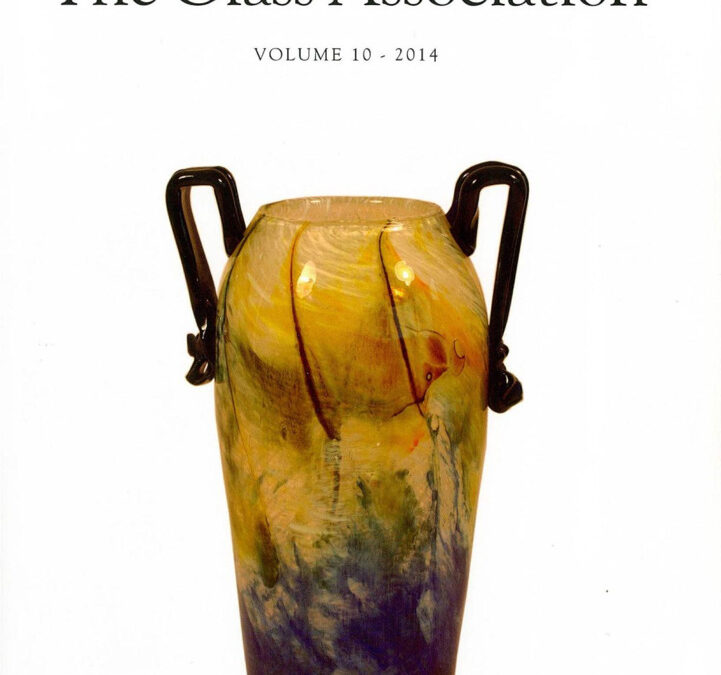
Front cover: A Gray-Stan Vase. Unmarked, 26cm tall from the collection of Sheila Sharman — see page 35
Back cover: A cut-glass lead vase cased red on clear; made by Japan’s Shimada Glass in the 1930s
and a Satsuma-style Idriko bowl from 188 I — see pages 22 and 23.
Title page: Frederick Noke’s design for a cameo plaque that won a national bronze medal
from the Department of Science and Art, Stourbridge, in 1900 —see page 12.
The Glass Association
Life President: Charles Hajdamach
Launched at an inaugural meeting at Stourbridge College of Art in November 1983,
the Glass Association
is a national society which aims to promote the understanding and appreciation of glass and glassmaking
methods, both historical and contemporary, and to increase public interest in the whole subject of glass.
The journal of the Glass Association deals primarily with the history of glass in the I 9th and 20th
centuries, although articles on earlier and later periods of glass history are published, as appropriate.
There is a natural emphasis on glass from the British Isles, but contributions on overseas glass
are welcome where they relate in some way to British glass. Articles reflect the breadth of interest
of current glass studies in the design, social, industrial and economic contexts of glass as well as its
aesthetic and art historical aspects.
Anyone wishing to publish in the journal should contact:
Brian Clarke
7 The Avenue
Finchley
London
N3 2LB
chairman©glassassociation.org.uk
Our contributors
JAMES MEASELL
A Life Member of the Glass Association, James Measell is historian at the Fenton Art Glass
Co. in Williamstown,WestVirginia, USA. A retired university professor, he is now preparing
a thesis on the Stourbridge School of Art for a PhD in Modern History through the
distance learning programme at the University of Birmingham.
SALLY HADEN
Sally Haden
is a private researcher and the great granddaughter of James Speed.
Almost the only information about him which had been handed down in the family was
the enigmatic statement’he went to Japan to larn ’em’, with the aside that he was a
glassmaker. Inspired by this information, Sally writes and lectures about the lives and work
of all four of the glassmakers who assisted at Shinagawa. She can be contacted at
haden.sallyagmail.com or www.hadenheritage.co.uk.
JUDITH VINCENT
Judith Vincent
has retired from her occupation as a nurse. She is a glass enthusiast and
collector, an event’s organiser for a local National Trust group and was a valuable former
committee member ofThe Glass Association.
CHARLES J. HAJDAMACH
Charles Hajdamach
was closely involved in the creation of the Broadfield House Glass
Museum in 1979, became its first director and then the Principal Museums Officer for the
whole of the Dudley Museums service. He is a Fellow of the Society of GlassTechnology,
a freelance glass historian, an international lecturer and much in demand for lecturing in
the UK. Charles, an authority on British Glass of the 19th and 20th centuries, is the author
of two standard reference works;
British Glass 1800-1914
and 20th Century British
Glass,
and as well has written many glass articles in the antiques and collecting press. He is a
Vetter at the ‘Masterpiece’ fair and ‘Antiques for Everyone Fairs’. Following his participation
in the formation of the Glass Association, he became its president for many years and is
now the Life-President
Contents
The Stourbridge School of Art, 1850-1905
6
James Measell
`They went to larn ’em’
How four British glassmakers played a key part
in the modernisation of Japan’s glass industry in
the late 19th century
18
Sally Haden
The ‘Complete Catalogue; Gray-Stan Glass’
An Exciting Discovery
28
Judith Vincent and Charles R. Hajdamach
6
8.M.263.4
echanice
institute
THE JOURNAL OF THE GLASS ASSOCIATION
The Stourbridge
School of Art, 1850-1905
James “easel)
When reading about glassmaking luminaries such as John
Northwood, Frederick Carder, Joshua Hodgetts, or brothers
George and Thomas Woodall, one sees brief mentions
of the Stourbridge Government School of Art.’ However,
there is no detailed study of this Stourbridge institution and
its relation to the local glass industry.This article will shed
light on five areas:
( I ) the political and social forces that brought the
Government schools into existence;
(2)
the circumstances of the founding of the Stourbridge
School;
(3)
the curriculum, students, and art masters during the
nineteenth century;
(4)
the relationship of the school and other similar nearby
schools to the local glass industry;
(5)
the advent of technical education in Stourbridge
and Wordsley.
Political and social forces
The Stourbridge School of Art began at a meeting in
Stourbridge in early 1851. Before turning to an account
of the meeting, however, one must consider the myriad of
forces manifest in the 1830s and 1840s that were the
impetus for Government schools throughout Britain.
2
Incidentally, these institutions were ‘schools of design’ from
1837 to 1853; thereafter,’schools of art’.
During the early nineteenth century, there was growing
interest in expanding educational opportunities (particularly
for ‘lower’ classes) coupled with a slowly increasing
willingness for Government involvement. Legislation in 1833
provided Government grants for new school buildings,
and the 1837 report of a Select Committee identified
deficiencies in the education of children. In the I 840s, James
Kay-Shuttleworth formulated plans for institutions to train
teachers and for school inspections.
While many industrialists were opposed to the Govern-
ment programmes, the Industrial Revolution had the effects
of concentrating populations in manufacturing towns and
THE STOURBRIDGE SCHOOL OF ART, 1850-1905
creating the need for a workforce that was better educated.
As early as the 1820s, manufacturers in textiles and other
products were aware that British expertise in the design of
manufactured goods was falling short of Europe, especially
within France, Prussia and Bavaria, where design schools
funded by government existed for some time. Other, less
visible factors, such as a concern for the improvement of
public taste, influenced the establishment of design schools
in Britain.An increasingly urban population was interested in
culture and art, as reflected in the London Art Union and
the sale of printed engravings of historical pictures. This
enthusiasm sparked efforts to provide free admission to
museums and art exhibitions and to make personal art
collections more accessible.
In the mid- 1830s, William Ewart
MP
proposed to the
House of Commons that a Select Committee on Arts and
Manufactures be established, This committee sought to
‘inquire into the best means of extending a knowledge
of the Fine Arts and of the Principles of Design among
the people — especially the manufacturing population of the
country’. Because of the committee’s desire to enhance
artistic design in manufactured goods, a new educational
effort was launched within the Board ofTrade and governed
by a Council drawn chiefly from the Royal Academy.
The Government School of Design at Somerset House in
London opened in mid- 1837 for male students, and its
Council included glass manufacturer Apsley Pellat.
fig.
I (left):This Ordnance Survey map shows the Theatre Road
location of the School of Art from its inception in 1852 to 1905.
Courtesy
of
Stourbridge Public Library
fig.2 (above): Modelled in wax on cobalt blue glass,William
Northwood’s design for a cameo plaque won a national bronze
medal from the Department of Science and Art in
1889.
Courtesy of Broadfreld
House Glass
Museum
In 1841, Parliament appropriated £10,000 for`provin cial’
design schools, and institutions in these areas began
operations: Manchester (1842); York (I 842); Nottingham
(1843); Coventry (1843); Sheffield ( I 843); Birmingham
(1843); Newcastle (1843-44); Glasgow (1844); Norwich
(1846);The Potteries in Hanley and Stoke-on-Trent (1847);
Paisley (1847); and The Irish Schools in Dublin, Belfast and
Cork (1849). Throughout the decade there was debate
and disagreement regarding the curriculum.There was little
central administrative structure and each school tended to
go its own way.
Mention must be made of the social impact of the 1851
Great Exhibition.This international event, embracing more
than 100,000 objects and attended by more than 6 million
people, further sharpened British interest in the design of
manufactured goods and kindled discussions of artistic taste.
Moreover, the event generated a financial bounty of
86,000 that led to the establishment of the South
Kensington Museum.
Founding the Stourbridge School
Stourbridge historian Jack Haden concluded quite rightly
that the Stourbridge School had its roots in the Mechanics’
Institution.
3
In the late 1840s, individuals associated with the
Mechanics’ Institution sought to obtain a Government grant.
Chief among them were barrister Robert Scott and
J.H. Hodgetts Foley
MP,
who was president of the Mechanics’
Institution. Scott and Foley had been active supporters of
the organisation since the mid- 1930s, so they were aware
of the drawing classes there. The Stourbridge Mechanics’
Institution maintained a reading room and library, and there
were lectures or informal instruction on scientific subjects,
art, and literature.
In
1849,
a Select Committee in the House of Commons
indicated that ‘applications’ had been made for a design
school at Stourbridge and concluded that ‘Macclesfield,
Bradford, Stourbridge, [and] Kidderminster, as the seats of
important decorative manufactures, have superior claims
to some of the selected places [for new schools]’.
4
In an
attempt to ascertain the potential value of such schools, the
Select Committee contacted manufacturers, including these
glassmakers: Richardson’s (Wordsley); Pellatt’s (131ackfriars);
Osler’s (Birmingham); and Moiyneux, Webb and Co.
(Stourbridge). The Richardson firm responded with this
statement: ‘A school of design should be established at
Stourbridge on purpose to instruct the makers and cutters
that are employed in the Flint Glass Works there’. Apsiey
Pellat testified before the committee on 22 May 1849,
and he urged that there be ‘clear and definite instruction
upon the conditions of art for the various branches of
manufacture’ and stated that ‘schools of design would be
very much improved if frequent lectures on the condition
of various branches of manufacture were given’.
On 3 February 1851, a public gathering was held in
Stourbridge, and its proceedings are recorded in detail in a
booklet entitled: Report of
a public meeting held at the Corn
7
THE JOURNAL OF THE GLASS ASSOCIATION
Exchange, Stourbridge, on Monday, Feb. 3, 1851; the Right
Honourable Lord Ward in the chair; to consider the best
means
of promoting
a
School of Design for
Stourbridge and
Kingswinford.
5
The
Report
alludes to Lord Ward’s ‘excellent
taste in the fine arts’ and his ‘influence in the promotion of
Schools of Design in this country’. According to the Report,
the Corn Exchange ‘was filled with a highly respectable
assemblage, consisting of the nobility and gentry of the
neighbourhood, with a good display of ladies, the chief
tradesmen and a large number of artisans’. Lord Ward
spoke of the ‘great advantages of the proposed School of
Design’, suggesting that ‘if a district with manufactures like
Stourbridge did not meet the requirements of this age,
or persevered in the old custom of admitting utility
uncombined with beauty, it could not long go on’. He
mentioned the forthcoming’great exhibrtion’ and expressed
his view that England lagged behind other nations in design
expertise. The iron and glass trades, Lord Ward declared,
needed ‘new forms and new lines of thought’, a remark that
elicited ‘hear, head’ from those assembled.
During the meeting, several resolutions were put forth,
each supported by the gentleman who offered it and others
who favoured it. Various statements generated ‘cheers’ or
‘hear; hear and served as rhetorical inducements to
crystallise opinion or stimulate action, but the following
resolutions must also be viewed in the context of the
political and social forces that fuelled the establishment of
the Government schools of design:
[proposed
by Lord
Lyttelton
and
seconded by
William Orme
Foster]
That the rapid development of art throughout
the
civilized world renders necessary systematic instruction in
design and in
taste to the artisans employed
in
the
processes
of manufacture.
[proposed
by J.
H. Hodgetts Foley,
MP,
and seconded by
Thomas
Clarke]
That in foreign countries, especially in
Belgium and in France, the artisans have long
enjoyed
peculiar advantages in public schools, instituted under
instructors of high ability,
to teach
them
the arts of
drawing,
painting and modelling, by which the beauty
of their
manufactures is
such as cannot be equalled in
the
productions
of less
favoured nations.
[proposed
by Rev. William Henry
Lyttelton
and seconded
by John Davis] That the manufacturers of this kingdom are
bound by their own
interests to promote the
formation of
Schools of
Design;
and that
districts where
no such
school
is established must soon yield
to
those
more happy
places where greater
public spirit shall have secured the
required boon.
[proposed
by
Robert Scott
and
seconded
by T. Wood]
That the grant by Government of liberal assistance
to the
Stourbridge and Kingswin ford School
of
Design demands
the
hearty
co-operation of the gentry, manufacturers,
and
well-wishers to the
district
to
provide a suitable building for
the school,
and to ensure its
efficiency on a
scale adapted
to
the
importance
of the
manufactures
of
this neighbourhood.
These resolutions reflect the considerations mentioned
earlier; namely, a need to improve the design of British
manufactured goods to compete with foreign products and,
perhaps, to elevate taste generally. In addition to noting the
political climate in providing Government grants for design
schools, those assembled were mindful of the desires of
other districts to secure a design school and called for
the immediate support of local manufacturers as well as the
philanthropic efforts of gentry and others. Moreover;
those in attendance sought to harness ‘public spirit’ to
enhance the civic culture of the Stourbridge district with
a ‘suitable building’.
A final resolution called for subscriptions totalling
£2,500 and created a committee `to prepare plans and
estimates’. Three weeks later; the
Worcester Herald
(22 February 185 I) listed these benefactors: Lord Ward
£100; Lord Lyttelton £25; J.H. Hodgetts Foley
MP,
£50;
Robert Scott, £ I 00; James Foster; E100;Williarn Orme Foster;
£50; Joseph Pitman, £25; and William Blow Collis, £50.
The Stourbridge School began by continuing the
drawing classes in the Mechanics’ Institution, as Henry
Alexander Bowler was appointed art master by the London
Head School and came to Stourbridge in September 1851.
A Committee of Management, otherwise known simply as
the Council, governed the school. In 1851-1852, Lord Ward
was president, and there were three vice-presidents: the
Earl of Stamford and Warrington; Lord Lyttelton; and
J.H. Hodgetts Foley
MP.
Other Council members were:
Robert Scott, chairman; insurance agent Charles W. Gibson,
secretary; Rev.William Henry Lyttelton; industrialist William
Orme Foster of the Bradley iron manufacturing firm;
solicitor John Harward; tanner Joseph Pitman; currier
William Akroyd; draper John Cooke; glass manufacturer
Joseph Webb; glass manufacturer Benjamin Richardson; and
clockmaker Edward Blurton.
6
In 1852, Berrow’s Worcester Journal (9 September 1852)
reported some progress. About £800 had been raised,
insufficient for new construction, so the Council purchased
a disused theatre building, obtained a mortgage, and
converted the premises ‘into a suite of rooms admirably
well adapted’. A Conversazione was held to celebrate the
school’s first anniversary, and the building was ‘filled with
the
elite
of the town and neighbourhood’. Lord Lyttelton
declared that the school was ‘established for the benefit of
all and not one particular class’, and he remarked further
that leading object was to elevate and improve the mind,
and promote the general well-being in the neighbourhood’.
The Stourbridge School was within the administrative
structure of the Department of Practical Art, which became
the Department of Science and Art in March 1853.
A report by General Superintendent Henry Cole affords a
look into the early operations at
.
Stourbridge.
7
The school
received a Government grant of £150, and classes began in
the renovated theatre on 1 September I 852.The building
contained ‘two classrooms, library, master’s room and
attendant’s house’ and could accommodate about 120
8
V.
R.
STOURBRIDGE SCHOOL OF ART.
THE School will Re-open, after the Mid-
i. suovner Vacation, on
NEOFDAT,
Anal:78T 5th.
Art Instruction is given, useful to the Artisan and
Decorative Artist.
The General Classes meet on Monday, Wednesday,
and Friday Evenings, from Seven to Half-past Nine
o’clock. Fee,
88.
per Quarter.
The Special Classes, on Tuesday and Thursday Morn-
ings, from Ten to Twelve o’clock.
Fee,
10s. 6d. per
Quarter.
rely 25th, 1867.
WILLIAM P. BOWEN,
Head Master.
8a
THE STOURBRIDGE SCHOOL OF ART, 1850-1905
students. During 1852,the school enrolled 84 males and 10
females. Fifty-one of the male students were 15 or younger,
and 26 were aged 16-20. Some 41 were either schoolboys
(25 from the Oid Swinford Hospital School) or had no
occupation, but others were in the glass trade: ‘9 glass
engravers . „ 7 glass painters … 2 glass manufacturers … 2
glass blowers’. The students in the Male Class, which met
Monday, Wednesday and Friday evenings, paid fees of
2 shillings per month, although the glass manufacturers and
the glass blowers were ‘prevented by their occupation from
receiving more than two lessons per week and are admitted
at half-fee’.The Female Class met on Tuesday and Thursday,
and fees were 21 shillings per quarter.
Curriculum, students, and art
masters
The Stourbridge School followed a curriculum of instruction
dictated by the Head School, When the school celebrated
its first anniversary in September I 852, the twenty-three-
stage South Kensington Curriculum developed by art
superintendent Richard Redgrave was in place, and each
school submitted regular reports enumerating the students
working at each stage.’ In 1852, most Stourbridge students
were engaged in basic drawing, that is, stage I (geometrical
perspective and architectural detail) or stage 2 (outlining
ornament from the flat). A few students were working in
stage 6 (drawing human figure from the flat), and there
were 20 works completed in stage 22 (elementary design)
and 6 in stage 23 (applied design, modelled and flat).
Unfortunately, one finds no descriptions of the projects
at stages 22 or 23, although such student work likely
incorporated principles of fine art in the design of utilitarian
or decorative objects.
In 1862-1863, the Stourbridge School noted that its
‘general course of instruction’ was intended to impart ‘a
knowledge of the scientific principles of Art’ and to
‘encourage and promote the training of skilled workmen’
to assist ‘the individual exertions of persons preparing for
special branches of our local trades and manufactures’.
9
These statements seem to suggest that the focus of the
fig.3: Stourbridge School of Art notice byWilliam Bowden
(Public Notice from TheAdvertiser,27 July 1867).
STOURBRIDGE SCITOOL OF ART.
T
HE ANNUAL MEETING and DIS-
TRIBUTION of PRIZES wiil take place tit
the Scnoo.t.
OF ART,
on
MOSDAY, DECEMBER
16th,
1.867.
The chair will be taken at Eight p.m. by the lion.
C. G. LYTTELTON.
Reserved Seat Tickets, Sixpence each, may be ohtainod
at Mr. Broomhall’s, Mr. Mark’s, or Messrs. Ford and
Son’s. The Unreserved Seat Tickets, Free, to
be
had
upon application to the Master, at the School.
There will be an Exhibition of Student’s Drawings
and Works of Glass upon the 13th and 14th of Decem•
ber, between Eleven and Nine p.m. Admission Free.
880a
WILLIAM H. KING, Hon, Sec,
fig.4:Stourbridge School of Art notice byWilliam King on prize
giving (Public
Notice from
The Advertiser,
14 December
1
867).
Stourbridge School had shifted towards a general approach
to fine art although the goal of instructing artisans in the
elements of design for practical purposes remained.
With the exception of a handwritten Register
of Students
covering 1864-1874, there is no unified record of the
hundreds of individuals, male and female, who attended
between 1851 and 1905, although students who won local
or national prizes were mentioned in local newspapers.
The Department of Science and Art created an elaborate
system for student achievements, embracing examinations
(first grade, second grade, and the top rank, third grade)
as well as competitions for national awards consisting of
certificates, book prizes or medals to special designations
such as the Queen’s Prize. At the local level, a committee
of Council members, in consultation with the Stourbridge
art master, chose students for recognition with medals or
book prizes.
The Register of Students lists females and males from
I 864 to 1874 and identifies many by age and occupation of
the student or a parent. During 1864,30 enrolled in the
Female Class, but enrolments in 1869 and I 870 were just
16 and 17, respectively. Most Ilved in Stourbridge or nearby
Amblecote, Cradley, Lye, Oldswinford, orWol laston. A few
resided in Brettell Lane, Brierley Hill or Wordsley. Five
female students in 1864 were children of clergymen, and the
Blakeway sisters (Georgina, Amy and Ada) were daughters
of George Blakeway, co-owner of Blakeway & Mansell, a
Stour
–
bridge firm described as ‘grocers, tallow chandlers,
hop merchants &c’.’° The wife of leatherworks owner John
Akroyd attended during 1864, as did daughters Kate and
Nellie. Other occupations listed for the parent of a female
student during 1864-1874 were: surgeon, brick manu-
facturer, chemist and druggist, auctioneer, bank manager,
professor of music, maltster, painter, stone mason, manager
of gasworks, teacher, clerk, glass master, and doctor Many
were enrolled for years in succession. All the Blakeway
sisters are listed for five consecutive years (I 864-1868), and
Ada Blakeway attended for eight years. Harriet Skidmore,
9
THE JOURNAL OF THE GLASS ASSOCIATION
STOURT3RIDGE.
STAGE
tudent
years ….. .
occupation
4″,
z
hne
in School
)4fedais
already t
btained in Stages
P
rice
ead Master
… ..
fig.5
(above):
Prize drawing of architectural detail by Joseph
Northwood and fig.b
(right):
Medal awarded to Northwood
for the drawing. Courtesy
of
Broadfield House
Glass
Museum
Amy Jones and Lucretia Davis attended for six consecutive
years each between 1864 and 1874. In 186 I , sisters Annie
Green and Fanny Green were recognized with local awards.
Georgina Blakeway won a local medal and scholarship in
1862, and in 1863, she and Annie Green won Government
medals. Harriet Skidmore received a Government prize
in 1868 and was recognized both nationally and locally in
several subsequent years before embarking on a career as
an artist.”
Regarding the Male Evening Class during 1864-1874,
the Register of Students provides a wealth of information.This
class enrolled numerous students, with about 70 on each
roster from 1864 to 1868, and at feast 55 in all but one
subsequent year to 1874, Many resided in Stourbridge
or Wollaston, and quite a few were in Brettell Lane or
Wordsley. Some were younger than 13, but relatively few
were 21 or older. Most were between 13 and 20 years of
age and were employed.
Many male students had occupations associated with
the local glass industry, but their employment was typically
in glass decorating rather than glass manufacturing. Among
the 55 male evening class students in 1864 for whom
occupations are noted, 26 were recorded as ‘glass cutter,
‘glass engraver’ or ‘glass etcher. Most were under the age
of 20, typically 13-17, which suggests that they were
apprentices)
2
Other occupations such as iron trade, engine
fitter, machinist, smith, painter, builder, or carpenter can
be seen with some frequency. The glass industry is also
reflected in occupations recorded for some parents (‘glass
cutter’,’glass manufacturer’,’manager in glassworks’, or simply
‘glass trade’), but most parents were in other lines of work
publican, builder, iron trade, saddler, clerk, mine agent,
machinist, timber dealer, painter, moulder; boat-maker,
brickmaker, bootmaker, slater, chainmaker, or carpenter.
Quite a few male students appear on the rosters forthe
Evening Class during many successive years between 1864
and 1874. At age 14, glass etcher James Hill enrolled in the
evening class on 9 May 1864, and his name appears on
every class roster thereafter through 1874)
3
The names of
some glass cutters (William Adey and Cornelius Adey),
glass engravers (John Chaloner William Henry Perks and
John A. Service), and glass etchers (Arthur Guest and Josh
Pilsbury) appear often between 1864 and 1874, as do
others whose occupations are given simply as ‘glass trade’;
namely, George Hingley, George Hipwood, James Marshall,
Benjamin Robinson and Alfred Saunders. Other glass
cutters, glass engravers or glass etchers who enrolled in the
Stourbridge School typically remained for two or three
years at most.
Between 1852 and 1905, many male students were
recipients of national or local awards such as medals, books
or scholarships. Josiah Muckley, who later operated a glass
decorating firm, was recognized on four occasions during
1852-54, and brothers John Northwood and Joseph
Northwood claimed various national awards between 1854
and 1861.’
4
Glass cutter William Adey had numerous
awards between 1858 and 1864. Brothers George Woodall
andThomasWoodall had several awards between 1866 and
1870, andThomasWoodall won a Queen’s Prize in 1879 for
a design for glass engraving.I
5
Glass etcher James Hill won
many national and local prizes from 1866 to 1879.
A Queen’s Prize awarded to Hill in I 869 for his design for
an engraved glass vase was a two-volume set of Sir Joshua
Reynolds’s literary works,’elegantly bound in red morocco’
(County
Express, t 5 January 1870). James Gething and
William Gething, who were assistants to an architect, won
many awards between 1867 and 1880, and William received
a Queen’s Prize in 1879 for design of iron gates.
10
figs 7,8, 9:
These designs by James Hill
for etched glassware were
awarded various prizes by the
Department of Science and Art.
Courtesy of
aroadfleld
House
Gass Museum
%I:lb 11 1i1
.
01
.
(ip»
>
10
I,
THE STOURBRIDGE SCHOOL OF ART, 1850-1905
Frederick Carder claimed the first of his many local
awards in 1879 for shading ornament and figure from the
flat, and his first Government prize came about two years
thereafter. Another Government prize came in 1885 for
work in design, probably for a panel In plaster, and a similar
prize in 1886 was for modelling figure from the cast.
In August 1889, Carder, who was then attending classes at
Wordsley, was awarded a Government gold medal (one
of just six awarded throughout the United Kingdom) for a
cameo vase entitled ‘The Muses’, done as a modelled design
in wax. Ludwig Kny took local awards in 1883, 1885 and
1886, and he had two Government prizes in I 885. He was
also awarded two Government prizes in I 887, including one
for design of a glass vase. Other students awarded Govern-
ment prizes over the years included Charles Northwood,
John Northwood ‘William Northwood, and Frederick Noke.
From 1852 until mid- 1894, groups of boys age 11-14
from Old Swinford Hospital School received instruction in
drawing from the Stourbridge art master or a pupil teacher
–
.
Admission to Old Swinford Hospital was granted to boys
aged 7 to 1 I whose parents were not ‘undeserving poor’
(that is, recipients of poor relief).These parents’ occupations,
fig. 10
(above
left): Centre detail of William Northwood’s
prize design.
fig. I I (left): Original labelling on William Northwood’s
prize design.
fig.12
(above):
Modelled in wax on cobalt blue glass, Frederick
Noke’s design for a cameo plaque won a national bronze medal
from the Department of Science and Art in 1900.
All
courtesy
of
Broadf:eld House Gloss Museum
THE JOURNAL OF THE GLASS ASSOCIATION
taken from the Register
of Students,
reflect the socio-
economic status of these boys in the 1860s and early 1870s:
blacksmith, domestic servant, grocer, publican, miner,
coachman, carpet weaver, gamekeeper; roller, spade maker;
silk dyer, wheelwright, and ironmonger. A few boys had a
father whose occupation (in parentheses) was in the glass
industry: 1864, Thomas Bate (glass maker); 1869, William
Sedaway (glass maker); 1870,Thomas Sutton (glass cutter);
and 1872, Henry Dunn (glass cutter).
Two students who attended the Stourbridge School and
were associated with the glass industry achieved recognition
in the world of fine art: Edwin Grice and Albert Gyngell.
As a student, Edwin Grice (1838-1917) was recognized with
various Government and local awards in 1858,1859, and
1861. His occupation was listed as ‘glass etcher or ‘glass
engraver, and he was employed at J. & J. Northwood in
Wordsley for about 18 years, probably starting there when
the firm began in I 860 and, in the 1870s, being an essential
assistant to John Northwood in cameo carving projects,
including the celebrated Portland Vase and the Dennis
Vase.
16
Grice was later associated with the glass decorating
firm of Guest Brothers, and he was identified as a ‘glass
designer in a Worcestershire directory for 1896)
7
trice’s
interest in carving wood and his work in fine art was likely
an avocation or hobby, although some of his oil paintings
(Stourbridge
High
Street
1897, Horn Dingle,
Country Lone,
and
Kinver)
are in the collection of the Dudley Museum and
Art Gallery.
Albert Gyngell (1841-94) was also employed as a glass
etcher at J. & J. Northwood,
18
and he enrolled in the
Evening Class on 17 January 1870 when he was 28 and
resided with his wife and young son at 58 High Street,
Wordsley. He was the first Stourbridge School student to
gain a medal in the Department of Science and Art national
competitions that were initiated in 1867. Gyngell’s medal,
awarded in 1870, was for the design of a fan painted on silk.
He relocated to Worcester about I 872 and pursued a
career in fine art, acquiring a sound reputation for landscape
pictures
(Worcestershire
Chronicle, 15 June 1878). In 1889,
two of his works, By
the Brookside
and The
Sound
of the
Scythe, were exhibited at the Royal Academy.°
Although information about them is scant, six gentlemen
held the post of art master at the Stourbridge School during
various times in the nineteenth century: Henry Alexander
Bowler, 1851-52; Andrew MacCallum, 1852-54; George
P Yeats, 1854-63; William P Bowen, 1863-1881; Edward
J. Simms, 1882-93; and George Henry Cromack, who
served from 1893 well into the twentieth century. All were
talented and well versed in one or more aspects of fine art
(painting, sculpture, etc.), but none had connections with the
glass or iron manufacturing interests in the Stourbridge area.
After his time at Stourbridge, Bowler returned to the
Head School, becoming an Inspector in the Department of
Science and Art and holding other posts until retiring in
1891. Andrew MacCallum, educated in Nottingham and
at the Head School, served as assistant art master in
12
THE STOURBRIDGE SCHOOL OF ART, 1850-1905
185052 at the Manchester School of Art before coming
to Stourbridge. He remained for about two years, until the
Department of Science and Art awarded him a scholarship
for study in Italy.
George R Yeats, a prize student at the Glasgow School of
Art in 1850-52, came to Stourbridge in the fall of 1854.
In 1855, he was among the art masters selected by the
Department of Science and Art to attend the Exposition
Universelle in Paris.
20
Yeats was a talented sculptor, and a
local newspaper praised his bust of a Stourbridge School
benefactor (the late Robert Scott) and noted several
months thereafter that a class in modelling with clay had
been instituted
(Brierley Hill
Advertiser, 22 March 1856 and
30 August 1856). In 1859,Yeats arranged an exhibition of
some 90 art works in conjunction with the annual soirée
of the Stourbridge Associated Institute (Mechanics’ Institute
and Working Man’s Association), including a painting of
his own,
The
Artist’s Chi/dren.
21
William Plastons Bowen was art master at Stourbridge
from October 1863 to December 1881. A student and
assistant teacher at the Worcester School of Art in
1852-53, Bowen was awarded a national medal in May
1853 and received further training at the Head School.
In 1855, Bowen submitted a design for a vase and gained a
Government stipend to attend the Exposition Universelle.
22
In 1864, Bowen told those who attended the annual public
meeting of the Stourbridge School that he expected to’give
greater prominence to colour and to painting in order to
‘vary the course of study'(Advertiser, 16 January 1864).
At the annual meeting in 1866, Bowen said that he ‘should
like to see more works in outline of foliage from nature
and coloured studies of the historical styles of ornament,
such as may be found in Owen Jones’
Grammar
of Ornament’
(Advertiser, 22 December 1866). A year later, Bowen
expressed interest in ‘the study of flowers and foliage drawn
from nature as the only true mode of arriving at facility for
design’, and this remark likely reveals his teaching philosophy
and the kinds of projects he encouraged among his
students. At the annual meeting in 1870, Bowen said that
`there are some branches of art that should like to see taken
up’, and he advocated ‘drawing the human figure, modelling,
&c’.(Advertiser,
15 January 1870).
Edward J. Simms was appointed art master in January
1882, and he resided at nearby Hanbury Hill.
23
Simms was
a student at the newly founded Bromsgrove School ofArt in
186 I , when he won two medals for outline drawings, but his
career over the next decade is difficult to trace except to
note that he was a student at Bromsgrove in 1870 when he
obtained his art master’s certificate.
24
About two years
after he came to Stourbridge, instruction in drawing was
offered in Brierley Hill as a ‘branch’ of the Stourbridge
School, and Simms was in charge of this effort as well as
a modelling class at Stourbridge
(Birmingham Daily
Post,
9 January 1884). At the annual meeting in January 1888,
Simms was praised for his ‘conscientious devotion,’ and
the Council noted that income from student fees and
SCROOI will
abl
alterations,;
op
bI
ARY 1886, w. en 8
K.
Gl., Di tor of t
wil Deliver th INT
7.80 p.m.. and I
and 1,00AL PR
Olaitese at. Stour
LOAN
GliSsoPettery, 0
Muietim, as well
Maau Lauren a
E’rept
g
and non
Fit
er partic
‘Ph CLASS will
RESUMED at the INSTI
TUP MARK .STR RT. on MONDAY, tbe 12th,
BIANT.STREET,BRIERLEY HILL, on TUES-
DAY the I3th JANUARY.
,7$.5
A.
W. WORTHINGTON, Hon. See,
fig.13:Stourbridge
School ofArt notice by the Hon. Sec. on
re-opening (Public Notice from
The Advertiser, 10
January 1885).
Government grants had increased substantially (County
Express,
14 January 1888). In September 1891, the
Stourbridge School began its Penny Classes, and Simms was
responsible for much of the teaching. During the late 1880s
and early 1890s, Simms worked with the formation of art
classes in nearby Lye as a result of the initiatives for technical
education. He served the Stourbridge School until the start
of the summer vacation in 1893, when he became art
master at Bromsgrove.
25
George Henry Cromack, 29, was hired as art master in
May 1893, and he took up this post at the start of classes
in the early fall of 1893. At the time of Cromack’s appoint-
ment, the County Express (27 May 1893) carried a detailed
account of his background. Cromack had studied at the
Stroud School of Art for eight years and was assistant art
master there when he won a scholarship of £350, enabling
him to attend training classes at South Kensington from
1887 to 1893. He won several silver and bronze medals in
national competitions, and he held numerous certificates
and had considerable teaching experience. Cromack
Instituted the Life Class at Stourbridge in 1895, and this
addition to the curriculum was clearly one in the direction
of education in fine art and was much welcomed by
Stourbridge School Council member H.Watson Smith, who
lauded the class in a letter to the County Express.
26
Art masters were aided by assistants or pupil teachers,
who received 10-15 annually so that they could continue
their education while assisting the art master with drawing
instruction in local elementary schools.Three pupil teachers
are mentioned in December 1860 (William Orford,Walter
Steele, and Samuel Danks), and two pupil teachers are men-
tioned in 1861 (John Northwood andThomas Guest). Edwin
Grice was a pupil teacher in 1863 and I 864. John A. Service
was assistant art master in 1874, and his duties included
teaching at ‘several of the public schools in the neigh-
bourhood’.
27
In 1886, Ludwig Kny was appointed ‘second
assistant pupil teacher (County
Express,
2 October 1886),
URRRI
SCHOOL OF ART.
RE-OPENED, after oonsider-
NDAY, tke 19th of JANU•
R P. OVNLIFFE OWEN,
South Neniington Museum,
°DUMONT’ ADDRESS. at
MST ‘BUTE the GOVERNMENT
ZEE to the SueoeigsfuI Studest• in the
ridge a’ d Brierle
rr-Hill.
HIBI ION, mol=ding Specimens of
rpets, a, from the South Kensington
as art ales contributed by the Glass
the, D triat, will be an view the same
inne 0 n for a Portaight.
rs net week.
13
THE JOURNAL OF THE GLASS ASSOCIATION
Relationship with the local glass
industry
From the time of the public meeting in February 1851 to its
relocation to a new building in 1905,the Stourbridge School
sought to maintain a relationship with the local glass
industry.The nature of that relationship over more than five
decades is varied and complex, but it seems prudent to
suggest that the Stourbridge School both sought to enrol
students associated with the industry and to enlist the
cooperation and financial support of those who
manufactured and/or decorated glass.
In terms of attracting students associated with the
glass industry, the Stourbridge School certainly had some
measure of success.As noted earlier, there were numerous
male students who held employ in glass decorating
establishments, especially J. & J. Northwood in Wordsley.
Over the years, quite a few students who were glass
decorators completed prize-winning projects in glass design,
and the Stourbridge School could point with pride to the
former students whose work in cameo glass (George
Woodall, Thomas Woodall, Joshua Hodgetts, Charles
Northwood and William Northwood) or other decorated
glass (Frederick Carder,Theodore Kny, William Adey, Frank
Scheibnerjohn Northwood,William Northwood and James
Hill) dominated the two hundred glass articles displayed at
the International Health Exhibition in London in 1884.
28
As early as 1853, however; the annual report of the
Department of Practical Art revealed that the glass manu-
facturers and the glass blowers enrolled in the Stourbridge
School were unable to attend the Evening Class regularly
because of the work schedule in glass manufacturing
plants, which consisted of six hours work/six hours off
commencing Monday evening or Tuesday morning and
ending Saturday noon. This work schedule remained
essentially unchanged throughout the latter half of the
nineteenth century, but it was not until the early 1890s that
the Stourbridge School had a class that could serve students
from this important area of the local glass industry. Art
master Edward J. Simms initiated the Penny Classes in
September 1891 .As the name implies,this class consisted of
drawing instruction for a fee of 1
d,
and interested students
could attend on any weekday evening they chose. Those
already enrolled in the Evening Class (meeting Monday,
Wednesday and Friday with fees of bs per quarter) could
take additional instruction for I
d
per lesson on Tuesday
and/or Thursday. As one might expect, student numbers
increased in the fall of 1891, but diversity in attendance from
day to day likely presented a teaching challenge. A few
months later; Simms related that although the Penny Classes
were ‘going on satisfactorily’, he ‘would like to see students
attend more regularly’ (Advertiser, 9 January 1892).
The Penny Classes continued for several years, but they
did not enrol many students employed in glass manu-
facturing, so the next art master, George Henry Cromack,
offered a Morning Class for males only in the fall of 1894.
The class met from 10am to noon on Monday, the lone
fig.14:Blue
and white cameo vase manufactured at the Thomas
Webb & Sons glassworks. Designed by Thomas Woodall and
carved by Benjamin Hollis — a bronze medal winner at the
International Health Exhibition 1884.
29
Courtesy of Hulbert
of
Dudley
Collection, on loan
to
Broadfield
House
Glass
Museum,
provided from
the display
at
Bifston
Craft Gallery,
Wolverhampton
weekday when most of the men employed in glass manu-
facturing could be free from work until at least 6pm.The
Morning Class fee was 5s per quarter; and students could
also attend any evening classes for an additional 3s per
quarter.
3
° Despite this apparent flexibility to meet glass
manufacturing work schedules, the Morning Class attracted
few students and was discontinued in 1897.
Why was the Stourbridge School generally successful
in gaining students from glass decorating but not glass
manufacturing during its time in the nineteenth century?
Two letters written in 1883 by former Stourbridge School
student John A. Service, who had been a glass engraver in
the 1860s and early 1870s and was then a manager at
Thomas Webb and Sons, Stourbridge Glass Works, offer
a variety of insights, ranging from the lack of practical
experience on the part of the art masters and a lack of
examples available for study by students, to a matter of con-
venience.’ t Following are excerpts from these letters:
Stourbridge School
ofArt has undoubtedly had
some little
influence
upon the trade
of the district
as
evidenced
by
the
fact that
many
of the
leading artists in
this district
had
their
earlier training
there;
but that
its influence
upon
the glass
trade
direct has been what it was originally intended it
should be, is very doubtful. In
the first place, the masters
not
having a
practical
knowledge ofthe trade, cannot impart
it
to the
student• his
efforts, therefore,
are confined
to the
simple rudiments of
drawing,
leaving the
pupil
to
form his
own ideas, or copy those
of his fellow workman away
from
14
THE STOURBRIDGE SCHOOL OF ART, 1850-1905
the school. Secondly, the
examples
at the school of art have
not been selected with
a view to specially
assist the worker
upon gloss.The Science and Art Department from time
to
time have sent
down
examples
on loan
for the use of the
students,
but beyond
the
Muireadys, I
never recollect
anything useful to
the
glass decorator coming down. I should
imagine
this
is, in a great
measure,
owing to the fact that
the
gentlemen
who form the committee of the
Stourbridge
School ofArt are, with one exception,
totally ignorant ofthe
requirements
of the glass trade.After a
student has passed
the elementary stages, there
is no
inducement held
out
to
him
to
attend
the schools; there are no examples or models
for
him
to copy
which would
be of use
to him, and
the school
is then only a place of
practice,
with this disadvantage, that
the bulk
ofthe
students connected with the
glass
trade live
at such a
distance from
the school that
to simply practice
drawing
they
will
not travel the
distance.
Service recounted his own experience as a pupil teacher in
the 1860s (‘devoting three nights per week, 2.
1
4 hours each,
to assistance at the school of art, besides giving instruction at
three separate local schools in the daytime necessitating my
absence from my usual employ for the handsome sum of
per year’) and indicated that accomplished glass men
such as John Northwood and Thomas Woodall ‘who would
be of use at the school as assistant masters cannot afford to
give the time and attention required for the miserable salary
attached to the post’. Despite his critical tone, Service was
not altogether pessimistic:
I know
there are several gentlemen
on
the focal committee
working very hard
to keep the concern up,
and I sincerely
trust they
will have such help from
the
department that
their
efforts
may meet with
success. I consider;
with
reference to the local committee,
that it would be far better
to have a few members, directly connected with the glass
trade; men who would take an
interest
in
the concern
and
assist
in guiding
it
into
the proper practical channel.
The first Council of the Stourbridge School in 1852 had
included glass manufacturers Joseph Webb and Benjamin
Richardson, but Council members and financial benefactors
over the next few decades came from local industries such
as iron works or leather and tanning as well as various
professions. Local glass manufacturers often loaned
examples of their products to be displayed along with
student works on the annual occasions for public meetings
of the Stourbridge School, but attempts in 1853 and again in
1885 to create an ongoing museum emphasizing glassware
never came to fruition.
In early 1884, the Stourbridge School began to offer
classes in the Moor Street School at Brierley Hill ‘as an
experiment’, and glass manufacturer Joseph Silvers-Williams,
a new member of the Council of the Stourbridge School,
was an enthusiastic supporter of this venture. By October,
some 70 students were engaged at Brierley Hill, and the
Midland Association of Glass Manufacturers,`with the view
of encouraging work at the school which might more
directly promote the excellence of the local glass manu-
facture’, promised .C10 annually for prizes to be awarded to
pupils at the school
(Birmingham Daily
Post, 24 October
1884)The Stourbridge and Brierley Hill schools held several
joint annual public meetings, and the Brierley Hill effort
became an independent institution as a technical school in
Albion Street during February 1892.
The Brierley Hill School surely enrolled some students
who might otherwise have come to Stourbridge for
instruction, but developments in Wordsley likely had far
greater impact. Some art instruction was begun in Wordsley
during 1885 under the auspices of the City and Guilds
of London Institute, and, in 1888, the Council of the
Stourbridge School was aware of the negative impact on
student interest and enrolment:
The Wordsley school especially
continues to attract
pupils
who used to
attend formerly at
your
school,
and who
owe
at
feast some of
their success
to
instruction
received
from
your
master Thus, Frederick
Carder, who has
recently
gained a
silver medal as a student atWordsfey, studied eight or nine
years at the Stourbridge
school, which he left in April, 1887,
and TA. Guest who has gained a third grade
prize
in that
school, left the
Stourbridge school at
the same
time, having
been a
student for
several years.
Your committee hopes
a little
friendly competition
of
this
sort
may
be
eventually
benepicial.
32
Technical education in Stourbridge
and Wordsley
In early 1891, a group of individuals sought funds made
available by the Technical Instruction Act from the
Staffordshire County Council to establish such a school at
Wordsley.When the group convened in the fall of 1891 to
develop further plans, the
County
Express (24 October
1891) noted that John Northwood and Thomas Woodall
were in attendance along with representatives of the Stuart
glassmaking firm. A sketch of a proposed school building
appeared in the local press in April 1892 as fundraising
began, but it was not until the Jubilee Year that the effort
neared its goal in late September. Working with a budget of
1,300 for construction and outfitting the ‘proposed new
art school’, a committee had secured Government grants
and subscriptions from benefactors totalling nearly £1,200.
The surnames of the subscribers reflect the interest of the
local glass industry: Boulton, Carder Guest, Hill, Hodgetts,
Mills, Northwood, Richardson, Silvers-Williams, Stuart,
Webb, and Woodall. The first stone was laid on 27 June
1898, and the Wordsley School had a grand opening on
6 February 1899. Frederick Carder designed terracotta
panels to frame the main entrance, and, until he left for
the United States in 1903, he taught a series of classes
specifically devoted to glass manufacture that embraced both
chemistry and design.
33
During the 1890s, the Stourbridge School of Art also
evolved into a technical school. Joining with interests in
15
figs 15 and
16:
Poster and Catalogue
for the 1905 exhibition.
Stourbridge Public Library
THE JOURNAL OF THE GLASS ASSOCIATION
Important–Closes 27th Max.
STOURBRIDGE
EXHIBITION
OPEN DAILY from 2 p.m.
GRAND COLLECTION of PICTURES
Br
csonrwoi Ora. oror Forebro A….r oOr rod
Mora l’idylar PO.. Paed..
INTERESTING & UNIQUE CURIOS
„
A
„r
i
L
D
,.
Japanese & Indian Art Treasures.
FRANK
stows
Mezzos, Etchings, Etc.
Art Industries, Glass, China, Moulton Ware, Etc.
ATTRACTIVE ‘ENTERTAINMENTS
BAND AT INTERVALS 1H THE LARGE PICTURE ROOM.
Admission to Exhibition—SIXPENCE,
(Phalan Tione. (OP Work/wank, and OW, 088,0
Fnlanthos
,
8P TAnkate and upreands, 444. pap I, MP and
44pwardo, 44. aeon. °bean nenapaion fan Sanaa..
407-.0. 0000, Hon. too-,
[AIM= Plflors,
MOURBAIDOL
Ike-
For
cheap Rahway Farm to atourtrldgo
—
Sea other
WU.
Oomfareahla Rafraelment & In Roome.
EXHIBITION CLOSES 27th MAY
;_-• OON’T OMIT TO VISIT IT.
I 7 INJa, 09
,
VAI4
4
74V
4
`
“”‘ ”
nearby Lye, the Stourbridge effort was funded by grants
from the Worcestershire County Council and governed by
the Stourbridge and District School of Science and Art and
Technical Board. Classes were offered in art and in scientific
subjects (chemistry, mechanics, etc.), and practical instruc-
tion in cookery and woodworking was also available. As
enrolments in the science and practical classes rose steadily,
the former theatre became increasingly crowded, so the
Board devised plans for a purpose-built structure, perhaps
to be called Victoria Institute and readied for opening in
the JubileeYear. Fundraising was not successful, but, over the
fig. 17: Stourbridge
glass display at the
1905
exhibition.
Stourbridge Public Library
next several years, an alternate scheme for
a combined public library and technical school
resulted in a gift of £3,000 from philanthropist
Andrew Carnegie and generated local
enthusiasm from about 90 guarantors who
pledged at least 5 guineas each.
The foundation stone for the Stourbridge
Free Library and Technical Institute at Hagley
Road and Church Street was laid on 25
February 1904, although the building was
actually well under construction at the time.
Art master George Henry Cromack and
longtime benefactor and Council member
H. Watson Smith led the effort to mount an
Art and Industrial Loan Exhibition, featuring a
wide variety of objects, including the work of
engraver Frank Short, who was a student at
the Stourbridge School in 1871-72. The
Viscount and Viscountess Cobham opened
the month-long exhibition on Easter Monday,
24 April 1905.
Those who gained admission to this exhibition for
sixpence (6d) could visit Room 18 and peruse more than
200 examples of the work of past and present students of
the Stourbridge School. In Room 21, one could view Case 4,
which contained the John Northwood’s Portland Vase, the
Milton Vase, three cameo plaques (depicting Shakespeare,
Newton and Flaxman) and ‘specimens of old Stourbridge
glass’, most of which had been loaned by glass manufacturer
Philip Pargeter. Those interested in science might attend
Mr Larcher’s demonstrations in the Radium Room. For an
addit
i
onal tuppence (2d), one could attend an evening
concert featuring a ventriloquist, an elocutionist, or the
Apollo Glee Singers.
All the images from
Stourbridge Public Library
and the scans from
The
Advertiser, were
presented by the author,
James Measell.
The images courtesy of the
Broadfield House Glass
Museum, were arranged
by
Kari Moodie
and
taken by Luke Unsworth.
Further information on glass
of the period, including
Stourbridge Cameo Glass is
available from
the
book by
Charles Hajdamach entitled
British Glass, 1800-1914,
ISBN: 9781851491414
I6
THE STOURBRIDGE SCHOOL OF ART, 1850-1905
fig.18: Free Library & Technical Institute building, c. I 910,
Stourbridge Public Library
and fig. 19: Pediment detail to entrance of Free Library & Technical Institute as it appears today. photo
by James
Memel/
References and notes
I. For specific mentions of some who attended the Stourbridge school,
see John Northwood IL/oho
Northwood:
His
Contributions to the
Stourbridge Flint Glass industry 1850— l
902, Mark and Moody, Stourbridge
1958,
pp.7, 62; Charles R. Hajdarnach, British Glass,
1800-1914,
Antique
Collectors’ Club, Suffolk 1991,
pp.190, 233; and Jason Ellis, Gfassmakers of
Stourbridge and
Dudley
/ 6 /
2-2002,
Harrowgate: by author. 2002,
pp.460, 479.
2.
My discussion of these political and social forces is based upon several
studies: Quentin Bell,
The Schools of
Design, Routlege and Kegan Paul,
London 1963; Stuart Macdonald,
The History and
Philosophy ofArt
Education,
University of London Press, London f 970 and
A
Century
ofArt
and Design
Education, Lutterworth Press, Cambridge 2005; Janet Minlhan,
The
Nationalization of Culture,
NewYork University Press, NewYork 1977;
and Anthony Burton, Vision &
Accident The
Story of the Victoria
and Albert
Museum, V&A Publications, London 1999.
3.
H.}. Haden, The
Stourbridge
Scene
1851-1951,
DudleyTeachers Centre,
Dudley 1976, p.1 I and Nigel Perry, A
History ofStourtridge,
Phillimore &
Co., West Sussex 2001, pp. I 67-68.
4.
Report
from the
Select Committee
on
the Schools
of
Design together with
the proceedings of the
committee,
minutes
of evidence,
appendix, and
index,
HMSO, London 27 July 1849.
5.
Found in the National Art Library at the Victoria & Albert Museum,
this sixteen-page booklet was printed in Worcester by Knight and
Arrowsmith.The meeting in Stourbridge received brief coverage in two
London newspapers. the
Daily News (7 &
1 I February 1851) and the
Era (15 February 185 I ).
6.
First
Report
of
the
Department of Practical Art,
HMSO, London 1853),
pp.99-100 (hereafter cited as
First Report
DPA).
7.
First Report DPA, passim.
8.
First
Report
DPA,
pp.84-85.
9.
School
ofArt, Stourbridge (single sheet c.1862-63, in the Stourbridge
Public Library).
10.
Mercantile Directory of the
Iron District, Jones and Proud,
London i 865), p. 157.
I I .’A Local Lady Artiste;
County
Express. 23 March 1889.
12.
Similar conclusions regarding male students 1865 to 1874 can be
drawn from the
Register
of Students class rosters, although the
occupations of those attending in successive years are not always
recorded, perhaps because they were well known to the art master.
13.
Hill was employed at J. & J. Northwood, aWordsley glass decorating
firm operated by brothers John and Joseph Northwood, both of whom
were former students at the Stourbridge Schooi,A note on the 1864
class roster in the Register of Students indicates that Hill’s fees were ‘Paid
for by Messrs Northwood’. Hill continued at the Stourtindge School
until at least 1879.
14, Joseph Northwood’s 1861 work1s at the Broadfield House Glass
Museum.
15.
Prior to attending the Stourbridge School, the Woodall brothers
received instruction through the Dudley School of Art, and they obtained
both certificates and medals; see
Birmingham Daily
Post, 19 February
1862,19 October 1863, and 16 November 863.
16.
County Express, I March 1913 (for a transcription of this article,
an interview with Edwin Grice, see the Friends of Broadfield House
publication
Cameo
(no.55, Summer 2011), pp.23-27.
17.
Kelly’s
Directory ofWorcestershire, Kelly and Co. Ltd, London 1896,
p.230.
18.
John Northwood II, op.cit; Mark and Moody, op.cit, pp.62, 132 and
Hajdamach, op.cit, p. i 90.
19.
The
Exhibition
of the
Royal Academy
ofArts, Wm. Clowes and Sons,
London 1889, pp,9, 55.
20,
Third
Report of
the
Department of
Science and Art,
HMSO, London
1856), p.21 6 (hereafter cited as Third Report DSA).
21.
Birmingham Daily Post,
27 November 1859.
22.
Third
Report DSA, op.cit
23.Advertiser, 14 January 1882 and
County Express,
14 January 1882.
24.
Worcester Herald,
14 December 1861 and
Advertiser,
2 July 1870.
25.
Calendar, History and General Summary of Regulations
of
the
Department
of Science
andArt, HMSO. London 1900, p.46.
26.
County Express, 30 January 1897.
27.
Advertiser, 24 January 1874.
28.’Glass — Cut, Engraved, Flashed, Pressed, &c.,’ The
Health Exhibition
Literature,voLXVII (London:Executive Council of the Intemational Health
Exhibition, 1884), pp.222-25.Whilst about 175 articles are listed, fewer
than 30 are credited to a specific designer, so it is likely that other former
Stourbridge School students were responsible for some pieces and those
named were responsible for additional items not credited.
29.The Health Exhibition Literature. London,William Clowes and Sons,
1884, vol.XVII, p.223.
30.
County
Express,
25 August 1894.
31.
Second Report of the Royal
Commissioners
on Technical instruction,
vo1.111,
HMSO, London 1884), pp.657-513.
32.
County Express, 20 October 1888.
33.
Stan Hill,’Wordsley School of Art. The
Bfackcountryman,
34 (Winter
2000), pp.73-80.
17
THE JOURNAL OF THE GLASS ASSOCIATION
They went to lam ’em’
How four British glassmakers played a
key part in the modernisation of Japan’s
glass industry in the late 19th century
Sally Haden
Introduction
In the early 1870s an extraordinary factory was built in
Japan.The Shinagawa glassworks, situated on the southern
edge ofTokyo, was the stage for the first direct transmission
into Japan of western glass technology at a time when the
country was undergoing very rapid modernisation. British
advisors and instructors helped its establishment and
trained many Japanese glassmakers who went on to
develop their own companies. From this seed grew Japan’s
modern glass industry.
This article offers the story of the factory in outline —
why it was developed, how it fared under different pressures
and what ultimately became of it. It Includes a brief
description of Japanese glassmaking in earlier centuries and
traces the careers of a few individual apprentices who went
on to establish their own companies. Direct links are traced
forward from some of those men to Japanese companies
which today lead the global glass market.
Initially established in 1873 as a private Japanese factory
named ‘Kogyosha’, for window glass manufacture with
fig. I :The Shinagawa Glass Works beside Japan’s first railway line,
circa 188 I :Dai-Nippon Zenkoku Meisho Ichiran Shashin-Cho’
(Photograph album ‘Collection ofjapanese Views).
Courtesy
of Ozawa Takeshi
British assistance, the glassworks was nationalised in I 876
and called the ‘Shinagawa Glass Works’. Its scope was
widened to include all forms of western-style glassmaking,
including flint glass. Four British glass experts provided
instruction to Japanese glassmakers, dispersing when the
factory shut down in 1 883. Two years later it opened
again as the ‘Shinagawa Glass Co. Ltd’, a private Japanese
enterprise which survived until 1892 and manufactured
tableware and bottles. Since 1908 the site has been owned
by a pharmaceutical company,
Early Japanese glass
Until the period of Japan’s modernisation glass had very
largely been seen as too precious a material for everyday
items. A western writer in 1895 described how a Japanese
man known to him had ‘preserved amongst his curios a
large fragment of flint glass, under the impression that it
was some foreign gem, perhaps equal in rarity to
“natural’
crystal’.’
In the Far East generally, utilitarian and household
requisites were made of paper, wood and clay. Although a
small number of European glass objects had filtered through
to China and Japan, admired and collected by elite members
of society, nobody thought to make practical things out of
glass. For many centuries mirrors, vessels and cups had been
made perfectly well, and beautifully, without glass. Only the
topmost elite Japanese residences had any glazing in their
walls or doors; paper and bamboo screens which could
easily be moved or removed were thought perfectly
adequate and were often very pleasing.
Japan’s glass before the modern era — as with many
pre-industrial countries—was largely for religious or spiritual
purposes, or else for elegant but fragile toys afforded only by
the rich.Workshops were generally small and localised, often
situated in temple precincts.They made beads and other
sacred items, or precious objects such as swords inlaid with
glass, often as burial goods. Bead-making was large-scale well
into the 19th century.There was no general market for glass
and Japan’s economy was feudal with very little division of
labour or use of motive power.
Indeed some writers say that in the 17th to 18th
centuries very little glass was made there at all .
2
Certainly
Japan did not engage with the great expansion of western
glassmaking during those centuries, becoming almost
completely closed from 1633 when the country’s rulers
18
‘THEY WENT TO LARN
instituted ‘sakoku’. Under this policy, exchange with the rest
of the world was forbidden bar from a single trading post at
the tiny man-made island of Dejima at Nagasaki. From there
tightly controlled trade was only permitted with the Dutch.
Meanwhile the West was undergoing dynamic revolution
on every level. Steam power, the factory, new monetary
systems and forms of government, imperial conquests;
Europe was astir.
Japan opens up
As such things were barely whispered of in ‘Old Japan’, it
was a great shock to almost everyone when in 1853 a
squadron of menacing American ships, puffing black smoke
and sporting big guns, suddenly appeared in Tokyo Bay and
Commander Perry demanded on behalf of the American
President that the country open its doors to trade.There
was nothing for it but to submit. America, rapidly followed
by Britain and other western powers, imposed humiliating
unequal treaties and exposed the country to all that
was modern.
Awoken from its medieval slumbers the country fell into
turmoil, unable to decide how to respond. Should Japan
westernise or try to repel the intruders? If it were to west-
ernise, how could that be done without Japan losing control
of the process? The questions were urgent, all the exciting
things which the West had developed were becoming the
new ‘must haves’ — steam trains and ships, a postal system,
telegraphs, guns, even top hats and ladies’ bustles.
In 1863, as internal strife flared and blood ran in the
streets, a small band of samurai noblemen — known to
history as the Choshu Five — decided to go and take a
closer look at the ‘hairy barbarians’ (as the westerners were
called) on their own territory, to see what made them
so formidable. With the help of British traders Jardine
Matheson CM) in Yokohama, they smuggled themselves out
of Japan onboard a British ship, bound for London. After
their gruelling journey they were warmly welcomed by
Hugh Matheson, head of JM’s parent company, Matheson &
Co. of London, and introduced to Professor and Mrs
Alexander Williamson who took care of their every need.
Williamson, as head of Chemistry at University College
London (UCL), enrolled them to study a variety of scientific
and engineering subjects. Over time an important relation-
ship was to develop between Hirobumi Ito (one of the
Choshu Five, and later prime minister four times),Williamson
and Matheson.This relationship became significant for the
history of not only Anglo-japanese relations and Japan’s
modernisation but also the Shinagawa glassworks.’
By 1868 Japan’s innerturmoil had been resolved and the
Meiji era began. A new government was formed, led by
members of the Choshu Five who had returned home.
It began to plan modernisation on every level and a Ministry
of Industry was set up to oversee industrial development.
In 1872 Ito returned to Britain as a member of the iwakura
Mission — a very extensive investigation of the West, looking
at every type of institution and business. He had in his
pocket a long ‘shopping list’ of industrial facilities his country
wanted, for he was now Minister of Public Works within the
Ministry of Industry. Glassmaking was on that list.
Because Japan wanted to be taken seriously by the
West, its presentation had suddenly become important.
With this in mind many western-style public buildings were
being erected in the capital, all needing window glass.
Increasingly, high imports of glass, chiefly from Belgium,
were endangering the developing economy, so the Mission
visited several British glassworks. Before leaving England in
November 1872 Ito dropped in to see his friend Matheson.
As Matheson was soon to be appointed Japan’s British agent
to assist with industrial development, they are very likely to
have discussed the sourcing of British men and materials for
the country’s leap forward, including glassmakers.
Setting up the glassworks
In Tokyo plans for glass were already underway. Some land
beside Japan’s newly-opened first railway line which ran
from Yokohama to Tokyo
(fig. 1 )
was requisitioned from a
hitherto-powerful Buddhist temple in Shinagawa. The
factory was to be owned by two Japanese businessmen,
Masatsune Niwa and Miyonosuke Murai who had received
encouraging giassmaking information from British mining
engineer Erasmus Gower.
4
As stewards of top statesman
Lord Sanjo they were able to secure financial backing. On
their behalf, in early 1873 JM applied to Matheson & Co. in
London for estimates and specifications.A private company
charter was drawn up, with the intention to start small and
expand later if successful, making sheet glass by the latest
(Belgian) cylinder method.That involved blowing a sphere of
soda glass, manipulating it so that it lengthened, cooling it,
then slitting it open. Reheated, it fell into a large flat sheet
(see
fig.2).
no.machinery was involved but it was technically
fig.2: Diagram showing the stages of
cylinder glassmaking, reproduced from
Asahi Glass Company website.
with
thanks
to Asahi
Glass
Company
19
THE JOURNAL OF THE GLASS ASSOCIATION
challenging, requiring long experience to avoid the
imperfections which rendered it useless.
London’s response was negative. Matheson’s advisors in
St Helens thought the project would be far too costly and
difficult.’ Great caution was urged, for the fear was that it
might turn out to be a white elephant like other Japanese
schemes at the time.
6
Undeterred, the Japanese investors
found ancillary help and JM agreed to act as brokers despite
Matheson’s warning. In January 1874 British firebricks and
fireclay were unloaded atYokohama dock and the factory
began to take shape.
The next task was to find British glassmakers willing to
advise and instruct in Japan.A total of four were employed at
Shinagawa, following each other in an overlapping sequence:
Thomas Walton 1874-78, glass manufacturer from Man-
chester; Elijah Skidmore 1877-81, crucible maker from
Stourbridge; James Speed 1879-83
(fig.4),
Scottish glass
craftsman and manager; and Emanuel Hauptmann 1881-82,
Bohemian-born cutter and engraver’
Although archives have not revealed how they were
recruited, they do show that the men’s engagement terms
were very strict. Because the country wanted to be in
control of its development, these four among thousands of
other engineers, administrators and trainers who came
from the West (the majority of them British) were
employed on contract only.They were known as ‘oyatoi’ or
‘hired foreigners’ — very well paid but not allowed to
conduct any business of their own and required to remain
subordinate to their Japanese managers and employers in
everything except technical matters. Unless there was a
very good reason for renewal, oyatoi had to go home at the
termination of their contract.
Walton’s first task when he arrived in September 1874
was to construct the furnace and make it work, which
proved very difficult.There were many delays to the start
of production. When completed, this rectangular furnace
contained six 240kg capacity open pots, fired by direct
combustion using coal, a new fuel in Japanese glass furnaces,
Glassmakers were recruited from across Japan and trials
began about August 1875, unfortunately failing again and
again.The men were experienced glassblowers, but unused
to manipulating such heavy amounts of glass. As had been
already pointed out by ‘St Helens’, it took years of practice
to blow a cylinder into acceptable glass without the
imperfections which would make it shatter after cooling.
And time cost money.The Kogyosha glassworks quickly fell
info deep debt.
Nationalisation
The glassworks was not the only model industrial project
that was struggling. Deciding that certain key industries had
to be fostered, the Meiji government set about nationalising
several enterprises.The Ministry of Public Works, with Ito at
its head, refinanced them and installed Japanese managers
to keep them accountable.
Under the government from I 876, Kogyosha
was renamed Shinagawa Glass Works and given a
new brief. It was required to start making flint glass
and instruct Japanese apprentices in a range of
western techniques that, it was hoped, they would
subsequently disseminate across the country.
The factory was given a monopoly on the manu-
facture of red glass for ships’ sidelights, now to be
manufactured for the first time in the country
under industrial conditions.
Walton constructed a flint furnace in a second,
larger glasshouse where a variety of items were
made under his supervision. He went home in
1878 to be replaced by lames Speed. Sheet glass
trials recommenced,the flint furnace was repaired
or replaced and a third man, Elijah Skidmore,
came from Britain to help with the crucibles.
Various metallic oxides together with moulds for
pressing and bottle-making were imported from
England, and at Japan’s Second industrial Fair in
1881,the glassworks displayed 268 items including
fig.3: Items exhibited at Japan’s Second industrial Fair
in 1881.
Left:writing brush holder in lead glass, 17 x 9.1cm.
Right: flower vase, 21.8 x 6.4cm.
Such multi-coloured twisting trails were new to Japan.
Courtesy of Tokeshi
Fujimori, ‘Gloss ofJapan’
20
THEY WENT TO
LARN ‘EM’
pharmaceutical and chemical glass,
tablewares, lamp chimneys together
with shades, bottles, vases, sidelights
and stationaries.
Bohemian craftsman Emanuel
Hauptmann gave instruction from
May I 881 to October 1882. He used
engraving machines, stone and wooden
wheels, emery powder and polishing
sand to teach western methods for
the first time in Japan. There is no
evidence that the factory had steam-
powered cutting machinery, it was
probably too expensive to import.
Other firsts for the factory,
fasting legacies in Japan’s glassmaking
history, include the demonstration of
modern glass-factory conditions and
mass production methods, larger
melting furnaces and Japan’s first
annealing furnace for strong glass.
Pressing was introduced, western
moulds were imported and there
were trials in the large-scale
manufacture of common household
items and the use of new colours and
designs.
The only product, however, which
could bring in enough profit to make
the factory viable was sheet glass.’ Its
continual failure took Shinagawa
further and further into the red.
Ships’ lights sold well because they
were in demand in the country at the
time, but Japan’s market was not
mature enough for the domestic
ware.The factory was closed in 1883
and British influence ceased at
Shinagawa.
The spread of
knowledge:
Hauptmann’s
apprentices
One field of Japanese glassmaking
which quickly took advantage of the
Shinagawa knowledge was the decor-
ation of fine lead glass. In the 1830s
some glassmakers in Edo (nowadays
Tokyo) had begun to copy a few
pieces of British or Irish cut glass that
had been obtained by feudal lords
through Nagasaki. This ‘kiriko’ glass-
ware had developed in two styles,
Edo-kiriko in clear uncoloured lead
glass, and Satsuma-kiriko (made in
Satsuma domain), clear lead glass
usually cased in red or blue. Kink°
originally meant facet but later came
to mean cut or engraved glass.
Modern Japanese scientific research
conducted on kiriko made before
about 1882 shows that this deep
cutting was done by hand with flat
iron bars, an extremely painstaking
task.
9
Although this seems
absolutely incredible to westerners,
there are many accounts of other
forms of pre-industrial Japanese work
which also show extraordinarily
laborious craftsmanship. Is it possible
that before the use of motive power,
in the feudal society of early 19th
Japan, kiriko-makers did at least start
out into lead glass cutting with hand
tools — even though the country had
been using wheels to decorate fine
stone for centuries and so already
had wheel technology? However
kiriko began, wheel-cutting became
usual in Japan after about 1882.
Some of the Shinagawa trainees
were already experienced in kiriko.’°
Even if they had seen machine-cutting
before, under Speed and Hauptmann
they obtained direct transmission of
fig.5: Cased glass oil lamp, 47 x 17.4cm.
Wheel-engraved fern pattern, before
1891, by Chuzaemon Oshige(detail
inset).
Private collection.
Courtesy
of
–
Takeshi
Fujimori, ‘Gass
ofJapan’
fig.4: James Speed.This portrait was retained
by Magoichi Shimada, one of his apprentices.
Shimada’s son wrote on it ‘Meiji 12-16
(1879-83), Shinagawa Glassworks, Mr. James
Speed, British, my father’s teacher’.
Courtesy of Osamu Shimoda
21
THE JOURNAL OF THE GLASS ASSOCIATION
fig.6: Satsuma-style kiriko bow[, lead glass, cased red over clear,
diam. 20.3cm, h 6.7cm. Wheel-cut and engraved. 188 I ,
by Hidejiro Miyagaki. Courtesy
of
Kobe City Museum
western glass cutting and engraving methods and styles, in a
factory setting where large-scale production was important.
This turned them away from extremely intensive crafts-
manship towards more industrial processes. The following
examples were made by trainees Chuzaemon Oshige and
Hidejiro Miyagaki after receiving instruction at Shinagawa.’
The spread of knowledge: Osaka
Direct British influence on Japanese glassmaking did not
cease with the 1883 closure of Shinagawa. Although
Hauptman and Walton had gone straight home at the end
of their terms, Skidmore and Speed stayed on in Japan for
a while. They moved to Osaka where a Japanese entre-
preneur named Keishin Ito had started up a small
glassworks. He invited Skidmore in I 881 and Speed in 1883
to provide instruction and help him establish his factory
along western lines. ‘Nihon Garasu Kaisha’ made
ships’
signals, retorts and acid-proof bottles; also firebricks, thanks
to Skidmore’s discovery of good fireclay at Shigaraki in mid-
Japan.
12
It is not known exactly when Speed and Skidmore
left Japan, but it was before 1886.
Ito’s factory attracted so many trainees from Shinagawa
that its popular name was ‘Little Shinagawa’. One of them
was Magoichi Shimada who had preserved the portrait of
his teacher Speed
(fig.4).
Shimada must have learned well for
in I 888 he purchased Ito’s venture, in later years becoming
very successful with tableware and container manufacture.
The Shimada Glass company was family-owned for three
generations, adapting, innovating and automating to lead the
way in Japanese household glassware. In 1909 Shimada’s
patented tank-furnace design was reputed to be as good as
‘the German one’. In the 1920s and 30s he imported the
latest American fully-automated press machine for tumblers,
mass-produced lead crystal glassware for the first time in
Japan, and employed up to five hundred workers.
fig.7: Portrait of Magoichi Shimada,
apprentice of Speed.
Courtesy
of Osamu Shimoda
In 1954 Shimada Glass changed its name to Toyo Glass,
in turn becoming Toyo-Sasaki Glass in 2002 after merging
with another long-established glass firm. The company’s
websirte today says ‘the combination of their long-standing
traditions, technologies and extensive sales networks have
made TSG the biggest glassware manufacturer in Japan’.
On the same page James Speed is acknowledged as
Magoichi Shimada’s teacher.°
fig.8:Shimada storage jar in uranium glass.17 x 11 .5 cm.
Courtesy
of Ritsuo Yoshioka
offopon
Uranium
Gloss
Collectors
Club
22
THEY WENT TO LARN ‘EM’
The Shinagawa glassworks returned
to private Japanese ownership
The Meiji government found a buyer for its Shinagawa glass
factory in May 1885. Katsuzo Nishimura
was
an experienced
entrepreneur who set about glassmaking with enthusiasm.
After research in Europe, especially looking at Siemens
furnaces, he hired German engineers and by 1889 had
installed a new annealing furnace and a Siemens-style
tank-furnace. In 1888 Nishimura defined his produce as
‘glassware, such as bathes for medicine and alcoholic drinks,
tableware, etc’„ for the domestic and Far East market.
By the following year he was employing i 50 people, double
the number working at the factory in 1880 under national-
isation, and the highest number in the glassworks’ history”
It was under Nishimura that the factory made its only
profits from glass, with beer bottles, For about four years
from 1888 Nishimura supplied Japan Brewery Company
with bottles for their Kirin beer, accumulating enough capital
to make an attempt at window glass. But a nationwide
depression thwarted him and the company was liquidated
in 1892.Today Nishimura’s remains lie in a tomb overlooking
the glassworks site, in a graveyard which is a remnant
of the original Buddhist temple.There he keeps company
with many important figures from the history of Japan’s
modernisation, such as Masaru Inoue, one of the Choshu
Five who ventured to London in I 863.Inoue, now known as
the ‘Father of Japanese Railways’, oversaw the construction
of the two railways which today overshadow the graveyard,
the Yamanote line on the north, carrying Japan’s super-fast
Shinkansen BulletTrain, and the important Tokaido line on
the south, the country’s first train track.
Nishimura’s business was purchased by another of
Speed’s apprentices,Takijiro lwaki.After joining the Shinagawa
glassworks in 1877, Iwaki had left in 1881 to set up his own
factory in Tokyo.This was Iwaki Glass, thought to have been
figs 9a and 9b:Two cut-glass vases with 30% lead content,
made by Shimada Glass. In addition to utilitarian glass, the
company was occasionally commissioned to make fine glass for
presentation gifts. These two vases, preserved in the Shimada
family home, were made between 1932 and 1938 as exact
duplicates of presentation vases.They are occasionally displayed
in public exhibitions. Courtesy
oirOsarou
Shimoda
9a:
Lead glass vase, for presentation to the Emperor of
Manchukuo (the last Emperor of China) when he visited Japan
in 1935
Product Name: Crystal Red ‘Kise’ vase
h 38cm, diam. 13cm, weight: 5.7kg
This clear crystal cut-glass vase, cased with red, was made using
the best technology of the time. The skilful cutting technique
leaves the outer casing of red delicately placed over the clear glass.
9b:
Clear lead glass vase, for presentation to the Japanese
Imperial Court
Product Name:Crystal ‘Neji Kiriko’ vase
h 40cm, diam. I 3cm, weight: 7.5 kg
The S-shaped cutting is deep and highly polished, using a
technique ahead of its time.
23
THE JOURNAL OF THE GLASS ASSOCIATION
2
0
6 ti
AEI 3k
WI”
It
Of
1?
n
a4
13
;fi
.( A PCT fR
(Z
t, tL nu
5
i<
)11
Itt
t411
f
+
r
)
-f-
Oil A
t
NI.
a
ffi
l
a
p
A..
in tv
n tz
;
1 14 gt
1:
*
a
Axz
WIC.
* 1
fq E
s
4
r
,
4t
fig.10:Advertisement in the Asahi Shimbun newspaper,
11 July 1889, Shinagawa Glass Co. Ltd.
The Japanese text reads:'Shinagawa Glass Co. Ltd is now
expanding its business, manufacturing new blown and pressed
tableware, shown here.As these are better quality and lower
prices than imported products, we are hoping to reduce
imports. Please buy our glass at your nearest shop and confirm
its good value'.
Japan's first completely private, independent glass enter-
prise. With a tank-furnace, pressing, cutting, acid-etching,
optical glass and various domestic items, it was diverse and
innovative. After about four years of research in America he
acquired the old glassworks at Shinagawa, re-lit the furnaces
and had some minor success with sheet glass, though not
enough to become established in that field.
Magoichi Shimada's experience with sheet glass was
similar. Between 1902 and 1904 he brought some to market
but the quality was insufficient.
Sheet glass at last
After long and expensive struggles, the holy grail of success-
ful sheet glass was found at last in the 1910s, soon making
Japan a leader in world flat-glass manufacture. It was
achieved by two principal men,Toshiya Iwasaki andYosaburo
Sugita, whose work helped to found the modern giants
Asahi Glass and Nippon Sheet Glass respectively.
Iwasaki, a previous associate of Shimada in Osaka,
originally entered the trade by studying applied chemistry in
London around the turn of the century — perhaps at UCL
where the Choshu Five students had been educated under
Williamson. Following Shimada's trials, Iwasaki joined him but
the venture did not fare well. They separated and while
Shimada returned to his roots in domestic glass, Iwasaki
set up independently, close to Osaka, using the Belgian
method of hand-blown cylinders. Osaka was to become the
centre of Japan's glass industry. His success in 1909 with
Japan's first quality sheet glass was confirmed from 1914
onwards when his company, Asahi Glass, began to export it
to several other countries, including England.
Sugita was a trader from Osaka who noticed in 1914
that while sheet glass in Japan was still being made manually
— a very arduous process — the Americans had invented a
much more efficient mechanical method. He encouraged
its adoption in Japan and in November 1918 the America
Japan Sheet Glass Co. Ltd. was founded in his home town.
Production began in 1920, with immediate success. This
company became Nippon Sheet Glass and later bought
Pilkington plc in 2006, making it one of the largest glass
companies in the world.
The site of several more firsts
It is very easy to list the number of 'firsts' in Meiji Japan's
wider industrial field because of the country's fast growth,
but it is surprising how many 'firsts' were achieved on the
Shinagawa factory site. After the pioneering of flint and
sheet glass, it was here in 1902 that Toshiba developed
Japan's first incandescent light bulb in flint glass; their
company history claims that this development was key to
their subsequent success.'s
Following the purchase of the glassworks by Sankyo
Pharmaceutical Co. in 1908, the first of Japan's plastics
was made here in 19I I, a synthetic resin named 'Bakelite'.
Further, the Rikuo motorcycle was manufactured here by
Sankyo in 1930s— I 950s.This Harley Davidson copy under
licence led the way for the country's motorcycle industry.
Other firsts were developed thanks to the importance
of one particular building and the natural association of
chemistry with glassmaking.
The laboratory
Essential to a glassworks is somewhere to experiment with
glass recipes and ingredients, so it was almost at the
beginning of the factory's story that a chemical laboratory
was established at Shinagawa. It was set up by the Ministry of
Public Works in 1876, to be directed by British chemist
Edward Divers, newly-appointed lecturer at Imperial
College of Engineering in Tokyo and chemical consultant for
the government. Hugh Matheson as British agent for the
Ministry of Public Works, Williamson as Professor of
Chemistry at UCL, and Ito as Minister of Public Works, were
all involved, directly or indirectly, in sending Divers to Japan
24
'THEY WENT TO LARN 'EM'
fig.1 la:Cylinder making,Asahi Glass Co., about. 1909.
fig. I 1b: The first successful cylinder of glass made in Japan.
Height about 2 metres.
and starting the laboratory. Divers put it to dual use, as
a training site for his College students (in a chemistry
'sandwich' course) and for the preparation of raw materials
for glass.'
6
As one of a small number of British men who
stayed on in Japan for many years, to be highly honoured
by the Japanese government, Divers, together with the
laboratory, played an important role in the development
of Japan.
ft must have been the laboratory which attracted
Sankyo Pharmaceuticals to the glassworks in 1908, for it
was in this Shinagawa factory in the opening years of
the 20th century that Sankyo pioneered the important
medicine Taka-Diastase in Japan and discovered Vitamin BI
it was this laboratory building which Sankyo preserved in
the 1960s when the factory was entirely rebuilt. The
company paid for it to be re-erected by the Meiji-mura
museum — an open air facility dedicated to Japan's Meiji
industrial heritage — where it stands today.
17
Conclusion
While it is easy from modern times to look back and see
how the glassworks at Shinagawa kick-started Japan's
industrial glassmaking, it is hard to imagine how difficult that
kick-start must have seemed at the time. It must be
remembered, for instance, that the four British experts
would not have been able to speak Japanese at first. Also,
for men who were entrepreneurs or managers at home
it would have been irksome to depend at every turn on
decisions made by bureaucratic state management after the
1876 nationalisation.They were well paid, with salaries up to
ten times what they could earn at home, but lived a strange
life in Japan, thousands of miles from their families and largely
restricted to foreign enclaves.
Had they been able to work with greater freedom and
been given more money and time, Walton's, Skidmore's,
Speed's and Hauptmann's achievements might have been
greater. But money and time were in short supply, and as the
Iwakura Mission commented in its 1873 report, Japanese
businessmen in those days tended to think too much about
profit, going headlong into projects with insufficient costing
analysis.'' Did Niwa and Mural believe they could make
sheet glass before they knew they could? Did Ito, as Minister
of Public Works, have unjustified faith in the factory's
capacity?
However, the Meiji government was pledged to rapid
modernisation, and the mistakes that were made must be
offset against the fact that the country achieved in only fifty
years an industrial revolution which it took the West at least
two centuries to accomplish. In relation to the glass factory,
Walton's struggle with the first glasshouse, the continual
failure of sheet glass trials, the immaturity of Japan's market
for tableware and the great debts which the factory
incurred almost throughout its glass history are all significant
but small considering the distance such technology had to
travel, in the hands of only a few British glassmakers over just
nine years.
19
25
THE JOURNAL OF THE GLASS ASSOCIATION
The glassworks at Shinagawa achieved many great
things. Western industrial methods were disseminated;
eventually sheet glass was fully achieved, albeit not at
Shinagawa, and new commodities were introduced - which
stimulated other industries, such as the building trade that
needed window glass. Exporting began, and glassmakers
such as Shimada learned how to set up their own factories,
pioneering the management of successful enterprises and
developing their own methods. Although fine artistic glass-
making was abandoned in the rush to industrialisation,
it was revived in the 1980s.
2
° Mechanisation flowed
gradually into the industry, enabling faster, easier mani-
pulation of glass into sheets, bottles and household
container and decorative ware, and craftsmen became
adept, competent factory workers. And all this happened in
a short forty years since the day in I 875 when the furnace
was lit for the first time at the Shinagawa glassworks.
The cold water poured on the 1873 project by the
St Helens advisors and Matheson's office was quite justified:
in many ways the glassworks did indeed become something
of a'white elephant'. Nevertheless even as a'white elephant'
the factory had potential. As a seasoned entrepreneur
Nishimura was able to spot a bargain, for like many other
nationalised model factories disposed of at the time, it was
being sold off ridiculously cheaply. For very little money he
was able to buy an enterprise which had already gone
through its worst start-up problems and was now ripe for
commercial development In this and many other greater
and larger ways, glass manufacturers in Japan built on each
others' successes and failures to reach the pinnacle that is
today's industry, stretching out as it does across the world.
Today a simple memorial stands as a testament to
the Shinagawa glassworks. Nestled unobtrusively beside
Sankyo's modern premises on the original site, it is easily
overlooked. Just a few yards away runs Japan's Bullet Train
on the world's busiest high-speed railway line, while beside
it moves the traffic of a main road and a river. There the
engraved stones speak quietly for any passerby, of the great
time when Japan began to make modem glass with the help
of four British glassmakers.
ACKNOWLEDGEMENTS
I would like to thank
Roger Dodsworth
for introducing
me to
Akiko Inoue Osumi,
glass historian of Japan.
Without her foundational work on this subject and our
collaboration, none of my research would have happened.
More recently
RitsuoYoshioka
of Japan Uranium Glass
Collectors Club (https://uranglass.gooside.com/english.htm)
has been most supportive. I thank him for his fine
explanations and translations of numerous obscure details
which would otherwise have been unavailable to me.
I am also grateful to
Dr William H. Brock,
chemistry
historian and descendant ofThomas Walton, for help in
understanding the role of the laboratory, and to his cousin
Carolyn Furukawa and her husband Takashi for their
- -
fig. 12: The monument to the Shinagawa glassworks.
Courtesy
of Michael
Stevens
invaluable translation of the Meiji-mura museum booklet
about the glassworks.
Thanks are also due to
Kimiyo Whitlam
and
Yuka Caves
for translations and to
Osamu Shimada
for kindly supplying
the photographs of his family's wonderful glass and the
portraits of James Speed and Magoichi Shimada, his great
grandfather
Finally I would like to acknowledgeTakeshi Fujimori's
photographs taken from
'Glass of Japan'
(figs 3 and 5).
Attempts have been made to contact the publishers for
permission, without success.Y.Tsuchiya and T. Fujimori,
Glass ofJapan, Shikosha Publishing Co. Ltd, Kyoto 1987.
26
'THEY WENT TO LARN 'EM'
References and notes
I. James L Bowes, Notes on Shippo a sequel to Japanese enamels, Kegan
Paul,Trench,Trubner & Co. Ltd 1895, p.7 I .
2.A. Macfarlane & G. Martin, The Gloss Bathyscaphe, Profile Books, London
2003, p. 114; and D. Blair,
,A History of Glass
in Japan,
Kodansha International
Ltd.,Tokyo 1973.
3.That important relationship continues today. In 2013, the 150th
anniversary of the Choshu Five's arrival in Britain was celebrated in joint
events by Jardine Matheson, UCL and representatives of the Japanese
government in London,together with members ofThree WheelsTemple,
Acton.The latter have created a monument to Professor Alexander
Williamson, his wife Catharine and some Japanese students at
Brookwood Cemetery, Surrey. At the UCL event, Sir David Warren,
Chairman of the Japan Society, said that the original connections 'helped
to create the prosperous and forward-thinking nation that Japan became'.
https://www.uclac.uk/news/news-articles/0713/03072013-UCL-and-
Japan-150-celebration.
4.
Detailed accounts of the establishment of the glassworks can be found
in the work ofAkiko Inoue (Osumi), in particular:
A. Inoue,'British Influence on the Shinagawa Glassworks - Japan's First
Industrial Glass Factory', in
Annales of the 1 bth congress,
AIHV, London
2003.
A. Inoue,'Kogyosha and Shinagawa Glassworks (I) -The Establishment of
the First Western-style Glassworks in Japan', in Glass,
Journal of
the
Association for Gloss Art Studies,
Japan, No.53, March 2009 (in Japanese),
pp. I 0-31.
5.
JM/B6/10, letter No. I 0, Jardine Matheson archive, University of
Cambridge.
6.
Olive Checkland, Britain's
Encounter
with
Meiji Japan 1868-1912,
Macmillan, London 1989, p.43.
7.Thomas Walton's life is described by the author: S.E. Haden,'Who Made
That Glass? Identifying Victorian glass makers and manufacturers:Thomas
Walton (1833-1897)', a two-part article in issues nos 102 and 103 of
The Glass Cone. Further articles are planned for Speed, Skidmore and
Hauptmann.
8.
See Martha Chaiklin's study of the glassworks for many further details.
M. Chaiklin,'A Miracle of Industry: the Struggle to Produce Sheet Glass in
Modernizing Japan', in Morris Low [ed,],
Building a Modern Japan:
Science,
Technology
and Medicine in the Meiji Era and Beyond,
Palgrave Macmillan,
London, 2005. pp.! 61-81.
9.
J.Tanahashi,'Class Cutting from the LastThird of the Edo Period to the
FirstThird of the Meiji Period'. (In Japanese)
The
Bulletin of
Shoin Women's
University, Shoran Women's Junior
College, no.29, 1987, pp.1-76.
10.
K.Yamaguchi, Edo
Kiriko:
Sono
nogare o
sasoeta hito to waza,
Ribun
Shuppan, 2009.
I . It is not certain that Miyagaki worked at the factory during the
nationalised phase but he was hired by Kogyosha as a talented Satsuma-
kiriko craftsman.A. Inoue,'About Shinagawa Garasu'.
Journal
ofAssociation
for Glass Art Studies,
Japan, vols 6 and 7, 1979.
12.
Nihon Kinsei Yogyo-shi.
13.
https://www.toyo.sasaki.co.jp/e/company/history.html, accessed 6 June
2014.
14.
https://www.city.shinagawatokyo.jp/hp/page000006700/hpg000006610.htrn
accessed 24 May 2014.
15.
email RitsuoYoshioka, 8 April 2014.
I 6.Yoshiyuki Kikuchi, The
English
Model of
Chemical Education in Meiji
japan:Transfer and Acculturation.
Unpublished PhD thesis, Open University,
2006.
17. Meiji-mura Museum, 1970,
Memorial Exhibition of Shinagawa
Glass
Works
.
."Iff5*p111
fii
levy:
18.The lwakura Embassy, 2002. vol.III, 1871-1873: Continental Europe, I .
Japan Documents. p.194ff.
I 9.A fuller assessment of the opening years of the Shinagawa glassworks
can be found in S.E. Haden,' "They went to lam 'em": British glassmakers
help to establish Japan's first western-style glassworks, 1874-1883'.
Glass
Technology.
European Journal of Glass Science and
Technology (part a),
February 2013, 54 ( I ), pp.25-30.Also Inoue, 2003 and 2009.
20. For example today there are around 150 workshops inTokyo and
Osaka making modem forms of kiriko (Yamaguchi, 2009).
27
THE JOURNAL OF THE GLASS ASSOCIATION
The 'Complete Catalogue;
Gray-Stan Glass'
An Exciting Discovery
Judith Vincent and
Charles R. Hajdamach
Since its closure in 1936, information about the glassworks
operated by Elizabeth Graydon-Stannus in Battersea has
been based largely on the article published by Albert
Christian Revi in the American magazine 'Spinning
Wheel'
in May 1963, and on records kept about the factory by
Robert Charleston. Until the publication of this article,
the glass collecting fraternity had known the products of the
glassworks to be of two main groups, the coloured vases,
bowls and candlesticks of her Art Glass and the more
dubious tableware in imitation of English and Irish 18th- and
early 19th-century glass. With a work force numbering
thirty at the height of the factory's success the range of
products must have been much greater than these two
categories suggest.The fortuitous survival and discovery of
a photographic catalogue from the company now sheds a
fascinating new light on the extent of the company's other
products. This article explains that chance discovery and
illustrates every page from the only known example of a
Gray-Stan catalogue. From research based upon family
evidence and anecdotes, the article also provides fresh
information about one of the gaffers at the factory, James
Manning, as well as Elizabeth Graydon-Stannus herself.
The Discovery
The story begins in November 2009 when the male co-
author of this article gave a lecture to the Literary and
Philosophical Society in Hull.The very formal arrangements
of the evening prevented any questions to the speaker after
the presentation but the audience were able to meet the
speaker individually as they filed out of the lecture room,
much as the congregation shakes hands with the priest
as they leave a Sunday service. This process at Hull was
performed very speedily with virtually no opportunity for
any conversation, but as she approached, one lady was able
to ask; 'Does Gray-Stan mean anything to you?' Surprised
by this question, especially as the lecture had been on the
subject ofVictorian glass, the lecturer had the presence of
mind to quickly hand her one of his visiting cards and asked
her to be in touch but, from previous experiences in similar
situations, did not expect to hear anything. However,
the lady, Sheila Sharman, fortunately
did
get in touch and the
fascinating connection with Gray-Stan unfolded.
Sheila Sharman is a granddaughter of James Manning,
one of the two head glassmakers at the factory who is often
seen in photographs working with Graydon-Stannus
(fig. 1 ).
She has inherited via her mother a substantial part of
her grandfather's collection of glass made at the factory
together with the complete factory catalogue plus
associated written material and photographs. During the
first visit to Sheila Sharman's house by the two co-authors,
it was agreed that the female co-author, who lives close to
Mrs Sharman, would research the two families (of Manning
and Graydon-Stannus) for material for this article. In the
course of that research, it soon became apparent that a
thread of talented women went back through some
generations of the Graydon-Stannus line.
Elizabeth Graydon-Stannus
Elizabeth Graydon-Stannus' grandmother was born Elizabeth
Grant in 1797, the daughter of Sir Peter Grant, lawyer and
laird of the Rothiemurchus estate in Scotland. Sir Peter was
a wealthy eccentric who lost a vast fortune following
his unrealistic political ambitions and left Scotland with his
family, setting up as a judge in Bombay.
In 1829 Elizabeth Grant married Lieut. Col. Henry Smith
in Bombay Cathedral. Some sources say this was a marriage
of convenience as he was older than his bride and a second
son with no prospects of inheritance and with a chronic
chest problem. However the marriage survived the test of
time and Henry lived to a ripe old age. Around the time
of the marriage the news came that Henry's brother John
had died in Paris without issue and Henry was now the
master of the family estate at Baltiboys in County Wicklow.
Ireland. Shortly after, Henry's poor health forced the family
to leave India and go to Ireland to claim his inheritance.The
house and estate of Baltiboys were both in a poor condition
having been neglected through absentee stewardship, so
the family lived in Dublin for a time while conditions were
improved.The estate was bounded by the Liffey and Kings
rivers and the land worked by numerous tenants. Elizabeth
Grant was literate and a prolific writer and her Scottish
Memoirs have long been recognized as a classic of 19th-
century Scottish literature. Her writings about Ireland have
been less well known but her diaries, kept for family history
28
THE 'COMPLETE CATALOGUE: GRAY-STAN GLASS'. AN EXCITING DISCOVERY
fig. I: James Manning
teaching glassblowing to
Elizabeth Graydon-Stannus.
reasons, have been published as The
Wicklow
World ofElizabeth
Smith 1
840-1850,
covering the period of the potato famine
and giving an insight into the difficulties of surviving through
this time from the landowner's perspective.
Henry and Elizabeth had three children, two daughters
and a son, John Graydon ( ! 838-73). John married Frances
Harvey in
1871
and a daughter Elizabeth Graydon, was
born in 1873.Two months after her birth her father died,
leaving her to be reared by her mother and grandmother
at Baltiboys. It would appear that following the death of
Henry in [ 862 and her father's death in 1873, Elizabeth
Graydon inherited Baltiboys and the estate.
The Smith family was part of the local social scene
comprising landed gentry and members of the military and
it was from the latter group that Elizabeth was to find her
husband. In 1895 she married Thomas Robert Stannus, an
army officer, and continued to live at Baltiboys.The couple
had four children, two daughters and two sons. Edris, the
second daughter, was to become the famous international
ballerina Dame Ninette deValois. Probably the expense of
running the estate and a growing family to support, in part
by Army pay, led the family to sell up and move to England in
1905. They stayed with their paternal grandmother, the
widow of an army general, in Walmer Kent. Edris was sad to
leave her home on the banks of the river Liffey but was
consoled by a well-stocked library and dance classes. She
wrote of this period in her biography Come
Dance With Me
(published in 1953) and records many years later her dismay
when she returned to Baltiboys to find it much changed.
In the late thirties the demand for water in Dublin led to
the building of dams across the Liffey and Kings rivers
to form the Pollaphuca ReservoirThe house is now almost
surrounded by water and the estate reduced in size, and is
at the time of publication in private ownership.
It would appear that the children continued to live in
Walmer with their grandmother and a governess while
Elizabeth Graydon-Stannus lived in London. By 1909 the
family was reunited in a large flat in Harrington Road and
only the summer was spent at Walmer. In her biography
Edris remarks that her mother drove a great deal, and she
would sometimes drive at Olympia for Smith, the big horse
dealer, whose London stables were close to their London
flat. Olympia at this time was mainly used for agricultural
shows.The family next moved from the flat to a five-storey
house in Earls Court Square where she was to open a
gallery selling English and Irish 18th- and I 9th-century glass
as well as her own imitations and reproductions. No
mention is made in Dame Ninette de Valois's book about
her mother's work or any involvement with glassmaking.
In 1917 Elizabeth's husband died of wounds sustained at
the Messines Ridge battle in France while serving with the
Leinster Regiment. In 1920 she remarried. Her second
husband was Warre S.L. Bradley, the marriage certificate
showing they were neighbours at Earls Court Square, he at
25 and she at number 23. The certificate records him as
a Company Secretary but there is no profession or trade
indicated for Elizabeth. Both of them shared a similar family
background in that both fathers served in the military and
died around the time of their respective births. Perhaps
these events brought them together.The Sharman papers
indicate that Mr Bradley may have been employed by a
brewery but there is no documentary evidence to support
this claim. Elizabeth called herself Mrs Bradley but kept her
Graydon-Stannus name for purposes of promoting and
selling her glass. A photograph of her from the Sharman
papers shows her as a fashionable woman in flapper-style
of the 1920s with hair set close to her head, posing with a
St Bernard; the inscription on the reverse reads 'With all
29
THE JOURNAL OF THE GLASS ASSOCIATION
best wishes from Mrs. Bradley & Champion Maureen'
(fig.2).
A watercolour by James Manning, showing him finishing
a large-footed bowl with Graydon-Stannus ready to take it
to the lehr, is inscribed on the reverse 'G'Pa & Mrs. Bradley
(fig.3).
From the evidence of this watercolour and from
the photograph in the headline story of the Doily
Mail
promoting the opening of the Ideal Home exhibition on
I March 1927,
it seems that Graydon-Stannus was able to
at least act as an assistant to the main glassmakers at her
glassworks
(fig.4).
James Manning
James Manning was born in Southwark on I 4 August 1869,
the second son of James and Alice Manning.The couple had
six children;Thomas, James, John, Henry, Beatrice and Alice.
fig.2: Photo of Elizabeth Graydon-Stannus with her St Bernard
dog. Date probably c.1920-26. Inscribed on the reverse
'With all best wishes from Mrs. Bradley & Champion Maureen'.
fig.3:Watercolour probably by James Manning showing James
Manning finishing a large bowl with Graydon-Stannus ready to
take it to the lehr. Unsigned. h S'Ax w 5 din. (13x 13cm).
S. Sharman Collection
30
I-
SF
TI USDA',; ll.4IICII I. lOfr
.,.
THE 'COMPLETE CATALOGUE; GRAY-STAN GLASS'. AN EXCITING DISCOVERY
IDEAL HOME EXHIpITION OPENING TO-DAY.
nJWn chef sharing N:nplish [auks
r.g....PZEY: a cui.
fig.4: Banner headline from the Daily
Mail.
Tuesday I March 1927, showing Elizabeth Graydon-Stannus
attaching a pontil rod to a bottle being made by James Manning.
James's father was born James Manahan in Ireland but after
he settled in London with a brother, the family name was
altered to Manning. James Senior was employed by James
Powell and Sons at the Whftefriars glassworks while his wife
apparently ran a corner shop. All the sons followed their
father into Whitefriars but there is only one reference in the
factory records; a listing of chairs includes a Manning as
'2nd in chair' in 1875. This position, with its requirements
of a high level of proficiency, suggests that Manning Senior
may well have learnt his glassmaking in an Irish glassworks
before coming to England.
James Manning married Hannah Athern at Kennington
on 15 August 1887. The 1891 census describes him as a
'Glass Silverer' and shows him living in a lodging house in
Southwark with his wife and daughter. James appears to
have been a multitalented man. He was very musical and
played the piano and organ as well as singing in church
choirs. He seems to have been self-taught and these skills
brought in extra much needed income throughout his life.
In 1897 James and his family, now with a son and daughter,
moved to the Mount Stuart estate of the Marquess of Bute
on the Isle of Bute where he was employed as organist at
the Mount Stuart Chapel.This was a considerable change of
employment from glassmaking but what led to the change
is unknown. The family lived in a cottage provided by the
estate.The Mount Stuart archive has very little information
about James's employment but they hold a musical score
from 1898
(Mass
for
Congregational Singing as used in
the
chapel of the Most
Noble the
Marquess of
Bute)
which
appears to be handwritten by James.This is an adaptation
of a Mass usually sung by the priest. In 1900 the Marquess
died at the age of 53 and the new family began to make
changes. In 1902 James received notice that his services
were no longer required, as a certificated teacher was to be
employed for the re-established private school and would
also hold the post of organist. Although he was asked to
vacate the cottage on the estate within a month, the
family eventually left six months later to live in Rothesay,
the main town on Bute, where James became a music
teacher and bandmaster on the promenade. Programmes
from the time show light music was played, some arranged
by James.The family also took in medical students as lodgers
to help with expenses. The two older children went to
school at Rothesay Academy; Sheila Sharman's mother,
Mavis, was born on Bute in 1903. In 1907 the family
returned to London.
While James and his family were in Scotland his father
leased a property in I 901 from the Church Commissioners
at 24 Cranmer Road, Southwark, not far from the Oval
Cricket Ground.This site was to be the Manning glassworks
until about 1928.The deed contains a plan of 24 Cranmer
Road suggesting that the plot consisted of a separate
building fronting the road, as part of a terrace, with a
workshop behind ft. The lease was for 21 years with an
annual rent of £47.The 1901 census shows James Manning
living at this address with his wife Alice and two sons, John
(19 years of age) and Henry (I 6 years of age); all three
males are described as glassmakers.
In 1904 Alice Manning died and sometime later James
Senior moved to live with his eldest daughter Alice
Holdaway and her family in Streatham. In 1908,
Kelly's
Directory lists 'Manning Jas, & Sons, Glass Manufacturers,
24 Cranmer Road. Brixton'. By 1 9 1 I the two younger
Manning brothers, John and Henry, and their wives were
living and working at the glassworks at 24 Cranmer Road.
The census of that year described James Senior as 'employer
(glass manufacturer); in the same year he died aged 63.
By this time James Manning Junior lived with his wife,
son Robert and younger daughter Mavis in Burton Road,
Brixton where his occupation is described as orchestral
31
fig.5: Comport, optic moulded in green and amber.
Unmarked. h 91/2in. (24cm).
fig.6: Comport, heavy green rib.
Unmarked. h 71/2in. (19cm).
32
THE JOURNAL OF THE
GLASS ASSOCIATION
pianist.The Sharman papers indicate that James returned
from Scotland to work at the Cranmer Road glassworks
but there was some disagreement between James and his
eldest brother Thomas about their father's will.The family
papers also state that the lease on the Cranmer Road
premises was ending and another glassworks was set up
in Warren Road. In fact, after an extension, the lease on
24 Cranmer Road did not expire until 1928.The Warren
Road premises could not be found despite extensive
searches and there are no roads of that name to be found
in the area. During the 914/18 war the glassworks made
hospital glass but their advertisements disappear from
the local directories returning in 1921 until 1928 when the
glassworks lease ran out. Elizabeth Graydon-Stannus and
James Manning met when she needed blue glass liners for
silver articles but when exactly he went to work for her is
difficult to pinpoint, Presumably their Irish backgrounds must
have helped to cement their working partnership. He was
certainly at the factory by March 1927, as the front banner
headline of the
Daily Mail
newspaper of I March 1927,
announcing the opening of the 'Ideal Home Exhibition',
shows various activities including a glassblowing scene with
Graydon-Stannus assisting James Manning
(fig.4).
During the
ten-year workng period of the Gray-Stan factory James
Manning features prominently in the publicity photographs
and he was the creative talent responsible for the striking
colour effects. After the closure of the Gray-Stan works
James Manning obtained a teaching post as Demonstrator in
Craftsmanship in Glass at Bromley School of Art. It was
from there, on the 30 July 1948, that he completed his
unpublished manuscript, running to an impressive I 37 pages
of text and diagrams, entitled 'Technique
of Craftsmanship in
Gloss'.
At this point in his life James Manning and his wife
were living at Laurel Cottage, Forest Lane, East Horsley,
and it was there, a year earlier, that they celebrated their
diamond wedding anniversary surrounded by their children
and grandchildren. James Manning passed away at the age of
84 in 1953.
The Manning/Sharman collection
of glass.
The collection of glass in the possession of Sheila Sharman
consists of 76 pieces, five of which are marked 'Gray-Stan':
nineteen are illustrated here
(figs
5-20).The other unmarked
pieces seem to be mainly Gray-Stan products, some of
which can be identified from the catalogue, but some pieces
may have been made by Manning while he was teaching at
Bromley School of Art. It seems that some of the glass was
'rescued' by James Manning when the Gray-Stan factory
closed.
THE 'COMPLETE CATALOGUE; GRAY-STAN GLASS'. AN EXCITING DISCOVERY
fig.7: Comport, amber with applied blue
trail. Marked 'Gray-Stan'. h 6%in. (15.5cm).
fig.8: Ginger Jar and Cover.
Marked 'Gray-Stan'. h 7%in. (20cm).
fig.9: Vase, mottled with yellow and orange
streaks, two blue side trails.
Marked 'Gray-Stan' with underline.
h 181/4in. (47cm).
33
THE JOURNAL OF THE GLASS ASSOCIATION
fig.! 0: Platter, brick red and green swirls.
Unmarked. Diam. I 81/4in. (47.5cm).
fig. I I :Vase or Goblet, blue and gold loop
decoration. Unmarked. h I 61/2in. (42cm).
fig. I2: Pair of Candlesticks.
Both marked 'Gray-Stan' with underline.
h 9in. (23cm).
34
THE 'COMPLETE CATALOGUE; GRAY-STAN GLASS'. AN EXCITING DISCOVERY
fig.13: Vase, mottled green decoration with two clear handles.
Unmarked. h 10'/,in. (26cm).
fig. I 4:Vase, blue, yellow and red patches and streaks
with two blue handles. Unmarked. h 10'/,in. (26cm).
fig. I 5:Vase, heavy ribbed amber glass.
Unmarked. h 12
3
/41n. (32.5cm).
This vase matches 'The Poppy' vases illustrated
in the catalogue at figs 142,143 & 144.
35
THE JOURNAL OF THE GLASS ASSOCIATION
fig.16:Vase,'broken ice' decoration with shaded amber top
and applied prunts. Unmarked. h 1 I An. (28.2cm).
This vase matches 'The Celery' vases illustrated
in the catalogue at figs 154, 155 & 156.
fig. 17: Goblet, yellow mottled bowl and blue stem and foot.
Unmarked. h 3in. (7.5cm).
fig.18: Bowl,'nipt-diamond-waies' decoration and looped rim
with two handles. Unmarked. length 6.4in. (15.5cm).
This is the only example in the Sharman collection of the
dubious items that Graydon-Stannus produced in imitation of
genuine 18th- and early 19th-century English and Irish glass.
36
THE 'COMPLETE CATALOGUE; GRAY-STAN GLASS'. AN EXCITING DISCOVERY
fig. I 9:Candlestick, ribbed and with `nipt-diamond-waies'
decoration on the foot. Unmarked. h 9in. (23cm).
Vase, clear heavy optic ribbed effect. Unmarked. h I I in.(28cm).
This vase matches The Tulip' vases illustrated in the catalogue
at figs 146 & 147.
fig.20: Two friggers in the form of swans. Unmarked.
h 31/2in.(9cm) and 4in. (10cm). Salt cellars in the shape of
chickens or swans were part of cruet services illustrated
in the catalogue at fig.64.
The Gray-Stan Catalogue
The small leather-bound catalogue measures 7 x 4%2 inches
(17.7 x 11.5cm) and consists of 170 black and white photo-
graphs which have been enhanced with paint to give them
a hand-drawn appearance. There are five categories
beginning with Table Services (50 photos); Bowls & Dishes
(38 photos); the largest category, Vases (57 photos);
Candlesticks (I 2 photos); and Powder Bowls, Scent Bottles
and Door Furniture ( I 3 photos).The latter category also
includes 'Fancy Paper Knives' and 'Fruit Knives'.
Many of the techniques seen in the catalogue pages
are known from the two other printed sources from the
factory, namely two coloured sheets showing the Art Glass
range, and the booklet,
'The History or
Gray-Stan Glass:
The Modern
Luxury Glass',
published sometime between
1925 and 1928, which includes nine pages of photographs
of her ranges at that time. But new to our knowledge of
the factory's products are the enamelled ranges of 'The
Erin', decorated with harps and shamrocks
(figs 25 & 26),
the enamelled 'Lyre' service
(fig.89)
and the acid-etched
and enamelled drinking set with decoration of swags and
paterae available in 'gold, blue, black and Iris green'
(fig.60).
The Irish / Roman Catholic connection comes to the fore
in theVatican range
(figs 44,45,129 & 130).
The photographs are printed in the order they appear in
the catalogue; the different sizes of some of the photographs
is simply an editorial decision to make maximum use of page
space. in the catalogue they are all the same size which is
virtually the size of the leather cover:The captions are the
texts on the photographs added presumably by someone
at the factory. Each photograph is also numbered on the
reverse and these details are also given.
All images are courtesy of Sheila Sharman.
ACKNOWLEDGEMENTS
The authors wish to express their very sincere and grateful
thanks to Sheila Sharman for her unstinting patience,
support, generosity and great humour during the research
and writing of this article, and for her gracious agreement
to lend the great majority of her grandfather's glass to an
exhibition of Gray-Stan glass held at Broadfield House
Glass Museum to coincide with the publication of this text.
Her belief in her grandfather's work and skills as a
glassmaker, and her custodianship of his collection and the
catalogue, mark a historic step forward in our knowledge
of this fascinating factory. For generations on, glass
collectors will acknowledge their huge debt to hen
37
TABLE SERVICES
fig.22
Title page for Table Services'.
'Service no.6 The Silver Swirl'
(back of photo not numbered)
•
1
4
Vs.
THE JOURNAL OF THE GLASS ASSOCIATION
fig.21
Front cover of the leather bound Complete
Catalogue Gray-Stan
Gloss.
w 7in. (18cm) x h 4'/tin. (I I .5cm).
fig.24
fig.25
'Service no.6 The Silver Swirl'
'Special Service The Erin 'B"
(back of photo not numbered)
(no.3 on reverse)
38
fig.29
'Comport to Service no.2'
(no.7 on reverse)
fig.26
'Special Service The Erin 'B"
(no.4 on reverse)
fig.27
Table Service no.2'
(no.5 on reverse)
y
ale,
-
2
-
)
fig.28
'Table Service no.2'
(no.6 on reverse)
THE GRAY STAN CATALOGUE
fig.30
fig.3 I
Untitled.
'Table service no.3
(no.8 on reverse)
(no.9 on reverse)
39
THE JOURNAL OF THE GLASS ASSOCIATION
fig.32
'Table Service no.3'
(no. I 0 on reverse)
fig.33
`Table Service no. I 4 (Golden Amber)'
(no. I I on reverse)
fig.34
fig.35
'Special Service in amber & blue cane 'C"
'Service no.9'
(no.I 2 on reverse)
(no.I 3 on reverse)
•
y
fig.36
'Service no.9'
(no. 14 on reverse)
fig.37
'Comport to Service no.9'
(no. I5 on reverse)
40
THE GRAY STAN CATALOGUE
f
'
,
fig.38
'Table Service no. I 0'
(no. I 6 on reverse)
AO
fig.39
'Service no. I 0'
(no. I 7 on reverse)
,
fig,40
`Service no.7'
(no. I 8 on reverse)
'—
7
fig.4 I
`Service no.7'
(no. 19 on reverse)
fig.42
fig.43
'Comport to Service no.7'
'Table Service no.4 'Thistle' shaped wines'
(no.20 on reverse)
(no.2 I on reverse)
41
4111111M0
THE JOURNAL OF THE GLASS ASSOCIATION
fig.44
fig.45
'The Vatican Service'
'The Vatican Service'
(no.22 on reverse)
(no.23 on reverse)
P
fig.46
fig.47
'Table Service no.13'
'Comport to no. I 3'
(no.27 on reverse)
(no.29 on reverse)
fig.48
fig.49
'Service no.13'
'Special Service with 'dog tooth' edge in any colour 'E"
(no.28 on reverse)
(no.30 on reverse)
42
43
fig.50
`The Basket pattern Service 'H"
(no number on reverse)
fig.52
'The Basket pattern Service 'H"
(no.32a on reverse)
fig.54
'Service no. I 7 'Broken Ice"
(no.34 on reverse)
THE GRAY STAN CATALOGUE
fig.5
Untitled
(no.3 I on reverse)
/
7
fig.53
'Service no. I 7 'Broken Ice"
(no.33 on reverse)
fig.55
'Special Service The Diamond' in any colour `G"
(no.35 on reverse)
fig.58
'Service no.8'
(no.39 on reverse)
fig.59
'Service no.8'
(no.40 on reverse)
AA4r...7
r
ei
r-.
""IlL
itiww
4.1
"'
C
n
THE JOURNAL OF THE GLASS ASSOCIATION
fig.56
fig.57
'Special Service with blue 'thread"D"
'Special Service with blue thread 'D"
(no.36 on reverse)
(no.36a on reverse)
r
fig.60
'Special Service etched in gold, blue, black or Irish green 'A"
(no.40a on reverse)
fig.6 I
'Coffee Sirvices
[sic]
to Match Sirvices
[sic]'
(no.4 I on reverse)
44
THE GRAY STAN CATALOGUE
fig.62
'Coffee Sets to Match Sirvices
[sic]'
(no.42 on reverse)
fig.63
'Coffee Sets to Match Services'
(no.43 on reverse)
fig.64
'Cruets to Match Services'
(no.44 on reverse)
•
,-
11
.
1 10
"
k•
.6N.
1,i;
fig.65
fig.66
'Ditto'
'Ditto'
(no.45 on reverse)
(no.46 on reverse)
fig.67
`Ice Plates to Match Services'
(no.47 on reverse)
fig.68
Untitled
(no.48 on reverse)
45
THE JOURNAL OF THE GLASS ASSOCIATION
fig.69
Untitled
(no.49 on reverse)
fig.70
Untitled
(no.49a on reverse)
fig.7l
fig.72
'Ice Plates'
'Ice Plates'
(no.50 on reverse)
(no.50a on reverse)
46
BOWLS & DISHES
L
fig.73
Title page for'Bowls & Dishes'
_I
fig.74
`No.144'
(no.51 on reverse)
THE GRAY STAN CATALOGUE
fig.75
`No.156'
(no.52 on reverse)
fig.76
'No. I 54'
(no.53 on reverse)
fig.77
fig.78
Untitled
'No.138 (in blue)'
(no.54 on reverse)
(no.55 on reverse)
47
1
1../447
(/
/-zz
r)
1,4A.P
.I.e1J)
THE JOURNAL OF THE GLASS ASSOCIATION
fig.79
`N o.166'
(no.56 on reverse)
fig.80
'No.148 with green thread'
(no.57 on reverse)
fig.8 I
'No. I 63'
(no.58 on reverse)
fig.82
No.169 heavy thread (shallow)'
(no.59 on reverse)
fig.83
fig.84
'No.1 69 heavy thread (deep)'
No.169 fine thread (shallow)'
(no.59a on reverse)
(no.60 on reverse)
48
49
THE GRAY STAN CATALOGUE
fig.86
`No.157'
(no.62 on reverse)
fig.85
No.143 blue shaded'
(no.6 I on reverse)
fig.87
'No. I 67 (in Blue)'
(no.63 on reverse)
fig.89
'Special Fruit dish to 'Lyre' service'
(no.64 on reverse)
fig.88
'No. 164 (very deep)'
(no.63a on reverse)
fig.90
`Fruit bowl to Service 'E"
(no.65 on reverse)
fig.9 I
The Salad bowl no.89'
(no.66 on reverse)
l4c>44A-
(424
l’eht
Ce4.144.”
fig.92
‘The Salad amber twist’
(no.67 on reverse)
71
z
a44.
/1•••
,,
,
• •’
_
•
•
•
-• y
\
**
4
a
1
• .
.1v
7
5P
1
ty`
THE JOURNAL OF THE GLASS ASSOCIATION
fig.93
‘Old English Rose bowl’ no39, amber blue shaded’
(no.68 on reverse)
fig.94
‘Old English rose bowl no.99, white amber shaded’
(no.68a on reverse)
fig.95
‘Moss rose bowls no.96 green no.97 in blue’
(no.69 on reverse)
.
7
/
fig.96
‘Moss Rose no.96 Do White rib’
(no.70 on reverse)
50
r
.• a
ro
AMC-
THE GRAY STAN CATALOGUE
fig.97
‘Comport to the ‘Golden Amber’ service no. I 4′
(no.71 on reverse)
fig.98
“Moss rose’ no.97 blue shaded’
(no.72 on reverse)
fig.99
‘Tall scent’Moss rose’ no.97′
(no.73 on reverse)
fig. I 00
“The Rambler’ no.87′
(no.75 on reverse)
!IF
—
Mr 11r
?61
–
.
1
n
1!
nn
•••
,—
–
f-N
I
fig.101
Untitled
(no.76 on reverse)
fig.102
‘Ogee Comport no.66 (amber)’
(no.77 on reverse)
51
THE JOURNAL OF THE GLASS ASSOCIATION
fig.103
fig.104
fig. 105
‘Ogee Comport no.66 (blue)’
‘The Ogee Comport no.24’
‘The ‘Ogee’ Comport no.63 (green splash)’
(no.78 on reverse)
(no.79 on reverse)
(no.80 on reverse)
fig.106
‘The Ogee Comport no.66’
(no.81 on reverse)
fig.107
‘The Ogee Comport no.63’
(no.82 on reverse)
fig.108
‘The ‘Ogee’ no.4′
(no.82a on reverse)
fig.109
fig.110
fig. III
‘The ‘Sea Horse’ Vase Series no.6′
‘The Sea Horse Vase no.6’
‘No.6 Series’
(no.83 on reverse)
(no.84 on reverse)
(no.85 on reverse)
52
L
rT
THE GRAY STAN CATALOGUE
VASES
fig.112
Title page for’Vases’
fig. 113
‘Specimen Vases 4” high’
(no.86 on reverse)
fig.1
14
‘Specimen Vases’
(no.87 on reverse)
fig. I 15
‘Untitled 9,10,
I I, 12′
(no.88 on reverse)
fig.116
fig. I 17
“The Salad’ no.89′
‘No.77 The Shrub’
(no.89 on reverse)
(no.90 on reverse)
53
,-…
.14,•
• –
)–
i
,:ea
•
aio .42′
1
42
f
a°
•. .
…h.. • ‘
dg• •
4
”
7. 1
••:*,
– .
. i • . • co •
.
2 f 110 ‘ •
.4.
–
•-”
f
,• •
•
146
* d
—
,61
‘ i”’
,
r.
_,
•
° -. v
,, _ ‘_
.
4
l‘f 2
4
Ce .
iv
•
a’ S
.
‘,.* IP 4
i ic
.
g, . .
4 p,
. •
.
1
.
0
1
oip.
. –
fr. .
–
–
, •
fr
fig.I 22
The ‘Jasmine’ no.25′
(no.95 on reverse)
fig. 123
`The’Goblet Vase’ Series no.26 to 31 Blue
shaded on twisted pillar’ (no.96 on reverse)
…—
fig.124
‘The ‘Goblet’ Series no.26-31 Fine twist
blue band’ (no.97 on reverse)
54
fig. 120
The Chintz 3 (&) 4′
(no.93 on reverse)
fig.121
‘The ‘Jasmine’ no.25′
(no.94 on reverse)
THE JOURNAL OF THE GLASS ASSOCIATION
•
-•”•••••
•
4
,,,…
11
41
11
:
..”—- .
..
— —
.
•
;re’Ig
• •
‘!”” • ..,.. ;
4.
–
•
.
is
.
‘
1
•
n
• I
0 •
n
• . . •
• . • I
*a
f
•
4 °
a
, • •
i .
4
. • • .
0
• •
‘P
o
I
”
.•
. •
6
I
‘, t .
•
a .•
•U,
,..
o
•
° 0
. .
„ 1,
6
• •
•
•
• •
i ”
•
.
.
,
t
•
‘
k
_
•
*
.
66
414 • , ‘ • .
4_
”;
•
a
; ‘ ‘ Ordt
‘”‘
• .
•
•
….,_
•
-I–
•
•
° I
0 o I/
•
t
p
,
1
S
I
0
te
•
s,e
,
.
,
D
‘
I
‘
ay. •
.. II
‘
•
4
b • I
•
41
I
.
0
0
4
fig.118
flg.1 19
“The Shrub’ amber’
‘Chintz Vases I (&)
2’
(no.91 on reverse)
(no.92 on reverse)
;
fig. 128
‘The ‘Coin Vase’ no.80 blue shaded’
(no. 0 I on reverse)
fig. I 29
`The ‘Vatican’ Cup no.83′
(no. I 02 on reverse)
•
•
c•
,
.
‘ Jr
•
-14 8a
(r
1
(
•
–
a•
fig. 130
‘No.81 Vatican Cup’
(no. 103 on reverse)
•
-• a
–
.9
• –
z
J
THE GRAY STAN CATALOGUE
fig.125
fig.126
fig. 127
The`Goblet Vase’ Series no.26-3 I amber
‘The ‘Goblet Vase’ Series 26-3 I no. I ‘
‘No.80 The Coin Vase (coin in stem)’
shaded basket mould’ (no.98 on reverse)
(no.99 on reverse)
(no.100 on reverse)
fig.131
`The ‘Peony’ no.69 White amber bands’
(no. I 04 on reverse)
fig.132
‘The Peony no.69 blue’
(no number on reverse)
fig.133
`no.69 The Peony’ Caned”
(no.105 on reverse)
55
THE JOURNAL OF THE GLASS ASSOCIATION
fig. I 34
‘no.69 ‘The Peony”
(no. I 06 on reverse)
fig. I 35
‘The Wall Flower’
(no. I 07 on reverse)
fig.136
“The Peony’ no.69 amber shaded’
(no. I 08 on reverse)
< fig.138 "The 'Trumpet' no.19 green shaded' (no. I I 0 on reverse) fig.139 'The Trumpet no. I 9 blue shaded' (no. I I 1 on reverse) fig. I 37 'TheWall Flower' (no. I 09 on reverse) fig. 140 'The Trumpet no.73' (no. I 12 on reverse) fig.141 'No.78 'The Trumpet" (no. I 13 on reverse) fig.142 'The 'Poppy' no. I 1 all green' (no.1 I 4 on reverse) 56 57 THE GRAY STAN CATALOGUE fig.I43 "The Poppy no. I I all blue' (no.115 on reverse) fig. 1 44 - The Poppy' no. I 1 all amber' (no. I 16 on reverse) fig. 145 'discontinued 'The Bell Vase" (no.117 on reverse) fig. 146 "The Tulip' all blue no.60' (no. 1 I 9a on reverse) 1 fig. I 47 'The Tulip all white no.60' (no. I 19 on reverse) A fig. 148 'no.84' (no. I 20 on reverse) fig.149 'Loving Cups' (no. I 2 I on reverse) THE JOURNAL OF THE GLASS ASSOCIATION fig.150 fig. 151 '119 (&) 123' 'White rib blue bands' (no. 1 22 on reverse) (no.123 on reverse) - - fig.152 'No.1 15 White amber bands & handles' (no.I 24 on reverse) fig.I53 '116 115' (no.125 on reverse) fig. 154 Untitled (no. 1 26 on reverse) fig.155 "The Celery' Vase no.I 0' (no. 127 on reverse) fig.I56 Untitled (no. 128 on reverse) 58 7_, 1, tz...4, THE GRAY STAN CATALOGUE fig. 157 The 'Acanthus' no.3 heavy 'cane" (no.I 29 on reverse) fig. I 58 "The Acanthus no.3' (no. I 30 on reverse) fig. 159 "The Acanth us" (no. 13 I on reverse) fig.160 "The Egg Vase' Blue shaded green cane' (no. I 32 on reverse) fig. 161 "The Moss Rose' Egg Vase' (no.I 33 on reverse) fig. I 62 'The Fan Vase Blue shaded' (no. 134 on reverse) fig.163 'The Fan Vase—green thread' (no. 135 on reverse) fig. 164 'Fan Vase green white foot' (no. 136 on reverse) 59 60 THE JOURNAL OF THE GLASS ASSOCIATION fig. I 65 'Fan Vase pale blue shading' (no. 137 on reverse) fig. 166 No.1 I 3 all amber' (no. 138 on reverse) fig. 169 Untitled (no. 138c on reverse) fig.! 67 'amber green cane' (no. 138a on reverse) fig.I 68 'No.123' (no.I38b on reverse) 61 fig.171 'Candlestick Plate no. I ' (no. I 39 on reverse) fig. 70 Tide page for 'Candleszicks' fig.172 'No.24' (no. 140 on reverse) fig.173 `No.2' (no. I 4 I on reverse) fig.174 'No.6' (no. I 42 on reverse) THE GRAY STAN CATALOGUE fig.175 `No.9 Basket-mould' (no. I 43 on reverse) fig.176 'No.8 Blue heavy twist (no. 144 on reverse) fig. 177 Untitled (no.145 on reverse) CANDLESTICKS / THE JOURNAL OF THE GLASS ASSOCIATION fig. i 78 fig. 179 `No.4 Shaded amber' `No.8 White heavy twist (no.146 on reverse) (no. I 47 on reverse) fig. 1 80 fig.I 81 'No.3 White heavy coloured twist' Untitled (no. I 48 on reverse) (no. I 49 on reverse) fig.182 Untitled (no. 15 I a on reverse) 62 THE GRAY STAN CATALOGUE POWDER BOWLS SCENT BOTTLES DOOR FURNITURE • • • • • .• • ‘, • • • • " • • • • • • O • o ° • • • • , • • • sty:. • • • • • • • • • • • .• • • • it' • i• • : ".*: • • . • ••• • 4 , • • , • • • e ••• i l.'" AtAtt4: •• I • • • • • 01 • • • ; • • • • . % iteolta•At • ...J O ,/ • •• • ••• • A••••.• • ••.. • • •• • .•• • 0 - '•••••• fig. 189 'No.104 with lid' (no.157 on reverse) fig.190 'No.1 8' (no. 157a on reverse) fig. I 87 'No.I8' (no. I55 on reverse) r fig.188 'Powder 'trailed' green' (no.156 on reverse) p 63 fig.I83 fig. 184 Title page for 'Powder Bowls, Scent Bottles, Door Furniture'. Untitled (no.152 on reverse) fig. 185 fig.186 Untitled 'No.2' (no.I53 on reverse) (no. 1 54 on reverse) THE JOURNAL OF THE GLASS ASSOCIATION fig.191 `No.101' (no.1576 on reverse) fig.192 'Door handles 1-6' (no.158 on reverse) fig. I 93 fig.194 'Fancy paper knives' 'Fruit knives' (no. 159 on reverse) (no.159a on reverse) fig.195 'Hand etched plates and handles Set no.3 Set no.4' (no. 160 on reverse) fig.1 96 'Set no.1 Set no.2' (no.16 I on reverse) 64 Andrew Lineham Fine Glass We buy collections or single pieces. Home visits by appointment. 07767 702722 01243 576241 www.antiquecolouredglass.com Delomosne & Son Ltd An unrecorded wineglass in the Prince of Wales service pattern finely engraved with fruiting vine, pansy, rose and thistle. Height 13.3cm., Perrin Geddes and Co., Warrington, c.1820-110 Court Close, North Wraxall, Ch ppenham,Wiltsh ire SN14 7AD. Tel: Bath (01225) 891505 www.Delomosne.co.uk For opening hours please telephone or visit our website Adam Aaronson Glass Studio Artwork Foxbury Barn, Epsom Road, West Horsley, Surrey, KT24 OAR 01483 375035 adam@adamaaronson.com w: www.adamaaronson.com f: adamaaronsonglass We are located on the A246, between Guildford and Leathethead, about 45 minutes drive south of London h e ury Nigel B ass enson English Amphora in gilt frame, c1890:'Wheatsheat by Josef Svarc, Czech 0980; Engraved panel by John Hutton c1960; and 'Penguins in Snow' by Anna Fogelberg for The Rembrandt Guild, by T Webb, c1930 www.20thcentury-glass.org.uk Mob: 07971 859 848 email: nbenson@20thcentury-glass.com facebook: nigelbensonglass 9 I I 073698