




The Journal of
The Glass Association
Volume 2 1987
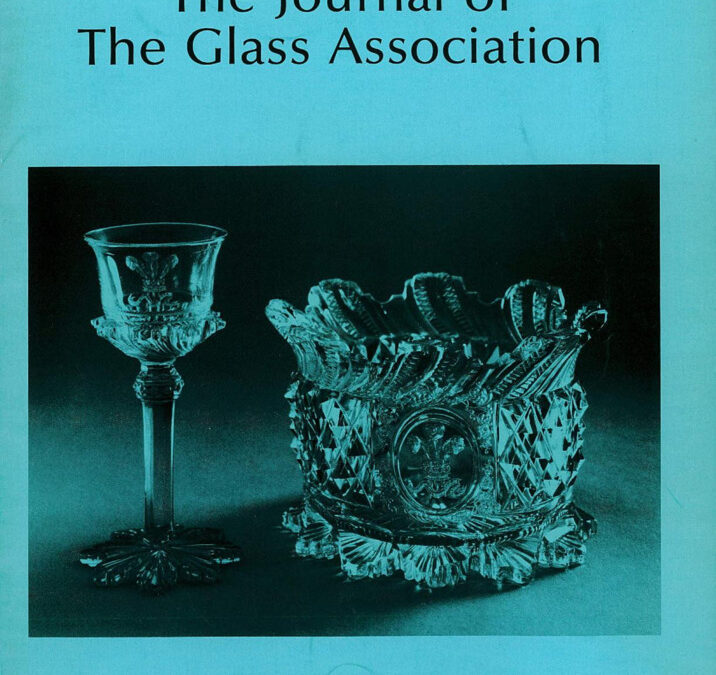
FRONT COVER: Wine glass and wine glass cooler, engraved with the crest of the Prince of Wales, c.1810. Reproduced by
gracious permission of Her Majesty the Queen.
Printed by BPCC Northern Printers Ltd., Stanley Road, Blackpool FY1 4QN
ISBN: 0 9510736 1 3
ISSN: 0951-3108
The Journal of The Glass Association
Volume 2
1987
Contents
Chandeliers at Bath
Martin Mortimer
1
The Prince’s Glasses: Some Warrington Cut Glass 1806-1811
Cherry and Richard Gray
11
The ‘WHR’ Drawings for Cut Glass and the Origins of the Broad Flute Style of Cutting
Ian Wolfenden
19
The Glassware of Percival Vickers & Co. Ltd., Jersey Street, Manchester, 1844-1914
Barbara Yates
29
Two Bohemian Engravers Rediscovered
Charles Hajdamach
41
Keith Murray Modern Glass — the Swedish Connection
Diane Taylor
55
The Glass Association
Chairman: Anthony Waugh
Hon. Secretary: Roger Dodsworth, Broadfield House Glass Museum, Barnett Lane, Kingswinford, West
Midlands DY6 9QA.
Launched at an inaugural meeting at Stourbridge College of Art in November 1983, The Glass
Association is a national society which aims to promote the understanding and appreciation of glass and
glassmaking methods, both historical and contemporary, and generally to increase public interest in the
whole subject of glass. The Association publishes a quarterly newsletter,
The Glass Cone,
which
includes short articles, news and reviews.
The Glass Cone
is edited by Charles Hajdamach, Broadfield
House Glass Museum, Barnett Lane, Kingswinford, West Midlands DY6 9QA.
The Journal of the Glass Association
is issued every two years. It deals primarily with the history of glass
in the nineteenth and twentieth centuries, although articles on the eighteenth century are published as
appropriate. There is a natural emphasis on the glass of the British Isles, but contributions on overseas
glass are welcome where they relate in some way to British glass. Articles reflect the breadth of interest of
current glass studies in the design, social, industrial and economic contexts of glass as well as its
aesthetic and art historical aspects. Anyone wishing to publish in the
Journal
should contact the editor.
Editor of the
Journal:
Ian Wolfenden, Department of History of Art, University of Manchester, Manchester
M13 9PL.
Published by The Glass Association 1987
Printed by: BPCC Northern Printers Ltd., Stanley Road, Blackpool FY1 4QN
ISBN: 0 9510736 1 3
ISSN: 0951-3108
Chandeliers at Bath
Martin Mortimer
Editor’s note: this paper was given as a lecture to the Glass Association at a meeting in Bath, on 3 May, 1986.
The city of Bath is fortunate in the number and quality
of English glass chandeliers which survive in its
various public buildings. Included in them is by far the
finest suite of eighteenth century chandeliers in the
country, possibly in the world. They still hang in the
rooms for which they were designed and made, and
they are fully documented.
In order to place the chandeliers of Bath in context, it
might be as well to run rapidly through the evolution of
English glass chandeliers to the point where the major
figure of William Parker appears.
It is customary to say that the first glass chandeliers
in England are two of those at Hampton Court, one of
which was severely damaged in the recent fire. While
happy to genuflect in the direction of these chandeliers,
they do not, for me, start the story. They are of crystal,
not glass; are contrived from chains of beads on
frames of metal, and in all look very un-English. Their
source may be France, or even Scandinavia. Indeed,
the one which suffered damage may have been rebuilt,
perhaps even twice. A further chandelier at Hampton
Court was found at some time to be signed as the work
of the furnisher and gilder, Benjamin Goodison, in
1736. This is the fitting whose silvered frame includes
pairs of lions and unicorns. For me, advent of the
load-bearing glass arm is the start of English chande-
liers, reflecting as it does in its deft turnery the
contemporary baluster glasses which themselves
owed nothing in material or design to the great glass
centres of Europe.
When glass arms first appeared, English makers
had been using lead for some 30 or 40 years. This is
reflected in the sophistication of early arms. Arm, drip
pan and candle tube were constructed in a single
piece, a matter of some skill. Very few chandeliers
survive with these arms, but short examples of the type
were often fitted to the aprons of pier glasses with
frames of gilt gesso, the combination being known as a
sconce. The well-known 4-light candelabrum in the V.
& A.
{
P
1.1}
is a development in this series of one-piece
arms. They were clearly a problem to clean and very
soon the drip pans were made to be removable. A fine
chandelier given to Emmanuel College, Cambridge, in
1732 illustrates this development
It hangs in the
Chapel and can thus easily be seen. Like all the early
glass chandeliers yet known, its stem comprises
separate pieces which were cut. Briefly, cutting was a
development from, or an elaboration of the bevelling of
looking-glass and window plates. Border decoration on
looking-glasses became complex in the early years of
the eighteenth century, giving rise to a certain amount
of machinery to aid the various processes.
The processes included the use of horizontal grind-
ing and also wheel cutting. It is perhaps no accident
that the first public reference to glass chandeliers at
present known is an advertisement of John Gumley,
the most important plate glass maker of the time, who
was by then in partnership with a major cabinet maker,
James Moore, in 1714.
In the late 1730s and 40s, moulded chandeliers
appear to have been popular. They frequently included
some cutting but were principally of reticulated glass
with rope twist arms. The Assembly Rooms at York
were furnished over several years from their opening in
1732 with a considerable suite of chandeliers of this
type. Fragments of two survive in the Treasurer’s
House. Others, at Doddington Hall, Lincolnshire, came
by tradition from the Lincoln Assembly Rooms. Soon,
makers cut the arms too, to add sparkle, and more
elaborate surface treatments were devised, such as
large flat diamonds with cross cuts, the commonest
decoration between 1750 and 1770.
Plate 1.
Two-piece candelabrum for four lights, c. 1725.
Victoria and Albert Museum.
1
The next change was fairly dramatic as arms
became more elaborately curved; canopies (or
`shades’ as they were called then) were added and the
whole hung and applied with ornaments. The splendid
example illustrated
(
P
I.3)
, one of a pair from Kimbolton
Castle, epitomises this stage and is the sort of thing
Thomas Betts could have made, judging by the items
of chandelier interest listed in his inventory. The
so-called ornaments were very varied, though always
arranged in sets symmetrically about the structure.
They were the first hanging drops and they brought
movement to glass chandeliers, a dramatic advance as
they turned in the draughts, winking in the reflected
light of many candles. This chandelier shows the
degree of elaboration reached during what can only be
called the Rococo period, before chandeliers were
touched by the Neo-classical style. That moment
happened at Bath in the chandeliers designed by
William Parker for the Tea Room of the new Assembly
Rooms, and it is a story of some complexity but great
interest.
The splendid Rooms were opened with a Grand Ball
in October, 1771. For some 50 years they formed the
focus of social life in this most fashionable of Spas.
During the late nineteenth century they gradually
declined and were let to various commercial enter-
prises. In the 1914-18 war they were used as billets,
and in the late 20s and 30s the Ball Room was used as
a Cinema. In 1937 Thomas Cook bought the Assembly
Rooms and gave them to the National Trust, who
leased them to the Corporation of the City of Bath at a
nominal rent. As a condition, the Corporation then put
them in order once again in considerable style,
entrusting restoration of the chandeliers, still surviving
although much dilapidated, to Delomosne and Son Ltd.
It is just as well Thomas Cook’s rescue bid came
when it did, since, after a Gala Ball in October 1938, at
which they were re-opened by the Duchess of Kent,
the Rooms were gutted in the Baedeker raid on Bath.
Had they not previously undergone restoration and a
reorganisation of their ownership, it is doubtful whether
they would have been re-built. As it was, they were
once again restored from mere walls by Professor
Richardson, later Sir Albert Richardson, P.R.A., and
put to use once more. The chandeliers had been
prudently dismantled and stored during the war, and
afterwards, while the future of the Rooms remained
uncertain, the Great Octagon chandelier was installed
in the Pump Room, and one of the Ball Room set in the
Octagon (confusion here!) in Milsom Street, a charm-
ing neo-classical galleried Hall, once a Chapel. On
completion of the second and far more major restora-
tion, all the chandeliers returned to their original
places.
So much for the Rooms themselves. When the
Furnishing Committee was first about its business, it
commissioned chandeliers from two makers: Jonathan
Collet and William Parker. Parker had been in business
on his own at 69 Fleet Street for some 9 years as a
glass manufacturer, buying his supplies from nearby
Whitefriars. It has been suggested by E. M. Elville that
Parker might have taken over the business and
connections of Jerome Johnson, on the grounds that
nothing seems to be heard of this famous maker after
1762, when Parker arrived in Fleet Street
(
‘
1
. Likewise,
nothing is attributed to Parker of any kind, certainly not
Plate 2.
Chandelier in the Chapel of Emmanuel College,
Cambridge, presented in 1732.
Plate 3.
Chandelier formerly at Kimbolton Castle, c. 1765.
2
Plate 4.
The two sides of the inscribed receiver bowl from one of William Parker’s Tea Room chandeliers, 1771.
3
chandeliers, before the commission for the three Tea
Room chandeliers.
It is of prime importance to glass history that the
receiver bowl of one of these chandeliers is inscribed
PARKER FLEET STREET LONDON
(
P
L4)
. The discov-
ery of this feature sent my senior partner, Bernard
Perret, on a voyage of research, the results of which
were published in
Connoisseur
in October and Decem-
ber, 1938
(2)
. It put to death the hitherto universal
attribution to Waterford, made presumably merely on
the grounds that the chandeliers had been there a long
time and must therefore be antique, and what other
source could there be?
Jonathan Collet, however, is known to have taken
over the business of an established glass manufactur-
er, that of none other than Thomas Betts who died in
1765. There is evidence for this in the existence of a
bill-head in the Heal collection, dated 1765, in which
the name of Betts is crossed out and that of Collet
substituted. Again, nothing of chandelier (or perhaps
any other) interest has been attributed to Collet before
his commission here for the five Ball Room chandeliers
(one large central fitting and four smaller flanking it),
though of course, as all should know from perusal of
Betts’ fascinating Inventory published by our Associa-
tion, he must have been deeply involved in all the
paraphernalia of chandelier construction, taken over
lock, stock and barrel from Betts
(3)
.
It is a fortunate thing that the Minute Book of the
Furnishing Committee survives, as it traces the history
of the supply of the chandeliers in some detail
(4)
. On 15
August, 1771, Collet’s quotation of £400 for the five
Ball Room chandeliers was accepted “provided the
extraordinary expenses be all laid out in Ornaments, as
you have agreed before to send gilt chains to all the
chandeliers”. At the same time, Parker’s quotation for
the Tea Room chandeliers was accepted, the Commit-
tee agreeing additional expense for ornaments, relying
on Parker’s judgement but “You will please to remem-
ber the top and bottom shades were to be ornamented
at the original price of seventy pounds”. On 19
September Parker’s account for £330 was paid. A
week later Collet’s bill was settled: £382 for the five Ball
Room fittings.
So far, so good. The Rooms opened in October, and
on 24 October an anxious entry reads “As one of the
arms of the chandeliers in the Ball Room fell down
during the time the company was dancing and two
others having before fallen down, it was resolved to
ask Councillor Lane how to act”. The Committee had
the chandeliers inspected both by Mr. Collet’s servant
and Parker himself and, as a result, dismantled them.
They then advised Collet “As several arms of the
chandeliers you put up in the New Assembly Rooms
have already failed, and all the others on close
examination are found to be so unsafe as to endanger
the lives of the company, your servant has taken them
down”. They forthwith demanded the return of their
money. What “close examination” might mean in
those days in the absence of a light polariser or other
means of establishing stress I cannot imagine, but it
seems probable that the trouble was inefficient anneal-
ing, perhaps linked to inexperience in assessing the
dimensions required of arms of this size.
It seems clear that Parker was on the spot (as has
been suggested by his being mentioned in person in
connection with the inspection), for on the same day it
was minuted: “Resolved: that Mr. Parker’s proposals
for making five lustres for the Ball Room, the whole to
contain two hundred candles, the fashion and orna-
ments to be left to Mr. Parker, who is to deliver and put
them up in ten weeks at the furthest for the sum of five
hundred pounds be accepted”. This may appear a
horrific challenge, but it must be remembered that the
three Tea Room chandeliers were made, delivered and
hung between 15 August and 19 September. This was
summer time and the roads as good as they ever could
be, so the committee will have considered they were
giving Parker plenty of extra time to take account of
worsening transport conditions. They were — since they
were able to pay Parker for the Ball Room chandeliers
on 31 January following. On 31 October, 1771, the
Committee wrote Collet a long and fierce letter,
brandishing the law and ending ” . . . however un-
pleasing a truth it may be to your ears, so long as a
chandelier of Mr. Collet remained, the general
apprehensions of danger would never be removed”. In
November the Committee went to law. By April, 1772,
Collet had suggested arbitration by the appointment of
a referee for each side, and in writing about this, the
Committee is beginning to mention only one chande-
lier. In June of the following year the Committee agreed
to keep the large central chandelier and release the
four smaller ones to Collet provided he “undertakes to
make the chandelier of 48 arms safe and good in every
respect”. In addition, they required £30 on top. “They
expect you will warrant the above chandelier safe and
sound as a satisfaction to the public and that it will be
ready and put up at yr. expense by the first of
September next”. It seems Collet’s reply suggested
that the smaller chandeliers were not of a saleable
size. The end seems to have come in June, 1773,
when the Committee agreed to buy the chandelier for
100 gns. (presumably they had by then received their
money back for the original purchase) and paid £15 for
its alterations, £14.4.10. for transport of the four
smaller chandeliers to London, and £12 for a new
chain, carriage and assembly. It seems clear from this
that the large fitting went back to London for correction,
while the others stayed in Bath until negotiations were
finally completed.
Now to the chandeliers. Collet’s mammoth lustre
(0-5)
was used in the large Card Room known as the
Octagon. It is to me a combination of superb glass and
terrible design. It is also so old-fashioned for its date
that it is amazing to realise that all these chandeliers
were made at the same time. Collet’s chandelier is a
large assembly of stem pieces, including the spherical
central piece almost obligatory through the eighteenth
century till now. Most of the major pieces have the
classic surface treatment of large flat diamonds with
cross cuts. The features which date this chandelier are
therefore the trumpet stem piece above the top ball,
the varied profiles of the arms and, perhaps, the
elaborate borders of the pans, which cannot be seen in
the plate but which one can see from below. It is
probable that this and the Parker fittings would have
been far more generously hung with ornaments.
Certainly the Octagon chandelier at least would benefit
from this; a more liberal sprinkling of drops would
soften its menacing and spider-like presence. Its early
4
history gives food for thought: which of the five
chandeliers originally provided by Collet for the Ball
Room, of which this was the central fitting, shed arms?
The possibility of technical miscalculation would lead
one to suppose that it was this, by far the largest of the
five, with arms of greatest projection. And yet it was
this chandelier that the Furnishing Committee even-
tually agreed to accept. One wonders why Parker, so
ready to take immediate advantage of the Ball Room
fiasco, does not appear to have offered to provide a
chandelier for the Octagon. He is unlikely not to have
suggested it. There is no record of an English glass
chandelier of this date larger than Collet’s. It is
something over 10 feet high with enormous stem-
pieces and four sets of twelve candle arms. At this time
it was only just becoming usual to taper glass arms so
that they reduced in bulk and thus weight as they
extended from the arm plate. It may be that Collet had
not introduced this feature of design. Parker certainly
did. On the whole one feels for Collet, his grand and
eccentric chandeliers collapsing while Parker snaps at
his heels.
Before considering Parker’s approach to the design
of large chandeliers, I have a suggestion as to what
Collet did with two of his set of four. In 1935 the
remains of two splendid chandeliers were bought by
Delomosne and Son Ltd., the arms being delivered in a
sack. Bernard Perret had at that time commissioned
his glass cutter to experiment with the re-joining of
broken chandelier arms, and he had just achieved
success in the problematical annealing. It was found
Plate 5.
Forty eight-light chandelier in the Octagon by
Jonathan Collet, 1771-3.
possible by cannibalisation to restore one of these
chandeliers, repairing sufficient arms by the new
process. They came to us with a tale that they had
formerly been in the “Taunton Assembly Rooms”. The
Assembly Room in the Market House was opened in
October, 1772, just a year after the grand suite at Bath,
and contained “two elegant and large glass chande-
liers”. They were the gift of Colonel Richard Coxe
when M.P. for the county, which he represented
between 1763 and 1784. Plate 6 illustrates the survivor
from which it can be seen that it shares many details
with the one in the Octagon at Bath; indeed, the upper
part of the Bath chandelier is virtually duplicated in the
Taunton example with those wandering double-curved
arms. Here again is the classic large diamond-cum-
cross cuts treatment, the pan borders, and the odd-
shaped dished canopy (at the bottom at Taunton, at
the top at Bath). Add to this the hollow finial cut all over
with hollow diamonds and the congenital ugliness, and
I feel it could be agreed that they are of the same date
and maker. This chandelier is now in the United States.
William Parker’s first chandeliers at Bath are the
three supplied for the Tea Room
(
p
1.7)
, one of which is
so usefully marked. The first thing to note about these
chandeliers is the surface treatment of the stem
pieces. Parker makes no use of flat diamonds with
cross cuts, a pattern in universal use during the
previous twenty years or so and retained by Collet. He
thus moves forward a generation as it were, though still
incorporating large spherical stem pieces, themselves
a traditional form. These he has cut with flat diamonds
Plate 6.
Chandelier perhaps by Jonathan Collet, possibly
one of four discarded by the Furnishing Commit-
tee.
5
Plate 7. One of the set of three chandeliers by William Parker in the Tea Room.
6
Plate 8.
One of William Parker’s set of five chandeliers made for the Ballroom, 1771-2.
7
alone, reverting to a pattern not seen since the 1730s.
The most significant feature of the design of the
chandeliers is the introduction of vase-shaped stem
pieces, the first datable use of neo-classical elements
in chandelier design. They are unpretentious, entirely
subservient to other parts of the shafts, forming only a
small part of the general layout, but they are there. It is
in this and in his repertoire of surface treatments that
Parker is seen to be in the van. He uses the flat
diamonds again in horizontal rows over spiral and
straight fluting. Rococo elements survive in the serpen-
tine, double curved arms which emerge in four sizes
from two receiver bowls on each chandelier. A Parker
trade mark of this date is the hollow-blown finial of
almost acorn shape.
When one turns to the Ball Room chandeliers
(
P
u
P
one can see how rapidly Parker developed his
thoughts. Here we have approximately the same
structure and virtually the same arm layout, but the ball
stem has gone in favour of large and smaller vase stem
pieces. Between August, 1771, when he was commis-
sioned for the Tea Room chandeliers and October,
when the Ball Room fittings were ordered, Parker thus
eliminated the ball stem, the principal feature of all
English glass chandeliers since their inception in the
1720s. Further obvious changes include the elabora-
tion of the ornaments to include slender spires stand-
ing on the curves of the arms. It is possible that the
plain spires are replacements, the notched ones
original. Again, many of the ornaments have been
broken, purloined or lost. There is a sparseness about
all the Assembly Room chandeliers which does not fit
at all well with the richness one expects of this period.
Unfortunately, one has no idea how loaded they were,
since possibly the only contemporary chandelier illus-
trations are those which appear on the Trade Cards.
Maydwell and Windle’s card shows a plain and
un-ornamented chandelier, albeit cut throughout, and
also a more elaborate one with standing fleurs-de-lys,
spires and stars, as well as ornaments pendent from
the top shade and arms. Despite this catalogue of
garnish, the engraver has achieved only a meagre and
unfurnished appearance. But these trade cards
will
often have been drawn without specific knowledge. It is
clear, too, that many of the glass manufacturers’ trade
cards were produced by the same supplier, since many
products appear on several cards in facsimile.
From an assessment of these chandeliers and their
style, then, one can distil the feeling that Parker was
the man of the moment, competent, reliable, fashion-
able. He provided the most splendid suite of chande-
liers in the country at that time for one of the most
fashionable centres. That his reputation was thus
made there is no doubt, and his career soared far
beyond the scope of this article. In the 1780s, for
instance, he was closely involved in the first furnishings
for Carlton House under the direction of the architect,
Henry Holland, the start of a Royal connection which
spanned some fifty years. Nearer home, when the
Guildhall was re-built in Bath after much controversy by
Thomas Baldwin in 1775-78, Parker was commis-
sioned for three chandeliers for the Banqueting
Room
(0.9)
.
Plate 9.
One of the set of three chandeliers made for the
Banqueting Room in the Guildhall by William
Parker in 1778.
It is most interesting to see that Parker’s thoughts, so
innovative at the Assembly Rooms, had
scarcely
advanced at all in the six years that had passed. The
arms are still double-curved, the vase-shaped stem
pieces the same; extra ‘shades’ or canopies have been
introduced between the two receivers, and the cano-
pies are a lot larger than those on the previous fittings.
The general effect of richness is due to the chains of
circular drops which were added in the early nineteenth
century, together with the pans and nozzles and their
mounts. It is a pity that these great chandeliers are now
immersed in this froth, where richness of another kind
was doubtless intended for them. Whether they were
originally dressed with chains of pear-shaped drops
cannot now be ascertained. They could perhaps have
been by 1778. Today we have become used to
continuous inflation, so that it is odd to note that Parker
charged less for these than the £100 each for the
Assembly Rooms’ fittings.
The neo-classical style took hold of chandeliers
following Parker’s use of the vase-shaped stem pieces
at Bath. Initially makers played with the possibilities of
the style, but gradually a pure form was developed. A
half-way stage is reached in a pair supplied in 1783 by
Parker to the Duke of Devonshire for Chatsworth
(p1.10).
There is a large central vase with deep spiral cutting,
canopies above and below, a single row of arms for
lights with a row above of alternate arms with spires,
and snakes. The whole is hung with chains of graded
pear-shaped drops of high quality, linked by fan-cut
four-ways which resemble the paterae of classical
8
Plate 10.
One of a pair of neo-classical chandeliers
supplied to the Duke of Devonshire by William
Parker for Chatsworth, 1783.
idiom much as the chains represent swags of husks.
Until about now, arms had continued to be made with
integral candle tubes. The whole component was
vulnerable, requiring complete replacement in the
event of a candle burning down and fracturing the tube.
Here, in the Chatsworth pair, the tube arms have been
discontinued, and one sees vase-shaped nozzles
which, with the pans, have Van Dyck borders; a turned
brass mount unites these components, and doubtless
every metal part is stamped with identification numbers
or letters to ensure correct assembly. The pair were
supplied at a cost of £210. Although this was still only
£100 or so apiece, they are less than half the height of
the Bath fittings and the price indicates a considerable
increase. The rather squat appearance would doubt-
less be improved by correct assembly. The style finally
settled to a classic formality, and these chandeliers
were made with little variation by various makers for
some twenty years. A pure example would have arms
on two levels as at Chatsworth, but where the low ones
would carry lights, the alternating high ones would
carry spires over small canopies, and there would be a
fairly rigid layout of dressings.
By the end of the eighteenth century arms were left
plain fluted to a six-sided section but not notched. An
elegant example was bequeathed to the Holburne of
Menstrie Museum in Bath
(p1.11),
and it represents the
final and most pure state of the neo-classical chande-
lier in England. It is mentioned here since it is readily
seen on any visit to Bath, in conjunction with those in
the Assembly Rooms and Guildhall. It is a good
example to consider in view of its degree of elegance
and refinement. The main stem feature is of vase form
with softened shoulders, the arms taper gracefully, the
spires are crisply cut and brilliantly polished on the lap.
It is hung with chains of graded pear-shaped drops,
meticulously faceted, of which the smallest are less
than half an inch long. By now, the quality of lapidary
cutting on drops had reached a peak of perfection both
in accuracy of layout and brilliance of finish never
surpassed.
On this note, then, it would be as well to finish. The
further development of English chandeliers is not
represented in Bath, at least in publicly accessible
buildings
(5)
. They became ingenious, elaborate and
very costly as the nineteenth century opened, but the
end of the previous 100 years surely set an unbeatable
standard of beauty, restraint, logic and fitness of
purpose.
Plate 11.
Neo-classical chandelier in the Holburne of
Menstrie Museum, Bath, 1795-1800. The in-
verted position of the central vase has been
corrected since this photograph was taken.
9
Footnotes
1.
E. M. Elville, ‘The History of the Glass Chandelier’,
Country Life Annual,
1949.
2.
J. B. Perret, ‘The Eighteenth Century Chandeliers at
Bath’,
Connoisseur,
October 1938.
3.
A. Werner, ‘Thomas Betts — An Eighteenth Century
Glass Cutter’,
The Journal of the Glass Association,
Vol. 1, 1985.
4.
Minute Book of the Furnishing Committee. Quoted from
ms notes made from a typescript of the original by
Bernard Ferret. The notes are in the possession of
Delomosne and Son Ltd.
5.
There are, of course, many fine chandeliers in private
hands in Bath and its neighbourhood, disclosure of
which would not give pleasure to their owners.
1 0
The Prince’s Glasses
Some Warrington Cut Glass 1806-1811
Cherry and Richard Gray
The 1806 visit of the Prince of Wales to Liverpool was
unlikely to be allowed to pass by without ceremony.
George’s brother the Duke of Clarence was the most
prominent opponent of growing political opposition to
the Slave Trade, a great source of wealth in Liverpool.
The Prince himself was an object of popular support
and loyalty at a time when Napoleon was still a
potential threat to the Crokivn and British prosperity at
home and abroad. ‘Prinney’s’ protracted stay on
Merseyside in the autumn of 1806 was highlighted by a
banquet attended by his brother, the Earl of Derby and
the principal naval, military and political officers of the
town, and the local gentry. The venue, The Liverpool
Arms, was, like most of the town, painted and,
illuminated, its floors covered with red baize and its
interiors seductively lit by Grecian lamps and plaster
figures holding wax lights, borrowed from the illustrious
Mr. George Bullock. Every extravagance was procured
or prepared in time to ensure the visit was memorable
and sumptuous. Plate was provided by the Royal
Goldsmith, Rundle Bridge and Co., for the Prince’s
table
)
. Delicacies from every season were served,
including a buck and freshwater fish from Mr. Blundell
of ince. Ivory-handled cutlery was to be provided and
wines, drawn from the cellars of the gentry, were
served in decanters adorned with blue ribands. In
particular it was the table glass which attracted
comment from the Prince, and he asked the Mayor to
order him something similar, from the manufacturer in
Warrington. The glass had been manufactured by
Perrin Geddes and Co. of Bank Quay, Warrington, and
was engraved with the Liverpool Corporation Crest.
The following extract serves to summarise the detail of
this unusual commission:
“. . .
The Prince of Wales had greatly admired the
Glasses that were procured for his table at the
dinner, and that he had requested the Mayor to
order him a few dozen Glasses of the same sort,
your Committee, conceiving that it would meet the
approbation of the Council, have directed a set of
Plate 1.
Wine glass and wine glass cooler, engraved with the crest of the Prince of Wales, c. 1610. h. 14.0 cm., 10.1 cm.
Reproduced by gracious permission of Her Majesty the Queen.
11
Plate 2.
Decanter, engraved with the crest of the Prince of Wales. h. 32.95 cm.
Reproduced by gracious permission of Her Majesty the Queen.
12
Decanters and Wine Glasses to be made, to be
presented to the Prince of Wales from and in the
name of the Corporation’.
Brimful of enthusiasm and self-satisfaction over
the success of his royal visit, the Council had not
the slightest hesitation, but the greatest pride, in
complying with what appeared so modest a
request. An order was given to Messrs. Perrin,
Geddes & Co., of Warrington, the manufacturers,
for twelve Decanters, thirty-six Coolers, six Carafs
or Water Jugs, six dozen Claret Glasses and six
dozen Port Glasses. This was subsequently consi-
dered too small a service for the Prince’s table,
and a supplemental order was given for twelve
additional Decanters, four dozen Wine, four dozen
Claret Glasses and three dozen Goblets. In
addition to this Colonel Lee and Major Bloomfield
were each presented with four dozen Decanters
and four dozen Wine Glasses. This was only glass
ware, and could not be expected to cost very
much, but let us see what happened. In February,
1809, the Accounts for the goods were before the
Council and referred for consideration to the
Reception Committee, the Treasurer in the mean-
time being directed to pay £600 on account, and in
May, 1811, (there was evidently no hurry to settle)
an order was made for payment of the balance,
amounting to £706.18s., the total thus being
£1,306.18s., a sum which probably disconcerted
the Council when their enthusiasm had cooled
down”
(2)
.
What is not obvious and bears clarification is the fact
that the Prince’s duplicate glass was essentially a
‘quantity nearly similar’ to the Liverpool service which
had been procured — like many other necessities — for
the Royal Visit. The Prince’s new glass was engraved
with his own crest rather than Liverpool’s, the three
feathers (Appendix1). Finally the further eight decan-
ters for Colonel Lee and Major Bloomfield were
considered and exchanged with eight from the original
Mayor’s glass used on the Prince’s table at the
celebrated dinner. These were personalised with the
Lee and Bloomfield Crests, additional to that of the
Corporation (Appendix 2). There can be little doubt
therefore that the Prince of Wales was given Warring-
ton table glass which he had first seen on a trip to
Liverpool in 1806. Two further tantalizing questions
beg answers about this Royal glass; its appearance
and secondly its present whereabouts.
The high cost of the glass, the fact that it took over a
year to make (September 1806-January 1808), and of
course the owner for whom it was intended does
suggest a rather lavish design. A letter from Bloomfield
to Liverpool does, even allowing for protocol, confirm
this impression:
“Dear Sir,
I have received the Prince of Wales’s com-
mands to acknowledge the receipt of your letter
and to request that you will convey to the
Corporation of Liverpool His Royal Highness’s
best thanks for the very handsome service of
glass with which they have presented them, the
magnificence, the exquisite workmanship and
taste of which His Royal Highness cannot suffi-
ciently admire but which he considers as the most
beautiful and ornamental specimens he ever saw
of this valuable manufacture . .”
(3)
.
The date 1806 suggests a heavily cut pattern in lead
crystal, and of course it is known that the bulk of the
suite was engraved with the Prince’s crest, rather than
the Liverpool crest and the Bloomfield and Lee family
crests. Since the order is documented, one can expect
to find the three kinds of drinking glass, decanters,
coolers and carafes. As to the location, a famous and
magnificent suite, some of which is engraved with the
Prince’s crest, is in the Royal collection at Windsor and
elsewhere
(4)
. This may indeed be some of the glass
ordered for the Prince from Perrin, Geddes & Co. At
Windsor in 1985 there were thirteen coolers, forty-four
decanters (two sizes) and nine stoppers (to fit the
larger decanters) and seventy-one glasses (three
sizes) in cut crystal
(5)
. Apart from the six ‘jugs or
carafs’, this is precisely the kind of drinking suite
ordered for the Prince. The Windsor glass is stunningly
opulent. No expense has been spared in the extrava-
gant design, with its lavishly thick metal and deep
complex cutting. The swirling design (most striking in
the shoulder of the decanters) animates the form of the
glass, suggesting the quality of molten metal. The
drinking glasses have unusual star shaped feet,
enhanced by mitre cutting on the upper surface. The
delicacy of the finely blown bowls which also bear a
strange rope twist border below the crest, and the
precision of the engraving are in marked contrast to
55
Plate 3.
Tumbler. Enamelled decoration, after ‘DR. SYN-
TAX IN THE GLASS-HOUSE’ by Thomas Row-
landson, published in 1820. h. 13.5 cm. Royal
Brierley Crystal Museum.
13
.-;
•
-…./ (7 -,'”
–
tel – *V . ,,,
– _e,
–
—
,
(;.
,
,,i,:,
–
i
/
j___,.
1 _
rza:e,,,/.1_,
,..
vie
;
___
c.,,,,,,..i •
4
I
1
1
1
—
Ery
i
‘,A – , –
, , – – ,,,,,f
”
—
___ 7 ~
/J
2′
–
..i _
,c
–
_
–
_
–
–
,
\,)
….- /
v-r-ef —
– • ,
11
…
,
( .
1
_
2
r
i 1
1
….-
_-.-
—
….- .•••-__
……..
…….
.
161
1
„.
.
e
.„
–
“”••••=11111•11111
n
•
_ …all
.; .4
.’,
!•
41
C
-….
.
/
„
Avr
-i
t’
.-migml
.11
, _…-
4
:..
.
414
.
filk
..:
i .
.1_
.11 liv.
Plate 4. Bill of sale to Ralph Wright
of Flixton. Manchester. from Perrin Geddes & Co., Warrington, 6 December. 1809. Private
Collection.
O
•
v
–
Plate 5. Wine glass and octagonal dish from Perrin Geddes & Co., formerly belonging to Ralph Wright of Flixton. 1809. h.
12.0 cm., 8.0 cm. Private Collection.
14
eh 1- / .”;
,
•
,
dry, 4t .
•
_
X44;”
iiimomi
n
e”
/
I
.4 rArintemlimpowill
.;
–
4111:040i)
•
1 irfririA”KraM11*°41**117
P
Plate 6.
Octagonal bowl, attributed to Perrin Geddes & Co., belonging to the Vawdrey family, c. 1810. h. 7.8 cm. Private
Collection.
Plate
7. Wine glass and wine glass cooler, engraved with the crest of the Prince of Wales, belonging to the Vawdrey family, c.
1610. h. 13.9 cm., 10.4 cm. Private Collection.
15
Peter Vawdrey (1780-1831). Employed at Perrin
Geddes & Co., 1802-11. Undated oil painting.
Private Collection.
their heavily cut, swirling undersides, faceted stems
and star feet
(
P
I.1)
. It has been estimated that the largest
of the splendid decanters would weigh about nine
pounds
(
P
I-2)
. It remains to prove whether this is the
glass ordered from Perrin, Geddes & Co. of Warrington
on behalf of the Prince of Wales, who had pointedly
admired such a suite at the 1806 banquet in The
Liverpool Arms. Some of the Windsor glass can be
linked to Perrin, Geddes & Co., but it is first important
to establish something about the reputation and output
of the Warrington Bank Quay Glass Works up to the
crucial date of 1806.
The Bank Quay Glass Works was begun in 1756/57
by Robert Patten and Peter Seaman of Warrington,
and Edward Deane and Thomas Falkner of Liverpool.
By 1797 Josiah Perrin and Edward Falkner had each
the largest shares in the firm whose total capital was
£25,000
(6)
. Perrin had been manager or partner in the
Liverpool Old Glasshouse in 1761
(7)
, and had married
Peter Seaman’s daughter Catherine in 1778
(8)
. The
Geddes side of the family had Scottish connections,
and were involved in the glass industries of Glasgow
(Verreville), and Alloa
(9)
. From 1795-1824 the Warring-
ton firm traded as Perrin, Geddes & Co., in whose
name the Company account was kept with bankers
Par, Lyon and Kerfoot in 1795
(10)
.
If the Bank Quay Works was increasingly large and
prosperous, it was also topical. Dr. Syntax’s adven-
tures published his attempts at making something like
a bottle at Warrington in a
Glass-house:
“Through the day he travell’d on;
The night he passed at Warrington; –
Where his keen, philosphic eye
Enjoy’d the highest luxury.
It seems the venerable town
Retains a national renown,
For its superior skill display’d
By which all kinds of glass are made; . .
‘Though’ he exclaimed ‘it doth appear,
Each Glass-house is his temple here
Where Art and Commerce both combine
In gratitude and praise to join’.
Syntax now wished to try his skill
In forming some neat utensil;
When ev’ry part was duly fitted,
As to his hand the tube submitted;
The strict directions he obey’d
And something like a bottle made”.
This amusing fantasy, and the not improbable specta-
cle of Syntax’s wig being set alight, is illustrated by
Thomas Rowlandson in the Dr.’s
Second Tour . . in
Search of Consolation
which was published in
1820
(11)
. An enamelled tumbler, decorated after Row-
landson, may have been made at the Bank Quay
Factory
(
P
I
.
3)
, continuing an earlier Perrin tradition in
enamelled glass:
“Just opened in the old Church Alley, Liverpool,
The Warrington Wholesale and Retail Warehouse,
where are sold all kinds of Blue, Green, White and
Painted enamil, double and single Chrystal Flint;
Cut, Flowered and Plain Glasses, of all sorts; and
Apothecaries’ Phials, as cheap as at the Manufac-
tory. Also Bottles and Cardevine Squares. Broken
glass taken in exchange or for ready money.
Josiah Perrin and Co.”
Some early nineteenth century glass can be attri-
buted to Perrin Geddes and Company with reasonable
certainty. A bill of sale to Ralph Wright of Flixton,
Manchester, is dated Warrington, 6 December
1809
(
P
1.4)
. Glass belonging to the family, which corres-
ponds to the goods on the bill, is now on loan to public
museums
(13)
. The striking thing about the glass is its
quality. The heavy thick metal is beautifully decorated
with all over step cutting, giving an impression of
prismatic brilliance
(
P
I.5)
. This ensuite Warrington Glass
is an important example of Perrin Geddes and Co.’s
production in its own right, but will also help to establish
a link with the Prince of Wales’s Glass of 1806/8. It is
intriguing that the Warrington Glass Manufacturer John
Unsworth, who styled himself ” . . . Manufacturer to
His Majesty and to His Royal Highness the Prince of
Wales . .”
(14)
had accounts with Perrin Geddes and
Co.
(15)
. Unsworth, who inscribed his 1798/1801 Sales
Day Book ‘John Unsworth Glass Cutter, Warrington’,
one can tentatively suggest was a glass cutter and
engraver who also sold glass (as well as a range of
other goods) between 1789 and 1806, and possibly up
to 1824
(18)
. Unsworth cannot be dismissed as the
decorator of the Perrin and Geddes and Co. Royal
Glass of 1806/8 at present because sales accounts
books and sales day books beyond 1806 do not
survive amongst his papers.
Recently a strong link has been established between
the manufacturer Perrin Geddes and Co., and the
Prince of Wales crested, cut service now at Windsor, in
the past attributed to London manufacturers such as
John Blades of Ludgate Hill
(17)
. A direct descendant of
(12)
.
16
Plate 9.
Decanter, engraved with the crest of Liverpool.
h.30.5 cm. Corning Museum of Glass.
a 1797 share holder in Perrin Geddes and Co., Daniel
Vawdrey (1733-1801), retains a collection of glass
including step cut pieces remarkably similar to the
documented Flixton glass of 1809
(
P
I-6)
. Also included
are a cooler and drinking glass identical to pieces in the
Royal collection at Windsor, engraved with the Prince
of Wales crest
(0.7)
. It is tempting to assume this
memento of the family firm was acquired by Peter
Vawdrey (1780-1831)sP
I.8)
, the younger son of Daniel
Vawdrey and Mary Seaman and a salaried employee
at Perrin Geddes, 1802-1811
(18)
. He was a signatory to
the dissolved partnership of Perrin Geddes and Co., on
30 June, 1824
091
. Vawdrey’s inventory of 1834 in-
cluded ‘useful glass’. The term ‘Regent Pattern’ is
bracketed between entries for a ‘Decanter, 4 wines
various, Rich Cut Decanter, Do Wine Cooler’
(20)
.
If Perrin Geddes and Co. manufactured drinking
glasses for the Prince of Wales, based upon similar
glass from Warrington used for the Royal dinner in
September 1806, some probably survive at Windsor in
the Royal collections in 1987. Some of the eight
decanters and eight dozen glasses passed eventually
to Liverpool for the use of the Mayor’s table in 1808
may be expected to appear, and like the Windsor suite
will bear the Prince’s crest. Vawdrey’s glass relates to
the Windsor and Liverpool groups.
For the moment the earlier prototype to the Royal
suite, used for the 1806 dinner, has been identified in
its original form
(P19)
as opposed to the eight decanters
personalised for Major Bloomfield and Colonel Lee by
further engraving. The extraneous glass, earlier than
the 1806/8 Perrin Geddes commission, yet stylistically
related to it, could be the subject of a separate study.
In the context of British glass of the early nineteenth
century the Royal Perrin Geddes commission is of
significance. Although it is not a fully equipped table
service it is an early suite of mature cut lead crystal for
the most opulent and prestigious of patrons and
connoisseurs. It pre-dates the 1824 Londonderry
service made at the Wear Flint Glass factory in
Sunderland, and is at least contemporary with if not
earlier than the Davenport service made for the Prince
of Wales by a Staffordshire manufactory, as a
documented provincial cut glass suite
1211
.
Footnotes
1.
Liverpool City Library Record Office (hereafter LCLRO),
Minute Book of The Prince of Wales Visit Committee
1806-9. 352MIN/COU I 2/10. Meeting 20 November,
1806, pp.90-91.
2.
James Touzeau,
The Rise and Progress of Liverpool
from 1551-1835,
Liverpool, 1910, vol.
II,
pp. 734-41.
3.
LCLRO, Minute Book of the Prince of Wales Visit
Committee. 352MIN/COU I 2/10. Meeting 21 April,
1808.
4.
Phelps Warren, ‘Luxury in English & Irish Cut Glass’,
Antiques
December 1969, pp.882-6, ills. 4, 5, 8.
5.
A letter to the authors from the Lord Chamberlain’s
Office, 25 April, 1985.
6.
Cheshire Record Office (hereafter CRO), Balance Sheet
of the Bank Glass Works, 30th June, 1797. DMD L6/1.
7.
Williamson’s
Liverpool Advertiser,
7 August, 1761. In
Francis Buckley, ‘Old Lancashire, Glasshouses’,
Trans-
actions of the Society of Glass Technology
1929, vol. 13,
p. 236.
8.
CRO, Genealogical Notes: Seaman and Darrel families,
18th November, 1914. DMD 3764/28.
9.
John Lees Carvel,
AIloa Glass Works,
Edinburgh 1953,
pp. 12-13.
10.
Warrington Reference Library, Microfilm of Ledger 1788-
95 from Parr Lyon and Kerfoot (MF29), January 1795.
11.
William Combe,
The Second Tour of Dr. Syntax in
Search of Consolation, A Poem,
London, 1820. First
issued in monthly parts with 24 coloured plates, after
Thomas Rowlandson. From a later edition: J. C. Hotten,
Dr. Syntax’s Three Tours,
London 1868, ill., pp. 182-3.
12.
Liverpool General Advertiser,
3 April, 1767. In Francis
Buckley, op.cit., p. 241.
13.
The Victoria and Albert Museum. Warrington Museum
and Art Gallery.
14.
R. J. Charleston, ‘Some English Glass-Engravers: late
18th – early 19th century’,
The Glass Circle
4, 1982, p.5.
15.
Manchester Central Reference Library. Archives Library,
The Records of John Unsworth Glassmaker. Sales Day
Books 1798-1806. L24/4. Microfilm M24/4.
16.
Pigot & Deans’
Directory for Manchester and Salford
1824-5.
In E. Surrey Dane’s
Peter Stubbs and the
Lancashire Hand Tool Industry,
Altrincham, 1973. pp.
187, 279.
17.
Howard Coutts, ‘London Cut Glass’,
Antique Collecting,
June 1987, pp. 22-3.
18.
CRO, Glassworks Account Books of Peter Vawdrey, vol.
1, 1801-13. DMD L6/3.
19.
London Gazette,
25 May, 1827, in Francis Buckley, op.
cit., p. 241.
20.
CRO, Inventory and Accounts of Peter Vawdrey, 1834.
DMD B/4.
21.
R. B. Brown, ‘The Davenports and their Glass 1801-87′,
The Journal of the Glass Association, vol.
I, 1985, p. 32.
17
Appendix 1
Extract from Minute Book of The Prince of Wales Visit
Committee, 1806-9. LCLRO, 352MIN/COU
I
2/10. A meet-
ing on 22 September, 1806.
83 The Mayor having reported that His Royal Highness the
Prince of Wales, while sitting at dinner had greatly
admired the Glasses that was procured from the Glass
Works at Warrington and that H.R. Highness had
desired the Mayor to order him a quantity nearly similar,
with his Crest ingraved upon them in lieu of the
Corporation Crest –
Resolved and Ordered
That the following Glass be ordered from the Warring-
ton Glass Works, and that H.R. Highness be requested
to accept the same from the Corporation:
12 Decanters
36 Coolers
6 Jugs or Carats
6 doz.” Claret glasses
6 doz.” Port
do.
And the Mayor having also stated that Col Lee had
requested him to procure for him a few Glasses
Ordered
That 4 decanters
And 4 doz.” Wine Glasses
For him
And . . 4 decanters and 4 doz.” Wine Glasses for
Major Bloomfield be ordered at the Glass Works and
presented to them at the expense of the Corporation.
Appendix 2
Extract from Minute Book of The Prince of Wales Visit
Committee 1806-9. LCLRO, 352MIN/COU
I
2/10. A meeting
on 21 January, 1808.
120. The Chairman reported that Alderman Clay and himself
accompanied by
M.r.
Falkner one of the Proprietors of
the Glass Works and M. Foster had been at the Glass
Works at Warrington, and inspected the Glass pre-
pared for His Royal — the Prince of Wales, and also the
Glass intended to be presented to the Colonels
Bloomfield and Lee, and he also stated that it had been
suggested that the Wine Glasses originally ordered
were too limited in their Number for the Prince’s Table.
Resolved
That Four dozen Claret Glasses and four dozen
Wine Glasses be added to the former order, making in
the whole Ten dozen of each sort of Wine Glasses. It
appearing that the Decanters made for the Colonels
Bloomfield and Lee were of a similar pattern to those
intended for the Prince of Wales.
Resolved
That it is the opinion of this Committee that the
Decanters to be presented to Colonels Bloomfield and
Lee ought to be of a different Pattern to those intended
for the Prince of Wales.
Resolved
That the Decanters made for these Gentlemen be
directed to be sent to Liverpool for the use of the
Mayors Table, and that Eight Decanters be sent from
hence (with the consent of the Mayor) to the Glass
Works in lieu of them (these Decanters being part of
those used at the Prince’s Table when he dined here
upon the 18th September, 1806) and that the Crests of
Colonels Bloomfield and Lee be put upon these
Decanters.
Resolved
That four of these Decanters when finished be
presented to Colonel Bloomfield and four others to
Colonel Lee, and that four dozen wine glasses be also
presented to each of these Gentlemen — and that
Alderman Clay be requested to present the same in the
name of the Common Council of Liverpool.
Acknowledgements
We would like to thank R.
B.
Brown, T. V. Jackson, Nicholas
Moore, Daniel Vawdrey’s family and Hilary Young for
showing us much unpublished information and making
helpful suggestions about Warrington glass. Alan Seabright
photographed the glass in pls. 3, 5, 6, 7 and 8.
18
t’t1t rt
rrft
•
The `1A/HR’ Drawings for Cut Glass and the
Origins of the Broad Flute Style of Cutting
Ian Wolfenden
Documentary evidence for British glass design in the
early nineteenth century is rare. There are just three
published series of pattern drawings for glass of the
1820s and early 1830s, the period of a major design
development in British glass, from elaborate, mitre-cut
work based on diamond patterns to a simple style
relying chiefly on broad, flat flutes. A fourth series of
drawings, now in the Broadfield House Glass Museum,
Kingswinford, provides some new evidence on the
emergence of the broad flute style. The fourth series
may be termed the ‘WHR’ drawings, from initials
pencilled beside a design for a cut glass sugar
bowl
(
P
I.1
.
The broad flute style of cutting was established by
the mid-1830s. A printed price list of the London firm of
Apsley Pellatt, published during 1838, illustrates de-
signs entirely in this style
)
. Prior to this date the
evidence is less secure. In discussions of the origins of
the style attention has normally been focussed on the
Waterford drawings of Samuel Miller, which are usually
dated to around 1830. The majority of designs in
Miller’s drawings are broad flute, and it has reasonably
been conjectured that the style must have formed
during the 1820s
(2)
. The Miller designs are not them-
selves dated, so the evidence for dating the drawings
bears close examination. The same is true for the other
published series.
Dudley Westropp, who first published the Miller
drawings, stated that they were ‘prepared by SamUel
Miller, foreman cutter in the glass works, in the
twenties and thirties of the nineteenth century’
(3)
.
Elsewhere he inclined to date them around 1830,
Plate 1. Design for sugar bowl, with inscription `WHR’. ‘WHR’ Drawings: Sketchbook. Broadfield House Glass Museum.
19
•
i
+
‘
pu-1.4)
-.0.’
‘
7
14
7
L
f,
•
i!
.
.
‘
Plate 2.
Designs for jugs, sugar bowl and covered bowl in broad flute style. ‘WHR’ Drawings: Sketchbook. Broadfield House
Glass Museum.
simply from the style of the decanters, almost all
having perpendicular sides”
)
. Two pieces of evidence
provide a broad framework for dating these drawings:
the paper is watermarked 1795, 1820 and 1825, and
Samuel Miller is recorded as foreman cutter at Water-
ford in a letter of 1831
(5)
. The variety of phrasing
Westropp used in dating them probably stems from
something which he briefly mentioned in publishing
them: they are not a homogeneous group. Some
designs occur in a notebook watermarked 1820 and
the remainder are on loose sheets. An example of
designs in the notebook is an oval centre bowl with
diamond cut swag motifs and splits
(6)
. This is, stylisti-
cally, rather earlier than glass recorded on the sheets.
Equally, designs for decanters in the notebook differ in
general from those on the sheets. The notebook
decanters are sometimes round-bodied and most are
cut with variations of the diamond frieze or vertical
panel, or else groups of mitre cuts or other Regency
motifs. The loose sheet designs are for vertical-sided
decanters only, and these are largely broad-fluted, with
flat or pillared flutes
171
. The notebook could have been
prepared in the 1820s before the sheets, and it is quite
possible that the whole series represents the produc-
tion of some years. As none of the designs is highly
numbered there is no unequivocal guide to a relative
chronology. Westropp may well have been correct
when he said that the Miller drawings were of the
1820s and the 1830s; it is difficult to draw precise
conclusions from them.
Even more problematic is a second series of
drawings with an Irish provenance. This is the John
Fitzgibbon series, published by Mary Boydell in the
revised edition of Westropp’s
Irish Glass,
in 1978. The
drawings are recorded in Westropp’s additional mate-
rial as having belonged to John Fitzgibbon who
‘worked in Hanover St. Glass House Cork’
0)
. When
published they were compared stylistically to the
drawings of Samuel Miller. More recently, it has been
implied that they should date before 1818, as the
Hanover Street works of the Cork Glass Company
closed in that year
191
. Since the drawings include broad
flute designs they would thus have an especial
significance for the history of cut glass style; no other
evidence suggests that broad flute cutting emerged in
the 1810s. However it is worth noting that the Waterloo
Glass House Company of Cork (1815-1835) had
warehouse premises in Hanover Street and advertised
under that address
(10)
. If Westropp’s source on Fitzgib-
bon confused the works with the warehouse, then the
Fitzgibbon drawings could derive from the Waterloo
Company, at any time up to 1835. Unfortunately the
drawings are now lost, although photographs of them
are in Dudley Westropp’s additional material. No
20
watermarks are recorded, so the question of whether
they might date from before 1818 remains open. The
style of the designs suggests a date nearer 1830, but
the drawings are a doubtful quantity.
Apart from the Miller and Fitzgibbon series the only
other published drawings of this period are of Scottish
origin. They are among the papers of the Ford and
Ranken families of Edinburgh and were published in
1915 and 1916
(11)
. The earliest material relates to what
began as the Caledonian Glassworks of William Ford,
in 1810 or 1812. Sheets of pattern drawings have
watermarks of 1811, 1814 and 1817
(12)
. Much later
material is also included in the papers, and the
collection requires further research before it can yield
any results. Broad flute glasses are named in a bound
volume inscribed ‘Fattens (sic) Holyrood Glass
Works, Edinburgh’, dating probably from the 1840s
(13)
.
As yet it is uncertain how early the broad flute style
began in Edinburgh.
The published pattern drawings are of limited assist-
ance in determining the origins of broad flute cutting in
Britain. They do suggest the style was in vogue, at
least in Ireland, at a time when diamond cutting was
still popular; the presence of both styles in the
Fitzgibbon drawings is perhaps the clearest indication
of this. Such a period of overlap could be anywhere
from the early 1820s to the early 1830s or, possibly,
even prior to 1818.
Before turning to the ‘WHR’ drawings, other evi-
dence for the beginnings of broad flute work needs to
be considered. The late Hugh Wakefield drew attention
to later nineteenth century claims that the style
originated in the Birmingham cutting shops
(14)
. He
further noted some glasses, acquired in Birmingham
around 1820 and now in the Conservatoire des Arts et
Métiers in Paris, which might be early in the develop-
ment of the style
(
‘
5
>; these have alternate flat flutes and
groups of vertical mitre cuts. Birmingham was certainly
developing as a centre for glass cutting in the first
decades of the nineteenth century. For the years
1770-1800 Francis Buckley had found references to
just five cutting firms in Birmingham, from
Directories”
)
. By 1829 there is evidence of almost
thirty
(17)
. Yet the sources noted by Wakefield are
vague as to dates; one suggests that diamond cutting
gave way to broad flute around 1840
(18)
. The same
source states that John Gold of Birmingham took out a
patent for a machine to cut broad flutes in 1832. In fact,
Gold’s patent dates from 1834, and an illustration to
the 1857 publication of the patent clearly shows a
broad flute decanter
(18)
. This at least suggests that the
style was well known in Birmingham by 1834.
Yet Birmingham was not alone within the West
Midlands in expanding as a centre for cutting glass.
Nine firms are recorded as glass cutters in Dudley in
1829 and a dozen in the Stourbridge district
(28)
. As
evidence from a Directory this may not be wholly
reliable. But of Dudley in 1829 it was said that ‘In the
town are several glassworks, where all kinds of
ornamental and cut glass are got up for the Eastern
and other foreign markets, as well as for home
consumption, in the most elegant style of
workmanship’
(21)
. There is also evidence that Stour-
bridge had gained a reputation for its cutting by
1819
(22)
. Bearing in mind the close proximity of Dudley,
Stourbridge and Birmingham, little difference might be
Plate 3. Designs for bowls and stands. ‘WHR’ Drawings: Blue Wash Sheets. Broadfield House Glass Museum.
21
4
–
7
—‘
I
re/
•
(
-77
_t-
—
—
r
A
j
Plate 4.
Designs for decanters. ‘WHR’ Drawings: Hatched Sheets. Broadfield House Glass Museum.
expected in the glass produced in all three places. In
this respect the ‘WHR’ drawings at Broadfield House
are of some interest.
The ‘WHR’ drawings consist of just over 250
individual drawings for cut glass vessels and sixteen
sheets of lighting equipment. They are in four separate
but inter-linked groups, showing designs from one
factory over a number of years. For convenience, the
groups are here given the following titles: ‘the sketch-
book’, ‘the blue wash sheets’, ‘the hatched sheets’ and
‘the decanter designs’. They are briefly described in
the Appendix. None of the groups is a systematic
record of production, such as one finds in factory
pattern books of the Victorian period,
but
there is
evidence within the drawings that they are of produc-
tion designs. There is also some evidence of a
sequence of design within the decanter designs;
relative dates for the introduction of designs can
therefore be suggested.
The sketchbook now consists of forty two pages,
often with several drawings per page, mostly in ink; the
drawings are partially annotated
(
P
1.2)
. There is no
obvious order to the drawings, and two of the early
pages have blue wash drawings pasted in. The
appearance of the sketchbook is that of perhaps a
designer’s notebook, although the inclusion of serial
numbers, weights or prices by some designs is
indicative of glass in production. The blue wash and
hatched sheets are loose sheets of highly finished
drawings
(pls.3and4)
One group is drawn and washed in
pale blue, the other outlined and hatched in dark ink.
The finish suggests that these are presentation draw-
ings; some designs are annotated with production
details, further suggesting that they could be drawings
for a traveller to show prospective clients. The fourth
group, the decanter designs, is of quite different
character
(P1
‘
5)
.
This contains small sketchy drawings of
decanters on pages which originally formed part of a
paginated notebook; the extant pages are numbered
118 to 120. Pattern numbers, ranging from 1 to 2238,
are associated with some designs, and all designs
have notes of weight and price of cutting, with
occasional additional information. The original book
seems to have been a type of factory price book.
The ‘WHIR’ drawings have little history attached to
them.
Of
the four groups three were deposited by a
Mr.
R.
C. Richardson, at an unknown date, with the
Stourbridge Public Library. No information on these
groups was recorded at the time of deposition.
Although he was not known to the last direct descen-
dant, the late Horace Richardson, R. C. Richardson is
likely to be of a branch of the Richardson glassmaking
family of Wordsley, near Stourbridge
(23)
. This is
suggested by the fact that within the R. C. Richardson
papers was material from the family’s firm
(24)
•
The
fourth group of drawings, the decanter designs, was
found in a file at Dudley Art Gallery marked ‘Richard-
son Patterns’. There is thus strong circumstantial
evidence to associate the `WHR’ drawings with the
Richardson firm, although the possibility that they
22
•
c• r – ‘ /
/1
•
‘ ‘ 4
‘
•:-
.-)
,. / ( /
7
;4″.
•e
–
V72
i
•
r ;),.
“,/
,/4:-/,
•
…
,(
iii; , !
‘,’
1_, i !
i
;
“T 7
–
rr,r
:
4
4
V-•
titi
n
r
t4
DI
Plate 5.
Designs for decanters. ‘WHIR’ Drawings: Decanter Designs, p.118. Broadfield House
Glass Museum.
23
originally derived from an outside source cannot
entirely be ruled out.
A further link to the Richardson firm lies within the
drawings themselves, in the inscription ‘WHR’. This is
pencilled by the side of an ink drawing for a sugar bowl,
with what might be the letter ‘F’ underneath. The initials
and the handwriting are those of William Haden
Richardson who, with his brother Benjamin and Tho-
mas Webb, founded Webb and Richardson late in
1829. While this could be a chance inscription it may
be conjectured that the initials are set beside the bowl
to indicate design authorship. W. H. Richardson did
sign designs for his firm during the 1830s; for example,
the inscriptions ‘WHR fecit 27/6 34’ and ‘WHR lnvr’ are
found by specific designs on loose sheets at Broadfield
House
(25)
.
Even if the initials are accepted as evidence of W. H.
Richardson as designer of the sugar bowl, the ‘WHR’
drawings should not necessarily be attributed to the
Richardson firm. A series of early pattern books from
the firm survives, which appears to commence from
the Webb and Richardson period of the firm from
December 1829 to 1836
(26)
. The numbered designs in
the ‘WHR’ drawings do not correspond with any in
these pattern books. From 1810 to July 1828 W. H.
Richardson worked for Thomas Hawkes of Dudley,
probably as a traveller at least for some of that
time
(27)
. The ‘WHR’ drawngs, which have serial
numbers up to 2238, representing probably some six
years production, could fit into this period of William
Haden’s career
(28)
. Watermarks of 1814, 1824 and
1825 are consistent with a possible date in the mid to
late 1820s, as are the numerous Regency style glass
designs in the drawings. A possible attribution for the
‘WHR’ drawings is therefore to Thomas Hawkes of
Dudley, although this must remain conjectural.
If it is impossible to be sure from which factory the
‘WHR’ drawings come they can at least be seen to
have strong West Midlands connections. A fixed date
for them is also impossible to establish. Most of the
drawings must have been made after 1824/1825, but,
as none of the groups is a day by day production
record, the glass designs themselves could be earlier.
A date for the designs in the mid to late 1820s is quite
likely in that there are a few correspondences of style
with some early designs in the pattern books attributed
to Webb and Richardson of 1829 to 1836.
The ‘WHR’ drawings contain a mixture of diamond
cut and broad flute designs. The serial numbers
associated particularly with some decanters in the
decanter design pages are a very useful guide to
relative dates for the introduction of broad flute cutting.
The lowest numbered, and presumably earliest broad
flute decanter in these pages is no. 378. No. 599,
which has a squat, rounded profile with broad flutes
and mitred basal flutes in the Regency manner, may be
contrasted with no. 463 and also no. 605, which should
be almost exactly contemporary
(pls.6 and 7)
The latter
two decanters also have rounded profiles, but the cut
patterns are in a typically Regency frieze arrangement.
Decanter 599 may then be contrasted with two of
higher number, for example nos. 2163 and 2230
(PI.8)
.
These retain the Regency frieze composition and
should be some four to five years later in date. No. 599
is an example of the transitional character of a number
of designs in the ‘WHR’ drawings, which suggest that
we are close to the origins of the broad flute style. A
considerable period of overlap between the late
Regency style and the broad flute style is also
indicated.
The decanter design pages show only round-bodied
shapes. Straight-sided broad flute examples occur
elsewhere in the drawings, comparable with designs in
the Miller drawings and the Stourbridge pattern books
of the 1830s. A decanter in the hatched sheets, with
alternate pillared flutes and grouped vertical mitres,
develops the theme of the Birmingham glasses of c.
1820 noted by Hugh Wakefield
(
P
1
‘
4)
. Two blue wash
drawings illustrating decanters with straight sides and
vertical panels of diamond cutting relate to a design
produced by Apsley Pellatt in London, also c. 1820
(2)
.
Among the decanters, which are the most common
type in the ‘WHR’ drawings, there is considerable
design variety. How far the firm that produced the
drawings was leading and how far following trends is
impossible to say, but, in respect of broad flute cutting,
the transitional character of many designs suggests
they were at least abreast of current developments.
The degree to which complex Regency and simpler
broad flute patterns overlap in the drawings is interest-
ing. The reason is probably that the broad flute style
was originally intended for a cheaper market, repre-
senting an attempt at diversification to meet a growing
demand for cut glass. The annotation of cost prices for
cutting found in the decanter design pages reveals the
relative cheapness of broad flute work. Costs for
cutting two decanters of similar weight compare as
follows: horizontal frieze, 3 lbs., 5/-
(page119,top r.)
;
broad flute 31 lbs., 3/-
(page 118, row 5, extreme r.)
The
suggestion is supported by an article in
Pottery
Gazette
in March, 1899
(39)
.
The author had been a
commercial traveller in the glass trade and he refers to
an old order book of his father’s, dated 1832, made up
from commercial travels in the North and Midlands:
The cutting
varied in style, and, evidently, in
price; low flute and hollows sufficing for decoration in
some cases, the better goods having hob-nail and
other diamonds well cut in’.
Altogther some thirty vessel types are shown in the
‘WHR’ drawings. Very few names of types are given,
so that nomenclature must sometimes be conjectural;
some types can reasonably be identified by reference
to types named in surviving West Midlands pattern
books of the 1830s and 1840s. Chiefly there occur:
decanters (quart/pint), wines/goblets, ales/cham-
pagnes, tumblers, wineglass coolers/fingers, jugs,
dishes/plates, bowls and caddies, covered jars,
sugars, butters, celeries, pickles, cruets, mustards,
custards, jellies and toilets. Some types tend to
simpler, fluted decoration, the wines for example.
Broad flute cutting appears on decanters, pickles, a
covered jar, a covered bowl on a stand (probably a
butter), a cruet and a croft. Other types tend to be richly
cut, several bowls and dishes, for example. The most
splendid glass illustrated, a blue wash drawing pasted
into the sketchbook, is an elaborately decorated centre
bowl and stand
(P1
‘
9)
.
This has full-blown Regency
ornament of strawberry diamonds and step cutting,
with a scalloped rim. The centre bowl and other bowls
and dishes may have formed part of large services and
so been richly cut.
24
—
,
–
0
..Tr
i
f
–
e-
–
/ c…. -..–
.16
r
10/10,2:
1
W.A.
Arblr
‘vier
n
4
1#0147
Ttei.LA LIFfroprAt
zcfie
Wit,
di;
Aga:*
1
1111 111111f
Plate 6. Decanter nos. 463 and 599. ‘WHR’ Drawings: Decanter Designs, p.119 (det.). Broadfield House Glass Museum.
Plate 7. Decanter nos. 604 and 605. ‘VVHR’ Drawings: Decanter Designs, p.119 (def.). Broadfield House Glass Museum.
25
1.1
1.
1u
“- I
2.290
-4
,414
7
/
el
e
–
14-s-A”
Plate 8.
Decanter nos. 2163 and 2230. ‘WHIR’ Drawings: Decanter Designs, p.119 (det.). Broadfield House Glass Museum.
Plate 9. Design for centre bowl. ‘WHR’ Drawings: Blue Wash Drawing in Sketchbook. Broadfield House Glass Museum.
26
•
•
•••••
2
••••
J.•
n
•••
nn
•••••40
,
•
11
,,
,•••••••
•
•I•••
“.
Plate 10.
Designs for celeries. `WHI:l’ Drawings: Sketchbook. Broadfield House Glass Museum.
Within the range of types the celeries have particular
interest, in that their form seems distinctive
(p1.10).
These are stemmed glasses with bowls of bell-shaped
profile, sometimes with a turnover rim. The necks are
fluted, the bowls sometimes cut in relief diamonds. The
type is very different to that found in the Miller
drawings, although it does have affinities with a
thistle-shaped celery, with conical rather than flared
neck, found in the Fitzgibbon patterns. Close in form, if
richer in decoration, is a celery glass engraved with the
arms of the Wards, Earls of Dudley (
31) (p1.11).
This
glass, which is likely to have been made in Dudley, is
tentatively attributed to Thomas Hawkes, one of whose
daughters married into the Ward family in 1843.
Whilst difficulties remain with their attribution, the
‘WHIR’ drawings both confirm and extend existing
hypotheses concerning the origins of the broad flute
style. There is strong circumstantial evidence, and the
initials ‘WHR’, to associate them with the West
Midlands and, in particular, with a firm where William
Haden Richardson worked. There is also evidence to
date them to the mid and late 1820s. The presence of
transitional and mature broad flute designs in amongst
an array of diamond cut work suggests that the
beginnings of broad flute cutting lie close to the period
of the drawings. The conjecture of Hugh Wakefield that
broad fluting began in the 1820s seems to be borne
out. However, it may be that the role claimed for the
Birmingham cutting shops in originating the style has to
be called into question. More positively, the drawings
indicate that the broad flute style was, initially at least,
simply a cheaper alternative to diamond cut glass,
Plate 11.
Celery cut and engraved with the arms of the
Wards, Earls of Dudley, c.1825-1830. h. 26.7cm.
Broadfield House Glass Museum. (Photo:
Michael Pollard).
27
developing, by the late 1830s, into the main style of the
day.
In recent years awareness has grown that several
centres outside Ireland, traditionally associated with
the cut glass of the first decades of the nineteenth
century, are significant for the history of British glass
cutting in this period. It is hoped that the ‘WHR’
drawings may help focus attention on the West
Midlands as one of those centres.
Footnotes
1.
H. Wakefield,
Nineteenth Century British Glass,
Lon-
don, 2nd.ed., 1982, p.33 and p.36.
2.
H. Wakefield, ‘Early Victorian Styles in glassware’,
Studies in Glass History and Design.
ed. R. J. Charles-
ton et al., Sheffield, 1969, pp.50-54.
3.
D. Westropp,
Irish Glass,
rev.ed., Dublin, 1978, p.177.
4.
Westropp, ibid., p.177.
5.
Westropp, ibid., p.93-94.
6.
National Museum of Ireland, Dublin, vol.102 – 1927:
notebook (p.15). III. in Westropp, ibid., pl.Xlll, top r.
7.
National Museum of Ireland, Dublin, vol.102 – 1927:
compare notebook (p.8 bottom) and loose sheets,
passim. III. in Westropp, ibid., pl.XIII, left, and pl.X.
8.
Private coll., Rev. Canon R. M. L. Westropp, Dudley
Westropp add. mat., ms note accompanying drawings.
9.
R. J. Charleston.
English Glass and the glass used in
England, c.400-1940,
London, 1984, p.198.
10.
Westropp, op.cit., p.122.
11.
J. C. Varty-Smith, ‘Concerning Old Pattern Books’,
The
Queen, the Lady’s Newspaper,
18 Sept. 1915, pp.524-
525 and 1 Jan. 1916, p.28 f.
12.
Varty-Smith, ibid., 18 Sept. 1915, p.524.
13.
National Register of Archives (Scotland), ‘Holyrood
Flint Glass Works’ (depos. at Huntly House Museum,
Edinburgh), Box No.1, 1/10.
14.
H.
Wakefield,
Nineteenth Century British Glass,
Lon-
don, 2nd.ed., 1982, p.29.
15.
Wakefield, ibid., pp.29-30.
16.
F. Buckley,
A History of Old English Glass,
London,
1925, p.140.
17.
Pigot and Co.,
Commercial Directory of Birmingham
and its Environs,
London and Manchester, 1829.
18.
Anon, ‘English Glass Cutting’,
Pottery Gazette,
1
Mar.
1883, p.269.
19.
Patent Specifications: Gold, A.D. 1834, No. 6640,
London, Great Seal Patent Office, 1857.
20.
Pigot, op.cit.
21.
Pigot, op.cit., pp.112-113.
22.
Pinnock,
History of Topography of the Counties of
England,
1819,
Worcs., p.30. Quoted in
V. C. H.
Worcestershire,
vol.2,
p.280.
23.
Enquiries of Mr. Richardson were very kindly made for
me by Herbert Woodward.
24.
Broadfield House Glass Museum, folder no. 3 (Stour-
bridge Library), R. C. Richardson coll. This contained,
for example, the Richardson firm pattern book water-
marked ‘S EVANS & CO 1830’.
25.
Broadfield House Glass Museum, orange folder of
loose sheets marked ‘Richardson Patterns’ and blue
folder of loose sheets. Uncatal.
26.
Broadfield House Glass Museum, series of seven
pattern and sketch books, one bearing the Richardson
price code and all inter-linked by design correspond-
ences. Uncatal. For the probable date of these see
Broadfield House Glass Museum, folder no.4 (Stour-
bridge Library), R. C. Richardson coll.: 28 pages of an
order book and some fragments of pages, ruled,
watermarked (2 varieties) T. Edmonds 1829,
273cm.(w) x 41.6cm. One page from this book has
orders dating 1830 and 1831 and another, apparently
from the same book, illustrates wines also found in the
early
Richardson pattern books.
27.
Stuart Crystal archive, box of Richardson Family
papers: notebook inscribed on front cover ‘William
Haden Richardson Dudley 1819’, p.85. A traveller’s
journeys are found on pp.43-44.
28.
The Stourbridge pattern books of both Thomas Webb
and of the Richardsons show a production rate of some
1000 patterns every 3 years during the 1830s and
1840s.
29.
Apsley Pellatt,
Memoir on the Origin, Progress and
Improvement of Glass Manufactures
London,
1821, fig.2.
30.
Anon, ‘The Revelations of an Old Order Book’,
Pottery
Gazette,
Mar. 1899, pp.343-344.
31.
Broadfield House Glass Museum, catalogue of glass,
978.
Acknowledgements
I am especially grateful to Roger Dodsworth, who brought the
‘WHR’ drawings to my notice, and to Charles Hajdamach,
who has always made material at Broadfield House so
readily available. For information supplied and for help of
various kinds, I particularly wish to thank the Rev. Canon
Michael Westropp, Herbert Woodward, Mary Boydell, David
Scarratt, Christine Golledge and Jack Haden.
Appendix
Description of the `WHR’ Drawings in Broadfield House
Glass Museum
1.
Sketchbook
Prov: folder no.6, Stourbridge Library, R. C. Richardson
collection.
Drawings in dark ink, hatched. Occasional rough pencil
sketches.
Several blue wash drawings pasted in to early pages.
Bound, no covers, 42pp. extant from probably 52.
Watermarked on several pages, `J WHATMAN 1824′ and
‘J WHATMAN 1825′. 29.3cm.(w) x 22.7cm.
2.
Blue Wash Drawings
Prov: folder no.6, Stourbridge Library, R. C. Richardson
collection.
Drawings in pale blue ink and wash.
Seven loose sheets of vessel glass and four loose sheets
probably cut down from the same size; eight sheets cut
down and pasted into the sketchbook. Also a number of
loose sheets with drawings of lighting equipment, prob-
ably from the same series. Watermarked (two large loose
sheets of vessel glass drawings), `..1 WHATMAN 1814’.
41.8cm. x 26.9cm. (vessel glass large drawings).
3.
Hatched Drawings
Prov: folder no.6, Stourbridge Library, R. C. Richardson
collection.
Drawings in dark ink over pencil, hatched and washed.
Nine loose sheets of vessel glass, three of which appear
to have been cut down from the size of the others. One
sheet of lighting equipment, apparently from the same
series. Watermark – remains of an ‘N’ on one sheet.
37.9cm x 26.5cm. (vessel glass large drawings).
4.
Decanter Design Pages
Prov: Richardson file, formerly at Dudley Art Gallery.
Drawings in dark ink, fully annotated with weights and
prices.
Two sheets, each of 4 pp., from a paginated notebook.
Pages 118, 119 and 120 extant. Page 174 from the same
notebook, with drawings of toilet flasks, is also extant, cut
down. Watermarked B & S 1824. 24cm. x 32.5cm.
28
The Glasswares of Percival Vickers & Co. Ltd.,
Jersey Street, Manchester, 1844-1914
Barbara Yates
Although recent exhibitions have brought the pressed
glass made in the Manchester area in the nineteenth
century into the public view, very little has been written
about the leading manufacturers and the wide range of
wares they actually produced. The development of
pressed glass did make Manchester the largest em-
ployer of glass makers by 1872
(1)
; however the
pioneer firms of the area began their production in the
manufacture of traditional fine cut and engraved
tablewares, that were considered of a quality equal to
any produced in the country mid century
(2)
.
The industry in Manchester grew very rapidly and
declined with even greater speed. The reasons for this
were undoubtedly the state of the industry as a whole,
which developed after the lifting of the Excise Tax in
1845, prospered, then declined very rapidly from the
mid 1870s up to 1900. Free trading and the lack of
import restrictions had led to the flooding of the home
market with foreign glasswares, and the export trade
was seriously affected by the imposition of heavy tariffs
abroad.
The new market created by the development of the
glass press led to the prosperity of the Manchester
industry in the 1850s and 60s, with the leading and well
established firms, such as Percival Vickers, gradually
turning over much of their production from free-blown
tablewares to pressed glass for the mass market.
Yet, although many firms contributed to this growth,
information regarding their activities is very limited as
so few records have survived to the present day. Also
Manchester was famous for its connections with the
cotton trade, not glass, so when all the factories closed
their existence was forgotten.
The identification of Manchester-made glass has
been reliant on the study of registered designs, trade
advertisements and the few trademarks that were
applied to pressed goods
(3)
. Until very recently only
one pattern book was known to have survived, a
compilation of sketches from the pattern books of
Molineaux Webb & Co. up to c.1870
(4)
.
The discovery of a series of trade catalogues
published by Percival Vickers & Co. between the
period c.1846
{5)
and 1902, although incomplete, offers
both the historian and the collector a unique opportun-
ity to study the diversity of wares by this firm, adding
greatly to the knowledge we have of glass production
in Manchester and hopefully extending the reputation
of the factory in the history of nineteenth century flint
glass manufacture.
This article is an attempt to show the variety of goods
produced by this firm in the sixty years of its existence
and the manner in which they changed with the advent
of new technology and the fluctuation in the market.
Although widely respected as a glass manufacturer by
contemporary writers, the firm of Percival Vickers has
hitherto received little attention or accolade; this is an
attempt to rectify this situation.
The British and Foreign Flint Glass Works was
founded in 1844 by the partnership of Thomas Perciv-
al, William Yates and Thomas Vickers
(6)
,
with a
company name of Percival, Yates and Vickers, finally
changing, with incorporation, to Percival Vickers & Co.
Ltd. in 1865
(7)
,
The factory was purpose-built on
leased land
(8)
with three furnaces of thirty-six pots total
capacity
(9)
,
one of which was used for coloured goods.
A continuity of production and technical skill was
brought to Manchester from Warrington by those who
pioneered the industry, as the majority had connec-
tions with, or had been apprenticed to Warrington
factories. Thomas Percival had been apprenticed at
the Bank Quay Glass Co.
(10)
, formerly Perrin, Geddes
& Co., a factory that had been working from c.1757 and
had gained a reputation for the production of fine cut
glass tablewares. in 1833 he moved to Manchester
and joined the firm of Molineaux, Webb, Ellis & Co.,
Thomas Webb Snr. being his uncle, finally becoming
works manager for the firm before venturing into
business in his own right. Although a rivalry between
the manufacturers in an area is often assumed, in
Manchester many of the factory owners, large and
small, were related to or had working relations with one
another. They attended each other’s functions, ex-
changed recipes and ideas and worked together under
the auspices of a local Manufacturers Association in
order to establish uniform rates of pay, conditions of
29
121
‘3)
as
JJ
13
.73
TM
OIP
employment and even selling prices. By the 1870s the
union factories in both Warrington and Manchester
worked to ‘Lists of Numbers’, whereby union repre-
sentatives and the employers agreed to the making
and selling prices of items in the districts, to avoid
competition between the factories. Such co-operation
may explain why, for example, the cut ‘tankard’ jugs
advertised by Burtles Tate in the
Pottery Gazette
of
March 1888 are identical to some illustrated in the
Percival Vickers 1881 cut glass catalogue.
By 1863 the firm had become the largest employer of
all the Manchester factories with a total workforce of
three hundred and seventy three
(11)
, holding its
position as one of the largest manufacturers until its
eventual demise in 1914.
A complete picture of the output of the factory is
impossible due to the lack of intermediate catalogues
(See Appendix for a list of the catalogues referred to).
However, as the firm registered ninety-eight designs
between 1847 and 1902 the only large gap is from the
mid 50s to the mid 60s when the firm was in a
transitional period between the manufacture of free-
blown luxury items and the mass-production market.
From 1865 the firm registered designs almost yearly,
virtually all for items of pressed table and ‘fancy’
goods. Some continuity of production can be traced
using the catalogues, as several of the cut glass
designs featured in the earliest catalogue were still in.
production in the 1890s and many of the registered
designs from the 1860s and 70s feature in the 1881
catalogues, with a great number of designs in con-
tinuous production for at least thirty years; a fact that
could strike a bitter blow to the collector in the dating of
individual pieces!
As there are many thousands of designs in the
series of catalogues a page by page appraisal is
obviously impossible, therefore examples have been
chosen that are representative of the ranges of
glasswares each catalogue presents. Some of the
illustrations, therefore, take the form of compilations of
individual items as opposed to full pages of designs as
published.
The earliest catalogue, which is beautifully illus-
trated, contains mainly designs for cut glass wares,
some with cut and engraved decoration and fifteen
examples of items that were moulded in one form or
another. In all there are two hundred and ninety three
designs for decanters, fifty one for tumblers and three
hundred and sixty eight for wines, numbered, judging
on the basis of style, in chronological order with the
highest numbers being the then latest designs. As it is
unlikely that the firm only made this limited range no
doubt other such catalogues existed illustrating addi-
tional tablewares. When this catalogue was produced
the firm was still mainly producing goods for the
traditional ‘luxury’ market; quality and variety would
appear to have been of importance as such a wide
range of individual designs were available. Mass
production techniques were considerably to limit the
variety of goods manufactured, as the later catalogues
show.
Plate 1, numbers 1 and 6 are examples from the first
page of the decanter section, in all probability some of
the earliest designs produced by the factory. The
decanters exhibit many characteristics of cut glass-
ware from the early 1840s with vertical pillar flute
cutting and relief moulding on the cylindrical and bell
shapes. Over one hundred similar designs follow, on
mainly the cylinder, barrel and bell shapes, with
subsequent designs such as those of numbers 33, 55
and 131 exhibiting the revival of intricate cutting
techniques in bold and simple large scale geometric
patterns of mitre cutting that became the vogue after
the lifting of the Glass Excise. Example 131 typifies the
way in which form became subservient to decoration in
many cases. The blown blanks must have been
extremely thick and heavy to allow this extent of
cutting. The lowest numbered non-geometric designs
take the form of stylised Gothic architectural panels, as
in example 23; later examples utilised the pointed arch
as a frame for panels of mitre cutting and engraving, as
in No. 221.
The earliest ‘datable’ piece in the catalogue is
number 53
(PL 1)
, a cylindrical decanter with ‘moulded
body and stopper’, presumably mould-blown in a two
or three piece mould. This design was registered by
the firm in 1847
(12)
and was obviously considered
worthy of protection as an oval dish with corresponding
pattern was registered shortly after it
(13)
. Interestingly,
this dish was one of the very first press-moulded
designs registered by the firm. Other moulding techni-
ques were also used by the factory; No. 144
(
P’
.2)
, is an
excellent example of diamond moulding in the ‘Vene-
tian style’, one of five such designs represented, one
being a ‘matching’ tumbler.
Plate 1.
A compilation of decanter designs (1846 Cut
Glass Catalogue).
30
/i6
DIAMOND MOULDED BODY
/37
CUT A
ENGRAVED
1013
287
/63
“rr
,
t Fig
–
Dap
237
ENGRAVED
Plate 2. A compilation of decanter designs (1846 Cut Glass Catalogue).
31
7f
97
15f
158
7.39
)72
178
is
219
252.-
JO.;
.7F d
JSS
The style of cut decoration changes quite noticeably
in the catalogue with the introduction of new, more
curvilinear shapes; number 137
(PI-2)
is a good example
of this. Here the plain fluted panels which constitute the
sides of the ovoid decanter are broken by a horizontal
cut band of Greek Fret patterning. This classical motif,
in its many variant forms, was to become a very
popular decorative feature used by all the major
Manchester factories in the 1860s and 1870s. This
decanter also has a matching wine glass, No. 260
(P1
‘
3)
;
many other such ‘sets’ are featured, the majority of the
latter decanter designs having matching wines, some a
range including port and sherries. Certainly post 1850
the concept of the tableware ‘set’ was to become very
important, particularly in pressed tablewares which by
the early 1880s might consist of over twenty individual
items per design.
Although all-over concave cutting of the neck fea-
tured more and more predominantly on the new
curvilinear shapes, all-over neck and body cutting, as
in No. 146.
(P12)
,
became much shallower in relief and
more sympathetic to form. Individual motifs also
featured much more in the last hundred or so designs;
the six and eight point star motif as illustrated in No.
208
(131.2)
,
was a device widely used in both cut and
engraved decoration and was one of the designs that
was translated by the firm onto pressed tablewares in
the early 1860s
(14)
.
Another interesting motif with
many illustrated examples, is the ‘portcullis’ pattern
which was perhaps directly influenced by the mid-
century vogue for the mediaeval (See No. 252
01-2)
,
and matching glass No. 312,
(
P
1.3)
).
The majority of the last fifty decanter designs, the
most recent in date, are examples of very complex
mitre cutting as in No. 287
(
P
1
‘
2)
.
This type of decoration
was the height of fashion by the late 1840s, and this
example compares very favourably in both form and
decoration to illustrated exhibits of the Great Exhibition
of 1851
(15)
.
Engraved decoration is limited almost entirely to the
decoration of the ovoid and globular shapes, the
earliest example of engraving being No. 99,
(/312)
,
a
cylindrical decanter with engraved panels of game bird
and vine. All the engraved decoration falls into easily
definable categories: naturalistic or stylised fruit/floral
motifs, grape and vine and Greek key and other such
classically-inspired decoration. An interesting feature
of the latter designs is the use of small motifs based on
geometric forms, used all over in conjunction with
cutting or in decorative banding on an otherwise plain
body. The majority of engraved decanters have match-
ing glasses.
The tumblers illustrated in the catalogue are almost
entirely flute cut in either six, eight or twelve flutes,
often with a split cut between. The most noticeable
feature of the wine glasses illustrated is the develop-
ment of bowl shape. Examples 1, 2 and 3
01.3)
are
typical of the first third of the designs in the catalogue,
the usual bowl forms being the trumpet, conical, bell
and ogee, cut with six flat flutes either running from
stem to bowl on a drop stem as in numbers 1 and 2, or
just on the bowl with a plain uncut knopped stem.
Gradually the illustrations introduce more intricately cut
examples, firstly on the stem then on the bowl,
culminating in the heavy all-over cutting exemplified by
No. 9. Bowl shapes gradually become more and more
Plate 3. A compilation of designs for wines (1846 Cut
Glass Catalogue).
curvilinear as the catalogue progresses with all the
latter designs executed on two basic shapes, com-
plimentary to the ‘new’ decanter shapes.
In general all bowl and stem decoration approxi-
mates to that found on decanters, the examples in
Plate 3 being chosen for their variety. Number 144 is
worthy of note as it is the only example in the catalogue
of an ‘added-to’ stem, with a trail of glass extending
from the foot winding up the stem to form the base of
the decoration of ivy stems and leaves engraved on the
bowl. Number 249 is also interesting as it illustrates the
use of panels of ‘frosting’ in contrast with cut panels as
a decorative feature.
Until the late 1860s all frosting was done by hand, by
the women and girls employed in the factories. It was
an arduous task that involved rubbing the finished
items with either a file or a bar of glass, using sand as
the abrasive
(16)
.
The popularity of the technique for the
decoration of pressed glass led to its mechanisation,
on a wheel similar to that used by glass cutters.
As no details exist, it can only be surmised as to how
long production remained predominantly for blown
tablewares. The factory made pressed glass from a
very early date, possibly from the outset, and by the
1870s pressed glass production was predominant, as it
constituted the ‘bread and butter’ end of the market.
32
GUT-i-CELER I ES•:)
.
“4.
//3.
/IS.
80.
/q,
/97.
Ova/
4111111141$11111110
1
‘
nu
tr
i
l
limitrommelli
/20
Plate 4.
Celeries, Etched, Cut and Engraved, from the 1881 Cut Glass Catalogue. (Compiled).
33
CLARET
.
.
……
J.
70S. 27
.
..yar 7.6
LW. 17.7fAi
JIA
167
d’dlf
Plate 5.
Claret Bottles and Water Jugs, 1881 Cut Glass
Catalogue. (Compiled).
LO
STA
The reputation of the Manchester glass industry in
the second half of the century was based on pressed
glass production. Factories such as Percival Vickers
and Molineaux Webbs had realised the market poten-
tial at an early stage and produced quality pressed
goods made from flint glass. Although by the end of the
century other areas had taken the lead in the market,
Manchester’s pressed glass was always considered
superior in quality.
Percival Vickers’ 1881 catalogues clearly show that
by that date the factory was aiming its wares at two
quite separate markets. The cut glass catalogue, which
is 48 pages in length, illustrates designs for over thirty
individual items of tablewares; yet in total contrast to
the earlier catalogue there were only 35 designs in
production for decanters and a mere 47 designs for
wines. A new decorative technique had also been
introduced, acid etching. The latest designs for table-
ware ‘sets’ were all numbered, by design, in the 1500s;
many, such as No. 1519
(0.4)
, were decorated with
etching or a combination of etching, cutting or engrav-
ing. Although acid etching is often viewed as some-
what inferior to engraving, it would appear to have
been quite the reverse at Percival Vickers. The price
lists for this catalogue show that items decorated with
etching were often appreciably higher than the same
item decorated conventionally. Of the examples given
in Plate 4, No. 1519 (etched) was the same price as
No. 120 (engraved), 4/6d. each, even though 1519
would appear a much simpler design. Yet both could
be considered relatively inexpensive when compared
with No. 149 which sold at 25/6d., the most expensive
item in the catalogue.
.93.
e
.5frey/AZ
/0′
Plate 6.
Flower Stands, 1881 Cut Glass Catalogue. (Compiled).
34
Al 4
11121 AAA
A. RAMO.0/10.
Aro. Xe. 7,e gird //
.
TH
–
E ‘OSBORNE
za
zz ay.
CSAIIAr
–.71
^
C
r
. d
Z.4.5147..rN
y
.Year./
1/ I
may
/ 9i
r
akam C
o • rt
11
is
..-e.;;;/
•
Bo
i
k-r.
—,
1
•T;;/,1
AA
,
-4/
••••X
274
,
14
,
/,
R
e1
4
Hiumdfackluted
iiyPeretivakNickers
& ee.
NaRake
star. 7,
Magtgaetur
r
ed
hyParairakNiakers
& te.
l~i
aa
tk
e
~
laRake stem 5.5
Plate 7. Part Pressed Glass Tableware Sets. The Osborne and St. Petersburg, 1E181 Pressed Glass Catalogue. (Compiled).
As
is well illustrated in this plate, intricately mitre-cut
decoration was experiencing a revival in the late 1870s
and early 80s. This type of ‘brilliant cutting’ features
throughout the pages of this catalogue, no doubt
accounting for the fact that all the large items, spirit
bottles, clarets, decanters, celeries, even pickle jars
were sold individually. Only drinking vessels and very
small items such as salts, cruets and ice plates were
sold by the dozen. In order to show the variety of
shapes and decorative techniques utilised throughout
the catalogue, Plate 5 is a compilation of designs for
claret bottles and water jugs, two sections displaying
some very decorative ranges of wares.
The last six pages of the catalogue contain some
very interesting designs, not for tablewares but table
decorations; root and crocus glasses, specimen tubes,
troughs and epergnes. Although produced predomi-
nantly in flint glass, many of the smaller items were
available in ‘fancy’ colours, including ruby and pomona
green, the firm’s standard tableware colours. The
flower stands are particularly magnificent, ranging in
height from 51″ to 25″. There are two types displayed,
the three-arm ‘hanging basket’ variety and those with
`fixed’ arms, some with mirrored bases (See p1.6). They
are decorated either with engraving in naturalistic floral
and fern patterning, or with ‘threading’, a simple
but
effective trailing technique applied at the furnace prior
to finishing
(See Nos. 707 and 683, p1,6).
It is worth remembering when discussing relative
markets that neither a footmaker nor journeyman cutter
working at this factory in 1881 could have afforded the
most expensive celery with a whole weeks wages
(17)
.
Hand produced and decorated glasswares such as
these were still aimed at the affluent middle class
market and would have been far too expensive for the
majority of the working population to afford.
Not so the glasswares illustrated in the 1881 pressed
glass catalogue; mass-produced and in many cases
sold by the gross these goods were aimed at the other
ends of the market, the brewery trade and glassware
for the masses.
The gap in information about the firm’s production of
pressed glass from the 1840s to the 1880s is lessened
by the existence of registered designs from 1865
onward. Perhaps the firm’s reluctance to register
designs prior to this was because the market was
relatively secure and the threat of replication not that
great. Many of the designs registered in the 60s and
70s were still in production in
1881.
For example the
St. Petersburg tableware set was based on a design
registered in 1873
(18)
for an ice plate
(S” P1.7)
. There
are, however, notable exceptions; two decorative
vases registered in the 1870s,
both
found in coloured
glass, do not appear in the catalogue
(19)
. As many
similar wares were registered by Manchester firms in
the 1870s for a huge variety of decorative pressed
glass, it is possible that many other decorative items
were manufactured by Percival Vickers, featuring
perhaps in a supplementary catalogue of ‘fancies’.
Only one solitary decorative item was still in production
in 1881, a chimney piece ornament of a rather shaggy
looking dog (“). Although this is a solitary specimen it
35
Plate 8. Pressed Dog. 1881 Pressed Glass Catalogue. h. 12.5 cm. Pressed Dolphin Vase, Reg. Des. No. 284031 (1874). Coll.
J. Edgeley and E. Frumin. Photo: Peter Burton.
does have a somewhat distinctive base and might help
to identify other similar items thought to have been
made in the Manchester area.
This catalogue lists no fewer than forty-five individual
items of table /house wares, candlesticks, compotes,
ink wells, brush trays, piano feet, even a paint palette
that was made in flint and ‘cornelian’ colour. Nearly half
of the catalogue is taken up with a huge selection of
drinking vessels, with 420 designs for tumblers, 94 for
goblets and 63 for grogs, with many more for wines,
liqueurs, champagnes and clarets in every conceivable
capacity. The tumbler market was particularly lucrative
at this time; ‘common’ goods as they were known were
one of the few lines that the English manufacturers felt
they could still compete in. The Manchester factories
held the market in tumbler manufacture and this was
no doubt a very important element of production at
Percival Vickers. As can be seen in Plate 9, a very wide
variety of designs was produced, some very striking
and original, such as the ranges 132-4, 135-7 and
140-3.
The catalogue then continues with page after page
of table and household goods in a wide variety of
shapes and sizes, mainly decorated in imitation of cut
glass, although there are no examples of pressed
copies of the firm’s cut goods. There are even
examples of the ‘lacy’ glass usually associated with
American factories of the period, including two some-
what impractical cup and saucer sets.
All the tablewares were only available in flint; the
housewares and fancies however, were available in a
wide range of colours. Unfortunately what these were
is rarely mentioned. The colours the factory termed
`common’ were blue, green, amber and puce; these
were used for candlesticks, piano feet, finger cups and
the like. The pressed dog and a few other items were
available in ‘fancy’ colours, a cigar tray in ‘best’
colours. A match striker was available in black, a spell
holder in opaque colours, and a number of items could
be made to order in what were termed ‘oriental’
colours. Hopefully some of the colour range used can
be established when individual items are identified
from the catalogues, these few details coming from the
accompanying price lists.
The final section of the catalogue, pages 48 to 70,
illustrates the pressed tableware sets produced by the
factory, eight in all: the Jersey, Grosvenor,
Osborne
(
P
1.7)
. Colonial, Milan, St. Petersburg, Vienna
and the huge Manchester set featured in a supplement
in the
Pottery Gazette
when the new catalogues were
advertised
(19)
. The Jersey, Colonial and Grosvenor
were available in clear glass only as they were all-over
imitation cut glass designs; the others were available
either in clear or frosted
glass
and were obviously
designed to accommodate the technique, with bands
of patterning that could be ‘picked out’ by the process.
36
*Pins
/47
*Ara
ISO
*0:hart
‘
e
134
*Pita
31
/42
Ores:al
.
HO
1411
krenott
P8456E.0 GOBLETS
•
a
WV
WNW
•
ofv.e
.7
!/.1 (heart
5
1
”
n
ilav
t
PRESSCD
rumaccfts.
Mastikeibtred JayPeraiYakNiekers
&
ea.
ibigiAltei,
MaRcilester.
21
MaRtigaatured bylPerreirals,Yiakers
&
ea.
liFaiked. braRehesier.
r
Plate 9.
Tumblers and Goblets, 1881 Pressed Glass Catalogue.
The sets came in a variety of sizes, ranging from
eleven to twenty
–
seven pieces, the larger sets includ
–
ing items such as table centres, biscuit barrels,
compotes, even pickle jars. The only items never made
by the factory in pressed glass were water and claret
jugs and decanters, even though glasses to use with
them were available. Obviously the market had no
need for such items! The range of goods illustrated in
these catalogues was extended in 1893 with the
publication of two supplementary catalogues, one for
moulded, cut and engraved tablewares, the other for
items
‘
specially designed for the electro
–
plate trade
‘
.
By 1893 the great depression in trade had caused
many of the Manchester factories to close, particularly
those reliant on pressed glass production. The market
for quality items had been superseded by the desire for
low cost, with even
‘
common lines
‘
becoming in
–
creasingly difficult to compete in. The publication of a
catalogue exclusively for the electro
–
plate trade was
undoubtedly an attempt to either break into or remain
in this market, which was under pressure from foreign
competition. There was heated opposition at the time,
led by the Manchester Manufacturers Association, to
the practice of Sheffield platers who
‘
bought
–
in
‘
foreign
glass cheaply then mounted it and labelled it
‘
British
‘
.
The designs illustrated in this relatively small catalogue
(25 pages/300 designs), are mainly
‘
smallwares
‘
;
castors, cruets, marmalades and the like, adaptations
of the designs found in the larger supplementary
catalogue, specially designed to be fitted with metal
rims or in metal mounts.
The other, much larger catalogue is interesting in
that the goods advertised indicate a change of direc
–
tion for the factory. The majority of the supplementary
designs are for blown tablewares, with only eleven
pages of pressed designs out of a total of eighty
–
three.
For example, a further forty
–
eight decanter designs
were added to the existing range, all with new pattern
numbers. It would appear that the firm was attempting
to re
–
establish itself in the luxury market, due to the
continuing decline in the pressed.
The majority of the pressed goods illustrated are by
and large for items patterned in the factory
‘
s latest
designs, those registered in the late 1880s and early
1890s. Competition forced all the major pressed glass
manufacturers to register nearly all their new designs
in an attempt to prevent the all too frequent imitation by
foreign factories. The latest designs registered, such
as those numbered 138130 and 134907
(p1.10),
were all
based on imitation cut glass, often in quite complex
all
–
over designs which would have been difficult to
mould and required a good quality metal. In many
respects the pressed glass designs were far more
intricate than those found on the blown tablewares.
Although many examples of ‘brilliant cutting
‘
can be
found in the cut glass designs, the majority of the
patterns are much more restrained, consisting of
distinctive
‘
blocks
‘
or bands of geometric cuts, with a
repeated use of fan
–
shaped cuts as a motif
(p1.11).
The
etched and engraved designs are frequently very
delicate, applied in simple banding or in light all
–
over
floral patterns such as the set illustrated in Plate 11,
37
VIP)
,•der,
ArliNf
r
YV
A
prat
i
f’ le!
f
t
;
•
A
•
, t j
.1
1
.
77
,
7r,
rYtitt
Imp
;WA
3.1
lusimaitiwv.munit.
ai7Fir
ZUAZI
,
6KE
–
1:11CP.1214
3′
EITOFS7′ •
g
n’a
141
,
vow
16,14147
Plate 10.
Tablewares from the 1893 Supplementary Catalogue. (I.) Reg. Des. No. 134907, (r.) Reg. Des. No. 168130. Max h.
22.2 cm. Private Coils. Photo: Peter Burton.
74
Plate 11.
Cut and Engraved Glasswares from the 1893 Supplementary Catalogue.
38
Set 1558. This was a twenty-seven piece set, one of
six illustrated; the range of items available in the cut
glass sets was very extensive, including vases and
epergnes. There are also extant pieces from one of
these sets in both the ruby and pomona green
colours
(20)
,
which may have been available to order.
Although the firm continued to register designs for
both cut and moulded glasswares well into the twen-
tieth century, no further tableware catalogues appear
to have been published, A revised price list, dated
1905, refers page by page to the 1893 catalogue, with
every item still in production. It is quite possible that
items from the 1881 catalogues were also still in
manufacture, although this can only remain conjecture.
Other than the registered designs, few other details
exist about production at the factory in the twentieth
century. Only one small catalogue of electric light
shades, published in 1902, and a few single page
leaflets remain. All this material relates to a side of the
business not previously mentioned, that as a producer
of scientific and technical glasswares. This side of the
business continued throughout the factory’s existence,
involving the manufacture of a wide range of items
including chemical retorts, pavement and deck lights,
light shades and globes and large trade containers.
The electric light shade catalogue, although only
eight pages long, is interesting as little is known about
this type of glassware production. All the leading firms
in the country manufactured light fittings as they were a
constant trade, yet very few can be attributed to
individual factories. This catalogue and the three
separate sheets of electrical globes contain eighty-two
production designs, both blown and moulded. The
blown shades were predominantly produced in opal
glass, either plain or frosted, many having a frilled rim.
Blown globes were either left plain, cut in predominant-
ly geometric patterning, or mould-blown and then cut to
sharpen the design. The press moulded shades and
globes were similarly patterned, frequently in reg-
istered designs. Interestingly the shades were pro-
duced in ranges, pressed in the same mould and then
finished at the furnace to give different shapes. This
would seem a very logical method of production,
allowing variety without the expense of producing a
large number of moulds.
How important financially this side of the business
was will probably never be established; what is clear is
that by 1907 the factory was in a serious financial state,
leading to the voluntary liquidation of the company by
extraordinary general meeting on 6 September that
year. Glass production would appear to have con-
tinued for some time after this date, the factory finally
being sold in 1914, prior to a large ‘clearance sale’ of
the stock by the company’s liquidators
(21)
.
Although the factory has long since ceased produc-
tion, hopefully the firm’s trade catalogue will enable a
lot more of the glass produced by this factory to be
identified. As a contemporary writer put it:
“Manchester glass has a reputation of its own.
There are distinct features about it that do not
pertain to the glass of other districts. Every
variety of table glass, cut, etched, engraved plain
and pressed, is made in the Manchester district,
and is found in Messrs. Percival Vickers & Co.’s
show-rooms.”
(22).
1.
2.
3.
4.
5.
6.
7.
8.
9.
10.
11.
12.
13.
14.
15.
16.
17.
18.
19.
20.
21.
22.
Footnotes
Trades union statistics, taken from the Quarterly
Reports of the Flint Glass Makers Friendly Society,
published in the
Flint Glass Maker’s Magazine,
(1851-97) (Hereafter F.G.M.M.). In 1872 the Manches-
ter factories (union controlled) employed 333 men of
status footmaker and above out of a total of 1,840 in the
country.
“It may be affirmed without prejudice to other manufac-
turers in localities where such business is now carried
on, that the Manchester glass is in no way inferior to the
best in the country.”,
The Art Journal,
1851, p.290.
Unfortunately very few of the Manchester manufactur-
ers are known to have used trade marks. Those known
to have been used on pressed glass are: JD/anchor
mark of John and James Derbyshire.
SEAFOAM . . . . a colour effect registered by Burtles
Tate & Co, Ltd.
P. V. & Co
Percival Vickers & Co.
I B B I
….
Webb Bros., Varley Street.
In the possession of the City Art Gallery, Manchester.
This catalogue has no printed date but is hand-dated
1846. It was published in the name of Percival, Yates &
Vickers.
Although frequently referred to as Percival Yates’,
particularly in early directories, the firm’s original title
and partnership was in all three men’s names.
(s
”
8)
.
The firm became a registered company on 16 Decem-
ber 1865, with all three partners listed as joint owners.
Although William Yates’ name was omitted from the
firm’s title after this date he and his descendants
continued to hold shares in the company until its
closure. Public Record Office, B.T.31,
(n
Details of Leases etc., 1844-1865, PRO, B.T.31
,(2692C).
Society Statistics taken from the annual schedule for
the year ending 31 Dec 1857.
F.G.M.M.,
Vol. III, p.248,
1857.
This factory was established under the title Peter
Seaman & Co., c.1757 – c.1782, when it changed to
Perrin & Co., becoming Perrin, Geddes & Co. from
c.1795 – 1824. Taken from the Warrington Poor Rate
Books, Warrington Local History Library.
Childrens Employment Commission,
1865, Vol. XX, Pt.
II, p.70, (C.E.C.), Evidence given by William Yates.
(Molineaux Webbs employed 311 workers at this.date).
Registered Design No. 46788, 5/11/47. Moulded de-
canter with the same design as a bottle, Reg. No.
42296, 25/2/47.
Registered Design No. 47344, 27/11/47. Pressed glass
dish.
Three separate items were registered in this design.
i)
Stemmed sugar, Reg. No. 183352, 18/1/65.
ii)
Jug, Reg. No. 183353, 18/1/65.
iii)
Comport, Reg. No. 185030, 21/3/65.
See
The Great Exhibition Catalogues,
Vol. II, Royal
Commission 1851, Glass Section.
G.E.C., 1865, op.cit., p.269, Evidence given by Mr. T.
Webb, Molineaux Webb & Co. Ltd.
Between 1871 and 1891 the nominal weekly wage for a
first class foot-maker rose from 17/- to 19/- for a 33 hr.
week, with overwork payable in proportion (when
available). Cutters received a lower rate of pay than
this. Even with overwork neither could expect a wage
exceeding 25/-.
Registered Design No. 272685, 7/5/73. An ice plate.
The two fancy glass vases described are;
i)
Pressed Flower Vase. Reg. No. 243554, 1/8/70.
ii)
Pressed Dolphin Vase. Reg. No. 284031, 29/7/74,
(See p1.8)
.
Kindly shown to the author from the collection of
Thomas and Edwina Percival.
The Pottery Gazette and Glass Trade Review,
January
1914, p.11.
The Pottery Gazette and Glass Trade Review,
Septem-
ber 1898, p.1120.
39
Appendix
Catalogues and Price Lists referred
to
Percival, Yates & Vickers
Illustrations of Cut Glass, manufactured by Percival, Yates &
Vickers, Dated by hand, 1846. (58 Pages).
Percival Vickers & Co. Ltd.
Illustrated Catalogue of Cut Glassware, 1881, (59 Pages).
Illustrated Catalogue of Pressed Glassware, 1881. (42
Pages).
Supplementary Catalogue of Moulded, Cut, Engraved and
Etched Flint Glass specially designed for Home and Export
Trade, 1893. (83 Pages).
Patterns of Moulded, Cut and Engraved Goods, specially
designed for the Electro-plate Trade, 1893. (25 Pages).
Glass Shades for Electric Light, Cut and Moulded, 1902. (8
Pages).
Electric Globes, Three separate sheets, 41 designs, 1902.
Fish Globes, Salvers & Covers, Ceiling Shades and Confec-
tionery Jars, two sheets, 12 designs, 1902.
Revised Price List of Cut Glass, 1881.
Pressed Glass Price List, 1881.
Price List of Electrical Shades, 1902.
Price List of Electrical Globes, Etc., 1902.
Revised Price List of Cut and Moulded Glass, 1905.
The catalogues and price lists are privately owned.
The authoress has photocopied the entire set for reference.
40
Two Bohemian Engravers Rediscovered
Charles R. Hajdamach
Glass collectors are well aware of the vital contribution
made to Victorian glass by immigrant Bohemian
engravers of the calibre of the legendary William
Fritsche and Frederick Kny. Others, such as Joseph
Keller in Stourbridge, Franz Tieze in Dublin and Paul
Oppitz in London, passed on their skills to English
apprentices and created a legacy which is still with us
today. Less known and more difficult to research are
the characters who produced a vast body of com-
memoratives, portraits and floral engraving, mainly
unsigned and resulting in anonymity. It is therefore
especially rewarding to discover a group of glasses
with family archive material of two of these forgotten
Bohemian engravers and to give credit to the families
who have preserved these treasures. This short note is
essentially a story of how a series of coincidences can
bring such information to light and increase our
knowledge and appreciation of glass history.
The first part of the detective story began in
Manchester in the winter of 1973 when the Manchester
City Art Gallery acquired an impressive presentation
goblet engraved for the opening of the Town Hall in
1877
(p11)
. It was made at the Prussia Street Flint Glass
Works of Andrew Ker and presented to the mayor by
the glass workers. Nothing else was known of the
history of the goblet or of the obviously talented
engraver responsible for the decoration. During the
previous two years the Art Gallery had actively
collected glass, especially pressed ware made by
Manchester factories, and by February 1974 it was
possible to stage a small display of those items
including the goblet. With the co-operation of the local
press an appeal was printed for information on
Manchester glass from the public
(1)
. Within a week
Mrs. Florence West had written to the gallery with the
information that the goblet was the work of her
grandfather Wilhelm Florian Pohl
(P1
‘
2)
. A follow-up
story described the discovery
(2)
. It showed Mrs. West
admiring the goblet which she had often heard about
but never seen”
(3)
.
The mystery of the Town Hall goblet began on 11
September 1926 when a note in the Observatory
section of the
City News
informed its readers that:
“Monday next marks the forty-ninth anniversary
of the opening of the Town Hall in Albert Square.
The honour fell to the Mayor (Alderman Abel
Heywood) and on September 13th 1877, he
performed his task with distinction. In the evening
came a banquet, which was held in the large
room of the new building. The company compris-
ed about four hundred guests, among whom
were .
. The gifts to the Lord Mayor included a
large glass goblet, richly cut, bearing a fine view
of the Town Hall front, made and given by the
men employed at the Prussian Street Flint
Glassworks, Ancoats. A few days ago, writes a
correspondent, I came into possession of the
booklet, issued by the Corporation, giving the
names and addresses of the banquet
guests. . .”
A Mr. Frank 011erenshaw replied to this note a week
later:
On reading the paragraph in the City News that
Monday was the forty-ninth anniversary of the
opening of the Manchester Town Hall, I was
interested in the mention that amongst the gifts to
the Mayor was a large glass goblet, bearing a fine
view of the Town Hall front, made and given by
the men employed at the Prussian (sic) Street
Flint Glassworks, Ancoats.
Can any reader please give us further information
regarding this (I expect now extinct) glassworks;
also if the goblet is still
in
existence. This
information, I am sure, will be appreciated by
many City News readers.”
By now the correspondence had.caught the imagina-
tion of various local historians and glassmakers. Three
letters in the
City News
of 25 September 1926 threw
some light on Pohl and Manchester glassworks. The
first, by William Simpson, included the following
comment that: the goblet referred to was no doubt
made by the firm of Andrew Ker of Prussia Street (not
Prussian Street), Oldham Road. This firm was noted
for its fine quality of flint glass, and also for its
high-class engraving and cutting of the same. Their
most skilful engraver was a Pole named Pohl. I posses
a number of glasses engraved and cut by him. He
started in business on his own account in Oldham
Road nearly fifty years ago, but whether his business is
still carried on I cannot say, as the premises he
occupied were pulled down when the extension of the
Oldham Road Goods Yard belonging to the Lancashire
and Yorkshire Railway took place some years ago.”
The second correspondent, a C.H.W.K. of Dyserth,
mentioned that: “it was from him (Andrew Ker) that I
learnt that most of the glass models carried by the
glassworkers in the procession at the opening of the
new Town Hall were made at his works. I am unable to
say definitely at which works the goblet referred to was
made”. Finally L. Milner Butterworth of the Newton
Heath glassworks added some information about the
history of local glassworks but did not expand on the
whereabouts of the goblet. All of this general corres-
41
Plate 1.
The Manchester Town Hall Goblet, 1877. h. 15″ (39.4 cm) Coll. City of Manchester Art Galleries.
42
pondence resulted in a letter
(4)
from Eleanor A. Pohl,
one of Wilhelm’s daughters:
Your correspondent, Mr. William Simpson, re-
fers to my father, the engraver of the goblet
presented to the Mayor of Manchester at the
opening of the Town Hall. It was made at Andrew
Ker and Co’s glass works, Prussia Street (now
Kemp Street), and the men who represented the
firm were Mr. Wilkinson, the mixer, Mr. McGui-
ness, the cutter, Mr. Travis, cutter, and Mr. Pohl,
the engraver (a Bohemian, not a Pole as stated).
I should like to know where it can be seen if it is
still in existence. My sister, who is now engraver
for Messrs. Stephenson’s, Barton Arcade, re-
members Mr. Pohl’s engraving, and how it had to
be slung up to bear the weight. It had the Town
Hall on one side and, I believe, the portrait of the
Mayor on the other side”.
Although some of the information in these letters is
incorrect, i.e. Pohl’s nationality of Polish and the
portrait of the Mayor on the goblet, they do create other
tantalising mysteries such as the Pohl glasses owned
by William Simpson and what type of engraving
Eleanor’s sister created for Messrs. Stephenson.
Excitement over the mystery receded until it was
revived with another newspaper article, printed some-
time between June 1951 and 1952
(5)
,
headlined:
“BEAUTIFUL POHL GOBLET HAS JUST
VANISHED.
Most people in Burnage know Mrs. Agnes Chap-
man who at 88, is the oldest member of the
Burnage Over Sixties Club.
But of all the people who see the dignified old
lady walking slowly from her home in Arbor
Avenue, to the shop at the corner, few would
think of her as a woman with a mystery.
And yet Mrs. Chapman is the last remaining link
with a problem which has baffled civic heads for
nearly half a century.
The ‘Mystery of the Missing Goblet’, with which
she is linked, has its beginnings in the prosper-
ous days of the nineteenth century when her
father, a skilled glass engraver, was commis-
sioned by the City Fathers of Manchester to
commemorate the opening of Manchester Town
Hall by engraving a goblet with a picture of the
‘new’ Town Hall and a portrait of the Lord Mayor
of the time.
To a man like Wilhelm Pohl such a commission
meant a great deal. A refugee from Bohemia,
land of exquisite glass, it was the highest honour
he could imagine.
The goblet he engraved was universally voted to
be remarkable and it was received with much
applause by the aldermen.
For a time it was kept in the Town Hall among the
civic treasures but suddenly, quite unaccount-
ably, it vanished.
‘It’s very strange’, said Mrs. Chapman, ‘I’ve tried
all my life to find the goblet, but it has just
vanished from the face of the earth’.”
Agnes Chapman may be the sister mentioned by
Eleanor in her letter of 1926. According to her
daughter, Mrs. Florence West, Agnes engraved glass
at her home for various firms. The practice seems to
have been widespread in Manchester. In conversation
Plate 2.
Wilhelm Florian Pohl. The photo is from a visiting
card inscribed “From the photographic Studio of
E. Ireland, Marsden Chambers, 105 Market
Street, Manchester”. Coll. Mrs. F. West.
with Mr. Shufflebottom of Frederick Hampson’s Pre-
serverance Glass Works in Manchester, he remem-
bered his firm sending quantities of plain tumblers and
other glasses, to ladies at home to be engraved
(6)
.
So after almost 50 years, the dreams of two of Pohl’s
daughters and his granddaughter were realised when
the goblet was rediscovered, but the reason for its
initial disappearance and its whereabouts for 50 years
are still a mystery. The only clue was the suggestion
that it was a lot in a sale in the North-East before
appearing in a County Durham antique shop.
The next exciting stage in this voyage of discovery
was the information from Florence West that the
Chapman branch of the family owned a number of
glasses engraved by Pohl as well as a family bible
which contained a record of Pohl’s travels and his two
wives and children
(7) (pls. 3 and 4).
The title page is
inscribed “William and Sarah Pohl Md. (Married) 21st
Agst 1871 Great Sankey, Warrington.” The next page
lists the children of his second marriage:
“Eleanor Ada Pohl
Born July 24th 72 Warrington Wolfs House
Sankey Bgs.
Elizabeth Mary Pohl
Born Feby 8th 74 Bank Quay
William Emmanuel Pohl
Born Nov 28th 75 Bowling G. Terace B. Quay
Alex.da Holm Vass Pohl
Born Jany. 14th 78 Rochdale Rd Manchester”.
43
/ g
hLt41
.
•
&Y
.
°
(/ I
11
‘
. rte/t
/
J
r
)
)(
;,
,/
t
.
‘
1.
.
.
•
f
j
4’
4
). t
r
cyct
r
/
A,
‘ ‘
j
:
.
.)
,•• 1444
,
•
,— -1 e”,
,
,,,,,e•
f’,,,,
4
–
,, i ,,
. ,,…
7
i;
–,….?,,„ n.-tiai-
,:•
,.,/: r & cnt(
,.., “,
/
V
i
7
;
f 7 .., 1.
. /
_
.
1(,, )i(`
/
44
c
‘
..?(/
r
/
1
Plates 3 and 4
The
Family Register title pages of Wilhelm Pohl’s bible. Signed by him in Manchester in 1882.
Plates 5
Rummer engraved with St. Mary’s Church in Sankey where Pohl married his second wife Sarah, and WooIfs House
and 6.
where they lived and where their first daughter, Eleanor Ada, was born. h. 6
2
/
5
“. Coll. Philip and Pat Chapman.
45
Plate 6.
See Plate 5.
46
Plate 7.
Goblet engraved with the initials SP for Sarah
Pohl within sprays of leaves, fuchsias and lily of
the valley with the date 1 June 1883. Although the
exact significance of the date is not known it may
be for Sarah’s birthday. h. 72”. Coll. Mrs.
F.
West.
=
Plate 8.
Cream Jug, cut with row of ovals, engraved with
sprays of ferns and lily of the valley and the initials
FP for Franciska Pohl, his first daughter. h. 3r.
Coll. Mrs. F. West.
This note is followed by a poignant entry which gives
the date of death of his first wife and their five children
including Christina who died in 1870 just 9 months old.
The full entry is as follows:
“Christina Blyth Pohl
Died Dec. 12th 1870 Aged 28
Franciska Pohl
Born May 13th 61 Edinboro N.B.}
Agnes Glassner Pohl
Born June 5th 63 Orford Lane Warrington
Jessie Blyth Pohl
Born May 15th 65 Orford Lane Warrington
Bertha Jane Pohl
Born Feby. 29th 67 Orford Lane Warrington
& Christina Pohl
Died May 1870 aged 9 months
interred in the Cemetery of Warrington”.
The third page is inscribed:
“Wilhelm Florian Pohl
Born May 31st 1839 in Parchen
by Steinschonau Bohemia
Edinburgh 1858
Warrington 1863
Manchester 1875″.
These three pages provide a vivid picture of Wilhelm
Pohl’s life. At the age of 19 he had left his native
Bohemia to avoid conscription and travelled to Edin-
burgh following a path taken by many other Bohemian
engravers. In her book
Victorian Table Glass and
Ornaments
Barbara Morris discusses a number of
these engravers, some of whom are listed in a
sketchbook of Franz Tieze who worked in Dublin. Pohl
married Christina Blyth, probably in Leith where he had
settled, and following the birth of their first daughter
they moved to Warrington. The next seven years in
Warrington must have been happy ones for Wilhelm
and Christina with the birth of another four daughters.
But tragedy struck in 1870 when the youngest,
Christina, died at 9 months old in May followed by the
death of his wife in December. Pohl married Sarah
(maiden name unknown) in August 1871 and in July of
the following year their first daughter Eleanor Ada was
born. Three more children followed, the last born in
Manchester in 1878, the year after the engraving of the
Town Hall goblet. Other information about him comes
from Philip and Pat Chapman. According to Philip
Chapman each member of the trades procession (at
the Town Hall opening?) wore an insignia to identify his
trade; Wilhelm Pohl wore a clear glass star with a blue
centre on his lapel. The star is now in the possession of
the New Zealand branch of the Chapman family.
Apparently Wilhelm Pohl also worked on the seafront
at Blackpool for two seasons where he engraved
tumblers etc. with names and mottoes. The high cost of
hiring a stall was prohibitive, and Pohl decided it was
unprofitable and he gave it up after two years. Philip
Chapman also knew that Pohl was buried at Philips
47
11•111•Emor,—…
Plate 9.
Water Jug engraved with horseman in military
uniform, sprays of oak leaves and acorns. h. 71″.
Coll. Mrs. F. West.
Plate 11.
Goblet, cut stem with star on foot, the bowl
engraved with a band of fruiting vine. h. 71″. Coll.
P. & P. Chapman.
Plate 10.
Glass Mirror engraved with flowers and ferns on the underside and silvered
after cutting. I. 7”. Coll. P. & P
.
Chapman.
48
Plate 12.
Side view of jug in Plate 13 showing the cornucopiae containing flowers, leaves and ferns. The base of the jug is
roughly engraved over the ground pontil with a spray of berries and leaves.
49
Plate 13.
Water Jug engraved with a view of The Devil’s Glen, Co. Wicklow. h. 8
4
/
5
“. Coll. P. &
P.
Chapman.
50
Plate 14. Print of the Devil’s Glen, Co. Wicklow, used by Pohl as source material for his engraving on the
jug. Published by Newman & Co., 48 Watling St. London; no date is given. In Hall’s
Ireland: its
scenery and character,
1841-3, The Devil’s Glen is described as “little more than a mile in
length .
a wide carriage road has been constructed all through the glen . . . It is perhaps the
most graceful, if not the most stupendous, of the Wicklow cataracts … . Reader, to reach it is,
literally, but a days journey from London.” This information has been kindly provided by Mary
Boydell who searched through all the available nineteenth century prints of the Devil’s Glen in the
National Library of Ireland. Photo: courtesy of National Library of Ireland.
51
Plate 15.
Valentin Weinich with his son Ferdinand. Coll.
Mr. & Mrs. Malpass.
1986 a goblet was brought into Broadfield House Glass
Museum which was said to be engraved by Weinich.
Another three glasses were part of the same collection
plus a number of original documents of Valentin
Weinich’s which included a trade card, a “Deportation
or Repatriation of Aliens” form, a First World War
Identity Book and his death certificate
(12)
. Weinich had
moved from Preston to the Stourbridge area on 10 July
1910 hence the lack of information in Manchester. The
Identity Book also contained two photographs of
him
(13115)
. With the information given in these papers it
is possible to piece together a detailed history of
Valentin Weinich’s life, even to his height of 5′ 4r. He
was born on 12 December 1844 in Blottendorf,
Bohemia and trained as a glass engraver. He moved to
England at the age of 18 but unfortunately we do not
know if he followed the same path as Wilhelm Pohl. In
an exhibition of glass in January and February 1876
organised by the Glass Sellers Company and held at
Alexandra Palace, Valentin Weinich was awarded a
bronze medal together with an F. Weinich of whom
nothing is known at present. Other Bohemians who
won medals were Paul Oppitz (gold and silver), F. E.
Kny, W. Fritsche, J. Blumtritt, F. Kirchoff and A. Proft.
By 1873 Weinich was living and working in Manchester
at 111 City Road, Hulme. He had married an English
girl, Janet Fields and on 29 October 1873 their
daughter Franziska was born. On 21 March 1878
Amelia was born; the third child Ferdinand was born on
11 May 1884
(13)
. Weinich’s trade card which proudly
mentions his Bronze Medal award describes him as a
Park Cemetery, Bradford Road, Manchester although
the gravestone had been removed. A search through
the burial registers revealed grave number 1165,
Section E, Church of England Part, the date 14 Jan
1893 and the entry Wilhelm Pohl, 52 years, Glass
engraver, 5 Butler Street, Ancoats
(8)
. His widow Sarah
died in 1908 at the age of 68 and was buried next to
him
(9)
.
The vivid, detailed record of Pohl’s life is enhanced
by the seven glasses which are owned by the
family
(1
0
) (
P
F
s
.5 t
o
14)
. The rummer, goblet and cream
jug are of special personal significance. None of the
glasses is signed; therefore without the existence of
the family records the significance of the engravings
would be lost to us. The rummer is important on two
counts. Firstly it portrays a new chapter in Pohl’s life
when he re-married and when he was able to provide a
settled home for the children of his first marriage.
Secondly, after the Town Hall goblet, it shows the full
quality of his engravings for he would have given of his
best on a subject so full of memories. Of all the glasses
it evokes the greatest emotions when seen against the
entries
in
the family bible.
The second part of the detective story moves to
Stourbridge and involves a contemporary of Pohl’s
who worked in Manchester. In his sketchbook Franz
Tieze records a “Valentin Weinich at 63 (or 163) Every
Street, Ancoats, Manchester”
(11)
. Amongst the in-
formation on Manchester glass coming in from the
public as a result of the 1974 press appeal there was
no mention anywhere of an engraver by this name. In
Plate 16.
Pair of ruby stained goblets and covers engraved
with horses and riders. h. 152’. Coll. Mr. & Mrs.
Malpass.
52
“Practical Glass Engraver, Wholesale Cut & Engraved
Glass Manufacturer (of) 111 City Road, Hulme, Man-
chester (supplying) Flower Stands, Water Sets, Water
Bottles and Tops, Decanters, Wines, Tumblers,
Sugars and Creams, Celeries etc. in Great Variety.
Coat-of-Arms, Monograms etc. Engraved in First Style
of Art”. According to family tradition Weinich had a
shop in Blackpool to sell his glass, a close parallel with
Pohl’s history.
The four glasses which have come to light would
appear on grounds of shape and style to date from the
1870s and 1880s
(pls.16-18).
Family tradition is certain
that they are the work of Weinich. The close attention
to details and fine modelling especially on the pair of
covered goblets approaches some of the best work of
Bohm or Zach.
By 1910 he had moved, as a widower, to Amblecote
where he would have been welcomed by other
Bohemian engravers. In 1914 his address was 13 High
Street, Amblecote, only a few minutes walk away from
the house of William Fritsche. It is tantalising to
speculate on the friendships between these immigrant
engravers and how the underground network of
information operated between them. Weinich may
have been attracted to move to Stourbridge by his
fellow countrymen. In Amblecote he worked at the
Plate 17.
Goblet engraved with three roundels, two with
birds amongst leaves and fruit, and one with
cornucopia and fruit, with bands of fruiting vine.
h. 9
3
6
0
“. Coll. Mr. & Mrs. Malpass.
Plate 18.
Jug engraved with a named
panel
of
“Satan
Smitten by Michael” surrounded by scrolling
foliage. h. 7
3
/
5
“. This subject matter does not
appear to be recorded elsewhere on glass. Coll.
Mr. & Mrs. Malpass.
glass house of Webb and Corbett where William Kny
was a partner. Together with Herbert Webb of the
same factory Kny was a signatory to vouch for
Weinich’s good behaviour on the application form for
exemption from Deportation or Repatriation of Aliens in
1914. Another Bohemian, Hugo Maisey, worked for the
same company and was interned as an alien during the
First World War. It is not known whether Weinich’s
application for exemption was successful. As an alien
his identity card was stamped with regulations such as
the War Office “approval for munition work if otherwise
eligible” and “Valid Only For Work With T. Webb and
Corbett.” His five changes of address in Stourbridge
between 1918 and 1921 are also recorded. Valentin
Weinich died on 6 April 1927 aged 82 years in
Stourbridge
(14)
.
Three years earlier the great William Fritsche had
died. With their passing away a glorious period of glass
engraving disappeared, but their legendary achieve-
ments are still discussed in revered tones by present
day engravers. The discovery of the group of glasses
by Pohl and Weinich serves to emphasise in broad
historical terms the level of quality work produced by
the lesser known engravers and underlines the influ-
ence they exerted on English engraving. On a more
personal family level it seems fitting that the skills of at
least two Bohemian artists are still enjoyed by their
descendants.
53
Footnotes
1.
In
Manchester Evening News
8 February 1974.
2.
In
Manchester Evening News
19 February 1974.
3.
I acknowledge with deepest thanks the generosity and
assistance which Florence West and Pat and Philip
Chapman extended to me in my researches into the life
of W. F. Pohl.
4.
City News,
Saturday 2 October 1926.
5.
Based on the known birthday of Agnes Chapman, née
Agnes Glassner Pohl, given in the Family Register.
6.
Conversations in March 1974.
7.
In the possession of brother and sister Philip and Pat
Chapman.
8.
The correct age would have been 53.
9.
Sarah was buried on 24 August 1908. Her address was
given as 20 Livesay St., St. George. The entry from the
Philips Park Cemetery Registers gives the following
information.
“1165 Grave Owner Eliz. Pohl
Internments
43, 317 Wilhelm Pohl
79, 127 Ada Chapman
91, 711 Sarah Pohl
Philip Berry Chapman, 73, Crem. Re-
mains, A23799, 7′ 0″
Wilhelm Chapman, 43, A35707, 6′ 0″
Elizabeth Mary Chapman, 87, Crem.
Remains, A39711, 4′ 0″
Eleanor Ada Pohl, 98, Crem. remains,
A44249 Urn, 3′ 6″ ”.
10.
One other Pohl glass remains a mystery. Mrs. West
mentions a goblet, possibly ruby cased, engraved with
a scene of the “Highland Bride Departed” which she
thought may have been in the Victoria and Albert
Museum. A search through the museum’s collections
by Mr. Robert Charleston did not reveal the glass and
its whereabouts remain unknown. Mrs. West also owns
a ruby goblet, 41″ high, engraved with a prancing stag
between trees. It is said to have been brought by
Wilhelm Pohl from Bohemia.
11.
Information supplied by Mrs. Mary Boydell.
12.
I am indebted to Mr. & Mrs. Malpass for allowing me
access to the four glasses and archive material in their
possession. Copies of the papers are deposited at
Broadfield House Glass Museum.
13.
Ferdinand was to become a school-master teaching
sport at Stourbridge Grammar School.
14.
Ferdinand continued to live in his father’s house until
the 1960s.
54
Keith Murray Modern Glass — The Swedish Connection
Diane Taylor
There has been scant recognition of the efforts of
British glass firms and individual designers who sought
to put British glass back in the international limelight in
the period between the two world wars. One might
reflect that, as so often happens with historical
research, the recent past is more obscure to us than
earlier periods which have been studied over the
years. British glass between the wars has recently
been the subject of a major exhibition at the Broadfield
House Glass Museum and features the work of one
designer, Keith Murray, whose designs for Wedgwood
and Stevens and Williams have received some recog-
nition from design critics and historians. Nevertheless,
Murray’s career as a designer of glass, ceramics and
metal, has been treated, for the most part, in a
summary fashion. The arch – modernists, Nikolaus
Pevsner and Herbert Read, both identified Murray’s
designs with the Modern Movement in architecture and
design and positioned him in the vanguard of British
industrial design. Whilst Murray’s simple, undecorated
designs for glass and plain, architectural ceramics with
their smooth matt glazes confirm this view of Murray as
a designer of ‘form’ for industry, there are, in his
extensive number of glass designs for Stevens and
Williams, many examples of decorative designs which
demand that Murray’s contribution to glass design of
this period be more fully assessed.
We are fortunate to have Keith Murray’s own
account of how he came to design glass for Stevens
and Williams in his article, ‘The Design of Table Glass’,
Design For Today,
June 1933. Murray was an
architect, not a professional designer, and if he had
been able to find work in his chosen profession, he
may well never have moved into design. As it was, he
found himself out of work in the difficult years following
the 1929 Wall Street Crash, and so he turned his
attention to glass design. Murray’s initial interest in
glass was that of the collector; he had a long standing
admiration for old English glass, which Murray catego-
rised as that made before 1850. His special preference
was for ‘plain or flat cut pieces, characteristic of
Waterford, which did not destroy the clarity of the
glass.’ However, the stimulus to make his own designs
for glassware came, not from his association with
historical glass, but rather from the modern glass
exhibits at the
Exposition Internationale des Arts
Decoratifs et lndustriels Modernes,
Paris, 1925. It was
the glass from Sweden, Finland, Czechoslovakia and
Austria which he admired most and convinced him that
‘there was no reason why the qualities of old English
glass should not be given modern expression’
(1)
.
Murray was not alone in recognising the lead that
foreign manufacturers, and, in particular, Swedish
glass firms were achieving in terms of innovative
design. Marriott Powell of Whitefriars’ Glass Ltd.
summed up the contribution of the Swedish glass
manufacturers displaying their designs at the 1925
exhibition as;
. . ..”the best exhibit of purely utilitarian wares in
simple, graceful forms, of pleasing colours and
reasonable prices alongside the beautiful
‘Graal’
(2)
wares and showpieces of outstanding
merit as regards the technical excellence of the
cutting and engraving.”
(3)
.
There can be little doubt from his remarks that
Powell was referring to the designs of Simon Gate and
Edward Hald for Orrefors. As a director of England’s
foremost manufacturers of art glass, Powell was
qualified critically to assess the glass on display at the
exhibition on behalf of the British Department of
Overseas Trade. He suggested that English manufac-
turers could learn from their Continental competitors,
some of whom enjoyed government support in the form
of special training for artists and craftsmen or govern-
ment-funded bodies dedicated to improving design in
industry. He concluded:
“If only sufficient inducement were forthcoming, I
see no reason why the results achieved in France
and Sweden should not be surpassed in this
country:’
(4)
.
Powell had identified a lack of interest in new design
in Britain which was slow to change. By the early
1930s, however, competition from abroad, combined
with the effects of the world slump, caused more
enlightened British manufacturers to introduce new
ranges. The directors of Stevens and Williams were
anxious to introduce a range of modern glass which
could compete with the modern designs imported from
countries such as Sweden
(5)
. Keith Murray’s designs
for simple table glass and ornamental designs fulfilled
this brief.
Murray was employed by Stevens and Williams as a
freelance designer in 1932 and was retained by the
firm for approximately two months per year with the
provision that he should design glass only for them. He
continued to work for the firm until the outbreak of the
Second World War, producing about one hundred and
fifty new designs each year. The designs that were
made up for costings are recorded in the ‘Keith Murray
Works Description Book’ which can be examined in
Royal Brierley Crystal’s Glass Museum. It is difficult to
establish just how many of those designs went into
production, and of those that did, the quantities that
were produced.
55
n
-•
The influence of Swedish design in England can be
measured by the importance attached to the
Exhibition
of Swedish Industrial Art,
held at Dorland Hall, London,
in 1931. Glass featured strongly in this exhibition
although the work of only four firms was on display:
Orrefors, Kosta, Eda and the Maleras Glas Co-
operative. Orrefors displayed a broad range of designs
including an elaborately engraved piece,
Celestial
Globe,
by Edward Hald and an engraved vase by
Simon Gate with a frieze of naked female figures in an
Arcadian setting. It was precisely these kind of pieces
which had established the international reputation of
the Orrefors Glassworks and its two leading artists,
Gate and Hald, throughout the 1920s.
It
is interesting
to note that Murray was not influenced by this aspect of
Swedish glass artistry. These pieces were technical
and artistic tours de force intended for public presenta-
tion and sold in limited numbers. They were prestigious
and elitist products. In this they were more akin to the
products of the Arts and Crafts Movement than newer
developments in Swedish design which emphasised
well designed everyday household products. There
were, however, many aspects of the glass on display at
this exhibition which were later to appear in Murray’s
repertoire of designs for Stevens and Williams. Indeed,
it is likely that he made his first designs on paper for
table glass soon after the 1931 exhibition during a
period in which he could not find architectural work.
Plate 1.
Plate from Guillaume Janneau,
Modern Glass,
1931, showing coloured soda glass designed by
Edward Had and Simon Gate for Sandvik. (With
kind permission from The Studio Ltd.).
The factors which Murray identified as essential to
good modern design were that it should show common
sense, be functionally satisfactory, have good line and
form and satisfy contemporary taste
(6)
. The range of
styles adopted by Murray for his designs in three media
show that his own appreciation of contemporary taste
was fairly broad. It is in his designs for glass, however,
that one sees the greatest variety of stylistic influences
ranging from Swedish modern, traditional and
`machine aesthetic’ to Art Deco. The largest part of
Murray’s design output for glass at Stevens and
Williams shows just how far he was influenced by
contemporary Swedish design in particular, in form,
decoration and colour. This influence is most apparent
in his designs for plain, colourless and coloured mould
blown glass; modern cut glass; engraved glass with
delicate all-over patterns or motifs such as swimming
fish and cacti; and two-coloured glass such as vases,
toilet sets and wine services in colourless crystal with
contrasting black glass details.
Murray’s designs demonstrate that he was aware of
developments in Swedish glass design after 1925,
although it is unlikely that he visited Sweden during this
period. In reality there was little need for him to do so
because Swedish glass was sold in design-conscious
stores and showrooms in London such as Heal and
Son and Gordon Russell Ltd. Swedish architecture and
design was frequently discussed and illustrated in
journals, and the DIA, of which Murray was a member,
had long been an ardent admirer and advocate of
modern Swedish design.
Undecorated Glass, Colour and form:
Notwithstanding the success of their designs for
decorative glass, Gate and Hald were equally
acclaimed by critics of design for their designs for
simple, undecorated glass at first for Orrefors and then
for her sister firm, Sandvik
(0-1)
. Undecorated glass
designed by Gate was featured at the Homes Exhibi-
tion
at
the Liljevalchs Art Gallery, Stockholm, 1917,
which saw the emergence of a new concern for the
design of everyday household objects in Sweden.
From the very first, Gate and Hald were concerned with
well-designed cheaper glass as well as with making
designs for the decorating shops
(7)
. The development
of the decorative Graal designs involved Gate, and
later Hald,
in
all aspects of what the Swedes call ‘heat
worked’ glass (hyttarbetat glas), and this sensitivity for
form and material is reflected in their designs for
simple, inexpensive glass.
A cheaper soda glass was made at Orrefors and
both designers made simple designs often with trailed
decoration in the Venetian style
(8)
.
This was made in a
popular blue-green colour but other coloured glass was
produced at Orrefors and Sandvik in shades of black,
brown, grey, blue, green and topaz. The designs by
Hald and Gate for Sandvik tended to be more utilitarian
than those for production in the Orrefors glass house,
which specialised in hand made glass. The mass
produced Sandvik glass was generally blown-in-
mould, which lent itself readily to optical effects such as
light fluting or spirals. Orrefors had, from its establish-
ment as a glass house, produced cheap utilitarian
glass but since 1913, when the firm was purchased by
Consul Johan Eckman, it had focussed on gaining a
reputation for all aspects of fine glass making. It was
the involvement of designers of Hald’s and Gate’s
calibre however, which set the cheaper Orrefors and
56
Sic,
I .11
rie
,•
‘
1.
1
two,/11r.
;
•
11.1.11
1
:
h
d
,
.
Plate 2.
Plate from Keith Murray, The Design of Table Glass
‘, Design For Today,
June
1933.
Sandvik glass apart from that of most other glass
factories.
It was an important part of Murray’s philosophy, as
one who saw himself as an industrial designer, to make
designs for mass production, although he advocated
standardised mass production by machine as the only
true means of making good design available to all
(9)
.
In practice, however, he was committed to working for
a firm that specialised in expensive hand made glass
and his efforts were limited to designing forms which
could be easily produced in simple moulds and could
therefore be made in greater quantities by less skilled
glass makers. It would seem that even in this respect
he was thwarted by the firm’s reluctance to commit
itself to the expense of making new moulds until a
design looked to be a certain good seller
(
p
1.2)
.
Nonetheless, Murray made designs intended for mould
production which were at first produced by hand
methods
(10)
.
Aesthetically, Murray preferred glass
which was undecorated and which showed the desig-
ner’s sensitivity to form and material. He persisted in
his attempts to produce this kind of glass for the lowest
possible price at Stevens and Williams, which shows
the extent to which Murray was motivated by the
achievements of designers like Gate and Hald at
Orrefors to bring good design to the lower end of the
market.
Murray’s designs for undecorated glass fit into three
different categories: inexpensive ornamental pieces
and drinking sets usually in coloured glass, simple
elegant table services and sherry sets often in colour-
less crystal and ornamental pieces in crystal or
coloured or two-coloured glass with thick heavy
bodies. All three categories have equivalents in the
various types of undecorated glass produced at
Orrefors and could be said to be thus in the spirit of the
hand-made Swedish glass.
Many of Murray’s designs for inexpensive coloured
glass are characterised by the thinness of the metal
combined with a graceful outline which emphasised
the finesse of their delicate hand-blown forms
(
P
13)
.
These designs could be considered to be the equiva-
lent of Gate’s and Hald’s designs for Sandvik. Some of
the designs have a moulded rib pattern which is
reminiscent of many of the Sandvik designs c. 1920-
30. A cocktail shaker by Murray in bottle green
glass
(11)
has a ribbed body similar to a decanter by
Hald in brown glass
(12)
and a waisted gourd-shaped
form with hollow stopper. The gourd shape has a
counterpart in Hald’s design for a cocktail shaker in
brown soda glass for Sandvik, which has a double
waisted body and hollow stopper
(13)
,
There are indeed similarities between some of the
forms of Murray’s designs for undecorated glass and
those of the Orrefors firm as, for example, in the use of
the trumpet foot for wine glasses. The trumpet foot was
a feature of traditional old English glasses of which
Murray was a collector; however its revival in Swedish
glass in the 1920s cannot be ruled out as a possible
source of inspiration for Murray. The trumpet foot was
used by Hald for the red wine glass and champagne
glass in a table service for Sandvik
(14)
. Murray used
the same form for several drinking services including
the RIBA wine glasses
(p1.4)
An amber coloured wine
glass and a candle holder in bottle green glass
(PI 5)
by
Murray both have an identical foot to a design by Hard
for Sandvik dated 1920-30
(15)
.
Hald’s candlestick is in
a brown-tinted soda glass whereas Murray’s candle
holder is in coloured crystal.
It is difficult to compare the prices of Murray’s
cheaper designs and the Sandvik range. Firstly, one
would be comparing an imported product with a home
produced one and secondly, there are no exact
equivalents in that the Sandvik glass was designed for
mass production in a cheaper metal whereas it is
unlikely that Murray’s designs, in lead crystal, would
have been produced in any great quantities. Where
sterling prices are available for Sandvik designs it
would seem that the prices were indeed lower than for
the approximately equivalent Murray piece. For exam-
ple,
Design For Today,
October 1935 featured,
“.. . Swedish sea-green table glass designed by
Simon Gate, and sold by Heal and Son Ltd. Decanter
6s. 9d., tumbler 2s., wine glass 1s. 5d., finger bowl
1 s. 7d., plate 3s. These are charming in colour,
excellent in quality and very inexpensive.”
(16)
.
A
57
Plate 3. Bath jar, bowl and bottle from toilet set by Keith Murray, c. 1934, in ‘Violet Crystal. (By courtesy of The Board of
Trustees of the Victoria and Albert Museum).
Stevens and Williams promotional brochure of the
same year shows a range of cocktail and whisky sets
by Keith Murray featuring a small cocktail shaker in
bottle green glass at 17s. and matching small stemmed
glasses at 36s. a dozen
(17)
. It can be seen from this
example that the so-called inexpensive pieces by Keith
Murray could cost more than twice as much as
well-designed Swedish imports.
Murray’s designs for plain glass were generally
cheaper than his designs for decorative glass. His
most expensive designs were for heavily cut glass;
however, his plain designs in black or black and crystal
tended to be thicker and heavier in weight than his
designs in the thinner bottle green glass and were,
therefore, in the middle price range. For example,
Stevens and Williams advertised plain vases at 25/-
and 29/- each in heavy black glass
(18)
. This compares
with designs for handmade glass by Gate and Held for
Orrefors in both coloured and colourless crystal, which
tend towards thick, heavy vessels often with optic
effects. These designs would naturally have been
more expensive than the more delicate, mass pro-
duced designs made at the Sandvik factory. An
advertisement taken out for Heal and Son Ltd., in
Design For Today,
July 1934, shows six examples of
‘Keith Murray’ glass described by them as, “.. . mod-
ern English glass, fluent in form, decorated by
one who
knows how to begin and where to stop.”
(Author’s
emphasis.)
(19)
.
Three of the pieces are simple col-
oured vases in ‘river green’ and are entirely plain; their
prices range from
12/6
to 14/9. The other three pieces
are decorated bowls in colourless crystal, two of which
have cut patterns and one a light engraved design;
they are priced from 25/- to 52/6, the engraved bowl
being the most expensive.
Two coloured glass:
Simon Gate and Edward Hald both made designs
with contrasting colourless and black glass from 1930
onwards, although the combination of black and
colourless crystal was fashionable in both Europe and
America before this date
(20)
. However, Gate’s and
Hald’s designs were certainly a stylistic departure from
what had gone before. These designs became popular
and sold well and were taken up by other Swedish
glass factories. The Orrefors display at the Swedish
Exhibition in London, 1931, featured several examples
including a heavy crystal vase with a black glass rim
and foot designed by Simon Gate
(21) (p1.6, bottom left)
One of Murray’s best known pieces is a tall crystal vase
with an engraved cactus motif and a distinctive black
foot, c. 1933.
6
‘
1:7)
. Both Murray’s and Hald’s vases
could be described as ‘bucket’ shaped but the form of
Murray’s vase is finer and more restrained than the
Gate piece which makes a virtue out of the glossy,
optical quality of thick crystal and irregular outline.
Murray’s design is dominated by the tall cactus motif
58
‘
4
Plate 4.
Table Glass designed by Keith Murray, c. 1934, with engraved monogram and star motif commissioned for the Dining
Club of the newly opened Royal Institute of British Architects, Portland Place. (Royal Brierley Crystal Ltd.).
Plate 5.
Candlestick in bottle green glass and wine glass in amber, both with trumpet foot. Designed by Keith Murray,
c. 1932 — 1938. (Royal Brierley Crystal Ltd.).
59
Plate 6.
Plate from
The Studio,
1930, showing three
examples of glass designed by Simon Gate and
Edward Hald for Orrefors on display at the
Stockholm exhibition of 1930. (With kind permis-
sion from The Studio Ltd.).
repeated around the vase which gives it a distinctive
character whereas Gate’s design confidently exploits
the organic qualities of the material.
There are several other designs by Murray which
feature the contrast of black or dark green glass
against a colourless crystal body, including vases,
bowls, decanters and glasses, table jugs and bathroom
sets. It is those heavier pieces such as a tall vase with
black foot, and a large beer jug with black foot and
handle, however, which are closer to the Gate design
in spirit
(22)
.
Murray’s interpretation of this particular
style was nevertheless different to that of the Orrefors’
designers in that Gate and Hald liked to contrast the
optical qualities of a slightly curvaceous form in
colourless crystal against the hard glossiness of the
shiny, opaque black glass,
(0-8)
, whereas Murray’s
forms are always precise and regular in profile.
Cut Glass — Modern Movement/`Machine Aesthe-
tic’ Style:
Murray’s attention to form is consistent for all of his
designs in all three media and was indeed an important
part of his personal philosophy of good, modern
design. There are designs in all three media, however,
in which particular emphasis was placed on geometric
forms, perfection of surface finish and turned or
wheel-cut decoration of a mechanistic nature. With
reference to cut crystal, there was certainly a prece-
dent in designs by Simon Gate for Orrefors,
c. 1931
{p1.6 top Tett)
A cut-glass vase by Simon Gate
illustrated in the 1931 exhibition catalogue is similar to
several of Murray’s designs for cut-glass bowls which
feature regularly-spaced bands of deep cutting around
the circumference of the vessels
(2
‘
)
. The modern
Plate 8.
Pair of vases in heavy crystal with contrasting black foot, HU 86, designed by Edward Hald for Orrefors, c. 1930
(h. 17cm.) (Private collection).
60
Plate 7.
Tall vase with engraved cactus motif designed by Keith Murray, 1933. Circ. 403 — 1954. (By courtesy of the Board of
Trustees of the Victoria and Albert Museum).
61
aesthetic for geometric forms and horizontal bands
was common to many aspects of Modern Movement
architecture and design. The Stockholm Exhibition of
1930 heralded the advent of the Functionalist style in
Sweden and marked the growing acceptance of
Modern Movement ideology amongst Swedish
architects and designers. Murray’s ‘machine aesthetic’
designs were all likely to have been produced during
his first year at Stevens and Williams, that is 1932, only
one year after the Swedish exhibition in London. He
does not seem to have produced any similar designs
after this date. The most likely reason for this is that the
larger bowls required up to five hours work in the
cutting shop and therefore would have been very
expensive to make.
Olive
–
cutting:
Murray’s designs for cut glass for Stevens and
Williams encompassed many styles, from the austerity
of a modern ‘machine aesthetic’ to simple modern
versions of traditional patterns such as reverse dia-
monds and broad flutes. Prior to Murray making
designs for the firm, its cut glass designs were
conservative in style
(24)
. When Simon Gate was asked
to make modern designs for cut glass in 1916, his first
year at Orrefors, he designed a range of tall, slender
vases and bowls in colourless glass, amethyst and
dark blue with vertical olive-cutting all around the
vessel called
Triton.
The range was later extended to
include table services as well as ornamental pieces.
The elegant proportions of Gate’s
Triton
designs with
their slim graceful flutes were the antithesis of the
`all-over’ cut patterns which were produced at Orrefors
Plate 9.
Page from ‘The Keith Murray Description Book’,
showing spirit decanter 521A with olive cutting to
base and stopper and toilet set 519A with vertical
mitre-cutting and contrasting black stoppers in the
Swedish manner, both c. 1934. (Royal Brierley
Crystal Ltd.).
Plate 10.
Heavy ashtray, dark green with cut flutes and hollows. (d. 18cm.). Designed by Keith Murray, c. 1934. This piece
retailed at 42/- in 1935. (By courtesy of the Board of Trustees of the Victoria and Albert Museum).
62
Plate 11. Cup and cover with engraved decoration de-
signed by Edward Hald for Orrefors, c. 1927.
(Broadfield House Glass Museum, Kingswin-
ford).
before Gate and Hald joined the firm. Murray occa-
sionally used olive-cutting in narrow vertical flutes in
the Swedish manner to decorate decanters and a
cocktail shaker; however, the flutes were cut in a band
around the base of the vessel rather than all over as on
Gate’s designs
(25) (PI.9)
.
An exception to this is a toilet
set which has narrow flutes of shallow mitre-cuts from
the base of each piece to the neck or rim
in
the manner
of Gate’s
Triton
designs. This set, with its contrasting
black glass stopper, is distinctly in the Swedish
style
(0.9)
.
Cut coloured glass:
The coloured glass of Simon Gate and Edward Hald
designed before 1930 was characterised by its light-
ness and elegance; however, around this time they
both began to design heavier, thicker pieces in both
colourless crystal, coloured glass and decorated glass.
Other Swedish glass factories followed Orrefors’ lead.
Elis Bergh designed a range of thick coloured cut
pieces with severely geometrical or spiral flutes for
Kosta which were illustrated in an exhibition publication
dated 1933
(26
.
A Stevens and Williams publicity
brochure of 1935 shows a range of ‘Cut and Fluted
Vases and Ashtrays Designed by Keith Murray’ in
crystal or coloured glass
p1.10).
The three designs
illustrated in the brochure are heavy dark coloured
glass with deeply cut broad flutes in a similar style to
the designs by Elis Bergh
(27)
.
The pattern numbers
indicate that Murray’s pieces were designed c. 1934
and the prices, which range from 35/- for an ash tray up
to 84/- for a globular cut vase, indicate that this range
was never intended to compete with the inexpensive
coloured glass made popular by Hald and Gate at
Orrefors.
Engraved Glass:
Murray was under some pressure at Stevens and
Williams to make designs of a decorative nature in
order to keep the various craftsmen in work. In such
designs he was clearly influenced by the example of
Swedish glass, especially that of the Orrefors firm,
which had set new standards for modern engraved
glass. He did not attempt to emulate the highly-worked
neo-classical designs which had established the inter-
national reputation of Simon Gate and Edward
Hald
(p1.1 1),
neither did he adopt the pictorial approach
of Edward Hald, but he did incorporate a certain
lightness of touch combined with a severity of form into
some of his designs for engraved glass, which was
characteristic of Orrefors designs.
Hald made a series of engraved bowls and vases
incorporating two simple motifs,
Wild Strawberry
and
Night Sky
(a star pattern), both of which reflected the
artist’s affinity with the ‘National Romantic’ spirit which
had pervaded Swedish architecture and design since
the turn of the century. They were introduced in 1918
and applied to a variety of designs throughout the
1920s. The small-scale motifs were engraved lightly all
over the surface of the glass, the lightness of the
engraving matching the delicacy of the vessel itself. On
a more practical note, this type of design was
successful for Orrefors because the lightly engraved
repetitive motif did not require the hand of the most
skilled engraving artists, and the all-over nature of the
pattern could disguise minor flaws in the glass
blank
(28)
.
It is therefore not surprising that Murray
should make similar designs for production at Stevens
and Williams. These designs by Murray were mostly
based on small flower motifs, stars, or repetitive
geometric patterns often with an engraved border
pattern of geometric motifs after the fashion of Gate
and Hald
(29) (p1.12)
.
The star motif was sometimes used
as a border pattern as in a design for a fluted decanter
and sherry glass decorated with a single row of
stars
(30)
.
The star motif is also to be found on Murray’s
table service commissioned by the RIBA Dinner Club,
where a single star is placed between each letter of the
monogrammed drinking glasses
(PIA)
.
Some of Murray’s designs have a single or repeated
motif of a plant or flowerhead as a central feature on a
colourless crystal vessel
(
P
I.
”
)
. These motifs are more
detailed and naturalistic than the ‘all-over’ patterns
described above and demonstrate Murray’s abilities as
a botanical artist. Such pieces demanded a high
degree of skill on the part of the engraver and, whilst
they did not approach the standard of the large,
prestigious exhibition pieces executed by the very best
engraving artists at Orrefors, they confirm that Stevens
and Williams could match much of the Orrefors
production in both design and quality.
Murray’s most distinctive designs for engraved glass
63
Plate 12.
Keith Murray vase with engraved decoration,
1932. (h. 22cm.) (By courtesy of the Board of
Trustees of the Victoria and Albert Museum).
Plate 13.
Keith Murray vase with engraved design,
c. 1938. (By courtesy of the Board of Trustees of
the Victoria and Albert Museum).
include cactus motifs and underwater scenes with fish,
plants and bright cut bubbles. It is difficult to determine
to what extent Murray was inspired by Swedish
designs in his choice of motifs. The swimming fish
motif had been used by Edward Hald on a small
engraved spirit glass dated 1930
(31)
.
Hald also de-
signed a range of pipe bowls in tinted glass decorated
with fish with tiny bright-cut air bubbles rising from the
fishes’ mouths which were on display at the Stockholm
Exhibition of 1930
(32)
.
Furthermore, there are sketch-
es of fish and sea creatures, some with little bubbles, in
the Edward Hald Archive at Vaxja, Sweden, dated
1930, which are probably the experimental designs for
this range. There is also a page of numbered designs,
also dated 1930, in the Orrefors archive showing
bowls, vases and dishes wih a variety of maritime
motifs including underwater scenes with little fish
and/or sea creatures
(33)
.
Hald continued to develop
his aquatic themes in the successful
Fishgraal
range
launched in 1937.
Murrays aquatic designs were intaglio engraved but
were generally more detailed than the Orrefors pipe
bowls
(34)
.
The earliest ‘fish’ design dates from 1932
and was indeed one of Murray’s first designs for
Stevens and Williams. It is certain, therefore, that had
Murray been influenced in his choice of motif for
engraved glass by Swedish examples, it would have
been Hald’s earlier designs which inspired him and not
the later and more popular
Fishgraal
designs.
There is a similar, though more tenuous link between
Murray’s choice of the cactus motif for engraved glass
and, once again, a design by Edward Held. Murray
used a cactus motif to decorate a variety of vases,
bowls, dishes and decanters, sometimes with the
popular contrasting black foot and sometimes on
colourless crystal. The designs were large scale and
probably intaglio engraved. Murray’s use of the cactus
motif was both sensitive and witty; he selected a
different species to match the individual vessel; a tall,
narrow vase would be decorated with a tall, columnar
plant whereas a broad, flat dish might have a design of
cacti branches with flat leaves, as on a Christmas
cactus. The inspiration behind this particular motif is
obscure although the cactus was a fashionable house-
hold plant and its use as a modern decorative form
implied a break with the botanical themes of the
nineteenth century. The inspiration for this motif may
have been an engraved vase designed by Hald in
1926,
Cactus,
which showed a fashionably dressed
young woman in a hot house full of potted cactus
plants
(35)
.
A vase of the same design was presented
to the then Duchess of York, Princess Elizabeth,
mother of the present Queen, on the official opening of
the Swedish Exhibition in London in 1931. Contempor-
ary photographs show that it remained on show during
the exhibition and the presentation was reported in the
press. It is typical of Hald’s engraving designs, pictorial
in composition and light hearted in style. The cactus
plants are tiny in relation to the size of the vase,
whereas Murray used the cactus as a large scale motif
for intaglio engraving. Although Murray’s designs were
not slavish adaptions of Hald’s, it seems most likely
that Hald was his source of inspiration for the cactus
theme.
Pictorial Designs for Engraved Glass:
Hald’s pictorial compositions of modern day themes
are amongst the most distinctive pieces produced at
Orrefors between the wars, not only for the delicacy of
the engraving but for the highly individual character of
the designs. In designs such as
Thunderstorm
1920,
Broken Jetty,
1920,
Firework Bowl,
1921,
Cactus,
1926, and
Circus,
1931
(p1,6, centre)
Hald brought into
64
Plate 14. Keith Murray vase with engraved decoration u: It,
–
, airport and dated 1934 on the piece. (h. 22cm.) (Manchester City
Art Galleries).
65
engraved glass a variety of new themes, both rural and
domestic, which represented modern life, albeit often
of a whimsical nature. Murray did not design pictorial
motifs, indeed, given that he believed that his training
as an architect qualified him essentially to design new
forms for industrial production, his extensive repertoire
of decorative designs for Stevens and Williams is most
surprising. However, most of his designs for engraved
glass tend to be either a simple all-over pattern or a
single, large scale motif usually arranged around the
vessel as described above. The only exception to this
is a large vase dated 1934, which shows a scene of a
modern airport building with windsocks and hangars
and tiny aeroplanes and helicopters in the sky
above
(36) (p1.14)
This design may have been intended
as either a prize or a commemorative piece but it was
purchased for Manchester City Art Gallery’s Industrial
Art collection.
Sweden was not alone in producing well-designed
modern glass in the 1920s. The firm of Leerdam in
Holland was noted for its excellent table glass of
modern form and, nearer to home, the Whitefriars
Glassworks had a long established reputation for
simple, inexpensive hand made glass. Keith Murray
and Stevens and Williams’ director, Col. Reginald
Williams Thomas, were personally encouraged by
Barnaby Powell of Whitefriars for their concerted effort
to improve the standard of English glass
(37)
.
Both firms
produced plain coloured glass and simple elegant table
services in crystal throughout the 1930s; however,
Murray had shown his first designs to Marriot Powell at
Whitefriars who did not find them suited to production
methods at the firm. This may have been because
Murray had ideas about designing for mass production
whereas Whitefriars specialised in hand made art
glass.
It is difficult to assess the precise extent of Swedish
influence on Keith Murray. It is clear that Murray was
certainly influenced by some of the developments in
glass design achieved by the combined efforts of
Simon Gate and Edward Hald at Orrefors, and, in
particular, by those styles which could be most easily
adapted for production at Stevens and Williams. The
areas in which Murray seems to have been most
strongly influenced include his designs for plain glass
in colourless and coloured crystal, two-coloured glass
in black and colourless crystal, heavy modern cut glass
in colourless and coloured crystal, engraved crystal
with delicate all-over patterns and also his choice of
motifs such as the cactus and aquatic themes which
both have precedents in the designs of Edward Hald.
Murray was never a slavish copier of Swedish
designs; indeed, it was ultimately the inherent qualities
of traditional English lead crystal to which he sought to
give modern expression. Murray was influenced by
both traditional old English glass and modern Euro-
pean decorative designs; however, all of the Keith
Murray designs for Stevens and Williams are unified by
the purity of form and restrained decoration which one
associates with the architect/designer. Murray recog-
nised in Swedish glass, and, in particular, the designs
of Gate and Hald, a combination of both formal
elegance and creative style which he believed was
appropriate to modern glass. There is little wonder that
Murray should look to the designs of these artists for
inspiration in his singular effort to develop a modern
aesthetic for English lead crystal which could embrace
decoration as well as form.
Footnotes
1.
Keith Murray, ‘The Design Of Table Glass’,
Design For
Today, vol.
i, June 1933, pp.53-56.
2.
‘GRAAL. A thick-walled piece of glass which may
consist of layers of several colors (sic) and etched, cut
or engraved with a pattern. The piece is then given an
outer coating of clear glass. It is heated and then by
blowing, a pattern emerges as the glass is “stretched”
out.’ — Anne Marie Herlitz-Gezelius,
Orrefors, A Swed-
ish Glassplant,
Stockholm, 1984, p.139.
3.
Reports on the Present Position and Tendencies of the
Industrial Arts as indicated by the International Exhibi-
tion of Modern Decorative and Industrial Arts, Paris,
1925.
Dept. of Overseas Trade, p.139.
4.
Ibid., p.139.
5.
Unpublished interview: D. Taylor/Lt. Col. R. S. Williams-
Thomas, 1986.
6.
Keith Murray, ‘Some Views of a Designer’,
The Trans-
actions of the Society of Glass Technology,
vol. 19,
p.11.
7.
Simon Gate came to Orrefors in 1916, followed by
Edward Hald in 1917.
8.
This was made with sulphate rather than soda during
the First World War, hence the name Sulphate glass.
9.
Murray, ‘Some Views of a Designer’, op. cit., p.16.
10.
Murray, ‘Table Glass’, op. cit., p.56.
11.
Cocktail shaker: Royal Brierley Crystal Museum
(hereafter RBC), Brierley Hill, ‘Keith Murray Works
Description Book’ (hereafter KM), no. 417A, c. 1934.
12.
Decanter: design no HS 840/11 — illustrated, Edward
Hald, Ex. Cat. National Museum, Stockholm, 1983, cat.
no. 175.
13.
Cocktail shaker: design no. HS 875 — illustrated, Hald,
ibid, cat. no. 179
14.
Table service: design no. HS 1010 — illustrated, Hald,
ibid, cat no. 196.
15.
Candlestick: design no. HS 913 — illustrated, Hald, ibid,
cat. no. 181.
16.
‘Furnishing the Home’,
Design For Today, vol.
iii,
October 1935, p.409.
17.
RBC, Stevens and Williams publicity brochure,
Brierley
Crystal,
c. 1935, p.8, design no. 417A, (illustrated on
reverse).
18.
Ibid., p.5, design nos. 440A & 441A.
19.
Design For Today, vol.
ii, July 1934, p.275.
20.
The Wiener Werkstatte designers, Kolo Moser and
Joseph Hoffman, both contrasted colourless with col-
oured glass in their designs. Hoffmann designed a
range called ‘Bronzite’ for Lobmeyer from 1910, which
contrasted black and colourless crystal. Contrasting
colours were also used for mass produced American
pressed glass in the 1920s. See advertisement for the
United States Glass Co.: ‘A Bowl and Black Stand’,
Pottery Gazette and Glass Trades Review,
1 May 1924,
reproduced in Raymond Notley, “The United States
Glass Company, An Introduction to its Origins and
Export Success Story”,
The Glass Cone,
No. 13,1987,
p.3.
21.
Illustrated in
Catalogue of the Swedish Exhibition of
Industrial Art,
London, 1931, plate 26.
22.
Illustrated: RBC,
Brierley Crystal,
p.6, design no 422A
and p.5, design no. 445A.
23.
RBC, (KM) design nos, 173A, 228A, 229A, 230A, 248A,
249A, 250A, 251A.
66
24.
At the 1925 Paris Exhibition, Stevens and Williams had
exhibited a heavily cut bowl with water lily motif and
petal shaped rim on a faceted pedestal. illustrated:
Report,
Paris, 1925, op. cit., p.143.
25.
RBC, (KM) design nos. 351A, 521A, 659A.
26.
Illustrated:
Svensk Stil och Standard,
exhibition cata-
logue, Stockholm, 1933, p.50.
27.
RBC,
Brierley Crystal,
p.3., design nos. 446A, 449A,
408A.
28.
Hald. op. cit., p.148.
29.
Vase in Victoria & Albert Museum collection, C 514
1934, 86, and RBC (KM) designs nos: 539A, 842A,
155A, 152A, 153A, 687A, 843A, 1115A, 116A.
30.
RBC, (KM) design no. 540A.
31.
Design no. H 824, illustrated: Hald, op, cit., cat. no. 135.
32.
Design nos. H 861 & JG 868, illustrated: Hald, op. cit.,
cat. nos. 231 & 232.
33.
Orrefors Archive, design nos. H 830 — H 839.
34.
RBC, (KM) design nos. 115A, 955A, 1014A, 1056A.
35.
The drawings for this design are in the Edward Hald
Archive, Vaxj6, Sweden, dated 1926.
36.
RBC, (KM) design no. 350A, (dated ‘1933’ on original
design).
37.
Unpublished Interview: D. Taylor/Lt. Col. Williams-
Thomas, 1983.
Acknowledgements
The author would like to thank the following individuals and
institutions for their help with this article: Roger Dcdsworth
(Broadfield House Glass Museum); Dr. Patricia Kirkham
(School of Art History, Leicester Polytechnic); Lt. Col. R. S.
Williams-Thomas (Royal Brierley Crystal Ltd.); Victoria and
Albert Museum, London; Smalands Glass Museum, Vaxjo,
Sweden; Orrefors Glass Museum, Orrefors, Sweden.
67