




/ I
n
••mm
moo
_l UM=
MIIIIIIIIINIII
EIM•111111
n
1
1
=IN
mum
—
_
•
:_.
1
4
.S
min.oirrow
KO I
•
-0-,
0-00
—.•
n
•••
n
••
n
•=11=101111111.—
………•
n
•
n
•
nn
•••••
n
••1
n
1
n
61••
n
••
n
/
Q
t
.-kJ
t
act
14
t.
oS
C
irtc-
1
-3 Vo ‘valet
50.
0.411.01
–
U
e
F
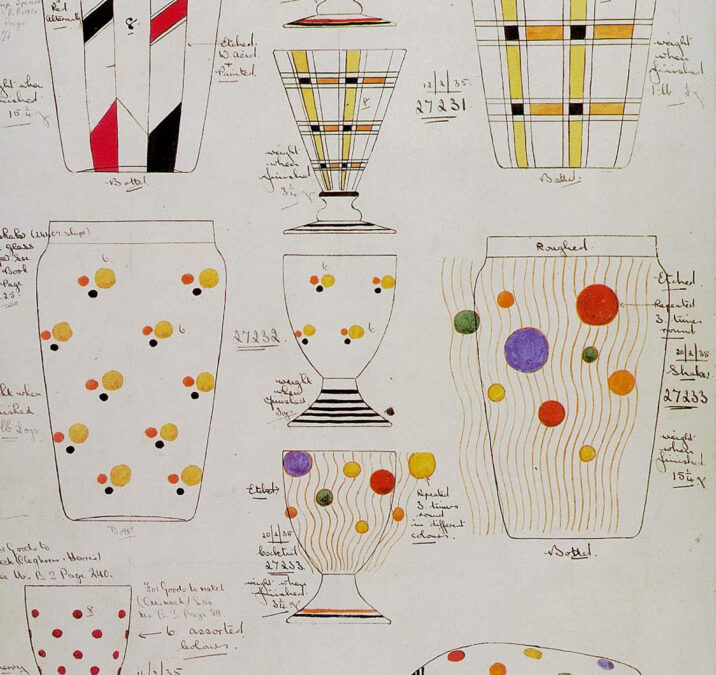
COVER: Art Deco style cocktail and sherry sets, 1935. Stuart & Sons pattern. Photo: Stuart & Sons Ltd.
Printed by BPCC Blackpool Ltd., Stanley Road, Blackpool FY1 4QN
ISBN: 0 9510736 2 1
The Journal of The Glass Association
Volume 3
1990
Contents
Robert and Thomas Hudson — Newcastle Glass Engravers
Alan Leach
1
A Nineteenth Century Glass Factory in Bolton
Peter Helm
7
Christopher Dresser’s Art Glass and Stained Glass
Widar Haler)
13
Enamelled Glass Produced by Stuart & Sons Ltd. 1928-1939
Christine Golledge
25
Further Notices
Joseph Caffrey — Etched Glass from Percival Vickers & Co. in the 1880s
Tom Percival
37
A Poet in the Glasshouse
Greville Watts
41
William ‘Clyne’ Farquharson (1906-1972) — A Short Biography
Roger Dodsworth
47
The Glass Association
Chairman: Anthony Waugh
Hon. Secretary: Roger Dodsworth, Broadfield House Glass Museum, Barnett Lane, Kingswinford, West
Midlands DY6 9QA.
Launched at an inaugural meeting at Stourbridge College of Art in November 1983, The Glass
Association is a national society which aims to promote the understanding and appreciation of glass and
glassmaking methods, both historical and contemporary, and generally to increase public interest in the
whole subject of glass. The Association publishes a quarterly newsletter.
The Glass Cone,
which
includes short articles, news and reviews.
The Glass Cone
is edited by Charles Hajdamach, Broadfield
House Glass Museum, Barnett Lane, Kingswinford, West Midlands DY6 9QA.
The Journal of the Glass Association
is issued every two years. It deals primarily with the history of glass
in the nineteenth and twentieth centuries, although articles on the eighteenth century are published as
appropriate. There is a natural emphasis on the glass of the British Isles, but contributions on overseas
glass are welcome where they relate in some way to British glass. Articles reflect the breadth of interest of
current glass studies in the design, social, industrial and economic contexts of glass as well as its
aesthetic and art historical aspects. Anyone wishing to publish in the
Journal
should contact the editors.
Editors of the
Journal:
Ian Wolfenden,
Richard Gray,
Department of History of Art,
Manchester City Art Gallery,
University of Manchester,
Mosley Street,
Manchester M13 9PL
Manchester M2 3JL
Published by The Glass Association 1990
Printed by BPCC Blackpool Ltd., Stanley Road, Blackpool FY1 4QN
Robert and Thomas Hudson –
Newcastle Glass Engravers
Alan Leach
The Hudson name had been connected with the
Tyneside glass industry for several generations before
a glass engraver came along — the earliest Hudson in
Newcastle is recorded in 1685. We find our Robert
Hudson first recorded as a “glass-cutter and engraver”
in 1789, living at Closegate, near the Newcastle flint
houses
(1)
.
Robert was born in 1757, the son of Thomas
Hudson, a glass-maker. W. A. Thorpe suggested
Thomas was an engraver, too, referring to a “christen-
ing glass dated 1787, which was made and engraved
by Thomas Hudson”
(2)
. Even at his burial in 1789,
Thomas was referred to as a “glass-maker”, so it is
most likely that Thomas made the glass, and had it
engraved by his son. Robert’s training will have been
between 1771 and 1778, and cannot have been with
any other than Thomas Alexander, the father of
Newcastle glass engraving. In 1788 Robert married.
probably on the strength of his trade. His marriage,
which at 30 was a late age for the period, was to Mary
Robe, at St. Andrew’s church, on 4 May 1788
(3)
. It is
probably because the couple were in their thirties that
they had only two children; these were Ann (1789) and
Thomas (1793), who were both born in The Close,
where the
Newcastle and Gateshead Directory
of 1795
lists Robert as a “glass cutter”.
By May 1801 Robert was advertising in the
Newcas-
tle Courant
and again on 17 May 1806, when he
moved to his new shop in Union Street, in the Bigg
Market area of the town. Here he offered:
“.
coats of arms, crests, cyphers or any other
devices engraved on flint glass in the neatest
manner.”
This advertisement leads us to suspect that Robert
engraved the large rummer in the Laing Art Gallery,
Newcastle which carried the Royal arms, the Newcas-
tle arms, a shield and a crest, with the words:
“In Gratitude to the Newcastle Volunteers Peace
October 1801
“(4)
.
There is still one of Robert’s bill-heads extant; it was
rendered in 1803 to the Newcastle Assembly Rooms
for the repair of a girandole
(3)
. This seems to confirm
Baillie’s statement
(
‘
)
that the chandeliers in what are
now referred to as the Old Assembly Rooms (built
1778) were indeed made in the town; perhaps Robert
had a hand in their manufacture as an apprentice.
There are also records of him ordering — from the
Beilby and Bewick workshop — a regular 100 “bills of
parcels” per year from 1805 to 1814, except for 1812
and 1814, when he ordered 200
(7)
. When his wife Mary
died of “consumption” in 1806, the family were living in
High Friar Street, with business premises in the Bigg
Market, as we have seen. He was to keep these two
premises until the last months of his life.
Robert married again
(8)
in 1808, and engraved a
glass (referred to by Thorpe
)
but its whereabouts are
unknown now) to commemorate the occasion. This
marriage, to Margaret Craigs, produced no children,
and we have no more directory references until 1828,
when he is listed twice, as a “glass cutter” and as a
“dealer” in glass and pottery at 10 Union Street, in the
Bigg Market
(13)
. But in 1827 he had written his will
(11)
.
By this he intended to leave his two premises to his
wife and daughter. However, three codicils to the will in
the first three months of 1829 changed all of his 1827
plans.
In the first codicil he records the selling of his High
Friar Street premises to Mr. John Richardson. In the
second, he records the sale of his Union street
premises to Robert Fell, and the placing of the
proceeds in the Dean street premises of Backhouse’s
Bank. So both of his properties had now gone, and on
both codicils one of the signatories was Matthew
Middlebrook, the Sunderland ship-owner. The third
codicil also concerns Middlebrook, for in March 1829
Robert used the money in the bank to buy a quarter
share in Middlebrook’s ship “Rebecca”. The two
witnesses in this case were the two shop-holders on
either side of his Union Street shop. Robert’s signature
on the first two codicils has been getting less and less
firm, but on the third it is very infirm indeed; a novelist’s
imagination might see coercion in the situation. Robert
died in July in Sunderland, and was buried there; he
had evidently followed his ship interests to the town
after a lifetime spent in Newcastle. He left “under 300”
to his wife and daughter.
By the time of his father’s death, young Thomas
Hudson was already into the third phase of a very
varied career. Born in 1793, he would have trained with
his father between 1807 and 1814. He married
(12)
Maria Callender, a surgeon’s daughter, in 1817, and
their first two children
(13)
were born (in 1818 and 1821)
in Orchard Street, at the top of the bank overlooking
the Northumberland Glass Company’s premises in The
Close. The address suggests that Thomas had broken
away from his father; and indeed he could have been
working for Andrew Fenwick, a glass-cutter with a
business in Orchard Street, perhaps doing engraving
work for him as the demand arose.
By 1823 Thomas had moved to High Bridge
(14)
near
his father’s shop, but by 1826 it appears that he was
not engraving at all, but working as an “Inn-Keeper” at
the Black Bull Inn, next to his father’s shop, where the
1827 Directory records him
(13)
. His father’s 1827 will
1
Plate 1.
Rummer engraved by Thomas Hudson, 1843; obverse. Broadfield House Glass Museum, Kingswinford.
2
had ordered that Thomas should receive “the sum of
one pound and all my working tools and implements for
ornamenting Glass”; the 1829 codicils did not alter this,
so we must presume that that was what he received in
the event. This apparent niggardliness need not
indicate discord between father and son, since by that
time Thomas would not need his father’s largesse as
much as would his mother and sister (who was never
to marry). But the fact that the two women were joint
executrixes of the will — Thomas is not mentioned at all
in this respect — does perhaps indicate some degree of
friction; Thomas may have invited his father’s displea-
sure by dropping out of glass engraving.
His father’s tools did not persuade him to return to
his craft, for by 1830
1 6)
he was living in Gateshead and
working as an “Agent”, as he was in 1833, and
probably throughout the 1830s. His agency would
probably have been with Joseph Price, whose busi-
ness was at peak during these years. During this
period Thomas lived at 13 Woodbine Terrace,
Gateshead
(17)
; the house was then newly built, and it
still stands. His business, however, was conducted
from Nun’s Lane, in Newcastle.
By 1814 he had moved house to 48 Blackett Street,
which was to remain the family home for the next
twenty years or so
(18)
. He kept up his ,Gateshead
workplace,’ though, since he is listed in Pipewellgate
(i.e. at or near Price’s factory) as a “glass grinder and
cutter”, as well as in Newcastle as a “glass engraver”.
The 1841 Census suggests that there were “house-
holds” in this new building at the time. One comprised
Thomas and Maria, with their remaining children:
Thomas, 20; Henry, 15; Ann, 12 and Robert, 8. Both
Thomases were described as “glass cutters”, while
Henry was an apprentice warehouseman, possibly
with Price.
A second group was composed of Thomas’ sister
Mary, aged 50, a servant, Maria’s father, and visitors
Henry and Margaret Hemy, with their young son
Charles (ultimately to attain fame as Charles Napier
Hemy, the painter). It was indeed quite an artistic
community in the area, with Margaret Hemy’s father
John Henzell (one of the oldest names in the history of
glass-making) and T. M. Richardson, both eminent
artists, living nearby. And two doors nearer Grey’s
Monument was the “Academy of Arts”.
In 1844 Thomas is once more listed as a “glass
engraver”
(1 9)
,
and is also so described on the marriage
certificate of his son Henry, who wed Isabella Arthur (a
butcher’s daughter) on 8 September at St. Andrew’s
church
(20)
; both were “minors”. But by 1857 the
Directory shows that Thomas’ business arrangements
had changed yet again
(21)
. Two concerns are listed at
the same address in Percy Street, Newcastle; they
were “Price and Hudson” and “Price, Thomas”, and
both were “Cut Glass Manufacturers”.
The latter was Joseph Price’s nephew, who was an
agent for his uncle in 1841, but who died in February
1847 at the age of 36; his venture did not last long.
Price and Hudson had been associated before, as we
know, and their formal liaison could have come in
1845, as a result of the repeal of glass duties. Cut glass
manufacture was at the time perceived to be one of the
best ways of taking advantage of repeal, and Price
would have been keen to revive his factory’s failing
fortunes by association with the area’s most prominent
glass engraver.
Plate 2.
Rummer engraved by Thomas Hudson, 1843:
reverse of pl. 1. Broadfield House Glass Museum,
Kingswinford.
Perhaps it was Thomas who cut the six-sided bottle
which in April 1847 was deposited, with much cere-
mony, in the foundation stone of the new Mechanics
Institute in West Street, Gateshead
(22)
. Price, however
— characteristically — took the credit for it in the press
reports. Incidentally, there was no bottle to be found
when the building was demolished in 1972.
It may be that Thomas’ son, Thomas Smith Hudson
was involved in the venture, too, as he is listed in the
parish register of St. Andrew’s in 1848 as a “glass
manufacturer”. Other than this reference, however, he
was never referred to as anything other than a “glass
cutter”, so it is unlikely that he had a hand in any of the
signed work of “Thomas Hudson”. Indeed, there is no
record of him after the 1840s; perhaps he was the
Thomas S. Hudson who registered some pressed
glass patents
in
the USA in the 1860s.
As inferred above, there is some of Thomas’ work
left to us; there are two signed pieces, and two
possibilities, all apparently from the 1840s. The first,
which is now in Broadfield House Glass Museum in
Kingswinford, is a rummer 20 cm high, engraved on
one side with a horse and jockey, and on the reverse
with cornucopias and the monogram “GW”
(23)
. It is
signed on the base “T. Hudson Engr/Newcastle No.
5/1843”
(pls. 1 and 2)
The second, which is in the Laing Art
Gallery in Newcastle, is a somewhat larger goblet. It is
engraved on one side with Neptune in a chariot drawn
by hippocampi, set in a panel, while the reverse has an
empty panel, flanked by cornucopias of flowers
(24)
. It is
signed on the base “T. Hudson Engr/Newcastle No.
9.
(pls. 3 and 4)
These two pieces are evidently part of a series done
3
Plate 3.
Rummer engraved by Thomas Hudson, 1840s. Laing Art Gallery, Newcastle upon Tyne.
4
by Thomas in the late 1840s. Perhaps they were
speculatively engraved (hence the blank panel) and
displayed to be sold by Price and Hudson; they may
therefore have been made and engraved in Gateshead
at Price’s works, for sale in the partners’ Newcastle
shop. It would be pleasing to discover others in the
series.
The two possibilities are both rummers, and are in
Broadfield House. The first is engraved on one side
with a horse and jockey, similarly proportioned to that
on the first signed piece
(25)
. On the reverse is the
monogram “JH” in a panel surmounted by a basket of
fruit. There is an 1838 coin in the stem; the piece is
15 cm high. The second piece is 13 cm high, and
engraved on one side with a dockyard scene, and on
the other with “J. Holmes” set within an oval cartouche;
there is no date
(26)
.
These two glasses cannot be firmly attributed to the
Newcastle area, but there are several points which
suggest a connection; and if that is acknowledged,
Thomas is the most likely engraver for them, consider-
ing their similarity to the two signed pieces.
Firstly, in 1838 (the date on the coin in the stem) at
the Newcastle Races on the Town Moor, the “North-
umberland Plate” was first run. A jockey called Holmes
was prominent in those years, and though he did not
ride the “Plate” winner, he did ride a winner at that
meeting. Could both of the “horse and jockey” glasses
be connected with the Newcastle races? Indeed, could
the horse be “Beeswing”, which the North had taken to
its heart, and which was dominating the race-cards of
those days? Secondly, “JH” (on the signed glass) and
“J. Holmes” (on the un-signed one) could be the same
person.
Thirdly (though this evidence points in a different
direction to the other two points), the dock-side scene
could be Newcastle, or it could be Hartlepool, where
Joseph Holmes, who came from Newcastle, was a
glass and china merchant. He may have had the glass
engraved and displayed in his shop near the harbour in
the “old” town.
To continue with Thomas’ life, by 1849 he had a new
source of supply for his blanks, for his son Henry, the
“apprentice warehouseman” of eight years previously,
had begun his own flint glass-works, no doubt encour-
aged by the recent repeal of duties
(27)
. This was the
“Falcon Glassworks” at Oakwellgate, Gateshead, near
to Sowerby and Neville’s new “Ellison” works; Henry
sold bottles and flint-glass ware, whereas Soweby and
Neville had only recently begun machine-pressing
glass. It is likely that his father would help him in this
venture, as he himself was only 24 years old.
Plate 4.
Rummer engraved by Thomas Hudson, 1840s: detail of pl. 3. Laing Art Gallery, Newcastle upon Tyne.
5
In 1855 Thomas is listed
(28)
in one directory as a
“glass engraver” and in another
(29)
as an “artist”.
Perhaps this state of affairs arose because of the
influence of his son-in-law William Bullock, who had
married Ann in 1852; he was from London, and was to
describe himself in the 1861 Census as an “Artist on
Glass”. He may well have been working with William
Wailes, at the latter’s stained glass factory.
After 1855 there were several rapid changes in the
linked fortunes of Thomas and his son Henry; they
were changes which must have been linked to the
failing fortunes of the flint glass industry in the area
during that period. By 1856 Alexander Elliott had taken
over the Falcon Works
(3O)
– though it was to last only
two more years before final closure – and Henry had
become acting manager of the South Shields firm of
John Cooke & Co., who made flint glass and green
bottles
(31)
. The owner lived in London, where he had
another factory.
This did not last, and 1857 saw Henry entering a
partnership with Henry Postlethwaite and John
B.
Gates in the Tyne Bottle Company in South Shields
(32)
.
This factory had been owned by Richard Shortridge,
and was soon to become the more northerly branch of
the bottle-works of Bowron & Bailey, of South Stock-
ton. During this period, Thomas was working in South
Shields, too, with premises in West Holborn, at or near
Cooke’s factory
(3
‘
)
. He still “resided” in Newcastle –
though only Maria was listed in the directories of the
time – while Henry quickly had two successive
addresses in South Shields
(
‘
4)
.
By 1857 Henry had finished involvement with flint
glassmaking, and was back in Newcastle, living in
Cumberland Row and operating two businesses in-
volving Commission Agency and sales of Bottles, Ales
and Porter. For the second of these he used his
father’s name, styling the business Thos. Hudson &
Co. There followed a period of unemployment, no
doubt brought about by the “economic hiccup” of that
year. This interrupted the general rising trend of the
1850s and shook out a lot of insecurely based
businesses. Thus it was during this period that he was
declared bankrupt
(3s)
The bankruptcy does not seem
to have been too much to Henry’s detriment, however,
for on the 1861 Census he was still at 23 Cumberland
Row with his family, his brother-in-law and two
servants. He was described as a “town agent”.
Thomas was still alive, but on the 1861 Census was
not at his family’s home. That he was not dead is
argued by the fact that Maria is still described as a
“wife” rather than a “widow”, though she was head of
the household. We do not yet know where he was on
Census night – perhaps in South Shields – nor what
became of him subsequently; his burial is still sought.
Wherever he was, though, it is most likely that by now,
aged 68, he would not have been engraving much
glassware.
So ended almost two hundred years of the Hudson
name being involved with Newcastle flint glass-
making; and with it the most interesting period of glass
engraving in the north-east. For from now on, as
pressed glass replaced it on Tyneside (and Wearside)
glass engraving was to reach new heights in the West
Midlands.
Footnotes
1.
Whitehead,
Account of Newcastle,
1789.
2.
Thorpe, W. A.,
Antiques,
June 1933, p. 208.
3.
Northumberland County Record Office (NCRO), ref. no.
EP.13/7.
4.
Laing Art Gallery, Newcastle upon Tyne, Accession No.
G.765.
5.
Charleston, R. J., “Some English Glass Engravers: late
18th-early 19th century”,
Glass Circle,
No. 4, 1983, p.
7.
6.
Baillie, Rev. J.,
An Impartial History of the Town and
County of Newcastle upon Tyne,
Vint and Anderson,
Newcastle upon Tyne, 1801, p. 217.
7.
Ellison, M., “The Tyne Glasshouses and the Beilby and
Bewick Workshop”,
Archaeologia Aellana,
5,
III,
p. 160.
8.
NCRO, ref. no. EP.13/27.
9.
Thorpe, W. A., op. cit.
10.
Pigot,
Directory of Durham,
1828.
11.
Will of Robert Hudson of Newcastle – 1827; in
Index of
Wills, 1787-1831
(under 1830, Wills), at University of
Durham, Dept. of Palaeography and Diplomatic.
12.
NCRO ref. no. EP.73/24.
13.
NCRO ref. no. EP.86/7.
14.
ibid.
15.
The Newcastle and Gateshead Directory,
1827.
16.
NCRO ref. no. EP.86/8.
17.
Richardson, M. A.,
Newcastle and Gateshead Direc-
tory, i
838.
18.
Robson,
Directory of Newcastle upon Tyne,
1841.
19.
Williams,
J.,
Commercial Directory of Newcastle,
1844.
20.
NCRO ref. no. EP.13/32.
21.
F. White & Co.,
Directory of Newcastle upon Tyne and
Gateshead,
1847.,
22.
Gateshead Observer,
Local Records of Gateshead,
1847.
23.
Broadfield House Glass Museum, Accession No.
61
–
1903.
24.
Laing Art Gallery, Newcastle upon Tyne, Accession No.
G.779.
25.
Broadfield House Glass Museum, Accession No.
BH919.
26.
Broadtield House Glass Museum, Accession No.
BH1116.
27.
Gateshead Observer,
28 April 1849, p. 1, col. 5.
28.
Ward,
Directory of Newcastle
etc., 1855.
29.
Whellan,
Directory of Northumberland including Gates-
head,
1855.
30.
Ross, C.,
The Development of the Glass Industry on the
Rivers Tyne and Wear 1700-1900.
A thesis submitted
for the degree of Doctor of Philosophy from the
University of Newcastle upon Tyne, 1982.
31.
Ward, op. cit.
32.
Gateshead Observer,
28 November 1857, p. 1, col. 2.
33.
Ward,
Directory of Newcastle, Gateshead, Sunderland,
North and South Shields,
1857-58.
34.
Gateshead Observer,
op. cit.
35.
ibid.
6
A Nineteenth Century Glass Factory in Bolton
Peter Helm
Although glass factories had been established in the
St. Helens/Warrington area by the mid eighteenth
century, they did not reach the south-east of Lan-
cashire until very late in the century, or very early in the
nineteenth century. By 1830, the pattern in Manchester
had become well-established, with the building of
factories close to the navigable River Irwell and in
particular, in the Ancoats (or Little Venice) area of the
town, by the side of the many canal branches. One of
the Ancoats factories was that of Burtles, Tate & Co.,
established in George Leigh Street (off Poland Street)
by Thomas Burtles and Matthew Tate in 1858. The firm
obviously prospered because, in 1883, their advertise-
ment in
The Pottery Gazette & Glass Trade Review
recorded that they were in Poland Street and at
Victoria Works, Bolton, Lancashire”. How — when the
glass-making tradition was firmly rooted in Manchester
— did Burtles, Tate & Co. come to be involved in making
glass in the comparatively distant town of Bolton?
Examination of available records at Bolton shows
that a glass factory was operating at Parrot(t) Street,
off Derby Street at least as early as 1851. It had access
to the railway, and was presumably located there as a
direct result of construction of the railway line on the
south-eastern boundary of the factory site. There is no
other known record of a glass factory in Bolton in the
nineteenth century and, unfortunately, all rating re-
cords for the period 1838 to 1896 — during which period
the factory was built, prospered, and died — have been
lost.
Gee & Armstrong
Bolton directories for 1849 and earlier have no
entries under “Flint” or “Glass”, the first directory entry
being for 1851 — presumably from information collected
in 1850 — which appears as “Geo Thomas & Co.,
Albion Flint Glass Works, Parrott Street, near Derby
Street”. This is thought to be an error for “Gee Thomas
& Co.
“. A notice in the local press in March
1851
(-0
suggests the ending of a partnership between
Samuel Armstrong of Bolton, Glass and Earthenware
Dealer, Thomas Molineaux of Manchester, Glass
Manufacturer, and John Yates of Bolton, Pawnbroker,
as Armstrong was here assigning “all his Estate and
Effects whatsoever” to Molineaux and Yates upon trust
for the benefit of Armstrong’s creditors. Molineaux was
almost certainly the principal of the Molineaux, Webb
factory, established in Kirby Street, Ancoats (Manches-
ter) about 1826, and he may have been the builder of
this Bolton factory. However, two days later
(2)
, Thomas
Gee and Samuel Armstrong, Glass Manufacturers,
were assigning by Deed all their personal estate and
effects to two other trustees for the benefit of the
creditors of Gee & Armstrong, so it is likely that Gee
and Armstrong were the partners in the firm of Thomas
Gee & Co. which was listed in the 1851 directory. In the
following week’s issue of the paper there appeared a
detailed notice of the sale — under a Deed of
Assignment — of a “Glass Blower and Manufacturer’s
Stock in Trade, Machinery, Implements, and
effects”
(3}
. The stock in trade comprised “Fish
Globes”; “Gas Consumers and Ring-Top Shades”;
“Frosted Etruscan Lamps”; “Confectionery Jars”;
“Cut and Frosted Gas Moons”; “Plain, Flint, and
Pressed Tumblers and Wines” (162 doz.);” Plain
Decanters”; “Watch Balls”; “Bulb Glasses”; “Flower
Tubes”; “Cruets”; “Flint and Coloured Lamp Makers’
Tubing”; “Celery Glasses” (60); “Water Bottles”;
“Naphtha Lamps”; “and a great variety
of other Uncut Stock”. Machinery and implements
included 50 blowing irons and punties; 7 chairs
and marvers;
middle sized glass makers press
seige paddles
3 glass cutters troughs with
hoppers; and 60 Dudley & Billinge stones. On 31 May
1851 the Works were advertised for Sale or to Let
(4)
.
They were described as The Albion Flint Glass Works
in Parrot Street, Bolton-Moor, “lately occupied by
Messrs Gee & Armstrong
The Buildings could be
advantageously adapted for a Cotton Mill
There is
a new excellent
10-horsepower
High Pressure Engine
upon the Premises
with a 16hp Boiler; Shafting &
Gearing. To a person of moderate Capital this affords
an excellent opportunity for entering the Glass
Trade
“. In July 1851 another announcement
made it clear that the late firm of “Thomas Gee and
Samuel Armstrong” trading under the style of “Gee &
Armstrong” had traded well beyond the point from
which they might expect to have recovered, the
creditors being paid only 1s 5
1
/2d in the £
(5
). Finally, in
November 1851, Samuel Armstrong
“lately car-
rying on business at Bolton-le-Moors
under the
style or firm of “Gee & Armstrong” as Glass Manufac-
turers” was required to appear at the Bankruptcy Court
in Manchester, and was presumably declared
bankrupt
(6)
.
The source of the workforce may be judged from
entries in the Census Returns of 1851 for the area in
the immediate neighbourhood of Parrot Street. Four
glass blowers are shown — Joseph Ratcliffe, born in
Warrington, his two sons John and Thomas, both born
in Manchester, and another young man also born in
Manchester; a 17 year old glass cutter born in
Manchester; a packer, born in Manchester; and a 10
year old “Glass Carrier”, born locally. Entries for Gee
and Armstrong could not be found.
7
///
;
//
/
/ /
/ / /
/
Wartitov5e
/
5011€
2
5tvreys
I 10,7 x.231
/ / / / / / / / / / ( / /
/1
eAfAcT
Plate 1.
Tracing of a Plan relating to Richard Walton’s
Glass Works in Parrot Street, from the original in a “Folder containing Plans of all the Cotton, Iron and
other Works in the Township of Great Bolton
in
the year 1857
“. Bolton Reference Library
(Archives), ref: BN:ZZ/62/1 (58).
8
Richard Martin and Richard Walton
The 1853 directory records Richard Martin and
Richard Walton as being the manufacturers at what is
now called Bolton Moor Glass Works, with Samuel
Walton as manager. As Richard Walton’s house was in
Parrot Street, and Samuel Walton’s in nearby Derby
Street, it seems that Bolton Moor was the contempor-
ary name for the works known both earlier and later as
the Albion Works; and finally as Victoria Works.
In 1857, plans were drawn up “of all the Cotton, Iron
and other Works in the township of Great Bolton,
Parish of Bolton, in Bolton-le-Moors” for Rate Assess-
ment purposes, and these have survived. Richard
Walton’s name appears as ratepayer
(
P
111
. Thus there
appears to be continuity of tenure by Richard Walton
between 1853 and 1857. This theory is undermined by
the appearance of a notice in 1856 announcing that
“the partnership lately existing between Joseph Ratc-
liffe and John Ratcliffe” — whose names appeared as
glass blowers in nearby Apple Street in the 1851
Census — “carrying on the business of Glass Manufac-
turers at Great Bolton
under the firm of “Joseph
Ratcliffe” has
been dissolved
and that the
business will in future be carried on by Joseph Ratcliffe
alone
”
(7
). A break in continuity of Richard Walton’s
tenure is possible, but seems unlikely.
Walton, Yates & Walton
By April 1861 the partnership was between Richard
Walton, Daniel Yates and Samuel Walton, trading as
“Walton, Yates & Walton”, but a legal notice in that
month announced the partnership’s dissolution, the
continuing partners being Richard Walton and Daniel
Yates
(8)
. The 1861 directory entry relates to “Walton &
Yates, Parrot Street”, with the residence of both men
shown as 207 Derby Street, close to the factory.
Richard Walton was the father-in-law of Daniel Yates,
Walton having been born in Oldswinford (in 1803,4),
his daughter Susannah (Yates’s wife) in Kingswinford
in 1835/36, and Yates himself in Hutton in Lancashire.
Thirty three entries relating to glass factory employees
(other than Walton and Yates) were found in the area
of the factory in the 1861 Census. Their recorded
birthplaces may be analysed as follows:—
Knowsley
Tyldesley
St. Helens
Wigan
Hulton
West
Warrington
Hindley
Bolton
Ireland
Midlands
Oth
e
r
Glass blowers
1
1
Glass makers
5
9
1
1
1
Glass cutters
5
3
Packers.
labourers etc
—
1
11
2
10
5
3
2
Daniel Yates
In 1865 the factory was under the sole control of
Daniel Yates. Unusually for a glass manufacturer.
Yates caused an advertisement to be printed in the
local directory, and this showed the factory’s products
to be “All kinds of cut and press Glass
and Press
Goods of all descriptions for the Indian and Australian
markets”
(
P
1.2)
. The appearance of the advertisement
might have indicated a buoyant trade; or, more likely,
that he was struggling to find new markets. This latter
was probably the case as, on 13 February 1868, Yates
executed a Deed ”
assigning
all his Estate
and Effects, to be applied
for the benefit of his
creditors, as in Bankruptcy
”
(9)
. In March 1868,
there was a notice of sale by auction of “The valuable
DANIEL YATES
‘Albion Flint Glass Works,
BOLTON, LANCASHIRE!
All
kinds of CUT &
PRESS
Gr L
AL
Gas Globes, Cut and Plain; Paraffin Globes and Chimneys; Lamps,
Chimneys, mild Press Goods of all descriptions for the Indian and
Australian Markets.
Merchants’ Orders for Export
Goods
executed with despatch.. Publicans, Innkeepers,
(!fc.
supplied at wholesale prices.
Plate 2.
Daniel Yates’ advertisement in
Slater’s National Commercial Directory of Lancashire 1865.
9
WILLIAM TOOTELL,
CRUCIBLE
MANUFACTURER,
ws,,c„
e
msx
fOT
mApa,
AND BRASS ASHES WASHER,
38, Shaw Street, BOLTON.
Plate 3.
Advertisement of William Tootell in
Axon’s Bolton Directory,
1881.
Glass Works and premises situate in Parrot Street,
Bolton known as “The Albion Flint Glass Works” in the
occupation of Mr. Daniel Yates”
(19)
. By this date the
works had two furnaces, one with ten 30-cwt pots, the
other with seven 12-cwt pots. The accommodation
included “Mould Room, Cutting Room, Warehouse,
Showrooms, Packing Room,
Sand Room, and
Mixing Room”, and there was a “12-Horse Vertical
Steam Engine” and associated boiler.
A further notice was published in April 1868,
addressed to “Glass Makers, Dealers, and Others”
relating to the Sale by Auction of the whole of the
machinery, plant, fixtures and extensive Stock-in-
Trade
(11)
. Included were “86 Press, Pillar and Dip
Moulds, 190 Blowing Irons, 60 Spring Punties, 13
Large Pots
large Press by Landells & Co., ditto by
Humphries
20 Glass Cutters Frames and Hop-
pers, six Ratting Machines, six Frosting Machines
”
The Stock-in-Trade was substantial, including 30,000
grogs and tots, 21,600 pressed tumblers, over 4,000
goblets and ales, and a similar number of pairs of
sugars and creams, with a further 900 frosted sugars
and creams. There were nearly 6,000 dishes of various
sizes, and 144 frosted salvers. The raw material stock
included French sand, red lead, nitrate of soda, lime,
pot clay, etc. The presence of pot clay would seem to
indicate that the factory made its own pots, even
though there may have been a specialist manufacturer
locally — William Tootell advertised himself as “Cruci-
ble Manufacturer and Glass House Pot Maker” in
Shaw Street in 1881
(0.3)
.
Samuel Walton
In 1870/71 Samuel Walton was again involved, as
“flint glass manufacturer, Albion Glass Works, Parrot
Street, ho(use) 42 Parrot Street”, but it seems that he
was unable to succeed as, in August 1870, the works,
plant etc. and stock-in-trade are again for sale
(12)
. It is
likely that the factory was in operation at the time of the
1871 Census as Samuel Walton (aged 32, born
Wordsley) still described himself as a glass manufac-
turer, and whilst there are three entries of “Glass
Blower (unemployed)” — two from Bolton and one from
Newcastle-upon-Tyne — ten entries were found for
“Glass Maker” and “Glass Blower” not claiming to be
unemployed.
Percival, Vickers & Co. Ltd.
By 1874 the Bolton directory was showing the
Manchester firm of Percival, Vickers & Co. Ltd. as the
occupier of the factory. No more legal notices appear in
the press, so presumably the operations remained
stable from then on, at least for the period during which
the factory was under the control of Manchester based
firms.
Burtles, Tate & Co.
In, or shortly before 1881 the factory had changed
hands yet again, coming under the control of Burtles,
Tate & Co., with Benjamin Burtles as manager. As
10
Plate 4.
A plan of the disused Parrot Street Glass Works as surveyed in 1890 by the Ordnance Survey.
11
stated earlier, in 1883 the Burtles, Tate advertisement
in
The Pottery Gazette
now included a reference to the
Bolton factory, and it is apparent that the firm continued
to operate the factory until 1888, by which time the
name of Joseph McQuarters appears in the directories.
After that date no more entries appear for glass
manufacturers, and by 1890, when the Ordnance
Survey carried out a 1:500 survey of the area, the
factory was recorded as “Glass Works (disused)”. The
plan shows the chimneys of both furnaces, as well as
the railway’s coal sidings at the south east of the
site
(
P
I.4)
.
In the Rate Book for 1897, in the position where the
factory entry might be expected, there is an entry for
“Yard, Stables, Workshops and Appurtances” in the
name of Magee, Marshall & Co. Ltd., which may have
been the factory. The date of its demolition is not
known, but the site has now been redeveloped and no
trace of the buildings remains.
The Glass
Since the factory operated for about 40 years, and
must have had a considerable output, judging by the
sale notices, some must have survived, although none
has been identified. Bolton Art Gallery and Museum’s
display includes a blown and cut celery glass having
many of the characteristics of Manchester — and
particularly Percival, Vickers or Burtles, Tate — manu-
facture; and also shown are several moulded goblets
or ales which similarly relate to known Manchester-
registered shapes and patterns. The interval of 100
years since glass was last made in Bolton makes it
unlikely that even folk memories of the factory and its
products remain, but a link across the century is not
impossible.
Footnotes
1.
Bolton Chronicle & South Lancs. Advertiser,
15 March
1851, page 4, col 4. Bolton Reference Library (Arc-
hives).
2.
Ibid.
3.
Ibid., 22 March 1851, page 4, col. 5.
4.
Ibid., 31 May 1851, page 4, col. 2.
5.
Ibid., 12 July 1851, page 4, col. 2.
6.
Ibid., 8 November 1851, page 1, col. 2.
7.
Ibid., 19 January 1856, page 4, col. 4.
8.
Ibid., 6 April 1861, page 4, col. 3.
9.
Ibid., 29 February 1868, page 4, col. 5.
10.
Ibid., 14 March 1868, page 4, col. 3.
11.
Ibid., 18 April 1868, page 4, col. 2.
12.
Ibid., 6 August 1870, page 4, col. 2.
12
Christopher Dresser’s Art Glass and Stained Glass
Widar Haien
The nineteenth century was a period of great industrial
and artistic expansion, and there was an increasing
interest on the part of both manufacturers and collec-
tors in the glass of the ancient world — Egyptian,
Islamic, Roman, and particularly Venetian — leading to
a revival of earlier styles and techniques. The emerg-
ence of this new glass, frequently called aesthetic or
art glass, can be compared to that of art pottery. It
developed from the simple formation of the material
per se,
but led to ever greater surface embellishment,
and to the production of so-called fancy glass in the
latter part of the century.
Art glass stood in sharp contrast to the popular lead
crystal and cut glass which had been so criticised by
John Ruskin. He believed that cut glass violated the
molten nature of the material and advocated a revival
of Venetian glass methods
(1)
. Other arbiters of design
reform such as Christopher Dresser, Charles L. East-
lake, and William Morris
(2)
championed this revival,
and in their time Venetian glass was imported in
quantities and formed suitable sources of inspiration.
Christopher Dresser (1834-1904), reform theorist,
botanist, and the most successful designer to emerge
from the School of Design, was one of the first to
acknowledge contemporary progress in glassmaking
under Venetian influence. His
Development of
Ornamental Art in the International Exhibition of 1862
devoted an entire chapter to “Glass for Decorative and
Household Purposes”. He praised the “exceeding
advantage of the simplicity of treatment” apparent in
the glass exhibited by James Powell & Co., and by
J. Lobmeyer of Vienna, and endorsed the “rapid
progress” in glassmaking. He stressed that this “more
exalted art” originated from a renewed respect for the
molten material:
“It will be found that whenever the true susceptibili-
ties of a material are sought out, and the endeavour
is to produce beauty by the mode of working which is
most befitting to the peculiar mode in which the
material is worked, that the manufactures progress
in art.”
(3)
Few, if any, materials, maintained Dresser, lent
themselves more readily to the purpose than glass and
clay, and he stressed the similarity between the glass
blower’s rotating of the pipe and the potter’s work at the
wheel. Both methods involved the most appropriate
recognition of natural laws and brought about shapes
that were beautiful, simple and functional. Indeed, it
was this kind of scientific interest which inspired
Dresser to launch a set of principles conducive to the
development of art pottery and art glass in Britain.
They were first treated as fully fledged subjects in his
articles on “Principles of Decorative Design” in 1871.
Here he expressed admiration for the complicated
scientific techniques which underly the working of
glass — later to materialise in his own glass designs.
In accordance with the doctrines of art furniture and
art pottery, Dresser voiced a preference for bold artistic
effects rather than excessive finish in the production of
glass. He quoted his sources of inspiration as Greek,
Roman and Venetian prototypes, which formed the
basis of his own glass designs, and recommended only
a limited use of cutting and engraving, stressing the
importance of appropriate working methods:
“Glass has a molten condition as well as a solid
state, and that while in the molten condition it can be
blown into forms of exquisite beauty
. For the
operation of gravitation and similar forces upon
plastic matter is calculated to give beauty of form.
(4)
An illustrative sample of a simple hock bottle,
described as a mere elongated bubble, “with the
bottom portion pressed in so that it may stand, and the
neck thickened by a rim of glass being placed around
it,” served to demonstrate the truth of this state-
ment
(
P
I-1)
. This led Dresser to the consideration of
fitness for purpose, which was one of his favourite
topics, and he presented a set of principles which were
remarkably ahead of their time and have remained
appropriate to this day:
“A bottle is only intended to be filled once, whereas a
decanter will have to be filled many times; and a
bottle is formed so that it may travel, while a
decanter is not meant to be the subject of long
journeys. . . . All objects which are meant to be
refilled many times should have a funnel-shaped
mouth, but if a bottle had a distended orifice it would
not be well adapted to transport. As most decanters
are intended to hold wine, the brilliance of which is
not readily apparent when that portion of the vessel
which contains the liquid rests immediately upon the
table, it is desirable to give to the vessel a foot, or, in
other words, raise the body of the decanter so that
light may surround it as fully as possible.”
(5)
In order to fulfil all the practical requirements for such
domestic glass vessels, Dresser repeated his dictum
that spouts and handles should be placed in accord-
ance with the centre of gravity. His illustrations of jugs
and decanters in
Principles . . .
were used as practical
examples of his argument
(
P
1.1)
.
Dresser is known to have designed a number of
similar glass containers for his electroplate mounted
decanters, cruets and condiment sets produced by
Elkington & Co., James Dixon & Sons, and by Hukin &
Heath from about the late 1870s onwards
(
P
L2)
, and he
may well have been engaged in glassmaking when he
published his articles on glass in 1871. Numerous
drawings of decanters and bottles in his sketchbook
13
Plate 1. Glass shapes recommended by Dresser ln his articles on ”Principles of Decorative Design”,
The Technical Educator,
vol.
III, 1871, p. 49.
14
Plate 2.
Hukin & Heath electroplate cruet stand with glass containers designed by Dresser in October 1877 and registered with
the Patent Office Design Registry, 31 July 1878. Photographed by Nikolaus Pevsner in 1936, and reproduced in his
article on “Christopher Dresser, Industrial Designer”,
The Architectural Review,
LXXXI, 1937, pp. 183-186. By kind
permission of the Getty Center of the History of Art and Humanities, Archives of the History of Art, Los Angeles,
California.
15
from about 1862 to 1875 suggest that this was the
case, but until recently the makers have remained
unknown
(
P
I.3)
. The bottles and containers for his elec-
troplate designs, however, were almost certainly pro-
duced by the Tees Bottle Company of Middlesbrough
on Tees. The scant information available about this
company confirms that it had a depot in London by
1879
(6)
and in 1880 launched its “new artistic glass” at
the opening of Dresser’s Art Furnishers Alliance Co. in
New Bond Street, London
(
‘? The Tees Bottle Co.
supplied a number of goods to the Alliance between
1880 and 1883. Dresser may well have instigated the
contact when he visited Middlesbrough in 1878 and
also met John Harrison with whom he founded the
Linthorpe Art Pottery in the following year.
We know that most of the goods marketed by the Art
Furnishers’ Alliance were designed by its art director
Dresser, and we may therefore surmise that he was
possibly the master of the new artistic glass” made by
the Tees Bottle Company.
Dresser’s major contribution to the production of art
glass was his understanding of the technical aspect of
glass blowing. His acknowledgement of novel techni-
ques of manufacturing made him aware of wholly new
colours and textures, and in
Principles of Decorative
Design
his interest in the aesthetic appeal of coloured
glass was based on the inherent characteristics of the
medium:
Plate 3. Glass designs in Dresser’s Sketchbook, dated
1862-1875, p. 6, Ipswich Museum, Ms. 1972-72.
“Glass is capable of assuming the most delicate of
shades, of appearing as a soft, subtle golden hue of
the most beautiful light tertiary green, lilac, and blue
and indeed, of almost any colour. .. . A dinner table
requires colour. Let the cloth be pale buff, or
cream-colour, instead of white; and the glass water-
vessels of very pale, but refined and various tints;
and the salt-cellars, if of glass, also coloured, in a
tender and befitting manner, and a most harmonious
effect will be produced.”
(8)
In this way Dresser prepared the way for art glass,
just as he had promoted the emergence of art furniture,
art pottery and art interiors. His own designs for Clutha
glass produced by James Couper & Sons of Glasgow
are typified by a daring use of colours combined with
hand blown and industrial manufacturing techniques.
Brian Blench, the expert on James Couper’s glass,
recently suggested that Dresser first became in-
terested in the company’s production of St. Mungo
glass, which was a Venetian-inspired material used by
stained glass artists in the 1860s and 1870s. He
believes that Dresser’s Clutha glass was made some
time in the late 1870s or early 1880s
(9)
. The subtle
colouring of St. Mungo glass does indeed accord with
Dresser’s theories on stained glass, and his windows
for Allangate Mansion, Halifax, of 1870-71, and
Bushloe House, Leicester, of 1879-80, may well
incorporate this material. St. Mungo glass was, in fact,
used by Dresser’s student, John Moyr Smith in his
interiors for Stirling’s Library built in Glasgow in 1865,
but unfortunately these have been destroyed
(10)
.
It has proved impossible to pinpoint the date of the
first production of Clutha glass, but Blench’s hypoth-
esis seems reasonable, and Dresser’s daughter Nellie
provided the date of 1880 for two pieces of Clutha
glass from her father’s collection, given to the Victoria
and Albert Museum in 1952. She also said that her
father made a few designs for his friend Arthur Liberty’s
company in 1882
(11)
. Amongst these were certainly the
Clutha glass pieces retailed by Liberty’s from about this
time and described as “Decorative, Quaint, Original
and Artistic”
(12)
. Liberty and Dresser had been friends
since at least 1875, when Liberty is recorded to have
helped fitting up Dresser’s Japanese Village at the
Alexander Park at Mulberry Hill. Liberty was a main
shareholder in the Art Furnishers’ Alliance company
founded by Dresser in 1880, and he took over many of
its products, including Dresser’s Clutha glass, when it
went into liquidation in 1883. Arthur Liberty had
recognised the potential of the Alliance and of Dres-
ser’s designs, and he appears to have organised his
own company after much the same pattern in 1883,
when he opened his Furnishing and DecOrating
Studio”
)
. Mervyn Levy recently emphasised that
“Arthur Liberty’s awareness of the need for change
derived partly, at least, from his close friendship with
Christopher Dresser”
(14)
. Dresser’s “Kardofan” candle-
holder made by Richard Perry & Son and his Clutha
glass were among Liberty’s most popular products,
and exemplify the purity of form which was to characte-
rise the Liberty style during the first part of the twentieth
century.
It has been suggested that the word Clutha was
derived from the Gaelic “cloudy”, but in fact it was
probably invented by Liberty’s, as were the names of
Dresser’s Kardofan candleholder and Archibald Knox’s
(1864-1933) later Cymric silver and Tudric pewter.
16
These fictitious Gaelic or Celtic sounding names were
intended to promote the idea of a national art, and
Clutha glass was frequently set in Tudric pewter during
the late 1890s. The Clutha glass retailed by Liberty &
Co. was marked with the company’s lotus flower
trademark and the words “Clutha, Designed by C. D.
Registered ”
(PI 4)
. A few pieces with the James Couper
& Sons mark have been traced, but, to confuse
the matter, most samples appear without marks. Some
of these have been recognised amongst the goblets
and jugs photographed by Nikolaus Pevsner from
Dresser’s account book for 1881
(15)
. Clutha glass is
deliberately bubbled and streaked in daring shades of
colour, incorporating “the subtle golden hues of the
most beautiful light tertiary green, lilac and blue, indeed
in almost any colour,” suggested by Dresser in
Principles of Decorative Design.
His favourite “green-
ery-yallery” scheme seems to prevail in Clutha glass,
but secondary and tertiary colours of amber, lilac,
purple, pink, turquoise, etc. were also incorporated
separately or in perfect fusions of tints.
During the 1870s, methods were developed in
Britain whereby one vessel with several colours could
be made. The technique, which involved the infusion of
coloured particles into the glass while it was exposed
to the heat, gave a seemingly faulty disposition of
colour, revealing patches or streaks of different tints.
Dresser was amongst the first designers to adapt the
technique, and his Clutha glasses frequently display
irregular patterns in lighter and darker shades, and
occasionally the multi-coloured technique of “solif-
luer”
(0.5)
. More regular combed and spiralling patterns
were also produced
(PI-6)
, but the seminal importance of
Clutha glass was that it reproduced Roman and
Venetian aventurine and murrhine techniques. These
permeated the colourful glass with irregular metallic
streaks or foils, and gave it a jewel-like brilliance which
had not previously been seen in Britain. It rapidly
became popular, and earned Clutha glass an interna-
tional reputation
(
P
I-7)
. A kind of bubbled, speckled and
frosted Clutha glass with lustre patches in the antique
fashion was a late product of the company, and was
probably introduced by the Glasgow architect-designer
George Walton (1867-1933). Walton replaced Dres-
ser as their chief designer in 1896, but continued to
produce the kind of glass and shapes popularised by
Dresser.
There are as many shapes as there are colours in
Dresser’s Clutha glass, and not two pieces are
identical. Frequently characterised by attenuated
Plate 4. Clutha glass vases produced by James Couper & Sons of Glasgow, all marked with Liberty’s lotus trademark and
“Clutha Designed by C. D. Registered”, c. 1883, 8.9cm-58.0cm. Private Collection.
17
•
..
Plate 5.
Clutha solifleur vase by Dresser, produced by James Couper & Sons, marked Liberty’s lotus trademark and “Clutha
Designed by C. D. Registered”, c. 1883, 33.5cm. Private Collection. Photographed by Christie’s, London.
18
Plate 6.
Clutha green glass vase moulded with spiralling
grooves by Dresser, made by James Couper &
Sons, marked Liberty’s lotus trademark and
“Clutha Designed by C. D. Registered”, c. 1883,
28.5 cm. Photograph by Sotheby’s, London.
necks with furled or wavy rims, Dresser’s vases have
been compared to his dissections of flowers, and
clearly some of his trumpet shaped vases owe much to
his artistic botany. Others relate to his ceramic
designs, as, for instance, the twisted vase inspired by
Japanese Tamba pottery, and the Pre-Colombian
shaped Clutha vase illustrated in
The Studio
article on
Dresser’s work
(p1s.8and4).
Persian and Indian water-
sprinklers and Japanese tall-necked bronze vases
acquired by the South Kensington Museum in the
1870s and 1880s also inspired some of Dresser’s
elongated and slightly bent vase-necks
(
P
1
:
4)
, while
others again reveal his liking for the oriental gourd and
ninepin shapes
(0
:
9)
. His jugs incorporate the angular
handles which predominate in the designs photo-
graphed by Pevsner in 1937
(
p
14
) In some cases a
decorative effect of horizontal trailing is applied to his
vases
(p1.10).
The machine which enabled this kind of
glass threading to be applied to vessels had been
patented by William J. Hodgetts in 1876, and Dresser’s
Clutha glass demonstrates his delight in such inven-
tions. Conceived in an antiquarian spirit, but revealing
novel techniques, colours and textures, Clutha glass
soon attained a solid commercial footing, providing an
impetus to the production of much late nineteenth
century art and studio glass.
Sowerby’s new art glass was exhibited next to
Clutha glass at a special glass show organised by the
Art Furnishers’ Alliance in 1882. The show attracted
considerable attention in the art press and the critic of
The Cabinet Maker’s and Art Furnisher’s Journal
announced it as:
“A new kind of glass of English manufacture, which
in point of artistic merit and originality promises to
rival the finest examples of the old Venetian glass-
blowers. The specimens on view will be large and
important decorative works, which are in no degree
imitiative, but have a character essentially original as
regards design and treatment, and are far more
improving than the examples of glass-blowing with
which we have hitherto been farniliar.”
(16)
Some of the first Clutha and Sowerby art glass
measured up to 60 cm in height, and their shapes,
colours and textures show distinct similarities. It has
been suggested that Dresser was involved with Sower-
by’s production, but he was probably more of an
inspiration than an instigator
(l
n.
It was around this time that William Morris first
expressed his views on art glass, and he was certainly
well aware of Clutha and Sowerby art glass by then.
His recommendation of plain hand-blown glass with
“specks and streaks” seems to echo Dresser’s, but
Morris never designed any art glass himself. It is
probable, however, that he inspired Philip Webb
(1831-1915) to create the plain and simple table glass
Plate 7.
Clutha amber glass vase in murrhine technique
with metallic foils by Dresser, made by James
Couper & Sons, marked with Liberty’s lotus
trademark and “Clutha Designed by C. D. Reg-
istered”, c. 1883, 58cm, Victoria and Albert
Museum, London.
19
Plate 8. Clutha glass by Dresser in
The Studio Magainze, vol. XV,
1898, p. 105.
20
Plate 9. Clutha glass ninepin-shaped streaked green vase,
attributed to Dresser, unmarked, 1880s, 40cm.
Private Collection.
which was produced by James Powell & Sons and
retailed by Morris, Marshall, Faulkner & Co. from about
1861 onward
(I8)
. The simplicity of Webb’s glass in fact
matched that of Dresser’s Clutha glass, and set the
pattern for Powell’s subsequent glass production, such
as the pale green glass designed by Thomas Graham
Jackson from 1874 onward, and Harry Powell’s
(1853-1922) art nouveau glass, all of which featured
regularly at the Arts and Crafts Exhibitions
(19)
. Clutha
glass was shown next to Powell’s at these exhibitions,
and they were frequently compared by contemporary
critics. This kind of glass was regarded as the result of
individual craftsmanship rather than as a commercial
product, hence the generic term art glass
(20)
. Plain and
simple art glass was in considerable demand during
the 1880s and 1890s, and the designer Lewis F. Day
(1845-1910) in his articles on “Victorian Progress in
Applied Design” noted that it was, “in the graceful
forms of blown glass that our recent advance is most
evident”
(21)
. The expansion of the cut glass industry,
however, frequently inhibited this progress.
The Pot-
tery Gazette
in 1882, for instance, told its readers that,
The age of plain glass is gone or going, and cut and
engraved glass is fast coming in again, in spite of Dr.
Dresser and Oscar Wilde”
(
‘
)
.
There was certainly a revived interest in some of the
more elaborate types of glass production and decora-
tion in the late 1880s, but the soundness of Dresser’s
principles and the success of his Clutha glass con-
tinued to play an important role in British glass making.
Plate 10. Clutha glass opaque green vase with horizontal
trailing, slightly bubbled, by Dresser, produced by
James Couper & Sons. Liberty’s lotus trademark
and “Clutha Designed by C. D. Registered”, c.
1883, 28 cm.
It may well have prompted Thomas Webb & Sons to
produce a similar range of art glass called “Old
Roman”, which in 1888 led to a complaint from James
Couper’s, alleging deliberate copying and infringement
of their copyright
(23)
. Under Dresser’s influence British
glassware attained an expressive characteristic which
was based on the consistency of molten glass and the
varying refraction of colour and light. A similar effect
can be obtained in stained glass.
Dresser dealt thoroughly with stained glass in his
Principles of Decorative Designs.
Seeking historical
precedence, he looked back to the medieval tech-
niques and methods advocated by Pugin, Ruskin and
Morris, These disciples of the art of the Middle Ages
had discarded the painted windows of later times, and
returned to the use of flat areas of coloured glass
bounded by dark lead lines. The Gothic designs of
Augustus W. N. Pugin (1812-52) were highly popular
in the 1850s, but by the 1860s Morris is known to have
experimented with a different kind of stained glass
production. Edward Burne-Jones (1833-1898) and
Ford Madox Brown (1821-1893) were encouraged to
realise the new ideas, and during the late 1860s
Morris, Marshall, Faulkner & Co. launched its Pre-
Raphaelite stained glass windows in the figural style.
This revival of an old art was greeted with unpre-
cedented admiration and soon inspired British artists to
experiment with innovative patterns and techniques.
21
Foremost amongst these was Dresser, whose enthu-
siasm had also perhaps been kindled by his tutor
Octavius Hudson (?-1874), who between 1844 and
1848 had catalogued a number of ancient stained
glass cathedral windows
(24)
. Dresser’s principles were
governed by his belief in two-dimensional and stylized
ornamental forms, which led him to reject much of the
figural and religious character of Pre-Raphaelite
stained glass:
“A window should never appear as a picture with
parts treated in light and shade. The foreshortening
of the parts and all perspective treatments are best
avoided, as far as possible. I do not say that the
human figure, the lower animals and plants must not
be delineated upon window glass, for on the
contrary, they may be so treated as not only to be
beautiful, but also to be a consistent decoration of
glass; but this I do say, that many stained windows
are utterly spoiled through the window being treated
Plate 11. Stained glass window design, fig. 183 in Dresser,
Principles of Decorative Design,
London, 1873;
also reproduced in Dresser,
Studies in Design,
London, 1875-76, pl. XXXIV.
Plate 12.
Stained glass window pattern in Dresser,
Modern
Ornamentation,
London, 1886, pl. XX, produced
for Allangate Mansion, Halifax, c. 1870-72.
as a picture, and not as a protection from the
weather and a source of light. If pictorially treated
subjects are employed upon window glass, they
should be treated very simply, and drawn in bold
outline without shading, and the parts should
be separate from each other by varying their
colours.”
(25)
Thus, according to Dresser, even a design for
stained glass embraced practical aspects. He decreed
that “strong colours should rarely be used in windows”.
In fact he advocated the same colour scheme which he
had employed in his Clutha glass: “Tints of cream
yellow, pale amber, light tints of tertiary blue, blue-grey,
olive, russet, and other sombre or delicate hues,
enlived by small portions of ruby or other full colour.”
(26)
The stained glass patterns illustrated in
Principles of
Decorative Design
show the schematic stylization
which characterises much of Dresser’s ornamenta-
tion
(p1.11).
Two of the designs were derived from the
frost on a window pane in winter and are reminiscent of
his designs from the late 1860s. In 1870-71 a similar
pattern was incorporated in his stained glass for
Allangate Mansion, later included in his
Modern
Ornamentation(P
1.12).
These kinds of abstract formal
22
IM
v
e
* n
lithavait
ei
doilivit
Mill
Avtra•
tettwe.
•-
li
IR
aa
1
hi
®
11
11
0
‘ II
1
1
11
1
III
11.11111611111N1
Plate 13. Skylight windows in entrance hall of Bushloe
House, Leicester, 1879-80.
designs, according to Dresser, represented what
stained glass “may advantageously be”. He also
illustrated some borders and centre squares of glass,
which could be combined with plain windows. The
same conventionalised and spiky leaves characterise
his skylight windows for Bushloe House from 1879—
80(pl. 13).
Dresser particularly recommended stained
glass as a means of brightening the sombre atmos-
phere of Victorian halls and corridors, which, according
to an American writer:
only need colored glass to throw a charm over the
entire interior, the depth of the hall giving that vista
which so appropriately terminates in the play of light
and color.”
(
27)
Dresser’s distinctly linear and ornamental stained
glass differed fundamentally from the more figural and
naturalistic windows created by the Pre-Raphaelites
and by his student John Moyr Smith. The latter
adhered to Dresser’s Japonism, but his style is far
more floreate and pictorial than that of his mentor
(
‘
)
.
Even Dresser’s Anglo-Japanese stained glass win-
dows were created according to his principles, with
middle panels in subdued colours surrounded by
borders highlighted by small strips of primary colours.
The stylized Japanese panels incorporate owls and
other birds, as well as butterflies and fishes combined
with flowers and leaf patterns, and several of the motifs
resemble those used by Dresser in other media of
design
(pl. 14).
Primarily, Dresser’s windows were created with the
aim of letting light into the room, but they were also
used for decorative purposes in his interiors. At
Allangate Mansion, for instance, he is recorded as
having inserted four stained glass medallions of female
heads personifying morning, noon, evening and night,
on the wall between the drawing room windows:
“These medallions are so arranged that whilst
during the daytime they are lit up from without in the
same manner as ordinary stained glass windows, in
the evening they can be illuminated by means of
powerful gas jets fixed behind, with extremely novel
and charming effect.”
(29)
This ingenious scheme thus focused attention on the
tinted glass even at night, and provided warmth and
colour to otherwise barren areas of the interior.
Dresser in fact pioneered this kind of decorative use of
stained glass in the aesthetic interior, and his various
applications were a natural outgrowth of his emphasis
on the integration of the various forms of art in a single
setting. Following his schemes for rooms decorated in
various colours and styles, his stained glass windows
were also designed to match specific types of interiors.
Dresser’s views on stained glass gained consider-
able popularity in the later 1870s and the 1880s. His
ideas even reached America through the work of
Charles Booth (1844-93), a stained glass artist from
Liverpool who emigrated to New York in 1875
(3°)
.
Booth’s writings and designs adhered remarkably
closely to those of Dresser, and he became the main
instigator of the stained glass fashion in the United
States, together with Louis Comfort Tiffany (1848
Plate 14. Stained
glass
window by Dresser for Bushloe
House Leicester, 1879-80.
23
-1933). Dresser and Tiffany had met at the Phi-
ladelphia Exhibition in 1876, and Tiffany soon
embraced many of Dresser’s ideas. The large collec-
tion of Japanese artefacts which Dresser collected for
Tiffany’s on his visit to Japan included numerous
window enamel screens, which were referred to as
“glass screens” in the catalogue
(31)
. Dresser claimed
to have introduced Japanese window enamels to the
west
132
t, and their luminous sensibility evidently
inspired his own designs as well as the first
Japanesque stained glass windows created by Tiffany
in 1877-78.
The two friends, Dresser and Tiffany, played a key
role in popularising artistic stained glass, and it soon
became an all-consuming interest in America and
Britain. An American critic in 1882 described the
transformation which had taken place:
“Many years ago stained glass windows would have
suggested to the vulgar mind a dim religious light,
but modern fashion decides that light transmitted
through colour is pleasanter and more artistic than
the full glare of the white light of the day and so . . .
handsome houses today are all more or less
decorated in it.”
(33)
Evidently Dresser’s principles on glass and stained
glass were elevated to an international level through
his association with Tiffany, who in the 1890s also
began producing “Favrile glass”, which seems to have
been inspired by Dresser’s Clutha glass. Drawings of
Clutha glass have recently been discovered in the
archives of Johann Loetz in Bohemia, who produced a
highly popular Art Nouveau glass similar to that of
Dresser’s
34)
. Clearly Dresser’s art glass and stained
glass had a considerable impact and met with interna-
tional acclaim during the last part of his life, and long
into the twentieth century.
Footnotes
1.
John Ruskin,
The Stones of Venice,
London, 1851-53,
vol. II, p. 392.
2.
Charles L. Eastlake,
Hints on Household Taste,
Lon-
don, 1868, p. 227. William Morris, The Lesser Arts of
Life”, in
Lectures on Art,
London, 1882, p. 197.
3.
Christopher Dresser,
Development of Ornamental Art in
the International Exhibition,
London, 1862, p. 117.
4.
Christopher Dresser, “Principles of Decorative Design”,
Technical Educator
(1870-1872), vol. III, 1871, p. 24
(published in book form in 1873).
5.
ibid., p. 26.
6.
David M. Tomlin, “A Nineteenth Century Glasswork –
The Tees Bottle Company”,
Cleveland and Teeside
Local History Society Bulletin,
Middlesbrough on Tees,
pp. 12
–
16.
7.
Prospectus of the Art Furnishers’ Alliance,
London,
1880, p. 4.
8.
Christopher Dresser,
Principles of Decorative Design,
London, 1873, pp. 131-132.
9.
Brian Blench, “Christopher Dresser and his Glass
Designs”,
Annales du 9eme Congres de !’Association
Internationale pour l’histoire du Verre,
Nancy, 1985, pp.
346 – 359.
10.
Building News,
1865, p. 312.
11.
Nominal Registry, Victoria and Albert Museum, Nellie
Dresser interview, 1 April 1952 and letter dated 4 April
1952.
12.
Barbara Morris,
Liberty Design, 1874
–
1914,
London,
1989, pp. 70-71.
13.
Widar Halen,
Christopher Dresser and the Cult of
Japan,
unpublished D.Phil. thesis, Oxford, 1988, pp.
278-279.
14.
Mervyn Levy,
Liberty Style, The Classic Years, 1898-
1910,
London, 1986, p. 39.
15.
Nikolaus Pevsner, “Christopher Dresser, Industrial
Designer”,
Architectural Review,
vol. 81, 1937, pp.
183-186.
16.
Cabinet Marker’s and Art Furnishers Journal,
1882, p.
204.
17.
Pottery Gazette,
1 May 1882, p. 464.
18.
Barbara Morris,
Victorian Table Glass and Ornaments,
London, 1878, pp. 175-177.
19.
ibid., pp. 178-183.
20.
Catalogue of Arts and Crafts Society Exhibition,
Lon-
don, 1890, no. 271, and do., 1903, p. 156.
21.
Lewis F. Day, “Victorian Progress in Applied Design”,
Art Journal, Royal Jubilee Number,
June 1887, pp.
185 – 202.
22.
Pottery Gazette,
December 1882.
23.
Barbara Morris, op. cit., p. 184.
24.
National Art Library, Victoria and Albert Museum,
Octavius Hudson’s Papers.
25.
Christopher Dresser,
Principles of Decorative Design,
London, 1873, p. 153.
26.
ibid., p. 155.
27.
Mary Gay Humphreys, “Coloured Glass for Home
Decoration”,
Art Amateur, vol.
V., June 1881, pp.
14-15.
28.
John Moyr-Smith,
Ornamental Interiors,
London, 1887.
29.
“Allangate Mansion, Halifax” (anonymous), in
Castles
and Country Houses in Yorkshire, compiled from
Bradford Illustrated Weekly Telegraph,
Bradford, 1885,
n.p.
30.
Charles Booth,
Modern Surface Ornament,
New York,
1877.
31.
The Dresser Collection of Japanese Curios and Articles
Selected for Messrs. Tiffany & Co.,
New York, 1877, no.
177.
32.
Christopher Dresser,
Japan, its Architecture, Art and
Art Manufactures,
London, 1882, p. 152.
33.
Crockery and Glass Journal, vol.
X, 1882, p. 19.
34.
Research undertaken by Jan Mergl, Institute for the
History of Art, Czechoslovakian Academy of Science,
Prague, Czechoslovakia.
Editors’ Note: The author’s definitive work on Christopher
Dresser has recently been published by Phaidon Press.
24
Plate 1.
u
L
)
From the 1929 pattern book. Ringed ware deco-
rated with fruit and flower designs. Ringed items
had the advantage of greater stability during firing
than some other blanks. Green foliage; orange,
red, yellow, blue and brown fruit. 24633 has blue,
yellow and red flowers, 24634 has blue flowers
and red berries.
1-Av
e ei4 •
Enamelled Glass Produced by Stuart & Sons Ltd.
1928-1939
Christine Golledge
The art of enamelling on glass probably developed at
Aleppo in Syria in the thirteenth century and the
technique spread throughout the glassmaking world. It
was popular with the Venetians, who applied delicate
jewel-like designs to their glass, and in the sixteenth
century Bohemia and Saxony became noted centres of
enamelling, with drinking glasses being covered with
armorial and figurative work. In England, William &
Mary Beilby of Newcastle-on-Tyne were responsible
for some of the finest enamelling during the middle of
the eighteenth century, while at the same time less
intricate work was being produced by the Central
European glasshouses. in general the English fashion
was for clear glass decorated with engraving or cutting,
but gilding and enamelling developed again during the
nineteenth century following the re-introduction of
transparent enamels by Samuel and Gottlob Mohn of
Dresden.
Company pattern books show that Stuart & Sons
produced a few “painted” pieces at the end of the
nineteenth century. The painting was restricted to
plateaux for epergnes, and no other details exist. At the
beginning of the twentieth century Jules Barbe, work-
ing as a freelance gilder, was responsible for some
intricate gilding patterns for Stuart & Sons. Both of
these periods were very short but they show that, in
1928, the idea of painting onto glass was not complete-
ly foreign to the company.
After World War 1 production at Stuart’s was
concentrated on re-establishing the market for high
quality cut glass. Artistic development was under the
direction of Robert Stuart together with Ludwig Kny,
who had been appointed Chief Designer in 1918.
There was a serious attempt to expand the market
by establishing a basic “bread and butter” range. The
mainstay of this was a line later to be known as
Stratford. Introduced in 1921 these were all Registered
Designs, the feature being the incorporation of
moulded rings between bowl and stem. The ringed
designs became the foundation of the range of
enamelled ware developed by Ludwig Kny from
1928
(P
”
)
.
Enamels are basically lead glass with a low melting
point (such as that containing borax) which is painted
onto the glass. Colour is obtained by the addition of
metallic oxides such as barium chromate for yellow,
ferric oxide for red, cobalt oxide toned by the oxides of
aluminium, zinc or chromium for blue and chromic
oxide with aluminium, cobalt or iron oxides for green
(
‘
)
.
In the 1920s and 1930s the two main suppliers used by
“Lu” Kny were Wengers Ltd. of Etruria and Blythe
Colours of Creswell, Stoke on Trent. The enamels
produced by Blythe Colours were made from a lead
borosilicate frit and were supplied in a cellulose base.
The enamelling was undertaken by a team of ladies
working in a light, airy studio on the canal side of the
factory in Wordsley. The outline of most of the designs
was applied by transfer which was then filled in by
hand. A camel hair brush was used for this and care
had to be taken to avoid building
up
a thick layer of
colour. The transfers were made from copper plates 2″
or 3″ deep and up to 7″ wide. The design was engraved
by hand onto the copper plate, the incision often little
25
gky
–
13.
4 – –
f
7
)
-11
1
111
6
,
E2ANZAW7
all I!!
2.T •
I
1
j
‘
7
k
Plate 2.
The first enamelling patterns, 24/8’28. Blue flowers with yellow centres. Green foliage. Holly leaves green with red
berries.
26
4
1., Sec
T
–
j
–
;
oftrolv%
/ sio%404`
more than a heavy scratch to ensure that only a very
fine line was produced. This was then “inked”, cleaned
and a sheet of fine tissue paper pressed onto the plate.
After warming the plate, the tissue could be removed,
placed on the glassware and pressed into place with a
roll of flannel or special brushes. When moistened the
paper was detached leaving the print on the surface of
the glass
(2)
. The copper plates could either be en-
graved with the complete design, or several could be
used to compile the pattern. The latter only appears to
have happened with those designs featuring flowers
and butterflies. Most of the designs were outlined in
black enamel but for some a gold colour was used,
such as for the “Persian” design (26428).
A true and permanent glaze was achieved by then
heating the glass, so melting the enamels and fusing
them into the surface of the glass. Firing was the most
critical part of the operation as the temperature had to
be high enough to melt the enamel but below the
softening point of lead crystal, which is about 550°C.
Most enamels were designed to be fired at 500°C –
530°C. If the temperature was too low the enamel
would not adhere to the surface, if too high there was
the danger of distortion of the glass and also the
enamel would lose its brilliancy and become dull.
Muffle ovens were used for firing the enamel, the firing
temperature being maintained for only a matter of
seconds. The standard way of ascertaining the temper-
ature of the kilns was with the use of Seger Pyramid
cones. These were placed in the kiln and when the
required temperature was reached the cone collapsed.
The first enamelled designs appeared in August
1928 and they continued until production was inter-
rupted by the outbreak of war in 1939
(3)
. In terms of the
number of new designs entered into the pattern books,
the most prolific years were 1929 and 1930 with 25%
and 28% respectively of the new designs being for
enamelling (i.e. 108 new enamelled designs in 1929
and 189 new ones in 1930). After this, production
averaged at 9% of the new designs in any one year. In
the 10 years from late 1928 to 1938 a total of 626
numbers was assigned to enamelled designs out of a
total of just over 4000 new designs in that period.
When the enamelled patterns were introduced,
about two thirds of them were for flowers — pansies,
irises, roses, tulips, lupins arranged singly or in sprays,
and fruit such as oranges and cherries. Abstract
designs which were etched first and painted later
accounted for the balance of the patterns. In the first
months most of the enamelling was on to the ringed
ware; sweet and grapefruit dishes, salad bowls and
honey jars were some of the most popular items.
The enamelling patterns proliferated during 1929
and 1930 with fruit and flowers remaining the major
themes. An anomaly is found in 1930 when 37 of the
189 new enamelled designs incorporate some form of
separate cut decoration. Many of these are vases,
some made especially for Army & Navy Stores, but
other items combining cutting and enamelling include
trinket sets, finger bowls, fruit bowls and sweet dishes.
From 1931, however, there is an increase in the
non-floral designs as , at the same time, the proportion
of new enamelling patterns drops. In the mid 1930s
“theme” cocktail sets were introduced along with
hunting scenes on lager sets.
By 1938 most of the enamelling was confined to
infilling and complementing an intaglio design. The
Plate 3.
Patterns for powder bowls, 1929. 24498; red and
black with green foliage. Pale yellow diagonal
band. Red and green chevrons around bowl.
24499; yellow crocus, green foliage, yellow and
green chevrons. 24500; black rim, blue, red and
yellow. Red and blue chevrons. 24501; blue, red,
orange, yellow. Red and orange chevrons.
pattern books for late 1939 and 1940 show some
special patterns for specific retailers but they were all
cancelled before going into production.
The flower and fruit designs need little description.
Most are accurate representations of the flora con-
cerned; however a few are depicted in a more stylised
form, such as the square pansy (24369)
4
‘
1.2)
, and some
colour schemes are due more to artistic licence than
natural representation, e.g. blue and green leaves
behind oranges or blue, yellow and orange fruit on one
branch (24656). The flowers used are those from a
traditional English garden, with the exception of mimo-
sa which was possibly included for the Australian
market. In general, outlines are simple and colours
bold, especially in the early patterns, yellow, orange,
red, blue, brown and green predominating, with little
attempt at texturing by shading or highlighting. Form is
sometimes conveyed by the use of light and dark
shades of colour as with the lupins (24657) and
pansies (25275) which have a lot of texture, but many
of the flowers and fruit are flat
(4)
.
Colour schemes range from a simple three colour
design, plus black, such as the first enamelling
patterns which have all the blooms the same colour
with a yellow centre, supported by green leaves. More
intricate floral designs may have flower heads or fruits
27
1
11111111111
Mkt 11r.^
.”
,A
,
ZU
n
171.11•MINMIIIMIMMION•11110
nn
•
U..
to
•
•
•
•
•
• 0
•
•
•
•
ilffrH
—
4″
\
r
,n1
4•••I.•
n
•••••••••
n
•••••••••••••I••Is..
Plate 4. Art Deco style cocktail and sherry sets. 1935. 27230; red and black. 27231, 27232; orange, yellow and black, 27233;
green, orange, yellow, blue, red on red wavy lines. 27234; red, orange, yellow, green, blue, black.
28
in up to five different colours, plus the green leaves.
There are many variations in the appearance of the
same basic flower; different colourings, how the flower
is arranged on the glass, and how many leaves and
buds are placed around it allow many permutations to
be achieved. This can be seen in a series of designs
produced in 1933 (26682 et al.) featuring a peony-like
flower head and leaves.
The abstract designs are an interesting group of
patterns. Ludwig Kny derived much of his inspiration
from the nineteenth century design reference book
The
Grammar of Ornament
by Owen Jones. Further ideas
came from contemporary developments in the design
world, the influence of the Russian ballet and also
public interest in all things Egyptian. The Russian ballet
had first appeared in London in 1911 and introduced
exotic designs and new strong colours. In the 1920s it
was responsible for much of the colour in the develop-
ing Art Deco Style. The use of blocks of colour is one of
the outstanding features of the enamelled designs
produced by Stuart’s, compared with the traditional
enamelling of previous centuries. In the same period a
twentieth century fashion revival for the Egyptian style
had been stimulated by the discovery of Tutankha-
mun’s tomb in 1922. This led to designs by Kny based
on papyrus, the lotus flower, feathers and the palm
branch which can be seen on several items such as
trinket sets and vases.
:60
,
1
4
,ss
6664
.1•
n
•••••••••
n
I
z
Cocktail and Fruit Sets. 1933. 26662; amber glass,
predominantly red flower. 26663; green glass,
predominantly yellow flower. 26664; red devil.
26665, engraved rings coloured from the top, red,
orange, yellow, green, orange. Stem and foot
amber glass with orange band.
1
_
Plate 5.
Plate 6.
Cocktail Set 27263, 1935. Engraved webs hold 2
red and 2 green spiders on the shaker. Each glass
has 2 spiders of one colour, green, red, blue,
yellow, black or orange. Shaker h. 22.9 c.m.
Cocktail glass h. 8.6 c.m. Stuart & Sons Ltd.
The first non-floral designs were introduced in
January 1929. A series of seven sundae dishes was
decorated with an assortment of chevrons, diamonds,
triangles, spots and papyrus. Later the same month
similar designs were used on two vases and on the lids
of a collection of powder bowls
(0 3)
. These lids have an
all-over pattern and are reminiscent of decorated
ceramic pot lids. A manuscript pricing book describes
some of the enamelled motifs as “Mosaic”, “Egyp-
tian”, “Carnival”, and “Rosette”; others were deco-
rated with crocus, clematis, butterflies and a tree and
mountain scene. Like the flowers these abstract
designs are painted in vivid colours (reds, blue, yellow,
green and black mainly), normally three colours being
used for each design. All of these abstract designs
29
,
11A1
,
1
,
.1
I.
Plate 7.
Double page
:t I
411•1111111111
n
111,
0
a°
book.
30
were acid etched first, which gives a depth and texture
to the final decoration.
The majority of the enamelled designs are outlined in
black, but in February 1933 a pattern entitled “Per-
sian” (26428 et al.) was introduced in which the
outlining is in gold, imitating the decoration on Persian
pottery. The decoration, all on ringed items, comprises
flowers arranged in a mosaic-like design with a
geometrical border. Some items where the indented
rings permit, are further embellished with butterflies.
Six colours, black, yellow, red, orange, brown and
green, are used in the decoration and an impression of
richness is conveyed by the use of gold to outline and
so highlight the design. It is interesting that this design
is the only one to be given an official name in the
pattern books.
Geoffrey Stuart, a grandson of the founder, joined
the company in the late 1920s and he immediately
started to promote a “modern” image for the com-
pany’s products, his first collection of designs appear-
ing in 1933. During the 1930s Art Deco designs
became more dynamic and hard edged than in the
preceding decade, with motifs such as the zig-zag or
electric flash and the sun-ray
(5
, and Geoffrey Stuart
incorporated this new mood into his ideas for cut,
intaglio and enamelled designs.
From the mid 1930s the character of the enamelled
designs changed, reflecting the ideas of Geoffrey
Stuart. They were no longer only on ringed items but
also decorated the new modern shaped blanks such as
V shaped cocktail glasses. Polka dots and larger spots
were a common decoration, in single colours, a multi
coloured assortment or concentric rings, and also hard
angular splashes of colour, for example pattern num-
ber 27230 (1935), a cocktail set with rectangular
patches of red and black colouring
(
P
I.4)
. As with many
of the earlier patterns these are also delineated with
etched lines and in some white acid has also been
used to enhance the texture. This idea was taken
further with no. 27420, a lamp and shade which has
been sandblasted. Lozenge shaped prisms have been
engraved and then filled in with enamelling, white
inside red, inside black. The outlined prisms show the
influence of Ludwig Kny, this device being typical of his
work, working with Geoffrey Stuart.
In 1933 the idea of a novelty cocktail set was
introduced. The first design (26664) featured a red
devil holding a goblet on the shaker and a devil in a
different pose on the accompanying glasses
(
P
I.5)
.
These were available in red, blue and possibly other
colours. Two years later this idea was taken up again
when two designs were released, one featuring snakes
and the other spiders in a cobweb
0.6)
. A further
cocktail set with the lucky symbols — white heather,
black cat, horseshoe, etc., was introduced in 1936.
With the three later “theme” designs each glass
carried the main motif in a different colour or a part of
the design such as one item from the lucky emblems,
the whole design coming together on the cocktail
shaker. The harlequin concept was also found on
Plate 8.
A selection of enamelled tableware. (left to right): Cocktail glass, blue devil. (26664, 1935) h. 8.7 c.m. Cocktail glass,
balloons assorted colours on white acid streamers; green stem and foot to glass. (1935) h. 12.6 c.m. Ringed sundae
dish, yellow, orange, black spots. (27265, 1935) h. 8.5 c.m. Cocktail glass, yellow and orange chevrons with white acid
infil. (1935) h. 9.00 c.m. (front): Individual butter dish, freehand flowers, blue, red and yellow. (26634, 1933) h. 2.8 c.m.
Honey pot, red, orange and yellow tulips and butterflies (27258, 1935) h. 10 c.m. Stuart & Sons Ltd.
many of the patterns featuring spots or horizontal
bands of plain colour which were applied to sherry
sets, sundae dishes and cruets as well as cocktail
sets
(p1.4 (27234))
.
Animal life in the enamelled designs is initially found
in the form of butterflies. During the following years,
however, patterns were introduced featuring hunting
scenes, fish, bees and cockerels as well as the snakes
and spiders previously mentioned. Butterflies were
used to fill in spaces in floral designs throughout the
enamelling period. However, in 1929/1930 they were
also used in their own right. When used as the sole
subject of the design the butterflies were usually all
different in size, wing pattern and colours although a
few patterns are the exception to this and have all the
butterflies of the same colour (always blue). From the
pattern books it would appear that the butterflies are
painted in considerable detail; decorating any one item
in this way would therefore be time consuming. A
footed sundae dish (24480) is decorated with nine
butterflies, all different, and the matching salad bowl
has 16 butterflies. Most small pieces were, however,
covered with only three or four butterflies.
Cockerels, both fighting and crowing, were used
throughout the period. Multicoloured birds, singly or in
pairs, adorn cocktail shakers and glasses, each glass
featuring a different pose from initial confrontation to
final conflict. A proud crowing cockerel is found on the
cocktail set 26814 of 1934 and accompanying bitters
bottle. Here the cockerel, with head in air and obviously
making a lot of noise, is surrounded by a brood of
chicks. Each glass in the set has a different number of
chicks, up to six, and there are also six on the shaker
and bitters bottle
(0.7)
. In another set (25910) two single
colour fighting cocks face each other on the cocktail
shaker and each glass has a lone bird in one colour
(black, red, orange, yellow, green or blue).
Like the butterflies, most of the cockerels were
painted in great detail with up to eight colours being
used on each bird. This also applies to the few items
decorated with leaping fish or humming birds. Both of
these creatures are drawn with considerable detail and
use many colours
(
p
1.7
. They
are not, however,
a very
common subject for designs and were only used in
1933 and 1934.
Hunting scenes were a natural subject for cocktail
sets, jugs and goblets, lager sets and beer mugs. One
is also found on a sherry decanter. Large items were
decorated with two or three different horses with riders
in hunting pink; goblets and tumblers have only one
horse and rider. A lager set for Army & Navy Stores in
1936 had the addition of trees and field to complete the
scene, although the horses and riders were the same
as used previously. Hunting was, however, not a
particularly frequent decorative subject, being the
theme of only half a dozen designs.
During 1930 Stuart & Sons reintroduced coloured
glass into their range; this was almost entirely res-
31
.at7 Ak‘at/e, X/€(/:
•
,W7/ ‘ •
f,Yad/
.
,w87)
.zvee/
tricted to the ringed items and the colours used for the
glass were green, blue and amber. Many patterns were
offered in any of these colours, or flint, as standard.
The coloured items were decorated by all the usual
methods, including enamelling. Designs and motifs
similar to those applied to flint glass were painted onto
the coloured ware. In some cases it is difficult to see
the attraction of using coloured glass as the vivacity of
the design is lost against a coloured background. This
is especially apparent on a series of vases produced in
1930 (25532-25543). These vases were of a dark
amber glass with brown random streaks on some of
which the decoration, such as butterflies, can hardly be
seen. The same problem occurs with a blue water set
(25277) which is decorated with a predominantly blue
and red mosaic design. However, coloured glass was
not necessarily used for the whole item; many footed
sweet dishes and similar pieces have a flint bowl with
coloured stem and foot. In these examples coloured
glass is used to great effect to enhance the enamelling
— for example in the previously mentioned “Persian”
design where an amber stem and foot on the sweet
dish complements the gold in the enamelling.
A variation in the method of applying the enamelling
was tried in 1933 when a few patterns were painted
free hand rather than with the use of a stencil or
etching to outline the motif. The first designs were very
simple impressionistic flowers, their appearance being
more like folk art than the earlier formal decorative
style
(p1.8 (small dish)).
Other designs without an outline
included two for spots in 1935 and a multi-coloured
Vandyke edge-like pattern applied to a wide range of
items in 1933 (26698 et al.). Compared with the
precision of the rest of the patterns these freehand
designs have a naivety which was obviously not
considered popular as the idea was not developed.
Many enamelled designs are individual and only
appear on one item, such as the scenic pot lid showing
a tree and mountain, and the ashtray decorated with
playing card motifs. In 1937 a beer mug decorated with
two dancing figures (28079) was entered into the
pattern book. These figures of two men in evening
dress are only drawn crudely in the sketch book. They
are, however, very similar in idea and pose to designs
suggested for Stuart’s in 1934 by both Dame Laura
Knight and independently by Ernest Procter. There is
nothing to suggest that this beer mug was not
produced; however a related 1939 design incorporat-
ing stick people engaged in winter sports (28600) was
possibly never issued. Whilst considering that these
two designs by Geoffrey Stuart (Ludwig Kny died in
1937) were inspired by the earlier ideas it is interesting
to note that Dame Laura incorporated enamelling into
some of her 1934 suggestions. While developing a
series of designs for glassware she worked very
closely with Geoffrey Stuart who at that time was
producing in-house enamelled designs, and at least
two of Laura Knight’s designs, “Modern Bacchanal”
and “Clowns” use enamelling.
Trade sales catalogues with price lists were pro-
Plate 9. Painting Price List 1928. The decorating costs for the first enamelled designs.
32
duced intermittently by the company during the 1920s
and 1930s. These catalogues never contained more
than a selection of the items available at the time, and
one notable feature is the virtual exclusion of all the
enamelled items. It would appear from the company
records that these were sold direct to retailers by the
company representatives visiting shops and stores and
via trade exhibitions such as the British Industries
Fairs. From the printed price lists and orders received
by the company it is apparent that enamelled items
were priced in line with the less expensive cut patterns.
For example, the sales catalogue for 1939 includes a
straight sided honey pot which was available with six
different decorative patterns, one of which was painted
(tulips, 27258). The most intricately cut of these honey
jars had a retail price of 12/3d (61p) each, whilst that
with the minimum amount of cutting cost 3/6d (18p).
The enamelled pattern sold for 4/3d (21p). In 1936 the
cocktail set with the spider motif (27262) was priced:
glasses 37/- (21.85) per dozen, shaker 1819d (94p). At
this time a loaf of bread cost about 6d (3p), 20
cigarettes 1/4d (8p) and in 1937 Wedgwood advertised
a white glazed sweet dish (4210) for 2/5d (12
1
/2p)
(6)
.
Contemporary production records give a breakdown
of the manufacturing costs of such itemsm
(8)
. In 1929 a
series of 3″ violet vases was produced (numbers
24562-24571). A basic intaglio pattern could be
applied at a cost to the company of 9d (4p) per dozen,
an enamelled thistle (24566) cost
1/
–
(5p) per dozen to
paint and a butterfly or crocus (24569 and 24571) cost
1/3d (7p) per dozen to decorate. This can be con-
trasted with traditional cut designs on similar 3″ vases
which cost from 3/3d (16p) to 3/6d (17p) per dozen to
apply. Where the pattern was etched onto the glass
before enamelling, production costs correspondingly
increased. A simple geometric etched design (24510)
on a footed sweet dish costs the company 1/9d (9p)
per dozen for etching. If this same design was then
infilled with enamel (24474) production costs increased
by a further 2/3d (11
1
/2p) per dozen.
As all decoration, cutting, intaglio, etching or
enamelling, was applied by hand, labour costs account
for a large proportion of the final figure. The enamell-
ing, applied by girls and women who were paid at a
lower rate than the glass cutters, would be cheaper to
apply than cut designs, although equally laborious in
terms of the time involved.
The enamelled designs produced by Stuart & Sons
during the late 1920s and
1930s
obviously filled a gap
in the market and were popular. Many pieces are still
in
use and are the subject of frequent enquiries to the
company. Examples may often be found at various
sales throughout the country. Whilst these items were
not produced for the mass market, they were priced
very competitively compared with some of the cut
crystal, and so were available to a wide range of
consumers. From a distance of over 50 years these
designs convey some of the character of that era — a
period of economic depression and poor trade sha-
dowing a spirit of innovation and new thinking in design
and decoration running parallel to a mood of flippancy
and frivolity. Max J. Friedlander, the art historian, said
that a shoe can tell us as much about a civilisation as a
cathedral. The spirit of a period can be reflected in the
minutiae of everyday life, while the masterpieces are
reflections of an individual genius. This concept surely
applies to these enamelling designs; not artistic mas-
terpieces or examples of the finest craftsmanship in
glass production and design but, owing to their
popularity, obviously typifying the spirit and taste of
their time.
Footnotes
1.
F. W. bodkin and A. Cousen,
A Textbook of Glass
Technology,
London, 1925, p.522.
2.
Wengers Ltd.,
English Price List No. 62,
1932. This
catalogue gives details of the decorating equipment,
processes and colours in use.
3.
Stuart & Sons Ltd. Production pattern books, numbers
17-20, 1928-1939. These books, in possession of the
company, record in full size every design produced. The
enamelling patterns are entered in colour.
4.
R. Dodsworth,
British Glass Between The Wars,
Dudley,
1987. This catalogue contains colour and black and
white illustrations of some of the items mentioned in this
article.
5.
Bevis Hillier,
The Style of the Century 1900-1980,
London, 1983.
6.
Wedgwood Advertisement,
The Studio,
June 1937,
p.AD1.
7.
Stuart & Sons Ltd. Manuscript loose-leaf file on produc-
tion costs for patterns 22070-24600.
8.
Stuart & Sons Ltd. Manuscript notebook
Painting Price
List,
1928.
33
Further Notices
This section of the
Journal
consists of shorter pieces of
original research or of follow-up items to articles previously
published in the
Journal.
35
Joseph Caffrey — Etched Glass from
Percival Vickers & Co. in the 1880s
Tom Percival
The Manchester firm of Percival Vickers & Co. are well
known for their high quality press-moulded glass, and it
is known that they also produced a large quantity of
ware that was cut and engraved. Reference has also
been made to etched glass although little has been
identified. In July 1881
The Pottery Gazette
reported
that they had just got out a very good plate of the late
Earl of Beaconsfield which they are transferring by the
printing process on to gas globes, water sets etc”
(1)
.
Benjamin Disraeli, the popular politician, was created
Earl of Beaconsfield in 1876 and died in 1881.
In its September issue
The Pottery Gazette
was to
add:
“Presentation to the Queen. — A beautifully cut-glass
“water-set”, consisting of a jug and two goblets,
etched with the portrait of the late Earl Beaconsfield,
the handiwork of Mr. Joseph Caffrey, a member of
the Winton Conservative Club, and etcher to Messrs.
Percival Vickers and Co. of this city, has been
presented to the Queen through Sir Stafford North-
cote, and Mr. Caffrey has received the following
acknowledgement:- ‘Osborne August 11, 1881, Sir
Henry Ponsonby has been commanded by the
Queen to thank Mr. Caffrey for the goblet which he
has presented to her Majesty through the hands of
Sir Stafford Northcote. Her Majesty has directed that
a print of the Queen should be sent to Mr. Caffrey.
Enquiries have revealed that the jug is now in the
Queen’s collection; it is shown in the two photographs.
Plate 1.
Jug etched with portrait of the Earl of Beaconsfield. Percival Vickers & Co. Ltd., Manchester, 1881. h.19.7cm.
Reproduced by gracious permission of Her Majesty the Queen.
37
These show a cut-glass water jug, on the front panel of
which has been etched a head of Disraeli, three-
quarters looking right and inscribed Earl of Beacons-
field, and in the top panel the coronet of an Earl. The
Supplement to The Pottery Gazette
of March 1880
shows a water set
(3)
. This consists of a similarly shaped
jug with two goblets having deep bucket shaped bowls
on short plain round stems (approximately 5 inches in
height). The goblets cannot be found but at least it can
be seen what shape they may have been.
Caffrey seems to be taking a lot of credit for the work
of a number of people. An article like this takes the skill
of the glass blower and his team, the skill of the cutter
and the skill of the engraver to produce the oval frame,
quite apart from Caffrey himself who did the etching.
This is not the only work known
to
have been
decorated by Joseph Caffrey. A piece that has recently
come to light, in a private collection, is a large goblet
with a colourless foot and stem and a bowl that has
been cased in ruby; it is 30 cm high and the bowl is
15 cm in diameter and 16.5 cm deep. The foot has
been broken and rivetted. On one side is a portrait of
the Earl of Beaconsfield K.G. in a laurel wreath
surmounted by an Earl’s coronet. The opposite side
has the Rt. Hon. W. E. Gladstone M.P. surrounded by
an oak wreath and surmounted by his crest; under it
are the entwined letters “JC”. The third side shows a
woodland scene of two does under two trees and
signed “J Caffrey”; the fourth side shows a similar
scene with two bucks under a tree and is signed “JC,
Salford”.
The common factor between the jug and the goblet
is the portrait of Lord Beaconsfield. The question then
arises, are they from the same plate? It is not easy to
judge but there are discrepancies which suggest they
are not. The edge of the frame around the name
“Beaconsfield” is square on one and rounded on the
other. There are small differences in the laurel leaves
and the expressions do not appear the same. The
coronets are not identical and would appear to have
been from different plates. The indications are that the
date of the two items
is
very similar as it is unlikely that
a manufacturer would produce a goblet with Beacons-
field and his successor Gladstone much later after
Beaconsfield’s death.
The portrait of Lord Beaconsfield is acid-etched.
Careful examination of the photographs shows that
there is no outline etching. Barbara Morris in
Victorian
Table Glass and Ornaments
shows a tumbler with an
acid etched decoration showing Queen Victoria
(4)
.
Here a resist was transferred on paper on to the glass,
the paper was removed and the glass then dipped in
white acid. This is the well known lithographic transfer
printing process, and probably the method used by
Caffrey.
Another goblet, colourless and similarly etched, was
sold recently in Manchester°
I3
>. Probably intended as
a souvenir from the Manchester Royal Jubilee Exhibi-
Plate 2.
Side view of jug in Plate 1. Reproduced by gracious permission of Her Majesty the Queen.
38
Plate 3.
Goblet commemorating the 1887 Royal Jubilee Exhibition, Manchester. Photo: Manchester City Art Galleries.
tion of 1887, at which Percival Vickers & Co exhibited,
it is signed by Caffrey. The decoration, in four panels,
shows 1) a portrait of the Manchester Ship Canal
entrepreneur and boiler-maker, Daniel Adarnson
(01.4)
2)
a view of the exhibition, with a possibly later inscription:
‘visited by 4,765,137 persons’ 3) a view of Old Barton
Bridge and 4) a view of Old Manchester and the
adjacent part of Salford.
In the Census return for 1881 Joseph Caffrey, aged
34, is shown as a married man with three young
children and describes himself as “Etcher and Sales-
man for Glass”
(5)
. Further investigation shows he was
the son of an Irish cotton weaver and was born in
Hulme, Manchester
(6)
. In 1881 he was living in Liver-
pool Road, Winton, a small district between Eccles and
Patricroft and four miles west of the centre of Manches-
ter and now part of Salford. The tramway to Manches-
ter ran past the house. By 1893 he had moved to
39
4600
0
“”
I
,Amalabiskifirgrzo;biiigkitgit
.
Plate 4.
Detail of plate 3. Photo: Manchester City Art Galleries.
Salford and described himself as a “Glass Writer” but,
after another change of address and an entry in 1896
his wife appears as head of the household the
following year and we can only assume that he died
about that time.
In 1880 there were actually two clubs opened by
Conservatives in the Winton area
{
‘? In June “under the
auspices of the Conservatives of the Winton District, as
a place of resort for Conservative working-men, and as
a centre of operations for the social comfort and well
being of the members,” one was opened on Worsley
Road. In the following November “The Winton Con-
servative Club was formally inaugurated by a public tea
party and meeting in the Worsley Court House”.
Joseph Caffrey knew his place, he was a founder
member of the “working-men’s club” where he could
enjoy his skittles and quoits and gain inspiration from
the portrait of the Earl of Beaconsfield above the
reading room fireplace.
Far more can be learned about Sir Stafford North-
cote who was Chancellor of the Exchequer and Leader
of the House of Commons from 1874 to 1880 and was
Secretary of State for Foreign Affairs when he died in
1887. Little of this information helps to find a connec-
tion with either Joseph Caffrey or Messrs. Percival
Vickers & Co., and how Caffrey came to present the
water set to the Queen may never be known. Perhaps
he was not only an expert etcher but salesman to
match.
Footnotes
1.
The Pottery Gazette,
1 July 1881, p. 593.
2.
The Pottery Gazette
1 September 1881, p. 771.
3.
The Pottery Gazette
1 March 1880, Supplement, p. 5.
4.
Victorian Table Glass and Ornaments,
pp. 121
–
122.
5.
Census Return April 1851. South East Lens District
Barton-on-Irwell, p. 9.
6.
Census Return April 1851. Township of Hulme, District
St. George, p. 313.
7.
Eccles and Patricroft Journal,
26 June 1880, p. 7 and 13
November 1880, p. 771.
40
A Poet in the Glasshouse
Greville Watts
Serendipity is the good fortune of the curious, and it
was initially mere curiosity that drew the writer to the
Mervyn Peake Retrospective at London’s Royal Festiv-
al Hall in February 1987. Of the many literary and
artistic gems in that exhibition, there was a remarkable
poem about glassblowers, with illustrations to match.
Further investigation became compulsive.
Part 1 — The Poet
As part of the war effort in 1943, a glassworks near
Birmingham was making hand-blown radar (cathode-
ray) tubes. An ordinary visitor to the works might well
have gone away with a dismal impression of heat,
noise and repetitious work in crowded, dirty and
dangerous conditions. But the visitor in 1943 was
Mervyn Peake, artist, poet and novelist extraordinary.
Peake saw something quite different in that awesome
cavern of a factory — but the resulting poem and
drawings speak more than eloquently for themselves.
Mervyn Peake (1911-1968) had by the outbreak of
war already established a reputation as a painter and
illustrator of strong and extraordinary imagination. His
fine poetry was to follow, though today he is more often
remembered for his “Titus” and “Gormenghast”
novels. Anxious to serve his country, Peake enlisted in
the army, but was ill-suited to soldiering. He was
discharged in 1942 and in May of the following year
obtained a three months’ commission from the War
Artists Advisory Committee of the Ministry of Informa-
tion, to make some artistic studies of “. . . the evolution
of the radiolocation tube”. For this he was to be paid
£162 10s. Od.
(1)
.
Doubtless for reasons of security, the original
correspondence does not disclose the name or precise
location of the factory where the tubes were being
made. However, records in the archives of Pilkington
PLC
(2)
confirm beyond reasonable doubt that it was
Chance Brothers Ltd., Spon Lane, Smethwick, which
Peake visited to carry out his commission.
After the war, Peake’s commissioned glassblower
drawings and paintings were allocated to The Imperial
War Museum, Birmingham Museum and Art Gallery,
and Manchester City Art Galleries. The easel painting
illustrated” is reproduced by kind permission of
Manchester City
Art
Galleries, where it was recently
conserved. Another oil showing twenty glassblowers
manipulating bulbs in various stages of manufacture
wss on view in a recent exhibition at the Imperial War
Museum in London. Both London and Birmingham also
have in their reserve collections a number of Peake’s
watercolour, gouache and pencil studies of individual
glassblowers. In an exhibition of Peake’s works at
Guernsey Museum and Art Gallery in 1987 there were
several glassblower drawings belonging to the Peake
family. One of these is dated 1950, which indicates that
Peake continued to work on the glassblower theme for
some years after his visit to Smethwick.
The Glassblowers,
a book of Peake’s verse contain-
ing the poem reprinted here, appeared in 1950. It has
not been reprinted since and is, therefore, scarce. This
verse, together with his novel “Gormenghast”, re-
ceived a Royal Society of Literature prize in 1951.
Tragically, Peake developed Parkinson’s disease,
which blighted the last twelve years of his life. The
story of this remarkable man is movingly told in John
Watney’s biography published by Michael Joseph in
1976. John Watney is Chairman of the Mervyn Peake
Society.
Plate 1.
“The Glassblower” by Mervyn Peake. Manchester
City Art Galleries.
41
THE GLASSBLOWERS
Turn of the head . . . turn of the hand . . . such wiseness in
These gestures of craft’s ritual lies, and such
A lyric ease pervades their toil as makes
Their firelit bodies lordly as they blow.
Turn of the hand . . . turn of the head . . . such a rare tremor
Of skill that weaves and winds and coils along
The giant flute they fondle, spin, and give
Their hoarded breath to, in the raddled darkness.
There is a molten language that is glass
Unborn, a poetry of barbarous birth;
It sings in sand and roars in furnace-fire;
The blowers breathe it voiceless, as they pass
Through brimstone halls and girdered aisles of ire.
Here, in this theatre of fitful light,
The dancers cast their long and leaping shades,
Their heavy feet thud on the firelit stage,
For they are dancers of the arm and hand,
The finger-tips, the throat and weaving shoulders:
Between the head and feet a rhythm of clay,
A rhythm of breath is wheedling alchemy
From the warlock sand.
Their cheeks are blown like gourds that sweat and flush
With goblin hues, rose-gold, diaphanous,
The violet glow and the alizarine blush.
The air is full of gestures suddenly lit,
As suddenly withdrawn. The mammoth throats
Of arches, gulp the dancers, flame, and loom.
O
factory fantastic! cave on cave
Of crumbling brick where shackled lions rave
And howl for gravel while their blinding manes
Shake radiance aross the restless gloom.
It is the ballet of gold sweat. It is
The hidden ballet of the heavy feet
And flickering hands: the dance of men unconscious
Of dancing and the golden wizardries.
Rough clothed, rough headed, drenched with sweat, they are
As poised as floodlit acrobats in air,
They twist the throbbing fire-globes over water
And whirl the ripe chameleon pears, whose fire
Threatens to loll like a breast, or a tongue or a serpent,
Over the breath-rod and the surly trough.
He has withdrawn the fire-flute from the jaws
Of cruelty, has gathered at its tip
A lemon of ripe anger, has become
A juggler spinning fire, and when he puffs
The hollow rod, his hands are spinning still
As burgeons at its lip the dazzling fruit
That burned the lips of Adam, yet more fair
Than the bleediest apples of that Orchard were.
See, it is spinning through the shadowland
Shaped like a sphere or giant worm of flame,
A slug of light, a snake, or fruit of air
According to the wisdom of his hand.
O
you have juggled with an Element
And tamed its heart — the sands and the flames are now
This delicate transparency that clings
To its last, fleeting tincture. Naked and white
It lies at last, snappped from the rod, among
Its delicate echoes on the factory floor,
And what was molten, tinkles; what was twisting
In dragon wrath is calm and twists no more.
Reprinted by kind permission of Eyre and Spottiswoode.
42
Part 2 — The Glasshouse
Mervyn Peake was understandably captivated by the
grace and skill of the glassblowers and by the drama of
molten glass, but the researcher can find equal
fascination in the long history of glassmaking at Spon
Lane, Smethwick.
Those well-known glass pioneers, the Henzey fami-
ly, were making window glass in the Spon Lane area in
the early part of the eighteenth century
(3)
. Then, from
1815, we find the single-cone works of the British
Crown Glass Company in operation
(4)
and this,
together with another fifteen acres of land, was
purchased by Robert Lucas Chance in 1824
(5)
. The
latter had learnt glass-making under his father and
uncles at the Crown glassworks at Nailsea Heath.
Sheet-glass manufacture was established at Sport
Lane from August 1832 and grew rapidly in response
to a brisk demand from North America and to a
booming requirement for building in the home trade
)
.
The quality of the product, made by cutting open
elongated blown cylinders, was much improved by the
recruitment of Georges Bontemps and other French
workmen
(
‘? However, “. . . the foreigners were a great
cause of trouble with their high wages, their high-
handed behaviour, their idleness and their huge
reluctance to impart the secrets of their craft to any but
their own blood relations”
(8)
.
The excise men, responsible for ensuring that the
correct duty was paid on all the glass manufactured,
were also a source of great aggravation. “No less than
five perspiring excise officers brooded day and night
over the pots at Spon Lane, besides an inspector
whose only duty it was to see that the others were not
bribed “(9)
Nonetheless, this was a period of rapid and success-
ful expansion and diversification for Chance’s. Robert
Lucas Chance was an active campaigner against the
excise duties and he had the foresight to install a new
glasshouse ahead of the repeal of the tax in 1845.
Chance’s then successfully tendered for the entire
glazing of the Great Exhibition’s Crystal Palace in
1851, requiring the production of a million square feet
of 16 oz sheet glass
(1°)
. James Timmins Chance,
nephew of Robert Lucas, who was admitted to
partnership in 1839, was a graduate of Cambridge, and
had great abilities as a mathematician, engineer and
lawyer. The most important of the new directions he
gave to the firm was undoubtedly the manufacture of
glass for lighthouses, a business in which Chance’s
were eminent for a century or more
(11
Chance’s also made a contribution to the develop-
ment of coloured glass, and they exhibited both
coloured sheet and stained glass windows at the 1851
Exhibition. Again, Georges Bontemps was a key figure
Plate 2. “Hysil”
television tube, 1938. Photograph: Pilkington Glass Museum.
43
and he took charge of the coloured glass department at
Spon Lane from 1848°
2)
.
Rolled plate glass was developed in the 1850s,
spectacle glass in the 1870s and figure rolled in the
1880s
{13}
. However, by the end of the century,
Chance’s fortunes appeared to be waning. In some
years in the 1890s they were making losses, while
Pilkington had forged ahead°
4)
. The 1914-18 War,
however, brought new opportunities, in particular for
optical glass now unavailable from the dominant
German companies. The output of optical glass, in fact,
increased twenty-fold by 1919. As well as working flat
out to produce mirrors and divergers for searchlights,
new and specialised varieties of glass were developed
for photography, optical instruments, gun-sights, field-
glasses, etc. High pressure lamp globes and heat-
resisting glass were also introduced°
6)
.
Important innovations in the 1930s included early
work on glass fibres and “Hysil” heat-resistant labora-
tory and chemical ware. The latter became a commer-
cial success from 1935°
6)
. Since some at least of the
glass blowing observed by Mervyn Peake was prob-
ably of “Hysil” it is appropriate to say a little more about
this hard borax glass and about the cathode-ray tubes.
The composition of “Hysil” was:
Sand
80.00%
Soda Ash
4.25%
Borax
13.00%
Alumina
2.50%
Its specific gravity was 2.24 and refractive index 1.47.
Fusion was carried out up to a maximum furnace
temperature of 1620°C and the glass was gathered for
blowing at 1420/1450°C. Its handling at the end of the
blowing iron required a significantly different technique
to that to which lead glass blowers were
accustomed
07)
.
Chance’s blew the first cathode-ray bulbs in 1934 for
the Baird Television Company, after some quite
complicated research and development
(16)
. In 1938, a
twenty inch cathode-ray bulb produced for Baird’s was
shown in the Berlin Wireless Exhibition, and this
apparently, “. . caused Hitler to perform one of his
carpet eating tricks” !(19).
Examples of early Hysil television tubes produced by
Chance’s are shown in plates 2 and 3. When the war
broke out in 1939, television came to an abrupt end but
it soon became clear that cathode-ray bulbs would be
needed for radar (radio detecting and ranging). Howev-
er, by then Chance’s had only one man, Deeley, who
could blow such bulbs and they had to choose and
train fourteen others, a formidable task at a time when
many men had been called up to serve in the armed
forces.
A little more detail of the blowing operation is
contained in an account by Mervyn Peake, later
published in a
Review
of the Mervyn Peake Society.
After describing the gathering and initial blowing, the
now cooling bulb was observed as, “. . the blood-red
thing . . . lowered gradually, spinning as it descends,
over a little cliff of brick, where wait the moulds, their
great iron mouths agape . . the jaws close, and in the
metal cage the fruit spins on, while bending over the
cliff edge, his cheeks blown out .. the glassman twirls
and puffs . . he taps his foot upon the brick-edged
cliff. The mould flies open . .”
Large numbers of girls were required to train as
inspectors to check for thickness, seed, string, contour,
Plate 3.
“Hysil” television tube, late 1940s. Photograph:
Pilkington Glass Museum.
electric leaks at the neck weld and side tubes,
scratches, chips and, finally, testing for pressure.
Evidently conditions were very congested and difficult,
but by mid-1943, Chance’s were producing each week
7,000 bulbs ranging from 3
1
/2 to 15 inches, for the
Ministry of Aircraft Production
(26)
.
Chance’s also produced many other things vital to
the war effort — for example, lenses for periscopes and
cameras, glass beads used in preserving blood serum
and penicillin flasks
(21)
— so it was hardly surprising that
Spon Lane should have been a target for German
bombers. However, although some damage was
caused, production was only briefly interrupted and no
one was killed or injured on the site
(22)
.
After the war, some pressed tableware was pro-
duced and the manufacture of rolled glass plate was
continued until about 1975
(23)
. However, as the twen-
tieth century had progressed, Chance’s had become
increasingly concerned about the lack of future family
participation and capital. As early as 1917-20 they
had discussed the possibility of an amalgamation with
Pilkington. In 1936, the latter acquired a substantial
stake in Chance’s and by May 1939 this had increased
44
to 44% of the share capital. By 1955, Chance’s had
passed completely into Pilkington’s ownership
(24)
. The
Spon Lane site was filially closed down on 18
December 1981 and has since been redeveloped for
other industrial purposes
125
‘.
So ended glass production which had continued
uninterrupted at Spon Lane for over 160 years. We
may not know whether our poet was aware of this
history but it is tempting to speculate that, had he had
time to take such an interest, he would have found the
story of human endeavour as rich a panorama as the
visual one to which he was so strongly attracted.
Chance’s was a paternalistic company in the best
sense of that word. Though it is the clever and
entrepreneurial figures who catch the historical lime-
light, the company in its 1951 publication was at pains
to pay the following tribute to its employees:
The men and women who work for Chance’s of
Smethwick for the most part belong to Smethwick –
many, indeed, to Spon Lane – and that through
generations. These are the Black Country folk, who
would be rather less offended to be taken for
Burmese than for Birminghamites. Their voices are
distinct, their traditions permanent, their loyalties
obstinate, and their sense of humour very much their
own. The hobbies they choose are those of country-
men. The skills they wield are a heritage.”
Footnotes
1.
Archives of The Imperial War Museum, London.
2.
Chance, Sir Hugh,
A History of Chance Brothers Ltd.,
containing an account by Mr.
H.
Martin, Manager of the
Globe Department. Unpublished manuscript, 1978.
3.
Powell, H. J.,
Glassmaking in England,
1923, p. 105.
4.
Powell, H. J., ibid.
5.
Chance Brothers (publishers),
Mirror for Chance,
1951,
P.
6
.
6.
Barker, T. C.,
The Glassmakers,
1977, pp. 60-61.
7.
Powell, H. J., op. cit.
8.
Chance Brothers, op. cit.
9.
Chance Brothers, op. cit.
10.
Barker, op. cit.
11.
Chance Brothers, op. cit.
12.
Powell, H. J., op. cit., pp. 117-118.
13.
Chance Brothers, op. cit.
14.
Barker, op. cit., p. 161.
15.
Powell,
H.
J., op. cit., pp. 168-169.
16.
Personal communication from Mr. Arthur Reeves,
employee of Chance Brothers Ltd., 1915-1967.
17.
ibid.
18.
Personal communication from Mr. L. J. McDonald,
Group Archivist, Pilkington PLC.
19.
Chance, Sir Hugh, op. cit.
20.
Chance, Sir Hugh, op. cit.
21.
Chance Brothers, op cit.
22.
Mr. Arthur Reeves, personal communication.
23.
Mr. Arthur Reeves, personal communication.
24.
Barker, op. cit.
25.
Mr. Arthur Reeves, personal communication.
Acknowledgements
The author is grateful to the following for their generous
information and assistance:
In connection with Mervyn Peake: John Watney, Jenny
Wood of The Imperial War Museum; Guernsey Museum
and Art Gallery; Birmingham Museum and Art Gallery;
Manchester City Art Galleries; Eyre & Spottiswoode.
In connection with Chance Brothers Ltd: Arthur Reeves,
former Furnace Engineer of Chance Brothers; Len McDo-
nald, Pilkington PLC; Ian Burgoyne, Curator of Pilkington
Glass Museum; Roger Dodsworth, Broadfield House
Glass Museum.
45
William “Clyne” Farquharson (1906-1972)
A Short Biography
Roger Dodsworth
Although Clyne Farquharson’s designs for the Birming-
ham firm of John Walsh Walsh are today recognised as
classics of twentieth century British Industrial Art
(1)
,
Farquharson as a person has always remained
shrouded in mystery. Now, thanks to information
provided by his sister Mrs. Froome and niece Mrs.
Bertram, a few biographical details can be provided
about this talented but enigmatic glass designer.
Farquharson was born on 14 February 1906 at 45
Upper Ryland Road, Birmingham, the second son of
Frederick Farquharson and Eliza Ann Clarke Barclay.
He was christened William Farquharson, and was
known in the family as Willie when young and Bill in
later life. Collectors and historians refer to him as Clyne
Farquharson as this is how he signed his glass, but
Clyne was never his actual christian name. It was in
fact the maiden name of his father’s mother, Elizabeth
Clyne, who had married a Thomas Hill Farquharson in
1873, and appears to have been adopted by William in
the 1930s as a marketing ploy to sell his glass.
Farquharson’s father and mother were Scottish,
from Montrose and Dundee respectively. Frederick
(1876-1958) was a blacksmith, while Eliza (1881
—1963) was in domestic service. They were married in
Montrose on Christmas Day 1903 and spent their
honeymoon in Birmingham — the reason for this
apparently strange decision being that Frederick’s
employer in Montrose, a Mr. Dunbar, had recently
moved to Birmingham and had suggested that
Frederick might like to join him there. The Farquhar-
son’s evidently found Birmingham to their liking and
several months after their honeymoon they moved
there permanently. Their first child, Tom, was born at
Upper Ryland Road in 1904. Next came William (born
1906) followed by three more children, Jenny I mrie
(1909), Elizabeth Clyne (1912) and Annie (1917).
Sometime between the birth of their second and third
child the Farquharsons moved to 51 Metchley Lane,
Harborne.
William inherited his father’s talent for drawing and in
1920 at the age of fourteen he won a three year
scholarship to the Junior Art Department of the
Birmingham Municipal School of Arts and Crafts in
Moseley Road, Balsa Heath
(2)
. The aim of the Junior
School was “to asssist and provide opportuinities for
those pupils of the elementary and secondary schools
of the city who possess any natural ability, and, by
means of pre-apprentice courses, to equip the student
for entry into those skilled trades which need craftsmen
and women with artistic training”
{3
>. The students
worked a thirty hour week, and took courses in
Elementary Drawing and Design, Measured Drawing,
Advanced Drawing, Lettering, Modelling, Metalwork
and Jewellery. Twelve hours a week in the first year,
nine hours in the second year and six hours in the third
year were set aside for General Studies (Maths,
English History, Nature Study, Geography and History
of Art)o
)
.
Drawing in all its different forms was the backbone of
the three year course, the aim of the teaching being “to
discountenance visual imitation and encourage the
logical sequence of deduction”
(5)
. To begin with
considerable emphasis was placed on drawing from
memory in order to develop the students’ powers of
observation and concentration. They then moved on to
drawing from objects, plants and animals (there were
even some live animals kept at the Art School to help in
this last exercise) and were encouraged to go sketch-
ing outdoors and produce finished drawings from their
sketches back at the school. There were lessons in
geometrical drawing, leading to the study of surface
pattern, they were taught measured drawing, and
ended up doing practical design exercises. It is not
difficult to see how this course with its emphasis on
drawing and its practical applications provided the
ideal introduction for someone wishing to enter the
design department of a busy commercial glassworks.
Farquharson completed his three years at the Junior
School in 1923, but then gained a free admission
place, probably as a result of good exam results, which
enabled him to stay on for one more year. In 1924 at
the age of eighteen he finally left the Moseley Road Art
School and went straight into the employment of John
Walsh Walsh as Chief Draughtsman
(6)
. To have
gained such a senior position was a considerable
achievement for one so young, and is an indication not
only of his precocious talent but of the high standing
that the Junior Art School had in the eyes of local
industrialists
(7)
. William did not abandon his studies on
joining Walsh Walsh. For another seven years up until
1931 he attended the Central Art School in Margaret
Street on a part-time basis, studying either in the
evenings or on day release. Between 1924 and 1928
he pursued a stained glass course under Richard
Stubbington, who was also the master of life drawing.
From 1928 until 1931 his course of study is not
indicated.
During his first few years at Walsh Walsh, Farquhar-
son would have been involved mainly with the produc-
tion of full size outline drawings of glass shapes for use
on the factory floor and occasionally finished drawings
with decoration to show to prospective clients. At some
stage, however, he would have joined the design team
and started producing his own designs rather than
47
Plate 1.
Three generations of the Farquharson family. Seated at front are William aged about
10
with his grandmother Elizabeth
Farquharson (née Clyne). Behind are William’s father Frederick and Frederick’s youngest sister Lizzie. (Photo courtesy
of Mrs. J. Bertram).
48
Plate 2. William with his sister Elizabeth Clyne Farquharson on a bicycling trip about 1931. (Photo courtesy of Mrs. M. Essex).
working to those of others. No designs can be
attributed with certainty to Farquharson until about
1935 but in view of the fact that he joined Walsh Walsh
in 1924, it is probable that some deisgns were issuing
from Farquharson’s hand by 1930 if not earlier, and
this should be borne in mind when looking at known
Walsh Walsh glass of the late 1920s and early
1930e
)
.
In 1923 or 1924, during William’s final year at the
Junior Art School, the Farquharsons had moved from
Harborne to 238 Wharfedale Road, Tyseley, a mixed
residential and industrial district on the eastern side of
Birmingham. This was handy for the Art School in
Balsall Heath, but not so convenient once William had
joined Walsh Walsh, whose factory lay on the other
side of Birmingham in Lodge Road, about a mile
north-west of the city centre. The small terraced house
in Wharfedale Road, which still stands today, was to be
William’s home for the next thirteen years during which
time he rose from being an anonymous draughtsman
in the Walsh Walsh drawing office to one of the most
celebrated glass designers in Britain. Here he lived
with his parents and four brothers and sisters, by day a
successful glass artist mixing with other artists, by
night a member of an ordinary working class family.
This double life seems to have imposed a consider-
able strain on William. His sister Annie relates how if a
friend was giving him a lift home, William would insist
on being dropped off some distance from his house so
that the friend would not be able to see precisely where
he lived. According to his sister, William was also very
fastidious about his personal appearance and would
send to London for some of his clothes. This again was
something that distanced him from the rest of his
family
(9)
. In 1937, at William’s instigation, the Far-
quharson family moved from Tyseley to Farnol Road,
Yardley, a street of newly-built semi-detached houses
in a quiet, almost rural, suburb on the eastern edge of
Birmingham. By this date Farquharson had made his
name with his celebrated Leaf and Kendal designs,
and he no doubt felt that respectable Yardley was more
in keeping with the image of a successful glass
designer than the somewhat dingy surroundings of
Wharfedale Road.
The year 1939 was a landmark in Farquharson’s
career. He married Winifred Florence Budd, an office
worker at Walsh Walsh, and for the first time moved out
of the family home to his own flat, in Francis Road,
Edgbaston
(1°)
. The same year he was elected to the
National Registry of Industrial Art Designers (NRD),
joining such luminaries of the design world as Keith
Murray, Eric Ravilious and James Hogan
(11)
. This
would imply that Farquharson was intending to loosen
his ties with Walsh Walsh and turn to freelance
designing. Any such plans, however, were forestalled
by the outbreak of the Second World War.
Paradoxically, the nearer we get to the present time,
the harder it becomes to trace Farquharson’s career.
He remained in Birmingham during the War, and after
the War resumed his design work for Walsh Walsh.
Some of his glass was exhibited at the “Britain Can
Make It” exhibition at the Victoria and Albert Museum
49
Plate 4.
Decanter designed by Clyne Farquharson about 1946, engraved with scrolling lines. Purchased by Hulberts of Dudley
on behalf of Broadfield House Glass Museum from Rosebery’s Auction 22 February 1989, lot 96. Height 10
1
/2″.
50
in 1946
(12)
and his work continued to attract the
attention of trade journals such as the
Pottery Gazette
and
The Studio Year Book of Decorative Arts
(13)
.
After
the “Britain Can Make It” exhibition information about
Farquharson is hard to come by, but it seems that he
stayed with Walsh Walsh until the firm closed in 1951,
and then went to work in the drawing office of Stevens
and Williams Ltd. The Brierley Hill firm, however,
already had an established design team, and unfortu-
nately Farquharson did not fit in. After a few months he
was offered the post of Stevens and Williams’s London
representative, and he moved from Birmingham to
London”
)
. Once again, though, he failed to come up
to expectations, and he soon left to join the firm of Bull
(Ely) Ltd., glass wholesalers and factors in the Hatton
Garden area of London
(15)
. Nothing more is known
about Farquharson’s professional career after this
point.
When the Farquharsons first went to London, they
lived in Notting Hill. At some stage they moved to
Brighton for the sake of William’s health, but later
moved back to London to a flat in Weech Hall, Fortune
Green Road, Finchley. William had been a heavy
smoker all his life
(16)
, and he finally died of bronchop-
neumonia and carcinoma of the lung at St. Mary’s
Hospital, Paddington on 21 March 1972, at the age of
66
(1
‘
)
. He was cremated at Golders Green Cremator-
ium on 23 March, and his ashes were scattered over a
section of the crocus lawn.
Winnie, his wife, continued to live at Flat 7 Weech
Hall until late 1988, when she was moved to an old
peoples home owing to increasing senility. To clear off
her debts, the local council consigned for sale her
personal collection of Farquharson glass with a North
London firm of Auctioneers, Rosebery’s. In a momen-
tous auction on 22 February 1989, Broadfield House
Glass Museum was able, thanks to the generosity of
Hulberts of Dudley, to acquire all fifteen lots — a small
tribute to one of the unsung heroes of British Glass
History
(18)
.
Footnotes
1.
For an account of Farquharson’s work for Walsh see
“John Walsh Walsh of Birmingham — Tradition and
Innovation 1918-39” by Roger Dodsworth,
Journal of
The Glass Association vol.
1, 1985, pp. 59-76.
2.
Information about Farquharson’s Art School education
comes from the Student Registers and Minute Books of
the Birmingham Municipal School of Arts and Crafts,
held in the Department of Art, City of Birmingham
Polytechnic, Margaret Street, Birmingham. I am most
grateful to Dr. John Swift for checking the Student
Registers and making the Minute Books available to
me.
3.
Report of Inspection of the Moseley Road Junior Art
Department of the Margaret Street School of Art held on
21. 22 and 23 June 1926, School of Art Minute Book
1926/27.
4.
Report of Inspection, ibid. Although Farquharson had
left the Junior School two years before this Report was
written, the course of study described is unlikely to have
changed significantly from this time.
5.
Report of Inspection, ibid.
6.
“A Return showing the occupations taken up by pupils
or ex-pupils of the Junior School in Moseley Road
during the school year 1923/24″, School of Art Minute
Book 1924/25, p. 8a.
7.
Farquharson was not the first student from the Junior
School to join Walsh Walsh. A girl called Norah Hall had
joined Walsh’s etching department in 1923 at the age of
eighteen.
14.zsolgh
,
—
Plate
3. William (third from the right) at the marriage of his youngest sister Annie in 1956. Also pictured are his parents, Frederick
and Eliza, and, on either side of William, his two sisters Jenny lmrie and Elizabeth Clyne. (Photo courtesy of Mrs. M.
Essex).
51
8.
In the Student Register of 1927/28 Farquharson is still
listed as Draughtsman. After 1928 the Student Regis-
ters are not so complete, and the occupations are no
longer listed.
9.
Other personal details about William related by his
sister include his interest in classical music. He was a
regular concert-goer and played the flute and concerti-
na. For his holidays he would be bicycling or camping,
either on his own or with friends from the Art School.
10.
The family knew nothing about the wedding until the
actual day, according to his sister.
11.
Pottery Gazette and Glass Trade Review,
January
1939, p. 98.
12.
Pottery Gazette and Glass Trade Review,
September
1946, p. 594 and October 1946, p. 659.
13.
The Studio Year Book of Decorative Arts 1943-48,
pp.
121-128. I am grateful to Peter Rose and Albert
Gallichan for this reference.
14.
Farquharson last appears on the Birmingham Register
of Electors in 1953, when his address was given as Flat
12, Clifton House, 77 Francis Road, Edgbaston. The
liklihood is that he moved to London during this year.
15.
Information about Farquharson’s time at Stevens and
Williams comes from Lt. Col. R. S. Williams-Thomas
and Mr. Sam Thompson of Royal Brierley Crystal, who
remember him as being polite and smart in his
appearance but rather reserved and difficult to get to
know.
16.
His favourite cigarette was Passing Cloud, an oval
cigarette usually smoked by women.
17.
Certified Copy No. QDX 081656 of an Entry in the
Register of Deaths in the Paddington District, entry no.
29. Farquharson’s occupation is given as Technical
Manager (Glass Importers).
18.
The dramatic story behind this auction is told by
Charles Hajdamach in
The Glass Cone,
no. 22,
Summer 1989, pp. 3, 4.
52
163
–ownwnomi
n
M=0•111
n
••-_
”
1
0 .91.RIIRO 0,31.
1
4
–
C
1
1
l
e • $.3
0
.-
.
4
“.
SCIA
k1/4.0
. 4
3
eat
4.1:
5
.
My.
c
5
nt. 940,
•
ISBN: 0 9510736 2 1