




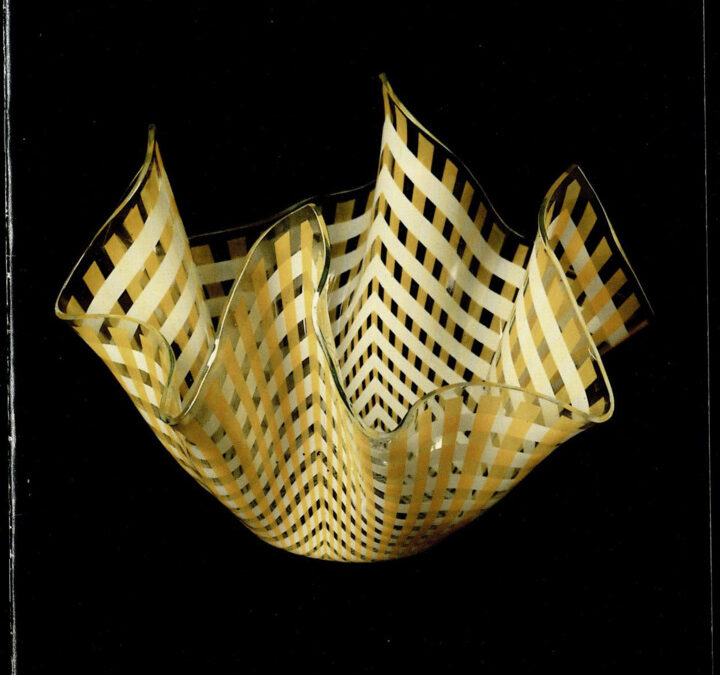
Volume 4 1992
COVER: Gingham handkerchief vase, Chance Brothers, 1977. Manchester City Art Galleries
ISBN 0 9510736 3 X
The Journal of
The Glass Association
Volume 4
1992
The Glass Association
Chairman: Anthony Waugh
Hon. Secretary: Roger Dodsworth, Broadfield House Glass Museum,
Barnett Lane, Kingswinford, West
Midlands DY6 9QA.
Launched at an inaugural meeting at Stourbridge College of Art in November 1983, The Glass Association is a
national society which aims to promote the understanding and appreciation of glass and glassmaking methods, both
historical and contemporary, and generally to increase public interest in the whole subject of glass. The Association
publishes a quarterly newsletter:
The Glass Cone,
which includes short articles, news and reviews.
The Glass Cone
is
edited by Charles Hajdamach, Broadfield House Glass Museum, Barnett Lane, Kingswinford, West Midlands DY6
9QA.
The Journal of the Glass Association
is issued every two years. It deals primarily with the history of glass in the
nineteenth and twentieth centuries, although articles on the eighteenth century are published as appropriate. There is
a natural emphasis on the glass of the British Isles, but contributions on overseas glass are welcome where they
relate in some way to British glass. Articles reflect the breadth of interest of current glass studies in the design,
social, industrial and economic contexts of glass as well as its aesthetic and art historical aspects. Anyone wishing to
publish in the
Journal
should contact the editors.
Editors of the Journal : Ian Wolfenden,
Richard Gray,
Department of History of Art,
Manchester City Art Gallery,
University of Manchester,
Mosley Street,
Manchester M13 9PL
Manchester M2 3JL
Published by The Glass Association 1992
Contents
Early Nineteenth Century Patterns from the Ford Ranken Archive
Gordon McFarlan
1
The Account Books of John Unsworth – Glass Engraver of Warrington
Arthur Wolstenholme
13
Glass Furniture in the Nineteenth and Early Twentieth Centuries
John Smith
18
“Synchronising with Contemporary Taste” – the British Glass Industry in the 1950s
Lesley Jackson
26
Geoffrey P. Baxter, Glass Designer
Brian Cargin and Basil Loveridge
39
Further Notice
Cut Glass in the Pattern Books of Matthew Boulton’s Soho Manufactory
Ian Wolfenden
47
EarlyNineteenth Century Patterns from the
Ford Ranken Glass Archive
–
Gordon McFarlan
Introduction
The
subject of this article is the early nineteenth century patterns and
I related documents within the Ford Ranken Archive, currently on loan
.
to
Huntly House Museum, Edinburgh. The archive comprises a large body of
documentary material; correspondence, bills, technical information and
pattern books relating to the most prominent Edinburgh manufacturer of
quality ‘flint tableglass in the nineteenth century. The factory was variously
named the Caledonian (c.1798 – 1819), the Midlothian (1819 – 1835), the
Holyrood (1835 – 1898) and the Royal Holyrood Flint Glassworks (1898 –
1904) at different periods in its history. The archive covers the entire history
of the firm during the period in which the Ford family had an involvement, (c.
1810-1904) and there is a fairly even chronological distribution of material.
The 1820s and 1830s was a time of great importance in the history of
British and Irish glass design. It was a period which saw the fashion change
from a preference for vessels decorated with intricate mitre cutting, (executed
with a wheel with a V-shaped edge) based on the use of small relief
diamonds, in favour of articles cut with broad vertical fluting. The use of both
these styles in Edinburgh will be discussed in this article.
Securely attributable examples of Edinburgh made tableglass which date
from the first half of the nineteenth century are rare, as illustrated in
0113
), and
so the patterns discussed in the following chapters are of the greatest
importance for the study of the Edinburgh industry during this period. As far
as can be judged from the admittedly scant evidence available, there is
nothing to suggest that there were regional styles in British glassware in the
early nineteenth century.
The pattern drawings of Samuel Miller which are associated with
Waterford and are thought to date from the 1830s even include a page headed
‘English, Irish & Scotch patterns’, implying a considerable interchange of
ideas within Britain at the time. Documentary evidence of this type is itself of
great rarity for there are just four published series of pattern drawings
including the present series, of items of glassware with a British or Irish
origin which date from the early nineteenth century(1).
Plate 1. Engraved view of the new cutting shop at the Holyrood
Glassworks which commenced production on 11 February 1837.
Not dated but circa 1837. Huntly House Museum.
CAI X.11()NIAIN
CLASS WORKS
r.”
/lie
-A,
$
A
•
•
Plate 2.
The first page of the volume titled
‘Account of time on work done in the
cutting shop’. Dated
1810.
Huntly House Museum.
One of the probable reasons why there seems to have been a national
style in British/lrish cut glass in the early nineteenth century was the mobility
of skilled workmen throughout the country. A notable example of this is the
peripatetic Thomas Leighton who was born in Birmingham in 1786. After
working in Dublin he came to Edinburgh where he was
in William Ford’s employ by 1816. In 1826 however
when he was approached by an agent of the New
England Glass Company of Cambridge,
Massachusetts, Leighton broke his contract and
crossed the Atlantic to continue his career.
Glass has been manufactured in the Edinburgh
area since the mid-seventeenth century, but the
industry underwent a major expansion during the late
eighteenth century. In Scotland as a whole, total
production of glass (including bottle and window
glass) during the thirty years preceding 1790 rose
from 1,769,712Ibs to 9,059,9041bs, a dramatic rise
indeed (2). During the early nineteenth century, the
production of tableglass in Scotland, whilst only about
ten per cent of the English production, was roughly
equal to that of Ireland, until fairly recently the
supposed origin of most quality cut glassware of the
later eighteenth and early nineteenth centuries. This
assumption was the result of a misinterpretation of the
effects of the glass excise, (a tax on glass, imposed by
weight, between 1745 & 1845) from which Ireland was
exempt. It is now realised however that many regional
centres, eg. Stourbridge, Warrington, Sunderland, Longport and Edinburgh,
were producing high quality cut tableglass in the first quarter of the nineteenth
century.
Although the technique of glass cutting had been employed in England
for most of the eighteenth century, its full potential was not realised until the
introduction of steam power to drive the cutting wheels. According to
tradition, a steam engine for cutting glass was introduced in 1790 at James
Dovey’s works at Wollaston Mill on the Stour, near Dudley, and in 1807,
William Wilson, of 40 Blackfriars road, London was advertising his ‘Steam
Mills for Cut Glass’. A firm in Bristol was using steam power by 1810 (3).
There is however evidence that manufacturers in the Edinburgh area were fully
up to date as regards the introduction of this new technology. In 1802-3 the
Swedish industrial spy Eric Svedenstierna toured Britain and wrote the
following account:
“The glassworks just outside Leith are especially
remarkable for here is made the clearest and purest crystal
glass that one can imagine, and which surpass in beauty
all other, in England as well as in France. There are several,
and all very large, but they seem, even with good
recommendations, only unwillingly to allow entry to most
of the workshops. I only got to see the cutting shop, which
consisted of many stones and lathes, which were all driven
by one steam engine.” (4).
It was probably around this time that iron wheels were introduced for the
first cuts, followed by a fine grained sandstone wheel for smoothing and
willow wood with a fine abrasive for polishing.
Although Fleming states that the Caledonian Glassworks were in
existence in 1798 (5), he does not quote his source, nor is the factory listed in
street directories of the period. The first firm mention
of the company occurs with the association of William
Ford who was born in 1770 and is described in the
Edinburgh postal directories of between 1803 and
1810 as a silk mercer and haberdasher. In about 1810
he retired and bought the Caledonian Glass Works
which were situated in Watergate, opposite Holyrood
Palace.
The Company’s production at this early period is
here represented by the ‘cutting book’ of 1810
“‘”
and
William Ford’s trade card of circa 1810 – 15 ”
1
“. In
1815 William Ford moved the works the short distance
to the South Back of the Canongate and in 1818 was
joined by his nephew John Ford, who was to play such
a prominent role in the company’s subsequent history.
In 1819 William Ford died and a partnership was
formed to run the works. This consisted of John Ford,
William Bailey, a glassmaker from Newcastle, John
Brough, an excise officer, and Robert Marshall. The
most important of the pattern books, FR9
0
‘
0
”
-0
&
110
‘ can
be regarded as representative of the products of the
works around this time and it is possible that this
volume was compiled in 1819 by the new partners of
the company, now renamed the Midlothian Glassworks.
In 1835 the partnership was dissolved and John Ford assumed full
control of the glassworks, which he renamed the Holyrood Flint Glassworks. It
is likely that the notebook FR10 “wow was compiled around this time as a
personal guide by a representative of this newly formed company. In 1838
John Ford was appointed Flint Glass Manufacturer in Ordinary to Queen
Victoria, and by the middle of the century’ over 200 men were employed in the
factory. When John Ford died in 1859, control passed to his son William
who, with a partner Francis Ranken, traded under Ithe name John Ford &
Company. In 1898 the company was granted the right to use the title The
Royal Holyrood Flint Glass Works but this privilege was short lived as the
works ceased production in 1904.
Plate 3.
Trade card for William Ford’s Caledonian Glassworks,
circa
1810
–
1815.
Huntly
House
Museum.
‘111111111114.1011.11J
J;
,I1
Plate 4.
Designs for glasses on a page of the pattern book
FR9.
Huntly House Museum.
A Cutting Book from
the Caledonian
Glassworks
The earliest datable illustrations of items of Edinburgh tableglass occur
in a notebook bearing a label on the front cover inscribed:
“Account of Time on work done in the cutting shop”
Within are sketches of seven items on the first three pages, the first of
which is illustrated in p1.2. The pieces comprise a quart pitcher, a butter
bason (sic), flat and cover, two wines with bucket-shaped bowls, a barrel-
shaped quart decanter, a candle nozle (sic) for a chandelier or candelabrum
and a
1
/2 pint carafe. Each of the sketches is accompanied by a description of
the pattern cut on the pieces, together with an assessment of the time required
to execute the cutting.
Significantly, the entries relating to each of these pieces are dated, the
dates running from 17 April 1810 to 16 May 1810. The allotted times required
for the cutting of the quart pitcher – 30 hours, and the butter, bason, flat and
cover – 17
1
/2 hours, are quoted as single items, but the other items are quoted
as multiples: 3 doz wines -10
1
/2 hours and 22 hours, 4 quart decanters – 28
hours, 6 nozles – 10 hours and 12
1
/2 pint carafes – 52 hours.
These entries would seem to have been the result of trials undertaken in
order to assess the time required to cut a given pattern, and the date 1810
suggests that they may well have been newly adopted patterns. Although the
cutters were paid in accordance with a system that paid by results rather than
by the hour, the employer or foreman would require a guide as to how long
each pattern should take to cut in order to assess whether a cutter was
working at a reasonable rate. The very substantial amounts of time involved
imply that the time indicated for the cutting of each piece was the total time
involved in the 3-stage process of roughing, smoothing and polishing.
Five of the seven patterns (the two patterns for wines excepted) indicate
cutting over the entire surface of the item and the style of cutting employed
indicates that items presumably produced in Edinburgh in 1810 were abreast
of fashions employed by other British manufacturers.
Comparison can be made between the butter bason, flat and cover
0021
which is of octagonal section, the body with horizontal prismatic cutting and
with a vertically fluted edge, and a bowl of the same shape and cut to the
same pattern which is amongst a group of items supplied to Ralph Wright of
Flixton, Manchester. This group is still accompanied by their bill of sale dated
6 Dec. 1809 from the Warrington firm of Perrin Geddes & Co (6).
The item requiring the most cutting time (30 hours) is the quart pitcher
illustrated in p1.2. It is decorated in typical Regency style with horizontal
bands of mitre cutting described thus:-
“1810 April. 17th A.2 Cutting a quart Pitcher as
Annexed Sketch – 3 Days at 10 hours pr Day – Say (?)
Notch Scalops, Fluted under, Ringd. Middle edge
(horizontal prismatic cutting) on neck deep – 5 rows
diamonds on body deep, middle edge under, foot Cut all
over, and Star on Bottom, Hand (handle) fluted”.
Although of a standard form this jug is remarkably similar to one which
appears on the trade card for William Ford’s Caledonian Glassworks, Watergate,
Edinburgh
(03)
. The address provides the means of dating this illustration for
William Ford only occupied the Watergate premises for about five years, (c.
1810-1815), before transferring the works to the South Back of the Canongate.
Nor is this jug the only item in the cutting book which is closely parallelled in
the Watergate trade card, for a
1
/2 pint carafe il-lustrated in the former is of the
same ovoid shape and has very similar bands of relief diamonds and curving
flutes as the decanter illustrated in the Watergate trade card.
Plate 5.
Designs for salts on a page of the pattern book FR9.
Huntly House Museum.
3
//
,(
.
iv
,
f
,
iv
/V\%
,
61\iNtriA/’
William Ford is variously described in the Edinburgh directories in the
years between 1803 and 1810 as a haberdasher and silk mercer and he seems
to have purchased the glassworks without any prior experience of
glassmaking. Although there is no clear indication as to exactly when Ford
purchased the Caledonian Glassworks, the first mention of his ownership
appears in the Edinburgh Post Office Directory of 1811-12 (published
Whitsunday, 1811). Although the dates quoted in the cutting book precede,
(by a matter of weeks), the publication of the 1810-11 directory, (published
Whitsunday, 1810), in which Ford is still listed as a haberdasher, it would
seem likely that he had an interest in the Caledonian Glassworks by early
1810 and the entries in the cutting book relate to trials undertaken by Ford in
his newly acquired business. The fact that there are no documents in the
archive pertaining to glassmaking dating to before 1810 strengthens the case
for the cutting book having been produced during William Ford’s ownership
of the Caledonian Works.
others used to decorate the items shown. It is normally found in conjunction
with the flatter, ‘sliced’ cutting of larger elements which was current in the late
eighteenth century, and its presence here is the only discernible evidence of
conservatism on the part of the Edinburgh glassmakers or their clientele at
this time.
In 1815 William Ford purchased a property a short distance from the old
works in Watergate in the South Back of the Canongate, now re-named
Holyrood Road, from the trustees of a bankrupt, William Thomson.
Accordingly William Ford had the address on his trade card changed to “Foot
of St. John Street, Edinburgh”, and the words,”wholesale, retail and for
exportation, lusters (sic), lamps,candlesticks and chimney ornaments” were
inserted. Ford also took advantage of the re-engraving of the plate to have two
additional items, both chandeliers (engraved on a much smaller scale),
inserted in the spaces to either side of the set of four decanters. This trade
card forms the top of a printed advertisement dated (by hand) ‘June 1815’ and
promoting:
A Trade Card
from
the Caledonian
Glassworks
Amongst the earliest datable illustrations of items
produced in William Ford’s Caledonian Glassworks
are those illustrated in an engraved trade card, of
which there are four separate impressions in the Ford
Ranken archive. The earlier state of the engraving
bears the inscription “Willm. Ford, Caledonian
Glassworks, Watergate, Edinburgh” *”. As has been
mentioned the Watergate address dates the trade card
to the years c.1810-15, the only years in which Ford’s
Caledonian Works occupied the Watergate premises
before moving to the South Back of the Canongate.
The trade card illustrates ten items which were
presumably a representative selection of the most
prestigious and fashionable products of the factory.
They comprise a hanging lampshade, two jugs, a set of
four ‘case’ decanters in a metal frame, a single
all kinds of FLINT GLASS,
PLAIN, CUT ENGRAVED, or
otherwise ORNAMENTED, in the
greatest variety of Taste and
Elegance; with a variety of
MOUNTED LUSTRES, and other
Beautiful Articles of that description
& on lower terms than can possibly
be had in any Retail shop in the
Kingdom being entirely of their own
manufacture and will pledge them
equal, both in Pattern and Quality, to
any that can be found anywhere else.
All Descriptions of CRYSTAL
GLASS WARE made to any pattern on
the Shortest Notice and most
Reasonable Terms . . .”
William Ford’s claim that his glass was “equal,
both in Pattern and Quality” is significant, for the items
illustrated in his trade card are of a type and style
Plate 6.
Design for a covered urn, one of the
‘blue wash’ drawings in the pattern book
FR9.
Huntly House Museum.
decanter and five bowls of various designs. The pieces are shown as being
decorated almost entirely with mitre cut devices, often arranged in wide
horizontal bands and consisting of horizontal prismatic cutting, small relief
diamonds and fine vertical and curving flutes or else cut entirely with small
relief’ diamonds. This style of cutting enjoyed widespread popularity
throughout Britain and Ireland in the first decades of the nineteenth century.
Items cut solely with fine relief diamonds are known to have been produced
by 1805, the date of an oval tea-caddy in the Victoria and Albert Museum cut
with an all-ovdr pattern of small diamonds and dated by its hallmarked silver
mount (7).
The one surprising aspect of the cut elements employed in the items
illustrated in the trade card is the presence of shaped “Van Dyck” rims, shown
on three of the vessels on the left side of the engraving (the octagonal bowl,
cover and stand, the footed circular bowl and the small circular bowl and
liner). This is a motif which belongs to an earlier stylistic phase than the
common to the whole of Britain
in
the early nineteenth century. It was a time
when the power and convenience of the steam engine had encouraged the
cutting of patterns based on monotonous repetition of very small elements.
The style which is developed in the pattern book FR9 is one of greater
invention and artistry.
The Pattern Book FR9
The quantity, variety and sheer quality of pieces illustrated in FR9, a
bound volume of pattern drawings measuring 13h/2″ x 9″, makes it by far the
most significant document in the archive. With the exception of two other
documents in the archive, the ‘cutting-book’ of 1810 and the trade card of
c.1810-15 of the Caledonian Glassworks, this volume is practically the sole
proof as to the form of high quality tableglass produced in Edinburgh, or
indeed Scotland as a whole, in the early nineteenth century.
sugar bowls intended to fit inside tea caddies, (marked ‘caddie bason’ (sic) on
one of the loose sheets), bowls with turnover rims (formerly thought to be an
exclusively Irish feature) and stands, and bowls with feet and without feet.
The central pages of the volume have been left
blank but one of the blank sheets has the words ‘butter
boxes’ written in pencil at the top of the page. This is
one of only five such legible identifying names in FR9,
the others being “tea box, liqueur, decanter” and the
words ‘Ice Pale’ (sic) beside one of the ‘blue wash’
drawings. Also near the centre of the volume are five
very precisely drawn covered urns and a footed bowl.
They are shown in profile with exact measurements,
the thickness of each vessel clearly indicated by the
words ‘substance of metal’. These drawings can be
assumed to have been intended for the use of Ford’s
glassmakers, the precise size and thickness of each
vessel intended for the cutting shop obviously being
of considerable importance.
The final pages of FR9 are illustrated with a
series of twenty beautifully executed, mostly full page
ink drawings which have been finished by the
application of a blue wash
(
“ee’s”
)
. They illustrate richly
cut covered urns, bowls with and without covers, jugs,
caddie bowls, decanters and an ice pail.
It is difficult to say if more than one hand was
Excerpts from the pattern book FR9 have been published on four
previous occasions. On the first occasion, J.C. Varty-Smith writing in 1915 in
The Queen, The Lady’s Newspaper
(8) made passing reference to the
Edinburgh Glass House Company, Leith before going
on to discuss the patterns. He did not actually state that
the pattern book originated from this factory but latterly
this was assumed by Bernard Hughes (9) and
perpetuated by Robert Charleston (10). In fact the close
relationship between the pattern book FR9 and related
documents in the Ford Ranken archive support an
attribution to the Caledonian/Midlothian Glass Works.
Analysis of the volume is complicated by the fact
that it is not a homogeneous prodUction. Not only are
the illustrations of markedly different character
ranging from small cursorily drawn sketches of simple
glasses finished with a grey wash,
(
seem
4)
to full page ink
drawings of presentation quality, carefully highlighted
in a blue wash, depicting vessels of the utmost luxury,
see o’s
6
‘
)
, but the volume shows many signs of pages
having been removed and pasted in. The existing
leaves are not even composed of the same paper but
comprise both laid and wove papers in roughly equal
quantities. There are in addition many loose sheets
from the same source which are obviously related to
those in FR9. The volume bears all the signs of having
Plate 7. Design for a covered bowl, one of
the ‘blue wash’ drawings the pattern book
FR9. Huntly House Museum.
involved in the production of FR9 but several of the drawings are annotated
with initials ‘AVM’, presumably denoting authorship. Most of the items
illustrated are individually numbered, but as the numbers used are low and
recur often, it is not possible to suggest a relative chronology for the
compilation of the volume. Almost all of the pieces are also priced, often with
one or two revisions suggesting that virtually all the items shown were
actually in production, presumably for a significant period of time.
As far as the dating of the volume is concerned, both the available
circumstantial evidence and the style of the
1
been a working document, produced by a designer principally as a guide to
production within the glasshouse.
The volume FR9 consists of three related but distinct sections. The first
half of the volume is occupied by ink drawings highlighted with a grey wash.
These are mainly of drinking glasses of various types, the majority of which
do not have any indication of decorative cutting (seem’s), but also including
drawings, sometimes full page, depicting vessels which display a variety of
elaborately cut motifs see
(05
–
810
.
Glasses are arranged according to
the shape of their bowls, usually with a
whole page devoted to glasses of varying
size but with the same bowl form. Stems
are plain or have single bladed, spherical
or fluted cylinder knops and the glasses
have barrel, cup, cup with everted rim,
ovoid, conical and bell shaped bowls.
Cutting is only occasionally indicated but
where it is shown it is similar in character
to that depicted on the later drawings in
the volume, suggesting the entire volume
was compiled within a short period of
time.
Also included in the ‘grey wash’
drawings are numbers of cut items; of barrel shape or straight-sided tumblers,
with and without everted rims, scent bottles, cruets, decanters, salts
0
‘
05)
,
covered urns of typical neoclassical form, cups and saucers (seem so, a drum
shaped cover and stand, tea caddies
0
‘
08)
, vases and bowls of various forms.
These include finger bowls, with and without lips, straight sided mixing or
vessels depicted suggest that this volume
and its related loose drawings were
compiled in the late 1810s or early 1820s.
The inside cover Of the volume bears a
faint pencil inscription of a name (?)
followed by ’27th Aug Edinburgh 1826′
and although this inscription is little more
than a scribble the date is consistent with
the period when the volume might have
•
been in use as a guide to production.
More evidence for the dating of FR9
is to be found in the related drawings.
Many of the sheets of which FR9 is
composed bear manufacturers’ watermarks
but none includes a date. However no less than ten of the loose sheets (which
bear illustrations closely related to and some being preparatory drawings for
those in FR9, often on indistinguishable paper) bear watermarked dates. The
distribution of dated sheets is as follows: 1 x 1811, lx 1814, 1 x 1815, 2 x
1816 and 5 x 1817. The illustrations on the dated sheets are jugs, bowls and
Plate 8. Designs for tea ‘boxes’ on a page of the pattern book
FR9. Huntly House Museum.
5
Plate 9. Shallow oval dish, circa 1820, attributed to the
Caledonian/Midlothian Glassworks. This dish, which has an
Edinburgh provenance, is cut with the same Gothic arch motif
illustrated in a drawing of a tea ‘box’ in the pattern book FR9
(see
p18). Length
25.6cms. Huntly House Museum.
a decanter, all bearing complex mitre cut motifs of the type found in the
illustrations in FR9.
Several of the illustrations in FR9 are cut with a central band of small
relief diamonds, with horizontal prismatic
cutting above and below. Cutting of this
form is associated with the opening years
of the nineteenth century and is to be
found on jugs illustrated • in the 1810
‘Cutting Book’ ow” and in the 1810-15
Caledonian Glassworks trade card
003)
.
Items cut with this essentially simple
though luxurious style are heavily
outnumbered in the volume and its related
drawings by items decorated with mitre
cut patterns of far greater complexity.
These represent a style which was fully
developed in Britain and Ireland in the
1810s and 20s,
(-
°”
5-8,1
°
)
.
This style is foreshadowed by early
examples such as the table service made
between the years 1806 and 1808 for
George, Prince of Wales, by the Warrington firm of Perrin Geddes & Co(11).
The style in its most extreme form, with almost indiscriminate use of elaborate
cutting, can be seen in the entensive table service produced in 1824 for the
Third Marquis of Londonderry by White and Young of Sunderland which is
now in Sunderland Museum. Robert Charleston has said of this service that it
suggests “ambition rather than taste” (12). The vessels depicted in FR9,
although frequently cut with equal opulence to the pieces of this famous
service, do frequently display a superior standard of design.
The presence in the volume of items cut with horizontal bands of simple
mitre cuts together with vessels cut with patterns of great complexity suggests
compilation at a period when both styles were in vogue. Although there is a
lack of evidence to suggest precisely when this move from simple to complex
mitre cut patterns occurred, if one assumes that the watermarked sheets
bearing dates were used within a year or two of production, the resultant
dating of circa 1815-20 suggests that at this period the products of the
Caledonian Glassworks were as stylistically advanced as any in Britain.
It does not seem, at least from the prices indicated in FR9, that in
Edinburgh pieces cut with simpler patterns were intended for a humbler
clientele. The pricing of the salts shown in
0
‘
5
‘ indicates that the one cut with
the all-over pattern of relief diamonds at 3/6, is more expensive than any of
the others cut with patterns of greater complexity. Similar examples are found
elsewhere in FR9.
The most commonly used motif employed in the cutting of vessels
depicted in FR9 and its related drawings is the strawberry diamond. These
were produced by cutting a field of diamond shaped areas with intersecting
mitre cuts, then filling these areas in a painstaking manner with shallow
intersecting cuts, producing within each diamond panel a profusion of tiny
relief diamonds. Strawberry diamonds are sometimes used in FR9 in
horizontal bands but more often they are employed to fill gothic arches or to
produce ‘angles’ of strawberry diamonds by filling triangular shaped panels
The strawberry diamond, although closely associated with the second
and third decades of the nineteenth century, is known to have been used in
Ireland in the late eighteenth century. Single bands of strawberry diamonds
are recorded on several Irish decanters marked ‘Penrose Waterford’. The
Waterford factory was under the ownership
of George and William Penrose between
the years 1783-1799(13).
Although strawberry diamond cutting
is depicted in illustrations in the archive of
vessels drawn on loose sheets bearing
watermarked dates for every year between
1813 and 1817, this is not in itself proof of
their use at such an early date. Other
documents however prove conclusively
that complex patterns of strawberry
diamonds were being employed in
Edinburgh at least as early as 1823 and as
late as 1835. The evidence for their use in
1823 is to be found on a headed bill from
the Midlothian Glass Works.
The bill is dated 5 July 1823 and is
made out to Messrs. Palmen & Co,
Amsterdam. It details amongst other items:
“Best JB Liqueurs cut angles of strawberry diamonds and fans
“(14).
A
later documented use of strawberry diamond cutting occurs on a small
wine glass on loan to Huntly House Museum from the Ford Ranken estate’`
“. It has a bucket shaped bowl and the stem has a single bladed knop. This
glass, which is of a type referred to in the archive as a ‘JB Wine’ and which
appears in various sizes on one of the first pages of FR9 would be
unremarkable but for the fact that it is engraved on the foot in diamond point
with the inscription:
“The first glass cut at the Holyrood Glassworks, Edinburgh 19th August
1835″.
In 1835 John Ford bought out the share of William Bailey, his partner of
16 years, in the Midlothian Glass Works. The factory was thereafter known as
the Holyrood Glassworks. Each of the strawberry diamonds cut on this
particular glass is ‘guarded’, i.e. framed by 3 rows of mitre cuts. This form of
strawberry diamond cutting is also found in a number of vessels depicted in
FR9. The documentary wine glass is of particular interest in the history of
Edinburgh glassmaking, for it proves that elaborate mitre cut patterns of
Regency character were still in production at a time when the broad flute style
had already gained wide acceptance in Britain and Ireland. Confirmation of
this fact is to be found in the patterns which appear in other volumes in the
archive.
Another of the recurring cutting motifs which appears principally in the
‘blue wash’ drawings in FR9 and again is based on the use of very small relief
diamonds is an element of curving teardrop shape, filled with small diamonds
and with a circular polished hollow placed in the head of the tear. These are
used, placed side by side on a covered bowl,
(
”
0
‘
)
as well as on uncovered
bowls and a decanter.
Motifs similar to the one described were certainly being employed
elsewhere in Britain on luxury pieces of glassware in the first decade of the
nineteenth century. Comparison can be made with the cutting employed on a
large suite of tableglass produced by the Warrington firm of Perrin Geddes &
6
‘
qp:rriff
British or Irish flint glasshouse of the early nineteenth century. Due to the
restrictions imposed by the technique of glass cutting it is rare to encounter
any pattern in early nineteenth century British glass that is based on an overtly
representational source.
Associated with these three drawings is a loose leaf bearing a faint
pencil sketch of a round bottomed bowl,
also cut with a row of thistles. In this case
the idea has been carried a stage further.
Not only do the thistles form the top edge
of the vessel but they are indicated as
having been cut out so that they stand
proud of the body of the bowl to the level
of the base of each flowerhead. Given the
extreme impracticality of such a design
and the fact that the drawing is so sketchy
in character, neither numbered nor priced,
it seems unlikely that this particular
Plate 10. Designs for cups and saucers on a page of the pattern
version of the thistle design was ever
book FR9. Huntly House Museum.
commercially produced.
One of the most fascinating aspects
Co and presented to George, Prince of Wales by the City of Liverpool in 1808
(15). Similar cutting is also found on a vase of campagna shape mounted in
silver by Paul Storr (the glass therefore likely to have been made in London)
and datable by the hallmarks to the year 1807 (16).
One of the more unusual vessels illustrated in FR9 are glass tea caddies.
The illustrations number eight, five
illustrated in FR9 itself and three in loose
but related pencil sketches. Often early
nineteenth century glass tea caddies are
mounted in silver and take the form of
contemporary wooden examples but all of
those illustrated (-
08
), are in the form of
squat bottles. These are of octagonal or
oval section with wide mouths intended for
ground-in stoppers, one of which is shown
in place. This is a similar form of stopper
to those found in contemporary decanters
ie. of star-cut ‘mushroom’ design.
This basic type of glass tea caddy
was well established for one of the earliest
known caddies, illustrated by Charleston and dating from the mid-eighteenth
century, is in the form of a faceted bottle of rectangular section with a ground-
in stopper (17). One of those illustrated in FR9,
(0)
is cut with the familiar
Edinburgh device of Gothic arches filled with strawberry diamonds with fan
cutting between the arches, the base and neck with prismatic cutting. Those
illustrated are priced from 10/- to 14/-, together with revised pricing of 7/6 in
each case.
One of the few lists in the archive contemporary with FR9 mentions ‘tea
boxes’ and ‘caddie basons’ (unfortunately the latter term does not help in
resolving the continuing uncertainty as to whether these bowls, which were
fitted in contemporary wooden tea caddies, were intended for blending tea or
containing sugar). The list is written on a sheet bearing the watermarked date
‘1818’ and several of the descriptions and levels of pricing correspond closely
to the illustrations in FR9, e.g.:
“1 Octagonal tea Box cut and Gothic Arches & leaves
of small diamond, stopper polished in -13/6” (18).
This list provides circumstantial evidence to support a proposed date for
the compilation of FR9 in the late 1810s.
Perhaps the most extraordinary pieces illustrated in FR9 or its related
drawings are two loose leaf drawings of a jug, one a pencil sketch for a
second more finished ink and blue wash drawing, together with a salt, one of
a page of salts in FR9, ((
05
). Both of these are shown as being cut with a
combination of circular hollows, fine diamonds and fan cutting, in such a way
as to form a band of thistles. In the case of the jug, the band of thistles is
placed around the body of the vessel but with the salt the thistles are placed
higher so the tops of the flower heads actually form the rim of the vessel. Both
these items are priced, the jug indistinctly, the salt 3/3d., suggesting that
these items were actually produced.
Their existence is of some significance, for the distinctively Scottish
thistle motif is perhaps the only one which appears in FR9, or the earlier
illustrations,. which might not easily be found among the products of any
of the pattern book FR9 is the evidence which it provides for the apparently
thriving export trade in table glassware to the continent of Europe in the early
nineteenth century. Figures show that by 1828 the quantity of flint glass
produced in Scotland amounted to 849,1731bs, of which 309,6801bs, or over
a third, was exported all over the world (19). Arnold Fleming, in his book
Scottish and Jacobite Glass,
states that following the death of William Ford in
1819, the partnership which was formed to run the Midlothian Glass Works
included one Robert Marshall who acted as the traveller, visiting clients in
Copenhagen, Berlin, Hamburg and other continental cities (20). One of the
earliest letters extant which is concerned with the export trade strikes a
somewhat negative note and illustrates the possible dangers in exporting
cargo to Europe in the early nineteenth century. It is from A.D.McLaren
(apparently the Midlothian Glass Work’s agent) in Hamburg and is dated 22
October 1819:
We are sorry to say that the Albion (which was
carrying 5 casks and 1 box of flint gloss) was stranded on
an island in (a) bank near the Dutch coast on the night of
the 16 or the morning of the 17th Sept. and from what we
can learn from a paper that has arrived your glass had to be
thrown overboard, at least that part of it which was on
deck’ (21).
Even at this early date however the firm’s export trade was not confined
to the continent of Europe, for 25 August 1820 saw William Bailey writing
with advice to John Ford on a consignment of glass bound for Australia.
“Mr.Malcolm of Brechine . . . will call to order about
f20 of glass to go to New South Wales in the Westmorland
. . . . different patterns can be selected to be ready”(22).
Apparently by this time the trade to the continent of Europe was a
valuable outlet for the Ford/Bailey partnership, for on 19 December 1820
7
d/ 44
,
(
t
i
e>t
,
•
,
9.0
.
ed.4
.447“Aet
1),/
,;
• /
../
4
4
.
,
Bailey wrote to John Ford, who was then in Hamburg, commending him
on
having obtained sufficient orders to occupy the works until Spring.
Fortunately the illustrations in FR9 throw some light on the type of
object being exported, at least to Europe, around this time. Many of the items
illustrated in the early pages of FR9 are annotated in pencil with the words
‘Berlin’ or ‘Breslau’
(in
Poland). These are mainly drinking glasses of various
sorts but decanters, cups and a vase are included. The drawings marked
‘Breslau’ are often also numbered, and items depicted in FR9 are variously
marked ‘Breslau No.1’ up to ‘Breslau No.27’ though by no means the whole
series is illustrated. While many of the glasses so marked are simple and
anonymous in character, eg. glasses with ovoid bowls and short plain stems,
there is a also series of glasses which it would seem could only have been
made for export. This is a group of roemers of German/Dutch form which are
thought to have been produced in Britain in large quantities for export at the
end of the eighteenth and beginning of the nineteenth centuries, (-PH
)
. They
have cup or double ogee shaped bowls, hollow stems with applied ‘raspberry’
prunts and threaded conical feet. Two of the examples are priced 7/- and 7/1
(per dozen). Comparable examples appear on a page of drawings of items of
tableglass, dated to circa 1840 but containing many earlier designs, from the
firm of Messrs Jones in London (23).
These green glasses were of course intended to lend some colour to the
characteristically pale Germanic white wines. Of the eight roemers illustrated
in FR9, two are finished with a dark green wash while other plainer glasses
are marked ‘green Berlin’. Fortunately there exists in the archive a letter from
one Franz Doms in Breslau to John Ford, dated 1 May 1831, which may
include an order for glasses of this type. Doms mentions having sent patterns
to Ford and places an order for some 270 dozen glasses of 13 different types.
These are all drinking glasses, some in green glass, some in colourless.
While some of the glasses referred to are recognisable in the illustrations of
FR9 the numbering does not appear to correspond. Presumably the numbered
illustrations in FR9 refer to an previous order, for it would seem likely they
were drawn some 10-15 years earlier. The glasses ordered in 1831 included:
“20 doz barrel tumbler
20 doz tumblers with the edge turned out
30 doz wineglasses Blucher form
30 doz green hockglasses, form like white pattern
No.11 without knob.” (24).
Instructions are also given for the items to be of ‘good strong and pure
metal all of equal form, measure and height’.
In addition to the glasses already mentioned, those marked ‘Breslau’
also include five out of a group of eight illustrations of flutes with very narrow
elongated bowls: There is also a drawing of a glass cup marked in pencil,
‘Breslau No.27’. It has an applied handle, a triple ring around the body and
narrow flutes cut to the lower body. It is priced 4/1 plain, and 8/6 cut and
engraved (both prices per dozen). This entry is of particular interest because,
apart from William Ford’S advertisement of 1815, it is the only reference to
engraving in any of the documents in the archive dating from the 1810s or
1820s. Several decanters are also included in this group of items apparently
intended for a Polish destination, but they are of very standard British/Irish
Regency form – mallet shaped body, three applied neck rings and a
mushroom stopper. One of the decanters however displays faceted neck rings
Plate 11. Designi for decanters on a page of the notebook FR10.
Huntly House Museum.
and narrow flutes cut to the lower body.
In a letter dated 26 April/ 8 May 1823 John Ford’s future father-in-law
J.H. Koch, a resident of the Baltic island of Oesel, wrote to him in Edinburgh
encouraging him to visit the continent and added:
“I hear by my son (then in Moscow) the highest taste
and the newest fashion, to have all table, thea, and other
services (utensils) of cristal rather than porcelan.” (25).
Might the content of this letter explain the surprising inclusion of a page
of ‘grey wash’ drawings in FR9
(
see”, which illustrate cups and saucers of
conventional porcelain form, heavily cut with an all-over pattern of strawberry
diamonds?. When considered in isolation, these cups and saucers would
surely have to be regarded as having been made for cold drinks, or as
prestige pieces intended primarily for display. Although it does seem unlikely
that glass tea cups could long survive the thermal shock to which they would
be subjected, nevertheless, might the cups and saucers illustrated in FR9
have been made to cater for this continental trend?
The Pattern
Book FR9A
This fascinating document was apparently compiled as a guide for the
glassmakers as to the number and type of item required to fulfil individual
8
Plate 12.
Designs
for bowls on a page of the pattern book
FR7.
Huntly House Museum.
orders. It comprises 20 leaves bound in paper covers and fits neatly into an
expanding flap pasted to one of the end boards of FR9.
The contents of the booklet consist entirely of outline sketches of
vessels, most of which are more carefully and more fully illustrated in FR9.
Considerable economy of paper has been achieved by overlapping many of
the sketches, suggesting that this volume was never intended to be seen by
prospective clients. Many of the sketches
are numbered to correspond with the
drawings in FR9, and in many cases the
number of items required to be blown, as
well as a client’s (?) name, are included,
eg. ‘Hoffman, Rotterdam – 4 pieces’, in the
case of a footed urn and cover with an
acorn finial. Brief explanatory notes such
as ‘punch glass squ(are) foot’ also
appear. Other items illustrated include
decanters, dishes, cruets and candle
sconces.
Another item depicted, however
is
of
considerable interest. This appears in a
quick sketch of a vase or beaker, a more
finished drawing of which appears in FR9
priced at 15/-. It is of flaring trumpet form
set on a low foot, and is decorated with
mitre cutting consisting of fans and oval
panels filled with strawberry diamonds
.
Although this form is a very unusual
one
for an early nineteenth century British
piece of decorative cut glass it was one
which enjoyed widespread popularity on
the continent at this time, particularly in
Germany and central Europe. Significantly
the sketch of the vase in FR9A, the
glassmakers’ notebook, is annotated
‘J.Van Manuer Haarlem’. It does seem
likely therefore that this is another
instance of an item produced in Edinburgh specifically for export to the
continent of Europe.
The Notebooks
FR10,11 and 13
and the Broad
Flute Style
of Cutting
FR10, FR11 and FR13 are a group of three similar, small bound
notebooks which are datable to the 1830s and 1840s and which appear to
have been used by John Ford’s representative(s) as a guide to the patterns
currently being produced by the Holyrood Glassworks. They are not guides
which were used in the manufacturing process (as the illustrations in FR9
appear to have been), but comprise simply the same numbered series of items
which apparently was the everyday output of the factory. This was mainly
tableglass with a heavy bias toward standard items such as decanters, wines
and tumblers, but also including items such as jet (gas) shades. Items are
only occasionally illustrated by small ink sketches (mainly of decanters) and
the prices of objects, if decorated by cutting, are quoted as the charge by
weight of the object added to the price for cutting.
Of the three notebooks, FR10, which has the following inscription on the
inside cover, ‘Pattrens (sic) Holyrood Glassworks, Edinburgh’, is apparently
the earliest in date. One of the pages bears
the watermarked date 1833 whilst three
others are marked 1834. The numbered
sequence in the volume runs from 1 to 514
but some of the last numbers have not been
allocated items. With the exception of one
carafe all the other 32 sketches are of
decanters. Significantly, the first decanters
illustrated are the earliest in terms of
stylistic development. The first four are of
Regency mallet shape with three applied
neck rings and decoration of mitre cut
elements of small size arranged in
horizontal bands, Pws
3
a^”-“-^
‘PH”.
This
form and style of decoration is associated
principally with decanters produced in the
first three decades of the nineteenth
century. Given that one sheet of FR10 is
dated 1834 then this illustration cannot
have been drawn before this date. The
detailed information regarding pricing,
often quoting for both pint and quart
decanters, does indicate that these items
were in production, and the watermarked
date of 1834, together with a sequence of
numbering which starts from scratch,
suggests that the items shown in FR10
were amongst the first produced at John
Ford’s Holyrood Glassworks, which
commenced production in August 1835.
These decanters are redrawn in a more cursory fashion and without the
detailed cutting information in another small notebook, FR13, in which the
numbered sequence of items runs to no.1211. The same items are relisted in
the third volume, FR11, which bears an inscription inside the front cover
which reads ‘Thomas Peacock, Holyrood Glass Works, Edinburgh 1
September 1842’.(26). The entries in the first seven pages of this notebook
have been covered by the insertion of a printed price list, dated 5 April 1845,
which has been pasted into the volume. It seems likely that the decanters
illustrated in FR10 were still in production in 1842 but were deleted from the
range of patterns produced by April 1845 when the relevant entries were
obscured. This evidence implies that these Regency style patterns were still
being produced in Edinburgh some twenty years after their style would
suggest, and at a time when the production of other manufacturers was
dominated by vessels cut in the ‘broad flute’ style which also appears in FR10
(s’ePih”. A printed price list of the London firm Apsley Pellatt, published in
1838, illustrates designs entirely in this style (27).
It has been suggested that the broad flute style was first introduced in
9
Plate 13. Wine glass cut with strawberry diamonds and
engraved in diamond point on the foot ‘The first glass cut at the
Holyrood Glassworks, Edinburgh 19 August 1835’. In 1835,
when John Ford ended his partnership with William Bailey in
the Midlothian Glass Works, he assumed full ownership of the
works and named it the Holyrood Flint Glass Works.
Height 10.3cms.Huntly House Museum.
the 1820s as a cheaper alternative to vessels cut with more complex Regency
mitre cutting. Evidence for this is given in Ian Wolfenden’s study of the
relative prices of decanters illustrated in a group of pattern drawings with
strong West Midland connections and dated to the mid or late 1820s(28).
This theory is also supported by an account published in 1899 of an order
book dated 1832 which pertained to travels in the North and Midlands.
“The Cutting . . .
varied in style and
evidently in price low
flute and hollows
sufficing for decoration
in some cases, the better
goods having hob-nail
and other diamonds well
cut in” (29).
Surprisingly, this situation does not
appear to be borne out by an examination
of the relative prices of the decanters
illustrated in FR10. Comparison can be
made between the decanter marked no.4
01
”
and that marked no.6
“Thl””
no. The price of the quart version of no.4,
which displays complex mitre cutting in the
Regency style is 5/9, calculated by
combining the price by weight, 2/3 (2lbs at
1/1 1/2d. per lb) plus the cost of cutting,
3/6. The quart size of decanter no.6
however, which is cut with a simple pattern
of nine broad flutes and a star cut base,
cost 11/6, exactly double the price.
Admittedly this decanter is heavier than
no.4 (3 1/41bs as against 2lbs), but the price
for cutting the broad flute pattern of no.6
can be calculated to have been 7/6,
(allowing 4/- for the 3
3
/41bs weight, as in
no.5), more than double the 3/6 allowed for
the more elaborate mitre cutting of no.4.
Hugh Wakefield drew attention to an account published in the 1880s
which alleged that the broad flute style evolved in the Birmingham cutting
shops. He also illustrates a decanter cut with a version of this style which was
purchased in Birmingham by the Paris Conservatoire National des Arts et
Métiers around the year 1820 (30).
The earliest mention of broad flute cutting in the Ford-Ranken archive
occurs in the following entry in a list headed ‘Work done in the cutting shop
from 13th to 17th July 1835’. The relevant line reads ‘I doz 1/3qt. Tumblers
Broad Fluted and flattened, (the bases ground) 5/6 1/2d.’ (31).
Although there is a lack of direct evidence in the archive as to the date of
the introduction of the broad flute style in Edinburgh, the lack of any surviving
indication of the style prior to 1835, together with the endurance of old-
fashioned patterns suggest that it was not one which gained rapid acceptance.
The Pattern
Book FR7
This pattern book comprises 33 leaves which bear a series of mainly full
page ink and grey wash drawings, principally of decanters but also including
covered and uncovered bowls, vases and rectangular dishes. A few of the
drawings display patterns for mitre cutting
but most of the vessels are shown with
cutting based on the broad flute style,
often with indications of flutes or facets of
considerable size. None of the patterns is
priced or dated but the style suggests a
compilation date in the 1840s.
In contrast to the patterns discussed
thusfar it would seem probable that many
of the patterns depicted in FR7 were never
put into production. Only seven of the
Illustrations have been assigned pattern
numbers, and on examination it becomes
apparent that the examples which would
require the heaviest blanks and the
removal of most metal on the cutting
wheel are thoe which have not been
assigned numbers. The upper two bowls
in p1.12 fall into this category but are by
no means the most extreme examples.
Perhaps these particular patterns were
drawn in 1845 (the year in which the
excise on glass, imposed by weight, was
abolished) or in the years following, in
order to explore the new design
possibilities which the lifting of this
financial constraint allowed.
Those seven drawings which are
numbered (between nos.1539 and 1592)
are mostly straight-sided decanters cut
entirely with broad fluting and stylistically
very similar to those illustrated in Apsley
Pellatt’s price list of items cut solely in
this style, which was issued in 1838 (32). Reference to the notebook FR11,
which is dated 1842 and in which the numbered sequence runs to no.1346,
makes a proposed date of the mid 1840s seem possible, but the presence of
illustrations, notably a jug and a covered jar shown with mitre cut patterns of
strawberry and cross-cut diamonds in a style associated with the 1810s and
1820s, makes it difficult to be categorical about the dating of this volume.
Perhaps the most significant drawing in FR7 is that of a bowl, the
bottom of the three illustrated in p1.12. This drawing’s importance lies in the
link which it provides with the remarkable eight branch epergne measuring 39
12 inches high, in Huntly House Museum, Edinburgh, which is illustrated in
Wakefield’s
Nineteenth Century British Glass
(33).
The epergne is said, probably because of its crown-shaped finial (one of
two interchangeable finials), to have been produced to celebrate the accession
of Queen Victoria in 1837. Tradition has it that it took Richard Hunter,
10
foreman cutter at the Holyrood Works, three years to cut and was completed
in 1840. A letter in the archive written by William Ranken to Capt.George
Gooding at Buckingham Palace in 1911 relates a slightly different story.
“With this we send you 2 photographs of a Cut
Crystal Epergne produced at our works in the early forties .
. . time occupied in cutting – 2 years.” (34).
Although a remarkable technical achievement (it is composed of forty
separate pieces held together purely by their own weight) the epergne is a
very conservative production, for the branched epergne is essentially a form
of the eighteenth century. The cutting also makes liberal use of relief
diamonds, which are associated more with the early part of the nineteenth
century. Mention has however already been made of their use at a late date at
the Holyrood Glassworks.
The link between FR7 and the epergne lies in the cutting pattern which
appears in the drawing of the bowl illustrated in p1.12 (bottom), and both the
large central bowl and cover and the small bowls on the branches of the
epergne. This pattern is extremely unusual and of some considerable
complexity. It is formed of horizontal rows of diagonally aligned elements of
cushion shape, actually short sections of convex ‘pillar’, alternated with rows
of small relief diamonds arranged in groups of four. This particular form of
cutting is of sufficient individuality to confirm the Holyrood Glassworks as the
origin of both the epergne and the volume FR7.
Conclusion
Much has been written in recent years to refute the belief, current in the
earlier part of this century, that most of the high quality cut glass produced in
the early nineteenth century emanated from Ireland and in particular the
Waterford factory. Although there is no evidence to prove the
Caledonian/Midlothian/Holyrood Glassworks pioneered new styles in
glassware it deserves to be included in the growing number of centres now
recognised as having produced cut glass of the highest quality in the early
part of the last century.
Acknowledgement
I would like to thank Dr J Cruikshank and Mrs A Cruikshank for their
permission to reproduce documents and glasses from the Ford Ranken
Collection.
Footnotes
1. The other three series comprise:
a)
The Samuel Miller drawings which have a Waterford
provenance and are illustrated in Warren, P.,
Irish Glass
1981 (2nd.ed.).
b)
The John Fitzgibbon drawings which have a Cork
provenance and are illustrated in Westropp, D.,
Irish Glass
(Revised by Mary Boydell), 1978.
c)
The ‘WHR’ drawings, tentatively attributed to
Hawkes of Dudley by Wolfenden, I.,
The Journal of the Glass Association,
vol.2, 1987, pp.19-28.
2.
Woodward, H.W.,
The Story of Edinburgh Crystal,
1984, p.8.
3.
Charleston, R.J.,
English Glass and the Glass used in
England
c.400-1940, 1984, p.179.
4.
Svedenstierna, E.T.,
Tour of Great Britain 1802-3,
(published Newton Abbot), 1973, p.129.
5.
Fleming, A.,
Scottish and Jacobite Glass,
1938, p.116.
6.
Gray, C. and R., “The Prince’s Glasses: Some Warrington
Cut Glass 1806-1811”
The Journal of the Glass Association,
vol 2, 1987, pp. 11-18.
7.
Charleston, R.J.,op.cit,p.179.
8.
Varty-Smith, J.C., “Concerning Old Pattern Books,”
The Queen,
18 Sept.1915,p.524.
9.
Hughes, B., “Fine Ware from Scottish Glass-Houses”,
Country Life,
24.Aug.1961,p.386.
10.
Charleston, R.J., “A.Glassmaker’s Bankruptcy Sale”,
The Glass Circle
2, 1975,p.13.
11.
Gray C. and R., op.cit.
12.
Charleston, R.J.,
English Glass,
1984, p.198.
13.
Warren, P.,op.cit.pp.36 and 86.
14.
Huntly House Museum, Ford Ranken Archive, bundle 2/5.
15.
Gray, C. and R.,op.cit.
16.
Clayton, M.,
The Collector’s Dictionary of the Silver
and Gold of Great Britain & North America(2nd
Edition),
Antique Collector’s Club, 1985, p.252.
17.
Charleston, R.J., “Appropos of Tea Caddies in Cut Glass”,
Antique Collector,
Aug. 1966, pp 151-5.
18.
Huntly House Museum, Ford Ranken Archive, bundle 2/5.
19.
Thirteenth Report of the Commissioners of Excise Inquiry:
Glass,
P.P.1839, vol.XLVI.
20.
The documents which were Fleming’s source are not
included in the material on loan to Huntly House Museum.
They may since have been destroyed.
21.
Huntly House Museum, Ford Ranken Archive, bundle 2/5.
22.
Huntly House Museum, Ford Ranken Archive, bundle 2/5.
23.
Coutts, H., “London Cut Glass”,
Antique Collecting,
June 1987. pp 22-3.
24.
Huntly House Museum, Ford Ranken Archive, bundle 2/5.
25.
Huntly House Museum, Ford Ranken Archive,
1990 loan, bundle 3.
11
26.
Peacock’s name first appears in the archive in a letter he
wrote to John Ford on 1 July 1835 from Gateshead.
‘Having been informed that you are about
to commence the glass works at Edinburgh and
that you are likely to want a traveller or clerk . . .
If you think well to give me a situation . . . ‘
Ford did employ Peacock who subsequently acted in
London as agent for the Holyrood Glassworks.
27.
Wakefield, H., “Early Victorian Styles in Glassware”,
Studies in Glass History and Design,
1969, pp 50-54.
28.
Wolfenden, I. op.cit.
29.
The Pottery Gazette,
March 1899, pp.343-4.
30.
Wakefield,
H.,
Nineteenth Century British Glass,
1987,p.29.
31.
Huntly House Museum, Ford Ranken Archive,
bundle 2/10.
32.
Wakefield, H.,op.cit.p.36.
33.
Wakefield, H.,ibid,p.38.
34.
Huntly House Museum, Ford Ranken Archive,
bundle 2/23.
Appendix
Description of the patterns/illustrations from the Ford Ranken collection
discussed in the text. Currently on loan to Huntly House Museum.
1.
CUTTING BOOK – Bound notebook containing seven annotated
ink drawings. Front covering bearing label ‘Account of Time-on Work
Done in the Gutting Shop’ Size: 8″ x 6
1
/2″
2.
TRADE CARD FOR THE
CALEDONIAN GLASSWORKS –
Engraving titled “Willm.
Ford, Caledonian Glassworks, Watergate, Edinburgh” and illustrating ten
separate items. Plate re-engraved in 1815, the address changed to ‘Foot
of St. John Street, Edinburgh’, and the words ‘Wholesale, Retail & for
Exportation’ and ‘Lusters, Lamps, Candlesticks & Chimney ornaments’
added. Two further items, both chandeliers, engraved.
Plate size: 4
5
/8″ x 3 1/4″
27th Aug Edinburgh 1826″ Size 13’/2″ x 9
1
/2″
3a. PATTERN BOOK FR9A – Unbound
booklet of 20 leaves which
fits into a flap in the cover of FR9. Illustrations of numerous overlapping
line drawings of items, annotated with pattern numbers, and quantities
required for individual orders (?) eg. “4 pieces” and clients (?) names,
eg. ‘J.Van Manuer Haarlem’.
4.
LOOSE DRAWINGS – Numerous loose sheets bearing drawings
in pencil, ink; some with a grey or blue wash. Many of the drawings are
preparatory exercises for more finished drawings in FR9 and some of the
pencil drawings display signs of having been ‘pressed through’.
Watermarks include “Weatherll 1820”, “Wilmott 1816”, “Zoonen”,
“Wilmott 1817” “1814”, “Smith and Allan
1817″, ” S & C. Wise”,
“J.Whatman”. Also 17 sheets of tumblers, stem glasses and decanters
and an urn and cover on sheets annotated in Dutch, the sheets with the
watermarks “Van Gelder”, “M. Schouten & Co.”
5.
NOTEBOOK FR10 – Small bound
volume of 47 leaves, 17
uninscribed. Inside front cover with inscription “Pattrens (sic) Holyrood
Glass Works Edinburgh”. Containing briefly described and priced series
of items numbered 1 – 514 corresponding with FR11 & 13. Small ink
sketches of 32 decanters, 1 carafe, mainly cut with broad flute patterns.
Volume of Leaves bearing watermarked dates for 1833 & 1834.
Size 71/4″ x 5″
6.
NOTEBOOK FR11 –
Small bound volume of 121 sheets illustrated
with 21 ink sketches and 4 pencil of glasses, bowls, jugs, decanters etc.
mostly cut with broad flute patterns. Inside front cover inscribed “Thomas
Peacock, Holyrood Glass Works,Edinburgh 1st September 1842″.
Briefly described and priced series of items numbered 1-1346,
corresponding with FR10 & 13.
A printed price list dated 5 April, 1845 pasted into the front of the volume
obscuring the early entries. Size: 7
1
/2″ x 5’/2″
7.
NOTEBOOK FR13 – Small
bound volume containing numbered
series of items, briefly described, priced and numbered 1 -1211,
corresponding with FR10 & 11.
Illustrated with small ink sketches of 6 decanters and a tumbler, cut with
mitred and broad flute patterns. Size: 7
1
/2″ x 5’/2″
8.
PATTERN BOOK
FR7 – Consisting of 33 unbound leaves
Illustrated with mostly full page ink and pencil drawings of decanters,
bowls, and dishes cut with both mitred and broad flute patterns.
Size: 12’/2″ x 8″
3. PATTERN BOOK FR9 – Bound
volume of 70 leaves with
indications of pages having been removed and pasted in.
Both wove and laid papers used. Sheets watermarked ‘ZOONEN’,
‘J.HONING’, ‘HONIC’, J.H. & Z.’There are 282 items illustrated.
Drawings are all in ink, most finished with a grey wash but others are line
drawings indicating exact sizes and forms.
There is also a series of 20 mostly full page ink drawings finished with a
blue wash. Inside the front cover is a pencil inscription ”
12
RAI
uay e
,..c
s
.t.,
–
TsW0
1
0)r
ir
ra/
Ls’s, /kpil
t7t4%it`
7
„,
:
–
7/,/
.4
0
J
–
•
‘4
.1
–
7 ? /
‘ .e y• .., 7
,/ •
4 oo 2.19(ts17)
,,
s,„.„,A,
D2. 145Sli
The Account Books of John Unsworth
Glass Engraver of Warrington
Arthur Wolstenholme
I n the autumn of 1923 Mr. F. Aylmer Frost, head of the firm of Pete Stubs
Ltd., Filemakers, told Prof. Daniels of Manchester, University that there was
a mass of old letters and account books at the firm’s premises in Warrington.
They were recovered by the University staff and subsequently Prof. T.S.
Plate 1.
Trade Card of J. Unsworth (1792)
Courtesy of British Museum.
Ashton used these papers as source material for his book
‘An Eighteenth
Century Industrialist, Peter Stubs of Warrington 1756 – 1806
published by
Manchester University Press in 1939 (1). Peter Stubs was born in 1756 and
by 1787 had become the Landlord of the White Bear Inn in Bridge Street,
Warrington. Previously he had been a filemaker on a small scale and he
carried on with the manufacture of files, whilst he was in the licenced trade.
He subsequently set up in 1802 substantial workshops and warehouses in
what is now Scotland Road, Warrington (2). His accounts, whilst landlord of
the White Bear, showed the purchase of bottles and tumblers from Joshua
Perrin, Ellen Johnson and John Unsworth – the last two of whom were
relatives of Stubs. The Stubs archives also show that in May 1794, when John
Unsworth was in financial difficulties, he asked Stubs for help in making an
agreement with his creditors “which will not only save me from entire ruin but
make me into a man” and which offered to “sign over” everything to Stubs (3).
It is therefore possible that Stubs acquired a financial interest in Unsworth’s
business and this explains why an account book (covering the years 1789 to
1803) and day books were found among the Stubs papers.
The Unsworth Papers refered to above are now held by Manchester
Central Library (4), and a microfilm copy is held by Warrington Public
Library. This latter copy was used by the author to prepare, and subsequently
analyse a transcript on behalf of Warrington Museum and Art Gallery. It is
regrettable that with so much information available from his account book
little other information can be gleaned of John Unsworth’s life. Parish
registers appear to show no entries and the only information that can be found
comes from tax returns from the Borough of Warrington (5). The account
books suggest that from 1785 to 1790 Unsworth was working in Warrington.
A trade card in the British Museum
0
/
0
suggests that by 1792 he had moved
his base to Manchester (6). However in 1794 Peter Stubs records Unsworth
as being in financial difficulties, and there is some evidence that he was back
in Warrington in 1795. Perhaps the move to Manchester proved unsuccessful
and caused the financial crisis. From 1798 till 1806 there is definite evidence
that Unsworth was in Warrington both from entries in tax books and from the
fact that his own accounts record the payment of money to a Mr.Carter of
Oliver Street for the use of a (steam) engine in connection with his work.
Finally a tax book for 1812 records a James Unsworth as owning a shop,
house and 5 cottages in Oliver Street, Warrington and John Unsworth owning
a cottage in Fennel Street and renting a cottage in Bridge Street. This simple
scenario of Unsworth working in Warrington till about 1790 then moving to
Manchester in the early 1790s and returning to Warrington in about 1795 is
disturbed by one fact and that is that Unsworth was made a freeman of the
Borough of Wigan
in
1800. This is authenticated by entries in the burgess
Plate 2.
Engraved Tumbler by J. Unsworth. Part of Borough of Wigan
Regalia. Courtesy of Wigan Heritage Service.
13
Plate 3.
Reverse Side of Tumbler (PL 2) Courtesy of
Wigan Heritage Service.
rolls and by an engraved tumbler
,
P
12,3)
which is still held as part of the civic
regalia of the Borough of Wigan (7). The tumbler is engraved on one side …
“A Gift to the worthy corporation of Wigan from John Unsworth, cut and
engraved glass manufacturer to His Majesty and His Royal Highness the
Prince of Wales, Manchester and on the opposite side . . . “Prosperation to
the Corporation”. There is nothing surviving that indicates why a Warrington
man trading from Manchester should be honoured by the nearby Borough of
Wigan. Apart from these traces no other evidence of the life and work of John
Unsworth appear to have survived.
The account book of John Unsworth that has survived consists of 150
pages of handwritten entries. The pages are numbered in ink in two separate
runs of 1-100 and 1-50, the first run recording accounts covering the period
1789 to 1792 and the second covering the period 1796-1805. The state of
the papers is such that it is not possible to say whether the records come
from one original book or more than one. Nor can it be judged whether
these records represent all or only part of his records for the periods in
question.
Individual entries in the books adopt a standard form. They start
with the year of the account and the name and address of the customer.
This is followed by entries for each transaction showing date, details of
goods supplied or services rendered receipt or otherwise of the total
amount due.
A typical entry is transcribed below from page 43 (first run) of the
account book:-
1790 Mr. Fielding – Blackburn
Apr.5
40 doz. of ale 2 pt. bottles
6
0
0
4 crates
8
0
Apr.16
6 pt. Darby decanters
1
1
0
6 square feet goblets cut bowls
9
0
6. 3 to pt. tumblers cut botts.
5
3
2 doz. finger cups
2
0
0
6 quart decanters
1
10
0
Packages
2
6
May 1st 50 Flint wines cut stem
1
17
6
18 Flint Flutes
1
3
10
Packages
1
6
May 11th 1 neat festoon lamp
1
12
0
Balance ball
12
8
Chain 3 yards
4
0
Rose 4/6 Boxes 1/4
5
10
17
13
1
May 15 1 large butter cooler
1
11
6
2 neat cut butter coolers
1
15
0
Basket
6
21
0
1
June 20 . . . Mr. Ainsworth settled the above with Mr.Fielding Junr. at
New Inn.
The few accounts that were not settled carry interesting comments. An
account for 12s 6d to a Dr. Smith of Preston is annotated “Died insolvent
soon after”, Mr. Thomas Bostock of Faulkner Street was noted to be “in
Lancaster Castle” – the county jail and Dr.Webb of Cheadle was reported as
“Failed and went to sea in 1791”. Bills that were cleared were settled in a
variety of ways – most by cash, some by bankers draft and others by exchange
of goods and services.
In total there are 344 such entries in the account book of which 261
relate to 1789-91 and 83 to the period 1796-1805. A closer look at these
figures shows a significant change in the nature of Unsworth’s business over
the years. Table 1 shows an analysis of the size and value of the accounts
included in the two periods. It is obvious that in the earlier year relatively
small bills (less than £10) predominated but that in the later period trade with
customers (greater than £20) were becoming of greater importance to the
business. Closer inspection showed that the smaller bills arose mainly from
trade with private individuals whilst larger bills were incurred by shops, inns
and other businesses.
14
Plate 4. Glasshouse at
Warrington. Drawing by Lady
Delamere circa 18
29. Courtesy of Warrington
1789 – 1791
NO.
% AMOUNT £ %
0 to 0.19.11’h
233
89.27
529.15.2’h
44.64
m0.0 to £19.19.11
1
/2
15
5.75
198.2.11
16.00
£20.0.0 to f39.19.11’h
7
2.68
161.10.8
13.61
< 00.0.0 6 2.30 297.5.4g2 25.05 261 100.00 1186.14.2 100.00 AVERAGE ACCOUNT SIZE - £4.11.0 1796 - 1800 NO. % AMOUNT £ % 0 to f9.19.11'/2 70 84.34 156.5.11'/2 24.59 £10.0.0 to f19.19.111/2 6 7.23 88.11.Y/2 13.93 E20.0.0 to £29.19.11'h 3 3.61 66.7.5 10.44 <£.30.0.0 4 4.82 324.7.11'h 51.04 83 100.00 635.12.7q2 100.00 AVERAGE ACCOUNT SIZE - E7.13.2 Table I - Analysis of accounts by size It is also of interest to note that in the earlier (1789-91) accounts there are items totally unconnected with the decoration and supply of glass. There are several references to bows and arrows, presumably for recreational purposes. Accounts for Sleek Stones (used for smoothing linen articles) also appear. One bill is for the supply of 14'/21b. salmon at 11/6d and another for a roll of velveteen. Although his business was mainly concerned with the supply and decoration of tableware, drinking glasses and decanters Unsworth was also dealing in other items of glass-ware. Glass bottles for wine and ale were supplied in large batches (up to 1 gross) to inn keepers, liquor merchants and druggists as well as to private individuals. Presumably it was common for the individual to purchase his liquor by the cask or barrel and to bottle it himself. Doctors and druggists were supplied as well with a range of vials or phials in sizes ranging from V2 oz. to 8 ozs. These were supplied in white or green glass. Throughout the period covered by the account books Unsworth sold oil lamps. These appear to have been lamps which were suspended from the ceiling whose height above the floor could be varied since he records the sale of chains and balance balls along with the lamps. Bills for lamp repair and maintenance occur as do bills for lamp sundries such as oil and wicks. It is most probable that most of these items were brought in rather than manufactured by Unsworth. Glass works (8) were already established at Warrington ( Pm' and at other sites in S.W. Lancashire including specialist bottle manufacturers and there is no evidence of Unsworth being involved in any form of glass manufacture other than post manufacturing decoration. Indeed there is some evidence to suggest that by 1802 he was working in premises adjacent to Orford Lane Glass Works - one of Warrington's glass manufacturers. Turning to drinking vessels and table-ware the following is a list of the main items handled by Unsworth. Decanters- pint - quart - 1/2 pint - Barrel - Sugar loaf - Rodney - Lord Derby - Prince of Wales - Green - Squares Glasses - Flutes - Burgandies - Beers - Hock - Champain Wine - Lemonade - Dram Tumblers- 4 to a pint - 3 to a pint - i/2pt. - pint (barrel) - Pint - ox eye - punch Crafts - water. 3 gill (carafes) Goblets - 1 /2pt. - 5 to a quart Finger cups. Custard cups Gooseberries Girandoles Dishes 10", Muffineers, Cruets, Butter coolers, Salts, lamp Shades, Sweetmeats, Green Gilt Basons, Cream Jugs, Patties, Smelling bottles, Octogan Jellies, Vases, Castors, Bird Fountains, Pickle Saucers, Mustards, Soap Dishes, Plate Covers, Bason Covers and Plates, Lining to Pepper Boxes, Antigoglers, Funnells, Mineral Water Machine. In the above list the spellings found in the account book have been used. It is most likely that Unsworth bought in these items in an undecorated form and his contribution to the trade was either as a middle-man in which he bought the items from manufacturers and sold on to the public or decorated items by cutting and engraving before selling on to others. Inns and hostelries were some of Unsworth's major customers and it is from his supply to them of drinking glasses and other items that the most useful pricing information can be obtained. Much of what was used by the licenced trade was undecorated so prices were not influenced by the degree and cost of any decoration applied. The most common item supplied was a ribbed 12 pint tumbler which Unsworth was retailing at 3/6d a dozen in 1789 at 4/0d a dozen in 1800 and 4/6d a dozen by the late 1790s. Other prices which were free of decoration elements were:- • Museum and Art Gallery. 15 Plate 5. Warrington from Atherton's Quay (1772). By D. Donbayand. Courtesy of Warrington Museum and Art Gallery. Wine bottles £1.10.0 per gross (1790) 1/2 oz. vials 9/6d per gross 1 oz vials 11/0d per gross 1 1/2 oz. vials 12/6d per gross 2 oz. vials 12/6d per gross 4 oz. vials 18/0d per gross 6 oz. vials 22/0d per gross 8 oz. vials 25/0d per gross Where pieces were influenced by the amount of decoration applied it is more difficult to quote accurate prices. The prices charged for decanters were examined and found to vary as follows: Sugar loaf decanters 2/9d (1790) up to 12/6d (1790) cut all over Derby decanters (1 pint) 3/6d (1790) up to 7/6d (1790) best - cut all over Rodney decanters 4/6d (1788) up to 5/0d (1788) Prince of Wales decanters 2/9d (1788) up to 5/d (1788) A similar range of prices was found for other items. As an example cruets in 1788-1790 were valued in price between 6d and 3/9d. Not only were cruet prices influenced by the cost and degree of decoration but also by whether tops or stoppers were supplied or not. Unsworth consistently accepted cullet as part payment for his bills. He allowed approximately 2d to 2 1/2 per lb. of broken glass returned. Warrington in 1790 and the early years of the 19th century, when it can be established that Unsworth was based there, was an important market town situated on the then lowest bridging point on the River Mersey forming a river crossing point for the main road north from Cheshire into Lancashire. Its population was about 7,000 in 1770 and had risen to 10,500 by 1800. A view of Warrington painted by D. Donbavand in 1772 and exhibited in Warrington Museum gives an impression of the town's size at this time (9) 0 ". On the far left are the glass cones at Bank Quay which were operated by Josiah Perrin. To the right of the glass works is Bank Hall, now Warrington's Town Hall. Two churches appear in the centre of the picture, Holy Trinity to the left on top of the hill and Warrington Parish Church (St. Elphin's) to the right. The bridge over the Mersey can just be seen in the far right of the painting. A town of this size 00 was not large enough to keep Unsworth busy with trade it could generate on its own, and the account books show that his customers came from much of Lancashire and Cheshire as well as from Warrington itself. Of 333 accounts 158 give the town or origin of the customer, 60 give the street address with no town quoted and 115 show either no address or the word "Town". Of the 158 showing town names 13 were Warrington. Thus 145 accounts or 43.5% of the total were from places other than Warrington. Figuring prominently were Manchester -9, Preston -8 ,Blackburn -8, Bolton -7, and Stockport -6. All the others were from Lancashire and Cheshire with the exception of 6 accounts. Of these 2 were from the Skipton area of Yorkshire, 1 each from York and Bristol, Burslem (Staffs) and Warwickshire. The York and Bristol accounts are With known glass workers - Surr of York and White of Bristol. So far work has been concentrated on the Account Book of Unsworth which has been translated and analysed. No systematic effort has yet been applied to the two day books which are extant. They cover the day to day record of all of the business activity and would appear to be the source material for any other records such as the account book. The entries are in chronological order and had to be consolidated subsequently by Unsworth into structured accounts. Some interesting information about Unsworth's business has however been gleaned from these day books. From 1802 onwards payments to a Mr. Carter of Oliver Street for the use of an engine are recorded on a regular basis. Oliver Street is a short thoroughfare between Orford Lane and Winwick Road in Warrington and it was the site of the glassworks of Davies, Glazebrook and Co. founded in 1798. It is highly likely that Unsworth was working in premises adjacent to these glassworks and it is very possible that it was they who were providing the power from a common engine. John Unsworth's account book provides a fascinating glimpse into his 18th and 19th century glass cutting and engraving business. The author of this article has been able to provide a preliminary look at the 16 /, ... .N. : --tt -c *_ , , s t. , . - 1N r cs.. - i , 1.-d' 4 Plate 6. Extent of Warrington in 1800 & Superimposed on Map of Modern Warrington. information available. No doubt there is more to be culled from the document if it were examined by an expert in the early cut and engraved glassware or by a skilled business analyst. Transcribed and type-written versions of the material are available for perusal at both Warrington Museum and Warrington Library as well as a microfilm of the original document in the library. These transcripts should make work on the archives much easier than working on the original document. Also the two day books are worthy of more detailed examination than they have received up till now. It is to be hoped that others will pick up this work where the author has left off. Finally, acknowledgement must be expressed to the Curator and Staff of Warrington Museum for their help and encouragement in this work. Particular thanks are due to Cherry Gray, Keeper of Art, whose knowledge of decorative glass-ware was invaluable. Footnotes 1. T.S. Ashton "An Eighteenth Century Industrialist - Peter Stubs", Manchester University Press 1939 p.lx 2. Ibid p. 1 to 10. 3. Ibid p 82. 4. Manchester Central Library. Local Studies Unit L24.4 5. Warrington Public Library. B1551 6. British Museum Prints Banks Collection 66.48. 7. Wigan Borough Burgess Rolls. 8. Warrington Museum Accession No. 201 ' 26. 9. Warrington Museum Accession No. RA 1517. 17 Glass Furniture in the Nineteenth and Early Twentieth Centuries - John Smith Work for a recent exhibition of Osier glass furniture (1), and the writing V V of a bail( (2) to go with the exhibition, has generated further information on glass furniture which was not relevant to the book. Publication has also brought more facts to light, in particular a previously unrecorded manufacturer in the Stourbridge area of England. All this new information is published here in the form of a review article, which is complementary to a fine article by Lisa Podos, a student for a Masters's degree in the History of Decorative Arts at the Cooper-Hewitt Museum in New York City (3). Glass and mirrors were used as decorative cladding in seventeenth and eighteenth century furniture on a wooden carcass and have been fully discussed (4). In particular verre eglomise was used in England, Scandinavia, France, North Germany, Bohemia and Venice " 1 ". However it was not until the nineteenth century that the glass was used as a structural material in items such as the leg of a chair. The story of glass furniture is the story of new technology meeting the market place. Before the nineteenth century glass houses could produce large objects as long as they were comparatively thin. To produce large thick objects, such as chair legs, required highly controlled annealing, otherwise the glass would 'fly', especially during cutting. Thick items of glass need an exceptionally clear metal if they are not to appear dull; this was at last achieved by Victorian chemists. Glass furniture requires a particular kind of taste to appreciate it. During the nineteenth century the market was almost entirely in the orient, predominantly India, with some further demand in the Muslim Middle East, and only countries and companies with good access to these markets could succeed. At this time these parts of the world were entirely divided up into English and French spheres of influence, and it is not surprising that other countries which had the technology, such as Italy, Belgium, Bohemia, the German States, Russia and the United States of America made little headway in this market place. Nearly all these countries, however, made a certain amount which is described below. United States of America The American glass industry did not have the ability to make the large and complex cut items required for furniture until.the second half of the nineteenth century. Revi (8) mentions an enormous punch bowl, 4 feet 10 inches high, which was made in 1844 by the North Wheeling, Virginia firm of M. & T. Sweeney, which he incorrectly states is in the British Museum. This bowl, or its pair, is still on show at the Mansion Museum, Oglebay Institute, Wheeling, West Virginia, U.S.A., having been removed from the grave of Michael Sweeny, 02, , for safe-keeping. The bowl weighs 225 Russia Both the Pavlovsk Palace, near St. Petersburg, Russia, and The Corning Museum of Glass, Corning, USA, have an example of a table in the empire style, designed by the architect A.N.Voronikhin around 1804 and made by the Imperial Glass Factory. The table top is made from a single slab of blue glass cut to an octagon and resting on a columnar support made of a single piece of amber- coloured glass decorated with spiral cutting. This in turn rests on a square plinth of amber glass so dark that it appears black. All these components are held together and embellished by elements of gilt bronze and are described in Podos (3), Charleston (5) and Asharina (6). According to Asharina (7) further glass furniture was made to designs of I. A. lvanov, artistic manager of the Imperial blassworks from 1815 to 1848, in particular two items made in 1819 - 1822 as gifts for the Shah of Persia, a bed and a crystal swimming pool! However, apart from a limited demand from the Imperial household no other furniture was manufactured as the Imperial Glassworks were producing for the home rather than export. Plate 1. Corner cupboard, decorated in gold verre eglomise, with gilded lead castings. On pinewood carcass. Scandinavian or north German. c 1700. (Credit Mallett and Son (Antiques) Ltd.) 18 Plate 2. The grave of Michael Sweeny, died 1875, Greenwood cemetery, Wheeling. The bowl was removed to the Oglebay Institute Mansion Museum in 1949. (Credit:- Oglebay Institute, Wheeling, USA.) Plate 3. Glass four-poster bed with crimson trimmings drawn in Osler's first large folio. (Credit :- Birmingham Museum and Art Gallery.) pounds (102 kilograms) and according to Gary Baker (9) was cut by William Westwater, an immigrant from Scotland. A further vase 3 feet 6 inches tall was made and eventually presented to Senator Clay (10) but has since been destroyed by fire. The museum also owns a glass table by Hobbs- Brockunier Co. of Wheeling, c. 1880-1890 (11). Revi claims that this company, founded in 1845, were, by 1879, considered to be the largest producers of cut glass in America (12). Later, Libbey of Toledo, founded in 1818 as The New England Glass Company, became the leading maker of fine, cut glass in the U.S.A. The Toledo Museum has a pedestal table made in 1902 for exhibition at the St. Louis World's Fair and Louisiana Purchase Exhibition of 1904 bearing the Libbey Trademark. The top and base are cut with the Neola pattern, the standard cut with a combination of the Chairbottom, Stepped Prism and Modified Hobstar patterns. The table is 31 3 /8 inches high, the normal height for a dining table (13). At the same fair Oliver Bros. Co. of Lockport, NY exhibited a four-poster bed with a canopy manufactured by T. G. Hawkes which Sinclaire (14) erroneously attributes to Osler. In the Birmingham Museum and Art Gallery, England, is kept a large amount of archive material of the F. & C. Osler business, including a large folio with drawings of all Osler's large scale production. Although Osler made several crystal beds none even remotely resembles the Oliver bed (3) . It is possible that Osler may have supplied the blanks, but even this is unlikely as an item such as this requires a range of individual, non-standard items to fit the metal-work which are much better made in situ with the metalworkers. At the time when glass furniture making was in its heyday the large houses being built for the steel and railroad magnates in Newport, Rhode Island were all furnished using French decorators in the latest French taste, redolent of France's great past. Consequently there is little Osler furniture in the U.S.A., and what little there is has been imported relatively recently in the U.S.A. from India by a well known and respected New York antique dealer. France and Belgium During the nineteenth century France's boundaries were rather changeable, depending on their political and military failures and successes. In particular the glassmaking area around Liege, in what is now Belgium, was under French control until 1830, and after the Franco-Prussian war of 1870 the area of Lorraine where the factory of St. Louis is situated became German. To complicate matters further a Frenchman M. d'Artigues, first owned St.Louis, then Voneche in Belgium, then Voneche and Baccarat, and finally just Baccarat, and because for a time the name of Voneche was more prestigious than Baccarat some Baccarat was sold under the Voneche name. Probably the most famous pieces of glass furniture in Europe are the glass arm-chair and dressing-table in the Musee du Louvre, Paris. These formed one of the centre-pieces of a recent exhibition held in the Grand Palais, Paris (15). They were first illustrated in the 'Le Manuel du Verrier' by Julia de Fontenelle and published in Paris in 1829. Apparently (16) this dressing table and chair, together with a foot-stool which is now missing, were made for Marie-Louise, The Queen of Spain, to a design of N.H. Jacob. The glass for this furniture was blown by Voneche, and despite the fall of the French empire in 1815, this appears to be the Voneche in Belgium and not the 'Voneche' made by Baccarat. The cutting and metal-work were carried out by 'L'Escalier de Cristal' which was founded around 1802 by Madame Desarnuad-Charpetier. Their workshops were in the Palais-Royal. The furniture has a steel frame to which the ormolu and glass are fixed. The dressing table has a black and gold verre eglomise table top, and at the time of making M.Desarnaud- Charpentier said, 'this dressing table of which all the compartments and all the decorations shine like diamonds contains a (mechanical) flute playing 13 airs which are repeated one after the other over an hour. That is to say that during the time a pretty woman can decently sit in front of a mirror on her own'. Saint Louis, probably France's leader in glass design, appear to have made no glass furniture, although as it came under German control in 1870 perhaps this is not surprising, glass furniture being too frivolous for German taste and the German sphere of influence not really extending to the Middle East and the Indian continent. Baccarat credit themselves with introducing lead glass into France in 1820; however modern scholarship would dispute this, and perhaps re- introduce would be a better word. Their museum, in the Rue de Paradis, is the most impressive of all the glass manufacturers' museums. It contains no glass furniture, but some of the light-fittings are astonishing, including candelabra over 3 metres tall. Like Osler, Baccarat discovered that there was a good market for glass in India where the Maharajahs were always looking for something new. The Baccarat records are less complete than those of Osler, and certainly less accessible! At the 1878 Paris exhibition Baccarat showed their Temple of Mercury, 7.70 metres high and 5.25 metres in diameter, consisting of 6 crystal pillars and a canopy surmounted by a crystal globe, which housed a gilt bronze statue of Mercury after Giambologna. The whole was surrounded by a crystal 19 47.2.rawrz , r'',55e1P .(111E)M,t '00,4CV Plate 4. Baccarat table made for an exhibition at Asprey in 1991 based on a drawing dated 1861 in the Baccarat archives. (Credit CVP Designs Ltd.) balustrade. In 1892 the temple was acquired by King Don Luis of Portugal. From 1917 it has stood in private grounds near Barcelona. In a newly published book (17) there is a drawing of a pedestal table, also a drawing on tracing paper of an arm chair. On page 64 is a drawing of an arm-chair and a sofa executed in 1885 (05) , made to accompany a crystal chair manufactured in 1883, the sofa being two metres long. The client is unknown. Baccarat have reproduced the table for a recent (1991) exhibition at Asprey in London, retail price £42,500, 014, In 1886 Baccarat opened a shop in Bombay; at the same time they extended their outlets in the U.K., Russia, Japan, Mexico, Argentina, Uruguay and Brazil. Baccarat also took part in the 1887 exhibition in Hanoi, not an exhibition which is well documented. The most famous items of glass furniture Baccarat made are two tables, one of which is in the Corning Museum of Glass, the other on loan to the Los Angles County Museum. As Baccarat keep all their moulds, they were recently able to make two more, which were put on display in Harrods in London and in a department store in Tokyo 00 . The history of both the old tables is unclear; Baccarat apparently do not know when they made them (18). Corning bought theirs in 1978 from the Drouot auction house in Paris, and the last private owner of the Los Angles table was the popular entertainer Liberace. Rene Lalique made glass his main interest from around 1906 and was known for his innovative designs. A speciality of his company was slabs of cast glass, usually with designs of classical figures in the 'Art Nouveau' style, which as well as being used in an architectural context were sometimes incorporated into furniture, particularly dining room tables. In the 1930s Asprey made a dining room suite for an Indian Maharajah; the rectangular chairs were made of chromium plate and fabric, and the table chromium plate and slabs of Lalique glass. In the 1930s Lalique also introduced their 'cactus' table, which was also made as a console-table. This table is still made, and the London showroom tell me that they still sell about five dining tables a year. Bohemia According to Dr. Olga Drahatova, Head Curator, Department of Glass and Ceramics, Umeleckoprumyslove Museum v Praze, (Prague), glass was not used in furniture in Bohemia during the nineteenth century, either structurally or as a veneer, This is surprising as they made large, Osier style chandeliers, and were always ready to copy a good idea. England The first recorded English glass furniture, of a type which is equivalent to furniture made of wood, was shown at the London Exhibition of 1862 on the stand of W. P. & G. Phillips of London and is illustrated by Waring (19), This shows a small glass tripod table, probably only 18 inches (45cm.) high'. It was only an exhibition piece and not intended for use. They were the only recorded London makers of glass furniture. John Blades had a large showroom in London where he showed tableware and large candelabra (20) and soon after 1822 he set up a branch firm in Calcutta with his assistant E.J. Matthews. On Blades' death in 1829 the business was taken over by Francis Jones (died 1834) and his sons, who ran the business until it closed in 1857. They described themselves as 'suppliers of cut glass to the King and East India Company.' It is difficult now to realise just how important India was to the suppliers of luxury goods in the nineteenth century. Many manufacturers opened showrooms in Bombay and Calcutta to cater for both the European administrators, merchants and soldiers, and for the rich native rulers of India and the Princely States. The latter, in particular, had tastes much more flamboyant than those of the Europeans and loved large items of glass which glistened in the Indian sunlight and felt cool in the heat of the day. The major manufacturer of glass furniture for everyday use (in a palace anyway!) was F. & C. Osier of Birmingham. The company was founded in 1807 and achieved international fame Plate 5. Drawing for a sofa (canape) from the Baccarat archives for 1885. This was apparently made to match an armchair made in 1883. Its present whereabouts is unknown. (Credit :- Editions du Regard, Paris.) Plate 6. Reproduction glass table made by Baccarat from the original moulds and exhibited at Harrods, London in November 1989. There are two originals, one now in the Corning Museum of Glass, and the other on loan to the Los Angeles County Museum. (Credit :- Evening Standard, London.) when they made the glass fountain, 22 feet (6.70m.) high, for the Crystal Palace exhibition of 1851. It struggled, making mainly chandelier drops until 1831 when Follett Osier took over the company from his father and vitalised the business. The company expanded rapidly and soon had a large showroom in London's Oxford Street and a showroom in Calcutta, India. In 1848 Prince Albert bought a pair of candelabra for his wife Queen Victoria at 'an Exhibition of Industrial Arts and Manufacturers' held at Bingley House, Broad Street, Birmingham. These candelabra can still be seen in the drawing room of Osborne House, Isle of Wight. The 1848 exhibition, which was England's first large trade fair, was so successful that it largely inspired Prince Albert to promote the 1851 exhibition. For this fair Osier built the glass fountain, and in 1852 they opened their own glass house. Up to then they had bought in their blanks from outside glass houses because their factory consisted only of cutting and metalworking shops. This combination was ideal when they came to manufacture furniture. Throughout the second half of the nineteenth century the company continued successfully to make table glass, chandeliers, and for India, glass furniture. They also retailed china in Oxford Street, and china and other requisites for both ex-patriates and Indians in Calcutta and Bombay. Although the glass furniture was greatly appreciated by the Maharajahs it was not to everybody's taste. Sir Edwin Lutyens, the great Edwardian architect, wrote of his visit to Udaipur (21): 'But the place from an architectural point of view I was disappointed in. They are so childishly vulgar and their taste is for all that glitters. The cut glass furniture, chairs, beds, tables and Huge looking glasses make one squirm. A four poster bed stuffed with red made of white cut glass of the worst sort.' The First World War effectively put an end to their luxury trade; in 1922 they closed down their glass house but struggled on with their other manufacturing activities until the late 1950s. The records of the company contain a folio of drawings, starting in 1858, which contains drawings of all the large glass items the company made. These include side chairs, arm chairs, stools, a throne, console-tables, pedestal tables both circular and rectangular, tables of blue glass, dressing tables, stools fireplaces, etageres, beds (four-poster), bed steps, cheval mirrors, folio stands, cradles, sideboards, side cabinets and punkah rails. As many items were made in pairs or sets and some orders were repeated it is not possible to calculate exactly the number of pieces made but it must be well over one hundred. For a long time it was thought that Osier were the only English producers of glass furniture in the second half of the nineteenth century. However, recently an interesting set of documents has come to light (22). These were found in the archives of Stuart Crystal Ltd, which was founded in 1881 when Mr. F. Stuart took over the Red House glass house from Philip Pargeter. This company is still active today and still owned and run by members of the Stuart family. I am most grateful to Mrs Christine Golledge, the company archivist, for bringing these documents to my attention and, through her research, helping to analyse their contents. The documents were in a brown envelope embossed 'BRIERLEY HILL GLASS WORKS STEVENS AND WILLIAMS.' and titled in manuscript Plate 7. Envelope discovered in the archives of Stuart & Sons Ltd. (Credit :- Stuart & Sons Ltd.) 21 Plate 9. Photograph taken by G.H. Jasper of Stourbridge of an armchair, one of the last two made and now in the Jai Vilas Palace, Gwalior, India. (Credit :- Stuart & Sons Ltd.) Plate 8. Coalbournhill Glassworks, Amblecote, 1900. (Credit :- H. J. Haden.) 'Contract for Crystal Furniture, Photographs of Do.' and in a different hand 'Joseph Hammond' 0 ' 7) . This caused considerable difficulty and interest as neither Stuart nor Stevens & Williams were known to have made or sold glass furniture. An extensive search through the archives of Stevens & Williams (now Royal Brierley Crystal Ltd.) with Mr. Sam Thompson (former works director) confirmed that Stevens & Williams made no glass furniture, or components for glass furniture, either for themselves or for other manufacturers. The most likely explanation of these documents is that Stevens & Williams Ltd. hand delivered a document to Joseph Hammond with his name on it, and Mr. Hammond, being a thrifty man, reused the envelope, over-writing it 'Contract for Crystal . . etc.' The furniture was all made by the executors of Joseph Webb. Recipe books exist in the archives of Stuart giving formulations for different coloured mixes which came initially from the old Joseph Webb factory, so if these could come to Stuart's why not the envelope? In the envelope are two contemporary photographs (silver chloride) taken by the studio of G.H.Jasper, Stourbridge. Jasper appears as a photographer in the Stourbridge and district almanac for both 1885 and 1888 0 " 10) . One is of an arm chair, a pair of which are now in a palace in India and illustrated in Smith (30), the other is of a chaise longue or couch, and this, or an identical one, is now in a private collection in London on". Also in the envelope is a costing sheet for each item, the sheet for the arm chair being headed 'Crystal Furniture ordered 30th Augt, 1880 sent off 7th Jany 1881'. 01 ' 1213) . Finally in the envelope are two rather crude sketches for etageres or whatnots The chiffonier sketches are rather crude and it is not clear whether the shelves, if made, were of glass or wood. The couch and armchair were made, and the costings give an interesting insight into the manufacturing process. As can be seen in the Gillows of Lancaster costing books of nearly one hundred years earlier a tight control on costs has always been essential for a successful business. Coalbournhill Glassworks Joseph Webb took over the Coalbournhill works ( 08, from Joseph Stevens in about 1850. Previously Joseph had been at Holloway End with his brother, Edward. This partnership was dissolved in 1850, Edward going to the Whitehouse glasshouse. Joseph Webb died in 1869 (23), and the business continued under the management of the executors, Jane Webb, Henry Fitzroy Webb and Joseph Hammond. The Coalbournhill works had a reputation for producing high quality, well designed pressed glass (24), and the executors continued to register designs until the moulds were sold to Edward Moore in 1888. Joseph Hammond's name appears with the other executors on the registrations until 1884; after that only Jane and Henry Fitzroy Webb seem to be mentioned (25). J. Haden (26), writing in 1949, records that the Coalbournhill works produced elaborate glass furniture, although the management is attributed to that of the executors Joseph Stevens and not Joesph Webb, and there is a suspicion that the remark is based on the Pottery Gazette articles reproduced below and is not independent corroboration. Initially it seemed sensible to assume that this furniture had been made by Stuart's for Hammond, but this premise fails on three counts. Firstly, if the first chairs were delivered on 7 January 1881 as stated on the contract for the armchair 00 this was before Stuart's had taken over the glasshouse. Secondly, the contract prices at the bottom of the costing sheets use a cost code different from Stuart's. Thirdly, although Stuart's were quite large suppliers to Hammond, the ledger, which still exists, shows no entry with a sum large enough to be for these items of furniture. The Pottery Gazette was the organ of trade gossip during this period and on 2 June 1884 (27) in 'Buyers Notes' appeared the following: 'On a visit to Stout bridge during the past month, we had the Plate 10. Photograph taken by G.H. Jasper of Stourbridge of a chaise longue now in a private collection in London. (Credit :- Stuart & Sons Ltd.) 22 ..-y,F;;Z ' 5_/ / 6' 7 - - 2 y Y 44Y/ 4Y( 2 /0, 9 7‘ 4,// 49' 1icdx1 .4tE, 2 of;,..x,..4.5 /4„.ke 4v/ sue. 2 12.4.:4W / - d.g.xYas/, 9 I 4, 6/ i . - .44,- J, ,eg48.78 2 4-4 ha xe / // - er A fir./0 - •••• i z. 4 ' 4 ; 9 4:64 Plate 12. Cost sheet for armchair ordered 30 August 1880, sent off 7 January 1881. (Credit :- Stuart & Sons Ltd.) Plate 11. Chaise longue, now upholstered in white velvet, illustrated in plate 10. (Credit :- Mallett and Son (Antiques) Ltd.) pleasure of seeing, in an advanced state of completion, a magnificent glass chandelier made by the Executors of the late Joseph Webb, of Coalbourn Hill Glass Works. But to adequately describe the beautiful suite of crystal glass furniture, upholstered in crimson satin, that we also saw, would be extremely difficult. The design is of a medieval kind, and what, under ordinary circumstances, would be a display of artistically carved woodwork is here represented in chastefully-cut crystal glass. The harmony in the colours employed for decoration, leaves nothing to be desired, and the whole reflects the highest credit on the firm producing it, while at the same time, it is another proof of the rapid strides that are being made in the development of the glass- making industry. We understand that the suite referred to is intended for an oriental court.' In December the Gazette noted (28) 'We have recently had the pleasure of inspecting a magnificent billiard table, the entire framework of which is made of richly cut glass. It has been manufactured by the executors of the late Joseph Webb of Stourbridge, for a wealthy East Indian merchant. The work is very finely executed, and the effect when lit up by brilliant light, is truly beautiful. This enterprising firm has been very successful lately in obtaining orders from India for crystal glass furniture and they have now another billiard table in hand, in addition to a suite of chairs, settees and sofas. We are pleased to see Stourbridge coming to the front of this class of work, which we believe has hitherto had its home in Birmingham, and with the executors of the late Joseph Webb every success in the new branch of trade they have taken up. Drawings of the billiard table and other furniture may be ,seen at their London showrooms 30 Holborn, EC (29). So there were two manufacturers of glass furniture in England in the nineteenth century, Osier, and the executors of Joseph Webb. In the same way as Osier sold china made by various manufacturers in their Calcutta showroom, sometimes with the Osier mark, as a complete service to their customers, it is quite possible that a porcelain manufacturer, such as Copeland, who also had showrooms in India, wished to do the same thing in reverse, and supply glass furniture to their regular customers. We know that Copeland had table-glass made to their own designs and this glass furniture from the Coalbourn certainly arrived in India. The first World War of 1914-1918 effectively 23 /44 Azar..6 /f: zJG 6- - "4.4 - — - , / 0 . 7 x.e°. / .4.. s .3 g, c19 9 z // -t• 6"7./ dseg..1& OA ;4....4 .. " ..e.i..4941 et...ty. 7 7 / • ,-- ‘41.4.Z? , , Plate 13. Cost sheet for chaise longue or 'couch'. (Credit :- Stuart & Sons Ltd.) killed off the demand for these types of luxury items in what was effectively high Edwardian style. Certainly Osler closed down their glasshouse in 1922. A little later some very stylish items were designed in the Art Deco style, but not in England. Footnotes 1. Exhibition. Mallett and Son (antiques) Ltd., 30 May - 20 July 1991. 2. John P. Smith, OSLER'S CRYSTAL for Royalty and Rajahs. Mallett, London 1991. 3. Lisa Podos, 'Glass Furniture: A Statement of Luxury. Part II', The Glass Club Bulletin, of the National Early American Glass Club. U.S.A., Fall 1991. 4. Lisa Podos, 'Part I. A Statement of Technology'. ibid., Winter 1992. 5. Robert J. Charleston, Masterpieces of Glass. A World History from the Corning Museum of Glass, Harry N. Abram, New York, 1990. 6. Drs. Nina Asharina, Tamara Malinina and Liudmila Kazakova. Russian Glass, of the 17th-20th Centuries Corning Museum of Glass, 1990. 7. ibid.,pp. 44-45. Plate 14. Sketch for a whatnot. (Credit :- Stuart & Sons Ltd.) 8. Albert Christian Revi. American Cut and Engraved Glass, Thomas Nelson & Sons, New York, 1965. 9. Pittsburgh Glass Journal, Vol. 1, September 1988. 10. On 14 December 1844 H. Clay wrote the following letter to Messrs. M. & R. H. Sweeney: 'Gentlemen - I duly received your obliging lettenand the large Glass Vase, in perfect condition, which having received the medal of the Franklin Institute of Philadelphia, you have kindly tended to me. I thank you, gentlemen, most cordially and gratefully for this beautiful article, surpassing in magnitude and splendor any production of cut-glass I have ever seen. And I thank you also for the friendly motives which prompted you to place me under an obligation so great to you. The vase is a triumphant indication of the wisdom of that policy, to the establishment of which I am devoted, respecting which, however, others should share largely in the merit which you are pleased to assign to me. How surprising, and at the same time, gratifying is the reflection that in the City of Wheeling on the site of which, at a period not much more remote than my birth, savages roamed in undisturbed dominion, an object of costly manufacture has been produced rivalling in beauty, elegance and exquisite taste the most finished fabrics of a similar nature in the old world! Long may that policy be cherished and substained whic by stimulating American skills and enterprise and protecting American labor has lead to these benifical results. 24 Plate 15. Sketch for a whatnot. (Credit :- Stuart & Sons Ltd.) I regret that the Vase has not some more conspicuous place than in my humble dwelling, where it might be expected and would command the admiration of a greater number than can view it here. But we shall exhibit it to our visitors as a precious testimony of your friendly regard, and as a brilliant evidence of the degree of perfection to which that species of manufacture has already arrived. I am gentlemen, with the highest respect, your friend and obedient servant. H Clay.' 11. Private Communication, Gerald I. Reilly, Curator of Collections, Oglebay Institute. U. S. A. 12. Revi,op.cit, p.368. 13. Private communication from William Hutton, Senior Curator, Toledo Museum of Art, U. S. A., concerning their forthcoming catalogue of American glass up to 1930 by Kenneth M. Wilson. 14. Estelle Sinclair, 'Pressures Toward the Anonymity of Corning-Area Cut Glass,' The Glass Club Bulletin, of the National Early American Glass Club. U.S.A., Fall 1991. 15. Exhibition Catalogue, Un age d'or des arts decoratifs, 1814-1848, 12 Oct. - 30 Dec. 1991, Palais Royal, Paris. 16. Exhibition Catalogue, L'art verrier en Wallonie de 1802 a nos Jours, Belgium, 1985. 17. Jean-Louis Curtis, Baccarat, Editions de Regard, Paris, 1991. 18. ibid. 19. J.B. Waring, Masterpieces of Industrial Art and Sculpture at the International Exhibition 1862, London, 1863. 20. Howard Coutts, 'London Cut Glass. The work of John Blades and Messrs. Jones', Antique Collecting, June 1987. 21. Clayre Percy and Jane Ridley (Eds.), The letters of Edwin Lutyens to his wife Lady Emily, Collins, London, 1985. 22. Private communication. Mrs. Christine Golledge, Archivist, Stuart Crystal Ltd, Stourbridge, England. 23. R.Wakefield, Old Glasshouses of Stourbridge and Dudley, 1934. 24. Ray Slack, English Pressed Glass, London, 1987. 25. Charles R. Hajdamach, British Glass 1800-1914, Antique Collectors' Club Ltd. Suffolk, England, 1991, p.338. 26. H.J. Haden, Notes on the Stourbridge Glass Trade, Libaries and Arts Committee, Brierley Hill, 1949. 27. The Pottery Gazette, 2 June 1884, p.643. 28. ibid., 1 Dec 1884, p.1366. 29. No records have been discovered of these billiard tables which were presumably destined for India. 25 "Synchronising with Contemporary Taste" - The British Glass Industry in the 1950s Lesley Jackson "If this were not so obviously the atomic age it might well be known as the age of glass." (Pottery and Glass, September 1950, p.68) This quotation, the opening statement of an article called 'This is British I Glass', provides a good starting point for an assessment of the British glass industry in the 1950s, reminding us of the destruction caused by the war, and its disruptive effect on British industry. During the war, although the principal Stourbridge factories had remained in operation, they had been largely engaged in war work, rather than in their normal range of production. Stuart & Sons, for example, manufactured chemical ware, electric light bulbs, landing lights for runways, cathode ray tubes, and valves for radars and radios (1). No crystal was produced at Webb Corbett between 1942 and 1945; instead the factory was commissioned by the Government to produce lamp chimneys, tubes for liquid air, glassware for scientific purposes, tumblers for service departments, and domestic utility ware (excluding stemware) for the home market (2). Meanwhile Thomas Webb & Sons were kept busy with huge orders from the Royal Navy and the Royal Air Force for heat-resisting radio- location valves, used both on ships and planes. Each bomber carried approximately 68 valves, so that a total of 68,000 valves was needed for each 1,000-bomber raid (3). After the war a combination of labour shortages and trade restrictions inhibited the development of the industry in the field of ornamental and table glass. The home market remained closed until 1952, except for a few manufacturers commissioned to produce essential Utility wares; decorated goods were reserved exclusively for export. For those manufacturers naturally inclined to be conservative, such as the Stourbridge Glass Company, the Watford Glass Company, and the Edinburgh & Leith Flint Glass Company, this experience served to convince them that traditional heavily cut crystal was the only style of product with an assured market. Consequently, when the domestic market was re-opened, it was these tried and tested wares that they continued to produce. During the early years after the war exports rose steadily: it was a sellers' market and demand outstripped supply. By 1952, however, this situation had changed quite markedly, and because of the high tariffs being imposed by importing countries, export sales began to drop at an alarming rate. At last the Government was forced to change its policy and to lift restrictions on domestic trade. At the same time, however they introduced an exorbitant 100% purchase tax, which was to act as a further obstacle to growth, and which aroused strong grievances within the industry over the next five years, until it was gradually reduced to the more acceptable level of 30% in 1955. Because of these artificially high prices, the much heralded post-war consumer boom arrived rather late in Britain, and it was not until the second half of the decade that manufacturers felt confident enough to admit that 1955 had been a 'good' year. The other main problem after the war, for which the manufacturers themselves were not directly responsible, was the chronic shortage of labour. An editorial in Pottery and Glass in March 1950 summed up the extent of the problem, and the alarm that was felt within the industry: "In the Stourbridge area the position is so grim that the future of the whole industry is said to be in jeopardy. The intake of apprentices into the glass industry has been inadequate for some years, but recently even the trickle of new blood has begun to dry up." It was for this reason that the Glass Manufacturers' Federation published a 52 page illustrated booklet in 1950 called This is the British Glass lndustryto try to attract new recruits into the industry (4). Some manufacturers, such as Stevens and Williams, wisely used the slack period after the war to invest in ambitious wholesale modernisation, so that they would be equipped to exploit the hoped-for post-war boom in after years. Between 1945 and 1949 they employed a firm of architects to engineer the complete reconstruction and reorganisation of their Brierley Hill works, an initiative for which they subsequently received high praise from L.M. Angus- Butterworth: "The new factory is a model of ingenious planning. Real inspiration has been shown in creating an establishment which is the last word in efficiency, while at the same time the most agreeable working conditions are provided for staff." (5). The main purpose of the modernisation programme was commercial rather than philanthropic, however, and as a result of this investment, output had,increased by 50% in 1950. The above-quoted article, 'This is British Glass', is invaluable in providing a list of statistics about the industry five years after the war. In 1939 Britain had been the fourth largest glass producer in the world after the USA, the USSR and Germany. In 1950 the industry employed 70,000 people, with container glass forming the largest single section, its annual output being 3,000,000,000 articles produced at about 50 factories. What the article also reveals is that the products of the industry as a whole were extremely wide- ranging, encompassing sheet glass, domestic glass, illuminating glass, laboratory, medical and scientific glass, optical glass, glass tubing, machinery glass, lamp-blown glass, stained glass, fashion accessories (buttons, beads and jewellery), and glass fibre products. While most of the smaller factories specialised in one area of production, some large firms, such as Chance Brothers of Smethwick, were involved in many different areas concurrently. An advertisement for pressed glass from 1950 described Chance Brothers' products as being for Science, Industry and the Home" (6), but the company clearly saw this as their broader mission statement at the start of the 1950s. In 1951 they published a book called Mirror for Chance which described the many diverse areas of their output (7). At this date Chance were producing anything from television screens, lighthouse beacons and hypodermic syringes, to tableware, rolled glass and stained glass. A strong commitment to technological research and development, and an unquestioning belief in the idea that scientific advances were the key to improvements in the welfare of society, are at the heart of this interesting and revealing self-promotional book, the futuristic presentation of which was, indeed, a mirror of its time (8). Chance used this publication to announce the imminent arrival on the 26 Plate 1. Ballerina bowl, Waverley pattern, Chance Brothers, produced from 1950 -53, Broadfield House Glass Museum. market of a radical new range of tableware called Fiesta, which was described as being created from an entirely new process (or rather a series of processes)", the exact details of which the manufacturers were careful not to reveal. Fiesta ware was developed initially as an alternative to, and ultimately as a replacement for, traditional press-moulded glass tableware. At the start of the 1950s Chance were producing four pressed glass ranges: Waverley, Britannia, Lotus and Spiderweb, all of which were exhibited at the Restaurant and Catering Exhibition at the Hotel Olympia in 1950 (9). The latter, designed by R.Y. Goodden, was the most progressive of the four, with its modern clean-lined angular ribbed shape. Britannia, although advertised as a "new" design in 1950 was more traditional, emulating the appearance of diamond patterned mitre cutting (10). Shapes were geometric, a feature of pre-war rather than post-war design, and included octagonal plates. In an attempt to introduce an element of greater informality into its usage, however, a selection of pieces from the Britannia range were marketed as a Social Set (11). Similarly, the Waverley range included a lemonade set, a consciously modern accessory (12) and in December 1950 the wavy-rimmed Ballerina bowl was launched (13) ". This bowl was significant for being one of the first organic shapes to be introduced into the British tableware industry after the war, not only in the field of pressed glass, but in the field of tableware as a whole, ceramics included. It shows the influence of the new plastic organic forms which had been developed in Scandinavian glass during the 1940s (14). Variants of this shape were introduced into the Fiesta ranges later in the 1950s. In spite of the innovation represented by the Ballerina bowl, and in spite of the introduction of a fifth shape range, Lancer, in 1951, the writing was on the wall for the manufacture of pressed glass at Chance Brothers. With the establishment of the new Fiesta range, launched commercially at the Ideal Home Exhibition in 1951, pressed glass production ceased at Smethwick in 1953 (15). Henceforth the gap in the market for cheap pressed glass tableware would be filled by firms such as Sherdley, who were part of the giant St.Helens-based combine, United Glass Bottle Manufacturers Limited (UGB), along with the automated stemware manufacturers, Ravenhead Glass. UGB's products are interesting because of the company's reliance on a professional designer, Alexander Hardie Williamson. He raised the quality of Sherdley's output on to a higher level than that normally associated with pressed glass, particularly in the Regency and Doric ranges, the names of which evoke the simplicity after which the designer was striving. Writing in Pottery and Glass in April 1951, Williamson summarised the situation in the industry before he started work at UGB, and outlined the mission he himself was trying to fulfil: "Traditionally, pressed glassware has been a means of producing cheap imitations of heavy hand-cut glass tableware . . . I have endeavoured to design a series of articles which would depart from this tradition. The essential shape of the article is all-important and ideally any further enlivening of the shape should be by means of a decoration which will give light and life to the metal and have characteristic moulded qualities" (16). The lobed shape and ribbed decoration of Regency, and the fluted pattern of Doric are highly satisfactory from this point of view, whilst the simple stepped form of Sherdley's jug and tumbler sets, advertised from February 1952, was also very economical. Another attractive modern tumbler design by Williamson which dates from later in the decade was Bamboo, advertised from April 1958, after which date the company moved on to producing gaily patterned enamel printed tumbler sets in handy six-piece carrying packs. These were decorated with colourful 'Contemporary' patterns sporting titles such as Festival, Twist, Moonshine, Aurora, Venetian, and Clematis, and they were marketed by means of a striking colour advertisement campaign from September 1958. The majority were abstract patterns in the spirit of 'Contemporary' printed ceramics and textiles by designers such as Jessie Tait and Lucienne Day. Twist (advertised from October 1958) resembled Chance Brother's popular Swirl design, and clearly by this date Sherdley were trying to compete with Chance's highly successful Fiesta ware. Although it subsequently became as commonplace as the product it was replacing, Fiestaware looked strikingly new and original in the early 1950s. It was thin and light, but it was also functional and durable, and it could be decorated with patterns in the latest 'Contemporary' style. Made of 24oz sheet glass, cut into circular, square or rectangular shapes with ground edges, each piece was then decorated by means of screen-printing using coloured enamels (17). The enamels were then fired on to the wares at the same time as they were given their final shape in the kiln by means of sag-bending. This was the mysterious manufacturing secret that Chance were so reluctant to disclose in their early publicity, as considerable research had been invested into overcoming the problem of combining these two processes (firing enamels and forming shapes). To shape the wares, the flat circle or square of printed glass was positioned on a concave female cast iron mould, which was then placed in an oil-fired kiln at 800° centigrade. When the glass began to sag, it was withdrawn from the kiln and depressed using a male cast iron plunger covered with asbestos padding and asbestos cloth. No release agent was used, but the moulds were buffed occasionally to reduce the build-up of scale. Some moulds were hollow, so that, once formed, the lower surface of the glass was not in contact with the female mould, thereby reducing the likelihood of firemarking. Fiesta glass, being so cheap and cheerful, was a great popular success and remained in production until the factory's closure in 1981. A bowl from the 1957 range, Night Sky, retailed at that time for under eight shillings, including purchase tax. Early designs included a version of the Willow Pattern, and some elaborate lacy designs resembling paper doillies. Then came the simpler looped linear border pattern called Greco, which resembled the controlled mechanical effects obtained from using a Spirograph. This was printed in black on opaque white glass (18). The first full-blown 'Contemporary' pattern, and the first full set of tableware produced in the Fiesta range, was Swirl, launched in the autumn of 1955 (19). It was 27 Plate 2. Calypto bowl, Fiesta range, Chance Brothers, produced from 1959 - 1970s. Manchester City Art Galleries. described at the time as a "pinwheel pattern ... in dove grey on plain glass", and it was noted that, "The design is especially effective on the tumblers, for if the viewer is moving, the lines on the opposite sides seem to criss-cross." Swirl was so popular that it was still in production in the mid 1960s, and just before the factory closed in 1981, it was due to be reintroduced to replace another failing range. In an article on the British penetration of the Canadian market which appeared in Pottery and Glass in August 1956, it was observed that Swirl was popular because of its 'Contemporary' appeal. It is not surprising to learn, therefore, that it was soon followed up by an even bolder abstract design, commissioned from Lady Margaret Casson, A.R.I.B.A., called Night Sky, launched at the Blackpool Gifts and Fancy Goods Fair in January 1957 (20). This range also included a dramatic handleless jug with a diagonal rim, known as the Giraffe jug, the shape of which complemented the boldness of the knobbly zigzagging line pattern applied to its surface. This was as far as Chance Brothers went in terms of embracing 'Contemporary' abstract patterns. Their next pattern, launched in 1959, was called Calypto, and was based on eucalyptus leaves 012 ). It was designed by W.H.Harris, a student at the Royal College of Art, and remained in production until the 1970s (21). With hindsight, however, it is technical aspects Fiesta glass which are of greater lasting significance than its modest aesthetic achievements. Similar effects were obtained by Webb in their Harmony range of 1957 (22). Webb also exploited the patented Durographic printing process, for which they were one of two British licence holders, in order to cash in on the growing demand for publicity wares in the form of shallow ashtrays (23). Chance were not alone, therefore, in their preoccupation with technology. James A.Jobling, the Sunderland based manufacturers of Pyrex heat resistant glassware, laid great emphasis in their publicity on the technological breakthroughs of their products, such as the Flameware cooking pans advertised in Pottery and Glass in May 1952, and featured in an article in July of that year. In this article Flameware was described as "a specially toughened glass which can be used on top of the stove and in direct contact with a naked flame or heating element. Before leaving the factory it undergoes exacting thermal shock tests and ageing treatment tests". (24) But perhaps the most significant technological breakthrough of the decade occurred in 1959 when the first public announcement was made that Pilkington Brothers had successfully engineered the process of making float glass, an achievement which marked the culmination of ten years of research. Prior to that, in 1951 the Festival of Britain had served as a vehicle for promoting the achievements of the British in the fields of science and technology. Two displays, one in the Dome of Discovery on the South Bank, the other in the Exhibition of Science at South Kensington, focused in particular on the subject of crystallography. It was this developing branch of science that prompted an interesting experiment known as the Festival Pattern Group, which bought together manufacturers from many different branches of the applied arts (wallpapers, textiles, metalwork, ceramics and plastics, for example) to design abstract patterns based on crystal structures (25). Accurate detailed crystallography diagrams depicting the molecular structures of various natural and man-made materials were provided by a Cambridge scientist, Dr. Helen Megaw. They were then interpreted in a variety of ways as 28 subtlety of the exquisite little design. Two pitfalls in window-glass design were avoided - to prevent cutting to waste for matching, the pattern is on a slant and the repeat is small; and so that the sunshine does not burn the curtains, the blobs themselves are small." It was later put into production and marketed under the name of Festival. At the outset in 1949 the purported aim of the Festival Pattern Group was to produce viable commercial designs for export. On the whole, however, it seems that the project, although it attracted media coverage, was ahead of its time in 1951, and would have met with greater success had it taken place later in the decade. The one identifiable spin-off of the scheme occurred in 1955 when Thomas Webb produced a range of intaglio and engraved vases, some spherical, some ovoid, decorated with a pattern resembling a ball and spoke model of a molecular structure. This striking design by David Hammond was featured in the 'Spotlight' section of Pottery and Glass in December 1955, where it was described, somewhat erroneously, as having been "inspired by the solar system - the movement of suns and moons in space". It appears that, four short years after it had taken place, the Festival Pattern Group initiative had been largely forgotten. However, if only in the subconscious, clearly the spirit of the original scheme lived on: "The finished patterns are as much the product of the designer's imagination and skill, as they are of the microscope's probing lenses" (27). The Festival Pattern Group represents the first concerted attempt after the war to introduce a modern idiom into British glass design, a style that would later become known as 'Contemporary'. During the 1950s the term Plate 4. Vase designed by Irene Stevens for Webb Corbett, 1952. (Photograph courtesy of Irene Stevens). Plate 3. Festival of Britain vase and cover, designed by Tom Jones for Stevens and Williams, 1951. Festival commemoratives such as this one, tended to be rather traditional; the innovations in glass design at the Festival of Britain emerged out of the Festival Pattern Group initiative to design patterns based on crystal structures. Broadfield House Glass Museum. a new source of imagery for the decoration of furnishings and household accessories, being considered "as representative of our age as the Canberra jet bomber" (26) (p1 . 3) Three glass manufacturers directly involved in the scheme were Chance Brothers of Smethwick, Wood Brothers of Barnsley, and Stevens and Williams of Stourbridge. The latter's contribution was perhaps the least ambitious, involving the straightforward enamelling of a simple crystal structure pattern based on china clay on to one side of a wine glass. More challenging were the moulded glass ashtrays based on the structure of pentaerythritol, which were designed by E. Sykes and produced by Wood Brothers for the Regatta Restaurant on the South Bank. These ashtrays were one of only two products within the Festival Pattern Group scheme which attempted to represent the three-dimensional structure of crystal diagrams, the other being some lightfittings produced by G.E.C. for the Science Exhibition. The interpretation of the Festival Pattern Group brief by Chance Brothers was also highly inventive, as well as being entirely practical: for Chance, J. Beresford Evans produced a design for figured rolled glass based on the structure of apophyllite. Chance's contribution was singled out for particular praise by the project co-ordinator, Mark Hartland Thomas, who wrote: "This design is as unobtrusive as the random-pattern obscured glasses used most frequently today; but it has a delicate charm as well, which comes from the 29 Plate 6. Vase decorated by Irene Stevens for Webb Corbett, 1957. The Board of Trustees of the Victoria & Albert Museum. Plate 5. Wine, sherry and water set (design no. 520) designed by Irene Stevens for Webb Corbett, 1950s, produced specifically for Heal's. (Photograph courtesy of Irene Stevens). 'Contemporary' was adopted increasingly widely, and manufacturers in almost every field gradually began to introduce new lines alongside of their traditional ranges to reflect this change in popular taste. 'Synchronising with Contemporary Taste' was the way the editors of Pottery and Glass chose to describe it in June 1953, and by March of the following year they were even starting to question, 'Is there too much tradition?' in their review of the products on show in the annual Harrogate Gifts Fair. At the start of the decade, however, manufacturers were sceptical of the marketability of 'Contemporary' glass. With their long history of dependency on heavily cut ornate lead crystal, the Stourbridge manufacturers were even more resistant than their colleagues in the Potteries to the idea of accepting the need for radical change. Change did come, however, and it is a valuable exercise to trace the course and the extent of its adoption, and to look at the foreign influences by which it was affected. The most enlightened of the Stourbridge firms was undoubtedly Webb Corbett. During the war their Coalbournhill factory had been partly occupied by the Admiralty. Afterwards it took some years to reoccupy the site, recover their labour force and complete their Government contacts, but once they had done so they made a conscious decision to start afresh and change direction. They discarded all but the best of their pre-war patterns and took on a talented young designer, Irene Stevens, to oversee their new range. A sustained commitment to good design was to form the basis of their later commercial success. They managed to lead the public rather than be led by them, as tended to be the case with their competitors: "The importance of good design has long been realised by the management, and while it is fully appreciated that 'the customer is always right' and that his needs must be covered if the firm is to prosper, it is also a belief of those responsible for the design side of the firm's activities, that the customer is not always sure just what he or she does really want and that, if buyers such as these can be offered and sold a good design, a public service has been performed." (28). • This determination to move forward must be set against the background of pressure to conform: witness the Exhibition of Craftsmanship in China and Glass held at Harrods during the summer of 1951, which acted as a vehicle for re-affirming retailers' prejudices in favour of traditional design. Progress was slow, however, and to judge from Webb Corbett's advertisements in the early months of 1950, it might seem initially that nothing much had changed from before the war. In September of that year, however, a 30 Plate 7. Vase designed by Irene Stevens for Webb Corbett, 1950s. Broadfield House Glass Museum. new style of advertisement appeared in Pottery and Glass publicising a product that looked decidedly fresh and modern. In this beautifully photographed publicity shot, the broad bands of cutting used to decorate a jug and tumblers throw ringed shadows on to the foreground of the image. Although this banded decoration recalls the style of the 1930s, the outlines of the vessels are softer and more rounded than the hard-edged shapes that had been prevalent before the war. By April 1951 this change of image was even more pronounced. In that month Pottery and Glass featured items selected for display at the Festival of Britain, including the Witch fruit bowls designed by Irene Stevens, which made dramatic use of tapered mitre cutting spiralling from the centre of the foot to the rim of the bowl. Once again creative lighting and photography emphasise the simplicity and effectiveness of the decoration. By this stage Webb Corbett's commitment to 'Contemporary' design was being openly avowed. An advertisement in March 1952 was headed, "The Modern Trend in English Crystal", and illustrated a squat vase decorated with large circular mirror cuts 04 ). The characteristics of the "Modern Trend" were by this time becoming apparent: simple shapes, large scale patterns, and the selection of either a single method of cutting, or the combination of two techniques carefully selected to complement each other, and judiciously combined. These characteristics can be seen in a vase illustrated in an article called 'Craftsmen in Crystal: Contemporary Productions of Webb & Corbett' from March 1952, which is described in its caption as 'A 12-in. vase of classic shape decorated by series of waving mitre cuts interspersed with hollow mirrors" (29). By the following year, with the introduction of Midwinter's Stylecraft tableware on to the market, there was a growing awareness throughout the ceramics and glass industries of the new phenomenon of 'Contemporary' design. An editorial in Pottery and Glass in June 1953 noted that "it is important to have one's finger on the quickening pulse of the contemporary mood, and success depends on the ability to do this" (30). In the Stourbridge glass industry, however, it was still only Webb Corbett at this stage who had their finger on the pulse. In August of that year an advertisement appeared in which they contrasted their traditional ranges with their contemporary designs, the word "Traditional" appearing in an elaborate scrolling border, the word "Contemporary" in a plain quartic border resembling the new squared- circular television screen shapes of Midwinter's Stylecraft plates, showing the alliance between these two progressive manufacturers. The name of Irene Stevens crops up repeatedly in connection with Webb Corbett, and as she played such an important role in the industry during the 1950s, it is worth taking a closer look at her career and her outlook. She began her training at Stourbridge School of Art during the 1930s, embarking initially on a career in dress design, but afterwards transferring to the course in glass design, at that time the only full course available on this subject in the country; the course at Edinburgh School of Art later established by Helen Monro Turner focused on glass engraving rather than all-round glass design. In 1939 Stevens went on to the Royal College of Art. In spite of interruptions Plate 8. Minuet wine glasses (pattern no. 29802) designed by John Luxton for Stuart, produced from 1956 - 1984. (Photograph courtesy of Stuart Crystal). 31 . 4 .410 Z.; •.„,, caused by the war, she completed her undergraduate and postgraduate courses, and was afterwards taken on by Webb Corbett as one of their designers in 1946, where she remained for twelve years, being promoted to Chief Designer in 1950. From 1954 she also acted as a visiting lecturer at the Royal College of Art, and in 1957 she took up a post in the Glass Department at Stourbridge College of Art where, during the 1960s, she pioneered the introduction of facilities for studio glassmaking. She continued to act as a consultant designer at Webb Corbett until 1963, and she retired from Stourbridge College in 1977. Although, before she started work at Webb Corbett, Stevens readily admits that traditional cut glass was not to her taste, once employed within the industry she adopted a positive approach to this difficult area of design and quickly made an impact within one of the most conservative areas of glass manufacture (31). In 1956 she even wrote an article for Pottery and Glass called 'The Resurgence of a British Tradition', which foretold the dawning of a new era in British cut crystal" (32). In the article she refers to a growing awareness among the British public of the value of good design, and encourages them to support the new initiatives currently taking place within the British cut glass industry towards simpler cutting. Cutting, she points out, does not have to be retrogressive; and, in any case, what most people think of as traditional is, in fact, simply High Victorian: "The truly traditional style of cutting, seen at its best towards the end of the eighteenth and in the early nineteenth century was much simpler, the design being built up from the Plate 9. Martini pitcher (pattern no. 29527) designed by John Luxton for Stuart, produced from 1952 - c. 1960 (Photograph courtesy of Stuart Crystal). Plate 10 & 11. Vase (pattern no.29751) and vase (pattern no.29752) designed by John Luxton for Stuart, 1955. Both vases use the same shaped blank, but one is traditional and one is contemporary in style. (Photographs courtesy of Stuart Crystal). minimum of different shaped cuts - often by the skillful use of only one type of cut ... This has a pleasing uncluttered effect which helps to accentuate the shape and is very much in line with the modern approach to glass design." Stevens concludes her article with a plea that industrial design of every period should accurately reflect the age in which it is produced, and asks: "Is there any reason why the glass of today should not also be of a style which is in line with the modern trend in textiles, ceramics, furniture, etc ?". Stevens herself was acutely aware of being ahead of her time in the 1950s, but this only made her more determined not to be compromised, and convinced her that she should carry on designing in her chosen vein. She admits, however, that she was very fortunate in the support she received from her company, who enthusiastically promoted her work throughout the decade, whether commercially successful or otherwise, and who also gave her the opportunity to experiment and to produce one-off pieces. Her work was most successful when sold through enlightened. retailers, such as Heal's (p/ 5 ) Ultimately it was her frustration with the market rather than with her employer that drew her away to teaching, which was perhaps ironic as, by the late 1950s, her work was gaining much wider public acceptance than it had done earlier in the decade. It must have been gratifying after she left, therefore, to witness the continuing commitment of her former company to the principles she had endeavoured to uphold. Her influence can be detected, for example, in Webb Corbett's enlightened decision to commission David Queensberry, Professor of Ceramics and Glass at the Royal College of Art, to design the 32 ali ...... , , Plate 11. (For caption see Plate 10). successful Domino range of cut glass bowls and vases in the mid 1960s. Stevens had clearly prepared the ground for this initiative, and therefore deserves to receive due credit. One of the reasons for the success of Stevens' cut crystal production designs, from an aesthetic point of view, was that they were all conceived whilst working directly on the glass itself, rather than by drawing. In this she was in accord with the glass engraver, Helen Monro Turner, who believed that "The best teacher of glass design is glass itself", and the best training is that which brings the student into the closest actual contact with the medium, and into an imaginative awareness of its latent possibilities" (33). During the first half of the 1950s Stevens carried out various experiments with mirror cutting. She found this technique deeply satisfying because of the unusual reflections that could be created, clearly not an effect that could be calculated on paper. Throughout the decade her work was untiringly imaginative, and it is an acknowledgement to her powers of invention that her achievement cannot easily be summarised. Two highpoints occurred in 1956: a stunning ribbed vase created through the repetition of tear-shaped cuts in narrow vertical columns to give a serrated outline; and the Debut range of fancy ware decorated with fine wavy criss-crossing intaglio lines to create a grid or fishing net pattern (34). As well as her mass production designs Stevens also produced a number of experimental pieces never intended for production. Working with David Smith at the Tutbury branch of the firm in Staffordshire, Stevens began to explore the effects that could be achieved with sandblasting. Working directly on the glass in the studio, she decorated a series of large thick-walled bucket-shaped vases in a highly individual and original shape. Two important pieces survive in museum collections: one in the Victoria and Albert Museum decorated with a design of concentric circles ( 00 ; the other in Broadfield House Glass Museum decorated with stylised leaves inside irregular freeform amoeboid shapes (07) . On both pieces the decoration has been left raised up high above the background, which has been deeply cut back by means of sandblasting to create a rough uneven surface. As the vases had to be extremely thick in order to take this depth of cutting, they were consequently very expensive, which explains why only a small number were ever made. They nevertheless represent the most innovative designs produced within Stourbridge glass industry during the 1950s ( 00 . Webb Corbett were not alone in choosing to employ a new designer after the war. A special feature in Pottery and Glass in September 1956 drew attention to the fact that three of the six major glass factories in Stourbridge had been revitalised as a result of an injection of new blood into their design departments during the late 1940s and early 1950s (35). Prior to this many glass factories had never actually employed a professionally trained designer. Irene Stevens was, in fact, only the fourth person ever to specialise in glass design at the Royal College of Art. In addition to Stevens, who joined Webb Corbett in 1946, there was John Luxton at Stuart's from 1949, and David Hammond at Thomas Webb's from 1951. They all shared a common training, having first attended Stourbridge College of Art, and having afterwards progressed to the Royal College. For the up-and-coming post-war designer, several years spent at the Royal College of Art were it seems, becoming increasingly de rigueur. Very few Stourbridge designers were awarded the same degree of artistic licence as that enjoyed by Irene Stevens, however. Luxton and Hammond were taken on by rather more conservative establishments and their work was subject to greater aesthetic and commercial constraints. Although during the 1930s Stuart's had taken the adventurous step of commissioning leading artists of the day, such as Dame Laura Knight, Dod Procter, Eric Ravilious, Paul Nash and Graham Sutherland, to produce designs for them, the scheme had been a commercial failure, and after the war it was obviously thought best to employ a professionally trained glass designer rather than to commission inexperienced artists. Luxton was described in the 1956 Pottery and Glass article as a "mediator between the traditional and the contemporary", and it is within the context of these sometimes conflicting pressures that his achievement must be assessed ( p 1 s 89) . He remained the Chief Designer at Stuart until his retirement in 1985, and was responsible for the majority of the company's designs during this thirty-six year period (36). On Plate 12. Vase (pattern no. 29506) designed by John Luxton for Stuart on 12th May, 1951. Broadfield House Glass Museum. 33 joining the firm in 1949 he worked closely with Stuart's directors, Frederick H. Godfrey and Derek Stuart, to create a new product image, and the following year he was instrumental in the launch of a new range of tableware and fancies. Whilst the 1948 sales catalogue contained only pre-war items, in the 1954 publication two-thirds of the 35 wine suites were new, and there was a vastly increased range of miscellaneous items such as bowls, vases and condiments sets. As at Webb Corbett, traditional designs were produced alongside more modern patterns, often using the same blank, as in the case of the Canon and Medley vases (numbers 29751 and 29752), the former decorated with stylised flowers on twisting stems, the latter with mitre cut crosses inside a grid, with a scalloped rim (P's '°"). By this date the patterns developed for the expanding American market were generally more restrained and sparsely decorated than those for the British market, although the pressure of trying to keep up with 'Contemporary taste can be seen in the constant revision and updating of the catalogue during the second half of the decade, so that by 1960 over 600 new designs had been added to the pattern book. A new marketing ploy adopted in the 1950s was to give names to all patterns, rather than to just a few specials, as had been the case before the war. This responsiveness to the market made Stuart highly successful during the late 1950s, leading eventually to the foundation of a new factory in South Wales in 1965. Like Irene Stevens, Luxton had a fondness for simplified forms of cutting, mirror cutting in particular, and it was in this area that his work was most impressive, especially when exploited on a monumental scale ". The Plate 13. Vase designed by David Hammond for Thomas Webb, c. 1954. Broadfield House Glass Museum. Plate 14. Vase designed by William Wilson for James Powell, c. 1950. Manchester City Art Galleries. two were in close contact, however, and care was taken to ensure that they did not duplicate each other's ideas. David Hammond, on the other hand, had a lighter touch, and specialised in designs which subtly combined shallow intaglio cutting with engraving. This could be done in an abstract way, as in the molecular structure bowls and vases described earlier, or the designs might be wholly or partly representational. Working closely with Stan Eveson, the Technical Director at Webb's, Frank Male, the glassmaker, and George Willetts and Cyril Kimberley, the engravers, Hammond created a series of beautiful vase designs in the mid 1950s depicting fish, birds and insects. One bucket-shaped vase designed around 1954 has internal air bubbles in its walls, over which are intaglio cut shooting stars and engraved dragonflies 0 ' 3) . Two others, featured in Pottery and Glass in June 1956, are baluster shaped and decorated with bright and dull intaglio cutting depicting a heron standing on one leg among reeds, and a pheasant in flight among the branches of a tree. Of the four major Stourbridge factories, Stevens and Williams were the slowest to develop in design terms during the 1950s. In 1950, for example,they were advertising Old Irish cut glass stemware in a very traditional style, and Tudor Rose airtwist stemware, described as "Traditional Jacobite Drinking Glasses Recreated:". This conservatism was surprising for two reasons: firstly, because of the strength of the company's commitment to modern design during the 1930s when they established a fruitful partnership with the architect, Keith Murray; secondly, because of the modernisation programme that had taken place at the factory between 1945 and 1949, which raised production by 50%, and meant that they were equipped technically as well as aesthetically to make further strides forward. Of the 38 wine services illustrated in the 1955 catalogue, however, only one, Imperial (C1575), could described as 'Contemporary'. The principal designers at Stevens and Williams during the 1950s were Tom Jones, who specialised in cut designs, and Deanne Meanley, who specialised in engraving. Other designers at this period were L.Myles and Sam Thompson. It was Tom Jones who designed the playful jaunty Imperial wine service decorated in intaglio with mirror cut circles looped together by 34 Plate 15. Three vases designed by Geoffrey Baxter for James Powell, c. 1960. (Photograph courtesy of Brian Cargin and Chris Morley). S-shaped curves. The shapes of the eleven different pieces in this service were also suitably simple and plain. Another distinctive design of the early 1950s was Deanne Meanley's delicate fruit set, engraved with tiny strawberries (37). Later in the decade, with the fashion for 'Contemporary' firmly established, Stevens and Williams became increasingly confident about producing designs to cater for this now well established area of the market. In January 1957 they launched their upbeat Tropical wine service, and the following year they exhibited two ranges of glasses at the Canadian National Exhibition in Toronto that were at the cutting edge of 'Con- temporary' design, freely decorated with abstract patterns of fine swirling lines(38). One of the most talented students at the Royal College of Art during the early 1950s was Geoffrey Baxter, whose highly original 'Contemporary' designs attracted notice in Pottery and Glass on two separate occasions during 1952 and 1953 (39). He received his initial training at the Guildford School of Art, and then spent two years working in decorative plate glass and as a designer and craftsman of stained glass, before entering the Royal College in 1950 on a scholarship. After three years at the college he then spent a further year travelling in Italy on a bursary before being head-hunted by the Managing Director of James Powell & Sons (Whitefriars Glass), William J.Wilson. Baxter was fortunate in being adopted by a firm who were already renowned for their history of artistic excellence. By the time of his arrival in 1954 there was an unbroken line of creative achievement at Whitefriars covering almost a century. During the 1950s Baxter worked closely with William Wilson, himself a talented designer, who had held the post of Works Manager since 1940 and risen to the position of Managing Director in 1950. During and immediately after the war, however, there had been little scope for development, and the 1948 catalogue was virtually a re-issue of that published ten years earlier. During the early 1950s the clean lines and simple understated forms of Whitefriars' water and wine services ensured that they stood out among the advertisements placed by their Stourbridge competitors in trade magazines, such as Pottery and Glass and The Pottery Gazette and Glass Trades Review. Wilson's cut lead crystal was unique at the time, having a weight and a scale of cutting that set it apart from the mainstream: the walls of his bowls and vases seem to be double thickness and the cutting double width. Wilson also won acclaim at Whitefriars for his diamond point engraving, an art that he revived in the 1930s and continued to practice in the 1950s (40). With the arrival of Geoffrey Baxter in 1954, however, Whitefriars began to develop in a new direction, and the influence of Scandinavian glass began to be felt more keenly. For the remainder of the decade close parallels can be drawn between the work of Wilson and Baxter at Whitefriars, the work of the Swedish designers, Nils Landberg at Orrefors, Vicke Lindstrand at Kosta, and Paul Kedelv at Flygsfors, and the designs of Per Lijtken at Holmegaard in Denmark. Each factory had its own distinct identity, but they were all part of one international movement: organic modernism. At Whitefriars orna- mental bowls and vases were character- ised by their soft plastic forms, always slightly irregular and often asymmetrical, and by the frequent use of deep rich coloured underlays cased in thick clear crystal. Wilson ex- perimented with lobed forms 0 " ) ; Baxter experimented with sheered rims 05 ). Tableware was plain and often undecorated, with the emphasis on fluid lines and subtle colouring. Cut crystal was pared down to the minimum of simplicity, the purpose of the cutting being to complement rather than to compete with the form. At Whitefriars the influence of Scandinavian glass was decisive, the designers there responding to initiatives that had been developing on the Continent since the early 1940s, but which, due to trade restrictions, did not receive exposure in Britain until 1953. Once Government restrictions on trade were lifted in 1952, not only were domestic manufacturers able to take full advantage of the home market for the first time in ten years, but the British market was also open to foreign manufacturers. From 1953 onwards wholesale importers of Scandinavian, Dutch and Italian glass, took full advantage of this situation, so that by the end of the decade not only were Orrefors, Holmegaard, Venini and Leerdam familiar names in British department stores, but their products were also actively influencing the style of goods being produced by British manufacturers. The example of Whitefriars is a case in point, but at the cheaper end of the market, the growing popularity of Italian style Handkerchief vases provides another good example. Handkerchief vases were developed by Fulvio Bianconi and Paolo Venini at the Venini glassworks in Murano during the 1940s. They were first exhibited in London in 1953, and by 1955 they were being imported and sold through Finmar, an occasion which prompted a special feature in Pottery and Glass (41). Two years later, due to the popularity of the Italian originals, British variants were being produced in both ceramics and glass by several different manufacturers, including Bagley of Knottingley, otherwise known as the Crystal Glass Company, who manufactured their version in opaque black glass, which they called Jetique, decorated with opaque white polka dots (42). 35 Plate 16. Gingham handkerchief vase produced that 1950s design was still alive and kicking Manchester Ci by Chance Brothers from 1977 - c. 1981, showing in the 1970s. Appearances can be misleading. ty Art Galleries. By the following year other versions were being produced by Chance Brothers, who had already enjoyed commercial success with their wavy-edged Ballerina bowls, produced initially in pressed glass and afterwards in Fiestaware. Chance's Handkerchief vases, produced from sheet glass by means of sag-bending on a mushroom-shaped mould, first appeared in advertisements from September 1958 (43). Initially they were decorated by means of the incongruously retrogressive technique of flashed glass, with decorative cutting through the coloured upper surface to reveal the clear colourless lower layer beneath. Later they were produced with either screen printed or transfer printed designs, and they were so popular that they continued in production until the factory's closure in 1981, with peak sales being achieved in the mid 1960s. This now causes confusion when it comes to the question of dating, as both the shapes and patterns of the Handkerchief vases of the later 1970s misleadingly suggest a production date of twenty years earlier. This is particularly the case with the Gingham range, screen- printed with brightly coloured chequered patterns in colourways such as yellow and white: , these were first introduced, not in 1957 as one might expect, but in 1977 (44) 0110 . Apart from the isolated phenomenon of Handkerchief vases, Italian glass proved less congenial to British taste than Scandinavian glass during the 1950s. For this, due credit must be given to the wholesale importers, such as Wuidart, Finmar and Danasco, who played such an active role in promoting the leading Scandinavian glass companies. Each importer acted as the agent for a number of ceramics, glass and/or furniture and metalwork manufacturers. In the field of glass, Wuidart represented the Swedish firms, Orrefors and Kosta; Finmar imported goods from Nuutajarvi in Finland; Elfverson introduced another Swedish manufacturer, Strombergshyttan; Bowman actively promoted first the Danish firm, Holmegaard, the Swedish firm, Flygsfors, and later the Norwegian company, Hadelands; while Danasco adopted another Danish manufacturer, Kastrup; and Peter Acatos imported Norsk Glass from Norway. Not only did these firms establish prestigious showrooms in London, through which they supplied local retailers nationally, they also regularly took stands at trade fairs, such as those held at Harrogate and Blackpool, and they advertised and attracted frequent editorial coverage in trade magazines such as Pottery and Glass and The Pottery Gazette and Glass Trades Review, as well as in women's magazines. Their growing influence on public taste, therefore, should not be underestimated. Perhaps the most high-profile and evangelical of all the wholesale importers was J. Wuidart. Established in 1869, the company took on a new lease of life during the 1950s when Swedish design enjoyed a period of unmatched creativity and was admired throughout the world. The main figure instrumental in promoting the company during the 1950s was its Sales Director, Ronald Stennett Willson. Willson was himself a glass designer, although he is now best remembered as the author of the seminal book, The Beauty of Modern Glass, published in 1958 by The Studio, which provides an excellent photographic survey of British and international glass in the 1950s. As well as designing Wuidart's new showrooms in 1958, he arranged all their displays and trade exhibitions throughout the 1950s, and he was an active and regular contributor to Pottery and Glass. Between 1954 and 1956 he wrote a series of articles on contemporary glass, advising in particular on how it should be retailed and displayed (45). The most interesting and informative of these articles is 'Design begins with the Material: An Account of Contemporary Glassware', published in November 1954. In this lucid article Stennett Willson cogently summarises the issues in the current debate regarding 'Contemporary' design: "To some people the phrase means all that is bizarre, freakish, exaggerated or experimental in design. Others accept anything with a 'Contemporary design' label and say that it is clean, fresh, original. Unfortunately, one is always being asked to be for or against with equal violence" (46). Stennett Willson's own designs, the majority of which were manufactured for Wuidart by Swedish firms such as the Bjorkshults Glassworks, clearly fall into category of "clean, fresh, original". Having spent so much time and energy promoting Swedish glass, Stennett Willson had deeply absorbed its fundamental aesthetics, to the extent that his own designs could quite easily be mistaken for those of Nils landberg and Vicke Lindstrand. This ability to absorb and respond to the creative impulses of other designers was the key to Stennett Willson's success, and set a pattern that was to continue into the 1960s. In addition to his work exclusively for Wuidart, he also carried out special commissions, such as the decanter and drinking glass set for Gilbey Gin, produced as part of a marketing campaign in 1958. The end of the decade also saw the genesis of another promising liaison, this time between Stennett Willson and the lightbulb and lightfitting manufacturing branch of the General Electric Company (GEC). For the company's Osram Glassworks at Lemington near Newcastle upon Tyne, Stennett Willson designed a range of 36 coloured domestic glassware (47). The elegant shapes of these tumblers and sherry glasses were clearly inspired by the clean lines of Swedish prototypes, but the adoption of the 'mix and match' principle of colour contrast within an individual set was a British variant of an American idea. The colours themselves were striking and intense: ruby, blue, smoke, green, manganese and amber. Incidentally, the production of Harlequin or Rainbow sets in a range of different colours was favoured by glass manufacturers because it helped them to overcome the problem of trying to achieve perfect colour matches from different batches of metal. If each piece in the set was a different colour, then the customer would not be aware of batch variations that might otherwise result in an increase the number of rejects. For these designs Stennett Willson received a Design Centre Award in 1960. "Does British Glassware Lag Behind?". In spite of the significant advances made by the British glass industry during the 1950s, and the undoubted talent of a small number of individuals, this question was still pertinent in August 1957, when it was posed in response to an exhibition mounted by the Glass Manufacturers' Federation called 'The Story of Glass'. The answer, sadly, was in the affirmative: Britain could not compete in terms of originality and inventiveness when compared on an international level, particularly with the Scandinavians. In Finland, Denmark and Sweden there was literally a flood of creativity; in Britain there was, at most, a trickle. The reviewer, quite rightly, calls for greater confidence on the part of the manufacturers in meeting the "healthy demand" for 'Contemporary' design. It was not until the following decade, however, that they would be seen to rise to that challenge. During the 1950s, clinging as it did to tradition, the British glass industry never quite managed to synchronise with 'Contemporary' taste. "Of the avowedly contemporary glassware on show there were some excellent pieces, but, having viewed the collection, visitors must have left with the impression that in this section of the industry the tendency appears to be to watch Scandinavian designers' work and then adopt the clichés - exaggerated height, the thick, broad rim or the elongated, tulip-shaped outline. It is understandable that designers should seek inspiration from their fellows, but here there are signs of a lack of original creative ability. "Especially when one considers the energy with which manufacturers in almost every branch of furniture and furnishings are today introducing contemporary-style productions which frequently show marked originality, one is forced to the conclusion that glassware is unaccountably lagging behind. There is a real need for good contemporary ware, as original and modern as the furnishings it is meant to complement. Today such glassware should arouse a healthy demand." ('Does British Glassware lag Behind?'. Furnishing, August, 1957, pp.50-51) Footnotes 1. 'Development', Pottery and Glass, May, 1950, p.63. 2. 'Craftsmen in Crystal - Contemporary Productions of Webb & Corbett', Pottery and Glass, March, 1852 p.54. 3. L.M. Angus-Butterworth, British Table and Ornamental Glass, London, 1956, p.40. 4. 'This is British Glass', Pottery and Glass, September, 1950, pp.68-71. 5. Angus Butterworth, op.cit., p.36. 6. Pottery and Glass, February, 1950, p.29. 7. Chance Brothers, Mirror for Chance, Smethwick, 1951. 8. Lesley Jackson, 'The Appliance of Science', The New Look Design in the Fifties, London, 1991, pp.85-94. 9. Pottery and Glass, March, 1950, p.72. 10. Pottery and Glass, May, 1950, p.21. 11. Pottery and Glass, August, 1950, p.39. 12. Pottery and Glass, July, 1950, p.16. 13. Pottery and Glass, December, 1950, p.77. 14. Jackson, op.cit., pp.35-60. 15. Pottery and Glass, April, 1951, p.77. 16. A.H. Williamson, 'The Design of Pressed Glassware', Pottery and Glass, April, 1951, pp.66-67. 17. Information about Chance Brothers obtained from the archive held for Pilkington Glass by I.M.S., St.Helens. 18. Pottery and Glass, June, 1952, p.82. 19. Pottery and Glass, November, 1955, p.342. 20. Pottery and Glass, January, 1957, p.11; March, 1957, p.87; and Furnishing, August, 1957, p.31. 21. Pottery and Glass, April, 1959, p.303. 37 22. Pottery and Glass, May, 1957, p.xxiii. 23. Pottery and Glass, May, 1955, pp.151-153. 24. Pottery and Glass, May, 1952, p.95, and July, 1952, p.80. 25. Mark Hartland Thomas, 'Festival Pattern Group', Design, no. 29-30, May; June, 1951, pp.12-25 26. 'Design for the Atomic Age?', Pottery and Glass, May, 1951, p.74. 27. ibid., p,.75. 28. 'Craftsmen in Crystal: Contemporary Productions of Webb & Corbett', Pottery and Glass, March, 1952, p.54. 29. ibid., p.55. 30. Pottery and Glass, June, 1953, p.132. 31. Information about Irene Stevens obtained from telephone conversation with the designer, 23/6/92. 32. I.Stevens, 'The Resurgence of a British Tradition', Pottery and Glass, January, 1956, pp. 1-5. 33. R.A. Robertson, 'The Influence of Edinburgh', Pottery and Glass, March, 1955, pp.84-85. 34. Pottery and Glass, August, 1956, p.271, and September, 1956, p.300. 35. 'Knocking at the Door', Pottery and Glass, September, 1956, pp.310-313. 36. Facts about Stuart's obtained from information supplied by Christine Golledge. 37. L.M.Angus Butterworth, op.cit., figs. 71 and 74. 42. The Pottery Gazette and Glass Trades Review, September, 1957, p.1173, and January, 1959, p.10. 43. Pottery and Glass, September, 1958, p.xxi. 44. Information about Chance brothers obtained from the archive held for Pilkington Glass by I.M.S., St. Helens. 45. R. Stennett Willson, 'An Account of Contemporary Glassware', Pottery and Glass, November, 1954, pp.325- 329; R. Stennett Willson, 'Three Aspects of Display', Pottery and Glass, May, 1955, pp.138-139; R. Stennett Willson, 'Responsibility of the Retailer', Pottery and Glass, January, 1956, pp.20-21. 46. Stennett Willson, Pottery and Glass, November, 1954, op. cit., p.325. 47. 'Lemington Vases - First British Glassware of its Kind', Glass, August, 1960, p.381. Acknowledgements I am extremely grateful to the following individuals for assisting with my research for this article by supplying information and photographs, and by providing access to collections and archives: Irene Stevens; Christine Golledge at Stuart & Sons Ltd; Diana Stobbs at the Chance Brothers archive held for Pilkington Glass by I.M.S., St Helens; Roger Dodsworth at Broadfield House Glass Museum; Brian Cargin and Chris Morley; Sam Thompson at Royal Brierley Crystal; Jennifer Opie and Judith Bradfield at the Victoria and Albert Museum. Collections Collections of 1950s British Glass are held by the following public museums: Manchester City Art Galleries, Broadfield House Glass Museum, Sunderland Museum and Art Gallery, Victoria and Albert Museum, Royal Museum of Scotland. Please note that most of the collections are in store at present. 38. Pottery and Glass, August. 1958, p.247. 39. Pottery and Glass, September, 1952, pp.74-75, and August, 1953, pp.232-235. 40. Christopher Morley, 'The Whitefriars Glassworks (James Powell and Sons Ltd): The final chapter in the post-war years', Decorative Arts Society Journal, 1991, pp.29-33. 41. Pottery and Glass, June, 1953, p.191; May, 1955, pp.vi-xi; December, 1955, pp.386-387. 38 Geoffrey P. Baxter, Glass Designer - Brian Cargin Basil Loveridge T he appreciation of style in art is rarely instantaneous. History records many examples of artists, craftsmen and designers labouring in various studios and workshops throughout the ages, creating fine works of art yet attaining little acclaim in their own time. It often seems necessary to view an era retrospectively, in order to extricate from that period the designs or styles of significance. Plate 1. Geoffrey Baxter at home, December 1990. Recently, the designs by Geoffrey Baxter for the firm of James Powell & Sons (Whitefriars) Ltd. have ben attracting interest from collectors of glass. His innovative designs were produced by the firm over a 26 year period, from 1954 to 1980. Popular in their day, they are now experiencing a considerable revival. The firm of James Powell and Sons (Whitefriars) Ltd. have long been known and acclaimed for producing some of the finest examples of English glass. Some of Britain's foremost glass designers have lent their considerable talents to designing glassware for the Powell blowers to fashion into superb examples of contemporary art of their period. Philip Webb in.1859 designed sets of drinking glasses to be produced by Powell's for Morris & Co. Webb was followed by other notable designers, nearly all of whom have been well known and their designs documented. Baxter was Plate 2. Three pieces by Geoffrey Baxter showing similarities to Scandinavian design of the time. Left and centre cased in clear, 1960s. Height of vase on right, 10 3 /4". the last of this very distinguished line. Geoffrey Baxter was born in 1922, the son of a handicraft teacher Charles Edward Baxter, and received his early art training at Guildford School of Art and later at the Royal College of Art in London where he Plate 3a. A design by Barnaby Powell from the 1920s. 39 Plate 3b. Design in plate 3a reworked by Geoffrey Baxter in the 1960s. studied glass working techniques under Professor R Y Gooden. The RCA course encompassed most aspects of glass forming and decoration including engraving, cutting and enamelling. Due to the lack of a glass furnace a practical knowledge of glass blowing was acquired at the Stourbridge Art College, (later to become Foley College), under the very able tuition of Charles David Stannier, a glass blower formerly employed at the Stuart Crystal factory in nearby Wordsley. During his time at the RCA, 1950-54, the first term of Baxter's fourth and final year was spent as a result of a scholarship at the highly prestigious English School in Rome where he "worked in the Roman atmosphere". While in Italy, Baxter naturally made the inevitable pilgrimage to Murano. There he saw designs by contemporary Italian glass designers which of course were radically different to anything being produced in Britain during this period. Surprisingly, Baxter seems to have been little influenced by his Italian experience. For him, Italian glass appeared too flamboyant and gaudy in colour: "I was not at all enamoured. I didn't spend very much time there I must admit, but what I saw I really didn't like at all. I was used to the colours at Whitefriars which were very subtle generally speaking; soft, being lead based colours. The Murano glass of course is very gaudy. Unpleasant reds and a lot of yellow and opaque colours and whites and things of this sort. And I didn't like the way they used them. It behaved quite differently to the English lead crystal or the English soda glass. Theirs is very much softer, more manipulative. You can work the glass longer and they play around with it and do all sorts of fancy things. By the way we saw it at that time they tended to abuse it. They played around with it more; very clever craftsmanship, the way they can manipulate it but they lost any sense of simplicity in the majority of the glass. I was more interested in other designers in Italy really. Their furniture and fabrics and things of that nature were far more interesting to me. I got more out of that than I did out of their glass"(1). Baxter's early forms appear to exhibit a much closer affinity with Scandinavian design of the period ( 8602 ), but with colour playing a greater part in Whitefriars production. The use of colour was a Whitefriars tradition emanating from the ready availability of coloured glass at their stained glass studio: "Colour played a greater part in Whitefriars tradition and manufacture than in Scandinavian design of that period. We were using colour whereas the Scandinavians were primarily using nearly all clear crystal. There was occasionally some colour used but not to the extent that Whitefriars were using it" (2). Plate 3c. Design in plate 3b reworked by Geoffrey Baxter in the 1960s. 40 Plate 4. Three examples of Whitefriars 'Studio' range with trailed decoration. Height of vase on left 6". 1970s. Although Baxter dismisses his early work as inconsequential and insignificant it must have been impressive for in 1954, as a result of discussions with Bill Stannier, Baxter's tutor at the RCA and the son of Charles David Stannier, he was approached by James Powell & Sons with the offer of a position as resident designer: "I was more or less asked if I was interested and of course I was. I was a bit desperate to know what my next move would be. I though crikey, my fourth year is almost over. I've got to find a way of earning a living: "(3). Plate 5. A large and heavy vase from the 'Streaky' range. Height 9". 1970s. Baxter readily accepted. His position appears initially to have been somewhat vaguely defined, which was not an uncommon occurrence within the Powell company where positions were sometimes arrived at through a process of evolution. In 1948 William Wilson, formerly Powell's chief designer, was made managing director, and as such could not continue indefinitely to design for the company as well as run it unaided. Baxter's earliest duties it seems were to assist Wilson in any way possible. Initially he would draw Wilson's designs accurately for eventual production by the factory. Baxter also set about the mammoth task of redrawing the Powell catalogue of designs, some of which had been roughed out on scraps of paper years earlier by various designers, never having been recorded in any systematic manner! " I was given all this freedom to wander round the glass house. There was a lot of drawing to do in as much that the records were in a terrible state. Everything wanted Plate 6. Melon dish, an example of Geoffrey Baxter's refreshingly simple cut glass, Early 1960s. re-drawing. They were just so many sheets and pieces of paper with no organisation to it at all. I had the job of trying to draw everything up so that kept me busy for a long time" (4). For much of the time Baxter was left to his own devices and given free rein to experiment. A very close working relationship developed between Wilson and Baxter and Wilson's influence can be seen in a number of Baxter's earlier designs in the 1950s. As time progressed Baxter took over more of the design work and came under increasing pressure to produce commercially successful designs to compete in the ever increasing competitiveness of the post war world: "I was forced to try to be commercial which I found very, very difficult when I first went there" (5). He wanted to introduce more cut glass into the company portfolio: " I was personally interested in bringing in more cut glass. There had been a period when Whitefriars wouldn't really look at what I would call real cut glass. It was all very lightly cut. We had colour and the colour knowledge which was probably the basis of the company and I think in some respects, even one of the reasons for its failure in 4/ Plate 7. Two mould blown vases by Geoffrey Baxter. Kingfisher blue cased in clear. Height of vase on right, 11". the end. We were so committed to colour that people didn't expect anything else from us. They didn't expect us to produce clear glass, didn't expect us to produce cut glass. After the war, my personal view was that we should have jumped into the cut crystal business which we had the ability to do. We had some very good cutters and we were making all this very nice plain glass and we had the ability to cut it but we never employed that ability. We should have got into it a bit earlier if we were going to be successful; do the equivalent of the Stuarts and the Brierley Crystal. Now people would decry that. It was something that was frowned upon by Wilson who had been told that you destroyed the bubble, the natural shape and form of a piece of glass by over-cutting it. Well, there is some truth in that but I always felt that cutting can be good in its own way. It's just another thing that you can do with glass. There's no reason why you shouldn't spoil the bubble and bring out this brilliance" (6). But this was a time of heavy Scandinavian influence in industrial art and design and glass was no exception. Powell glass had for its long history a tradition of subtlety and simplicity of form. This tradition Baxter readily absorbed and we can see superb examples of his re-working of some of the earlier Powell designs into the modern (1950s - 1960s) idiom (designs initially by Barnaby Powell and re-worked some twenty or thirty years later by Baxter can be seen in pls. 3a, 3b and 3c). "I was allowed to experiment with things. Later on that became curtailed to a large extent because people became aware (of the cost) of doing anything like that you though you had your hands tied all the time and you didn't even do experiments unless you had talked it over with somebody. So you couldn't play with glass. If you are going to develop anything you have to. It was a terrible pressure you were under every year. What is the new range for next year going to be like? It was your customers, outside the buyers, who put you under this pressure, perpetually. You just kept your eyes open. You would walk round trade fairs and never try to copy what anybody else was doing. We always tried to come up with our own things and that was the difficulty, of trying to be different and different enough from what you had done before but still interesting. Hopefully it would be commercial in as much as you could produce something at a cost. It wouldn't be so expensive that people wouldn't buy it. Being hand made glass it wasn't easy to produce things rapidly. I always talked things over with the glassmakers and I was very close to the glassmakers. I always worked with them, alongside and leaning over them, virtually with their chair. This was a tradition in Whitefriars" (7). As well as beautiful free-blown and heavy optic designs of great purity of form, a range of millefiori paperweights was produced, rivalling the best of the French productions from the nineteenth century. There was a range of 'Studio' glass with hand-trailed decoration and surface iridescence '°"' and a range of heavy, almost amorphous vessels known as 'streaky' glass after their streaks of colouring 'seepL 5 ). Baxter also eventually got his own way and produced several series of designs for cut glass in a much clearer and brighter metal than had previously been used , ' 16 ). However it is for a range of heavily textured and brightly coloured mould blown glass produced in the 1960s that he will probably best be remembered. Plate 8. Mould blown vases by Geoffrey Baxter all cased in clear. Height of largest 10'/4". Wanting to stamp his own personal style on the designs of Powell glass Baxter had to wait for an opportunity when he could work uninterrupted without any interference from others, no matter how well meaning, who might dilute or compromise his ideas. His opportunity came when Wilson left for a fortnight's holiday, leaving Baxter in charge: "Wilson was away on holiday for a fortnight and I though right, he's out of the way, I'm going to do what I want to do for once without any influence from anybody" (8). Work commenced in the garage of Baxter's home in Stanmore where he laboured for the whole of the first weekend making two- and three- part moulds out of wood cut to random abstract shapes. These were variously 42 Plate 9. Large mould blown vase in Tangerine cased in clear. Height, 11 1 /2". nailed, stapled, or wired together. Metal tacks, boot studs, cooper wire, in fact anything in the garage which would give texture was utilised by fixing it to the mould's interior. These inclusions served the dual purpose of adding texture to the vessel produced and dissipating heat from the molten glass. On the Monday Baxter carried the prototype moulds into the factory and persuaded the blowers to try them out. It was possible to blow only two or three impressions into such moulds before the wood became too charred. This charring effect however, was used to advantage on some of the designs to soften sharp edges. The results, along with the fruits of the second weekend's work in the garage were placed with trepidation on Wilson's desk to await his return: "I expected to get something of a raspberry because , it wasn't in his style at all. His style was very beautiful, slick shapes. I expected him to be repulsed by these thinge(9). The degree of enthusiasm with which Wilson received the new designs surprised everyone, including Baxter. It was decided the designs should go into production and metal moulds were made direct from the moulds used for prototypes in order to produce the range on a commercial scale. So began one of the most distinctive and innovative ranges of British glass to be produced this century o's 7-14 . More designs followed and, in addition to the original colours of Midnight (Blue), Cinnamon (Warm Brown) and Shadow Green a range of new colours was introduced including Kingfisher Blue, Pewter, Sage and of course Tangerine, one of the most distinctive and difficult to produce: "One of the colours that was the greatest fun to produce was the orange colour that we did in the swinging '60s period when the orange was suddenly 'in'. Glass-wise, it was a difficult colour. I think we were the first to bring out orange glass. It was a very successful one. It was a very good orange. It was gaudy of course but it was a jolly good orange coloury10). Based on selenium with antimony and other constituents, Tangerine was a soda glass colour as were all the colours in Baxter's textured range. As a consequence of this any casing also had to be of soda glass. This seems surprising when one lifts one of these heavy vases. The weight is purely from the hugh mass of soda glass and not due to lead oxide. Some of the larger vases were intended to be floor standing and needed the weight in order to cope with the tall displays of twigs and grasses much in fashion in the 1960s. The moulds were mostly hand operated for larger pieces, and foot operated for smaller pieces and, as such, production was much increased when compared with hand formed vessels. Even so, production could only just keep pace with demand. The market at first received the range with mixed reactions. A few of the more traditional of Powell's customers did not take to the new designs, but others such as Selfridges and John Lewis's and many Plate 10. Tall mould blown vase in Kingfisher Blue cased in clear. Height, 11 J/2". 43 Plate 11. A range of massive "banjo" shaped vases in various colours. These were among the first of the range produced by Geoffrey Baxter in his garage in 1966. Height 12". new customers placed orders for which Powell's could only just keep up with in production. In January 1967 the first of the tree bark textured pieces were added to the range: "It literally was tree bark. I went up to the woods, Wippendale Woods in Hertford. They had been doing some tree felling and there were sheets of stuff laying around so I picked some up and put it in the car. I found you couldn't bend it reverse-ways which was what I wanted so that it was inside a mould. I virtually took pieces and cut it put and stuck them bit by bit with Casco glue. I remember sitting for hours and if I didn't get the right texture I stuck more bits on top in order to build the texture up. It was a crazy way of doing it. It took hours. Anyway, the end result was what mattered"(11). It had long been the tradition at Whitefriars for designers to work closely with the glass blowers and cutters, often collaborating in the design of vessels. Geoffrey Baxter continued this tradition working closely with blowers such as 'Boffo' the Italian blower who later joined Michael Harris at Medina Glass in Malta and Ron Wilkinson, now working at the Glass House in Covent Garden, and of course the Hill brothers, Tom, Frank and Charlie and Harry Dyer. Baxter also worked closely with the glass colour technicians in order to achieve the various colours for his new designs. To this range of colours, as a result of the many tests and experiments, Geoffrey Baxter added his own. There were of course many 'one-off' colours and shapes o'" 14 ); these all serve over the years to inspire, intrigue and sometimes confuse the enthusiast and collector. At the end of December 1980 as a result of increased costs and cheap competition from abroad, Geoffrey Baxter, followed by Roy Lakin, the last Managing Director of James Powell & Sons (Whitefriars) Ltd., both left the premises for the last time. The next day demolition workers moved in and the factory was demolished thus ending a tradition of three hundred years of glass making. We are left Plate 12. Three large "brick" vases. Height, 13". 44 Plate 13. An experimental piece in red cased with clear and trailed with turquoise. Height, 7". with the glass itself, Baxter's being the final testimony to a great glass working tradition. Much of the glass produced by the factory thankfully remains in existence as a lasting tribute to the quality of the work force and can be seen in museums, galleries, or private collections in many countries. Indeed it is still possible to form a good collection at reasonable cost even today. The variety of glassware was so varied that there will be something to delight even the most discriminating of connoisseurs. Geoffrey Baxter's works will long be remembered as a fitting finale to a proud and famous glassworks. Acknowledgements The authors would like to thank Geoffrey Baxter for his infinite patience . Photography by Peter Hall, Oxford. Footnotes All the quotations from Geoffrey Baxter used in this article are from tape- recorded interviews conducted by the authors during 1990. Tapes of a wide range of other ex-employees are being made to form an oval history project on the later years of the Whitefriars firm. The footnote reference 'G.B' is to the tapes of Geoffrey Baxter. 1. G.B. Tape 2, side A. 2. G.B. Tape 2, side A. 3. G.B. Tape 1, side A. 4. G.B. Tape 1, side A. 5. G.B. Tape 1, side A. 6. G.B. Tape 1, side A. 7. G.B. Tape 1, side A. 8. G.B. Tape 1, side A. 9. G.B. Tape 1, Side B. 10. G.B. Tape 1, Side A. 11. G.B. Tape 2, side B. Plate 14. An experimental piece using a classical shape blown with amber coloured glass and decorated with swirls of greens and browns. Height, 7 1/4". 45 Further Notices This section of the Journal consists of shorter pieces of original research or of follow-up items to articles previously published in the Journal. 46 Cut Glass in the Pattern Books of Matthew Boulton's Soho Manufactory - Ian Wolfenden A mong the papers of Boulton and Watt in the Birmingham City Reference Library are eight books of patterns from the Soho Manufactory of Matthew Boulton (1). This manufactory was established by Boulton in 1762, in partnership with John Fothergill, to produce fine wares in metal and other materials and continued until 1848. In 1850 the Soho plant was auctioned off, and the pattern books were acquired by William Ryland, works manager of Elkington & Co.. Inside the front cover of each book is a typescript dated 1912 stating that there were originally nine books, one of which had its designs cut out and pasted into one of the remaining eight. The designs are dated from 1762 to 1844 and among them are many for metalwork associated with cut glass - cruets, salts, jugs, decanters on metal stands, inkstands, epergnes etc., the whole series giving a valuable insight into the development of cut glass design during this period. In this short notice the focus will be on cut glass design of the period c.1790 to c.1825, when the English cut glass trade was transformed by the application of steam power to cutting machinery. It was Matthew Boulton Plate 1. Pattern 2077, Soho Pattern Books. Late 1790s. (Reproduced by permission of the Reference Library, Archives Dept., Birmingham Public Libraries). 4 ' .• c e (• 1• 1 n . e ,• ' , gtlY' • 1;4 Z 2 I 2 7 7 „ .7._. -7.r_- 1 • 0 I 7 \ i t , 11 Plate 2. Pattern 2322, Soho Pattern Books.c.1800.(Reproduced by permission of the Reference Library, Archives Dept., Birmingham Public Libraries). himself, in partnership with the engineer James Watt, who developed and marketed a steam engine capable of driving industrial lathes and rotating machinery during the mid 1780s. Hence not the least interesting questions raised by the Boulton pattern books are whether Boulton might have designed his own glass and cut it using steam power from an early date. A list of workmen in Boulton's plate company in 1812 survives, mentioning three glass cutters (2). Also, in 1829, Boulton is listed in a trades directory as a 'cut glass manufacturer' (3). So, from 1812 at least, it would seem that Boulton did cut glass - the three cutters of 1812 suggesting that this activity was confined to the glass required for accompanying his own metal goods. Another metal manufactory in Birmingham, that of Edward Thomason, had a cutting shop (for outside work) as early as about 1796 (4); this is likely to have been steam powered as Thomason was already using engines to power machines for working metals. Such metal manufactories had good opportunity to use steam power for glass cutting and may well have done so in advance of the cutting shops and glass factories themselves. 47 ATINKIN AMPAISh, IMAM WAIIMIS Inigirdiertaranii IIHNIMPAWASIN 11113111 AIM 1111•11111 n 1 did not then he is most likely to have acquired his cut glass prior to 1812 from Birmingham cutters or cutters elsewhere in the west midlands. The Boulton designs should therefore be thought of as simply of west midlands origin, at least up to 1812, from which date there is the evidence to suggest that many or all may have been produced at Soho itself. The present binding of the Boulton pattern books was apparently arranged by Elkington's in 1906, and they are stamped 'Elkington & Co. Ltd.'. The pages have been pasted onto backing paper and the present order is unlikely to be the original. However many designs are dated to the day and month and most have a simple serial number, making them extremely useful evidence for design development. Some patterns are prefixed 'A' or 'Z', the significance of which is not clear. Most are line drawings in ink, but Book 5 has pen and grey wash drawings of high quality - these being either 'A' or Z' numbers, or serial numbers with five or six figures (unlike the usual four). Books 2, 3 and 4, covering the years from 1790 to 1828, are the source for most glass designs Plate 3. Pattern 2627, Soho Pattern Books. 1809. (Reproduced by permission of the Reference Library, Archives Dept., Birmingham Public Libraries). In the absence of evidence beyond the cutters' list of 1812 the question of whether Matthew Boulton was quick to adapt his steam engines to glass cutting must remain speculation. If he discussed here. Pattern Book 2 has designs from about 1790 (the first designs in the book are undated) to 1814. Dates are infrequently given but there are sufficient to enable any pattern number to be dated fairly accurately. Patterns numbered in the 1800s are datable to 1791-1792 and are in restrained neoclassical style, with thin, finger flutes common around the lower bodies of vessels, horizontal rings cut round the bodies and the occasional star and festoon design. Prior to 1795 there is just one example of the low relief diamond pattern, arranged in a simple frieze at the junction of neck and body of two cruets set in a metal frame (pattern 1929, datable c. 1793-1794). From 1795 the low relief diamond becomes common, marking a transition to the Regency style, which is heavily dependent on the relief diamond motif. A good example of this transitional style is pattern 2077 - a design for castors, cruets and a covered (?mustard) jar - with a frieze of low relief diamonds flanked by edge slices and flutes on necks and around the lower bodies 0 ' 1) . Bowls, probably for epergnes, typically have Vandyke rims at this date, normally again with a single frieze of low relief diamonds above flutes on the body, the flutes somewhat broader than on the cruets and castors (e.g. patterns 2160, 2171, 2172, 2173). This transitional style, very light in feel, continues into the first few years of the 1800s but is already accompanied by a richer, heavier style, dependent on multiple rows of low relief diamonds, before the end of the century. The earliest appearance of what might be termed the first Regency style comes just before 1800. A good example is a frame containing two cruet bottles, datable c. 1800 f 0 2 ). The bottles have flutes above and below a relief diamond frieze and a mass of rings cut on the mitre wheel. The feel of this design is altogether heavier than anything from the early-mid 1790s and the presence of mitre cutting a new feature. The depth of this type of cutting has suggested the use of steam power for driving the cutting wheels; whether or not this is the case Boulton was certainly marketing designs by around 1800 which anticipate the full Regency style of mitre cutting and deeply cut relief diamonds. In other ways too the designs of the early 1800s reflect a new taste. Motifs are now increasingly arranged in compact groups, especially of diamonds, although these are probably still in quite low relief. An example is a probably commissioned epergne, annotated 'Gray Jones 1804' ( which also appears in Book 5 as no. A25 ), which has a shallow centre dish decorated with diamonds all over. Flutes remain popular on many shapes, a survival of the style of the 1790s. By 1809 the second phase of the Regency style has arrived. The drawings make it clear that diamonds are now tut deep, and the massing of patterns of diamonds, 'flutes and mitres cut horizontally or vertically in groups brings weight and richness to the designs. Some square decanters for spirits dated February and March 1809 ( nos. 2627, 2628, 2632 ) are among the first'"". It is difficult to believe that these were not cut using steam power. Through the rest of Book 2 - up to 1813 for the most part with one design from late in 1814 - this second Regency style continues with no noticeable development. For the development of cut glass design from 1813-1814 onwards the Boulton pattern books are less helpful in that fewer items with glass elements appear. Books 3, 5 and 8 all have designs datable up to the late 1820s, and from them certain insights may be gained. Broadly speaking the main development of cut glass style occurs in the early 1820s, when the Regency style can be seen to enter a third phase - one of increased complexity of pattern. At the same time there are occasional designs with vertical flutes only, marking the beginning of the broad flute style typical of British glass in the 1830s and early 1840s. Pattern 2458 of April 1822 shows the new complexity in a set of four cruet bottles. These display deep relief diamonds 48 , i ant. Vh ..403•11, 461011Kno. ipp 4/201PaiIsom .P. tr, 40, 1" vommin$It Taiiigt .4 ;. ., ,go 1011011,1 livt 4', 4TS 0 3.1. 1Prel 1 .1•.... 4, 4 fr 4),• 44 , ` 111 ' ate.AtP4kg.la iriblt de `ANOVITAIW \V N iiirtree: _ finIVII A -- IA ,- ", , ,W,001 ,- i - e - ie. , 4 4 41 ZAP- - , kciri ) 30106\liV, efriffieleir eiV" Plate 4. Pattern 2458, Soho Pattern Books. 1822. (Reproduced by permission of the Reference Library, Archives Dept., Birmingham Public Libraries). and both vertical and horizontal mitres, in counterpoint with plain diamonds and mitred fans; the necks are stepped and carry two rings 00 . Simultaneously, a simpler style of fluted glass emerges, although there are few examples of it. Three designs for castors, dated November 1823, show flutes and horizontal rings, and one of them has pillared flutes around the lower body om "7-9 ". The plain fluted wares were perhaps for a cheaper market. The Boulton pattern books help throw light on the stylistic development of British glass in the early 1800s and add to speculation about the origins of steam powered cutting within the industry. They may be viewed against the background of recent studies of late eighteenth and early nineteenth century cut glass in general and in the context of current knowledge of the cut glass trade in the Birmingham district. The most recent survey of cut glass of this period is that of R.J.Charleston in 1984 (5). Two key glasses mentioned in this survey are the covered bowl and stand with silver-gilt mounts by John Emes, hallmarked London 1805, and a jug and claret glass supplied to R.Wright by Perrin Geddes and Co. of Warrington in 1809 (6). The bowl is cut all over with relief diamonds and the jug and claret are simply decorated with deep horizontal mitres. To these documented pieces may be added the known versions of the Prince of Wales service of 1806-1810, attributed also to Perrin Geddes and Co. (7). This is a deeply cut service with three rows of relief diamonds in panels, twisted leaf shaped motifs and lobed feet cut with fans. All these glasses are in what has been described above as the second Regency style and they provide interesting points of comparison with designs in the, Boulton books. 49 Plate 5. Pattern 3007, Soho Pattern Books. 1823. (Reproduced by permission of the Reference Library, Archives Dept., BirminghamPublic Libraries). It is clear that this style of deeply cut glass, featuring mitre cut rings and relief diamonds and almost certainly dependent on steam power, was introduced by cutters and manufacturers in London and Warrington from c. 1805-1810. There is also evidence from Scotland,, recorded in Gordon McFarlan's paper in this journal, that the style emerged around the same time in Edinburgh. The Matthew Boulton pattern books show that it was also established in Birmingham by c. 1809. The mitre cut rings and compact design of the cruets of c. 1800 in these books, mentioned above 0 ' 4 , show that elements of the style were in place in Birmingham even earlier. The Boulton books thus add to our growing knowledge of the importance of provincial towns for the development of cut glass in the early years of the nineteenth century. Footnotes 1. Birmingham Public Libraries, Reference Library, Archives Department : Boulton and Watt Collection, 169-176. 2. Birmingham Public Libraries, Reference Library, Archives Department : M. Boulton and Plate Company and Robinson, Edkins and Aston, box of misc. papers (no number), document 22. 3. Pigot and Co.'s Commercial Directory of Birmingham and its Environs, London and Manchester, 1829. 4. Sir E. Thomason, Memoirs during Half a Century, London, 1845, pp. 2-3. 5. R.J. Charleston, English Glass and the glass used in England, c. 400-1940, London, 1984, pp. 174-180. 6. ibid., p. 179. 7. C. and R. Gray,' The Prince's Glasses : Some Warrington Cut Glass 1806-1811', The Journal of the Glass Association, vol. 2, 1987, pp.11-18. 50 _