




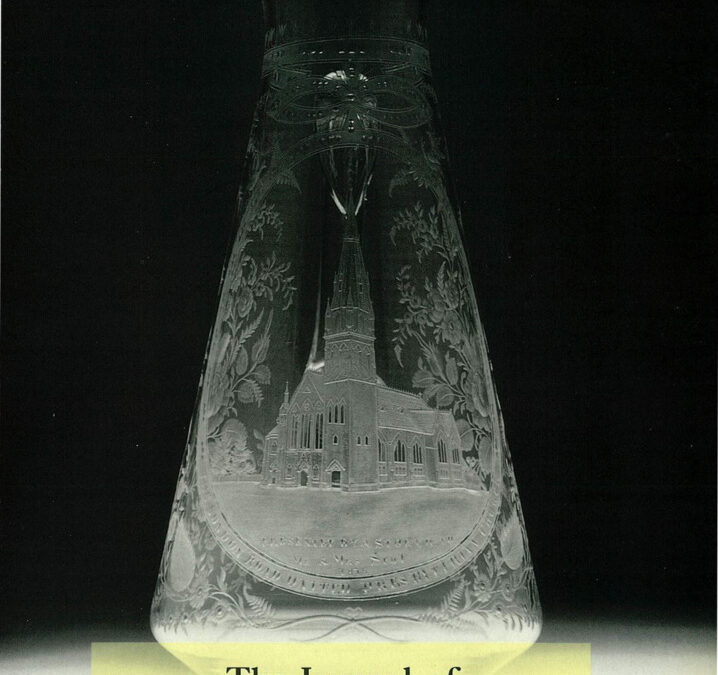
The Journal of
The Glass Association
44
%
,
–
L
–
ALOLUME
5
1997
The Journal
of The
Glass Association
VOLUME
5
1997
The Glass Association
Life President: Anthony Waugh
Launched at an inaugural meeting at Stourbridge College of Art in
November 1983, The Glass Association is a national society which aims to
promote the understanding and appreciation of glass and glassmaking methods,
both historical and contemporary, and generally to increase public interest in
the whole subject of glass.
The Journal of the Glass Association
deals primarily with the history of glass in
the nineteenth and twentieth centuries, although articles on the eighteenth
century are published as appropriate. There is a natural emphasis on the glass
of the British Isles, but contributions on overseas glass are welcome where they
relate in some way to British glass. Articles reflect the breadth of interest of
current glass studies in the design, social, industrial and economic contexts
of glass as well as its aesthetic and art historical aspects. Anyone wishing to
publish in the
Journal
should contact the editors.
Editors of the Journal:
Ian Wolfenden
Department of Art History and Archaeology, University of Manchester,
Manchester M13 9PL
Richard Gray
Manchester City Art Gallery, Mosley Street, Manchester M2 3jL
3
PUBLICATION DETAILS
ISBN 0 9510736 4 8
OFFICE ADDRESS
Broadfield House Glass Museum
Kingswinford
West Midlands
DY6 9QA
Text © Authors and
The foam& of the Glass Association,
1997
Catalogue typeset and designed
by Alan Ward @ Axis, Manchester
COLOPHON
This catalogue was set in Monotype Erhardt
Printed by Jackson Wilson, Leeds
Cover and text material is Megamatt 300gsm and 170gsm stock
Reprographics by Leeds Photo Litho, Leeds
CONTENTS
A Lost Stourbridge Glassworks
Rediscovered
Peter Boland and Jason Ellis
PAGE
7
Cellars of Glass
Peter Lole
PAGE 26
Three Edinburgh Engravers
Gordon McFarlan
PAGE 36
Whitefriars Lookalikes
Lesley Jackson
PAGE
47
The Survival of Traditional Design in
Post War Stourbridge Glass
Frederika Launert
PAGE
6i
Automated Glass Production in Britain
since World War II
Lesley Jackson
PAGE 69
FURTHER NOTICE
The Davenport Glass Works
in the 19th Century
Ronald Brown
PAGE 83
Y
DUDLEY
A4101
KINGSwINFORD
.tour.0ridge
Lanai
WORDSLE
Dudley anal
STOURBRIDGE
Canalside
.0.12
%
Glassworks
ono
4
7
Deo’
EIALESOWEN
Dob Hill
Glassworks
WORDSLEy
u‘n-
_ Coltman
and Grafton
Glassworks
Wordsley Flint
A
Glassworks
MI
Redhouse Cone
Audnam Bank
AUDNAM
y
AI
Glassworks
New Dial
Canalside
Glassworks
Glassworks
not
,
,
s
Bagues A
0,01
Glasshousesa
Wheeleys
Glasshouses
AMBLECOTE
ROA
STOURBRIDGE
A LOST STOURBRIDGE GLASSWORKS REDISCOVERED
PLATE I
The Canalside Glasshouse in its national and local context
PLATE
2
Plan of Audnam, Amblecote and environs. Showing principal glasshouses
mentioned in the text.
6
A Lost Stourbridge Glassworks
Rediscovered
Peter Boland & Jason Ellis
This article attempts to shed some light on Stourbridge glass
in the late Georgian period, when the “Black Country” area
was undergoing meteoric expansion. The article has been made
possible by the collaboration of a professional archaeologist and
an amateur – although dedicated – historian and genealogist.
Peter Boland is the Borough Archaeologist of Dudley
Metropolitan Borough. Jason Ellis is the historian, previously
living and working in the area, but now of Harrogate.
Jason Ellis had been preparing to publish a definitive his-
tory of the Stourbridge glass trade for over ten years when
Peter Boland began to study Dudley and Stourbridge glass-
works sites for the Heritage Division of the Planning and
Leisure Department of Dudley Council. At that time they had
not met and were unaware of each other’s activities.
One fateful day in 1992, Dudley Metropolitan Borough
granted planning consent for a new housing development on
derelict land between the Stourbridge Canal and the River
Stour. Peter Boland knew the area could have archaeological
remains and was granted permission conditional on what is
known as a “watching brief”. This allows access for archaeol-
ogists to observe development in progress and record any
archaeological remains uncovered, but without delaying the
development. The developers Konrad Kottler Ltd. began
work by the canalside and, while removing topsoil, exposed
the brick foundations of what was obviously once a substan-
tial structure. Peter and his colleague John Hemingway swung
into action and in the three days allowed to them through the
good offices of the developer carried out a limited “dig”.
Their find forms the first part of this article.
Peter shook the dust off his boots and returned to his
office. Here he enlisted the assistance of his colleagues to try
and identify exactly what it was that Konrad’s excavators had
unearthed. The evidence was mixed. Was it an ironworks?
Was it a glassworks? Was it both? Although the shape sug-
gested a glasshouse cone, the overriding problem was that
nobody had any recollection or record of a glassworks having
ever stood at that location.
A colleague suggested Peter should contact Jason Ellis to
see if he had any information about a former glassworks at the
canalside site. Their first meeting took place in 1993 and was
immediately fruitful. Having been forewarned by letter, Jason
arrived with a large file of likely references to Peter’s “find”.
Peter was astonished that not only had Jason brought several
contemporary written references to the site, but even an orig-
inal drawing of how the glassworks looked in 1886!
This initially appeared incredible to Peter, but for Jason it
was quite straightforward. During his research he had linked
all available manuscript and genealogical evidence with spe-
cific sites – except one. This was the site that Jason had been
trying to locate for about five years and of course it was the
one Peter’s trowel had just overturned.
Inevitably the two were delighted their respective informa-
tion was clearly linked and began a further investigation into
extant map evidence. Jason already had the basic genealogy of
the proprietors and glassworks managers documented, only a
few further cross-checks were required. The genealogy of
these families forms the second part of this article.
PART 1: EXCAVATION OF THE CANALSIDE
GLASSHOUSE, AUDNAM, NEAR STOURBRIDGE
Introduction 01..71-3)
In 1992 Konrad Kottler Ltd. and Wilcon Homes lodged a
planning application for a large scale housing development to
be undertaken between the Stourbridge canal and the river
Stour in Audnam. Archaeologists working in the Planning and
Leisure Department of Dudley Metropolitan Borough
Council were aware of the previous existence on the site of a
furnace described on the 1883 Ordnance Survey map as the
`Audnam Furnace (Iron and Brass).’
Although this was of potential interest, little hope of sur-
vival was held out. The 1919 edition of the Ordnance Survey
clearly shows that by then the furnace had been demolished
and the site occupied by a completely different configuration
of buildings comprising the `Audnam Works (Anchor and
Shackle).’ The site then continued to develop through time
with an increasing intensity of use, culminating in a large
modern manufacturing complex, which was to be cleared
ahead of the housing development.
Nevertheless the Planning and Leisure Department
attached a watching brief condition to the planning consent,
allowing access for observation and recording should remains
of interest be revealed. The results far exceeded expectations.
The Watching Brief
(Hale
4,1
As the developer’s machinery attempted to clear the site, it
7
1214
.
4*.
12
4
4‘
1
,
0
.;.!•• A4
122G
1227
•
28
1293 1
.1go
,
•
5
:3
1298
1.294
..:
1
—%”,
1294
I
–
.
2.619
,,„.rif
_,
,
Indnar
Fortn .ry
Disused j
1295
–
-930
Mw…1•
n
/ga
l°
Ural IronyWo
•
Pi-ru,sed„,1
1296
70. 31
2.273
415,
i
k
t
7.1
.Dial
•
.§
A LOST
STOURBRIDGE
GLASSWORKS REDISCOVERED
PLATE
3
The historic development of the Canalside Glasshouse, as shown on Fowlers 1840 Map of the Parish of
Kingswinford and the 1883, 1903, and 1919 editions of the Ordnance Survey. (see footnote 1)
became apparent that a very large and deeply founded brick
structure was emerging. A halt was called when preliminary
archaeological excavation showed a circular structure with at
least one major flue had survived. This obviously had the
potential to be of great significance, and negotiations were
opened with the developer to allow time and machine
assistance for a rapid excavation and recording exercise. The
developer lent a machine and driver and made three
days available.
A two-man archaeological team was therefore able to
conduct salvage recording, but this was obviously of a less
intensive nature than would normally have been justified or
wished for. Only tops of walls and flues could be exposed and
recorded in the time available and many features of interest
were left unexcavated.
However, further valuable observations, especially as to the
dimensions and characteristics of the flue system, were made
when the site was totally cleared by the developer’s machin-
ery, although obviously precise measurements were
impossible.
The basic make up of the site comprised a typical Black
Country pot pourri of black burnt loarns, ash and industrial
debris. This had been deposited in chaotic juxtaposition by
continual large scale industrial activity. A decision was there-
8
Nor h
A LOST STOURBRIDGE GLASSWORKS REDISCOVERED
fore taken at the outset not to collect any artifactual material
nor any of the abundant metallic and glass slag on the site. It
was felt the enforced method of recovery would only result in
the accumulation of masses of unstratified material of
unknown date-range and place of origin, more likely to con-
fuse rather than assist analysis.
Description of Excavated Features
(pia.
4.5
CS 6)
As the ground plan gradually emerged it became apparent that
the basic component being revealed was a circular brick struc-
ture with two major brick-arched flues running up to it and
into its centre from the north and west. (See
PLATE
12)
The configuration left little doubt that this was the base of
a glass cone. Precisely similar components are still visible in
the immediate locality in the form of the New Dial
structure, but rather that they occupied preexisting spaces.
Only the western structure was fully excavated and this
had a dead flat bottom composed of the soft red sandstone
bedrock. Lying directly over the bedrock was a layer of black
burnt sandy material. The surface of the sandstone was indeli-
bly stained an intense black colour. Set at intervals around the
circuit of the cone interior, and integral with the structure
itself, were broad shallow buttresses. Three of these, in the
eastern half of the cone, were spaced regularly at 4.5m apart
and two shared a common width and depth of 2.5m and
o.25m respectively. However, the most northerly of the
group, sitting next to the gap in the cone’s north wall, was
only
21/1
wide. This general configuration was not repeated in
the western half of the cone. Here there was only one buttress
proper, which was 1.75m wide by o.25m deep and positioned
PLATE
4
Photograph of the glasshouse under excavation, looking north-west and
showing the main north-south flue.
Glassworks, a truncated cone on the opposite bank of the
canal, and the Red House Glassworks, which survives intact
a mere quarter of a mile distant.
Glass cone walls o’°”‘)
The walls of the cone were bonded with white mortar and
were generally some o.7m in width at the top level observable.
However, the external profile, visible to a greater depth, sug-
gested gradual narrowing in wall width from the base
upwards. Several features of interest associated with the walls
were recorded.
It was notable that in the centre of its northern side the cone
wall did not form a continuous circuit but contained two gaps
sitting on either side of a short length of wall. This wall was
offset to the north by approximately a wall width, ie the inner
face of the walling in this central area was aligned with the
outer face of the main structure. On excavation the two gaps
were occupied by rectangular brick settings which appeared to
be later insertions. Both were constructed of machine-made
bricks, obviously different from – and later than – those used
elsewhere in the cone. It did not appear that the insertion of
the brick settings created the gaps in the walls of the circular
PLATE
5
Photographic overview of the glasshouse as excavated looking cast, ranging
rods indicate path of central minor flues and north-western major flue.
PLATE
6
Plan of the excavated glasshouse superimposed onto the
1883 Ordnance Survey building configuration- not to scale.
9
A LOST STOURBRIDGE GLASSWORKS REDISCOVERED
south of the westernmost gap in the cone wall. Elsewhere, a
buttressing effect was created through a thickening of the
cone walls in the areas over the main west-east flue and adja-
cent to the north-south flue. This resulted in the creation of
a recess some 4m in width and o.25m deep between the two
thicker areas.
Located central to the cone’s west wall, and butted against
it, were the remnants of a brick floor. This was bedded on
layers of sand and ash some o.2m in depth, which in turn sat
over a white mortared pad levelling over the brick arch of the
west-east flue beneath. This seems to be the only fragment of
flooring to survive later disturbance. Just south of this rem-
nant flooring, curving alongside the cone wall, was an open
rectangular brick setting with a fill of ash and clinker. This
was not fully excavated.
Central to the cone’s eastern wall and integral with it was
a small fireplace whose corbelled back was heavily sooted.
The flue system (Ph'”‘
1
”
Turning now to the major flues, ‘airways’, ‘caves’ or ‘draught
holes’ of the glasshouse. The north-south aligned flue ran
from its point of origin south of the cone for the impressive
distance of some 15m before reaching the main structure.
Limited contact with the east-west aligned flue by the devel-
oper’s machinery suggests it ran for a similar distance at least,
but this intelligence from the contractors was not confirmed
archaeologically.
flue more detail of the cone foundations were revealed by con-
trolled machining down to red sand at the base of the flue.
This gave a height for the flue from base to arched top of at
least 2.5m or 8 feet, with a width of just under 2m, in fact 6
feet. It was observed that the flue abutted the main structure
externally and internally at low level. Its arch is, however,
integral with the cone, suggesting contemporaneity. Towards
the base of the flue, just external to the main structure, are
two rectangular opposed slots set horizontally into the brick-
work. These contained fragments of rotted wood. The inter-
section of the east-west flue (which was also nearly zm wide)
with the cone was not exposed archaeologically to any great
depth. Here the arch is obviously integral, running through
the cone wall, although it was abutted externally.
A further flue of similar dimensions to those described
above lies inside the cone in its northwestern quadrant. This
branches off the main north-south flue via a flat-headed rec-
tangular opening which immediately gives way to a brick arch
further into the flue.
Further details of both the branching and north-south flues
were revealed when the developer’s machinery was involved
in later wholesale site clearance. It became clear, not surpris-
ingly, that the brickwork of both flues occupied substantial
trenches cut through the red sandstone bedrock. It also
became clear, perhaps more surprisingly, that both flues ter-
minate within the cone in blind ends, rather than carrying on
up to, or beyond, the cone walls.
PLATE
7
PLATE
8
Phased ground plan of the glasshouse.
Ground plan of the glasshouse, glass-making phase only.
Most of the length of the north-south flue was machined
out before archaeological intervention, but a particularly dense
mass of brickwork was noted at its southern end, which per-
haps represents an entry point to the flue.
At the intersection of the cone wall with the north-south
At the northern termination of the main north-south flue
are two minor flues sitting at high level and running north in
a Y shape or fishtail configuration. The easternmost of the
two is brick arched only to a height of around o.2m. It ter-
minates against the wall of the cone, where the arch has been
10
A LOST STOURBRIDGE GLASSWORKS REDISCOVERED
stoved in by a later pit obscuring the actual point of junction.
The westernmost flue is wider and deeper, (up to tin),
which may imply a different function. Less associated brick-
work also survives, although there is evidence of brick arch-
ing at its northern end. The flue ran through the gap in the
cone wall, at least as far as the cone’s outer face. At this point
it has been truncated by the later insertion of a rectangular
brick feature, which has been described above.
Further more minor flues, precisely similar in character to
the smaller of the two described, were observed in the central
area of the cone at the junction of the main flues. Here, high
in the east wall of the north-south flue, three smaller flues run
east for only a short distance before terminating at a rectan-
gular brick feature. All three have rectangular openings onto
the main flue but were thereafter brick arched to a height of
around
0.2M.
Two of the three flues curve noticeably to meet
the rectangular structure, suggesting
a
functional association.
The flues are contained within and levelled over by a heavily
mortared platform of brick intermixed with firebrick, the east-
ern side of which is markedly curved. A similar pad of heav-
ily mortared brick could be seen on the opposite side of the
main north-south flue where it lay over the line of the major
north-west branching flue. However, the platform’s original
extent was obscured here by the severe damage and trunca-
tion caused by later disturbance.
In the body of the main north-south flue, just north of its
junction with the east-west flue are two slight buttress-like
projections with rounded corners. These sit opposite one
another and thereby narrow the flue. The tops of the but-
tresse are angled brick, forming the spring of an arch that
would have had a narrower profile here than in the rest of the
main flue. The curved sides of the buttress on the east return
to form a side wall for two of the secondary flues previously
described. An iron strap projecting from the eastern side of
the main north-south flue, north of the buttresses, was also
observed.
A notable feature of the whole of this central area is the
bonding of the brickwork with fireclay, rather than the white
mortar used elsewhere. This is still in plastic form where col-
lapse exposed the wall core. It must be assumed the use of
fireclay was a response to the intense heat generated by the
central furnace.
External features recorded
f”‘ plate
Time constraints only allowed the briefest consideration of
features external to the cone structure. However some walls
were exposed which appeared to conform in plan
to
structures
shown on early maps of the site.
Recorded external to the south side of the cone were lin-
ear fragments of brick wall running from the cone south-
wards. These were not examined in detail but they can prob-
ably be seen on the 1883 Ordnance Survey map, and see
PLATE
6. One ran parallel to and alongside the canal towpath,
two others angled off the main structure, one lying over the
main north-south flue the other occupying the space between
the incoming flue tunnels.
Destruction material and intrusive featurest
(6
”
16″
It was clear, as suggested by map evidence, that the site of the
glass cone had at some stage been cleared and that a new use
had been imposed upon it. This destruction was represented
archaeologically by the removal of nearly all the brick floor-
ing of the cone. This allowed the stoving in of the exposed
flue tunnel arches in many places and the subsequent filling
up of the flue tunnels and levelling over of the rest of the site
with black foundry sand.
In the western half of the cone interior were two massive
concrete foundations containing very large iron bolts, thread-
ed at the top. Both concrete bases were impressively deeply
founded. Their removal caused the developer’s machinery
considerable trouble. They were obviously sited with no
regard to the earlier glasshouse, smashing through its flue
structure. The most southerly of the bases is the more com-
plex, incorporating a rectangular well at its top, floored with
wooden beams. These beams have the dimensions of railway
sleepers and are integral with the lower parts of the founda-
tion.
Angled away from the main rectangular foundation on its
western side is a smaller rectangular brick-built pad with two
surviving iron bolts. This is integral to the main foundation
but set at a lower level. It seems to be aligned with a further
brick foundation, bonded with the same extremely hard blue-
grey mortar or concrete, which lies to the southwest, external
to the cone wall. This brickwork is roughly square in plan,
taking the form of a central floor area surrounded by higher
brickwork abutting the cone wall.
Interpretation
The documentary and excavated evidence suggests there were
three main phases in the life of the site. First, use as a
glasshouse, second use as a foundry, and finally, after whole-
sale clearance, use as an anchor and shackle works. Taking
each of these phases in turn:
Phase I. Glasshouse
Features internal to the Cone (“‘P°”
8
)
As noted previously, the ground plan of the Canalside
Glasshouse generally conforms with other surviving and exca-
vated examples of glasshouses.
However, due to later site clearance we are limited here to
consideration of the “guts” of the cone, principally its flue
system, and the few surviving features attached to the circuit
of its walls.
Of note in the latter respect are the series of slight but-
11
A LOST STOURBRIDGE GLASSWORKS REDISCOVERED
PLATE
9
Photograph, looking cast at the central area of the glasshouse and showing
flue configuration, part indicated by ranging rods, as
PLATE
5.
PLATE
I 0
Photograph of the glasshouse central area, looking north-west and detailing
putative rectangular secondary furnace and path of incoming minor flues,
as indicated by ranging rods.
PLATE II
Photograph of the east side of the major north-south flue showing minor
flue outlets, base of siege and putative secondary furnace.
tresses ranged around the walls, which were presumably
designed to bolster the cone structure. They may also,
although this is not provable, have delimited openings in the
cone walls. Noted previously is the thickening of the cone
walls over the main flue entry points. This no doubt strength-
ened the cone structure at these potential weak points.
Also of note, is the small hearth built into the east wall of
the cone. Such hearths have been interpreted on other sites
such as Catcliffe, near Sheffield’ and Gawber, near Barnsley’
as being for use by blacksmiths maintaining the glassworkers’
equipment. This seems a reasonable interpretation here also.
Almost directly opposite this hearth, curving alongside the
west wall of the cone and adjacent to the east-west flue, is the
hollow brick setting described previously. Since this remained
unexcavated, little can be said as to function, although the
associated ash and clinker make it tempting to speculate that
another hearth is indicated.
Configuration of the flue system “P'”””'”)
Regarding the flue system generally, this at first sight appears
straightforward, with two major flues providing draught from
the south and west of the cone, presumably for a central cir-
cular furnace. Control of the draught via a set of movable
screens or doors is suggested by the previously described rec-
tangular opposed slots, set into the sides of the north-south
flue where it meets the cone.
Although nothing survives of the furnace superstructure,
the location of the core of the main melting furnace is sug-
gested by the small buttresses sitting on either side of the
north-south flue. These are well placed to give added struc-
tural support to the furnace area. In particular they may have
formed one edge of the furnace eye, within which, over a
grating, coal for the furnace would have been burned.
However, no trace of either grate or eye could be discerned,
the walls of the flues having been reduced by destruction to
too low a level.
A similar narrowing of the flue structure is observable in
the same area at the surviving Red House Cone, although on
a larger scale. Also at the Red House, iron strapping is visi-
ble within the roof of the flue tunnel for strengthening the
arch. The iron strap projecting from the east side of the
north-south flue of the Canalside Glasshouse may also have
performed this function.
It seems highly likely that the sieges of the melting furnace,
on which the clay pots used for glass melting would have
stood, are represented by the heavily mortared brick and fire-
brick platforms lying on either side of the main north-south
flue. In particular, it seems that the markedly curved eastern
edge of the more complete western platform reflects the posi-
tion of the outer edge of the circular furnace. Both platforms
were laid over and levelled off elements of the flue system.
That on the west contained the major branching flue and that
12
A LOST STOURBRIDGE GLASSWORKS REDISCOVERED
on the east the three minor flues described previously. Two
of the minor flues lay on either side of the eastern buttress
described above, whose rounded moulded brick corners
returned to form one side of each flue, strongly suggesting the
flues and buttress are contemporary. Similarly, the western
buttress is integral to the major branching flue.
It will be apparent from the interpretation advanced above,
which suggests the major branching flue and the minor flues
ran beneath the siege of the melting furnace and were integral
with the buttressing of the main north-south flue, carries with
it the implication that the airways must have formed an inte-
gral element in the glassmaking function of the cone. This
view finds further support when the major flues, which in
their massiveness and relationship to the cone walls are clear-
ly primary, are considered in more detail.
As noted earlier, the main flue system accords well with
excavated and surviving examples of glass cones and with
those surviving only in the form of contemporary plans.
However, in all the cases cited above the flues seem to be
open ended. That is open to the air at each end and going
beyond or at least piercing the wall of the glasshouse, there-
by providing a through draught.
This is not so with the Canalside Glasshouse, where the
main north-south flue ends well beyond the furnace area in a
blind end, but with two smaller flues leading off from a high
level. Similarly, the further major flue running as a spur to
the northwest has a blank end. Unfortunately, later distur-
bance here precluded the survival of any smaller flues that
might once have existed.
There seems no functional logic in such an arrangement of
the major flues nor in digging them through several cubic
metres of bedrock unless they were intended to induce a
through flow of air. Smaller flues, such as those observed at
the top of the northern end of the main north-south flue
would effectively achieve this air flow. The inference must be
that smaller flues at the blind end of the major flues formed
part of the original design.
The intended function of the minor airways is probably
illustrated by the three small high-level flues considered ear-
lier. Branching off the east side of the major north-south flue,
these lead to a rectangular brick structure. The fact that they
clearly curved to meet it suggests they were designed to func-
tion with it.
The flues were well placed to convey heated air from the
central furnace into the brick structure, which it must there-
fore be assumed was a secondary furnace attached to the main
melting furnace. By analogy, the most likely explanation for
the fishtail flues at the northern end of the main north-south
flue and for the arrangement of the major branching flue, is
that they were similarly designed to provide draught for sec-
ondary heat sources within the cone. Presumably the lighting
of a fire in the subsidiary furnaces would induce a through
flow of usefully preheated air from
the area of the central fur-
nace.
Functions of the Glass Cone
Before attempting to interpret the surviving physical evidence
from the Canalside Glasshouse further it is appropriate to
briefly consider what basic working components might be
expected on any glasshouse cone site.
The main central melting furnace with associated flues pro-
vided the
raison d’etre
for the cone structure, whereby a
through draught could be achieved sufficient to create high
temperatures using coal. However, it is obvious from surviv-
ing structures, site plans and contemporary accounts that var-
ious secondary heat sources would also be required, catering
for several different functions.
An annealing furnace or lehr
was
necessary to enable glass
products from the main furnace to be cooled gradually, there-
by avoiding rapid shrinkage and cracking. For similar reasons
the fireclay pots used to contain the glassmaking mixture in
the main furnace had first to be dried and brought up to tem-
perature in a pot hearth. The glass making mixture or metal
was also preheated in a furnace variously known as a calcar,
corker, or fritting oven. This dried the sand and burnt off any
organic impurities, resulting in a frit ready for use in the main
furnace. Secondary furnaces, known as glory holes, were used
for the reheating and further working of glass after its initial
removal from the main furnace. What, then, were the likely
purpose and dispositions of secondary furnaces at the
Canalside Glasshouse, taking account of both the flue system
and the general arrangement of the site as described on early
maps and documents?
The lehr probably operated as in the surviving Red House
Cone. This has a conveyer system in a long annealing tunnel,
emanating into
a
checking, packing and despatch room known
as the `shrawer’. Map evidence shows a suitably large rectan-
gular building to the north of the cone, nearest to the canal-
bridge entrance to the site and running alongside the canal,
which probably provided wharfage. The fish-tail flues are
thus well placed to have provided draught for fires heating the
lehr, the gap in the wall of the cone here perhaps being asso-
ciated with the base of the annealing arch.
Regarding the rectangular secondary furnace juxtaposed
with
the central furnace, it is impossible to suggest a precise
function from the surviving evidence. Any of the various
hearths outlined above might have been positioned here, or
the structure may even represent a subsidiary melting furnace.
Similar ambiguity applies to the putative furnace beyond the
major branching flue. Here the major effects of later destruc-
tion preclude any clear picture being formed.
Buildings External to the Cone
Structures lying to the south of the cone, as depicted on
13
1
1
1
n
111111111
4
11
F
A-7
4
(042=e =c.see
4
j
t4, -47/.0,04.-pt4
Ztfcatc.r.r.s.e.
cL
,
Twe
Ot>VITZ7VI…
NEW DIAL
GLASSWORKS
cat
cz.,&y..
–
rtg•,,eribcrA
COAL YARD
SHROWER
LEHR
n
r
j
“:
TUNNEL
ACCESS
CLAY BUNKERS
THE REDHOUSE CONE
(
\
6
ENTRANCE
TUNNEL
ACCESS
TUNNEL ACCESS
POT ARCH
TUNNEL. ACCESS
A LOST STOURBRIDGE GLASSWORKS REDISCOVERED
PLATE 12
Comparative Ground Plans of the Red House and New
Dial Glasshouses.
14
A LOST STOURBRIDGE GLASSWORKS REDISCOVERED
Fowler’s maps and the Ordnance Survey could have had a
multiplicity of purposes. This can be observed by a brief
perusal of the ancillary areas of activity indicated on contem-
porary plans of the New Dial, Red House and Audnam Bank
works.
(PLATES
12 & 13)
However, for the Canalside Glasshouse we can turn to the
evidence of Benjamin Richardson’s notebook, including a
sketch of the glassworks’. The sketch suggests that the range
of buildings alongside the canal housed the ‘art room’ and ‘pot
room’.
(PLATE 14)
Genealogical research, discussed below, suggests the
Canalside Glasshouse was run by the Grazebrook family, and
that in the first half of the nineteenth century it produced
bottles. The presence of an ‘art room’ is therefore of interest,
as it would hardly be necessary for bottlemaking. Perhaps the
more sophisticated crystal glass products from the
Grazebrooks’ other glassworks at Audnam Bank were dis-
played or designed here’. Perhaps by the time of Richardson
writing in the eighteen-eighties and after the lifting of excise
restrictions, the Canalside cone was producing crystal glass?
Also of interest is Richardson’s depiction of an arched
opening into the range from the canalside. This he labels
`cave’ but its position does not suggest a furnace flue. It is
perhaps a passageway used for conveying materials between
canalside and glasshouse.
Parallels for the Flue System of the Canalside Glasshouse
The presence of minor flues, leading off the main flue at high
level, makes the Canalside Glasshouse (to the authors’ knowl-
edge) unique in either excavated or extant glass cones.
However, this could well be a product of poor survival and
insufficient opportunities for extensive excavation.
Contemporary illustrations do suggest the general principle
was well known. Diderot, in his drawings of `Verrerie
Angloise’, shows both pot hearths and a fritting oven next to
a central furnace. These apparently fed air via ‘linnet holes’
or small flues opening off the main furnace, but at relatively
high level!’
Celia Fiennes records that at a glass house in Yorkshire ‘we
saw them blow white glass and neale in a large oven by the
heat of the furnace’.’ In the Stourbridge area, Benjamin
Richardson records:
‘an old glass house that was built before there was any
Stourbridge canal… After the works had been carried on for
many years the annealing kiln or lear were heated by the ring at
the top of the furnace and was
approached
by steps at the side of
the fitrnace…’
Even closer to home, the plan view of Audnam Bank glass-
works in 1888, reproduced in
PLATE
13, clearly shows, albeit
at a later date and not in a cone structure, the use of a sec-
ondary draught hole leading off the main furnace flues, to ser-
vice a pot hearth some distance away. It seems clear this is a
subterranean flue as with the Canalside Glasshouse.
A lease for Audnam Bank drawn up in 1874 makes specif-
ic reference to this or a very similar arrangement as: ‘clay
tempering tank lined with slate slabs with hot air pipes from
fiurnace to heat the pot.'” Interestingly the plan suggests a cir-
culatory air flow around the two furnaces depicted. This may
have relevance in the context of the stone lined channel exca-
vated by Dr. Denis Ashurst at Gawber Glasshouse, which
curved around the siege and was interpreted as an ‘insulation
cavity.’w
It therefore seems clear that the principle of using hot air
from the central furnace to assist in ancillary operations was
well known. The system arrived at in the Canalside
Glasshouse may presently be unique, but it is unlikely to
remain so as more glasshouse sites are identified and more
extensive archaeological excavations are undertaken.
Phase 2. Iron and Brass Foundry
(
“`P'””
If it is accepted that the major and minor flue systems already
described form features of the glassmaking function of the
site, there appear to be few physical remains relating to the
documented use of the site as an iron and brass foundry. This
is not surprising since the main glass melting furnace would
presumably have been equally capable of melting metals,
without the need for major adaptations below superstructure
level.
It is significant that the changes affect only an area inter-
preted as having a specifically glass related function, not rel-
evant to metalworking. Thereby in the suggested position of
the lehr, one of two rectangular brick settings was inserted
and these may have functioned as ash pits. The inference is
that the now unnecessary annealing tunnels were stripped out.
Phase 3. Glass Cone Destruction “P’°” JJ
The destruction of the glasshouse must have taken place in
the period between the production of the 1903 Ordnance
Survey, on which the Audnam Foundry is marked ‘disused’
and the 1919 edition, which shows completely new structures.
Clearance was presumably designed to create a stable base
level for the subsequent use of the site as an anchor and
shackle works.
Examination of the Ordnance Survey mapping of the new
works shows a series of small buildings with associated chim-
neys. The large concrete settings excavated complete with
retaining bolts may have been engine beds and the small
square brick setting outside the cone’s south wall could well
represent the base of an associated chimney.
History of the Canalside Glasshouse.
Having uncovered the physical evidence of the glass cone, the
problem remained as to its origins, its owners and its place in
the history of Stourbridge glassmaking. Answers to these
15
1
a
11 1102
MP
ROA
TUR/VP/M
6
FI•ortz.-Wi2reesle,
7′ It
aC
E
Afireispfoo erzy
r
FF
6
A RD
NOSE
o
b,
PPFV
,L
Roo
li’diThaase
,
Yte-weigha
Acu
ra
,
;
S.
APONA A4
BA NA’
NOUSE
•
‘
to,,St ct.-4/-1
–
ex
–
bye,
A LOST STOURBRID GE GLASSWORKS REDISCOVERED
PLATE 13
Plan of Audnam Bank Glassworks in 1888.
questions were eventually teased out by extensive map and
documentary research. It was apparent from early canal maps
of the area that the glassworks was not in existence when they
were drawn up. No buildings are shown on the site on Robert
Whitworth’s x774 map of the planned Stourbridge Canal, nor
John Snape’s map of its planned extension drawn in 1785.”
However, buildings, in the general precise configuration of
the “Audnam Furnace” depicted on the 1883 Ordnance
Survey, are visible on Fowler’s surveys of 1822 and 1840.
Fortunately a book of reference survives for both of
Fowler’s surveys, within which a brief description and details
of owner and occupier are recorded. In 1822 the buildings
were described as glasshouse and shop, the owner being
Michael Grazebrook, the occupier John Swift. Next to the
main complex was a small plot also owned by Grazebrook
containing a house and garden occupied by Joseph Moore. All
these individuals remained in place in 1840.
With this new information documentary research already
undertaken by Jason Ellis began to fall into place. In particu-
lar, references to a particular glasshouse in Benjamin
Richardson’s notebook of
I
886
12
began to make excellent sense.
Richardson wrote:
‘There is a glasshouse cone by the Stourbridge canal that
Thomas and Michael Grazebrook built and worked it for a short
time and then turned it into an iron foundry and is carried on by
Cookson and Sons.’
This could obviously refer to the Canalside Glasshouse,
which we know was an ironworks by 1883 and was owned by
the Grazebrooks. A sketch of a glassworks in Richardson’s
notebook also seems to reflect the precise layout of the excavated
glassworks and is undoubtedly a depiction of it (PLATE 14).
Further corroboration is provided by another passage in
the notebook. It is equally informative and includes details
that can be directly related to Fowler’s 1822 map:
‘There used to be a very old glass house opposite the Boat Inn
and near to Dab Hill and used to be worked by Madam
Grazebrook and they used to take the materials from the glass house
at Audnam to Bug Pool or Dob Hill glass works and vice versa .
. . and after the old glass house fell down they put up a new cone
by the canal side and went from the Audnam glass works across the
top of the Sider Field to the new cone near the bridge at the canal.’
PLATE 15,
adapted from Fowler, clearly shows the interre-
lationship of the sites and features mentioned in Richardson’s
text. This leaves little doubt that the excavated cone and
Richardson’s ‘new cone’ are one and the same (Richardson’s
`Audnam glass works’ is unquestionably a reference to the
well documented Audnam Bank Glassworks).
Grazebrook’s landholding recorded by Fowler in 1822 is
also shown in
PLATE 15
and is equally suggestive in its dispo-
sition. The only land between Audnam Bank glassworks and
the new cone not controlled by the Grazebrooks was that
which had been acquired by John Pidcock to build the New
Dial Glassworks in 1788.
The Canalside Glasshouse and
the Stourbridge Industry O
Pi””
zf
16
vte
.74-te
IL-as
0441
–
412
‘
1
-1=v
C-
7
,e-,
C
7
,
4,11
1
1
; I
C)
–
r1
4
,
4 (i’rj
.
EA
—
(17
IA{
/ Of/le-44 442’1
64
–
1
–
1/.
4’11014
//fne
41-
7
7-
–
fru.P
A LOST STOURBRIDGE GLASSWORKS REDISCOVERED
PLATE 14
Enhanced extract from Benjamin Richardson’s Notebook, i886.
If it is accepted that the glass cone referred to by
Richardson and the excavated cone is the same site, then sev-
eral observations can be made which relate to the wider
Stourbridge glass industry.
For instance, the conversion of the Canalside Glasshouse to
an iron and brass foundry finds echoes in many other
Stourbridge glasshouses. This was because of changing mar-
ket conditions and the consequent need for flexibility.
According to Richardson”, Coltman and Grafton’s glasshouse
was converted to an iron foundry not long after 181o;
Wheeley’s Brettell Lane Glassworks and the smaller of the
two Dial glass cones had been converted to metal melting by
the time of the 1883 Ordnance Survey. Bagues, also on
Brettell Lane, was making pottery at the time of Fowler’s
1822
survey.
It is also clear that the ‘new cone’ was being run in tandem
with the Audnam Bank glasshouse, just as Dob Hill had been
previously. Recent research suggests this twinning of
glasshouses was common in the Stourbridge area, although
more usually it took place on the same site rather than at a
distance.
Sitting directly opposite the Canalside Glasshouse, over the
canal, the New Dial Glassworks is a case in point. It origi-
nally had two glass cones, one for making broad glass, the
other making bottles. This pattern is repeated at the Heath
Glassworks where a document of 1705 refers to two cones,
one for bottle and one for white or flint glass. Two cones
similarly existed at both Bagues Glassworks and Wheeley’s
glassworks, which sat opposite each other on Brettell Lane.
Other examples could be cited and it is the authors’ belief
that most glasshouse sites known to posterity only by a corn-
pany name may have either contained more than one cone or
have had access to the product of another furnace. The rea-
son for this may be found in that bane of the glassmaker’s life,
the Glass Excise Duty, levied from 1750-1850. This eventu-
ally became quite explicit in requiring glassmakers to register
precisely the type of glass being made in any particular fur-.
nace at any particular time. The excise regulations for 1835
stated:
‘The manufacturers of glass are prohibited making … any other
glass than common bottles, or vessels made from common bottle
metal, in any glasshouse entered or used for making common
bottles.”‘
Therefore, although it was clearly feasible to combine bot-
tle and flint glass production at one furnace, these regulations
clearly precluded it. If a glassmaker wished to retain the
capacity to respond to fluctuations in the market for both bot-
tles and flint glass, control over more than one glasshouse was
a necessity.
It will be noted in the genealogical section below that John
Swift of the Canalside Glasshouse was a bottlemaker, where-
as the Grazebrooks’ other glasshouse, Audnam Bank, was
famed for its production of flint glass and pottery. Finally, the
innate flexibility of a glasshouse furnace makes it a fraught
business to rely – as some historians have been inclined to do
– on supposedly complete lists of Stourbridge glassmakers
such as Tunnicliffe’s’s, or to extrapolate such things as pro-
duction figures from them.
It seems apparent from the examples cited above that at
any given time a particular glasshouse might escape listing
through being either mothballed or engaged in a different
industry entirely. There is also likely to be an under-repre-
17
1 I
11,111.111
Wen
Piece
o
Dial
Glum Houses
John Pidcock)
Breda
Lune End
Stourkidge
to
Wekerhampmn
Turnpike (1766)
Crawl:um
–
A:Occupier
Of Lord Dudley)
Crazebrook Proprietor
A LOST STOURBRIDGE GLASSWORKS REDISCOVERED
PLATE 15
Placcnames and Landholdings. Based on William Fowlers 1822 Map of the Parish of Kingswinford.
sentation in the lists of the number of actual furnaces in oper-
ation, given the frequent occurrence of two glass cones oper-
ating under the aegis of a single company name. This suggests
great care is needed when estimating both the volumes of pro-
duction of the industry at various times and the number of
glasshouses operating.
The bare bones of the excavated evidence can now be
fleshed out by reference to documented history and the
genealogy of the individuals involved in the operation of the
Canalside Glasshouse, and this is attempted in Part 2.
PART 2: GENEALOGICAL ANALYSIS OF OWNERS
AND PROPRIETORS OF THE CANALSIDE CONE
The Audnam Glassworks
Genealogical research makes it quite clear that the founders of
the Canalside cone were members of the Grazebrook family.
However, it was not their first venture. In 1747 Michael
Grazebrook I took the lease of a glassworks at Audnam from
Lord Dudley at an annual rent of X50. The glassworks had
been built by Henry Bradley in r7i6b
6
next to the earlier
works started by his father Edward. Henry was affected by a
steep fall in the price of broad-glass and was declared bank-
rupt in 1727″. With a lot of financial assistance from his fam-
ily he restarted the business, but finally collapsed under the
weight of debt in 1747. Baron Ward, later to become Lord
Dudley”, was one of his principal creditors.
Michael Grazebrook was of a wealthy and annigerous fam-
ily°. He was the sixteenth generation to bear the family’s arms
and had been the Overseer of the Poor for Oldswinford in
1721. Trade was buoyant under Michael Grazebrook’s man-
agement and he soon introduced his son, Michael II”, to the
business. In 1753 Michael II married Sarah Worral, the only
child and heiress of Thomas Worral of Stourton,
Staffordshire’. Michael Grazebrook I died in 1756
22
, aged
sixty-nine and his will” was proved the following year. In his
will he is described as a glassmaker of the Heath, Oldswinford
and left his estate to his widow Elizabeth, his sole executrix.
He was succeeded by his son, Michael Grazebrook II, who
lived at Audnam. A list of glassworks in 176o showed Michael
Grazebrook II producing smooth enamel glass, best and ordi-
nary flint glass, and phials”.
Michael Grazebrook II of Audnam Brook only lived to
forty-two years of age and died in 1766
25
, five years before his
mother. In his will” he is described as a master glassmaker
and desired his trade be carried on by his widow, Sarah. He
also directed that his stock in trade, book debts, personal
estate and effects be equally divided between his only two
sons, Thomas Worral Grazebrook” and Michael Grazebrook
III” so they could carry on the trade. Sarah Grazebrook con-
tinued to manage her late husband’s business for many years
and although both her sons were involved, they developed
many other interests.
Elizabeth Grazebrook, the widow of Michael Grazebrook
died in 1771
29
. She died intestate and letters of administra-
tion” were proved for her estate. She had outlived her son,
and her grandsons were by now wealthy men, so her estate
was administered by her daughter Sarah Littlewood and
Sarah’s husband, Benjamin Littlewood. Benjamin Littlewood
was a blacksmith of Amblecote at the time, but later became
a partner at Wheeley’s Brettell Lane glasshouses.
Sarah, the widow of Michael Grazebrook II, ran the busi-
ness for many years. Whitworth’s canal map of 1774′ shows
18
A LOST STOURBRIDGE GLASSWORKS REDISCOVERED
the outline of the cone at Audenham Bank and in 1777, when
the land around was subject to enclosure, Mrs Sarah
Grazebrook was the occupier of the glasshouse at Audnam
owned by Lord Dudley, and the Dob Hill glassworks, owned
by Robert Honeybome”. She is listed as a glass manufactur-
er in
Bailey’s Western and Midlands Directoiy
of 1783 and in
the same year she took a further twenty-one-year lease from
Lord Dudley. By the terms of the lease the glasshouse with
furnaces, millhouse, warehouses and buildings was rented at
£52
per annum with maintenance and repairs to be under-
taken by the lessee at her own cost”. The premises were
insured on 5 May 1783 by Sarah, Thomas Worral and
Michael Grazebrook. The policy shows that they were potters
as well as glass manufacturers, with ‘seven rooms for earth-
enware’, housing stock valued at £20″. Five years later the
policy was renewed when the schedule suggests they had
ceased pottery manufacture”.
In 1785 Michael Grazebrook III married a distant cousin,
Mary Ann Needs, the oldest daughter and co-heir of Thomas
Needs of London, by his wife Mary, nee Grazebrook”.
Shortly afterwards the newlyweds moved into the Grazebrook
family home, Audnam House, where their family of eleven
children were all born. The family tradition states he always
carried a small dog whip in his pocket to keep his large fam-
ily of spirited youngsters in order”.
After his marriage Michael Grazebrook III, and to a lesser
extent his brother Thomas Worral Grazebrook, appear to
have taken over the running of the glass business from their
mother Sarah. Their wealth and influence grew as they pros-
pered as glass, coal and iron masters. They moved in the
higher echelons of society and were involved with many
improvement schemes in the area. For example: turnpike
trusts were established to improve the roads in the locality
and provide for their upkeep. The Stourbridge to
Wolverhampton road was greatly improved as a result. To
fund the work, loans were raised on the security of the expect-
ed tolls. There were four glassmakers whose premises were
not on the banks of the newly-built canal. They were so keen
to see the roads improved that they lent money to the trust
without interest. In 1786 Thomas Rogers, Thomas Hill and
Messrs. Pidcock & Grazebrook lent the trust £too each”. It
was probably about this time that the Grazebrooks built the
Canalside Cone, as will be described subsequently.
For many years the two brothers ran an eight-pot furnace
trading as T. & M. Grazebrook”. Their mother remained the
head of the firm until she died in 1799. In 1795 it was Sarah
Grazebrook, not her sons, who paid £53 rent for the Audnam
glassworks to Lord Dudley”. In 1796 the Grazebrooks took a
lease on Lord Dudley’s land at the Delph to supply clay to
the Audnam Bank Glass Works. Under the terms of the lease,
thirty acres were occupied at a rent of £32 per annum with
the right to ‘erect Engines etc to mine Glasshouse Clay at 9/-
per ton Royalty, Pot Clay, 5/- per ton, Offal Clay, 2/6 per ton,
Potters Clay, 2/-.'”
One of the many children born to Michael Grazebrook III
and his wife Mary Anne was George Grazebrook”. He mar-
ried Jane, the youngest daughter of Joseph and Elizabeth
Smallman, and one of their six children was Henry Sydney
Grazebrook”. H.S. Grazebrook became a barrister of the
Inner Temple and an ardent genealogist. He wrote prolifical-
ly upon the gentry of Worcestershire and the Stourbridge
glass industry. He eventually died unmarried at Chiswick on
19 June 1896 and was buried at Oldswinford.
As late as 1798 Sarah Grazebrook was still the glassworks’
leaseholder, holding a twenty-one-year lease from Lord
Dudley at £53 3s a year’. Presumably this lease would have
run from 1794 to 1815, but Sarah Grazebrook died in 1799″,
aged seventy-eight”. Her will” divided her estate between her
two sons, Michael Grazebrook III and Thomas Worral
Grazebrook.
The firm continued to trade under the management of the
two brothers in the face of punitive excise duties. On 17
January 1803 a meeting took place at the Stewpony Inn,
Stourton to petition the government to have the duty on flint
glass based on manufactured goods instead of metal or raw
materials. Michael Grazebrook III of Thomas & Michael
Grazebrook contributed Lso to the fund. The amount con-
tributed implies it was one of the smaller firms of the district.
However, glassmaking was only one of the trades the
Grazebrook brothers were involved in. They were also mer-
chants and dealers in clay and fire bricks”.
Thomas Worral Grazebrook died in 1816″, aged sixty. His
widow Elizabeth continued to live at their home, Stourton
Castle, with her two children, Thomas Worral Smith
Grazebroole and Elizabeth”, until 1832 when they left
Stourton and moved to Dallicot House near Bridgnorth in
Shropshire. In June 1837 Mrs T. Grazebrook had her late
husband’s remains exhumed and reburied in a vault in Clavely
churchyard, near to Dallicot, only to die herself on 18 June
1837, aged sixty-five, and was also buried at Clavely. Thomas
Worral Smith Grazebrook became a barrister of Lincoln’s
Inn, but died on 1 August 1846, aged 37″. The accumulated
family wealth and estates, derived from: Wilkes, Smith,
Grosvenor and Worral passed to his sister Elizabeth
Mackenzie Kettle. As he was the last male of his line, the rep-
resentation of the family and its arms passed to his cousin,
Michael Grazebrook IV of Audnam.
After the death of Thomas Worral Grazebrook in 1816,
Michael Grazebrook III took his two oldest sons, Michael”
and Williams” into the business. The firm continued making
flint and coloured glass, trading as M. Grazebrook & Sons” or
Grazebrook & Sons”. In 1822 the outline of the cone and sur-
rounding buildings are clearly shown on Fowler’s survey”,
occupied by Michael Grazebrook and owned by Lord Dudley.
19
A LOST STOURBRIDGE GLASSWORKS REDISCOVERED
In 1821 Michael Grazebrook IV married Elizabeth Wallace
Phillips, the only child and heiress of John Phillips of the Old
Square, Birmingham'”. They met under unusual circum-
stances at Brighton, which was at the height of fashionable
popularity in Regency times. Michael Grazebrook was seized
with cramp while bathing, and when he finally struggled to
shore was unconscious with exhaustion. Miss Phillips attend-
ed to him and had him removed to her hotel. Not long after
this they became engaged. Despite the romantic background
to their meeting, and the fact that they were both over thirty
years old and quite able to choose for themselves, Michael’s
new bride was not welcomed in the Grazebrook family circle.
Elizabeth’s father was a self-made man, who through his per-
sonal industry and energy had established a flourishing busi-
ness in coopering and wood-turning. His lack of polish dis-
pleased the more fastidious of Michael’s sisters. Despite his
artisan background he seemed to get on with one of them,
Charlotte, as he and Charlotte both held political views of ‘the
crusted Tory type’. After Michael and Elizabeth’s marriage
they rented Kingswinford Rectory for a year, then moved to
Corbyn’s Hall, where their two oldest children, Michael
Phillips and Elizabeth were born”.
Early in 1826 Michael Grazebrook IV and his family
moved to Belle Vue, Halesowen, where in April their second
son John Phillips Grazebrook was born°. Two months later
Michael Grazebrook III died at Audnam”, aged sixty-eight. It
has not been possible to find his will but evidently his sons
Michael IV and William continued the business; Michael rid-
ing over from Halesowen when not shooting, and William
attending to the business when not hunting. William
Grazebrook’s love of hunting was legendary. Known as ‘gruff
Will’ he was for many years secretary to the Albrighton pack.
After the death of Michael Grazebrook III, his widow Mary
Anne and their unmarried children, including William, con-
tinued to live at Audnam House. The firm began to operate
under the title of Michael & William Grazebrook”.
It is indicative of the status of the Grazebrook family to
note the marriage of Elizabeth”, one of the six daughters of
Michael Grazebrook III. Although her father did not live long
enough to see it – having died four years earlier – on 5
October 1830 she married Lieutenant Colonel Ferdinando Lea
Smith of Halesowen Grange, the senior coheir to the ancient
barony of Dudley.
Although profitable, the Audnam glassworks was one of the
smaller works in the district. Michael Grazebrook paid £2,218 5s
3d excise duty for the year ending 5 January 1833″, suggesting
this was the thirteenth largest of the sixteen Stourbridge/Dudley
glasshouses.
Pigot and Co.’s National Commercial Directory
of
1835 showed how conservative remained their range of products
by listing ‘Michael & Wm. Grazebrook, Audnam, manufacturers
of Flint Glass, Plain and Cut’.
Besides crippling excise duty the glassmasters had to con-
tend with a new problem – the organisation of labour. On 5
December 1837 a meeting took place at the Dudley Arms
Hotel where the manufacturers considered their response to
the formation of the first glassmakers trade union, Michael
Grazebrook IV was one of those attending!’
In 1838 Michael Grazebrook IV and his family left Belle
Vue, Halesowen, and moved into the family house at
Audnam. The older generation of the family, including
Michael Grazebrook III’s widow and William Grazebrook,
moved to Summer Hill, Kingswinford. When he left
Halesowen, the inhabitants presented Michael Grazebrook IV
with a silver salver as a mark of their esteem and goodwill. He
was a very popular man who maintained goodwill with the
populace throughout the politically turbulent times of the
eighteen-thirties. The period before and immediately after the
passing of the Reform Bill in 1832 had stirred the country to
its profoundest depths. Halesowen, where the Grazebrooks
had ironworks at the bottom of Mucklow’s Hill, had been
affected by the disturbances. The nailmakers formed a large
proportion of the working population there and had been
stirred to high spirits by the oratory of the reformists.
Birmingham had been afflicted by terrible rioting and arson
and a large mob gathered in Halesowen much to the conster-
nation of the householders and shopkeepers. The situation
looked ugly and the military were about to be summoned.
Michael Grazebrook coolly rode into the thick of the mob and
by a combination of his personal popularity and adroit han-
dling of the rougher elements, diffused the situation and dis-
persed the mob. This led to a strong sense of gratitude from
the law-abiding citizens of Halesowen, and their gift of the
salver was a symbol of their respect.
Michael Grazebrook IV was a strong Whig in politics, the
only member of his family who strayed from the Tory fold.
Political debate was therefore commonplace in the Grazebrook
family; particularly between Michael Grazebrook IV and his
sister Charlotte or his father-in law John Phillips, who were
both virulent Tories. Many were the debates between ‘church
and king’ and ‘church and state’. In 1841 Michael Grazebrook
IV lived at the family home at Audnam, described as a glass-
master. His son, Michael Phillips Grazebrook lived with him,
described as an iron master. The family’s iron business trad-
ed as Michael & William Grazebrook, Iron & Coal Masters,
Netherton Works, Woodside, Dudley’.
The eighteen-forties were years of great depression in the
Black Country; 1842 was probably the worst year of the cen-
tury. The miners were on strike, Chartism was rife and there
was great distress and starvation. Although it is clear that in
common with employers in all trades the Grazebrooks were
having problems with their workforce, they survived the
recession”. On
12
November 1845, during a period of unrest
between employer and employee, a meeting of the Master
Flint Glass Cutters was held at the Stork Hotel in
20
A LOST STOURBRIDGE GLASSWORKS REDISCOVERED
Birmingham. The employers’ main weapon was that they
agreed not to employ any glasscutters laid off by another firm.
Among employers from all over the country the firm of M. &
W. Grazebrook was a signatory. Michael Grazebrook chaired
the meeting which resolved:
‘That this meeting recognises no right or authority in any body
of workmen to interfere with their arrangements for carrying on
their business and is determined to resist any such interference to
the utmost.’
69
In 1851 William Grazebrook was head of the household –
including his brother and sister at Summerhill, Kingswinford.
He was an iron master, glass master and farmer of a hundred
and forty acres, employing four labourers”. By this time he
no longer actively participated in the Audnam glass business,
but continued to enjoy its profits, while he spent his days
hunting. Michael Grazebrook lived with his family at
Audnam, a magistrate and glass manufacturer employing a
hundred people”.
Michael Grazebrook IV died at Audnam in 1854″, after a
long and painful illness. During his distinguished life, besides
his varied business interests, he had been a Justice of the
Peace for Stafford, Worcester and Shropshire, and Deputy
Lieutenant for Worcester.
After his death, the management of the family firm was
taken over by his sons, Michael Phillips Grazebrook” of Holly
Grove, Hagley and John Phillips Grazebrook of The Court,
Hagley.
John Phillips Grazebrook had begun his education in
Edgbaston, near Birmingham. He came under the influence of
his grandfather, John Phillips, whose house he visited regu-
larly, particularly after his mother died in I833″, when he was
only seven years old. He spent many happy hours in his
grandfather’s wood-turning factory watching and learning.
While playing amid the chips and shavings, he acquired a love
for machinery and woodwork that lasted throughout his life.
After completing his education, he began working for the
family firm as a traveller. He was introduced to the firm’s
customers all over the country by his father and their agent,
a lively Irishman called Chamberlain. Their early journeys
were by gig, but as the railway network developed, the train
eventually became his favourite mode of transport”.
In 1855 John Phillips Grazebrook married his childhood
sweetheart, Harriet Draffen Francis, the youngest daughter of
Thomas Francis of Edgbaston”. They moved to a little old
cottage by the roadside at Hagley and lived a long happily
married life of sixty-four years there until John Phillips
Grazebrook died in 1919″.
The first successful trade union in the glass industry had
been formed in 1851 and by the beginning of 1858 unionisa-
tion of labour was almost complete”. Serious disharmony in
the glass trade between employer and workmen first began at
Grazebrook’s. The firm caused dissent by an unsuccessful
action against five men who left their situations without due
notice”. The glassmakers’ union realised that control of the
apprenticeship system allowed the employers to generate a
surfeit of skilled labour and therefore depress wages. The
union therefore attempted to wrest control of the apprentice-
ship system. Matters came to a head when Grazebrook’s
wished to employ a man but refused to employ one sent from
Edinburgh by the union’. A dispute took place that led
Grazebrook’s to issue a circular on 16 October 1858 naming
workmen discharged and requesting their fellow glass manu-
facturers not to employ them. On 23 October 1858 the work-
men proposed terms to their employer for re engagement but
John Grazebrook replied that he had made his arrangement;
he would have no society men, and meant to pursue a differ-
ent system in future. A similar dispute took place simultane-
ously at Stevens & Williams’ Moor Lane works. Faced with
an outbreak of strikes, the employers responded by holding a
meeting on 1 November 1858 at the Talbot Hotel,
Stourbridge, where they formed a manufacturers’ organisa-
tion. Many local glassmasters attended including John Phillips
Grazebrook and the two who were subsequently to take over
the Audnam works, William Webb Boulton and Frederick
James Mills. From October 1858 onwards the strike spread
throughout the district and in December the Association of
Flint Glass Makers enforced a national lockout that was to last
for seven months. In 1859, after the lockout, the Grazebrook
brothers decided to quit the glass trade. A hundred and
twelve years of Grazebrook tradition at Audnam ended. The
glassworks was taken on by William Webb Boulton who
agreed to employ only society labour.
Dob Hill glassworks, Wordsley
Dob Hill glassworks stood in Wordsley, on the north side of
the Brierley Hill Road, opposite what is now called Dock
Road. It was positioned at the southwest foot of Dob Hill, a
small hill rising above an area known as Bugpool, or later,
Buckpool.
The first reference to a glassworks at Dob Hill is from
Guttery who stated that Windsor James was at Dob Hill in
1710″, although no substantiation of this is quoted. Windsor
James was the son of Walter James of Powick,
Worcestershire”. In 1713 his daughter Mary married Henry
Bradley”, who was running the earlier Audnam glassworks.
For some time up to 1723 James and Thomas Compson
worked the glasshouse, although it has not been possible to
find any genealogical background to these two people. By
1723 they were bankrupt’, probably because of the steep fall
in the price of broad-glass.
Windsor James then ran the glassworks for six years until
his death in 1729. He was a man of high social standing and
was either a friend or client of the attorney Thomas Milward.
When Milward died in 1724, Windsor James and several
21
A LOST STOLIRERIDGE GLASSWORKS REDISCOVERED
other glassmakers were among the mourners at the funeral
held on 6 August.
Windsor James died in 1729″, his position being demon-
strated by the burial register entry of ‘Mr. Windsor James’.
His will” describes him as a whiteglassmaker of Wordsley and
refers to his ‘glasshouse and lands at Wordsley’. A codicil
dated ti May 1727 refers to the complicated agreement he had
made to support the Audnam glassworks of his son-in-law,
Henry Bradley”. He left his interest in the Audnam business
in trust to his brother-in-law Edward Oseland of Bewdley, for
the benefit of his daughter Mary Bradley. The inventory of his
goods and chattels was valued at £178 15s 2d and provides
some interesting references to the contents of the glasshouse.
The testator had no male heir and so after leaving legacies to
his widow and Bradley grandchildren, his residual estate was
left in the trust of his executors. His witnesses and executors
were all connected with the Stourbridge glass trade.
After Windsor James’s death there is a fifty-year gap dur-
ing which no more is heard of Dob Hill glassworks until 1776
when the land around was subject to enclosure. In the
Enclosure Act Volume” Mrs Sarah Grazebrook was shown as
the occupier of two glasshouses. One was the Audnam works
owned by Lord Dudley, the other was the Dob Hill works
now owned by Robert Honeyborne. Sarah Grazebrook was
the widow of Michael Grazebrook II, who had been running
the later Audnam glassworks. As previously stated, when
Michael Grazebrook II died in 1766, his sons were too young
to inherit his business. So he left a will” stipulating ‘I desire
my trade may be carried on by my loving wife’. His wishes
were carried out; his widow, Sarah, ran the glassworks at
Audnam and Dob Hill until she retired about I790 when her
sons took over. Further references to Sarah Grazebrook oper-
ating as the principal occurred in 1783 and 1789″.
Presumably the Grazebrooks needed the Dob Hill glass-
works in addition to their Audnam works to make bottles.
Benjamin Richardson wrote:
There used to be a vet)/ old Glass House opposite the Boat Inn
and near to Dob Hill and it used to be worked by Madam
Grazebrook. They used to take the material from the glasshouse
at Audnam to Dob Hill glass works and vice versa.’
The exact date of cessation of Dob Hill glassworks is not
known, but Benjamin Richardson further recorded:
After the old glass house fell down they put up a new cone by
the canalside…’
91
Dob Hill glassworks was remote from both the turnpike
and the new canal opened in December 1779. It was logical
to build its replacement alongside the canal, with the
improvements in transport envisaged.
Available evidence from contemporary maps does not pro-
vide a conclusive date for the cessation of the Dob Hill glass-
works. An undated map in Dudley Archive of about 1800
names the site as Glasshouse Close and the adjoining field as
Great Dob Hill. Fowler’s 1822 survey” shows the site con-
taining a House, Offices, Barn, Land etc, owned by Richard
Ensell. The adjoining field was still called Dab Hill.
Grazebrook’s Canalside Glassworks
When the need arose to replace the Dob Hill glassworks, the
Grazebrooks would logically have chosen a site on the canal,
but as close as possible to their main Audnam works. John
Pidcock had built his new Dial Glassworks in 1788 on the
land directly opposite the Audnam works, so Michael
Grazebrook bought all the land around it. This comprised
fields called Siden Hill to the north of Dial, Stewkins to the
south and Sawkins meadow to the west, on the far side of the
canal. It was in Sawkins meadow that the Graebrooks built
the glassworks. The evidence therefore suggests a date for the
erection of the Canalside glassworks between 1788 and 1816.
Benjamin Richardson referred to the Grazebrooks exchang-
ing material between their main Audnam glassworks and their
glassworks at Dob Hill and vice versa. After the new cone was
built by the canalside, material travelled:
from the Audnam Glass works across the top of the Siden field
to the new cone near the bridge at the canal.’
Siden Hill, or Siden piece was the field that ran from the
turnpike, opposite the Audnam works, to the canal bridge and
had been purchased by Michael Grazebrook to provide
access”. By the time of the 1834 Ordnance Survey, this route
is identified as a road, and in the 1866 Kingswinford Parish
Survey” it is called the Occupation Road to the canal bridge.
This description coincides precisely with the location of
remains uncovered in February 1993 by Konrad Construction.
Primrose Rostron” mentioned the glassworks in a brief
article in the
Blackcountryman
magazine, without being aware
of where it stood, stating it was put up by Michael
Grazebrook soon after settling at Audnam, which occurred in
1785. This therefore reinforces the hypothesis in relation to
the canal maps, suggesting that the glasshouse was built post
1785. The glasshouse was built on land owned by a Mr
Thomas, including land called the `Stewkins’, the name still
in use today for the lane running down to the canal alongside
the Dial glassworks property. Mr Thomas was paid £10 I os
for the use of the land and
£5
6s 8d moiety of the joint land.
The Audnam business paid Mr Thomas £52 sos annual rent
for his eight cottages and buildings.
The Grazebrooks presumably built this glasshouse to make
bottles. However, by 1822 it had been leased to John Swift.
The outline of the cone and adjoining buildings is clearly
shown on Fowler’s survey of 1822″. The property is
described as glasshouse and shops, owned by Michael
Grazebrook and occupied by John Swift. Adjoining is a small
strip of land comprising house and garden also owned by
Michael Grazebrook and occupied by Joseph Moore, who was
probably the glasshouse manager”.
22
A LOST STOURBRIDGE GLASSWORKS REDISCOVERED
Extensive research into the genealogy of John Swift sug-
gests this was the John Swift who married Ann Alen at
Kingswinford on 24 April 1803. They had six children and
when the eldest, Mary, was baptised at Oldswinford on 28
April 1816, John Swift was described as a botdemaker”.
On Fowler’s 1840 survey” the property is described as a
glasshouse still owned by Michael Grazebrook and occupied
by John Swift. As previously discussed, by 1883 the
glasshouse had been converted into a foundry’
°°
, described as
Audnam Foundry (Iron & Brass). In r886 Benjamin
Richardson gave a contemporary view;
‘There is a glass house cone by the Stourbridge Canal that
Thomas & Michael Grazebrook built and worked for a short time
then turned into an iron foundry and i.s now carried on by
Cookson & Sons.’
He drew a sketch of the works that matches in all aspects
the plan views seen on Ordnance Survey maps.
MAPS REPRODUCED OR UTILISED IN THE TEXT.
Ordnance Survey, 25 inches to the mile, editions of 1883,
1903 and 1919 . `Reproduced from the 1883, 1903 and 1919
Ordance Survey based mapping with the permission of the
Controller of Her Majesty’s Stationery Office © Crown
Copyright, licenc no. ED2755300001.’
Dudley Metropolian Borough Council, Archives & Local
History Service, Plan of the Parish of Kingswinford, William
Fowler 1822, Reference C.1351.
Dudley Metropolian Borough Council, Archives & Local
History Service, Plan of the Parish of Kingswinford, William
Fowler 1840, Reference A.2455.
ACKNOWLEDGEMENTS.
Archaeological work of the scale accomplished at the
Canalside Glasshouse would not have been possible after the
granting of planning permission without the voluntary coop-
eration, assistance in kind and forebearance afforded by the
developers of the site and their agents. The authors are
accordingly extremely grateful to Wilcon Homes and Konrad
Kottler Ltd, for making this research possible.
The authors would also like to acknowledge the major contri-
bution made by John Hemingway, archaeologist in the
Planning and Leisure Department of Dudley MBC, to the
excavation and recording of the Canalside Glasshouse under
the most physically difficult and time constrained of condi-
tions.
Thanks are also due to the Dudley Planning and Leisure
Department draughts-person, Shirley Ochi, for producing
many of the figures used in this article and to the
Departments Archives and Local History Service, who made
accessible much historic material for study and reproduction.
We are also grateful to all those many individuals who gave
freely of their time and expertise in the researching of this
article, but in particular the authors would like to thank;
Roger Dodsworth and Charles Hajdamach of Dudley
Museums, Paul Collins and the Black Country Society IA
Group, Christine Golledge of Stuart and Sons Ltd., John
Crompton of the Black Country Museum and David Crossley
of the University of Sheffield. The views expressed in this
article, and any errors or omissions, are, however, entirely the
responsibility of the authors.
NOTES
There are two detailed plans of the vicinity surveyed by
William Fowler to support Tithe Acts (Dudley Archive).
Both show owner and occupier of the territory described.
The first is his 1822
Plan of the Parish of Kingswinford.
The second is a plan of the same name surveyed in 1840
by William Fowler & Son.
G D Lewis,
The Catcliffe Glassworks,
Sheffield Museums
Service, n.d.
3
D Ashurst, ‘Excavations at Gawber Glasshouse, near
Barnsley, Yorkshire’,
Post-Medieval Archaeology, vol.
4,
197o, pp. 92-140.
4
This notebook, written by Benjamin Richardson of
Wordsley Flint Glassworks in 1886, describes the history
of the local glasshouses known to him. The original is in
the possession of Herbert Woodward of Brierley Hill who
has done so much to promote the Stourbridge Glass
industry. The text, written in Richardson’s idiosyncratic
style and difficult handwriting, was transcribed by Jason
Ellis in 1993 and has proved to be of great historical importance.
No art room is shown on the plan of the Audnam Works
reproduced here as PLATE 13.
6
R
to 1
v
r
OSe,
Glass,
198o, p.15 I.
C Morris (ed),
3’ourneys of Celia Fiennes,
1947.
Benjamin Richardson’s notebook — see note 4.
9
Lease for Audnam Bank Glassworks 1874, Dudley
Metropolitan Borough Council, Archives and Local
History Service, Doc Ref, 1566C.
10
D Ashurst, ‘Excavations at Gawber Glasshouse’,
Post
Medieval Archaeology,
4, 1970, p. 107.
II
Seventeenth century map evidence for Stourbridge glass
works sites is almost non-existent. ‘Canal-mania’ in
the
following century provides the researcher with two useful,
but unreliable, maps detailing glasshouse sites. The
Stourbridge and Dudley canals were part of a single
scheme initiated in 1775 to bring coal from the mines
around Dudley to works near Stourbridge and also to the
Severn towns
by way
of the Staffs & Worcs canal. The first
map resulting
from the scheme is
A Plan for a Navigable
Canal from Stourbridge to the canal from the Trent to the
Severn.
This was surveyed by Robert Whitworth in 1774
(Birmingham Reference Library 436711). The second is
A
23
A LOST STOURBRIDGE GLASSWORKS REDISCOVERED
Plan of the Intended Extension of the Dudley Canal into
the Birmingham Canal.
This was published by John Snape
in 1785 (Birmingham Reference Library 340683).
12
See note 2.
1
3
See note
2.
14
D Ashurst,
The History of South Yorkshire Glass,
n.d., p.53.
Tunnicliffe’s Survey of Worcestershire,
1789.
16
The letter-heading later used by Boulton & Mills, Audnam
Glass Works, states ‘Established AD 1716’.
17
London Gazette,
9 May 1727, ‘Bankrupt, Henry Bradley,
late of Audenbrooke, in the county of Stafford, Glassmaker’.
18
Viscount John Dudley, born 6 March 1704, Sedgley Park.
Son of William Ward and Mary, daughter of the Hon.
John Grey, of Enville Hall MP, Newcastle, 1727-48;
succeeded as Baron Ward, May 1740; created Viscount
Dudley,
1763.
19
Michael Grazebrook, son of Joseph Grazebrook of
Stourbridge and his wife Elizabeth nee Millward, baptised
11
February 1687, Oldswinford. Joseph Grazebrook was
the third son of Michael Grazebrook, originally of
Middlebon, Warwickshire, who settled in Stourbridge
about I640, and his wife Dorothy. See Burke,
The Landed
Gentry,
pp. 682-4 and
Miscellanea Genealogica et
Heraldica
Vol III,
Third Series, pp. 117, 158,
212, 246.
20
Michael Grazebrook
II ,
son of Michael Grazebrook I and
his wife Elizabeth, nec Hunt, born 21 June 1723, baptised
3o June 1723, Oldswinford.
21
Marriage of Michael Grazebrook II and Sarah Worral, 16
January 1753, Wolverhampton.
22
Michael Grazebrook, buried 13 December 1756,
Oldswinford.
23
WRO, Will of Michael Grazebrook, 25 October 1757.
24
j
A Langford,
Staffordshire and Warwickshire Past and
Present,
Vol
I lxviii.
25
Michael Grazebrook, died 14 May 1766, buried
Oldswinford. His grave is a large chest that was to become
the family tomb.
26
PRO, PROB I 1918,
PCC will of Michael Grazebrook, 27
May 1766.
27
Thomas
Worral Grazebrook, son of Michael Grazebrook
and his wife Sarah, nee Worral, born II August 1756,
baptised 2 September 1756, Kingswinford.
28
Michael Grazebrook, son of Michael Grazebrook and his
wife Sarah, nee Worral, born 7 March 1758, baptised II
April 1758, Kingswinford.
29
Elizabeth Grazebrook, buried 15 February 1771,
Oldswinford.
3(1
WRO, Admon of Elizabeth Grazebrook,
22
February 1771.
31
Ibid.
32
Dudley Archive, Ashwood Hay and Wall Heath Enclosure
Act, 1776.
33
T J Raybould,
The Economic Emergence of the Black
Country,
p. 133.
34
Guildhall MS Vol II, 936, Sun fire insurance policy
registers, 313/477930.
35
Guildhall MS Vol II, 936, Sun fire insurance policy
registers, 353/542507.
36
Marriage of Michael Grazebrook III and Mary Ann Needs,
21
December 1785, St Giles’ Church, London.
37
WRO, Palfrey Collection, MS Lucy Grazebrook,
Collections and Recollections of John Phillips Grazebrook,
pp. 11-2.
38
WRO, Palfrey Collection, Stourbridge Road Order Book.
39
Universal British Directory,
1793.
40
Dudley Archive, Lord Dudley’s Rent Rolls.
41
T J Raybould, op. cit., p. 133.
42
George Grazebrook, son of Michael Grazebrook and his
wife Mary Anne, nee Needs, born
21
July 1796, baptised
23 July 1796, Kingswinford.
43
Henry Sydney Grazebrook, son of George Grazebrook and
his wife Jane, nee Smallman, born 6 June 1836.
44
Dudley Archive, Right Honourable William Lord Viscount
Dudley and Ward’s Rental Roll for 1798 and
County
Express,
23 September 1961.
45
Mrs Sarah Grazebrook, died 7 June 1799, buried 13 June
1799, Oldswinford family tomb.
46
Birmingham Gazette,
io June 1799.
47
LRJO, Will (and codicil) of Sarah Grazebrook, 8 January
1800.
48
Holden’s Triennial Directory
for 1809, 1810 & 1811.
49
Thomas Worral Grazebrook, died 9 August 1816, buried
Oldswinford family tomb.
50
Thomas Worral Smith Grazebrook, son of Thomas Worral
Grazebrook and his wife Elizabeth, nee Wilkes, born 6
November 1809, baptised 9 October 1810, Kinver. Mat.
Brasenose Coll. Ox., 18 June 1827;
B.
A. 1831; Barrister-
at-Law, Lincoln’s Inn, 1838; died I August 1846.
51
Elizabeth Grazebrook, daughter of Thomas Worral
Grazebrook and his wife Elizabeth, nee Wilkes, born 29
January 1808, baptised 9 June 1808, Kinver. Married
George MacKenzie Kettle,
20
May 1842.
52
Gentleman’s Magazine,
September 1846, p. 332 and
Foster,
Alumini Oxonienses,
Series II, p. 554.
53
Michael Grazebrook, son of Michael Grazebrook and his
wife Mary Anne, nee Needs, born 6 June 2788, baptised 8
June 1788, Kingswinford.
54
William Grazebrook, son of Michael Grazebrook and his
wife Mary Anne, nee Needs, born 31 March 1791, baptised
9 April 1791, Kingswinford.
55
James Pigot’s 1818 Commercial Directory; Wrightsons’
1823 Triennial Directory of Birmingham and Wrightsons’
1825 Triennial Directory of Birmingham.
56
Lewis’s 1820 Worcestershire General and Commercial
Directory
24
A LOST STOURBRIDGE GLASSWORKS REDISCOVERED
57 Ibid.
58
Marriage of Michael Grazebrook IV and Elizabeth Wallace
Phillips, 28 May 1821, St Philip
‘
s Church, Birmingham.
59 Ibid, Lucy Grazebrook.
60
John Phillips Grazebrook, son of Michael Grazebrook and
his wife Elizabeth Wallace, nee Phillips, born 7 April 1826,
baptised it April 1826, Halesowen.
61 Michael Grazebrook, died II June 1826, buried
Oldswinford family tomb.
62
Pigot and Co.’s National Commercial Directory for 1828-9
and
Pigot and Co.’s Commercial Directory of Birmingham,
1829 and 1830 editions.
63 Elizabeth Grazebrook, daughter of Michael Grazebrook
and his wife Mary Anne, nee Needs, born 26 March 180r,
baptised
5
April 1801, Kingswinford.
64
Thirteenth Report of the Commission into the Glass
Excise,
1835, Appendix
7.
65 Pottery Gazette, I
July 1891, p. 643.
66
PRO, 1841 Census of Kingswinford.
67
Post Office Directory of the Neighbourhood of
Birmingham,
1845.
68
Pigot and Co.’s 1841 Directory of Birmingham.
69 Royal Brierley Museum.
70
PRO
1o
0
51 C
ensus HO 107/2036 08/145/049.
PRO
,
n
0
r
Census HO 107/2036 o6
/
t 1108.
72
Michael Grazebrook 24 April 1854, buried Oldswinford
family tomb.
73
Michael Phillips Grazebrook, son of Michael Grazebrook
and his wife Elizabeth Wallace Grazebrook, nee Phillips,
born 24 September 1822, baptised 29 September 1822,
Kingswinford.
74 Elizabeth Wallace Grazebrook, died 12 May 1833 at Belle
Vue, Halesowen, buried Oldswinford.
75 Michael Grazebrook IV had been a director of both the
Great Western and the Severn Valley Railways.
76 Marriage of John Phillips Grazebrook and Harriet Draffen
Francis, 3 May 1855, Edgbaston. The Francis family was
a wealthy and old-established Birmingham dynasty. Francis
Road in Edgbaston is named after one of the family.
77 C
ounty Express,
9 March 1919.
78 FGMM quarter ending 29 May 1858.
79 FGMM quarter ending 27 Nov 1858.
80
Royal Commission on Trade Unions, 1867-69, loth
Report,
32 Parliamentary Paper 1867 (3952) xxxii.
81 D R Guttery,
From Broad-glass to Cut Crystal,
1956, p.
154.
82 Windsor James, son of Mr Walter James, baptised 15
December 166o, Oldswinford.
83 Marriage of Henry Bradley and Mary James, 14 February
1713, Kingswinford.
84 D R Guttery, op. cit., p.62.
85
Windsor James, died 3o October 8729, buried
Kingswinford.
86 LJRO, Will of Windsor James, to November 1730.
87 Supra, Audnam Glassworks.
88 Dudley Archive, Ashwood Hay and Wall Heath Enclosure
Act, 1776.
89 PRO, PROB II 918.
90
Bailey’s 1783 Western and Midlands Directory
and
Tunnicliffe’s 1789 Survey.
91 Benjamin Richardson
‘
s notebook: see note 2.
92 Ibid.
93
Fowler
‘
s Survey of 1822.
94 Dudley Archive, 58A
95
A
nom du plume.
96
F
owler
‘
s 1822 survey, plot 285.
97 Joseph Moore of Brockmore Green, Kingswinford who
died 4 February 1813 sired an extensive family that included
fifteen glassmakers over five generations. The oldest sons
were all names Joseph, and all were glassmakers, viz:
Joseph Moore, oldest son of the aforementioned Joseph
Moore and his wife Sobieskey, nee Silvers, baptised 4
November 1770 at Brierley Hill. He married Maria
Chebsey
29
July 1792 at Kingswinford (Chebsey was a
glassmaking family). Their oldest son was Joseph Moore
baptised 9 June 1793 at Brierley Hill. He married Jane
Edwards of Kinver on 22 September 1822 at Oldswinford.
Their oldest son was Joseph Moore baptised on 12 January
1823. The glasshouse manager was most likely Joseph
Moore II, baptised 1770. He was a glassmaker most of his
life although he ended his days as a weaver in Coleshill,
Warwickshire, dying 25 April 1844.
98
This research was doubly difficult because of the coevality
in Wordsley of a far more famous John Swift; a substantial
ironmaster of Wordsley Green, then Stourbridge.
Originally from Lambeth, London, he also married a
Kingswinford girl, Sarah Matilda Hobson on 4 January
1816. They had four children, all baptised at
Kingswinford, then they separated. His ironworks stood on
the Stourbridge Canal Arm. In 1835 he formed a company
with five other partners to build Stourbridge
‘
s first gas
works. The details are described in
Bentley’s 1841
Directory of Stourbridge.
This John Swift died 23 January
1841 and has an impressive monument in Wordsley
Churchyard. The opportunity for confusion is exacerbated
because in his will, proved 16 March 1841, he made
William Grazebrook, ironmaster of Kingswinford his joint
executor and joint guardian of his children. An object
lesson for the genealogist not to jump to unproven conclusions.
” See note r.
1
‘ Ordnance Survey map 1883, 25in to a mile.
25
Cellars of Glass
Peter Lole
“Tis the dessert that graces the feast.”
wrote William King in
1708,
1
and there is abundant evidence that this remained true
for well over a century. Despite the complaints of George 11
when he came to the throne in 1728, that
“There is no English
or even French cook that can dress a dinner, no English confec-
tioner set up a dessert”,a
clearly English confectioners did set
up a very pretty dessert, and often a very expensive one, too.
When Watkin Williams Wynn (a Welsh Croesus, ‘The Great
Sir Watkin’ of Cycle Club fame) became Mayor of Chester in
1736, at the ‘treat’ he gave to the electors:
“his lady presented one hundred and twenty services of sweet-
meats to that number of citizens’ wives, valued at 7s. 6d. each [a
labourer’s weekly wage] and the feasting continued several days,
insomuch that little business was done but by Cooks and
Confectioners.”‘
There is, too, the well known case of Lord Fairfax’s din-
ner in York, of 1763, where his payment to the confectioner
for the dessert and hired glassware was, at fifteen guineas,
equivalent to his housekeeper’s salary for eighteen months.’
Since in so many cases, the jelly or mousse which comprised
much of the dessert had to be poured into sweetmeat or jelly
glasses to set, if the confectioner was to provide these good-
ies he must perforce provide the glassware. Some confection-
ers’ trade cards give us as good an illustration of dessert glass-
ware as do the cards of glass makers or sellers.’
For the more thrifty gentry household, Elizabeth Raffald
sets out the situation in her
“Experienced English Housekeeper”,
first issued in 5769 and much reprinted. She makes it clear
that jelly and sweetmeat glasses frequently served as long term
storage vessels. Her recipes for preserved fruits and jellies
often conclude,
“when it is cold put it into jelly or sweetmeat
Glasses, tie them down with Brandy Papers over them, and put
them by for future use.”
So it is no surprise that jelly glasses
are usually relatively plain and have an everted rim, so that
the
‘Brandy Paper’
may readily be tied over and seal well. In
her
“Directions for a Grand Table.”
she says:
“lanuag being a month when entertainments are much used
and most wanted, … I have drawn up my Dinner at that season
of the year.”
After discussing the first two courses, (the layout plans for
which were published by Jane Grigson in
Country Lift
for 4
December 1989) she comes to the dessert, telling us that she
has not suggested:
“… Things Extravagant; but I have endeavoured to set out a
dessert of sweetmeats which the industrious Housekeeper may lay
up in Summer, at small expense, and when added to what little
fruit is then in season will make a pretty appearance after the
cloth is drawn. …. before you draw the cloth have all your sweet-
meats and fruits dished up in china dishes or fruit baskets; and as
many dishes as you have in the first courses, so many baskets or
plates your dessert must have, and as my Bill of Fare is twenty
five in each course so must your dessert be. And as ice is often very
plentifid at that time, it will be easy to make five different ices
for the middle, either to be served upon a frame or without, with
four plates of dried fruit round them.”
She gives in her book a number of recipes for ice creams.
Dessert was also the time when drinking started, for not
until well into the nineteenth century was it usual to take wine
with the main courses; even if wine was called for at this
stage, the proffered glass was not suffered to be placed on the
table, but removed immediately after drinking back to the
sideboard. With the dessert however came the wine, bottles,
decanters and glasses, finger glasses or glass rinsers, all of
which remained and were supplemented once dessert was
taken. So from the viewpoint of the glass student, whilst the
main courses were virtually barren of glassware, with the
dessert came all the eighteenth century table glass with which
we are familiar.
But whilst dessert glass was extensively used by the mid-
eighteenth century, for the reasons we have seen above much
of it was relatively plain and utilitarian, and to find crested or
elaborately decorated dessert glassware of this period is most
unusual. Possibly one should except from this accusation of
plainness the large ‘Captain’ sweetmeats, or orange glasses,
with which a pyramid was crowned; but even this is only a
partial exception. Since, too, dessert glass was relatively cheap
it was unlikely to be regarded as fashionable; the fashion ele-
ment, the conspicuous wealth exhibition, was provided by
ornate silver centrepieces (the
Frame
of Elizabeth Raffald’s
description), by armorial or finely painted porcelain or
creamware dessert services and by the porcelain figures which
partially replaced their moulded sugar or `marchepane’ prede-
cessors. Glass pyramids of sweetmeats, jellies and fruits were
built up from relatively functional components, jostled togeth-
er to create an impact, – sometimes all too literally. As early
as 1671, at Versailles, Mme. de Sevigne records that, since
26
CELLARS OF GLASS
one’s ancestors had not had the prescience to make the door-
ways high enough, a wretched servant, bearing in his tall
pyramid of twenty sweetmeats, had come to grief in the
doorway with such a crash that it quite overwhelmed the
playing of the violins.’ And in 168o, at a dinner given by the
Edinburgh Corporation to the Duke of York (who four years
later became the ill fated King James II) the breakages
amounted to 36 glass trenchers, 16 stalked glass plates and
12 jelly glasses, with two silver mounted knives being ‘lost’.
(the clerk to the pantry always had to count the silver after
these affairs!).
7
But, as lan Wolfenden pointed out in his 1994 Parkington
lecture, the image of dessert glass in aristocratic circles
changed quite suddenly, when richly cut glass, aided by the
advent of power driven cutting wheels, came into fashion in
the late eighteenth and early nineteenth centuries, and great
services of table-glassware started to appear. Cherry and
Richard Gray have described the Liverpool Corporation ser-
vice of Warrington manufactured glass which spawned the
elaborate Prince Regent service.’ These two services had no
dessert glass, but the well recorded Londonderry service,
made in Sunderland in 1823, was endowed with both dessert
and drinking glassware,’ as was the Irish (?) service now in the
Wadsworth Athenaeum.° Anglo-lrish glass was especially
strong in dessert wares, and increasingly we are appreciating
how much of the so called ‘Irish’ glass was English, and that
for the luxury market the heavy excise duties had by no
means killed off massive glass vessels.
Let us return for a moment to Elizabeth Raffald; in her
`Grand Table’
for January she specifically mentioned ice cream
as being not uncommon in winter. The first record of ice
cream in this country seems to have been the 1671 banquet
for the Garter festival at Windsor Castle, where Charles II’s
table, alone, was served with
“one plate of white strawberries
and one plate of Ice Cream.” ”
Ice houses, for the prolonged
storage of winter gathered ice seem to be recorded even ear-
lier, and by the end of the eighteenth century almost all
country houses of any pretence had their ice house into which
to garner winter ice, from ponds often specially constructed
for convenience. In the first quarter of the nineteenth
century importation of ice from Norway and North America
started, so that by 183o there was a huge ice repository under
London’s Haymarket which could store 1,500 tons of ice.”
However, as late as 1746, the young Alexander (“Jupiter”)
Carlyle could write of expensive tavern suppers, that
“Ice-
creams were then rare in London”;”
but well before the death
of George III ice creams and sorbets had become an essential
element of any well appointed dessert throughout the year.
In matters of the table the French led the way, despite
George II’s Germanic strictures. Meissen produced very few
of the ice cellars here discussed, and of these, some sacrificed
utility to decoration by having pierced designs round the
flange of the lid; French and German cuisine followed differ-
ent paths. In 1753 the first recorded Sevres porcelain dessert
service, of to6 pieces, was produced for Mme. de Pompadour;
it included 6 bottle coolers, and 12 glass coolers. By 1758
Sevres was producing
Seamy a Glace,
or ice cream buckets:
4
In 1786 William Eden successfully negotiated a commercial
treaty with France, for which his English masters rewarded
him by elevation to the peerage as Lord Auckland, and the
French Court, who seem to have thought highly of him, pre-
sented to him a magnificent Sevres dinner service. Following
Lord Auckland’s death in 1814 this service was sold at auc-
tion by Christies, and the catalogue listed 9 various bottle
coolers and monteiths, and also:
A
pair
of Ice Pails, Covers and
Liners.”
But even before this gift arrived in England, such ice-
cellars were being produced by the English potters.
Wedgwood’s 1774 Creamware catalogue lists four-part
GLACIERES, which include as the central component: “the
Bason which contains the Ice-Creams”
16
The lid of this type
was made in two parts for filling with ice, which were
“fixed
together before bringing to the table”;
all subsequent designs
seem to have had a one piece lid. Derby, too, was producing
porcelain cellars before the Eden service arrived.” The
description in the Wedgwood catalogue leaves little room for
doubt about the method of use, but a drawing from Sevres
with instructions in French, and annotated in English, con-
tained in the Leeds Original Drawing Books held in the V &
A, makes the method of use quite explicit; this drawing was
first published by Howard Coutts in
Country Lift
of
21
October 1993 in response to a letter which questioned their
use, and queried whether they were in fact used for warming
soup.
(PLATE
r). Ice cellars in creamware, porcelain and bone
china continued in production until the end of Queen
Victoria’s reign, including a number of ‘Sevres Revival’ exam-
ples from the second half of the nineteenth century. The
major, but by no means the only potter to produce these was
Minton; there is just such a revival Coalport dessert service
at Tatton Park, including a pair of bone china ice cellars.
Such ceramic ice-cellars for ice cream are really quite well
known and documented, despite the
Country Lift
letter. But
what seems to have gone virtually unrecorded is the existence
of glass ice-cellars. I first became aware of this when working
on the Baccarat glass at Tatton Park, in Cheshire, where the
curator, Maggie McKean, drew my attention to a pair of glass
cellars documented as being of Warrington glass.’s But I sub-
sequently found another, and earlier pair, at Shugborough,
also a National Trust property.
Apart from the earliest four piece GLACIERES noticed
above, the form of all these CELLARS is similar, whether
they are of English or French origin; it is well summed up in
Christies’ description of 1814:
‘Ice Pail, Cover and Liner.’
There is an outer body, in the ceramic versions of bucket
shape, an inner bowl, the
“Bason which contains the Ice
27
‘ I,
•(;•• •
….
114.4;‘,
4142,
,
G
e
V)
,
– .-,…ataannar.wwwwwwWWW”..’
0
.-
;;.1″.• •
r
y;
9
4,
f/ZWA,
apt:
velf
•
•
Vg.,1….v
.
Ae•s.,
*rule,. •
int
—
9;6
–
ff5-.
ft& 0.
CELLARS OF GLASS
PLATE. I
Design for an Ice Pail: Leeds Original Drawing Books
Photo: Victoria and Albert Museum, London
Creams”,
and a cover. In some cases the top of the inner bowl
is of a flanged form which projects outside the body (the
Tatton and Shugborough glass versions are both of this type)
but more usually the presence of the inner bason is not exter-
nally apparent. The lid or cover is, with the ceramic versions,
almost invariably dished with vertical sides, open to the top,
and forming a receptacle into which ice can be placed, with a
central handle rising up above the level of the ice; in none of
the British glass versions is the cover dished, – presumably the
relatively thick lead glass is a better insulator than thinner
porcelain would be. However, I note below a French glass
specimen with a dished lid.
There is a clear space of 3 – 4 inches between the under-
side of the bason and the bottom of the body, allowing ice to
be placed into the body to keep the bason and its contents
cold. Until the advent of thick sawn blocks of imported ice,
the home grown ice was almost certainly rather dirty and
unpleasant looking, so the substantial ornament on the bodies
of the glass cellars may have played a functional part in con-
cealing this dirt. French versions of the cellar seem to have a
hemispherically shaped bottom to the inner bason, which,
whilst it probably facilitated scooping out the ice cream, pre-
cluded the bason from standing up independently of the body.
The Shugborough and Tatton glass cellars described here
both have flat bases to the inner basons, which allows them
to be removed from the body for serving; judging by the
heavy scratching to their bases this was the practice with the
Tatton cellars, although the bases of the Shugborough pair are
virtually free of scratches.
Since the pair of cellars at Shugborough are older than
those at Tatton, we will start there. Shugborough lies six
miles to the east of Stafford, and is the home of the Ansons.
Two members of the family are particularly well known;
George, Admiral Lord Anson, a younger son, whose success
as first Lord of the Admiralty was only equalled by his
earlier prowess in taking prizes, which yielded a magnificent
collection of oriental porcelain and substantial wealth both
devoted to Shugborough, the estate of his elder, bachelor,
brother. The present, 5th. Earl of Lichfield is also renowned,
as the photographer Patrick Lichfield. The house has a late
seventeenth century core, much remodelled in the mid-
eighteenth century with the Admiral’s money, and even more
comprehensively remodelled by the 1st. Viscount Anson, with
the aid of Samuel Wyatt, between 1790 and 18o6, leaving the
building much as we see it today. The first Viscount, who
presided over Shugborough for thirty years from 1789,
acquired the glass which interests us. His son, who became
the first Earl of Lichfield, was profligate with his inheritance,
and a massive series of sales was necessary in 1840 to stave off
bankruptcy. However, both the glass and porcelain survived,
and rather over a century later the present Earl’s grandfather
made the house over to the National Trust, for whom it is
managed by Staffordshire County Council.’
Although not normally heralded as a treasury of glass,
Shugborough does in fact have some highly important glass.
Earlier than our present concern are a pair of late seventeenth
century decanter jugs, and a set of early eighteenth century
four taced pedestal stemmed wine glasses with gilt rims
adorns the dining table. From the first Viscount’s time is a
large sweetmeat, together with two covered bowls
en suite,
all
having shallow diamond and vesica cutting, of the 178os.
There are two severely classical cylindrical cut jugs with
silver gilt mounts of 1799/1800, and a couple of dozen assort-
ed Anglo-lrish cut dessert vessels and dishes, of varying pat-
terns, plus the two large ice-cellars.
(PLATES 2 & 3)
The ice cellars are bucket shaped, in this resembling the
standard porcelain pattern, and carry silver-gilt mounts with
a pair of U-shaped handles. The mounts on both vessels have
identical hall marks, and although lacking the Leopard’s head,
are London marks. The date letter is G, for 1802/3 and the
maker’s mark T.I, probably for Thomas Joyce, who entered
this mark at Goldsmiths’ Hall in 1791, and whose work is
known as late as 1819. The mounts are of excellent work-
manship, with fine herring-bone milling on both edges of the
flat band from which they are formed; this clasping band
round the body of the cellar is secured by a grub screw below
the centre of one of the handles. The total height of the
28
CELLARS OF GLASS
PLATE. 2
Ice-cellars, cut glass with silver-gilt mounts, 1802-3; Shugborough Hall, Staffordshire
Photo: F.P. Lole
PLATE.
3
Components of cut glass ice-cellar, Shugborough Hall, Staffordshire
Photo: F.P. Lole
29
CELLARS OF GLASS
ensemble is i i 1/2 inches, and the diameter of the glass body
8 1/2 inches, with the width over the handles being II 1/2
inches. The inner bason, to contain the ice cream, is unusu-
ally deep, at 5 3/4 inches, and has an everted ‘van-Dyck’ cut
rim. There is an inner shoulder, some
2
inches below the peak
of the van-Dyck cutting, on which the lid rests; this everted
notched rim rising above the lid gives a superficial resem-
blance to the dished lid of the porcelain type. The base of the
bason is flat, and its underside has been ground and polished
to give a flat outer base rim and a large shallow concave
centre area. The outer, annular rim on which the bowl stands
is only some 3(8 inches wide, and shews very little scratching,
suggesting that the bason was not used independently of the
base, unlike the Tatton pair, where the bases of the basons are
very heavily scratched. The base of the bucket also has an
outer, annular, ground and polished rim, but in this case
rather over an inch wide; this rim is, of course, much
scratched. The lids rise up in a flat inverted ogee profile, with
a substantial knob finial; their height is 4 – 4 1/4 inches, with
a diameter of 6 3/8 inches.
The lower half of both the inner and outer vessels are cut
with broad, vertical, concave flutes; whilst, as already men-
tioned, the inner bason has an everted van-Dyck cut rim; the
outer bucket has a single row of large, sharp diamonds, almost
2 inches in height, which encircle the body above the clasp-
ing gilt band and below the indented neck ring. The neck ring
is also cut with broad, shallow flutes, although since they are
broader than long, flute is a slightly misleading term. The
covers are `tin-hat’ shaped, with a broad, flat flute cut outer
section, which then rises sharply into a finial-topped dome.
The upper half of the dome is cut with large diamonds,
reflecting those on the outer body, and the finial knob is cut
with small diamonds. The profile of the lid is unusual,
perhaps more reminiscent of a Samurai helmet than of a
conventional `tin-hat’.
But although I have written so far of these two cellars as
being a pair, the two glass vessels are not truly paired. As I
have already described, the two silver gilt mounts are identi-
cal, but there are a number of differences between the two
vessels. The component parts are not interchangeable, and the
three components of what I shall call ‘Number: IC are all of
noticeably darker metal, and in the bases of both body and
bason may be discerned a considerable amount of seed in the
metal, unlike ‘No: z’, which is of brighter metal and has very
little seed. The diamond cutting of ‘No: i’ is significantly
deeper and sharper than that of ‘No: z’, and the van-Dyck
spires to the bason are longer, with the rim being more flatly
everted than is the case with ‘No: z’. The internal finish of
the bucket, too, is different, with ‘No: i’ having a smoothly
rounded internal junction between side and base, whilst with
`No: 2′ the inside profile moves outwards at the bottom,into
the footrim, presumably as a result of more tooling during the
formation of ‘No: 2’s footrim. Furthermore, the cutting of
`No:
2’
is not only less deep, but at the top of the body,
immediately above the plain recessed band for the silver gilt
mount to clasp, the body cutting finishes with a row of ‘half
diamonds’; on ‘No: 1′ these are sharp and pointed, whilst on
`No: 2’ what should be the points of a majority of the half
diamonds finish as flats. ‘No:
2’
also has a lot more minor
abrasion damage round this upper part of the body cutting,
where the circumference is at its greatest, and also a lot of
minor abrasion damage inside the neck ring, presumably
caused whilst lifting the bason in and out. This abrasion is
almost absent on the ‘No:
vessel, suggesting that the glass
metal itself is more resistant to minor bumps. All in all very
confusing, for what one regards as earlier features appear in
both vessels; all that one can be positive about is that they
were not made at the same time by the same workmen; whilst
hazarding a guess that one (which?) is a replacement for a
broken cellar, could it nonetheless be merely the difference
between different glass melts and different workmen in the
same workshop over a period of days only?
Let us now turn to Tatton Park, near Knutsford in
Cheshire, which is essentially an early nineteenth century
house. The Egertons of Tatton, very much a junior branch of
the large Egerton family, only made Tatton their seat around
1700, and for the first sixty years there their finances were
very rocky. The bequest of a rich maternal uncle’s fortune in
1758 set them on their feet, and prudent management and
good marriages then brought them considerable wealth. In
1790, at the same time that Samuel Wyatt was remodelling
Shugborough, he also built the first phase of the present
mansion at Tatton. The scheme was not completed at that
time, and when Wilbraham Egerton inherited in 1806, he
immediately set about completing the building started by his
father, using as his architect Lewis Wyatt. On his accession,
Wilbraham, who ruled over Tatton for exactly fifty years, was
reported to have an income of k2o,000 pa.z° only a third of
that of the first Earl of Lichfield, but spent much more
wisely. Wilbraham acquired a considerable amount of Gillow
furniture, and other fittings, – including a pair of glass ice
cellars. Wilbraham Egerton’s great grandson, Maurice, was a
bachelor, and on his death in 1958 the house and park came
to the National Trust; again, the local authority, Cheshire
County Council, manage it on their behalf! It was the pro-
bate inventory which followed Wilbraham’s death, in 1856,
which really started this study of glass ice cellars.
As I noted earlier, Maggie McKean, Tatton’s curator, drew
my attention to an entry for the Dining Room in an abstract
of the 1856 inventory, which reads:
Pair offine old Cut Glass Ice Pails liners and covers. (one damaged)
(These are Warrington Glass Ice pads. .r9th. Century)
Unfortunately we do not have the original inventory, and
the document from which the above entry is taken is head-
30
CELLARS OF GLASS
ed
‘List
No:i; re
Egerton Settled Estates; List of 1856
Heirlooms.’
and is accompanied by a covering letter of 191z
from his solicitor to Alan de Tatton Egerton, 3rd. Baron
Egerton, shortly after he succeeded, (it is a coincidence
apposite to our subject that Alan de Tatton Egerton was first
President of the Ice and Cold Storage Association”) I think
we can be sure that the main entry is verbatim for what
appeared in 1856, but how much of the parenthesis is a later
gloss is uncertain, even though that does not necessarily
lessen its value. We do have the original of the
1920
probate
inventory, following Alan’s death, which has an identical
entry in the dining room for these cellars, but omits the par-
enthetic remark as to their being Warrington glass.” Thus,
the cellars remained to grace the dining room for well over
a hundred years, but by the advent of the National Trust
they were no longer there. However they were rescued by
the curator from separation and obscurity in different parts
of the service areas less than ten years ago, and now again
stand imposingly on the dining room sideboard. These
cellars are urn shaped, and were for long thought to be orna-
mental rather than functional.
(PLATES 4 –
6)
We also noted earlier the Prince Regent’s Warrington Glass
service, considered in some detail by Cherry and Richard
Gray. Some details of the Tatton Cellars bear a striking
resemblance to Prinny’s Warrington glass. The massive
pineapple finials to the lids have a sepal like frill below them,
virtually identical to the treatment of the decanter stoppers in
the royal service, and the swirling cutting on the shoulders of
the decanters is very reminiscent of the swirling acanthus
leaves on the bodies of the Tatton cellars; the horizontal
prismatic step cutting on the body and cover of the cellars is
also similar to the Vawdrey glass illustrated in the Grays’
article. Perrin and Geddes, of Warrington, who ceased pro-
duction in 1824, must have felt very satisfied when the Tatton
cellars awaited delivery from their warehouse.
The cellars have rather globular urn shaped bodies,
somewhat taller than the Shugborough pair; indeed the
Tatton pair overall are nearly half as tall again (16 1/2 inches
compared with 11 1/2 inches).The lids are most imposing, and
sit higher in relation to the body, so that the whole effect is
monumental, and at first sight apparently more decorative
than useful. The basons, with wide turnover rims, are at only
3 ilz inches deep much shallower than their fellows at
Shugborough, and as noted above have much scratched bases,
suggesting that the basons were removed from the bodies for
serving. I wondered whether the greater height of the Tatton
pair made serving more difficult, but a few experiments
suggested that with the shallower bowls it was probably
easier. Thus the difference in practice would seem to be a
matter of whim rather than function. The turn over rims are
vulnerable to damage, especially if the two should ever be
banged against each other whilst being slid around on the
PLATE.
4
Ice-cellars, cut glass, design of c. 181o, probably Perrin & Geddes, Warrington; Tatton Park, Cheshire
Photo: P.P. Lole
31
CELLARS OF GLASS
PLATE.
5
Ice-cellars, cut glass, design of c. 18to, probably Perrin & Geddes, Warrington; Tatton Park, Cheshire
Nolo: F.P. Lole
32
CELLARS OF GLASS
table; the damage noted in the inventory is precisely of that
form. One of the rims has had a section some four inches long
broken off into five pieces, which have been rather roughly
glued back into place.
The cutting is very sophisticated; on the lids the all-over
diamond cutting is in the form of graduated swirling spirals;
the diamond cutting, although bold and effective, is composed
of much smaller diamonds than with the Shugborough cellars.
Whilst as with the Shugborough pair the side of the inner
bason is decorated with flat flute cutting, it has the added
embellishment of two rows of cut diamonds round the foot, –
a feature which would never be seen if the basons were not
removed from the bodies. The undersides of the basons have
such their crest should stand upon a torse (a flat bar with
alternate light and dark diagonal sections.), not upon a cha-
peau or ‘cap of maintenance’, which is indicative of nobility;
the Egertons were not elevated to a Barony until 1859, whilst
the cellars seem to originate half a century earlier than that;
indeed, they appear in the probate inventory three years
before the Barony was granted. However, the heraldry writ-
ers do admit that observance of this distinction was less
scrupulous than it should have been. So, with the help of
Tatton’s librarian, I looked at the Egerton’s book plates and
armorial book bindings. Wilbraham I’s father,
“the first
builder”,
who had died in 18o6, seems to have followed the
rules on heraldry. There are bindings of his books of the
PLATE. 6
Components of cut glass ice-cellars, cut glass, Tatton Park, Cheshire
Photo: F.P. Lole
been ground and polished in the same manner as the
Shugborough pair. The urn body has a band of diamonds
round the foot, and at the top and bottom of the body. The
globular portion of the body, between the two bands of
diamonds, is cut with an alternating swirling pattern of
acanthus leaves and thistles, and each urn bears opposite pairs
of engraved armorial shields, with the Egerton lion holding a
vertical arrow, point down; in heraldic terms:
On a chapeau,
turned up, a lion, rampant, supporting a broad arrow.
This crest presents a problem, – as does the fact that yet
again the two Cellars are not truly a pair. Let us consider the
heraldry first. In 1806 the Egertons were commoners, and as
179os blind stamped with the crest properly standing on a
torse. But we could find no bookplates with a torse, all had a
cap of maintenance; but what clinched it was the discovery of
two generations of Eton School textbooks with the offending
chapeau. The first, an edition of Sophocles of 1823, inscribed
to ‘William Tatton Egerton at Eton School’, the eldest son
(born 1806) of Wilbraham; the bookstamp gave the crest on a
cap of maintenance. We also found a text book, inscribed in
1849 to William’s son, Wilbraham II (born 183z), again with
the crest on a chapeau. So clearly the Egerton’s aggrandised
their heraldic status in anticipation of the peerage which fol-
lowed fifty years after the urns were made.
33
CELLARS OF GLASS
What are the differences between the two cellars? The
most obvious is in the stem and foot. In one case the stem is
2 r/2 inches in diameter, in the other only 1 5/8 inches; also,
the construction of the stem to foot join is quite different
between the two. There are marginal colour differences
between them (much less marked than with the Shugborough
pair), with a very slightly more blue metal for the cellar which
has more regular cutting, and where the engraving of the crest
is very deep and wholly polished; on the other cellar (the one
with the damaged rim) the engraved crest shows only partial
polishing. This deep, polished engraving and more regular
cutting might be indicative of the second half of the nine-
teenth century, but the metal has more seed in it, suggesting
an earlier date; thus, once again we have contradictory evi-
dence. Whilst I suggest we can be reasonably confident in
assigning the original pair to Perrin and Geddes, circa 181o,
we really cannot be sure whether the two were more or less
contemporary, or if one is a much later replacement.
There is a close connection between the Anson and
Egerton families, in their London residences, which tempts
me to a speculation so audacious as to be almost reckless in
this august journal. Both had their Town Houses in Saint
James’s Square, and also the head of each family was a long
standing Member of Parliament (coincidentally, both relin-
quished their seats in 1806, when William Egerton died, and
Thomas Anson became a Viscount). The Anson’s owned
No:15 (next door to what is today the London Library) from
1766 to 1854, although their finances dictated a note in the
Saint James’s Square chronicles:
frequently let’.
The Egerton’s
acquired No:7 in 1797 and retained it until 1909, using it
regularly.” There are many references in the Tatton Wine
Cellar Books to sending parcels of wine from Cheshire to
Saint James’s Square”. Could it perhaps have been that the
young Wilbraham dined with his nearby Anson neighbours
and was told, indeed probably saw for himself, how good glass
ice cellars are in comparison with the more common ceramic
ones ? And did this then influence the acquisition of his own
pair, a few years after the Ansons acquired theirs ? It is, at
the very least, a nice thought, and certainly not impossible.
At least three other English glass cellars are known to me.
A single one is at the V & A, but until recently was not recog-
nised for what it is, having been regarded as a covered bottle
cooler with a saucer stand; as such it is illustrated in Jo
Marshall’s
Glass Source Book.”
That illustration, however
infelicitous it may be, is revealing as to its structure; interest-
ingly, when exhibited in this manner the lid could only be
made to fit with the aid of an internal mandrel of Perspex,
(the Tatton lids will not fit directly onto the bodies; nor will
their feet fit into the bason) but the lack of any expectation of
glass ice cellars had led to its true function and assembly
remaining unsuspected. I am glad to say that, in the light of
the
evidence of the Tatton pair, this one is now displayed
correctly. Whilst the body, with its glass handles, is unique,
both the bason and the cover are virtually identical to the
Tatton specimens, and I firmly believe that one may confi-
dently attribute it to Perrin and Geddes at Warrington.
Another pair was illustrated by the dealers Shreve, Crump &
Low, of Boston Mass., in an advertisement in
Apollo
for May
1975, and described there as ‘a
unique pair of fruit coolers, with
inner liners.’
This pair, too arc clearly ice cellars, but as with
most of the porcelain versions, and in contrast to the other
glass specimens, the inner bason cannot readily be discerned;
at first glance their appearance is simply that of ornamental
urns. Also I should mention a glass cellar in the Louvre (OA
10671) labelled as:
`Rafraichissoir, Normandie XVIlle;
I sug-
gest that it it would be more accurately called:
‘Seaux ‘a
Glace, Normandie XVIIIe’.
The form is very close to the
standard porcelain type, with a bucket body and dished cover
having a central handle; this, and another similar specimen are
illustrated by Jacqueline Bellanger.’
Since this work was first written up, I have learned of what
may be another pair of Ice Cellars; they are however without
lids and would seem incapable of seating lids comfortably
(PLATE
7).
In 1993 Christies sold what were catalogued as:
“A
Pair of Large Cut Cylindrical Two-Handled Coolers and
Liners.””
The bodies are about 6 inches high and to inches
in diameter and are cut all over with diamonds. The liners,
PLATE.
7
Pair of cut glass ice-cellars, c. 1810 – 182o
Photo: Mallets, London
with an internal diameter of 5 1/4 inches, have a wide flat
upper rim, also diamond cut, with cylindrical bodies, forming
an inverted top hat shape. Both the outer bodies and the
basons have star cut bases. If one met this form of cooler in
metal it would be regarded as a bottle cooler; as such they
34
CELLARS OF GLASS
appear, for instance, in Boulton and Fothergill’s pattern books
for manufacture in in silver, plate, and ormolu, and were
offered for both pint and quart sized bottles.’ Whilst one’s
first reaction is that dumping glass bottles into a glass cooler
would be a recipe for disaster, the use of ceramic bottle cool-
ers is well enough attested to make this first impression ques-
tionable. Thus, it is by no means clear whether they were
intended as ice-cream vessels or as bottle coolers. There is,
however, virtually none of the internal scratching of the
basons which one would expect had they seen much use as
bottle coolers, and John P.Smith of Malletts, who recently had
them on offer, is confident that they are for ice-cream; per-
haps this is just one more instance of ‘one pays one’s money
and makes one’s choice.’ Indeed, John Smith’s own work on
Osler’s glass reveals a contemporary reference to just such
alternative uses.” In his book he reproduces an article from an
1847 issue of the
Art-Union Monthly Journal,
entitled
“Glass
Vessels &c., for Ice”.
This starts by describing the exportation
of sawn ice blocks from Wenham Lake, near Boston, Mass.,
whence, in 1845, seventy five thousand tons of ice blocks were
shipped, of which five thousand tons came to London. The
article goes on to illustrate and review glass made by F. & C.
Osier of Birmingham, both for individual use and as serving
vessels for ices and sorbets. Two covered serving vessels are
illustrated; it is unclear whether they are two or three piece
vessels, but both Smith and I believe that one at least is prob-
ably a three piece vessel with an inner bason. More impor-
tantly, however, the text reads:
“…vases or pails, which may be
used
either as wine
–
coolers, or for freezing fruits, creams
&c.;
they are exceedingly graceful in form, and must add considerably
to the elegance of a well furnished table.”
It is further worth
mentioning that
The Book of Wine Antiques
illustrates a mas-
sive pair of glass one-piece Campana shaped urns, with pris-
matic and diamond cutting akin to the Tatton ice cellars,
which are described very plausibly as bottle coolers.’
It remains for me to express the hope that this will bring
to light other examples of glass cellars, and to acknowledge
my thanks to those who have helped me with this research:
The National Trust and Cheshire and Staffordshire County
Councils for allowing me access to the glass at Tatton and
Shugborough, and especially to Maggie McKean, Harry
Barnes and Jenny Allen for their kindness and help. I am
indebted to Howard Coutts of the Bowes museum for the ref-
erences both to the Sevres/Leeds drawing, and the 1975
American advertisement, and also to John P.Smith for his
help with the open coolers and the Osier reference. Particular
thanks are due to Ian Wolfenden, not only for encouraging me
to write this article, but for his contribution at Tatton in
helping to resolve the implications of the differences between
the two specimens.
FOOTNOTES
1 R J Charleston,
English Glass,
1984, p.166.
2 Carolly Erickson,
Bonnie Prince Charlie,
1993, p.83.
3
Annon,
Wynstay and the Wynns,
1876, p.to.
4
Peter Brown,
Pyramids of Pleasure,
199o, p.23.
Louise Conway Belden,
The Festive Tradition,
1983,
illus:
4.23.
G B Hughes,
English, Scottish and Irish Table Glass,
1956, illus: pls 27 & 28.
6
Connaissance des Arts,
Tables Royales,
1993, p.29.
Carola Oman,
Mary of Modena,
1962, p.68.
Cherry & Richard Gray, ‘The Princes Glasses’,
G. A. Journal No.
2,
1987.
Annon,
Glassmaking on Wearside,
1979, pp.10-12.
& C R Hajdamach,
British Glass, iuur, pp.41-42.
19
Phelps Warren,
Irish Glass,
197o, pp.125ff
11
Sir Roy Strong, ‘Frozen Assets’,
Country Life,
19 August 1993.
12 Christina Hardyment,
Home Comforts,
1992, pp tooff.
13
Autobiography of Alexander Carlyle of Inveresk 1722-1805,
191o, p.196.
14
S Eriksen & G de Bellaigue,
Se-ores Porcelain,
1987, pp. 72ff.
15
Aileen Dawson, ‘The Eden Service’,
Apollo,
April 1980.
16
Wolf Mankowitz,
Wedgwood,
198o, pp.54-55.
17
John Twitchett,
Derby Porcelain,
1980, various illustrations
and references.
18
F P Lole, ‘too Years of Glass at Tatton Park’,
Glass Circle
News
No. 59, 1994.
19
John Martin Robinson,
Shugborough Guide Book,
NT,
1989.
20
Sir Lewis Namier & John Brooke,
History of Parliament
1754-1790,
1964, Vol II, p.386.
21
Annon,
Tatton Park Guide Book,
NT, 1982.
22
Sarah Paston-Williams,
The Art of Dining,
1993, p.277.
23
Cheshire Records Office,
Egerton Probate Inventory; Tatton
Park;
1920, DET/3229.
24
Denys Forrest,
Saint James’s Square,
1986, various references.
25
Tatton Park Cellar Books;
there are three of these covering
the years 1844-1909. The earliest book remains at Tatton
Park; the two later ones are in the Cheshire Records Office
DET/3229/74 & 75.
26
Jo Marshall,
Glass Source Book,
1990, p.96.
27
Jacqueline Bellanger,
Verre d’usage et de prestige,
1988, p.96.
28
Christies,
Sale Catalogue,
29
June 1993, Lot 48.
29
Nicholas Goodison,
Ormolu; the work of Mathew Boulton,
1
974, p.
1
37.
30
John P Smith,
Osler’s Crystal,
1991, pp.29-31. Note that
the text on page
29
has transposed figures in the date,
which is wrongly given as 1874; it should read 1847.
31
R Butler & G Walkling,
The Book of Wine Antiques,
1986, p.123.
35
Three Edinburgh Engravers:
The Work of Adolph Melzer, Augustine Storch
&
Alexander Beutlich Millar
Gordon McFarlan
The manufacture of engraved glass in Edinburgh would
seem to have reached its height in the t87os when it was a
sizeable local industry employing several dozen engravers. By
1878 the
Edinburgh Post Office Directory
reveals the existence
of no fewer than eight individuals or firms of glass engravers
of varying sizes working in the city. In addition to these, the
two major Edinburgh glass-makers, John Ford & Co. at the
Holyrood Glass Works and the Edinburgh and Leith Flint
Glass Company both employed skilled engravers.
The largest of the engraving firms was founded by Joseph
Henry Beutlich Millar (changed from Muller), who came
from Prague and who first appears in the
Edinburgh Post
Office Directory
in t861. Although a signed piece survives
which testifies to his own talent’, he also employed other
engravers and his firm quickly rose to a position of promi-
nence in the city. The most important source of information
on the Millar studio is an account of a visit which was pub-
lished in
The Scotsman
on 8 August 1866, where it was
recorded that Millar employed about thirty men who
engraved a wide variety of subjects including:
“representations of fruit, flowers, trees, men, quadrupeds,
birds….
Jupiter and goddesses, Elgin marbles, night and morning, and
Cupid’s triumphs… ”
This account also states that:
“Wages at Bohemia not exceeding 8s or ros a meek for good
engravers, he (Millar) has been enabled to secure the services of
first class workmen from that place, to some of whom he pays ,five
or six times that amount”
One of these “first class workmen” was Adolph Melzer, the
engraver of the glasses illustrated in
PLATES
1-3, which are still
in the possession of Melzer’s great-grandson, Mr Allen Sloan.
Born in Bohemia in 1841, Melzer was the son of a glass
engraver. He was aged about zo when he was employed by
J.H.B. Millar who had returned to his homeland to recruit
skilled engravers to work in his studio and to teach his
Scottish workforce. Melzer moved to Edinburgh and despite
having only a slight command of English succeeded in per-
suading Anne Kerr, a tailor’s daughter, to break off her
engagement to the local butcher. The couple married in 186z
and eventually had four daughters and a son.
The decanter illustrated in
PLATE I,
which is engraved in
typically Bohemian rococo style with two castles, foliage and
diaper-filled shells is almost certainly the earliest of the
Melzer glasses. Although it is not signed, family tradition is
certain that this decanter as well as the two items shown in
PLATES 2 &
3 are from Melzer’s hand. In the case of the
decanter, this claim is supported by an element of circum-
stantial evidence which suggests that it has never been offered
for sale. Perhaps because of a crack through the pontil mark,
the base and lip of the decanter as well as the edge and top
of the stopper have been left unpolished. This shape of
decanter does not appear in any patterns of Edinburgh origin
but is known to have been produced in Bohemia’. In view of
the fact that the decanter is the only one of the Melzer pieces
made of non-lead glass, the conclusion must be that the
decanter was brought from Bohemia by Melzer when he came
to Edinburgh in around 1861.
Lest it be thought that the style of engraving of this
decanter is in itself proof of a Bohemian origin, it is worth
noting that there exist a number of drawings which show
engraving of very similar style. These occur in a pattern book
from the Holyrood Glassworks which is now in the Corning
Museum of Glass’. This volume is not dated, nor is it a
homogeneous production but includes some patterns from
about the 184os. The main part of the book would seem to
date from circa 1868 as many of the pages show working
drawings for items which appear in a printed catalogue of
approximately this date’, pages of which are pasted into the
back of the volume.
The second Melzer glass, the carafe illustrated in
PLATE 2
is engraved in amusing fashion with grasses and seven well-
defined bees. Although this pattern seems to owe a debt to
Japanese art, the scrolling band on the neck of the carafe is
still distinctively Bohemian in character.
The final Melzer glass is the impressive presentation
goblet illustrated in
PLATE
3. This form of coin goblet was
popular in Edinburgh in the second half of the nineteenth
century and is often found engraved with detailed depictions
of local buildings such as Edinburgh Castle and the Scott
Monument.
This particular goblet was made for Mary Ann Melzer,
Adolph Melzer’s eldest daughter who was born in 1867. It is
likely that the goblet was made in 1873 when Mary Ann was
six, as it has a silver 3d of that date enclosed in a knop in the
stem. The bowl is beautifully engraved with a monogram
36
THREE ENDINBURGH ENGRAVERS: ADOLPH MELZER, AUGUSTINE STORCH
&
ALEXANDER BEUTLICH MILLAR
PLATE I
Decanter, engraved by Adolph Melzer with two castles, shells and scrolls.
c. 186o, Height 19.7cms
Coll Mr A Sloan
PLATE 2
Carafe, engraved by Adolph Melzer with grasses and bees. Height 17.8cms
CO
Mr
A Sloan
M_AM, which is flanked by sprays of flowers and ferns. Those
who are familiar with Scottish engraved glass of the late nine-
teenth century know that ferns were an especially popular
subject. There is also a Melzer family tradition regarding the
introduction of fern engraving which makes it appropriate
that this goblet should incorporate this form of decoration.
Fern engraving on glass seems to have appeared simulta-
neously in Scotland and England around the year 1862.
Examples were shown at the London International Exhibition
in that year by the Edinburgh retailing firm of John Miller &
PLATE
3
Goblet, engraved by Adolph Melzer with a monogram MAM and sprays of
flowers and ferns. A 3d of 1873 is enclosed in the knop in the stem.
Height 22.4.ems
Coll. Mr A Sloan
Co, (no relation to
J.H.B
Millar) and by James Powell and
Sons.
The Scotsman,
writing in 1868 about John Miller and
Co’s display at the 1862 exhibition said:
`A happy hit was made by the bearrtifirl
fern pattern then first produced and now
copied by engravers everywhere’
We shall read later that the glass shown by John Miller
& Co. was almost certainly engraved in the studio of J.H.B.
Millar. The family tradition related by Adolph Melzer’s
great grandson which supports this states that it was Melzer
who first had the idea of engraving fern designs on glass,
after being inspired by the beauty of those grown by his
37
THREE EDINBURGH ENGRAVERS: ADOLPH MELZER, AUGUSTINE STORCH & ALEXANDER BEUTLICH MILLAR
wife in the parlour of their home at 39 Maryfield Place.
It is worth mentioning at this point that the houses occu-
pied by Adolph Melzer, as well as J.H.B. Millar, his son
Alexander Millar and Augustine Storch lie in two streets,
(Maryfield Place and Alva Place) of the Maryfield housing
scheme. This development was situated within sight of the
Norton Park glassworks of the Edinburgh and Leith Flint
Glass Company in the east end of the city. It was built around
187o, together with a number of similar complexes in the city
by the Edinburgh Co-operative Building Company.
does not seem to have been producing fine glassware. It may
be however that the company planned to introduce a range of
engraved glass.
After a short time Melzer left the Orange County Glass
Company and moved to Pittsburgh. He had intended to estab-
lish himself before sending for his wife and children but
unfortunately in 1882 he died suddenly before his family
could join him.
The second Edinburgh engraver whose work is featured
here was, like Melzer, an immigrant to Scotland. The 1871
PLATES
4 & 5
Jug, engraved by Augustine Storch with a view of London Road Church, flanked by sprays of flowers.
Inscribed “Presentet (sic) by A Storch to Mr & Mrs Scot, 1875, The London Road United Presbytirian (sic) Church”. Height 27.5cms
Huntly House Museum, Edinburgh
The small terraced houses were available for purchase out-
right or in installments and were bought typically by skilled
artisans. The price of a single house was about £165
6
and a
good number of the buyers in the Maryfield housing scheme
were glass workers. Despite the small size of the houses, the
1871 census reveals that J.H.B. Millar managed to accommo-
date his wife, six children and a servant at No. 47 Maryfield
Place.
In 188o Melzer crossed the Atlantic and obtained work at
the Orange County Glass Company, Port Jervis, New York.
This factory was still a new concern, having been started in
1873 by Charles Brox and his partner, a Mr Buckley. Why
Melzer should have been engaged is a mystery for although
the company employed about one hundred people by 1879 it
census returns show that Augustine Storch, aged z6 was liv-
ing at 4 Alva Place with his wife Elizabeth, two daughters and
a son. His place of birth is given as Bohemia. Storch’s name
does not appear in the trades section of the Post Office direc-
tories and so it is fair to assume that he worked throughout
his time in Edinburgh for a glasshouse or for one of the
engraving firms. Given that he was living within a couple of
streets of J.H.B. Millar’s studio it is likely that he was
employed there.
Thus far only one work by Storch is known, the jug illus-
trated in
PLATES
4 and 5, yet the superb quality of the engrav-
ing shows that he was amongst the most talented of the
engravers working in Scotland during the second half of the
nineteenth century. The jug is engraved with a detailed depic-
38
THREE EDINBURGH ENGRAVERS: ADOLPH MELZER, AUGUSTINE STORCH & ALEXANDER BEUTLICH MILLAR
tion of London Road Church and so well does the engraving
fit that it is tempting to suggest that it was designed special-
ly for the purpose. The church still stands and is situated
directly opposite West Norton Place, the site of the Millar
studio. The sides of the jug are engraved with meandering
sprays of roses and other flowers on which two pheasants are
perched.
Although the jug is not signed the identity of the engraver
can be established from the inscription below the church
which is executed in polished lettering:
PRESENTET (sic) BY A S7ORCH 70
MR & MRS SCOT
1875
THE LONDON ROAD UNITED PRESBYTIRL4N (sic) CHURCH
The handle is also inscribed “Presented to Mr & Mrs
Scott.”
The lapses in spelling and inconsistency in the wording of
the name Scot(t) are understandable considering that Storch
was not using his native language.
Mr Scott, the recipient of the jug, was presumably the
Mathew Scott who on 12 January 1876, was elected as an
elder of London Road Church but subsequently declined to
accept the appointment’. The congregation of the church was
founded in 1872, largely it seems from the membership of a
local bowling club, and the jug was probably produced to cel-
ebrate the completion of the building in 1875.
The remainder of the glasses illustrated here (with the pos-
sible exception of that shown in PLATE 16) were engraved by
Alexander Beutlich Millar, eldest son of J.H.B. Millar. Born
in Edinburgh in 186o he was the eldest of six children.
Although his brother Franz, five years his junior became a
glass stainer, Alexander followed his father in becoming an
engraver. By referring to trades directories, census returns
and other records it is possible to build up an outline of
Alexander Millar’s working life.
He first appeared as an independent engraver in the trades
section of the
Edinburgh Post Office Directory
for the year
1887-8, when his business address was given as 5 Brunswick
Road. Although J.H.B. Millar died on 6 August 1879, this is
the first year that his firm, which since 1881 had been locat-
ed at Lover’s Lane, Leith Walk, did not appear in the direc-
tory. It is fair to assume then that Alexander Millar learned
his trade in his father’s firm and continued to work there until
its closure in 1886.
In 1889 Millar’s business address changed to 45 Alva Place.
Presumably he was working alone for this small terraced
house was also the family home where he was listed as living
with his wife Margaret and two sons in the 1891 census.
Between the years 1891 – 1893 Millar’s name disappears from
the trades directory. This was almost certainly because he had
gone to work for the Holyrood Glassworks. William Ford
Ranken, writing in 1958, fifty four years after the closure of
the glassworks referred to ‘Alec’ as ‘our engraver”. There is
also the known fact of Alexander Millar’s participation in the
engraving of the Holyrood Glassworks 1893 Royal Wedding
Service (PLATE r6).
It seems that by 1894, the year after the production of the
Royal Service, Alexander Millar again set himself up as an
independent engraver for he appears in the 1894-5 trades
directory, again at his home address of 45 Alva Place. By 1896
Millar’s name is the sole entry under ‘Glass Engravers’, clear
evidence of the decline in popularity of engraved glass towards
the end of the century. This is the last occasion on which his
name appeared and from 1897 no engravers were listed at all.
Although it is possible that it was the decline in the demand
for engraved glass which caused Millar to retire, it was more
likely to have been for reasons of ill health for he died of con-
sumption on 27 October 1901 at the young age of 41.
The one piece which has been published as being the work
of Alexander Millar is the jug illustrated by Barbara Morris
which is in the Ford Ranken Collection at Huntly House
Museum’. It is deeply engraved in characteristically north
Bohemian fashion with two deer in a woodland scene. The
attribution of this jug and a matching celery vase were based
on sound evidence, for William Ford Ranken, who knew
Millar personally, confirmed in a letter written to
Hugh
Wakefield on 17 October 1958 that the jug was
Millar’s
Recently however the attribution of these pieces to Millar
has been disproven by Mary Boydell who has convincingly
shown that they are in fact the work of Franz Tieze, the
Bohemian engraver who was associated with the Pugh
Glasshouse in Dublin”.
It is not known how these pieces arrived in Edinburgh but
it is possible that they were engraved there. Tieze’s sketch-
book includes the names and addresses of a number of fellow
Bohemian engravers amongst which is that of F.J. Marschner,
22 South Back Canon gate, Edinburgh, which suggests that
Tieze may have visited Scotland at some point”.
With the exception of the claret decanter illustrated in
PLATE 16, all the glasses engraved by Alexander Millar which
are illustrated here are preserved by and are reproduced by
courtesy of Mrs Evelyn Hislop, Alexander Millar’s grand-
daughter. Only the glasses which can with certainty be linked
to Millar have been shown but the family collection also
includes two very fine pieces engraved with figural decoration.
One of these is a jug deeply engraved with a frieze derived
from the Portland Vase. These pieces however are not signed
and cannot confidently be said to be from Millar’s hand.
Also in Mrs Hislop’s collection are some books which
belonged to her grandfather and reveal an interest in history
and a number of original photographs. Two of these show
pieces engraved by Alexander Millar (PLATES 6 & 7) but there
are another group of nine photographs, which, although not
39
PLATE
6
Original photograph showing an engraved decanter, claret decanter and two
glasses. Signed on the reverse “A B Millar 17/4’86 Edinburgh”.
Coll. Mrs E Hislop
PLATE
8
Cameo Vase of royal blue glass overlaid with white and carved with an
example of Streptocarpus rex, one of the species of “Cape primrose”.
Signed “A B Millar 1887”. Present height r3.5cms
Coll. Mrs E Hislop
THREE EDINBURGH ENGRAVERS: ADOLPH MELZER, AUGUSTINE STORCH & ALEXANDER BEUTLICH MILLAR
PLATE
7
Original photograph showing three engraved jugs with matching goblets.
Stamped on the reverse “A B Millar, Edinburgh” (date unknown).
Coll. Mrs E Hislop
directly relevant to this article are worth mentioning for they
do provide some assistance with the problems of attributing
Edinburgh engraved glass. They show twenty five items –
jugs, decanters, glasses etc, engraved with a variety of
classical, heraldic and contemporary subjects. Many of these
were shown by the retailing firm of Messrs John Miller & Co
of
2
South St. Andrew Street, Edinburgh, at the Paris
International Exhibition in 1867. The appearance of some
pieces was already known from contemporary lithographic
illustrations”, but the survival of the photographs in the hands
of J.H.B. Millar’s great granddaughter is significant in that it
provides strong circumstantial evidence that these glasses were
engraved in the studio of J.H.B. Millar.
Attributing engraved glass of known Edinburgh origin to a
specific studio is a difficult matter.
The Scotsman
in 1866 stat-
ed that J.H.B. Millar’s studio was “an establishment to an
extent an ajunct to Mr Ford’s”, while the same newspaper
in 1868 referred to “Mr J.H.B. Millar, who only works for
Messrs (John) Miller & Co., and Mr Ford of the Holyrood
Glasswork”. Although it is known that the Holyrood
Glassworks employed its own engravers, it is not known what
proportion of their engraving was contracted out.
Nor does it seem as though J.H.B. Millar was the only firm
they employed, for there exists a bond dated 15 August 1879
40
THREE EDINBURGH ENGRAVERS: ADOLPH MELZER, AUGUSTINE STORCH & ALEXANDER BEUTLICH MILLAR
which is signed by Ignaz Hauptman who ran an engraving
studio in Leith Walk. (Hauptman & Co. had earlier employed
Emanuel Lerche, the Bohemian engraver who worked in Alloa
after 1873). The bond details an advance of £300 from John
Ford & Co, presumably for engraving work to be undertaken
for the Holyrood Glassworks.’
Returning to Alexander Millar, his earliest known pieces
appear in the photograph illustrated in
PLATE
6, which is
signed on the reverse, ” A.B. Millar, 17/4/86, Edinburgh”, at
which date he was presumably still working for his late
father’s firm. The photograph shows part of a drinks service,
namely a decanter, a claret decanter and two wine glasses.
Each piece is engraved with a Japanese inspired pattern, a
style which does not seem to have been much favoured in
Edinburgh. The plain cylindrical shape of the decanter and
claret decanter is ideally suited for engraving and it is fair to
assume that the glass itself was made at the Holyrood
Glassworks, the makers seven years later of a service of the
same shape
(PLATE
16).
A second photograph depicting items of engraved glass
bears a stamp on the reverse, ‘A.B. Millar” and shows three
jugs with matching goblets, two of which are engraved with
similar fern patterns
(PLATE
7). One of those, the jug on the
left, is an exact match in terms of shape and cutting for a pair
of jugs engraved with the Scott Monument, with sprays of
thistles and roses, which is in the Ford Ranken Collection at
Huntly House Museum. This provides another tangible link
between Alexander Millar and the Holyrood Glassworks.
PLATE
9
Cameo Vase of pink glass overlaid with white and carved with a rose.
Signed “A B Millar 1888”. Height 19.3cms
Coll. Mrs E Hislop
PLATE 10
Photograph of Alexander Millar, c.1888. The cameo vase shown in
PLATE
9 is visible in the left foreground.
Coll.
Mrs E Hislop
41
THREE EDINBURGH ENGRAVERS: ADOLPH MELZER, AUGUSTINE STORCH & ALEXANDER BEUTLICH MILLAR
PLATE
II
Cameo Vase of pink glass overlaid with white and carved with a bust of a
young woman. Signed “A
B
Millar 1889″. Height ‘gems
Coll. Mrs E Hislop
The jug in the centre is decorated in Japanese style with
engraved panels containing fans and flower sprays bordered
by bands of shallow cutting. This use of integrated areas of
cutting and engraving is again found in the Holyrood
Glassworks Royal Service of 1893
(PLATE
16), in the produc-
tion of which Alexander Millar is known to have had a hand.
After the items shown on the 1886 photograph, the next
dated piece by Alexander Millar is the vase illustrated in
PLATE
8. Remarkably, this and the vases shown in
PLATES
9-
441#21414
PLATE 12
Detail of the signature on the vase illustrated in
PL ATE s
I
14 are of true cameo glass. Three of the Millar cameo pieces
are signed and dated 1887, 1888 and 1889 respectively. There
are two further cameo vases, one of which is unfinished.
It is not surprising, given the extent and quality of wheel
engraving done in Edinburgh that cameo glass should have
been made there. Thus far Alexander Millar is the only
engraver in Scotland known to have employed this difficult
and time-consuming technique but documents in the Ford
Ranken archive at Huntly House Museum testify to the fact
that changing fashions in glass in England were followed in
Edinburgh. The catalogue of items sent by the Holyrood
Glassworks to the 1879 Sydney International Exhibiton, for
instance includes, besides items engraved with kangaroos,
examples of ‘rock crystal’ engraved glass”. It is also likely that
this glassworks provided Millar with the blanks for his cameo
pieces for they are known to have produced glass in a wide
variety of colours, the forumulae for some of which they pur-
chased from William Haden Richardson in 1859′
8
.
One occasion when Alexander Millar would have been able
to examine examples of the finest Stourbridge cameo glass
was the Edinburgh International Exhibition of 1886. Both
Thomas Webb & Sons and Stevens & Williams exhibited
cameo glass and it is perhaps more than coincidence that the
earliest dated piece of Alexander Millar cameo glass was pro-
duced in the year following this exhibition.
The earliest of the three dated cameo pieces, the vase
illustrated in
PLATE
8 is of royal blue colour, cased in white
and carved with a specimen of Streptocarpus rex, one of the
species of ‘cape primrose’ native to southern Africa which
have long been cultivated as pot plants in Europe”. It is neat-
ly wheel engraved on the blue ground “A.B Millar 1887″.
Unfortunately the vase is broken but fragments survive to
prove that it had a short flaring neck, (similar in form to that
of the vase shown in
PLATE
9) which was carved with a lam-
brequin border. Millar thought enough of this piece to have
it photographed, together with another cameo vase of slender
baluster shape. Although it is the earliest of the three dated
cameo vases it does show considerable sophistication from
both a design and technical point of view and it is hard to
believe that this was Millar’s first attempt at carving cameo
glass. The vase is especially unusual because of the thickness
of the casing layer, the stiff leaves around the base of the vase
standing fully 4mm proud of the blue ground. Another inter-
esting feature is the row of thirteen holes drilled clean
through the body of the vase between the basal leaves.
The fact that it has been broken serves to reveal that this
cameo vase shares a feature also found in English examples,
notably that the blue ground colour is contained in a thin
internal layer, which is divided from the white casing by a
layer of colourless glass. The function of this colourless layer
is not fully understood but it is thought that it might have
been employed to economise on the more expensive coloured
42
THREE EDINBURGH ENGRAVERS: ADOLPH MELZER, AUGUSTINE STORCH & ALEXANDER BEUTLICH MILLAR
PLATE 13
Unfinished cameo vase by Alexander B Millar of turquoise glass overlaid
with white and carved with Celtic serpents. Height 8.3cms
Coll. Mrs E Hislop
PLATE 1
4
Cameo vase by Alexander B Millar of pale blue glass overlaid with
white and carved with a geranium. Height 13.5cms
Coll. Mrs E Hislop
glass or to allow areas of the casing to be removed with acid
without fear of biting into the ground and altering the even-
ness of the ground colour'”.
It is interesting to note however that none of the Millar
cameo pieces show any sign of acid having been used to
remove the casing layer, although evidence of wheel as well as
hand tooling is apparent.
The next dated cameo piece is the vase illustrated in
PLATE
9. Signed and dated “A.B. Millar, 1888” it is of pink glass
cased in white and is finely carved with a stylized rose spray.
Millar chose to include this vase in the foreground when he
sat for a portrait (see
PLATE 10).
It is worth mentioning in passing that the chair on which
he sits and the piece to his right on which the vase stands may
have been made by Millar himself. In his spare time he was
a keen furniture maker and Mrs Hislop still owns a number
of similarly carved pieces of oak furniture which were made
by her grandfather.
The latest of the three dated cameo pieces is the baluster
vase illustrated in
PLATE I I.
It is of the same colour as the
preceeding piece and is signed and dated `A.B Millar 1889′
(see
PLATE 12).
This vase has a portrait bust of a young lady
as its main decorative feature rather than the more usual
floral motif. It is not known however whether this is a
portrait of an individual or a generalised image.
The small bun-shaped vase illustrated in
PLATE 13
is of
turquoise glass overlaid with white. Although unsigned, it is of
particular interest on two counts. The Celtic decoration of
intertwining serpents, of the type found on metalwork and
manuscripts from the seventh century onwards, though appro-
priately Scottish is an extremely rare decorative theme for a
piece of cameo glass. Secondly, the vase is unfinished. The
profile of the serpents are already well-defined with only a
small area of the ground still to be exposed but the relief carv-
ing of the casing layer has been abandoned at an early stage.
The final Millar cameo piece is the ovoid vase illustrated
in
PLATE 14.
The ground colour is pale blue and the white
casing is carved to form a geranium. In this case the unusual
feature is the mouth of the vase, which is of trefoil form.
With the exception of the Celtic vase, the Millar cameo
glasses are technically and stylistically so similar to the prod-
ucts of the Stourbridge firms that, were it not for the fact that
three of the pieces are signed, one would not suspect that they
were made in Edinburgh.
Thus far, Alexander Millar is the only engraver known to
have produced cameo glass in Scotland and the fact that the
signed pieces date from the period 1887-9, when Millar is
thought to have been working on his own does nothing to
increase the likelihood of other Scottish cameo engravers
being discovered. It does seem as though the Millar cameo
glasses are probably an isolated phenomenon in the history of
Scottish glass.
43
THREE EDINBURGH ENGRAVERS: ADOLPH MELZER, AUGUSTINE STORCH & ALEXANDER BEUTLICH MILLAR
The small pocket flask illustrated in
PLATE 15
which is
engraved with the monogram ABM for Alexander 13. Millar is
the most modest but also the most personal of the Millar glass-
es. Unlike the other pieces, this flask has not passed in an
unbroken line to Alexander Millar’s granddaughter but only
came into the family collection in about 1958, when it was given
to her by William Ford Ranken. Writing to Hugh Wakefield on
8 September 1958, he explained how he had come by it:
`Alec as we called him gave to me as a keepsake a small glass
oval flat pocket flask with his monogram engraved on
The final piece with an Alexander Millar association illus-
trated here is the claret decanter shown in
PLATE
16 which is
from an extensive service made by John Ford & Co. at the
Holyrood Glassworks. This service was one of the gifts to the
Duke and Duchess of York (later King George V and Queen
Mary) from the citizens of Edinburgh on the occasion of their
marriage on 6 July 1893. It was intended for 24 persons and
comprised of 256 pieces.
John Ford & Co. were justly proud of this service. They
made a number of photographs of it, including one showing
pieces in an unfinished state, and also kept an example of each
of the forms. The claret decanter shown here being one of these
surplus pieces. The reason for its inclusion here is that the
names of the twelve persons responsible for the manufacture of
the service are known and one of them was Alexander Millar.
Samples from the service were exhibited in the showrooms
of William Frain & Sons, Edinburgh. The entire 256 pieces
were displayed at the Museum of Science and Art in
Edinburgh in May 1894 and representative pieces shown in
1895 at the Arts and Crafts Exhibition in Manchester Art
Gallery. The leaflet produced for this occasion states:
“The special design, chosen by the Lord Provost and the mem-
bers of the Committee, after consideration of several examples,
prepared expressly for the occasion by Mr John H. Ford, is in the
richest style of Glass Engraving, in combination with Cutting of
a yea.), tasteful description…
22
”
The same leaflet states that:
“The manufacture of the service occupied ten months, the
artists and workmen who took part being:-
GLASS MAKERS
Alfred Tatton
Charles O’Farrell
William Tatton
William Thomson
Joseph Grundy
James McKinlay
GLASS CUTTERS
Thomas Greenfield
Alexander Harper
John Barnes
GLASS ENGRAVERS
Alexander B Millar
Franz Beitlich
Franz Albert”
A glance at the names of those involved in the production
of this service makes it clear that, even at this late date,
PLATE 15
Pocket flask engraved by Alexander
B
Millar with a monogram ABM.
Height 11.5cms
Coll Mrs E• Hislop
PLATE
r6
Claret decanter. John Ford & Co. Holyrood Glassworks c.1893. A sample
of the service of 256 pieces produced as the City of Edinburgh’s gift to the
Duke and Duchess of York on the occassion of their marriage in 1893.
Height 33cms.
Huntly House Museum
44
THREE EDINBURGH ENGRAVERS: ADOLPH MEL ZER, AUGUSTINE STORCH & ALEXANDER BEUTLICH MILLAR
engravers of Bohemian birth or parentage continued to dom-
inate the prestige commissions. (Franz Beitlich was born in
1864, and at the time of the 1881 census was living at 40
Maryfield Place with his Bohemian born uncle, John Beitlich,
also a glass engraver).
Representative pieces from the service were presented to
the royal couple by the Lord Provost at a ceremony at the
Royal Hotel, Edinburgh on 3 october 1893. An account of the
presentation programme published in
The Scotsman
the day
before includes this description of the design.
“The leading features are circular panels of bright cutting, in
which the Royal Ducal arms are delicately engraved on the
larger pieces, and the monogram G. V. surmounted by the coronet,
on the smaller pieces, with the city arms on the panel opposite.
These panels are connected by cut ribbons, interlaced with engrav-
ing of the rose and the shamrock, the intervening diamond-shaped
spaces being filled up with thistle decoration treated naturally,
sprays of thistle also forming borders for the whole design. The
shape of all the pieces being cylindrical, is specially suitable for
such treatment. The fine cut stems of the glasses are relieved by
lapidary cut balls at the extremities, and the feet are tastefully
decorated with finely cut rayed stars….”
On 3 October 1893, the same day in which part of the ser-
vice was presented to the royal couple, John Ford & Co was
granted a registration for the design of the service. This was
assigned the number 219565.
CONCLUSION
Because of the uniformity of style of the glass engraved in
Britain in the second half of the nineteenth century, much of
that which originated in Edinburgh, it is safe to say, is cur-
rently attributed to Stourbridge or London manufacturers. In
many cases it is only a topographical subject which enables a
Scottish attribution and it is rare to be able to make an asso-
ciation with an individual hand. The engravers whose work is
illustrated here were chosen, not for reason of the common
link in their background, but because their work can be iden-
tified. The fact that two of them were born in Bohemia and
the third was the son of a Bohemian engraver is an indication
of the debt which the Edinburgh glass industry owed to these
immigrant craftsmen, the names of many of whom have
already been forgotten.
FOOTNOTES
C.R. Hajdamach,
British Glass 1800-1914,
1991, p.158.
2
For an example of this shape, ruby-stained and engraved
with a continuous scene of a stag being chased by a hound
in a wooded landscape see
Christies, South Kensington, 17
March 1994,
lot 110.
1
Corning Museum of Glass, New York, CMG – 6617.
4
Ford Ranken Archive, FR3, Huntly House Museum,
Edinburgh.
5
The Scotsman
November 16, 1868.
6
Minutes of the Edinburgh Cooperative Building Company,
November 1872, Scottish Record Office.
7
Minutes of Session Meetings, London Road United
Presbyterian Church, Scottish Record Office.
Unpublished letter from William Ford Ranken to Hugh
Wakefield, 8 September 1958. Copy in Huntly House
Museum.
9
B. Morris,
Victorian Table Glass and Ornaments,
1978 p.93.
10
Unpublished letter, copy in Ford Ranken Archive, Huntly
House Museum.
11
Unpublished letter from Mary Boydell, 7 August 1993,
Huntly House Museum.
12
Franz Tieze’s sketchbook, which bears the date 1869 is
held at the Victoria
&
Albert Museum. See Mary Boyden
in ‘The Pugh Glasshouse in Dublin’,
The Glass Circle,
vol.2, 1975, pp.37-48.
11
p.115 ‘5o years of Art’,
The Art Journal,
190o.
14
The Scotsman,
8 August, 1866.
15
The Scotsman,
16 November, 0368.
16
Ford Ranken Archive, 1993 Donation, Document No 472,
Huntly House Museum.
17
Ford Ranken Archive, FR 14.
18
Ford Ranken Archive, Bundle 2/14.
19
I am grateful to Dr Crinin Alexander of the Royal Botanic
Garden, Edinburgh for this information.
20
Cameo Glass: Masterpieces from 2000 years of Glassmaking.
The Corning Museum of Glass 1982, p.56.
21
Unpublished letter from William Ford Ranken to Hugh
Wakefield, 8 September, 1958. Copy in Huntly House
Museum.
22
Ford Ranken Archive, Bundle 1/22,.
ACKNOWLEDGEMENT
I would like to thank Mr & Mrs Sloan and Mr & Mrs
Hislop for granting permission to reproduce glasses and pho-
tographs in their collections and Dr J Cruikshank for his per-
mission to quote from the Ford Ranken Archive.
45
PLATE I
Three drinking glasses and a jug designed by Philip Webb for William Morris and Morris, Marshall, Faulkner and Co. during the 186os,
made by James Powell
&
Sons, flanking an unidentified Whitefriars Lookalike vessel in the centre. This vessel uses a standard Whitefriars colourway
of the 187os (applied turquoise on dark green glass), and adopts similar contours to the Webb glasses on the left, but is probably not by Whitefriars.
Manchester City Art Galleries, Cannon Hall Museum, and Private Collection, London
46
Whitefriars Lookalikes
Lesley Jackson
James Powell & Sons were arguably the most creative glass
factory Britain has ever produced. They made glass of excep-
tional artistic and technical quality over a period of almost
1
5o
years. In terms of their achievements they rank alongside the
great art glass manufacturers of Europe, Scandinavia and the
USA, both those whose work has been publicly acknowledged
– such as Tiffany, Galle and Lalique – and those whose work
is privately revered – such as Leerdam, Orrefors and Iittala.
Yet up until now Whitefriars have not assumed their rightful
place in this top league. During the heyday of the Arts and
Crafts Movement James Powell & Sons were recognised both
at home and abroad as a firm of international pre-eminence.
Since that time, however, their achievements have been con-
sistently undervalued, and following the closure of Whitefriars
Glass in 198o, the firm has sunk into even greater obscurity.
The aim of the exhibition,
Whitefriars Glass – The Art of
James Powell (.5 Sons,
(which took place at Manchester City
Art Galleries from 27 January – 3o June 1996), and the cata-
logue by which it was accompanied, was to draw attention to
the outstanding artistic achievements of James Powell & Sons,
and to raise the factory’s profile to the level it deserves. In the
process, however, it proved necessary to address some of the
questions of attribution which have dogged the subject in
recent years from the curator’s and the collector’s point of
view. Until recently Whitefriars had been shrouded by an
aura of mystery, which had deterred many glass enthusiasts
from acquiring work in what would otherwise have hitherto
long ago been recognised as a rich collecting field. Confused
by innumerable misattributions in sales catalogues and other
publications, the picture had become seriously distorted, and
those brave collectors who had ventured into the field had
found it fraught with problems.
The material evidence presented in the exhibition cata-
logue, which this essay is intended to complement, was the
result of extensive research: it represents a pooling of infor-
mation from the factory archive, from key individuals who
worked at the firm, from contemporary sources, and from
documented acquisitions in museum collections. The exhibi-
tion selection process was extremely rigorous. On route any
doubtful pieces were weeded out, so that only those which
could be documented were included. Along the way many
interesting pieces formerly assumed to have been by
Whitefriars were discarded, the selection having been made
from a much larger body of available work approximately
double the size of what was actually shown. Making the selec-
tion, therefore, was an extremely valuable part of the research
process because it meant that every piece was subjected to
scrutiny, and in this way it became apparent which pieces
were being attributed to Whitefriars on the basis of hard facts,
and which were being attributed on the basis of inherited
assumptions.
The reason for doing this is self-evident: the historical
importance of Whitefriars is undermined by misattributions.
The main purpose of this article is to illustrate some of the
pieces which were rejected from the exhibition (what I refer
to as the Whitefriars Lookalikes), and to explain on what basis
they were ‘thrown out’. It also includes illustrations taken
from contemporary journals and catalogues showing examples
of glass which bears some similarity to Whitefriars, which
might, conceivably, be mistaken for the latter’s work. These
examples are selective rather than comprehensive. What is
presented here is simply a number of selected ‘case studies’.
Hopefully in the process, however, some of the myths sur-
rounding Whitefriars will be debunked, which should help
those with an interest in the subject to avoid some of the more
obvious pitfalls in the future.
Tackling the subject chronologically, the first problems
which arise date back to the mid 19th century, to the time
before James Powell & Sons had developed their own distinct
design identity. For the first three decades of the company’s
history, Whitefriars produced ornamental and table glass
which is difficult to distinguish from other manufacturers.
Even with the help of the earliest Pattern Book dating from
the 183os, this period remains problematic. By the I86os,
although the partnership with William Morris had been estab-
lished with the introduction of the Philip Webb series,
because the production of this tableware range was, in effect,
a special order for Morris, Marshall, Faulkner and Company,
it remained a sideline for Whitefriars, and it was not until the
following decade with the launch of the T.G. Jackson range
that the style of James Powell and Sons’ main output began
to undergo any significant change. Even during the 186os to
the 188os, in addition to the Aesthetic Movement or ‘art’ glass
with which the firm was now becoming associated, much of
the factory’s output was still of a type which is difficult to dif-
ferentiate from glass made in Stourbridge and Birmingham,
47
WI4ITEFRIARS LOOKALIKES
particularly in the field of engraved tableware. In order to give
a firm Powell attribution to glass of this date and type, there-
fore, there must either be some firm documentation to prove
that it was acquired directly from the firm, or it must be
matched up exactly with a design which appears in either the
183os Pattern Book or one of the three early printed cata-
logues dating from the 185os, 186os or 187os.’ It is not until
the advent of the Harry Powell era, when the factory began
to create designs and produce colours which were totally
unique, that many watertight attributions can be made. That
is why the exhibition and the catalogue concentrate on the
designs of the later period from the 187os onwards, because
earlier attributions will always be, to a large extent, specula-
tive.
(PLATE 1)
Problems of attribution do not suddenly cease with the
arrival of Harry Powell, however, and it is significant that one
of his first actions on joining the firm in 1873 was to conduct
a tour of the West Midlands, visiting, establishing contacts
with, and making notes about, all the major glass factories in
the district. Athough Whitefriars was geographically removed
from the main glass-making region in the West Midlands, and
although from the 186os onwards the company developed a
new role as glassmakers to the Arts and Crafts Movement
(primarily London-based in terms of its core activities), nev-
erthless the relationship between Whitefriars and the glass
manufacturers of Stourbridge and Birmingham continued to
be fairly close right up until the end of the 1930s. In fact it
was not until the 195os and t96os, when a new range of com-
petitors, both British and foreign, emerged to challenge
Whitefriars’ position within the home market, that the
crossover of ideas between Whitefriars and Stourbridge
became less marked. Even then, close ties were maintained
through the agency of the Society of Glass Technology, the
Glass Manufacturers Federation and the Stourbridge
Co-operative Glassmakers Association, of which Whitefriars,
although outside the district, was a member.
One of Harry Powell’s early successes at Whitefriars was
the creation of two new types of heat-sensitive opalescent
glass which he called straw opal and blue opal, the former
being yellowish in tone, the latter pale blue, both developed
during 1877-79. Versions of blue opal and straw opal were
also later produced by various Stourbridge and Birmingham
firms, however, including Richardson from the 188os and
John Walsh Walsh from the 189os. Although the term opal
was specific to Whitefriars, it equates with the terms opales-
cent or opaline which were adopted in the West Midlands. As
it was not until 1883 that the first patent was taken out for
heat sensitive glass by anyone associated with the Stourbridge
glass industry, it appears that Harry Powell’s discovery pre-
dates the production of any other similar types of opalescent
glass in the West Midlands by at least six years.’ Nevertheless,
the fact that opalescent glass was subsequently produced by
PLATES 2-4
Three late tuth century photographs from the Richardson Archive showing
examples of Venetian-inspired glass made in amberina, opaline and green.
Dudley Library
48
WHITEFRIARS LOOKALIKES
various factories has caused considerable confusion, and in
recent years many pieces have been attributed to James Powell
& Sons which are more likely to have been made by
Richardson, Walsh Walsh or other West Midlands firms. This
is an area where further research is required, however,
because although it is now possible to eliminate certain pieces
from the Powell oeuvre, to make positive alternative attribu-
tions is often still difficult. To illustrate this point, three illus-
trations are provided of photographs from the Richardson
Archive showing shapes dating from the late 19th century
which were produced in opalescent glass. (PLATES 2-4) A fur-
ther illustration (PLATE 5) shows a pair of vases assumed to he
by Whitefriars on the basis of their colour, their shape and
their elaborate scrolling metal mounts. Until recently howev-
er, the Powell attribution was queried, firstly because there
was a lack of documentary evidence in the Whitefriars
Archive; secondly, because there are minor blemishes in the
glass which are uncharacteristic of Powell at this date. This
example is included to underline how difficult it can still be
PLATE
5
Two opalescent vases in scrolling brass and copper stands,
attributed to Whitefriars, 188os-189os.
Private Collection
in certain cases to prove a Whitefriars attribution.
One feature which distinguishes the work of the West
Midlands firms from that of Whitefriars is that the former
often made use of moulds to produce a distinct pattern high-
lighted by the opalescence. It is thought that Richardson, for
example, made use of a dip mould with a raindrop pattern
during the 188os. Later Walsh Walsh used a mould with an
elaborate design of stylised foliage in their ‘New Opaline
Brocade’ range of 1897 illustrated in
The Pottery Gazette
in
November of that year.’ (This range also features another
non-Powell characteristic: a loop in the stem.) Apart from
simple ribbed effects, such patterning was not a feature adopt-
ed for the opal glass vases and tableware made at Whitefriars
(PLATE 6), where most of the opalescent effects appear to have
been created through localised banded cooling.
The photographs in the Richardson Archive indicate that
the latter not only produced patterned opalescent vessels, they
also made simpler designs in the Venetian style with wavy
rims and twisted stems. These pieces are much closer to those
produced at Whitefriars, although there are significant differ-
ences too: the proportions of the Richardson pieces are not as
well-balanced, for example, and the vessels themselves are
more thickly blown. Some Richardson pieces have features
such as domed feet and thick, evenly-twisted stems; and the
PLATE
6
Group of Whitefriars Lookalikes. From left to right: (i)-(ii)
Two vases with applied two-tone green decoration, Stuart, e.l000-toio;
(iii) German-inspired roomer-shaped bluish-green wine glass, English,
late Toth century; (iv) Opalescent mould-blown vase,
possibly John Walsh Walsh, c.1895-1905.
Manchester City Art Galleries
crimping of the wavy rims is also noticeably more mechani-
cal.’ PLATES 7-9 show illustrations of other wavy-rimmed
Stourbridge pieces sometimes confused with Whitefriars. By
contrast, typical Powell pieces have fluid ‘thrown’ wavy rims
(created by swinging the vessel downwards on the end of the
pontil rod while the glass was still hot, causing the walls of
the vessel to collapse), thinly blown flat ribbed feet and taper-
ing twisted stems surmounted by a merese. Finally, although
it is difficult to judge on the basis of colour alone, particular-
ly when all the contemporary archival evidence is in the form
of black and white photographs, non-Powell opalescent pieces
appear to be much more yellow in tone than the distinctive
creamy straw opal produced at Whitefriars.
Whitefriars also made another type of heat-sensitive glass
during the 188os with graduated two-tone colouring shaded
from amber and ruby. This has some similarities to the
`Amberina’ glass made by Libbey’s New England Glass
49
ENGLISH FLOWER
HARRODS Limited, Brompton Road, London, S.W.
GLASS DEPARTMENT.
TUBES
IN FLINT OR ORDEN.
THE POTTESY GAZETTE
JO.
I. II.,
MeLers
of Earns…. of Every
Destriplion for all Mnrtr N. . .
I
William Adams & Co.,
r:RLOWO
BQ
at
GREATLYREPUCEP PRICES.
13vfore
placing orders
abroad
please
write for 1905 price list
to
DEDflIS GE.A$$ WORK$. VOTIRBRIDGE.
WHITEFRIARS LOOKALIKES
454
HARRODS
Roa.:,
Lonion. S.W.
GLASS DEPARTMENT.
goal Faunal. EWA.
aAA.•
An. 4. “…Kat… It .41
n
Nan,
ReavRIlelPs
DA.Natame. Ana. bean
s
AI
I,*
A…… OAK
IS PAINISED
….a egewrrmss,r
EISTOMEAS. INS
RUST HANELMADE ENGLISH FLOWER TOMES, BOWLS AND TABLE CENTRES
PLATES
7
-8
Two pages from a Harrods catalogue, t00% showing ornamental glass
probably made in Stourbridge or Birmingham. Wavy-rimmed, ribbed and
spiral-ribbed pieces of this type are commonly mistaken for Whitefriars.
Broadfield House Glass Museum
Company in the USA, which was patented by Joseph Locke
in 1883. In this case the only firm basis for a Powell attribu-
tion must be a documented shape. In fact, shape is invariably
the most reliable feature on which to base an attribution.
Standard Powell vase shapes for the straw and blue opal
ranges (also produced in dark green during the 188os and
189os) are recorded in photographs in the Whitefriars
Archive, such as those in Harry Powell’s Photograph Album
1876-1915, and in two other Photograph Albums dating from
the 188os which were used at the firm’s Bayswater depot. In
addition, the Corning Museum of Glass holds an invaluable
1880s Whitefriars photograph album featuring many pieces
from this range, illustrated in the appendix to the exhibition
catalogue. From the late 1880s onwards illustrations also start
to appear in contemporary magazines such as
The Art journal,
The Studio
and
The Architectural Review,
which provide an
invaluable source of reference.
Also pertinent at this date is how to distinguish between
standard Powell table glass from similar Stourbridge and
PLATE
9
Advert for
Thomas Webb,
The Pottery Gazette,
July 1905.
Birmingham tablewares of late t9th and early zoth centuries.
(PLATES 10-15)
One design which has caused particular con-
fusion, because it was so ubiquitous, is the spiral ribbed and
dented wine service. Tumblers and wine glasses from this ser-
vice are illustrated in the Whitefriars Pattern Book: Specials
1906-1912, on a page annotated “Congreve”, dated 1909. Ten
years earlier a similar tumbler was illustrated in
L’Art
Decorati vol.I,
1898-1899, where it was described as “Verres
de table industrials anglais”, although it is unclear whether
this particular piece was by Whitefriars. Similar drinking
glasses are known to have been made by John Walsh Walsh,
and were probably also made by a number of Stourbridge
firms, such as Thomas Webb. A variant of this wine glass
appears in a Harrods catalogue of 1909 (PLATE tz), where it is
50
’11-;(:( )N1-:” stmt.
st.I. tt,11..itStit
In
THOS. WEBB
a
SUSS.
Ltd.. Dennis
Glass
Works.
STOURBRIDGE.IDW-
tP.,.
tt.t• e
n
application.,
WHITEFRIARS LOOKALIKES
PLATE I0
Advert for Thomas Webb’s ‘Fircone’ suite,
The Pottery Gazette,
March 1906.
WE
–
1313
.
5
HAND-MADE
GLASS
14.r
1.0
Satottira tent Imo. en atittraboa t.
THOS. WEBB & SONS. Ltd.,
PLATE
II
Advert for Thomas Webb’s suite 36090,
The Pottery Gazette,
December 1915. This range remained in production until the 193os.
accompanied by a decanter and a finger bowl, but the manu-
facturer is not identified. The decanter has a squared body
and stopper, and the set (no.cHA27) is described as “English
Glass, best quality, Optic Flute and Pinched Sides.” Walsh
Walsh pieces remained in production until at least the inter-
war period. In a 1927 catalogue they are described as “The
Venetian Suite”
(PLATE 15),
and are accompanied by the fol-
lowing caption: “This is a well-known design embodying the
delicate Venetian sham-flute twist. The indented bowls
adding greatly to its charm and general effect.”
3
The neck of
the decanter in the Walsh service is very long and body is
rather squat. There is no record of any Powell decanter
resembling this design; nor is there any evidence of spiral-
ribbed and dented wine glasses or tumblers being produced at
Whitefriars after the First World War. The wine glass and
tumbler of this design selected for the exhibition came from
the Museum of London’s collection, and were acquired
directly from Whitefriars when the factory closed. While these
pieces can be firmly attributed to Whitefriars, very few of the
other pieces currently on the market are likely to be by
Powell; they are much more likely to be by Walsh Walsh or
one of the Stourbridge firms, such as Thomas Webb.
In fact, Walsh Walsh and Webb were two of Whitefriars’
foremost competitors up until the Second World War in the
field of table glass. Before the first World War, Webb pro-
duced a spiral-ribbed service (pat.no.36o9o), which was later
illustrated in their catalogue of 1930-31. (PLATE I
1)
The same
catalogue also illustrates a footed decanter with an ovoid body,
a flared wavy rim, and a blown stopper containing an air bub-
ble (pat.no.38492). Similar shaped pieces had been produced
fifty years earlier by Whitefriars, so this is clearly an area of
potential confusion.
(PLATES
13-14). Consequently, in the
absence of any cut or engraved decoration to link a specific
pattern to Whitefriars through one of their earlier catalogues,
attributions in this area must remain somewhat speculative.
The various dip-moulded patterns produced by Thomas
Webb from the early 19oos onwards, initially used for table-
ware, subsequently applied to bowls and vases as well, were
to have a significant influence on Whitefriars during the
1920s.
It was from Webb’s ‘Cascade’ pattern, for example,
that Whitefriars apparently derived the idea for their wave-
ribbed range.
(PLATE
16)
Attributions based on looser and more general stylistic fea-
tures are particularly risky, and it is these attributions which
have resulted in many of the most wayward myths about
Whitefriars in recent years.
(PLATE
17)
This fact is well illus-
trated by the confusion surrounding the use of applied ‘tear’
decoration. Whitefriars began to produce vessels decorated with applied tears as early as 1895. ‘Tear’ wineglasses were
shown at the Arts and Crafts Exhibition in 1899. These were
followed by the famous Hugo van der Goes ‘tear’ vase in
1901, and subsequently, during the early 19oos, by a series of
related variants. Whitefriars’ tears’ have a distinctive appear-
ance: they are long, thin and tapering, and are applied in sub-
tle pale colours on either a flint or sea green body. At around
the same time, however, during the 19oos, various other man-
ufacturers began to produce Art Nouveau-inspired applied
`tear’ decoration. Although this was entirely different in char-
SI.. R.*.
26.11416m ccrJn..
F.C.
14.A… hi.
my,. att
st
ltrid•A
For.
10140,1
Mar I. la
51
HARRODS Limited, Brampton Rood, London, SW.
945
PLAIN CLASS SERVICES.
GLASS DEPARTMENT.
C
0
1
,11,11
rda.1.1.1.71..ALLAA
4.0.
*
PLATE 1
4
Group of Whitefriars Lookalikes. From left to right: (i) Flint wine glass,
Val Sr Lambert, c.1899.(ii)-(iii) Two flint decanters, probably Stourbridgc
or Birmingham, late t9th or early 20th century, similar to some of the
designs illustrated in
PLATES,I2-13.
(iv)-(vi) Three pale green vessels by
Rheinische Glashinten, 1903. All three shapes are illustrated in the
Rheinische Glasinitten catalogue shown in
PLATES
22-26.
Brian Garin and Chris Morley, and ..4lanchester ..11etropolitan University.
AtA.
NA. 7.1.rAPI.
YAM.. eererresetet toe Avon* en{Ayont17 ALLIA-
.
7.TIONAL UPON ASPIA..1101111.1
oast
HARRODS Linnted. Brampton Road, London, S.W.
…..0•14
IAA AIWA
osA.
The most beautiful In the United
Kinneloot di.pleyieg the best
pos.ible production. at loweat
prices. ac cionparimm will prom
7
1
.
—
Z7
PLATE 1
5
‘The Venetian Suite’ from a John Walsh Walsh catalogue, 1927.
Jeanette Hayhurst
ar•CIA.L. meenee•orret 11.1TA. WAY. a…mm(0 11.1.1AsYwalTiOAAR
n
PrAlca.now.
WH1TEFRIARS LOOKALIKES
PLATES 12-1
3
Two pages from a Harrods catalogue, 1909, showing table glass probably
made in Stourbridge or Birmingham, which is commonly mistaken for
Whitefriars. The spiral-ribbed and dented suite (04 A27) on p.944 is similar
to a Whitefriars design, but was probably made by Thomas Webb or John
Walsh Walsh.
Broadfield House Glass _Museum
acter to the Powell variety, much of this glass has been mis-
takenly attributed to Whitefriars of late, including the
‘Dewdrop’ range illustrated in a Liberty’s catalogue of
1
9
02,
and several other similar designs, such as the ‘New
Emeraldene’ range, the ‘English Jewel’ range and the
‘Peacock’ range, all illustrated in a Harrods catalogue in 1909.
5)
N INAN
IN. lila. 9,…118.exn
ON
An
952
IIARRODS Limited, Brampton Road, London, S.W.
GLASS DEPARTMENT.
THE ultra:MISR JILWEL
–
bCOORATION.
[1111L11 ALL 1.111, 4,1111,1 OR FU NT ‘WITH CHI, RA,
tA r.er r. Ct71111E.S.
lion LC
AND V…
Tag (AMIN., EM1INLA$1-1
A 4.1.1..E 111112•77 or 511.1eFA lAn ALMS 11 1.1.1.,111E STAknA,11‘41
–
1.5. •X111
111,1, N/1.11E
7.1.1.1,1:5
TN
STOCK
–
N AELN.
11
,
a
,
La
N.
Ar.
1.
‘
14
1.11
7:7 ;11
ns
….,.
iker,D01-e
.
re de.. err.,
GAT.[.
Flea,
phf f 1. Iff:Cf72.114.1.1.
r, lora
‘
od :e.
–
e• a en,
950
HARRODS brnae1. Brompton Road. London, S.W
CLASS DEPARTMENT.
THE NEW EMERALDENE DECORATION.
,
nr.,114,11, AM. •A011.11..11.
(WA
•
,AA•MAL.1111.7
G1AAA
[IN
11.11,1 CA1,11
IOW
r-wommir(
r
r/
‘9
-97
nko
cr•rwore fiaa.M…Nc<45 LAO IWO. so azge. 7 And J. PLATES 1 8-1 9 Two pages from a Harrods catalogue, 19o9, showing glass with applied decoration probably made in Stourbridge or Birmingham. Vessels of this type are commonly mistaken for Whitefriars. Broad field House Glass Museum C I Ti T11: 30854 WFIITEFRIARS LOOKALIKES PLATE 16 `The Pitcher Suite' from a Thomas Webb catalogue, 1930-31. Wave-ribbed vessels of this pattern were made by Whitefriars during the 192os and 3os. Broadfiehl House Glass Museum PLATE 17 Group of vessels designed by George Walton, shown at the Arts and Crafts Society Exhibition in tgo3. Because of their Arts and Crafts aesthetic, it was assumed until recently that this group of glass was made by Whitefriars. However, there is no conclusive evidence for this, and this tableware may, in fact, have been made for Walton by Italian glassblowers, Manchester Metropolitan University (PLATES 18-19) 'Dewdrop' type designs were made by a num- ber of Stourbridge manufacturers, including Richardson, as evidenced by photographs in the Richardson Archive (PLATES 20-2,1), and also Stuart (PLATE 6), examples of which can be seen in the factory's collection. None of the pieces with this type of decoration are by Whitefriars. Establishing firm documentation provides the key to pene- trating to the heart of the confusing mixture of fact and fic- tion by which the subject of Whitefriars is surrounded. Often this involves researching not only into Whitefriars but into the output of other manufacturers as well, as it is only in this way that the danger of making incorrect assumptions is fully exposed. A good example of the potential for confusion between the work Whitefriars and other manufacturers is pro- 53 P Blittahrls es II VIII id. Cl o ldlho-'xlltrCnoCnitflaElNeillw1 Oft ildthdi OltthdlktrAttita.GotilluilfthEhreiftlholOta. 1 .1- 10,tF! 141sltde Cladiffte-ArliwGrultsdekEltniliiitd OIL - -, 4a1/4 - • • Mthinle 011iklithliktIn-CosillahrtiOnIf)thit raw sintviCE cit1100 ;M51 WHITEPRIARS LOOKALIKES vided by the German company, Rheinische Glashutten. Their glass is little known in this country, but is known to have been imported into Britain during the early loth century by Morris and Co. It is well made and the glass itself is of high quality, some of the colours being similar to those made by Whitefriars, especially a pale green similar to Powell's sea green. Rheinische Glashiitten were particularly strong in the field of historical revivalism, producing a wide range of designs in styles ranging from Old German and Netherlandish to Venetian Revival. (PLATES 22-26) These were areas in which Whitefriars were also working as a result of the inter- est of James Crofts Powell and Harry Powell in historical glass. Until recently three historical revival vessels in the for-. mer Manchester Municipal School of Art Collection were PLATES 20-21 Two photographs from the Richardson Archive of glass with applied decoration, probably dating from c.t9oo-1 ow. Dudley Library PLATES 22-26 Five pages from a Rheinische Glashutten catalogue of 1886 showing some of the historical revival glass made during the late loth and early zoth century by this German firm, now commonly mistaken for Whitefriars. Amongst these designs, the three pieces illustrated on the right of PLATE L(. can all be identified. Corning Museum of Glass 54 WHITEFRIARS LOOKALIKES thought to be by James Powell & Sons. (PLATE 14) However, new research has revealed that these pieces are, in fact, the work of Rheinische Glashutten.' They are identical to designs in a Rheinische Glashutten catalogue of 1886, and have now also been matched up with an entry for Morris and Co. in the Museum Stockbook for 1903. It appears that another piece in the V&A currently attributed to Powell, a yellowish-green goblet vase in the Venetian Revival style (circ.196o-35o), may also have been made by Rheinische Glashutten, as this too bears a Morris and Co. label, and is said to have been pur- chased from one of the Arts and Crafts exhibitions early this century. It is only by keeping an open mind, therefore, and by looking not only at Powell but at the work of their con- temporaries, that such mistakes can be picked up and recitifed. (See also PLATES 6 and 27 for examples of historical revival by English manufacturers which might be confused with Powell). Special care is required with foreign manufac- turers, whose work is less well known in Britain. During the late 19th century, for example, there were a number of man- ufacturers on the Continent who were producing glass of comparable quality to that of James Powell, so quality alone, either of materials or technique, is not necessarily the basis for a Powell attribution either. This is the case with the Belgian firm of Val St Lambert, whose work was illustrated alongside that of Powell in Continental journals around the turn of the century, and whose glass could now quite easily be mistaken for theirs. (PLATE 14) Although with the appearance of printed factory catalogue sheets (from c.1931) and catalogues (from 1938), it becomes easier to make firm Whitefriars attributions, there is still some risk of confusion during the 192os and 3os. The Wealdstone range, discussed in chapter five of the catalogue, is a case in point. In fact, trying to establish the pattern of influences between Whitefriars and their competitors in the West Midlands remains a challenge right up until the Second World War. Aficionados of Whitefriars might assume that, because the firm had a reputation as a maker of art glass and had been associated with good design since the mid 19th cen- tury, by the zoth century the influence would all be in one direction; from Whitefriars to Stourbridge. Supporters of the Stourbridge glass industry, on the other hand, might regard the West Midlands as the epicentre of the British hand-made glass industry, and might well assume that the influence is all outwards: from Stourbridge to other firms scattered around the country. However, the truth is somewhat more complex and multi-layered, and during the inter-war period it also involves consideration of the work of factories in other parts of the country, such as Monart in Perth, Gray-Stan in London and Nazeing in Broxbourne. What emerges is a net- work of influences rather than evidence of any one-way traffic. (PLATES 28-29) When two manufacturers launch similar product ranges at virtually the same time, it not only causes confusion between them, but makes it particularly problematic to identify who influenced who. This was the case in 1932 with the thread- ed ranges introduced apparently concurrently by both Stevens and Williams and Whitefriars. The range produced by the former is illustrated in The Pottery Gazette in April 1932 in a report on the British Industries Fair. (PLATE 3o) The illustration shows a group of four pieces (two vases and PLATE 27 Group of 'Antique Decanters' from a John Walsh Walsh catalogue, 1927. jeanette Hayhurst two bowls) described as "Smart new creations in tinted and threaded glass", 7 and the accompanying commentary refers to amber, ruby and blue colour effects. A bowl from the Whitefriars range appears in a photograph of one of the Architect's Rooms at the Ideal Home Exhibition in 1932 in a report on the exhibition by F.R.S Yorke which appeared in The Architectural Review in February of that year. The following year a full range of threaded pieces was shown by Whitefriars at the exhibition of British Industrial Art in Relation to the Home at Dorland Hall, along with the new ribbon-trailed range designed by Barnaby Powell. In spite of the fact that mechanical threading was an invention of Stourbridge glass industry during the late 19th century, in this instance, on balance, one is tempted to give the credit for the design to Whitefriars. Hand-applied threading, and particularly melted in threading, was a technique of decora- tion with which Whitefriars had been associated since the late 19th century, and although they appear to have stopped using it after the First World War, by 1929 it is known that 55 WHITEFRIARS LOOKALIKES they had begun experimenting with it again, as they exhib- ited two somewhat crude pieces that year at the Red Rose Guild of Art Workers exhibition in Manchester, which were purchased by Manchester City Art Gallery. These pieces were clearly prototypes for the more finely threaded pieces developed subsequently, which had been put into production by the beginning of 1932. The threading on these pieces is not only thinner, it is also more controlled, as is the colour- ing of the body which, like the Stevens and Williams pieces, was also produced in tinted versions as well. The Stevens and Williams threaded range is remarkably similar to the Whitefriars range, not only in its colours and techniques of decoration, but also in its range of shapes, some of which appear to be based on Whitefriars pieces, even down to the adoption of the milled rigaree foot ring, a distinctive Powell feature dating back to the turn of the century. More research remains to be done, particularly on multi- faceted firms such as Walsh Walsh. It was the latter, for example, who produced a range of shallow cut pieces during the early 193os not dissimilar in style to Harry Powell's Roman cut series, which was still in production at that date.' (PLATES 31) Walsh Walsh also made a type of clear bubbly glass called the 'Pompeian' range, which proved highly suc- cessful following its launch during the late 1920s, and which is referred to in The Pottery Gazette in September 193o as "a bubbly type of glass... produced in a range of tints, includ- ing... blue and amber." Walsh's blue was known as "butterfly blue". Further colours were later introduced, including jade, green and pink, all referred to in The Pottery Gazette's report on the British Industries Fair of 1931. Whitefriars did make some slightly bubbled alsatian blue and amber pieces at around the time of the Leipzig exhibition in 1927, but they never made any pieces in which random small bubbles of this kind were the main feature of the design. The bubbles in their streaky and cloudy pieces were always secondary to the colouration. Walsh's 'Pompeian' glass is different to anything ever made by Whitefriars, in its colours, its shapes and in the nature of the glass itself. Whitefriars do not seem to have had any serious competi- tors in the field of streaky glass during the 19zos and 3os; it is in the area of cloudy glass where there is more potential for confusion. Certain colours (such as cloudy green) were partic- ularly popular, and were made by several firms. Variants of the same shapes were also produced by different factories, one example being the posy vase, a low bowl with a narrow cen- tral well and a very wide everted dipping rim, the shape of which was common to various ceramics and glass manufactur- ers during the inter-war and early post-war period. (PLATE 29) On the Whitefriars version the profile of the foot of the well is quite distinctive, and this, combined with a familiarity with the standard Whitefriars colour range, should help to prevent confusion. The firm whose cloudy pieces most closely resem- ble Whitefriars is Nazeing, and the fact that the latter's out- put is as yet so poorly documented only adds to the confusion. Like Powell glass, Nazeing is normally unmarked, but cloudy pieces bearing the label of the Essex retailer, Elwell's of Harlow, can safely be ascribed to Nazeing, as this was one of their known outlets. One such piece, a large rounded bucket- PLATE 28 Group of Whitefriars Lookalikes, all made in Stourbridge during the 193os, From left to right: (i) Green diamond-moulded vase, marked Stuart. (ii) Green 'Wave' vase, Thomas Webb. (iii) Ruby, blue and green spiral-ribbed vase, possibly Stevens and Williams. (iv) Amber ribbed vase, marked Stuart. (v) Threaded vase with opaque white on flint decoration, Stevens & Williams. See PLATE 30. (vi) Amethsyt ribbed vase, marked Thomas Webb. See Hill Ouston catalogue illustrated in PLATES 32-36. Brian Cargin and Chris Marley PLATE 29 Group of streaky and cloudy Whitefriars Lookalikes from the 1930s. From left to right: (i)-(ii) Streaky reddish brown and cloudy pink vases, Nazeing. The piece on the left bears a paper label for the retailer, Elwells of Harlow, Essex. (iii) Cloudy green posy vase, possibly Nazeing. (iv) Large green bowl decorated with coloured enamels, Monart. Brian Cargin and Chris Morley, and Manchester City Art Galleries shaped vase, has what might be described as streaky rather than cloudy colouring in a reddish brown colour; another piece of identical shape but without a label has opaque white and pink mottled cloudy colouring. (PLATE 29) The quality of the glass is good, the colours used are interesting and imaginative, but neither the colours nor the shape match the standard Whitefriars range, so although hypothetically it would seem at first that they could have been made by Whitefriars, judged 56 rs1.1.1,41 11.1\I5 515111. NL 1151.1 1.1.15,5 5111 1:55,1.1511 1-15511 SI SUE Hl mail 64, S.\% SRI. 0 I 1 , .. 1.1,, 5111,1 a inIrS 1.l. 1,55 4k1 11,00,74.u.t. il . 11 lIl li HI NN11 i.1 1•••• n .1 1R1. 111. r. ( A?Ot11 . 41 'ART Cl-I ARA . _ • WHITEFRIARS LOOKALIKES PLATE 30 Group of threaded vessels by Stevens & Williams illustrated in The Pottery Gazette and Glass Trade Review, April 1932. The vase on the right is similar to PLATE 28(v). PLATE 31 Group of cut vessels by John Walsh Walsh illustrated in The Pottery Gazette and Glass Trade Review, January 1932. The style of cutting on the two shallow-cut vessels on the far left is similar to Whitcfriars ' Roman style cutting, produced from 1894 until the mid 19305. PLATES 32-36 Six pages from the catalogue of the Birmingham merchant, Hill Ouston, 1934, showing glass made by various Stourbridge and Birmingham firms, some of which could be mistaken for Whitefriars. The ribbed vase (E 9466) on the bottom right of page 10 resembles the Webb vase in PLATE z8(vi). The ribbed bowl (E. 9233) in the top centre of page tog resembles a bowl in PLATE 37. Ermulfield House Glass Museum 57 WHITEFRIARS LOOKALIKES PLATE 37 Sapphire blue bowl, Stourbridge, 193os. This piece is identical to a bowl illustrated on page 109 of the Hill Ouston catalogue of 1934 (PLATES 3z-36). The colour is identical to a standard colour made by Whirefriars during the 19305. Brian Cargin and Chris Morley PLATE 38 Group of glass by Whitefriars' competitors during the 196os and twos. From left to right: (i)-(iii) Three `Sheringham' candlesticks in flint, blue and green, originally designed by Ronald Stennett Willson for King's Lynn Glass c.1968, subsequently produced by Wedgwood. (iv)-(v) 'White Fire' bowls by Ravenhead Glass, early 1970s. (vi)-(viii) 'Siesta' textured tableware by Ravenhead Glass, early 197os, which resembles Whitefriars' Glacier' range. Manchester City Art Galleries 58 WHITEFRIARS LOOKALIKES against these criteria, it becomes clear that this is not possible. The characteristics of glass by Monart and Gray-Stan, both of whom began to produce cloudy coloured glass during the mid 19zos, is described in detail in the exhibition catalogue, British Glass Between the Wars, edited by Roger Dodsworth (Broadfield House Glass Museum, 1987). Monart glass is intrinsically different from Whitefriars, the colour effects in the former being much richer and denser. Monart frequently used a bright yellowish green as the base colour for their pieces, onto the surface of which particles of bright multi- coloured opaque enamels were marvered, this surface layer being sometimes manipulated into a pattern, or broken up through rapid cooling and reheating of the glass followed by further blowing. Whitefriars, on the other hand, made either one-colour or two-colour cloudy pieces where the colouring was in the main body rather than in a layer on the surface. In the case of their dual colour pieces, the two colours are not integrated, the colouring being divided roughly half and half. Also, although Whitefriars made use of metallic inclusions in their streaky and cloudy pieces produced before the First World War, during the inter-war years the use of gold foil inclusions was reserved for the knops of flint, sea green or alsatian blue goblets, and was no longer combined with streaky or cloudy glass. Work by a number of West Midlands glass manufacturers (but apparently not by Whitefriars) appears in a catalogue produced in 1934 by the Birmingham merchants, Hill Ouston, the illustrations in which provide useful parallels to Whitefriars. (PLATES 32-36) This catalogue includes sections on "English hand-made bubbly glassware", probably made by either Walsh Walsh or another Birmingham firm, Arculus; "hand-made flecked bubbly glassware", not dissimilar to Whitefriars' cloudy range; and "coloured 'art' glassware", a range of ribbed pieces, some of which bear a loose resem- blance to certain designs from the Wealdstone range. One ribbed bowl formerly thought to be by Whitefriars has now been matched to a photograph in this catalogue. (PLATE 37) In this case confusion was caused because of the colour, which was virtually identical to a known Whitefriars colour, sapphire. The Hill Ouston catalogue suggests that some of the colours being made by West Midlands firms were similar to those being produced by Whitefriars at this date, particularly Hill Ouston's sapphire blue, which equates with Whitefriars' sapphire; and Hill Ouston's flame amber, which presumably equates with Whitefriars' golden amber. In addi- tion, three other colours are listed in the Hill Ouston catalogue which appear to be different from those made by Whitefriars at this date: ruby (which was not made by Whitefriars until 1940), pomona green and bottle green. As with the earlier cited examples of catalogues produced by the retailers Liberty's and Harrods, Hill Ouston did not credit specific manufacturers. Because of this, the process of match- ing designs to illustrations in the catalogue does not in itself resolve the problems of attribution. Further research remains to be done in this area. After the Second World War the process of identifying Whitefriars designs becomes relatively straightforward because of the existence of regular printed catalogues, illustrated using photographs rather than line drawings. Later catalogues from 1964 onwards have a colour section at the beginning of each brochure illustrating each of the different colour ranges, and although the quality of the colour printing is not entirely accurate, this does mean that virtually all the shapes and colours for the post-war period can be identified with a high degree of accuracy.' One of the few possible areas of confu- sion during the 195os and 6os might be with Scandinavian glass, but as the latter is almost invariably marked, the risk of misattribution is slight. During the early 197os, when tex- tured tableware was in vogue, various ice-patterned and bark- patterned pieces were made, not only by Whitefriars and var- ious Scandinavian manufacturers, most notably the Finnish firm, littala, but also by the St. Helens firm, Ravenhead Glass (in the case of the latter, by fully automated means). Although there is some cross-over between the work of these various firms, it is fairly straightforward to distinguish the machine- produced tableware made by Ravenhead (PLATE 38) from the hand-made pieces by Whitefriars. Tumblers from Ravenhead's Siesta range, for example, were produced in two- part moulds with undisguised mould lines, and with the pat- tern in shallow relief. The Whitefriars equivalent from the Glacier range was made in a three-part mould with carefully disguised mould lines, and the textured pattern in deep relief. To conclude, it would be vain to think that the Whitefriars Glass exhibition and the accompanying catalogue have resolved all the problems of attribution which have dogged the subject in the past. In spite of its scope (over goo pieces in all), the exhibition illustrated only a relatively small pro- portion of the total output of the factory during the course of its long history. The other problem which still persists is that of Whitefriars Lookalikes, the overlap between the type of glass which Whitefriars produced and that made contempora- neously by other firms which, whether by chance or by design, bears some resemblance to it. When it comes to Whitefriars identifications, there are two cardinal rules. The first is never to make attributions based on vague similarity. The second is never to make an assumption based on one characteristic alone. As this essay has shown, similar colours were sometimes made by other firms; variants of some Whitefriars shapes were also made at times by their competi- tors; and various manufacturers, at certain periods, shared similar decorative techniques. Only when you have a known shape, a known colour and a known pattern all combined together in one piece, can you say with certainty that you have a piece of Whitefriars rather than a Whitefriars Lookalike. 59 2 3 4 5 6 7 S 9 WHITEFRIARS LOOKALIKES ACKNOWLEDGEMENTS I would like to thank Roger Dodsworth and Charles Hajdamach at Broadfield House Glass Museum, Kingswinford, for their help in the preparation of this appen- dix, and Dudley Leisure Services Department for supplying many of the illustrations. I have also drawn extensively on Hajdamach's British Glass 1800-1914, Woodbridge 1991, and Dodsworth's British Glass Between the Wars, Dudley 1987, both of which provide invaluable sources of information about the British glass industry in general, and the West Midlands glass industry in particular, during the 19th and early zoth centuries. Chris Morley and Brian Cargin have also provided many insights, and useful information has also been supplied by Jeanette Hayhurst and Wendy Evans. I am grateful to the Corning Museum of Glass for allowing pages from their copy of the Rheinische Glashtitten 1886 catalogue to be repro- duced. FOOTNOTES Pages from these documents are illustrated in Whitefriars Glass - James Powell & Sons of London (Museum of London, 1995) by Wendy Evans, Catherine Ross and Alex Werner. Hajdamach, British Glass 1800-1914, Woodbridge 1991, P.3 1 5. These examples are illustrated in Hajdamach, p.316 and p.3 1 9. Some of the mechanical devices used for crimping are illustrated in Hajdamach pp.299-301. I am grateful to Jeanette Hayhurst for drawing my attention to this catalogue, and for allowing images from it to be reproduced here. I am grateful to Wendy Evans for alerting me to the Rheinishce Glashtitten connection. The three pieces in question were shown in the exhibition Inspired by Design - The Arts and Crafts Collection of the Manchester Metropolitan University at Manchester City Art Galleries in 1994. The re-attributed pieces are cats.139, 144 and 145 in the publication which accompanied the exhibition, written by John Davis and Ruth Shrigley. Doubt has also now been thrown on the attribution to James Powell & Sons of the tableware designed by George Walton also shown in the exhibition, cats.17I-176. (see PLATE 17) The Pone Gazette and Glass Trade Review, April 1932, P-497- The Pottery Gazette and Glass Trade Review, January 1932, p.170 Selections from all these catalogue arc reproduced in the Museum of London book, Whitefriars Glass: James Powell & Sons of London. 60 The Survival of Traditional Design in Post-War Stourbridge Glass Frederika Launert The historiography of twentieth century glass has been deeply influenced by Modern Movement views on design. Authors writing in the second third of the century perceived the dec- orative, elaborate styles of the nineteenth century as design at its most commercial and debased, and instead favoured glass whose design emphasised form rather than surface'. For most of the twentieth century, Stourbridge relied primarily on the sale of cut glass, some of which was based upon nineteenth century patterns, for its survival. lts chief output, consisting of laboriously cut domestic crystal glassware, was condemned as being stylistically backward-looking, derivative, and vulgar. In the rare positive descriptions of twentieth century Stourbridge production, the main emphasis was upon the modern - the exceptional, innovatory pieces, usually the work of a named designer or artist. These were valued according to a Scandinavian model of design innovation whose excellence provided a yardstick against which Stourbridge was judged and found wanting. With various exceptions', authors made little attemnt to examine the conctraints imposed upon design by the structure of the glasshouse, the nature of the market and the nature of foreign competition. This essay will attempt to examine the reasons for the survival of traditional design in the Stourbridge glasshouses, and the structural impediments to design change, in the context of the immediate post-war years, 1945-55. It is well known that the Second World War had caused considerable disruption to the production of domestic glass due to a shortage of raw materials, labour and fuel and the government requirement for glass products for the war effort'. Problems of reconstruction, refurbishment and the slow return of labour after the war were compounded by a contin- uing commitment to outstanding wartime government con- tracts. The transition from war to peacetime production therefore took place slowly - too slowly for the many who were aware of the danger faced by the Midlands glass indus- try from foreign, particularly Czech, competition. When war ended, the re-establishment of previous export markets, the exploration of new potential markets (particularly those mar- kets previously buying German glass) and the protection of the home market from cheap imports became the overriding concerns of the glass industry. These efforts were hampered by the presence of a purchase tax of up to t00% which increased the final price of glass above pre-war levels.' The tax on cut glass was eventually reduced to 66 2/3% in September 1952 and was later reduced by 25% in April 1953'. Import licensing after the war however protected the home market, and under this protection the inter-war situation was reversed in the short-lived post-war boom as total exports for the glass industry finally exceeded imports in 1948.' Post-war reconstruction of manufacturing industry was also a national concern, and the formation of a government work- ing party to make a thorough examination of the current state of the glass industry and recommend measures to ensure its future prosperity had been announced in March 1945. Its intention was to investigate all aspects of glass production including facilities and mechanisation, the availability of raw materials, labour organisation and recruitment, marketing, imports and exports. Design was considered by a separate sub-committee which included representatives of management Sven Fogelberg and Frederick Stuart, representatives of the unions including Charles Stanier, and the progressive retailer Geoffrey Dunn, who was Chairman of the Committee. Representatives from the recently established Council of Industrial Design submitted their own evidence. Implicit in the investigations of the Design Sub-Committee was the view that design was to provide a significant factor in the commercial success of the trade in domestic glassware. The Committee, consisting as it did of members of the indus- try, was careful to consider the techniques and processes cus- tomary to the trade, but despite this, the goods of the Stourbridge factories had been, it was claimed, spoiled by over decoration, and were too heavily cut to suit modern taste.' Furthermore, it was noted in the final report that the designs employed by the industry did not consist of coherent, integrated patterns, but 'mere collections of intricacies' evolved by the cutter to demonstrate his skill.' Design, it was felt, was in need of improvement. This could be achieved per- haps by the establishment of a regional Design Centre, which was proposed by the representatives of the Council of Industrial Design, and by the encouragement of trained free- lance designers. The hope that the war itself might have given the glass industry a more permanent incentive to revolutionise its approach to design had arisen when in 1942 all applied deco- ration on glass was banned and the cutters removed from the factories. In 1946, for example, Professor Turner of the 61 THE SURVIVAL OF TRADITIONAL DESIGN IN POST-WAR STOURBRIDGE GLASS University of Sheffield and the Society of Glass Technology commented that he himself had believed that when stocks of crystal had diminished during the course of the war, designs which appealed to what he referred to as 'more cultured peo- ple' might replace them. Instead, however, when the manu- facture of decorative crystal again became possible, he described the re-introduced goods disparagingly as 'cut and slash', and reminiscent of the Victorian age.' It is true that the decorated domestic goods which formed the first output of the Stourbridge glasshouses after the war consisted only of a limited number of the items which had been produced as part of the pre-war repertoire (PLATES I & 2). The Webb Corbett factory concentrated on three basic ranges during 1945: the `Dudley' suite, which was decorated with modernistic wavy lines and geometrical motifs, a more elaborately cut flower pattern, and a range decorated with conventional diamond cutting. The first catalogue sent out by Stuart Crystal after peace was declared likewise contained exclusively pre-war designs. As decorated wares, these goods were until 1952 available for export markets only. Members of the Sub-Committee on Design attempted to discuss with the factories the possibility of employing trained designers, a measure which it was felt would have a modernising and invigorating effect. The final report criticised the design system, stating that the designers currently employed in the glasshouse had a nar- row and provincial outlook: Their work has too often tended to be restricted to the mere finding of some pattern for cutting somewhat different from those in current use, but likely to appeal to the retailer in search of something which his nearest competitor cannot match. That the pattern, or something very near it might actually exist, forgotten amongst the thousands registered in the pattern book of the firm, has not seemed to signifY. 1 ° Perhaps as a response to criticisms such as this, during the late 194os several designers all trained at Stourbridge Art school and then at the RCA were taken on by the leading glasshouses - Irene Stevens at Webb Corbett, John Luxton at Stuart Crystal and later David Hammond at Thomas Webb. Although several of the Stourbridge companies had a history of bringing design into the glasshouse, the employment of full- time staff with a specialised training in glass design was a nov- elty in the industry, and their presence did make itself felt in the new designs to be produced during the subsequent decade and beyond". Change was not instant, however, and where it took place it was piecemeal. The new designers found that they had to fit into an existing method of working within the glasshouse and, to an extent, they had to accommodate the existing philosophies by which the crystal factories were run. The designer did not have a monopoly design, nor did the designer direct design policy or create a 'house style'. The structure and working practices of the typical The name "Stuart" is etched on every piece. STUART & SONS, LIMITED . STOURBRIDGE, ENGLAND Temporary London Office Addresr . . tl, CHARTERHOUSE STREET, HOLBORN CIRCUS, E.C./ Telephone: Holborn 5041 Telegraphic Address: — Glastartos," Smith, Landon AUSTRALIA: L. J. Wohlers & Co.. Tasmania House, Flinders Lane, Melbourne: 210, Clarenee Street, Sydney. CANADA: Oakley, Jackson & Farewell, Ltd., 20)22, Wellington Street West, Toronto. SOUTH AFRICA: Ross-Elliort & ,HcKeller (P.O. Rum 2104), Mercantile Braidings, 63, Hour Street, Cope Town: (P.O. Box 1310) 407, West Street, Durban; Nonnerley's Building.s, 98, President Street, Johannesburg. U.S.A.: The 1Vorcester Royal Port:x.101n Co. Unc.I. 19, East 47th Street, New York 17, N.Y. DENMARK, NORWAY, SWEDEN and FINLAND: Ore Larsen, Lundingsgade 1, Copenhagen. POMAY (AIME ctnss PLATE I Advertisement for Stuart Crystal taken from Pottery Gazette, May 1946. Stourbridge glasshouse had changed comparatively little during the industry's several centuries of history The same tools and methods of glassmaking which had been used for centuries were still prevalent although various technical improvements had been introduced.The skills of the glass- maker were valued because of their local, 'handed down' nature. Although some movement of labour between glasshouses was possible, and a number of foreign craftsmen, largely from Czechoslovakia and Germany, had been known to join the Stourbridge industry, in the main, skills were pro- tected and the operations of the glasshouses were conducted with some secrecy. Innovation in technique was sometimes resisted. The designer David Hammond recalled: The funny thing about Webb's is that for many years it was a non-union glasshouse so there was no problem either in bringing people in either locally, if they could get permission to move, or 62 P0111PY GA1M1 AMO GLASS 11.1011150W. MAY. THE SURVIVAL OF TRADITIONAL DESIGN IN POST-WAR STOURBRIDGE GLASS PLATE 2 Advertisement for Webb Corbett taken from Pottery Gazette, May 1946. non-locally.. but glassmakers and glass people generally were very inward looking, they thought that the way they did it was always the best way, and there was only one way and that was the way they were doing it. It was very difficult to get them to change." Glassmakers worked in relatively inflexible patterns: the production of a single footed vase or wine glass required a number of processes to be undertaken. With handmade glass, these processes would be conducted in order by each member of a team of five, each member having a specific task. This division of labour meant that within each team there would be one highly skilled and experienced workman, two skilled, one semi-skilled and one unskilled. The system relied upon the familiarity of the men with each other's pat- tern of work. With designs that the team knew well, pro- duction would be relatively speedy. The men were paid by the piece, and the production time of each piece was care- fully recorded and calculated as part of the cost of each article. The time spent on the production and the amount of labour required were major determinants of cost, and theref- ore introducing a new design was relatively expensive. In addition, the production of experimental lines would hold up the normal production and increase the waiting time for delivery of existing orders. The workers were all paid by the piece; it was therefore in their interest to be involved in the production of runs of batch produced objects. Although many of the new Stourbridge designers had been trained in glassmaking, they were not proficient enough to produce their own prototypes. Experimentation was not integrated within the system; for an experimental design to be made the designer would be forced to find a free 'chair' to execute it for him. To take a team off its normal glassblowing duties and give the men a task such as this cost time and money, the fact of which everyone in the glasshouse was acutely aware. The nature of the industry - not only in its scale but in its reliance on tradition in terms of workforce, organisa- tion, skill and technique - put distinct limitations upon the role of the designer and made the introduction of new designs potentially problematic. A further constraint on design was imposed by the nature of the material, so that cutting, or some form of surface dec- oration, was regarded as necessary. Firstly, the addition of lead oxide to the batch (30-34% in the case of the Stourbridge industry to make what is described as full lead crystal) pro- duces a soft glass that lends itself to cutting. Secondly lead crystal has a high refractive index, a property that can be exploited when the surface is cut up into prisms, producing the characteristic lead crystal sparkle. Thirdly the low melting temperature of lead glass when compared with other glasses combined with the use of traditional individual melting pots and the addition of cullet to the raw materials or batch result- ed in a glass that inevitably contained some impurities such as bubbles, stones and striae or cords. Cutting was a useful way of disguising these flaws, resulting in a lower proportion of rejected items. Certain types of cutting - straight mitre cuts as opposed to flutes or pillaring - were quicker to execute and therefore more economical than others. The 1954 catalogue produced by Stuart Crystal was the first to contain new designs since the war. These were large- ly the work of the designer John Luxton, with contributions by Geoffrey and Derek Stuart, who had overall control over what was put into production. The design policy of the com- pany was, according to Luxton, one of gradual rather than dramatic change, and the designs in the 1954 catalogue reflect this policy. Several of the wine suites illustrated in the cata- logue showed minimal use of decoration; 'Ariel' (PLATE 3) had a plain bowl and was ornamented only by an air-twist stem. Other designs showed an overall tendency towards simplicity and unbroken areas of uncut glass. Many of the other designs 63 THE SURVIVAL OF TRADITIONAL DESIGN IN POST-WAR STOURBRIDGE GLASS were firmly rooted in tradition. 'Glengarry' (PLATE 4) for instance, used a traditional shape and diamond cuts, and could most accurately be described as a 'modernisation, a thinning out of a pattern that goes back in the sketch books almost to the beginning'.' This policy of gradual change was in many respects successful, satisfying the demands of journals such as The Studio and Design for modern English glass, and at the same time accommodating the constraints laid down by the existing methods of production. PLATE 3 'Ariel' designed by John Luxton for Stuart & Son, as it appeared in the 1954 Stuart Crystal catalogue. The 1954 Stuart Crystal range can be examined to reveal how the design of an object was achieved in the Stourbridge glass industry in this period. New designs were developed collaboratively and were based upon reference to existing items in production or upon existing designs drawn up in the pattern books. A single shape might be decorated in any number of patterns, and a pattern might be adapted to any shape or type of object. These different permutations would be recorded either by drawing or making rubbings and kept in the relevant pattern book - if the pattern was an old one and the book was full, a new application of the pattern would be recorded in separate `matchings' books. By the mid twentieth century, each of the four major glass firms pos- sessed books containing thousands of patterns. 'Beaconsfield' (PLATE 5) was the name given during the 195os to a pattern produced by Stuart Crystal, (number 17298), which original- ly had appeared in a pattern book dating from 1907. The pat- tern had been subsequently adapted to different blanks: for example, a 'miscellaneous book', used to contain `matchings', contains an illustration of a tray which has the Beaconsfield pattern adapted to it, dated 1936. 14 Clearly, Beaconsfield was in production then, and in fact the pattern continued to be used and appeared in the sales catalogues until its eventual (but not permanent) deletion in the 197os. Even designs introduced as 'new' were not often entirely original, neither were they intended to be. In 1947, Stevens & Williams began to advertise in the Pottery Gazette and Glass Trade Review a new cut glass design called 'Constellation' (PLATE 6). The 1955 catalogue for the company - '' listed over sixteen different shapes to which 'Constellation' had been applied, including tankards, celery jars, punch sets, rose bowls, decanters, vinegar jars and various vases. The pattern was heavily promoted, even appearing on the front covers of Pottery and Glass and Pottery Gazette and Glass Trade Review. `Constellation' was a striking arrangement of large mirror cuts and deeply cut star shapes, made all the bolder with the option of blue, green or red glass casing. Any enquiry into how such a pattern came about is problematic because the practice of design was not restricted to a single department within the factory: after investigations, all that can be con- cluded is that a number of different members of the glasshouse, including the director, sales staff, cutting shop staff and drawing office staff, each had a hand in it. The style of the 'Constellation' design could not be described as mod- ern: it was a curious synthesis of old and new. Its elements were taken from a long line of patterns which employed the same devices and type of cut, so that in fact there was noth- ing fundamentally new in 'Constellation% it was a rearrange- ment and updating of classic motifs. The existing marketing, distribution and retail mechanisms for the products of the glasshouse placed further constraints upon the designer's freedom to innovate. Matching produc- tion to demand was, reasonably, a major consideration for any manufacturing firm, and for this reason it was quite custom- ary for the sales director to play a part in the generation of designs. Major Gilbert Hill was employed as a sales repre- sentative at the firm of Stevens & Williams. He was respon- sible for observing the current market trends and for getting the stock of his employers onto the retailers' shelves. Hill became well acquainted with the operations of the glasshouse and in his capacity as sales manager was responsible for vari- ous aspects of actual production, such as the measurement and costing of piecework and the management of time and staffing within the factory. Hill's knowledge of the state of the 64 THE SURVIVAL OF TRADITIONAL DESIGN IN POST-WAR STOURBRIDGE GLASS PLATE 4 `Glengarry' taken from the 1954 Stuart Crystal Catalogue. market, gained through his contact with buyers and retailers, gave him some control over what items were produced, and possessed of some artistic training, he also frequently pre- pared designs for manufacture himself. Sales for the home market were generally made direct to retailers; either their representatives would visit the works or the London showrooms of the firm, or representatives from the glasshouse would visit regional centres annually with sam- ples. Hill's awareness of what was currently selling in the glass and china stores, combined with a personally-felt responsibil- ity to keep the workers in the factory employed to full capac- ity, dictated what was put into production. The production of undecorated objects would cause unemployment amongst the cutters: when deciding on the production of certain designs, a major consideration was that all of the workforce should be evenly occupied. Hill commented: The thing is, you don't want to be too distinctive...you don't want one-offs. I used to reckon that every one of the teams in that glasshouse, it was my responsibility to keep them employed. I would always be trying, watching the income of the orders as to keep everyone...on a number of occasions I would supplement a couple of pieces on display in order to bring a little extra towards that man. 16 Between the ordering and the delivery of a consignment of glass there was a waiting time of around six months, but for some goods this could extend to one year. Sales had to be planned ahead. It was with this in mind that Hill tried to implement a more rational system of stock replacement in the department and china and glass stores whereby the number of lines on offer would be reduced, and goods once sold would automatically be replaced by the same stock, instead of retail- ers demanding new lines each time he visited them. This way, the sales and the orders were kept steady, and the employees of the factory would receive a steady flow of work. The scale and organisation of the industry along the lines of several relatively small, competing firms, provided its own lim- itations. It was noted by the Marketing Sub-Committee that while individual firms did not have the capacity to conduct long-term campaigns or scientific market research, the industry had also failed to introduce any collaborative action to provide for formal market research or promotions. Market intelligence, and analysis of foreign competition, was therefore highly limit- ed and conducted in an ad hoc manner. Information about changes in public taste, both at home and abroad, was provid- PLATE 5 `Beaconsfield' taken from the 1954 Stuart Crystal Catalogue. 65 0 601111ff 0.457111 ..11:1 MASS 11.01.1.10.1 1 , 0 .er ; :tzs Agents . :E. 9.11lantau Mr/ 1.11. 14 Cluaan 1 11 ..4 ./dna7. !South Africa 'Coo. Too d 1 371 A Co. 1012), 1.Audon Auurcree llocat. )19. . LIZ NI. Lan., Psrancrs Lisnlerd. )11. JullUce Canada 1 ., C ., 9941,1 0 (fxra) 7, Wallanat hen. Zcaland : Mara* Cooke Co. Lad. P.O. aoa 911, Auckland. India ; F. 11 . k ,1 • 1 1a. at. ”.0 lambed Bank ad Ind 6 9 - .C 6 k 11116 11,116-. Cs:tatie C. L a d.. tun. 619, Rau* All 59.1 Paulo. li ....IVITA7F; L inpany. 9141 lice, 0111 Som. Feu Elaatedt, 1. Ana, 5/A. CA. .11: ,.,. L'ArT:::14:flt. s7:4772 4 41;.. sz. 1......, „,. n „. a STEVENS & WILLIAMS LIHITEIL RRIERLEY HILL GLASS WORKS. STAFFS. THE SURVIVAL OF TRADITIONAL DESIGN IN POST-WAR STOURBRIDGE GLASS ed by the sales staff, who, it was further noted, were given no systematic training in the field of marketing." Aside from problems associated with production and mar- keting, the nature of retailing placed constraints on the move towards modern design. Cut glass to be sold in the home mar- ket was generally displayed for sale in either specialist china and glass shops, department stores or in the showrooms of the glass companies. Most commonly, these showrooms were filled with tables and shelves which were loaded with samples of stock. The drawback here was that many china and glass shops were short of space and could not easily accommodate all of the popular lines they sold; therefore they were unwill- ing to give a sluggish line its own protected spot in the show- room. Buyers from department stores were looking for a rea- sonably quick turnover. They were not prepared to keep stock for lengths of time and await its eventual sale. With the end- ing of restrictions, design for the British market became again a major preoccupation, and here it was clear that the market was for 'traditional' goods, albeit of a simplified, pared down nature. When a 'modern' design was produced, all kinds of problems arose in selling them. Even 'progressive' retailers who did sell some of the modern glass were reluctant to stock modern style Stourbridge glass, because modern glass was associated with Scandinavia, and to a lesser degree with France, and not with Stourbridge. Scandinavian glass presented a particular source of frustra- tion for Midiands producers. Scandinavian design was exalt- ed by design lobbyists such as those associated with the Council of Industrial Design and the production of factories such as Orrefors and Kosta was consistently praised in publi- cations such as The Studio, a forum for modern artistic design. When Stourbridge was urged to produce modern design, it was the Swedish model to which the design lobbyists looked. This was unfortunate, because as the glassmakers were well aware, to demand that Stourbridge should attempt to compete with a system of glassmaking which not only operated under different conditions but which used an entirely different type of glass, was impossible. Not only this, it was commonly understood that the abandonment of cutting in Swedish fac- tories had not been without its pitfalls: it was well known that when Orrefors had decided to reintroduce cut patterns into their production, they had been unable to obtain the labour required, and craftsmen had become reluctant to acquire skills such as cutting because of the unstable nature of employment in this area. The risk of losing a highly skilled workforce, and of being unable to replace it, was too great for Stourbridge to contemplate abandoning traditional cutting. This having been said, it was indisputable that in terms of design, Scandinavian glasshouses such as Orrefors and Kosta had taken active mea- sures to ensure that design experimentation and innovation was possible in their factories to a degree which had never been attempted in Stourbridge. PLATE 6 A 194.7 advertisement for 'Constellation' taken from the June edition of Pottery Gazette. Nonetheless, the true threat to Stourbridge came not from Scandinavia, which supplied an entirely different market, but from nations where cheaper labour and a cheaper metal com- position made glass from these producers highly competitive. In Czechoslovakia, cutting was contracted out from the facto- ry, and was also speeded up by a division of labour whereby each operative made single cuts in turn. The claim was fre- quently made that Czech glass was by far inferior in quality, although it was not always clear whether references to poor quality in Czech glass referred to the quality of metal, the skill of execution, or the standard of design employed. The Czech product was visually similar to that of Stourbridge. Therefore Stourbridge was competing against the products of lower wage economies in a market where the goods themselves were not highly differentiated. The perceived demands of the market however discouraged the introduction of untested designs in Stourbridge. Manufacturers preferred to supply what they knew to be rel- atively risk-free. The majority of exports were sent to Commonwealth and non-European countries; the major mar- kets were in the Dominions and the United States. Dominions markets were notoriousiy conservative. The demand in 66 THE SURVIVAL OF TRADITIONAL DESIGN IN POST-WAR STOURBRIDGE GLASS Australia was for traditional style glass, and, furthermore, this market required glass from the cheaper ranges which usually bore simple diamond cutting. To satisfy such a market the designer could do little other than arrange straight lines on a glass with a view to economising on the decorating time. In the United States, the demand was for a wide range of glass- es in larger sizes; initially the demand was for old-fashioned goods but during the 195os the market in glass reportedly became 'more modern' in outlook'. Despite this, at the end of the decade Stevens & Williams were still producing ranges which embodied eighteenth and nineteenth century styles of cutting, as well as coloured cased glasses in green, ruby, amethyst and blue specifically for the US. In response to the threat of foreign competition, the Marketing Sub-Committee suggested measures such as col- lective advertising and marketing campaigns which would promote the association of quality and character with English crystal, which would become identifiable through the imposed marking of goods with the country of origin. As a further measure the imposition of tariff barriers was also recom- mended. The Design Sub-Committee, however, failed to develop any ideas for a specific design strategy which might effectively counter Czech competition, and indeed, appeared to have only the vaguest ideas about the relationship between design and commercial success. A design policy appropriate for English crystal glass remained unformulated beyond that of generally 'improving' design. Stourbridge manufacturers considered it foolhardy to com- pete in a relatively narrow market for which they did not pos- sess the skills and which posed far less of a threat to them than the Czech industry. With the exception of only several of the glasshouses producing handmade goods, such as Whitefriars, the image of British crystal glass remained one of tradition. To abandon cut ornament in Stourbridge was an impossibility. Cutting in traditional style was not only inte- grated within the structure and operation of the glasshouse but also within the related mechanisms of marketing and retailing. As far as the design process was concerned, the Design Sub-Committee was forced to concede: Where design has been most successfiill commercially, it has generally been the joint concern of executives and craftsmen, both glasshouse workers and decorators, the chief factors to be consid- ered being public taste, the worker's skill, the peculiarities of the material, limitations of plant and cost.' Despite this, an evaluation of which designs were commer- cially successful, where, and why, remained to be done, and without this, a comprehensive and systematic scheme of design and marketing for Stourbridge glass which might have enabled manufacturers to gain the optimum commercial ben- efits of design, and to counter low-wage competition by exploiting the advantages offered by a highly skilled work force, could not exist. ACKNOWLEDGEMENTS I am grateful to Roger Dodsworth at Broadfield House Glass Museum for his help with this article, also to Penny Sparke at the Royal College of Art, Christine Golledge at Stuart Crystal, Irene Stevens, Major Gilbert Hill, John Luxton, Sam Thompson at Royal Brierley Crystal and David Hammond for their advice and information. This research was originally undertaken as part of an M. A. thesis for the V & A / R.C.A. History of Design Course. FOOTNOTES N Pevsner, An Enquiry into Industrial Art in England, Cambridge, 1937; H Read, Art and Industry, London, 1945; W B Honey, English Glass, London, 1946; R Stennett- Willson, The Beauty of Modern Glass, London, 1958; and A Polak, Modern Glass, London, 1962. For example, M Farr, Design in British Industry: A Mid- Century Survey, Cambridge, 1955. 3 'British Table Glass: its War Work and its Future', Pottery Gazette and Glass Trade Review (hereafter PGGTR) Feb 1945, pp.89-95; S Eveson, Reflections: Sixty years in the Crystal Glass Industry, Glass Works Equipment Ltd, W. Midlands. 4 Public Record Office (hereafter PRO) BT 64/2727, Hand- blown Domestic Glass Working Party Reports, 1946. 5 Michael Farr, 'English Crystal Glass Design', Design No. 54, June 1953, p.24 6 F J Gooding & E Meigh, Glass and W S Turner, Sheffield, Society of Glass Technology, 1951, p.117. 7 PRO BT 64/2726, Minutes of the Sub-Committee on Design, I April 1946. PRO BT 64/2727, Hand-blown Domestic Glassware Working Party Reports, Appendix IV, 'Evidence Presented to the Working Party by the Council of Industrial Design'. 9 `Design in the Glass Industry', PGGTR, May 1946, pp. 328-33o. 10 Board of Trade Working Party Report, Hand-blown Domestic Glassware, London HMSO, 1947, p.67. 11 L Jackson, 'Synchronising with Contemporary Taste - The British Glass Industry in the I95os', 3ournal of the Glass Association, Vol 4, 1992, pp.26-38. 12 David Hammond, unpublished interview. 13 John Luxton, unpublished interview, 1992. 14 Stuart Crystal Misc. 2, C. 1936, p.265. 1 ' Royal Brierley Crystal, Cut Fancy Crystal Cat. No. 50.2, 7 955- 16 Major Gilbert Hill, unpublished interview, 1992. 17 PRO BT 64/2724, Report of the Marketing Sub-Committee of the Domestic Glass Working Party, 1946. 18 'Design in Glassware: Contrasts in Britain, America and Sweden', PGGTR, April 1948, pp.317-322. 19 Working Party Report, Hand-blown Domestic Glassware, 1947, op cit., p.66. 67 ••TU I1 014 ' 0r-6rfrort l'n•dt• nandd loavld no•ddrou Sail , Edgy. Prompt export 111111.1(1P range of dr.-orate.] dia.- , as ;Mold.- for rsporl. '.••••nd for catalog... .1111.i l g range of gla.....are as ailald, DEMA GLASS LTD Rrcd. 011ire Id. Sonbron Road. Clone li.state. London. N.W. In Plwrfr I tray ! , .114 limn) relmapeir aJd‘to 7 &eke_ Hark, • Ton rngnirira lo : Ecpnrl 1/1.11.11111. (Old rower Station. Coronation ltd. N.A .111. : Haar 1132 • Gatlin AND GLASS 11.51 ova.. Ana 1.50 575 4 6 AUTOMATED TABLE GLASS PRODUCTION IN BRITAIN SINCE WORLD WAR II PLATE I Advert for Tudor paste mould machine-blown tumblers produced by Dema Glass, from The Pottery Gazette and Glass Trade Review, April 1 95 o. Trade restrictions limited the ran g e of g oods that could be sold on the home market for several years after the Second World War. 68 Automated Table Glass Production in Britain since World War II Lesley Jackson During the Second World War the activities of most British glass manufacturers were severely curtailed. After the war trade restrictions imposed by the Government further inhib- ited the recovery of the industry. The home market remained closed to the sale of ornamental lead crystal until 1952, with most decorated wares being reserved exclusively for export during this period. Only in the field of more utilitarian pressed glass were regulations relaxed after Board of Trade directives were revised in November 1948, an initiative which served for a short time to boost and strengthen this branch of the industry as a result. It was shortly after the war, for example, that the Smethwick-based firm of Chance Brothers took the decision to enter the field of pressed glass manufacture via the agency of a subsidiary company, W.E. Chance. Realising that there was a gap in the market for the production of modestly priced press-moulded glass tableware - a market which prior to the war had been filled by cut-price imports from countries such as Czechoslovakia - Chance Brothers ventured to increase the range of British-produced pressed glass on offer. According to L.M. Angus Butterworth in his 1956 survey, British Table and Ornamental Class: PLATE 2 Spidenneb vase designed by R.Y.Goodden for Chance Brothers, produced from 1948 until [953• Manchester City Art Galleries, 1994.12 "Chance's felt that the temporal) , lull in Continental competition provided an opportunity to enter this branch of the industry. Their aim was to make it unnecessary for the home buyer to depend so largely on imports, and at the same time to increase British exports in this line... Chance's felt that there was room for a superior kind of pressed tableware, which could be kept inexpen- sive by the use of the most up-to-date methods of production. The latest automatic plant was installed, which ensured that the glass- ware made was of a uniformly good quality, unlike some of the glass . that was hand-moulded for the lower grade trade... Design received special attention and the new patterns placed on the market showed a welcome freshness of ideas... Colour was introduced - a welcome change from the general drabness of wartime austerity... Another change was in weight. The pre-war pressed dish was usually a thick clumsy object, awkward to handle and unpleasant in appearance. Automatic production made possible lighter and more elegant glass which at the same time was stronger. An added advantage of this reduction in weight is lower transport costs." Operating on a very large scale in order to take full advan- tage of their new automatic plant, Chance Brothers produced a series of tableware designs during the late 194os and early 195os which had a significant effect on the home market. By 1948 they had launched the Spiderweb range of bowls and vases designed by R.Y. Goodden, the shapes of which harked back to the angularity of pre-war Art Deco. The following year saw the arrival of two new patterns, Waverley and PLATE 3 Waverley bowl by Chance Brothers, produced from 1 949-53- Manchester City Art Galleries, 1994.11 69 P 1 II E11 11' II IR21.—. nom, 1 . 1.1.1. ler mt. Mtn.. CI.— ”aatttlon • 6.2. 1.11.1.• 211.114.1r 46.1. Ilershi. n.a, Gra.a.1,..11..11, I. on. arr , sd.R 1 •• 4 •... Oar p•2 4.20.2 si r. 2...2. 11,1.•• n five. ,..21r :;,CKED In A GREAT NATIONAL ADVERTISING CAMPAIGN 1 CHANCE TABLE GLASS will be a big selling line this Christmas x••IA Warerlen •••• • 1 4wL..I.4 T42,4*2 '.••• 11.... "•••• R .4. at 14.1.4. watt — . 344 rreattt .144 Rt./. 1.4.44.t. FOR SCIENCE. tFIOUSTRY ANO THE Komi. Bard SO GLASSWARE I r ttablt.h.1 Ch et 4. 1 4 ,4 1 , 22 "CHIPPENDALE" '.morn. ttttt • .1 gla,“ ore ENGLISH PRESSED GLASS OF QUALITY AND DISTINCTION A few examples from the famous "Chippendale - rang e of table glassware I•4,' GEO. DAVIDSON & CO. LTD TEAMS GLASS WORKS. GATESHEAD-ON•TYNE 8 LONDON SHOWROOM . III NEWGATE STREET. E.C. n AUTOMATED TABLE GLASS PRODUCTION IN BRITAIN SINCE WORLD WAR II PLATE 4 Advert for Spidenneb, Waverley and Britannia ranges produced by Chance Brothers, from The Pottery Gazette and Glass Trade Review, November 1949. PL ATE 5 Advert for the traditional Chippendale range of tableware produced by George Davidson & Co., from The Pottery Gazette and Glass Trade Review, February [954 , Britannia, with the wavy-edged Ballerina bowl appearing in 1950 as a new addition to the Waverley range. These patterns were Iess successful than Spiderweb because they were mod- elled too closely on ornate cut glass originals. Some of these pieces were sprayed with matt enamel colouring on the exteri- or in colours such as pale pink and green. Two further ranges, Lancer and Gossamer were launched by Chance in 1951. In general, it was commercially astute and technically enlightened firms such as Chance and United Glass Bottle Manufacturers (UGBM) of St Helens who took greatest advantage of the opportunities on offer for the production and marketing of pressed glass after the war. By the early 195os these two manufacturers had clearly emerged as the market leaders in this field, to judge by the number of advertisements that they placed and the amount of editorial coverage they received in the trade press during this period. The writer Desmond Simpson evidently had Chance and UGBM in mind when he commented in an article on 'Pressed Glassware' in The Pottery Gazette and Glass Trade Review in July 1948 that "There is considerable future for such mares if prices can be kept sufficiently low to enable us to compete with the American and Czechoslovakian products. Some of our manufac- turers are forging ahead in this field, and when the old prejudice against tanks and automatic machinery is entirely overcome, there will be plenty of scope for development and progress in this sphere." By tanks Simpson was referring to the tank furnaces with automatic feed machines which had recently been devel- oped in the USA, and which allowed for continuous machine production. It was this style of manufacture which had been adopted at UGBM's Sherdley plant when tableware produc- tion was first embarked upon in 1932. Although after the war the refreshing new design ideas introduced by UGBM and Chance, supported by new stream- lined production methods, raised the aesthetic standards of much of the pressed glass being produced in Britain, this did not mean that the production of glass in more traditional styles ceased altogether. The two leading North East compa- nies, George Davidson and Sowerby's, who had both been using manual techniques to manufacture press-moulded glass since the t9th century, were slow to change either their pro- duction methods or their product styles. While progressive firms such as Chance projected an image of modernity in their advertisements, conservative manufacturers such as Davidson implied that the longevity of a firm established as long ago as 1867 was an assurance of quality and reliability that should not be overlooked. Those manufacturers who had an estab- lished market, and who felt that they were still doing well commercially with product designs registered up to thirty years ago, clearly saw no reason to update their designs, although this did not preclude them from taking advantage of changes in technology. The London merchant Clayton Mayers, for example, continued to market their old-fashioned 70 layton Mayers CREATORS 00 JACOBEANEasswaaw orsal demand In both the co 010 CNYSTOLAC 7.7,11ENE117.0111.X.N. • I " Wel El over to be Inv 11031. MIOIY null I. ..110 of vontInuot0 ensile. C LAV or...Jew:AIM A range of pmasol alums o1 undue finality and Salo. now In course of on posed on to a full range for that.... In addition we now have an 00011I00 new rangy of Imported glassware InteludInfr the tr.1101111P11/11y Attractive RAZ:ELSA CRYSTAL Ey developing the Mot hilly automatic deeeranon nmersa numb! the U.S.A. we aro ably to proulde a Mtge Of 11100011ed glass of truly exceptional vatue. wee r..1,ii•VeIciatre n itilaa10.1147a.M. CLAYTON MAYERS a 00. LTD. WARTA CIRCULAR ROAD. IPATION. NAVA JOHNSEN & JORGENSEN FLINT GLASS ta, raseopoom tram 1""°7 =4.1 AUTOMATED TABLE GLASS PRODUCTION IN BRITAIN SINCE WORLD WAR II Jacobean range of tumblers, stemware and tableware success- fully throughout the 195os, while at the same time promoting the adoption of automatic production techniques. Another well-established registered design marketed by Clayton Mayers during the 195os was the Crystolac range of tough- ened tumblers. Interestingly, however, although their prod- ucts were traditional in appearance, the style of the company's advertisements became more overtly 'Contemporary' during the course of the 195os. The introduction of fully automatic production into the manufacture of pressed glass had its drawbacks as well as its advantages, however. One of these was the need to establish and maintain a large market for the sale of the vast quantities of tableware produced. Chance Brothers got off to a good start initially during the early years after the war. Opportunities for exports were good at this time as so many European glass fac- tories had been disrupted by the war. By 1952, however, this situation had changed and, because of the high taxes now being imposed on imports by many foreign countries in order to protect their own trade, export sales from Britain began to plummet. Chance Brothers were so badly hit by these changes that by the end of 1953 they were obliged to cease production of pressed glass tableware. A brief announcement by the com- pany in The Pottery Gazette and Glass Trade Review in January 1954 explained the reason for this decision: "Chance Brothers Ltd. inform us that as the general demand for their pressed glassware is not sufficient to keep their large-scale automatic machinery economically employed at Smethwick, they have decided to discontinue production." Henceforth, for the remainder of the decade, the market for cheap pressed glass tableware in Britain was dominated by the Sherdley branch of UGBM. UGBM, who in 1959 changed their name to United Glass, were at this date responsible for producing one third of all the container glass being made in the UK. Their success in both fields - pressed glass and container glass - was entirely due to their longstanding commitment to automated production. In fact, the reason for the incorporation of the original group of companies into one firm in 1913 was in order to pool the limited resources of several small factories so that they could invest in the new Owens automatic bottle- making machines that had recently been developed in the USA. Later, in 1948, it was Owens Illinois who provided the new technology for the manufacture of automated stemware at UGBM's Ravenhead plant, and the association between the two companies continues today with United Glass now being whol- ly owned by their American competitor. Initially, from the late 194os until the mid 196os, tableware production at UGBM and subsequently at United Glass, was split between two twin plants, Sherdley and Ravenhead, both in St Helens. The for- mer produced pressed glass tableware and tumblers; the latter concentrated on the fully automatic production of stemware. In 1964, however, all tableware production was transferred to the PLATE 6 Advert for the Jacobean, Crystolac and Cla,ymer ranges marketed by Clayton Mayers, from The Pottery Gazette and Glass Trade Review, February 1958. THE UNITED GLASS BOTTLE MANUFACTURERS LID PLATE 7 Advert for Ripple jugs and tumblers produced by the Sherdley branch of United Glass Bottle Manufacturers, from The Pottery Gazette and Glass Trade Review, March 1945. This range, the design of which predates the appointment of Alexander Hardie Williamson as designer at UGBM, was discontinued in 1948. 71 AUTOMATED TABLE GLASS PRODUCTION IN BRITAIN SINCE WORLD WAR I I Ravenhead site, and the following year this branch of the com- pany became known as Ravenhead Glass, the tradename of Sherdley being dropped at this date. The takeover of United Glass by Owens in 1987 prompted the sale of Ravenhead Glass, which is now owned by the Belgian tableware firm, Durobor. The reason for the success of the tableware division of United Glass during the 195os and 6os was threefold; firstly, because of its commitment to fully automated production techniques, both in the manufacture of vessels and in subsequent decorating processes; secondly, because of its commitment to good design; and thirdly, because of its awareness of the importance of mar- keting. Until 1968 all Ravenhead and Sherdley products were marketed by an independent firm, Johnsen & Jorgensen Flint Glass Ltd, who are sometimes mistakenly referred to as manu- facturers. This company, which was of Scandinavian origin, had been established in the 188os as a specialist importer of drinking documented as by Williamson; their original date of design is given in brackets after the pattern name: Doric bowls (1947), Hoopla jug and tumblers (1947), Regency bowls (1947), Kensington jug and tumblers (1947), Olympic jug and tumblers (1947-48), Tudor tumbler (1948), Lyric tumbler (1948), Nonik tumbler (1948), New Worthington sherry, port and beer glass- es (1948), Club wine service (1948). Later, towards the end of the following decade, several further new designs appeared, including Williamson's attractive Bamboo tumblers launched in 1958, and the Radiance fruit and salad bowls advertised from 1959. The simple graduated forms of Williamson's tum- blers, such as Bamboo, were particularly successful. Such designs made a virtue out of a necessity, their tapering forms enabling them to be produced by fully automatic means. An interesting short feature by Alexander Hardie Williamson called 'The Design of Pressed Glassware' PLATE 8 Doric bowl designed by Alexander Hardie Williamson for the Sherdley branch of UGBM, 1947, produced until c.r96g. Manchester City Art Galleries, 1994.4 glasses and domestic tableware. By 193z when the firm took on the marketing of the newly launched Sherdley tableware range, Johnsen and Jorgensen were the largest importer of table glass into the UK. However, the growing popularity of the new Sherdley and Ravenhead ranges after the war led to the decline of the importation side of the business in favour of the market- ing of these British goods. This arrangement lasted until 1968 when the marketing of Ravenhead's goods reverted to the con- trol of its parent company. For most of the 195os and 196os the majority of the new tableware shapes and patterns that were launched under the tradenames of both Sherdley and Ravenhead, as well as much of their packaging, were designed by a professional freelance consultant designer, Alexander Hardie Williamson (1907- 1994). A pattern book still in existence at the Ravenhead fac- tory confirms that there was a flurry of design activity in the tableware section at UGBM following the appointment of Williamson as designer in 1947. The following shapes are all PLATE 9 Regency serving bowl and dessert bowl designed by Alexander Hardie Williamson for the Sherdley branch of UGBM, 1 947- Manchester City Art Galleries, 1994,2/2 appeared in Pottery and Glass in April 1951. In it he wrote: "Traditionally pressed glassware has been a means of produc- ing cheap imitations of heavy hand-cut glass tableware. Owing to many technical limitations the results were more often than not heavy, blunt imitations of the sharp cut, sparkling patterns of their prototypes and with practically no consideration for the basic shape of the article. This has gradually led to heavy, clumsy anti unnecessarily ornate articles being produced. From the commence- ment of my connection with 3ohnsen and Jorgensen Flint Glass Ltd., I have endeavoured to design a series of articles which would depart from this tradition. The essential shape of the article is all- important and ideally any further enlivening of the shape should he by means of a decoration which will give light and life to the metal and have characteristic moulded qualities. At the same time the handling of the article is also important, its weight, finish, ease of cleaning, etc. If these factors are carefully considered together with the processes of production it will in nearly every case lead to the production of an article pleasant to handle and look at. It 72 RAVEN HEA1) .1111711.I tAC l/I HAUL fin..4 . LASS MA NUFACTURERS LTD it MCI". ST •LONDON • W.C.2 Talsybonst Getratel Ni TT"P•mit Un.latismsn, Ssiquat•. Lana.. Dinributzsl by JOHNSEN & JORGENSEN FLINT GLASS LTD 16•IT FRRITILLION VT • LONDON • cc. 1,1TOrsesTt Csettrslial T.Irrram, lon6en AUTOMATED TABLE GLASS PRODUCTION IN BRITAIN SINCE WORLD WAR II will also be a good economic and production proposition." Of his lobed and ribbed Regent)/ bowl Williamson com- mented that it was "primarily designed as a fancy bowl depen- dent almost on shape alone. The finely stepped rings emphasise the shape and give sparkle to the quickly moving contour. This achieved an exceptionally lightweight bowl for its size." Of his fluted Doric bowls and ice plate set the designer noted that the design was "a bold departure from the heavyweight stolid imitation of the cut-glass type. It has an elegant line, emphasised by the vertical rib, is light in weight and well illuminated by this simple moulded pattern. Note the interaction of the reflections of Bamboo' tumblers The fast-selling line at just the right price n 4. Ref. P.711 TN, popular tumbler from U' Shereler range retail.. the U.K. at Ref, P.717 5 ax- Sid each Ref. P.711 10 a,. 7d etch Ideal far parties and day use. 5 oz. for bottled Fruit jukes, IS on. for squashes. Children grip them easily grown-ups tool 0,drr today from your Plenary wholesarr , SHERDLEY GLASS TUMBLERS MAD! AT ST. IILLENS STOICS PLATE I 0 Advert for Bamboo tumblers designed by Alexander Hardie Williamson for the Sherdley branch of UGBM, from The Pottery Gazelle and Glass Trade Review, December 1958. the ribs within ribs, giving an even finer needed effect." While of his Kensington water set with its swagged mouldings he remarked: "this jug has an elegance heightened by the strong but graceful line of the handle which is particularly pleasant to hold. The tum- bler echoes the elegant line of the jug and is well illuminated by a simple pattern which is essentially a moulded one." During the 195os all the pressed glass designs produced by UGBM were manufactured at the Sherdley works. In techni- cal rather than artistic terms, however, the most significant development in the manufacture of glass tableware after the war took place at Ravenhead rather than Sherdley, as it was here that fully automated stemware production began in 1949 with the launch of the Worthington and Club ranges. Of the former Williamson commented, "The Worthington glasses are entirely dependent upon elegance of proportion and pleasant- PLATE II Radiance dessert bowl designed by Alexander Hardie Williamson for the Sherdley branch of UGBM, 1959, produced until c.1969. Manchester City Art Galleries, 1994. 1 PLATE 12 Advert for New Worthington stemware designed by Alexander Hardie Williamson for the Ravenhead branch of UGBM in 1948, produced by fully automatic means from 1949 to the present day, from The Pottery Gazette and Glass Trade Review, September 5 949. ness in handling", while of the Club suite he remarked that they were designed to combine "market requirements of strength with pleasant appearance, and ease of production." A feature in The Pottery Gazette and Glass Trade Review in 73 Monwfacybewl by UNITED GLASS BOTTLE MANUFACTURERS LTD Le ickil. ST °Noon - W.C.7 Dlyutibemyl by ' 1 . OHNSEN • 1 0 SG" 5E" FLINT GLASS LT D 1,11 ,}11INNOOON ST • LONDON ...CA C T na -clue SUITE 5 , .-erie n and Cock.. 2 evt ccccc ity AUTOMATED TABLE GLASS PRODUCTION IN BRITAIN SINCE WORLD WAR II September 194.9 described how the Westlake machines need- ed to produce this new stemware were acquired from the Libbey Division of the Owens-Illinois Glass Company in Toledo, Illinois, then shipped over to Britain and installed with the assistance of American engineers. The operation of the Westlake machine for the production of stemware is then described in some detail: "The process, which is fully automatic, operates for 24 hours a day, 7 days a week. In operation, a machine draws the molten glass from the liirnace, and in the first stage of blowing the bowl for the stem glass, the molten metal is manipulated in twelve con- stantly rotating paste moulds, thereby giving the finished article the same lustre and appearance as would be expected from the mouth-blown process. Feet and stems are made concurrently by press-moulding, the feet being shaped and flattened in one process - the joining of the stem and foot to the bowl. After this stage the removal of the surplus glass from the bowl is successfully accom- plished automatically. Following the normal fire-polishing proce- dure, the ware is entrained to and through a continuously operat- ing five-foot annealing lehr. Here, still as it were an integral part of the machine, the ware is packed in corrugated cardboard con- tainers, and is ready for despatch". That the introduction of such sophisticated machinery into the British glass tableware industry marked a significant departure, was recognised by the prophetic concluding com- ments of the author of the above quoted article: "Now let me consider for a moment the implications of the new process to the retailer of table glass, and to his customer. For the first time, ample supplies of British-made moderately priced stemware are now obtainable. For the particular market, the stan- dard of design, finish, and general overall quality is probably the highest the trade has ever known... I confidently expect the new Ravenhead' stemware eventually to become as much a household word as some of our domestic labour-saving devices. It is well- made, has been well launched, and deserves to be well received". Although it can hardly be claimed that Ravenhead ever became as famous a brand name as Hoover, nevertheless the company's stemware has, in a quiet and anonymous way, dominated the British table glass market since the late 194os. By 1967 Ravenhead had the capacity to produce 3,000,000 glasses per week, and an indication of the success of the orig- inal Worthington range is the fact that it is still in production after nearly 5o years. Similar automated mechanisms were also applied to tum- bler production at Ravenhead using Hartford machines. By 1967 the two machines in operation could produce soo,000 tumblers per week. The press and blow process used by these machines was evocatively described in an article in The Pottery Gazette and Glass Trade Review in October 1967 called `Ravenhead Factory - More Automation': "Glass is fed into the Hartford from the furnace, mechanical shears cutting the molten metal into gobs of exact weight. The gobs PLATE 13 Advert for the Club suite designed by Alexander Hardie Williamson for the Ravenhead branch of UGBM in 1948, produced by fully automatic means from 1949, from The Pottery Gazette and Glass Trade Review, November 1 949. PLATE 14 Ravenhead's New Worthington stemware emerging from the lehr, illustrated in The Pottery Gazette and Glass Trade Review, September 1949. drop into a mould and a plunger partly forms the tumbler, making a hole into which compressed air can be blown and inci- dentally forming a ring of glass, or moil, by which it can he held during the rest of the process. At the next stage the rotating, swing- ing, molten sausage of glass is encased in a paste mould which encloses it like hands catching a cricket ball. It rotates while the 74 GLASS LIM I TED CONICAL SHAP Prrnop+ a.., 161 - ,an, of - t o.. 01 -17. TULI ;kr' ZCRCIAN . 0.1.0...111 .. • S L ta no. *110 $.1ua. , 7. Jr/ 741.717 w1.71ko.,70.0•0 1 n 11 . 7<01111. WW1. 7,0 rasi snr 1 INS 7,1.,...., - ntert. me a lugbeer ,11,r1v.rr for noor lures SI /1111 /1, 1 . .1 1 1.110. Ih. 177. rruclorric-1•11,n O71.,17 Nrankt . rkschrrnnen1 in Brltll1 Omer,: 1.nbkr, a.rn IN rrIrcrcd ei tic r.rotl .n. - croonttr.. {,lien. watt III, I OINA h.., thxl.en.r.1 wall. awl ronlores-d rsnrk. GI.A1)1Att1i1 pluy.e, 71C t *a , ,hl °loran., Iront.blcr, rougher. and /rPluerr ! 1%1111411ns and hvIelim escr,• M ere .1.11 .77k my for GLA L7tA TOR CiLmuarv.! Li... r.orta. - . ROM VT El(PORT - S vr c E 7; '1" AUTOMATED TABLE GLASS PRODUCTION IN BRITAIN SINCE WORLD WAR I I PLATE 15 Advert for Dams Glass from The Pottery Gazette and Glass Trade Review, April 1952, showing a range of glass designs very similar to those pro- duced by Ravenhead at this time. PLATE 16 Advert for Gladiator Glassware by Dona Glass, from The Pottery Gazette and Glass Trade Review, February 1953. final shape is formed... The tumbler then travels upside down on gas jets round the fire-polishing table, where the top is melted off, and then to the Lehr inhere any stresses set up in the glass are removed''. Three Ravenhead tumblers of the late 19405 are still in production today: the Nonik, the Tulip and the Conical. These three designs, along with other classic beer drinking vessels, such as the pressed glass Dimple tankard widely used in pubs, were subsequently copied by Ravenhead ' s main commercial rival, Dema Glass. To UGBM, Dema ' s sudden appearance on the market in 195o was not altogether welcome, as Dema seemed to be riding on the back of the design achievements of Ravenhead, rather than seeking to establish an identity of its own. In Dema ' s advertisements from 1950 onwards, for example, the company misleadingly projected designs directly copied from those of Ravenhead as their own. In order to cap- ture a share of the lucrative new post-war export market for tumblers Dema even adopted near-identical Ravenhead shape names for their wares, taking care, however, in one instance to avoid the accusation of plagiarism by slightly altering the spelling of Nonik to Nonic. This keen commercial rivalry between the two firms has continued up to the present day. The history of the firm known during the 195os as Dema Glass is complex, and the company differed from most of the other major British firms with which it was competing at the time in that it acted as both a merchant and a manufacturer. In other words, not all the products sold under the Dema tradename during the 195os were manufactured at the Chesterfield factory which gave the company its name. The Dema Glass factory at Chesterfield in South Yorkshire began life in 1923 as part of the British Thomas Houston Company (13TH), manufacturers of electric lamps and valves. In 1948, after BTH joined together with GEC to form Glass Bulbs Ltd. at Harworth in Doncaster, the range of production at the Chesterfield plant was expanded to include the automatic pro- duction of domestic tableware, in addition to the manufacture of the special glass components and tubing required in the electrical field. The same Westlake machinery that was used for making components for televisions was adapted for the manufacture of glass tumblers. It was these paste mould machine-blown tumblers with " safety reinforced edges " that were marketed during the 195os as Dema Glass. In 1952 a new " tougher-than-ordinary " range of heavy bottom tumblers called Gladiator Glassware was launched, the bases of which were half an inch thick. These were aimed at the publican and hotelier market, and were marketed in the trade press with a series of hard - hitting advertisements: " Glass replacements are a bugbear for everyone... were a bugbear - for now here ' s GLADIATOR Glassware, the new machine-blown heavy bot- tom tumblers " . Later, around 196o, the engineers at the Chesterfield plant patented a machine for making one-piece stemware, as opposed to the two-piece stemware made by 75 Trade visitors to Blackpool are cordially invited to see the new range of Sherdley Gift Glass nt 1NIPERIAL HOTEL Rt. 11 101oucn,tevi AUTOMATED TABLE GLASS PRODUCTION IN BRITAIN SINCE WORLD WAR I I PLATE 17 Clematis pattern on Conical shape tumblers, pattern designed by Alexander Hardie Williamson for the Sherdley branch of UGBM, 5959, applied by means of automatic enamelling. Manchester City Art Galleries, 1 994.5/ 2 G Sh ift e G rd las i s e f y r 198 : NEW SHAPES LINES GIFT SETS UNITED GLASS Sold by • prod.'s England JOHNSEN & JORGENSEN LTD. 3o St. Body SIT&CT, London. 1C.1 PLATE 18 Advert for range of glassware designed by Alexander Hardie Williamson for the Sherdley branch of United Glass, from The Pottery Gazette and Glass Trade Review, January 1962. As well as the established Radiance and Kensington pressed glass ranges, this advert also includes illustrations of the new Slim jams range of tall narrow decorated tumblers, and the Merrymaker range of wineglasses. UGBM at Ravenhead, and from 1962 advertisements for Dema's Ideal and Paris stemware began to appear, followed in 1967 by the Viking range. The Paris shape was again based on a Ravenhead design, but because it was produced in a differ- ent way, it had a smooth rather than a faceted stem. Dema's one-piece stemware was made initially using mod- ified Westlake machines, after the original tumbler-making equipment was replaced with faster machinery during the sec- ond half of the 195os. The process by which one-piece stemware is made at Dema is as follows. The machine gath- ers carefully measured amounts of glass from the furnace into a blank mould by means of vacuum suction. The glass is then released into a pair of jaws which grip it, and the blowing process begins. During this process, which involves the con- trolled release of a series of bursts of air, the weight of the glass itself and the force of gravity are used to assist in form- ing the shape of the vessel. In the case of tumblers, this results in the creation of a long thin vessel, around which a mould now closes to determine the final shape, and the main blowing air is applied. In the case of stemware, however, the article formed at this stage in the manufacturing process has a blown bowl, a moulded foot and a thick heavy stem. It is then transferred to another machine (this machine being the one developed and patented by Dema) where the thick stem is re-heated. At the same time the vessel is gripped by the bowl and foot, and is pulled down to elongate the stem. As a result of this technique there are no mould lines on the stem, so that the finished vessel closely resembles hand-blown glass. Since it was introduced in the early 196os this technique has since been developed and refined, but the same basic process is still in use at the factory today. During the early 195os, acting in its capacity as a mer- chant, Dema Glass was a major supplier to the British chain- store market. From 1952 onwards the company expanded to supply machine-made glassware to the British licensed vict- ualler and catering trade, as well as increasing its exports abroad. Since the 195os the marketing company known as Dema Glass has been involved in a complex pattern of takeovers and mergers. As part of the Crown House group during the 196os, for example, it became allied with the two lead crystal manufacturers, Thomas Webb and Edinburgh Crystal, who formed part of Webb's Crystal Glass Company, and it was subsequently absorbed by Coloroll during the 198os. Today, following the demise of Coloroll, the market- ing company is known as Dema International and forms part of Dema Limited. After Coloroll went into receivership, Dema Limited was created through the takeover of Dema International by Dema Glass. Dema Glass is the current name for the original Chesterfield factory site, which has been var- iously known since the 195os as Glass Bulbs Ltd., Glass Tubes and Components, and GB Glass Ltd. In Dema Limited, therefore, both the original manufacturing and mar- 76 Elegant and shapely... Thr pc+ toSi.v kr• - rnbsJJ_ imm bqueur A Lk. new thapo rele erl - APi by Britain's 1=ding(11.1.1Deu8sin1Imax Vilharnwn, binsn 'Tiun' cm, ra bolbancc rind srorkle witM1 sinntgth. I:41e thtbtaurilvl G.quine tumbler, Fire Sur glasun sic r.1.+11.n. appeglicrgdispLe, Meta which moarc whcnr..10. DAIL, rrtamul the nor Illy Srxr -tango ena the Cblybms so. at Anon:tin. filou.sics Nun, 181h haesnoiion.101(n. Fair, Imperial 1 'Md. Marlpard. Splc Diwilwtors: Johmen ).7 , ... 1 . 1 -• Fle Lsndon (Tel: GRErnwich 6141 I. RAVENIIE AO • • • ;9. - hie tWa4,. eatime AUTOMATED TABLE GLASS PRODUCTION IN BRITAIN SINCE WORLD WAR I I keting branches associated with the name of Dema Glass are currently reunited. Today, in addition to tableware, the Dema Glass factory at Chesterfield manufactures scientific glass- ware, pharmaceutical tubing, tubing for fluorescent lamps, and the internal components and envelopes for bulbs. While Raven head and Dema competed in the field of wine- glasses and plain tumblers for use in pubs and canteens, from 1958 until 1964 the Sherdley branch of UGBM led the mar- ket in the field of decorated tumblers. During this period Sherdley's gaily patterned, brightly coloured, enamel-printed tumbler sets, which were sold in handy six-piece carry-packs, were a huge commercial success. The patterns, which were normally restricted to two colours at this date, were applied PLATE 19 Automatic enamelling machine at the Ravenhead factory, illustrated in The Pottery Gazette and Glass Trade Review, October 1967. by means of a fully automatic direct screen-printing process. At the end of the 19505, when this product range was first launched, the stylised and abstract 'Contemporary' style of pattern-making was in vogue and Sherdley's tumbler designs followed this trend. After tableware production was trans- ferred from Sherdley to Ravenhead in 1964, similar decorat- ed tumblers were produced for the remainder of the 196os and into the 197os by Ravenhead Glass. Reflecting the relaxed mood of the late 196os, a new range of barrel-shaped tumblers appeared in 1966 called Gaytime, while the old Conical range were renamed Coolers. Also during the 19605 a new range of tall narrow conical tumblers was produced, marketed as Slim lints. Like their predecessors produced at Sherdley, these tumblers were sold in packs of six or eight, the packaging and advertising of which became increasingly sophisticated during the course of the decade. During the late 196os the influence of 'flower power' and psychedelic art began to affect both the subject matter and the colours of the patterns produced, cre- ating an effect similar to stained glass. In 197o a set of bold geometric patterns influenced by Op Art was introduced under the title of Grand Prix. Throughout this period advances were made in the automation of the decorating process, so that by 1967 the Ravenhead decorating department had the capacity to print 15,000,000 items annually. By this date, too, according to an article in The Pottery Gazette and Glass Trade Review in PLATE 20 Advert for Five Star stemware and Gaytime decorated tumblers designed by Alexander Hardie Williamson for Ravenhead Glass, from The Pottery Gazette and Glass Trade Review, February )967, October 1967, equipment was available which could overprint three different enamel colours in one run: "The modern three-six colour decoration equipment, which comes from the United States, has three stations on a revolving turntable. Each colour is correctly registered, the first being a heated thermoplastic enamel which sets immediately for overprint- ing by the next colour, the final one being in enamel. This machine picks up each glass by suction principle and discards it automatically on to the exit conveyor". The narrow elegant Five Star wine and sherry glass range, and the lively knopped Merrymaker shape were interesting additions to the standard Ravenhead stemware ranges of the 77 AUTOMATED TABLE GLASS PRODUCTION IN BRITAIN SINCE WORLD WAR II early 196os. In the early r97os the company received a boost with the appointment of two new consultant designers who brought with them fresh ideas from outside fields. One was Annette Meech, a young studio glassmaker who had recently graduated from the Royal College of Art, who acted as design consultant for Ravenhead between 1972 and 1983. Although PLATE 21 Maim Fire dessert bowls designed by John Clappison for Ravenhead Glass, produced from the early 197os to the present day. Manchester City Art Galleries, 5994,13/7 worked at Hornsea Pottery since the 19505. His two most suc- cessful designs - both still in production today - were the angular Barmaster stemware and beer mug range, and White Fire, a range of textured press-moulded dessert bowls and ashtrays decorated with a "crushed ice" pattern effect on the underside and flame motifs on the sides. Another extremely popular press-moulded range from the early 197os, designed by Ravenhead's in-house design team, was called Siesta. This rather derivative pattern was inspired by the rough textural surfaces applied to the glass produced at the Iittala factory in Finland by Timo Sarpaneva during the t96os, particularly the Festivo range. The patterning resembles bark, and it may also have been influenced by a mould-blown range of vases called Bark produced at the Wealdstone-based firm of Whitefriars Glass, which came on the market in 1967. The major difference between Ravenhead's Siesta glass and the PLATE 23 Automatic production of Pyrex cereal plates at the factory of James A. Jobling, illustrated in The Pottery Gazette and Glass Trade 12eviern, January 1953. PLATE 22 Siesta range of textured drinking glasses produced by Ravenhead Glass from the early 197os until the late 198os. Manchester City Art Galleries, 1 994- 6/ 7 not many of her designs actually went into production, Meech was responsible for the highly successful 'Space Age' inspired Apollo range of drinking glasses. These mixed-use multi-func- tional glasses, described as "of classic design for all occasions", were distinguished by their compact form and their round chunky combined stem/feet. They were produced in four dif- ferent sizes and were sold in packs of six. The second new designer to be engaged by Ravenhead during the 197os was John Clappison, an experienced ceramics designer who had designs produced at Iittala and Whitefriars, however, is that the latter were blown by hand and the former were entirely machine-made. The full Siesta range included straight-sided tumblers in several different sizes, chalice-shaped beer glasses, tankard-shaped beer mugs, goblet-shaped wine and sherry glasses with knopped stems, and small sundae dishes. Since the early 198os Ravenhead has become more conservative again. At present it relies mainly on tried and tested designs from earli- er decades, and new product launches are increasingly rare. Apart from fully automated pressed glass tableware pro- duction and machine-blown stemware, the other major devel- oping area of mass-production in the British glass industry during the 19505 was in the field of heat resistant tableware and cookware. In this field there were two main firms: James A. Jobling, the Sunderland-based manufacturers of Pyrex; and the British Heat-Resisting Glass Company based at Bilston in Staffordshire, who marketed their products under the trade- 78 HALF PAGE IN THE DAILY EXPRESS Advert for Phoenix casserole with "Cool-lift" lid, produced by the British Heat-Resisting Glass Company, from The Pottery Gazette and Glass Trade Review, May 1955. Tell your customers about these i NSW easy—grip P Y Pei CaSSerO 1e9 1 1 1i.,1,,,,:m,i,, , k.,, - experts acre asked for their opinions—that 'Pvt..' Stood cir,crok, .1[1., p a dding basins arc the answer. The:v're junithal :COW (nehmen wane Sheer them the, tvatt, - - , Bigger, better handles -for sorer, safer Ming Another Elf boost for your . Pyrex' sales gad new pudding basins too! 1....rsh,rrertnt 6.nrcr ,vimfor dPit yawns and for 30.1 O. the mien ;••1• ri int a • n. NI4orga tor toy. rnatenal and fr., • • 0,7 4....,14.1,crt, , ng ORDER NOW _ through your usual supplier of `PYREX oren-ra b le gluss a (IC Ian wa.a PLATE 25 Advert for Pyrex "easy-grip" lidded casseroles produced by James A. Jobling, from The Pottery Gazette and Glass Trade Review, February 1 954. Smoother curVes— ear ,, n ,, cave , Laaava - So lovely to look at — a teal .hvvrem 4 3. 4 Ala s mas at al 3 1+ la49' S a the New 'Cool-tiff lid EXCLUSIVE TO PHOENIX It% a wonderful new advantage. This Phoenix casserole is Cued with the special • Cool-Lift ' Lid which may be removed milk orp• bare hand a minute or two after the doh has left the men. Notice, too, what a thoroughly pad.loplaing casserole it is. Hand- somely designed in a modern ttyle — it's a real pleasure to set /on the table. You can also buy ' Casseroles in round and oval designs. ••••••• •-, • HOENIX HIE MODERN OVENPROOF GLASSWARE L PLATE 26 AUTOMATED TABLE GLASS PRODUCTION IN BRITAIN SINCE WORLD WAR II name of Phoenix. Jobling were the better-known and the longer established of the two, having obtained the British Empire patent rights for the production of borosilicate Pyrex glassware from its North American inventors, Corning, in 1921. As the benefits of thermal shock-resistant glassware to the domestic market became increasingly apparent, Pyrex rapidly grew in popularity. This led in 1924 to the introduc- tion at Jobling's of semi-automatic pressing on a Miller machine, followed in 1927 by the installation of a larger 6o- ton tank and the introduction of fully automatic production. The continuing rapid expansion of the company during the post-war period was documented in 1956 by L.M. Angus Butterworth in British Table and Ornamental Glass: "The automatic presses of the Jobling plan now have a capacity of about 26,000,000 glasses a year, 500,000 a meek. To handle this production a large five-storey warehouse has been PLATE 24 Pyrex Colourware gravyboat and stand produced by James A. Jobling, c.1952, clear colourless glass decorated with opaque red sprayed enamel colouring. Motekesier City Art Galleries, 19944'2 built. The variety of articles manufactured is a good indication of the extent to which contemporary life has been enriched by the development of the glass industry... In a generation the staff has grown from rso to 2,000 in spite of the change in the meantime from hand-making to automatic production. In the last 30 years the area of the works has increased from 1/2 acre to 8 acres. The buildings now provide a floor space of soo,000 silt." Further details about the methods of production used a Jobling's are provided in an article in January 1953 in The Pottery Gazette and Glass Trade Review: "Pyrex brand glass is melted at a temperature of about Moo degrees centrigrade, the molten material flowing through the furnace and down feeder channels, whence it emerges through one of sever- al small holes, where automatic shears cut off predetermined weights of white hot fluid glass. Every 3-4 seconds one of these 'gobs' of white-hot glass drops into a mould on a large rotating table, the moulds being met successively by a plunger - it can exert pressures 79 AUTOMATED TABLE GLASS PRODUCTION IN BRITAIN SINCE WORLD WAR II PLATE 27 Advert for Sherdley beer mugs, including the ubiquitous Dimple range, from The Pottery Gazette and Glass Trade Review, December 1957. of up to 12 tons - shaped to form the inside of the article... After the plunger is raised from the moulds, the latter are rotated fiirther by the turntable, before the dishes are removed by automatic means, and placed on a conveyor leading to the entrance of a continuous annealing lehr. Here the articles are automatically stacked and allowed to cool under conditions so carefully controlled that all stresses set up in the process of manufacture are removed." In July 1957 it was announced in the trade press that a new automatic blowing machine called the Turret Chain Machine - the first to blow borosilicate glass - had been installed at the Jobling factory. It was intended initially that this machine should produce beakers and flasks for laboratory use, and later Pyrex brand tumblers. Other new Pyrex products launched during the 195os - or in some cases re-launched because of the interruption caused by the war - included the Flameware range of skillets and saucepans launched in 195z; the Colourware range of bowls, also launched in 1952, which were decorated in "wear-resist- ing enamel" in Pastel Blue, Primrose Yellow and Apple Green, and which were also available in mix-and-match Harlequin sets; and the Gaiety range of casseroles launched in 1958, pro- duced in Opahnare coloured glass decorated on the surface with printed Snowflake and Daisy patterns. The increasing importance of colour in Pyrex wares during the 195os, and the move away from sprayed-on enamel colouring to the colour- ing of the glass itself, was the consolidation of a trend to expand into areas of the market previously considered the exclusive preserve of ceramics manufacturers. The resident designer at Jobling's during the 195os was John D. Cochrane, with the well-known and highly regarded industrial design firm, the Design Research Unit, acting as outside consultants. From the late 193os onwards Jobling's main commercial rival in the field of Pyrex glassware was the British Heat- Resisting Glass Company, and throughout the 195os the latter's Phoenix range attracted almost equal coverage in the trade press. This company, founded in 1937, is less well-remembered now because in 1966 it was taken over by United Glass, and by the end of the decade it had gone into liquidation. Although Jobling was the larger firm, the British Heat-Resisting Glass Company did take the lead in some areas, however, such as the development of a method for melting glass by electricity rather than gas. Furthermore, in design terms, although some Phoenix wares closely resembled those of Pyrex, others showed a remarkable degree of independence and innovation. Clearly throughout the post-war period the two rival firms followed each other's progress keenly so as not to lose out in the mar- ketplace. Following the launch of Pyrex Colourware, for exam- ple, Phoenix introduced three colours of their own: Guardsman Red, Sunflower Yellow and Cornflower Blue. These were fol- lowed later in 1958 by the fashionable 'Contemporary' colour, Sizzling Pink. Later that year the Phoenix White Pearl range was launched to compete with Pyrex Opalware. All the various products described in this article were widely available in Britain from the 195os onwards. Many still form part of the everyday tableware of pubs, restaurants and the home. Because this type of glassware was created entirely by machines, it could be manufactured remarkably cheaply by comparison with glass made by hand. Today most people take these everyday objects completely for granted. Over-familiar- ity has bred indifference, and cheapness has bred contempt. One day in years to come, however, these products, and the achievements of the designers and manufacturers who created them, may be better appreciated. The fact that they were mass-produced on such a large scale, and thereby made avail- able at a reasonable price to the mass market, is all the more reason why they deserve our respect. NOTE A version of the text in this article first appeared as part of a chapter called 'British Glass in Use' in the exhibition cat- alogue, European Glass in Use, edited by Kaisa Koivisto (Finnish Glass Museum, 1994). Further information about the glass of the post-war period, including Chance Brother's Fiesta Glass, can be found in my previous article for The Journal of the Glass Association, vol 4, 1992, entitled "Synchronising with Contemporary Taste" - The British Glass Industry in the 195os'. Since completing this article I have learnt that Broadfield House Glass Museum have acquired the collection of the late Alexander Hardie Williamson, the longstanding designer at Ravenhead and Sherdley, who died in 1994• ACKNOWLEDGEMENTS I am grateful to the following individuals for help with my research: Kathryn Burgess at United Glass, Derek Grimes at Ravenhead Glass, Derek A. cock at Dema Glass, Roger Dodsworth at Broadfield House Glass Museum, and Liz Paul at Manchester City Art Galleries. 80 FURTHER NOTICES This section of the Journal consists of shorter pieces of original research or of follow-up items to articles previously published in the Journal 51 PLATE. I Davenports stained glass windows from Bucklers views of Eaton Hall Courtesy of Chester Record Office 82 The Davenport Glass Works in the 19th Century From an old Cheshire doggerel, "AS MANY DAVENPORTS AS DOG'S TAILS." Ronald Brown Since the publication of the paper on the above firm in the first 3ournal of the Glass Association in 1985, evidence has come to light of various aspects of its history: of the managers and its workmen, examples of quality flint glass with good provenance, its involvment with the early glass trades unions, and with the advent of greater competition, cheap imports, loss of foreign markets, and eventually its ultimate demise. The workmen in the glass department were a small unit, divorced as it were from the pottery, with its thousand workpeople: in many cases sons following fathers in their jobs. They were loyal in most cases with long years of service, and even in the I85os with the firm giving no encouragement, they refused to join the newly formed unions. The glass works were in an unusual position; there was no pool of labour to draw from, as at Stourbridge, Manchester, or London. Men had to be drafted in from outside: they were always in full employment and rarely sick. In Manchester for example work- men were often unemployed, sometimes up to a third of the workforce, and a quarter of them sick at any one time over a period of months.' By the mid-sixties things were changing and the influence of the main Davenport family had waned; certainly with the death of William Davenport in 1869, the managenent was mostly in the hands of the departmental managers. One of the earlieat of the glass hands, George Lear (late Stourbridge) died at Longport on to January 1810 aged 35, and was buried at St. Johns, Burslem. In the early days the entries from the General Commercial Directory for 1822-3 were as follows: Glass Cutters:- Thomas Bridgens, Henry Bridgens, Ralph Foster, William Lear, Thomas Steel. Glass Blowers:- James Davenport, Joseph Griffen, Richard Harrison, Joseph Henshall, William Harrop, John Lear, Thomas Lear, Benjamin Scott, Joseph Scott, Thomas Simon, Samuel Smallman, all of Longport. From White's Directory of Staffordshire 1834, there is an entry for a Christian Lakin, enam- eller, of Stoke, who could have been a relation of Thomas Lakin, who was such a great influence in the early days of the glass works, during the years of the ''Patent" and stained glass described in the first Yournal of the Glass Association.' One of the most complete list of glass workers comes from the census returns for Burslem and Longport, for 1861, with their ages: Glass Warehouseman, Charles Davenport (20), Glass Cutters:- William Lear (69) Cyrus Hill (31), Daniel Davenport (25), Thomas Straudstreet (33), Henry Martin (27) George Harris (20), Stephen Adams (22), James Cooper (2o), Thomas Sanders (35), Alfred Sanders (i4), William Sanders (24), William Eardley (19), William Malpas (24), J. Moran (5o), Charles Heard (24), W. Sanders (23), Henry Summerfield (35), Glass Blowers:- William McKean, James Harris (20), Abrahan Ashton (64), Thomas Dart (39), F. Moran (5o), Edward King (37) James Bloor (34). Engraver:- John Hancock; Cobalt Refiner Joseph Twigg (8o). There may of course be others living outside the area. Membership of the Flint Glass Makers Friendly Society was quite low until 1853 when there were 6; after that it grew to zo and then 24, and carried on at that figure until its closure.' Factory statistics showed workmen as 8: servitors as 8: foot- makers as 2: Apprentice footmakers as 6: unemployed nil; Pots filled week ending 31 December 1857, were 8. This was the number in the furnaces; average weight of metal was i8ewts. There were no cribs in the district. They had too small a workforce to work the 6 hour system, so still must have been working the 12 hour day Towards the i88os the state of the glass trade worsened throughout the country to such an extent that the Brierley Advertiser reported in 1879 that "foreign decanters are being sold largely in the Midlands, completely finished at a price which is little if any more than the cost of cutting would amount to in an English shop". In 188o the fac- tory inspector reported that the "flint glass trade has been suf- fering much from the effect of foreign competition, great efforts are being made to retain our position". The golden age of flint glassmaking was coming to an end. From a report in the Pottery Gazette for September 1878, it noted that Davenports have suspended all their glass hands from July 1878 and not started again until 2 September 1878. From the census returns of 1881, it is noted that Charles Davenport was now the glass manager, and must have then carried on in this position until its closure in 1886-7. He lived at that time at 256, Newcastle Street in a house built for him costing a few hundred pounds. In the first Journal of the Glass Association mention is made of stained glass windows being ordered by certain noblemen. Despite much searching, only one set of these can be con- firmed (PLATE I). These were at Eaton Hall Cheshire, the home of the Earl Grosvenor. The hall was redesigned in the early 1800s by the architect William Porden; Davenport's con- 83 THE DAVENPORT GLASS WORKS IN THE 19TH CENTURY PLATE. 2 Ice plate and topaz finger bowl from Guildhall [S37, Courtesy of j. Smith, Malletts, London PLATE. 3 PLATE. 4 Glass Goblet Longport Pottery & Glass Works. Glass goblet, Last Supper. 1838 Courtesy of Stoke-on-Trent Museum Courtesy of Stoke-on-Trent Aluseunr 84 THE DAVENPORT GLASS WORKS IN THE 19TH CENTURY tribution was three large stained glass windows in the Saloon, depicting the history of the Grosvenors from the early days of the Norman Conquest'. The Irish artist Henry Fresham was resonsible for the design and Davenports final account came to £1,042 '. Although the hall was reconstructed by Alfred Waterhouse in 1870, and then taken down in 1963, there seem to be no records of the original windows surviving. With the accession of Queen Victoria to the throne in 1837, many functions were arranged to celebrate the occasion, one of the most elaborate being at the Guildhall in the City of London, in November of that year. Davenports were given the order to supply most of the ceramics and glass for the tables and the royal table, and all had to be assembled within a month The glass was composed of 6,150 pieces. For the royal table it was engraved with the royal cypher, and deco- rated with the rose, thistle and the shamrock'. It is only recently that items from this glass service have been recog- nised. The two pieces in question are the ice plate, and the topaz finger bowls (PLATE 2). The topaz or uranium glass was at that time, the perquisite of Messrs Powell of Whitefriars, and entries in their ledgers show transactions with Davenports during the late 1830s ' . Examples of these pieces can now be seen at the Museum of London, the Victoria and Albert Museum, the Parkington collection at the Broadfield House Glass Museum and the Corning Museum of Glass in New York. Only one dozen topaz glasses were on the Royal table, and incidently there were also two dozen topaz hock glasses in the Service, with the same decoration. Within the last few years a gentleman in Devon left in his will two glass goblets and some china of Davenports to the Hanley Museun at Stoke-on-Trent. Both goblets are fine examples of flint glass, finely cut, and engraved. One of them has a short stem, with cut base, and an engraving on one side of the bowl of the Longport Pottery and Glass Works, with rural views; on the reverse side is the crest of the Davenports (a rope around the neck of a felon), with the motto "Fear God and Honour the King"; this refers to the Bromley- Davenports, of Capesthorne Hall, Siddington, Cheshire (PLATE 3). The other goblet, again with a short stem and similar bowl, is engraved with the Last Supper, and the disciples and Jesus; on the reverse side is engraved the name of Moses Lees, who at that time was named as the Superintendent of the Glass Works (PLATE 4). In 1985, a lady from Eastbourne left a collection of Davenport glass and late china to the ceramics and glass department of the Victoria and Albert Museum. This had belonged to her grandfather Cyrus Hill, at one time a glass cutter and a designer at Longport during the 185os and 186os. This collection had therefore a good provenance; it also included a recipe book, which when examined carefully, revealed no connection with glass but only china body recipes and glazes; this is now in the Art Library at the V&A. Along with the bequest was a design by Cyrus Hill for a decanter and glasses said to be for Queen Victoria; this again is in the Print Room at the V & A (PLATE 7). Some time ago, a small bottle, made with millefiori canes and with a silhouette of Queen Victoria, was shown to the writer, from a private collector: in the Cyrus Hill collection, there is a normal shaped paperweight with similar millefiori canes and with a silhouette of Queen Victoria There are two other public collections of Davenport glass, and these are in the Potteries; the larger of the two is at the Hanley Museum, while Newcastle-under-Lyme Museum, which has a smaller but most interesting collection, including PLATE. 5 Candelabrum presented to Enoch Davenport Private collection a set of three glass bells, two red, and one green, given to the museum by a Mrs. Clarice Shorter (nee Cliff). Quite recently two more pieces of glass have come to light, both connected with the management, and workers, at the glass works. Enoch Davenport, who is noted as a clerk in the census of 1851, retired as the manager in August 1870. On this occasion he was presented with a three branch cande- labrum, and an illuminated address on 19 August of that year by his fellow workmates (PLATE 5). It read as follows:- Presented to Mr. Enoch Davenport, on his receiving a Glass Candelabrum, the gift of his fellow workmen employed at the Glass Works of Messrs. Davenport. 85 THE DAVENPORT GLASS WORKS IN THE 19TH CENTURY Respected Sir, It is with unfeigned pleasure that we make this presentation you in recognition of your integrity and uprightness in the position you so worthily hold. In discharging these duties incident to the place of Manager, which you have filled for so many years, you have evidenced a desire to act with the utmost impartiality, while you have in duly bound studiously regarded the interest of your employers: you have not intentionally done anything adverse to, but have sought the rather to advance our welfare. Our cordial testimony is that you desire to walk in the path of uprightness. We respectfully solicit your acceptance of this Testimonial, of our appreciation, and with it the best wishes of your fellow workmen. May you long be permitted to look upon this humble gift with an equal satisfaction that we feel in giving, and when it pleases Almighty God to remove you hence, we trust that this token of our esteem, will be transmitted in careful keep- ing, an incentive to emulate your character in evidence of the respect in which you are held by your workmen. Signed on behalf of the Subscribers. Thonas Harper. Henry Martin. Joseph Ryder. Noah Sutton. John Southall William Shirley. Edward Moor James Cooper. LONGPORT. AUGUST. 19th 1870. In the later years of the 7os, there is still evidence of good quality flint glass being made, and this is borne out by an order from the Emperor of Germany, Wilhelm the first, father of the man who called himself the Kaiser. When this order was received none of the cutters were enthusiastic at doing the job, claiming that when nearly finished, an intricate cut article like the one ordered, a large goblet, could come to grief, with the continous pressure on the body. One of the workers called Lloyd, however, agreed to work on this clear crystal, provided he could make a similar one for himself but in ruby glass. This was agreed and as far as is known the work was completed, and delivered. The ruby goblet is still extant, in the hands of one of his descendants (PLATE 6). With the running down of the firm in the late 7os and early 8os, it was decided that the main offices and warehouse at 82, Fleet Street, London, should be closed and transfered to smaller premises at Ely Place. The sale took place at Phillips of London on 18 March 1879, and the two following days. This was advertised as only a part of the large stock of china, earthenware, and glass. The latter included many table services in large quantities '°. By their description they are similar to those reported in the first Journal of the Glass Association at Liverpool. There could be many Davenport pieces still scattered abroad, which without good provenance, will never be recognised. The above two plus Hamburg, Lubeck, St. Petersburg, and New York were part PLATE. 6 Ruby Goblet, facsmile of one made for Wilhelm the first of Germany. Private collection PLATE. 7 Design for decanter and glasses by Cyrus Hill Courtesy of Victoria £.5 Albert Museum 86 THE DAVENPORT GLASS WORKS IN THE 19TH CENTURY PLATE. 8 Detail of map of Longport Pottery & Glass Works, 1851 Courtesy of Archaeology Dept, Stoke-on-Trent Museum of the great trade branches built up by John Davenport." The writer has two pieces bought from a dealer, who in turn had bought them from descendants of glass workers. One so called 'Ladies Ale Glass' with ten concentric rings of ruby around the lip, decorated with engraved flowers and leaves with the initials T.D. and the date 8 February 1873; and the other a loving cup with two handles on a cut stem, again engraved with leaves and flowers, and marked 'A. Preston, March 7th 1882'. Unfortunately both have cracks on the main body. It was in May 1847 that William Davenport the youngest of John Davenport's sons, who had run the business since his father's retirement, moved from Longport Hall to Maer Hall, the home of Josiah Wedgwood the second, who had passed away in 1843. 12 After the death of William in 1869, his only son Henry was involved with the firm, until its ultimate closure, and carried on living at Maer Hall with his unmarried sisters, until they had to leave,and it was let to various tenants, and eventually sold to a Mr Harrison,a member of the ship- ping firm of that name in Liverpool. Henry Davenport who was a bachelor, and the last of the male line died at the age of 74 in May 1914. He along with his father, mother, and a sister are buried at the local church St. Peter's, Maer. ACKNOWLEDGEMENTS To the following individuals who have helped in various ways I am most grateful:- Mrs. A. Atterbury, Mr D. Barker, Mr. H. Coutts, Ms M. Goodby, Mr. C. Hajdamach, Mrs. P. Halfpenny, Mr. R. Hampson, Mr. R. Hildyard, Mrs. K. Niblett, Miss.E. Salmon, Mrs. D. Skinner, Mr. J. Smith, Ms. M. Ward, Mr. 0. Watson, Mr. I. Wolfenden, Miss B. Yates. I also thank most sincerely the staff of the University of Keele Library, Manchester, Newcastle-under-Lyme, Hanley, Victoria & Albert Museum Reference Libraries, Broadfield House Glass Museum, Hanley Museum, Newcastle-under- Lyme Museum, Victoria & Albert Museum, and also the owners of private collections who have given their help and encouragment. FOOTNOTES B. Yates, unpublished thesis 2 The valuable recipes of the late Mr Thomas Lakin by Edward Baines of Leeds. 87 THE DAVENPORT GLASS WORKS IN THE 19TH CENTURY 3 Takao Matsumura, The Labour Aristocracy Revisited, 1850- 188o, 1983. 1 B. Yates, unpublished thesis 5 Country Life, February 1971. 6 Account Books (Agent Eaton Hall) 18110 tz, Courtesy of Grosvenor Estate 7 Staffordshire Advertiser, II November 1837. a T. A. Lockett and D. Godden, Davenport China, Earthenware, and Glass 1794-1887, 1989. 9 Ledgers, J. Powell. Whitefriars Glass. Courtesy of the Museum of London. ID Sale catalogue, Phillips, 18 March 1879. British Library 11 Pottery Gazette, March 1, 1898, p. 529. 12 Ars Ceramica No.4, 1987, pp 25, 26. 88 4 'e 4 A 0. **NINNIMMOMMON0000101006mow , o ,