




The Journal of
The Glass Association
21si r:Birifi:ciczy Issue
VOLUME
7 2004
The Journal
of the
Glass Association
Volume 7
2004
The Glass Association
Life President: Anthony Waugh
Launched at an inaugural meeting at Stourbridge College of Art in November
1983, the Glass Association is a national society which aims to promote the
understanding and appreciation of glass and glassmaking methods, both his-
torical and contemporary, and generally to increase public interest in the whole
subject of glass.
The Journal of the Glass Association deals primarily with the history of glass
in the nineteenth and twentieth centuries, although articles on earlier periods
of glass history are published as appropriate. There is a natural emphasis on
the glass of the British Isles, but contributions on overseas glass are welcome
where they relate in some way to British glass. Articles reflect the breadth of
interest of current glass studies in the design, social, industrial and economic
contexts of glass as well as its aesthetic and art historical aspects. Anyone
wishing to publish in the Journal should contact the editor:
Roger Dodsworth
Broadfield House Glass Museum
Compton Drive
Kingswinford
West Midlands DY6 9NS
ISBN 0 9510736 6 4
OFFICE ADDRESS
The Glass Association
Broadfield House Glass Museum
Compton Drive
Kingswinford
West Midlands
DY6 9NS
Text © Authors and
The Journal of the Glass Association,
2004
The
Journal
was prepared for publication by the Society of Glass Technology and
printed by Alden Group Limited.
FRONT COVER
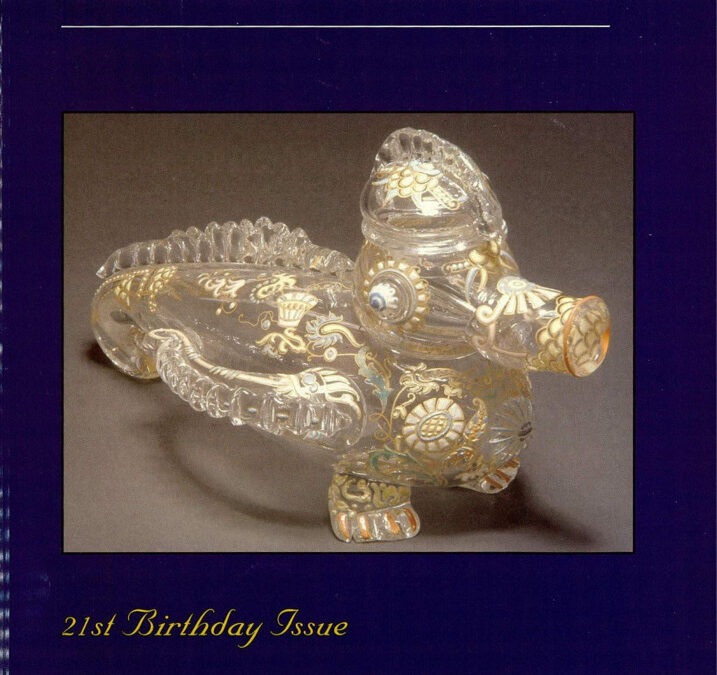
Ewer, blown, trailed, pincered and enamelled in the form of a mythical creature with drop-in cover and hollow wing
handles, Thomas Webb and Sons, Amblecote, Stourbridge, enamelled by Jules Barbe, c.1888-1890.
C.
R
Hajdamach Collection.
BACK COVER
A P5/S7 dual bulb French-style lamp with a Moncrieff’s ‘standard fitting’.
Ex-Turner Collection, © Christie’s Images Ltd. 2003.
CONTENTS
Medieval Glass Vessels used in Ireland
c AD 1200-1500
Rachel Tyson
7
“A most artful deception”: behind the scenes of an 18th century Scottish glasshouse
Jill Turnbull
22
Bulb, Root or Hyacinth Vases in the 18th and 19th Centuries
John P Smith
29
The Wyllie Family of London – Glass Cutters
and
Wholesalers 1792-1856
Alex Werner
39
The ‘Grotesque’ Designs of Thomas Webb and Sons
Charles R. Hajdamach
52
Fenton Art Glass: English Inspirations for Design
James Measell
61
Monart Lighting
Ian Turner
65
Medieval Glass Vessels used in Ireland
c AD 1200-1500
Rachel Tyson
INTRODUCTION
Over the past twenty years there has been a great inter-
est in medieval glass vessels throughout Europe. This
has culminated in exhibitions and publications from
Italy (Mentasti
et al.
1982), Germany (Baumgartner
and Krueger 1988), France (Foy and Sennequier 1989)
and the Low Countries (Henkes 1994). The author
has published a survey of the medieval glass used in
England (Tyson 2000). Research on the medieval glass
in Ireland has previously been undertaken by Edward
Bourke, resulting in both unpublished research from
Dublin (Bourke 1987) and published work from Wa-
terford (Bourke 1997). Donald Harden referred to the
most notable vessels from Winetavern Street, Dublin
in a survey of medieval glass in Britain in 1978. There
is however a limited awareness of the full extent of
these Irish glass finds outside Ireland.
In November 2000 a research visit was made to
the Republic of Ireland in order to complete an up
to date survey of the medieval glass vessels excavated
in Ireland. This paper describes the results of that
survey, and compares the glass used in England and
Ireland during the high medieval period to answer
several questions. Ireland was colonised by the Anglo-
Normans in 1169, whose founders were not only from
England but also Wales, Normandy and elsewhere in
France, and on a smaller scale from Scotland (Phillips
1984, 88). Similarities between glass consumption in
Ireland, Britain, and possibly France, would there-
fore be expected. There were certainly pan-European
fashions in glass tablewares amongst the wealthy, with
similar types being used throughout Europe. However
there were also idiosyncrasies within particular coun-
tries. Heraldic designs on glass were most favoured in
Germany; particularly popular were enamelled beak-
ers produced in Venice as they were a perfect medium
for coloured emblems and coats of arms.’ In France
these enamelled vessels were unexpectedly sparse, as
were the high-lead glass vessels thought to have been
produced in Germany.’ In Italy a larger proportion
of undecorated glass has been found, and the use
FIGURE 1
Locations in Ireland, England and France mentioned in the text.
of glass appears to have been more widespread in
the population. Stemmed goblets and handled jugs
were more popular in North-Western Europe, while
Mediterranean Europe favoured beakers and flasks.
This study explores whether the glass found in Ire-
land is from the same range of sources as England
and whether there are any notable characteristics of
Irish glass consumption.The research concentrated
on glass vessels from Dublin, Waterford and Cork
7
0
100m
Key
1.
Wood Quay
2.
St John’s Lane
3.
Winetavern Street
4.
High Street
1
.
.,
, ….- V1/4
I
r..
,
/ / ‘ %
.„ ,-
-”
r
t
1
12
th
C town wall!’
,
%
r/
1, ,–
_
s 1
…..
k
-) t
/I
I
i
, ,.,….v.
, ,…
k
…. _
\
n
e
I i
… -. –… —
…..— ..:
:.-…
–
2
……
fi
..-• —
.—
…”
___.
-.. ….
i
1
i Christ Church
, 1/… -• —- “.
,,,,,
, ….
, ,..
1 i
•
,'”
•
N
r – — – –
-../)
I Cathedral
, .., ,
…
-,-
n
r
/
%1
II
i
0.
,…
lk
–
N.
i 1
……; ‘
\
1
.–•
“‘”
I
II
I
N.
….- .–%
I
I
,N…….
4
..7
….
–•
-…………. / ….
..,
“‘s …..
N.
……………. ……
./ …..
I,
..:-
..
—I
i r
/ ••• ,./ /
/
ir
N
/ /
……..%
1
‘…….,
MEDIEVAL GLASS USED IN IRELAND
FIGURE
2
Map of sites in Dublin (after Bourke 1987, fig. 42).
(Fig. 1). Glass was known to have been found in a
number of medieval excavations in Dublin and Wa-
terford. Cork was an important port where imported
pottery had been found and glass was surely used. It
was considered that medieval glass was likely to exist,
perhaps unrecognised or uncatalogued, in museum
stores. Although glass from other sites and museum
stores across Ireland was sought for further evidence
of glass consumption, very little was found. The pe-
riod considered commences with the Anglo-Norman
colonisation of 1169, and covers the high medieval
period up to c. I 500. In fact all of the glass found came
from contexts dating between the late 12th and the
early-mid 14th century. Glass vessels were present in
Ireland in earlier periods, but they are not the focus
of this study.’
The author is indebted to Edward Bourke who
generously made his unpublished research on glass
vessels in Ireland between AD 100 and 1400 avail-
able, without which this study would not have been
possible. Much of the glass included in his thesis was
found to have decayed further or was not available for
examination. Surprisingly little additional glass was
found that had been recovered by excavation since
he completed his thesis in 1987. However, since 1987
new finds and publications in Europe have cast further
light on fragments described by Edward Bourke, and
more information on their origin, date and form has
become available. Some undiagnostic fragments and
glass listed by Bourke that is not conclusively medieval
have not been included in this study.
MEDIEVAL GLASS IN ENGLAND
The glass from Ireland will be compared to that from
England, its immediate neighbour and from where
most of its colonists came. A summary of glass con-
sumption in England is therefore given below, outlin-
ing the main glass forms, many of which were imported
from continental Europe, and their functions.
The author’s survey of medieval glass vessels found
in England showed particular patterns in when and
where glass was used.
4
While little has been identified
from the beginning of the 13th century, by the end
of the century its use was flourishing. The late 13th
to mid 14th century is the period in which decorative
glass tablewares were at their peak, in quantity as
well
as in the range of different decorative types. Stemmed
goblets, beakers, bowls and jugs of greenish potash
glass were imported from northern Europe,
as
well
as yellow and opaque red high-lead glass from Ger-
many, and colourless soda glass with applied blue and
8
is
Red
Yellow
Blue
Green
DI Orange
111 White
CM
(
1.
MEDIEVAL GLASS USED IN IRELAND
PLATE 1
Enamelled beaker from Winetavern Street, Dublin.
By courtesy of the National Museum of Ireland.
colourless trailing from southern France and Italy.
Drinking glasses decorated with coloured enamels
came from Venice. Islamic glass included gilded and
enamelled vessels, and while nothing has been posi-
tively identified as Spanish, it is likely that products
also came from the glass industry there. Meanwhile
glassmaking had become well established in England,
with the best-known concentration of furnace sites in
the Surrey/Sussex Weald (Kenyon 1967). In addition
to large quantities of window glass, they produced
green potash glass utilitarian vessels, often crudely
finished. These included urinals — thin-walled vessels
FIGURE 3
Enamelled beaker from Winetavern Street, Dublin.
9
n
_ —
–
”
…..
1
11111111111111111
4.
CM
MEDIEVAL GLASS USED IN IRELAND
FIGURE 4
Jugs from Winetavern Street, Dublin.
with rounded bases used to monitor and diagnose
health by urine inspection — and hanging oil lamps
with rounded bowls narrowing to long hollow bases.
General-purpose household flasks and storage bottles
were also made. Unlike the decorative wares whose
styles changed with fashion, these utilitarian vessels
were made to the same designs from the 12th through
to the early 16th century.
The later 14th century and early 15th century have
yielded much less evidence for glass, particularly ta-
blewares. While this may partly be affected by the
difficulty
in
dating archaeological deposits to that
period, there is no doubt that there was also a decline
in production and use. Glass recovered again by the
later 15th century, and by 1500 was more widely used,
with utilitarian vessels reaching their peak. In addi-
tion to the types described above, large quantities of
distilling vessels were used, particularly on monastic
sites. Tablewares included elaborate Venetian vessels
and green beakers from Germany.
The consumption of glass was restricted to the
more wealthy and educated in society throughout
the medieval period. Typical sites were castles, royal
palaces, manor houses, monastic sites, and wealthy
urban sites. Consumers ranged from kings and monks
to the more successful merchants. It was not until the
16th century that glass penetrated further down the
social scale. So, were similar vessels found on the same
range of sites in Ireland?
DUBLIN
The greatest quantity of glass, up to 53 vessels, was
found in Dublin, the centre of the Anglo-Norman ad-
ministration. It is here that there have been more exten-
sive urban excavations than anywhere else
in
Ireland,
carried out in the 1970s by the National Museum of
Ireland, particularly in the area between Christ Church
Cathedral and the River Liffey (Fig. 2). Three of the
sites where glass has been found are situated in this
area — Wood Quay, Winetavern Street and St John’s
Lane — while the High Street lies slightly further to the
south. All lie within the walled Anglo-Norman city,
which continued to occupy the Hiberno-Norse area of
settlement, with no obvious changes with the Anglo-
Norman ‘invasion’ of 1169 (Barry 1987, 120). These
sites all provided waterlogged conditions, preserving
glass that would otherwise have disintegrated.
The majority of the glass came from Winetavern
Street (Figs. 3-6). This was referred to as the Street
of the Tavern keepers in 1220 and 1236-7 and the
Street of the Wine Tavern Keepers in 1316 (Bourke
1987, 120). If glass was imported as an adjunct of the
wine trade this would certainly have been the area to
find it. It produced a wide range of 13th to early 14th
century vessels including high-lead glass vessels, an
enamelled beaker, colourless drinking vessels includ-
ing those with blue trailing, jugs, as well as urinals and
hanging lamps. Wood Quay also yielded glass from a
10
MEDIEVAL GLASS USED IN IRELAND
2.
5.
FIGURE
5
Vessels from Winetavern Street, Dublin.
wide range of contexts and included 12th to 13th cen-
tury footed goblets, and 13th to 14th century high-lead
glass and a colourless and blue trailed goblet (Fig. 6).
The glass from High Street was not seen by the author,
and all comes from Edward Bourke’s research; it is
included here as it falls within the date range under
discussion (Fig. 7). The contexts are thought to date to
the 13th century, and the few small fragments certainly
suggest a date no later than the 12th to 13th century;
it is important as very little glass survives from this
period. Lastly, the glass from St John’s Lane all comes
from one deposit, and includes a late 13th/early 14th
century goblet and a hanging lamp (Fig. 7).
The earliest post-Conquest tablewares came from
High Street and Wood Quay. Part of a footed goblet
with a folded double-walled base, and traces of rib-
bing on the foot and possibly on the lower edge of the
missing bowl, can be dated to the 12th or 13th century
(No. 28). Surviving examples of these fragile, early,
footed goblets are rare, but are concentrated in France,
indicating that they were probably made there. A late
13th century goblet from the château at Caen has rib-
bing on the foot with wider ribs around the bowl (Foy
and Sennequier 1989, 166, no. 89). Two fragments from
possible footed goblets were also found in Waterford
(Nos. 63 & 70), while only one candidate is known in
England, from York (Tyson 2002, 2818-20, no. 11131).
In Dublin, two further fragments from Wood Quay
and one from High Street appear to come from footed
vessels (Nos. 31, 32 & 34).
A number of inverted rim fragments from High
Street all come from contexts probably of the 13th
century (Nos. 38, 40-42). While these are too small
to give a conclusive diagnosis, inverted rims tend to
disappear after the 12th to 13th century. More com-
mon in the earlier medieval period, they are found
on two colourless and one green ‘beaker’ or ‘bowl’
dated to the 12th to 13th century in England (Tyson
2000, 104-6, types C5-6). Other green trailed bulbous
vessels with inverted rims have been found in, and are
thought to originate in, Germany (Baumgartner and
Krueger 1988, 107-9, nos. 50-2).
High-lead glass, dating to the 13th to early 14th
century, was found at Wood Quay and Winetavern
Street. The presence of high-lead glass invites particu-
lar interest since this type of glass was only revealed
to be medieval in the late 1980s (Baumgartner and
Krueger 1988, 161-75). There are still relatively small
numbers of identified examples, for example only
about 35 vessels in England. Before Baumgartner
and Krueger’s research, these vessels, recognised as
containing lead on account of their weight and bril-
11
MEDIEVAL GLASS USED IN IRELAND
26.
21.
27.
28.
30.
32.
cm
33.
FIGURE
6
Vessels
from Winetavern Street and Wood Quay, Dublin.
liance, were attributed to the 17th century or later.
Analysis in Germany showed that this medieval type
of glass contains up to 84% lead oxide.’
Although no furnace sites have yet been discov-
ered, isotope analysis of the lead found that, in the
fragments sampled, the lead came from Germany,
suggesting that it was probably manufactured there
(Wedepohl
et al.
1995). The vessels represented here
are however very fragmentary. They are all yellow,
the most common high-lead glass colour, although
bright green and opaque red vessels were also made
(Baumgartner and Krueger 1988, 161-75). A base frag-
ment from Winetavern Street with concentric trails on
the underside may come from a trailed jug/flask or
possibly a beaker (No. 19). A similar base from Not-
tingham with part of the body surviving comes from a
jug or flask (Tyson 2000, 116-7, g256), while a yellow
jug handle survives from Battle Abbey in Sussex
(ibid.,
g255). A further body and a rim fragment of high-lead
glass were also found in Winetavern Street (Nos. 20
& 26). The central section of a stemmed goblet was
found in Wood Quay (No. 33), but not enough of the
bowl or stem survives to show how it was decorated.
All of the more complete lead glass vessels known are
decorated, so we can safely assume that these vessels
also would have been. Decoration is usually in the
form of applied trails or prunts, in yellow, green or
blue glass.’
The most striking glass vessel from Dublin is the
enamelled beaker from Winetavern Street (Fig. 3,
No. 1 and Plate 1). This is made of colourless glass
with brightly coloured enamels painted on the inner
and outer surfaces. The surviving fragments depict a
creature, possibly a dromedary, next to a column with
foliage in the background. There are dotted and solid
borderlines above and below this scene. This vessel
belongs to a group of well-documented enamelled
beakers that were made on Venice’s glassmaking is-
land of Murano between c.1280 and 1351.
7
Venetian
archives contain descriptions of this type of decoration
between those dates together with the names of some
of the glassmakers and painters. Some of those crafts-
men referred to, such as Bartolameus, also occur in
inscriptions on excavated beakers (Zecchin 1969-70;
12
)
43.
38.
40-42
46.
50.
35.
48.
47.
MEDIEVAL GLASS USED IN IRELAND
FIGURE 7
Vessels from High Street and St John’s Lane, Dublin.
Clark 1983). The reconstructed form of this beaker
is particularly wide and squat; other beakers of this
form have been found, although they are not com-
mon.’ The most comparable design can be seen on a
beaker from the Karl Amendt collection in Germany;
it depicts a dromedary, with foliage and dotted and
linear borders, but lacks any columns (Baumgartner
and Krueger 1988, 142-3, no. 92). Columns are fre-
quently found on other beakers of this type, although
they usually depict human figures and, particularly,
religious subjects (e.g.
ibid.,
129-137).
The remaining 13th or 14th century colourless glass
vessels are also likely to come from Mediterranean
Europe, although a more precise attribution is difficult
to provide. All but one come from Winetavern Street.
No. 27, from Wood Quay, is part of a stemmed goblet
with a hollow stem, a flat-based bowl, with plain blue
and pincered colourless horizontal trails around the
bowl. This resembles a more complete goblet from
a late 13th century pit context in Canterbury with
similar features including alternate plain blue and col-
ourless pincered trails, a flat-based bowl and hollow
stem (Tyson 2000, 61-3, g33). A number of beakers
with similar decoration are concentrated in Germany
(Baumgartner and Krueger 1988, 181-3); the Dublin
and Canterbury goblets are more unusual in being
stemmed. A source in southern Germany is a pos-
sibility
(ibid.,
180). Colourless glass with blue trailing
was also made in southern France where a number of
medieval furnace sites have been excavated (Foy and
Sennequier 1989, 74-87). But despite the many frag-
ments found there, the combination of plain blue and
colourless pincered trails does not seem to be present.’
Similar products appear to have been popular and
probably made in Italy, for example Murano (Baum-
gartner and Krueger 1988, 40-42), although fewer fur-
nace sites have been found in Italy than France. Bowl
fragments from Winetavern Street (No. 2), decorated
with a horizontal blue trail and blue looped trails be-
low, are similar to a number of bowls which have an
S-shaped profile found in Southampton (Tyson 2000,
107-9, type C8.2), while a stemmed bowl with a more
13
E527
g5S2 E406
= E421
NB
E435
® E434
MEDIEVAL GLASS USED IN IRELAND
similar profile comes from Nottingham
(ibid.,
62 &
65, g40). This style probably dates to the early 14th
century, and was certainly made in southern France,
and possibly also northern Italy
(ibid.,
107).
The rim of a colourless beaker, bowl or goblet bowl
is decorated with blue trails marvered into the body
(No. 8); a solid stem from the same context (No. 9)
may possibly belong to the same vessel. This decora-
tive technique is less common than applied trails, but
three 14th century goblets with marvered blue trails
on the bowl were found at the Bank of England site
in London (Tyson 2000, 62, 65-7, g41-43). All three of
these goblets had solid stems with decorative knops,
while the upper profile of the bowls is not known.
Evidence for marvered blue trailing beneath an ap-
plied pincered colourless trail exists from the southern
French furnace site at Rougiers, although not enough
survives to confirm whether the style of trailing from
Dublin or the Bank of England could have been made
there; it is merely a possibility. A colourless goblet
stem with flared base (No. 6) unfortunately lacks any
associated bowl fragments, so no detailed attribution
is possible, but may come from any of these southern
European sources.
Fragments of a green glass stemmed goblet deco-
rated with mould-blown fins around the bowl were
found at St John’s Lane (No. 46). This is one of the
most common decorative types of green potash glass
goblets, made in the Argonne region of France dat-
ing to the late 13th/early 14th century (Baumgartner
and Krueger 1988, 240-9). The lower bowl of a simi-
lar green glass stemmed goblet displays the edge of
mould-blown vertical ribs (No. 21), a slightly less
common variation made in the same area. Other green
glass tablewares include fragments from a jug deco-
rated with concentric trailing (No. 4). There is also
an opaque red jug (No. 3), believed to have originally
been decorated with similar trailing. Opaque red glass
jugs have been excavated from a 13th century context
in London, and a late 15th-early 16th century context
at Eynsham Abbey in Oxfordshire (Tyson 2000, 119,
g 266-7). There is some evidence that opaque red glass
was made in England, but it was also made in other
regions. Fragments have been found at furnace sites
in the Black Forest in Germany (Baumgartner and
Krueger 1988, 37-8), La Seube in southern France
(Foy and Sennequier 1989, 81), and the Italian-estab-
lished workshop in Corinth (Davidson 1940, 306). A
jug of this colour from Neuss in Germany was found
to be made of high-lead glass, and is probably Ger-
man (Baumgartner and Krueger 1988, 172, no. 137).
Chemical analysis would be required to confirm
whether this jug is high-lead, potash or soda glass.
At least four hanging lamps are represented
(Nos. 15, 16, 48-51) and a minimum of three urinals
(Nos. 5, 10-14, 17, 36-37) from the Dublin sites. These
vessels could have been made in a number of countries
(see below).
FIGURE
8
Map of sites in Waterford (after Hurley
et al.
1997, fig. 1:1).
WATERFORD
Waterford was a major Anglo-Norman city from 1170,
the second most important city after Dublin in this
period (Walton 1992 quoted in Barry 1997, 17); long-
term royal mints were located only in these two cities
(Barry 1997, 18). Waterford and New Ross in County
Wexford were the two main ports for international
trade (Barry 1997, 14). Considerable wealth must have
been found amongst the inhabitants of Waterford.
The 27 glass vessels found in Waterford were recov-
ered from five different sites along either side of Peter
Street in the heart of the original Hiberno-Norse part
of the city, close to the River Suir, and were excavated
between 1987 and 1990 (Fig. 8; Hurley 1997). At E406
yellow high-lead glass and green potash glass goblets
came from a stone-lined pit with other high-status finds
including highly decorated Saintonge ware ‘indicative
of the high social and economic status of the owners’
(Gahan and McCutcheon 1997, 336). Pits containing
glass tablewares also featured at E421, E434 and E527
(Fig. 9). E527, Arundel Square, produced the largest
quantity of glass, from several pits and other layers
(Figs. 9-10). These included two fragments possibly
from early footed goblets and many hanging lamp and
urinal fragments, dating between the late 12th and late
13th centuries. A decorated vessel fragment came from
a burial in St Peter’s graveyard (E435; Fig. 9).
There are some interesting early drinking vessels
amongst the Waterford assemblage. These include
two fragments from Arundel Square, possibly from
footed drinking vessels dating to the 12th or 13th
century. Unfortunately they are, like the other few
examples known in England and on the Continent,
only small with incomplete profiles. The thick mould-
blown vertical rib (No. 63) may have come from the
bowl of a footed goblet of the late 12th or early 13th
century, or a small flask of the same date. More com-
14
MEDIEVAL GLASS USED IN IRELAND
7
54.
56.
MI.
1
1====111
n
55.
57.
60.
58.
70.
63.
cm
FIGURE 9
Vessels from Waterford (all sites).
plete footed goblets with mould-blown ribs have been
recovered from domestic deposits at Saint-Denis and
Etampes in France (Foy and Sennequier 1989, 162-3,
nos. 83-5). Flasks with similar ribs have been found
in graves in Chauvigny, St Germain, and Bordeaux
Cathedral
(ibid.,
183-6, nos. 114-8). The domestic
nature of Arundel Square suggests that a drinking
vessel is more likely. The pushed-in foot with optic-
blown ribs (No. 70) may come from a footed goblet
of similar shape. These were often manufactured with
optic-blown ribs on the foot, the most similar being
from a late 13th century context in the château at Caen
(ibid.,
166, no. 89).
The high-lead glass vessels from Waterford are of
considerable interest from a European perspective.
While all high-lead glass of this date invites interest,
since it is a relatively newly discovered phenomenon
(see p.11), two of the three vessels are types not seen
before in this glass. Some high-lead glass goblets have
mould-blown ribbing on the hollow stern, but the two
Waterford vessels are most unusual in having mould-
blown decoration on the bowl. The bowl with vertical
fins (No. 58) is a style relatively common on green
potash glass goblets made in the Argonne region of
France,
1
° but this example is unique in high-lead glass.
The second high-lead glass goblet has an unusual S-
shaped ‘stepped’ profile, not found on any other high-
lead goblets, and mould-blown patterning in alternate
vertical panels of raised bosses and a paired leaf design
(No. 54). A range of mould-blown designs are found
on green goblets (Baumgartner and Krueger 1988,
nos. 250-61), but none are very similar to the pat-
terning found on No. 54. The third high-lead glass
goblet (No. 57) has an applied zig-zagging blue trail.
15
MEDIEVAL GLASS USED IN IRELAND
67.
68.
71.
CM
FIGURE 10
Vessels from Waterford (site E527).
Parallels can be drawn with a yellow high-lead glass
goblet with blue/green zig-zagging pattern around the
bowl from Kriaresborough Castle in Yorkshire (Tyson
2000, 58-60, g22-4); most other goblets in this type of
glass are also decorated with trailing.
Interestingly, part of a green goblet with a very
similar profile and similar style decoration as the
stepped high-lead glass goblet came from the same
pit in Waterford (No. 55). The stepped profile of the
bowl is unusual, and cannot be identified amongst any
of the vessels found in England. Two stepped green
goblets with mould-blown ribbing on the bowls have
been recovered in Maastricht, with another probable
example from Cologne (Baumgartner and Krueger
1988, 260-1, nos. 286-8). These date to the late 13th/
early 14th century and are attributed to the Rhine-
Meuse region. This suggests a strong link between the
high-lead and potash glass of North-Western Europe.
The weathered hollow stem is all that survives of a
second green glass goblet (No. 56).
The only colourless glass from Waterford consists
of a body fragment probably from a bowl with an S-
shaped profile, with vertical ribs and a horizontal trail
above (No. 60). This is similar to a bowl, thought to
have been made in southern France, found in a context
of AD 1300-50 in Southampton, (Tyson 2000, 103-4,
g195). Bowls of a similar form decorated with applied
colourless and blue trailing are more common than
this type with mould-blown ribs.
At least six urinals (Nos. 61, 67-69, 72-73, 75-78, 80)
and a number of rim fragments possibly from hanging
lamps (Nos. 65, 66, 71) were recovered from Arundel
Square, from contexts dating between the late 12th
and late 13th centuries. See below for a discussion of
their uncertain source.
CORK
Cork has been shown to be the third most important
port in Ireland in the late 13th and 14th centuries,
through which 17% of all Irish trade passed (Gra-
ham 1977, 41). It became an Anglo-Norman colony
in
1177,
so imported goods similar to those found
at the colonies at Dublin and Waterford might be
expected. Merchants of many nationalities traded in
the city, including Dutch, Flemish, English, Spanish,
Italian, Breton and Aragonese (O’Brien 1995). Cork
was the largest importer of wine from Bordeaux in
Ireland
(ibid.,
45), and although much was transported
onwards to the English army, there is little doubt that
it would also have been consumed within the city.
Probably imported with the wine, Saintonge pottery
is found in considerable quantities in Cork in the later
13th and 14th centuries. Glass vessels are often found
in the same contexts as Saintonge ware, seen for ex-
ample at the Dublin and Waterford sites.
It was therefore expected that vessel glass was to be
found in Cork. All of the boxes of glass in Cork Public
Museum were searched; this search however proved
negative. Evidence only exists for one undiagnostic
glass vessel from an unpublished excavation report.
These fragments were recovered from a pit in Grattan
Street with good preservation conditions due to the
presence of organic material, which also yielded two
fragments of Saintonge green-glazed ware (Hurley
and Ni Loinsigh 1998, 3 & 12). The site was situated
in an area just inside the City Wall consisting of gar-
dens and yards. There was no evidence of structures
that may have given a more detailed picture of the
type of site. It is likely that it was the burgage plot
of a reasonably wealthy consumer, with imports of
16
MEDIEVAL GLASS USED IN IRELAND
Saintonge and North Devon ware from other parts of
the site. Medieval window glass and a linen smoother
were also found.
It is likely that the absence of medieval vessel glass
in Cork is due to archaeological bias rather than a
real absence; either the right places have simply not
been excavated or the preservation conditions have
not been good enough for glass. A similar anomaly
occurs in Bristol, one of the largest ports in medieval
England where glass was surely used and traded, but
has not yet been found. Because glass was relatively
rare and needs good preservation conditions, the fact
that it has not yet been found cannot be seen as par-
ticularly significant.
CHARACTERISTICS OF IRISH GLASS
CONSUMPTION
A major feature of the glass in Ireland, which differs
from England and other European countries, is the
lack of any medieval glassmaking industry in Ireland.
There is no evidence that Ireland had a glass industry
of its own until the second half of the 16th century,
when there are references to licenses for glasshouses
in Ireland to Pierre Briet and Jean Cane, Verzelini
and Captain Thomas Woodhouse (Westropp 1920,
20-1). References to glaziers and glassworkers exist
from the 13th century onwards, including William the
glass worker in 1258, Richard the glazewright in 1409
and 1434, and William Cranch and other glaziers in
the 16th century
(ibid.),
but these refer to the instal-
lation of windows rather than glass manufacture. In
1332-33 a sum of money is recorded in the Pipe Rolls
of Edward II as ‘Wages for a glazier working on divers
occasions, and for divers colours brought for making
the glass windows’ at Dublin Castle
(ibid.).
Although
it is possible that this may refer to the manufacture
of coloured window glass, implying the existence of a
glassmaking furnace in which vessels could also have
been created, it is more likely that the ‘colours’ were
simply for painting or staining the glass.” Evidence
for glassmaking sites can be extremely elusive, but it
seems likely that some documentary evidence would
have survived if any had existed in Ireland.
The question therefore arises, where did the utilitar-
ian hanging lamps and urinals used in Ireland come
from? In England and other European countries these
basic, crudely finished and relatively cheap items are
likely to have been indigenous products. Both forms
were manufactured at glasshouses in England, for ex-
ample Blunden’s Wood in the Surrey Weald (Wood
1965). The same types are also found in other North-
ern European countries including France (Foy and
Sennequier 1989, 340-50, 329-31), and Germany (e.g.
Nassachtal glasshouse, Baumgartner and Krueger
1988, 35-6). If they were available locally there would
have been no reason to import them in these countries;
importation would have increased the cost, and in
England the few documentary references that exist
indicate that they were relatively cheap (Tyson 2000,
149). However, if there was no native glass industry
in Ireland, would these utilitarian vessels have been
imported to Ireland from England, the nearest avail-
able source, or would they have been purchased with
decorative glass and other imports from France or
elsewhere in Europe?
Bourke suggests that France may have been a more
likely source since other glass vessels were probably
imported as ‘an adjunct of the wine trade’ along with
Saintonge pottery (Bourke 1997, 384). However,
considerable trade also occurred between Ireland
and England, for example in pottery from the areas
around Bristol and Chester, the principal two ports
used (O’Keeffe 2000, 115, 118-20). There is no way
of distinguishing whether these utilitarian vessels are
English or French. Chemical analysis of medieval
glass, while able to answer some questions, is unable
to distinguish between the products of different glass-
houses within broadly similar traditions. Northern
European and English production methods, while
varying in the exact recipes between furnaces and
batches, have no discernible characteristics.
The areas from which decorative glass vessels
were imported to Ireland are broadly similar to
those supplying England. Both countries had the
full complement of the three different glass types:
yellow high-lead glass and green potash glass from
northwestern Europe, and colourless soda glass ves-
sels from Italy, southern France and perhaps south-
ern Germany. However, there are some absences in
the glass recovered from Ireland. Glass of the 12th
and 13th centuries from the eastern Mediterranean,
including flasks, bottles and beakers from Syria or
Egypt, and painted Byzantine bottles, found in small
quantities in England, might have been expected in a
colony whose trade was most prosperous in the 12th
and 13th centuries. On the other hand, it is not certain
whether the eastern Mediterranean glass in England
arrived via merchants or whether it was brought back
by pilgrims or Crusaders. ‘
2
These absences should not
be taken too literally, however, since most can prob-
ably be attributed to the limited number of excavations
that have been carried out in Ireland, and the smaller
population.
On a more positive note, Ireland is particularly well
represented in high-lead glass from Germany — argu-
ably better represented than England in its proportion
of the total glass, coming from four of the nine sites
in Waterford and Dublin. It has been shown that
two of the high-lead glass goblets from Waterford
are unique in Europe, being the only known examples
of high-lead glass to have mould-blown patterning on
the goblet bowls.
The medieval glass in Ireland is even less similar
to that in the parts of France from which some of
Ireland’s colonists came; notably Ireland favours
the enamelled and high-lead glass that is so sparse in
France (see page 7).
17
MEDIEVAL GLASS USED IN IRELAND
Another major aspect of Irish consumption is the
lack of any glass dating to the 14th and 15th century.
While there appears to be a gap in the archaeological
evidence in the later 14th and early 15th century in
England, there is no shortage of earlier 14th century
glass as is the case in Waterford; the lacuna in the
evidence appears to feature a little earlier in urban
excavations in Ireland, from the mid 14th century.
Maurice Hurley cites theories for this including the
absence of diagnostic pottery dating between the mid
14th and early 16th centuries, so cesspits cannot be
dated to this period, a ‘general urban decline’, and
the removal of rubbish from towns. In Waterford ‘the
use of stone in house construction and the removal of
pre-existing strata prior to the erection of new houses
was common from the 13th century onwards’ (Hurley
1997, 894). It therefore remains likely that although
the archaeology is absent, glass continued in use at
least into the 14th century in common with the rest
of Europe, although evidence is lacking more widely
by the end of the 14th and early 15th century. No
glass from the later 14th and 15th century has been
identified at all in Ireland, and this may be because
Ireland suffered a more severe economic decline in this
period (Barry 1987, 168). Later 15th and 16th century
stratigraphy in towns falls victim to destruction by
Georgian cellars.
Current evidence for vessel glass in Ireland ap-
pears to suggest that its use was only an urban
phenomenon. All of the glass in this paper comes
from Anglo-Norman towns; glass in England simi-
larly comes from relatively wealthy urban plots,
which also yielded other imports. However, Ireland
lacks the other types of sites where glass was used
in England, namely castles, palaces, manor houses
and monastic sites. Can we therefore assume that
inland sites and the Gaelic-Irish population had no
interest in it? Imported pottery from France certainly
found its way to other sites; 12th and 13th century
Rouenais jugs have been found at rural sites such
as Rathmullen motte in County Down and Kells
Priory in County Kilkenny (O’Keeffe 2000, 121).
13th century Saintonge ware from France has been
widely found, including Gaelic-Irish settlements at
Clonroad, County Clare and Armagh
(ibid.).
The
only glass recovered comes from Movilla Abbey
(Henderson 1984), and one fragment from the An-
glo-Norman foundation of Kells Priory. This is a
folded base (Bourke 1987, 192-3, no. 167), which
is likely to date to the late 15th or 16th century. As
such, there is a resemblance to finds from England
in that most of the glass from monastic sites comes
from the Dissolution deposits of this date. Presum-
ably earlier rubbish was disposed of away from the
site, and surprisingly few examples of 13th or 14th
century glass have been found, despite this being
the date at which the greatest range and quantity of
glass tableware is found. Rural and monastic sites
are poorly represented by excavation compared to
those in England, so the lack of evidence from Ireland
cannot be taken as indicative that it was not used in
these communities.
Dr Rachel Tyson
August 2003
The author is a freelance specialist in archaeological
glass, and author of a major survey of medieval glass
vessels used in England.
ACKNOWLEDGEMENTS
I am indebted to Edward Bourke for access to his
unpublished research. The Glass Association kindly
provided a travel grant enabling this research to take
place. I would also like to thank the staff of the Na-
tional Museum of Ireland, particularly Patrick Wal-
lace, Nessa O’Connor, Mary Cahill, Andrew Halpin
and Margaret Lannin for assisting so helpfully with
the research. Stella Cherry of Cork Public Museum,
Maurice Hurley of Cork City Corporation, and Rose-
mary Ryan of Waterford Corporation also provided
valuable assistance and advice.
NOTE ON THE GLASS DRAWINGS
Some drawings are original illustrations by the au-
thor, but the majority have been re-drawn from Ed-
ward Bourke’s illustrations, particularly those where
the glass was not available for examination or where
its condition has deteriorated since Edward Bourke’s
research. Any errors in the re-interpretations remain
the responsibility of the author.
ENDNOTES
1.
Eg Baumgartner and Krueger 1988, 126-60; Krueger 2002. In fact, these
vessels are so popular in Germany and Switzerland that it has been
suggested that some were made there (Krueger 1996, 283-5).
2.
Regarding the lack of enamelled glass in France, see Krueger 2002,
118. Only one fragment of high-lead glass is published from France
in the surveys by Baumgartner and Krueger 1988 and Wedepohl
er
1995.
3.
Bourke 1987 includes 9 examples of vessel glass from the Roman period
in Ireland, 47 from the early Christian period and 47 instances from
Viking Age Dublin.
4.
The detailed study can be found in Tyson 2000.
5.
See Wedepohl
et al.
1995, 76. This compares with around 30% lead oxide
in modem lead glass.
6.
But see the high-lead glass goblets from Waterford, with unusual mould-
blown designs.
7.
Eg Clark 1983, Zecchin 1969-70, Baumgartner and Krueger 1988.
8.
Eg from Strasbourg, with a rim diameter of 100mm and a base diameter
of 75 mm (Baumgartner and Krueger 1988, 150-1, no. 105).
9.
Personal research by the author, examining the glass excavated from these
furnace sites, was carried out in France in 1994.
10.
Late 13thlearly 14th century examples can be seen in Baumgartner and
Krueger 1988, 240-9. No. 46 from Dublin is also of this type.
I I. The painted colours, in the form of oxides or re-used coloured glass,
were commonly fused on to the window glass in a furnace requiring a
lower temperature than for manufacturing glass, in the location where
the windows were being fitted. This process is described in the glazing
accounts of St Stephen’s Chapel, Westminster, in the late 14th century
(Hunter 1981, 46).
12. For example, a pair of beakers belonging to the Walters Art Gallery in
Baltimore, with enamelled scenes interpreted as the Dome of the Rock
and the Holy Sepulchre in Jerusalem, with Christ entering Jerusalem
on a donkey, are interpreted as pilgrim souvenirs (Carswell 1998).
18
MEDIEVAL GLASS USED IN IRELAND
BIBLIOGRAPHY
Barry T.B., 1987,
The Archaeology of Medieval Ireland,
Methuen, London.
Barry T.B., 1997,
Waterford. A Historical Introduction,
in Hurley
et al.
1997, 12-20.
Baumgartner E. and Krueger 1., 1988,
Phonix aus Sand rand Asche: Glas des
Mit telalters,
Klinkhardt and Biermann, Munich.
Bourke E., 1987,
Glass vessels in Ireland c100 AD-1400 AD,
M.A. Thesis
(unpublished), National University of Ireland.
Bourke E., 1997,
The Glass,
in Hurley
et al.
1997, 381-9.
Carswell J., 1998,
The Baltintore beakers,
in R. Ward (ed.),
Gilded and
Enamelled Glass from the Middle East,
British Museum Press, Lon-
don, 61-3.
Clark J., 1983,
Medieval enamelled glasses from London,
Medieval Archaeol-
ogy 27, 152-6.
Davidson GR., 1940,
A medieval glass-factory at Corinth,
American Journal
of Archaeology 43, 297-324.
Foy D. and Sennequier G., 1989,
A Travers le Verre du Moyen Age a la Renais-
sance,
Musee Departemental des Antiquites, Rouen.
Gahan A. and McCutcheon C. with Hurley M.F. and Hurst J.G., 1997,
Medieval Pottery,
in Hurley
etal.
1997, 285-336.
Graham B., 1977,
The towns of medieval Ireland,
in R.A. Butlin (ed.),
The
development of the Irish town,
London, 28-59.
Harden D.B., 1978,
Anglo-Saxon and later glass in Britain: some recent
developments,
Medieval Archaeology 22, 1-14.
Henderson J., 1984,
The Glass,
in R. Ivens,
Melville’ Abbey, Newtownards,
Co. Down: Excavations 1981,
Ulster Journal of Archaeology, 3rd
series, vol. 47.
Henkes H.E., 1994,
Glas Zonder Glans, Vij Eewen gebruiksglas uit de Bodem
van de Lage Landen 1300-1800,
Rotterdam Papers 9.
Hunter
J.,
1981,
The medieval glass industry,
in D.W. Crossley (ed.),
Medi-
eval Industry,
Council for British Archaeology Research Report 40,
143-50.
Hurley M., 1997,
The excavations: Genera! Introduction,
in Hurley
et al.
1997, 1-6.
Hurley. M., 1999,
Archaeological evidence for trade in Cork from the 1211,
to
the 17th centuries,
in Lfibecker Kolloquium zur Stadtarchaologie im
Hanseraum II: Der Handel
Bereich Archaologie der Hansestach Lubeck,
Lfibeck: Verlag Schmidt-Romhild, 13-24
Hurley M.F. and Ni Loinsigh M., 1998 (unpublished),
Archaeological Excava-
tions at 17 Grattan Street, Cork,
Cork Corporation.
Hurley M.F., Scully O.M.B. and McCutcheon S.W.J., 1997,
Late Viking
Age and Medieval Waterford. Excavations 1986-1992,
Waterford
Corporation.
Kenyon G H., 1967,
The Glass Industry of the Weald,
Leicester University
Press.
Krueger I., 1996,
Research in medieval glass: Where are we standing now?,
Annales du I 3e Congas de ]’Association Internationale pour l’Histoire
du Verre, 277-88, Lochem: AIHV.
Krueger I., 2002,
A second Aldrevandin beaker and an update on a group of
enameled glasses,
Journal of Glass Studies 44, 111-32.
O’Keeffe T, 2000,
Medieval Ireland• An Archaeology,
Tempus Publishing
Ltd, Stroud.
O’Neill, 1987,
Merchants and Mariners in Medieval Ireland,
Irish Academic
Press, Blackrock.
O’Sullivan M.D., 1962,
Italian Merchant Bankers in Ireland in the 13th Cen-
tury,
Allen Figgis and Co Ltd, Dublin.
Phillips J.R.S., 1984,
The Anglo-Norman Nobility,
in J. Lydon (ed.),
The
English in Medieval Ireland,
Proceedings of the first joint meeting of
the RIA and the British Academy, Dublin 1982, 87-104.
Tyson R., 2000,
Medieval glass vessels found in England cAD 1200-1500,
Council for British Archaeology Research Report 121, York.
Wedepohl K.H., Krueger I., and Hartmann G., 1995,
Medieval lead glass from
North-Western Europe,
Journal of Glass Studies 37, 65-82.
Westropp M.S. Dudley, 1920,
An account of glass-making in Ireland from the
16th century to the present day,
Herbert Jenkins Ltd, London.
Wood E.S., 1965,
A medieval glasshouse at Blunder’s Wood, Hambledon,
Surrey,
Sussex Archaeological Collection 62, 54-79.
Zecchin L., 1969,
Un decoratore di vein a Murano alla fine del duecento,
Journal of Glass Studies I I, 39-42.
Zecchin L., 1970,
Fornaci Muranesi fro it 1279 ed it 1290,
Journal of Glass
Studies 12, 79-83.
APPENDIX: DETAILS OF GLASS FROM
DUBLIN AND WATERFORD, LISTED BY
CONTEXT
DUBLIN
Winetavern Street
Within the area of Pit Ill: beaker base fragments from the upper fill of Pit
111, ?13th century; beaker body fragments north of Pit Ill with 13th/14th
century Saintonge ‘parrot’ jug; bowl in pit 1/1; jug ‘found close to enamelled
beaker fragments’.
I.
Beaker ( Fig. 3; Plate 1):
fragments, some rejoined, of colourless glass
beaker decorated with painted coloured enamels. Enamel is slightly corroded
and patchy. Design is bordered at the top by a horizontal row of white dots,
and orange and yellow lines below. Bordered at base of design by a white
line. Main scene includes a column with spandrel. To the left is some foliage
and the head possibly of a dromedary. To the right some foliage is visible.
Painted on outer and inner surface. Outer surface: yellow, white and green.
Inner surface: red, blue and orange. Rim diameter 90-100 mm. Extant height
66 mm. Additional body fragments show a fragment with a column base
with part of spandrel, a fragment with column base and most of spandrel,
and three fragments with undiagnostic enamel design, and an undecorated
fragment. E81:735, 736, 765, 786.
Colourless kicked base fragment with applied base ring, thought to belong to
same beaker. Base diameter c.75 mm. E81:723 (Bourke 1987, nos. 137, 139,
141; Harden 1978, 14, pl. VI B).
2.
Bowl or goblet bowl ( Fig. 5):
adjoining rim and body fragments of a col-
ourless bowl, possibly stemmed. Vertical rim, curving downwards to form
a rounded bowl. Applied horizontal blue trail halfway down, with traces
of two looped trails below. Rim diameter c.91 mm. E81:734 (Bourke 1987,
no. 138).
3.
Handled jug (Fig. 4):
fragments of opaque red glass jug. Most covered by a
layer of opaque beige weathering. Kicked base with pontil mark on underside.
Rim fragments, with part of pouring lip. Solid handle, round in cross-section,
with pinched fold at uppermost end. Numerous body fragments. Irregular
rim diameter. Harden described as originally covered by self-coloured trails.
E81:1746 (Bourke 1987, no. 165; Harden 1978, 15).
Pit 5, probably 13th century:
4.
Handled jug ( Fig
4): rim, body and base fragments of jug with opaque
brown weathering, originally green. Applied decoration of concentric hori-
zontal trails. Everted rim fragments, with pouring lip. Part of handle survives,
which is folded up, above rim, and down; folded outwards above lower join.
Part of kicked base with trailing on underside. Irregular rim diameter, est.
c.90-100 mm. E81:999 (Bourke 1987, no. 166; Harden 1978, 15).
Pit 5/5, 13th century:
5.
Flask/urinal ( Fig 5):
rim and base fragments of flask/urinal of opaque
weathered glass. Flared rim, intumed and thickened. Convex base with pontil
mark. Rim diameter
c.96 mm. E81:8295 (Bourke 1987, no. 140).
Pit 6/1, pit dated by dendrochronology to 1233; glass found in upper fill with
tokens of 1279 and Ham Green and local pottery of the 13th-14th century:
6.
Stemmed goblet ( Fig. 5):
part of stem and base of rejoined fragments of
colourless glass with a slight yellow-green tinge. Solid stem, missing upper
section, forming a bulb at its base, which has a pontil scar on the underside.
The flared base is joined about half way down the bulb, pressed on to the
bulb with four slightly curved tool marks around the join. Base flares out
gradually, then widely to form foot. No base rim survives. Extant base dia-
meter 110 mm. Stem diameter c.8 mm. Extant height 145 mm. E81:4620
(Bourke 1987, no. 156).
7.
Body/base fragment:
undiagnostic fragment of opaque weathered glass.
E81:6176 (Bourke 1987, no. 157).
Pit 615, black organic fill with 13th/14th century glazed and unglazed pot-
tery:
8.
Beaker or goblet bowl? ( Fig
_5): adjoining rim and body fragment of a
colourless vessel, with marvered blue glass decoration. Everted rim. Rim
diameter c.92 mm. E81:8362a
&
b (Bourke 1987, no. 163).
9.
Stemmed goblet ( Fig 5):
fragment of solid goblet stem of colourless glass
with a light brown/yellowish tinge. Thickened at end where originally joined
to bowl or foot. Eat: 8363 (Bourke 1987, no. 164).
10.
Flask! Urinal:
convex base fragments of urinal with pontil mark on under-
side. Weathered opaque brown. E81:8361a (Bourke 1987, no. 158). All of the
following flask/urinal fragments could belong to the same vessel.
I I.
Two small rim fragments,
with a thickened everted rim. Weathered opaque
brown. E81:836Ib (Bourke 1987, no. 159).
12.
Flaring body or neck fragment
of probable flask/urinal with strain marks
on external surface. Weathered opaque brown. E81:8361c (Bourke 1987,
no. 160).
13.
Small rim fragment
of probable flask/urinal, everted with thickened rim.
Weathered opaque brown. E81:8361d (Bourke 1987, no. 161).
14.
Three body fragments
found with 8361a-d, probably from flask/urinal.
Weathered opaque brown. E81:8361e (Bourke 1987, no. 162).
Pit 8/1, lower fill with 13th century Saintonge and local pottery:
15.
Hanging lamp:
base stub of hanging lamp. Rounded convex base, now with
surface corrosion, but originally would have had a pontil scar on underside.
Weathered opaque dark brown. Fourteen separate fragments from the adjoin-
ing base and stem of the lamp. E81:3140a (Bourke 1987, no. 153).
16.
Hanging lamp:
adjoining fragments from the centre of a rounded convex
hanging lamp base. Pontil scar on underside. Weathered opaque brown. E81:
3140c (Bourke 1987, no. 155).
17.
Flask/ Urinal:
convex base of urinal with pontil mark on underside.
Weathered opaque brown. E81:3140b (Bourke 1987, no. 154).
Pit 8/1, upper level with 13th century wares:
18.
Body fragments:
35 undiagnostic fragments, opaque brown weathered
glass. E81:3128 (Bourke 1987, no. 152).
19
MEDIEVAL GLASS USED IN IRELAND
Pit 1312, upper levels, 13th century:
19.
Decorated vessel ( Fig 5):
?base fragment from kick of vessel (beaker or
jug?) of yellow high-lead glass with four concentric trails. E81:2880 (Bourke
1987, no. 146). Same vessel as below?
20.
Decorated vessel:
thin body fragment of yellow high-lead glass from flaring
body wall. E81:2866 (Bourke 1987, no. 145). Same vessel as above?
21.
?Stemmed goblet ( Fig 6):
base of probable goblet bowl, with trace of
stem or pontil mark on underside. Traces of optic-blown ribs towards the
broken edge. Green glass, weathered opaque brown. E81:3032 (Bourke 1987,
no. 149).
22.
Rim fragments: tiny
rim fragments with a slightly thickened edge. Slightly
everted or vertical. Possibly from a hanging lamp, or goblet bowl. Weathered
opaque brown. Thickness c.0.6 mm -1.5 mm. E81:3032a (Bourke 1987, no.
148).
23.
Rim fragments: tiny
rim fragments with a slightly thickened edge, and
body fragments. Slightly everted or vertical rim. Weathered opaque brown.
E81:2997 (Bourke 1987, no. 147).
24.
Body fragments:
thin body fragments, weathered opaque dark brown.
Some show faint traces of mould-blown ribs. E81:3032c (Bourke 1987, no.
150).
25.
Body fragments:
thin body fragments, weathered opaque dark brown.
E81:3104 (Bourke 1987, no. 151).
Under mortar deposit, associated with 13th/14th-century pottery, and near
the enamelled beaker:
26.
?Decorative table vessel (Fig. 6):
rim fragment of yellow high-lead glass.
Slightly everted. Rim diameter c.125-140 mm. £81:895 (Bourke 1987, no.
143).
Wood Quay
Upper fill of drain, associated with 13th/14th century Saintonge ware, 13th
century Dublin ware and a stained glass window:
27.
Stemmed goblet ( Fig
6):
three fragments of goblet bowl of colourless
glass. Bowl has flattened base with tapering walls. Two adjoining body frag-
ments from upper part of bowl have a horizontal blue trail and pincered
colourless trail below. Applied colourless trail around the base of the bowl,
tooled to form pincered projections. Remains of a hollow stem with a pontil
mark in the centre of the underside of the bowl. E132:302340 and 302264
(Bourke 1987, no. 105).
Upper fill of culvert, associated with 13th century Dublin ware:
28.
Footed goblet ( Fig. 6):
base of a footed goblet of green glass with patches
of dark enamel-like weathering. Base pushed in high in centre, with faint
traces of wide ribs, and double-width walls folded over at flaring foot rim.
Only a trace of the bowl remains, with trace of ribs. Complete circumference
of base survives. Faint pontil mark on underside. Base diameter c.60 mm.
El 32:54168 (Bourke 1987, no. I 1 1).
Infill between structures, with 13th century Saintonge and local wares:
29.
?Hanging lamp:
base of a possible hanging lamp stem, pushed in on the
base with a pontil mark at edge. Opaque brown weathered glass. El 32:97740
(Bourke 1987, no. 113).
Square A, in deposit of leather offcuts, associated with 13th century Saintonge
and local cooking ware:
30.
Rim ( Fig. 6):
pale bluish colourless rim of bowl or goblet bowl, or possibly
lamp. Rim diameter c.140 mm. E132:50682 (Bourke 1987, no. 107).
Dark fill, associated with 12th century Gloucester and 13th/14th century
Saintonge wares:
3 l .
Base fragment:
base rim fragment of vessel, folded over forming hollow
base rim, opaque weathered glass. E132:53444 (Bourke 1987, no. 110).
Found while clearing water accumulated over bedrock, associated with 13th
and 14th century Saintonge and Ham Green pottery:
32.
Base fragment ( Fig 6):
fragment from the junction of base and foot of
footed vessel of opaque brown weathered glass. Estimated base diameter c.50
mm. E132:55190 (Bourke 1987, no. 112).
Context not known:
33.
Stemmed goblet ( Fig 6):
part of a stemmed goblet of yellow high-lead
glass. Good condition. Top section of hollow stem, solid section above with
pontil scar on underside, and small part of goblet bowl. Tool marks visible
around join between bowl and stem. No visible decoration survives. Extant
height c.28 mm. Extant stem diameter 18-19 mm. E132:164.
High Street
Between lines of wattle and daub under east wall of TFS1, probably 13th
century:
34.
Footed goblet?:
base fragment of vessel with everted foot and double-
thickness walls with hollow base rim. Blue-green glass. E71:3914 (Bourke
1987, no. 122).
Below TFSI, a 13th century timber framed house, with green-glazed Sain-
tonge ware:
35.
Ribbedfragment (Fig.
7):
slightly inverted rim fragment of colourless glass,
with edge rolled inwards, and wrythen mould-blown ribbing. Rim diameter
c.93 mm. E71:2320 (Bourke 1987, no. 114).
Dark soil from immediately pre-house levels, probably 13th century:
36.
Urinal rim:
rim with inturned edge of blue-green glass, probably from
flask/urinal. E71:3696 (Bourke 1987, no. 118).
37.
Urinal rim: flared
rim fragment with inturned edge, of greenish glass,
now partly weathered opaque brown. Rim diameter c. I 10 mm. E71:36I2
(Bourke 1987, no. 126).
Trowelling of wattle features, possibly Ilth-12th century:
38.
Rim fragment ( Fig
7):
rim fragment of good condition greenish-blue
glass, with slightly inverted rim. Rim diameter c.113 mm. El1:3294 (Bourke
1987, no. 115).
Post and wattle wall pm house TFSI, probably 13th century:
39.
Body fragments:three
adjoining body fragments of blue-green glass vessel
with tapering walls. E71:3871 (Bourke 1987, no. 121).
East of post and wattle, pre house TFSI, probably 13th century:
40.
Rim fragment (Fig.
7): thickened rim of blue-green glass, slightly inverted
at rim. Estimated rim diameter c.170 mm. Adjoins and is same vessel as Nos.
41 and 42. E7I :3766 (Bourke 1987, no. 117).
Dark soil north of workshop TFS2, probably 13th century:
41.
Rim fragment
( Fig.
7): thickened rim of blue-green glass, slightly inverted
at rim. Estimated rim diameter c.170 mm. Same vessel as Nos. 40 and 42.
E71:38I I (Bourke 1987, no. 125).
North of post and wattle, possibly a plot boundary; probably 13th century:
42.
Rim fragment (Fig. 7):
thickened rim of blue-green glass, slightly inverted
at rim. Estimated rim diameter c.170 mm. Same vessel as Nos. 40 and 41.
E7I:3689 (Bourke 1987, no. 120).
Square 4, possibly 13th century:
43.
Body fragment (Fig 7):
body fragment of colourless glass with mould-
blown vertical ribs possibly bowl or bottle neck. E71:3929 (Bourke 1987,
no. 124).
44.
Body fragment:
body fragment of greenish-blue glass bottle with vertical
sides. E7 I :3978 (Bourke 1987, no. 123).
South-east of 13th century timber framed building:
45.
?Base fragment:
base fragment of mould-blown vessel, possibly bowl,
of blue-green glass with faint mould blown ribs. E71:3387 (Bourke 1987,
no. 116).
St John’s Lane
Group found in dark organic deposits west of trench, Square 1, with I3th
century Saintonge jug:
46.
Stemmed goblet ( Fig. 7):
rim and bowl fragments, some rejoined, of
goblet bowl. Originally greenish glass, now dark opaque brown. Everted
rim. Vertical ribs around the bowl, starting a little below the rim, becoming
more pronounced, fins around lower part of bowl. No stem survives. Rim
diameter c 140-150 mm. E173:3210a (Bourke 1987, no. 127).
47.
Trailed fragment (Fig. 7):
body fragment with horizontal trail. Weathered
opaque. El 73:3210c (Bourke 1987, no. 129).
48.
Hanging lamp (Fig 7):
Rejoined and loose fragments of the stem and low-
er bowl of a hanging lamp. Originally greenish glass, now weathered opaque
brown and iridescent. Narrow stem with rounded convex base and pontil scar
on underside. Flares out widely towards missing bowl. Extant height c 118
mm. Also body fragments. E173:3210b (Bourke 1987, no. 128).
49.
?Hanging lamp:
slightly inverted rim fragments of opaque weathered
glass, possibly a lamp bowl, or other bowl. Rim diameter c.92 mm. E173:
3210d (Bourke 1987, no. 130).
50.
?Hanging lamp ( Fig 7): vertical
rim fragments of opaque weathered glass,
body tapering slightly inwards. Possibly a lamp bowl. Rim diameter c.I30
mm. E173:3210e (Bourke 1987, no. 131).
51.
?Hanging lamp:
vertical rim fragments of opaque weathered glass, inturned
at edge. Possibly a lamp bowl, or other bowl. Rim diameter .c113 mm. El 73:
3210f (Bourke 1987, no. 132).
52.
Body fragments:
body fragments of opaque weathered glass, found with
32I0b, d-e. E173:3210g, i & j (Bourke 1987, nos. 133, 135 & 136).
53.
Rim fragments:
tiny rim fragments of opaque weathered glass, found with
3210a-g. E173:3210h (Bourke 1987, no. 134).
WATERFORD
E406 (fronting on to Peter Street, also bordered by Cooke Lane and
High Street.- 1987)
Fill of stone-lined pit (2003), mid-late 13th century, with highly decorated
Saintonge ware:
54.
Stemmed goblet ( Fig.
9):
fragments of yellow high-lead glass from the bowl
of a stemmed goblet with a stepped S-shaped profile. Mould-blown design
in vertical panels alternately of raised bosses and paired leaves with central
small bosses. E406:2088:183 (Bourke 1997, 383 & 8, fig. 13.1.1).
55.
Stemmed goblet ( Fig
9):
rejoined fragments of greenish glass bowl from
stemmed goblet with a stepped S-shaped profile. Mould-blown patterning on
20
MEDIEVAL GLASS USED IN
IRELAND
underside of bowl consisting of small bosses. Estimated rim diameter c.100-
110 mm. E406:2018:183 (Bourke 1997, 383 & 8, fig. 13.1.2).
E421 (east of St Peter’s Church, 1987)
Fill of stone-lined pit (1020), mid-late 13th
century:
56.
Stemmed goblet (Fig 9):
hollow goblet stem of pale bluish-green glass,
flaring out towards base. Surface layers weathered away leaving only a thin
layer of the original thickness. E421:1076:100 (Bourke 1997, 383 & 8, fig.
13.1.6).
E434 (fronting on to Peter Street, also bordered by Olaf Street and High
Street; 1988)
Fill of pit (3019),
late
12th century:
57.
Stemmed goblet (Fig 9):
three fragments of yellow high-lead glass from
the flaring bowl of a stemmed goblet. Blue trail applied in a zigzagging pat-
tern around the bowl. Bowl turns in sharply towards the base, where there
is an applied horizontal yellow trail. E434:3036:1-3 (Bourke 1997, 383 & 8,
fig. 13.1.5).
Fill of stone-lined pit (28),
mid-late 13th century:
58.
Stemmed goblet ( Fig. 9):
two fragments of yellow high-lead glass from
the bowl of a stemmed goblet. Mould-blown vertical fins around the bowl.
Remains of three fins on lower bowl, two ribs on rim fragment. Bowl has
bell-shaped profile with slightly everted rim. Rim diameter estimated c.80-100
mm. E434:530:172 (Bourke 1997, 383 & 8, fig. 13.1.3).
Pit HS1:L10, late 12th century:
59.
Vessel:
numerous small undiagnostic fragments of vessel glass. E434:593:
172 (Bourke 1997, 389).
E435 (St Peter’s graveyard; 1988)
Burial, mid 13th-late 16th/early 17th
century:
60.
Bowl?( Fig 9):
body fragment of colourless glass, probably from bowl
which flares out towards rim. Vertical mould-blown ribs (two surviving),
with an applied colourless horizontal trail above. E435:228:B41:1 (Bourke
1997, 383 & 8, fig. 13.1.4).
E527 (Arundel Square, also bordered by Peter Street, Cooke Lane and
High Street; 1990)
Stone-lined pit IN2:L14,
mid-late 13th century:
61.
Urinal:
convex base from a urinal, with trace of pontil mark on underside.
Originally greenish or bluish glass, now weathered opaque brown. E527:718:
60 (Bourke 1997, 385 & 8, fig. 13.2.9).
62.
Vessel:
twelve fragments from curved vessel body, with traces of three
applied horizontal trails around waist or neck. Weathered
opaque brown
glass. E527:718:61 (Bourke 1997, 389).
Organic layer IN2/3:L11-12, late 12th-early
13th century:
63.
?Rib from decorative vessel (Fig.
9): thick vertical fin, mould-blown, on
curving body fragment. Weathered opaque brown. Thickness of rib c.8 mm.
E527:687:17 (Bourke 1997, 387 & 9, fig. 13.3.2).
Cess-like
deposit IN3:L12,
early 13th century:
64.
Vessel:
thirteen small undiagnostic body fragments of vessel of weathered
opaque brown glass. E527:766:29 (Bourke 1997, 389).
Fill of stone-lined pit (654) IN3:L14,
mid-late 13th century:
65.
Hanging lamp:
fifteen small rim fragments from the wide rim of a ves-
sel, probably a hanging lamp. Rim inturned at edge. E527:638:52d (Bourke
1997, 389).
66.
Hanging lamp:
several rim and upper body fragments from the wide rim
of a vessel, probably a hanging lamp. Rim intumed at edge. Estimated rim
diameter c.150 mm. E527:638:52e (Bourke 1997, 389).
67.
Urinal (Fig. 10):
flared rim fragments from a urinal. Originally greenish
or bluish glass, now weathered opaque brown. Estimated rim diameter c.105
mm. 11527:638:52a (Bourke 1997, 385 & 8,
fig. 13.2.6).
68.
Urinal ( Fig 10):
convex base and part of bulbous body wall from a urinal,
with pontil mark on underside. Originally greenish or bluish glass, now weath-
ered opaque brown. E527:638:52b (Bourke 1997, 385 & 8, fig. 13.2.8).
69.
Urinal:
numerous undiagnostic body fragments of weathered brown glass,
probably belonging to 13.2.6 or 8. E527:638:52c (Bourke 1997, 389).
Stone-lined
pit IN5:L14,
mid-late 13th century:
70.
BeakerlFooted Goblet (Fig. 9):
folded base of beaker or footed goblet,
pushed upwards on underside to form a dome, with pontil mark in centre.
Optic-blown vertical ribs on inner and outer layer of the double folded base.
Base rim missing. Broken where starts to flare out to form body. Extant
diameter c.39 mm. Originally green, now weathered opaque mottled beige.
E527:1017:12 (Bourke 1997, 383 & 8, fig. 13.1.8).
71.
Rim (Fig. 10):
several rim fragments from the wide rim of a vessel, such
as a hanging lamp or goblet bowl. Rim inturned at edge. Originally greenish
glass, now weathered opaque beige. Also numerous tiny body fragments.
Estimated rim diameter c.180 mm. E527:1017:9a (Bourke 1997, 383 & 8,
fig. 13.1.9).
72.
Urinal:
rim and body fragment from a urinal. Everted fire-thickened
rim, turning downwards to a cylindrical neck. Originally greenish glass, now
weathered opaque beige. E527:1017:9b (Bourke 1997, 385 & 8, fig. 13.2.5).
73.
Urinal:
convex base from a urinal, with pontil mark on underside. Rim
fragment. Estimated rim diameter c.80 mm. E527:1017:9b (Bourke 1997,
385 & 8, fig. 13.2.7).
74.
Vessel:
three rim fragments of greenish glass. E527:1017:9c (Bourke
1997, 389).
Timber-lined pit IN7:L11, late
12th-early 13th century:
75.
Urinal:
two rim fragments and numerous small body fragments from
a urinal. Widely everted and fire-thickened rim. Originally greenish, now
weathered opaque brown. Rim diameter c.95-100 mm. E527:747:88c (Bourke
1997, 385 & 8, fig. 13.2.1).
76.
Urinal:
three fragments from the wide cylindrical neck of a urinal. Trans-
lucent bluish glass. E527:747:88b (Bourke 1997, 385 & 8, fig. 13.2.2).
77.
Urinal:
two adjoining fragments from the convex base of a urinal. Pontil
mark on underside. Originally greenish glass, now weathered opaque brown.
E527:747:88d (Bourke 1997, 385 & 8, fig. 13.2.3).
78.
Urinal:
convex base fragment from a urinal, with pontil mark on underside.
Translucent bluish glass. Numerous tiny body fragments, probably from same
vessel. E527:747:88a (Bourke 1997, 385
&
8, fig. 13.2.4).
Timber-lined pit IN7:L11,
late 12th-early 13th century:
79.
Vessel:
numerous undiagnostic body fragments of vessel now weathered
opaque brown. Estimated rim diameter c.160 mm. E527:747:5 (Bourke
1997, 389).
Sunken barrel, backyard sill-b hs PS2:L12, early 13th
century:
80.
Urinal:
convex base from a urinal, with trace of pontil mark on underside.
Originally greenish or bluish glass, now weathered opaque brown. E527:1079:
12 (Bourke 1997, 385 & 8, fig. 13.2.10).
21
“A most artful deception”: behind the scenes of
an 18th century Scottish glasshouse
Jill Turnbull
This story begins on a dark and stormy winter’s night
at the end of the 18th century, as many good Scottish
stories do. It involves confrontation, incarceration,
unfair dismissal and a legal battle, but it is not a tale
of romantic fiction with a happy ending; it is a story
of conflict between the Excise and the glassmakers of
Greenock, and it provides some small insights into
life behind the scenes in their operations.
On 1 1 th December 1794, at between 8 and 9 pm,
four men banged on the door of the glasshouse at
Crawfurdsdyke, Greenock, demanding entry. They
were admitted by the manager, William Tennant, who
had been expecting them. The four were James Bal-
vaird, General Examiner of Excise in Scotland, John
Carr, Supervisor of Excise in England and (temporary)
Officer of Excise in Scotland, James Anderson, Super-
visor of Excise in Greenock, and James Williamson,
Excise officer at the glasshouse.
The visit was the second of the day. During their
earlier inspection the men had surveyed all the readily
available areas of the glasshouse, including the pot
chamber and scaffold, without any difficulty. Just be-
fore their departure, however, they had asked to see
the pot loft and the pot-making area, a request that
was adamantly refused, despite considerable argu-
ment. The evening visit followed contact with a local
magistrate, who had signed a warrant allowing them
to force entry to the prohibited areas. The magistrate
accompanied them to the glasshouse.
The Greenock Glassworks Company had begun
their operations only just over seven months earlier,
on 28th April 1794, producing bottles for both the lo-
cal and export markets. There was a four-pot furnace
in which, during the first eight months of operation,
30,700 dozen bottles were made, of which 4,356 dozen
were exported to Portugal. William Tennant, a part-
ner and the manager of the firm, was an experienced
glassmaker, who had trained under Archibald Geddes
at Leith.
Despite being shown the magistrate’s warrant,
William Tennant persisted in refusing entry to the
pot loft, insisting that the Excise had no legal right of
access to that area of the glasshouse — a claim hotly
denied by Carr and Balvaird. Eventually, the Excise
officers broke down the doors to the pot loft and en-
tered. Their wet clothing brushed against some of the
`green’ pots, allegedly causing damage to two of them.
According to Tennant, the Excise men also caused
harm to the crucibles in his pot chamber “by exposing
them to a current of air far below their temperature,
so that many of the pots may have been much hurt,
if not rendered totally useless…”. In justification of
his action John Carr later claimed that, as a result of
his perfectly legal forced entry, he had found “upward
of thirty glass pots very considerably larger than any
presented to, or gauged by, the [Excise] officer”, thus,
in his view, confirming the scam he had been called
in to investigate.
William Tennant was clearly very angry and set out
to get his own back on Carr. It was not until 26th De-
cember 1794, however, that he lodged a legal protest
with the Court of Justiciary, that “Messrs Balvaird,
Anderson, Williamson and Carr, have been guilty of
a gross violation of law, as well as damaging the pots
in his pot chamber…”. He also obtained a warrant to
arrest Carr “because he was English and might return
there” and thus be outside Scottish jurisdiction.
In the subsequent court case,’ John Carr gave
a graphic description of how he had been “sitting
comfortably”, with his sister and her family in Aln-
wick Castle (which is, of course, not in Scotland, but
Northumberland), where she was in service, when
he was arrested, at about four o’clock on Saturday
27th December 1794. He was taken by post chaise to
Dunbar, where he was locked up in the jail from the
evening of Sunday 28th December to eleven o’clock
the following night, when he finally managed to ob-
tain a warrant of liberation, with a ‘caution’ of 1,000
22
“A MOST ARTFUL DECEPTION”
merks Scots (£666 13s 4d sterling). Carr’s incarcera-
tion in Dunbar, some 23 miles from Edinburgh, was
particularly galling because he had no access there
to the legal advice and courts of the capital, where
he would almost certainly have obtained his freedom
much more quickly. Carr was not a happy man.
Records of the actions of the Excise after the inspec-
tion of the Greenock glasshouse and the legal battles
which followed Carr’s arrest and imprisonment are
the sources for this paper. Before exploring them,
however, it should be mentioned that in Scotland, in
addition to the usual antipathy between the Excise
and the glassmakers, the involvement of an
English
Excise officer would have further fuelled Scottish
animosity.
EXCISE FRAUD
John Carr, a senior English Excise officer, had been
sent to Scotland in 1794 to investigate suspicions of
fraud concerning the operation of the Excise in the
glasshouses there. It was suspected that the Scottish
glassmakers had been depriving the Revenue of money
by “the shifting and substitution of large pots for mak-
ing glass instead of small ones shown to and gauged by
the Revenue officers…”. The basis of this claim was
that the larger pots were concealed until they were
required in the furnace and were secretly substituted
for the pots already gauged and ready for use.
Carr went to Scotland and, with James Balvaird,
undertook a complete survey of all the fifteen glass-
houses operating there.’ They issued a joint report on
22nd December 1794, concluding that “vast frauds are
most assuredly practised at all of them”, and went on
to describe the principal deceptions they considered
had been practised:
1. Pot substitution
“The
pot chambers are not entered as
required by law and the stock of large
working pots is kept private and no Of-
ficer suffered to approach them. A few
small conical pots are made and kept
at each House for the purpose of being
brought down to the annealing arches
FIGURE 1
Sketch of pots discovered by the Excise men at the bottleworks at
Alloa, showing the deceptive pot on the left.
FIGURE 2
Sketch of pots discovered by the Excise men at the Leith Flint
Glass Works, showing the “most artful deception” on the left.
and there presented to the Officer to be
gauged; and this is no sooner done than
an opportunity is taken to remove them
back into the chamber and to place in
their stead other pots far larger and more
capacious, and approaching much nearer
to a cylinder in form, and these latter sort
are the only ones out of which they are
now working.”
The
two pot shapes were illustrated in the report of
their inspection of the bottleworks at Alloa, “from
which your Honours will judge of the Fraud at this
and all the other Houses” (Fig. 1).
A further, and more subtle, variation on this prac-
tice was found during their visit to the flint glasshouse
at Leith. The use of closed pots to melt the finer metal
enabled the internal dimensions of the pots to be var-
ied, and they claim to have found:
“one of the usual make, but the other was
a most artful deception, made wholly for
the purpose of being gauged, but never to
be put into the furnace. Externally they
appeared of the same size and shape …
but internally the sides were so increased
in thickness from the mouth downwards,
so as to represent a very sharp cone, and
the diameter was thereby so contracted
that at ten inches only from the mouth, it
became about ten inches less.”
They then illustrated the two types of pot (Fig. 2).
2. Ladling
“Another very
general method of fraud is
that of taking large quantities of metal out
of the pots, before gauging, under pretence
of scumming
(sic)
them, and in numerous
cases whole pots are laded out
(sic),
but
from their manner of proceeding it is evi-
dent that this is all privately returned into
the pots during the time of working…”.
23
“A MOST ARTFUL DECEPTION”
PLATE 1
View of Dumbarton showing the glassworks on the left. Coloured aquatint published 1824.
Broadfield House Glass Museum, Kingswinford.
Their visit to Dumbarton Giass Works (Mate
1)
was used as an example of this practice. There they
had observed:
“that they frequently respite the work-
ing in particular pots, which is a certain
indication of fraud, and this is confirmed
by whole pots of metal being frequently
laded out under pretence of its not being
fine enough for working, but it is most cer-
tainly done to procure a quantity of cullet
for charging the respited pots with.”
3. Cracked pots
A third alleged scam involved damaged pots. A minor
crack in a working pot was often repaired temporarily
by opening the furnace in front of it and turning the
pot so the cracked section was exposed to the air. The
glass cooled and solidified as it seeped through the
crack, “but the traders here evidently take advantage
of this, and always work the metal down to below the
cracked pot before the gauge is taken, pretending it
has not been higher filled”.
It is clear from the detailed descriptions of their
visits to the Scottish glasshouses that the Excise of-
ficers had been opposed and thwarted at every op-
portunity. The glassmakers, from the management
down, had used every trick in the book to prevent
them gauging the pots and gaining access to the pot
lofts, the only exception being the Leith Glassworks
Company, which operated a crown and a bottle house,
next door to the larger Edinburgh Glass House Com-
pany. There the management had co-operated fully,
while the bottleworks at Dundee was also commended
for using correctly gauged pots.
At the remaining eleven glasshouses, several
of which were under the management of various
members of the Geddes family, they experienced a
frustrating time. At the flint glasshouse in Glasgow,
for example:
“we found No. 6 pot in the furnace open
without notice and worked a considerable
way down; but on going back to the other
side of the furnace for the gauging irons,
we found on returning the pot shut up by
putting a loose stopper against the mouth
and sticking a quantity of wet clay behind
it; this we immediately removed but before
the stopper could also be taken away Mr.
Geddes interfered, seized the gauging iron
and in the most violent and passionate
manner opposed us; finding it impossible
to succeed we gave up the contest after
struggling some time.”
At Dumbarton they were refused access to the ‘pot
rooms’ so, as they had at Greenock, they obtained
a warrant granting them entry. Despite being ac-
24
“A MOST ARTFUL DECEPTION”
companied by a local constable they claimed to have
been “most violently opposed and threatened with
being treated as common thieves if we proceeded any
further. As there were upwards of thirty of the work-
men collected about us, and finding… that nothing
but the most imminent personal danger would arise
from persisting, we gave it up and retired from the
premises.”
Carr and Balvaird examined the Excise officers’
books and working practices, finding inconsistencies,
errors and, at Glasgow, that no officer was in attend-
ance at the time of their visits. They suggested that,
as a result, the amounts of Excise charged at Glasgow
totalled £60 a round, “whereas they ought to be near
ten times that sum”. Their report concluded with rec-
ommendations for some internal reorganisation of the
Excise and the prosecution of several of the glasshouse
managers. They also brought to the attention of the
Scottish Excise Board the fact that on every occasion
that they had been opposed “the fraudulent glass-
makers have … grounded their opposition … on a
compromise which they allege took place in the Court
of Exchequer more than two years ago and by which it
was agreed, notwithstanding the express terms of the
law, that their pot chambers were not to be entered
and that after the officer has charged the metal in the
pots, no other gauges were to be taken”.
An inevitable consequence of this report was some
internal upheaval in the Scottish Excise department,
resulting in the suspension from duty of three Excise
officers, Messrs Maitland, Corbet and Leven, ap-
parently on the recommendation of James Balvaird.
There was also an internal investigation, the results
of which were of considerable embarrassment to the
Scottish Excise Board.
There had, indeed, been an agreement between the
glassworks managers and the Excise, a ‘Memoran-
dum’ of which remains with the court papers. This
records a meeting which took place on 25th January
1792, attended by James Montgomery, a lawyer rep-
resenting the Glass House Company of Leith, and
Archibald Geddes manager there; James Dunlop,
on behalf of the Dumbarton Glass House Company
and Mr Dixon, the manager; John Geddes, manager
of the Glasgow Glass House Company; and William
Geddes of Alloa. On the other side was John Mait-
land, whose role with the Excise was not specified,
and William Corbet, General Supervisor of Excise,
together with the Advocate General and Mr. Bonar,
Solicitor of Excise.
Their purpose was “to put an end to the different
prosecutions in Exchequer filed in the name of his
Majesty’s Advocate General and the managers of the
Leith, Glasgow and Alloa Glass House Companies”
and to prevent all disputes between the companies
and the officers of the Excise. They agreed, as the
managers had insisted to Carr, that provided they
were given an hour’s notice, the Excise officer would
gauge the pots an hour before manufacture started
and would not interrupt the work afterwards. They
also agreed that there should be no access to the
“place or places used for making pots” but as soon as
the pots were ready for use they should be removed
to somewhere the officer had access to at all times
so they could be surveyed before being placed in the
annealing arch.
It would appear from this document that there
had been, at least on the part of the Excise, a genuine
desire to come to an agreement that was within the
British law but which would reduce the number of
prosecutions for infringements of the very demanding
Excise rules. The glassmakers themselves were clearly
keen to reduce the inconvenience inherent in the strict
application of the rules. John Carr was completely
unaware of the agreement, nothing similar to which
existed in England, as, apparently, was the Excise
Board in 1795. James Balvaird knew all about it but
said nothing, happy to have Maitland, Corbet and
Leven in the role of scapegoats.
Justice prevailed, however. In a damning report
dated 29th May 1795, the Excise Board ruled that
James Balvaird had abused his position as General
Examiner of Excise in Scotland. He had been at fault
in not informing John Carr “an entire stranger to
persons & circumstances” of the 1792 ‘Compromise’
agreement, ignorance of which had caused Carr to
present a false report. They also made it clear that it
was Balvaird who had blamed Maitland, Corbet and
Leven for dereliction of duty, despite Carr’s refusal
to name any individual officer, “so that the applica-
tion of the general charges to these three officers
must have originated from malice or prejudice of the
said Mr Balvaird”. The upshot was the suspension
of James Balvaird and the honourable reinstatement
of the other three officers to their former posts. They
were also granted compensation ranging from £105 to
£157 10s, in addition to their outstanding salaries. The
Board’s report makes it clear that Maitland, Corbet
and Leven had constantly complained to their bosses
that they were being obstructed by the glassmakers,
but no action had been taken. The Board subsequently
discovered that Balvaird had deliberately deceived
them and they confirmed his dismissal from the post
of General Examiner.
WORKING PRACTICES
The court case Carr versus Tennant, which was heard
at the Court of Session in Edinburgh in 1796, was
quite separate from the Excise enquiry discussed
above. John Carr, acting as an aggrieved individual,
pursued William Tennant for “wrongous imprison-
ment” and claimed reparation of £1000 sterling plus
expenses of £200. The evidence justifying Carr’s action
has already been mentioned; the evidence presented
in Tennant’s defence provides a rare glimpse behind
the scenes of an 18th century glasshouse and will be
discussed below.
25
“A MOST ARTFUL DECEPTION”
FIGURE 3
Plan of the furnace, pot chamber and pot manufactory at William Tennant’s bottle works at Greenock, dated December 1794.
Reproduced with the permission of the Keeper of Records of Scotland.
26
‘A MOST ARTFUL DECEPTION”
Writers from Pellatt to Hajdamach have empha-
sised the importance of crucibles to the success of a
glassworks and there are plenty of descriptions of the
making processes and the essential skills of the pot-
makers. The men called to give evidence on behalf
of Tennant included the pot-makers themselves and
numerous other workmen at the glassworks who gave
first-hand accounts of their actual working conditions,
as well as details of Carr’s inspection. William Ten-
nant provided an illustrated plan of the pot loft and
relevant areas of the glasshouse (Fig. 3).
The pot loft at Greenock was described by William
Lamb, a married man aged 30, who had previously
worked as a warehouseman and then as a pot-maker
at Verreville and at Dundee. It was 100 feet long and
18 feet wide, and was kept at a steady temperature of
between 54 and 60 degrees Fahrenheit, being heated
by a `cockel’ or stove. The pots were made there, as
well as dried. The windows were sometimes opened
during the summer, but even then were closed if there
was any wind, because a cold wind could crack the
drying pots. Every effort was made to keep the tem-
perature steady and in order to avoid any draught,
there were three doors between the pot loft and the
glasshouse, only one of which was opened at a time.
There were “4 plies of brown paper pasted over the
seams of the door to the glasshouse and 2 plies on the
second door”. The day after Carr’s visit two of the
unfinished pots in the loft “had a piece fallen out of
their sides”, something Lamb had never experienced
before. The damaged pots are illustrated clearly in
Tennant’s plan. Lamb estimated that the value of each
pot, which had previously been £5, had considerably
increased by 1794 because the price of clay and the
cost of carriage had gone up. He confirmed that the
plan of the pot loft and glasshouse presented to the
court by Tennant was accurate.
Since one of Tennant’s main reasons for having
Carr arrested had been the damage caused to his pots
by the forced entry, there was a logical emphasis by
his defence on the need to avoid sudden changes of
temperature and cold draughts in the pot loft. Lamb
described how on one occasion at the Dundee glass-
works 13 pots were broken “in consequence of air
which came up from below through the seams of the
floor, which was prevented from happening again by
plastering the room below”. He also stated that when
he had been working at Verreville there were no doors
between the pot loft and the glasshouse, and of the 84
pots made there “only 6 or 7 could be used, all the rest
having cracked in drying”, a substantial loss to any
glassworks. Two doors were put in and the problem
was solved.
While in the pot loft the crucibles did not stand
directly on the floor, but on “a kind of stools called
pot-bottoms, which raise them about six and a half
or seven inches above the floor”. During the drying
process the pots, the walls of which were some three
inches thick at the brim, shrank by three to four inches
in diameter. Since they were making bottles at Green-
ock, the pots were, of course, open. When removed to
the pot chamber, they were placed on straw to prevent
them standing on bare bricks. They usually remained
there, at a temperature maintained at between 95 and
100 degrees Fahrenheit, for three weeks. It is notice-
able that Lamb’s description of the making process,
particularly the timings, was sometimes different from
Tennant’s evidence.
A later witness, the pot-maker at the Edinburgh
Glass House Company at Leith, described how they
stuffed the windows with straw in winter to prevent
draughts, but he only made pots at that time of year if
there was a shortage; “the common season for making
pots begins in April and ends in October”. Only one
employee, James Bell, a bottle sizer, described as an
`outwork hand’, gave evidence for the pursuer. He
stated that, in the absence of the Excise officer, he had
seen the mouth of an annealing arch opened and the
pots inside replaced, but the originals were not taken
to the working furnace.
William Tennant was, of course, loquacious in
his own defence. A main plank of his argument was
the slightly bizarre one, that there were actually two
manufacturies at his glasshouse — one “for making
the vessels or large crucibles in which the materials
for making glass are melted in the fire”, the other to
manufacture the glass. He maintained that, since there
was no tax on the crucibles, the Excise officers had no
more right to enter that area than to enter his, or the
judge’s, bedroom.
Equally implausible, given the rank of Carr and the
senior Excise men accompanying him, was Tennant’s
original allegation against Carr that he had entered the
glasshouse illegally so that he “might thereby discover
and learn the secrets of the valuable manufacture of
making pots … for your own private benefit, or that
those who sent you from England upon such a clan-
destine employment”. Rather more believable was the
statement that they were unable to pay the tax due to
the Revenue because the Carr incident had caused
them financial loss.
The individual Excise ledgers relating to glass
in Scotland no longer exist, except when kept for a
particular reason — such as a court hearing. Among
the evidence remaining in the National Archives of
Scotland, in material related to the case Carr v. Ten-
nant, are a number of the ledgers kept by the Excise
men responsible for the Greenock glassworks, James
Williamson and James Anderson, between 6th July
1794 and 7th July 1795. They, too, contribute to the
glimpse behind the scenes at the glasshouse.
The working year was divided into eight rounds,
most of which lasted 42 days, but two being of 50
and 49 days, each round being recorded as an en-
tity. Of particular interest is the ‘Glass Dimension
Book” which records the diameters of each pot
taken at different points, the date it was set in a
particular hole in the furnace and the date it was
27
“A MOST ARTFUL DECEPTION”
demolished. The ‘Glass Table Book’
4
lists the mean
diameter of each pot, which varied considerably
from 23 to 35 inches. The top diameters given in the
Dimension Book varied less, most being around 36
inches — conforming to the space allotted for each
pot in Tennant’s plan.
The period of use for each pot was sometimes
remarkably short — the average life being only four
weeks. The shortest period recorded was a week, the
longest almost seven. The records show that only a
few months after the glassworks opened, the furnace
was demolished and rebuilt, no glass being produced
between 13th November and 1st December 1794 while
the work was done. It took six days to demolish the
old furnace and another five to rebuild it, after which
it was annealed for a further five days before pots
number 26-29 were set and charged, two of them with
9 cwt, two with 10 cwt of metal. They were ready for
working on Monday 1st December. Two weeks later
number 4 pot broke but was repaired and survived
until 25th December when it was again mended; but
this time the repair failed to hold and the following
day the metal was lost. On 27th December number 3
pot broke and that metal was also lost. Both pots were
replaced but on the 29th number 4 pot was ladled out.
Then the workmen made the most of their Hogma-
nay and on 1st January 1795 Williamson noted “Men
unfit to work. Metal ladled out”. Sequences such as
this illustrate very clearly the frequent disruption to
production.
William Tennant’s robust defence included his
own lengthy description of the pot-making process,
in which he was at pains to emphasise the inherent
fragility of the pots until they were really dry. He de-
scribed the length of time it took to dry out the pots,
in particular the care that had to be taken in the pot
loft, where they remained for several months. Because
new pots were being constructed in the same room
“the great quantity of wet clay, the cloths with which
the pots are kept constantly covered while building
and breath and other exhalations from the numerous
workmen employed keep the air always in a very damp
state”. When dried out sufficiently, they were moved
to the pot chamber, where “every endeavour is made
use of for … keeping up a perpetual circulation of very
dry and moderately warm air”.
According to Tennant, the pots remained several
months in the pot chamber — Lamb told the court
the period was three weeks — and were then moved
“to what is generally called the pot scaffold, being
a scaffold or projecting floor within the area of the
glasshouse where they are exposed at some height
above the ground to the almost suffocating heat of
the glasshouse itself … Thence a short time before
they are wanted they are again removed into … the
annealing oven … the mouth of the furnace is then
built up, and they are for some weeks
(sic,
but he
later says days) exposed to a gradually increasing
heat …”.
Tennant went on to describe in detail how the
Excise officers examined the pots from the time they
entered the pot chamber, where they were measured
and marked by the officer “with his name or in such
other manner as in his opinion may most effectually
prevent another pot from being substituted …”. No-
tice was given on removal to the pot scaffold and the
officer examined his mark, again measured the pot
etc. before seeing it sealed into the annealing oven, a
procedure repeated before it was placed in the glass
furnace. The Excise officer at Greenock, James Wil-
liamson, clearly gave each pot a number, which he
recorded as it was placed in the furnace.
Despite Tennant’s impassioned defence, the story
had no happy ending for him. Judgement went to
Carr, and Tennant was ordered to pay damages and
costs. So John Carr finally had his revenge, his only
material loss being the certificate granting him the
rank of Excise officer, which remains in the Edin-
burgh court records. The Scottish glassmakers lost
their privileges under their unofficial, but legally sanc-
tioned, ‘Compromise’ agreement, and had to accept
the same inconvenient Excise rules as their English
rivals. The Greenock Glass House Company was
closed down early in the 19th century, and by 1806
William Tennant was out of work and looking for a
new job in Newcastle.
Dr Jill Turnbull
October 2003
Jill Turnbull is the author of
The Scottish Glass In-
dustry 1610-1750
and is currently researching glass-
making in Scotland after that period.
ENDNOTES
1.
All the material in this paper is contained in Court of Session papers
CS231/CJ6/5 Carr v Tennant, held in the National Archives of Scotland
(West Register House), unless otherwise referenced. Individual items
are not numbered.
2.
This figure does not refer to companies, some of which owned several
glasshouses.
3.
CS96/3121.
4.
CS96/3122.
28
Bulb, Root or Hyacinth Vases in the 18th and
19th Centuries
John P Smith
In1989 Asprey held an exhibition of over 150 antique
bulb vases together with a large number of old col-
oured prints dating from 1612 to 1880, complete with
a brief but well illustrated catalogue.’ This was the
first large exhibition devoted to this subject and was
assembled by the author (Plate 1).
Bulb vases fall halfway between the decorative and
the useful and have a much longer history than is usu-
ally supposed. They are still made today, sometimes
in clear plastic, and in England can be found on the
shelves of supermarkets in the early autumn next to
the ‘bulbs from Holland’ section. Although usually
for hyacinths, small versions exist for crocus or grape
hyacinths, which the author’s mother also used for
forcing acorns.
The origins of the bulb vase date back to first half
of the 18th century, rather earlier than one might in-
tuitively expect. Most people, discussing bulb vases,
assume them to be of Victorian origin, developed
around 1830 when English floral societies were very
PLATE 1
A selection of hyacinth vases from the 1989 Asprey exhibition.
Asprey.
29
BULB, ROOT OR HYACINTH VASES
active. They also believe that the hyacinth has always
played second fiddle to the tulip and that
Tulipomania
meant that the tulip was always more important than
the hyacinth, both aesthetically and commercially. In
fact
Tulipomania
was over by the end of 1637, the mad-
ness of previous decades peaking with many people
ruined, and by 1700, with changes of fashion in garden
design, the hyacinth had started to overtake the tulip
in commercial importance. Indeed, in 1734 a catalogue
published in Holland warned against speculation in
hyacinth bulbs and in 1739 a catalogue of bulbs by
Nichaas van Kampen of Harlem listed nearly 500
varieties of hyacinth but only 381 of tulips.
The earliest reference to growing bulbs in water
alone was published in 1731 in the
Philosophical Trans-
actions of the Royal Society of London.
A Swedish
scientist, Samuel Treiwald (1688-1742), director of
mechanics to the King of Sweden, wrote “An account
of Tulips and other Bulbous plants, flowering much
sooner, when their Bulbs are placed on Bottles filled
with Water, than when planted in the Ground”. His
experiments, calculated more for amusement than sci-
ence, involved placing bulbs of tulips and other flowers
on glasses filled with water. These bulbs were observed
to bloom in January, five months before they would
have flowered in a garden bed. In the same issue of the
Transactions,
Philip Miller (1691-1771), author and
gardener to the Worshipful Company of Apothecar-
ies in Chelsea, who had been inspired by the Swedish
experiments, published his own study on employing
`early blowing tulips’, hyacinths and narcissi. The
bulbs were set on utilitarian glass carafes filled with
`common Thames water’ to about one-quarter of an
inch below the bottom of the bulb and placed in a
green house for several weeks. The hyacinths bloomed
a full six weeks sooner than the tulips and narcissi,
although the blooms were not as large as on bulbs
planted in earth. Miller appreciated the novelty of the
experiment, recommending it as an amusement for
display in the chambers of those without a garden.
2
In 1734 Robert Furber (c.1674-1756), the London
nurseryman, reissued his 1732 edition of
The Flower
Garden Display’d,
to which he added “A flower-
garden for gentlemen and ladies, being the art of
raising flowers without any trouble, to blow in full
perfection in the depth of winter”. Furber describes
how he “bought some Dozens of Flint Tumbler
Glasses of the Germans who cut them prettily and
sell them Cheap; whole pints to Halves and Quarters;
wide at the top and tapering to the bottom”. In these
he placed spring bulbs — narcissus, several sorts of
hyacinths, tulips, daffodils and jonquils — and “took
particular care that no water shou’d be fill’d up to wet
any more than just the Bottoms of the Bulbous Roots,
for that would certainly rot them and have destroyed
all my hopes”.
3
In fact the early experimenters soon
discovered that, although tulips would survive with
their roots in water rather than soil, hyacinths actu-
ally thrived, making them the ideal flower for those
PLATE 2
Worcester transfer-printed hyacinth vase c.1770.
Phillips, Son & Neale.
without a greenhouse or other expensive protection
to grow during the winter months.
Although Robert Furber tried out all sorts of bulbs
in German tumblers, possibly with bulbs standing on
pebbles in the glass, before long special glasses were
developed for hyacinths and, more rarely, crocus. Some
bulb vases were made of ceramic materials, and the au-
thor has seen one made in brass and stamped ‘Keswick
Art Guild’. However, the best material was glass as it
is necessary to control the level of the water carefully;
too high and the bulb rots, too low and it dies. Also
with glass there is the fascination of watching the roots
descend — a most educational aspect for children.
One of the ceramic factories that may have made
hyacinth bulb vases was the Sevres porcelain factory
in France, but extant examples are rather smaller than
normal bulb vases and may well be night-lights. Indeed
the cataloguer of Sotheby’s English and Continental
Ceramics and Glass sale, London 1st March 1994, in
a footnote to lot 82, a Vincennes vase c.1745-48 from
the collection of T.H. Clarke, wrote: “These objects,
formerly described as
Vases
a
oignons,
are now known
to have been given to brides on their wedding night to
light them to bed. The ingenious idea of a narrow cylin-
drical interior both gives stabilising weight and acts to
extinguish the candle as it burns below the rim, leaving
the bride and groom to concentrate on other matters.”
The use of these objects is confirmed by an engraving
in Lawrence and Dighton,
French Line Engravings of
the late XVII Century,
London 1910. It may also be
suggested by the decoration of this example, where
30
BULB, ROOT OH HYACINTH VASES
PLATE 3
Portrait of a Lady, pastel by Jean-Etienne Liotard.
Musee d’Art et d’Histoire, Geneva.
the offering of a scallop shell, attribute of Venus, to an
embarrassed young man may well be symbolic. The
Bowes Museum in County Durham has a similar vase.`
On 26th May 1993 Phillips of London sold (lot 347)
an English transfer-printed ceramic vase from the Cyril
collection attributed to Worcester c.1770, which was
undoubtedly a hyacinth vase (Plate 2).
5
However, this
paper will concentrate on glass examples.
Glass hyacinth vases come in three basic forms,
squat and bulbous, churn shaped like an old milk
churn, and inverted baluster, the latter sometimes
with a pedestal foot. Some documented examples of
these will now be discussed.
In the Musee d’Art et d’Histoire, Geneva, Switzer-
land, is a pastel portrait,
Femme Inconnue a la Jacinthe,
by Jean-Etienne Liotard (1702-1789), depicting a lady
in a good blue day-dress and with a double string of
pearls sitting at a table and holding in her right hand
a clear bulb vase with a white hyacinth in bloom
(Plate 3).
6
The upper half of the vase is decorated
with trailing, and the flower has few florettes, typical
of hyacinths of this period. The pastel is catalogued
as being drawn in 1754 and this date is thought to be
secure.’ This is the period of Liotard’s first visit to
England, although it is not suggested the lady is an
English woman.
On the 14th December 1999 Eric Couturier,
Com-
missaire
–
Priseur Associe
at the Drouot auction centre
in Paris, sold an oil painting attributed to the school
of Nicolas Lavreince (1739-1807) entitled
Jarnais
cf Accord dit aussi la Petite Guerre,
showing two fash-
ionable young girls, one with a cat, the other with a
dog. In the background on a mantelpiece is a clear bulb
vase of the pedestal variety being used as a flower vase.
The painting probably dates from around 1780.
The National Trust at Upton House, Warwickshire,
holds a print
La Soirée d ‘Hyver,
dated 1774, which
shows a domestic scene with three bulb vases of churn
form on the mantelpiece, all with flowering bulbs in
them. The Bordeaux Museum also has a print with
bulb vases on the mantelpiece (Plate 4).
The earliest documentary reference known in
England is for the 6th November 1770 when Michael
PLATE 4
Detail from a print entitled “Louis XVIII offrant des violettes a plusieures dames”, dated llth January 1816.
Musee des Beaux Arts, Bordeaux.
31
BULB, ROOT OR HYACINTH VASES
•
4’6
PLATE 5
Cut Georgian hyacinth vase illustrated in
Irish Glass
by
Dudley Westropp.
Edkins, the Bristol based enameller and gilder, re-
corded in his ledgens
To: 12 Hyacinth glasses, blue gilded
2s. Od.
Edkins is known to have decorated clear, white and
`Bristol’ blue glass, but none of these hyacinth vases
are known to have survived.
The Victoria and Albert Museum in London
possesses two oil paintings of flower arrangements
executed by John Constable (1776-1837) in 1814, and
in both pictures a coloured hyacinth vase has been
used a the holder. The museum used to sell postcards
of these. One is illustrated in
Hyazinthenglaser
by
Joachim Henley
Cut glass hyacinth vases in the Irish style are known
(Plate 5). In 1920 Dudley Westropp,’° former curator
of the National Museum of Ireland in Dublin, made
a list of random items of Waterford glass taken from
old account books. Included for 1816 is:
6 flower root glasses
3s. 4d.
It is interesting to note that these cut clear glasses were
67% more expensive than Edkin’s coloured and gilded
examples. Cut glass has always been a luxury.
My attention has been drawn to several American
sources.” James Gilliland, the famous American glass-
maker, advertised in the
New York Mercury
on the 11th
October 1762 ‘tulip and flower glasses of the neatest
patterns’. And on the 4th April 1763 he advertised
`flower root glasses’. Triplett and Neale, merchants
of Alexandria, on the 18th April 1817 advertised in
the
Alexandria Herald
that they were importing from
Dublin ‘cut and plain
Flower root glasses’.
I have drawn extensively on Joachim Henle for
documented examples from mainland Europe dating
from the 18th and 19th centuries.” In 1731, the same
year as Treiwald and Miller published in
Transactions,
Der Neu
–
antommende Hollandische Gartner
was pub-
lished in Nurnberg by Job. Georg Lochner. This also
illustrates a hyacinth growing in water. In 1762, the
second edition of a book written by George Voorhelm
(1711-1787),
Traite sur la Jacinte,
was published in
Harlem by C.H. Bohn. This illustrated (folio 139) a
hyacinth in a glass root vase (Plate 6) and a hyacinth in
a ceramic delftware decorated vase. In 1753 a German
translation was published in Nurnberg. This work is
well known and has been quoted by Ferguson and also
in the Bloembollenglazen Club newsletter.”
Henle illustrates the Constable painting mentioned
above and also a charming painting by Maier Philippe
Rousseau (1816-1887) of an off-white hyacinth in a
pedestal bulb vase next to some crocus in a terra-cotta
pot.’
4
In the 18th century the Nostanger factory in
Norway produced churn-shaped vases which are
illustrated in their catalogue, published in Copenhagen
in 1763.
In his book Henle illustrates 19th century hyacinth
vases from Bohemia, with typical gilt and impasto
enamel decoration, as well as examples from Daum
in Nancy, France, Germany (naturally), Saint Louis
in Alsace, The Netherlands, Denmark, Norway and
Switzerland. Particularly interesting is a catalogue
published by the Fenne Glashate Raaspiller & Co.
GmbH Nachfolger in 1909-10, which illustrates fifteen
PLATE
6
Hyacinth vase from
Traile sur la Jacinte
by George Voorhelm,
Harlem 1762.
32
BULB, ROOT OR HYACINTH VASES
the catalogue of a forced sale of some of their stock
in 1881 listed as lot 853 ‘Cruet stand, with six cut
bottles, twelve hyacinth glasses, and twelve puce hock
glasses’. ‘
8
A 19th century method of decorating hyacinth
vases, which has never been seen by the author, is
De-
calcomania
or
Potichomanie. The Art Journal
of 1855,
on pages 39-40 in an article on ‘fancy work’, devoted
several paragraphs to the subject:
BLOEMBOLLEN
voor kamer en thin
Verzamelingen van Hyacinten, Tulpen.
Crocus, „nz. not verpakt d
[2.50, 15.
—
r
f7.
—
, 19.
—
,
[10.
—
,
ft2–, [144
–
1
of
f
16.–.
(910) I
Beschrijvende en geillustreerde Prijs-
couranten
van Sloembollen
ziju
op
aan
–
:
vrag, kostoluos ver1s7ijgbnar.
GROENEWEGEN
& Co.
BLOEMISTEN
TE
PLATE 7
Advert by Groenewegen & Co showing the type of vase patented
by the Schleswig-Holstein/Fiensburger Glasfabrik.
vases in three shapes:
Bauchige
(bulbous),
Konische
(conical), and
Urne
(urn shape) in hand-engraved, gilt,
enamelled or optic glass.
Henle also details three German patents. The first
is an extraordinary concept of having one bulb grow-
ing upwards together with one underneath growing
down in the water, and was taken out by the Schleswig-
Holstein/Flensburger Glasfabrik in 1875. Known as
the Antipodean, this is the holy grail of all continental
vase collectors. Plate 7 illustrates a Netherlands adver-
tisement for such a vase, and an actual example exists
in the Museum des Kreises, Pion, Germany. In 1884
the Schmidt company patented a two-piece vase in
Berlin, and an example marked
SCHMIDT PATENT
was number 124 in the Asprey exhibition. In 1890 a
similar idea was patented in Stuttgart. This patent,
or derivatives of it, had a very long life. An example
is illustrated in a Berlin catalogue of 1888,
15
and the
catalogue of Christiania Glasmagasin, Oslo, Norway,
illustrated five forms of vase including a two-piece
Schmidt patent type.
16
To return to England and the 19th century, in 1849
Apsley Pellatt, by then the Grand Old Man of British
glassmaking, published his
Curiosities of Glassmalc-
ing.
He opened the section on coloured glass with the
following paragraph:
“Dark, massive, coloured Glasses, former-
ly made in Flint Glass-houses — whether
blue, green, amethyst, or other colours,
for hyacinth, hock, and finger glasses, or
in large cylinders for cutting and flatting
into Window Glass — have been almost
superseded; the latter by Crown Glass-
makers, and the former by lighter or less
dense Flint Glass colours.”
17
Davenport is well known for its porcelain, but its
glassmaking activities are less well known. However,
“POTICHOMANIE –
Solomon’s proverb,
`there is nothing new under the sun’ and
`the thing that has been shall be again’,
holds good in the Decorative Arts as
in
other things. The new accomplishment,
now so popular, called
Potichomanie,
is but
a resuscitation and combination of some
varieties of fancy work, which was fashion-
able about 30 years ago. The earliest form
of this decoration consists in applying to
the inner surfaces of
colourless hyacinth
glasses
daubs of water-colour paint of
different colours. These daubs were suf-
fered to run one into another at the edges,
as in the process called ‘marbling’. When
dry, a coat or two of thin plaster of Paris
mixed with water was applied to the inside
of the glass. This set in a few minutes and
secured the colours from injury by water,
and also gave them body or solidity. The
glasses were then filled with water, which
had no action on the plaster of Paris, and
the flower roots were placed in them in the
usual manner. A still nearer approach to
Potichomanie
is still to be found in some
country villages, where window-blinds are
formed by gumming to the glass flowers
and birds cut out of chintz furniture or
paper-hangings, and then covering the in-
ner surface with oil paint. Five or six years
after
the vari
–
coloured hyacinth vases
had
been introduced, it became the fashion to
paint with oil-colours the outer surfaces
of large raisin-jars and others of suitable
form. When the paint was dry, birds and
flowers, cut out of chintz furniture or pa-
per, were fastened to the surface of the jars,
which were afterwards varnished. They
were used for dried rose-leaves, lavender,
and other scents. Many of these jars are
still in existence.”
“Potichomanie
is now so fashionable
that the shop windows are full of speci-
mens of the art to the exclusion of other
fancy-work, and one cannot walk along
the streets without meeting shop-boys car-
rying glass vases, and other materials for
it in their hands, so that the fact almost
verifies the name
Poticho-mania.”
33
er£7,
751:M?
tr./
PLATE 8
Tye’s original design registration of 1850.
said frame or support consists of a piece of
wire the lower end of which is bent into a
circular figure; the plane of the said circle
being at right angles to the straight por-
tion of the ring (d) is not quite closed but
admits of being compressed to diminish in
diameter to permit of its introduction into
the groove (a); the upright wire (b) is kept
firm a? this position (e) is a wire bent in
the form represented and standing in the
upright (e).
2
‘ The stem of the hyacinth is
introduced on the upright into the space
(f) and leaves are supported by parts (e)
& (e). The part (e) & (0 may be raised
or lowered on the upright (b) so as to be
just the height of the plant. When not in
use as a bulb glass the frame (b) may be
removed and the vessel (a) then constitutes
a flower vase. The object of my design is
supporting of the stem and the leaves of
the plant as explained. The form of the
whole is new.”
Mr. Tye was not a glassmaker but a mould-maker,
and vessels from at least two of his moulds survive.
On one the base has the moulded inscription
GP TYE
31 CHARLES ST BIRMINGHAM,
the other inscrip-
tion being
GP TYE REGISTERED NOVEMBER 4
1850
(Plate 9).
A few years ago Birmingham Museum and Art
Gallery acquired a marked G.P. Tye vase with a fac-
simile of the metalwork (Plate 10). These must have
been in production for a long time as in 1880 the firm
of Barr and Sugden, Seedsmen and Nurserymen of
Covent Garden, London, were advertising Tye’s vases
BULB, ROOT OR HYACINTH VASES
“It may, therefore, appear superfluous
to describe it, yet as some of the readers
of this journal may not have been initi-
ated into the mysteries of the Art, I shall
briefly explain the process. Figures, birds,
flowers, &c. — cut out of paper and prop-
erly arranged — are gummed on the right
side and placed on the inside of thin glass
vases. A coat of varnish is applied when the
figures are dry, then a coat of oil-paint of
a suitable colour, and lastly, another coat
of varnish. The effect, where the pattern
is well arranged, is good, and the glazed
surface of the vase with the opaque colour
within forms a good imitation of china.
Generally speaking, the taste shown in the
arrangement of the figures is by no means
good, and in some it is execrably bad; so
much so, that it is more than probable that
this fashionable occupation will exercise a
pernicious influence on the public taste. It
is a kind of patchwork in which the most
incongruous designs of all nations and
periods, Greek, Etruscan, Egyptian, Chi-
nese, Indian, and Modern European, are
jumbled together in inextricable confusion,
and with a total ignorance of artistic effect
and the rules of ornamentation.”
“The drawing is a view of my design. It
consists of a vessel (a) in which the bulb is
to be grown having the shape represented
and round the mouth of which is a groove
of the form shown at (a) in Fig. 2. The
object of this groove is to allow of the in-
sertion of the frame or support (b) which
As anyone who has tried to grow a hyacinth in a
bulb vase knows, the weight of a fully opened flower,
if large, is often enough to cause the flower to droop
or the whole bulb to tip out of the vase. Even in 1764
Philip Miller wrote about this problem for bulbs grown
in soil in his
Gardener’s Dictionary:
“When the stems
of the Flowers are advanced to their Height, before the
Flowers are expanded, you should place a short Stick
down by each Root, to which, with a Wire formed into
a Hoop, the Stem of the Flowers should be fastened,
to support them from falling; otherwise, when the Bells
are fully expanded their Weight will incline them to
the Ground.”
19
At least two British designs were registered to help
alleviate this problem. Both these designs were regis-
tered for the associated metalwork, and can be missed
by anyone trawling the patent office for glass-related
materia1.
20
On November 4th 1850, George Percy Tye,
described as Proprietor, Birmingham’, registered a
`Design for Hyacinth glass and support’ (Plate 8).
The text of the design registration (No. 2516) reads
as follows:
34
BULB, ROOT OR HYACINTH VASES
with supports, including a triple hyacinth bulb holder
known as Tye’s Triple (Plates 11 & 12).
22
Incidentally
in 1878 Barr and Sugden listed in their catalogue no
less than 150 types of daffodil!
Another design advertised in Barr and Sugden’s
1880 catalogue was the Princess (Plate 11). This design
was registered on 20th July 1877, number 312057, by
PLATE 9
Hyacinth vase by G.P. Tye and view of base showing moulded mark.
John P Smith.
Stevens & Williams of Brierley Hill,
23
and their pattern
book notes that these vases were produced in Flint,
Blue, Amber, Green, Puce, another (illegible) colour
and Ruby, with the Ruby, made from gold, costing
nearly half as much again as the other colours. They
were engraved with Ferns and Palms by Edward Miller,
who also engraved the registration mark, all for a cost
PLATE 10
Tye hyacinth vase in the collection of Birmingham Museum and Art Gallery, with modern facsimile of the metal support.
The left-hand vase is also by Tye.
John P Smith.
35
BULB, ROOT OR HYACINTH VASES
Elegant Hyacinth
The
‘Woodcuts arc aithfuf representations of
r,
bd.
per dozen.
Glasses.
New Designs, Colours, and Decorations.
These
beautiful Floral Vases. It is recommended that Supports
are
ordered with the
Un.55d5,
11 doe
price of the Princess and Tyc’s Triples, Supports ore included.
TEE
QUEEN.
rerrii.Licr.c.arco
volUME.
In Jet, La 6.1 each
In
Hush fa. cd, eaolL
it Rohe do 130.117, la ad.
etch.
101T1[ PLOWER! AND
TRACCIEV.
1,010 :a Grny,
Od.
Ill
4aCh
Hoge d0 IOM, la. Ed_
THE PRINCE.
WITH FlJnIAL
In jet-, as 03. each.
I n onalae, at. Gd. itch.
In Gown,
tooth.
In
Sorry, e5VIL
/n Isabella Gler,1a.6,1.041h
‘`,:.1
1
111’4=,t,17.7’1,17
THE PRINCESS.
tlnaludinc Sun./I I
TRAWsnAn car.
ORAL’.
TIFIILLT RS011AcEn.
In Amber, te.’GJ. each_
15 Mae, :KM. !Mb.
In Pose. an. Cot. caul,
in AVIiltc, Fa. Cal. bath.
nubs,
ea.
each.
TYE
‘
S 14
.
0.
1.
WW1
.
, AllTaAst au FnICRC.
in
Jut. .
a. c.o..
In Tornuolm, A.. cid. cach.
In Huta du urry.f., OA. antic,
WITH FLORAL RFRARATI300.
In noes Colour, II. each.
..1m.,91.034
–
.11.
In R.
cooh-
La
Houl du IlarcF,
n
IA•C
A
.L
1,71, Ar anLL 07.:11 COLD.
TO Done COleux. 10. eAch
In J et, Ja. each.
In I’ LI Nadu, Ia, each.
larlatalt.,
91. -oncli.
Many
d,1501
Hodanc,
1..
CUL
to
Tar 5d. each.
rInln Colour.%
p3
–
icon,
la each
TYE’S TRIFLE,
Including Support.
IFITH /FLORAL O8C01AT1011.
In Ora, !Oa Od. each.
In Hose, Ws. SR coal.
In mac.
wILhoul.
DerelualIon.
rui.
anon.
In /11de. without Descridlon,
In
.
Orn..5. without
Dec
Oration,
RYE’S 111INTAT1TRE.
tr.
IF.Ala cOlan
,
n5,
pl. par dem!, W. each.
hol
e
ttlaX…A.
1.1
..hata:
each.
In ToscuuSee, la 00 ouch.
PLATE 11
Hyacinth vases from a catalogue by Barr & Sugden, Covent Garden c.1880.
Reproduced from Hyazinihenglaser by Joachim Henle.
of 2
1
/4 (old) pence, about one new penny. This also had
a metal contraption similar to the G.P. Tye design to
support the flower.
In the second half of the 19th century John Ford’s
Holyrood Glassworks in Edinburgh was the largest
glasshouse in Scotland. The Museum of Edinburgh
has in its collection a Ford catalogue from the late 19th
PLATE 12
Tye’s Triple hyacinth vase.
Ken Cannel! Collection.
century, which lists eight different forms. These were
available in assorted colours, in flint or plain glass,
some being engraved.
24
Silber and Fleming was a London based firm of
wholesalers and importers. One of their catalogues
has been published in facsimile.
25
Dating from c.1880
this illustrates three vases: number 5645, an inverted
baluster vase decorated all over in trailing in purple,
green, blue and citron, number 5646, a churn-shaped
vase in puce, amber, blue, green and flint (clear), and
number 5647, a squat vase in puce, amber, blue, green
and flint. John Wheeler of Fulham registered ‘an or-
namental design for the shape or configuration of an
article of glass’, i.e. a bulb vase, at the Patent Office
in Chancery Lane on 9th November 1883.
As well as the items of American interest noted ear-
lier, a search of the index to the Rakow Library at the
Corning Museum of Glass produced several references
including one to a catalogue of articles for nursery and
seedsmen by C.F.A. Hinrichs of New York dated 1879
(Plate 13). The company was described as ‘Importers
and dealers in foreign glassware, French china, fancy
goods, toys
proprietor of Kleeman’s Patent SST.
Germain Lamp, and sole agent for the glass factories
of the Compagnie Anonyme, of Namur, Belgium’. As
the illustration shows, they imported several different
forms from both Belgium and Bohemia. The Co-op-
erative Flint Glass Co., Beaver Falls, PA, produced a
28-page catalogue in 1909 featuring a wide range of
glass objects including hyacinth vases in three forms,
apparently in clear glass, which they wholesaled at 61/2
36
BULB, ROOT OR HYACINTH VASES
Sr
,
1;:
I .7′ F7.1
n
113 117:11-4. r/-4:0.
grar THIS LIST CANCELS ALL PREVIOUS ONES.
alt
CATA LOGU E OF ARTICLES
— FO —
C. F. A. I-TIN
–
MCI-IS,
29, 31 & 33 Park Place,
N. Y.
Trir ACINTE1 OH
NO. 1. VASE, SHAPE BELGIAN.
In cases of 200 pieces, viz., 50 pieces each,
Clear Glass, Blue, Purple and Green, per dozen
by the case
$1 25
Repacked, per dozen
1
50
NO. 2. AMERICAN SHAPE BELGIAN.
In cases of 200 pieces, viz., 50 pieces each,
Clear Glass, Blue, Green and Purple, per
dozen by the case
$
Repacked, per dozen
1
2
50
5
AMERICAN SHAPE BOHEMIAN.
Chocolate, Celadun, Green, Black, Blue,
Rose, Ruby and Amber, $4 00 and $4.50 per dozen, accord-
ing to decoration.
–
?TA ”
A
Tv I A
–
10
,.
.72,71.
BOHEMIAN.
BELGIAN, in cases of 200 pieces, viz., 67
Blue, 66 Green, and 66 Purple, or 50 each,
Clear Glass, Blue, Green and Purple, per dozen
by the case
$0 90
san:is repacked, per dozen
1 16
BOHEMIAN.
NO. 5. NEW SHAPE, C. F. A. H.
BELGIAN.
In cases of 16i dozen, assorted, Blue, Green,
Purple and Crystal, by the case per doz., $0 90
Repacked, per dozen
1 15
SMALL BOHEMIAN, NO. 9.
Shape like No. 3, but not so tall.
Clear Glass, per duz
$1 00
Blue ”
” .„
1 15
Green ”
”
1 15
Purple ”
”
1 15
Clear Glass, with Rose
Band, per dozen
1 50
NO. 0. 6
I
J
1
5 BOHEMIAN, LARGE.
Green, Plain, per dozen
$3
80
Blue,
”
It
3 50
Ruby, ”
3 75
Ruby, Engraved, ”
. . ….. 4 50
Bine, Etttuelled, ”
4 50
Green,
”
”
4 50
Ruby, Gold Decorated, per dozen
4 50
Blue,
”
fl
……
4 50
Green, ”
4 50
13 Ur I-.Y3
NO. 7. 5 1 1
4
BOHEMIAN, SMALL.
Same Shape as No. 6.
Blue, per dozen
$3
Green, ”
3
Ruby, ”
3
Blue, Enamelled Flow-
era, per dozen
3
Green, Enamelled Flow-
ers, per dozen
3
Ruby, Engraved Pow-
ers, per dozen…
3
AMPELON9 OR HANGING FLOWER
BASKETS.
Each with Pot inside,. of Lava or Terra-Cotta Stone.
have over forty different
– .
‘ion; u
..•
inches wide, at $1 to $10 per
pair—prices without cord or
wire—such as Light and Dark
Brown, Natural, Chocolate, Red,
Yellow, Violet, Cream, Black,
Green and Bronzed, all of vent-
ours Patterns, Designs and Decorations.
AMPLE CORDS, WIRES, ETC.
Cotton
$3 00 per dozen.
Chains
8 00
Chains in boreal No. 39. No. 18. No. 16. No. 15.
of 12 yards… f
$1 00
$1 12
61 50
$1 75
AQUARIA AND FISH GLOBES.
Lava Stands, being Lava Figures and Groups, supporting
Fish Globes, kgcc. The Fish Globes,
&c.,
range in size from 5
to 10 inches, the stand complete from 10 to 30 inches. They
are decorated with great taste similar to ampler, and repre-
sent a number of pleasing subjects, such as Leda and Swan,
Castle, Cottage, Triton on Sea Horse, Pedestals of Coral,
Peasant Lad and Girl, Dancing Nymph and Cupids, Birds-
nest, Shepherd and Shepherdess, Graces, Satyr, Cupids in
Peace and at War, Angling and Net Fishing, Dolphins,
Marquis, Hunter, Cherubim, Elephant, &c., $1 60 to 30 00
each.
Some in Bohemian Glass, richly Cut, Colored
and
Gilt.,
with Medallions, up to $75 00 each.
4 inches.
$2 00
S inches.
$3 50
FISH GLOBES.
HANGING.
5 inches.
6 inches.
$2 25
$2 50
9 ine
.
hes,
10 inches,
$5 00
$7 50
7 inches.
$3 00
11 inches.
$9 00 per dozen.
ON
Foot.
1 qt.
gal.
1 gal.
gal. 2 gal. 3 gal. 4 gal.
56 00 $8 00 $10 0
–
1 $12 00 $14 00 $18 00 $27 00 doz.
ON SILVER FOOT.
$10 00 $12 00 $16 00 $21 00 $26 00 $31 50 per doz.
$3
3
Blue Enamelled Band
50 per dozen.
Green ”
”
50 ”
Ruby Gold Decoration
3 50
ii
Blue
”
f4
3 50
it
Green ”
84
3 50
if
Ruby, plain.
Amber, plain. Ruhy, eng.
Amber, eng.
$3
26.
$3
00.
$4 00
$4 00 doz.
Ruby Glass, per doz
$1 75
Amber ”
”
1 75
Ruby Engraved Vine
Leaf, per dozen
2 50
Amber Engraved Vine
Leaf, per dozen
2 50
00 Ruby, Gilt Decoration,
00
per dozen
$3 50
25 Green, Gilt Decoration,
per dozen
3 50
50
Blue, Gilt Decoration,
per dozen
3 50
50
50
The
PLATE 13
Hyacinth or bulb glasses from catalogue by C.F.A. Hinrichs, New York, September 1879,
Rakow Library, Corning Museum of Glass.
37
BULB, ROOT OR HYACINTH VASES
or 7 dozen lots in a barrel. A catalogue of GilHinder
and Sons, Philadelphia, PA, c.1919,
26
lists vases of
both churn and squat form in blue, green, crystal and
amber, either imported or of their own manufacture.
In 1920 the Dutchman S. Bleeker wrote
Geillust-
reerd handboek over Bloemistery,
which illustrated a
Schmidt’s patent type vase, a de-luxe arrangement of
three vases on a delftware (?) stand with wire supports
for the flowers, a single vase with wire support similar
to the G.P. Tye and Stevens & Williams registered de-
signs, and also one of the elusive Antipodean double
vases.
The production of bulb vases continued through-
out the 20th century in Europe and continues to the
present day, but this is outside the scope of the present
article.
John P Smith
August 2004
John Smith is head of the Glass Department at Mallets
& Son (Antiques) Ltd , London, and is also Chairman
of the Glass Circle.
ACKNOWLEDGEMENTS
Various authors have already published on the
subject of hyacinths and hyacinth vases and I have
drawn freely and with gratitude on their work.
I
am
particularly indebted to the following: Joachim Henle
whose well illustrated book
Hyazinthengleiser
27
brings
us right up to the 21st century; Anna Pavord, whose
book
The Tulip
28
informs us comprehensively about
this bulb and also contains much history about the
hyacinth; and Patricia Ferguson,
29
who has not only
written about the growing of hyacinths from a mainly
ceramic background but who also referred me to the
earliest documented references in English to growing
bulbs in water. The newsletters of the Bloembol-
lenglazen Club
3
° have also been a continuing source
of information.
ENDNOTES
1.
Hyacinths, Vases and Prints,
Asprey, New Bond Street, London, 8th-24th
December 1989. Written by but not attributed to John P Smith.
2.
Ferguson, Patricia
F, Wedgwood and Bentley’s Bulbous Root Pots: Refining
and Reviving an Eighteenth-Century Floral Fashion,
in Keith A. Mcleod
(Ed.),
Wedgwood, Art, Design and Production,
Selected
Papers from the
Proceedings of
the
Wedgwood
International
Seminars, Nos.43, 44, 45,
Toronto 2002,
pp.55-70, p.56.
3.
Blacker, Mary Rose,
Flora Domestics: a History of Flower Arranging
1500-1930,
London 2000, p.59.
4.
I am grateful
to Howard Coutts, Curator of the Bowes Museum, for
bringing this to my attention.
5.
I am grateful to Jo Marshall, formerly of Phillips, for bringing this to my
attention.
6.
Museum inventory number CR88.
7.
Private correspondence to the author, dated 18th June 1992, from
Renee Loche, Conservateur des Peintures Anciennes, Music d’Art et
d’Histoire, Geneva, and author of a monograph on Liotard.
8.
W.A. Thorpe,
A History of English and Irish Glass,
London 1920,
p.223.
9.
Henle, Joachim,
Hyazinthengliiser, Geschichte and Tradition,
Munich
2000, ISBN 1 58234 013 7.
10.
Dudley Westropp,
Irish Glass,
London 1920, p.87.
11.
I am indebted to Arlene Palmer Schwind for drawing my attention to
this in private correspondence dated 12th January 1990.
12.
Henle,
op. cit.
13.
The Bloembollenglazen Club, formed in 1998, is a Dutch club for col-
lectors of hyacinth and other flower bulb forcing
vases.
14.
Museum Boijmans van Beuningen, Rotterdam,
inv. no.2257.
15.
Preis-Liste Crystall-Glas-Fabrik v. Ferd. V.
Poschinger Buchenau’ !Catalog
der
Glasproduktion aus
dem Jahr 1888, reprinted by Morsak Verlag
Grafenau 1987.
16.
Teigninger til priskkurant A, April 1929 (Rakow Library, Corning Mu-
seum of Glass).
17.
Apsley Pellatt,
Curiosities of Glass Making,
London 1849, p.73.
18.
Lockett, Terence A. and Godden, Geoffrey A.,
Davenport – China,
Earthenware and Glass 1794-1887,
Barrie and Jenkins 1989, p.290.
19.
Ferguson, Patricia F.,
op. cit.
20.
Jenny Thompson discusses this problem in
The Glass Cone,
No.
62,
Winter 2002.
21.
The writing is impossible to decipher at this point,
22.
Henle,
op. cit.,
p.79.
23, As noted by Dilwyn Hier,
The Glass Cone,
No. 63, Spring 2003.
24.
I am grateful to Jill Turnbull for bringing this to my attention.
25.
The Silber & Fleming Glass and China Book,
Wordsworth Editions, Ware,
Hertfordshire, England 1990.
26.
Library Call Number TP8868 G48c 1919.
27.
See endnote 9.
28.
Pavord, Anna,
The Tulip – the story of a flower that has made men mad,
Bloomsbury Publishing 1999.
29.
Ferguson, Patricia E,
The eighteenth century mania for hyacinths,
Antiques Magazine, USA, pp.844-851.
30.
See endnote 13.
38
.k4
NO
IRIS
LUX’
–.
“11
1
W4
sole
ZiEll IWO
ti
ti
47
41
–
4r,
to
ugh%
11
14.1151
05
,
_414TE-LaInIg
NE
111111
ssssss cot
sss
a
.
F
ri
2•
44
x ..T.
The Wyllie Family of London –
Glass Cutters and Wholesalers 1792-1856
Alex Werner
In 1856 the business records of Thomas Wyllie were
exhibited in the Chancery Case Wyllie v Green) They
record the dealings of two generations of London glass
cutters and wholesale glass dealers. The ledgers and
papers were deposited by the defendant George Joseph
Green of the Stoner Glassworks, Birmingham. In 1854
Thomas Wyllie was declared a bankrupt. His creditors,
one of them being Green, took over the business, and,
to settle his outstanding debts, agreed to a payment
of ten shillings in the pound. However, the sister of
Thomas Wyllie, Emma Wyllie, a spinster of Eltham,
who was owed £158 12s 1 d by her brother, refused
these terms. She stated that the outstanding sum was
not what she or her solicitor called a ‘trade debt’.
2
The
papers were deposited at the Court of Chancery and
were never reclaimed after the case had been heard.
This archive is of major importance for glass his-
torians in that it reveals the business of a London
wholesale glass dealer and cutter from the late 18th
century right through to the mid 1850s. It is a large
and comprehensive archive filling fourteen large boxes.
The account books and work books throw light upon
the supply of glass to customers in the metropolitan
area and further afield to counties in the South-East.
Moreover, the information found in the archive is not
limited just to the London area. It has a wider rel-
evance as it shows how glass was ordered from many
different manufacturers in England and Scotland,
and on a few rare occasions from Ireland and Ger-
many. Patterns of supply can be studied, revealing the
emergence of new glassmaking centres during the first
half of the 19th century. At times the records are so
complete that it is possible to chart the emergence of
new shapes and styles, reflecting the fashions of the pe-
riod. Although no pattern books survive in the archive,
further research may enable the firm’s detailed orders
to be studied alongside surviving glasshouse designs,
records and price-lists. Only a very small proportion
of British glass made during the first half of the 19th
century can be linked to particular retailers, cutters
PLATE 1
This detail from Horwood’s Map of London, 1792, shows
the area to the east of Bishopsgate Street. The dotted red line
identifies Smock Alley where John Wyllie had his business.
Museum of London.
or manufacturers. Retailers dictated to a large extent,
through their orders, what the glasshouses supplied.
Standard types of wine glasses, goblets and decanters
were produced by all the leading manufacturers. How-
ever, regional variations in pattern, shape and cutting
may exist. The archive covers the period when steam
power extended the possibilities of glass cutting and
when press-moulded glass began to imitate cut glass.
In 1792 John Wyllie, the father of Thomas, set up a
glass cutting workshop at No.7 Smock Alley, Widegate
Street. This area, situated to the east of Bishopsgate,
one of the main northern thoroughfares leading out
of the City, and to the west of Spitalfields, London’s
silk weaving quarter, consisted of narrow lanes and
alleys with small shops, workshops and warehouses
(Plate 1). There were other glass businesses nearby
such as Philip Jacob & Son’s cutting manufactory
located at 14 Artillery Passage just a few doors down
from Wyllie’s premises. Information about John Wyl-
lie’s Scottish background has come to light through
39
THE WYLLIE FAMILY OF LONDON
PLATE
2
This engraving by E. Soulby of a glass cutting workshop appears on Lawrence Dorgan’s trade card. There were cutting workshops in
London that employed steam power. However, most small workshops would have continued to use hand and foot power
during the first half of the 19th century.
Heal Collection of trade cards, British Museum, London.
family history research.’ He was christened on the 7th
April 1766, the fourth child and first son of Andrew
Wylie and Jean Greig. His father was a `tacksman’ or
tenant farmer at Stracathro in the County of Angus,
Scotland. How John Wylie came to open a glass re-
tailing business in London remains a mystery. Wyllie’s
accounts do show dealings with Robert Greig, a china
and glass merchant, who may have been related to his
mother. Furthermore, there was a successful merchant
in London called Thomas Wyllie, possibly a relation,
who had been made an honorary burgess of the town
of Brechin in 1774. It is conceivable that John Wyllie
worked for him before setting up his own business. He
named his second son, Thomas, possibly as a mark of
appreciation.
The market for glass was expanding in the metropo-
lis as the wealth and size of its population increased.
The London directories of the 1790s refer to Wyllie’s
`cut-glass manufactory’, suggesting that he ran a small
cutting workshop. The term ‘manufactory’ is used
quite widely at this period and does not necessarily
mean a large undertaking, though it usually implies
some form of making, assembly or decorating. In
other words, Wyllie was more than just a wholesaler or
warehouse owner. His workshop was probably located
at the back or at the top of his narrow terraced house.
He employed perhaps three or more glass cutters, who
worked hand or foot-powered glass cutting machines.
The trade card of Lawrence Dorgan of 137 Aldersgate
Street illustrates such a ‘manufactory’ (Plate 2). John
Wyllie appears to have been a respected figure in the
local community as in 1799 he was nominated as an
overseer of the poor in the parish. His local church
was Christ Church Spitalfields where all his children
were baptised.
The first entry in Wyllie’s earliest surviving account
book is to Abiathar Hawkes of Dudley. It records a
balance due of £68 lOs 8d on November 30th 1792.
No information is given about the type of glass that
Hawkes had supplied, although 9s 8d was taken off
the balance for ‘goods flown’, meaning a small amount
of glass had cracked due to not being annealed cor-
rectly. Wyllie obtained a discount of 20%, probably
the standard rate between glassmaker and wholesaler
at this period. A further 2% was allowed for break-
ages. Carriage was paid by the wholesaler and then
refunded when the final bill was settled. In the follow-
ing year Wyllie ordered a total of 185 hundredweight
of glass from Hawkes costing £814 lId, with a carriage
charge of 5s 6d a hundredweight. The transportation
of the glass to London represented about 7.5% of
the total bill before deductions and nearly 10% after
the discount allowances. There was a further ready
money discount of 5%. Most of the payment for this
first entry in the ledger was made in cutlet or broken
glass. Glass cutting produced considerable quantities
of cullet. This waste product had a monetary value of
18s 8d a hundredweight in the 1790s. Glass manufac-
turers added it to the batch to aid melting. The four
late 18th century Whitefriars trading ledgers in the
40
THE WYLLIE FAMILY OF LONDON
Museum of London’s archive reveal a similar practice
whereby customers returned cullet to the glasshouse. It
was weighed and its value credited to their accounts.
4
In 1793 the cullet that Wyllie sold to Hawkes came
to just over a fifth of the total payment due. Later
entries show just the occasional consignment of cul-
let noted on the credit side of the accounts. London
glasshouses were the more obvious buyers for cullet,
and transport to Dudley would have been expensive.
Perhaps, the carrier that had transported Hawkes’s
first orders of glass returned with Wyllie’s casks and
hogsheads of cullet.
The earliest account ledger records just the value
of ‘goods’ bought and sold, with only the occasional
suggestion of what the ‘goods’ might have been. In
1806 Wyllie returned 106 cruets at is 6d a pound
(weight) and 45 decanters at is 10d a pound to Rooker
& Jackson of Darlaston near Walsall. Glass was sold
by weight more often than by the piece or the dozen.
Occasionally, on the debit side, goods were listed as
missing or sent back as they had been received in er-
ror, such as ’64 Ringd decanters and 55 plain pint
Prussian decanters’ returned to Abiathar Hawkes in
1797. Glass was also sent back if not up to standard.
An example of this was in 1805 when £9 worth of glass
from T & G Hawkes was described as ‘being melted
and sulphered’.
John Wyllie bought from many different glassmak-
ers, but only very occasionally from one of London’s
glasshouses. No reason for this is given in the archive.
The Whitefriars glasshouse, off Fleet Street, and the
Falcon glasshouse, on the south of the river Thames
close to Blackfriars Bridge, as well as others in South-
wark and Ratcliff, did make the standard table glass
that Wyllie needed for his business. Cost may have
been a factor in his choice of suppliers outside of
the capital. Despite evidence of national price agree-
ments, discounts offered by provincial glassmakers
were likely to have been more generous than those of
the metropolitan glasshouses. Regular deliveries of
glass from a number of different regional manufac-
turers kept Wyllie well supplied, precluding the need
for a reliable local supplier. By the beginning of the
19th century, it was clear that London depended on
large consignments of glass made in other centres, as
the metropolitan glasshouses were unable to meet the
demand. However, there is no evidence of any trade
restrictions or cartels existing that limited the sale in
London of glass made at regional centres.
Between 1792 and 1808 Wyllie bought all his glass
from the Midlands. In the glassmaking centre of
Dudley his suppliers included Abiathar Hawkes and
then later Thomas & George Hawkes of the Dudley
Flint Glass Works and William Penn of the Phoenix
Glass Works. From Stourbridge Wyllie ordered glass
from Coltman & Grafton, Wheeley & Littlewood and
Honeybourne and Batson.’ The archive shows how
from the early 1800s Birmingham began to rival the
Dudley and Stourbridge area as a glassmaking centre.
No doubt other London glass wholesalers started to
buy glass from this town at around the same period.
In the 18th century most of the glass needed by the
Birmingham toy and small metal ware manufacturers
would have come from the Dudley and Stourbridge
glasshouses. As Birmingham developed into a very
important manufacturing centre, and with more and
more workshops and manufactories using glass, it was
not surprising that a local glass industry developed.
The fashion for cut glass was another contributing
factor. Cutting workshops were set up using steam-
engines, made by the local firm of Boulton & Watts, to
power the cutting and polishing wheels. In 1800 Wyllie
bought glass from Jones Smart & Company, in 1803
from Hughes and Harris, in 1804 from Shakespear &
Company and from Rooker & Jackson from nearby
Walsall, in 1806 from Brueton Gibbins and in 1807
from Haywood & Hodgson and George Madeley.
Much of the glass ordered by Wyllie from Birming-
ham seems to have been similar to that supplied by
the Stourbridge and Dudley glasshouses, such as de-
canters, wine glasses and goblets. There was a slightly
higher percentage of salts and cruets. Sometimes the
word ‘neat’ was used against orders from the Bir-
mingham glasshouses noted after the unenlightening
words ‘by goods’, which was the standard wording for
each order. Whether this had a different meaning to
the word ‘plain’, which was also used, is unclear. The
word ‘neat’ could mean that the base of items such
as goblets and decanters had been polished down.
Sometimes the abbreviation ‘gr.’ was used which may
stand for ‘ground down’.
The inland navigation system of canals and rivers
would have made Birmingham just as well placed as
Stourbridge and Dudley to supply ports such as Bristol
and Liverpool and from there the expanding markets
of North America and the West Indies. Up until 1802
most of Wyllie’s purchases from the Midlands would
have been transported to London via a combination
of canal, river and roads. The trade directories list car-
riers that departed nearly every day from both centres.
Unfortunately, in the archive, virtually no details are
given about the carriage of glass on the canals. The
information recorded for the Staffordshire pottery and
porcelain ordered by Wyllie is more complete with car-
riers’ names often given.’ The routes from Stourbridge,
Dudley and Birmingham were well established, though
slow and hazardous. The Oxford Canal had opened
in 1790, giving London a partial connection with the
canal system of the Midlands and the North. The
final leg, from Oxford to London down the Thames,
remained an unreliable navigation. The transport link
improved greatly with the opening of the Grand Junc-
tion Canal in 1801, though the Blisworth Tunnel was
not finished until 1805. This canal joined the Thames
at Brentford, with the main London terminus at the
Paddington Basin. Here goods were unloaded onto
wagons for the short journey into the centre of Lon-
don. It was not until 1820 when the Regent’s Canal
41
stjjr~l ,s
/2
–
/5
‘6
4’4/
9
/7
THE WYLLIE FAMILY OF LONDON
PLATE
3
An example of an order to the Northumberland Glass Company dated 14th September 1811. The order includes ‘Gloster’ and ‘Lisbon’
wines. On the right-hand side of the page, a number of items are described as ‘short’ or ‘broke’.
National Archives .1901935.
opened that a more central depot was established at
the City Basin. This was very well placed for Wyllie’s
business, no more than a mile away from his Spital-
fields warehouse.
In 1807 and 1808 Wyllie ordered glass from Isaac
Jacobs of Bristol. In the account ledger it was recorded
that £147 7s worth of goods was supplied as well £3
of ‘goods neat’. It seems likely that the main order re-
ferred to general undecorated glass and that the ‘goods
neat’ included cut and gilt items. This is born out in the
following year when Wyllie ordered a further £152 2s
2d worth of glass from Jacobs with £4 2s 6d for ‘cutting
and gilding’. After this no further glass was ordered
from Jacobs or, for that matter, from Bristol.
From 1809 more detailed information about Wyl-
lie’s glass orders is found in the archive. Two invoice
books dating from 1809-1818 and 1818-1829 contain
descriptive entries of orders to 43 Staffordshire pot-
A’.
17
‘5
6 Ae,
/4-
-e5”
•
4-AI-
–
e
p
tery and china firms and 23 glass manufacturers. Glass
orders were allocated a running number, probably to
aid the identification of the particular barrel or pack-
ing case containing the glass.
In the early 19th century another part of the country,
the North-East, takes over from the Birmingham and
Stourbridge area as Wyllie’s main supplier of glass. In
1803 he had bought about £50 worth of glass from
R. J. Shortridge & Co. of Newcastle-on-Tyne. However,
in 1809, Wyllie began to order from the Northumber-
land Glass Company, a glass works situated at Lem-
ington to the west of Newcastle-on-Tyne. Soon, this
firm became his principal supplier, with shipments of
glass arriving in the Port of London on a regular basis.
In September 1809 he ordered £157 worth of glass, in
October £198 of glass, and in December two orders, one
of £167 and another of £492. The following year, the
orders become more frequent and larger, the quantity
42
0.11wN-
ingq,N1
,
:.
J111,FEK
,•119911
11
l`
111k
.
H’.
Mit •
rTir
•
THE WYLLIE FAMILY OF LONDON
exceeding anything he had acquired previously from
any single glass manufacturer. For the next five years
the company supplied him with an average of about
£1500 of glass per annum.
It is possible to compare the prices and the de-
scription of the glass Wyllie ordered with a surviving
price-list of the Northumberland Glass Company dat-
ing from around this period.’ The price-list reveals that
the standard price for a pound of plain flint glass was
I s
4d
with an extra 2d for strong flint glass for cutting.
The price paid by Wyllie was slightly higher suggesting
that the price-list dates from around 1805. To gauge the
quantity of glass that Wyllie was ordering, it is worth
examining just one of his orders from this company.
In August 1810, in a total order of £273 of glass, Wyl-
lie was supplied with over 22 dozen ‘confectioners’
of different sizes, 35 dozen salts and mustards, 350
decanters and 530 dozen goblets and wines of various
sizes and patterns. This order was packed into twelve
hogsheads or large barrels.
Between
1810
and 1820 other glass companies from
the North-East started supplying Wyllie, though none
as important as the Northumberland Glass Company.
These included the Gateshead Glass Co. (1811), Turn-
bull & Company, also called the North Shields Glass
Company (1815), Atkinson & Wailes (1815), Lowry
& Sowerby
(1817)
and White, Young and Tuer (1817)
of the Wear Glass Works, Sunderland (this company
made the famous 200 piece cut Londonderry service).
Often the ships carrying the glass were identified such
as the
Olive,
the
Charlotte,
the
Britannia
and the
Boun-
tiful,
along with the captain’s name. Once, tragically,
a ship was lost and a whole consignment of glass had
to be re-ordered. Another time there was a collision
with another ship’s bowsprit resulting in damage to
some of the glass. The glass seems to have been packed
into casks or tierces, probably the standard form of
packaging for transporting flint glass at this period.
The packing cases illustrated in prints later in the cen-
tury, especially those found in Thomas Shotter Boys
lithographs of London street scenes, may have been
more appropriate for the
age
of steam-powered ships
and the railways.
Wyllie ordered a wide range of different types of
wines, goblets and decanters. In the invoice books
the quality of the glass is described by words such as
`tale’, ‘best’, ‘flint’, ‘strong’, ’13 formed’. Some of these
terms relate to the weight and thickness of the glass
while others refer to the quality of the glass. ‘Tale’
is commonly employed suggesting less than perfect
glasses probably with ‘seed’, bubbles and minor im-
perfections. Fashion dictated a range of changing bowl
shapes and proportions to wine glasses and goblets.
Terms such as ‘Gloster’, ‘York’, ‘Wellington’, and
`Coburg’ appear frequently, named after royalty and
dukes, as do terms such as ‘Spanish’ and ‘Lisbon’,
the towns or countries from where particular styles
of wines were produced or shipped. It would seem
that royal
events
sometimes dictated the introduction
– _
33 ,SITATEN;3′.6
–
117iothaarauv..W.Arraferoifiroa
2
pLATE4
William Stevens’s trade card shows how a glass and china
wholesaler set out his wares. The warehouse’s upper floors were
used as stock rooms although the first floor room on the
left-hand side has curtains (& no stock) suggesting a
bedroom or living room.
Banks Collection of trade cards, British Museum, London.
of new glass shapes. The marriage of the Duke
of
Clarence (later William IV) to Princess Adelaide of
Saxe-Meiningen probably led
to the pattern known as
`Adelaide wines’. ‘Coburg Drams’ may possibly have
been named after Queen Adelaide’s father George,
Duke of Saxe-Coburg Meiningen.
The terms for the bowl shapes of wines and gob-
lets were sometimes descriptive such as ‘flute’, ‘pear’,
`calm’, ‘barrel’ and ‘globe’ with further illustrative
terms for various stem types including `pully buttons’,
`B
stem’ and ‘knob’. The most common term used to
describe the foot of the glass or goblet was ‘cast’. Ca-
pacity was perhaps of even greater importance to the
supplier and retailer. It is clear that some goblets had
a very large capacity, up to three pints sometimes,
but
more commonly they were
under or just over a pint.
Wines and goblets were by far the most common items
ordered by Wyllie with next in quantity being decant-
ers and tumblers. Other sorts of glass were supplied
ranging from mustards and cruets to lemonades and
`sugar basons’ and from finger cups and muffineers to
salts and vinegars.
A number of customer order and work books have
survived in the archive relating to Wyllie’s late 18th
43
THE WYLLIE FAMILY OF LONDON
century and early 19th century business. In London
Wyllie had a wide variety of customers; some were in-
volved directly with the china and glass trade like Tho-
mas Bettridge of Whitechapel and Samuel Richardson
of Coleman Street; others can be identified from the
London directories as being stationers, furniture mak-
ers, publicans and inn-keepers — trades that required
regular supplies of glass and pottery. A number were
not listed in any trade guides, implying perhaps that
Wyllie was selling to hawkers, small refreshment estab-
lishments and private individuals. Wyllie was not sup-
plying the top end of the London market. His glass was
destined for the homes of middle class Londoners and
the many drinking establishments in the metropolis.
Most of his customers were to be found perhaps within
a two-mile radius of his warehouse. Locations in the
ledgers are only given when customers were situated
further afield. Some were sited in riverside parishes
and hamlets to the east of the City of London. These
are likely to have been ship-chandlers and suppliers
of glass (and ceramics) to merchants and the crews
of ships involved with the coasting and export trade,
such as Luke Staples of Wapping, Mrs Elizabeth Wil-
son of Rotherhithe, William Dunn of Greenwich and
Jacob James of Woolwich. A few of Wyllie’s customers
THE 8’11/EWE-SELLER Or OROCEERT-WAI/E
84ATEitN0 FOB 00) CLOTH2S.
[Prom a
lkquerreanx LY
Muss.]
PLATE
5
The Street-Seller of Crockery-Ware, a wood engraving of 1851
made from a contemporary photograph by Beard. The old
clothes, including a hat, that have been bartered for, are shown
alongside his basket of china.
were located outside the London area. Broadly, their
businesses were in small market towns close to the
metropolis like Edward Jones of Luton, John Cox of
Leighton Buzzard, James Shorter of Maidenhead and
John Cooper of Windsor.
Wyllie’s most prestigious customer was Josiah
Spode. It is possible that Wyllie was keeping Spode’s
London Staffordshire warehouse stocked with plain,
cut and engraved glass. The first order dates from 17th
May 1793 when he sold ‘goods’ to him, and small
orders continued on a regular basis until 1797. Spode
reciprocated with ‘goods’ in exchange. We learn some-
thing of what he sold by the returns listed on the debit
side of the account book; these include ‘best wines’,
`3 gill goblets’, ‘finger cups’, ‘4 square goblets’, ‘a sett
of cruets and castors’, ‘
1
/2 pint tumblers’, ‘3 gill tum-
blers’ and ‘1 goblet engraved’. Wyllie’s involvement
with wholesale earthenware trading in London may
have developed from his initial contact with Spode.
Wyllie’s only overseas customer was John Lownds of
`Norfolk, Virginia, America’, who ordered from Wyllie
in the late 1790s. Lownds may have been introduced
to him by Spode; he reappears in a later ledger in 1801
trading from St Ives, Cornwall.
A particularly rare survival in the archive is a hawk-
ers’ book of the 1820s. This lists items sold to six or
seven regular hawkers, who would have bartered glass
and pottery in the streets and markets in London and
the suburbs. In the 1850s Henry Mayhew provided
one of the best descriptions of the ‘street-sellers of
crockery and glass-wares’ (Plate 5). Despite Wyllie’s
ledger relating to glass hawkers some twenty to thirty
years earlier, it is still worth examining the aspects of
this trade as related by Mayhew. The street-sellers car-
ried their goods in large baskets that were principally
sold close to Spitalfields market where Wyllie had his
warehouse. Furthermore, the main ‘crock swag-shops’
and glass shops were located ‘in the streets neighbour-
ing Spitalfields market’. The hawkers rarely sold their
glass wares for money. Mayhew was told by one of the
street sellers that ‘they all goes in swop’.’ The baskets
containing the stock were carried on the head through
the streets. When selling house to house or from the
street pavement, the basket was lowered and borne…
on the arm’. A hawker related that:
“We give a sugar-basin for an old coat, and
a rummer for a pair of Wellington boots.
For a glass milk-jug I should expect a
waistcoat and trowsers, and they must be
tidy ones too.”
Most of the hawkers’ stock was of second-rate
quality, the sort of glass that ‘won’t stand hot wa-
ter’. The hawkers went round the streets announcing
their wares by shouting out aloud, going into pubs
and shops to see whether anyone wanted to buy or
swap items. Four of Wyllie’s hawkers were women,
Mrs Sidney of Clifton Street, of Finsbury Square,
44
THE WYLLiE FAMILY OF LONDON
PLATE 6
Thomas Wyllie’s house still survives, shown here
in
this
photograph taken in October 2004. These two houses were built
around 1757 and Wyllie lived in the one on the left
(No. 58 Artillery Lane, formerly 4 Raven Row).
Mrs Simpson formally of Leadenhall Market, Mrs
Wrougham of Old Street and Mrs Simonds of Raven
Row just by Wyllie’s shop. They sold low value goods
such as sham drams, wine glasses and goblets, as well
as china plates and jugs.
From 1809 right through until 1854 the ledgers list
in detail the glass which John Wyllie, and then Ann
Wyllie and her son Thomas, and finally Thomas on his
own, ordered. John Wyllie’s business began to change
after about 1815 as pottery and porcelain orders grad-
ually decreased and he concentrated more and more
on glass retailing. He died in 1820 and the business
was continued by his wife Ann Wyllie. He had married
her in 1801 and they had had eight children, though a
number died in infancy. John Wyllie’s will specifies that
his business of a ‘glass and china warehouseman’ was
to be continued by his wife until his son Thomas, born
1803, ‘arrives at the age of twenty one years’. In 1825
the last two ceramic orders were placed with Benjamin
Godwin & Sons and New Hall. There is no obvious
reason why Ann Wyllie discontinued this trade, though
she may have been following the advice of her hus-
band to gradually wind down the Staffordshire side
of the business. Perhaps, it was no longer an economic
proposition for her and her son to retail both glass and
ceramics. They may have decided to concentrate on
what they knew best — glass cutting and wholesale glass
dealing in the London area. The firm became known
as Ann Wyllie and Son. Ann Wyllie seems to have been
a proficient tradeswoman, though the competency of
her son as a businessman is less clear. His father had
left the foundation of a well-established business with
£5000 in ready cash, investments and property, includ-
ing a dwelling house in Commercial Road. Thomas ran
the firm from 9 Artillery Street until about 1836 when
he moved to 4 Raven Row (now 58 Artillery Lane), a
fine mid 18th century house (Plate 6). The reason for
the failure of the business in 1854 is unclear, though
the development of press-moulded glass may have
been a factor.
A number of customer order and work books of
the early 1820s throw light upon the type of work that
was carried out by London glasscutters. An interest-
ing entry for the customer William Raven, dated May
18th 1824, describes the type of cutting that Wyllie
supplied (Plate 7). The work included ‘cut tumblers’,
`cut jug strawberry’, ‘cut Lisbon goblets edge flute’,
`cut salts — rings on side’ and ‘cut salts festoon’. The
`strawberry’ cutting was mentioned frequently, and
was clearly a fashionable type of cutting in which
the Wyllies specialised. In entries such as `I cut Cad-
dys lattice’ & ‘1 cut Cream jug lattice’ one discovers
references to the popular raised diamond cutting.
Quite a number of other orders mention ‘strawberry
diamond’. Sometimes the descriptions are even more
precise such as ‘I square castor 4 rows Dimaon [sic]
& spheres & rings’. An order book of the 1820s to the
cutting shop specifies the glass to be cut. An order for
cutting on tumblers — ’12 1/2 pint tumblers flute 12oz,
and 12 1/2 pint tumblers fingers 12oz’ — implies two
variations on flute cutting. ‘Fingers’ were probably
narrower and longer than ‘flutes’.
From the order books it is clear that Wyllie’s work-
shop engraved glass. For example there is an entry
for ‘2 quart tankard mugs, 2 pint tankard mugs and
2 1/2 pint tankard mugs’ to be engraved with ‘Hunts-
man with Hat a whip in hand 3 or 4 dogs Chasing the
Fox before them Cyphered WL Done Well & 2 pint
Cyphered mugs J.B. & Hop & Barley’. Engraving is
mentioned frequently suggesting there was someone
skilled enough to do this work in his workshop. Quite
a few of the orders for engraving were for local inns
such as the Blue Boar, or were to be delivered to a
certain place by a certain time such as `to be packed
in this basket, [for] Mr Hutchinson – New Turnstile
Holborn before 4 o’clock’.
Glass was bought from an increasingly wide-
ranging area. Over 100 suppliers are recorded in the
archive (see Appendix). Different glass partnerships
relating to the same glasshouse are noted in the chang-
ing company names. Scottish glasshouses were tried
out such as the AlIoa Glass Company (1828-1834),
Bailey & Company of Edinburgh (1826-1834) and
Robert Marshall, perhaps of Leith (1826). Glass
firms in the North-East and the Midlands continued
to remain very important suppliers, with usually one
or two firms supplying the bulk of Wyllie’s annual
requirement.
45
THE WYLLIE FAMILY OF LONDON
t
t-
AY.r z
;
3
_
h
,Yke
-4 1,, /,
/
J.
1.
47,„
•
if •
‘
7
—
–
O •
•
..
,
•
44 • (Y
4
— „
‘e
f
.
(
”
4-
”
,,4
7
-” „
4
4, 1-e
14—fic>2–
–
,5
C
l
,
.
4
,/
•
4,6;,,-81
ft
•
•
7
10
—
e-1
•
7
/
PLATE 7
William Raven’s order of 18th May 1824 detailing different types of cut patterns. The most expensive items were the nine inch oval cut dishes.
National Archives J901936.
In the late 1820s and early 1830s an important
change took place in Wyllie’s business as an increas-
ing amount of glass began to be supplied ready cut.
This is in sharp contrast to the earlier history of the
business when it would appear that much of the glass
was supplied either plain or as blanks to be cut by
Wyllie’s own workforce. It was the Birmingham glass
manufacturers that first began to supply Ann Wyllie
with ready cut glass. In 1824 she ordered a range of
glass from Harris Gammon
&
Company (Plate 8) that
included ‘flint ales’, ‘flint clarets’, ‘flint liquors’, ‘jelly
glasses’, ‘handled lemonades’, ‘wine coolers’, ‘goblets’,
`decanters’ to what was termed ‘exact to cut pattern’.
Three or four years later manufacturers’ pattern
numbers start to be used more regularly in the order
books. Some of the orders identify the pattern through
a number rather than a description. Sometimes the
pattern numbers were supplemented by a brief descrip-
tion, making it possible still to visualise the type of
glass being supplied. For example, the order in 1828
for cut jugs to Shortridge Sawyer and Company, a
South Shields glass manufactory, gives not only the
quantity ordered and the pattern number but also the
capacity, the type of cutting and the cost:
6 2qt Cut Jugs Hollow Flute 9/-
1066
6
Flute & Split
8/-
1049
3
Star Diamon
10/- 1097
46
11
4
lr
I
•
f
/f
e,
‘1
1-
“,77
–
/
„
.e<1
-0/
_eV
THE WYLLIE FAMILY OF LONDON
4
,‘,,ed
J, 4
4/-/6
/4
6a, -kJ
j1
-...
),-
,,
, ,,
'‘
;, ...„
-
v
-
.. •
-
_,
.
.----____
•• f
„ , - e
z
/-
d/ _,,, ? ;41..),,_•,;,(,
2.
1
-te--6j,f,
v7
.
,
cy/
6:4ee,
e
,
•
Ali
.1.,0
6?4e-e-a
/7. 1 . j
eLie.."../
i
''
,
1T.'4- ____.
,,,,
44r --
.
4
/
,,
,
,,,•_•
.,_ .,*. ..i,-
„
3
-i
';
, ,,,,„..)
9, li -4 .de-7 -4-aeee., .
m
.- (fr
,,
--
..(4,__ ),
,,,-. -
4
7
.,
4-
vid----
1/
-
"
4
,
-‘-
67-"1,.,),
;
,
-7*,--,
. D)/
•
A
,-
,
0
-
e
7
- -
,
4 /
3
/ ree—t%6
---
' A ______
/,
A,;1.
-
1
' -
J -1 --
r.
_ .„
PLATE
8
Harris Gammon & Co.'s order of 12th March 1824 has a number of items specified to be made to pattern. The 'confectioners and covers' of
different sizes were used for displaying sweets, cakes and confectionery, no doubt displayed in many London shop windows.
National Archives J901940.
The latest styles were also sometimes identified in
the orders, such as an order to Shakespear & Son in
1829 that stipulated the salts, wines and decanters to
be cut 'new Gothic'. By the 1830s it was unusual for
the glass firms not to supply some part of their orders
to the Wyllies in a cut form. This was very different
to ten year earlier when most items were requested to
be sent ready Tor cutting' or just plain. The 1830s saw
the Birmingham glasshouses providing Wyllie with
bulk orders of many of the standard cut forms and
patterns. Crates of 'fluted' or 'edge fluted' goblets were
supplied in quantity.
47
/4.
z
/e".`
e
'
(
7,4
Ji
b:0-vo
)
•
THE WYLLIE FAMILY OF LONDON
h-
)^.'
,6
-
-/
5141$
fr
z
`X%;•,‘
PLATE 9
In the order of Molineaux Webb of 16th April 1846 colours such as cerulean and opal appear and pattern names such as Brunswick, Albert
and Princes are used. Near the bottom of the order note the `prefsed plates'.
National Archives J901936, 937.
.0(
,
1
The establishment of agents or representatives of
regional glass manufactories in London may have
begun to undermine Thomas Wyllie's business in
the late 1830s and early 1840s. Some of his larger
customers may have found it possible to deal directly
with the manufacturer through such individuals, do-
ing away with the wholesaler. Clearly, by the 1830s,
it was becoming uneconomic for the Wyllies to cut
certain standard types of patterns in London. The
steam-powered workshops attached to Midlands,
North-East and Scottish glasshouses could cut glass
much more quickly; also wages were lower than in
London. This undoubtedly led the Wyllies to scale
down their own cutting facilities. Special orders for cut
patterns needed urgently would have still been carried
out in their own workshop. As a result of the competi-
Live nature of the cut glass market in the 1820s and
1830s, London workshops probably began to specialise
in the luxury end of the market. Nevertheless, even
in this area, the regional centres probably competed
with London. The deepest and most elaborate cutting
could be undertaken cost effectively and orders could
be turned round very rapidly.
The communication and transport revolution al-
lowed the regional production centres to
compete
with the metropolis not only on cost but also on
delivery. The distribution and supply networks were
transformed by new forms of transport. Although it
is difficult to substantiate directly from the archive,
it would appear that orders to glass manufacturers
in Scotland and the North-East were turned around
more quickly than before. These centres of production
48
THE WYLLIE FAMILY OF LONDON
would have benefited from the regular and frequent
steam ships linking the ports of Leith, Newcastle and
London. For the Midlands, the canal system was very
important in providing a reliable, though not quite so
rapid, transport link with the metropolis. In 1838 the
London to Birmingham railway opened. This may
have helped to improve communication between the
Midlands and London. However, it is not clear what
quantity of glass was transported by rail in the 1840s
and 1850s. There is some evidence in the archive that
London agents, acting for the different regional glass
manufacturers, co-ordinated orders for metropolitan
wholesale customers. These agents would have been in
weekly if not daily contact with their suppliers, sending
back orders and checking on delivery dates.
Some of these factors may have led Thomas Wyl-
lie to develop new lines of business in the 1830s and
1840s. Some of these may have been very competitive
in London with only small profit margins. Clearly, the
business was not as secure as when it was run by his
father at the start of the 19th century. Large orders
for glass chimneys for oil and gas lamps were ordered,
suggesting a new area of trade. Coloured glass begins
to occur more often in the invoice and order books,
but this was probably no more than a reflection of
the general development of the glass trade. Manu-
facturers began to produce a wider range of colours
at this period. Wyllie's stock included the standard
root glasses in blue, green, white and puce. Green
hock glasses were regularly supplied, as were blue
and green finger bowls. From the late 1830s distinct
sets of glasses were ordered, usually comprising wines,
clarets, champagnes and 'liquors'. An example of this
is an order from William Gammon & Son in 1838 for
30 dozen cut wines, 12 dozen cut clarets, 12 dozen cut
champagnes and 8 dozen 'liquors' all with the same
pattern number (No. 73).
In 1837 Ann Wyllie died, and the directories give
only Thomas Wyllie at their address. New suppliers
appear from the late 1830s alongside some familiar
names. From St. Helens there was Bell & Company
(1835), then the Ravenhead Flint Glass Works (1839),
followed by S. Sherwood (1849) and finally G. Sher-
wood & Company (1852). From Stockton-on-Tees we
find the Haverton Hill Glasshouse (1835) and later
Walton & Company (1849), from Dublin, Elijah Pring
(1841), from Tutbury, Thomas Jackson (1839) and
from Warrington, Thomas Robinson (1843). In the
1840s Manchester glass firms become major suppliers
to Wyllie, especially of press-moulded glass. Although
the Manchester glassmakers Maginnis & Company
had appeared in the order books as early as the 1820s,
it was the appearance of William Robinson in 1838,
followed by Atherton & Watson in 1842, and especially
Molineaux Webb Ellis & Company in 1846 that really
marked out this city as a major new production cen-
tre, supplying Wyllie and no doubt other wholesalers.
Molineaux Webb supplied Wyllie with a wide range
of coloured items, notably made in opal and cerulean,
as well as press-moulded plates and dishes such as
Warwick dishes (Plate 9).
The final years of the Wyllie business were clearly
not very successful. The emergence of press-moulded
glass imitating cut glass may have been one of the
reasons for Thomas Wyllie's bankruptcy. The firm
had tended to concentrate on the middle to low qual-
ity market for glass, and this sector may have become
very competitive by the 1850s. There were many large
wholesale glass dealers in London and some were
linked or even part-owned by regional glassmakers.
In 1852 Wyllie made one last attempt to widen his
stock of novelty glass by importing fancy coloured
flower and scent bottles from Vogelsung & Son of
Frankfurt. Perhaps he had seen their display at the
Great Exhibition. Unfortunately, this had no effect
on the business, and it finally failed in 1854.
This article has only touched on some aspects of
the material covered in the archive. It is to be hoped
that further research into the papers and ledgers may
reveal new insights into the products of particular
glass manufacturers that supplied Wyllie, as well as
providing new information about the cut glass trade
and the general economics of British glass production
and retailing in the first half of the 19th century.
Alex Werner
September 2004
Alex Werner is a leading authority on glassmaking in
London in the 18th and 19th centuries. He is Deputy
Head of the Later Department at the Museum of
London.
ENDNOTES
1.
National Archives .190/927-944.
2.
Emma Wyllie won her case.
3.
Research by Colin and Frank Wylie — personal communication.
4.
Museum of London,
Whitefriars Archive,
3092, 3093, 3095 & 3096.
5.
See Charles R. Hajdamach,
British Glass 1800-1914,
pp.63-79, and Ha
Haden,
The Stourbridge Glass Industry in the 19th Century,
1971.
6.
See Ann Eatwell & Alex Werner,
A London Staffordshire Warehouse,
1794-1825,
Journal of the Northern Ceramics Society, Vol. 8, 1991,
pp.91-124.
7.
Price list is held by the Durham County Record Office and reproduced
by Dr. Catherine Ross,
The Flint Glass Houses on the Rivers
Tyne and
Wear during the 18th century,
Glass Circle Journal No. 5, 1986, p.84.
8.
Henry Mayhew,
London Labour and
the London Poor, 1851,
Vol. 1,
p.410.
49
THE WYLLIE FAMILY OF LONDON
APPENDIX
Alphabetical list of suppliers to Wyllie, compiled from the Wyllie archive. Locations are given, where known, and
the dates between which the companies were doing business with Wyllie.
Name of supplier
Location
from
to
Alloa Glass Co.,
Alloa, Scotland
1828
1834
Appleby (late
of)
Haverton Hill, nr Stockton
1837
1842
Atherton, W
Manchester
1846
1849
Atherton & Watson
Manchester, Oldham/Old Hulme Rd.
1842
1842
Atkinson & Wailes
Gateshead
1815
1816
Bache, J.
1846
1849
Bache & Nevill
1846
1849
Bailey & Co.
Edinburgh, Midlothian Glass Works
1826
1834
Bailey & Co.
Portobello
1846
1849
Barber & Pallister
1847
1847
Bell & Co., Thomas
St.Helens
1835
1836
Berry & Harris, Rice
Birmingham, Islington Glass Works
1828
1834
Biddle & Co.
Birmingham, Park Glasshouse
1838
1841
Bing Brothers & Co.
Hamburg
1844
1844
Booth & Co., William
1835
1842
Booth, French & Mirt, W
1828
1834
British and Foreign Glass Co.
Manchester
1844
1844
Burrell & Co.
North Shields
1819
1820
Coltman & Grafton
Stourbridge, Brettle Lane Glasshouse
1795
1801
Cook, William
Gateshead
1846
1849
Coulston & Pallister
Sunderland, Deptford
1846
1849
Cowper & Co.
Haverton Hill, nr Stockton
1848
1848
Dodd & Co., J.C.
Newcastle-on-Tyne
1846
1849
East & Vincent
Birmingham, Phoenix Glass Works
1835
1836
Gammon & Co., William
Birmingham, Belmont Glass Works
1828
1834
Gammon & Son
Birmingham, Belmont Glass Works
1837
1849
Gateshead Glass Co.
Gateshead
1811
1815
Gibbins, Brueton
Birmingham, Aston Glass Works
1806
1811
Green, George Joseph
Birmingham, Stoner Glass Works
1841
1854
Green & Son, Joseph
Birmingham, Stoner Glass Works
1843
1843
Guest, Wood, Guest
Dudley, Castle Flint Glass Works
1840
1842
Harris & Co, Thomas
Birmingham, Belmont Glass Works
1804
1808
Harris, Thomas & John
Birmingham, Belmont Glass Works
1816
1829
Harris, Gammon & Co.
Birmingham, Belmont Glass Works
1821
1824
Harris, Rice
Birmingham, Islington Glass Works
1835
1842
Haverton Hill Glass Co.
Haverton Hill, nr Stockton
1835
1836
Hawkes, Abiathar
Dudley
1792
1799
Hawkes & Co., Thomas
Dudley
1800
1807
Hawkes, Thomas & George
Dudley
1801
1812
Haywood Hodgson & Co.
Birmingham, Greatbrook St.
1807
1808
Henley, Thomas
Birmingham, Baskerville Mills
1828
1834
Hewson
1828
1834
Hodgson, William
Birmingham, Greatbrook Street
1809
1818
Holmes, William
London
1833
1833
Honeybourne & Batson
Stourbridge, Brierley Hill Glass Works
1805
1805
Hudson, H.
Gateshead
1849
1852
Hughes & Harris
Birmingham, Bartholomew St.
1803
1804
Jackson, Thomas
Tutbury
1839
1849
Jacobs, Isaac
Bristol
1807
1808
Johnson, Berry & Harris
Birmingham, Islington Glass Works
1827
1830
Jones Smart & Co.
Birmingham, Aston Glass Works
1800
1805
Littlewood, Benjamin
Stourbridge, Holloway End Glass Works
1805
1806
Lloyd & Summerfield
Birmingham, Park Glass Works
1843
1852
50
THE WYLLIE FAMILY OF LONDON
Lowry & Sowerby
Gateshead
1817
1822
Madeley, George
Birmingham, Greatbrook St.
1807
1808
Maginnis & Co.
Manchester
1828
1834
Marshall, Robert
1826
1826
Marshall, Sandeman & Co
1827
1830
Micklethwait, J.R. & H.
1841
1841
Mills, Webb & Stuart
Wordsley, nr Stourbridge
1854
1854
Molineaux & Co.
Manchester
1849
1852
Molineaux, Webb, Ellis & Co.
Manchester
1846
1849
Neville & Co., Samuel
Gateshead
1849
1852
New Stourbridge Glass Co.,
Gateshead
1835
1849
North Shields Glass Co./Turnbull & Co.
North Shields
1815
1816
Northumberland Glass Co.
Lemington Glass Works, nr Newcastle
1809
1842
Parrish & Co.
Wordsley, nr Stourbridge
1801
1803
Pellat, Apsley
London
1843
1843
Penn, William
Dudley, Phoenix Glass Works
1802
1803
Percival & Yates
Manchester
1846
1846
Perry & Co.
Carrs Hill Glass Works
1828
1834
Pring, Elijah
Dublin, Ringsend Flint Glass Works
1841
1842
Ravenhead Flint Glass Co.
St.Helens
1839
1842
Robinson, Thomas
Warrington
1843
1846
Robinson, William
Manchester, Hulme Glass Works
1838
1849
Rooker & Jackson
Darlaston, nr Walsall
1804
1806
Roughton & Parkes
Dudley, Holly Hall Glass Works
1804
1805
Sandeman, John
1828
1830
Shakespear & Co.
Birmingham, New Town Row
1804
1806
Shakespear, William
Birmingham, Soho Glass Works
1828
1830
Shakespear & Son
Birmingham, Soho Glass Works
1828
1836
Sherwood, S.
Eccleston, St.Helens
1849
1852
Sherwood & Co., G.
Eccleston, St.Helens
1852
1854
Shortridge & Co., R.J.
Newcastle-on-Tyne
1803
1816
Shortridge & Co.
South Shields
1816
1821
Shortridge, Sawyer & Co.
South Shields
1822
1843
Shortridge & Sawyer
South Shields
1839
1842
Silvers, Thomas
Dudley, King St.
1828
1834
Sowerby, George
Gateshead
1822
1836
Sowerby, John
Gateshead
1846
1852
Stevens, James
Birmingham
1850
1854
Thomson, C.L. & Shaw
Birmingham, Aston Glass Works
1837
1842
Thomson, C.L.
Birmingham
1841
1849
Valentine, Benjamin
1852
1852
Vogelsung & Sons
Frankfurt
1852
1854
Walsh, J.W
Birmingham, Soho and Vesta Glass Works
1852
1854
Walton & Co., Thomas
Haverton Hill, nr Stockton
1849
1854
Webb, E. & J.
Stourbridge, Holloway End Glass Works
1846
1852
Webb, Edward
Stourbridge, Holloway End Glass Works
1852
1854
Webb, Joseph
Stourbridge, Coalbournhill Glass Works
1849
1854
Wharton, Thomas
Birmingham
1828
1834
Wheeley & Littlewood
Stourbridge, Dennis House & Park
1796
1803
White, Young & Tuer
Sunderland, Deptford
1817
1819
51
The 'Grotesque' Designs of
Thomas Webb and Sons
(or The Story of Two Friends, a Saleroom, the Cheltenham Gold Cup, and Ebay)
Charles R. Hajdamach
This article is as much about good luck, chance, syn-
chronicity or serendipity, call it what you will, as it
is about new information on glass history surfacing
unexpectedly. It involves the finding of an unusual
set of glass designs on Ebay followed by a sequence
of events which ended up with the identification of a
spectacular example from those designs, and provided
fresh information about a group of products from a
Stourbridge factory, which had hitherto been attrib-
uted to the Continent.
The sequence of events began on the 20th Janu-
ary 2004 when my friend Alix Gilmer was searching
through the pottery and glass sections of Ebay and
found a set of designs described as Art Pottery De-
signs'. I had just returned to the house when she called
me to the study to look at the designs, bearing in mind
that the auction finished within about six minutes.
The designs on one page looked as if they could be
ceramic but from the next page which the vendor had
illustrated, it was obvious that these were glass designs
PLATE 1
Ewer, blown, trailed, pincered and enamelled in the form of a mythical creature with drop-in cover and hollow wing handles, made at
Thomas Webb and Sons, Amblecote, Stourbridge and enamelled by Jules Barbe, c. 1888-1890. Height 16 cms, Length 26 ems, Width 15 cms.
This piece matches design no. 249 in Figure 6.
Author's Collection.
52
ti:+t
P411.
THE 'GROTESQUE' DESIGNS OF THOMAS WEBB AND SONS
PLATE 2
Jug made by Thomas Webb and Sons, Amblecote and enamelled by Jules Barbe, c.1888-1890.
This example is similar to jug no. 214 in Figure 10.
Broadfield House Glass Museum, Kingssvinfard.
using well-known late 19th century techniques. There
was no factory attribution although the illustrated de-
signs suggested a possible link to Thomas Webb and
Sons. With a minute to go a large bid was put in to
try and ensure a successful outcome. Luckily the bid
was successful and the designs duly arrived within two
days from the seller in North Wales.
The eleven pages measure 54 cm wide by 38 cm
high and contain 42 individual designs (Appendix,
Figs. 1-11). The designs are numbered; the lowest is
195 and the highest is 266, although they do not run
in sequence through the pages. Some of the designs
are annotated. A few extra designs have been loosely
sketched in later using a blue biro pen. The format is an
early form of copying, possibly blueprint, suggesting
a date of about 1900, which would be commensurate
with the rusting of the five staples holding the pages
together. On some pages, where there has been move-
ment during the copying process of the original or the
copy paper, the designs have a ghost image.
All of the designs are for enamelled glass. Fortu-
nately, one design gives the clue to allow definite iden-
tification of their origin. Alongside pattern number
196 is the note 'Engraved Fish (Kny)' (Fig. 4). The
Kny in question is Frederick Engelbert Kny, the bril-
liant Bohemian copper wheel engraver who worked at
Thomas Webb and Sons from the 1870s. The jug in this
design would have been engraved by Kny, then passed
to the enameller who in-filled the engraved work with
his enamels. Twenty designs have fish or lizards ap-
plied as handles, feet or decoration, and are further
highlighted by the heavy enamelling. The most exotic
and unusual of the designs are five in the shape of
grotesque animals suggestive of a Peruvian or Mexican
influence reminiscent of some of the ceramic work of
Christopher Dresser.
The next part of the story involves the chance find
of one of those animal pieces. A glass collector friend
shares an interest in horse-racing and the two of us
met to go to the Gold Cup day at the National Hunt
Festival at Cheltenham in March. For jump racing
fans this was a historic day when Best Mate equalled
Arkle's record of winning the Gold Cup three times in
succession. On our return home the waiting pile of let-
53
THE 'GROTESQUE' DESIGNS OF THOMAS WEBB AND SONS
PLATE 3
Jug made by Thomas Webb and Sons, Amblecote and enamelled by Jules Barbe, c.1888-1890.
This jug matches design no. 235 in Figure 1.
Broadfield House Glass Museum, Kingswinford ( Parkington Bequest).
ters included a sale catalogue from Dreweatt Neate at
Donnington, near Newbury. While I was pouring the
much-needed refreshing drinks, my friend commented
about an unusual glass in the catalogue. When I lent
over to see the catalogue, I could hardly believe that
the illustration of the piece which had caught her eye
matched one of the designs. Leaving the gin and ton-
ics to one side, a move which reflects well the urgency
of the situation, I quickly rushed to get the designs,
found the appropriate page and sure enough the piece
coming up was an exact match to design number 249
(Fig. 6). After the initial excitement, it dawned on me
that the oddest element of this find was that neither
before nor since had I received a catalogue at home
from the auction house.
Lot 507 was described as 'an unusual Continental
enamelled glass ewer, fashioned in clear glass in the
form of a winged mythical creature with scrolling tail,
tubular beak and a crested drop-in cover, painted in
coloured enamels with stylised floral and foliate mo-
tifs, 26 cm long, possibly French or Bohemian'. The
auctioneers kindly supplied a condition report, which
gave the piece as in excellent condition. On the day of
the sale, Wednesday 24th March 2004, I had booked
a telephone link and after a quick round of bidding I
became the owner of the animal ewer. A few days later
it was back in Amblecote, only a stone's throw away
from the site of the Webb factory where it had started
its life at the end of the 19th century (Plate 1).
The final exciting element of this story is the con-
nection with the renowned enameller at Webb's in
the latter part of the 19th and early 20th century,
Jules Barbe. Local tradition stated that Webb's had
made grotesque pieces with lizards (Plate 2) and fish
(Plate 3) decorated with enamelling by Barbe, but
lack of evidence often meant that glass pieces in this
vein, when they did appear, were usually attributed
to French or Bohemian factories, as the saleroom
rightly did on available knowledge. After all, most
glass enthusiasts would place these zoomorphic ew-
ers, with their bizarre shapes and florid decoration,
into a European context rather than an English one.
The lack of information about Barbe's designs was
compounded when his one surviving design book
disappeared from the Webb factory when it was clos-
ing in 1991 following the bankruptcy of its owners
Coloroll.
1
It was standard practice for the top artists
at the factories to keep their personal design record
with their own numbering system; a design book kept
by Daniel Pearce at Webb's is now in the collections
54
THE 'GROTESQUE DESIGNS OF THOMAS WEBB AND SONS
at Broadfield House Glass Museum. These eleven
pages may therefore be copies from Barbe's design
book. Six of the eleven sheets have page numbers
in the bottom right hand corner, i.e. 22, 24, 16(?),
26, 20 and 18, proving that they were taken from a
larger volume. The compiler of these pages was ob-
viously not too bothered to keep them in sequence.
We may never know why these pages were chosen or
how they ended up in Wales at the beginning of the
21st century. Bought by sheer chance on Ebay as
Art Pottery Designs, these pages now provide vital
evidence for a hitherto unappreciated part of Webb's
production and underline even further the quite as-
tonishing range of products from one of the great
British glass companies.
Charles
R.
Hajdamach
September 2004
ACKNOWLEDGEMENTS
I would like to thank Dreweatt Neate for their help and
assistance and particularly Geoffrey Stafford Charles
and Dave Pincott for supplying the colour photograph
of Lot 507, and Roger Dodsworth for supplying the
images of the jugs in the Broadfield House Collection.
My thanks also go to Mix Gilmer and Judith Vincent
for making this story one of those memorable 'eureka'
moments.
ENDNOTES
I. Some designs from Barbe's design book, for enamelled Burmese glass
c.1886 in 'American Shapes', were illustrated by Janie Chester Young
in her article
Insights into the Development of Burmese Glass: The Ju-
les Barbe Pattern Book,
published in The Glass Club Bulletin of the
National Early American Glass Club, Number 158, Spring 1989.
Charles Hajdamach is a well-kn own author and lecturer
on 19th and 20th century glass. He is Chairman of the
Glass Association and former Director of Broadfield
House Glass Museum.
APPENDIX
FIGURE 1
Page I
showing pattern no. 235, a jug and matching goblet with shell moulded decoration, a technique patented by Thomas Webb and Sons.
The jug is annotated 'I Large blue fish in front/ smaller fish under handle and 6 small fish with gold seaweed on reverse'. The goblet note
states '2 large fish and 6 small ones on goblet'. The page number 22 appears on the bottom right of the page.
The blue carp is a later biro(?) addition.
55
r'
-
0`..
t
.
9
•
.
•
•
•ir
•
•
1
.
%
THE 'G ROT ESQU E'
DESIGNS OF THOMAS WEBB AND SONS
7
.s
FIGURE
2
Page 2 with applied fish on gourd shape vases.
FIGURE•
3
Page 3. The small bowl, no. 245, is annotated 'Brown glass Faint rib'd and Crysled'
(sic).
Bowl no. 242 is inscribed 'Smoke colour Faint
ribbed, lilies and rushes continue round'. The page number 24 appears on the bottom right.
56
57
FIGURE
5
Page 5. The three designs on the right are in blue biro.
THE 'GROTESQUE' DESIGNS OF THOMAS WEBB AND SONS
FIGURE
4
Page 4. The jug on the left, no. 195, is annotated `Foliage and Flies eng'd (engraved) Foliage gilded — Flies silvered'. The crest on the left of
the jug bears the 'Ich Dien' motto and feathers of the Prince of Wales. Jug no. 196 gives the name Kny, making the link with Thomas Webb
and Sons and Jules Barbe. The handled decanter, no. 197, was enamelled with '5 different fish and gold seaweed on body and 7 small fish on
shoulder'. What appears to be page number 16 is on the bottom right of this page.
THE 'GROTESQUE' DESIGNS OF THOMAS WEBB AND SONS
FIGURE
6
Page 6. Pattern no. 249 matches Lot 507 in the Dreweatt Neate catalogue. The small bowl, no. 252, is described as Amber Vase Blue Lizard',
a colour combination often attributed in the past to Bohemian glass factories.
FIGURE
7
Page 7. No. 259 is an upright
version of the ewer in the Dreweatt Neate sale. The small cover with the three knops presumably would have
lifted off. The page number 26 appears bottom right.
58
THE 'GROTESQUE' DESIGNS OF THOMAS WEBB AND SONS
FIGURE 8
Page 8. Two of the 'grotesque' zoomorphic jugs.
FIGURE 9
Page 9 only has one design, for this lizard stem goblet, annotated 'Wt 13 oz'. The page number 20 is on the bottom right.
59
THE 'GROTESQUE' DESIGNS OF THOMAS WEBB AND SONS
FIGURE 10
Page 10 has two faint pencil outlines of a butterfly and an exotic bird, which were part of the original designs.
FIGURE 11
Page 11. Vase no. 205 came in two variations: no. 205a 'same vase with French Cave (?) Fish' and no. 205b
`same vase but made in Crackled Flint'.
60
Fenton Art Glass:
English Inspirations for Design
James Measell
From 1905 up until 1948, company founder Frank
Leslie Fenton was responsible for designing the
glassware made by the Fenton Art Glass Co.' His
designs were often based on nature (flowers, fruits,
and animals), but he also found ideas in art, espe-
cially great paintings, and in lace work. And, like
many glassmakers in early 20th century America
and elsewhere, he sometimes produced close copies
of wares that were being marketed successfully by
his competitors.
When Frank L. Fenton passed away in May 1948,
the reins of management and other responsibilities
were assumed by his two sons, Frank M. Fenton,
32, and Wilmer C.
Fenton, 24. Like his father,
Frank M. Fenton had no formal training in art, but
he was well aware that, in order to remain in business
and make a profit, the company had to create and
manufacture products that would be accepted by the
buying public.
"I observed that we had been successful during
World War II in selling glass with a Victorian styl-
ing", Frank said in a recent interview, "so I began to
try to learn all I could about the glass designs of that
period. Antique reproductions made by other glass
companies were then selling well in the gift market,
and I spent much time in antique shops and at antique
shows looking for design ideas. Over the next thirty
years, our company made quite a few moulds that
were really adaptations of old patterns or shapes. We
thought these would sell well in our glass colours and
treatments."
A storage area at the Fenton plant contains many
items purchased during those years. The tightly-
packed shelves hold a few metal or ceramic pieces,
but most of the Victorian-era articles are glass made in
England, Europe or America. This article will discuss
some of the English-made items which have served as
inspirations for Fenton designs.
In 1952, Fenton began to market a four-piece flower
set called Clusterettes (Plate 1). These were created
by designer Stan Fistick, who worked at Fenton for
a short time. The Clusterettes are plain and without
pattern, but their debt to the rectangular and semi-cir-
cular Sowerby flower troughs of the 1870s and 1880s is
obvious.
2
Each of the Fenton Clusterettes has a socket
for a taper candle, but this feature is not present on
the Sowerby pieces.
Spanish Lace is the Fenton name for a motif
originally called New Opaline Brocade, introduced
by the Birmingham firm of John Walsh Walsh in
1897.
3
Fenton used this design to create a footed cake
plate in pressed glass in 1954 (Plate 2). The pattern is
PLATE 1
Fenton Clusterettes in milk glass c.1952.
61
FENTON ART GLASS
PLATE
2
Fenton pressed cake plate in Spanish Lace pattern c.1954.
on the plunger, and this item has to be flattened by a
skilled finisher using a cherry wood paddle. This cake
plate was made
in
several opaque colours during the
1950s and 1960s, and it may have a scalloped edge or
a tightly crimped edge.
The Spanish Lace motif was also added to several
previously plain moulds: bowl, candleholder, footed
candy box, salt/pepper shaker, and vase. These pieces
were produced in opal (Milk Glass), and they have
crystal edges created by a Fenton process called 'ring-
ing', wherein a skilled glassworker spins a ribbon of
molten crystal glass onto the edge of the item. In
the 1970s, Fenton marketed many of these with an
attractive hand-painted decoration called Violets in
the Snow.
A small Fenton pressed basket with rustic handles is
clearly derived from a piece made by George Davidson
and Co. of Gateshead, the design for which was reg-
istered on 15th August 1891, registry number 176566
(Plate 3). The Fenton basket was first made in 1964
and was variously described as 'oval basket', 'Daisy
and Button basket' or 'English basket' in Fenton cata-
logues or promotional materials. Both the Davidson
and the Fenton baskets measure about
5
7
/8"
long, but
the Fenton piece is noticeably thicker. The look of the
tree-branch handles is more realistic on the Davidson
piece,
too.
Likewise, a Fenton oval bowl, which dates from the
late 1960s, is similar to items in Davidson's 1890 Suite
(Plate 4).
4
The Davidson bowl measures 8W' long and
6
3
/4" wide and is slightly flared, while the Fenton piece
is 7
3
/4" long, 5`/2" wide and not flared. The Davidson
piece has pattern on the outside of its small toes, but
the Fenton piece has smooth toes. The Fenton oval
bowl was grouped with other Fenton Daisy and But-
ton items (although the patterns are not exactly the
same) made from moulds originating in the late 1930s
when the firm called this line Cape Cod.
PLATE
3
Davidson oval basket (left) and its Fenton counterpart.
62
PLATE 5
Fenton 3634 Hobnail pattern oval basket.
PLATE 6
Base for Fenton two-piece fairy light.
FENTON ART GLASS
PLATE 4
Davidson 1890 Suite oval bowl (left) and its Fenton counterpart.
The Fenton Hobnail pattern was selling well in the
1960s, so the company was always looking for shapes
that could be adapted to this line. Several small Sow-
erby pieces, which are well-known in vitro-porcelain
colours, e.g. the 1240 Gladstone bag and the 1301
basket-shaped posy holder, were probably the founda-
Fenton began to make fairy lights in the early 1950s,
but these were one-piece items. A two-piece (shade and
base) fairy light was developed later, and the base for
these resembles an 1890s Samuel Clarke candle cup,
which has a cross-hatched pattern and rests upon six
small toes on its underside (Plate 6).
6
tions for Fenton's 3634 Hobnail oval basket (Plate 5).
5
This Fenton basket is just under 6" long, so it is quite
a bit larger than the Sowerby pieces. Nonetheless, the
similarities among the respective topmost edges and
the handles are noteworthy, as is the shape itself.
Frank M. Fenton's purchase of a Burmese glass
candle cup for a Clarke fairy light led the company to
create a mould that closely replicates this Clarke piece.'
Fenton's pressed article, which is called an 'insert' by
the company, is, however, somewhat smaller and less
PLATE 7
Clarke (left) and Fenton fairy light candle cups or inserts.
63
FENTON ART GLASS
PLATE
Fenton's Water Lily covered candy box (centre) and candle-holder (right) were inspired by the English ceramic covered bowl and plate (left).
The diamond registration mark dates the ceramic piece to 1849.
detailed than the original Clarke piece (Plate 7). The
Clarke candle cup is embossed on the inside with the
inscription
S. CLARKE PATENT TRADE MARK
FAIRY,
but Fenton's version is perfectly smooth. This
Fenton insert has been used with many different fairy
lights for more than twenty years, and these are among
Fenton's most popular products today.
A mid 19th century English ceramic covered bowl
and plate inspired a Fenton pattern called Water Lily
in the 1970s (Plate 8). By this time, the Fenton firm
had a full-time designer, Anthony Rosena, on its staff.
Frank M. Fenton worked closely with him to adapt the
pattern of these English pieces for shapes that could
be made successfully in pressed glass. "We needed a
knob on the cover of our Water Lily candy box so it
could be handled easily", Frank M. Fenton recalled,
"and the socket in the Water Lily candleholder needed
to be deep enough to hold a taper candle. Tony did
a nice job of adding what was needed to the original
design so that these pieces would be a success for us.
The Water Lily pieces sold very well."
Glass design and glass production are complex
processes, but perhaps this brief article has demon-
strated how the characteristics of one product can
influence another many years later.
Dr James Measell
January 2004
Dr Measell is Associate Historian at the Fenton Art
Glass Company, Williamstown, West Virginia. He can
be contacted on jsmeasell@jentonartglass. corn
ENDNOTES
1.
For a brief account of Fenton history and products see Lesley Jackson,
20th Century Factory Glass,
Mitchell Beasley, London 2000, pages 72-73.
On Frank L Fenton's designs in iridescent glass, see Glen and Stephen
Thistlewood,
Carnival Glass: the Magic and the Mystery,
Schiffer Pub-
lishing Co. 1999. For more information about Fenton and its current
products, see the company website: www.fentonartglass.com
2.
Simon Cottle,
Sowerby Gateshead Glass,
Tyne and Wear Museums Service
1986, page 67. These are pictured individually or as sets in virtually all
of the books devoted to English pressed glass.
3.
Eric Reynolds,
The Glass of John Walsh Walsh 1850-1951,
Richard
Dennis Publications 1999, front cover and pages 13 and 42; Charles R
Hajdamach,
British Glass 1800-1914,
Antique Collectors Club 1991,
pages 318-319. This motif (and the phrase Opaline Brocade) were ap-
propriated by Harry Northwood for a line of blown ware in opalescent
glass made at his plant in Indiana, Pennsylvania, during 1899-1900; see
William Heacock
of al., Harry Northwood: The Early Years 1881-1900,
Antique Publications, Marietta, Ohio 1990, pages 132-134. Interest-
ingly, Frank L Fenton's first job was as a decorator at the Northwood
plant.
4.
Raymond Slack,
English Pressed Glass 1830-1900,
Barrie & Jenkins 1987,
page 77.
5.
Both Sowerby pieces are illustrated by Cottle,
op. cit.,
pages 100 and 109,
and there is an excellent photo of the 1301 basket-shaped posy holder
on page 41 in Slack's book.
6.
For an original catalogue showing this candle cup, see chapter 3 of
Dorothy Tibbitts's unpaginated book,
Clarke's Fairy Lamps,
Mission
Press, Huntington Park, California. Many examples of Clarke's lamps
with these candle cups are pictured in Amelia E. MacSwiggan,
Fairy
Lamps: Evening's Glow of Yesteryear,
Bonanza Books, New York
1962; T. Robert Anthony,
19th Century Fairy Lamps,
Forward's Color
Productions, Manchester, Vermont, 1969; and Bob and Pat Ruf,
Fairy
Lamps: Elegance in Candle Lighting,
Schiffer Publishing Co. 1996, A
good website to visit is www.fairy-light.com
7.
Tibbitts,
op. cit.,
plate VI, number 7.
64
Monart Lighting
Ian Turner
INTRODUCTION
Ysart Glass,
which was published in 1990,' will
probably remain the Monart collector's standard
reference work for many years to come, even though
it is now out of print. Its colour photographs illustrate
a wide range of Monart glassware and paperweights,
and it includes the two Monart Glass pattern books.
Collectors are able to distinguish genuine Monart
from other later glassware by referring, in particular,
to the pattern book shapes. New collectors, especially,
need such references because Monart-style glass is still
being made in Scotland, and more recently in England,
by glassblowers trained by one or other of the Ysart
brothers, and, as genuine Monart has increased in
popularity, other competent glassblowers have been
encouraged to imitate this style.
However, to a limited extent the Monart story, as
told in
Ysart Glass,
needs to be re-written in the light
of new research. When the book was being written
in the late 1980s only two surviving pattern books
were known; one was the published catalogue, and
the other a manuscript which was then in Paul Ysart's
possession and was reproduced in the book with his
consent. Since then, however, other pattern books
have come to light.
These all came from Miss Betty Reid's estate. Betty
Reid's family lived next door to Paul Ysart and his
family in Scone, and as a child she played with Paul's
children. She joined Moncrieff's in Perth straight from
school in 1944 and worked in the dispatch office until
she was made redundant on 31st March 1984. She
died in 1993.
In 1947 Miss Reid was photographed (Plate 1) with
the first post-war Monart, the Royal Wedding Gift Set,'
and from then until the end of Monart production in
1962 one of her office tasks was to process orders for
Monart glass. She kept a sales book and periodically
updated the price lists; she dispatched stock orders to
shops in the UK and sent paperweights to Paul Jokelson
PLATE I
Betty Reid, photographed in the Moncrieff boardroom in 1947 with the Royal Wedding Gift Set.
65
MONART LIGHTING
in the United States; and she entered the shape and size
codes on to the paper labels and then stuck them to
every piece of glass that left the factory. When Monart
production ceased, she kept all the sales documents,
together with the office copies of the Monart pattern
books, and made them available to me when I was re-
searching the Monart Glass section of
Ysart Glass.
What she did not tell me at the time was that she
also had the manuscript Lighting Pattern Book and
a manuscript copy of the line drawings for some of
the Monart Ware shapes. The line drawings for Mon-
art Ware are not the subject of this paper, and will
be written up separately later, but they do require a
correction to a statement made in
Ysart Glass
to the
effect that 'the shapes that appear in the pattern books
were designed by Mrs Moncrieff in collaboration with
Salvador Ysart'.
3
The evidence from both surviving
manuscripts does not support that view because all the
shapes, all the sizes, and all the subsequent amendments
are in Paul Ysart's very distinctive hand.
So,
to put the record straight, whilst his father
Salvador Ysart was undoubtedly the inspiration for
Monart Glass and may well have worked with Mrs
Moncrieff on all the early colourways, the shapes were
primarily Paul Ysart's responsibility.
Just before her death Betty Reid told me that, soon
after Monart production ceased, she had found both
manuscripts in a skip in the factory yard and had re-
moved them. Much to her regret she could not find
the Monart colour recipe book. She knew exactly what
it looked like, but there was a limit to what she could
do, in the dark, after the factory had officially closed
at the end of her working day.
The second correction is to the statement in
Ysart
Glass
to the effect that Monart ceiling lamp shades and
table lamps are 'non pattern book ware'.
4
This is not
correct; pre-war lamps and shades were made to recorded
shapes and sizes in a separate lighting pattern book.
THE MONART LIGHTING PATTERN BOOK
The Monart Lighting pattern book is very early. It has
a green cover on which there is a first period Monart
Ware label design, and it is headed 'Lighting Ware
Models'. It is reproduced in full as Appendix I at the
end of this paper. It was probably started in 1924. This
ties in with Mrs Moncrieff's
Friendly Talk on Monart
Ware,
published in 1925, where she writes:
"While up to the present time this enam-
elled glass has only been employed by us
in the making of bowls and flower-jars it
has a future of considerable importance for
quite another purpose, namely, for electric
standard lamps and shades. The glass, when
illuminated from within, yields some very
beautiful effects, and it can be easily imag-
ined how charming it might be if introduced
with taste and restraint in accordance with
any special scheme of decoration. Although
it
has already been adapted by us in pendant form
for diffused ceiling lighting
(my emphasis), this
is a field so large that no time has as yet been
available for its development. We however
anticipate wide scope for activity along this
line and feel confident that the appreciation
so freely granted to our first endeavours will
be equally merited by those to follow."
The manuscript is in two sections. In the first,
marked 'Pedestals', there are designs numbered P1 to
P29 for lamp bases, and in the second section, marked
`Shades', there are shapes SI to S25 for shades. Every
drawing is in pencil, and many are annotated in Paul
Ysart's hand. Four pedestal shapes are crossed out
and marked 'see new shape' and the new shape, with
the same number, has been inserted and precedes the
old shape; P6 old and new shapes illustrate this point.
There are two versions of shape P28.
Some of Paul's amendments are dated; e.g. shape
P9 has been amended with the note 'broader base to
prevent toppling over per Mrs John B.I.F 1935'; an-
other, P16, with shade S16, carries the note 'as sent to
Antwerp April 1930'. Some of the shades were dual
purpose, either for ceiling shades or, inverted, for the
top part of a lamp. S6 is an example; another, S22,
has a special variation for a tilting fitting.
Some pages are dirty and the annotations indistinct.
It is very much a working document that has been used
in the office and probably on the shop floor too, and it
has been amended from time to time either in the light
of experience or in response to changes in customer
demand. Whilst this manuscript pattern book is a
definitive record of pre-war pedestals and shades, it
does not include any of Paul's post-war lamp designs,
and was probably not used after 1939.
Separate from the manuscript proper, but kept loose
inside the same cover, are two drawings of dual bulb
lamps, and these are reproduced immediately after
the pedestal and shade shapes as Appendix II. They
deserve detailed study.
The first is a true-to-scale technical drawing of a
dual bulb lamp with a P6 size VII+ base and a S3 size
VI shade. As we have already noted, shape P6 is one
of the shapes that is superseded by a new and different
shape, so we can safely assume that this type of lamp
was an early one although, to date, not one complete
lamp of this design has been identified. The drawing
contains several annotations in Paul's hand, mostly
relating to the light fitting. It appears from these that
the 'standard fitting', which is illustrated, is a fitting
made specially for Moncrieff's, and that it was ap-
proved by John Moncrieff himself on July 18th 1927
and by his wife Isobel (`Mrs John') the following day.
Such fittings are not uncommon on surviving lamps,
and their distinguishing feature is the carrier support-
ing the shade, which, as can be seen in this drawing, is
cast in one piece. A different sized carrier was required
66
•
MONART LIGHTING
PLATE 2
A Krinks dual bulb lamp fitting.
Turner Collection.
for each size of shade; this is clear from Paul's notes in
the right hand margin where he records that the carrier
illustrated, which is for a 7" shade, is "also made for
9" Shade and for 11" Shade".
Having separate fittings for different sizes of
shade must have been too expensive or too inflexible
in practice because the drawing shows that Paul has
crossed out the reference to the approved standard
fitting and replaced it with the note "Subsequently
replaced by Krinks fitting". A look at the pattern
book proper shows that there are several other refer-
ences to the `Krinks' fitting, which would appear to
have superseded Moncrieff's own fittings for most of
the pedestals used for dual bulb lamps. For example,
shapes P1-6 all contain similar annotations showing
that the neck size has been adjusted to fit the Krinks
fitment. P13, in contrast, has Paul's note "keep to our
fitting" in the right hand margin.
There are no technical drawings of the Krinks
fitting, but it is almost certainly the fitting found on
many dual bulb mushroom lamps in which the car-
rier has adjustable sliders to fit different sized shades.
One of these is illustrated in Plate 2, which should be
compared to the technical drawing of the P6/S3 lamp
in Appendix II and to the colour plate of the French-
style Iamp, formerly in my own collection, which is
illustrated in Plate 3. The adjustable Krinks fitting is
almost certainly one bought in from an electrical fit-
tings catalogue; the one illustrated in Plate 2 is marked
`Made in England', but there is no maker's name. Betty
Reid herself told me that the fitting came from a com-
pany called 'Samuel Krinks', but she had no further
information. Someone with a detailed knowledge of
inter-war electric lighting may be able to throw more
light on this subject.
One final point of interest in this particular drawing
concerns the light bulbs. Both bulbs, with differently
sized bayonet fittings, are large and of a type that
quickly went out of production in the 1920s to be
replaced by the small bulbs found today. In the Krinks
fitting,
the bulb holders are still differently
sized, as
are the holders
for Paul's post-war flange lamps that
we shall look at later.
The second lamp drawing in Appendix II is not a
technical drawing. It shows a P23
size
VII pedestal
married to a S22 size VII shade and contains, in addi-
tion to dimensions, the note 'neck our fitting' in Paul
Ysart's handwriting. The note is curious because this
type of lamp usually comes with what we have now
assumed to be the Krinks fitting. Unlike the other
lamp drawing, the electrical fitting and bulbs are not
shown. This dual bulb lamp is by far the commonest
type of Monart lamp, and is usually described as a
`mushroom lamp' to distinguish it from French-style
lamps. An excellent example is illustrated in Plate 4,
with a Krinks fitting.
Monart shades come in three types: ceiling shades,
uplighters, and lamp shades. Shapes Sl, 4, 8, 13, 18
and 25 are clearly down-facing, everted ceiling shades
because they are all drawn with holes in the top. We
know from surviving photographs that the metal
electrical fittings attached to the larger glass shades
were supported from a ceiling rose by a metal chain
through which the electrical
flex was
loosely threaded,
but smaller shades were supported (as on small mod-
ern fabric or paper shades) by the strength of the flex
alone. Shape S15, although not shown in the pattern
book with a drilled hole, is in practice a common ceil-
ing shade shape.
Another type of ceiling shade is shown by shapes
S5, 6, 10 and 11. These are all up-facing and supported
•
PLATE 3
A P5/S7 dual bulb French-style lamp with a Moncrieff's
`standard fitting'.
Ex-Turner Collection, © Christie's Images Ltd. 2003.
67
PLATE 4
A P23/522 mushroom lamp with a Krinks fitting.
Ex-Turner Collection, © Christie's Images Ltd. 2003.
by three brass chains attached to the ceiling rose at one
end and to the shade at the other. The shade is drilled
in three places, and the chains are attached to hooks
held in place between felt pads by a nut on the inside
of the shade which support the chains
outside
the lamp
or, on larger shades, the hooks or in some cases eyes
are inside the shade and attached between felt pads by
a decorative screw-threaded moulding which supports
the chains
inside
the lamp. In both cases, the light fit-
ting at the end of the flex hangs loosely down from the
68
MONART LIGHTING
PLATE
5
A S5 medium hanging shade with chains attached
outside the shade.
Perth Museum & Art Gallery, reproduced by permission of
Perth and Kinross Council.
ceiling rose and carried no weight apart from the bulb.
Examples of both types are shown in Plates 5 and 6.
Ceiling shades were made in many different sizes.
S6, for example, when used inverted as shown, (it was
also used upside down as a dual bulb lamp shade),
came in five sizes from 9" to 14" in diameter. The
largest, and probably the commonest ceiling shade,
is S10, which came in three sizes of which the largest
(size I) was a massive 161/2" wide. These ceiling shades
were specifically designed for diffused room lighting
and are most commonly, for obvious reasons, found
with nearly white centres and multi-coloured mottling
around the rim, usually worked all over with whorls.
Uplighter shades are rare. There is only one shown
in the lighting pattern book, shape S19, which seems
to have been produced in one size only with a 16" dia-
meter rim. This would have had a central drilled hole,
although that is not shown on the drawing. None has
yet been found, although one is illustrated in a contem-
porary photograph discussed later in this paper.
The rest of the shade shapes appear to have been
designed for dual bulb lamps. S2 and 3, for example,
are clearly of this type, as are S7 and 9. As we have
PLATE 6
A large S10 hanging shade with chains attached to fittings inside
the bowl and decorative screw-threaded mouldings outside.
Perth Museum & Art Gallery, reproduced by permission of
Perth and Kinross Council.
PLATE
7
A colour 384 RF vase used as a dual bulb lamp base with a
matching hand-painted parchment shade.
Photo reproduced by kind permission of Mr Gary Millar.
already noted, S6, which is shown as a ceiling shade, is
used the other way up as a table lamp with a P3 ped-
estal. Shapes S15 and 16 have never been found on a
lamp base but are found drilled as ceiling shades; S21
seems to be a taller and smaller version of S20.
Not illustrated in the lighting pattern book are
the fabric shades on pedestals with wide necks. These
dual bulb lamps are not uncommon and are sometimes
found with their original tattered parchment or silk
shades on pedestal shapes in the lighting pattern book
and
on vase shapes in the two Monart Glass pattern
books; in both cases the bases are often frosted on the
inside to give a more diffused light. There is a good
example in Plate 85 in
Ysart Glass,
which shows the
wide metal plate fitting over the neck, in that case on
a shape FB vase, and a superb example on a RF vase
is illustrated in Plate 7 in this paper. Pedestal shapes
New 6, Old 8, Old 9, Old and New 10, 11, 17, 18,
19, 20, 22, 27 and 28 are all of this type, and some
duplicate Monart vase shapes (e.g. P11 is identical to
vase shape EA).
The fabric shades, painted to match their bases,
are well illustrated in Plates 213-219 in
Ysart Glass
5
where seven pages from the Liberty catalogues are re-
produced in colour. There is some duplication from
one year to the next, but the variety is self-evident. The
fabric shades were not made in Scotland. All the bases
and their fittings were sent to London to a small but
69
MONART LIGHTNG
0 0
2
FIGURE 1
Paul Ysart's drawing of nine pedestal shapes.
as yet unidentified workshop where the shades were
made and painted by hand. It is noteworthy that there
are no dual bulb lamps in the Liberty catalogues with
glass shades.
Amongst Betty Reid's papers was an envelope con-
taining small drawings of pedestals and shades, which
appear to show how Paul Ysart matched them together
in his lamp designs. They are reproduced in Figures
1-3. On a sheet of lined writing paper (Fig. 1) he has
drawn nine pedestal shapes (all in the lighting pattern
book); he has then drawn nine shades at the same scale
on a separate sheet of lined paper and cut the sheet
horizontally into three strips (Fig. 2); finally he has
placed the shade strips over the page of pedestals and
traced through them to produce a page of lamps which
— and I am presuming here — he considered at the time
to be the most harmonious combinations. The sheet
of lamps (Fig. 3) was also cut into three strips, though
the purpose of this isn't at all clear. Some of these lamp
designs may not have gone into production.
In the same envelope was a further drawing at a
larger scale showing five lamp designs. Four of these
match the lamp designs illustrated in Fig. 3 while one
extra pedestal/shade combination has been added.
In this drawing (Fig. 4) the lamps are now fully an-
notated with their pedestal and shade numbers and,
in two cases, their dimensions. These five dual bulb
lamp designs are the ones that are most commonly
found today and I think we can safely assume that
they were the ones that were judged most likely to
sell. Other designs of lamp, however, were definitely
made and are occasionally found.
These surviving drawings, all in pencil and in Paul
Ysart's hand, throw an interesting light on the design
process going on at Moncrieff's in the 1920s.
)
FIGURE 2
Paul Ysart's drawing of nine shade shapes, cut into three strips.
POST-WAR LAMPS
After the Second World War Paul Ysart was working
on his own in the Monart shop making only a limited
range of glass. He did not introduce any new Monart
shapes, but he seems to have abandoned the pre-war
lighting range and introduced an entirely new range of
lamps. So far as is known, he did not make drawings
of any of his post-war lamps. Just as he never allowed
anyone else to see how he made paperweights, he kept
all his new lamp designs in his head; it was part of the
FIGURE 3
Paul Ysart's drawing of nine lamps with Fig. 2 shades matched to
Fig. 1 pedestals, cut into three strips.
70
Y2
2$s
.
9/
/
.0-
2
MONART LIGHTING
FIGURE 4
Five lamp designs in Paul Ysart's hand.
`mystery' of his craft that he kept hidden even from
his post-war assistants like Charles Young and John
Jones. It is thought that he did not make any ceiling
shades after 1947, except as replacements.
Although there are no drawings, there is photo-
graphic evidence of displays at Watson's China Hall
in Perth High Street dating from 1959, and good
examples of post-war lamps have survived. Plates 77
and 78 in
Ysart Glass
and Plate 8 in this paper show
one type of post-war lamp, a bedside globe lamp on
a turned wooden base, some of which had a metal
spring clip to hold the globe in place. These examples
L
PLATE 8
A bedside lamp on a turned wooden base, probably made in the
late 1950s as a companion to Plate 9.
Turner Collection.
have a hole drilled in the top. Paul told me that Mon-
crieff's always did this to prevent heat shattering the
top of the globe, but just before he left the company
he experimented, omitted the hole, and found that the
lamp worked just as well without it. It did not shatter
provided, of course, that it was used with the 15-Watt
bulb supplied. It amused him that they had wasted
nearly 15 years drilling holes in lamps that didn't need
them, especially as the drilling itself sometimes caused
so much damage that the globe had to be destroyed,
and the company certainly could not afford that sort
of wastage. I have yet to find one of these undrilled
globe lamps. Plate 8 is a good example of a globe lamp
made by Paul Ysart in the late 1950s.
The second type of post-war lamp is illustrated in
Plate 86 in
Ysart Glass
and Plate 9 in this paper. In
this dual bulb lamp the glass shade is now supported
directly on the base on a flange formed in the pedestal
neck. The flange is drilled to take the flex into the dual
bayonet fitting which is supported by a chrome-plated
or aluminium disc sitting within the flange. The whole
mechanism is demonstrated in Plate 9 on a lamp that
is shown assembled illuminated (left) and dismantled
(right). These post-war mushroom lamps are made
in different sizes and with slightly differently shaped
shades; most pedestals have a separate foot. Each
lamp was hand blown and shaped, and the footed and
flanged pedestal shape is so complex that it must have
stretched Paul's skill as a glassblower to the limit
DISPLAY PHOTOGRAPHS
Examples of surviving Monart lighting wares are il-
lustrated in
Ysart Glass
and in the colour plates in this
article, but contemporary photographs are another
valuable resource.
PRE-WAR PHOTOGRAPHS
Amongst Betty Reid's papers were black and white
photographs of displays of Monart wares, and three
of these are reproduced here as Plates 10, 11 and 12.
71
PLATE
9
A flange-fitting dual bulb lamp made by Paul )(sari in 1959, shown
dismantled and assembled.
Turner Collection.
MONART LIGHTING
The earliest is Plate 10, which is thought to be a pho-
tograph of a display of Monart ware at Moncrieff's,
perhaps in the boardroom, taken in the mid to late
1920s. Apart from the Monart vases and bowls, our
main interest here is the Monart lamp on the table.
This appears to be a surface decorated lamp with
Moncrieff's own electrical fitting, and it has a P3
base and an inverted S6 shade. The ceiling shade may
be Monart, but this isn't clear; if it were, it would be
a wavy rimmed version of S25.
PLATE 10
Photograph of a Monart Ware display, probably in the Monerieff Boardroom, taken in the late 1920s.
72
PLATE 12
Photograph of a Monart Glass display, probably at the Glasgow Empire
Exhibition in 1937.
MONART LIGHTING
PLATE 11
Photograph of the Moncriefi Display Stand at one of the British Industries Fairs at Olympia in the 1930s showing the only known example
of an uplighter.
Plate I 1 shows Moncrieff's stand at one of the
British Industries Fairs at Olympia in the 1930s.
We know that it is in the 30s because the stand
fascia describes the wares as Monart Glass not
Monart Ware, a name change that occurred in
1930. The stand is photographed with the lights
on. There are six ceiling shades, two shape S 10s
suspended on metal chains and four S15s sup-
ported by the flex alone, a S19 uplighter on a
turned wooden standard lamp base, and four dual
bulb lamps. The two lamps on the extreme left
and right, one of which is partly obscured on this
photograph but not on a companion photograph
(not reproduced), are P13 bases with S14 shades;
the lamp in the centre, within the curtained al-
cove, is probably a P18 mantelpiece lamp with a
matching fabric shade, although this is not entirely
clear; and the lamp to the left of the alcove has a
P7 base and S6 shade.
Plate 12 is a photograph of a much smaller
display, which is thought to be the Monart stand
at the 1937 Empire Exhibition in Glasgow. The
ceiling shade is S10, as in Plate 10, but the three
lamps are all different. The tall left-hand lamp has
a fabric shade on a NF vase base, and the other
dual bulb lamp mid left in the photograph is an-
other P18 mantelpiece lamp with a fabric shade.
The single bulb lamp on a wooden stand on top
of the display cabinet at the rear is very unusual.
73
i
Scottish made
far ,
.....
........
temeHt.
MONART LIGHTING
PLATE 13
Photograph of the right-hand window display at Watson's China Hall, High Street, Perth in 1959.
Perth Museum & Art Gallery, reproduced by permission of Perth and Kinross Council.
PLATE 14
Photograph of the left-hand window display at Watson's China Hall, High Street, Perth in 1959.
Perth Museum & Art Gallery, reproduced by permission of Perth and Kinross Council.
74
MONART LIGHTING
PLATE 15
A Monart cameo (etched) lamp.
Private Collection, reproduced by permission of Lyon and Turnbull, Edinburgh.
Although one cannot be certain from the picture, it
appears to be a Monart MF vase that has been drilled
through the base so that it can be illuminated from
within by a fitting in the bottom of the vase.
POST-WAR PHOTOGRAPHS
The only documentary evidence of post-war lamps
comes from two 1959 black and white photographs of
the shopfronts of Watson's China Hall in Perth High
Street, which are reproduced here in Plates 13 and 14.
These are interesting in several respects. They show
the range of Monart and other Scottish glassware on
sale at that time, and the quality of the photography
is so good that it is possible to read many of the price
labels.
6
Four mushroom lamps are displayed, one in the
left-hand window and three in the right-hand one.
Although not in colour, three of the lamps appear to
be similar to the lamp in Plate 9, i.e. they have a mot-
tied pastel ground with whorls of darker colour and
aventurine in a 'nebulae' pattern. The exception is the
top lamp in the right hand window that is in darker
colours. With a magnifying glass it is possible to read
that the latter is priced at £8 12s 6d and the lamp in the
lower right hand corner is £8 18s Od. The top lamp in
the left-hand window is £8 12s 6d. When I visited the
shop in 1984 and spoke to Jim Ramsay, the manager,
he told me that he could recall selling mushroom lamps
similar to the one in my own collection (Plate 9) at
£9 19s 6d as late as 1963, and that the globe bedside
lamps were priced at 53/-.
CAMEO LAMPS
In 1990, when
Ysart Glass
was written, no complete
cameo lamp had been seen. Several bases were known,
and one was illustrated in Plate 93 in the book.
7
Paul
Ysart told me that he could recall making the blanks for
these lamps, but after Jimmy Walker had acid etched
75
MONART LIGHTING
them his father was disappointed with the results and
the experiment was not repeated. He also told me that
the cameo pieces were not sold commercially, although
he thought one complete lamp had been bought by
the Japanese Ambassador. I assumed — in 1990 — that
none had survived.
In 2002, however, a complete lamp emerged in a
private house in Cheshire, and this is illustrated in Plate
15. It is a P16/ S14 lamp, and the pedestal has a Monart
Glass paper label marked 'etched glass'. The lamp was
bought in the early 1930s as a wedding present for a
couple with a family business in Lancashire, and the
buyer had business interests on Merseyside; neither
family had any connection with Scotland. So far as the
owner was aware, the lamp had been bought locally,
but there were no details of place or price. Paul Ysart
was clearly unaware that the lamps had been sold
commercially after all.
The familiar colour scheme and pattern on the
base, in which the surface decoration of brown and
green enamels has been etched away to represent earth,
tree trunks and foliage on a mottled orange lining, is
repeated on the shade. One might have expected the
brown and green base, representing trunk and foliage, to
be surmounted by a shade containing more foliage and
then sky, but that is not the case here, and it is probable
that all cameo lamps were made in a similar manner.
It has to be said that the etched cameo work is
clumsy, and the Ysarts were probably right not to
repeat the experiment. However, the survival of such
a lamp in a household with young children and,
more recently, young grandchildren, is little short of
miraculous. It may be the only surviving complete
cameo lamp, and as such it is of great interest to
collectors even though, to my own eyes, it does not
possess the beauty of many of the more familiar
mushroom and French-style lamps. Its appearance
just as this paper was in its final draft could not have
been better timed.
8
CONCLUSION
The Lighting Pattern Book, together with the colour
plates of lamps and ceiling shades, contemporary pho-
tographs and other archival material reproduced in this
paper, have all added considerably to our knowledge
of Monart production. The appearance of a Monart
cameo lamp has been has been a special bonus.
The documentary evidence clearly shows that
Paul Ysart played a larger role in the early history
of Monart production than had previously been
suspected. I interviewed Paul Ysart at length in the
1980s, and I did not quite know how to take it when
he once told me that he was a far better glassblower
than his father. He had, after all, fallen out with his
father in 1932 and was never reconciled thereafter.
Factual evidence would suggest that Paul was right.
In the 1950s, his father and the two other brothers,
making Vasart Glass at The Shore Works, did not
and possibly could not make either blown glass or
paperweights to match in quality his own production
back at Moncrieff's.
9
It is now clear, particularly from the Lighting
Pattern Book manuscript, that Monart production
generally almost certainly owed far more to Paul
Ysart's genius than has previously been recognised.
Ian Turner
May 2004
Ian Turner wrote the essay on Monart Glass for the
British Glass Between the Wars
catalogue in 1987 and
is the co-author of
Ysart Glass
with Frank Andrews and
Alison Clarke. His collection of Monart Glass was sold
at Christie's in September 2003.
ACKNOWLEDGEMENTS
Thanks to www.web-mouse.com photographic serv-
ices for their original photography and their work
enabling the reproduction of the Monart catalogues
and archive photographs.
ENDNOTES
I . Ian Turner, Alison Clarke and Frank Andrews,
Ysart Glass,
Volo Edition,
London, 1990.
2.
Now at Balmoral Castle.
3.
Turner, Clarke and Andrews,
op. cit.,
page 18.
4.
Turner, Clarke and Andrews,
op. cit.,
page 21.
5.
Turner, Clarke and Andrews,
op. cit.,
pages 165-166, plates 213-219.
6.
As an aside, this shop display also shows three magnificent pieces of
Monart. In the left hand display there is a huge colourway 200 vase
holding pampas grass, and in the right hand display there is more
pampas grass in a large footed vase with an elongated neck plus a large
temple jar, both in colourway 162. I saw all three in Paul's house in
1989 and presume they are still owned by members of his family. They
were never offered for sale in Watson's China Hall, that is for sure.
7.
This is now in the Perth Museum and Art Gallery.
8.
The lamp appeared at auction at Lyon and Turnbull Edinburgh on 21st
April 2004 and was sold, inclusive of buyer's premium and VAT, for
£4800.
9.
To be fair, though, Salvador Ysart was by that time over 70 years old and
not in good health, and the Vasart Company's finances were precarious
at the best of times.
76
MONART LIGHTUNG
APPENDIX I
The Monart Lighting Ware Pattern Book.
77
MONART LIGHTING
1
78
-29'
r 1Y51
MONART LIGHTING
79
MONART LIGHTING
80
MONART LIGHTING
81
(SC
IG
S.4t
MONART LIGHTING
82
MONART LIGHTING
83
MONART LIGHTING
111PRIPROF
84
0
V
.
3
r
a
f
t-
IS ‘I
.
I!
lLur
4.
5
,
..
1
'
l
i
k
'
so....Ws,
1
t
.
2
MONART LIGHTING
85
I
1
MONART LIGHTING
86
MONART LIGHTING
I
•
UI
87
MONART LIGHTING
88
Ccah
.
'il
f
MONART LIGHTING
.2c)1R-
5
1
,
.
1!!
-
4
'
,
/
..
89
MONART LIGHTING
J
90
2
MONART LIGHTING
91
5/2 5.
MONART LIGHTING
APPENDIX II
Two Lamp Designs filed with the Lighting Ware Pattern Book. The design on the left is reproduced at a larger
scale on the next page.
92
MONART LIGHTING
•
".1•1•11MoeswrJ
uZA..,4,;=it.10I
-
.17:=7.51;
,
=
-77
,
11111101P
93
ISBN 0 9510736 6 4