




•
THE JOURNAL OF •
The Glass Association
VOLUME 9 – 2010
1:2-
4
14e.
The Journal
of
The Glass Association
Volume 9
2010
First published in 2010 by The Glass Association
Broadfield House Glass Museum, Compton Drive, Kingswinford,West Midlands DY6 9NS, England
www.glassassociation.org.uk
©Text copyright the Authors and The Glass Association 2010
© Images copyright as detailed in each article orThe Glass Association 2010
Design, layout and image processing by Malcolm Preskett
World copyright reserved
The rights of the individual authors to be identified as the authors of their respective work
have been asserted by them in accordance with the Copyright, Design and Patents Act 1988.
All rights reserved, no part of this publication may be reproduced, stored in a retrieval system ortransmitted
in any form or by any means, electronic, mechanical, photocopying, recording or otherwise, without the prior
written permission of the respective authors and publisher.
Whilst every care has been taken in the research, compilation and production of this publication,
neither the authors nor the publisher accept any liability for any financial or other loss incurred
by reliance placed upon the information contained in this publication.
A ClP catalogue record for this book is available from the British Library
ISBN: 978-0-9510736-8-1
Editorial Board: Brian Clarke, Roger Dodsworth,
Specialist Advisors: Tim Osborne, ShaneTheophilus
Select photography for the article on Rene Lalique by Dennis Hebden,greebo@greebo.eu;
forthe article on engraved British drinking glasses, Brian Clarke
Cover photography by Dennis Hebden, greebo@greebo.eu,
Colour reproduction and printing by Micropress Printers Ltd, www.micropress.co,uk
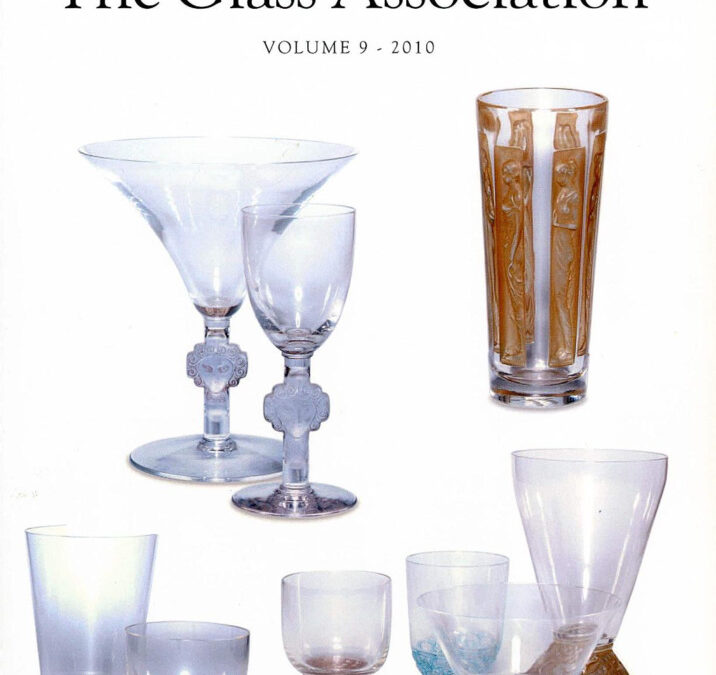
Front & back cover image: A selection of drinking glasses by Rene Lalique
Title page image: A pair of pages from a catalogue of the Holyrood Flint Glass Works,
showing their designs forVenetian lampshades
The Glass Association
Life President: Charles Hajdamach
Launched at an inaugural meeting at Stourbridge College of Art in November 1983, the Glass Association
is a national society which aims to promote the understanding and appreciation of glass and glassmaking
methods, both historical and contemporary, and to increase public interest in the whole subject of glass.
The Journal of the Glass Association deals primarily with the history of glass in the 19th and 20th
centuries, although articles on earlier and later periods of glass history are published, as appropriate.
There is a natural emphasis on glass from the British Isles, but contributions on overseas glass
are welcome where they relate in some way to British glass. Articles reflect the breadth of interest
of current glass studies in the design, social, industrial and economic contexts of glass as well as its
aesthetic and art historical aspects.
Anyone wishing to publish in the Journal should contact:
Brian Clarke
7 The Avenue
Finchley
London
N3 2LB
chairman@glassassociation.org.uk
Our contributors
TIM MILLS
Tim Mills, based in Olney in Buckinghamshire, has been a specialist dealer In 18th- and 19th-
century English glass for nearly twenty years. He exhibits at the National Glass Fairs and at
the Cambridge Glass Fairs. His own specialist interests include glass jugs and engraved glass,
especially rummers. In 2007 he organized the foyer exhibition at the Cambridge Glass Fair,
titled British Jugs from 1750 to 1900 and wrote a supporting article published in the Winter
2007 edition of The
Gloss
Cone.Tim can be contacted at www.antiqueglass.org.uk
ROBERT MARRIS
Robert Marris has been buying and selling 18th-, 19th- & early 20th-century English and
Irish glass since 1986. His father had been a maker of’weights & measures’ and in selling
these at an antiques fair, he became fascinated by the glass on an adjoining stall.
Robert bought a plain stem-drawn trumpet glass with a tear and his entry into the world of
antique glass had begun. He is now a member of the British Antique Dealers Association.
His own collection concentrates on engraved tumblers and the Arts & Crafts glass of Harry
Powell. Robert exhibits at the major glass fairs and in the Long Melford antiques centre.
He can be found at www.marrisantiqueglass.com
RICHARD GOLDING
Richard was born in Kenya and was first introduced to glass through his mother’s love of
collecting. He studied electronic engineering in the Navy and on a whim, in 1978 signed up
for a course at the International Glass College, Brierley Hill, where he learnt the art of
glassmaking and the theory of glass technology.Together with his engineering knowledge this
gave him the know how to create his own efficient glass furnace, since when he has lectured,
written and advised on glass furnaces. He is well known for forming Okra glass in 1979 and
now runs Station Glass in Leicestershire, where he has built the firstmini’ Combo furnace,
combining furnace, gloryhole and Lehr in one.
Richard is at wwwstationglass.com
MIKE MOIR
Mike has been a specialist dealer in the glass of the Art Nouveau and Art Deco periods
from France and Bohemia, particularly Rene Lalique, Emile Galle and Daum. for nearly
fifteen years.Together with his wife Debby, Mike has been collecting glass for double that
time; he ‘blames’ his mother for starting his passion for glass; in the 1960s, when it was a
little out of fashion, she brought home a Rene Lalique opalescent’Poissons’ bowl and it
completely fascinated him,They also collect and deal in Stuart Enamel glass. Mike Moir
has previously published in specialist magazines, such as Collect
It!, Antique Explorer
and
The
Glass
Cone. He can be found at specialist glass fairs, some general antique fairs
and at www.manddmoircom
JILLTURNBULL
JillTurnbull has been researching Scottish glass history for 16 years. Having retired early and
moved to Edinburgh in 1989, she studied for a degree in the history of art and design at
Stoke-on-Trent, specialising in ceramics and glass, graduating with 1st class honours in 1992.
She went on to obtain a doctorate at the University of Edinburgh in 1999 and her thesis
‘The Scottish Glass Industry I 610-1750′ was published by the Society of Antiquaries of
Scotland in 2001. Jill lectures and has published articles in
The Journal
of
the
GlassAssociation
and The
Gloss Circle Journal,
as well as in Scottish local-history publications. She is currently
working on the history of the post-1750 period of Scottish glass production.
Contents
Copper-wheel engraving on British drinking vessels
between 1770 and 1850
6
Timothy
Mills and Robert Morris
An insight into fuel-efficient furnaces and gloryholes.
Why I care
25
Richard Golding
Drinking with Rene Lalique
33
Mike Moir
`Scotch Venetian Glass’ — Edinburgh’s contribution
to theVenetian revival
51
Jill Turnbull
5
THE JOURNAL OF THE GLASS ASSOCIATION
Copper-wheel engraving on
British drinking vessels
between 1770 and 1850
Timothy “ills and Robert “arris
Background
This paper reports the findings of a survey of engraved
drinking vessels made and engraved in Britain between 1770
and 1850.
The subject of wheel engraving on drinking glasses in the
later Georgian and early Victorian period has been largely
neglected in the literature. In part, this might owe something
to the lack of firm attribution when considering the likely
executors of such engravings. The names of the engravers
have mostly escaped us due to their reluctance to sign their
work. Furthermore, the primary focus for writers on drinking
glasses has been the vessels themselves, with the engraving
often seen as of secondary importance. With the exception
of the intrinsic interest in Jacobite engravings much of the
work of British engravers has been dismissed as crude or
naive, certainly not worthy of comparison with their
continental contemporaries. Hugh Wakefield summed up this
view by suggesting ‘Very little distinguished engraved work
had been carried out in this country in earlier times; but
from the middle of the nineteenth century British glass
manufacturers and dealers began to produce a great amount
of fine engraved work’ (Wakefield ( I 961) p.36). Engraving in
Britain during our period can thus be seen, perhaps not
unreasonably, as folk art, reflecting those issues of account to
the general people and made for them rather than those of a
loftier social position.The engravings themselves can be seen
as important, not necessarily for their artistic merit (though
some are of great merit) but for their relevance as historical
and social artefacts.
The description of the various subjects of engraving for
–
the
period has generally been attempted in an
ad
hoc fashion.
A century ago, Percy Bate provided a chapter on what he
referred to as
inscribed glasses.
His focus was primarily on the
glasses of the eighteenth century but included some early
nineteenth-century examples. He suggested the following
groups to cover the subject: Jacobitism and their clubs,
Hanoverian, Loyalty and Patriotism, Heroes (naval and military),
Political and parliamentary, convivial and Masonic, toasts and
sentiments, societies hunts and clubs, ships and naval glasses,
names of owners, and emblem glasses. He admitted that
limitations of space prevented an ‘attempt to formulate … a
succession and a classification’ (Bate (1910) p.96).
Barrington Haynes (1948) offered a framework of
classification for British and Continental commemorative
glass from the 17th and 18th centuries. The framework is
comprehensive and detailed and presents four overarching
categories:
1.
Records of public congratulation or appreciation;
2.
Similar
records of
a
more restricted or semi private nature;
3.
Records of political or controversial import;
4.
Records of social
and
private interest
This four-group framework is then broken down into more
detail providing 24 sub-categories some of which break down
further into minor categories. Barrington Haynes notes that
There are so many glasses of historical or social interest … that
a perfect analysis is impossible’ (Barrington Haynes (1948)
p. 144). Nevertheless the framework he presents provides a
wide, quite complex coverage of the glasses of his period.
Brooks (1981) provides a classification framework, which
is useful, but only goes as far as the limits of space in an
introductory text allow. Brooks uses the following to classify
the subjects: royalty, historical events, personalities, political,
industrial, sporting, and general. As with Bates this framework
is derived from the authors experience of the subject but not
from any formal analysis of the glass.
Hajdamach (1991) gives a chapter to copper wheel
engraving and provides an interesting discussion, particularly
relating to the Newcastle engravers of the early nineteenth
century. He stops short of offering any framework to cover
the diverse subject matter provided in the engravings and
focuses more on information concerning the work of
Bohemian engravers about which more is known.
In general, whenever any taxonomy of engraving is
discussed, the framework offered is usually derived from the
reflections of the author and often lacks comprehensiveness
and detail. Furthermore little can be said relating to eitherthe
relative frequencies of the various types of engraving or the
frequencies of sub groups making up overarching categories.
Barbara Morris highlighted this problem by suggesting in
a paper to The Glass Circle: that ‘[ 19th and 20th century
commemorative glass] is clearly a vast subject of which it is
impossible to give a fully comprehensive survey’ (Morris, 199 I ,
p. 15). This reiterates the difficulty observed by Barrington
Haynes noted above. This paper seeks to address this
problem by providing a survey of engraved glass within our
period, leading to a systematically derived classification and
quantification of the glass observed.
6
THE JOURNAL OF THE GLASS ASSOCIATION
Method
A survey was carried out of examples of engraved glass
drinking vessels made between 1770 and 1850.The limits of
the period were chosen for practical and historical reasons.
First, any such survey needs limits.The cut off of 1850 was
chosen as it was felt that this represented a change in the
nature and possibly purpose of the engraving produced in this
country. Following Wakefield’s observation it was felt that
the influence of Bohemian engravers after the middle of the
nineteenth century provided a natural point to limit the survey.
Wheel engraving in Britain is rarely seen on glass before
the mid part of the eighteenth century. The focus of a
considerable amount of engraving at this early period is
Williamite and Jacobite. Both these forms have been
discussed at length elsewhere (Seddon, 1995) and some
controversy has surrounded Williamite glass in particular
(Francis, 1994). A practical reason also helped select 1770
as the start date as this is roughly when most writers
suggest facet-stemmed wines started to become popular.
This enabled facet stems to be included in the survey,
though other stemware was excluded for practical dating
purposes. It is accepted that some opaque twists and
some plain stems fall into the period but they are difficult
to identify and were therefore excluded. Thus, the survey
included any British drinking vessel engraved with more than
a simple border that could reasonably be dated between
1770 and 1850.
Glasses were recorded from four sources. First, sale
catalogues were examined.These were predominantly from
the glass sales held in the major London rooms though some
were from provincial auction houses. Catalogues from the
1950s to the present day were examined and 225 sales
provided an average of ten engraved glasses each.A total of
2,259 glasses were recorded from sales.The literature was
also examined and this included books, journals, and articles.
A total of 109 separate publications provided 886 glasses for
the database. Museum and private collections were also
included in the survey and these provided a further 171
glasses.The survey database therefore contains 3,316 glasses
each with engraving to the body of the vessel more
substantive than a simple border engraving.
A number of pieces of information were recorded for each
glass.These included the type of object, the estimated date, an
engraved date if present, the bowl and foot form, the height,
the category of engraving, a description of the engraving, any
mottoes or inscriptions, details of any monogram and a
reference to where the glass had been recorded. Whilst
constructing the database care was taken to avoid entering
the same glass more than once if it appeared in more than
one source. Once cornpleted,the database was examined for
any errors and these were removed. The product of this
process was a database of glasses, which provides not only a
valuable reference tool but also a dataset suitable for
systematic analysis,
At this point it is worth considering what a database
constructed in this way truly represents. Clearly it is not
perfectly analogous to the body of engraved glass from
this period. Authors in the literature choose to illustrate
important and rare glass over the ordinary.This bias is less
likely in the salerooms though the very ordinary is likely
under-represented. Therefore any analysis of the dataset
might over-state the prevalence of the rarer categories and
under represent the more mundane. The content of any
taxonomy however, is unlikely to be affected.
Findings
Initial analysis of the data showed that rummers were
the most numerous vessels recorded with 1,421 examples.
A total of 893 facet-stem glasses provided the second most
numerous form with tumblers represented by 600 examples
along with 110 tankards.These four forms made up almost
92% of the sample with ale glasses, slice cut wines and drams
making up much of the rest.These latter forms are likely to be
under-represented due to the reasons noted above. A total
of 352 (10.6%) glasses carried an engraved date judged to be
contemporary with the original engraving and manufacture
of the glass.
Each glass was categorised into a group suggested by
the subject matter of the engraving. It was observed that
many glasses could be classified into more than one group.
For example, floral engraving alone might be classified as
Decorative.
However, floral engraving accompanied by some
pictorial subject should be classified as something beyond
the simply decorative.To account for this a simple hierarchy
was used in order to make the classification clear. Any glass
with decorative engraving such as hops and barley or flowers
etc was classified as
Decorative.
If a monogram was present
along with such engraving then the glass was designated as
Individual
emphasising that originally the glass was clearly
intended to be of significance to an individual. If names,
dates and/or family events were recorded then the engraving
was classified as Domestic. In addition to this any pictorial
engraving or mottoes were given a category relating to
the relevant subject area. Thus, for example, a rummer
engraved with a coaching scene together with a monogram
and flowers, would be classified as
Coaching
as the most
significant aspect of the engraving, though clearly it had
decorative elements and had individual significance to the
original owner. Each glass was examined in this way and a
category given to it.
This initial analysis revealed 118 different categories of
engraving.This level of detail is, of course, too complex to be
useful.Therefore an analysis of the 118 categories was carried
out to identify a more concise taxonomy.This second analysis
resulted in a ten-component framework with each component
being made up of numerous sub-categories.Thus each glass
recorded falls within a sub-category and each sub-category is
part of a major category.
Table 2
shows each major category along with its sub-
categories.The relative sizes of each group are also provided.
The ten major categories are discussed in detail below.
7
THE JOURNAL OF THE GLASS ASSOCIATION
The taxonomy
I. Decorative
The largest group in the database was that designated as
Decorative. This accounted for 29.7% (984 glasses) of the
whole sample. Its major sub-categories were
floral
(523
glasses representing 53.2% of the group)
Adam
style (177
glasses 18%), hops
and barley (115
glasses 11.7%),
fruiting vine
(90 glasses 9.1%) and
Chinoiserie
(61 glasses 6.2%). Minor
additions were lone birds in flight (6 glasses) and glasses
marked for particular drinks such as cider (3 glasses)
grog
(4 glasses) and
beer; gin,
and
punch (I
glass each).
This type of engraving is the most common to be found on
facet stems. Of the 893 engraved facets recorded 624
(almost 70% of all facets) were classified as decorative.Across
the other three main vessel types a consistent frequency of
this decorative form is observed: rummers (12%), tankards
(I 1.8%) and tumblers (12.7%).
The quality of engraving within this group varies
enormously. At their most naïve, the engravings may be
stylised flora that simply break up the plainness of the un-
engraved surface (fig.
I).
The majority of floral engraving is
generally of a weak nature; nevertheless there are some very
finely engraved examples, often accompanied by moths and
insects (figs 2a
and
26) with polished highlights and shading.
Interestingly, the better engraved examples often appear in
the earlier glasses and on facet stems.These may have set the
fashion that subsequently became debased as it spread to
cheaper production.
Fig. I
(above left):A
tumbler with straight-sided bowl with naive
floral engraving. h I Ocm. c. I 780.
Figs 2a and 2b
(left and below):A
facet-stem wine glass, the
bowl finely engraved with floral band and bees and the foot
with floral engraving. h I 2.8cm. c. 1770.
8
COPPER-WHEEL ENGRAVING
The fashions of the day are also represented in the
Decorative group with Adam style and Chinoiserie decoration
(fig.3).
These appear on 238 glasses representing 24.2% of
the group. Following these, the most common engraving
forms represent the drink for which the glass was intended.
Thus, hops and barley, fruiting vine and numerous other
examples are recorded. In total 215 glasses representing
almost 21.8% of this category were engraved with reference
to the intended drink.
Though the Decorative group is the largest classified it is still
likely to be under-represented in the survey. Some evidence
for this is apparent in the database when the source of the
data is considered. In the salerooms 32.3% of the glasses
recorded fell into this category. However, only 25.4% of
engraved glasses In the published literature are Decorative.This
bias is even stronger in the museums and private collections
examined. Thus, wherever some form of selection occurs,
not surprisingly, the more common glasses become less
represented.
2. Individual
The second largest category in the sample was designated as
individual. This group consisted of 532 glasses representing
16% of all glasses recorded.To be designated as an
Individual
glass it needed an engraving that made the glass personal to
an individual or more rarely a family.
The simplest engraved form classified within the
Individual
category was that of a plain, unadorned
monogram
usually
within a simple cartouche or panel. Glasses falling within the
monogram
sub
–
group were relatively uncommon with only
33 glasses observed. Glasses with monograms were usually
accompanied with some other decorative motif such as
flowers
( I I 3 glasses representing 21.2% of the group), hops
and barley
(60 glasses, I 1.3%,
fig.4)
or more rarely Adam style
(I 2 glasses, 2.3%) or
fruiting vine
(6 glasses, I. I %).The relative
rarity of Adam style probably reflects the general lack of
monograms on the earlier glasses where Adam style was
more common. The popularity of using larger glasses for
monograms that naturally favour ale and been rather than
wine, probably accounts for the lack of fruiting vine.
The largest sub-category observed within the
Individual
category was that labelled Domestic.This sub-group contained
I 89 glasses representing 35.5% ofthe group and included any
glass that had more information than a simple monogram, for
example, names, dates or family occasions. Such a glass was
a rummer of ovoid form on a square foot dating from around
1790 recently offered at auction
(fig.5).
The large bowl is
engraved Dane/
Toner [sic] Born May
The
23 1731
and may
have been given as a birthday gift on the occasion of Daniel’s
Fig.3
(above
right): A tankard, the waisted body engraved with
oriental acrobat within a chinoiserie cartouche. h 13.3cm.
c. I 775.
Fig.4
(right):
A Tumbler engraved with monogram and hops and
barley with cut basal flutes. h I I.4cm. c.1
800
9
THE JOURNAL OF THE GLASS ASSOCIATION
Fig.5. A rummer with ovoid bowl on pedestal stem engraved
with a rose and inscribed ‘Danel Taner Born May the 23 1731’.
h 16.3cm. c.1790.
Fig.6. A tankard with waisted and gadrooned body inscribed
‘Tho Robinson Oldbury Shropshire 1776’ flanked by hops
and barley. h 20.5cm.
60th birthday. Such glasses are rare in the facet stem
group, with only 7 glasses being recorded, accounting for less
than 1% of engraved
facets.
Perhaps surprisingly Domestic
engravings are not particularly common amongst rummers
either with 71 recorded examples representing 5% of all
rummers examined. Of all the tumblers recorded 68 glasses
representing l 1.3% of tumblers had domestic engraving,
whilst the tankards (admittedly with a smaller sample size)
were much more likely to have domestic information with
26 glasses representing 23.6% of these vessels. A particularly
fine tankard is named for
Tho Robinson Oldbury
Shropshire
776 (fig.6).
Another sub-category included glasses with family crests
and coats of arms. These were recorded as
Armorial
and
102 glasses were examined representing 19.2% of the
Individual
group.
3. Transport
and
Travel
Our period saw great innovations in the area of transport and
travel and so it is perhaps unsurprising that 388 glasses,
representing 11.7% of the database, made reference to it in
some way. The group includes bridges, and five different
bridges were recorded including those at lronbridge and
Scarborough. However, one bridge in particular contributed
261 glasses to the group and that, of course, was the
Sunderland
Bridge.This engraving could almost be considered
a major category in itself, representing as it does 7.9% of the
entire dataset. It is possible that this is slightly inflated due
to the same examples being recorded more than once.
However, care was taken to avoid this and where possible
glasses that were clearly repeats were removed.The use of
monograms when present aided this process. The earliest
representations of the Sunderland Bridge seem to appear in
the ten years or so following its opening in 1796. A series of
rummers with straight-sided bowls and lemon-squeezer feet,
finely engraved, appear to date from around 1810
(fig.7)
though the earliest engraved date recorded is 1818. The
subject then appears throughout the rest of the period and
beyond. The bridge was renovated in the 1850s and one
rummer records an image of both the original and renovated
bridges.A total of I 6 dated examples were recorded and the
average date was 1828. The engraving is most commonly
found on rummers, with 236 examples in the survey repre-
senting 90.4% of this form of engraving, Only 16 tumblers
were examined, with 8 tankards and a single ale glass. It is
worth noting that the earlier representations tend to be
named as the
Bridge
over the
river
Weir whilst the majority of
later examples are named for
The Sunderland Bridge.
Some
simply show the bridge without being named, which in itself
hints at the fame of the image at the time.
The reason for the popularity of the Sunderland Bridge
image is unclear. It appears on pottery and prints of the
period and oddly stays in fashion right through to the end of
our period when, presumably, more impressive engineering
feats had been achieved. It is likely that the large number of
glass engravers working in the area was influential, but this
10
.
..t
‘te
a 1101
7
42
1
‘:M11111
111
]
.
1111101
i
61
COPPER-WHEEL ENGRAVING
Fig.7. A rummer with straight-sided bowl on lemon-squeezer
foot engraved with image of Sunderland Bridge with numerous
vessels beneath.With script ‘Cast Iron Bridge over River Weir
Sunderland’. h I 5.5cm. c. I 8 I 0.
can only be a part explanation. Clearly the image would not
have continued to be engraved without a ready market to
purchase the glasses. The Newcastle High Level Bridge
becomes a subject for the North East engravers after it was
opened in 1850 but this is a much rarer image
(frg.8).
Commercial shipping represents almost 13% of the
categorised group with 50 glasses recorded.This certainly is
an under-representation of this group due to the difficulty in
categorising some shipping glasses as commercial or naval
(another category). Only glasses that could confidently be
placed into this category were recorded as such. A total of
69 glasses had some form of marine engraving which was
unclassified. By comparing the ratio between the naval and
commercial shipping glasses that were categorised, we can
estimate that around a further 20 or so glasses are likely to be
of commercial shipping interest.
Coaching
was the subject of 56 glasses representing 14.4%
of the group
(fig.9)
whilst only three recorded locomotives
and three celebrated canals. A single tumbler presages the
coming of the bridge across the Menai Straits complaining
Hobson’s
Choice,This or None. Bangor Ferry (fig. 0),
This gives us
a flavour of the original owner’s obvious dislike for the
uncomfortable and often dangerous crossing on a major
route to Dublin beforeTelford’s bridge was opened in 1826.
Fig.8. A rummer with bucket bowl engraved with ‘Newcastle
high level bridge’. h I 9cm. c.1850.
Fig.9. A tumbler of barrel form engraved with coach and four
horses inscribed ‘Success to the Coachman’ and on the reverse
‘A Trifle from Yarmouth William Flint London’. h I 2.4cm. c. 1794.
THE JOURNAL OF THE GLASS ASSOCIATION
Fig.10. A tumbler with straight-sided bowl engraved ‘Hobson’s
Choice.This or None. Bangor Ferry’. h I 5.8cm. c. I 820.
Fig.I I. A rummer with ovoid bowl over capstan stem.
The bowl engraved with masonic emblems with script to the
reverse ‘The heart that conceals and the tongue that never
reveals A Trifle from Yarmouth’. h l 6.3cm. Absolon c. 800.
4. Clubs and Societies
Various clubs existed, predominantly for men, in the eighteenth
and nineteenth centuries and a number of glasses have
survived commemorating membership. Glasses categorised
as belonging to the Clubs
and
Societies category represented
7.7% (254 glasses) of the total.
Masonic glasses were by far the most common sub-group
in this category with 224 glasses recorded, which made up
88.2% of the Clubs and Societies category. Typical Masonic
engraving consists of numerous symbols used in the teachings
of the society
(fig. 11).These
engravings are rare on facet-stem
glasses with only I I recorded, just over 1% of all facets.They
are much more common on rummers (I 24 glasses, 8.7% of
all rummers) and tumblers (61 glasses, 10.2% of tumblers).
Not a single tankard was recorded in this sub group.
One of the functions of any Masonic lodge is to offer its
members some form of support when times become
difficult By the early nineteenth century this aspect had been
developed by a number of other organisations known as
Friendly Societies. Often these societies had their roots in the
guilds of earlier times, but developed and expanded to help
ordinary working people with a form of insurance. Thus
membership offered some security when jobs were lost or
illness required expensive medical care. Over and above this,
the societies offered social gatherings and events and some
clearly became important enough to record membership
through engravings on their glasses. One such group was the
Oddfellows society which was active in the eighteenth
century. In 1810 a number of groups around Manchester
broke away to form the Independent Order of Oddfellows.
Independent orders developed across the country and most
of the glasses recorded came from the years following this development. Oddfellows engraving often mimics Masonic
engraving, but is usually executed in a more naive fashion
(fig. 1 2).
This lack of quality perhaps reflects the lower social
position of the original owners, limiting the amount of money
that could be spent on such items.The similarity between the
symbols used on these glasses, does lead to a misclassification
in sales catalogues, which often refer to them as Masonic
glasses. Because of this, it is possible that some Oddfellows
glasses inflate the Masonic group and conversely the
Oddfellows group is perhaps under-represented. Thirteen
glasses in total were recorded as
Oddfellows
and these had
explicit reference to the society.
The Ancient Order of Foresters was another friendly
society to emerge from earlier roots. It was founded in I 834
and like others provided financial and social support to its
members. Their engravings are distinctly different from
Masonic type engraving, often having an image of a bowman
shooting an arrow towards a stag, Some glasses of this type
have green or turquoise rims and date from the 1830s and
1840s. More rarely, a subgroup of the Foresters known as the
Ancient Order of Shepherds can be found.These engravings
show a Shepherd tending his flock. A tumbler and a rummer,
both with green/turquoise rims are represented on the
database
(fig. 1 3),
Only five foresters glasses were examined
12
COPPER-WHEEL ENGRAVING
for the database. Generally, the quality of engraving on
Foresters’ glasses is somewhat better than for Oddfellows but
they remain in the naive tradition.
A rather more generic sub-category of this group is that of
Clubs.
This classification was given to any glass with reference
to the convivial club the original owner wished to commem-
orate. Included are the
Sons of Harmony,
The Druids,
The
Caledonian
Society and The Moreton Society. Two different
examples bearing the same unusual image of a cat playing
bagpipes before a music stand are also recorded
(fig. I
4).This
engraving has caused previous authors to question the
possible meaning of such a strange image. In 1910 Percy Bate
suggested that the original owners must have been ‘eccentric
souls to whom the quaint symbols had meaning. To the
observer of today the reason for the choice of a cat as the
instrumentalist, and the bagpipe as the instrument, is far from
clear; and the motto “HONOUR AND FRIENDSHIP”
is
still less
obvious’ (Bate (1910) p.1 15). In 1937 Arthur Churchill in his
exhibition
History in
Glass was perplexed enough to offer the
glass free to anyone who could offer the first satisfactory
explanation of its meaning. A clue to a possible meaning is
given by Waite (2003). He lists a number of convivial clubs
operating in the eighteenth century. One such club, which
offered members social intercourse along with liberal
quantities of alcohol, was the Cat and Bagpipes Society, which
met in the Great Western Road in London at a public house
of the same name. it seems quite possible that members of
the club were given commemorative rummers, sometime in
the I 790s, to mark their membership. A total of ten glasses
are recorded that are engraved for clubs making this a
relatively scarce form.
Fig.12
(above
left): A tumbler with straight-sided bowl with
applied blue rim engraved with Oddfellows symbols. Inscribed
`Independent Order Of Oddfellows’. h 1 I.2cm. c.I835.
Fig.
13
(above):
A rummer with bucket bowl with applied green
rim engraved with a Shepherd playing pipes overseeing his
flock with initials to reverse. h I3.7cm. c.I 830.
Fig.I4
(below):
A rummer with ovoid bowl on square pedestal
stem engraved with a cat playing the bagpipes beneath the
inscription ‘Honour and Friendship’ with hops and barley and
fruiting vine. h I 4.2cm. c. I 795.
13
THE JOURNAL OF THE GLASS ASSOCIATION
Figs I 5a,b,c Two tumblers one engraved with hunting scene the
other with ‘Tom Noel Fox Hunter’ both with ‘Tally, 0′ and
running fox engraved to base. h 10.1cm and 9.4cm. c.1800
5.
Pastimes
A broad range of pastimes is commemorated on the glass of
our period. Pastimes are recorded on 239 glasses repre-
senting 7.2% of the database. Of the facets 6.3% (56 glasses)
are noted, rummers 7.7% (110 glasses), tumblers 9.2%
(55 glasses) and tankards 1.8% (2 glasses).
Bloodsports were clearly a popular way for our ancestors
to pass the time. Overall 163 glasses (68.2% of the group) had
some form of blood sport commemorated. Most popular
was hunting with hounds, either foxes or stags, on or off
horseback. 110 glasses fell into the
hunting
sub-category.
A total of 45 facet stems were engraved with hunting scenes,
representing 5% of all facets, making it the third most popular
image for these glasses, Hunting glasses often have an
inscription toasting the hunt.These include the most popular
Tally
ho or
Tally 0 (figs I 5a, f 5b, 15c).
Less often the hunt is
named, for example The
Buxton
Hunt.
More rarely
hare coursing
(15 glasses) or
stag coursing
(7 glasses) were observed.
Cockfighting
had 11 glasses whilst
shooting
was represented on 16 glasses, usually at rabbits and
birds
(fig.! 6),
but occasionally stags. Most rarely, the rather
more genteel
Angling
was observed on 4 glasses.
After bloodsports the most popular pastime was that of
horse racing.
Often these glasses mark a favourite horse of the
original owner, or perhaps the winner of a particular race.
Examples Include Prince Leopold, the Derby winner in 1816,
Wroton winning the St Leger in 1829 and Surplice, ridden by
S.Templeman, winner of the 1848 Derby.A total of 42 glasses
were recorded in this sub-group representing 17.6% of the
Pastimes category.
Within the
Pastimes
group are a relatively large number of
much smaller sub-categories.
Boxing
had 10 examples noted
commemorating the bare-knuckle heroes of the day. Fruit
growing and gardening provide 3 glasses each. One particular
rummer offered for sale in 1987 recorded a prize-winning
peach —`Circumference I I Ins.Weight 9
3
/10z July 4th 1793’.
Four glasses were observed with
ballooning
subjects, and two
were engraved for
bell ringing.
Only three examples were
found with musical images such as instruments and sheet
music
(fig. I 7).
Interestingly, only a handful of glasses relate to
socialising with friends or family. A group of four tumblers
were recently auctioned that commemorated the names of
those who attended a housewarming party in Wales in 1797.
Two other glasses show figures sharing drinks in a convivial
setting whilst two more show family members sharing tea.
6. War and Peace
Our period saw a number of conflicts between Britain and
her rival nations, Not surprisingly therefore, we find a number
of subjects relating to
War and Peace.
This group of 227
glasses (6.8% of whole sample) is rather lopsided in the
distribution of glasses observed between the state of war and
14
COPPER-WHEEL ENGRAVING
Fig.16. A tumbler with straight-sided bowl engraved with
shooting scene named for Thomas Moody Newmarket.
h 11.5cm. 1822.
Fig.17. Tumbler with straight-sided bowl engraved with a
violinist in front of music stand with his image reflected in
a mirror. h 9.1cm. 1779.
the state of peace. Only 12 vessels were clearly commem-
orating peace, often marking a treaty of some kind. For
example, a fine rummer on lemon-squeezer foot sold in I 974
with an image of Britannia with a lion and ships, with the
inscription Peace 1
814
commemorating the Treaty of Paris,
which temporarily brought peace to Europe before
Napoleon’s escape from Elba.
It is worth noting that more glasses are seen with motifs
that may be interpreted as referring to peace. For example,
the naive
bird in flight
that is seen on many glasses from the
beginning of our period through to about 1820 often carries
a
sprig in its beak.This might be symbolic of peace, as a dove
with an olive branch. Furthermore, the mottoes such as Peace
to
all mankind
or Peace to
all the world
occurs occasionally on
glasses which have other subjects that may lead them to being
classified into other groups. However, what is clear is that the
number relating to war swamps overt references to peace.
The most common sub-category in this group is that
of
Naval
with 157 glasses representing 69.2% of the group.
As noted earlier, a number of maritime glasses were
uncategorised because it was difficult to determine whether
they were of naval or commercial shipping interest.The ratio
between the identified glasses in these groups suggest that as
many as 50 of these unclassified glasses may relate to the
Naval
sub-category. Glasses were included in the
Naval
category if reference was made to any aspect of the Royal
Navy. This group Is inflated by the large number of Nelson
glasses which must reflect his enormous popularity both
when alive and after he died. A very popular image is that of
the funeral catafalque used to carry Nelson’s body to St Paul’s
Cathedral during the procession of 9 January 1806
(fig18).
These glasses are often of fairly crude workmanship and
appear to be by the same hand. The engravings appear
exclusively on rummers, usually with ovoid or straight-sided
bowls. Both round and lemon-squeezer feet are observed.
Many have the date engraved on them, but not all. They
were presumably produced as souvenirs of the day for some
of the many thousands of people that lined the funeral route.
It is worth noting that only a single example (Bickerton 1985,
plate 956) has a monogram personalising the glass. The
monogram is unclear in the image and could possibly have
been added at a later date.This lack of monograms hints at
the way in which they were originally sold as immediate and
unplanned souvenirs.
A second form of engraving is one celebrating four admirals
along with the dates of famous naval victories: Howe
1st June
1794,
St Vincent
14th February 1797, Duncan 1 I th October
1797, Nelson 1stAugust 1798.
These most commonly appear
on tapered tumblers with basal flute cutting
(fig. I9)
though a
single rummer is recorded. Numerous examples depict a ship
with an inscription that identifies the vessel. Nelson’s
Victory
is
most popular but other examples were examined.
One particularly competent engraving type is provided
by the Absolon workshop in Great Yarmouth. Yarmouth
provided the Navy with a convenient North Sea port during
the Napoleonic Wars and a number of naval vessels are
15
THE JOURNAL OF THE GLASS ASSOCIATION
Fig.20. A tumbler of barrel form engraved with a Man of War
named for the ‘Queen Charlotte’. inscription to reverse ‘May
Success Swell the Sails of Britain and Victory Wave her Flag’.
h I 0.7cm.Absolon c.I 795.
Fig.I 8. Rummer with ovoid bowl on capstan stem engraved
with Nelson’s funeral car, Trafalgar”Nile’ and ‘Victory’ and the
reverse engraved ‘Lord Nelson January 9th 1806’. h 15cm.
Fig. 19. Tumbler with cut basal flutes engraved ‘Howe 1st June
1794, St.Vincent 14th February 1797, Duncan I I th October
1797 & Nelson I st August 1798’. h I 2cm. c. 1800.
commemorated.The image is of a Man of War viewed from
the stern sailing away from the viewer (fig.20).The image is
accompanied by an inscription identifying the vessel (for
example Queen Charlotte) along with some other motto such
as
May
Success Swell The
Sails
of
Britannia and Victory Wave
Her
Flag.
These appear most often on barrel tumblers and
date from the 1790s and I 800s, though they are also recorded
on ovoid bowl rummers of the same period. One such
declares
Nelson’s Victory
and to the reverse Plenty to
a
Generous
Mind.
In contrast to the funeral glasses these usually
carry a monogram suggesting their original purpose was for
personalised gifts. Absolon’s naval vessels are distinguished
from his commercial vessels by the profile of the ship, with
commercial vessels represented with a view of the port side
in profile.
The second largest sub-category of the War
and
Peace
group and providing 23.8% of it with 54 glasses, is that of
Military.
Unlike the
naval
category no single image dominates
the glasses recorded. Not surprisingly most date from the
period of the Napoleonic wars and they often reflect the
formation of the many militia groups (latter day Home Guard
regiments) that were formed to defend the country from
French invasion. One form appears mainly on flute-cut
tumblers and dates from the turn of the century. These
sometimes simply have what appears to be a monogram in a
belt cartouche, for example OLV
–
the significance of which can
be easily overlooked
(fig.2
I).
Such glasses originally commem-
orated the
Loyal Volunteer
groups (in this case probably
Oxford) that were part of the militia force.The initials are of a
feathered copperplate form and are usually in the same hand.
16
COPPER-WHEEL ENGRAVING
Fig.21
(above):
A tumbler cut with basal flutes and with
engraved cartouche, crown, the initials OLV, and ‘Sempa
Paratus’ with monogram to reverse. h I 0.8cm. c. I 800.
Fig.22a
(above right) 22b (right):
Tumbler and wine glass
engraved ‘Loyal Colchester Volunteers LCV’ in cartouche
with initials CAC. h 12.8cm. 1797.
Other, more obvious, examples are recorded. A rummer
with ovoid form shows three infantrymen with fixed bayonets
with the rousing motto Chester Lads For Ever. Another
rummer is named for the original owner Grantham Moss,
who served in the East Norfolk regiment around 1800,
another declares Success to the
Loyal Independent
Sheffield
Volunteers,
whilst across the Pennines the
Royal Manchester
and Salford Volunteers
prepared to defend the country.
A number of glasses from a suite engraved for The
Loyal
Colchester volunteers are recorded
(figs 22a,22b).
Regular army subjects also appear. One rummer on an
ovoid bowl simply declares Success to
Wellington Cavalry
(fig.23)
though no other image is on the glass.This presumably
is an example of a glass engraved specifically for a toast.
A drawn wine glass is recorded with the crest of the 6th
Inniskiilin Dragoon Guards (the heavy Brigade at Waterloo).
Wellington is by far the most commonly named military
commander with 10 glasses inscribed either
Wellington for Ever
or
LD
[Lord]
Wellington for
Ever. These inscriptions usually
occur with a sword and dove and so presumably celebrate his
victory at Waterloo. Wellington’s career as a politician may
give these glasses a political flavour.
Few other glasses are recorded outside the two main sub-
categories of
Naval
and
Military.
One glass is engraved with
the legend
England has done her duty,
whilst three glasses have
Britannia accompanied by martial trophies and military
vessels.The survey recorded most glasses with images of
Britannia as relating to matters of state and therefore they
were categorised in the next major group,that of
Governance.
Fig.23. Rummer with ovoid bowl engraved ‘Success to
Wellington Calvary’. h I I .7cm. c. 1800.
17
THE JOURNAL OF THE GLASS ASSOCIATION
7. Governance
Our period saw huge political upheavals in the western world.
The early years witnessed the independence of the fledgling
United States, and this along with other changes in political
philosophies led to events such as the French Revolution, all
of which have had a considerable impact in Brftain.Throughout
the first half of the nineteenth century radical ideas about
liberty and social justice found voice in groups such as the
Chartists, and the fledgling workers organisations that fore-
shadowed modern trade unions. For the eighty years of the
period people concerned themselves with who should govern
and how they should govern. Given this, it might be expected
that such ideas would find themselves expressed in a substantial
number of engraved glasses of the period. In reality only a few
non-establishment views are expressed in the engravings, and
most are quite conservative. In total, 217 glasses representing
6.5% of the whole sample were recorded with engraving
making reference to Governance.
The most common sub-category observed is that of
Royalty.
Just under half the glasses classified fell into this group (47%)
and all were supportive of the institution if not necessarily the
incumbent. One interesting group of glasses, in support of
Caroline of Brunswick, emanate from the very public rift that
occurred between George IV and his estranged wife. The
couple married in 1795 for political reasons; this marriage
soon faltered due to mutual dislike. Despite separating very
quickly, a daughter was born, which provided a possible heir
to George’s throne. However, the child Charlotte died whilst
young and this removed the last reason for the couple
to remain married. Despite attempts to divorce his wife the
marriage remained intact until the death of George III
brought matters to a head. George and his advisors were
desperate to prevent Caroline becoming Queen Consort
and went so far as to bar her from the coronation. All the
glasses recorded come from this period and their number
stand testament to the obvious popularity of the Queen
around this time. Of the 75 glasses that can be interpreted as
supportive of a particular royal figure, 21 (28%) are supportive
of Caroline (which beats her husband’s 20 glasses by one).
Caroline died in 1821 and most of the glasses commem-
orate her death. It is interesting to speculate why the queen
should have been so popular. One theory is that she pro-
pounded some fairly radical political views about the nature
of government. For example she told The
Times
in 1820
`A government cannot stop the march of intellect any more
than they can arrest the motion of the tides or the course of
the planets’. At the time she was perceived to be an advocate
of more representative forms of government and she explicitly
assured people of all classes that she would represent their
concerns as queen.What this episode suggests is that support
for Caroline may extend beyond sympathy for an apparently
wronged woman (much evidence even at the time suggested
her behaviour put her well beyond the pale as a future queen)
and rather enabled a veiled support for new political ideas.
George III was the monarch most often recorded on the
database. Given that he reigned for the first fifty years of our
Fig.24. A rummer with straight-sided bowl engraved
with a crown above ’50’ with anchor and all-seeing eye.
GR III with the inscription ‘Jubilee Oct 25 1809’. h I 9.2cm.
period, this is perhaps not surprising. One form of engraving
seen more than most is that for George’s fifty-year Jubilee
celebrations in 1809. These glasses typically show a royal
crown, an all seeing eye, occasionally an anchor, the royal
cipher and the legend Jubilee Octr 25th
1809,
50 Year
GR1I1
(fig.24).
This is an unusual date to record for the jubilee as
George actually came to the throne on 25 October 1760
suggesting that the engraved date commemorates the 49th
anniversary.We can only assume the Jubilee was celebrated
at the start of the fiftieth year of the reign. Most commonly
these engravings are found on straight-sided rummers.This
pattern does not seem to have been employed to mark sixty
years as no glasses were found to explicitly mark the start of
the sixty-year celebration. If they were waiting for October
I 820 then hindsight showed this to be a mistake, as George
died in January of that year.
One particularly interesting glass relating to George III is a
tumbler marking a failed assassination attempt against the
King
(fig.25).
George was attending a theatre performance in
Drury Lane in May 1800 when James Hadfield fired two shots
at him. George survived and Hadfield was incarcerated for
life after being acquitted of High Treason on the grounds of
insanity.The glass celebrates George’s good luck rather than
the attempted murder
18
COPPER-WHEEL ENGRAVING
Fig.25. Tumbler with cut basal flutes engraved ‘God Save The
King’ with Crown Sword and Sceptre, the reverse inscribed
‘GR’ and ‘Preserved from Assassination May 15 1800’.
h 10.2cm. c. I 800.
The last twenty years of our period saw William IV reign
between 1800 and 1837 after which Victoria came to the
throne. Only two glasses were marked for William and only
one for Victoria.This must reflect the passing of the fashion
to commemorate royalty on engraved glass of our type.
It should be observed that the fashion for other subjects did
not wane in this way and possibly reflects the fall in esteem for
the institution following George IV’s reign.
Following
Royalty
the second largest sub-category in the
Governance
group was that of
Political.
This category had
63 glasses recorded representing 29% of the group. Glasses
in this sub-category expressed some form of overtly political
sentiment to which the original owner would have had
sympathy. Nine of the glasses declare for some candidate or
other in an election. For example a tumbler is inscribed Ford
for Ever supporting the MP Francis Ford, returned for
Newcastle-under-Lyme in 1793.
A large proportion of the
Political
sub-category expresses
support for some aspect of the state. For example
Church and
King
or King
and Constitution
or
Church and
State and variants
on this theme are recorded on 16 glasses.A particularly well-
engraved form appears on flute cut tumblers from around
1800 and shows a figure standing before parliament with the
inscription Bill
of Rights, Magna Carta . . . May
Our
Happy
Constitution
In
Church and
State
Ever Continue Unimpaired (fig.26).
Such sentiments presumably relate to the debate around the
dominance of the established church and whether Catholics
should enjoy more political freedoms such as the right to
Fig.26. Tumbler with cut basal flutes engraved with crowned
figure standing before parliament with the inscription ‘Bill of
Rights, Magna Carta … May Our Happy Constitution in Church
and State Ever Continue Unimpaired’.
h
I 3.5cm. c. I 795.
enter parliament as MPs.These glasses are usually from the
years around the turn of the century and no examples were
observed after the repeal of the Test Act in 1828.
Aspects of Liberty are also expressed and were likely to
carry an element of opposition to the political status quo. Six
glasses express support for the radical politician John Wilkes,
most commonly with
Wilkes and Liberty.
One glass simply
states Beef
and
Liberty no doubt declaring for freedom with
an English flavour.A facet stem shows a seated female figure
holding a staff topped by a cap of liberty with a ribbon with
Magna Charta
inscribed
(fig.27).
The third sub-category in this group is that of
Patriotism.
Most of these (24 glasses) show Britannia seated and often
carry the motto
0 Britannia Hail.
These glasses are difficult to
categorise and might be considered closely related to the
political glasses.Two glasses recorded show a finely-engraved
figure of St George slaying the dragon with a lance
(fig.28),
Finally, we have classified the few
Williamite
and Jacobite
glasses that were recorded in the
Governance
group though at
this period they might reasonably have joined the Clubs
and
Societies group. Only glasses that explicitly carried Williamite
or Jacobite motifs were recorded as such.There has been a
tendency to categorise any glass with a rose and bud as
Jacobite
(or in the Jacobite taste) when it seems more likely (in
our period at least) to simply be a form of floral engraving.
Some glasses have even been presented as
disguised Jacobites
because of the vague resemblance to a rose obtained by
viewing the facetted bowl from above. Because of the risk of
19
THE JOURNAL OF THE GLASS ASSOCIATION
Fig.27. A facet-stem wine glass engraved with a seated female
figure with ribbon inscribed ‘Magna Charta’. h 13.9cm. c.1780.
Fig.28. A rummer with cup bowl on lemon-squeezer foot
engraved with St George slaying the dragon. h I 5.8cm. 1818.
misattribution only glasses with other features such as the
word
Fiat
were recorded in this group. Using these criteria 6
Williamites and I 7 Jacobites were recorded.
In the
Williamite
category three tumblers and two rummers
were observed with the standard equestrian portrait of
William Ill and an inscription referring to the Boyne.These
appear to date to around 1825, Two other glasses simply
carry inscriptions, for example To the
Glorious Memory
of Duke
William,
Only four of the Jacobites, dating from around 1780,
carried inscriptions beyond the rose motif, and all were on
facet stem glasses. A series of thirteen facet stems originally
belonging to members of the Cycle of the White Rose (a
Welsh Jacobite Society) were also included in this group.
These glasses dated from the mid 1770s and were individually
named for each member of the group.They carried no other
reference to Jacobite sympathies but they did have a
provenance that placed them in the Jacobite sub-category.
8.
Trade and Work
Making a living was clearly a necessity in a world where little
systematic social welfare protection existed. It is therefore
somewhat surprising that the
Trade and Work
group was one
of the smallest categories in the taxonomy, with 150 glasses
representing 4.5% of the total sample. Though the smallest
group overall,
Trode and
Work provided one of the broadest
categories with many different trades represented.
A large sub-category was that of generic
Trade
glasses.
These engravings carried a general reference to trade itself.
Some, for example linked trade to a particular town such as
success to the
town and trade
of Leeds. Others included a
rummer on lemon squeezer with simply the motto
MayTrade
Flourish
and a tumbler with the legend
May industry
Meet its
Just
Reward
and named for
Abram
Cocker
(fig.29).
A total of 50
glasses represented general trade of this nature.
The rest of the Trade
and
work group consists of glasses
representing some specific trade. By far the largest group is
that for
Agriculture
with 60 glasses (40% of the group)
(fig.30).
This large number clearly shows how important agriculture
was to people in our period when compared to the relatively
small number working on the land today. However, it must
also say something about the type of people who were the
original owners. Many of these commemorative glasses must
have been originally given to people from the growing middle
class; people for whom life was becoming easier through
changes in technology, along with political and economic
change.
Inns
and
innkeepers are noted on eight glasses,
steam
engine
makers on three, glassmakers on three,
butchers
on three,
after which other trades are represented by either two or
a single glass, The following provides a list of some of the
trades represented:
coal mining
copper mining
cotton trade
iron workers
lacemakers
millers
milliners
pawnbrokers
potters
rope makers
ship builders
straw workers
tailors
wagonners
weavers
20
COPPER-WHEEL ENGRAVING
Fig.29. A tumbler with straight-sided bowl engraved
‘May Industry Meet It,s Just Reward’ the reverse named
for ‘Abram Cocker’. h I Ocm. c.I810.
9. The Physical World
This group included 144 engraved vessels representing 4.3%
of the whole sample. Glasses in this category represented
aspects of the physical world in which their original owners
lived.The largest sub-category was Landscape, which classified
65 glasses encompassing almost 45.1% of the group.
Landscape images were most common on facets with 47
examples. Some of these were probably part of
hunting
sets
as such sets often portrayed different aspects of the hunt, the
empty landscape being part of the series. Others clearly are
simply representations of an Idyllic world with hills, castles,
birds, farm animals and small boats depicted.
Only 12 rummers are recorded in the
Landscape
sub-
category, and 6 tumblers, representing 0.8% and 1% of these
vessel forms respectively. No tankards were observed. Most
commonly on rummers the image consists of a continuous
band of a house, trees, animals and fences.These are often
engraved on bucket bowls over a frieze of fruiting vine or
thistles. They are found in all sizes from port size to pint
goblets.They often have triple annulated knops. It is possible
that a number of these glasses come from a single suite; they
are certainly by the same hand.
Twelve glasses were recorded with Seascape images.These
typically showed groups of vessels, coastlines and lighthouses.
The
Physical
world group also contains 35 glasses repre-
senting buildings of one form or another.These Architectural
representations include a number of churches, for example
Yarmouth church, Skelton church in Yorkshire
(fig.3 1),
St Paul’s
Fig.30.
A
tumbler inscribed ‘God Speed the Plough’ above
an engraved wheat sheaf with initials W B. h 9.7cm. c. I 780.
Cathedral and St Nicholas’s in Coventry, Other popular
buildings include Sunderland Exchange represented on the
reverse of a number of very fine Sunderland Bridge rummers;
yet others represent topographical images of castles such as
those at Ludlow and Alnwick. Some bucket-bowled rummers
show theTower of London.
A number of glasses were engraved to commemorate
various
towns.
Occasionally these would have engraved
images of the town such as a straight-sided rummer with an
image of Newcastle upon it. Most simply commemorate the
town with a motto such as A present from Bolton or
A trifle
from Yarmouth. A total of 15 glasses fell into this sub-category
representing 10.4% of the group. As noted earlier some
towns were linked to trade and were categorised as such.
Other than these sub-categories a few glasses were recorded
with more obscure references to the physical world. Fourteen
glasses had images of
animals
that, to us, have no obvious
meaning, though no doubt meant something to their original
owners.These included elephants, turkeys, chickens, monkeys
and dragonflies,Three glasses commemorated aspects of the
New
World,
for example a tumbler with a bust portrait of a
native in head-dress with a parrot to the reverse (fig.32).
10. Miscellaneous
A total of 181 glasses were not classified into the previous
nine major categories and are therefore recorded as miscel-
laneous.The largest sub-category within this group has already
been noted and has been labelled
Unspecified maritime.
21
THE JOURNAL OF THE GLASS ASSOCIATION
Fig.3 I. A rummer with straight-sided bowl on lemon-squeezer
foot engraved with an image of Skelton Church in Yorkshire.
The reverse with ornate cartouche surmounted by a four
turret castle with the monogram ‘EP’. h I 6.5cm. c. 1810.
Each of these glasses has some reference to the sea (usually a
ship engraved) but it is unclear whether they belong to the
Naval
or Commercial shipping sub-categories. A total of
69
glasses representing 38.1% of the group fall into this category.
These glasses are covered by the taxonomy but it is our
failure to place them appropriately. Accounting for this, the
miscellaneous group represents 3.4% of the whole sample.
The next largest sub-category has been designated
Proverbial.
These glasses carry some message that had
significance to the original owners. Examples include Love Your
Mother,An
Old Hat Well Cocked, May Health and
Peace
Flow all
Around and
Love Sincere
with Bliss be Crowned, May
we live
well
on the road as we
travel
through
life, and Gentlemen here
goes
a nobler.
Some of these inscriptions are clearer than others.
For example a
Nobler
as mentioned in the last of the
examples was Georgian slang for a glass of drink or the vessel
from which it was drunk — not immediately obvious but clear
after a little research. Others still have some currency today;
such as the rummer that extols Welcome
all, no grumbling.
A total of 32 glasses were categorised as
Proverbial
which
represents 17.7% of the unclassified group.
Other sub-categories that did not easily fit into the first nine
groups were Religion ( I 2 glasses) Plenty often represented by
cornucopia of fruit (10 glasses) and
classical
subjects
(8 glasses), Five glasses made allusion to Love and four glasses
representing the
seasons
were recorded. Other categories
were observed with only one or two examples. These
included college,
medical,
nursery rhyme, skull
and
crossbones,
trade unions, humour
and trick glasses.
Dates
Two pieces of information recorded for each glass on the
database was the estimated date and any engraved date if
considered to be contemporary with the glass and engraving.
A total of 352 dated glasses were recorded representing
10.6% of the whole sample. It is possible to use these
recorded dates to provide average dates for each of the
major categories.
Table I
provides the date ranges for each
category within which most of the examples of that category
fall (i.e. one standard deviation either side of the average).
To ensure reliability those categories which provided less than
20 engraved dates are presented using the estimated date.
From
Table l
it can be seen that the type of engraving
changes as the period progresses.Thus, early on, the emphasis
is on the Decorative with the engraving emphasising the
function of the drinking glass. As time passes the emphasis
appears to shift so that the engraving reflects the matters that
interest the original owners.The categories of the
Individual,
the
Physical
World and matters of Trade
or
Work span the
middle years of our period; the width of the range indicating
that these issues remain of interest fora wide span of years.
Not surprisingly matters relating to
War and
Peace are
found in the years that span the turn of the century and
closely match the period of the Napoleonic war. Issues of
Governance appear to be most salient for the first three
decades of the nineteenth century.This matches the period
of upheaval faced in the Regency, the uncertainty with
Category
Date range
Decorative
1770-1799
(n = 932 estimated dates)
Individual
1782-1826
(n = 131 observed dates)
Transport and Travel
1803-1850
(n = 24 observed dates)
Clubs and Societies
1802-1842
(n = 20 observed dates)
Pastimes
1799-1839
(n = 34 observed dates)
War and Peace
1792-1812
(n = 50 observed dates)
Governance
1801-1828
(n = 41 observed dates)
The Physical World
1777-1820
(n = 141 estimated dates)
Trade and Work
1787-1825
(n = 135 estimated dates)
Table I. Showing the date range within which most
examples in each of the categories were engraved.
22
COPPER-WHEEL ENGRAVING
Fig.32. A tumbler engraved with bust portrait of a South
American Indian in head-dress and a parrot on the reverse.
h 9.5cm. c. I 780.
George III’s health and the split between George IV and
Caroline of Brunswick.
Finally
Clubs and
Societies,
Transport and Navigation,
and
Pastimes
appear more often from around I 800 onwards.This
presumably reflects a shift in interests and concerns as the
political and military turmoil in Britain and internationally
calmed towards the end of the Georgian period.
Conclusions
By systematically examining the engravings found on glasses
between 1770 and 1850 we have gained an insight into the
issues and concerns that excited our ancestors sufficiently to
commemorate them on their glasses. These issues are
perhaps not very different from those of our own today.
Families and those people we know, loom large in our
concerns, now as they did then.Who runs the country and
how they do it is still important and pastimes and clubs and
even technological change are still celebrated, though typically
not by engraving glasses.
These engravings, like most folk art, say much about those
who made them and those who had them made. This is
because they were made for everyday people and not just
those in high society who could afford only the best. Often
naive, they do nevertheless carry great charm for collectors
two centuries later.
Table 2 (overleaf)
shows the final listing of all the glasses
examined, with the incidence of the type of engraving noted
as a percentage of the whole sample and as a percentage
within the major category.The differing quality of engravings
observed is worth noting. By reputation native engravers have
been seen as amateurish in comparison to their continental
counterparts. In reality some engravings are of a much higher
standard than others and probably reflect the financial limits
of the customers as much as the technical ability of the
engravers.There were clearly some very good engravers, but
their work is found on impressive vessels and would have
been intended for the wealthy. The demand from the
burgeoning middle classes is likely to have led to engraving of
a standard they could afford.
It is also worth considering those forms of engraving that
rarely appear on glasses. For example, very few religious
subjects were observed, and this is odd given the popularity
of such subjects in pottery equivalents of the time. Perhaps
sensibilities of linking alcohol with religion explain this (after all
we see teapots and milk jugs exhorting the user to
Fear thy
God
etc). It is also worth noting that radical politics rarely
found expression on glass despite being very alive during our
period. Perhaps sometimes disguised,
it
is nevertheless rare.
The engravings hint at who the original owners were.
In their trades and occupations we see generally skilled
artisans, people working for a living, farmers and the like.
People who enjoyed (and could afford to enjoy) their pastimes
such as hunting and racing. In general they were not the
people who worried about the workhouse or starvation; and,
in general, they were not the people who longed or agitated
for political change.
What is clear from examining the whole period is that
themes came and went. Thus, not surprisingly in times of
conflict, patriotism and support for military figures rose
enormously. When political upheavals came, these found
expression in the engravings, often in support of conserving
rather than change. As times became more settled, entertain-
ment, social intercourse, widening travel opportunities and
technological advancement were celebrated.
The form of engraving appearing on the different vessel
types is also likely to owe much to the physical characteristics
of the glasses themselves.The larger bowl forms of rummers,
tumblers and tankards offered the engraver a larger canvas on
which to work Furthermore, once a glass is presented to
an individual, and given meaning beyond its function, larger
glasses are simply more impressive.The fact that most engraving
on facet-stem wines is decorative suggests that these glasses
were usually produced, and used, simply to drink from.The
engraving thus reinforces their function as drinking vessels but
does little else. Many of the engraved facets recorded were in
pairs or greater numbers. Clearly the vast majority were
originally sold in sets and were intended for use as such.
The survey of over 3,300 engraved drinking glasses has
been useful in generating a comprehensive taxonomy of the
engravings found in our period.
Of
course this particular
framework is not the only one that could be fitted to the
data. However, the nine major categories identified cover
more than 96% of the glasses recorded and we can be
confident that this is applicable to the wider population
of such vessels. Furthermore, with the qualifications noted
previously, it is likely that the relative proportions of the
different groups and sub-groups are, on the whole, reliable.
Collectors of engraved glass from this period can therefore
be confident that the rarity or otherwise of their latest
acquisitions can be judged against the framework presented.
23
Table 2.
The
taxonomy with relative
proportions
Major category Sub-category
and proportion
of whole sample
percentage
of whole
sample
percentage
of major
category
Major category
and proportion
of whole sample
Floral
Adam style
Hops and barley
Fruiting vine
Chinoiserie
Birds
Grog
Cider
Gin
Punch
Beer
Domestic
Monogram with floral
Armorial
Monogram with hops
and barley
Monogram alone
Monogram with
Adam style
Monogram with bird
Monogram with
fruiting vine
Marriage
Monogrammed others
Sunderland Bridge
Coaching
Commercial shipping
Other bridges
Canals
Locomotives
Ferry
Wagons
Masonic
Oddfellows
Clubs
Foresters
Other friendly societies
Hunting with hounds
and horses
Horse racing
Shooting
Hare coursing
Cockfighting
15.8%
53.2%
5.3%
18%
3.5%
11.7%
2.7%
9.1%
1.8%
6.1%
0.2%
0.6%
0.1%
0.4%
<0.1%
0.3%
<0.1%
0.1%
<0.1%
0.1%
<0.1%
0.1%
5.7%
35.5%
3.4%
21.2%
3. I %
19.2%
1.8%
11.3%
I%
6.2%
0.4%
2.3%
0.2%
1.1
0
/0
0.2%
1.1%
<0.1%
0.6%
0.2%
1.5%
7.9%
67.3%
1.7%
14.4%
1.5%
12.9%
0.4%
3.1%
<0.1%
0.8%
<0.1%
0.8%
<0.1%
0.3%
<0,1%
0.3%
6.8%
88.2%
0.4%
5.1%
0.3%
3.9%
0.2%
2%
<0.1%
0.8%
3.3%
46%
1.3%
17.6%
0.5%
6.7%
0.5%
6.3%
0.3%
4.6%
Decorative
29.7%
Individual
16%
Transport
and Travel
I1.7%
Clubs
and Societies
7.7%
Pastimes cont
War
and Peace
6.8%
Governance
65%
Trade
and Work
4.5%
Physical World
43%
Miscellaneous
5.5%
Pastimes
7.2%
THE JOURNAL OF THE GLASS ASSOCIATION
Sub-category
percentage
percentage
of whole
of major
sample
category
Boxing
0.3%
4.2%
Stag coursing
0.2%
2.9%
Socialising
0.2%
2.1%
Angling
0.1%
1.7%
Ballooning
0.1
0
%
1.7%
Gardening
0.1
0
/0
1.3%
Fruit growing
<0.1%
1.3%
Music
<0.1%
1.3%
Bell ringing
<0.1%
0.8%
Naval
4.7%
69.2%
Military
1.6%
23.8%
Peace
0.4%
5.3%
Britannia
<0.1%
1.3%
Royal
3.1%
47%
Political
1.9%
29%
Patriotism
0.7%
12%
Williamite
0.2%
2.8%
Jacobite
0.5%
7.8%
Others
<0.1%
1.3%
Agriculture
1.8%
40%
Trade
1.5%
33.3%
Innkeepers and Inns
0.2%
5.3%
Specific trades
(24 in total)
1%
21.4%
Landscape
2%
45.1%
Architectural
1.1%
24.3%
Town
0.5%
10.4%
Animals
0.4%
9.7%
Seascape
0.4%
8.3%
New world
<0.1%
2.1%
Unspecified maritime
2.1%
38.1%
Proverbial
1%
17.7%
Religion
0.4%
6.6%
Plenty
0.3%
5.5%
Classical
0.2%
4.4%
Love
0.2%
2.8%
Seasons
0.1%
2.2%
Single miscellaneous
glasses
0.7%
12.8%
Uncategorised
0.6%
10.5%
References
Barrington Haynes E (1948)
Glass
Through TheAges. Penguin Books. Hounslow, England.
Bate P. ( I 9 10)
English Table Glass.
B.T. Batsford. London
Brooks J. ( I 981) TheArthur
Negus Guide to British Glass.
Hamlyn. London.
Francis P. (1994) 'Franz Tieze (1842-1932) and the Reinvention of History on Glass'.
The
Burlington Magazine,
May 1994, no. 1094, pp.29 1-302.
Hajdamach C. ( I 991) British Gloss
1 800-1 9 14.Antique
Collectors Club.
Woodbridge. England.
Morris B. (199 I) 'Nineteenth andTwentieth Century Commemorative Glass'.
The Gloss Circlefourna/. no.7, pp. 15-3 I .
Seddon G. (1995)
The Jacobites and their Drinking
Glasses. Antique Collectors Club.
Woodbridge, England.
Wakefield H. ( I 961) 19th
Century British Gloss.
Faber and Faber, London.
24
THE JOURNAL OF THE GLASS ASSOCIATION
An insight into fuel-efficient
furnaces and gloryholes.
Why I care
Richard Golding
Introduction
When I look back I sometimes wonder exactly what I am and
why.An engineer, an artist, an electronics wizard, a glassmaker,
an environmentalist, a scientist, a teacher or a maverick?
The truth is I'm a mixture of lots of skills along with a big
helping of common sense and practicality, a large dose of
resilience, a survival instinct and a passion for glass, the
environment and people.
If I were a stick of rock the words through my middle would
probably say Glassmaker. I have been involved with glass now
for over 30 years. During this time I have run Okra Glass,
a studio glass business, currently operating from Wordsley,
near Stourbridge,West Midlands.
Okra is fairly unique in the Studio Glass world. We have
remained financially successful through two recessions, rising
fuel prices, an influx of imported glass, the demise of most
of the country's major glass industry and changing tastes
amongst collectors.
In this article I will tell you a little bit about why I think this is
and share with you some of my learning. In doing so I hope
I can help others in our industry make a go of being successful
glassmakers in the 21st century.
My early years
I was born in Kenya in the mid 1950s and spent my childhood
moving between countries as my father was a consultant
mechanical engineer often used as a troubleshooter by
multinationals all around the world.Alongside his professional
life my father made furniture as a hobby. He set me a very
early example of how it is possible to make anything you want
from very limited materials, under changing circumstances,
if you persevere and just believe you can do it.
My mother collected bits of glass.They were magical.1 can
remember as a child wondering how one product could be
so versatile. Glass surrounds us in a practical and artistic way
and we just take it for granted.
My frequent travels made me a survivor. I quickly learnt
how to get to know new people, how to adapt to different
places and systems and how useful it is to have practical skills
that meant you could solve problems.
I suspect I was an 'interesting child'. Very practical. Very
independent. Determined not to be beaten by things not
working out first time round. Wanting to paint and capture
beauty as well as make practical things. Wanting to help
others, Probably a bit worrying to my parents who dreamed
that their son's ability in science would lead to a doctor in
the family.
At eighteen Iran away' and joined the navy.The alternative
was 'A' levels and a career as a doctor, or so my parents
thought. I decided I wanted to learn a trade or craft and find
my independence. Looking back. I had no idea at the time
exactly how useful this would be.
I trained as an engineer and then specialized in electronic
engineering in the Royal Navy but soon realised that life at sea
wasn't for me. My practical suggestions for improving things,
saving money and reducing the time and effort involved in
routine tasks fell too often on deaf ears.
So, armed with a real understanding of electronic
engineering and lots of practical skills, I left the navy in 1977
and tried to find my vocation as an engineer, initially in Brazil
then back in the UK
It was hard to find my way. I knew, deep down, that I didn't
want to work for anyone else. I was a strange mixture.
Artistic, practical, independent and needing a purpose in life
that mixed these characteristics.
Somehow or other I wandered onto aTOPS (government
sponsored 'Training Opportunities') glassmaking course.
I have my brother in law to thank for this. He challenged me
one night, over a pint, saying 'you can do anything you want -
just find it and do it!' Possibly inspired by the empty beer
glasses in front of us he said 'you could even be a glassnnaker.
Little did he know what he was setting in train.
Once I knew what I wanted I set about making it happen.
The first problem was that I knew very little about how and
where you could learn to make glass. Fortunately, I discovered
the International Glass College in Brierley Hill in the West
Midlands.The college had just started running a course for
25
THE JOURNAL OF THE GLASS ASSOCIATION
people who wanted to set up as glassmakers and ! secured
the final place on the i 978 course.
At that time the course was run by Fred Bridges, Colin
Gill and John Davies. Fred Bridges taught the technology,
Colin Gill glassmaking and John Davies the cold finishing and
cutting.This gave us a real insight into the three main elements
of successful glassmaking, a thing many courses now miss out
on with their emphasis limited to art, design and glassmaking.
This early introduction to the technology of glass, along with
my existing electronics and practical skills, equipped me well
to succeed as a studio glass artist.
I was fascinated by the equipment in the International Glass
College and wanted to know how it all worked. Given that
my natural instincts make me want to take things to bits,
understand how things work and improve systems, I quickly
came to the conclusion that the equipment was a bit archaic.
My twelve months on the course confirmed everything
I expected. I'd finally found my purpose. Now I had to make
it happen,
Once I had got my head around the basic principles of glass
making I decided that I just had to set up my own business.
So, in 1979 I opened my first studio at the LightwaterValley
Park inYorkshire and Okra Glass was born.
As I'd found the furnace technology at college absolutely
fascinating I had decided that once I became my own boss
I would have a go at building the equipment myself— furnaces,
glory holes and lehrs,This is precisely what I did and I haven't
stopped wanting to improve things ever since. My approach
was partly based on money — as a young glassmaker money
was very scarce — but probably more by my determination to
make the best quality glass I could as efficiently as possible
both in terms of money, energy use and time.
In the rest of this article I will try to explain some of my
experiences over the past 30 years as 1 have developed more
and more efficient glassmaking equipment. I recognise that I'm
not the only person who has sought the holy grail of the
totally efficient furnace but I think I have learnt things that may
help others and I'd like to share them now.
Ingredients for success
Every glassmaker has their own definition of success. For me
it is making glass of the highest quality possible, making glass
people want to buy, designing pieces I feel proud of and doing
things efficiently. I will focus particularly on the quality and
efficiency elements in this article but, by default, high quality,
well designed and efficiently produced (hence more
affordable) glass will sell.
The first thing I focused on was working out how to
improve the quality of my glass. Right from the start of my
career as a glassmaker I have been fascinated by glass recipes.
Must be the scientific leanings I had as a child.To me, there is
something magical about melting sand and other bits and
pieces to produce different types of glass.
I started experimenting with glass recipes back in 1980 in
response to the poor quality colour rods I was using. Each
experiment — and from a distance it seems like there were
hundreds — took a long time to test and each test cost me a
lot of money.
I recognise that for many glassmakers, melting batch isn't
always practical but my search for perfect glass quality
through these early experiments showed me something that
makes a difference to all glassmakers, whether we melt batch
or cullet. Something it's easy to recognise with hindsight but
eluded me for a long time.
It took me some years to realise that the biggest problem
with glass quality was that the furnaces, burners and
equipment are traditionally designed and built by people who
aren't glassmakers. These designs 'evolved' to make things
easier and cheaper to manufacture but didn't necessarily help
deliver high-quality glass efficiently.
I eventually realised that if I could design a furnace so that
heat could be maintained at the right temperature in the
places that really mattered and minimise heat in the other
places, this would boost natural convection and so thoroughly
mix the glass and improve quality no end.
Okra Glass has now been trading for thirty years. I believe
that there are two main reasons why we have managed to
succeed. Firstly, overthe years we have managed to build ever
more efficient furnaces, glory holes and lehrs. Secondly, and
perhaps more importantly, by doing so we have been able to
improve quality.
When Okra first started, fuel costs were fairly low so
running costs weren't too much of a problem. However,
since then the costs of running a glassmaking business have
continually risen and fuel costs are the biggest burden. 25
years ago I started looking at recuperation on the furnaces.
Recuperation is literally the re-use of the heat coming out of
the flue of a furnace running on gas.
A complete recuperator
26
The inside of the recuperator
FUEL-EFFICIENT FURNACES AND GLORYHOLES
My first port of calf was the lead crystal industry who were
struggling to survive but did at least have recuperation on
most of their furnaces. f was told by them that the furnaces
we were using were so small that it was not worth having
recuperation at all. Undeterred, I did manage to get some
information out of them as to how efficient the recuperation
on their furnaces was. At that time they were recouping an
efficiency of about 20%.
Stuart Crystal were kind enough to allow me into their
factory and show me how the recuperation worked.
I immediately realised that reliability was far more important
to Stuart Crystal than efficiency, but seeing their systems gave
me the idea that I could easily improve things to achieve 30%
savings in fuel use. I also realised that there was the potential
to push it a lot further and that's when I started to
experiment and play with the furnace side of things
to improve efficiency. Twenty-five years on, Stuart Crystal
no longer exists as a company, along with Royal Brierley,
Tudor Crystal, Thomas Webb, Webb Corbett and a whole
string of others.The cost of running Stuart Crystal's electric
tank furnaces in the years prior to their closure was a
staggering £450,000 per year. I often wonder if they had
invested in energy efficiency whether they might still be in
business! Having designed and made my own equipment for
years, I know from personal experience that you can have
efficiency, reliability and first-class products. Okra Glass is still
alive and well making high-class glass. I rest my case!
So what is an efficient furnace and how does it work?
Furnaces
A furnace is essentially a box of bricks that is heated up to a
given temperature to do a certain job. In the glass world these
run at around 1,100 degrees centigrade when gathering and
up to 1,300 degrees centigrade when melting afresh batch of
glass.The amount of heat required to heat a furnace up to
1,100 degrees depends on the size and the insulation value of
the walls. I'll concentrate first on insulation and come to the
other factors later.
Imagine a furnace made of the perfect insulator:All you do
is heat it up to temperature and there it would stay forever.
No heat losses. Unfortunately this material is not yet available,
though there are some very good insulation materials on the
market
Once a furnace is up to temperature and all the insulation
has warmed through, the amount of heat required to hold
the temperature is exactly equal to the heat losses through
the walls. Unfortunately, there has to be a hole in one of
the
walls to get the batch in and the glass out!This is called
the
gathering hole and is usually about nine inches square.This is
where one of those other factors comes in — radiation or
heat loss through the hole.
When the furnace, or any other hot object is at a high
temperature, say 1,100 degrees, the amount of heat lost
through a 9-inch square hole is huge! To give you an idea of
how big that loss is, a small 50kg pot furnace would use about
0.8 of a therm (100,000 btu/hr = I therm) to run with no
hole in the wall. The radiant heat loss through the door is
nearly 2 therms! One Therm is approximately 27Kvv/hr.
I should mention that this figure of 0.8 of a therm only applies
to gas furnaces. Another factor to talk about later! However,
the 2 therms lost through the door is the same no matter
what fuel the furnace is using.
With no radiant loss an electric furnace would be running
on about 0.3 of a therm or 8.5Kw/hr.The cost of electricity is
about 17p per Kw. So, an electric furnace with no door would
cost £1.45 an hour to run.That is £243.60 a week.This figure
can be reduced a bit by decreasing the furnace size.This can
be done because electric furnaces do not require space to
burn gasses. This reduces the heat required to about 6Kw
bringing the cost down to £170 per week Looking at a gas
furnace, using 0.8 of a therm the cost is 3.5p per Kw/hr.This is
L198 per week to run. Looks like a no brainer. Yes, you
guessed it, here's the next factor. When gas is burnt in a
furnace, what goes in must come out. That means another
hole in the wall called the flue. Fortunately, it can be arranged
in such a way as to have little radiant loss. However,
all the
gasses coming out of the flue are leaving the furnace at the
furnace temperature, i.e. 1,100 degrees.That is a lot of heat
Not only that, the gas and the oxygen in the combustion air
alone are doing any work Air is about 23% oxygen — the rest
are inert gasses. They are still being heated up though and
then being thrown away. This is another heat loss and
accounts for the difference between that 0.8 therms for gas
and the 0.3 therms for electricity.What about that hole in the
wall I hear you ask? A door solves that problem. It acts as a
27
No radiant
heat
loss through
door
50kw saved
•
Radiant hea
t
`„'''
loss
501