




GLASS CIRCLE NEWS
No. 101
DEC.
0 0 4
EDITORS Dr. David Watts (Hon. Vice President)
27 Raydean Road, Barnet, FNS 1 AN
F. Peter Lole, 5 Clayton Avenue,
Didsbury, Manchester, 5120 6BL
Henry Fox, 20 Ockford Road,
Godalming, Surrey, CU7 1QY
Web site, www.glasscirele.org
E-mail, dcw(i)
tdaroben.demon.co.uk
A Question
of Taste!
The first
British Glass Biennale was held in
the old furnace hall of Webb Corbett, now the
central area the Ruskin Glass Centre. The Cen-
tre is an offshoot of the Ruskin Foundation a
charitable partnership created in 1994 between
Education Trust Ltd (owners of the Ruskin
Collection) and Lancaster University. The
once derelict buildings have gradually been
reclaimed and rebuilt to form one of the most
exciting new enterprise in English craft and
glass making and an ideal location for the Bi-
ennale as part of this year’s Glass Festival. The
Biennale can be described as a shop window of
some of the best of British Studio glass se-
lected from over 1000 submissions in the form
of slides. The judges, including Charles
Hajdamach and Jeanette Hayhurst, were faced
with the imponderable task of selecting the
best piece in the show from the diversity of
glass and mixed media creations. The technol-
ogy behind large scale casting is so different
from that of blowing or cold working, such as
engraving, that individual preferences were
bound to figure in the decision. In the end
Hannah Kippak took the prize in preference to
more internationally established names with
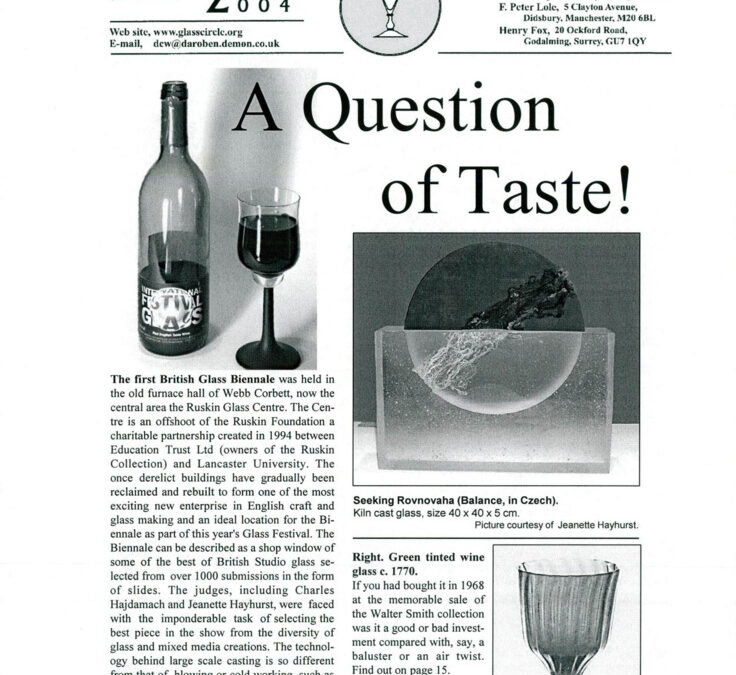
her massive
Seeking Rovnovaha
(above right),
generally acknowledged as a worthy winner.
More details on page 3.
Seeking Rovnovaha (Balance, in Czech).
Kiln cast glass, size 40 x 40 x 5 cm.
Picture courtesy of Jeanette Hayhurst.
Right. Green tinted wine
glass c. 1770.
If you had bought it in 1968
at the memorable sale of
the Walter Smith collection
was it a good or bad invest-
ment compared with, say, a
baluster or an air twist.
Find out on page 15.
Plus:- the history of M’dina
glass, page 4.
Belfast decanters, page 6.
Who did make the Lynn
glasses, page 13.
Thoughts about ‘wafers’.
page 14.
. . . and much more.
GLASS CIRCLE NEWS No. 101, 2004
•
I
The Glass Circle Committee wishes Kt° be made clear that the views expressed in this newsletter are notthose ofthe Circle. I
Editorial
Yep and Nope
T
am pleased to report that
Glass Circle News 100 and its
Supplements have been received by members with gen-
eral approbation. It was certainly a lot of work and my
thanks go to the Committee and authors for their support.
Typographical and spelling errors are an editor’s nightmare
and GCN 100 has not escaped unscathed. How, I ask
myself, did the letters BEM for the British Empire Medal,
awarded to Jack Lloyd, rearrange themselves into MBE in
the Supplement? Incidentally, John Sanders would like to
know what happened to the medal after his death. It would
make a fine addition to the Broadfield House collection.
Also, the mysterious way in which an extra vowel will
creep un-noticed into Wedg(e)wood, passed over by all our
proof readers. I am sure there are others
On a different plane was the observation that princess
Marie-Therese (my article on lead glass) was not born until
1717, three years after the Austrian Habsburgs (also spelt
Hapsburgs) took control of the Austrian Netherlands. Here,
in schoolboy French, I was following the scheme of section
headings used by Raymond Chambon in his
L’Histoire du
Verre en Belge.
Whether the princess actually took control
of the United Provinces in the first half of that century has
so far proved elusive. Her father, the Holy Roman Emperor,
Charles VI, had no male heir so to ensure passing the throne
to his daughter he enacted the
Pragmatic Sanction.
Marie,
possibly determined that her daughters should not be
caught in the same trap, neglected her regal training and
awesomely produced 16 children by 1755, although, unfor-
tunately, her youngest, Marie Antoinette had her head
chopped off. So the United Provinces was most probably
actually ruled by the Emperor’s emissaries. But if any
member can enlighten us further I should be grateful.
Be all that as it may, to Marie-Therese was apparently
attributed the edict that no crystal glass should be made
there in order to promote home exports (i.e.
German/Bohemian chalk glass crystal). However, after
Marie-Therese became Empress of Austria, following the
Emperor’s death in 1740, this ruling was apparently relaxed
allowing Sebastian Zoude to develop the manufacture of
both Bohemian crystal and facon d’Anglais glass in Namur.
Chambon provides evidence for the early restriction in that
over the period the number of glasshouses reduced from
fifteen to ten and those remaining were mainly, if not
exclusively, occupied with the manufacture of window
glass and bottles, plus a little green glass tableware for local
use. At that time, crystal was only made in the region by
Nizet in the independent Bishopric of Liege.
Additionally, it is important to understand that, unlike in
Britain where setting up a glasshouse was an entrepre-
neurial activity by private investors, on the continent, and
in the Low Countries, in particular, both approval (octroi),
and a grant to set up the glasshouse, nearly always had first
to be obtained from the controlling dignitary. Sebastian
Zoude suffered greatly from a lack of grants to facilitate his
production of lead glass but that is another story.
The problem of “Hon.”
Unfortunately, I did not see the Committee’s newsletter
extracts until after they had been printed or I might have
noticed that Simon Cottle referred to me in his introductory
letter as Vice President, omitting the troublesome “Hon.”.
Its significance is that it indicates that this gratefully appre-
ciated honour has no administrative power at all within the
Circle. As it happens it does not matter either way as the
OED describes the role of Vice President as to understudy
and act on behalf of the President who we do not have!
How Robert Charleston became President is something of
an undocumented mystery (see page 17). It appears that he
acquired the title by default after having awarded Hon. Vice
Presidentships to our American colleagues. Before that he
was simply the Chairman appointed by the Committee, as
that situation is with regard to our Chairman today. Robert
was officially made Hon. President upon his retirement to
Whittington about the time the Committee formulated its
new constitution. At the present time Hugh Tait is Hon.
President and a very active one. I was surprised to discover
in the old Minute Books that he joined the Circle in 1956
(see the extracts on page 17) and must now be our longest
serving member as well as being academically by far the
most prestigious. It is surely long overdue that he should
now be offered the full title of President (see, also, page 5
regarding his Fellowship of the Corning Museum).
As a point of further clarification of this confusing issue it
should be mentioned that some of our officers have been
known to define themselves as Hon. (today generally mean-
ing unpaid), a not uncommon appendage that has no special
significance in the constitution for our officers.
According to the OED the use of Hon. goes back to 1726
and
Leges Anglo Saxonicce
by D. Wilkins to indicate the
status of a gentleman. By 1840 it had become associated
with Hon. Sec. (probably male at that time) although with
no indication of status being implied, and in 1906 it is said
to have been used as an abbreviated term of endearment
meaning “honey”! We can all agree with that!
Font upgrade
In response to several requests the general text in GC News
has been upgraded from 9pt. to lOpt. to make it more
readable. Consequently a couple of extra pages have been
added to allow for the extra space used. More unexpected
has been the increased number of word breaks at the ends of
lines. I have tinkered with authors text and the page layout
to minimize this problem and I hope members will not find
the outcome unacceptable.
The tribulations of Henry Fox
Apparently, preparing the catalogue of one’s glass collec-
tion for auction is worse than filling in the annual tax
return, particularly one as extensive and with important
glasses as Henry’s. The additional pressure of trying to
prepare copy for this issue of GC News by mid-November
has meant that, inevitably, his usual contributions have
been put on hold. However, he assures me that he hopes to
be back to normal form in time for GC News 102.
2
LISH VINEYARDS
ZObti
Utxclre
LO
t
C
tYiNE
GLASS CIRCLE NEWS No. 101, 2004
ti
International Festival of Glass
T
he British 1st Glass Biennale formed only part of the International
Festival of Glass which included lectures and other activities centred
round Broadfield House and the now firmly established Red House Cone
Glass Museum (on which more below). However, so far as I could judge, it
was the Biennale that brought the crowd of glass workers and their support-
ers flocking to this event. The private view which concluded with a new
musical creation inspired by glassblowing, and a slide show
was lavishly supported throughout with an excellent Eng-
lish wine from the Halfpenny Green Vinery and fish cana-
pes from Sainsbury. But it was the glass that was the centre
of attention.
The problem for the judges was, I felt, the criteria for
selection. All exhibits were excellent in their own way;
some were achievements of technical skill while others
probed for that elusive Turneresqe originality. Again, there
was the question of whether to submit to the undoubted
ability of our long-established artists or show a conscious
bias in favour of less established students in the field
(although we are told that the original selection from slides
submitted by 225 competitors was blind.)
Iestyn Davies 2-metre tall
Fish Bush Water Feature
(illustrated in the GC News 100 Supplement) was, in my
view, in a class of its own on all counts, as was the 50 x 100
x 5 cm engraving
Streetwise
by Alison Kinnnaird while not
far behind was Bob Crooks metre tall
Vertical vase,
chal-
lenging but not exceeding Tagliapietra’s handling of com-
plex line and colour in blown glass. Peter Layton, Ray
Flavell and Anthony Stern tackled the same problem on a
smaller scale and in their own distinctive ways. Anthony’s
brother, Patrick, for whom I have always had a high regard,
contributed a distinctive 59 x 25 x 11 cm pate-de-verre
column in shades of blue and lilac called
Lenticular Lattice
Wedge.
Furnace-formed inclusions and mosaics gave it a
distinct ancient Gaelic flavour. Original and superbly
executed, it would have certainly been on my short list.
If size was a consideration Yumi Nogaki’s
108 Egos,
con-
sisting of 108 blown white glass bowls laid out on a low
plinth roughly the size of a cricket pitch should have been in
with a shout. Likewise two rooms, each roughly 12 foot
square featured, respectively, motorised madly swinging
lamps –
Swinging Around
by Emma Woffenden – (don’t tell
Dim and Bri!) and a 2-dimensional life-like representation
of a room created on one wall by an overhead projector
image of a miniature 3-dimensional creation of the room in
glass. It doesn’t sound much but it was a clever and impres-
sive use of the medium to achieve the realistic effect.
The Biennale is, of course, a selling exhibition and most of
the items were priced, a few having already been sold. A
25x32cm, 112-page hard-bound catalogue illustrating in
colour the works of the 80 artists with their portraits and
short biographies was available for £18. It was
said to be a short run publication and sold
well so whether there are still copies avail-
able from Broadfield House I do not
know. Interestingly, the lady artists out-
numbered the men by 41 to 29 in this
once male-dominated activity.
The organising curator, another female
glass artist, Candice-Elena Evans can be
well satisfied with this initial enterprise that
looks set for a flourishing future.
Above.
Logo of the Interna-
tional Festival of Glass 2004.
There was also a much appre-
ciated Festival Brew of beer.
Left.
Booklet with details of
eight vineyards in the Heart of
England. Just the job if you
fancy a vinous holiday tour
without the hassle of crossing
the channel or battling with
Euros. Available free from:
Heart of England, PO Box 1,
Much Wenlock, TF13 6WH or
Tel. 01746 785185.
Red House Glass Cone
Museum.
This is now a fully functional
and impressive outpost of
Broadfield House. Without ac-
tually submitting you to the heat of the furnace or wreaths
of smoke it gives you a fair idea of what it was actually like
to work in the claustrophobic environment of a glass cone.
The modest entry fee (free to Friends of Broadfield House)
includes an audio guide to explain each section either
briefly or in detail according to how long you wish to spend
there. Working studio glassmakers operate in the cone
itself. Glass from the original Stuart’s museum is also well
displayed. There is reasonable access for wheel chairs in-
cluding a lift to carry them up the inside of the furnace. In
addition to a Refreshment Room there is also the Stuart
Crystal shop packed with interest and temptation. Don’t
miss it! Adequate parking on both sides of the road.
Royal Brierley Crystal
Although traditional glassblowing in the Stourbridge square
mile is reduced to the one factory of Tudor Crystal operat-
ing in the Dial Glasshouse, Royal Brierley has now re-
established itself not far away next to the Black Country
Museum in Dudley. It has a large showroom with bargains
galore, a tea area and a museum of, mostly, its special
commemorative glassware and some early glassworking
machinery, as well as the opportunity to view commercial
glassmaking. Both factories are well worth a visit. To show
that glassmaking is not entirely lost from the area Dudley
Council has produced a single sheet
Glass Direc-
tory
listing over 65 designers, makers and re-
tailers, although it does stray as far as the
Royal Doulton factory in Tutbury. Copies
of this free touring guide are available
from Broadfield House Glass Museum.
Left.
Twist by Mark Bickers.
Turquoise bowl. A combination of originality,
elegance and traditional cutting followed by
reheating and reshaping. Size 17 x 33 x 33cm.
GLASS CIRCLE NEWS No. 101, 2004
M’dina Glass History and the Origin of
GOZ
Isle of Wight Glass
Report based on an interview with Mrs Elizabeth Harris,
Director of Isle of Wight Glass by Michael Thomas Vaughan
MALTA
“My husband Michael Harris had been a tutor at the Royal
College of Art, teaching industrial glass, for six years when
he decided to start up in business on his own. This all
happened during the time of the studio glass movement.
The company M’dina Glass Limited was founded in Malta
in 1968 and run by Michael Harris and Eric Dobson, his
partner until 1971/2 when Michael sold his shares. Today it
is still operating and is a thriving tourist attraction. We
chose Malta for various reasons. The Maltese government
was keen to encourage small industries on the island. They
offered various incentives; premises, help with establishing
a foothold and last but not least a ten-year tax holiday. The
reality however was quite different.
Shama
MALTA
]r Valletta
•
M’dina
St. Thomas’Op
Tower
husband and I designed the colours and shapes. We did not
have any trade brochures during my time. Most of the glass
we made included a label depicting St Thomas’s Tower and
the Maltese Cross. As the business grew, more skill was
needed so we employed two Italians — Vincente Boffo and
his son Etore Boffo whom we had poached from Whitefri-
ars (a glassworks in Middlesex, closed in 1980 ending 300
years of glassmaking).
When Dom Mintoff became Labour Prime Minister in 1971
he began a policy to expel certain foreign nationals and to
negotiate the closure and removal of British and other
foreign military bases. The Maltese government, in con-
junction with various countries, developed in many direc-
tions, one being with the Chinese to build a glass factory
(which no longer exists) because they saw how successful
M’dina was. Paperweights and other glass
objects of dubious quality for the tourist
trade were manufactured. The situation was
very uncertain as to how much longer we
would be able to remain in Malta. Many ex-
patriots had already been expelled. In 1971,
Michael and I finally decided to sell the
business and return to the UK. One of those
who purchased shares and became a new
Gozo Glass, Fruit and Vegetable Collection.
For other items in their catalogue see www. gozoglass. com
(the capital city of Malta during the Medieval period)
proved ideal with plenty of space and no inhabitants to
worry about. So the decision was made to move all the
equipment to the airfield. (The air base was famous as the
Second World War home of the three aeroplanes ‘Faith’,
`Hope’ and ‘Charity’, which defended the island during the
threat of the German invasion).
At the time that the furnace was first fired, weeks later, we
heard that the fuel permit for the previous site had been
turned down — so moving had been a good decision and
third time lucky. Lucky or not, money and enthusiasm were
getting very thin. Samples had been made in the UK ready
for a training programme. The sun shone, as it mostly does
in Malta, and we soldiered on. We employed several young
boys to train, some from the fields; Michael was deter-
mined to achieve what he set out to do and the outcome was
instant success. The boys with no skills became pioneers of
Malta’s glass industry with many splinter groups. The
colours of our glass were indicative of the Maltese country-
side and of the sea and sky of the Mediterranean. My
In 1969 Michael Harris arrived in Malta with his family
and tonnes of equipment with the blessing of the then
Nationalist Government of Malta. 13
th
century St. Tho-
mas’s Tower, in the south of the island, had also been
promised as premises; hence the logo, also used for labels
later on. The tower being of historical value, they decided it
wasn’t going to be a glass studio but did not say so until six
months later. At this time the commissioner of land said
there were no other suitable premises availab e for us. After
considerable time spent searching for alter-
natives, a disused cinema was found, a long
lease was paid for and everything made
ready, furnaces built etc. Only the fuel
tanks needed to be installed and a permit
required to supply fuel. A petition had to be
raised with local people – all agreed but one,
so no fuel tanks. Rather than wait any
longer to begin manufacturing, as money
was running out by now, we went on to
owner was a former employee, Mr Joe Said.
consider the airfield at Ta Qali. The Air M’dina glass vase in shades of Mr Boffo remained working at M’dina until
Ministry had only just handed it back to the blue, green and reddish brown, Mr Mintoff came to power, when he was
Maltese government and it was somewhat designed by Michael Harris. given an ultimatum — either work under the
derelict. Ta Qali, in the fields below M’dina Early 1970s. Ht. 7.5 cm.
Chinese or leave the island. He decided to
stay but unfortunately, and all to soon, his son Etore devel-
oped leukaemia and died a year later. His father was heart-
broken. 1971 saw us settled on the Isle of Wight on our
return to Britain. The island has many similarities to Malta
— sea and sky etc. So began Isle of Wight Glass founded in
1972 — now over 30 years old. >>
4
O
Glass Circle Matters
From your Chairman
The Circle continues to flourish with trips abroad. In early
October 14 members travelled on Eurostar to Brussels to
see and study the glass in the
Musees royaux d’Art et
d’Histoire.
This museum is on the outskirts of Brussels and
not much visited by foreigners. After a good lunch Madame
Lefrancq, the curator, showed us their extremely extensive
glass collection. We then went by coach to the home of a
local collector, M. Malfaison, who had helped organise the
visit, where we admired his collection and were generously
entertained by his wife. We thank them all for their gener-
ous hospitality
The Autumn is now nearly over and it is time to think of
2005. As you already know, we plan a trip to Dusseldorf
and Cologne in February to visit the Dominic Beimann
exhibition. The next Journal, number 10, is well under way
and should be published later in the year.
Also, as a new venture, we will be holding a seminar with a
series of lectures on May 8t
h
at the National Motor Heritage
Museum near Bicester to coincide with the Glass Fair. This
will provide an opportunity to attend both for members
who cannot easily get to a midweek meeting in central
London, and also to recruit new members. Details will be
circulated with the next Newsletter, but make a note of the
date in your dairy.
John Smith
New Members
Mrs. S. Avery
Mr. J. Bate
Ms. S. Dallman
Mr. S. Dear
Mr. J.H. Phillips
Mr. G. Ronald
Mr. R.K. Stephenson
Ms. Dena K. Tashis (America)
Mr. R. Taylor
GLASS CIRCLE NEWS No. 101, 2004
New President of the Fellows of The
Corning Museum of Glass a Circle
Member.
Dena K. Tarshis, one of
our latest group of new
members, has been
elected President of the
Fellows of The Corning
Museum of Glass. Her
tthree-year term began
this October. She re-
places another Circle
member, Dorothy-Lee
Jones, who has served in
this office since 1992.
Dena, an independent art
historian, author, lec-
turer and curator, has
been a Fellow of the Museum since 1991. She is already
active in a number of glass groups including The Paper-
weight Collectors Association. She is co-president of The
Westchester Glass Club, and former vice-president of the
New York-New Jersey Paperweight Collectors Association.
Tarshis is also a member of the Ennion Society of The
Corning Museum of Glass, a group of high-level donors
who support the Museum.
In addition to having published numerous articles, including
in the prestigious Journal of Glass Studies, Tarshis wrote
the preface to
The Jokelson Collection of Antique Cameo
Incrustations,
by Paul H. Dunlop.
She has also curated several glass exhibitions, including
Baccarat: Paperweights and Related Glass 0820-1860),
for Baccarat New York, and
Objects of Fantasy: Glass
Inclusions of the Nineteenth Century, at
The Corning
Museum of Glass.
The Fellows of The Corning Museum of Glass number
among the world’s leading glass collectors, scholars, glass-
makers and dealers. The 47 Fellows, who also include our
Hon. President, Hugh Tait and Chairman, John Smith, help
to disseminate knowledge about the history and art of glass-
making and support the acquisition program of the Corning
Museum’s Rakow Research Library. Admission to the
fellowship is intended to recognize accomplishment in the
field, and is by invitation only. *
>> Other Maltese glass companies include:
Malta Decorative Glass Co.
The glass factory only proved
to be a show place. Mr Boffo was seconded to work there
and train boys or leave Malta and he worked for the govern-
ment for as long as it survived. It was the end of his glass-
making days — very sad.
Mafia Glass.
A second unit of glass making on Ta Qali run
by a brother of Joe Said, the new owner of M’dina.
Phoenicia Glass.
Owned and run by ex-M’dina workers
since Joe Said took over M’dina. This unit is at present on
Manoel Island in Sliema, Malta’s leading resort.
Gozo Glass.
In 1990 Michael and I started Gozo Glass as a
retirement interest for Michael, who by this time was not
enjoying very good health. Gozo, a sister island to Malta,
needed some attractions for the, by now, large tourist trade.
Sadly Michael died in 1994 and my sons and I have put all
our resources into Isle of Wight glass since then. Gozo glass
is owned and run by Mr R. Brook, who was Michael’s
partner during its development. Gozo Glass is probably the
most progressive of Malta’s glass industries and continues
to prosper.”
Acknowledgements
My sincere thanks to the following: Mrs Elizabeth Harris, Director
of Isle of Wight Glass and a “busy mother and grandmother” for
her help and encouragement in my endeavours to record art glass
history. Her (and I quote from her own note) “rather rushed efforts
at outlining M’dina Glass” during hectic preparations for Christ-
mas of 1997 are greatly appreciated. Also many thanks are ex-
tended to Jonathan Harris Director of Isle of Wight Glass and last
but not least John Smith (not the Circle Chairman) of Broadfield
House Glass Museum, Kingswinford.
This article is dedicated to Eleanor Moorhouse.
5
Marked Irish Glass Part 2. Edwards, Belfast
by Martin Mortimer M.B.E.
Figs. 1(left) and 2.
Above. Detail of a
rose from the de-
canter on the right,
Fig. 2, as described
in the text.
GLASS CIRCLE NEWS No. 101, 2004
I
n Part 1, I briefly alluded to the Irish merchants that had
marked glass made to order and then considered the two
Cork glasshouses of the Cork and Waterloo Glass Compa-
nies. I now come to Benjamin Edwards’ enterprise at
Belfast and begin with marked examples (Fig. 1). Taking
these one by one, the decanter on the left has grooved and
crimped neck rings and is engraved with thistles. The next
has triple neck rings but only two of them. The body is cut
with two opposing bands of arrowheads. The third is a taper
with two rings of triangular section. If its form were not
enough to date it, it is engraved with festoons of tulip
ornament, a common motif popular in the 1780s and ’90’s.
Lastly, an example with rather casual grooved and crimped
rings engraved again with thistles within festoons and rib-
bon ties. Fig. 2. shows unmarked decanters surely attribut-
able on the grounds of their engraver. All have thistles
prominently displayed. While the central decanter has Ma-
sonic emblems on the reverse, the others have roses and
shamrock. These Union motifs, recording the Act of Union
of 1800, that brought about the United Kingdom, date these
decanters with a degree of precision. Note that they also
illustrate and confirm the form of decanter favoured at the
turn of the century. The hand of the engraver is epitomised
not only in his portrayal of thistles, but in the rose whose
dark centre is indicated by an area left un-worked (Fig. 2,
detail), and by his depiction of shamrock as flat discs. This
engraver was titled by the late John Bailey as “No 1” of two
identifiable Belfast engravers. I have not so far been able
to interpret work attributable to an identifiable No. 2 with
certainty. However, No l’s work is readily recognised and
its occurrance on a decanter makes an attribution to a
Belfast factory pretty secure.
But what is the
significance of all those thistles? As the
nearest port to Scotland, perhaps Belfast will have provided
glass to match. Certainly, there are more thistles alone than
groups of all three Union motifs together in the output of
Engraver No. 1. This point brings me to the series of
decanters engraved with ships (Fig. 3), all by the hand of
one engraver but not engraver No. 1. The layout of the
vessels follows a set format and all sit on a rippling sea
represented by a row of short diagonal gashes. Fig. 4
shows another example. The one on the right, also shown in
Fig. 1 (right), is marked Edwards. It is here for comparison
with that in Fig. 3 which has very similar ribbon ties.
The ship-engraved decanters are not by engraver No. 1, but
this artist clearly also engraved the most common layout of
the
Land-We-Live-In
decanters. (The toast was favoured by
Irish who had emigrated to America). Fig. 5 illustrates
three of this extensive series. They turn up as frequently as
the ‘Ships’ and share many features of decoration; particu-
larly on the reverse side where elaborate panels for initials
are flanked by sprays of rose in bud and thistle; very
seldom is a shamrock included. The presence of these
motifs of Union perhaps provides a date of approximately
1800-1805. Are these two series the work of Engraver 2? A
shamrock, when it occurs, (and it appears more frequently
on the LWLI decanters than on the Ships) is engraved with
veins, unlike those of Engraver 1. There is much use of a
formalised leaf in the shape of a blunted trident (which I
call triffids). In pursuit of my feeling that these two series
might be Belfast, I explored, with the help of Kim
Mawhinny of the Ulster Museum and Andrew White at
Lancaster, the meaning of the
inscription DALLAM TOWER,
engraved on the example in Fig.
6; I had hoped it might have
been the name of a ship’s cap-
tain trading out of Belfast. The
answers were as strange and in-
conclusive as the rest of my ma-
terial in this article. Kim told me
it is the name of an estate in
Cumberland. Dr. White con-
firmed this and told me that the
owners of that estate, the Wil-
son family, had gone into ship-
Figs. 3 (left) and 4.
6
7
Left. Figs. 6 and 7. Above. Figs. 11, 12, and 13.
GLASS CIRCLE NEWS No. 101, 2004
14
Left and above,
Fig. 5 with detail of
the engraving on the
left-hand decanter.
-vsk
Right. Figs. 8, 9 and
•
_
below, 10.
ping and named one of their vessels DALLAM TOWER.
But this ship was launched in 1866!
So it is not yet clear whether or not we can attribute the
Ships and LWLI decanters to Belfast. An LWLI decanter
engraved by No. 1 exists, with his typical flowers, but the
arch containing the toast is different. In 1978, the late
Catriona MacLeod was sure the common LWLI decanters
were from Cork. She based her assertion on a marked
example, which appeared at auction many years ago. But,
alas, she had only seen a photograph and it was a reproduc-
tion. Peter Francis, too, believes these decanters to be Cork.
Yet most have panels for initials, a feature rarely seen at
Cork.
The common layout of the Land-We-Live-In decanters
carries the toast on an arch above the initials panel and the
arch is bordered by what Catriona MacLeod termed “inter-
linked linear loops” (see Fig. 5,detail). We saw just this
feature on the commonest pattern of festoons used by the
Waterloo Company, Cork! But, before we all go mad, I
don’t have confidence that there is any connection. The
whole aspect of these three is less sure and capable than
most of the Waterloo decanters; there is a casual approach
to their manufacture, which is not seen at Cork. Fig. 7
shows one of a pair of decanters that we might identify by
recalling points made previously. The initials panel, though
oblong, are bordered by zig-zags as seen on several ship-
engraved decanters (Fig. 8). The initials are feathered and
embellished with stars like those on the central Land-We-
Live-In decanter. In both cases they
are flanked by “feathers” (Fig. 9).
In the hope of clarifying the attribu-
tion of these Ships and LWLI decant-
ers we should now consider those
marked Mary Carter. Those I know
are:
1.
The LWLI, which was sold in John
Bailey’s sale. It has the commonest
layout, the arch with linear loops,
shamrocks with veins, triffids, etc.,
and is flanked by rosebud and thistle
(Fig. 10). Is it, perhaps, by Engraver 2?
2.
In the Ulster Museum are two engraved Ships by the
same engraver (Fig. 11).
3.
One engraved Ship by the same engraver (Fig. 12).
4.
One with unusual LWLI arch engraved by No. 1 with
plain shamrock, etc (Fig. 13).
Only No. 4 can securely be attributed to Edwards, Belfast
on account of No. l’s method of engraving which appears
on marked examples.
However, it is my contention (at present) that the Mary
Carter mark, present on all of these, strongly suggests that
Engraver 2 also belongs to Belfast and that Edwards made
all the decanters marked Mary Carter. If he did, he also
made all the Ships and most of the LWLI examples.
In Part 1 of this article, I mentioned other Irish retailers who
had their products marked. Fig. 14, marked “Armstrong,
Ormonde Quay” indicates how little resemblance to the
GLASS CIRCLE NEWS No.
101, 2004
rather sketchy LWLI and Ships decanters these have. That
in Fig.15 (left) is marked “Francis Collins” and the little
decanter on the right is marked Penrose Waterford.
There is much left unsaid; I think there always will be. The
products were cheap, records sparse. I’ve not touched on
the researches, started many years ago by Mary Boydell,
into the number and extent of the flutes on the moulded
bases both vertical and radial and, for obvious reasons,
I’ve kept well away from stoppers. There is also the study
of neck rings to be considered, particularly rationalisation
of the number of indentations made by the tools used for
crimping. I have mentioned the work shared by Peter Fran-
cis and the late John Bailey in their study of the moulds
used at Belfast and elsewhere. Peter is convinced that the
ship-engraved series were made at Cork, the common
LWLI group also, since they share an engraver. He bases
his conviction on an example marked Cork Glass Co for-
merly the property of John Bailey. But this example has
gone to earth. Until I can see it, I shall remain in the North.
Figs. 14 and 15. All pictures in this and Part 1 of this article
are the copyright of Delosmosne & Sons. Ltd.
But perhaps it can be seen what a maze is the subject of
Irish marked decanters and how wise one should be to keep
a tight rein on dogmatism. *
FROM THE ARCHIVES
Nailsea Glassworks:- Coathupe’s Work’s Notebook
Part 2. The Workers’ Wages
Information kindly provided by Andrew Smith
In 1836/7 Charles Thornton Coathupe, the manager at Nailsea kept a pocket book in which he jotted various notes on
production etc. The information presented verbatim here by Andrew Smith is taken from a transcript of the notebook that
may contain errors as it cannot be checked against the original, which is too fragile. The numbers in bold at the head of each
section refer to the page numbers of the original notebook.
114
116
Epitome of Wages.
Glass Makers per Journey £7.. 8..9
(vide P.39)
do
do per Over journey. 5..10..0
Founders Crew per week £10.. 0..0
including allowance and Coal Wheeling. &c.
Cutters, Packers, &c. £12.10.0 to 13.10.
Halliers & Dilly men. £5. to 6.
Crate makers, £3. to 4.
Pot making & Clay department £5. to 5.5.0.
House and Coal allowances 5.9.9 per week.
The Rent and Coal allowances
to those who receive 8 loads of
Brush Coal per an.. & £5 rent,
amount to £0..3. .2 per week. •
Total allowance in Coal and House
rent, to all who receive them
is
It is now £286..5..0 per an.
or £5.10..0. per week in
consequence of the Founders.
(for the year) 1837
115
Alkali workers per week. £3.6.8
Metal mixing, &c.
9.7.0
Glass Pickers
2.8.0
Smiths
£3 8..0
Carpenters
2..0..0
Masons
4..0..0
Pensioners £1..7..6
variable
Yardsmen 7..0..0 variable
Standing exps. in Wages and
allowances £138 to £158 per wk
117
Wages @ Nailsea
Managers, £200 ea. per an.
Clerk. £100 + (C. + H.) = £120.
Pot Maker
35/-.
H. &
Coal.
Furnace Mason 28/- H. & C.
Other do
21/-
Carpenter….
20/-
Smith’s Headman 28/-
2nd. do 21/-
8
GLASS CIRCLE NEWS No. 101, 2004
118
119
Assistant 12/-
Lad-
7/-
Crate makers 1/- per pair.
Glass Makers Wages.
Edwd. Phillips
£3..17..0
John Brooks.
2.. 5..0
Thos Smart
2.. 5..0
2 Flashers @ 30/-
3.. 0..0
2 Pliers @ 30/-
3.. 0..0
2 Assistants @ 20/-
2.. 0..0
2 Carriers Off @ 21/-
2.. 2..0
8 Blowers @ 30/-
12..
0..0
1
do. practising 25/-
1.. 5..0
8 Gatherer s @ 25/-
10..
0..0
1 spare Gatherer @ 25/-
1.. 5..0
2 Skimmers @ 25/-
2..10..0
121
Metal Mixers.
Edwd. Gainer. 2/3rds.
£1.. 0..0
Jas. Connelly
1..10..0
Assistant mixer
0..12..0
2 Pan men @ 14/-
1.. 8..0
2 Caulker men @ 18/-
1..16..0
2 Mill men @ 12/-
1.. 4..0
2 Horses @ 18/-
1..16..0
24 Quarters of Coal @ 1/4. 1..12..0
Hauling do
O.. 2..8
Total Wages.
£11..0..8
for 72 Batches of Mixture.
= about 4800 Tables; or
8 double journeys.
122
[No entry on this page]
Edito
rial Notes
1. Pages
114 to 116 appear to be a general summary or
estimate of the weekly wage cost of running the factory.
This tallies fairly well with the actual costs listed on pages
117 to 121 although page 121 includes costs that have not
been estimated for.
for 4 “double journeys”
2. 1″ time Gatherers @9/-
£0..18..0
1 Ponty sticker @ 12/-
0..12..0
1 do
do @ 9/-
0.. 9..0
2 do
do @ 7/-
0..14..0
2 spare boys @7/-
0..14..0
2 Marver cleaners @ 5/-
0..10..0
7 other boys @ 4/-
1.. 8..0
1 Spare man (N.S.) @10/-
0..10..0
2 Blowers behind @ 20/-
2.. 0..0
2 Flashing Pe. Keep’ @18/- 1.. 16..0
1 Crambo Keep’ (N.S.) @15/- 0..15..0
Total
£55..15..0
Besides Coal allowances &c.
(in FebY. 1836.)
120
Founders
Crew
Founder-
2 Teazers @ 23/-
2 2nd do @ 18/-
2 Spare men @ 15/.
Gave man
Coal wheeler-
Average Pot money-
Sweeping Furnace
Wheeling Ashes off
Usual drink allowance
Extra allowance-
Total-
N.B. In case you have forgotten,
in old £..s..d. money
12d. = 1s. and 20s. = £1.
2.
The total of £55..15..0 is the sum of pages 118
and 119.
3.
Pages 114 and 121. Since this is a non-lead factory for
making window glass by the spun method (see Part 1) the
alkali mixers would be involved in purify and evaporating
crude sodium sulphate, probably from a soap factory. It is
not clear whether quicklime (CaO) would be used neat or
slaked and left as heaps in the air to form the carbonate.
It is usefully stated that 72 batches of mixture are required
for about a week’s work and yield about 4800 tables. If a
table typically weighs 2
1
/2 lb this would involve shifting
around 5 – 6 tons of batch/week. The purifiers and mixers
would be kept very busy.
Although Pot makers are mentioned in the summary I can-
not identify them in the wages list. Pot money (p.120) refers
presumably to a separate beer allowance for coal wheelers.
4.
Pages 118 and 119 suggest that the Glassmakers prepared
the slightly inflated paraison; this was reheated and ex-
panded by the Blowers. The Glassmaker would be involved
again in attaching the pontil, tipped with glass and offered
up by the Ponty sticker, and tidy up the opening left by the
broken-off blowing iron. The Flasher would then spin the
globe to form the final table, taken to the leer by the Carriers
off. Juniors would be involved in collecting and cleaning
the blowing irons and pontils and placing them to warm at
the furnace ready for reuse, among other minor duties such
as, possibly, picking over the cullett since a Glass picker
(p.115) is not specifically mentioned..
The Crambo keeper, if the table is in logical sequence,
would attend the leer or, alternatively (see the O.E.D.),
provide the supply of beer to the workers, an important duty
that might be performed by a disabled worker or a pen-
sioner. Care of the leer might also be the role of the Pliers
for
whom I can suggest no other activity. *
£1..10..0
2.. 6..0
1..16..0
1..10..0
0..16..0
0..15..0
0..12..0
0.. 1..0
0.. 7..0
0.. 5..4
0.. 1..4
£9..19..8
9
his interests with a fascinating series of
pictures, portraying the Wolryche Hunt, his
gamekeeper, and of especial interest to us
are portraits of two of his servants, each
with a large Constable Glass filled with
ale, or possibly brandy. Both portraits are
by a local artist, George Alsop, one being
dated 1719 and whilst the other is undated,
it must be of similar date. A Silesian
stemmed Constable Glass survives in the
house, and is apparently the very Glass
standing beside the young boy servant por-
trayed in the 1719 painting; the other paint-
ng shews a much older man, holding a
plain stemmed drawn-trumpet Glass of
similar size, and this is the portrait illus-
trated in
GC.98.
Frequently, acknowledgements for help re-
ceived are somewhat trite; but in this in-
stance, the assistance of the deputy curator
from the Regional Office of the
National
Trust
and the house staff, demands thanks
far beyond those normally offered. This is
Eight-faced Silesian stemmed goblet,
because the Glass
in question had,
many
from Dudmaston House (N.T.), depicted
in the portrait of The Wolryche Pot-B
oy.
years
ago, been placed in a special display
11W high. (Photo FPL)
cabinet fixed to the wall of
the entrance hall
GLASS CIRCLE NEWS No. 101, 2004
Limpid Reflections
by A Peter tole
rr he Glacial wanderings that inspire
1 these reflections were centred on that
rich swathe of pastureland that runs
north-westwards from the Black Country
to the Mersey valley. Two counties con-
tain it, Shropshire and Cheshire, and it is
countryside where hunting has always
been, and still remains, an important part
of life; in the C.18
th
there were no great
towns and even the largest, Shrewsbury,
had strong hunting links that produced
celebratory Glass. Indeed, one could
maunder on for pages about the part
hunting has played in inspiring pictorial
art, furniture and the applied arts, and
Glass itself can offer many examples.
In
GC.98, Limpid Reflections
considered
the fine
‘Below Stairs’
exhibition at
The
National Portrait Gallery,
illustrating the
c.1720 portrait from Dudmaston of the
Wolryche Fool. He was shown holding a
large Constable Glass. One said at that
time that the story was incomplete and a
visit to Dudmaston might well yield more
information; and so it proved. Dudmas-
ton, now a property of the
National Trust,
was built around 1700 by Sir Thomas Wolryche, the 3r
d
Bt.
However, his early death in 1701 left an only son and heir,
the ten year old John Wolryche. On coming of age in 1712,
Sir John devoted his life to sport and gambling, which
culminated eleven years later, in 1723, when he was
drowned in the River Severn whilst fording it after a day’s
racing. Dissipated though he may have been, he celebrated
at Dudmaston, some nine or ten feet above
floor level, between the two pictures in which it had been
thought to appear; I was truly grateful that assistance was
available for the delicate task of removing and replacing it.
Whilst the aim of this unusual mode of display is to relate
the Glass to the portraits, my observation of the public’s
viewing of the hall displays suggested that its height meant
Dragon Creator
Extraordinary
F
ascination with this mythical creature never seems to go
away and its artistry in glass has never been greater
than in the beast pictured here. It was one of the lesser
known features of the Stourbridge Glass Festival where, in
the factory shop of Plowden and Thompson, one encoun-
tered a ‘herd’ of these aggressive animals all shapes, sizes
and colours. Normally of solitary disposition, they are the
creations of a retired postman, Bob Martin. This dragon is
one of his largest to date, about 9 inches tall, and crafted in
a golden amber glass with extraordinary attention to detail
that one might well believe was taken from the real beast.
They are actually constructed as a series of sections that are
stored hot in a kiln and then assembled at the lamp to create
the final product. Representing hours of work, this speci-
men cost a modest £55 as may be seen from the label left
attached as an indication of its size.
Bob, age 64, did a 5-year glass-blowing apprenticeship
after leaving school beginning with the simpler life forms
such as pigs and swans. The firm closed down and he
became a postman for 13 years before returning to the
lamp. Dragons probably became prolific in the area be-
cause of the coal measures required to stoke their flame, but
many are now to be found in other parts of the country,
including, as you might expect, Aberystwyth in Wales. *
10
Dim
ant 13ri
I say Bri, that lady up the
ladder is cutting that tree
a very funny shape. But it
does look familiar some-
how.
Yes, I think its what
often tends to happen
when an obsessive
gardener gets a
taste for collecting
Wedgwood glass.
GLASS CIRCLE NEWS No. 101, 2004
that most did not notice it; furthermore, to discern any
detail was virtually impossible. However, after it had been
safely placed on the massive oak refectory table in the hall,
one was able to study it properly. It is an 111/4″ high lead
Glass, having a round funnel bowl with a solid base
mounted onto a cushion knop, above an eight-faced Sile-
sian stem with very crisply moulded stars on the shoulders;
the foot is unusually widely folded, with the welt being
about an inch wide. One of my aims was to try to estimate
its original cost, working from the range of prices per lb
given in Glass Seller’s bills; this Glass weighs 2 lbs 2’/4 oz,
and as it is a highly wrought Glass that required an expen-
sive mould for the stem, and particularly careful annealing,
it was probably priced at the top of cost by weight range;
one suggests an original price for the Glass of 4 — 5
shillings, probably more than the weekly wage of either of
the servants depicted with these Constable Glasses, and 8
or 10 times the price for a ‘standard’ Wine Glass. Calcu-
lated from the dimensions of the bowl, the capacity is a
little over 11/2 imperial pints, rather smaller than either the
Naworth Castle Glasses that James Boswell stated held
above a quart, or the nine surviving Constable Glasses at
Levens Hall. It seems unlikely that Sir John Wolryche
would have encouraged his servants to drink from such an
expensive Glass, so probably one should indeed interpret
the pictures as displaying ‘Welcome Glasses’, either for an
individual guest, or as a loving cup for a whole group,
perhaps at the meet of the Wolryche hunt. In the latter case
possibly the drink would have been Brandy, whilst for an
individual welcome it would more likely have been Ale; the
colour of the drink in both pictures could be interpreted as
either beverage. The fact that both servants are depicted
smoking a clay-pipe perhaps suggests a contemplative wait
to proffer the Glass to an individual visitor, rather than the
hectic activity of serving a hunt meet.
One’s concluding reflection is on a distinguished group of
C.18
th
classic Drinking Glasses in a collection that recently
I was kindly allowed to inspect. Whilst Dudmaston is in
Shropshire, this group is further north, in Cheshire; the
hunting connection continues through membership of
The
Tarporley Hunt Club,
whose Glass was considered and
illustrated in our last
Journal
(No.9).
The collection com-
prises some fifty or so Glasses, some assembled during the
past decade, but a core consists of family Glass that has
come down through the distaff forbears of the present
owner. At first sight a small group of cordials seemed
familiar, and there are indeed three Cordial Glasses that
feature in Delomosne’s
“Strength and Chearfulness”
sell-
ing exhibition of John Towse’s Cordial Glasses, including
one of the enigmatic ‘deceptive’ Cordials, whose already
small bowl is so attenuated as to be, in the words of
Delomosne’s catalogue,
“absurd”.
There is also a soda
Glass Ale Flute, some 6″ high that is engraved with an
encircling floral band round the bowl, and another pleasing
soda Glass is in the collection; in the light of the unexpect-
edly high proportion of soda Glass found in the Traquair
House bills (see
GC.100)
it is interesting to find two good
looking soda Glasses amongst so distinguished a group.
But, to my mind, the palm for the collection has to be
awarded to a set of three high quality Firing Glasses, some
five inches high, that have descended from the owner’s
maternal grandmother rather than being collected. Of dark
metal, having thick, flattish feet and with facet stems that
develop into an elaborate petal top-notch on the lower part
of the quite small bowl, they carry a circlet of beautifully
uniform and well polished small printies around the upper
part of the bowl; they emphasize that high quality firing
Glasses were in domestic use, as well as the more workaday
variety that were so often used in Clubs and Pubs in the
second half of the C.18
th
. They also illustrate an interesting
series of treatments of the punty mark under the foot; one
has the punty largely ground and polished away, although
distinct crevices in the ground out portion remain, suggest-
ing that the punty was originally very rough and corrugated.
Another of the three has had the protruding sharp long
extension ground off, with much of the punty remaining,
whilst the third appears not to have been ground at all. This
variety of treatments seems to indicate a pragmatic, practi-
cal approach to the problem of a protruding punty. Where
the foot is high enough, as with most C.18t
h
drinking Glass,
there is little practical benefit in grinding away the punty;
but with a flatter foot, as with almost all firing feet, there is
a real risk that the punty will protrude far enough either to
scratch the table top, or even to render the Glass unstable,
and for these corrective treatment is essential. The varied
treatment of this set suggests that even where the Glass was
already being subject to grinding it was not axiomatic that
the punty would be ground and polished out, but that each
Glass would be considered on its merits. In my own collec-
tion is a facet stem Glass whose punty has not been
touched, and another that has had merely the rough extrem-
ity ground off; however, two facet stem Glasses that have
some pretension to be by James Giles, and thus of ‘best’
quality, have both had their punties ground and polished.
All four have sufficiently high feet to suggest that grinding
away the punty was cosmetic, rather than a practical need.
Of the firing Glasses that I have, all with fairly flat feet, two
have untouched punties that have been broken off relatively
smoothly, whilst a third, otherwise very much a tavern
Glass, has the punty completely polished out. *
11
GLASS CIRCLE NEWS No. 101, 2004
PAUL HOLLISTER
1918-2004
An appreciation by Derek Ostergard
P
aul Hollister died in Hanover, New Hampshire July 2.
Author, lecturer, and painter, he was one of the world’s
foremost scholars in 17th to 19th century glass studies and
was also deeply involved with contemporary studio art
glass, playing a significant role in shaping the emerging
movement through his erudite writings,
Paul Hollister was one of those remarkable individuals
whose life-long passion for the arts coalesced with his
career with remarkable precision. Paul was able to work
simultaneously as a painter and as an art historian, who was
able to bring the insight and discipline indigenous to each
profession to the other. In the course of a long career, he
was a highly successful painter, who had numerous exhibi-
tions of his work and a historian who wrote over 150
articles and half a dozen books. Apart from the degree of
solitude necessary to work as both a painter and a writer,
Paul was also a gifted public speaker, and a spirited advo-
cate for causes that he deemed important. Further evidence
of his strong artistic sensibility is provided by his Haiku
poetry and the 1947 novel he wrote under the pseudonym,
“Paul” entitled
Fine Tooth Comb
which was published by
Doubleday & Company.
As an author, however, Hollister is best known in the field
of glass studies, beginning in 1965 when he published the
first article of what came to be a bibliography of nearly 200
publications on glass history which addressed a variety of
topics as diverse as Medieval windows, 17th-century glass
table tops and American studio glass of the post-war era.
His earliest publications, however, were the result of his
painstaking research on glass paperweights. Paul would
eventually produce two books and three museum cata-
logues on the topic — one of which was the critically
received
The Encyclopedia of Glass Paperweights,
pub-
lished by Clarkson Potter in 1969. Initially concerned with
19th-century material, Paul made a noteworthy contribu-
tion to contemporary studio glass studies during the 1970s
and 1980s when he wrote critical reviews of significant
studio artists and exhibitions for
The New York Times,
American Craft, Antiques, Neus Glass,
and
The Journal of
Glass Studies.
Colleagues noted that apart from his enormous number of
publications, Paul had a remarkable memory for the arti-
cles of others which he could readily cite in order to help
someone with research, and he was well regarded for pos-
sessing the true “eye” of a connoisseur. A principal founda-
tion of his knowledge was the remarkable library he assem-
bled. Most of the collection became part of the library of
the Bard Graduate Center, but when Joslin Hall sold a
portion of the rare books from the collection, Forrest
Proper, a cataloguer with the bookseller wrote, “I will say it
was probably the finest collection of books on glass in
private hands in this country.”
Hollister was particularly proud of the fact that he testified
before the Landmarks Preservation Commission of New
York on behalf of the unique set of windows by Rene
Lalique that had been installed in 1912 in the Coty Perfume
store on Fifth Avenue. That building, in the process of
being renovated in 1984 and integrated into a much larger
piece of real estate, had been purchased with no guarantee
that the windows would be left
in situ.
Paul argued that the
windows were remarkable documents not only of New
York’s mercantile history, but of international glass history
as well. His impassioned and poetic plea, later published in
The Glass Club Bulletin
(1984), heightened the significance
of these windows in the eyes of preservationists, historians
and ultimately the developers, who took Paul’s advice to
heart. Today, these windows are still amongst the most
important elements of Fifth Avenue.
In the decade before moving to Hanover, New Hampshire
in 1997, Paul enjoyed a particularly fruitful involvement
with graduate studies when he taught the glass survey
course at the Cooper-Hewitt Masters Program for eight
years, and at the Bard Graduate Center for Studies in the
Decorative Arts (1993-1994). His carefully prepared lec-
tures educated a large and enthusiastic generation of emerg-
ing scholars, but his remarkably high standards were also
viewed by many potential students with a certain degree of
wariness. Paul was known for his unyielding position when
it came to writing and editing — skills he had honed as
editor of
The Glass Club Bulletin*
from 1975-1985.One
student who was shocked at the heavily edited paper that
was returned to her with a low grade, remarked, “I have
been writing professionally for ten years and no one has
criticized me before.” to which Hollister replied, “Well, I’m
the one who finally caught up with you.” Another glass
scholar edited by Paul commented years later, “When Paul
finished with my article, I wondered if I had even visited an
English class, let alone taken an English class.” Neverthe-
less, Paul was neither an unfair editor nor a stern academic,
as witnessed by the extraordinary number of students and
colleagues who kept in touch with him after he and his wife
Irene moved to New Hampshire.
Perhaps his most original and creative contribution to glass
studies came near the end of his long career when he began
his examination of the glass depicted in the paintings of
Vermeer. Combining his own intimate understanding of the
painter’s medium with the painstaking research techniques
he had developed as a glass historian, Paul was able to
reveal what scholars had completely ignored in the corpus
of Vermeer scholarship – that the urban scene of late 17
th
–
century Holland was depicted in the delicate reflections on
the glass panes of the open windows frequently used in that
artist’s paintings. Paul’s painstaking consultation of maps,
engravings and the works of other C.17th Dutch painters,
reconstructed the transient and now altered city-scape of
Haarlem that made a major, if subtle, contribution to the
paintings of Vermeer. Paul delivered his findings in Milan
in a lecture in 1995 at the Congres of the l’Association
Internationale pour l’Histoire du Verre (A.I.H.V.) and later
an article entitled,
The Windows in Vetmeer’s Paintings:
Secrets of The Officer and the Laughing Girl.
* Quarterly journal of the National American Glass Club.
12
GLASS CIRCLE NEWS No. 101, 2004
WHO MADE THE
by Dr Timothy Mills
Way
I came across the Museum
ilst idly surfing the net the other
of London’s excellent on-line catalogue
of its glass collection. Much of the glass
is excavated from the greater London area
and includes examples from the Roman
period through to the nineteenth century
I was intrigued to find an illustration of a small tumbler that
had been buried for many years and presumably related to
the eighteenth century occupation of the site.* As can be
seen in the museum record it was excavated from the site of
the Whitefriars glasshouse in Temple Street, London. The
photo appears to represent a mid to late eighteenth century
tumbler with characteristic ‘Lynn’ moulding.
According to most writers such glass emanates from Nor-
folk. Hartshorne originally suggested Kings Lynn as the
source though this has consequently been shown to be
impossible as any flint glasshouses in Kings Lynn were shut
by the second half of the eighteenth century when this
group appears to have been made. Dr David Stuart (1997)
suggests the Yarmouth glasshouse as the most likely source
though he points out that firm evidence for a factory here is
not available after
1758.
As far as I am aware no archaeological evidence exists to
locate Lynn glass in Norfolk. The attribution appears to rely
on the late nineteenth and early twentieth century observa-
tions that such rib moulded glass entered collections from
predominantly Norfolk sources.
David Stuart highlights the evidence for London glass being
sold in Norfolk from the 1770s though not before. He
interprets the appearance of London glass at this date as a
potential marker for the closure of the Yarmouth factory. Is
it possible that Lynn’ moulded glass originated from the
Whitefriars factory and that it was imported into East An-
glia in the 1760s and 70s?
* We are unable to illustrate the actual piece Accsn No: A27765
due to the Museum’s high reproduction charge but apart from
weathering it is not sensibly different from those illustrated above.
Obviously the single find at the Whitefriars site does not
prove that it was responsible for ‘Lynn’ production. After
all there is no firm evidence for London glass in Norfolk in
the 1760’s when this is clearly the date for many of the
opaque twists. Furthermore, we may expect to find Lynn
glass more widely spread geographically if they were being
made in London. However, it is interesting to speculate
why a glass apparently produced in Norfolk should appear
in a London factory when the direction of such trade is
more likely in the opposite direction.
I thought it might be useful to share this observation with
the Circle as I have not come across this example elsewhere
in the literature and it may add to the ongoing discussion
concerning this type of glass.
Editorial Note
By far the best account of this subject was published, in 1995, by
Delomosne’s glass gurus Tim Osborne and Martin Mortimer based
on the fine collection of Lynn glasses in the Derek Wilmot
collection*. Relevant to Dr. Mills’ contribution is the information
that the fum of Jackson & Straw, with a glasshouse in Southwark
and a warehouse in The Strand, also had a factory in Lynn from
where they obtained their sand. The possibility that they might
have made these glasses on either site (or both) is considerable if
one accepts the Lynn attribution. Whitefriars might have acquired
an example or perhaps originated the design themselves.
* The 34 page booklet illustrates, from a diversity of sources, the
extraordinary variety of Lynn glass still existing today. As well as
wine glasses, tumblers, decanters and carafes there are jellies,
bowls both plain and footed, large jugs and cream jugs, salts, water
bowls, wine coolers, spill jars, a monteith and a bucket.
For anyone interested a few copies of this important but little-known
booklet are available from Delomosne, price £15 inc. P+P.
Despite his love of glass, Paul remained committed to
painting, his most personal of pursuits. A prolific painter
with many one-man and group exhibitions over sixty years,
Paul’s paintings can be found in the collections of The
Museum of Fine Arts, Boston and many private collections.
He often cited the watercolors of John Mann and the oils of
Cezanne as early influences on his work, and he developed
his own lyrical approach to the depiction of nature. Once he
moved to Hanover, New Hampshire, Paul established a
studio in the nearby town of Lebanon. His work with oils
and pastels remained one of the great joys of his life and he
never tired of finding new ways to express his creativity.
Paul Holster is fondly remembered by those who knew him
as a fine friend, a consummate scholar and a man of strong
moral and ethical standing who possessed a wry sense of
humour. Paul was born in New York City in 1918 and
attended Milton Academy, before graduating from Harvard,
Class of 1941.
Paul is survived by his wife of 53 years, Irene A. Mclean
Hollister and a sister, Marion Lombardini of Rome. Contri-
butions in Paul Hollister’s memory may be made to the
Paul Hollister Memorial Fund for Lectures on Glass at the
Bard Graduate Center for Studies in the Decorative Arts,
Design and Culture or to the Paul Hollister Memorial Fund
at the AVA Art Center, Lebanon, New Hampshire.
Note
Paul was a keen supporter of the Circle and lectured to it on two
occasions to my memory, once on the 1851 Crystal Palace for
which he had a particular fascination. He notably contributed an
appreciation of Robert Charleston to GC News. I was fortunate to
enjoy a long chat with him on a coach trip at a Seminar of the
American Glass Club. More than most, he appreciated the impor-
tance of attention to detail and communication and education
through writing and was always on the look-out for new angles to
explore in glass, most recently, historical graffiti on glass. With
his passing the world has lost a great and much-loved scholar.
D.C.W.
13
GLASS CIRCLE NEWS No. 101, 2004
WORKING WITH WAFERS
AND
THE ORIGIN OF THE MERESE
by David Watts
T
at American press-moulded glass
i of the 19t
h
century one quickly realises that
a significant part of its diversity and interest
for collectors derives from the way in which it
is made, particularly for the more complex
pieces such as lamps, comports and candle-
sticks. One of the earliest known pieces of
American pressed tableware, the celery (1) was
too difficult to make in one piece and so the
bowl and foot were made as separate sections
and then stuck together. The “glue” for this
purpose was a dab of molten glass known in
America as a “wafer” as can clearly be seen in
picture. There was nothing elaborate about
this, at best, semi-skilled operation as shown–
by the close-up (2). Another example is the comport (3).
These are relatively rare examples but many oil lamps,
vases and candlesticks, particularly those made by the
Sandwich glassworks, occur in large enough numbers for
the mix and match aspect of production to become obvious,
with the rarer combinations being eagerly sought. Fig. 4, in
my collection is a Sandwich reproduction candlestick in
uranium glass made in the traditional way. The fact that the
nozzle is made of shaded glass tells you at once that it is not
an original as do other variations such as size and the shape
of the base. For the uninitiated it has the initials of the
Sandwich Glass Museum helpfully moulded into the base.
Back in England my first instinct was to look for a similar
use of the wafer in English pressed glass. Although I have a
number of what I consider to be early pieces from their lead
Fig. 3. Early American press-moulded comport, the bowl and
stand joined by a wafer.
content and a few that appeared to be made in two sections
(5), I could not with certainty identify the use of the wafer.
Is this because we had better mould makers or had better
pressing machines, or was it deliberate policy on the part of
the American firms. I am inclined to think it was the latter
to cater for their much wider market and provide a choice of
both shape and colour combinations that would not other-
wise be economically possible.
However, the story does not end here, for when one looks at
English 18
th
century hand-made glass, clear examples of the
use of the wafer emerge, although not necessarily to create
diversity. It is particularly obvious on some sweetmeats and
Fig. 1. Left. Early American press-moulded
celery c. 1830.
Fig. 2. Above. Close-up showing the wafer
joining the bowl to the base.
similar vessels.(6) Its use may often be
anticipated by the way in which the bowl
.gaila sits not quite true on the stem. Ordinary
drinking glasses are mostly immune from its use but in the
more complex pieces it seemed clear that a wafer was being
used; but in the hands of the skilled glassmaker, as opposed
to a press-mould operator, it was tooled to a more elegant
shape, what we now call a merese. The merese, one can
conclude, was not included solely as a decorative element
but was a crucial feature in the construction of the glass. In
some examples a tooled merese sits immediately on a
bladed or similar knop, perhaps in order to disguise that it is
often not well executed. It is interesting that among the
balusters and drawn or Silesian stem glasses the lack of a
merese is considered an early
feature and the desire to acquire
an example at auction can lead
to some very competitive bid-
ding. I relate this absence of a
merese to the fact that the bowl
is of a simple blown shape and
that the stem itself, certainly
among the balusters, usually
nothing more than of simple
baluster shape. We have, of
course, the useful precedent of
the sealed Ravenscroft glasses
and the contentious question of
those, unsealed but with a top
merese, of slightly later date
Fig.
4.
Traditionally made
found in Ireland. The introduc
–
Sandwich souvenir dolphin
tion of a complex baluster
stem, candlestick. The wafer is the
perhaps with tears, in a section, dark blob immediately on top
of the animal’s tail.
Fig. 5.
Heavy English
lead glass comport
pressed in two
sections. The col-
lar at the base of
the bowl is part of
the bowl moulding.
The stem, wrythen
after pressing, is
fused directly onto
to its flat surface.
Mid-18th century.
14
Fig. 6. English glasses with wafers
Above. Patch stand with bowl and base joined by wafers shown in
the close-up on the right.
Above. Champagne and sweetmeat, both with the bowl attached by
a wafer.
GLASS CIRCLE NEWS No. 101, 2004
often features a merese or shaped wafer to join the parts
together. Forming the lower part of the stem may well have
been carried out by the footmaker while the gaffer would be
forming the upper section extending from the same gather
used to shape the bowl.
On drawn stems a merese helps disguise what might other-
wise become rather messy attachments of bowl and foot.
This also avoids the potential problem of having to reheat
the stem at the glory hole with consequent loss of the
sharpness of the moulding and a greater expenditure of time
in making each glass.
The introduction of the merese or bladed knop was un-
doubtedly first introduced in continental glasses of the later
17th century and earlier in Venetian forms. In England,
with the development of lead glass, it may have been
quickly adopted to add variety, which it certainly does, or
perhaps in a pathetic attempt to compete with the exquisite
multiple mereses or bladed knops of the continental glasses
(7). In this respect the heavy, slow setting lead glass is
manifestly inferior. On the
other hand the less dense,
quicker setting Bohemian
crystal is clearly ideal for this
type of decoration and the con-
tinental glassmakers rapidly
learnt to exploit it to the full.
In conclusion, an appreciation
of American glassmaking
techniques has made me look
at my own collections of both
press-moulded and blown
glass with fresh eyes and I
hope members will do the
same. I am sure there are as-
pects
F
that I have overlooked
Fig.7. Nuremburg goblet with
and I look forward to receiving
typical multiple bladed knop
s.
Late 17th century.
your own
views and pictures of
examples that can be included in GC News in the future.
INVESTING IN OLD ENGLISH GLASS:
THE HARVEY’S WINE MUSEUM SALE
by Graham Vivian
Lecture held at a meeting of The Glass Circle on Tuesday 19
th
October 2004 at the Art Workers’ Guild by kind invitation of Mr
D. Woolston, Mr R. Hardy, Mr L.A. Trickey and Mr A.W.P. Ross.
I
am told that when Robert Charleston was Chairman of
The Glass Circle, a talk of this nature would never have
been on the agenda. The price paid for a glass was not
discussed and irrelevant to the study and history of the
subject. Times have changed and there is now considerable
interest in the value and performance of alternative invest-
ments, as collectables are sometimes called.
This analysis is based on the resale at Bonhams, in October
2003, the contents of Harveys Wine Museum which in-
cluded 64 glasses purchased at the Walter J. Smith sales at
Sotheby’s, 35 years earlier, in 1967/8. Back in the 1960’s,
Sotheby’s and Christies held between them around ten glass
auctions a year and would have featured a far greater
selection of fine and rare English drinking glasses than
would be found at most auctions today. It was thought that
with so many glasses coming on the market at the Smith
sale, there would be a considerable number of bargains.
But, in fact, high prices were achieved for most glasses.
Walter Smith was an American collector, and many of his
glasses were acquired for him by the firm of Arthur
Churchill. What made the collection especially interesting
was that a large number of the lots came from the pioneer-
ing collections of the great Pre-War collectors including
Berney, Bles, Kirkby Mason and Hamilton Clements. The
range of drinking glasses was exceptional. For example,
there were 8 different types of baluster cylinder knop
glasses illustrated in the catalogues. Just one in an auction
today would be noteworthy.
Slides analysing the prices of the glasses in terms of vessel
type were then discussed. But, explained Graham, if we are
to consider how prices have moved during those years it is
necessary to recall the Economy over that period as this
would affect sale prices in the intervening period:-
1970’s – Oil Crises, a 3-day week, a falling house price
market and the very high inflation that followed.
1980-1982 – Another falling house market, a Stock Market
15
GLASS CIRCLE NEWS No.
101, 2004
boom and then the crash in 1987. After that there was the
House Market boom in 1988 which led to the worst housing
crisis in living memory between 1989 and 1995.
Mid-90’s – A gradual then strong recovery. More recently
there was another fall in the Stock Market which triggered
the crises in pensions. House prices continued to grow in
many areas at a high rate and slowed only recently.
It is important to bear in mind that the cost of living had gone
up about 10.5 times between 1968 and 2003. Thus, if a
collector paid £100 for a glass in 1968, last year he would
have needed to obtain £1050 for it, before selling costs, just
to keep up with inflation. In 1968, Sothebys’ selling costs
for a single item varied between 10% and 12% . There was
no VAT and no Buyer’s Premium. Today, selling costs
including VAT and Buyer’s Premium for a collector, can
vary between 30% and nearly 40% on single items, although
a lower fee may be negotiated for a collection.
If selling costs are assumed at 30% for a private collection
including VAT plus Buyer’s Premium, the collector selling
a glass he had purchased for £100 in 1968 would today need
to obtain £1500 to stay abreast of inflation – an increase of
15 times. In summary, the fact that after a number of years a
glass can be sold for more than it cost does not mean it is a
good investment. To be a good investment, the value of
glass should beat inflation after all the costs of sale are taken
into account.
A growth of 15 times over 35 years, corresponds to a com-
pound interest rate of about 8% pa after tax. This would not
have been possible to achieve using conventional Building
Society investments. Unusually, because at the Bonham’s
sale VAT was charged on both the hammer price and the
Buyer’s Premium, this had the effect of increasing the ham-
mer price by 40.5%. Overseas buyers capable of recovering
the VAT could save about 15% on my figures.
Major limitation of the analysis were 1. the condition of the
glass at resale. 2. Distortion by competitive bidding at each
sale. 3. Small size of the sample of glasses available.
The following conclusions emerged.
Of 20 Smith glasses that achieved the highest prices in 1968
only 5 beat inflation by increasing in value more than 15
times after allowing for the costs of sale. On the other hand,
of the 20 glasses for which the lowest prices were paid in
1968, 13 beat inflation which suggests they performed better
than their more expensive counterparts. The average in-
crease was 16.1 times. This is equivalent to a compound
growth of 8.3 % pa before allowing for selling costs.
Colour twists were the star performers at the auction where
6 out of the 7 sold beat inflation. The highest growth of 46
times, represents a compound growth rate of just over
10.5% pa after selling costs. On the other hand, green tinted
goblets, one of which only increased 3.6 times, were the
least good investment showing a compound growth of about
2.7% pa after selling costs. None of these four green glasses
or four Jacobite glasses beat inflation suggesting a decline
in demand, although, according to Peter Lole, the negative
influence of Peter Francis’ article on the Jacobite glasses
may now be changing.
Of the other groups where a reasonable number of glasses
were sold, 8 out of 13 balusters beat inflation but only 4 out
of 12 Dutch engraved glasses achieved this goal. The overall
PERFORMANCE TABLE. Number of times the value has
increased above the original purchase price.
NB.
Inflation over the
35 year period was approx. 10.5 times.
i.e. c.
7% pa. But, including VAT + 30% buyers premium,
(= 8%
after
tax.) the
increase needed today to match infla-
tion over the period is 15 times.
The average increase in value of the Walter Smith glasses =
16.1 times or approx. 8.3%.
Type
No.
Increase in Value
Highest
Lowest
Average
Colour tw.
7
46.14
14.76
24.08
Beilbys
2
23.85
18.71
21.22
Balusters
13
36.25
8.63
19.91
Airtwists
6
28.75
10.77
14.46
Dutch engr.
12
23.77
6.48
12.63
Jacobites
4
12.11
7.00
9.66
Green glass
4
13.43
3.65
8.09
results are summarised in the above Performance Table.
So how does the average 8.3% pa increase in value before
the deduction of costs, of the Walter Smith glasses compare
with the performance of other collectables in investment
terms? According to a recent article in the Financial Times,
my analysis shows that the compound growth in the value
of antique glass compares moderately well.
Art – 11% pa over the last 25 years.
Coins – 9% -11% pa over the last 50 years.
Stamps – 7% -15% pa over the last 5 years.
Fine Wine – 9% pa over the last 25 years.
First Edn. books – 11-12% pa various times scales.
Since 1952 stocks and shares have shown an average
growth of 11.2% pa and housing 9.2% pa over a similar
period.
What really affects the return from a glass collection and
other similar collectables is the high cost of selling at
auction. This has increased over three-fold since 1968 when
the Walter Smith collection was sold. A dealer would also
normally require at least a 30% margin on an average glass.
(My impression was that dealers simply doubled the ham-
mer price. Ed.)
The low inflationary environment of today suggests that the
returns seen in the last 35 years are unlikely to be replicated
in the next, although the present shortage of fine glass may
counter this to some extent. If a current inflation rate of
2.5% pa is assumed, it would require a compound interest
rate of 2.75% pa after tax in order to get the original invest-
ment back at the end of 10 years after allowing for selling
costs. A return of 6.25% pa after tax is needed just to keep
up with inflation, which, after 10 years, is equivalent to
about 1.8 times the price originally paid. Antique glass, like
other collectables, should therefore be viewed as a long
term investment where, subject to demand, the longer you
hold on to your collection the more it should be worth.
My advice
therefore is to buy the best quality antique glass
that you can afford so that you can enjoy it, not because you
expect to make a killing when you sell.
My thanks to our sponsors and to Susan Newell of Bonhams who arranged
for me to use catalogue photographs of the glasses. To Simon Cottle for
providing early sales results, and to Martin Mortimer for helping to set the
scene in 1968. Finally, to my son Nick who helped with the master
spreadsheet and came to my aid when my computer crashed. *
16
GLASS CIRCLE NEWS No. 101, 2004
r-rom the rir3t Minute 1200il3
No Glass Circle Minute Books seem to have survived from before World War II and the Minutes of Committee meetings
from our earliest records, in two school notebooks, are extremely sketchy and infuriatingly inconclusive. However, the
following extracts, reproduced verbatim, are taken from them and may be of interest to members.
Year
Date
Entry
Comment
1949
May 4
£52 paid to Arthur Churchill for a Great Goblet given to the BM in memory
of John Bacon.
Now on view at the BM.
Oct 11
Thorpe to enquire of Colchester Museum about accepting glasses belong-
ing to Mr Bacon.
Nothing productive seems to have come
from this enquiry. The Museum currently
hold only a small collection of glass.
1950
Apr 14
Visit to Powell’s factory arranged
1951
Oct 9
A committee member had submitted a design to be used on the front page
of the Circle Membership lists. The member graciously undertook to pay
the cost of the block and the Ctee gratefully accepted.
I suspect that the design was by Mrs Char-
leston and submitted by Robert. The block
is now lost. The current logo was redrawn
on a BBC computer by D.C. Watts
1952
July
29
Annual Outing. Mr Thorpe proposed a visit to Chartres but this was
thought not to be practical so a visit to Fairford in Gloucestershire arranged
instead.
The church has an almost complete set of
unique English 15th century glass.
Dec 10
Mr Thorpe to write a short summary of talks to keep country members
informed.
1953
May 7
Meetings reduced to every other month due to difficulty over hosts and
finding lecturers.
Nothing changes here but we have been
lucky with our lecturers.
Dec
7
R.J. Charleston and A. Polak had been co-opted onto Ctee. now elected
members of Ctee.
Mr Charleston to arrange circulation of photos of interesting glasses to
members.
First official involvement of Robert Char-
leston. Ada Polak curator and expert on
Scandanavian glass.
No record of any
photos having been circulated.
1954
Sept 7
Mrs King resigned as meeting sec. Offered life membership. Mrs White
appointed in her place. Colchester museum for annual outing.
First reference to the idea of life member-
ship.
1955
Apr 19
The hire of a lantern paid out of Circle funds and Mr Thorpe reimbursed for
expenses of a small dinner party given to Mr Edward Hald.
First reference to the use of slides in a
Circle lecture. Hald the Swedish glass de-
signer.
1956
Aug 8
Hugh Tait
member.
Our current Hon. President was included
as Hon. Vice President in the 1980 mem-
bership List.
Nov 15
Mr J. Rose elected member.
He had an outstanding collection of Eng-
lish glass. Later a Committee member.
Dec 4
Mr Barelett (Barralet) to speak to Circle next March. Mr Thorpe to retire.
National authority on French glass.
1957
April 9
Mr Charleston Chairman. Paul Perrot member. Mr Thorpe to be presented
with a gift voucher for Harrods.
A list of papers given to the Circle available at 1/- each.
The 1971 membership list gives Charles-
ton as President and Mr Paul N. Perrot (at
that time director of The Corning Museum
of Glass) as Vice President.
Dec 3
Col. E.E.B. Mackintosh (founder member) died. Mr Rose to Ctee.
The colonel wrote a useful paper on the
origin of the Circle (paper 78, 1947.)
1958
May 29
New members:- Sir Hugh Dawson, Mr Laurence Whistler. Mr H.G. Wake-
field of the V&A..50 enquiries on membership following Mr Charleston’s
talk on the BBC.
No indication of how many of the 50 were
elected but ownership of a collection was a
requirement at that time.
Sept 16
Mr Maxwell written to say he had been asked by Mr Bacon to join as an
Hon Member and had accepted.
Mr H. Woodward member.
Maxwell, of the Constable Maxwell col-
lection of Roman glass. First reference to
Hon. Membership. Woodward was curator
of Brierley Hill Library glass collection
before transfer to Broadfield House.
1959
Sep16
Rev. M.C. Humphrey a member (All Saints Ealing)
His glass collection, bequeathed to be raf-
fled gratis among the Circle members at a
banquet. The largest ever Circle turnout.
June 9
New Guide to Corning Museum of Glass — discussed whether should be
given free to members. The cost was to be reported.
No indication of the action taken on this
proposal. It was probably not carried out.
Dec 7
Rex Ebbott member
Australian who helped acquire the G. Gor-
don Russell (another Australian member)
collection of English glass for the National
Gallery of Victoria in Melbourne.
1960
Mar 25
Mr Revel Oddy member.
Curator of the extensive glass collection of
the Royal Scottish Museum in Edinburgh.
•
17
GLASS CIRCLE NEWS No. 101, 2004
4
Book Review.
Steuben Design; a legacy of light and
form
M.J.Madigan
2004. 144 Pages 27.5cm x 23 cm. ISBN 0-8109-4645-9 £22.50
This is both a coffee-table book and a company commis-
sioned `puff ; superficially this might put you off, but don’t
let it, for it is a superb book. Mary Jean Madigan is a
journalist with a background in history and the decorative
arts, and first published a book on Steuben Glass in 1982;
she demonstrates how an inspired journalist, with the
wholehearted cooperation of company staff, can produce a
book which is as valuable to the knowledgeable Glass
enthusiast as it is to the wealthy tyro. There is not a
photograph amongst the profuse selection that can be
damned as mere atmospheric padding; all convey useful
information.
The work covers Steuben Glassware from the first thirty
years under the direction of Fredrick Carder starting in
1903, (when his defection from Stevens and Williams, who
had sent him to the States to study Glass making there,
aroused so much resentment throughout Stourbridge)
through the changes introduced by the masterly and patri-
cian guidance of Arthur Houghton Jr., down to its centenary
year in 2003. Steuben claims to be
‘purveyor of the world’s
purest crystal’
although one wonders whether perhaps Bac-
carat, for instance, would concede this title. There are
interesting details of the application of modern technology
to age old techniques, such as the delivery from the tank
furnace to the gaffer of an exact, computer controlled gather
for the design in hand, in an individual ‘pot’ (caterers would
call it ‘portion control’.) Engraving today is largely under-
taken by the
Hausmaler
system, although each engraver is
bound to spend six weeks of every year working in the main
factory, for the benefit of visitors to the plant. There is an
interesting group of photographs of the creation of the
`Merry-go-round’ engraved bowl, presented by President
Truman in 1947 to Princess Elizabeth and Prince Philip
when they married; those of us lucky enough to join the
visit to Buckingham Palace were able to see this bowl on
display, and it is illustrated in
GC.95.
The book is a fascinating exposition of how a successful
commercial enterprise can be maintained in a labour inten-
sive industry based in the country with the World’s highest
paid labour force; intriguingly, for instance, all polishing is
done on the wheel and the use of acid is totally eschewed.
What is called for of course, and this book is itself part of
the process, is design and marketing of the highest standard
and flair to promote the image of a product whose desirabil-
ity and exclusivity is such that cost becomes a secondary
consideration, to the extent even that the price must not
seem to be too low! But good marketing can only succeed
when the product itself lives up to the expectations created.
The piece that I most coveted, from amongst the many
items illustrated, was not one of the major set-pieces, but
the baluster Glass that graces the front cover; not an exact
copy of any Glass, but a vivid interpretation of the ethos of
the early C.18
th
has produced tableware whose proportions
are wholly satisfying. I cannot commend this book too
strongly; buy, beg or borrow or a copy and you will find it
both an enlightenment and a delight. F.P. Lole
vir
Fragile Cargo: Seminar and Exhibition
Saturday January 5, 2005
A one-day event at The Glass Art Gallery, The Leather-
market, London. to coincide with the opening of the
Anglo/Hungarian Touring Exhibition.
Eight top speakers including Vera Varga, Curator of glass at
the Museum of Applied Arts, Budapest, will compare con-
temporary glass art in the two countries with an emphasis
on historical and cultural perspectives as well as other art
disciplines in defining the essential “State of Glass”.
Provisional programme of other speakers:
Max Jacquard (UK), Peter Layton (UK), Endre Gaal (H),
Matthew Durran (UK), Zoltan Bohus
or
Maria Lugossy (H),
Kirsty Brooks (UK). and Angela Thwaites (UK).
Seminar fee:
(£35/£25
concs) includes a buffet lunch and
an opportunity to see the
Fragile Cargo
Exhibition,
Information from:
www.newlondonglass.com
www.londonglassblowing.co.uk
Tickets:
info@londonglassblowing.co.uk, Tel. 0207 403280
And
don’t forget
ne Olory of glass
350 Masterpieces of 18th century English Production
from the Butler Collection.
Fairfax House, York. until
Dec. 31, 2004
Opening times: see www.fairfaxhouse.co.uk
Exhibition information: Tel. 01904 655543
Glass sales in December
Sotheby’s
2nd December,
New Bond Street, – Fine British and Euro-
pean Ceramics and Glass – includes a rare dated Privateer
wine glass, good colour-twists and Beilbys, together with
two very fine pieces of Webb cameo by George Woodall.
Sotheby’s
14th December,
at Olympia – British and European Ceram-
ics and Glass – has about 140 lots of mostly British glass
including the extensive Pullen Collection of 18th century
wine glasses.
There are a number of pieces in both sales from the Walter
F.Smith Collection which, in the light of Graham Vivian’s
talk, could be of special interest to members.
Fieldings.
Hagley Community Hall (nr. Stourbridge),
Worcester Road, West Hagley, DY9 OLG.
11th December, 11.00
am Specialist Glass Sale on behalf
of the Glass Association. 650 lots ranging from C.18th
drinking glasses; C.19th British, Bohemiam and pressed
glass, paperweights; C.20th British, Continental and Scan-
dinavian studio glass; reference books.
You certainly wont forget
Bonhams,
New Bond Street,
8th December,
The Henry Fox collection, part 2. with
approx. 140 lots of fine glass.
18